❌

Reading view

UK to relax post-2008 rules that hold City bosses accountable for wrongdoing

Regulators say removing ‘unnecessary burdens’ will save businesses about £2bn over 10 years

The UK is watering down rules introduced in the aftermath of the financial crisis that were designed to hold City bosses accountable for wrongdoing.

The plans, put forward by the financial industry’s two top regulators, the Bank of England and the Financial Conduct Authority (FCA), include a reduction in reporting for “lower-level misconduct” and would also free 140,000 managers from extra checks.

Continue reading...

© Photograph: Gary Yeowell/Getty Images

© Photograph: Gary Yeowell/Getty Images

© Photograph: Gary Yeowell/Getty Images

  •  

In Delhi or Paris, restoring order cannot replace public trust

Protests rarely remain confined to the grievances that first bring people into the streets. When the citizens believe their concerns are being ignored, a grievance over a particular policy or administrative decision can evolve into a broader challenge to the political authority. Consequently, what begins as a demand for correction becomes a question of accountability. […]

The post In Delhi or Paris, restoring order cannot replace public trust appeared first on Asia Times.

  •  

Felix Vulis: “I will inform Kazakhstan’s president and the European Council about ERG’s outstanding debt to me”

Former ENRC Chief Executive Says Unresolved Financial Obligations Could Raise Questions About Kazakhstan’s International Business Reputation.

Following his interview with EU Today, Felix Jeff Vulis discusses his outstanding financial claims, his relationship with Kazakhstan and why he intends to bring the matter to the attention of President Kassym-Jomart Tokayev.

For more than three decades, Felix Jeff Vulis has maintained close professional ties with Kazakhstan, a country whose transformation into a major international mining and industrial economy he witnessed firsthand.

His relationship with Kazakhstan began in the 1990s, when he helped introduce the country’s economic potential to American investors. In 2001, he joined Eurasian Natural Resources Corporation (ENRC), eventually becoming Chief Operating Officer and then Chief Executive Officer.

Under his leadership and that of his colleagues, ENRC expanded internationally, listed on the London Stock Exchange in 2007 and entered the FTSE 100, becoming one of Kazakhstan’s most prominent industrial companies.

But the relationship between Vulis and the group that subsequently became Eurasian Resources Group (ERG) has taken a different direction.

In a September interview with EU Today, Vulis described his years at ENRC, the challenges of corporate governance and the impact of the British Serious Fraud Office investigation, which ended in 2023 without charges.

He also raised a question that had remained largely outside public discussion: financial and contractual obligations that he believes ERG and related entities have failed to honor.

The first interview concluded with Vulis maintaining that ending a corporate position would not eliminate previously established financial obligations.

Now, in this proposed continuation, Vulis addresses the outstanding claims more directly and explains why he intends to seek the attention of Kazakhstan’s highest political authorities.

The unresolved financial questions

EU Today: In your previous interview, you spoke about financial obligations that you believe remain outstanding. What exactly are you referring to?

Felix Vulis: Throughout my many years with ENRC, I held significant executive responsibilities and worked under various contractual and financial arrangements.

My position is that certain obligations arising from those arrangements have not been fulfilled. These matters include remuneration and other financial entitlements associated with my professional relationship with the group.

I believe the relevant documentation should be reviewed and the legitimate outstanding obligations settled.

EU Today: Are we talking about a substantial amount of money?

Felix Vulis: I would prefer not to discuss specific figures publicly at this stage. There are financial calculations, contractual documents and correspondence that need to be considered.

This is not simply about a number. It is about respecting agreements and commitments.

EU Today: Has ERG been given an opportunity to resolve these matters privately?

Felix Vulis: My preference has always been to resolve outstanding issues through professional discussions rather than public confrontation.

I believe that an agreement remains possible if the relevant parties are prepared to examine the documentation and engage constructively.

But after so many years, I also believe that unresolved obligations cannot simply remain unanswered indefinitely.

Why the president of Kazakhstan?

EU Today: You have indicated that you intend to bring this matter to the attention of Kazakhstan’s President, Kassym-Jomart Tokayev. Why?

Felix Vulis: Because Kazakhstan is not an ordinary country in my professional life.

My relationship with Kazakhstan began long before I joined ENRC. I have spent decades working with its industries, institutions and people.

I have enormous respect for the country and its economic achievements.

At the same time, the Republic of Kazakhstan is an important shareholder in ERG. I believe that shareholders, particularly those representing a sovereign state, have a legitimate interest in ensuring that companies associated with them respect their financial and contractual commitments.

I intend to inform President Tokayev about my situation and explain why I believe these outstanding obligations deserve attention.

EU Today: Are you asking the President to intervene personally in a private financial dispute?

Felix Vulis: I am not asking the President to act as a judge or to assume responsibility for obligations that legally belong to a corporate entity.

I am asking for attention to a matter that I believe deserves a fair and professional review.

Kazakhstan has worked hard to establish itself as a reliable destination for international investment. That reputation depends, among other things, on confidence that legitimate business commitments will be respected.

EU Today: Do you believe the matter could damage Kazakhstan’s international reputation?

Felix Vulis: I sincerely hope it does not.

Under President Tokayev, Kazakhstan has made important efforts to strengthen its international standing, attract foreign investment and build confidence among its economic partners.

I recognize and appreciate those efforts.

However, when a former chief executive of one of the country’s most internationally recognized industrial groups raises unresolved financial claims, questions can arise about corporate governance and the treatment of contractual obligations.

I believe the best way to avoid unnecessary reputational questions is to examine the matter fairly and resolve legitimate claims.

The international dimension

EU Today: You are an American citizen. Could this matter also be raised in the United States or Europe?

Felix Vulis: As an American citizen, I have the right to protect my legitimate financial and contractual interests through the appropriate legal channels.

If a reasonable settlement cannot be reached, I intend to explore every lawful avenue available to me, including bringing the matter to the attention of relevant European institutions in Brussels and appropriate authorities in the United States.

That may include the US Department of State and the US Department of the Treasury, where there is a relevant basis for doing so.

I would much prefer that such steps prove unnecessary.

EU Today: Would you also approach European political institutions?

Felix Vulis: I reserve the right to raise the matter with appropriate European institutions, including the European Council, through lawful procedures and established channels.

My objective would be to explain my position and seek appropriate consideration, not to turn a private commercial matter into an international political confrontation.

EU Today: Some people might interpret these statements as pressure on ERG. How would you respond?

Felix Vulis: I am simply explaining the options that may be available to someone seeking to protect his contractual rights.

I have no interest in harming Kazakhstan or creating unnecessary difficulties for its international partners.

But I also do not believe that a person should be expected to abandon legitimate financial claims simply because the other party is a large and influential corporation.

Kazakhstan beyond ERG

EU Today: Has this experience changed your opinion of Kazakhstan as a place to do business?

Felix Vulis: No. My respect for Kazakhstan remains unchanged.

I still believe it has extraordinary economic potential, particularly in mining, critical minerals, energy, infrastructure and industrial development.

Its strategic position between Europe and Asia creates opportunities that extend far beyond the extraction of natural resources.

The country has the industrial experience, human capital and geographic advantages necessary to attract significant long-term investment.

That is precisely why I believe questions of contractual reliability and corporate governance matter so much.

EU Today: What message would you like President Tokayev to take from your letter?

Felix Vulis: That I remain a friend of Kazakhstan.

I am proud of the work we accomplished there, and I appreciate the efforts of the President to strengthen the country’s international credibility.

I hope the relevant parties will examine my claims seriously and help facilitate a fair resolution within the appropriate corporate and legal framework.

The strongest message Kazakhstan can send to international investors is that legitimate commitments are respected and contractual obligations are fulfilled.

The final question

EU Today: What would you say directly to ERG’s leadership today?

Felix Vulis: I would say that there is still an opportunity to resolve these matters professionally.

We have a long shared history. I spent an important part of my life helping build this company into an internationally recognized industrial group.

I would prefer to conclude our outstanding business through dialogue, mutual respect and fulfillment of legitimate obligations.

But I also intend to protect my rights.

I believe the responsible course is to sit down, review the facts, address the outstanding financial questions and reach a fair conclusion.

EU Today: What would you say to your former employees in Kazakhstan?

Felix Vulis: Thank you.

People sometimes talk about corporations as if corporations build factories.

They don’t.

People build factories.

People operate furnaces. People go underground. People run power stations. Engineers solve problems at three in the morning.

Whatever disagreements exist today cannot erase what those people accomplished.

I remain extremely proud of having worked with them.

EU Today: After years of silence, why should ERG believe that this time is different?

Felix Vulis: Because I am speaking now.

For years I chose discretion.

That was a conscious choice, not an inability to speak.

I continue to believe that a negotiated solution is better for everybody: for me, for ERG, for its shareholders and for everyone associated with our shared history.

But negotiation requires two sides.

EU Today: What exactly do you want?

Felix Vulis: A table.

The appropriate representatives.

The documents.

A serious discussion about everything that remains outstanding.

And then a comprehensive settlement that allows everybody to close this chapter.

EU Today: An apology?

Felix Vulis: No.

A solution.

EU Today: Revenge?

Felix Vulis: Absolutely not.

Revenge is emotional.

This is business.

EU Today: And if ERG refuses?

Felix Vulis: Then I will continue to defend my rights through every lawful mechanism available to me.

And where I am legally entitled to speak about my own experience, I reserve the right to do so.

EU Today: Is that a threat?

Felix Vulis: No.

It is clarity.

There is still an opportunity to resolve this privately and professionally.

I would prefer that.

After more than twenty years of shared history, I think sitting around a table is a much more intelligent ending than spending the next several years sitting opposite each other in courtrooms.

EU Today: If the people running ERG read only one sentence from this interview, what should it be?

Felix Vulis: Call me.

Let’s sit down and finish this properly.

  •  

Choices that will define Asia’s AI future are coming into focus

We are fortunate to live at an incredible moment in history. As more and more AI applications have become available, people have turned to them to seek advice, build businesses, express ideas, learn, and improve their health and quality of life. Nowhere is this more clear than in Asia. AI is already turbocharging small businesses […]

The post Choices that will define Asia’s AI future are coming into focus appeared first on Asia Times.

  •  

As US tech leaders call for rules on AI, China already has them

Recent warnings from American AI leaders have created the impression that the world is only beginning to confront the dangers of advanced artificial intelligence. Dario Amodei, chief executive of tech company Anthropic, has called for governments to intervene to slow the development of increasingly powerful AI models. His proposal begins with independent evaluators embedded inside […]

The post As US tech leaders call for rules on AI, China already has them appeared first on Asia Times.

  •  

US, China should treat AI risk like a pathogen, not a missile

Donald Trump and Xi Jinping wrapped up their Washington summit on September 25 with a two-month extension of the trade truce and warm words about friendship. On artificial intelligence, the leaders mostly ratified what their deputies had sketched in New York days earlier: a formal US-China dialogue on AI, plus an American proposal for a […]

The post US, China should treat AI risk like a pathogen, not a missile appeared first on Asia Times.

  •  

Xi backs AI safety with Trump, draws Taiwan line, urges Iran talks

Beijing has agreed to work with Washington to improve governance of artificial intelligence (AI) technologies and to enhance cooperation as Chinese President Xi Jinping and United States President Donald Trump met face-to-face at the White House on Thursday. Xi made the pledge in his speech at a morning welcoming ceremony, before the two leaders held […]

The post Xi backs AI safety with Trump, draws Taiwan line, urges Iran talks appeared first on Asia Times.

  •  

Tavira custody businesses face scrutiny following regulatory action and disputed civil claim

Public records show that businesses associated with Tavira have undergone changes to their custody operations following regulatory intervention in Dubai and Monaco. Separately, Tavira Monaco is a defendant in English civil proceedings concerning shares provided as collateral for a stock-backed loan.

The civil allegations remain disputed, and the public judgments reviewed for this article do not establish that Tavira knowingly participated in fraud. Neither Tavira nor its founder, Eliot Goodfellow, is charged in the related United States criminal case.

An international financial group

Tavira was founded in London in 2005 as Tavira Securities. It has since expanded into areas including agency brokerage, asset management, corporate broking and custody.

The group has operated through regulated businesses in several jurisdictions, including the United Kingdom, Monaco, Dubai, Australia and the United States.

Goodfellow remains Tavira Financial Limited’s controlling shareholder. Companies House records state that he owns at least 75 per cent of its shares and voting rights and has the right to appoint or remove directors.

Tavira Financial’s accounts for the year ending 31 March 2025 reported increased revenue alongside a wider annual loss. The accounts also referred to the closure of its contracts-for-difference business and restructuring of its custody activities as the group concentrated on agency brokerage, asset management and corporate broking.

The Salinas civil proceedings

Tavira Monaco is one of six defendants in English civil proceedings brought by Mexican businessman Ricardo Salinas Pliego and Corporacion RBS.

According to the claimants’ case, as summarised in a 2024 High Court judgment, Salinas transferred Grupo Elektra shares worth more than $400 million to two custodians, Weiser Global Capital Markets and Tavira Monaco. The shares were provided as security for loans under a stock-loan agreement concluded in July 2021.

The claimants allege that they entered the transaction after being led to believe that the lender was associated with the prominent American Astor family and that the shares would not be sold unless an event of default occurred.

They further allege that Vladimir Sklarov, who used the name “Gregory Mitchell” in connection with the transaction, caused the shares to be transferred and sold without their authority and used part of the proceeds to fund the loans themselves.

Financial Mail reported in June 2025, citing trading logs reviewed by Salinas’s team, that some of the disputed shares were sold through transactions involving Morgan Stanley, BBVA and Merrill Lynch. The report did not allege that those banks knew of or participated in the alleged fraud. Their appearance in a transaction chain does not, by itself, establish misconduct or knowledge of any underlying dispute.

These remain allegations in continuing civil litigation. In the interlocutory proceedings, the Sklarov defendants maintained that the transaction documents entitled them to trade the collateral and that Salinas’s advisers had been told this. The public decisions reviewed for this article do not amount to a final determination of Tavira Monaco’s liability.

The High Court granted freezing and proprietary injunctions in August 2024. An application by the Sklarov defendants to discharge those injunctions was rejected in October 2024. Later appellate proceedings concerned procedural and evidential issues rather than a final trial of the underlying claims. Tavira Monaco was not involved in the most recent appeal.

Separate US criminal case

A US federal indictment filed on 30 April 2026 and unsealed in May charges Sklarov with conspiracy to commit wire fraud, wire fraud and conspiracy to commit money laundering.

The US Attorney’s Office for the Southern District of New York alleges that Sklarov operated an entity presented as an established stock-backed lender associated with the Astor family. Prosecutors allege that he used aliases and false representations to obtain control of shares worth approximately $450 million.

Sklarov has not been convicted in that case. The charges are allegations, and he is presumed innocent unless and until proven guilty.

The publicly available indictment charges Sklarov, not Tavira Financial, Tavira Monaco, Goodfellow, Morgan Stanley, BBVA or Merrill Lynch. The existence of the criminal case should therefore not be taken as establishing criminal conduct by any of those companies or individuals.

Restrictions in Dubai

On 10 September 2024, the Dubai Financial Services Authority imposed restrictions on Tavira Financial Limited’s Dubai branch.

According to the DFSA public register, the firm was restricted from soliciting or conducting specified regulated financial-services business with new clients. It was also restricted from soliciting or onboarding new clients in connection with financial promotions.

The public register does not state the reason for the restrictions and does not connect them to the Salinas litigation.

Tavira’s accounts subsequently referred to a decision to close the Dubai branch’s custody operation and to restructure custody activities across the group. The DFSA register nevertheless continues to list Tavira Financial as an authorised firm, subject to the published restrictions.

Companies House records show that Goodfellow ceased to be a Tavira Financial director on 13 September 2024, three days after the restrictions were imposed. Neither the DFSA entry nor the Companies House filing gives a reason for his departure or establishes that it was connected to the restrictions or the Salinas proceedings.

Monaco sanction suspended pending challenge

Tavira Monaco has also been the subject of regulatory action.

On 12 February 2026, Monaco’s Commission de Contrôle des Activités Financières ordered the withdrawal of Tavira Monaco’s authorisation after upholding four regulatory breaches.

The published CCAF decision found that the company had failed to submit required accounts, activity reports and auditors’ reports within statutory deadlines. It also found that the company had not continuously maintained two people responsible for its strategic direction and management, had lacked a bank account in its own name with a Monaco credit institution since July 2023, and had lacked sufficient human and technical resources since 2023.

Tavira Monaco challenged the decision. On 21 May 2026, the President of Monaco’s Supreme Court suspended its execution. According to the CCAF’s current case notice, Tavira Monaco’s application to annul the decision remains pending.

The withdrawal decision should therefore not be described as presently effective without also reporting the suspension and continuing challenge.

Questions about custody controls

The Dubai restrictions, restructuring of custody operations and Monaco proceedings raise legitimate questions about governance and operational controls. They do not, by themselves, prove any connection to the alleged misconduct in the Salinas transaction.

The English civil case raises separate, disputed questions about the instructions received by Tavira Monaco, the authority it understood the relevant parties to possess, the movement of the collateral and the custody records maintained during the transaction. Those matters remain for determination in the civil proceedings.

Right of reply

EU Reporter sent Tavira Financial, Tavira Monaco and Eliot Goodfellow a detailed summary of the matters in this article and asked for their responses concerning the civil allegations, regulatory decisions, custody restructuring and Goodfellow’s departure from the board. EU Reporter has received no replies from Tavira Financial, Tavira Monaco and Eliot Goodfellow

EU Reporter also asked Morgan Stanley, BBVA and Bank of America, the parent company of Merrill Lynch, whether they could confirm the reported transactions and whether they wished to comment.  Morgan Stanley replied, saying “no comment”. The others,  BBVA and Bank of America, the parent company of Merrill Lynch, have not replied at all.

  •  

Belgium nominates Hans Kluge as WHO Director General

The Belgian federal government has nominated Hans Kluge (pictured) for the position of Director-General of the World Health Organization (WHO).

“I am very honoured by the trust Belgium has placed in me and am grateful for the opportunity to take on this important responsibility,” Kluge said on X. “Serving the WHO has been the greatest privilege of my professional life.”

Kluge has served as WHO Regional Director for Europe since 2020 and began a second term in February 2025. Under WHO rules, he will step aside as WHO/Europe Director while campaigning for the role, a process that involves lobbying member states, NGOs and the organisation's largest funders.

Tried and tested
After qualifying as a doctor in Belgium, he began his international career with Médecins Sans Frontières in conflict settings in Liberia and Somalia. He subsequently coordinated tuberculosis programmes in Siberian prisons and across the former Soviet Union.

Kluge joined WHO in 1999, initially working on tuberculosis and HIV in...

  •  

How to think about a Le Pen presidency of France

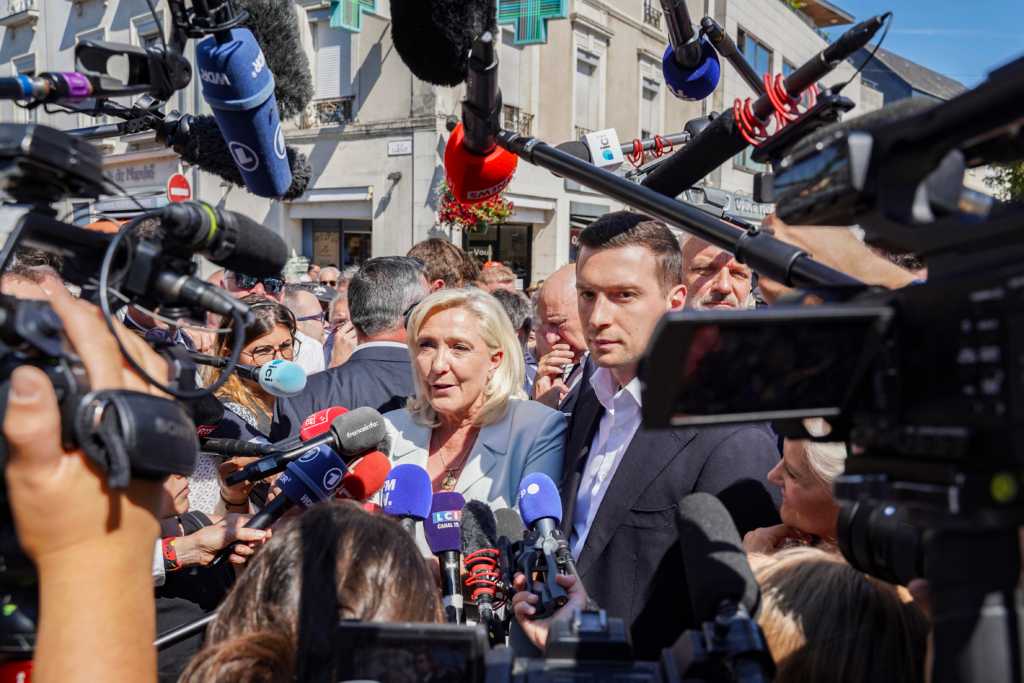
FRANCE: MARINE LE PEN AND JORDAN BARDELLA S FIRST CAMPAIGN APPEARANCE FOLLOWING THE ANNOUNCEMENT OF HER PRESIDENTIAL CANDIDACY
Cover image: picture alliance / Hans Lucas | Frédéric Pétry
NPP Metaball Banner

The restoration of a matriarch

July 7th saw one period of uncertainty in French politics end and another begin. Despite an appeals court upholding Marine Le Pen’s fraud conviction, the leader of the far-right National Rally (Rassemblement National, RN) will run for president next year. The election result remains wide open, but she is polling strongly and the possibility of a Le Pen-ist France is once again plausible. Should she win, the rest of Europe would have to contend with a highly abrasive and confrontational leadership in Paris, determined to unwind significant parts of the country’s integration with the rest of the EU.

Bracing for impact

European policymakers must prepare for that turbulent eventuality. In particular, they should:

  • Avoid clinging to precedents when thinking about an RN-led France. A President Le Pen would be neither “a Viktor Orban” nor “a Giorgia Meloni”, but a distinct phenomenon rooted in French political traditions and circumstances.
  • Seek to understand the party and its instincts. Le Pen is a familiar figure, but her party has never held national power before and has evolved over time. Knowing how it ticks will be essential.
  • Manage expectations about the pliability of a Le Pen presidency. Unlike Bardella, she primarily thinks not in terms of alliances with the broader political right (at home or in Europe) but of the RN as a monolithic national movement, beyond left and right, dedicated to French autonomy. Working with others will come less easily to her.
  • Prepare to deploy the arts of European and international politics. As France is one of the keystone states of the EU, its turn away from the project could be highly disruptive. Handling a Le Pen presidency will demand a clear sense of where cooperation could be possible (elements of European defence, perhaps) and where events might necessitate coalitions-of-the-willing circumventing Paris.

Courting public opinion

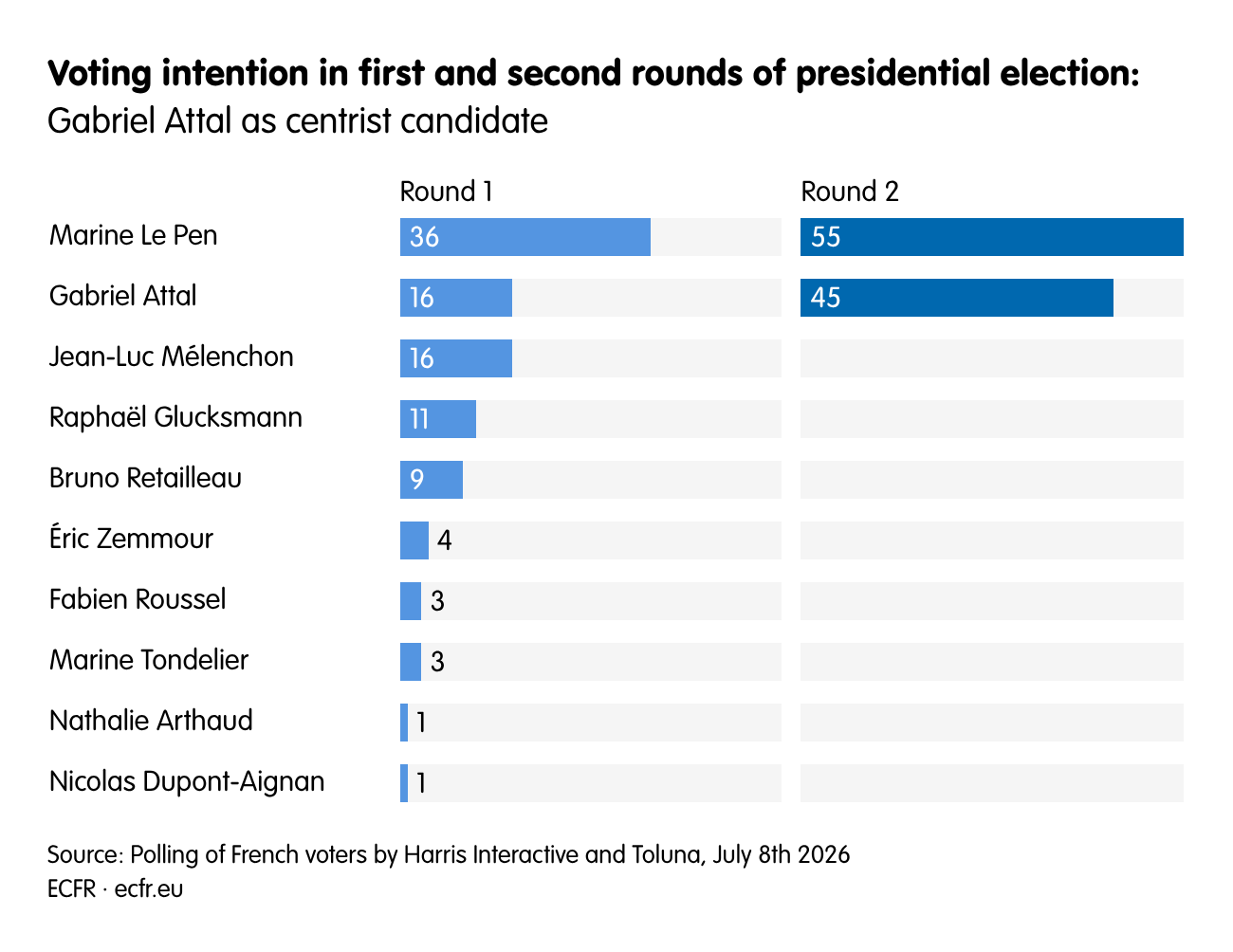
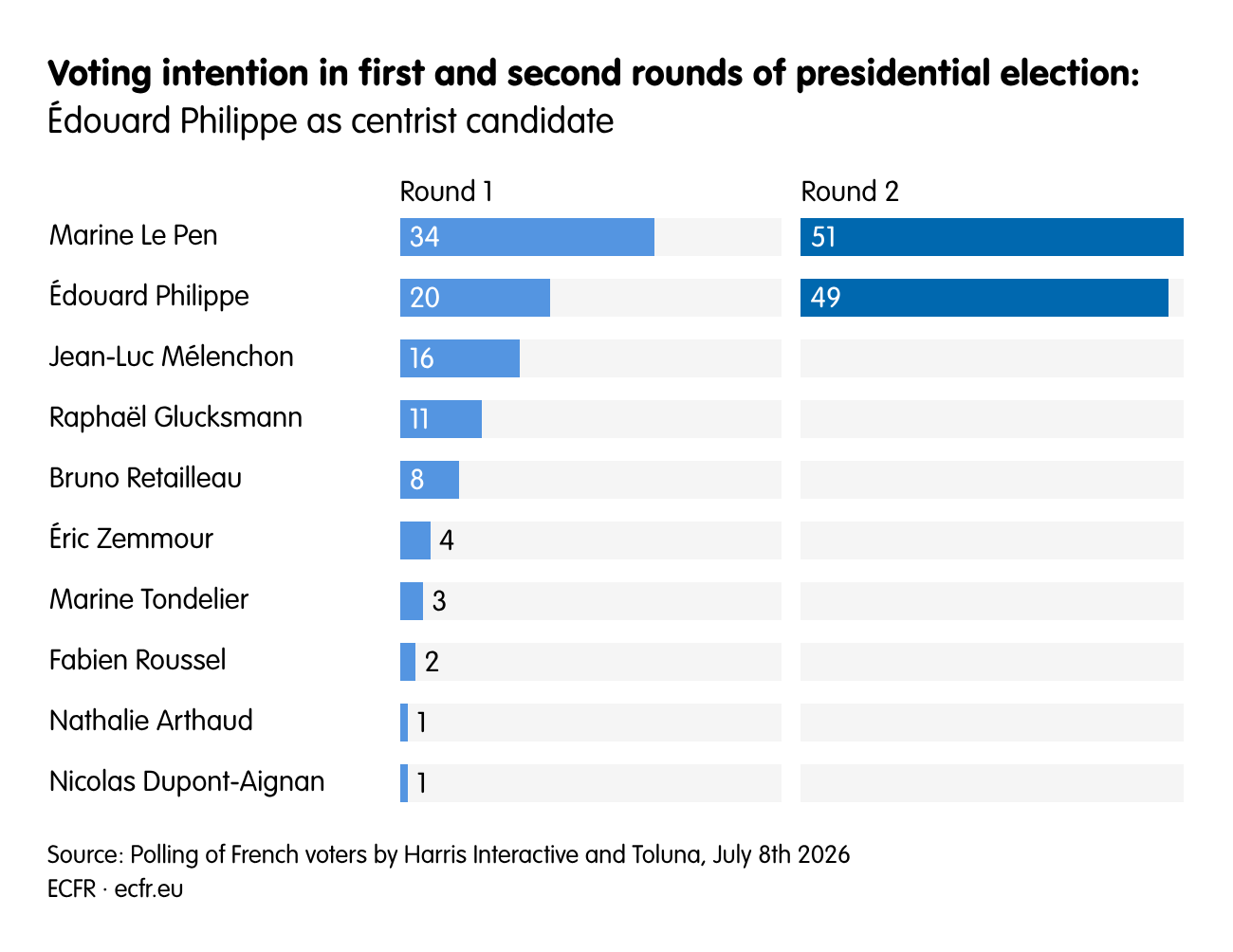
Voting intention in first and second rounds of presidential election:

France’s appeals court on July 7th confirmed Le Pen’s conviction for embezzling European public funds. It reduced her “ineligibility” sentence, opening the possibility of her running as a candidate in the presidential election, but required her to serve a year of house arrest wearing an electronic tag. Le Pen has always said she would not run in those circumstances, but has announced that she will appeal to the Court of Cassation, France’s highest court, suspending the penalty until it delivers its verdict at some point in the new year. Until then, she is tag-free and able to take back the reins from her young protégé, Jordan Bardella. The possibility that his more cautious approach might temper the party’s populist radicalism now seems remote.

Now entering her fourth presidential campaign, Le Pen is an experienced candidate well-known to the French electorate. Having taken over the party (then called the National Front) from her father in 2011, she has sought to detoxify its image. Le Pen presents herself as both an empathetic leader and an unapologetic nationalist who champions “national priority” for French citizens over foreigners. She is polling far ahead of challengers in the first round and appears highly competitive in the second. Current polls put her slightly ahead of her strongest (centrist) challengers in the second round of voting, though French presidential elections can see significant volatility.

Source

  •  
❌