Two longtime associates of convicted sex offender Jeffrey Epstein are being sued over allegations that they helped facilitate and conceal his sex trafficking operation, including the abuse of young women and girls at a remote New Mexico ranch. The New Mexico attorney general’s office announced the lawsuit Tuesday against Epstein’s personal attorney Darren Indyke and…
Two longtime associates of convicted sex offender Jeffrey Epstein are being sued over allegations that they helped facilitate and conceal his sex trafficking operation, including the abuse of young women and girls at a remote New Mexico ranch. The New Mexico attorney general’s office announced the lawsuit Tuesday against Epstein’s personal attorney Darren Indyke and…
President Donald Trump promised that his tariffs would usher in a "golden age" by prioritizing the interests of American workers.
Those workers, however, are now turning against Trump's tariffs.
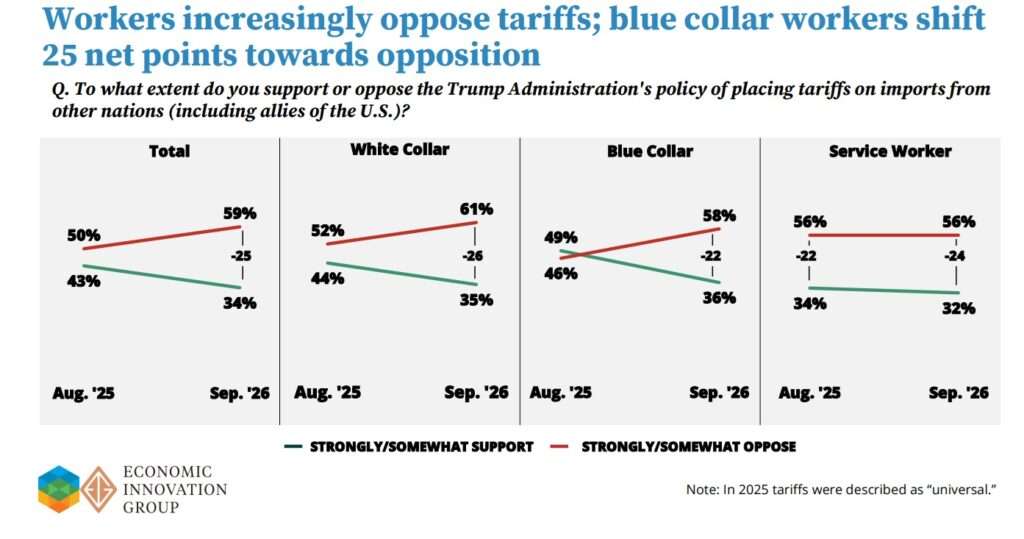
Support for the Trump administration's tariff policies has fallen by 25 percentage points among blue-collar workers over the past year, according to new polling data from Echelon Insights and the Economic Innovation Group (EIG).
A poll conducted by the two groups in August 2025 found that blue-collar workers supported the tariffs by a narrow margin. Now, that same segment of the population has turned decisively against Trump's tariffs: 58 percent oppose them, compared to just 36 percent who support them.
Source: Economic Innovation Group / Echelon Insights (https://eig.org/wp-content/uploads/2026/10/EIG-State-of-the-American-Worker-2026.pdf)
Overall, support for the tariffs has declined from about 43 percent last year to only 34 percent. Opposition to the tariffs has grown from 50 percent to 59 percent. Elsewhere in the same survey, 68 percent of respondents said the tariffs have made the cost of living higher.
It's not hard to figure out why people have turned against the tariffs: They have contributed to rising prices across the economy.
The annualized inflation rate ticked upward to 3.7 percent in September, according to new data from the Bureau of Labor Statistics (BLS). More BLS data released Thursday morning shows that the producer price index, which often operates as a precursor to inflation, is up 6.3 percent over the past year.
America's war with Iran has been a major factor in rising inflation, but the tariffs have played a significant role as well. In a study released last week, the New York Federal Reserve concluded that consumer prices would have declined slightly over the past year if not for the economic effects of the tariffs.
The tariffs have become so unpopular that not even partisanship can save them. "Among GOP-voting workers, only 3 percent select tariffs as their top priority," note Jordan McGillis and John Lettieri, policy experts from the EIG, in their write-up of the poll.
Other parts of Trump's economic agenda are not faring much better. The Trump administration has bought or seized shares of more than 30 private businesses over the past two years—ranging from major firms such as U.S. Steel to small mining companies with few customers. "The federal government's state corporatism is unprecedented," reports the Cato Institute in a new analysis of those deals.
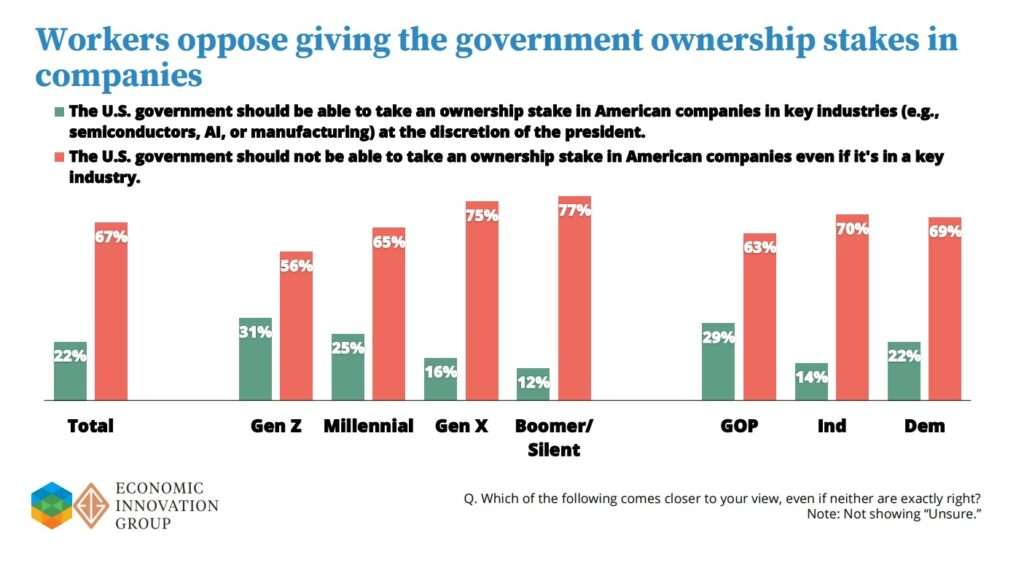
Large majorities of workers across both major parties and all generations said they opposed the federal government taking equity stakes in American companies in the Echelon/EIG poll.
Source: Economic Innovation Group / Echelon Insights (https://eig.org/wp-content/uploads/2026/10/EIG-State-of-the-American-Worker-2026.pdf)
In short: This economic populism sure isn't very popular.
All of this is likely to be a major factor in next month's midterm elections. Regardless of how that shakes out, however, there are lessons to be drawn from this poll for both sides of the political divide.
For conservatives, these polling data should end the tariff experiment. It has proven economically damaging, and it is no longer a political winner (if it ever was).
Remember, the idea to hike tariffs and start trade wars with all of America's biggest trading partners was not some grand plan backed by careful study and thoughtful analysis. It sprung, half-baked, from the head of one man. Yes, there have been various attempts to support, in a post hoc way, Trump's desire for tariffs. All of that can, and should, be easily discarded. There is no reason to allow a lame duck president to continue to set such a politically and economically destructive path for the country.
Undoing the tariffs might also put a meaningful dent in rising prices. That should be a no-brainer after the midterms, no matter which party controls Congress.
On the left, this poll should be a reminder that Americans do not look favorably on the mixing of government and business. Democrats should promise to unwind the "equity stakes" that the federal government has taken under Trump's watch. Heading toward the 2028 presidential cycle, Democrats might want to borrow some old Republican talking points about how government shouldn't be picking winners and losers—they may find that message is still quite popular.
Yes, it's probably right to be skeptical that those things will happen. Trump's efforts to centralize economic power in the executive branch are likely to outlive his presidency—that's how these things always seem to go.
But there is a glimmer of hope here. Americans are soundly rejecting the Trump administration's big government policies.
When a president starts with a predetermined policy and then goes looking for a statutory pretext to justify it, he is building on shaky ground. President Donald Trump illustrated that point once again in July, when he announced a third round of broad tariffs after his first two attempts ran into legal trouble.
Shortly after taking office in 2025, Trump claimed to have discovered a previously unnoticed delegation of extensive tariff authority in the International Emergency Economic Powers Act (IEEPA), a 1977 law that does not mention import taxes and had never been used to impose them. That claim was rejected by every court that considered it.
Last February, the Supreme Court ruled that IEEPA does not authorize tariffs at all. But Trump had a backup plan: Hours after that decision, he announced another sweeping set of tariffs, this time relying on Section 122 of the Trade Act of 1974.
That provision allows tariffs in response to "fundamental international payments problems" caused by "serious United States balance-of-payments deficits." In May, the U.S. Court of International Trade (CIT) ruled that the new tariffs were illegal because Trump had failed to "identify balance-of-payments deficits within the meaning of Section 122."
Although that decision was stayed pending appeal, Trump's Section 122 tariffs, which were subject to a 150-day statutory limit, expired on July 24. Trump then switched to Plan C, invoking Section 301 of the Trade Act, which authorizes tariffs in response to a foreign "act, policy, or practice" that is "unreasonable or discriminatory" and "burdens or restricts" U.S. commerce.
Trump's Section 301 tariffs supposedly targeted countries that had failed to "impose and effectively enforce a prohibition on the importation of goods produced with forced labor." The alleged offenders included 86 economies that accounted for nearly all U.S. imports.
In separate complaints, the Liberty Justice Center (LJC) and the law firm Akin Gump, which had played leading roles in challenging Trump's prior tariffs, immediately asked the CIT to block the new import taxes. By and large, they noted, the government had failed to explain how the targeted countries had fallen short, how their alleged failures burdened U.S. commerce, or why the new tariffs could be expected to ameliorate the problem they were supposed to address.
The LJC argued that the forced-labor issue was "simply a pretext" for reinstating Trump's "invalidated global tariff regime." It added that Trump's reading of Section 301, like his interpretation of IEEPA, would violate the "major questions" doctrine, which requires clear congressional authorization for policies of "vast economic and political significance."
This was Trump's "third attempt" to "impose essentially the same set of sweeping global tariffs," Akin Gump's lawyers wrote. "The third time's not the charm."
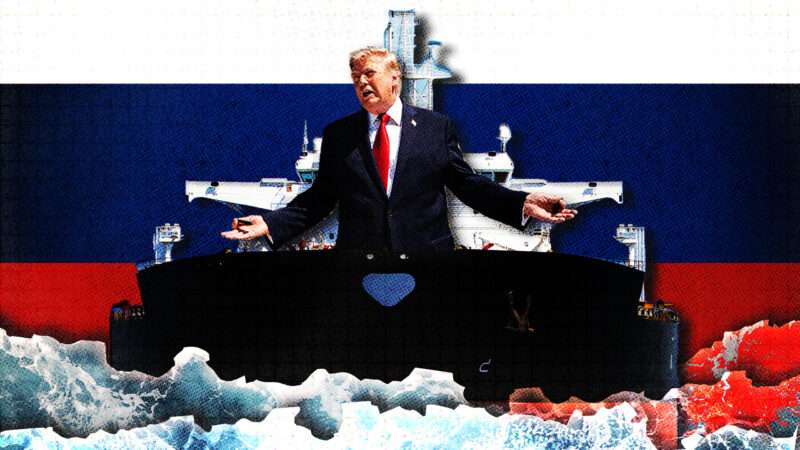
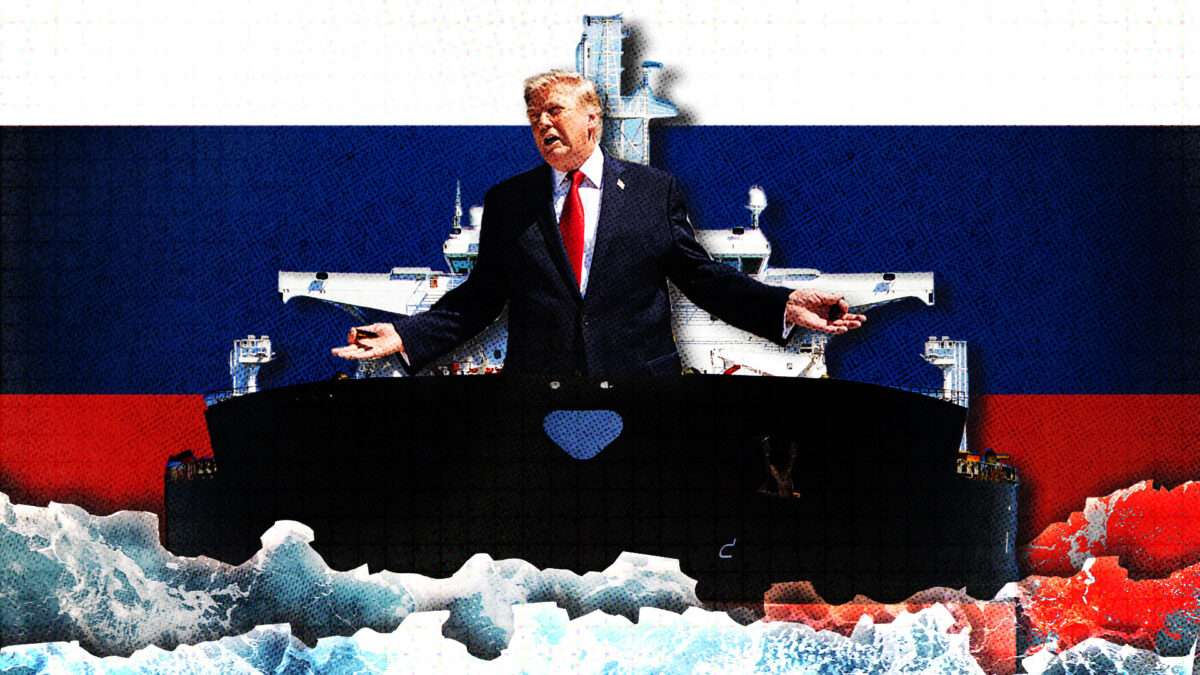
President Donald Trump says he has struck a deal with Russian President Vladimir Putin to import large amounts of diesel fuel into the United States—apparently hoping to lower fuel prices in the weeks before the midterm elections.
The exact terms of that agreement remain somewhat unclear. The White House has not said when the purchases will be made, what prices will be paid, or who will be paying (private companies or taxpayers), though the Treasury announced that it would be issuing a "temporary general license to allow the supply of Russian diesel to the global market." Reporting by The New York Times suggests that investors with ties to the administration are most likely to profit. Because diesel prices are determined by a global market, it's also far from certain that the Russian gas would make much of a dent in American prices.
However, this much is clear: If Trump follows through with this "deal," he will have violated two federal laws recently passed by Congress—one of which he signed just weeks ago.
The more significant of those two laws is the Ending Importation of Russian Oil Act, which passed the House with a 413–9 vote and was unanimously approved by the Senate. President Joe Biden signed that bill into law on April 8, 2022. The law is an outright ban on Russian energy products, including diesel fuel.
The law also lays out the process for lifting the ban on imports. The president must tell Congress that Russia has "reached an agreement to withdraw Russian forces and cease military hostilities in Ukraine" and has recognized "the right of the Ukrainian people to independently and freely choose their own government."
There is also a clear timeline for lifting the ban. Any termination of the ban requires a 90-day waiting period, during which time Congress has the opportunity to block the change.
Obviously, Russia has not withdrawn from Ukraine. Even if it had, the White House has not gone through the necessary process to notify Congress, nor waited the necessary 90 days.
The law does not allow a president to ignore it if fuel prices are high and an election is approaching. It does not allow a president to ignore it if he starts an illegal war in another part of the world that causes fuel prices to spike.
Trump's attempt to disregard that law has drawn a bipartisan rebuke from members of Congress. A group of seven senators—three Democrats and four Republicans—issued a joint statement this week saying that Trump's deal "runs directly counter to" the 2022 law.
Sen. Thom Tillis (R–N.C.), one of the senators who joined that statement, said on Sunday that there is "a legitimate case for saying the president's not following the law."
The second law at play is the Lindsey O. Graham Sanctioning Russia and Iran Act, named for the late senator and passed earlier this year. Among other things, it authorizes the president to levy tariffs of up to 100 percent against countries that buy Russian crude oil and natural gas. The intent is clear: to prevent Russia from being able to finance its war against Ukraine by selling energy commodities onto the global market. Trump signed it into law last month.
Lawmakers on both sides of the aisle have also pointed to that law in the days since Trump announced his deal to buy Russian diesel.
"Now is the time to use those sanctions to squeeze Putin's war machine, not reward a dictator by putting more money in his hands while he continues targeting and killing Ukrainian civilians," Rep. Don Bacon (R–Neb.) posted on X this week. Rep. Steny Hoyer (D–Md.) said it was "outrageous" for Trump to be buying energy from Russia after signing a bill that could be used to punish other countries for doing the same.
The White House could argue that, in this case, Trump is merely violating the spirit of the law rather than the letter of it. Even so, this is blatantly hypocritical.
The hypocrisy runs deep. The Trump administration has spent much of its second term trying to restrict trade and downplay the advice of economists who have warned that doing so would raise prices. Now, Trump is once again seeking imports as a means to ease high prices—as he has done with beef and other products. Perhaps the White House should apply this general principle more broadly, and in circumstances where doing so would not violate federal laws.
Some of the president's allies are now trying to downplay these violations of federal law. Conservative pundit Mollie Hemingway says Trump is merely trying to "put the American people first" by addressing rising gas prices.
Sorry, but no. The president is not allowed to disregard federal laws because he believes it will lower gas prices in swing states.
You can, of course, criticize those laws for being misguided. Trade is generally good, and erecting barriers to the flow of goods tends to be costly. Trump could ask Congress to repeal these laws. He cannot deliberately ignore them.
If the "deal" with Russia comes to fruition, it will further erode what little power Congress retains within America's democratic system. If a president is not bound by the laws Congress has passed, then the legislature might as well not exist at all.
When Rhonda MacDonald put out a plea for help on Facebook, the cowboys answered. Wildfires have been ravaging British Columbia, Canada, this summer—and when a ranch is put under evacuation, it is no easy feat to round up 150 free‑roaming cattle. The MacDonald herd was roaming a vast, 100,000‑acre expanse of Crown rangeland above the ranch, and the people of most use were those on horseback. This exhilarating piece documents the people who came to help, and honors the skills and hard‑won knowledge needed to navigate treacherous, fire‑scarred terrain to save the herd and help a neighbour in crisis.
Before the riders headed up Mimenuh Mountain, Wayne MacDonald stood in front of a whiteboard with a red Sharpie and began drawing. Not a map, exactly. More like 50 years of memory. He sketched the ridges, draws and escape routes cattle would choose under pressure. There was one thing he kept returning to: the lack of escape routes. “As far as road, there’s one in and one out.” They knew there might come a moment when staying was no longer brave – it was reckless.

 Login