Russian tech giant Yandex's data center in Sasovo burned out from the inside, a Ukrainian OSINT analyst wrote on 22 October. On cloud-free satellite images, he saw almost no significant holes in its roof. Ukrainian drones hit the site overnight on 8 October.
Sasovo was the first strike on a data center in Russia. It came two weeks after Russia destroyed data centers in Kyiv. Drones then hit Yandex sites in Vladimir and Kaluga, a Sber data center, and a VK data center near St. Petersburg, which VK acknowledged. In occupied Donbas, monitoring channels reported hits on buildings housing telecom operators.
What the analyst sees
The analyst, who goes by Harbuz, runs the Ukrainian OSINT channel Dnipro Osint. His roof reading comes from the images. His interior claim comes from what he called available information: he wrote that a fire broke out inside and put part of the equipment out of action.
Cloud-free satellite image of the damaged Yandex data center in Sasovo, Ryazan Oblast, posted 22 October 2026. Image: Dnipro Osint
In an earlier post, Harbuz wrote that a third of the data center had burned out. In the new one, he writes that the building burned out from the inside. He does not say whether he revised the earlier figure.
Russian outlet Agentstvo studied Airbus images from 12 October. It found damage on about a third of the building. Unlike Harbuz, though, Agentstvo described a blackened western roof with damage resembling holes.
What Yandex says
On 8 October, Yandex stated that the attack caused a fire and forced it to suspend operations at the site, which hosts tens of thousands of servers, Reuters reported. Yandex Cloud and the Disk and Documents services that run on it ran with major disruptions that morning, Russian outlet The Bell reported.
Later that day, the company stated: "The scale of the damage to the infrastructure is still being assessed. For the moment, we cannot confirm whether it is possible to restore the data centre equipment in Sasovo." Two of Yandex's three supercomputers, used to develop its AI model, are housed there.
The same day, journalists asked Ukrainian President Volodymyr Zelenskyy whether Ukraine was targeting Russian data centers. He did not refer specifically to the Yandex strike, Reuters noted, but said: "We always respond in mirror-like fashion."
A Russian satellite, Kosmos 2612, may have passed within approximately 85 feet (26 meters) of a U.S.-registered satellite belonging to commercial imagery provider ICEYE. This would be an extraordinarily close and potentially dangerous pass-by for two objects in space traveling at thousands of miles per hour. For weeks beforehand, ICEYE-X36, which would be of special interest to Russia, had already found itself in increasingly close orbital alignment with its pursuer. The two satellites now look to be drifting further and further apart, but the episode has been a clear sign of what is to come as the potential for conflict in space only continues to grow.
Publicly available space tracking data from the satellitemap.space and orbitalradar.com websites show that Kosmos 2612 (also written sometimes Cosmos 2612 and abbreviated K2612) and ICEYE X36 had their especially close encounter at approximately 16:07 UTC today. Private space services company LeoLabs also told TWZ today that it could not “confirm or contradict what other data sources have stated publicly,” but that it has “high-confidence that the objects came within approximately [emphasis in the original] 500 meters [1,640 feet] of each other.” Kosmos 2612 had been making progressively closer passes by ICEYE X36 in recent days.
Short time-lapse of part of this morning’s first pass of ICEYE-X36 (59103) and COSMOS 2612 (68762) over South America under partly cloudy skies. pic.twitter.com/t8RhwmKcV4
6/x Note that while ICEYE-X36 was Finnish built, it is (like other ICEYE sats who's ownership transferred) no longer Finnish. It is registered in the US but might be Ukranian owned/leased now.
“COSMOS 2612 closed from hundreds of kilometers away to extreme proximity to ICEYE-X36. It then maneuvered around ICEYE-X36, remained nearby for an extended period, and then began moving away,” LeoLabs also stated in a report assessing the situation, which was updated today and provided to TWZ. “The latest observations show the spacecraft strongly diverging and confirm that the close-proximity activity had ended.”
LeoLabs’ broader assessment here is supported by data from other publicly available sources, as seen below.
UPDATE: Cosmos 2612 appears to have maneuvered following a close approach with the ICEYE satellite.
The latest TLEs show 2612 in a larger orbit that will drift away with no further maneuvers.
None of the distances stated earlier may seem especially close, let alone worrisome, by terrestrial standards. However, this is absolutely abnormal for operations in space that are not being directly coordinated by the parties involved. As a point of reference, in 2020, another Russian satellite, Kosmos 2542, came within 150 to 300 kilometers (93 to 186 miles) of USA 245, a KH-11 spy satellite, and became a major international news story.
“We are aware of the situation and tracking it closely,” a spokesperson for ICEYE’s U.S.-based division told TWZ this morning. “Our constellation architecture is designed for continuity and resilience.”
ICEYE was founded in Finland, but now has offices globally. The company specializes in providing imagery via synthetic aperture radar (SAR) from satellites like ICEYE X36, which was launched in 2024.
SAR has the benefit of being able to capture images day or night, and regardless of bad weather or other obscurants like heavy smoke. There are trade-offs in terms of the kinds of details typically visible via SAR compared to what is seen in visual spectrum imagery. Ukrainian authorities have been utilizing ICEYE imagery for years now, including for targeting purposes, as part of the ongoing conflict with Russia. There have been reports in the past that ICEYE X36 has been operating more directly under the control of the Ukrainian government, but this has not been confirmed.
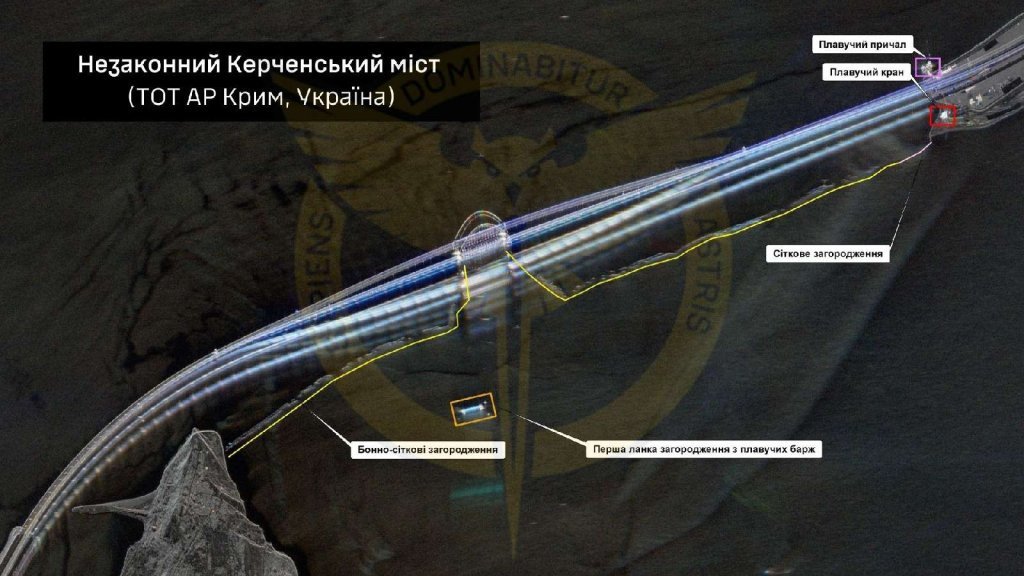
The Main Directorate of Intelligence of the Ministry of Defense of Ukraine (better known by the acronym GUR) previously released this SAR image of the highly strategic Kerch Bridge that links the occupied Crimean Peninsula to undisputed Russian territory, which it said came via ICEYE. GUR
Kosmos 2612 is one of six satellites (Cosmos 2609 through Cosmos 2614) the Russian military launched via a single Soyuz-2.1b rocket on April 17. The exact purpose and configuration of these satellites are unconfirmed. However, they appear to be so-called inspector types capable of rendezvousing and maneuvering close to other objects in space. We will come back to this later on.
What is clear is that Kosmos 2612 has spent the past three weeks deliberately maneuvering to extremely closely shadow ICEYE X36.
“Over two weeks beginning on September 30, 2026, Cosmos 2612 executed a series of new maneuvers that brought it back into coplanar alignment and placed it at nearly the same altitude as the commercial satellite,” Clayton Swope, Deputy Director of the Aerospace Security Project and Senior Fellow at the Center for Strategic and International Studies (CSIS) think tank in Washington, D.C., along with Research Assistant Chantal Li, wrote in an analysis of the situation just last Thursday.
“According to current orbital elements, the Russian #KOSMOS 2612 satellite is now within 1-2 km [0.6 miles to 1.2 miles] of #ICEYE-X36,” Dr. Marco Langbroek, currently a lecturer on Space Situational Awareness at the Faculty of Aerospace Engineering of Delft Technical University in the Netherlands, wrote in a thread on X on Saturday. “Based on current elements, it might come within meters of the latter within a few hours from now. This is an #RPO [rendezvous and proximity operation] without consent.”
2/x Initially I was skeptic whether #ICEYEX36 really was an intentional target: but a series of manoeuvers by #Kosmos2612 starting on Sept 30, were clearly designed to bring the two objects very close and synchronise their orbital periods, orbital altitude and eccentricity: pic.twitter.com/BhIoi8Rtbe
“New TLEs [two-line elements] show that K2612 made a manuever [sic] on Oct 16 and is now stationkeeping within 5 km [3.1 miles] or less of ICEYE X36,” Jonathan McDowell, an astrophysicist and astronomer, who previously worked for the Harvard-Smithsonian Center for Astrophysics and has long been tracking objects of interest in orbit, also wrote in a series of posts on X on Saturday. “To my knowledge this is the first LEO [low Earth orbit] rendezvous of two active satellites where the owner of one of the sats did not give approval.”
McDowell later clarified that “close passes” of objects in orbit had certainly occurred previously, “but not I think rendezvous [sic] (matching velocity vector).”
“This is the most advanced and potentially dangerous uncooperative RPO we’ve observed,” Adam Marsh, LeoLabs vice president for technical solutions, separately told Breaking Defense.
Unprecedented orbital maneuvering
As underscored by the previous interaction of Kosmos 2542 and USA 245, close shadowing of satellites in orbit is certainly nothing new. The U.S. government, as well as Russia and others, have been observed engaging in this kind of activity in the past. At the same time, just how close Kosmos 2612 got to ICEYE X36, and how long they spent in close alignment, are, at the very least, highly unusual.
“It’s important to note that ‘red’ on ‘blue’ engagements, such as this, are relatively uncommon in Low Earth Orbit (LEO),” LeoLabs’ report points out. At the same time, “this was not a routine conjunction or ‘fly by.’ The sequence included a controlled approach, changes in relative position, close-proximity loitering, additional small maneuvers, and a controlled departure. The behavior is consistent with sophisticated rendezvous and proximity operations (RPO).”
On top of this, there are other signs that what just happened between Kosmos 2612 and ICEYE X36 may follow a Russian playbook of sorts that could also be used in a prelude to an on-orbit anti-satellite attack.
Within weeks of their launch in April, Kosmos 2610, 2611, 2612, 2613, and 2614 had all moved orbital planes shared by multiple ICEYE satellites. Three of them subsequently made close passes by ICEYE X36, specifically, but none of them initially kept station with it. ICEYE CEO Rafal Modrzewski did say “the company later moved its satellite, prompting further Russian manoeuvres [sic],” according to a story Reuters published last week.
Russian satellites approaching ICEYE: a closer look at the timeline.
Tracking data via @LeoLabs_Space . Analysis via COMSPOC SSA.
On April 16, Russia launched six maneuverable satellites (Cosmos 2609-2614) from Plesetsk. Five of them — Cosmos 2610, 2611, 2612, 2613, and 2614… pic.twitter.com/ISoToOptnp
To take a step even further back, before Kosmos 2542 was caught shadowing USA 245 in 2020, there were reports that the U.S. spy satellite had shifted its orbit. This was possibly prompted by the movements of another Russian ‘inspector,’ Kosmos 2543. This does not appear to have ever been confirmed.
While in space, Kosmos 2542 had deployed Kosmos 2543 in November 2019. Then, on July 23, 2020, the U.S. military said that it had detected Kosmos 2543 itself launching a smaller object in what it described as a test of a space-based anti-satellite weapon. In a subsequent interview with Time, then-Chief of Space Operations Gen. John “Jay” Raymond, U.S. Space Force’s top uniformed officer, disclosed that American forces had first observed Russian “nesting doll” satellites – a reference to traditional Russian matryoshka dolls – similarly demonstrating the “characteristics of a weapon system” in 2017.
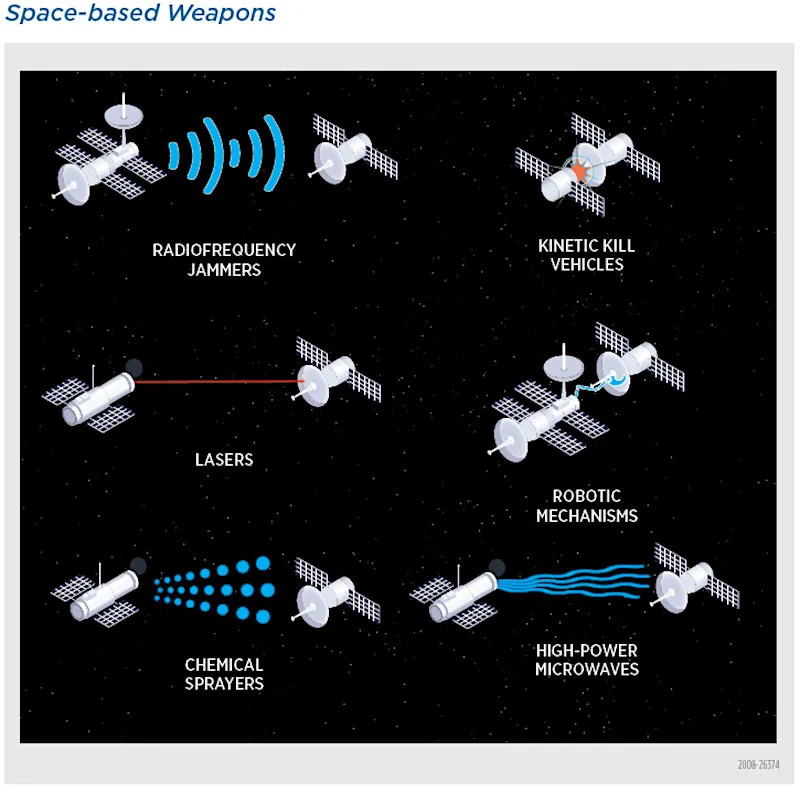
U.S. officials have been warning for years that Russia’s growing array of inspector-type satellites, ostensibly designed to examine other assets the country has in orbit if they break down or otherwise malfunction, are inherently dual-purpose in nature. Beyond launching projectiles, a host of other modes of attack, kinetic and non-kinetic, are enabled by the underlying ability of a spacecraft to maneuver very close to other objects in orbit and hold that position. This includes the use of grappling arms to cause damage or just tow a satellite out of orbit, spraying aerosols to harm or impair optics and solar panels, and electronic warfare jamming. A satellite could turn out to be the weapon itself, becoming a kinetic interceptor that smashes into its target on command.
A U.S. Defense Intelligence Agency graphic highlighting some of the ways on-orbit attacks can be carried out. DIA
One satellite shadowing another closely in orbit allows various kinds of intelligence gathering, as well. Collection of imagery and signal emissions can offer valuable details about a target’s capabilities and vulnerabilities, as well as how it is being used in a particular context.
“As observed by LeoLabs Global Radar Network and analyzed by our team, COSMOS 2612 demonstrated a sequence of capabilities that could be used to inspect, characterize, shadow, or potentially interfere with another spacecraft,” according to LeoLabs’ report. “These actions require planning, maneuverability, precise navigation, and significant fuel. They may also indicate the use of onboard sensors capable of measuring the relative position of another spacecraft.”
What has just transpired between Kosmos 2612 and ICEYE X36 highlights how just a viable threat of attack can be disruptive in its own right. Simply forcing an imagery-gathering satellite out of position could prevent it from collecting over an intended area, or at least doing so in the most effective manner.
Furthermore, satellites only have a limited amount of fuel with which to maneuver in any way after reaching orbit. Harassment in space that forces them to burn off that finite resource at a higher-than-expected rate could reduce their total operational life expectancy, as well as further limit their effectiveness and make them more vulnerable to attacks or accidents. Debris in space is a steadily growing hazard that satellites increasingly need to dodge.
“We can only speculate about the operation’s goal, but it could have been anything from simply intimidation to outright destruction or sabotage of a U.S.-registered satellite,” CSIS’ Clayton Swope told TWZ directly today in light of the new developments regarding Kosmos 2612 and ICEYE X36. “Perhaps the operation is on hold. There are, however, several other satellites that shadowed ICEYE X36 back in May that could be brought in[to] action too.”
Attribution and broader ramifications
It is important to point out that space, as a domain, inherently creates complications when it comes to attributing any form of attack, should one occur. Satellites do suffer mishaps, sometimes with catastrophic results, the causes of which are not always clear.
Update: Debris from active PRC satellite Yaogan 50-02.@S4S_SDA has now cataloged 62 pieces of debris originating from the PRC's active Yaogan 50-02 satellite (68196 / 2026-051A) on around 20 July 2026 (ref my initial analysis on Substack, link in thread).
Some recordings of USA 32 (#19460), whose fragmentation in LEO on 13 Sep 2026 at approximately 2113 UTC was confirmed by U.S. Space Forces–Space (S4S). By the time of the recordings, a large number of fragments had already dispersed over a wide section of the track. pic.twitter.com/gjRxCTPz2o
“While the intention behind COSMOS 2612’s behavior remains uncertain, the deliberate nature of the activity, the fuel required to conduct this activity, and the proximity to a Western commercial imaging satellite make the event strategically important,” LeoLab’s report notes. “This event, and the capabilities demonstrated, do not establish hostile intent. It does, however, demonstrate capabilities that could support intelligence collection, on-orbit inspection, coercive signaling, interference, or preparation for future counterspace operations.”
It is very possible, if not highly probable, that Kosmos 2612’s recent activities will be indicative of a trend going forward. Aggressive and potentially dangerous maneuvering by armed forces in close proximity to each other is not uncommon within the atmosphere, especially in the air and at sea. Extending a variation of those tactics into the space domain would make sense, especially given the central role that capabilities in orbit increasingly play in modern military operations globally. Those roles extend to early warning, general intelligence gathering, weapons guidance, near-real-time communications, and beyond.
American officials have already said in the past that American assets in space are routinely the target of “reversible attacks,” meaning ones that do not cause permanent damage. That also speaks to the difficulty of attribution if there is no lasting effect or impact to draw attention to.
The U.S. government’s long-time monopoly on the space domain has also been steadily eroding in recent years, especially in light of China’s massive expansion of its intelligence-gathering and other satellite constellations. The scale and scope of what commercial satellite imagery and other space services providers, like ICEYE, offer today have led to a further democratization of space-based capabilities to countries like Ukraine that do not possess significant, if any, constellations of their own.
This satellite image indicating multiple Russian Tu-95 Bear bombers having been damaged or destroyed at Belaya Air Base after a Ukrainian strike last year is indicative of what ICEYE provides commercially. Courtesy ICEYE
More details may yet emerge about Kosmos 2612 and its recent rendezvous in orbit with ICEYE X36, but it already points to how space has become an increasingly likely potential zone for direct conflict going forward.
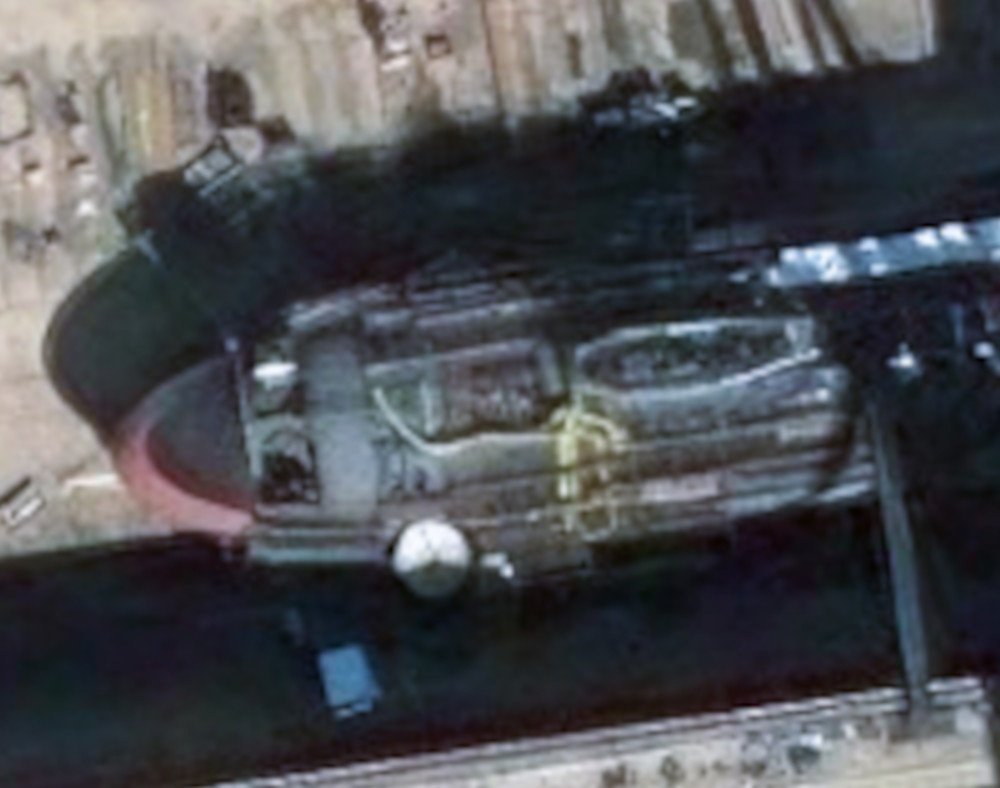
Recent satellite imagery of a shipyard in northeastern China offers interesting new insights into the country’s next-generation submarine developments. The images notably show a pumpjet propulsor and other features worth examining on an example of what is generally described as a new class of nuclear-powered attack submarine, or SSN.
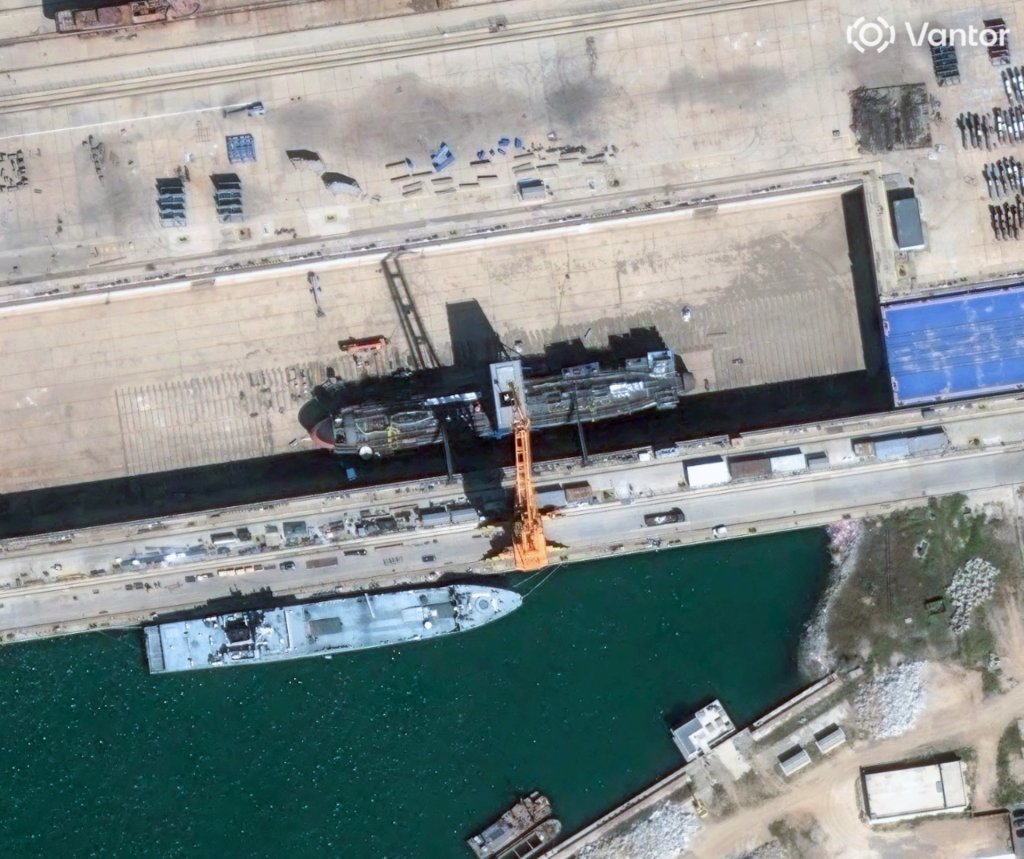
TWZ has obtained a new image taken on September 18 of the submarine in question, which is being built at the Bohai Shipyard in Huludao, from Vantor. Janes reported on this submarine earlier today, based on a separate Vantor image from September 1. The outlet also described the boat as a Type 095, a commonly used, but still unofficial designation. This is something we will come back to later on.
As mentioned, the pumpjet propulsor immediately stands out in both images. This is also understood to be a feature on the Type 093B nuclear-powered attack submarine, a significantly improved variation on that earlier design, which first emerged in the early 2020s. Compared to traditional exposed propellers and more basic shrouded types, pumpjets offer benefits for quieter operation and efficiencies, especially at higher submerged speeds.
The recent imagery also highlights the submarine’s X-shaped stern plane arrangement. This is not found on the Type 093B, which is considered to be something of a bridge between that class and the next-generation design. Broadly speaking, an X-shaped configuration offers advantages when it comes to enhanced maneuverability, efficiency, and safety, which can be particularly useful in littoral environments. It can also provide benefits when it comes to acoustic signature reductions across significant parts of the submarine’s operating envelope compared to the cruciform stern planes.
Another Chinese submarine design that emerged in 2024, currently referred to as the Type 041 or Zhou class, and that is understood to feature a hybrid nuclear/conventional propulsion system, also has an X-shaped stern configuration. The first known example of the Type 041 came to light after it appeared to have sunk in a shipyard.
An X-shaped stern arrangement also looks to be a feature on yet another new class of submarine that appeared at the JN (Jiangnan) Shipyard in Shanghai earlier this year. Initial reports also suggested that the design lacked a traditional sail. However, it has been confirmed that it has a sail, but that is very small proportionally to the overall size of the boat. Truncated sails can offer performance and other advantages, but there are trade-offs.
The image of the submarine that Janes obtained also notably shows an open rectangular-shaped section aft of the sail. The September 18 image that we received from Vantor shows a structure placed over that section of that submarine, obscuring ongoing work on that part of the boat. The Type 095 is widely expected to feature some type of vertical launch system (VLS) array able to accommodate a variety of anti-ship and land-attack cruise missiles, as well as potentially hypersonic types. The Type 095 is also sometimes referred to as a guided missile submarine, or SSGN, as a result. The open area seen in the September 1 shot could be where the VLS array is set to be fitted. It might also provide access to the reactor compartment or another area of the submarine.
The clearest photos we have on the Type 095 SSN!
As we can see, there is one confirmed chamber than could physically fit about 18-24 VLS Cells. There is a big chance that more than one VLS Chamber exists, with an estimate VLS count from 24-48+ VLS pic.twitter.com/0ZJ8gsl4su
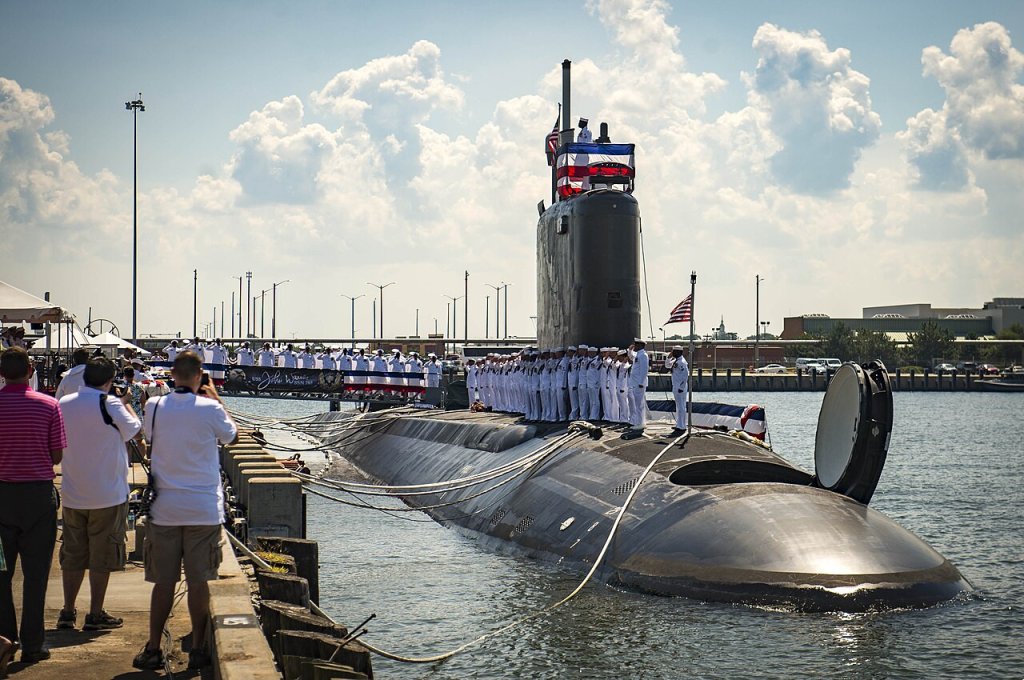
Interestingly, the September 18 image also shows what look to be at least two relatively large circular openings, side-by-side, at the bow end of the submarine in front of the sail, the purpose of which is not immediately clear. There is a possibility these could also be for vertically launching munitions or other payloads. As a point of comparison, U.S. Virginia class nuclear attack submarines, starting with the Block III version, have two large-diameter Virginia Payload Tubes (VPT), one in front of the other, in the bow in front of their sails. At the same time, the openings on the submarine in Huludao also appear to be in a position that is very close to where the submarine’s main sonar array would be installed, and they could be tied to that aspect of the design, too.
“I think it’s too early to be sure about the VLS configuration from publicly available imagery. I realize people assume the large rectangular space halfway behind the sail is the VLS, but I am not sure this is the case and I’d caution to jump to conclusions. The space could also be related to work on the reactor compartment,” Alex Luck, a naval analyst who closely tracks submarine and Chinese navy developments, told TWZ. “With Type 093B, the VLS after launch was initially covered with a tarp, and then the installed launchers were readily visible quite quickly during the fitting-out process. The work process may change with these newer boats, but the different appearance during launch and fitting out needs to be considered in that regard.”
“I do expect Type 095 to have a VLS of some sort, but I am not sure as of yet what the configuration would look like, or where exactly it is located,” he added.
The bigger outstanding question may be exactly what type of submarine is currently being built now at the Bohai Shipyard. Based on a review of additional imagery from Planet Labs’ archive, the boat appears to be around 394 feet (120 meters) long. When the first example of what was assessed to be a Type 095 emerged in Huludao in February, it was estimated to have a length of roughly 361 feet (110 meters). The ‘small sail’ design that broke cover earlier this year in Shanghai is also estimated to be some 394 feet/120 meters long based on available imagery, but also looks to be narrower than the boat presumed to be a Type 095 in February.
“One significant question is the nature and difference between the boat launched by Bohai in February, and the two newer hulls launched in late May/early June both by Bohai and at Jiangnan in Shanghai,” Luck, the naval analyst, also told TWZ. “Specifically, we do not quite know whether they are for different operational roles, or rather a two step development for one final configuration of a new SSN. I think the latter is at least plausible.”
“A related question then is what boat we are looking at now with the new imagery, i.e. the February boat or the newer hull Bohai had launched,” he continued. “Without exact and reliable measurements that question for now is unresolved in the public discourse. For now we need more, and more detailed imagery, including of the different boats together, to clarify these aspects.”
“This [September 1] image reinforces my impression that the boat launched in February may have been a one off not including the full spec featured on the notional 095A launched by Bohai and Jiangnan in late May. We’ve already seen both versions side by side in Bohai,” Luck also wrote on X after Janes‘ published its report.
This image reinforces my impression that the boat launched in February may have been a one off not including the full spec featured on the notional 095A launched by Bohai and Jiangnan in late May. We've already seen both versions side by side in Bohai. https://t.co/wBMkB1gmSQ
Regardless, the emergence in recent years of so many new, more modern submarines, and across what appear to be several distinct classes, is significant. It is no secret that China’s People’s Liberation Army Navy (PLAN) is working to significantly expand the size and capabilities of its submarine force with a clear eye toward extending operations further and further out in the Pacific, at least. In the past, U.S. officials have publicly said the overall quality of newer Chinese submarines has been getting closer in parity to American designs.
“The PLA Navy is executing a significant strategic shift from diesel-electric to all-nuclear construction, representing a fundamental departure from historical construction patterns,” U.S. Navy Rear Adm. Mike Brookes, head of the Office of Naval Intelligence, wrote in prepared remarks ahead of a hearing before members of the U.S.-China Economic and Security Review Commission in March.
In particular, the Type 095, as well as the new Type 096 nuclear-powered ballistic missile submarine, “represent next-generation platforms expected to enter service during the late 2020s through 2030s,” Brookes also wrote at that time. “These submarines will incorporate substantial advancements in nuclear reactor design, sensor performance, weapons integration, and noise quieting technologies.”
Submarine modernization efforts are just one aspect of a larger effort by the PLAN to expand its capabilities above and below the waves. Chinese shipyards have also been producing ever-more capable aircraft carriers, amphibious assault ships, destroyers, frigates, and more in recent years, as well. The pace of China’s construction of new surface ships and submarines has also been growing, creating a particularly significant and still-widening disparity in this regard with the U.S. Navy. This is something that has become increasingly concerning, as TWZ routinely highlights.
Work in Huludao, as well as shipyards elsewhere in China, is certainly already revealing interesting new insights into China’s next-generation submarine efforts.

 Login


 Russian satellites approaching ICEYE: a closer look at the timeline.



 (@PLA_MilitaryUpd)