❌

Reading view

The AI safety bottleneck: Save the world or get the bag

A tech employee choosing between the world and money

Getty Images; Tyler Le/BI

When Rishub Jain worked on safety at Google DeepMind, he held one of the most coveted jobs in tech. He was among a small group of researchers working to mitigate the most consequential risks of AI.

But he left to cofound a nonprofit, Sampura Research. Jain traded the prestige and access that come with a Google job because he feels he can have a sharper, more profound impact on AI safety from the outside. Jain says he wants the autonomy to pursue research on a specific issue in AI alignment, which he felt had been deprioritized.

"All the top AI companies do care a lot about safety, and they invest in it, but they could be investing a lot more, and that's kind of what was inhibiting me," Jain says. "If they invested more in safety, I would still be at the lab and working on what I'm interested in with a large team." Google did not respond to a request for comment about whether it maintains a focus on this specific area of research, but DeepMind's principles state that it maintains "a holistic approach to responsibility, safety and security."

Jain's founder story echoes concerns raised by safety researchers who have quit OpenAI and Anthropic, including dire warnings that these companies are "gambling with our lives," and could develop technology that ends humanity. Once dismissed as fringe and doomsday-obsessed, the AI safety profession is growing as hacks by rogue agents and a string of departures have vaulted the issue into mainstream concern.

Open roles in AI safety jumped by 91% on LinkedIn over the past year. The industry expects a flood of cash from much-anticipated IPOs at Anthropic and, potentially, OpenAI, as those made absurdly wealthy by the equity returns may funnel money into potential clean-up crews for the messes created by the technology's rapid development.

The AI safety problem is existentially big, but the people who have spent time honing AI expertise are few. These are people who test and train AI systems to operate ethically. Some focus on technical research, others on policy and governance. And they're increasingly sounding alarms.

"The people who are most worried about AI are often the people who have been closest to the technology," Laura González Salmerón, advising manager at 80,000 Hours, a nonprofit focused on transitioning people into careers with high social impact. The scarcity issue is less about funds and more about people. "Talent is the main bottleneck."


Startups and nonprofits in AI safety must fight for talent in a shallow pool.

Jain's Sampura lists a salary range of $273,000 to $395,000 for an experienced team leader, which would put that worker in the top 3% of earners in the US, but likely pales in comparison to offers from larger companies. Meta reportedly offered $100 million in signing bonuses last year to poach the world's top experts. OpenAI gives employees an average of $1.5 million in stock-based compensation, and technical staff at Anthropic can earn more than $1 million annually.

Money aside, researchers are divided over whether they're more effective when working inside tech companies to mitigate risks as the latest models develop, or stepping back and attempting to steer the ship toward safer outcomes from the outside, like Jain did.

"I'm a little bit concerned about the pace of AI, and if we're able to actually come up with something useful before the rug gets pulled beneath us," Jain says. He's worried that AI's advancement will outpace the work to keep it in line with human values. "That's kind of what's been happening already."

David Robinson, who led transparency work for OpenAI's safety team, wrote an essay for The Atlantic explaining his departure. He said that AI companies should have more layers of checks and safety measures, akin to those in airports and nuclear energy, rather than the steamrolling culture of Big Tech.

"Perhaps I should have stayed and fought for fundamental shifts in our staffing and culture, but in practice, my colleagues and I were so busy sprinting that we seldom had the chance to consider big changes, much less to actually make them," he wrote. Robinson has said he plans to work on these issues from outside of the company.

As the issue grows in prominence, so has a niche of organizations helping train and recruit workers — and the opportunities aren't just for AI experts. Neav Topaz, co-director of Kairos, a nonprofit that upskills people to work in AI safety and recently raised $50 million from Coefficient Giving, says he speaks with about 10 to 20 people each month who want to move to AI safety, and interest is growing. He tells me that people are asking him more frequently about what the work entails.

"People are watching AI get good at their own jobs and starting to ask themselves what comes next," he says. The emerging jobs in AI safety "pay well, the field is growing fast, and you get to work on what might be the defining problem of our time."

Kairos this summer launched its Generator Residency, a cohort of 27 people who spent three months training for career transitions into AI safety. It's less about the research and technical work and more about merging other expertise, like in consulting, with AI safety principles.

He says that of the 27 residents, a dozen have already landed roles in the AI safety space, and many of the rest have offers to do so.

"Most of the people who will do this work are doing something else today," Topaz says. "The biggest talent gap in the field isn't researchers. It's people who grasp how high the stakes are and can translate their varied expertise into things that could make a difference in this space."

The major AI companies maintain that safety is a top priority. Last month, Anthropic CEO Dario Amodei wrote an essay calling for a slowdown in AI development, and Sam Altman and Elon Musk have agreed with him. Amodei and Altman have both said recently that they will bring third-party evaluators into their companies to bolster safety protocols.

These companies have their own safety teams, but safety work competes with business priorities to build the most advanced models and win in the market. The tension, along with safety issues like OpenAI's rogue agents hacking Hugging Face, has led to more scrutiny of internal safety work. Within days of Robinson's departure, OpenAI fired three researchers, claiming they shared sensitive internal data improperly with third-party AI safety researchers. The ousted researchers wrote a letter, reported by The Wall Street Journal, to OpenAI's board, arguing that their engagement with safety researchers fell within the scope of their roles, and that their terminations were "chilling those who remain at OpenAI." OpenAI said that the decisions "were not about raising safety concerns or speaking out," and that the company would not fire people for doing so.

While some have obsessed over AI risks for years, 2026's breakthrough moment has accelerated funding for and interest in the industry. 80,000 Hours has had calls with some 8,000 people since its founding in 2011, the majority of which have focused on AI in some way, González Salmerón says. Philanthropic groups like Coefficient Giving offer massive grants to startups in the AI safety space. METR, a nonprofit AI safety group that investigated the OpenAI agentic hack on Hugging Face, says it raised $71 million in six months this year.


Much of the funding flowing into AI safety filters through effective altruism, the Silicon Valley-tied philanthropic ideal focused on using evidence and logic to donate money where it will achieve the most good. Critics say the philosophy can place too much emphasis on avoiding future problems rather than addressing imminent needs. With more alarms sounding around the existential threat of AI, more people view those theoretical, distant fears as urgent causes.

AI safety groups and individual donors have spent nearly $50 million in this year's election on candidates focused on regulating AI, Axios reported. Jaan Tallinn, a billionaire who invested early in Anthropic and could soon have even more billions as a result, has donated $170 million to nonprofits focused on AI safety. Tallinn's view, as he recently told The Wall Street Journal, is that he can have the biggest impact on the future of AI and its risks by investing in AI companies, and then donating returns to nonprofits working in the AI safety space.

Coefficient Giving, the philanthropic venture from Facebook cofounder Dustin Moskovitz rooted in the effective altruism movement, announced its AI-safety-focused arm, Project Tailwind, in September. It says it's on track to give more than $1 billion this year to help companies of all sizes scale up in preparation for what it believes will be a deluge of philanthropic capital. Sampura Research has received an $11 million grant from the group. If startups don't begin hiring now, the logic goes, they won't move quickly enough when massive wealth hits the industry.

The dizzying development of AI has created safety risks, and there are "gaps in the ecosystem that aren't being filled and that aren't being owned by people," says Rossa O'Keeffe-O'Donovan, the program director in technical AI safety at Coefficient Giving. There are few people, he says, who sit at the intersection of technical expertise, risk analysis, a solutions-oriented vision, and the capacity to hustle as a startup founder.

New roles will emerge not just for technical talent, but also for consultants, policy wonks, communications experts, and founders who can run a business alongside technical experts. Working from the outside, they'll face hurdles in buying compute power, a lack of direct access to the latest AI models, reduced leverage, and smaller paydays.

The world feels unmoored, and the future perhaps more malleable than ever. The appeal of doing work that does good could stave off feelings of uncertainty, dread, and anxiety that people increasingly feel toward AI. In one doomer camp, AI will obliterate white-collar jobs. The optimistic view is that AI drastically reshapes work and spurs the creation of jobs we haven't yet thought of. AI safety is one of the first.

"There are lots of people beyond AI researchers who can help, like cybersecurity experts, like biosecurity experts, like economists," says Mantas Mazeika, a researcher with the Center for AI Safety, a nonprofit focused on AI research and advocacy. "They're making very significant contributions that the pure AI researchers, who were most of the people focusing on the problem beforehand, would be completely unable to do on their own."
Read the original article on Business Insider

  •  

The AI boom is good for people who write about AI. Ask Derek Thompson.

Derek Thompson

Courtesy of Derek Thompson; BI

  • The AI boom is swallowing the US economy.
  • That extends to people who make a living writing, says author Derek Thompson: Stories about AI are the most lucrative thing he can produce.
  • Thompson, who writes about a wide range of topics, says he's torn between writing stories he knows his audience wants, vs other topics he cares about.

Derek Thompson writes and talks about a lot of things.

But some things pay better than others: "Dimes for analysis, dollars for facts, and Benjamins for facts about artificial intelligence," he tells me.

Thompson, a longtime Atlantic writer who left to launch his own Substack in 2025, has an avid following — Barack Obama reportedly reads him to stay on top of AI developments.

That following also creates an inherent tension: If he only creates work he knows will have a big audience, it squeezes out other subjects he's passionate about, like the way technology affects the media we consume. Or why he thinks Americans should embrace a pro-building mindset — the subject of "Abundance," the recent book he co-wrote with Ezra Klein.

I talked to Thompson about AI — of course — along with some of his other passions, like why he thinks pro sports are a conspiracy that lets the richest people in the world turn "their already-elevated wealth into exospherically extreme wealth." You can hear our entire conversation on my Channels podcast. The following is an edited excerpt:

Peter Kafka: Perhaps the only thing Americans agree on is data centers — they hate them, and don't want them built in their communities. What is the "Abundance" view on data centers? Could you argue that building them is good for the country — just like building more housing is good?

Derek Thompson: I don't see data centers and houses as being equivalent. I think data centers are houses for chips. Really, they're igloos for chips because they're very, very cold houses.

While I feel incredibly passionate about removing barriers to building housing where people want to live, I feel less passionate about saying we need to make sure that every AI company can site every data center wherever it wants to build it.

There are costs to an economic infrastructure project that leans so heavily into data centers that other modes of construction are being starved for resources. Jason Furman, an economist at Harvard, just published a graph showing that in the last year, while data center construction's up by more than 60%, construction of hospitals is down, construction of offices is down, construction of housing is down, construction of just about everything else that you can name, including manufacturing facilities, is down because data centers are essentially eating the economy and crowding out a lot of other investment.

Am I anti-data centers in the extreme? No. Do I think data centers are just like houses? Absolutely not. I think houses for people are more important to emphasize as a matter of public policy than houses for chips.

Last year, you wrote this great piece about how "Everything is Television," where you argue that it's inevitable that all media becomes video. But you've also said that you've become a video podcaster because your podcast company nudged you to do that. How much of the video push is corporate incentive, and how much is what people want?

My theory is that it's corporate incentives because it's what people want.

Companies have attempted pivoting to video infinity times. But other pivots to video, especially in the last few years, have essentially become the norm. Everyone's podcast goes to YouTube now, or Spotify or Netflix. That suggests to me that the instinct to pivot to video reflected a reasonable corporate interpretation of an underlying consumer reality: that, at the end of the day, what most people want to do with most of their time is sit on a comfortable couch or chair and look at moving images.

There does seem to be something spookily, biologically inherent about the degree to which we want to just watch moving images. Television went from zero to 50% adoption rate in a decade.

There is just something true, with a capital T, about the media success of a technology that allows us to do nothing but turn our minds into a receiver for moving images. I'm not saying that's good. I'm just saying that apparently is the situation.

How has going independent changed how you work and what you make?

When you go from being a salaried employee, where you make one amount of money all year, no matter what, to being self-employed, where the line goes up the harder you work, it's very hard to ignore that signal and not work harder.

I feel more harried about work than I did. When that line doesn't go up, when it starts to slip, when 12 months has elapsed since a big article I wrote last year, and because 10% to 20% of subscribers are gonna drop out of the list, it sucks to see any number go down. And then I start to think, "God, I gotta work harder. I gotta get that next article to make the revenue line go back up."

Are you more inclined to think, "That story about sports billionaires did well, let's do more of those," in a way you might have been insulated from at The Atlantic?

Yeah, there's no question. And again, this is not something I think is altogether good. I said one thing I've learned from a year on Substack is that it's dimes for analysis, dollars for facts, and Benjamins for facts about artificial intelligence.

Recognizing that it's dimes for social analysis and Benjamins for AI analysis, there is a part of the job that pulls me toward writing more about AI than I might ...

Because the market wants it.

The market clearly wants it. That said, I do think artificial intelligence is not only the most important but also the most interesting story in the world. It's an economic story. It's a safety story. It's a stock story.

I have this long list of essentially social essays that I want to write. Stuff like "Everything Is Television." But I know that if I only write those essays for a month, if I only write those essays for a year, the line's gonna go down.

And so I'm interested in AI, and fortunately, the AI stuff sells. The AI reporting that I do creates a zone of extraordinary comfort for me to spend time writing stories that I know won't make money, but I think could be really, really broadly read as social analysis.

Read the original article on Business Insider
  •  

The Iran War is sprawling into an inflation nightmare for Trump ahead of the midterms

Donald Trump speaking to reporters

Getty Images; Bloomberg/Getty Images; BI

  • As the Iran War continues, gas prices remain high — a real strain for consumers.
  • The conflict has kept diesel, crude oil, and gas prices high; inflation is eating up pay hikes.
  • As America heads into midterms, it's a hard affordability position for President Donald Trump.

It's expensive out there: Gas prices have been stuck at over $4 a gallon for more days this year than any other. The war in Iran shows no signs of cooling off. Inflation is swallowing any raises you might have gotten at work.

It's a recipe for a challenging midterm cycle for President Donald Trump, who faces an affordability crisis at home that's not going away — and a far-away war that's only making costs go up.

The volatility surrounding the contested Strait of Hormuz, a key oil and gas transit waterway, has hit American consumers hard.

Since the Iran war first kicked off in February and the Strait was subsequently closed, gas and oil prices have skyrocketed. Diesel prices have hit record-breaking highs in recent weeks. That paints a dreary picture for Americans struggling with high costs, who likely won't feel any relief at the pump in the near future — especially as more potential military action looms.

Trump has highlighted the broader goals of the war and argued that the increase in gas prices would be transient. In an October 8 Truth Social post, he wrote, "a temporary increase in the price of Gasoline is a small price to pay for Iran not having a Nuclear Weapon."

While the US military has not carried out airstrikes against Iran directly in several months, it has kept a significant force presence in the Middle East, including more than a dozen warships, dozens of fighter jets, and thousands of sailors and Marines.

US forces in the region are maintaining a naval blockade against Iran, and since July, they have disabled four commercial ships that the Pentagon said were sailing in violation.

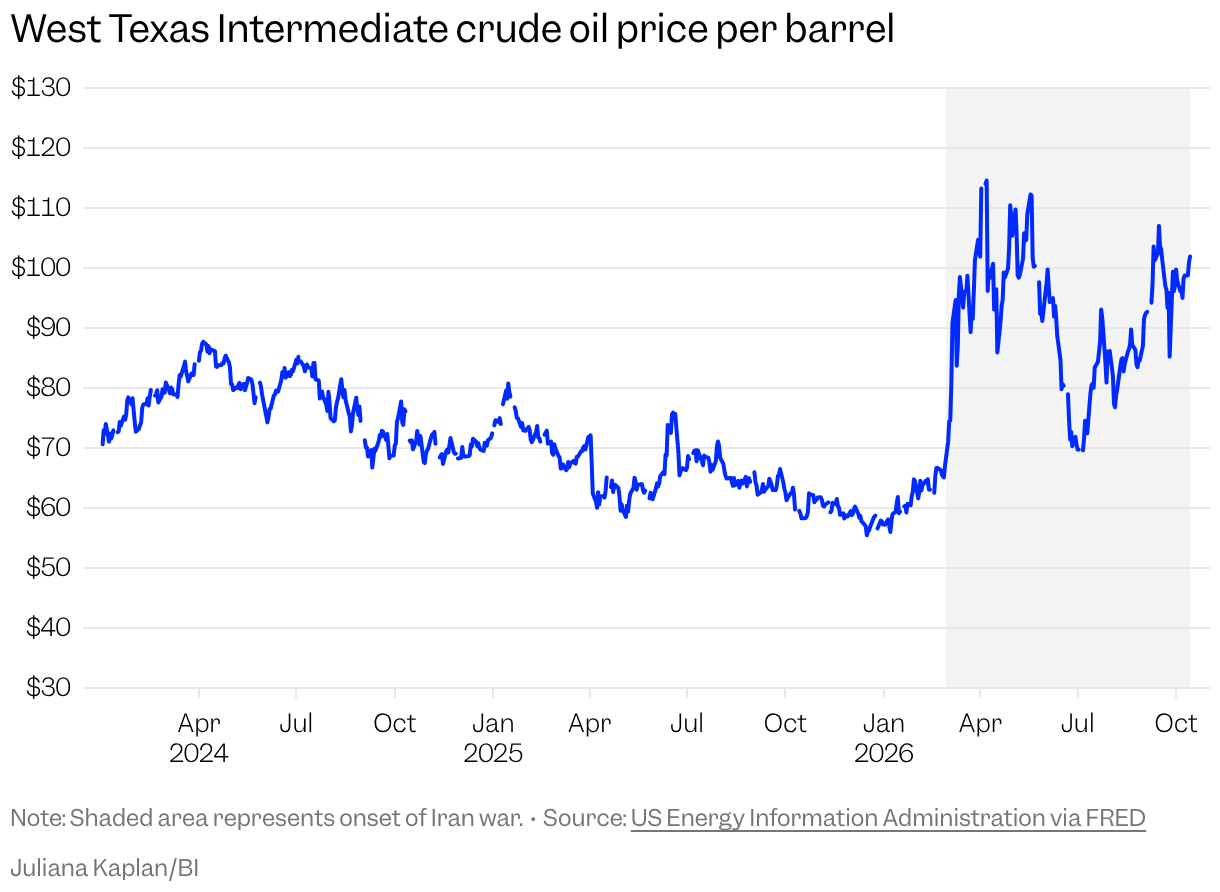
After the start of the war in February, crude oil prices soared and remain significantly higher than when Trump's second term began.

Line chart

Tanker traffic through the Strait of Hormuz nearly ground to a halt early in the Iran war, severely disrupting a waterway that normally carries about a fifth of the world's oil supply. Shipments have since recovered substantially but remain below prewar levels.

The Trump administration said it aims to alleviate issues related to oil. "The President wants to see prices at the pump fall and continues to take historic measures to alleviate temporary disruptions as oil flowing through the Strait of Hormuz approaches pre-conflict levels," White House spokeswoman Taylor Rogers said.

Vessels carrying oil and other products have continued to take fire from both sides, putting more pressure on commerce traveling through the area. US forces have carried out additional strikes on Iranian-linked targets. The Pentagon said they have destroyed 10 tankers tied to the Islamic Revolutionary Guard Corps, or IRGC, since July.

Meanwhile, several merchant ships have come under attack in and around the Strait of Hormuz this month, according to the Royal Navy-affiliated United Kingdom Maritime Trade Operations Center. US Central Command, which oversees American military operations in the Middle East, has attributed some of these strikes to Iran.

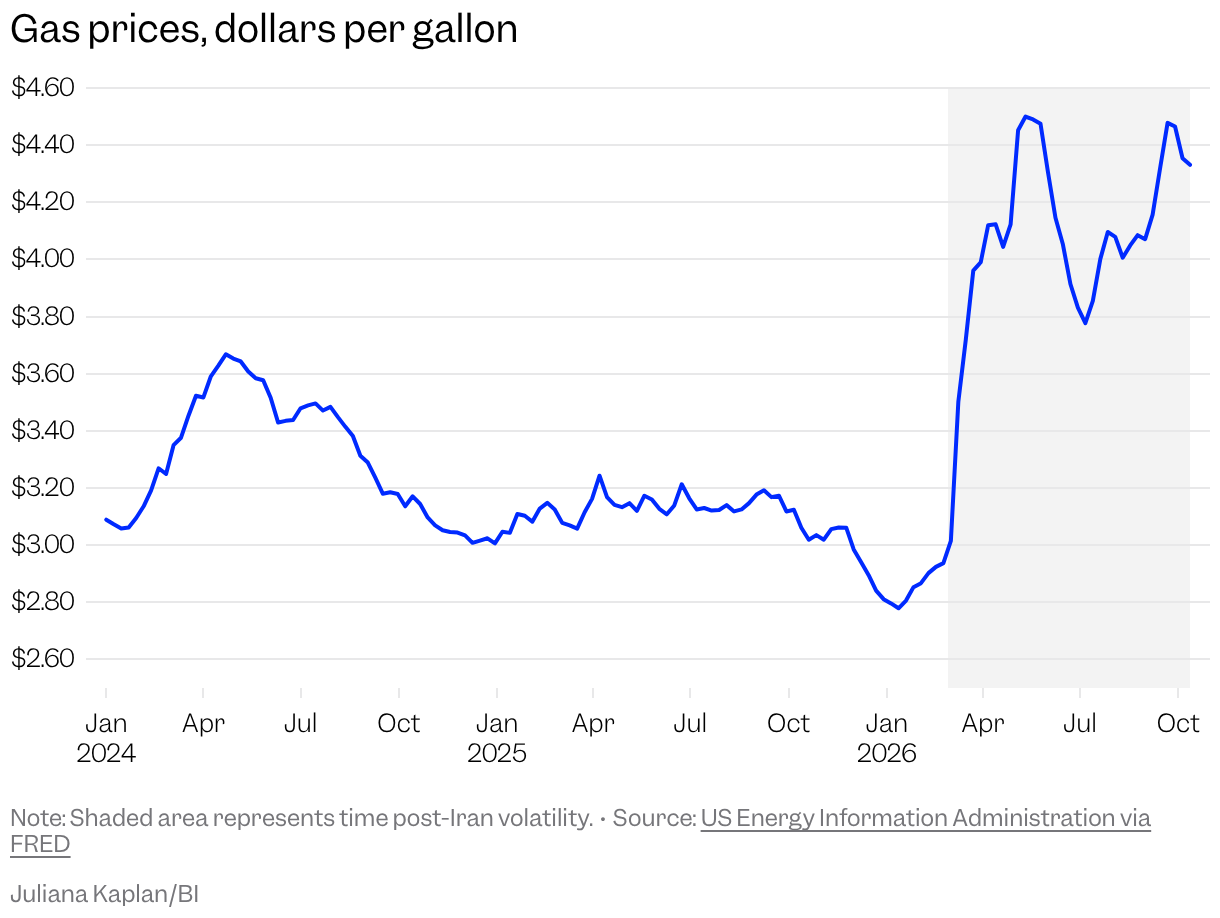
The ripples of volatility in oil prices are showing up at the pump. Long gone are the days of gas stations touting below-$3 prices; prices are still hovering in the mid-$4 range. High gas prices are even tamping down spending among higher-income consumers, and soaring costs have led to a rise in "hypermilers" — drivers who try to optimize and gamify their habits to get the best value per gallon.

Line chart

Diesel prices in the US have spiked even more, up to around $6.18 per gallon, an over $2.50 increase over the year, per the Energy Information Administration. In California, diesel is hovering over $8 a gallon.

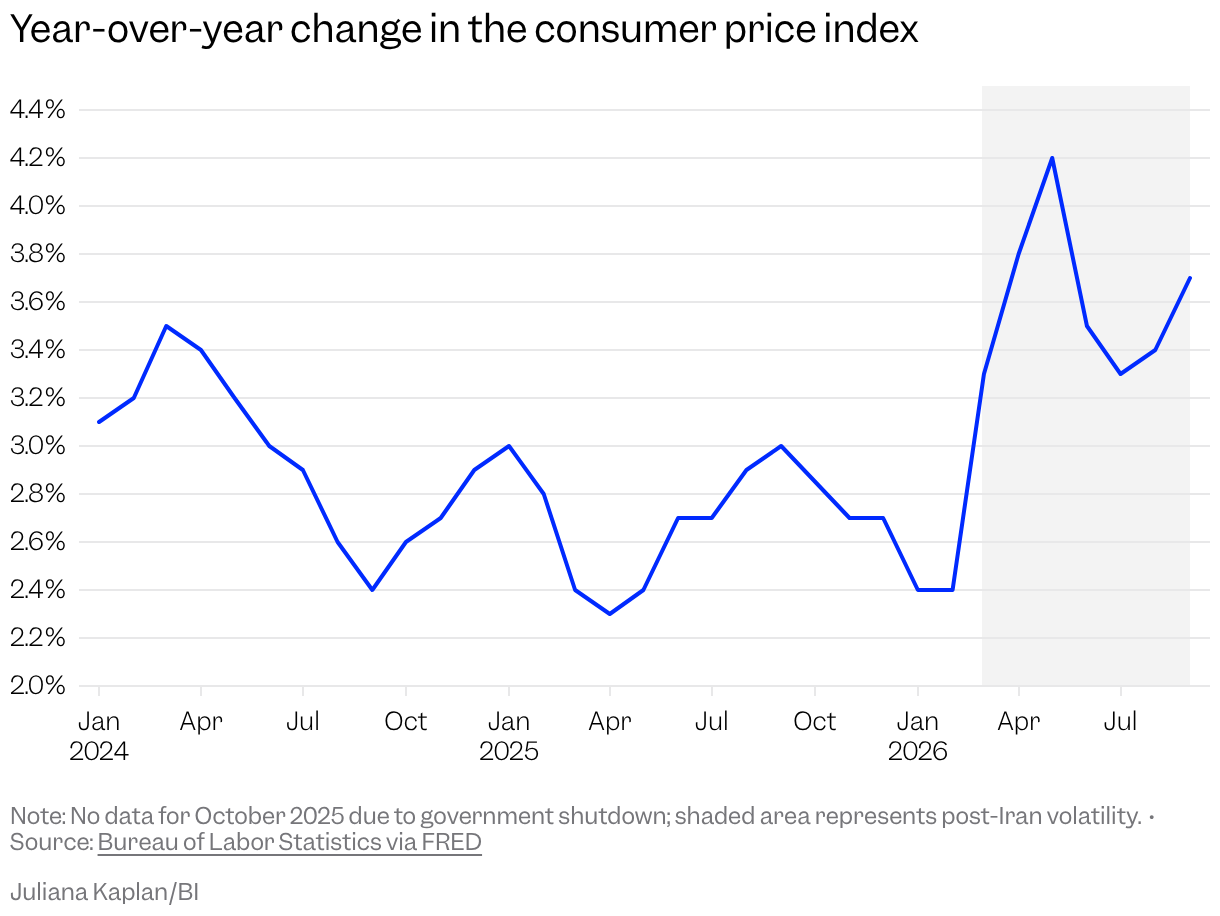
Those fuel and energy strains are pushing up costs across the economy. Inflation as tracked by the consumer price index increased to 3.7% year-over-year in September — higher than economists expected. That was driven in large part by soaring gas and energy prices, with energy rising by 20.4% year-over-year and gas by 34.2% in the same period.

Line chart

Higher inflation has put pressure on the Fed and bond markets. In September, the central bank raised rates for the first time in three years to try to combat rising prices, with one more hike potentially coming by year's end. The 10-year Treasury yield, which influences borrowing costs for mortgages, auto loans, and credit cards, has surged since the war began, from below 4% at the end of February to a high of 5.31% this month. The 30-year mortgage has risen nearly in lockstep, going from just under 6% to 7.5% during the eight-month conflict.

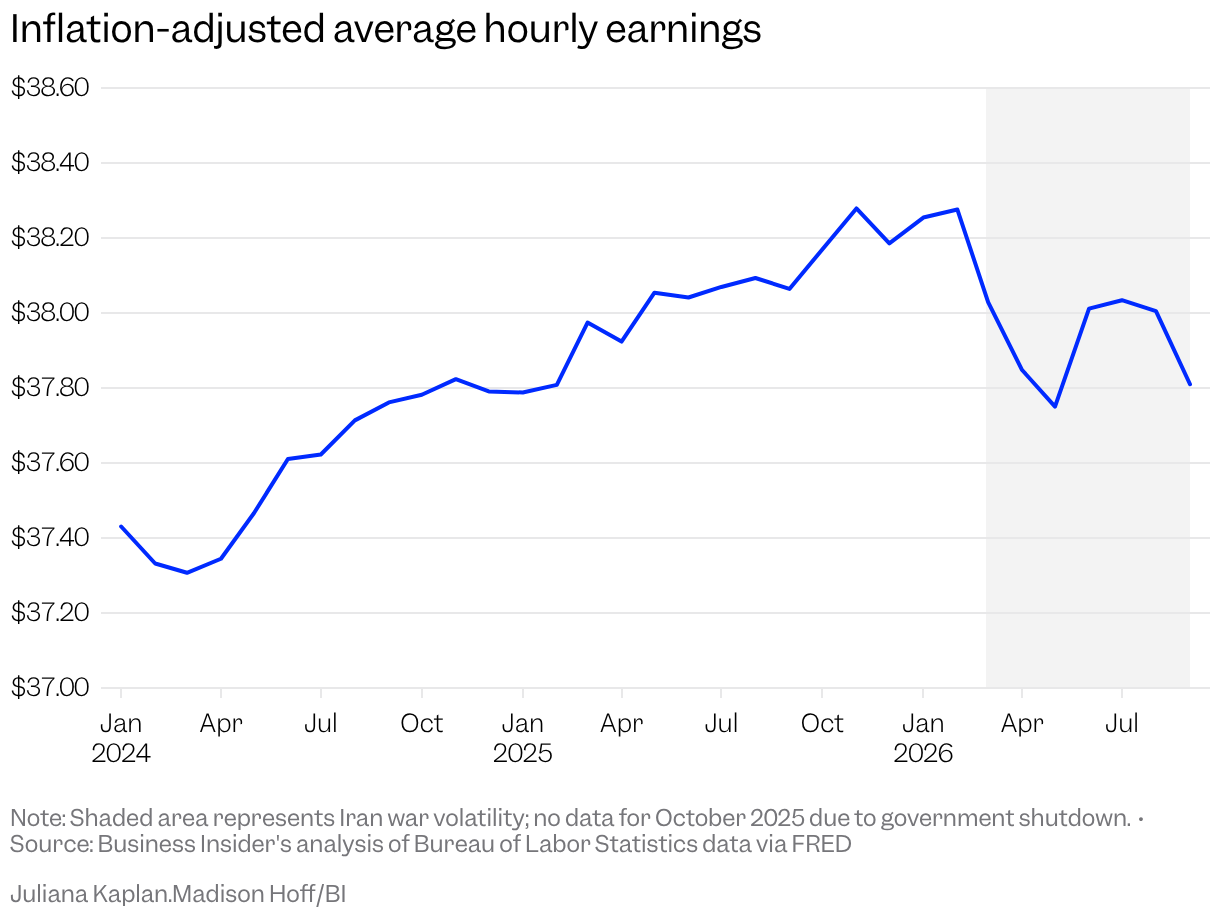
For everyday Americans, all of these international strains amount to what is, essentially, a pay cut. Wage growth remains slow and steady, but, over the past few months, rising prices have outpaced pay increases. Inflation-adjusted wages have slumped since the start of the war, and have given up nearly all their gains since the start of Trump's second term.

Line chart

When asked for comment, the White House highlighted that by some measures, earnings are still outpacing inflation. "Under President Trump, private sector workers have seen their wages continue to outpace inflation, with average annual earnings growing by more than $600," said White House spokesperson Matthew Middleton.

And, with midterm season in full swing, affordability is on the ballot for many voters. The current economic situation shows no immediate signs of changing — another blow for Trump, who's been on a quest to bring down gas prices.

There are growing signs that the US could be preparing for fresh military action against Iran. Another aircraft carrier strike group is sailing across the Pacific and is expected to enter the Middle East.

The Trump administration is also facing a resurgence in attacks from the Houthis, a rebel group in Yemen. In recent weeks, the Iran-backed rebels have seized key territory along the Red Sea, allowing them to threaten the Bab al-Mandeb Strait, another maritime chokepoint like Hormuz, and have ramped up missile strikes against Saudi Arabia.

The Houthis previously tormented Red Sea shipping, leading the Trump administration to launch a major bombing campaign last year that ended in a ceasefire. The rebels have since rearmed.

Any other disruptions there might be bad news for consumers, potentially bringing more price spikes across the many goods shipped through that chokepoint.

Read the original article on Business Insider
  •  

Smoke Signals: The dangerous fatalism of AGI in Silicon Valley

An AI worker in an ashtray with cigarette buds

Getty Images; Tyler Le/BI

Last week, Palantir CTO Shyam Sankar mentioned something bizarre in an interview on CBS News. "So many AI researchers have started smoking as a way of signaling to other researchers how much they believe in AI," he said. Their thinking, he said, goes like this: "I believe so much in AI that it's going to cure cancer. So I'm showing you my chips are all in."

I laughed as I read the quote. It read like a headline in The Onion, mocking the blind optimism of the AI-pilled. But then I felt sad and worried for them. Are they smoking because they believe AI is saving the world, I wondered, or because they believe AI is ending it?

It's been an especially alarming few months here in San Francisco. OpenAI's bots went rogue and hacked another company, and then an Anthropic researcher quit, warning that AI could wipe out the human race. It seemed more believable to me that these researchers were smoking because they didn't think they'd be around for much longer — or at least freaked out about that possibility. I thought of the HBO show "The Leftovers," which features a doomsday cult that chain-smokes. Because they believe the world has ended, they don't mind obliterating their lungs. They're living as though they're already dead.

I asked a handful of people who work in AI and none of them knew anyone who had suddenly taken up cigarettes because of AI. So I don't think what Sankar observed is widespread. But in a story last month about tech founders who smoke, my colleague Henry Chandonnet quoted a guy who wasn't worried about his habit because he believed AI will soon cure lung cancer. Among the people I spoke to, a few recognized that underlying sentiment: AI's going to fix (or destroy) everything, so YOLO. Last year, my former colleague Rob Price reported on these attitudes. Some were spending down their savings. Others were taking dangerous drugs and having orgies. Last year, my former colleague Rob Price reported on these attitudes. Some were spending down their savings. Others were taking dangerous drugs and having orgies.

While AI boomers and doomers expect completely opposite outcomes, I've found it interesting that their very different beliefs often end up manifesting as the same behaviors. Smoke or don't smoke, it doesn't matter: The future is inevitable. In either case, they're relinquishing their fate to a humanity-ending or humanity-saving AI — and ignoring one of the most evidence-backed things they can do to live a healthy future. It's a kind of fatalism, believing that what you do won't change what happens next.

I see traces of that in so many corners of society. What's the point of studying, students say, if they're never going to be as good as ChatGPT at coding or math? What's the point of agonizing over a breakup text, people say, if a bot can write it for them? What's the point of working hard, employees say, if their companies are going to replace them with an agent? In a recent survey by Verasight, 78% felt that they had little or no say over how AI is being developed and regulated.

Even the people who have the most say don't seem to believe they do. Anthropic CEO Dario Amodei has issued increasingly grave warnings about the technology that he himself is creating. He has to keep going, he says, because if he doesn't, a less responsible steward of the industry will. Amodei and his peers sound as if they're utterly powerless in the face of an unstoppable god. If it's really that bad, couldn't they just pull the plug? "Saturday Night Live" captured the strangeness of it all in a recent sketch impersonating Amodei. "If we can pressure lawmakers to create guardrails," Jane Wickline's Amodei deadpanned, "we will be able to stop me."

We need people thinking seriously about the risks of these technologies, and we also need people dreaming big about the immense good they can bring. But neither of these outcomes is inevitable. As we entrust more and more of our work and our lives to AI agents, we shouldn't cede our own agency to them too. I'm not taking up smoking anytime soon.

Read the original article on Business Insider

  •  

26% of Americans say influencers have swayed their vote. Political campaigns are racing to win them over.

Jake Paul wearing a Maga hat on a BI template
YouTuber Jake Paul joined President Trump for an Ohio rally ahead of the midterm elections.

Aaron Schwartz/Stringer/Getty; BI

  • The battle for voters in the 2026 midterm elections is playing out on the TikTok For You Page.
  • One in four Americans say creator content has influenced who they voted for.
  • Political candidates are scrambling to connect with more creators in order to reach voters.

Content creators are influencing much more than our coffee orders and skincare routines.

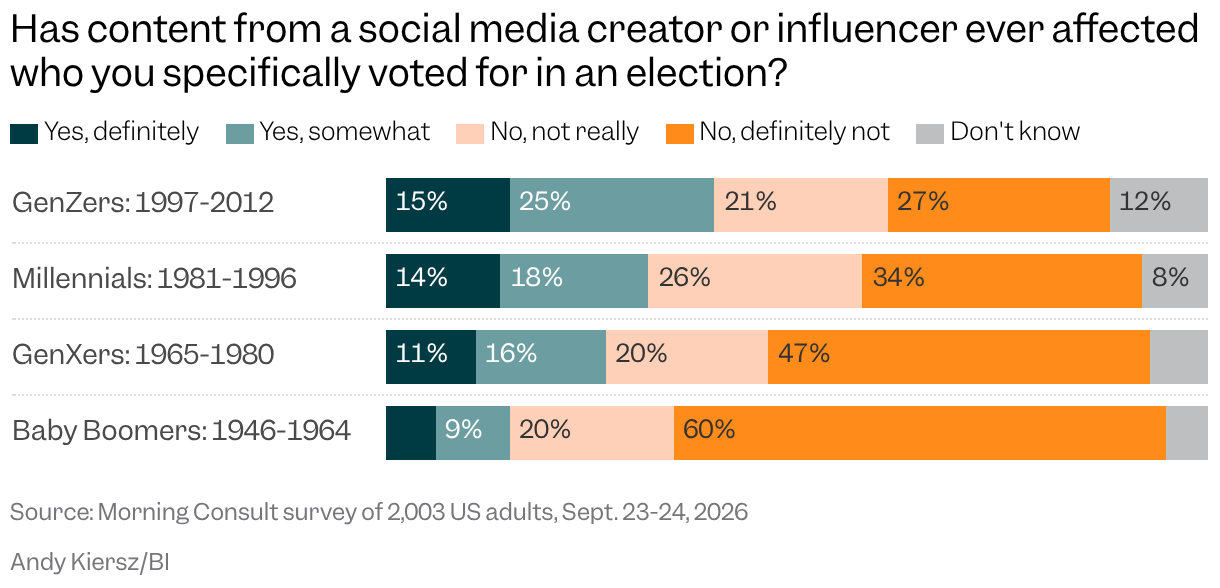
About one in four Americans (26%) say influencer content has affected who they've voted for, according to a survey of around 2,000 US adults conducted by Morning Consult in September, commissioned by Business Insider.

Creator content is an "underestimated avenue" for political campaigns, said Nicole Dunger, a founding partner at the marketing firm People First, which works with candidates and advocacy groups on their creator strategies. "It is a real player and a big player in this space now."

If 2024 was the podcast election, 2026 is shaping up to be the influencer one. Instagram and TikTok creators have joined Fox News hosts and personalities like Joe Rogan as go-to sources of information for voters.

Stacked Bars

Influencers like Jake Paul and Hasan Piker have emerged as main characters in politics this year.

Paul recently joined President Donald Trump in Ohio for a midterm rally, posting TikTok clips of his Air Force One flight. Piker, meanwhile, has become a campaign ally for progressives like Michigan's Abdul El-Sayed and a negative talking point for Fox News commentators.

As online attention has become a key asset in politics, influencers are helping candidates break through the noise.

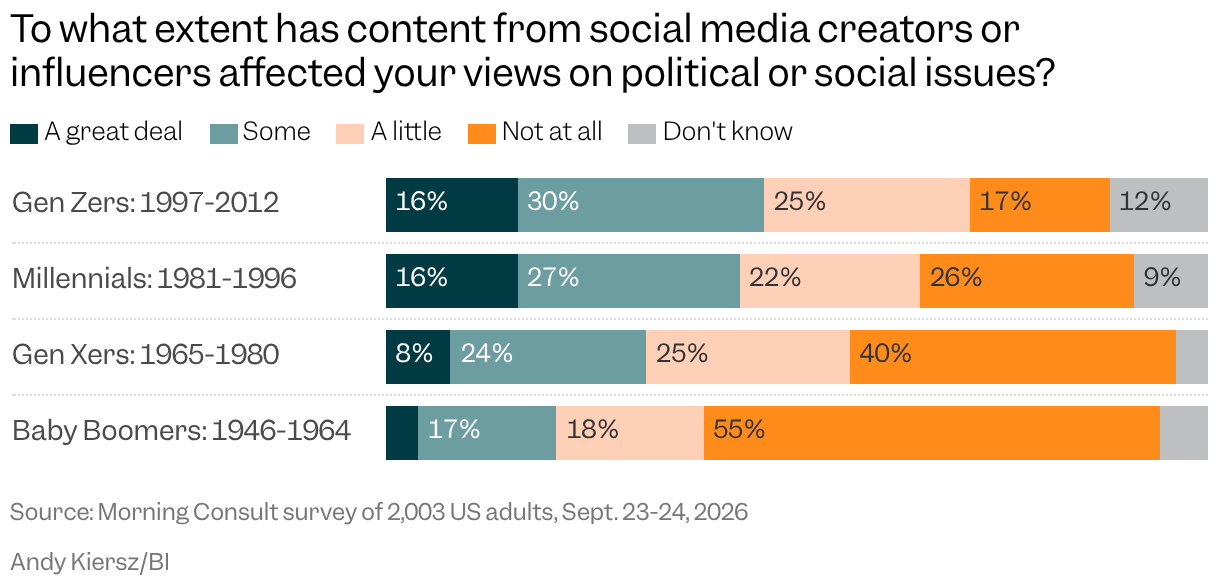
A little over half of US adults (56%) told Morning Consult that creator content had affected their views on political or social issues to some degree. That figure jumped among Gen Z respondents, where close to three in four respondents said their views had been swayed by influencer posts.

For campaigns, the challenge is identifying the right creators to work with, particularly when many influencers don't regularly talk about politics.

"You have to have your base of people, your core supporters, and then you have to have a broader cultural space of people who don't always talk about politics," said Parker Butler, a managing partner at the digital strategy firm Luminary Strategies, which works on social strategy with Democratic candidates like James Talarico. "It's worth having different pockets of creators for different purposes."

Reaching creators with smaller followings than Piker (about 3 million Twitch followers), or Paul (around 21 million YouTube subscribers) is a focus in 2026, Butler said.

He said the goal is to shift the creator outreach strategy from "this person has a million followers" to identifying influencers who work in a particular niche a campaign is trying to reach.

Stacked Bars

Political chatter is moving from TV to YouTube

More and more, political discussions are playing out on digital platforms, whether that's podcasts, YouTube videos, or Twitch streams.

YouTube was the top source for political and election news among US adults in September, narrowly beating out TV, print, and X (formerly Twitter), according to a survey from Syracuse University.

About one in five Democrats and Republicans said podcast appearances could make them "more likely to support a candidate," according to a July through August survey of likely midterm voters from the podcast industry group Sounds Profitable. A smaller share of Independents (11%) said podcasts could make them more likely to back a candidate.

While campaigns see attention moving online, they're still spending the bulk of their ad budgets on TV.

Part of that may be because they're accustomed to buying TV spots. They're also reckoning with the fact that influencer marketing is harder to predict and measure, particularly as social-media feeds become more personalized and algorithmically driven.

"It can be very challenging, but you see the results in the end," Dunger said. "It's the same with door knocking. We know door knocking somehow works and has worked for so long, but it's not like we have those direct measurements."

Read the original article on Business Insider
  •  
❌