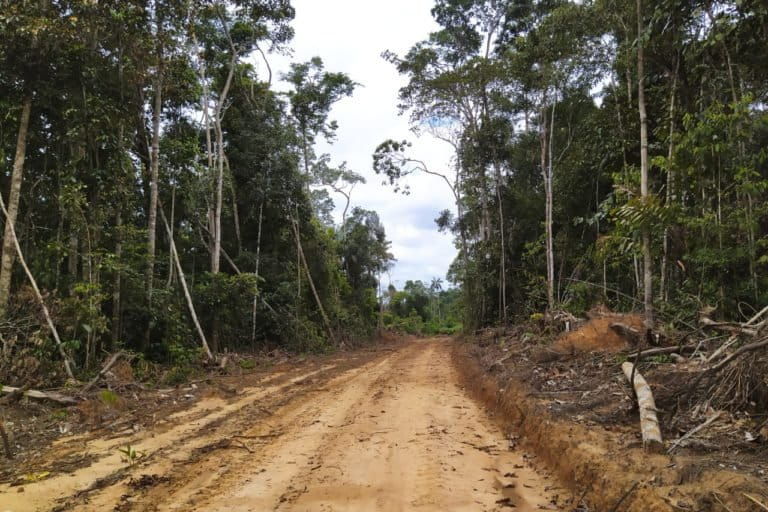
Lawmakers in Suriname are calling for a formal investigation into mining activity that allegedly uses heavily restricted chemicals like cyanide, and risks creating runoff and pollution in the surrounding ecosystem. On Sept. 19, two members of the National Assembly, Rabindre Parmessar and Michael Marengo, visited an area in Pelin Bergi, near Kwakoegron, in northern Suriname, and said they discovered “substantial” mining activity that raised legal questions about permitting. Now, the two lawmakers are calling on President Jennifer Geerlings-Simons to launch an immediate investigation and temporarily halt all mining activity in the area. “The situation on-site raises fundamental questions about the nature, duration, permitting, oversight and the fiscal and environmental controls on these activities,” the lawmakers said in a letter, reviewed by Mongabay, to the president’s office last month. It added, “[It’s] necessary to establish how activities of this scale have been able to take place over an extended period and to what extent the state’s interests and revenues have been protected in the process.” The lawmakers, who traveled with a group of local journalists and an environmental activist, observed “deep excavations” at the site and materials being transported to processing locations. There were also indications of cyanide use via heap leaching, a process in which the chemical is sprayed onto rock to dissolve gold, making it easier to collect smaller particles. The import and use of cyanide is heavily restricted in Suriname. Geerlings-Simons is trying to phase out imports and implement a registry system for the chemical, which is still…This article was originally published on Mongabay
PUERTO WILCHES, Santander – On the banks of Colombia’s largest river, the town and the wider municipality of Puerto Wilches sit amid a maze of wetlands and floodplain lakes in the Middle Magdalena Valley. Residents spend weekends at riverside swimming spots known as balnearios and nearby waterfalls, while local fishermen still cast their nets each morning. Since about 2018, however, the municipality has been a focal point in Colombia’s debate over how to balance energy security, environmental concerns, and the transition away from fossil fuels. In 2021, Puerto Wilches was chosen for two pilot projects to test whether fracking, a method of extracting oil and gas trapped in shale rock, could be done commercially in Colombia, targeting shale formations beneath the region. Then-President Gustavo Petro later halted the projects, arguing that Colombia should move away from fossil fuels rather than expand oil and gas production. But that policy could soon be reversed under the new government of right-wing populist Abelardo de la Espriella, who during his campaign pledged to “fully open the door to fracking.” De la Espriella and other fracking supporters say the practice could help shore up Colombia’s gas supplies. According to the National Hydrocarbons Agency (ANH), the country’s proven gas reserves will only last another 5.9 years at the current production rate and with no new discoveries. Critics, however, warn that fracking could expose communities and ecosystems to environmental risks while also deepening Colombia’s reliance on fossil fuels, just as the country has been accelerating its clean…This article was originally published on Mongabay
The government in Suriname this year said it planned to evict illegal settlers in the Amazon Rainforest, and possibly send many of them back to their home countries. But eviction has proven much more complicated than it first appeared, with settlers allegedly ignoring court orders and officials expressing confusion about which people are breaking what laws. Suriname President Jennifer Geerlings-Simons created a task force to investigate illegal settlements destroying the rainforest, many of them Mennonites moving from other countries. Officials delivered eviction notices to some of the settlers as recently as July, yet some deny receiving the notices and continue to develop the area. Lawmakers said they’re confused about the location of the new Mennonite communities, the legal process for removing them, and how they entered the country in the first place. “We got bits and pieces of information that more and more families were coming,” Rabindre Parmessar, leader of the National Democratic Party in the National Assembly, told Mongabay over the phone. “We don’t know whether immigration rules were taken into consideration, and the other rules and procedures we have here in Suriname.” Since at least 2022, agribusiness investors in the country have been trying to relocate Mennonite farming families from Bolivia, Belize and other parts of the Americas. The conservative Christian group has a track record of rapid farming growth, and would have helped develop hundreds of thousands of hectares of mostly primary rainforest. Geerlings-Simons during the press briefing Aug 4. Image courtesy of Key tv 8.2 In…This article was originally published on Mongabay
A new initiative between the U.S. and Argentina is meant to bolster investment opportunities and strengthen supply chains for critical minerals that could be used in the clean energy transition, such as copper and lithium. The Andes-Atlantic Corridor, announced Sept. 23, will make it easier to funnel U.S. investment into Argentina’s mining sector and to export critical minerals. At the same time, the initiative will help continue to develop the Vaca Muerta region, home to Argentina’s largest oil and gas reserves. “Working together, the United States and Argentina seek to continue to build on our robust relationship through increased U.S. investment, close security cooperation, and aligned values,” the two countries said in a joint statement. Argentina has about 117.91 million metric tons of copper reserves and 216.32 million metric tons of lithium carbonate equivalent, the chemical used in lithium-ion batteries. Many of the country’s minerals are needed for building the cables and transformers in power grids, wind turbines and solar panels, among other things. The country is also part of the “Lithium Triangle,” alongside Chile and Bolivia, an approximately 400,000-square-kilometer (154,400-square-mile) stretch of salt flats where 40-60% of the world’s lithium is located. Historically, exporting minerals has been a challenge for Argentina. The closure of a major copper mine and a lack of foreign investment, among other economic troubles in the country, saw copper exports drop between 2012 and 2019, according to an analysis by the Payne Institute for Public Policy, a U.S.-based think tank studying energy, natural resources, and…This article was originally published on Mongabay
Along a freshly repaved stretch of the BR-317 highway in Acre, a Brazilian state bordering Bolivia and Peru in the Western Amazon, pasture stretches out as far as the eye can see. Solitary Brazil nut trees (Bertholletia excelsa), a protected species, are the only reminder of the tropical forest that once stood there. The road is part of the Interoceanic Highway, inaugurated in 2011 as the first paved road in South America connecting the Atlantic and Pacific oceans. Built through the Brazilian and Peruvian Amazon to help increase trade to Asia as well as between neighboring countries, the highway has been associated with deforestation on both sides of the border. “Roads are the main vector for deforestation and irregular [land] occupation,” says Sonaira Souza da Silva, a professor at the Federal University of Acre’s Floresta Campus and co-author of a recent paper on road expansion in Acre. The desolate landscape that now lines the BR-317 could be replicated elsewhere in Acre, environmentalists warn, if plans go ahead to build a second road connection with Peru. This is part of a renewed push to turn the state into a corridor to the Pacific for the export of Brazilian agricultural and mineral goods, following the 2024 inauguration of Chancay, a Chinese-built mega-port just north of Peru’s capital Lima. A new report from the NGO Amazon Conservation argues that expanding road infrastructure is incompatible with Acre’s deforestation commitments and that new corridors could add between 74,700 to 133,800 hectares (around 184,600 to 330,600…This article was originally published on Mongabay

 Login