Delegates from most of the world’s governments are assembling this week in Yerevan, Armenia for the latest summit of the Convention on Biological Diversity (CBD COP17), whose aim is to prevent the extinction of our fellow creatures, and promote sustainable and just land use. There could be no more fitting location: in the Bible, Mount Ararat is where Noah’s Ark found dry land after the great flood – and where the animals he had rescued, two by two – finally disembarked: “But God remembered Noah and all the wild animals and the livestock that were with him in the ark, and he sent a wind over the earth, and the waters receded. Then God said to Noah, ‘Bring out every kind of living creature that is with you — the birds, the animals, and all the creatures that move along the ground — so they can multiply on the earth and be fruitful and increase in number on it.’” (Genesis 8). Thousands of years later, our fellow creatures need another rescue in the shadow of Mount Ararat, via this summit. That is fitting, because, as a lifelong environmentalist, I have personally never seen a time where politicians around the world seem to care less about nature than they do right now. A wreathed hornbill, found across South and Southeast Asia. Image by Nick Volpe via iNaturalist (CC BY-NC 4.0). A leading edge of this political assault on nature is the U.S. Government, even though America was in many ways the…This article was originally published on Mongabay
VERSHIRE, Vermont – When Sabra Ewing and Sebastian Lousada bought a tired dairy farm with pastures featuring old apple trees alongside sprouting maples, it was obvious that the grass below these trees’ crowns was a lot lusher than in the open. Then they noticed their sheep began to prefer those shady spots, and their manure added to the richness of the grass and of the other annual plants growing underneath. “You do a lot of observation when you’re a farmer, and when we put the heritage sheep in the orchard, we quickly noticed,” Ewing said in a phone interview after Mongabay’s recent visit. Then the couple discovered a grant program offered by the American Farmland Trust that would help them incorporate more kinds of trees into the 30 acres (just over 12 hectares) of pasture on their overall 250 acres (nearly 102 hectares). “I pounced on it, because I was already excited about this,” Ewing said. Flag Hill Farm co-owner Sebastian Lousada provides water to heritage breeds of sheep grazing under 80 varieties of apple and other sorts of useful trees, Vershire, VT. Image by Erik Hoffner for Mongabay. That grant and other financial supports like one from the U.S. Department of Agriculture (USDA)’s Natural Resources Conservation Service (NRCS) helped turn their Flag Hill Farm – which now grazes heritage breeds of sheep under 80 varieties of apples plus other useful trees, to produce high quality wool, hard cider and brandy created in an on-farm distillery – into an idyllic,…This article was originally published on Mongabay
As global leaders convene in Armenia this week for the U.N. Convention on Biological Diversity (CBD) conference of the parties (COP17), it is difficult to ignore how women’s oppression is deeply intertwined with the exploitation of ecosystems. After almost two decades of pledges, biodiversity action remains underfunded, forest loss continues to be a growing threat, socio-ecological transitions are a low priority, and ecosystems are spiraling toward collapse. The impacts of resulting climate disasters and biodiversity destruction are not felt equally, yet gender justice issues also remain unresolved within these international talks. In Yerevan, Armenia, countries will consider the first global review of the Kunming-Montreal Global Biodiversity Framework (KMGBF), which was the first formal assessment to measure progress since its adoption in 2022. COP17 is also poised to advance efforts on biodiversity finance under the umbrella of common but differentiated responsibilities. But progress cannot be measured only in targets, financial commitments and international mechanisms. We should also ask a more basic question: What can we learn from the people who are already protecting biodiversity in their territories? Women leading agroecology and community conservation initiatives in Zambia. Image courtesy of Kapyanga Women Association & Zamsof. While hundreds of policymakers spend long hours negotiating decisions to promote false solutions and powerful corporate actors lobby to continue profiting from biodiversity destruction and obstruct environmental regulations, women from the Global South continue working without big cameras or fancy social media presences to protect what is left of their territories. They are ensuring the continuation of…This article was originally published on Mongabay
On Indigenous Peoples Day, let’s honor the leadership and contributions of Indigenous women in water. Women – and particularly Indigenous women – are underrepresented in the water workforce and make up less than one in three voices in water governance. Yet, the water sector has much to learn from women’s leadership. Women have always led, and women get things done. Across the water community, women bring people together, build partnerships, solve problems, and move important work forward every day. Their leadership takes many forms. Some lead through community engagement and relationship building. Others advance technical solutions, policy, research, infrastructure, public health, or education. Many do all of these things at once. Different perspectives help turn vision into action. Women lead in complementary ways, and that collaboration often drives meaningful progress. Indigenous women and girls gather stones to make water filters to provide their community with safe water in Ecuador. Image courtesy of Yachana Foundation. In working alongside Indigenous leaders such as Emma Robbins and Crystal Tulley-Cordova, I have seen how community knowledge, technical expertise, and relationship-building complement one another. Throughout this work, women continue to champion Indigenous knowledge, environmental stewardship, water justice, and community resilience. They advance conversations about water rights, water hauling, universal access to clean water, public health, policy, research, and infrastructure. They also recognize that solving water challenges requires more than technical expertise: Real progress happens when communities, researchers, educators, advocates, and decision-makers come together around shared goals. Women play a leading role in creating and sustaining…This article was originally published on Mongabay
A group of activists in the small border town of Lochiel, Arizona, U.S., is fighting to save 200-year-old cottonwood trees by stopping contractors from building a section of the U.S.’s new wall along its border with Mexico. One activist lived for over 70 days in the upper branches of an ancient cottonwood dubbed the “Grandmother Tree,” preventing construction workers from cutting it down while other activists used pulleys to bring them food and water. The protest was about more than protecting ancient trees: Activists were also fighting habitat fragmentation caused by the border wall in a landscape where biodiversity depends on ecological connectivity. The tree encampment began on July 28, after construction workers cut down three of the four cottonwood trees that were in the path of the wall. This double wall consists of two 30-foot-high (just over 9 meters) steel walls that run parallel to one another with a buffer zone between. Since then, helicopters, drones, U.S. Border Patrol agents, and local law enforcement have been surveilling the area, according to the activists at the encampment. I interviewed activists camped in the meadow adjacent to the tree, photographed the landscape, and participated in the daily morning rituals aimed at honoring Grandmother Tree and the land. There I learned that the movement has connected social and environmental issues since its inception. Many of the activists I met at the Lochiel protest are involved in No More Deaths, a humanitarian group that provides water and aid to migrants crossing the border,…This article was originally published on Mongabay
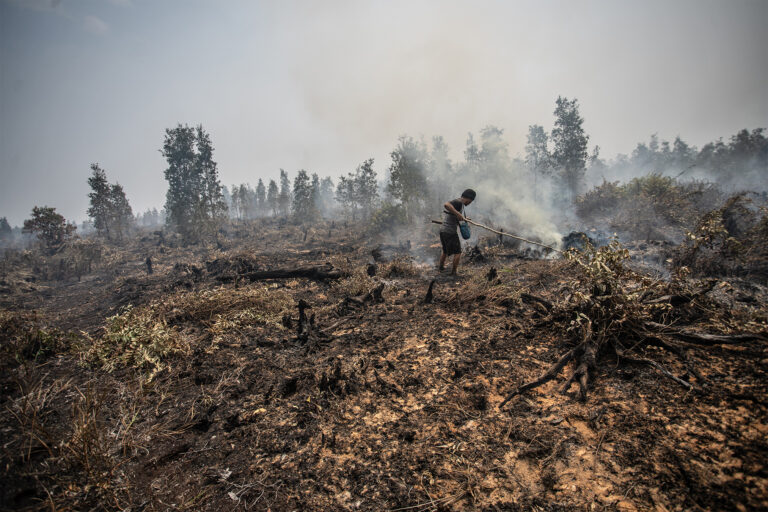
In October 2006, I was supposed to be starting my dissertation research on tropical reforestation in Indonesia. Instead, I found myself in the forests of Tanjung Puting National Park in Central Kalimantan helping locals to fight fires with brooms, backpack pumps, and hoses connected to hand-dug water wells. It was an ‘all hands-on deck’ moment for the local NGO I was working with then — Friends of Nature, People and Forests (FNPF) — including Basuki Santoso, FNPF’s Kalimantan program manager, alongside Adut and Isam, who were teenagers at the time. On our first night of firefighting, we slept in the forest on a raised platform that would later become part of a field station. I was awoken in the middle of the night by a sun bear rifling through our makeshift kitchen about 20 feet away. I sat frozen, watching this wild animal who was fleeing the fires while everyone else slept soundly. It was a surreal and humbling moment. Twenty years ago, these severe forest and peatland fires were due to a dangerous combination of El Niño-induced drought, slash-and-burn agriculture and other land clearing, and the grass-fire cycle. Much of Southeast Asia was left choking on the haze, and that was a weak El Niño year. Firefighting in Indonesia often requires resourcefulness as well as resilience and fortitude. Image courtesy of Basuki Santoso. History keeps repeating itself, and it’s hard to watch. Experts say we are now facing a Super El Niño. For the past three months, millions of…This article was originally published on Mongabay
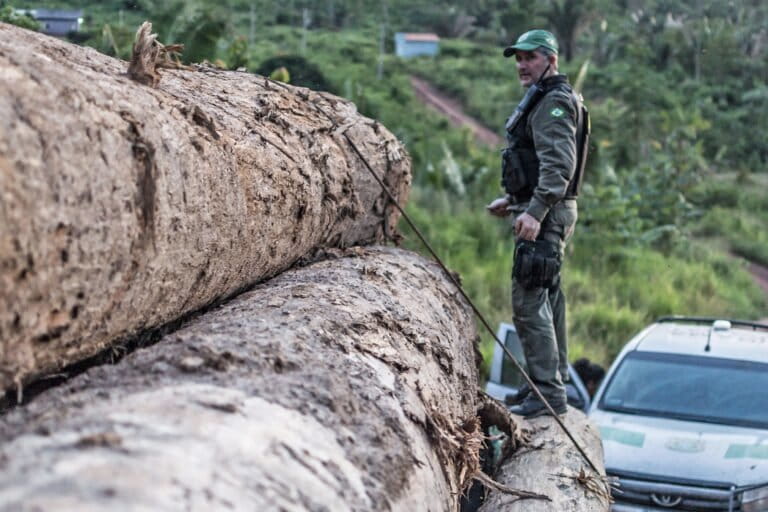
The world has spent a decade trying to put a price on nature. Forests have become carbon sinks, while wetlands are increasingly described as natural infrastructure. Biodiversity is also being drawn into financial markets. Governments and investors have poured billions into carbon markets and conservation finance, including green bonds. Around them, a financial system is emerging on the assumption that intact ecosystems can generate enough economic value to protect them. A more destructive economy has been putting a price on nature for much longer. It makes money by extracting and selling it. Land grabbing, illegal logging, illicit gold mining and wildlife trafficking are usually treated as environmental offenses, so responsibility falls to park rangers, customs officials and specialized police. That view badly underestimates what is happening. In a new paper for the Brookings Institution, we argue that environmental crimes are a serious drag on both sustainable development and climate action. They damage ecosystems and weaken the institutions charged with governing them. They also drain revenue from legitimate companies and public coffers. Enforcement alone will not solve a problem that runs through trade, finance and local political economies. An IBAMA agent participates in a raid on an illegal logging and mining operation within an Indigenous reserve. Image courtesy of IBAMA. Global criminal economy No one knows exactly how large this economy has become. A widely cited estimate puts annual proceeds at between $110 billion and $281 billion, but the true figure is probably far higher, perhaps in the trillions. What makes the business…This article was originally published on Mongabay

 Login