Conservationists are launching a project to protect dwindling vulture populations in Chad amid a Central Africa-wide decline. Run by the nonprofit Sahara Conservation, the project is part of a larger EU-funded LIFE EV Safe Return program that focuses on protecting the endangered Egyptian vulture (Neophron percnopterus). Egyptian vultures migrate from their breeding sites in the mountains of Southern Europe, North Africa, and Asia, to winter feeding sites in sub-Saharan Africa, including in Chad. Sahara Conservation’s efforts will focus on Chad’s Ouadi Rimé–Ouadi Achim Faunal Reserve and Lake Fitri, which Egyptian vultures visit. Meanwhile, critically endangered Rüppell’s vultures (Gyps rueppelli) and endangered lappet-faced vultures (Torgos tracheliotos) use both areas as their breeding grounds. “This project really aims to tackle the main threats to vultures in Chad, with a focus on Egyptian vultures,” Cloé Pourchier, program officer at Sahara Conservation, told Mongabay in an interview. “Any action for vulture conservation will benefit all species as well.” Indications are that vulture populations in Chad are declining. Like those in West Africa, they’re threatened primarily by demand for belief-based use, where people kill vultures believing the birds’ body parts can bring luck or misfortune. Last year alone, poisoning claimed the lives of more than 100 Rüppell’s vultures in Chad in three incidents. Several birds were decapitated, indicating they were killed for belief-based use. Investigations and interviews with locals by the Sahara Conservation team revealed the birds’ parts were destined for markets in Nigeria and Niger. “They were saying that there were people coming from…This article was originally published on Mongabay
Authorities in Thailand say they have seized about 400 pieces of African elephant ivory in a shipment of timber from Zambia, and are now testing the contraband to identify the origin of the animals. The tusks were found concealed inside logs in two containers declared as holding processed timber at Laem Chabang Port, Chonburi province, according to an Oct. 7 announcement by the Thai Department of National Parks, Wildlife and Plant Conservation (DNP). Thailand’s environment minister, Suchart Chomklin, said in the statement that a team of DNP academics and forensic experts have been asked “to officially inspect and count the confiscated items and conduct DNA testing.” The DNP added the testing will help determine the origin of the elephants from which the ivory was taken. This “will be used to coordinate with [Interpol] to identify the main perpetrators and the destination countries.” “The fact that DNA analysis is being initiated at an early stage demonstrates considerable leadership in the fight against the illegal trafficking of ivory and should assist in determining the source country as it is unlikely that all the ivory in the consignment is from Zambia elephants,” Mary Rice, executive director of the Environmental Investigation Agency U.K., told Mongabay by email. Rice added that another large seizure made earlier this year in Zambia hasn’t yet undergone DNA analysis. Under the regulations of CITES, the global wildlife trade treaty, ivory seizures of more than 500 kilograms (1,100 pounds) should trigger collection of DNA samples for forensic analysis within 90…This article was originally published on Mongabay
A mushroom is analogous to a flower on a plant — it’s the reproductive organ of a fungus, which protects and distributes fungal spores. Mushrooms are critical part of our ecosystems. For humans and other animals, mushrooms are also food. And they may be part of the solution for food security and solving the plastic crisis. On Oct. 15, World Mushroom Day, we highlight three such stories that Mongabay has covered. Mushrooms can help inspire eco-friendly solutions to problems Mushrooms are helping us create low-cost, sustainable housing materials and additional income for farmers, according to Gabriela D’Elia, director of the Fungal Diversity Survey. In a Mongabay video titled “Fungi are our climate allies” published last year, D’Elia cited examples of projects that are using mushrooms to address food security and waste management. For example, a company called Evocative uses a mushroom called artist’s conk (Ganoderma applanatum) to create materials that can possibly replace leather, plastic, and other packaging materials, D’Elia said. “Fungi are showing us new ways to live in allyship with the planet,” D’Elia added. Golden oyster mushrooms are crowding out native fungi in North America Golden oyster mushrooms, known for their bright yellow caps and earthy flavors, are prized edible mushrooms. They’re native to Asia, but have gained popularity throughout North America, where they’re spreading across forests and displacing native fungal species, a 2025 study found. Aishwarya Veerabahu, lead author and a doctoral student at the University of Wisconsin-Madison, U.S., told Mongabay’s Shreya Dasgupta that the study was prompted by…This article was originally published on Mongabay
After Donald Trump began his second term as president of the U.S. in 2025, his administration moved to dramatically cut federal funding for agencies including the National Oceanic and Atmospheric Administration (NOAA), which administers grants for community-based projects that often focus on climate resilience. The nonprofit Grant Witness has created a database of those awards and found that as of Sept. 2, NOAA awarded just 229 grants this year, a 74% drop compared to an average of 891 by that date in an average year. NOAA also terminated at least 26 existing grants including $1.2 million for the nonprofit New Orleans Community Support Foundation. The grant was intended to support climate-resilient water management, particularly for Black and Indigenous communities in New Orleans, a flood-prone city chronically facing extreme weather events and sea level rise. The grant would have supported “planning around infrastructure to prevent flooding and other types of challenges associated with living on the coast,” Scott Delaney, a co-founder of Grant Witness, told Mongabay in a video call. NOAA also terminated more than $2.5 million in funding for the University of Washington’s Northwest Climate Resilience Collaborative. In a statement, organizers said the termination was “a major blow to climate adaptation and community-based resilience in the Northwest.” The grant supported ongoing projects with rural and tribal communities in the region to build resilience to extreme heat, drought and sea level rise associated with climate change. “I believe that inclusion of terms like ‘indigenous,’ ‘resilience,’ and ‘climate change’ in the grant…This article was originally published on Mongabay
Founder’s Briefs: An occasional series where Mongabay founder Rhett Ayers Butler shares analysis, perspectives and story summaries. The jaguarundi was recently recategorized from least concern to near threatened on the IUCN Red List, reports contributor Sean Mowbray for Mongabay. The small cat, which ranges from Mexico to southern Brazil and Argentina and lives in a variety of habitats, is in decline due to human-wildlife conflict, dangerous roadways, attacks by dogs, and infectious disease, according to researchers. The reclassification of the jaguarundi (Herpailurus yagouaroundi) to a higher threat category may be surprising because it’s one of the most frequently seen small cats in the Americas, as it’s active during the daytime and often lives in open areas. “It’s easier to be seen and because of that, people perceived it as common,” said Tadeu de Oliveira, who led the assessment as co-chair of the Cat Specialist Group at the IUCN, the global wildlife conservation authority. “But when you quantify it data-wise, it shows to be otherwise.” Conservationists say they hope the reclassification will give the jaguarundi more attention. Its otter-like appearance, color variants, and wide range of vocalizations make it an especially charismatic species. Read the full story by Sean Mowbray here. Banner image: Jaguarundis are sometimes known as the “otter cat” due to their distinctive, uncat-like appearance. They’re unique for their wide range of vocalizations, including “chirping” like a bird. Image by Wild Cats Brazil-Americas Conservation Program/Gatos do Mato.This article was originally published on Mongabay
Founder’s Briefs: An occasional series where Mongabay founder Rhett Ayers Butler shares analysis, perspectives and story summaries. For the first time in the modern history of the Democratic Republic of Congo, a local nongovernmental organization will co-manage a protected area in the country with its wildlife authority, reports Mongabay’s Elodie Toto. Strong Roots Congo will co-manage Itombwe Nature Reserve in South Kivu province with the Congolese Institute for the Conservation of Nature (ICCN) under a public-private partnership. “It is an honor,” Dominique Bikaba, founder of Strong Roots Congo, told Toto. “I think the government chose us because they have observed the work we have done in the biodiversity corridor and the way we have put local communities at the center of conservation.” Strong Roots has secured nearly 600,000 hectares (roughly 1.5 million acres) of community land to create a corridor between Kahuzi-Biega National Park and Itombwe Nature Reserve. It aims to secure 1 million hectares (about 2.5 million acres). The development comes three months after the DRC adopted a National Forest Policy that recognizes the rights of Indigenous peoples and local communities to manage forest areas. The measures are significant because many protected areas in the country were created through the eviction of Indigenous populations, exacerbating conflict between local communities and park authorities. Read the full story by Elodie Toto here. Banner image: Critically endangered Grauer’s gorillas live in Itombwe Nature Reserve. Image courtesy of Strong Roots Congo. This article was originally published on Mongabay
Founder’s Briefs: An occasional series where Mongabay founder Rhett Ayers Butler shares analysis, perspectives and story summaries. In Clayoquot Sound, in the Canadian province of British Columbia, a partnership between the Tla-o-qui-aht First Nation, the Redd Fish Restoration Society, and West Coast Kelp is helping rebuild degraded kelp forests, reports contributor Jennifer Cole for Mongabay. The initiative, launched in early 2026, has established a nursery to grow young bull kelp (Nereocystis luetkeana) and giant kelp (Macrocystis pyrifera) beyond the reach of grazers such as sea urchins. Sections are then harvested and transplanted to sites around Clayoquot Sound. So far, the area replanted is small — 4,200 square meters (45,208 square feet), or the size of about 10 basketball courts — but the project may help show how kelp forests can be restored more effectively. “We know that kelp creates habitat, but we don’t have numbers to associate with that, and we want to be able to determine the actual benefit,” Emily Fulton, the marine program manager for the Redd Fish Restoration Society, told Mongabay. Fulton said traditional knowledge preserved in Tla-o-qui-aht oral history has helped the project identify where to plant. “My ancestors had a system of reciprocity where they knew not to take too much, and we were always giving back,” said Tatt Charlie, a tribal guardian of the Tla-o-qui-aht. “So, to have that balance is what we’re trying to achieve with our territories. It’s really interesting to see that these are the baby steps we need to take…This article was originally published on Mongabay
Zuzana Burivalova, a tropical forest ecologist who uses sound to understand the health of forests globally, was recently named the winner of the 2026 Pritzker Emerging Environmental Genius Award. The award is an initiative of the Institute of the Environment and Sustainability at the University of California, Los Angeles (UCLA). “Receiving this award feels really humbling, and also special, maybe particularly so during times that are challenging for work in environmental issues and conservation,” Burivalova told Mongabay by email. “I see getting an award like this to also mean taking the responsibility for doing as much as I can for biodiversity conservation in the years to come.” An associate professor at the University of Wisconsin–Madison, U.S., and the principal investigator of the Sound Forest Lab, Burivalova has worked in forests across the world, including Papua New Guinea, Indonesia, Peru, Madagascar, and Ecuador. Within those forests, Burivalova and her colleagues have placed remote audio recorders, which allow them to listen to mammals, birds, amphibians, and insects, all day long, all year round. The sound data offer a baseline of what life currently sounds like inside those forests. They also provide valuable information to understand what’s changing over time. Burivalova has collaborated with Mongabay on the Conservation Effectiveness platform that examines how well (or not) various conservation strategies work. “It’s a huge encouragement to know that work on biodiversity conservation in tropical forests and beyond is seen as important,” Burivalova said. “It makes me feel proud of our lab.” Founder and chair…This article was originally published on Mongabay
A recent study has proposed a road map for countries to better monitor wildlife health and disease outbreaks. Previous research found that nearly 60% of the 107 countries it surveyed showed no evidence of a functional wildlife health surveillance system. This leaves ecosystems, agriculture, and human populations vulnerable to catastrophic outbreaks, the researchers say. The blueprint presented in the latest study offers actionable solutions to improve surveillance, said study co-author Sarah Olson, director of health at the Wildlife Conservation Society (WCS). “Earlier research did a good job diagnosing the problem in terms of what’s missing, and what wildlife health surveillance needs to deliver,” Olson told Mongabay by email. “This paper goes further: it uses a Theory of Change to map out how we actually close that gap, given limited resources and fragmented networks, to reach real collaborative surveillance. The challenge now is scaling efforts and expertise through a global community of practice — no single organization can meet this need alone, and the more we collaborate, the faster surveillance can grow everywhere.” Olson and her colleagues write that unmonitored disease events have already inflicted severe ecological and economic damage; for instance, sheep and goat plague caused an estimated 80% decline in Mongolia’s endangered saiga antelope (Saiga tatarica), while highly pathogenic avian influenza (H5N1) continues to trigger mass mortality across populations of wild birds and marine mammals. Mongabay recently reported on the spread of H5N1 affecting wild birds, urban wildlife, and live animal markets across cities like New York. The researchers…This article was originally published on Mongabay
Wind energy is a valuable tool for addressing the climate crisis, but wind turbines can be deadly for birds. A recent study found that a low-tech, relatively inexpensive fix can dramatically reduce bird collisions with turbines: A can of paint. When wind turbines rotate their massive white blades can become a transparent blur, making them difficult to discern for birds, a phenomenon known as a motion smear or motion blur. Breaking up that blur, by painting one blade a different color, can theoretically make the turbine more visible to birds so they can navigate around the deadly blades. Researchers recently reported results from a long-term experiment that did exactly that: Between 2020 and 2021, Acciona Energía, owner of El Ruedo wind farm in Cadiz, Spain, painted one of three rotor blades black on four of its turbines. Another 16 turbines had all white blades and served as controls. Every day, from 2012 to 2024 (before and after the turbines were painted), they looked for dead birds under all 20 wind turbines and recorded their data. The researchers found that annual bird fatality rates dropped by nearly 74% for the painted turbines compared to the controls. The Spanish study joins others that have found similar results. A study in Norway found a more than 70% drop in annual bird fatalities after turbines had one of their blades painted black, while a South African study found bird deaths decreased by 83% after painting one of the three blades red. However, a study…This article was originally published on Mongabay
A chance sighting of photos on Instagram, then a five-day expedition, including a last-minute, late-night detour in a Colombian rainforest — that’s what it took for researchers to confirm a new-to-science species of giant water lily. The plant has such large leaves the researchers could also spot it from space, according to a new study. The saga started in 2021, when giant-water-lily expert Carlos Magdalena came across photos posted by Jeremiah Harris on Instagram. In the photos, Harris, who runs a carnivorous-plant nursery in the U.S., was swimming next to giant water lily leaves in Colombia’s Inírida River. Harris had labelled the plant a wild individual of Victoria amazonica, but Magdalena knew that no known species of South American giant water lilies from the genus Victoria had previously been reported from the Orinoco Basin, of which the Inírida River is a tributary. “So the moment I saw the picture on Instagram with a geolocation on Inírida I realized it was remarkable,” Magdalena, a botanical and scientific research horticulturist at Royal Botanic Gardens, Kew, U.K., told Mongabay by email. Intrigued, Magdalena turned to satellite imagery. Giant water lilies have massive, circular leaves, more than 3 meters (10 feet) in diameter, and Magdalena spotted several Victoria floating pads in the Inírida and nearby lakes. This confirmed there were more Victoria water lilies in that river system. Magdalena then formed a team with researchers, as well as with Nilo Rodríguez, Jaime Hernández, and Gustavo Melo, members of the Río Atabapo, Caranacoa-Yurí-Laguna Morocoto, and…This article was originally published on Mongabay
A new-to-science species of egg-eating snake has been documented in the forested mountains of southern Ethiopia, according to a recent study. The snake, which has an ink-black body, bluish skin between its scales, and stark-white throat and belly, has been named the white-throated egg-eater (Dasypeltis albigularis). It’s nonvenomous, feeding entirely on bird eggs, which it cracks using specially adapted vertebrae in its throat before swallowing, the authors say. Arthur Tiutenko of Germany’s University of Erlangen-Nuremberg, and his colleagues, first encountered a population of this snake in 2019 in the Harenna Forest, in the Bale Mountains. They collected a young female for identification and initially thought it was an African egg-eating snake (Dasypeltis atra), a similar black, nonvenomous species. But the team also noticed the juvenile had some unusual scales and coloration that differed from the known D. atra. These observations prompted captive-breeding trials, where the researchers mated the female with a male African egg-eating snake, and saw that their offspring showed a mix of traits from both parents. Further genetic analysis and examination of more individuals seen on future field trips confirmed the snake in the Harenna Forest was indeed new to science. “In the case of D. albigularis, it was a classic discovery, like in previous centuries, when one encounters an animal in a place previously not visited by researchers and recognizes it as something new,” Tiutenko told Mongabay by email. To formally describe a new species, researchers would typically have to deposit a dead, preserved physical specimen, known as…This article was originally published on Mongabay
The Zambian government is investigating a chemical spill in its Copperbelt Province allegedly linked to Konkola Copper Mines (KCM), owned by U.K.-based multinational Vedanta Resources. Residents in Chingola district told Mongabay they observed discoloration of the Kafue River and fish die-off on Sept. 28, raising fresh concerns about the environmental and social impacts of mining operations in one of Zambia’s most important copper-producing regions. According to a statement by Gilbert Siame, Zambia’s minister of Green Economy and Environment (MGEE), the incident was caused by a leaking pipe at KCM’s tailings leach plant and an overflow from the company’s pollution control dam outside Chingola. “The pollution control dam was full, that’s why it spilled,” Eugene Mulenga, Chingola-based human rights activist and coordinator for caritas, told Mongabay. “The [chemical] discharge happens all the time, mostly at night, and the local residents consume this water because they don’t have another option.” Following the Sept. 28 spill, tests conducted by the Zambia Environmental Management Agency (ZEMA), KCM and local water utility Mulonga Water Supply and Sanitation Company showed elevated levels of turbidity and conductivity downstream along the Kafue River. In a statement issued Oct. 1, KCM contested its responsibility in the spillage, saying that company officials reported the incident to ZEMA and asked for a fact-based investigation. Mongabay reached out to the company but did not receive a response by the time of publication. Siame noted in the statement shared with Mongabay that authorities are still testing water samples to confirm heavy metals and…This article was originally published on Mongabay
Humpback whales found in the Arabian Sea are likely a distinct subspecies, having evolved in isolation for tens of thousands of years, according to a newly published genetic analysis. “Arabian Sea humpback whales have long been an enigma to the scientific community,” lead author Rita Amaral, from the Wildlife Conservation Society (WCS), said in a press release. “Their ecology is unlike that of any other known humpback whale population, and this new genetic work represents an important milestone in understanding how that uniqueness developed.” Humpback whales (Megaptera novaeangliae) are found throughout the world’s oceans, typically migrating from warm waters near the equator, where they breed, to the colder poles, where they feed. To date, scientists recognize three subspecies: the North Atlantic (M. n. novaeangliae), Southern Hemisphere (M. n. australis), and North Pacific (M. n. kuzira) humpback whales. Unlike most humpbacks, however, the population living in the Arabian Sea doesn’t migrate, remaining in tropical and subtropical waters all year. Researchers compared mitochondrial DNA, which mothers pass to their babies, collected from 2,285 humpback whales globally, including those from the Arabian Sea coast of Oman. The analysis showed considerable genetic differentiation between the latter population and the other subspecies. The researchers also found the Arabian Sea population had the lowest genetic diversity observed across any global ocean basin. The study estimates humpback whales in the Arabian Sea diverged from the other populations between roughly 43,000 and 113,000 years ago, suggesting a long history of isolation. Such isolation also makes them vulnerable to…This article was originally published on Mongabay
More than half of the world’s wild tulip species assessed so far are threatened with extinction, reports Mongabay’s Shreya Dasgupta. “For a flower this famous, it may surprise people how rare its wild relatives have become,” Brett Wilson, co-founder of the Wild Tulip Specialist Group at the IUCN, the global nature conservation authority, told Mongabay in an interview. Researchers have so far assessed the conservation status of 62 wild tulip species for the IUCN Red List, Wilson said. Of these, 32 are threatened with extinction. Most of the assessed species, 53, occur in Central Asia; five are critically endangered, seven endangered, 15 vulnerable, and 14 classified as near threatened. These at-risk wild tulips are concentrated in the massive Central Asian mountain systems of Tien Shan and Pamir-Alay, which Wilson calls the single richest region on Earth for tulip diversity. The biggest threats to most wild tulips are livestock overgrazing and climate change. Tulips grow underground as dormant bulbs in cold, harsh conditions, before emerging and flowering in spring. Grazing animals can trample tulip bulbs and eat the flowers before they produce seeds, Wilson said. Meanwhile, “a warming, drying climate is squeezing mountain species upslope with nowhere left to go while more unpredictable weather can lead to landslides and floods,” he added. Other threats including mining, infrastructure development, and overharvesting of bulbs from the wild, which affect specific species. The “classic victims of overcollection,” Wilson said, are the big, showy red-flowered species growing close to settlements. “Tulipa fosteriana in Uzbekistan and…This article was originally published on Mongabay
The reported death of a 28-year-old laboratory technician in eastern Siberia has triggered regional quarantines and international attention over fears of the cause of death and a lack of transparency. According to local media reports, Darya Shipilova, a technician employed at the Irkutsk Anti-Plague Research Institute of Siberia and the Far East, died on Oct. 2 at a regional hospital in the nearby town of Shelekhov. She had been diagnosed with pneumonia of “unknown” origin, according to Rospotrebnadzor, Russia’s public health agency. Local Russian media reported that Shipilova told medical staff she had accidentally dropped a test tube containing live bacteria while collecting samples. Rospotrebnadzor refuted claims of a biosafety reach, maintaining that tests detected no professional pathogens and there had been no complaints from other staff at the institute regarding infectious diseases in the past 10 days, Russian newspaper Kommersant reports. Russian authorities have reportedly quarantined the hospital and anyone who came into contact with the employee, according to the Associated Press (AP). AP also reports that Anna Popova, the head of Rospotrebnadzor, flew to Irkutsk for an emergency anti-epidemic meeting with the region’s Governor Igor Kobzev, who called the case a “particularly dangerous infection”. Local media have reported that more than 60 staff members at the Anti-Plague Institute were isolated inside their workplace. Unofficial reports, including those from the independent Russian media outlet Liudi Baikala, said that nearly 200 people were placed under medical observation or isolation. “Attention must be paid to the reported illness and death of…This article was originally published on Mongabay
Researchers surveying garden and wild flowers across northern Thailand have uncovered 16 previously unknown species of black, yeast-like fungi living inside the flowers, according to a recent study. The newly described fungi belong to the Aureobasidium genus, a commonly occurring group of yeast that can be found almost everywhere, from air and human skin, to water, rocks, soils and wood. A research team from Chiang Mai University and Kasetsart University, both in Thailand, found the 16 new-to-science species growing in 31 different flowering plants, including bougainvillea, vinca, and butter daisy, according to the study. Many of the newly described fungi take their names from their host flowers, such as A. bougainvilleae, or A. catharanthi, referring to its host, the Catharanthus genus of periwinkles. Others were named after their collection sites, such as A. chiangmaiense, referring to the province, and A. kwanphayaoense, referring to Kwan Phayao (Phayao Lake). Two species were named in honor of prominent Thai mycologists, or fungi experts: A. saisamorniae recognizes Saisamorn Lumyong, a professor at Chiang Mai University, while A. savitreeae honors Savitree Limtong, a professor at Kasetsart. “We wanted the names to tell a story, either about where these fungi came from or about the people who have helped advance mycological research in Thailand,” Nakarin Suwannarach, study co-author and professor at Chiang Mai University, said in a news release. Alongside the 16 species, the researchers also recorded four species of fungi that had previously never been documented in Thailand before. “Our team was motivated to study…This article was originally published on Mongabay
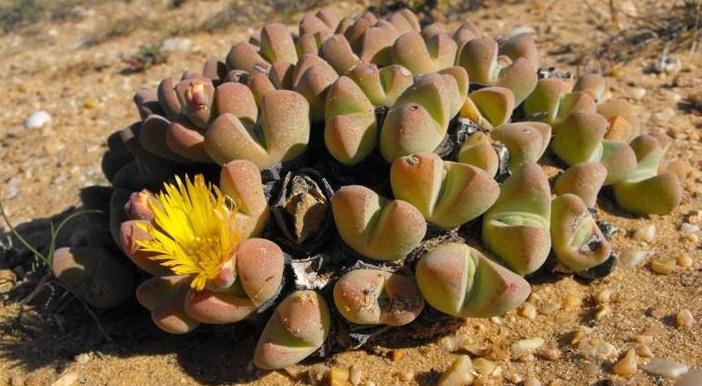
The brown clockfig, an extremely rare succulent growing in the hot, arid border region of Namibia and South Africa, was recently assessed as critically endangered by the IUCN, the global wildlife conservation authority. The western Gariep Valley is a vast landscape spanning the southern part of Tsau ǁKhaeb National Park in Namibia and the Richtersveld region of Northern Cape province in South Africa. It’s in this harsh environment, shaped by extreme heat and dryness, that the brown clockfig (Cheiridopsis brownii) grows on quartz ridges, shale, gravel, and sandy soils, and in cracks and fissures in desert mountains. The IUCN estimates the species, with thick leaves and daisy-like yellow flowers, has a total range of 424 square kilometers (164 square miles) in the valley, but occupies only around 60 km2 (23 mi2) of this area. Habitat loss due to overgrazing is among its major threats. Another is the demand for mineral resources such as diamonds, with mining permits being issued across the region. That’s placed more of the species’ already limited habitat under pressure in both South Africa and Namibia. “The vast desertification of the Aniesvlakte [plain in South Africa’s Richtersveld region] as a direct result of severe overgrazing, as well as the mass desertification caused by sand moving from the coast due to unrehabilitated mines, are threatening to swallow most of the remaining population in South Africa,” Pieter van Wyk, a botanist with South African National Parks (SANParks), who carried out the most recent assessment, told Mongabay via email. Another…This article was originally published on Mongabay
A multi-day thunderstorm over the Mediterranean Sea struck Malta, stranding hundreds of passing migratory birds on Sept. 14, 2026. Hunters in the country then shot hundreds of those birds, including protected species, shows evidence gathered by the conservation NGO Birdlife Malta. Malta sits on the Central European-Mediterranean flyway that millions of migratory birds use annually as they fly from their breeding grounds in Europe to overwinter in Africa. Strong weather systems can interrupt these journeys, causing a “bird fall” — a phenomenon where hundreds of birds seek shelter on land. “This can result in unusually large concentrations of exhausted migratory birds in particular locations,” Antonia Micallef, public engagement executive at BirdLife Malta, told Mongabay by email. “This concentration makes birds much easier to detect and target [by hunters].” Malta has the highest density of hunters in all of Europe. “Over 10,000 hunters [are] active at any one time,” Micallef said. According to BirdLife Malta, hunters shot more than 500 European turtle doves (Streptopelia turtur), a threatened species whose numbers have plummeted, after the storm. Malta allows a quota of 500 European turtle doves to be hunted in autumn, which runs through the end of September, but Micallef said that number was reached soon after the storm, and the season was closed on Sept. 14. “Despite the official closure, BirdLife Malta documented ongoing hunting of Turtle-doves in the hours and days that followed,” Micallef said. Volunteers also reported hunters shooting at a flock of more than 150 little egrets (Egretta garzetta)…This article was originally published on Mongabay
The Uganda Wildlife Authority (UWA) and the Wildlife Conservation Society (WCS) have signed a 10-year agreement to co-manage a portion of Queen Elizabeth National Park, famous for its tree-climbing lions. WCS will take over some day-to-day roles for the Ishasha Sector in the south of the park, including those covering biodiversity management, community engagement and the development of tourist enterprises, according to WCS Uganda country director Simon Nampindo. UWA will retain responsibility for law enforcement and wildlife protection in Ishasha, he added. The agreement follows a wider trend of “public-private” partnerships between African governments and conservation organizations to manage parks. “Across all pillars, WCS and UWA will work closely in the co-development and implementation of all activity workplans and budgets,” Nampindo told Mongabay by email. Queen Elizabeth’s Ishasha Sector covers around 500 square kilometers (193 square miles) of the park’s 1,978 km2 (764 mi2) area. Historically, Ishasha’s lions have been a magnet for tourists, but the animals are becoming rare. According to UWA’s figures, the overall lion population in Queen Elizabeth declined by more than 90% between the late 1970s and 2022, falling from 400 to 39 individuals. Nampindo said there are now fewer than five lions in Ishasha. Unless that population is supplemented — likely through translocation from elsewhere — it will not be able to recover naturally. Queen Elizabeth’s lions have faced several overlapping threats, including conflict between the predators and local herders, habitat loss and snares set by poachers in the park. Nampindo said these causes of…This article was originally published on Mongabay

 Login