❌

Reading view

The New Subterranean Front

Photographs and videos by Sasha Maslov

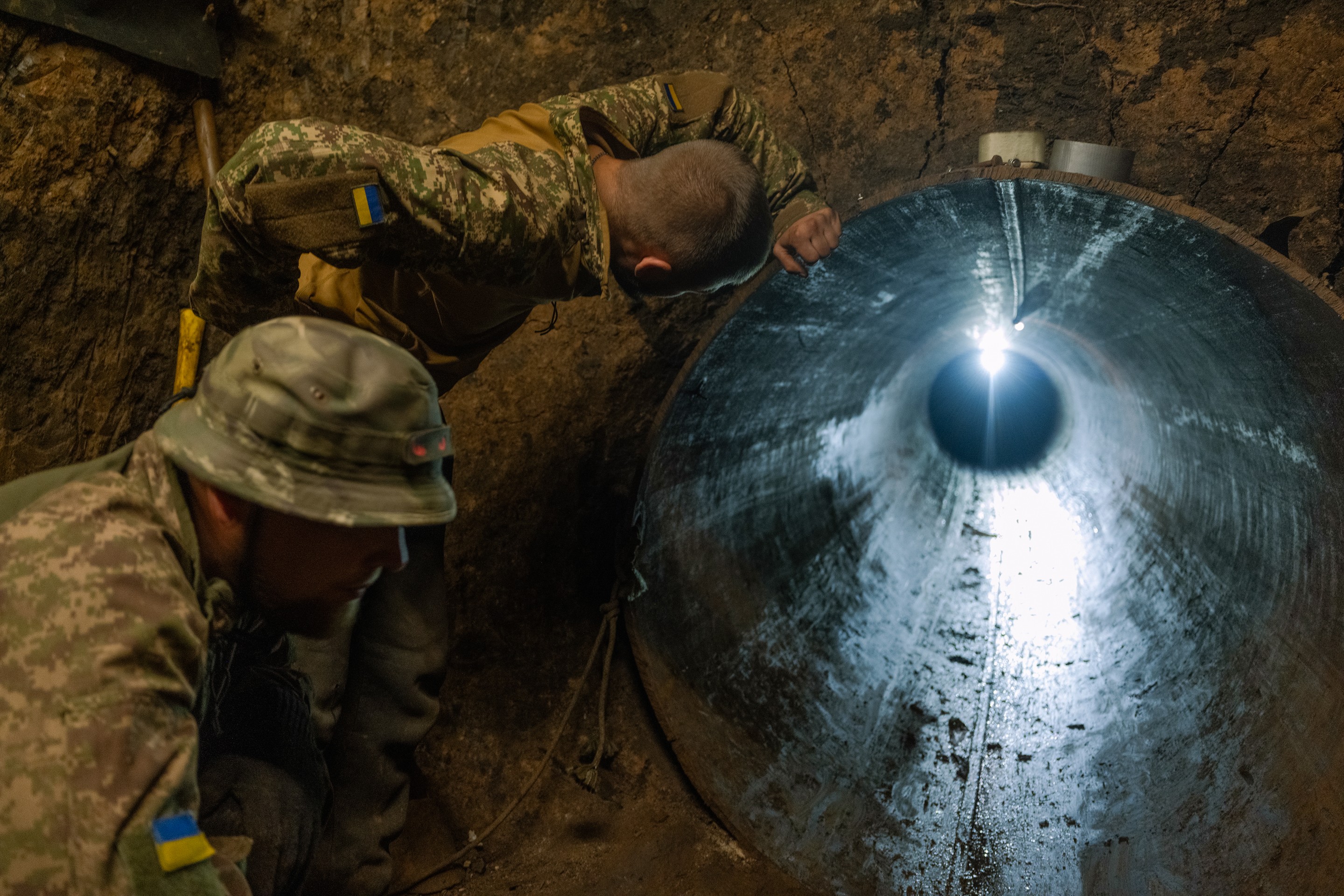
Ukraine’s newest battlefield lies inside a network of steel pipes deep below the ground, some barely wide enough for a person to crawl through. Before the war, these pipes carried natural gas from Russia to Ukraine. Now soldiers zip through them on electric buggies, ambushing one another with machine-gun fire and rocket-propelled grenades.

Most wars put soldiers through excruciating trials. But even by the standards of brutality set more than a century ago in the mustard-gassed trenches of World War I, the fighting in Ukraine keeps plumbing new extremes. At least 1 million troops—by some estimates, more than 2 million—have been killed or gravely wounded in this war, mostly by the drones that fill the skies above the battlefield, hunting anything that moves. Over the past few years, the omnipresent drones have produced an effective stalemate at the front, which stretches for more than 700 miles across eastern and southern Ukraine. 

Sasha Maslov
A Ukrainian officer of the Khartiia Corps, Volodymyr Dehtyarov, rides through a pipeline on an electric buggy.

Aboveground, neither side has found a way to advance through what’s known as the kill zone—a new kind of no-man’s-land, dozens of miles wide, where drones can spot and attack any dugout, any vehicle, even a lonely soldier trudging through a field. “Day by day, the kill zone is expanding, getting wider and deadlier,” Brigadier General Ihor Obolensky, who commands a force of several thousand Ukrainian troops, told me. “So what’s the answer? You go underground.” There, at least, the drones cannot see you. The Russians were first to figure this out, and they have pioneered a new approach to warfare, Obolensky said. “Now we’re catching up.”
2026_10_21_ukraine-pipe-network-228.jpg
Sasha Maslov
Ukrainian soldiers stand at the entrance to one of the steel pipes now used for subterranean warfare.

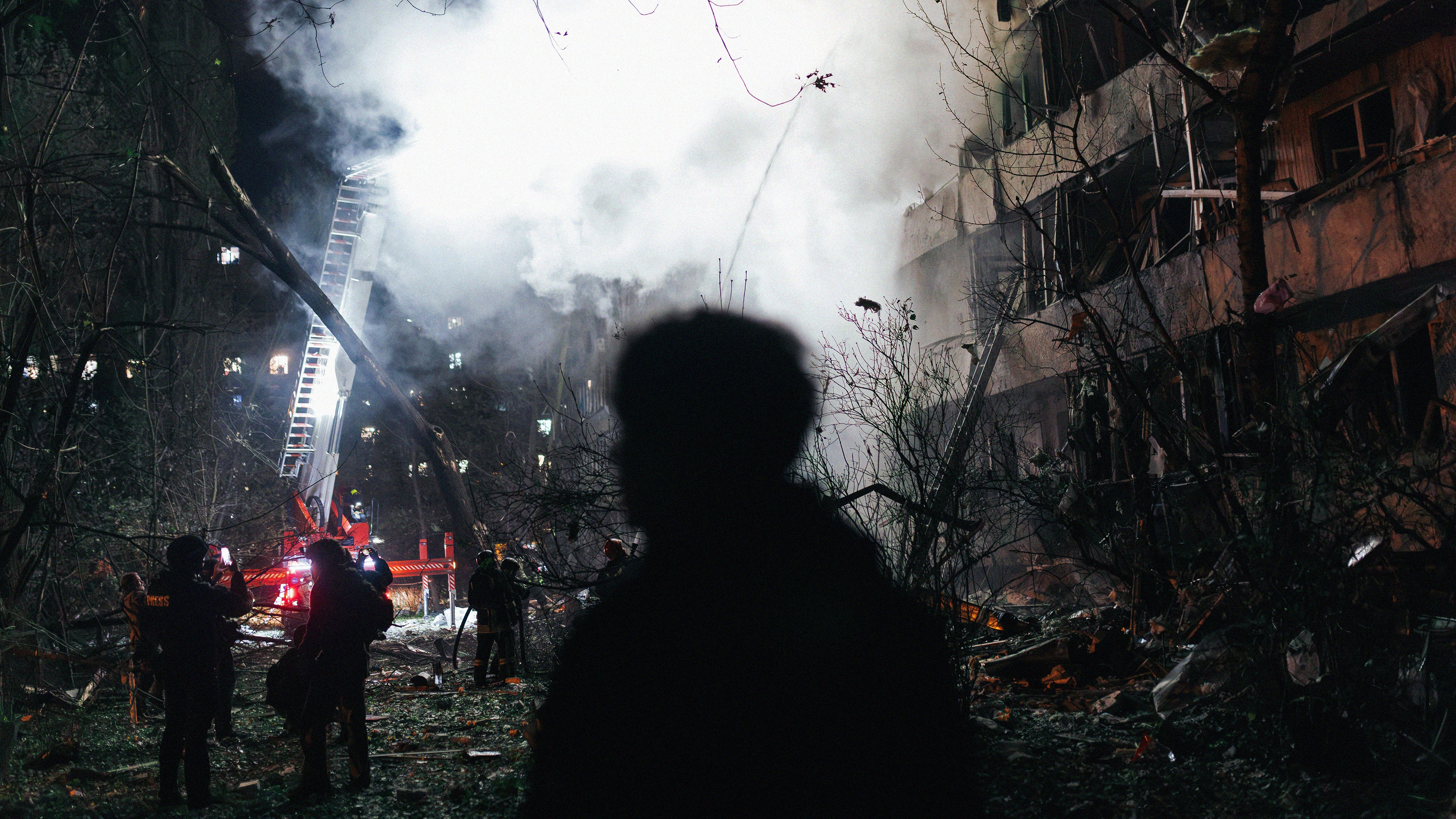
These battles, which have not been previously reported in detail, mark a broader shift in the war. Amid the intensifying barrage of Russian missiles and drones on Kyiv and other cities, many civilians have been forced to shelter underground. Schools have built subterranean classrooms. Parts of the electricity grid have moved belowground. 

Weapons factories now tend to operate inside enormous bunkers. And firefights take place under the earth, one of the only areas in Ukraine that remains safe from drones and missiles. 

The outcome of these battles could decide the course of the war. Throughout the year, the Russians have stockpiled supplies and mobilized soldiers in preparation for a winter offensive, several military officers and senior officials in Ukraine told me. They fear that the offensive will attempt to punch a hole through the kill zone and seize all of eastern Ukraine, which Russia could use as early as next year to launch another push toward the center of the country and its capital. Control of the gas-pipeline network in the contested region of the Donbas could give Russia a decisive advantage in the winter campaign, Obolensky told me.

[Read: Ukraine finds a new set of targets]

a soldier stands in a hallway
Sasha Maslov
Commander of the Khartiia Corps, Ihor Obolensky, at a bunkered headquarters in the Kharkiv region

His troops, part of a military corps known as Khartiia, or “The Charter,” realized the importance of the pipeline network in the spring of 2025, when Russian troops used it to sneak behind Ukrainian lines and stage a series of surprise attacks. “They kept climbing out of the earth like devils,” Obolensky said. The infiltrations mostly took place in bad weather, when drones had a hard time spotting the Russians as they emerged from underground.

The Ukrainians responded at first by playing a deadly game of whack-a-mole. “We would try to find their exit points and cut them down when they surfaced,” Obolensky said. “But they would just keep popping up several kilometers behind our lines and attacking us.” 

To better understand the threat, the general requested maps of the pipeline network from Ukraine’s state energy company. The documents showed the extent of the danger: a warren of at least 57 steel tubes running underneath the war zone, most of them one to two meters in diameter. For decades, such pipes had been used to transport gas from Siberian fields to customers in Ukraine and other parts of Europe. Ukraine cut off this trade with Russia at the start of last year. The pipeline network then went dormant, but not for very long. 
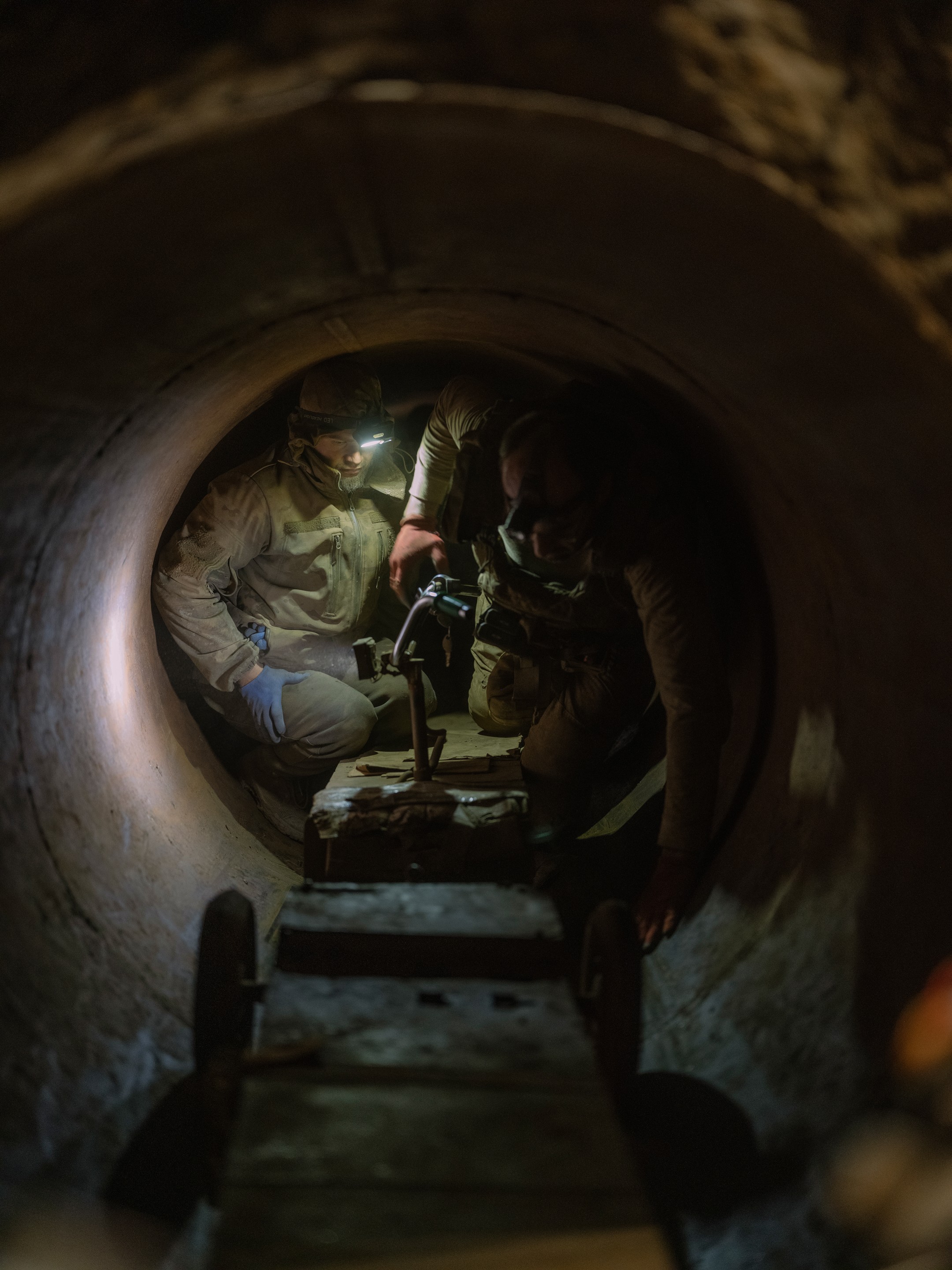
soldiers fix a scooter in a tunnel
Sasha Maslov
Soldiers with one of the electric buggies they use to travel through the underground network of pipelines
Courtesy of the Khartiia Corps
In footage taken by Ukrainian soldiers, firefights erupt at close range inside steel pipes belowground, as troops fire high-caliber rifles and rocket-propelled grenades at one another.

Russian commanders sent their troops into the tunnels only a few weeks later, near the end of the months-long battle of Sudzha, a town in western Russia that the Ukrainians seized in August 2024. Not since the Nazi invasion of the Soviet Union in 1941 had an enemy taken Russian land by force. For the Kremlin, Sudzha stands as one of the defining humiliations of this war, and for Ukrainian President Volodymyr Zelensky, it was a significant if fleeting victory. He ordered his troops to hold that terrain, hoping to trade it against territory Russia had occupied in his country. 

But his counterpart in Moscow, Vladimir Putin, had no intention of making such a deal. Instead, Putin called on support from his ally in North Korea, which sent thousands of troops to help Russia retake the wider region of Kursk. The fighting raged throughout that winter. At the start of last year, the Ukrainian hold over Sudzha began to slip, in large part because the Russians made extensive use of sewers and other tunnels to take the town back street by street. 

Reports of these infiltrations horrified many Ukrainians, who found it hard to understand how Russia could motivate its soldiers to crawl for miles through a filthy pipe to reach enemy territory. This summer, a Ukrainian blogger interviewed two Russian prisoners of war who claimed to have done that. Both said they had been serving time for murder in Russian labor camps when military recruiters came to offer them their freedom in exchange for service in Ukraine, a common practice in Russia. 

One of the prisoners recalled hobbling through the pipe for two days, doubled over at the waist, before reaching a hole through which he could escape into Ukraine and hide in a forest. When he radioed his commander for permission to retreat because of a leg injury, the response made clear that he had been sent to die. “There was no way back,” he said. “Only forward.” 

In early 2025, soon after the Ukrainians withdrew from Sudzha, they began to see similar tactics on their own territory, including in the battle for Pokrovsk, in eastern Ukraine, Obolensky told me. His men mostly operate in the northeastern region of Kharkiv, where they have fought for more than a year to defend the city of Kupiansk, about 25 miles from the Russian border. Enemy troops kept appearing behind their lines, sometimes only one or two at a time, hiding in an abandoned building or digging a foxhole under the roots of a tree. Then they would wait for other Russians to join them before launching an ambush, Obolensky said. “The question kept arising: Where are they coming from?”

Sasha Maslov
Ukrainian soldiers emerge from a gas pipeline near the front line.

In late July, the general made his first trip into the pipes, and he came out shaken. When we met in Kyiv last month to talk about the experience, he showed me a video he had taken of himself in those moments, his face smeared with grime and his voice unsteady with emotion. “The guys working down in these pipes right now, they are heroes, unlike any other warriors I have seen,” he said into the camera of his phone. 

[Read: Trump’s October surprise]

a man covered in soot
Sasha Maslov
A Ukrainian soldier emerges from a 30-day deployment in the system of underground pipes, in the frontline region of Kharkiv.
a rifle and bag covered in mud
Sasha Maslov
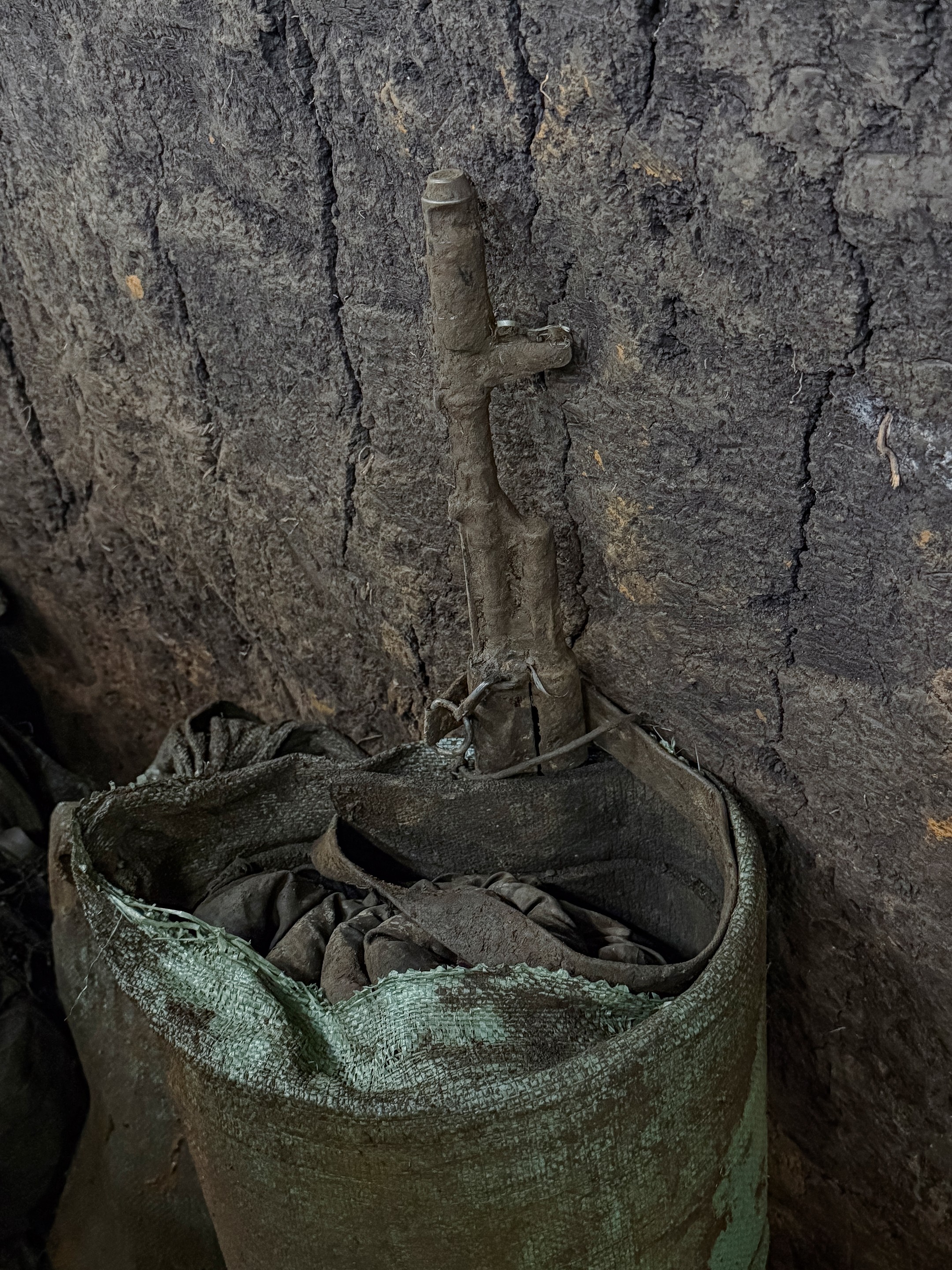
The rifle of a Ukrainian soldier, covered in grime after a month in the network of pipes

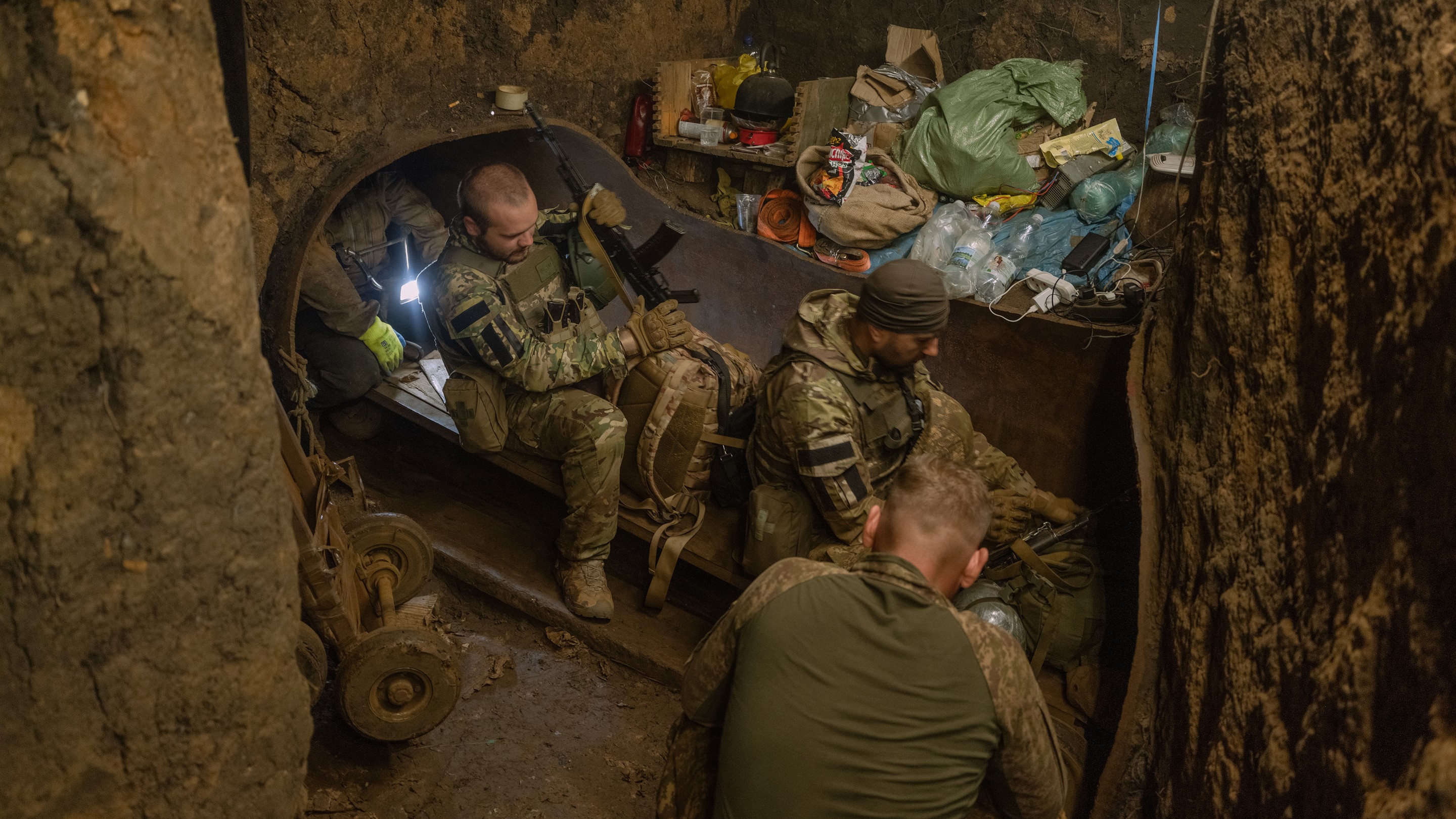
Other videos Obolensky shared with me show the terrifying conditions in this subterranean front. Troops from the Khartiia Corps often spend weeks underground, advancing through the pipes on repurposed coal-mining wagons powered by motors from electric scooters. The tunnels reek of residue from natural gas and other chemicals. When the Ukrainians approach an enemy position underground, firefights erupt. Both sides shoot high-caliber rifles and launch grenades, causing shrapnel and bullets to ricochet inside the metal pipes. 
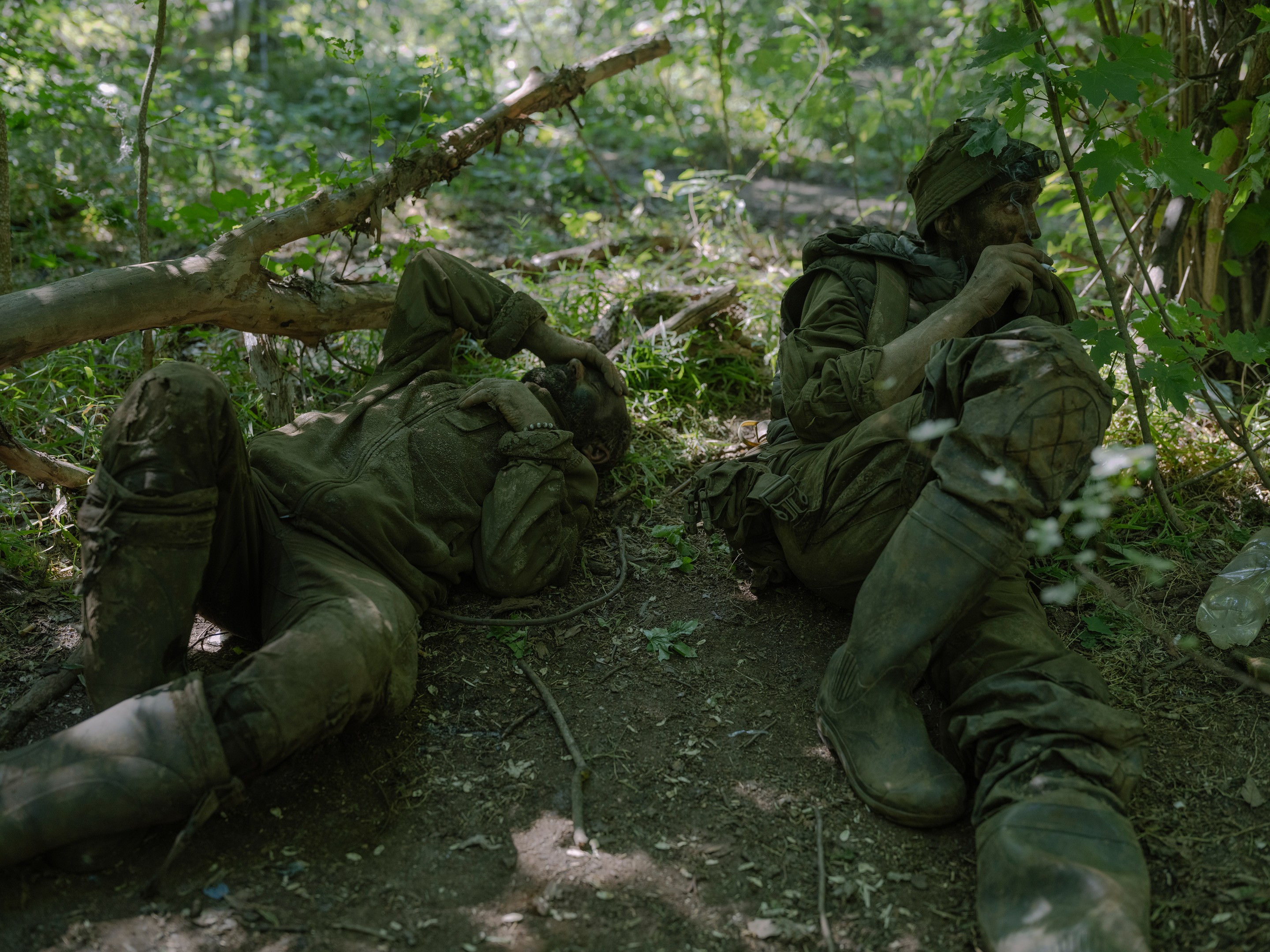
dirty soldiers lay on grass and smoke cigarettes
Sasha Maslov
A pair of Ukrainian soldiers from the 39th Marine Brigade rests near the front after emerging from a month-long deployment in the system of underground pipes.

Explosions suck the air out of the cramped spaces, forming vacuums that leave the soldiers unable to breathe. They rely on gas masks and oxygen tanks, plugging their ears to muffle the deafening blasts. To advance, the Ukrainian troops often break through walls of sandbags erected by the Russians and push forward through incoming gunfire. 

As of this week, after roughly six months of underground warfare, the Khartiia Corps had seized back control of about nine miles of pipelines in northeastern Ukraine, part of an operation they code-named Veles, after the Slavic god of the underworld. Obolensky described it as the first successful counterattack ever carried out in such conditions. But he knows that many more will be required to clear the network of pipes that Russia controls. Ukraine has, so far, retaken two. Dozens remain in Russian hands. 

Sasha Maslov contributed additional reporting.
© Sasha Maslov
  •  

Why Trump Is Furious at Ukraine

Over the next eight weeks, as winter envelops Ukraine, Russia plans to use the frigid weather as a weapon. Its arms factories have already made enough missiles and drones to take down Ukraine’s electrical grid, as well as the heating systems that millions of people rely on to stay warm. Homes far from the front will become deadly for their inhabitants as temperatures fall.

In that same time frame, three events taking place thousands of miles away could determine Ukraine’s future. The first is America’s Election Day, now two weeks away; leaders in Kyiv fear that if Democrats win one or both chambers of Congress, President Trump may turn even further against them in those final weeks of full Republican control of Washington. The second is a proposed summit in mid-November in southern China, where Russian President Vladimir Putin wants to meet with Trump and Chinese President Xi Jinping to plan how to end the war—without having a seat at the table for Ukraine.

The third is the G20 summit at Trump’s Miami-area golf course, scheduled to take place in mid-December. The president has visions of standing between Putin and Ukrainian President Volodymyr Zelensky as they sign a peace deal, even if he has to strong-arm Ukraine to do it, according to advisers. One Ukrainian official, speaking on the condition of anonymity to candidly discuss internal conversations, told us that it’s hard not to feel left out of decision making that will dictate the country’s future: “It looks like this is all happening without us.”

The U.S. president, who used to brag that he could resolve the war in 24 hours, has tossed aside some sanctions on Russia and struck a deal with Putin to import diesel from Moscow, giving a boost to the Russian war machine. He and his allies have threatened Kyiv, demanding that Zelensky stop attacking Russian oil refineries or risk losing access to American intelligence, weaponry, and satellite communications that it uses to defend itself. The calendar is now Ukraine’s foe—and so, Ukrainians fear, is Donald Trump.

Trump’s war in Iran has appeared to throttle Republicans’ chances in the midterms; the unending conflict, and the resulting surge in oil and gas prices, has eroded the GOP’s poll numbers and fueled Democrats’ hopes of taking both chambers of Congress. Stymied in his efforts to bring that war to a close, Trump recently shifted his focus to resolving the Ukraine conflict, in part to bring fuel prices down. But the way he’s chosen to try to do that has provided his fellow Republicans with a nasty October surprise. In a first for a U.S. president, Trump has sided with a traditional adversary, Russia, over a democracy that is not only fighting for its existence but also acting as a bulwark against a wider war. Trump’s diesel deal with Putin will have a negligible impact on American energy prices, but it’s a financial lifeline for Moscow.

[Read: Ukraine finds a new set of targets]

Trump has demanded an energy cease-fire—he even announced one earlier this month that had no basis in reality—yet has focused his ire entirely on Ukraine’s attacks on Russian oil refineries. He blames those strikes for the rise in energy prices while ignoring the real culprit, Iran’s ability to defy the United States and close the Strait of Hormuz. He’s convinced himself, three people close to him have told us, that Ukraine’s attacks on the refineries are, in part, meant to undermine Republicans’ chances next month—and, by extension, Trump. The president has ignored Moscow’s attacks on Ukraine’s electrical grid, and yesterday, hours after a drone strike on a public park killed six people, including two children, he downplayed its strikes on Ukraine’s cities, declaring that Russia had not “been doing much.” An image of one of the dead children, a 1-year-old killed as she sat in her stroller, was broadcast around the globe.

More pressure could be coming. Trump aides have threatened to withhold arms sales unless Kyiv stops targeting Russian diesel plants; this week, the administration delayed approving the transfer of missiles that Ukraine needs for its defense. Ukraine in the past week has said that it has not consistently received early warnings of attacks and no longer has full Starshield satellite access, which is impeding its ability to defend itself against Russia’s new fleet of jet-powered drones. (The Wall Street Journal reported today that Starshield’s creator, Elon Musk, ordered the slowdown. The White House and Musk had previously denied involvement.)

Some in Trump’s orbit have suggested that the United States go further and stop sharing intelligence with Ukraine. Trump’s deference to Putin has been a theme for a decade, yet this new round of kowtowing has handed Republicans another obstacle ahead of the elections. In a rare act of defiance, a handful in the party have denounced the president’s decisions, including his move to undercut a Russia-sanctions bill that he signed only a month ago in honor of its champion, the late Senator Lindsey Graham. The quick betrayal of Graham’s legacy was a blow for some of his Senate colleagues; GOP aides told us that Graham’s sudden July death cost Ukraine its most vocal champion in Trump’s inner circle, and that no one has stepped up to fill that void.

Michael Froman, who worked in the Clinton and Obama administrations and is now president of the Council on Foreign Relations, told us that cutting off Kyiv from American weapons or intelligence might, in fact, prolong the war because it “would undermine Ukraine’s position at the negotiating table and make it less likely Russia would be willing to negotiate on any of the key outstanding issues.”

Officials with both parties predict that the Democrats will capture the House next month; the Senate appears to be a true toss-up. Kyiv will be carefully watching the results. A Democratic win next month will, in the long run, likely help Kyiv, and some of the more hopeful members of Zelensky’s camp believe that Republican defeats could force Trump to focus more on domestic issues, resulting in him leaving Ukraine alone. But other observers on both sides of the Atlantic fear that the opposite could be true. A president without a friendly Congress tends to fall back more on foreign policy, where he needs little help from Capitol Hill. Either way, the new Congress won’t be seated until January 3, leaving Trump unchecked for two more months and perhaps motivated to wield power before his party moves into the minority. Another major national election would not be for two years—plenty of time for Trump to push Ukraine without fear of voters punishing Republicans. “He could get distracted at any time,” one outside Trump ally told us. “But right now, he’s furious at Ukraine, and he wants Zelensky gone.”

Two weeks after Election Day, Trump plans to board Air Force One bound for a series of summits in Asia. Earlier this month, Trump overruled White House aides who had counseled against him calling to wish Putin a happy birthday, warning that little good would come of it. In that conversation, Trump authorized the diesel deal, and Putin suggested something grander: a meeting of the world’s great powers to divide up the world. Or at least Ukraine.

Putin proposed that he, Trump, and Xi hold a trilateral meeting on the sidelines of the Asia-Pacific Economic Cooperation in Shenzhen, China, in mid-November to discuss a variety of issues, including Ukraine. Trump told reporters yesterday that he is open to attending the meeting, which would be his first face-to-face encounter with Putin since their unproductive summit in Alaska last year. It is no surprise that Trump is drawn to the idea; his deference toward Putin is rivaled only by his regard for Xi, whom he hosted in lavish fashion at the White House last month. He has previously been intrigued by the idea of the three powers—China, Russia, the United States—dividing the globe into spheres of influence, although Moscow these days hardly wields the international clout of Washington or Beijing.

[Read: The deferential president]

The idea of two authoritarians and their admirer plotting to slice up sovereign nations alarmed much of the West. And how, Kyiv demanded, could Ukraine’s future be decided with no input from Ukraine? But some in Trump’s orbit have backed the idea, belittling Ukraine as a corrupt backwater with no autonomy. Putin has never viewed Ukraine as a legitimate country, and Trump has held a grudge against it since 2019, when he was impeached (for the first time) after pressuring Zelensky to dig up damaging information about Trump’s political rival Joe Biden. He and his Ukrainian counterpart had a shouting match at the White House early in Trump’s second term, causing the U.S. to briefly withhold intelligence. Since then, Zelensky has tried to flatter Trump to stay on his good side, but those niceties have vanished as the American president has demanded that Ukraine pick a new leader.

Many of those in Trump’s orbit are unsympathetic to Ukraine’s plight and see the war not as a battle for the modern, rules-based world order—with its cardinal tenet prohibiting the seizure of land by force—but as an impediment to future business deals with Russia, some of which could enrich members of the president’s inner circle. Pushing Ukraine into taking a deal, even if that means it has to give up its claim on the Donbas, would open up avenues to dealmaking on Russia’s diesel, rare-earth minerals, and other resources. Zelensky has balked at any territorial concessions. “Our worry is that they are looking at this as a new Yalta Conference, to divide the world into spheres of influence,” another Ukrainian official told us.

Trump’s ideal timeline for some sort of Russia-Ukraine peace agreement, as we reported last week, would be in December at the G20 summit. That bit of history, were it to occur, would take place at one of Trump’s own properties. In Trump’s first term, he pushed to host the 2020 G7 at his golf course in Doral, just outside of Miami. But Trump abandoned the idea amid bipartisan blowback over his plan to personally profit off the event.

This time, there has been nary a Republican whimper of protest about Trump’s venue choice, but some have lodged complaints about the president’s other idea for the summit: to invite Putin. The Russian leader has yet to agree to show up, but if he does, it would be the first time he has attended a multilateral summit in a Western country since his invasion of Ukraine. It would allow him to take another step in shedding his status as an international pariah, though it is hard to imagine that European leaders are eager to talk with Putin.

Zelensky, who has already committed to attending the G20, has made clear that he would be willing to sit down with Putin, no matter the venue, to work out an agreement to end the war. If Trump has his way over the next eight weeks, it might be not a negotiation, but a capitulation.

© Efrem Lukatsky / AP

  •  

Ukraine Finds a New Set of Targets

Ukrainians have gotten used to awful news. But even by their standards, the past several days have felt dismal. Russian missile strikes are pounding Ukrainian cities relentlessly. Donald Trump announced a deal last week to buy Russian diesel fuel. Then came reports about disruptions in U.S. support to Ukraine, including the Starlink communication system. Together, these developments have caused alarm in Kyiv on a scale rarely seen since the start of the war.

The only letup in the gloom appeared on Friday, when Ukrainians had a chance to imagine their tormentor, Vladimir Putin, aboard his presidential plane, seething as it circled over Moscow, unable to land in his own capital. A swarm of Ukrainian drones had forced the closure of the city’s airports that day—all four of them—as Putin flew home from a trip to Turkmenistan. His plane, known as the Flying Kremlin, does not appear to have been the target. “It was purely coincidental,” a military officer familiar with the operation told me. “Just a matter of chance.”

Still, to many Ukrainians, it tasted briefly of revenge, and it showed that their military still has ways to hurt Russia’s economy and its leader, even if Trump decides to abandon them. On Tuesday night, nearly 500 drones attacked Moscow, again prompting the closure of its airports, according to the city’s mayor. Such methods may not be enough to force Putin to negotiate. But they allow Ukraine, if it chooses, to stay in the fight and keep up the pressure on Moscow to come to the table.

Since early last month, Ukrainian drones have interfered with air traffic over the Russian capital almost every day, a version of a military operation code-named M&Ms, which The Atlantic first reported in August. The operation does not rely on U.S. technology or intelligence, two of its architects told me. Instead, it uses drones produced in Ukraine and equipped with AI guidance systems to bring the war to Russia. (Both sources spoke on condition of anonymity to discuss sensitive military plans.)

Such homegrown innovations could give Ukraine leverage in any future peace talks. But they do not bode well for the global state of aviation safety. Not since the terrorist attacks of September 11, 2001, have airports and airplanes looked more vulnerable. The Houthi rebel group, which is backed by Iran, launched two salvos of missiles and drones this weekend at the main airport in Riyadh, killing more than a dozen people and wounding hundreds. A week earlier, the U.S. Air Force evacuated a dozen bombers from an air base in England, reportedly due to a threat from Iranian drones.

The spread of these weapons has made such attacks far cheaper and easier to stage. In early August, German authorities discovered a suspected Russian drone at an airport near Leipzig, apparently armed with explosives and prepared to blow up a Ukrainian cargo jet. A month later, Russian drones targeted Zelensky’s plane as it took off from Moldova on the way to Norway. “That is the reality he lives in,” Norway’s prime minister, who first reported the apparent attempt on Zelensky’s life, said.

[Read: Trump’s October surprise]

Many world leaders now live in that reality, even Putin. On the day of his diverted flight to Moscow, the Russian leader spent 90 minutes on the phone with Trump, who announced after their call that the United States would buy millions of barrels of Russian diesel. To protect that deal, Trump urged Ukraine to stop bombing Russian oil refineries. Zelensky has reluctantly complied in recent days. But his military has intensified attacks on other sensitive targets, which could prove no less disruptive for Russia’s economy and the lives of its people. The spate of attacks on Russian data centers in the past week has made that clear.

Since October 8, Ukraine has bombed at least four Russian data centers, a class of targets it previously avoided. The attacks caused widespread outages of online services, including some of Russia’s most popular banking, delivery, map, and taxi apps. At Moscow’s airports, Ukrainian drones forced authorities to cancel 345 flights last week alone, according to a tally kept by Echo of Moscow, a Russian news outlet. “The Russian sky is becoming extremely dangerous,” Zelensky said on September 1, when he announced the start of the campaign to disrupt air traffic in Russia. “Civilian aviation has no place amid drones.”

The two architects of this campaign told me that it is only just getting started. So far, Ukraine has used long-range drones to clog the airspace around Russian airports without striking them directly. In one incident this weekend, debris from a downed Ukrainian drone reportedly fell on the airport in Sochi, causing a fire at an administrative building. Zelensky has not yet allowed his military to proceed with the original plan for operation M&Ms, which called for much more aggressive tactics.

According to the authors of the plan, the more ambitious version would use AI-guided drones to circumvent Russian air defenses and hit airports in Moscow and other cities. These drones will soon be manufactured at scale, one of the authors of the plan told me.

Although Trump has intervened to secure supplies of Russian diesel, he has said nothing about the recent attacks on Russian airports and data centers. On the contrary, when he first called on Zelensky last month to stop bombing Russian oil refineries, he tempered his demand with an invitation for Ukraine to bomb something else. “There are plenty of other targets,” Trump said.

[Read: Trump’s latest appeal to Russia could outrage even his allies]

But the same holds true of Ukraine. Last month, when Zelensky began the M&Ms operation, Russia intensified its bombing of civilians, launching regular daytime strikes against apartment blocks, schools, and academic institutions. Such attacks serve no military purpose other than to terrorize the population. The most recent casualty report from the United Nations said that the Russian bombing campaign reached “a new level of intensity” last month, killing at least 200 civilians and injuring 1,234 from September 1 to 24, when the report came out.

At this stage in the war, the escalations cut both ways. No matter what new weapons and tactics Ukraine deploys, Russia can always answer with more brutality. Trump no longer seems interested in stopping that cycle of violence. He has shifted from the role of mediator between warring sides to a dealmaker with the Russians, and that presents Zelensky with a stark choice: accept Trump’s and Putin’s demands to end the war on Russia’s terms or find new ways to continue fighting, with or without American support.

At the start of this year, when Ukrainian officials first offered Zelensky the M&Ms plan, he deemed it too dangerous. It called for as many as 1,000 drones to attack Moscow’s airports every day, making it impossible for civilian flights to operate. Zelensky allowed his defense minister at the time, Mykhailo Fedorov, to continue developing the AI-enabled drones required for the operation. But Zelensky kept a tight rein on their deployment, insisting that Fedorov minimize the risk to travelers, the two designers of the plan told me.

My first report about the operation, published on August 20, led to an intense public debate about its morality. Many in Ukraine and allied Western countries noted that Russia has shown no qualms about bombing the innocent. “It’s not fair for one side to break all the rules of war while the other side holds back,” a senior European official told me of Zelensky’s hesitation.

One of the architects of the plan told me that public pressure contributed to Zelensky’s decision to announce the start of the campaign on September 1. In a video address released that day, he called for all international airlines to stop flying to Russian airports. “Ukraine does not threaten civilian aviation as such—not a single civilian aircraft,” he said. “There will simply be drones in Russia’s skies on a scale that has to be taken into account.”

At the time, Ukraine did not have the means to act on Zelensky’s threat, one of the officials behind the operation told me. The military lacked the enormous fleet of specialized drones required to shut down Moscow’s airports for an extended period of time, he said. In response to Zelensky’s declaration, only one foreign carrier, Air Tanzania, briefly suspended flights to Moscow. Larger airlines, such as Emirates and Flydubai, continued as normal. “We didn’t follow through,” the Ukrainian official told me in frustration.

Ukrainian arms manufacturers are still developing the specialized drone fleet, which relies on an AI-enabled technique known as map matching to identify targets and decide when to strike, the second person behind the plan told me. He said Ukraine first used this new type of drone in combat in mid-September, when a handful of them struck targets in the Russian-occupied region of Donetsk. They have not yet been deployed at scale against Russian airports, he added.

[Read: Inside the feud over Ukraine’s drone success]

Instead, the Ukrainian armed forces have used other weapons to achieve a similar effect. Rather than targeting airports directly, drones need only to appear in the sky around Moscow, forcing Russian authorities to cancel flights or close runways until the threat subsides. One adviser to Zelensky called it a “side effect” of Ukraine’s regular drone strikes against various targets in Russia. Zelensky prefers this approach because it does not involve targeting civilian aircraft. “That would be piracy,” the adviser, who has not been involved in the operation known as M&Ms, said. “The president doesn’t want to allow that.”

His approach has still been disruptive for travelers in Russia. According to the tally from Echo of Moscow, the city’s airports restricted flights, on average, for more than three hours a day during the first full week of this month. On Friday, when Putin’s plane could not find a place to safely land in the capital, at least two of Moscow’s four airports remained closed to all flights for roughly seven hours.

For regular citizens, these disruptions have been compounded by the new wave of Ukrainian strikes against Russian data centers. Most of the attacks have targeted the facilities of Yandex, a local counterpart to Google that acts as the backbone of Russia’s digital economy. Millions of Russians use its services every day, and many of them posted angry rants on social media in response to the latest outages. Yandex could need up to six months to repair the damage to its data centers, the Russian business newspaper Kommersant reported.

As a bonus for Ukraine and many of its allies, the attacks appear to have caused a sharp decline in the activity of Russian bots across the internet, Zelensky noted in a video address to the Warsaw Security Forum on Monday. “It suddenly became a little easier to breathe on many social-media platforms,” he said. “There was less hate, less division, and fewer provocations, because there were fewer bots.”

In response to such attacks, the Russian military has expanded its strikes against civilians. Locomotives have become a favorite target. In August, 37 of them came under attack, more than one a day, the head of Ukraine’s state railway company, Oleksandr Pertsovskyi, told me. Last month, the number rose to 47, including freight and passenger trains. When we met in Kyiv a few weeks ago, Pertsovskyi pulled out his phone and scrolled through a series of photos, each one showing trains torn apart by explosions. One of the gutted sleeper carriages had spilled its blackened cots and luggage onto the tracks. “This is how my mornings start now, with these reports and images, every day,” he said.

A few days later, Russian drones prompted the evacuation of a train full of foreign dignitaries traveling from Kyiv to Poland, including David Petraeus, the former director of the CIA. One of the passengers, an American philanthropist, told me that she walked through marshy fields in the middle of the night to get away from the train during an evacuation. The attack served as a reminder that no matter how creative Ukraine gets in targeting Moscow’s economic pressure points, Russia can always escalate, stomping on whatever norms remain un-trampled in this war. Trump’s deal to buy Russian fuel will make that easier by inviting the Kremlin to top up its war chest with billions of dollars in export revenue. The deal also lifts some of the sanctions that the U.S. had imposed to punish and isolate Russia, leaving Putin with even less reason to accept a cease-fire.

[Read: Why would Europeans believe Trump now?]

For some members of Zelensky’s team, that act of American betrayal felt less like a setback for their strategy to win the war than it did the end of their best hope for victory. Even one of the officials behind the plan to shut down Moscow’s airports told me that if the U.S. sides with Russia, Ukraine will have little choice but to abandon the ladder of escalation and sue for peace. “There’s a realization now that Russia will not collapse because of its difficult economic situation,” he said. In offering a lifeline to Russia’s energy industry, Trump made the U.S. an obstacle to the Ukrainian strategy of wearing down the Russian economy and exhausting its population. “That means we need to change our strategy,” the official said. “Russia will not collapse, at least not now.” Ukraine still has plenty of ways to make life miserable in Russia, but it will likely take more than that to force Putin to accept a truce.

© Nikoletta Stoyanova / Getty

  •  

Trump’s October Surprise

It rained most of Sunday in Washington, as the remnants of Hurricane Isaias washed over the East Coast. Unable to golf, and stuck inside the White House, President Trump spent part of his morning on social media touting the size of his rallies and defending Christopher Columbus. He also declared that Russia and Ukraine had agreed to halt strikes against each other’s energy infrastructures. Except that he hadn’t first confirmed that with Ukrainian President Volodymyr Zelensky—and Russia spent the hours that followed bombarding Ukraine with missiles and drones, hitting a Kharkiv power plant.

Trump’s inability to bring the Iran war to a close has left him incensed but also oddly paralyzed, two people close to him told us. One of them, an adviser, said that Trump “is used to snapping his fingers and having the whole world—Republicans, world leaders, the media—come to attention, and he is losing his mind that Iran won’t listen.” Iran has resumed menacing oil tankers in the Strait of Hormuz, and the average price of diesel in the United States has crossed the $6-a-gallon mark, raising the cost of goods that travel the nation’s highways on trucks.

Republicans are panicked that those high energy prices could help Democrats take control of the House and Senate in the midterm elections, which are now only three weeks away. Trump has been searching for a scapegoat, and appears to have settled on Ukraine. Although blaming a European country that’s fighting for its existence for the rise in global oil prices might seem implausible, Trump seems to prefer that to accepting responsibility for his decision to attack Iran. His broadsides against Ukraine, moreover, are consistent with his decade-long deference to Vladimir Putin. With rare exceptions, Trump has aligned with Moscow over Kyiv throughout the four-and-a-half-year war. He wants Ukraine to end the fighting—and has pressured the country to agree to terms that Zelensky finds unacceptable.

A U.S. president siding with the Kremlin is quite an October surprise. But in just the past few days, Trump appears to have fully turned against Ukraine. He announced on Friday that he had reached an agreement with Putin to import Russian diesel fuel, undercutting the new sanctions bill against Moscow’s energy industry that Trump signed into law last month. Even if the roughly 2.25 million barrels headed to the U.S. only marginally ease fuel costs, the deal allows Trump to tout efforts to help Americans while also providing Russia with additional revenue. (Another few million barrels are set to ship next month.)

Despite the opposition of European allies and some Republicans on Capitol Hill, Trump has followed up by placing even more pressure on Ukraine. He called for Zelensky to be replaced. His aides have threatened to withhold arms sales unless Kyiv stops targeting Russian diesel plants. Some in Trump’s orbit have suggested that the U.S. go further, and stop sharing intelligence with Kyiv. That was the context in which Trump announced his fictional energy cease-fire. A senior Ukrainian military officer told us that Trump’s statements are “simply beyond comprehension.”

“Things are already incredibly difficult for us here,” the officer said, speaking, like others who talked with us, on the condition of anonymity to discuss sensitive matters. “But apparently, there’s always another level below rock bottom. Things can always get worse.”

Ukraine has expanded its strikes deep into Russian territory in recent months, targeting the larger nation’s oil refineries. Those attacks sparked an energy crisis in Russia and were cheered across Europe—but not in the White House. Russia imposed a ban on diesel exports in response, which added more pressure to global diesel markets already under strain from the war in Iran. Zelensky told Trump and his envoys Steve Witkoff and Jared Kushner that he was willing to stop attacking Russian oil refineries if the Russians halted attacks on Ukrainian power plants, a White House official told us. But Trump doesn’t see the strikes as equivalent—and demanded that Ukraine first stop attacking Russian refineries, the official said. Zelensky refused.

“Zelensky is overplaying his hand and pissing the president off,” the White House official said. “The president is asking for one thing: stop hitting the refineries. Give him that.”

[Read: Trump’s latest appeal to Russia could outrage even his allies]

Trump’s next move against Ukraine came, as it so often does, after a phone call with Putin. Zelensky’s aides have expressed frustration that Putin has swayed Trump at crucial junctures in the conflict (once, even, while Zelensky was flying to Washington to meet with Trump in an effort to secure access to new U.S. weapons). This time, Trump spoke with Putin on Friday to wish him a belated birthday, even though some in the White House counseled against the call, the adviser told us, believing it would yield little. During the 90-minute conversation, Trump told Putin that he would lift the sanctions on Russian diesel exports. (Some in Kyiv believe that the deal was agreed to earlier, because a ship carrying Russian oil and gas is already approaching the U.S.)

That undermined sanctions applied in 2022 and undercut the tougher Russian-sanctions bill that Trump signed last month; the law was named in honor of one of its champions, the late Senator Lindsey Graham. A bipartisan group of lawmakers was infuriated by the move, and some Republicans denounced Trump for siding with Putin. Four GOP senators—Lisa Murkowski of Alaska, Susan Collins of ⁠Maine, Thom Tillis of North Carolina, and John Curtis of Utah—joined some of their Democratic colleagues to release a statement yesterday saying that lifting the sanctions “runs directly counter to that law” and that the U.S. should not provide “Putin with a financial lifeline while Russia continues to kill Ukrainian civilians.”

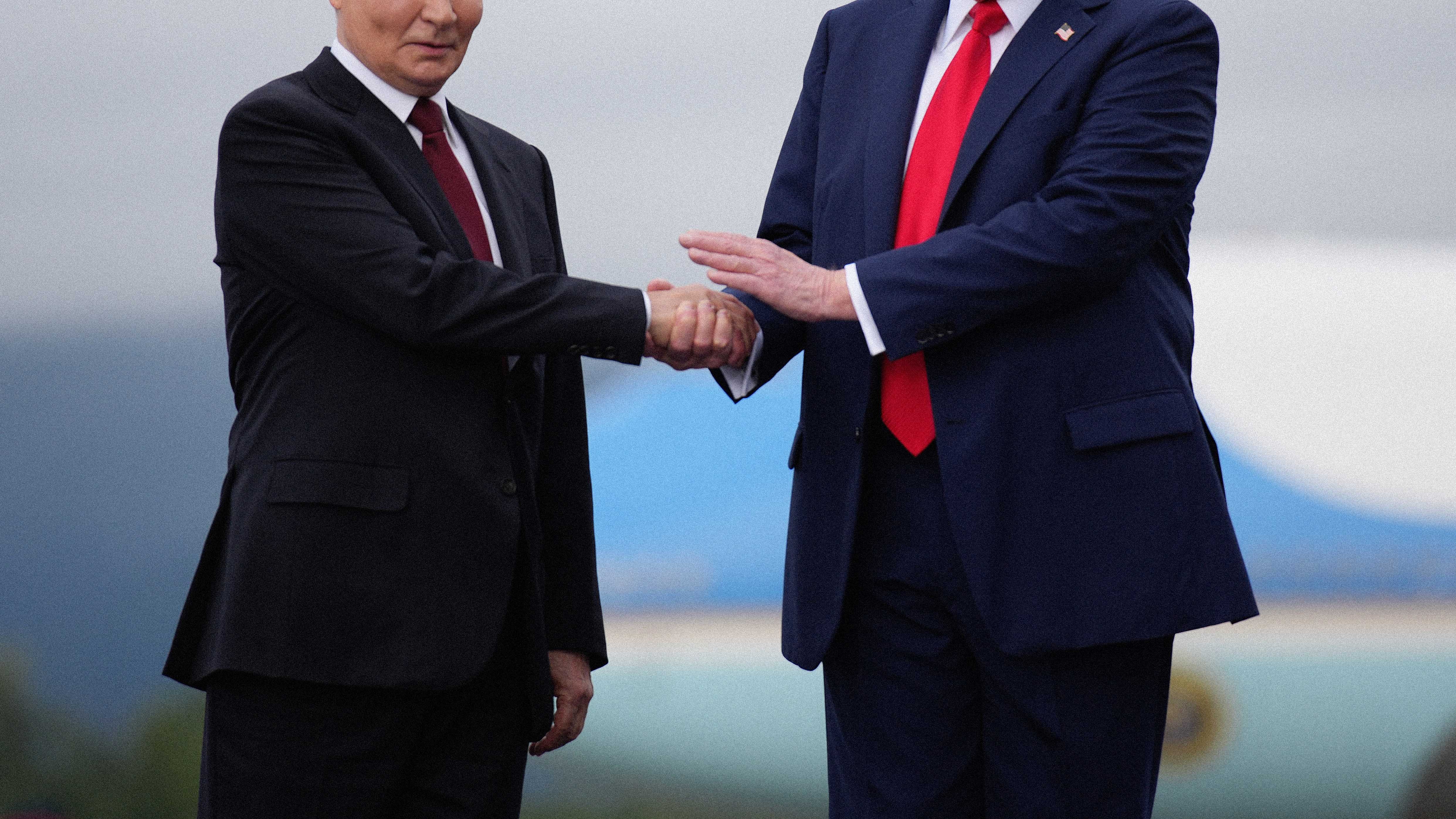
Zelensky, who was blindsided by the diesel deal, deemed it “not fair and not honest.” He had spent more than a year trying to repair his relationship with Trump, which hit its nadir in February 2025 during a shouting match in the Oval Office. Since then, Zelensky has taken to flattering the U.S. president, and he has tried to capitalize on Trump’s occasional annoyance that Putin will not end the war. Trump and Putin’s Alaska summit last year yielded little more than a photo of the two that hangs in the Palm Room at the White House. Even if Trump wouldn’t fully support Ukraine, officials in Kyiv had hoped he would not actively hurt their cause. That hope may be fading.

Recent talks between Kushner, Witkoff, and Putin have included the promise of massive business deals that Russia could strike with U.S. interests once the war concludes, according to reports. Ukrainian officials have long believed that Trump’s foreign policy focuses on opening up business deals—and the potential enrichment of the president’s family and friends—over the defense of democracy, human rights, or territorial sovereignty. Some officials in Kyiv believe that Russia’s economy, which has been remade to fuel Putin’s war machine, will not implode, despite the pressure of increased drone strikes and sanctions. A Ukrainian official close to the negotiating process told us that means “we need to change our strategy, stop fooling ourselves,” and find a way out of the war with Europe’s help. That, the official said, would likely require a new emphasis on negotiations.

During his call with Trump, Putin declined to commit to resuming peace talks, the Kremlin later told reporters. Yet Trump continues to view Zelensky as the primary impediment to peace—and the business deals it might bring—and he called for Ukraine to hold elections to select a new president. (Zelensky has said he will hold an election if Putin agrees to a 60-day cease-fire.) Trump also views Zelensky as an obstacle to his coveted, yet elusive, Nobel Peace Prize, for which he was passed over again last week. A senior European official told us that the U.S. has threatened to stop selling weapons to Ukraine via Europe if the strikes continue, and some close to Trump have suggested that the U.S. stop sharing intelligence with Ukraine, as it briefly did after the 2025 Oval Office argument.

[From the November 2026 issue: The Baltic states prepare for war]

Ukraine was already bracing for a difficult winter. Moscow has escalated its attacks on Ukraine’s cities. It has grown its missile stockpiles and debuted a jet-powered drone that Ukrainian defenses have had difficulty stopping. Europe has tried to fill the gaps left by Trump’s indifference—and the U.S. being bogged down in Iran—but Zelensky’s aides believe that Putin will use the winter to pummel their cities before making another lunge at Kyiv in the spring. If, suddenly, Ukraine were left without U.S. intelligence or American-made weapons, Kyiv might be in its most vulnerable position since the first days of the war.

Trump’s admiration for Putin has been one of the most enduring geopolitical subplots of the past decade. He refused to publicly acknowledge Russia’s efforts to help elect him in 2016, infamously siding with Putin over U.S. intelligence agencies during the leaders’ summit in Helsinki during his first term. More recently, he has refrained from holding Putin to account for helping Iran, even after American intelligence agencies revealed that Moscow gave Tehran targeting information to strike U.S. military assets in the region. Some of Trump’s closest outside advisers have privately wondered what Putin has done to so thoroughly enthrall the president; Trump’s respect for the Russian leader appears undiminished despite the humiliating struggles Putin has faced during the Ukraine invasion.

Instead, Trump has taken steps to help Putin shed his status as an international pariah. Though Putin has been charged with war crimes by the International Criminal Court, Trump welcomed him to Anchorage last summer. Trump’s move to undo the diesel sanctions could provide a boost to Russia’s faltering economy. And he has overruled the objections of some in his own party by inviting Putin to this winter’s G20 summit, which the United States is hosting at a Trump-owned golf course in Doral, just outside Miami.

If Putin accepts the invitation to that December meeting, it would be the first time he has attended a multilateral summit in a Western country since his invasion of Ukraine. Zelensky has said he’ll be there, and is hoping to meet with Putin to negotiate the end of the war. Trump has mentioned to advisers, one of them told us, that he’d like both sides to arrive to Doral ready to make a deal, so he can then preside over a peacemaking summit. Maybe then, Trump has suggested, he can finally win that Nobel.

© Andrew Harnik / Getty

  •  
❌