Heavy rainfall during the cacao flowering season is a major driver of Ghana’s recent harvest fluctuations, new research finds. A study published in September by researchers at the Harvard University Center for the Environment in the U.S. found that heavy rainfall during cacao’s flowering and early pod development is linked to significant yield decreases. The researchers described how short, untypical rains during the flowering season, together with dry-season drought, is a major reason for recent fluctuations in Ghana’s cacao production. Ghana and Côte d’Ivoire together account for about 60% of global cocoa production, making West Africa central to the world’s chocolate supply. Cacao seeds are the primary ingredient in chocolate. The authors raised concerns about how these changing rainfall patterns could affect Ghana’s cacao industry, which is one of the West African country’s most important agricultural sectors. “Along with dry-season drought, [heavy rainfall during flowering and early pod development], those two factors alone explain about two-thirds of the year-to-year variability in Ghana’s production,” lead researcher Anna Lea Albright from Harvard told Mongabay via email. A flowering cacao tree in Ecuador’s Los Bancos Canton. Image courtesy of Pablo Leautaud via iNaturalist (CC BY-NC 4.0). Albright and her colleagues began looking into the issue in 2024, when global cacao prices surged after several poor harvests in West Africa. They considered several possible explanations for the trend, including aging trees, pests and diseases, gold mining, smuggling and weather. Analyzing daily rainfall and temperature records, the researchers noticed a pattern. Losses or gains during…This article was originally published on Mongabay
When researchers mapped almost 100,000 square kilometers of South Africa, or nearly 40,000 square miles, they only found 83 mature adults. They called their project the Free-Roaming Cheetah Census, and it’s the most comprehensive survey of cheetahs ever conducted in the region. The cheetahs that inhabit the unprotected areas here move naturally across borders, going between South Africa, Botswana, Namibia, and Zimbabwe. But farming, construction, development, and fences are making it harder for them to move around. Cheetahs need vast connected landscapes to survive. If they don’t mix with other cheetah groups, their genetic pool can be lost. There’s another big challenge for these animals: farmers. They sometimes kill cheetahs, because they believe cheetahs kill their livestock. But the researchers found that cheetahs hunt mostly wild prey. The species is currently listed as vulnerable, but the census suggests they should be reclassified as endangered in South Africa.This article was originally published on Mongabay
The Zambian government is investigating a chemical spill in its Copperbelt Province allegedly linked to Konkola Copper Mines (KCM), owned by U.K.-based multinational Vedanta Resources. Residents in Chingola district told Mongabay they observed discoloration of the Kafue River and fish die-off on Sept. 28, raising fresh concerns about the environmental and social impacts of mining operations in one of Zambia’s most important copper-producing regions. According to a statement by Gilbert Siame, Zambia’s minister of Green Economy and Environment (MGEE), the incident was caused by a leaking pipe at KCM’s tailings leach plant and an overflow from the company’s pollution control dam outside Chingola. “The pollution control dam was full, that’s why it spilled,” Eugene Mulenga, Chingola-based human rights activist and coordinator for caritas, told Mongabay. “The [chemical] discharge happens all the time, mostly at night, and the local residents consume this water because they don’t have another option.” Following the Sept. 28 spill, tests conducted by the Zambia Environmental Management Agency (ZEMA), KCM and local water utility Mulonga Water Supply and Sanitation Company showed elevated levels of turbidity and conductivity downstream along the Kafue River. In a statement issued Oct. 1, KCM contested its responsibility in the spillage, saying that company officials reported the incident to ZEMA and asked for a fact-based investigation. Mongabay reached out to the company but did not receive a response by the time of publication. Siame noted in the statement shared with Mongabay that authorities are still testing water samples to confirm heavy metals and…This article was originally published on Mongabay
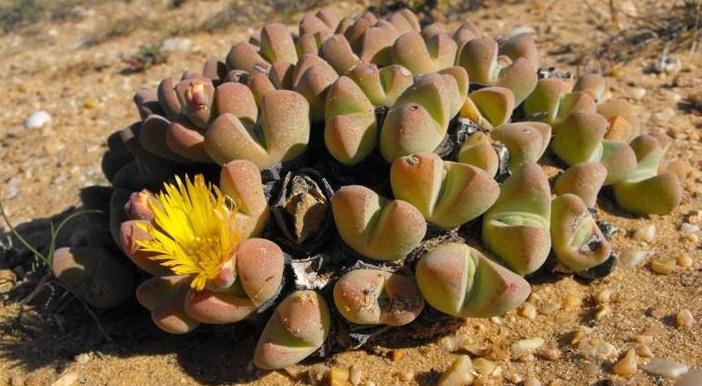
The brown clockfig, an extremely rare succulent growing in the hot, arid border region of Namibia and South Africa, was recently assessed as critically endangered by the IUCN, the global wildlife conservation authority. The western Gariep Valley is a vast landscape spanning the southern part of Tsau ǁKhaeb National Park in Namibia and the Richtersveld region of Northern Cape province in South Africa. It’s in this harsh environment, shaped by extreme heat and dryness, that the brown clockfig (Cheiridopsis brownii) grows on quartz ridges, shale, gravel, and sandy soils, and in cracks and fissures in desert mountains. The IUCN estimates the species, with thick leaves and daisy-like yellow flowers, has a total range of 424 square kilometers (164 square miles) in the valley, but occupies only around 60 km2 (23 mi2) of this area. Habitat loss due to overgrazing is among its major threats. Another is the demand for mineral resources such as diamonds, with mining permits being issued across the region. That’s placed more of the species’ already limited habitat under pressure in both South Africa and Namibia. “The vast desertification of the Aniesvlakte [plain in South Africa’s Richtersveld region] as a direct result of severe overgrazing, as well as the mass desertification caused by sand moving from the coast due to unrehabilitated mines, are threatening to swallow most of the remaining population in South Africa,” Pieter van Wyk, a botanist with South African National Parks (SANParks), who carried out the most recent assessment, told Mongabay via email. Another…This article was originally published on Mongabay

 Login