Les ministres de l’Intérieur des pays membres de l’Union européenne tiendront mardi une réunion en visioconférence sur la situation à Ceuta, enclave espagnole en Afrique du Nord où plus de 60 000 personnes, selon Madrid, sont entrées illégalement la semaine dernière. Le débat sur la politique migratoire européenne est relancé.
Nearly 50,000 of the 60,000 young Moroccans who had entered Ceuta, Spain’s 7.5-square-mile enclave on Africa’s coast, on July 29-30, 2026, by swimming around border barriers, may have returned to their country. But the global headlines they were responsible for have had geopolitical impacts on the rest of Europe and the United States.
Prime Minister Pedro Sanchez of Spain called the event “a violation of Spain’s territorial integrity”. But then the fact remains that his left-wing government’s series of liberal migration policies, coupled with the Spanish Supreme Court’s ruling last month that migrants arriving by sea could not be summarily returned, prompted such a massive migration, for which the country was perhaps not ready.
Of course, this was not the first surge from Morocco. As many as 10,000 from Morocco were said to have entered Spain in 2021. But the scale on July 29-30 made it the largest not only in Spain but also in the history of the European Union(EU).
After all, Ceuta, the small Spanish exclave on the North African coast, has a permanent population of just 84,000. Obviously, swarms of 60,000 outsiders totally overwhelmed the locals.
The crisis forces 3 questions: What drove it? What does Spain’s approach mean geopolitically? And how does the debate over religion, demography and identity shape it?
As pointed out above, the influx was possibly triggered by a ruling by Spain’s Supreme Court that a law allowing the prompt handing back of migrants who breach frontier barriers at Ceuta and Melilla, another Spanish exclave, does not apply to those who arrive by sea. (Those who swim, the court reasoned, do not technically breach frontier barriers, since there are none in the water.) Word of this got around on social media in Morocco, prompting the stream of swimmers.
It may be noted that historically, Morocco has contested Spanish sovereignty over Ceuta and Melilla, just 13 to 14 kilometers from its shores through the Strait of Gibraltar. This has led some analysts to believe that Rabat “deliberately did little to prevent the crossings”.
They cite the similar opening that was made in 2021. But this is a minority view, given that Morocco has already facilitated the return of 50,000 of its people and is doing so even now.
The 2021 episode was a little different. That time Morocco allowed its people to wade into Ceuta, as an expression of its anger that Spain had allowed the leader of Polisario, a group that has long fought for the independence of Western Sahara, to come to Madrid for medical treatment. Morocco, incidentally, had annexed two-thirds of Western Sahara, a former Spanish colony, in 1975.
However, over the last four years, diplomatic parleys between Madrid and Rabat have stabilized the bilateral ties. Spain now backs Morocco’s autonomy plan for Western Sahara in exchange for Rabat policing the coast and taking back illegal migrants.
In 2024, Spain started a program to legalize 900,000 undocumented migrants already in Spain (most of them Moroccans) to bring them into the tax and social security. It decided to issue “Labor visas”, under which fast-track permits to address Spain’s rapidly falling population.
The Sanchez regime has tried to legalize immigration as much as possible under what it calls a “human rights and labor needs” approach that envisages expanded regularization programs, bilateral cooperation with Rabat, and faster work permits for migrants in agriculture, tourism, and elder care.
Apparently, Spain has become the EU’s largest entry point for irregular migration, overtaking Italy and Greece. The vast majority of arrivals were from Morocco and the likes of Malians and Senegalese, who crossed through Morocco by sea. So much so that Spain now has the largest Moroccan diaspora in the EU — over 800,000 people of Moroccan origin, as per Spanish data.
Reportedly, the UN projects Spain needs 200,000 net migrants per year to maintain workforce size. And 10 million foreign-born people for the first time in Spain’s history; they now constitute a fifth of the country’s total population, about 50 million.
At 1.1 million, Moroccans happen to be the largest single nationality of all the foreign nationalities. Birth rates among Moroccan-origin residents are said to be higher than those of native Spaniards, but converge to the Spanish average of 1.6 percent by the second generation, per demographic studies.
In other words, Spain’s population would be shrinking without immigration.
However, the geopolitical reactions to what happened in Spain are quite different, particularly on both sides of the Atlantic.
The incident provided armor to President Donald Trump and all his supporters in their fight against what they say is illegal immigration into the US.
As images spread, Trump posted that the Ceuta scenes “vindicated” his wall and deportation policies, arguing Europe was now facing what the US faced in 2019. US conservative media amplified the Ceuta footage as evidence for border closure.
“I saw Spain yesterday, and I watched the catastrophe that took place,” Trump told a meeting of his cabinet at the presidential Camp David retreat in Maryland. “It looks like an invasion of a country by hundreds of thousands of people, and that same thing’s going to happen to us if the Republicans don’t get elected, except worse, much bigger.”
Tech billionaire Elon Musk also commented on the situation in Spain, writing on X that “Spain’s entire budget will be destroyed by illegal migrants” and arguing that offering benefits to migrants would create a “forcing function” for large-scale migration.
There were similar reactions from right-wing parties and EU centrists across Europe, demanding tougher immigration policies.
Far-right Alternative for Germany (AfD) co-leader Alice Weidel claimed in an X post that “Ceuta was left in ruins overnight” by the mass influx from Morocco. She argued that Germany is “likely the destination for most of these migrants”, adding “Germany must prepare itself: borders must be secured and rejections rigorously enforced”.
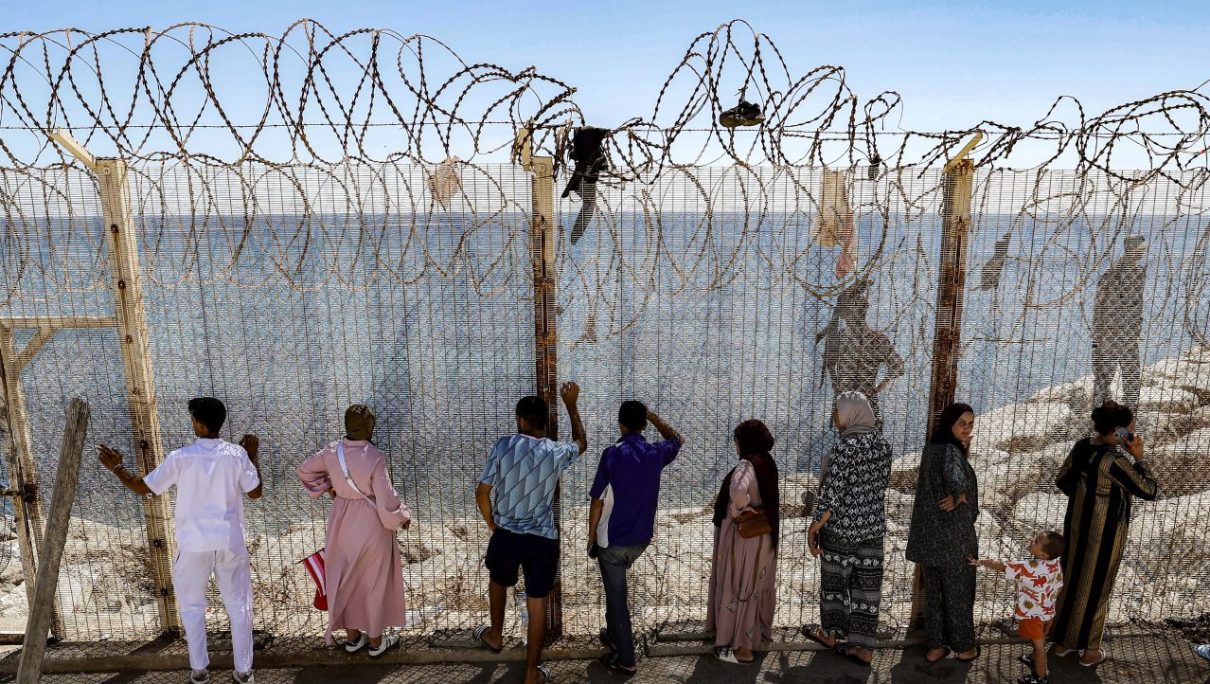
Relatives and friends wait by a fence topped with barbed wire for the return of people who had previously crossed into Spain’s North African enclave of Ceuta, at Morocco’s Bab Sebta border crossing on the outskirts of Fnideq on August 2, 2026. As many as 60,000 migrants entered Ceuta in recent days, mostly swimming around the small border post that juts into the Mediterranean Sea, in an unprecedented surge that prompted an international crisis for Spain. The mass crossing into the tiny Spanish territory resulted in at least 67 deaths, according to Spanish authorities, and led to clashes with Moroccan police on the shared border. (Photo by Abdel Majid BZIOUAT / AFP)
Italian Prime Minister Giorgia Meloni described the scenes in Ceuta as evidence that “uncontrolled illegal immigration poses a concrete threat to the security of Europe’s borders,” saying Italy was prepared to take “extraordinary measures” to defend its borders and the safety of its citizens, including the possible suspension of the Schengen Area with Spain.
The right-wing ruling coalition in Finland also called for excluding Spain from the European visa-free zone as a result of the situation. Czech Prime Minister Andrej Babis said the Ceuta situation was caused by Spain’s policy of offering hundreds of thousands of migrants already in the country a legal status.
In fact, the weekend incident in Spain is said to have accentuated the political turbulence in Europe and strengthened forces, including even conservatives and liberals, to end what was hitherto a “Liberal Consensus” on a liberal immigration policy.
That explains why on Saturday, Denmark’s Prime Minister Mette Frederiksen, German Chancellor Friedrich Merz, and Italian Premier Meloni initiated a letter that got signed by 22 member states, calling for immediate EU action.
“The bloc cannot allow uncontrolled mass crossings, the instrumentalization of migration or other hybrid threats to create the perception that illegal entry into the European Union is possible,” they wrote.
It may be noted here that for years Germany was the face of liberal asylum policy under Chancellor Angela Merkel. Now it has really reversed that under immense political pressure.
The AfD nearly doubled its vote share, especially in eastern Germany, by campaigning on immigration and crime linked to asylum seekers. As a result, the new CDU-SPD coalition started last year the policy of “Stricter border checks” and a “de facto entry ban” for undocumented migrants, including asylum seekers.
Even the British leadership labeled the developments in Spain deeply concerning while highlighting that the UK’s own restrictive operational measures are yielding lower overall small-boat crossing numbers compared to prior tracking periods.
Moving away from past perceptions of a liberal framework to stem the rise of populist Reform Party UK, the ruling Labour Party is now systematically tightening rules through higher salary thresholds, bans on dependents for most students, restrictions on overseas care worker recruitment, and shorter temporary protection grants for refugees.
And still its government is facing intense but growing popular pressure for mass deportations, rigorous enforcement and digital pre-departure checks.
Incidentally, the growing fears in Europe over uncontrolled and illegal immigration seem to have an angle of the fear of “Islamisation”. It may not be the main driver of policy changes, but it is a major factor in the political turbulence around immigration, particularly in Germany, the UK, and France.
There is a growing Muslim population in these countries due to immigration and higher birth rates among the immigrants.
Reportedly, there are 5.5 to 6.5 million Muslims in France, making it the largest Muslim minority in Western Europe. This group makes up about 8% to 10% of the country’s total population. The majority of them have roots in North Africa (Algeria, Morocco, and Tunisia), with smaller groups from Turkey and Sub-Saharan Africa.
Germany’s Muslim population is estimated to be between 5.5 and 7 million, which makes up roughly 6.5% to 8.5% of the country’s total population. The largest group has Turkish heritage, dating back to the guest worker program in the 1960s. Recent growth comes from refugees and migrants arriving from countries like Syria, Afghanistan, and Iraq.
The Muslim population in the United Kingdom is approximately 4 million people, making up about 6.0% to 6.5% of the total population. Islam is the second-largest religion in the country.
The largest share, as much as 66 percent, of British Muslims trace their family roots to the Indian subcontinent, with many arriving in waves during the 1950s and 1960s to fill postwar labor shortages. The rest came mainly from Somalia, Nigeria, Libya, Morocco, Algeria, Afghanistan, Iran, Turkey, and Cyprus.
In these three leading countries, considered to be the engines of Europe, the Muslim immigrants have created what are called economic, cultural, and political concerns over their running parallel societies, sharia law, religious schools, mosques, headscarves, and value clashes over free speech, gender, and LGBTQ issues.
Besides, there are problems relating to issues concerning economics, housing, asylum backlog, crime (the rise of extremism in Islam), and border control.
As it is, the Netherlands, Sweden, and Denmark have already passed laws on face veils, foreign funding of mosques, and “ghetto” laws. Denmark’s Social Democrats explicitly said they wanted “fewer Muslims” to protect their welfare state.
But then, as seen in Spain, these countries also face acute labor shortages, for filling up which most of these Muslims, like others, migrate. In any case, apart from the UK, in no country have Muslims become politically active to endanger the native whites. They do not have high-paying jobs like the skilled and highly educated immigrants, though they are doing very well in the sporting arena.
Therefore, if they are being seen with suspicion, it is because of the changes they have made to mainstream culture.
For many center-right and working-class voters in Europe, that includes concerns about mosques, religious schools, and values. That is why even left-wing parties like UK Labour and German SPD are now tightening controls. They have realized that if one does not address the cultural anxiety, one loses to parties who do or will.
In sum, what the weekend’s episode in Spain seems to have done is raise two questions: whether a liberal-immigration model of Europe will survive by combining open labor markets with credible borders; and whether Europe will still debate culture without dehumanizing people.
Author and veteran journalist Prakash Nanda is Chairman of the Editorial Board of the EurAsian Times and has been commenting on politics, foreign policy, and strategic affairs for nearly three decades. He is a former National Fellow of the Indian Council for Historical Research and a recipient of the Seoul Peace Prize Scholarship.
Parmi les dizaines de milliers de migrants ayant tenté de rejoindre l'enclave espagnole de Ceuta ces derniers jours, 72 personnes sont décédées selon Madrid. Le ministère marocain de l'Intérieur a, lui, donné un premier bilan de 11 morts. La police et l'armée poursuivaient leurs patrouilles dimanche et procédaient toujours à des arrestations et expulsions.
Russia has for the first time officially claimed that its fifth-generation fighter jet, the Su-57, has registered its first air-to-air kill in the Ukraine War, using a hybrid RVV-SDM missile.
Alexander Mikheev, Director General of Rosoboronexport, Russia’s state arms exporter, said that the stealth aircraft has proved its superiority in all aspects of warfare, including hitting targets on the ground and in the air.
This, he said, is fueling a heightened global interest in the Su-57E fifth-generation fighter.
“Rosoboronexport notes increased global market interest in the Su-57E fifth-generation fighter. It has proven its superiority in real combat conditions when countering the most advanced air defense and electronic warfare systems. The aircraft has engaged numerous airborne, ground, and surface targets with Russian air-to-air munitions, including the latest RVV-SDM guided missile,” Russia’s state-controlled news agency TASS quoted Mikheyev as saying.
The RVV-SDM is a new medium-range air-to-air missile introduced by Russia’s Rosoboronexport to arm the export variant of the fifth-generation Su-57E stealth fighter. It features fire-and-forget capabilities, active-passive radar guidance, and high resistance to electronic warfare.
According to Vijainder K Thakur, former Indian Air Force (IAF) pilot and defense analyst, the RVV-SDM is a medium-range missile, most likely a derivative of the RVV-SD tweaked for internal carriage by the Su-57 and improved performance.
While reports of Su-57’s first aerial kill have been doing rounds for some time now, this is the first official acknowledgment by Russia of Su-57’s air-to-air kill in the Ukraine War.
In April 2026, a report attributed to Sergei Lebedev claimed that a Su-57 had destroyed a Ukrainian Air Force aircraft in an aerial engagement over the Mykolaiv region using a long-range missile.
In May 2026, Russian media and Telegram channels claimed that a Su-57 had used a long-range R-37M missile to shoot down a Swedish Saab 340 AEW&C aircraft transferred to Ukraine over eastern Ukraine.
Mikheyev said that Su-57’s combat performance in the war has fueled global interest in the aircraft’s export variant, the single-seat Su-57E. However, despite its best efforts to promote the aircraft in the international market, so far there has been only one confirmed customer of the Su-57.
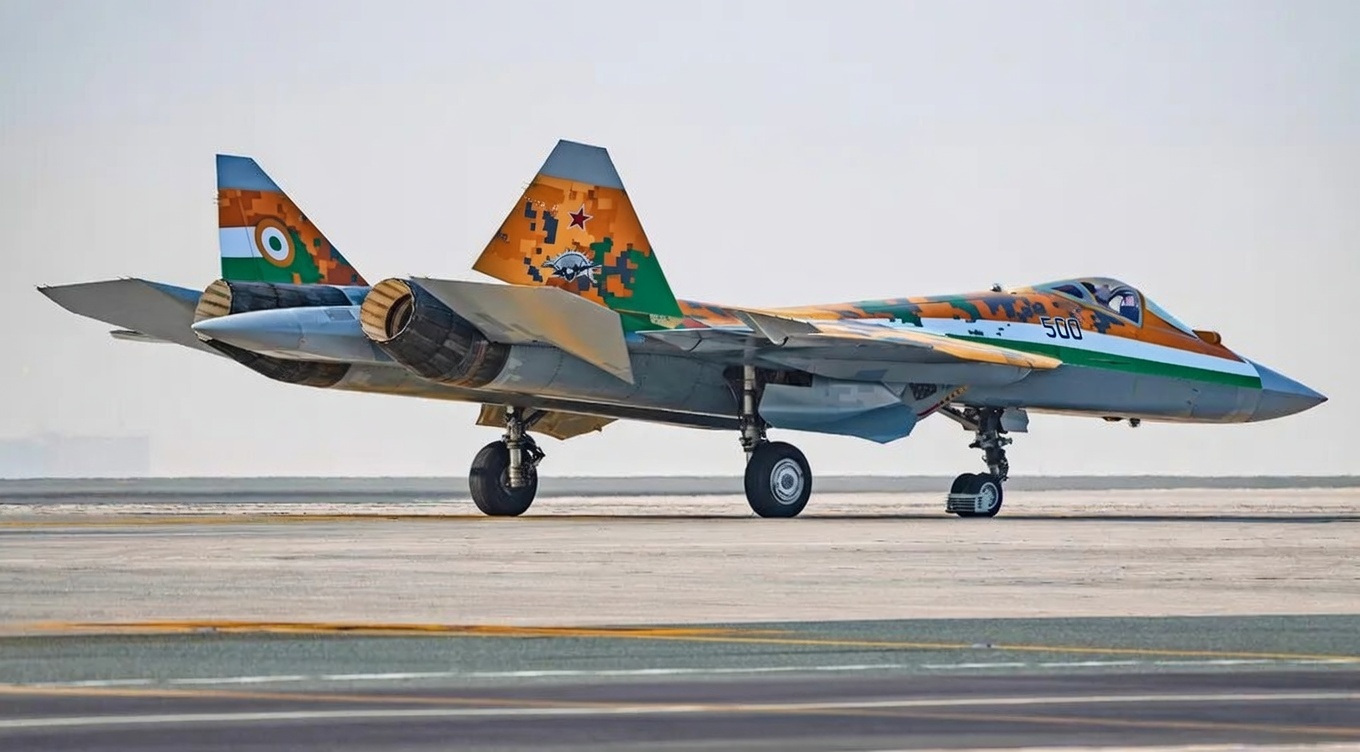
Edited Image: Su-57
Algeria was the first country to confirm the acquisition of the Su-57E. The country, which has a fleet of Soviet-Russian Su-30MKA, MiG-29, and MiG-25 fighters, has bought an unspecified number of aircraft and has reportedly deployed the jet on operational duty.
In November last year, Vadim Badekha, the Director General of United Aircraft Corporation (UAC), which manufactures the Su-57, announced that Russia has delivered two Su-57E stealth aircraft to a foreign client.
“Our foreign customer, our foreign partner, has already received the first two aircraft. They have begun to carry out combat duty and demonstrate their best qualities. Our customer is satisfied,” Badeja said.
Russia is also pitching the Su-57E to India and has even promised full Transfer of Technology (ToT) and to localize the production of the stealth aircraft in India. However, New Delhi has not made a decision yet.
According to Russian officials, the Su-57’s combat experience in the Ukraine War and limited exposure during the Syria war is a key highlight of the stealth fighter jet’s export potential.
Russia has, however, used the Su-57 very cautiously in the Ukraine war. According to security analysts, the aircraft has been mostly used for stand-off strikes from long distances.
Notably, just a few days earlier, a picture emerged showing the Su-57 fitted with R-73 air-to-air missiles attached to its wing pylons rather than in its internal weapons bay.
Carrying the missiles beneath the wing pylons would compromise the Su-57’s stealth; however, if the jet is deployed primarily for anti-drone operations, maintaining stealth is of no use.
Carrying these short-range AAMs externally suggests that the Su-57 load-out was optimized for close-range aerial engagements, most likely against the long-range Ukrainian one-way attack drones and cruise missiles that Kyiv has recently begun using.
Critics argue that Moscow is deliberately limiting the aircraft’s exposure to protect its export potential. Any confirmed losses to Ukrainian forces, they say, would severely damage the jet’s credibility in the international export market.
Still, an official acknowledgment by Russia of Su-57’s first aerial kill will no doubt boost the jet’s credibility, which has so far struggled to find many export customers.
Notably, while the US’s F-35 fighter jet has been in service for 11 years and has seen action in many wars, including in Iraq, Syria, Yemen, Gaza, and Iran, it scored its first air-to-air kill in March this year.
“This is the world’s first shootdown of a manned fighter jet by an F-35,” the statement added.
It must also be noted that Ukrainian airspace is heavily defended by frontline Western air defense systems such as Patriots. This is in contrast to where the F-35 has seen combat, in the poorly defended airspace of Gaza, Syria, Iraq, Yemen, and Iran.
Meanwhile, the USAF’s F-35 fighter jet also got hit by an Iranian drone-missile hybrid in the Iran war, underscoring that even most advanced Western stealth fighter jets are not completely invisible or invincible.
Additionally, while Russia initially faced many issues with the Su-57, including production delays, Moscow has made key improvements to the aircraft in recent years, increasing its lethality and survivability in contested airspace.
Su-57’s Continuous Upgradation
In February this year, Moscow’s Rostec press service said that the Russian Aerospace Forces (VKS) have inducted a new batch of Su-57 fighters featuring a “new technical profile.”
The upgraded version of Russia’s fifth-generation fighter incorporated enhanced onboard systems and a new weapons configuration that significantly expanded the jet’s combat role.
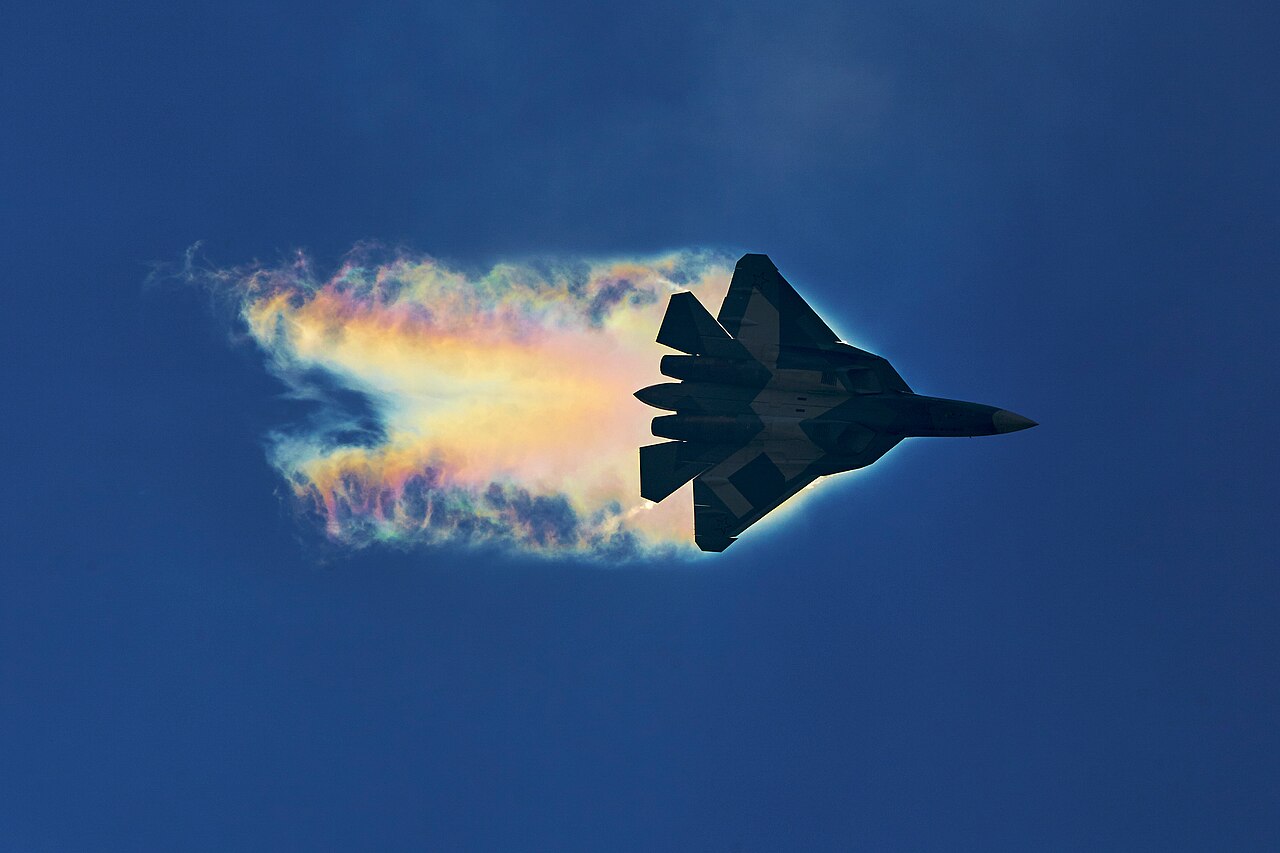
File Image: Su-57. Via Wikipedia
“To fulfill the targets set by the Russian Defense Ministry for the supply of highly sought-after weapons and military equipment to the troops, crews of the Russian Aerospace Forces have accepted the Su-57 aircraft in its new technical configuration,” the Rostec press service quoted a Su-57 pilot as saying.
“The aircraft has already proven itself during the special military operation (Ukraine War). The new technical configuration will provide for the expansion of the range of missions for which this aircraft type is deployed. The advanced capabilities incorporated into the aircraft armament system make it possible to use new types of aircraft weapons,” the pilot added.
While Rostec provided no details of the upgraded onboard systems or the new weapons package, analysis of higher-resolution images released by UAC and examined by OSINT analyst George N. revealed visible changes to the 101KS electro-optical complex, which supports self-protection and missile warning functions.
The 101KS complex is an electro-optical targeting system that provides the Su-57 with all-weather surveillance and passive infrared detection.
The 101KS complements the radar by detecting and tracking targets in the infrared and visible spectra. It can detect heat signatures of missiles and aircraft and conduct passive situational monitoring.
This allows the fighter to operate without active emissions, enhancing survivability in highly contested environments.
The aircraft also received revised apertures, presumably operating across multiple spectral bands, including visible, mid- and long-wave infrared (IIR), and possibly ultraviolet (UV), pointing to a substantial expansion of passive observation capabilities.
The imagery suggested that the 101KS would no longer function solely as a defensive sensor, but rather as a key element of situational awareness, aligned with the philosophy of the AN/AAQ-37 Distributed Aperture System (DAS) carried by the F-35.
It underscored that the Su-57 is moving toward a distributed, passive surveillance capability that can detect and track airborne threats without relying solely on radar.
The announcement came nearly two months after the UAC confirmed it had tested the Su-57 with a new Izdliye 177 engine, a powerplant developed by the United Engine Corporation (UEC) specifically for the Su-57.
The new Izdliye 177 engine was tested with the Su-57 in December 2025. According to a Rostec official, each Izdliye 177 engine can deliver up to 16,000 kg of thrust (approximately 35,000 pounds) with the afterburner engaged.
The new engine will further reduce fuel consumption and is stated to be far more durable than the previous power plant, the Saturn AL-41F1 afterburning turbofan engine.
In fact, the fighter jet has been steadily upgraded since its induction into the VKS in 2020.
Vadim Badekha, CEO of UAC, recently said the platform continues to evolve.
“The fifth-generation Su-57 aircraft system is the best aircraft in its class, but we’re not resting on our laurels. The fighter has undergone a tremendous evolution, and its improvement continues today – the aircraft’s weapons and systems capabilities are being upgraded,” Badekha said.
“This fighter allows us to solve the most important tasks today, demonstrating efficiency and excellent maneuverability and combat capabilities,” he added.
All these upgrades fit within the progressive maturation of the Su-57 program, also known as the Megapolis development program.
Under it, the Su-57 would receive incremental upgrades to its avionics, cockpit, engine, sensors, and weaponry.
Russian engineers claim that the Su-57 is a future-oriented project that will evolve as Moscow’s principal air combat system well beyond 2040.
At the same time, these upgrades will also boost the jet’s export potential.
Sumit Ahlawat has over a decade of experience in news media. He has worked with Press Trust of India, Times Now, Zee News, Economic Times, and Microsoft News. He holds a Master’s Degree in International Media and Modern History from the University of Sheffield, UK.
He can be reached at ahlawat.sumit85 (at) gmail.com
Madrid a assuré samedi que la quasi-totalité des dizaines de milliers de migrants entrés illégalement dans l'enclave espagnole de Ceuta étaient repartis. Face à cette crise migratoire, les ministres de l'Intérieur des pays de l'UE vont se réunir mardi pour apporter "une réponse européenne immédiate et coordonnée".
Lt. Col. William Henry Rankin was a decorated US Marine Corps fighter pilot who flew combat missions in World War II and the Korean War. His greatest ordeal, however, came in peacetime.
On July 26, 1959, he ejected from an F-8 Crusader straight into a massive thunderstorm. And he lived to tell the tale.
The Vought F-8 Crusader was a single-engine, supersonic, carrier-based air-superiority fighter designed for the U.S. Navy and Marine Corps. Known as the “Last of the Gunfighters,” it was the final American fighter built with guns as its primary armament at a time when missiles were rapidly taking over. The aircraft entered service in 1957.
In May 1957, Rankin took command of Marine Fighter Squadron 122 (VMF-122). The following year, it became the first Marine squadron to operate the F-8 Crusader.
In 1959, he catapulted to fame for surviving what seemed like an impossible incident with the Crusader.
The Story Of Rankin’s Riding A Thunderstorm
On the afternoon of July 26, 1959, Rankin led a two-ship flight with wingman Lt. Herbert Nolan from Naval Air Station South Weymouth, Massachusetts, back to Marine Corps Air Station Beaufort, South Carolina.
During the flight, the pilots encountered a large cumulonimbus thunderstorm.
Typically, thunderstorms pose severe threats to fighter jets, including extreme turbulence, powerful updrafts and downdrafts, hail, lightning, icing, and torrential rain. So, fighter pilots are trained to climb above the storm to prevent damage to their aircraft.
The F-8 Crusader’s strong climb performance and high service ceiling of about 50,000 feet made this a practical choice for Rankin on that fateful day.
Rankin climbed his F-8 fighter jet to 47,000 feet at a speed of Mach 0.82 over a massive cumulonimbus cloud that peaked at about 45,000 feet.
While on this quest, he suddenly heard a loud, unprecedented bump and rumble from the aircraft’s engine. He instantly knew something was wrong with his jet.
The engine immediately stopped producing power, a bit of bad news that was delivered to Rankin by a bright fire warning light.
Acting swiftly to arrest the threat, Rankin immediately pulled the lever to deploy auxiliary power, but instead of saving his jet, it snapped in his hand.
Lt. Col William Rankin (Via X)
At this point, Lt. Col Rankin knew he had to eject, which was a formidable challenge without a pressure suit at that altitude.
As soon as he ejected and touched what is believed to be -58 to -60 degree air, his body started to fail. The veteran fighter pilot who had braved enemies in the wars he fought through his career was now struggling for survival—he suffered frostbite, the decompression caused his stomach to bloat, and he started to bleed from his mouth, nose, and ears. The only respite, at least initially, was that he had an emergency oxygen supply.
The chances of survival were grim, something Rankin was fully aware of.
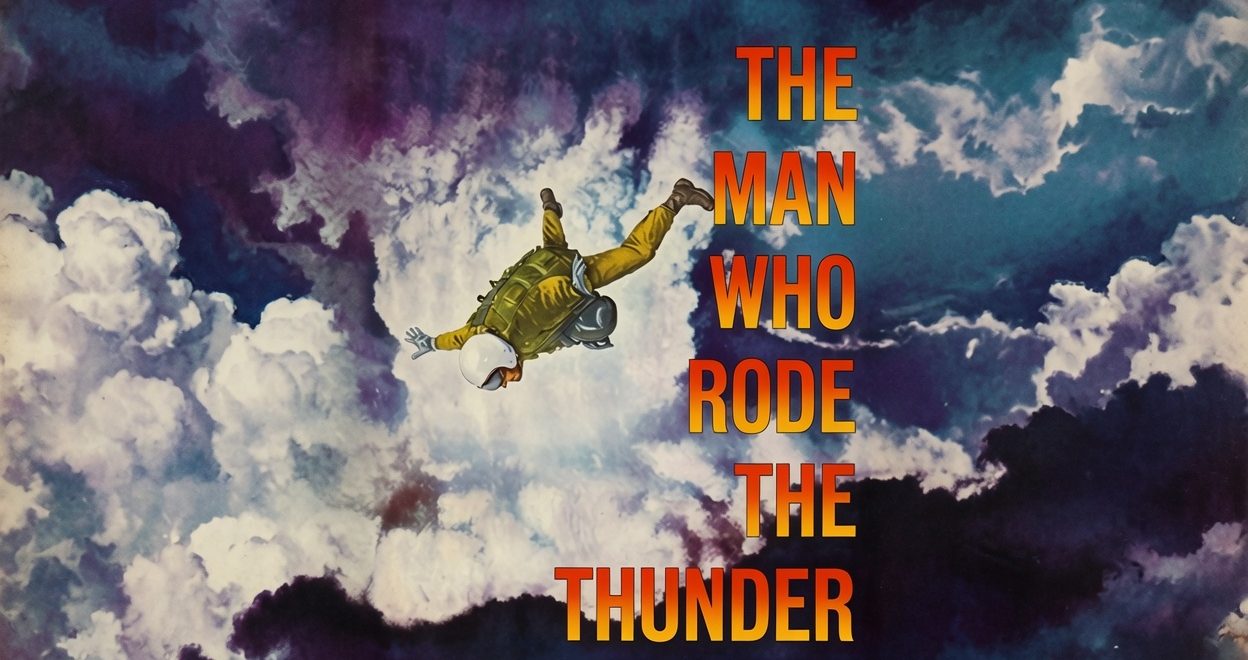
“I was convinced I would not survive; no human could”, Rankin later wrote in his book “The Man Who Rode the Thunder”.
“The pain of ‘explosive’ decompression was unbearable,” he recalled in his book, which has been widely read by aviation enthusiasts globally. “I could feel my abdomen distending, stretching, stretching, stretching, until I thought it would burst. My eyes felt as though they were being ripped from their sockets, my head as if it were splitting into several parts, my ears bursting inside, and throughout my entire body, there were severe cramps.”
However, he also bravely emphasizes, “I was terrified, but not petrified. It’s a brave distinction of terms.”
After roughly five minutes of free fall, Rankin realized his parachute had not opened. The system was designed to deploy automatically at about 10,000 feet via a barometric switch, allowing the pilot to reach denser, breathable air before the canopy opened. The already disoriented pilot began to worry that the parachute’s auto-deployment system may have been broken, causing his only chance at survival to fail.
Unfortunately, though, he was now in for a completely different kind of challenge.
As he was passing through a massive thunderstorm with zero visibility, the parachute opened prematurely as the violent pressure fluctuations, updrafts, and turbulence inside the cumulonimbus cloud “fooled” the barometric sensor.
Once under the open canopy of the parachute, Rankin was far more vulnerable to the storm’s powerful vertical currents. The long descent increased the risk of his death from cold or asphyxiation. Additionally, it meant that he was dangerously caught in the up-and-down draft of the storm system, which buffeted the pilot thousands of feet into the air before dragging him back down. And that’s exactly what happened.
Ten minutes into the ordeal, he began vomiting from the violent spinning and pounding even as lightning flashed around him—later described as blue blades several feet thick.
The rain was so dense that he repeatedly inhaled or swallowed water with every breath and had to hold his breath to avoid choking. “Gasping for air, swollen, bleeding, and battered by hail, it was as though I were under a swimming pool, and I had held my breath several times,” wrote Rankin.
For Rankin, this was akin to “drowning in the sky.”
For about forty minutes, he was battered by hail, nearly drowned by torrential rain, and subjected to lightning and extreme turbulence.
“I didn’t hear the thunder, I felt it,” Rankin wrote in his book.
Thankfully, the storm’s intensity eventually decreased, allowing the pilot to finally avoid its drafts. Then, the rain that had threatened to drown him gave way to a comforting summer shower, and the air got substantially warmer.
Lt. Col Rankin and his parachute, which had endured unimaginable turbulence and the ferocity of nature, had miraculously survived the thunderstorm.
Soon, he approached the forests of North Carolina’s backcountry, got entangled in a tree, cut away from it, and landed on the ground.
Battered, frostbitten, bleeding, rain-soaked, and covered in vomit, he stumbled through the woods using a search pattern until he found a country road. “Lying on my left side. I simply could not believe that I was on the earth—that I had survived,” he later wrote.
Several cars passed before a motorist stopped, drove him to a nearby country store, and allowed him to call for an ambulance. He collapsed while waiting and was taken to a hospital in Ahoskie, North Carolina. Rankin spent several weeks recovering but sustained no permanent long-term injuries from the forty-minute ordeal and soon returned to duty.
Rankin gained widespread recognition for his iconic and unbelievable battle with the thunderstorm after he returned to active service.
Having survived a 40-minute thunderstorm in the air, he lived for 50 more years before passing away at 89 in 2009.
Nevertheless, Lt. Col Rankin is still remembered—nearly 70 years after the incident—as the only man who defeated a thunderstorm.
Contact the author at sakshi.tiwari13 (at) outlook.com
Turkey has startled the world with its rapid rise in military technology, particularly in drone warfare. However, it is now charging full steam ahead with the development and testing of the KAAN combat aircraft, a move that will place it in the elite group of nations with stealth fighters
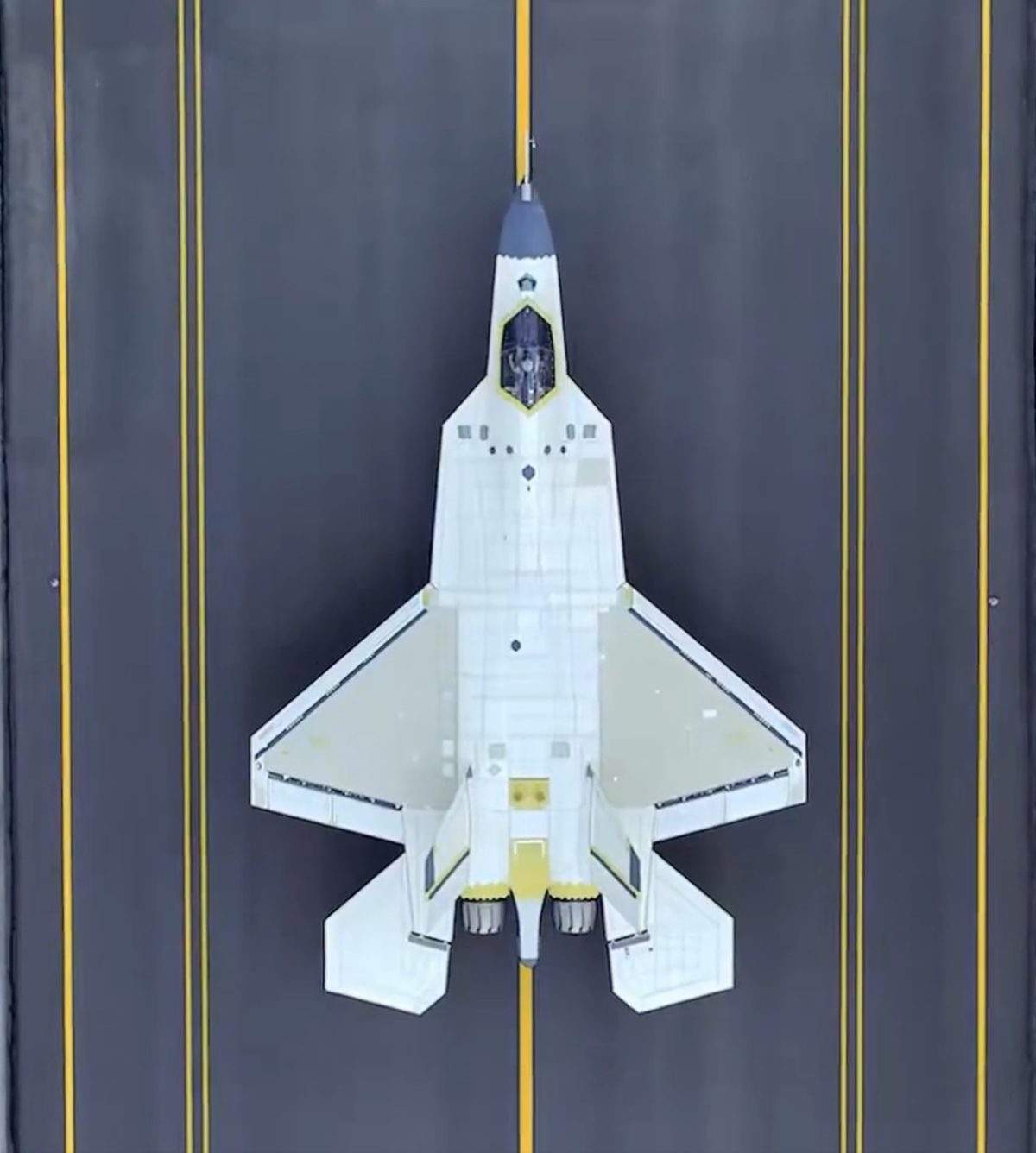
Turkish Aerospace Industries (TAI) recently released a video of KAAN’s new prototype performing powered taxi testing, suggesting that the first flight may be imminent. The video, posted on X, shows the aircraft moving on its own, verifying the functionality of the engine, brakes, steering, and flight control systems prior to flight clearance.
The new prototype, known as P1, is based on the original P0, which flew for the first time in February 2024, as EurAsian Times reported at the time.
However, the P1 is considered a more mature aircraft that will be crucial to the fighter development and testing campaign. The P0 prototype was constructed to confirm the aircraft’s fundamental flight characteristics, flight control system, and core platform. The P1, by contrast, incorporates a more advanced systems architecture and is intended to carry the bulk of performance, avionics, and mission-systems validation.
Notably, a second prototype, P2, remains in parallel production and integration, with the goal of having both aircraft flying by the end of 2026 to accelerate the test campaign through concurrent work.
— Türk Havacılık Uzay Sanayii (@TUSAS_TR) July 31, 2026
TAI CEO Mehmet Demiroğlu earlier stated e that the company hopes to see KAAN airborne within a few months and aims to have the second aircraft flying by year-end. “We hope to see KAAN in the sky within a few months. We also aim to fly the second aircraft by the end of the year. Our goal is to have two KAANs flying one after the other, or side by side, at year-end,” Demiroglu said at the Farnborough Airshow in the UK last month
Turkey plans three pre-production prototypes followed by series production of 250 aircraft. A deal was reportedly signed last month for 20 units of the original Block 10 KAAN
Notably, the P1 symbolizes the Kaan program’s evolution from a technology demonstrator into a developmental test fleet. It demonstrates that the program is proceeding at a speed to match the aspirational schedule of delivering the jets to the Turkish Air Force by 2028.
In addition to accelerated development and testing, the KAAN received another big boost last month when the US cleared for export the General Electric-made F110 engines initially destined to power the plane, removing a major roadblock in the program. Simultaneously, TAI is advancing work on the indigenous TF35000, which will power the aircraft in the long run, as EurAsian Times reported earlier.
TAI KAAN P1 prototype conducted taxi test
The induction of the KAAN fighter will transform the Turkish Air Force, which has been operating aging F-16s since Ankara’s removal from the F-35 program in 2019 over its purchase of Russia’s S-400. The expulsion pushed Turkey to develop its own advanced fighter, aiming to achieve technological sovereignty and reduce dependence on the US.
More significantly, KAAN is Turkey’s most ambitious defense project in decades, positioning the country among the select group of nations that have independently designed and built a fifth-generation stealth aircraft. This progress aligns with Ankara’s broader emergence as a major defense producer and innovator, most notably in drones.
Turkey seems to be overtly prioritizing stealth, as evidenced by the development of KAAN. The KAAN is a twin-engine, single-seat stealth fighter featuring internal weapons bays, low-observable shape, and composite materials that improve stealth by lowering weight and radar signature. Furthermore, it carries a range of weapons internally, including air-to-air and air-to-ground munitions, such as indigenous Gökdoğan (BVR) and Bozdoğan (WVR) missiles, to bolster lethality while preserving stealth.
Alongside the manned fighter, Turkey continues advancing stealth unmanned systems. This includes the Anka-3, the first flying-wing, deep-strike drone developed by Turkish Aerospace Industries. According to reports, this stealthy unmanned combat aerial vehicle (UCAV) is currently advancing toward serial production, with design upgrades to intakes, exhausts, antennas, and other components.
More importantly, Turkey’s list of unmanned stealth aircraft prominently features the Kizilelma, an unmanned fighter jet expected to conduct a wide range of military operations.
The Bayraktar Kızılelma incorporates low-observable design features. It is routinely described by Baykar and Turkish defense officials as a low-RCS (radar cross-section) unmanned fighter. In fact, the Kizilelma recently conducted a weapons-firing test that further added to its stealth characteristics.
Stealthy Kizilelma Fired From Internal Weapons Bay
Last month, Kizilelma successfully conducted its first live-fire tests from its internal weapons bay, achieving direct hits. The test was reportedly conducted at the Corlu Flight Training and Test Center in the northwestern province of Tekirdag, using the production model with tail number S2 and Roketsan’s TEBER-82 munition and TOLUN munitions.
Baykar hailed the test as a historic milestone that confirms the jet’s ability to attack with precision while maintaining a low radar signature.
It is worth mentioning that external weapons, pylons, and the cavities they create dramatically increase an aircraft’s RCS. In fact, even a well-shaped low-observable airframe loses much of its stealth advantage once munitions are hung outside.
By successfully firing precision-guided munitions from the internal bay on the serial prototype, Kızılelma demonstrated that it can carry and release weapons without compromising its clean, low-RCS airframe, conduct stand-in or penetrating attacks in contested airspace while remaining harder to detect, and maintain higher speed and better aerodynamic efficiency.
“Thanks to its internal weapons bay, Kizilelma will be able to penetrate deep into hostile territory and strike using indigenous munitions while maintaining a low radar signature,” Baykar said, adding that internal carriage allows it to function “more effectively in areas with dense air defense coverage.
The Kizilelma is a stealthy multi-role unmanned platform designed for air-to-air combat, air-to-ground strikes, ISR (intelligence, surveillance, reconnaissance), close air support (CAS), missile strikes, suppression of enemy air defenses (SEAD), and destruction of enemy air defenses (DEAD), among other things.
“Bayraktar Kizilelma made its first flight in 2022. Since then, intensive flight activities have continued. Serial production was completed last year, and our goal this year is to place Kizilelma into service for Türkiye,” Bayraktar said at SAHA 2026.
The platform integrates Artificial Intelligence and can be operated out of aircraft carriers, according to the manufacturer, although those capabilities are still being refined. Moreover, it can fly alongside KAAN in a manned-unmanned teaming configuration (MUMT), adding what is referred to as “affordable mass” and substantially reducing the risk to manned fighters in contested environments,
If the current trajectory holds, KAAN and stealthy unmanned platforms will strengthen Turkish airpower and advance Ankara’s goal of self-reliance.
Contact the author at sakshi.tiwari13 (at) outlook.com
Plusieurs hypothèses sont évoquées pour expliquer l'afflux soudain de 60 000 migrants à la frontière de l'enclave espagnole de Ceuta au Maroc. Si l'extrême droite européenne estime que la politique migratoire de Pedro Sanchez a créé un appel d'air, plusieurs témoignages rapportent des rumeurs d'ouverture d'un poste frontière ayant conduit à cette crise. La presse espagnole s'interroge également sur le rôle des autorités marocaines.
L'Italie a dit jeudi vouloir fermer l'espace Schengen à l'Espagne après que des milliers de migrants sont entrés illégalement ces derniers jours dans l'enclave espagnole de Ceuta en provenance du Maroc. Problème : aucun texte ne prévoit d'exclure un pays membre de la zone de libre circulation de l'Union européenne.
"Aux 4 Coins de l’Europe" vous propose de découvrir l’Italie de Giorgia Meloni, sous l’angle des valeurs et de l’Etat de droit. Si la première femme de l’histoire à gouverner l’Italie rassure ses partenaires européens, en particulier par son positionnement diplomatique aligné sur l’Ukraine, au niveau national, elle met en œuvre un agenda conservateur, avec la volonté de mainmise sur les médias.
L’Italie de Meloni fait parler d’elle Aux 4 Coins de l’Europe. L’UE apprécie le soutien à l’Ukraine du gouvernement Meloni, et le pays a bénéficié d’un plan de relance massif de Bruxelles. Mais les contradictions sont nombreuses sur les chapitres diplomatiques entre les partenaires de cet attelage à droite toute ! Sur la question migratoire, il y a des divergences entre le discours et la pratique.
Les 27 pays membres de l'Union européenne ont trouvé un accord jeudi matin à Bruxelles pour infliger de nouvelles sanctions – le 21e paquet – à la Russie, ont indiqué des diplomates après plusieurs semaines de négociations.
Andy Burnham a été nommé lundi à la tête du gouvernement britannique. Dans un contexte d’instabilité économique et politique similaire à celui de son prédécesseur Keir Starmer, le nouveau Premier ministre travailliste devra surtout prouver la stabilité de son programme, selon les experts interrogés par France 24.
Nous vous proposons une "opération vérité" sur les grands textes adoptés et les positionnements politiques, à méditer pendant les congés d'été ! L’année 2026 est particulièrement chargée en grands textes législatifs - près de 300 ont été votés - et, phénomène nouveau, les majorités sont très fluctuantes au Parlement de Strasbourg, en fonction des sujets.
Cette semaine, Caroline de Camaret reçoit Odile Renaud-Basso, présidente de la Banque européenne pour la reconstruction et le développement (BERD). Alors que l'économie européenne est fragilisée par la guerre en Ukraine et les conflits au Proche-Orient, elle revient sur des investissements risqués en Afrique et sur les importants financements américains dans la BERD.
Volodymyr Zelensky a annoncé dimanche un remaniement du gouvernement ukrainien. En place depuis un an, la Première ministre Ioulia Svyrydenko devrait obtenir un nouveau poste. Une opportunité qui la mettrait en "relations avec un partenaire-clé", a déclaré le président ukrainien, sans plus de précisions.
Cette semaine, Caroline de Camaret reçoit Antonio Tajani, ministre italien des Affaires étrangères et vice-président du gouvernement de Giorgia Meloni – une coalition tripartite allant de son parti, Forza Italia, à la droite radicale (Frères d'Italie, La Ligue). Il fait un tour d'horizon de l'actualité internationale vue de l'Italie meloniste et revient sur les réformes migratoires et institutionnelles controversées.
Malgré les émissions de CO2, l'avion a toujours la cote : un milliard de passagers par an volent dans le ciel européen, et l'Union européenne (UE) défend les droits de ces passagers face aux compagnies aériennes. Un accord a été trouvé le 15 juin au sein de l'Union pour réformer le règlement européen sur les droits des passagers aériens, après treize ans de négociation.
L'Union européenne a demandé vendredi à Meta de changer les interfaces de Facebook et Instagram, les jugeant trop "addictives". La Commission européenne reconnait que "Meta a toujours essayé d'agir en matière de protection des mineurs", mais qu'elle doit "obtenir des changements" du géant de la tech américaine.
Pays économiquement fragile et soumis à la guerre hybride russe, la Moldavie souhaite avancer à grands pas vers l'Union européenne. Après l'ouverture du premier chapitre des négociations d'adhésion, l'Europe entend servir de levier à des transformations dans le pays et attirer les entreprises, via un plan de croissance de 1,9 milliards d'euros conditionné a des réformes structurelles.

 Login








 TEBER-82 & TOLUN-P Munition Firing Test from the Internal Weapons Bay
 Bull’s Eye


