❌

Reading view

Democrats, groups fight back after Supreme Court clears way for Trump attack on mail voting

Ballots are tabulated on election night at the Fulton County Elections Hub and Operation Center on November 5, 2024 in Fairburn, Georgia. Photo by Megan Varner/Getty Images
Common Dreams Logo

This story originally appeared in Common Dreams on Aug. 25, 2026. It is shared here under a Creative Commons (CC BY-NC-ND 3.0) license.

Democratic leaders and a “pro-voter” coalition on Tuesday announced separate actions to combat President Donald Trump’s attack on voting by mail after the US Supreme Court’s right-wing majority delivered a “painful setback” for critics who argue the Republican’s executive order is unconstitutional.

The president’s March order directed the US Department of Homeland Security to compile lists of citizens eligible to vote, states to provide voter information to the federal government, and the United States Postal Service to craft new regulations for absentee ballots—for which the USPS published a final rule last Friday, less than three months away from the midterm elections.

The nation’s top court said in a 6-3 decision on Monday that Democrat-led states had not demonstrated sufficient standing to challenge the president’s order and paused a lower court injunction blocking its implementation. The attorneys general in that case, Trump v. California, vowed to keep fighting back, and as of Tuesday evening, others already are.

The chairs of the Democratic National Committee (DNC) and Democratic Governors Association, US Senate and House minority leaders, and heads of the party’s campaign committee for each chamber of Congress on Tuesday announced the filing of a new motion for a preliminary injunction.

“Today, we are taking strong, joint legal action to stop Trump’s unlawful attempt to restrict mail-in voting through the Postal Service,” said DNC Chair Ken Martin, Kentucky Gov. Andy Beshear, Sen. Chuck Schumer (NY), Rep. Hakeem Jeffries (NY), Sen. Kirsten Gillibrand (NY), and Rep. Suzan DelBene (Wash.) in a joint statement.

“Yesterday’s Supreme Court ruling did not say that Trump’s executive order attacking voting rights is constitutional,” they stressed. Rather than ruling on the merits of the challenge, the majority of justices simply said that the states had sued prematurely, as federal efforts to respond to Trump’s order were still underway.

“But the law is clear: States have the authority to run elections—not the president,” the Democrats said. “”We will not stand by while Trump and Republicans try to unnecessarily inject chaos and confusion into our elections, just weeks before voting begins. We are asking a district court to immediately stop the Trump administration from unlawfully disrupting mail-in voting in every state. Democrats will continue fighting every day until Trump’s illegal executive order, and all of his other attempts to undermine our free and fair elections, are completely thrown out.“

The Campaign Legal Center (CLC) and Democracy Defenders Fund (DDF) also continued their battle against the order, filing a new complaint on behalf of the Arizona Students’ Association, League of United Latin American Citizens, Secure Families Initiative, Texas’ Travis County, and the city of Madison, Wisconsin.

BREAKING: we just filed to STOP the new USPS rule on mail ballots

The Court only held that the injunction came too early. Now we HAVE a final rule & we are litigating it@DDFund_ & @CampaignLegal are proud to represent LULAC, Madison WI & Travis County TX pic.twitter.com/e7MTj66U0W

— Norm Eisen (@NormEisen) August 25, 2026

“Key provisions of the president’s second executive order on elections have already been declared unlawful in multiple federal cases,” said Anna Baldwin, CLC’s director of voting rights litigation. “But the US Supreme Court’s recent lawless order on the shadow docket has given USPS the green light to attempt to implement their new mail voting rules—mere weeks before mail ballots start to be sent out in some parts of the country.”

“But nothing in the Supreme Court’s procedural order suggests that the rules are lawful,” Baldwin emphasized. “We will not let the president’s dangerous anti-voter agenda go unchecked, so we’re filing a new complaint challenging USPS’ unconstitutional new rulemaking to ensure all voters can cast their ballot in November.”

Ripping Trump’s order as a “reckless power grab that would likely result in mass confusion, chaos, and disenfranchisement of eligible absentee voters,” DDF legal director Tianna Mays said that “this rule not only places ordinary Postal Service employees in the untenable position of determining whether eligible voters may receive and cast mail ballots, it wreaks havoc on state and local election officials and civic engagement groups.”

“If not stopped,” Mays warned, “our clients, voter advocacy groups, and local election officials in two states would be tasked with deciphering, implementing, and educating their staff and members about the rule’s requirements, just weeks before Election Day.”

Separately on Tuesday, Massachusetts-based US District Judge Indira Talwani found that the Trump administration violated her injunction by finalizing the rule published last week by the Postal Service, though she declined to take any action over it.

The group behind that case, the League of Women Voters Massachusetts, also pledged to keep fighting Trump’s efforts to restrict voting by mail—despite repeatedly voting that way himself—after the Supreme Court’s interim ruling on Monday.

  •  

The media’s go-to ‘electability’ experts are funded by Wall St., Amazon, and health insurance giants

Matt Bennett, Jonathan Cowan, and Jim Kessler, three of the five co-founders of Third Way. Photo By Chris Maddaloni/Roll Call/Getty Images.

As progressive, DSA, and DSA-adjacent candidates win primaries throughout the US, corporate media is rushing to prop up their favorite “centrist” and “moderate” critics—who, ostensibly, are just looking out for the wellbeing of the Democratic Party—to explain why these candidates people are voting for are actually dangerous and “unelectable.” What the media is refusing to do, on an institutional level, is disclose the glaring conflicts of interests these groups—backed by billionaires, health insurance giants, pro-Israel lobbying firms, and massive corporations —would have in attacking candidates who undermine their sponsors’ bottom lines and ideological agendas. 

As progressive, DSA, and DSA-adjacent candidates win primaries throughout the US, corporate media is rushing to prop up their favorite “centrist” and “moderate” critics—who, ostensibly, are just looking out for the wellbeing of the Democratic Party—to explain why these candidates people are voting for are actually dangerous and “unelectable.”

As I noted in TRNN in June, certain personalities and parties with blatant conflicts of interest are being boosted by US media—presented as mere neutral observers who are Deeply Concerned About Electability—to dump on insurgent candidates such as Claire Valdez, Darializa Avila-Chevalier, Melat Kiro and, most recently, Michigan Democratic Senate nominee Abdul El-Sayed. El-Sayed’s primary victory in Michigan signaled serious upward momentum for the latest progressive insurgency within the Democratic Party—and triggered a PR crisis for the Democratic establishment. That momentum was stemmed this week, if only for now, as DSA-endorsed candidate for Wisconsin Governor Francesca Hong was narrowly defeated—a defeat that was reportedly due, in part, to voter concerns over “electability.” 

But who shapes “electability” perceptions in our media? 

Let’s examine a recent article in The New York Times, which broke the news on August 6, in the wake of El-Sayed’s primary victory, about a $15-million effort by “moderate” group Third Way to attack the DSA specifically and socialism more broadly (despite El-Sayed explicitly being neither a socialist nor a DSA member, but he still champions Medicare for All and cutting US support for  Israel, so the distinction to these groups is purely academic). In response to socialist and progressive primary wins, Third Way President Jonathan Cowan told the Times he is “preparing for war” against candidates he views as insufficiently “moderate.” Central to Third Way’s argument are supposed concerns over the “electability” of Democratic candidates facing MAGA Republicans in the November midterms—a motive taken at face value by The New York Times. 

Third Way does not publish their donors and refuses to answer media inquiries about who keeps their operation financially afloat.

Not once did Times reporter Shane Goldmacher inquire about or address—much less investigate and unearth—who is funding this operation. The money is simply said to come from Third Way. But Third Way does not generate revenue. They are backed by specific interests. “Who are these interests?” seems like a fairly obvious question that a reporter should ask. Alas, it’s not one Shane Goldmacher seems the least bit interested in. 

So who is backing Third Way? 

Third Way does not publish their donors and refuses to answer media inquiries about who keeps their operation financially afloat. But reporting in The Nation in 2013 revealed the group was being backed then by the US Chamber of Commerce, Deutsche Bank, Intel, the Business Roundtable, and the Pharma lobbying giant PhRMA (Pharmaceutical Research and Manufacturers of America). More recent digging by The Sludge revealed major donors now include the Republican-run insurance industry front group Better Solutions for Healthcare, PhRMA, CVS Health, pharma giant Johnson & Johnson, and the Business Roundtable. Other major corporate backers include Entergy, Yum! Brands, Amazon, and Meta––all corporations with much to lose in the event Congress passes measures to impose higher taxes on corporations and the rich, or to provide single-payer healthcare for all. 

Additionally, Goldmacher quotes two other “centrist” groups in his Times article—the Center for New Liberalism and Welcome PAC—without noting the patronage they receive from billionaire and corporate interests. The Center for New Liberalism, as I documented in 2023, is a front group for Third Way Foundation (which also goes by the name Progressive Policy Institute) and is funded by ExxonMobil, Big Pharma, Big Tobacco, Walmart, and Amazon. (The Third Way Foundation used to be related to the aforementioned Third Way, but is now its own independent corporate front group.) 

WelcomePAC, for its part, is funded directly by mega-billionaires: LinkedIn cofounder Reid Hoffman; six different relatives and heirs of Walmart founder Sam Walton (the richest family in America); Bain Capital co-chairman Joshua Bekenstein; Rupert Murdoch’s son James Murdoch; and Mark Heising, the founder of private equity firm Medley Partners, among others.

Shouldn’t these obvious conflicts of interest at least be mentioned? Noted in passing, maybe? Especially in an article specifically about one of these groups spending $15 million to attack “the left,” shouldn’t a reporter be asking where exactly the $15 million came from?

Shouldn’t these obvious conflicts of interest at least be mentioned? Noted in passing, maybe? Especially in an article specifically about one of these groups spending $15 million to attack “the left,” shouldn’t a reporter be asking where exactly the $15 million came from? Or where the money behind these other Deeply Worried Centrist Groups comes from? Isn’t it relevant to note Third Way’s long history of being funded by Wall Street and the health insurance lobby? For a high school reporter, this would obviously be the first line of questions to ask. Presumably, Third Way didn’t just manifest the money out of thin air… So who is footing the bill? And shouldn’t potential voters know who is paying for this campaign, and others like it, to bombard them with falsely “objective” arguments about who is and isn’t “electable” in America? 

The Times isn’t alone. Recent softball coverage of, op-eds by, or interviews with Third Way and other “moderate groups” in mainstream media also did not disclose who is bankrolling Third Way, which has quickly emerged as a Sensible Voice opposed to the “radical left.” 

Shouldn’t potential voters know who is paying for this campaign, and others like it, to bombard them with falsely “objective” arguments about who is and isn’t “electable” in America? 

Last week, CBS News did a five-and-a-half-minute puff interview with Third Day’s Jon Cowan, in which Cowan was given free rein to bash the DSA and El-Sayed without mentioning that Cowan’s salary is paid by private health insurance companies and other corporate America behemoths that would all stand to lose a lot of money and power in the event Medicare For All became a mainstream Democratic position. The Washington Post, likewise, published an op-ed by Cowan and Third Way Executive Vice President Matt Bennett the next day, in which they lambast El-Sayed and other progressives’ supposed lack of “electability” without disclosing who backs their astroturf “think tank.” Earlier that same week, CNN ran an otherwise balanced segment on “The Left Insurgency” that nevertheless featured an interview with Cowan and introduced Third Way as a “Democratic centrist group” without mentioning the corporate funders paying him to go on CNN and lament about “electability concerns.”

Why is discussion of “electability” almost entirely being shaped by astroturfed corporate front groups with obvious conflicts of interest? 

It’s not that US media should never report on potential “electability” dynamics—with both the center and left––but why not turn to parties with fewer obvious conflicts of interest? Why not consult independent pollsters or academics? Why not ask Left-aligned experts as well as those on the dole of the Health Insurance lobby? Why is discussion of “electability” almost entirely being shaped by astroturfed corporate front groups with obvious conflicts of interest? 

Journalism is supposed to, at least in theory, be about questioning the motives of the powerful, following the money, and connecting the dots. It’s not supposed to be the practice of credulously reprinting the opinions of powerful people presenting themselves as having only the noblest of motivations. 

But here’s the rub: these billionaire- and corporate-backed groups, and their media mouthpieces, can’t talk about the forces propping them up, because to do so would give the game away. They can’t openly discuss or defend their attendant ideologies of capitalism, deregulation, imperialism, and Zionism because these are increasingly unpopular among the Democratic voters whose interests they allegedly care about. So what’s left? If they can’t speak openly about their elite patrons and make arguments from first principles, all that’s left is feigned concern over the “electability” of the “other guy.” That’s why it’s all they talk about. They can’t make arguments for “centrism” or against Medicare for All, so all they have is a nonstop posture of Deep Concern Over Electability, which, over time, gets repeated into becoming conventional wisdom despite no empirical basis for the narrative that “moderate” “centrists” are more electable. It apparently doesn’t matter how many times the centrist wing of the party loses Congress or blows it to Trump, they still claim, through sheer assertion and dogma and endless media spots, that they are uniquely positioned to “defeat republicans.” And this is a posture our media pundits echo without an ounce of skepticism. 

It apparently doesn’t matter how many times the centrist wing of the party loses Congress or blows it to Trump, they still claim, through sheer assertion and dogma and endless media spots, that they are uniquely positioned to “defeat republicans.”

“Moderate” groups like Third Way are fronts for corporate America and billionaire interests; they’re not just aw-shucks groups of concerned citizens with organic worries about Democrats losing in November. Those claiming to be journalists should ask deeper questions, follow the money, and provide readers essential context that the person being held up as a neutral—if vaguely ideological—expert on winning elections is sponsored by the very health insurance industry that stands to lose a great deal should the progressives they’re bashing ever ascend to positions of power.  

  •  

Trump doesn’t rule out ‘national security emergency for elections’ floated by far-right host

U.S. President Donald Trump listens to questions from reporters during a Cabinet meeting at Camp David, the presidential retreat, on July 31, 2026 in Camp David, Maryland. Photo by Anna Moneymaker/Getty Images
Common Dreams Logo

This story originally appeared in Common Dreams on Aug. 11, 2026. It is shared here under a Creative Commons (CC BY-NC-ND 3.0) license.

A right-wing talk show host on Tuesday pushed President Donald Trump to declare a “national security emergency” that would let him meddle in the 2026 midterm elections—and the president did not rule it out.

In an appearance on Real America’s Voice, Trump listened as host Wayne Allyn Root rattled off actions he would like to see the president take ahead of the midterms.

“Let me put an idea in your head,” Root told Trump. “Because it’s so hard to get the Senate to do anything, now they’re on recess, they never get anything done. If they never get the SAVE America Act done, you have the right to declare a national security emergency for elections.”

🚨🚨🚨

WAYNE ALLYN ROOT: You have the right to declare a national security emergency for elections. If you do this in the next month, we will get photo ID, proof of citizenship, and a limit to mail ballots

TRUMP: Let me just say stranger things have happened. I'll leave it at… pic.twitter.com/SvXYoYI0lQ

— Aaron Rupar (@atrupar) August 11, 2026

Root then told the president that “if you do this in the next month” it would allow for the implementation of photo identification and proof of citizenship requirements, as well as restrictions on mail-in ballots.

“Let me just say that stranger things have happened,” Trump said in response. “I’ll leave it at that.”

The US Constitution does not give the president power to declare a “national emergency” that would allow him to unilaterally rewrite states’ election laws.

Regardless, ABC News reported in February that a group of pro-Trump attorneys were circulating a 17-page draft order that would use the purported threat of election interference from the Chinese government to declare a “national emergency” that would outright ban mail-in ballots and mandate that all ballots be hand-counted.

Trump has not yet signed such an order, but he has issued other election-related directives, including one that instructs the United States Postal Service (USPS) to not deliver ballots in any states that have not given the federal government access to their voter lists.

The USPS executive order and an order that required Americans to show proof of citizenship when registering to vote have been blocked by courts.

Regardless, some observers expressed concern that the president wasn’t yet finished in his efforts to meddle in the coming elections.

“There is zero reason,” wrote CNN host Jake Tapper, “to not take Trump at his word that he and his team are planning something alarming to disrupt the midterms and beyond.”

Criminal defense attorney Scott Greenfield observed in response to the president’s appearance on Real America’s Voice that “Trump has no legal authority to do this,” but warned “that doesn’t mean he won’t try.”

Journalist Mike Rothschild questioned what the conversation between Trump and Root said about both men’s mental stability.

“Once again, Donald Trump is not a wizard,” wrote Rothschild. “He can’t just manifest things into existence by saying them or with a tweet. There is no ‘right’ to do this in US law, nor is there any mechanism that would enable any of this to happen. Both people in this conversation are deranged.”

After losing the 2020 presidential election to former President Joe Biden, Trump refused to concede the race, lied about the election being “stolen” by nefarious actors, pressured Georgia Secretary of State Brad Raffensperger to “find” enough votes to overtake Biden in the Peach State, and pushed then-Vice President Mike Pence to reject certifying the election despite lacking constitutional authority to do so.

When these efforts to overturn the election failed, Trump encouraged his followers to march to the US Capitol, where they broke into the building, assaulted law enforcement officers, and sent members of Congress running for their lives.

  •  

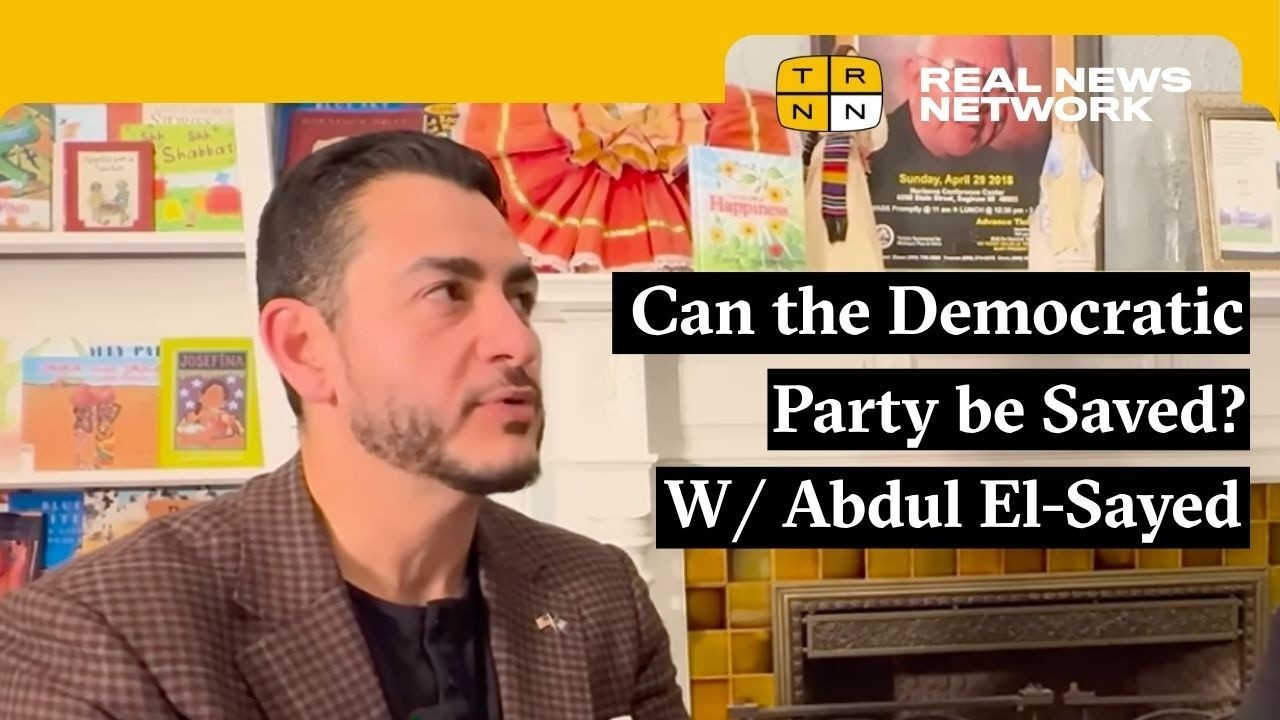
Can the Democratic Party be saved? TRNN’s full, unedited interview with Dr. Abdul El-Sayed

Michigan Democratic candidate for Senate Abdul El-Sayed speaks at The People V. The Powerful rally at the Detroit Opera House on July 18, 2026 in Detroit, Michigan. Photo by Sarah Rice/Getty Images.

Michigan’s Senate race has become one of the most pivotal electoral battlegrounds in the country. With primaries taking place on August 4, all eyes are on the high-stakes competition between progressive candidate Dr. Abdul El-Sayed and establishment candidate Haley Stephens to see who will represent Democrats in the general election.

In this raw, unedited interview, TRNN Editor-in-Chief Maximillian Alvarez sits down with El-Sayed in Saginaw, Michigan, to talk about his campaign, the civil war within the Democratic party, and about fighting corporate oligarchy and MAGA fascism at the same time.

Credits:

  • Videography: Maximillian Alvarez
  • Post-Production: David Hebden
Transcript

The following is a rushed transcript and may contain errors. It will be updated.

Maximillian Alvarez: I’m here in the Mexican American Council Building in Saginaw, Michigan, and I’m sitting with Dr. Abdul El-Sayed, who is running to represent Michigan in the United States Senate. Brother Abdul, great to see you again, man. Thanks for joining me. I really appreciate it.

Dr. Abdul El-Sayed: An honor.

Maximillian Alvarez: And we first met when you were running for governor here in Michigan in 2018.

Dr. Abdul El-Sayed: Feels like yesterday. It feels like 15 years ago.

Maximillian Alvarez: Exactly. Both a day ago and a lifetime ago. And I think the circumstances around each election can sort of trick us into feeling like they’re very similar moments. When you were running in 2018, the question was how are Democrats going to respond to Trump? But also, who’s going to inherit the Bernie Sanders mantle? AOC just won. And so you were part of that progressive cohort. And now we kind of have a similar situation. How are Democrats going to respond to Trump winning again? Zorn Mamdani just won in New York. Who’s going to inherit the progressive movement? But these are two very different moments and you’re a very different person than you were back then. I wanted to ask to start how you would characterize the differences between that campaign and this one.

Dr. Abdul El-Sayed: Let me break it down two ways. There’s where we are as a country, and then there’s the growth that you do as a person. I think where we are as a country, this is a moment where I think, to be honest, we had failed to learn the central lesson of Trumpism. I think a lot of folks felt like the record had skipped, that there was this mistake. And they didn’t see the fact that Donald Trump was exploiting a foundational pain in people. And I said this thing at the time, I think that was just, it was premature and most folks didn’t see it. Donald Trump himself is not the disease of our politics. He’s just the worst symptom of the disease of our politics. And the disease is the system that allows corporations and billionaires and would be oligarchs to buy and sell politicians to do their bidding.
You watch as they use their power to suppress our wages for the work that we have to do and to raise our prices for the things we have to buy. And I think this time around, people are recognizing that actually we dealt with the symptom, but we didn’t deal with the disease. And as a doctor, I’ll tell you, if you only deal with the symptom and you don’t deal with the disease, it comes back roaring worse. And that’s exactly what’s happened now. So I think folks are a lot more interested in authentic engagement with the structures of our system. Even now though, you got a lot of corporate folks out there who just want to deal with the symptoms. They’re like, oh, affordability? Okay. I’ll make one thing more affordable for you. It’d be great. And they’re like, no, there’s a structure underneath affordability. There’s a reason why everything accelerates in the wrong direction always.
And if you don’t deal with the foundational infrastructure, you’re not going to deal with the outcome. I’ve grown up a bit. I was 32, never run for office in my life. I had one and a half years of public service, two years of public service under my belt. Didn’t have any kids, lived in my in-law’s basement. I’m 41 now with two kids and a mortgage. And I’ll tell you, there’s something you learn about yourself when you have kids. And I think more than anything, it puts a patina on your soul in the sense that your kid walks into your bed, they piss your bed, and then you have to clean them and your bed while they’re pitching a tantrum in the middle of the night. Which is, to be fair, really unfair. But you’re like, “Hey, the baby, it’s okay. It’s all right. No worries.
It’s okay.” And it’s that ability, I think, to just have to metabolize more of life. That I think for me is probably the big difference.
I also, I think I learned a lot about life is short, but it’s also quite long. And one of the frustrations I think I have with some folks in our movement sometimes is that we want people to agree on the critique. And we always break apart on the critique. It’s not about the critique, it’s about the outcome. And I think the more you could focus on how you want the world to be like and get people to agree to that, even if they come at it with different perspectives, I think the better off we are. And I think that’s probably what I’ve learned over time.

Maximillian Alvarez: I’m thinking about what you were saying about having kids and the way it changes your worldview. And I wholeheartedly agree. There’s a foundational, existential humbling that comes with having kids and getting your ass beat once in your life. And you can tell the people in politics who have had neither of those

Dr. Abdul El-Sayed: Things. Well, I’d had the first one.
Delivered a couple myself, but I’ve had the first one. The second one, right? To be honest, having kids, to your point, that humbling nature of it, because it never ends. There’s always something. I give all the credit to my wife, Sarah. She’s a real MVP. And I’m just in awe of all that she has to do every day because of what I’m doing right now. But there is something about recognizing you’re trying to cherish something vulnerable for what it could be. And isn’t that what we’re trying to do here? And I think it also forces you to contend with pain quite a bit. And for me, I’ve trained as a doctor and that training’s been really useful for me because both doctors and politicians have to be really good at being able to sit with other people’s pain and to speak truth to pain. It’s true truth to power, but also truth to pain.
And I think having a kid has really brought that’s crystallized that in a certain way because you kind of understand the project. You know what I mean? Taking care of you because I love you. And I also love what you could be, even if I don’t love what you’re being right now. You know what I mean? And I think those are the moments that your kids test you the most. And you get tested like that enough times. You come out in political circumstances and you’re like, at least you’ve been pissed my bed.

Maximillian Alvarez: I agree with you, but by that definition, my mom would be a great politician because I test her a lot. And let’s talk about how you’ve grown as a person, but also as a politician –

Dr. Abdul El-Sayed: I’m waiting for the Mama Alvarez congressional.

Maximillian Alvarez: Oh man. Yeah. Mama Alvarez would take it, baby. But you’ve grown as a politician as well. Your career in public service and my career in journalism almost started around the same time. And again, you know this because I was the Cub reporter on your gubernatorial campaign bus being like, “What am I doing?” And

Dr. Abdul El-Sayed:: Wrote one of my favorite profiles then. So I was really grateful. A good journalist can see the thing beyond or the depth, the structure of the thing. And I appreciated that then.

Maximillian Alvarez: Thank you, man. I appreciate that. And I wanted to ask, how have you changed in those 10 years, especially let’s focus on the work that you did in Wayne County to prepare you to be qualified for US Senate?

Dr. Abdul El-Sayed: Yeah. There’s a couple pieces there. I had run a health department, but the Wayne County department was just a lot more complex. 550 FTEs across all the programs that you run, the contracts that you oversee, et cetera. And $172 million budget, all kinds of moving parts in a bureaucracy that can be really difficult to negotiate and manage. And you’re working with everything from federally funded programs to state funded programs to county programs. You’re managing constituencies. And more than anything else, you are responsible for a particular thing for a particular group of people. And I think negotiating all of those moving parts for me was really valuable in a space like the county. And also just deepening my relationships with the community in Wayne County. Wayne County is Michigan’s largest, most diverse county, about a fifth of the state’s population. You got all kinds of different communities.
Downriver community, predominantly working class, black or white. You’ve got Dearborn, you’ve got the city of Detroit, of course. And thinking through the ways that you have to build coalitions around the work that you can do to deliver for everybody. And then there’s the technical part of things. And as a public health director, you’re responsible for a very technical set of things. So to me, the space of public service I’ve always been most excited about is how do you bring the technical, the practical and the political together? And you think about where we are in the Senate right now, you think about what we lack. We lack the political will to actually take on Trump and also to articulate what we’re fighting for and not just what we’re against. We lack a lot of technical skills in terms of understanding some of the leading edge questions of our time, whether it’s AI or rebuilding a public health infrastructure that RFK Jr.
Is all but ruining right now. You think about what it means to take on the healthcare challenges we have. We’re fighting for subsidies, for health insurance for 25 million people when we should really be having the conversation about whether or not 350 million people should have to worry about premiums at all. But these are technical questions that are political and practical in their nature. And so I think for all of those reasons, going back to public service, being engaged on the ground will make me a better public servant. The last thing I’ll say is this. At the end of the day, these issues, the rubber hits the road in city and county government. We don’t have folks who’ve served in these rules in the Senate all too often where you actually have to look people in the eye and say, “Here’s how you get this thing done.
And here’s the service we can render to you.” And I hope I can bring that. So whether it’s the technical skill set when it comes to healthcare, we haven’t had a Democratic doctor in the Senate since 1969. Never had a public health official in the US Senate. Whether it is the practical part of it, understanding how is this legislation that we put together going to impact Ms. Sue’s life living in downriver. And then it’s the political work of bringing people together around building and moving, I think is a good preparation all around.

Maximillian Alvarez: Well, and kind of bringing that back into the climate that we’re in. I’m going to ask you basically a similar version to the same question that I asked Beto O’Rourke when I got the chance to. Because I imagine you would agree, but my sense from the coverage we’ve done is that the 2024 election was less of a referendum on how much people love Donald Trump than it was a referendum on how much people hate the Democrats. And the people’s faith in the Democratic Party is in the basement right now, especially on top of a year of doing what feels like virtually nothing to stop Trump. Caving on the longest government shutdown in our history while people are watching their SNAP benefits, their healthcare disappear before their eyes. So the question there is like, is why run as a Democrat? And how are you going to address that lack of faith and prove that this isn’t just the right message that you’re going to meet people’s needs?

Dr. Abdul El-Sayed: Yeah. I know what I’m about. And Democratic Party hasn’t always met my needs. I think a lot of people out there feel like they’re Democrats by hostage situation. You look at the other guys and you’re like, “That’s crazy.” And then you look at the Democrats and you’re like, “I don’t know what’s worse.” Being cruel and crazy or being feckless in the face of being cruel and crazy. Now, the party is so far away from its voters. The majority of Democrats out there, when I talk to them out at Democratic clubs or indivisible or you name the organization that I’m out, they are so far away from the party elders who hold all the power. And I think we have an opportunity as a party to molt. Out with the old, in with what the people underneath the party really want. And I’ve said this for a very long time.
The problem with Democrats is too often they’re taking money from the very same people who created the problem. So now you’re in this weird position of trying to articulate a solution to the problem that includes the people who created the problem. That makes sense. I don’t take over money. I never have. I never will. And I understood from the day I started in politics that that wasn’t the big issue. And so when folks look at me, they say, at least I know what he believes because he’s not bought. And I think the party could do the same thing. Say what you will about Donald Trump. He’s got a coherent narrative. You out of a job. Immigrant took your job. Out of a home. Immigrant took your home. Out of healthcare. Immigrant took your healthcare. That’s his narrative. Simple, easy to understand, dead wrong. We could have a narrative too.
Out of a job, corporation offshored or automated your job. Out of healthcare, corporation squeezed you out of healthcare. Out of a home, corporation speculated that you can’t afford a home. But when you’re taking money from corporations, guess what you’re not going to say? So you come with your little list of 10 point policy plans that’s going to deliver something for maybe somebody 10 years from now. It’s bullshit. So I think the party could be better and I’m running to make it better. So I’m a Democrat with lowercase D, and I hope someday we can win the fight for what the Democratic Party can be. And I’m not willing to let go of all that infrastructure because a few folks who can’t let go of power say that it’s theirs.

Maximillian Alvarez: Do you feel hopeful about other people running as Democrats that you’ll be among a cohort of people who believe that?

Dr. Abdul El-Sayed: I hope so. I hope so. I think there are some folks out there who see the issue, working to try and address it, and we’re going to have to build power. No one US Senator is going to solve all the problems. I mean, one out of 100 senators, 1% of the US Senate, always, that’s all you are. So you better figure out how to build the team. But I also think that we’ve given up on persuasion. Democrats do this thing where Donald Trump’s out there persuading people left, right, center all the time. And we’re out here trying to run a poll and figure out where people are and then speak right to the poll. So what happens is the public’s moving in one direction and we keep speaking to where that is. We can be like, “Well, immigration’s not a popular issue.” I was like, “Are you kidding me?
Shredding the damn constitution over it.” Popular issue. I don’t give a damn.This is the issue of our time and you don’t want to talk about it, but also talk about it in a way that’s complete. So you get a lot of people who talk about immigration as this esoteric abstract thing that sits on a mantle and we just admire it. I mean, democracy was broken the day corporations started to buy elections. That didn’t just happen. We’re at death’s door now, but we’ve been here. We’ve been sick. And so why don’t you talk about it in ways that are actually fully complete? Hey, every time a corporation comes in and buys off a politician, that kills your democracy a little bit. But most of these folks who want us to talk about democracy now didn’t feel it when that happened. And I think we got to talk about it completely.

Maximillian Alvarez: I want to talk about what that means for where we are sitting right now in Saginaw, Michigan. And I have a special attachment to this place. My wife grew up here. I have a lot of in-laws who live around here. My wife’s family had generations of men work in the old GM plant up the road. It is a cold, hard, but beautiful place with a lot of families, with a lot of deep roots. A lot of immigrant families going from back to Poland, Germany, Mexican and other Latino immigrants, a lot of black folks who came up during the Great Depression. People don’t give towns like Saginaw credit for how complex and beautiful they actually are. But in many ways, this is the archetypal rust belt

Dr. Abdul El-Sayed: Town.

Maximillian Alvarez: I mean, there is a lot of pride. There’s a lot of joy. There’s a lot of family here. There’s also a lot of boarded up windows. There’s a lot of blight. There’s a lot of pain. There’s a lot of poverty and economic devastation. So why is it important for you to come to a place like Saginaw? And again, moving past the sort of democratic messaging, I guess my question is not how do you hope to reach people who live in places like Saginaw, but what can you and other politicians do for places like Saginaw?

Dr. Abdul El-Sayed: Yeah. The simple question, how do you reach? You come. We’re here. You know what I mean? This is not my first time in Saginaw. It’s not going to be my last time in Saginaw. And then I think the way you reach folks is to be vulnerable with them. I can’t solve all the problems, but I can’t tell you why the problems exist. And I can tell you I’m going to try like hell to take it on. And then I think you need to go back to that point that I was making to be a really good listener to people’s pain and to try to forge that pain into purpose. I can’t solve it. Anybody walks in here is like, “I’m going to fix your problems.” No, you’re not. We can solve it. And if I can be a vessel that helps to create something that can organize us and can impose what it is that we’ve been asking for, for a very long time into power, then I think we can solve it.
We can’t solve it tomorrow, but we can solve it in due time. And I’ll tell you that the analogy here to medicine is clear. Somebody gets a cancer diagnosis. You want to tell them you’re going to be fine. It’s bullshit. If I tell you you’re going to be fine, it’s a lie. But what I can tell you is I’m really sorry that this happened to you. And I can tell you what we know. And I can tell you what we can do. And I can tell you I’m going to sit here and listen for as long as you need me to listen to you. And that I’m going to be your advocate for helping get the best outcome you want.
In this case, it’s not terminal. Places like Saginaw can heal, but not doing the same shit that we’ve been doing. And so in some respects, there is an honesty that you have to tell people. It’s not just always going to be okay or I’m going to solve all your problems. I’m not. I’m going to do my best to help you, to be honest with you about what the problem is, to sit down and think about what our approach moving forward can be, and to fight like hell for you against people who’ve created this problem. And if we can do that and you can trust me to do that, we can build things over time. But it starts there. And I just think there’s a humility and a vulnerability in that.

Maximillian Alvarez: And I know I got to let you go in a minute because you’re about to walk into the next room and participate in a round table with members of the Latino community out here. And I kind of wanted to end

Dr. Abdul El-Sayed: On – Well as a Latino myself.

Maximillian Alvarez: Well, that’s why I kind

Dr. Abdul El-Sayed: Of wanted – I’m not Latino, but I’ve been mistaken one

Maximillian Alvarez: For

Dr. Abdul El-Sayed: Enough times that I’m just like, I kind of get it.

Maximillian Alvarez: I was about to say, it was like you walk into a family party. People would think that you’re, hey, he’s Mexican. I walk into one of yours and be like, “Hey, he’s Egyptian.” Exactly. But that’s kind of where I wanted to go with it. We’re both brown men living in America in 2025. You’re running for office. Your last name is Elsayed. I don’t need to tell you that this is a dangerous exercise. But I wanted to sort of ask for yourself, your family, your children, why is it important to you to run when there are so many forces in America that are trying to keep people like you out of America?

Dr. Abdul El-Sayed: Yeah. I spent a lot of my childhood summers in Egypt with my grandmother who’s the smartest person I ever met. And she never got to go to school. So I’ve spent a lot of time with really smart people. The smartest of them was the person whose story would never get told. You would never know she lived. People who got to live with her knew she lived. She was immense. And I saw the chasm and opportunity that I had versus my cousins. So I know what America did for me. And I also know what America fails to do for so many other kids. And so in some respects, I’ve gotten to live a really nice life relative to all my cousins. I’m kind of playing with house money. You know what I mean? So to me is when you’re playing with house money, you put it all back in the center of the table and say, “What can I do to create the America that other kids deserve?
The one that I got.” And at the end of the day, if that’s the value of a life is to create opportunity for other people, that’s the best I can do. And it means so much to me to get to do it because I don’t know what it’s like to be someone whose American identity has a bit of an asterisk on it. And so if my doing this gets to take a little bit more of that asterisk off, gets to erase some of that asterisk, that’s meaningful. More importantly, if there are kids out there who get to manifest and get to live the kind of life that I got to live because of the work that I did, I think that’s the kind of thing that would make my grandmother proud. And that to me is meaningful. How I judge my moral work is like, would my grandmother be proud of this?
So you can get all the titles and all the accolades and all the everything. And there’s a moral simplicity to being able to speak to the right side of right and wrong for someone whose sense of morals were never clouded by what an institution thought. And so I think it’s just put it all back in.

Maximillian Alvarez: And are you scared? And what do you say to people on the campaign trail who are very understandably, justifiably scared right now?

Dr. Abdul El-Sayed: Scared. That’s a complicated sort of thing. I think I am scared for where our country is headed. I’m scared I will not do what is my responsibility to do about it. But there is something about. I don’t believe in the term happiness as much as I believe that happiness is a whole bunch of consolation of different things. There is contentment. Eating ice cream, that’s contentment. There’s fulfillment. I got a good workout in. There’s joy, just the excitement of something that’s happy. And I would choose fulfillment over the others every day. And so I know I’m putting everything I can into trying to create opportunity for people who otherwise don’t have it, and that leaves me fulfilled. So in that respect, I think if all of us tried to chase, I did what I could with what I had where I was, I think we can get through this.
And the thing that to me frustrates me the most is that we know enough to be scared. There are a lot of folks out there who are so busy just trying to make life work that they can’t actually think about the broader existential questions at play. And I fear for those folks. See what I mean? Because most of the time those folks’ lives have been a function of circumstances they can’t control. And this all feels a lot worse. So I think that’s probably where my fear comes from.

Maximillian Alvarez: Well, I know we got to get going. All right. Yeah. And what’s, I guess, again, for folks who want to fight back, don’t want to go gently into the night, but are still afraid. They’re afraid of getting abducted by ICE. They’re afraid of getting surveilled online. They’re afraid of not being able to make their house payment. How do we respond to the politics of fear that Trump has risen on? What is the counter message

Dr. Abdul El-Sayed: To that? Tell you what I do.
So for a long time I’ve realized that anxiety is, it’s the fear of a future pain. And so what I try to do is just actually think that through. So what would happen? What would that actually feel like? And I process that and I seek to get myself comfortable with the worst possible outcome. And then I think about my life and what I have to lose versus the people I’m trying to fight for. See what I’m saying? And I don’t know. I try to think about what is courage in this moment because that’s what we’re all trying to summon. And I think courage is the ability to be comfortable with your loss of control and to metabolize the pain you might experience.
And pain comes in a lot of different ways. But you see what’s happened over time is that the people with the most power have folded the fastest. And I never want to be that guy. And so I just think that there’s like soul work you have to do to get comfortable losing it all. You know what I mean? And to be okay with the fact that if you’re willing to incur pain so that other people don’t have to, that I think is virtue. And I think it’s important for all of us to actually think through those things and do that exercise and to live in that moment of saying, okay, if this so-and-so were to happen, what would that mean for me? And also just, I’m a person of faith and I believe that there’s another side of the equal sign. That what happens here is not the end.
And so I’m comforted by the idea that if you do what is right here, if you are willing to take pain here for others for the right reasons, that in the end, God doesn’t forsake you. So however people think about that in their belief system, I think these are the moments where you actually have to really reflect on it. Do the spiritual work of asking what begets virtue for you? What begets courage for you?
Because we’re going to need it right now. And that’s the thing is we don’t know really where it’s going to go, but we’re watching the richest and most powerful fold the first. And what that tells you is that we have a certain spiritual failure. You know what I mean? You got the most to lose. What’s the point? I mean, it’s like, what’s the point of having F you money if you can’t say F you? You mean? And in a lot of ways, I’ve been so privileged in this world. All the advantages. What’s the point of having F you privilege if you can’t say F you? You know what I mean? Yeah. At the end of the day. So at some point, you look at Donald Trump and you’re just like, F you. We’re not going to back down.

Maximillian Alvarez: That was the perfect ending spot. So I will close it there. But brother Abdul al-Sayed, thank you so much, man. I really appreciate you. Appreciate it.

💾

“I'm a democrat with lowercase D, and I hope someday we can win the fight for what the Democratic Party can be. I'm not willing to let go of all that infrastructure because a few folks who can't let go of power say that it's theirs.”
  •  

Abdul El-Sayed believes a new Democratic Party is possible

Still image of Dr. Abdul El-Sayed (left), a Democrat running to represent Michigan in the US Senate, speaking with TRNN Editor-in-Chief Maximillian Alvarez (right) at the Mexican-American Council in Saginaw, Michigan, on Dec. 5, 2025. Credit: Maximillian Alvarez/TRNN.

The outcome of Michigan’s Senate race will have major implications for the balance of power in Washington, DC, and for the future of the Democratic Party itself. With primaries taking place on August 4, all eyes are on the battle between progressive candidate Dr. Abdul El-Sayed and establishment candidate Haley Stephens to see who will represent Democrats in the general election. TRNN Editor-in-Chief Maximillian Alvarez sits down with El-Sayed to talk about his campaign, the civil war within the Democratic party, and about fighting corporate oligarchy and MAGA fascism at the same time.

Credits:

  • Videography: Maximillian Alvarez
  • Post-Production: Maximillian Alvarez, David Hebden
Transcript

The following is a rushed transcript and may contain errors. It will be updated.

Speaker 1:

Michigan is shaping up to be one of the most closely watched Senate races of this entire cycle.

Speaker 2:

Democrats will choose between Congresswoman Haley Stevens and former director of the Department of Health, Human and Veterans Services, Wayne County, Dr. Abdul El-Sayed.

Dr. Abdul El-Sayed:

We pay more for the stuff we got to buy, get paid less for the work that we do and watch as our tax dollars get misappropriated abroad to drop bombs on other people’s kids instead of to invest in our own kids and their schools and their healthcare.

Speaker 4:

We’re done. Business as usual politics is over.

Dr. Abdul El-Sayed:

Most people don’t walk around thinking, where do I stand on the left right spectrum? Most people walk around thinking, how am I going to afford my groceries? How am I going to pay for my rent? Can I ever afford a home? What am I going to do if I get sick? The majority of Democrats out there, when I talk to them, they are so far away from the party elders who hold all the power. And I think we have an opportunity as a party to molt out with the old, in with what the people underneath the party really want.

Speaker 5:

Obviously politics are a very tumultuous time right now and the Democratic Party’s kind of in disarray. So I’m coming out to support Abdul.

Maximillian Alvarez:

He really knew and understood the people, that he was for the people.

Dr. Abdul El-Sayed:

So we’re running a campaign to do three very simple things. Number one, we’ve got to get money out of politics. We’ve got to take on the system that tells us that corporations are people and that their money is speech. So we’ve got to get money out of politics. Number two, we’ve got to put money back in people’s pockets. So what does that mean? It means empowering people to join or form a union in every sector of our lives. It means standing with small businesses like this one that really do create the backbone of our economy. And it means finally taxing billionaires some wealth.

Speaker 7:

And that is precisely why we need people like Abdul in the US Senate.

Speaker 8:

I worked third shift and I made sure to get my butt out here in support before I have to go into work because the message has always been amazing. Watch out. There’s a car right there. But yeah, the way he just speaks to the working class I feel like is really what we need. And also when I shook his hand, he dabbed me up like a homie.He felt like somebody I knew already and that’s somebody I want fighting for us in the Senate. So I’m really glad I came tonight.

Dr. Abdul El-Sayed:

The question for us is bigger than this seat. It is about what we want out of our democracy in the first place. So if everything is working just fine for you, I’m not your guy. Do not vote for me. But if you believe that you deserve healthcare, if you believe that your tax dollars ought to be spent on you, if you believe that corporations should not have a bigger say in our politics than you do, then maybe I am.

Maximillian Alvarez:

We first met when you were running for governor here in Michigan in 2018. The question was how are Democrats going to respond to Trump? But also who’s going to inherit the Bernie Sanders mantle? AOC just won. And so you were part of that progressive cohort. And now we kind of have a similar situation. How are Democrats going to respond to Trump winning again? Zorn Mamdani just won in New York. Who’s going to inherit the progressive movement? But these are two very different moments and you’re a very different person than you were back then. I wanted to ask to start how you would characterize the differences between that campaign and this one.

Dr. Abdul El-Sayed:

Let me break it down two ways. There’s where we are as a country and then there’s the growth that you do as a person. I think where we are as a country, this is a moment where I think to be honest, we had failed to learn the central lesson of Trumpism. I think a lot of folks felt like the record had skipped, that there was this mistake and they didn’t see the fact that Donald Trump was exploiting a foundational pain in people. And I said this thing at the time, I think that was just, it was premature. Most folks didn’t see it. Donald Trump himself is not the disease of our politics. He’s just the worst symptom of the disease of our politics. And the disease is the system that allows corporations and billionaires and would be oligarchs to buy and sell politicians to do their bidding.

You watch as they use their power to suppress our wages for the work that we have to do and to raise our prices for the things we have to buy. And I think this time around people are recognizing that actually we dealt with the symptom, but we didn’t deal with the disease. And as a doctor, I’ll tell you, if you only deal with the symptom and you don’t deal with the disease, it comes back roaring worse. And that’s exactly what’s happened now. So I think folks are a lot more interested in authentic engagement with the structures of our system. Even now though, you got a lot of corporate folks out there who just want to deal with the symptoms. They’re like, “Oh, affordability? Okay, I’ll make one thing more affordable for you. It’d be great.” And they’re like, “No, there’s a structure underneath affordability. There’s a reason why everything accelerates in the wrong direction always.

And if you don’t deal with the foundational infrastructure, you’re not going to deal with the outcome.” One of the frustrations I think I have with some folks in our movement sometimes is that we want people to agree on the critique and we always break apart on the critique. It’s not about the critique, it’s about the outcome.

And I think the more you could focus on how you want the world to be like and get people to agree to that, even if they come at it with different perspectives, I think the better off we are. And I think that’s probably what I’ve learned over time.

Speaker 4:

There’s a big battle brewing. A battle brewing against not only the corrupt fascist forces of the Republican Party, but also against do – nothing Democrats that would rather sit there and collect paycheck after paycheck and fundraise from corporate donors that put your interests second to the interests of those very same corporations.

Maximillian Alvarez:

The 2024 election was less of a referendum on how much people love Donald Trump than it was a referendum on how much people hate the Democrats.

Speaker 2:

Agree.

Maximillian Alvarez:

People’s faith in the Democratic Party is in the basement right now, especially on top of a year of doing what feels like virtually nothing to stop Trump, caving on the longest government shutdown in our history while people are watching their SNAP benefits, their healthcare disappear before their eyes. So the question there is like, is why run as a Democrat? And how are you going to address that lack of faith and prove that this isn’t just the right message that you’re going to meet people’s needs?

Dr. Abdul El-Sayed:

Yeah. I know what I’m about. And Democratic Party hasn’t always met my needs. I think a lot of people out there feel like they’re Democrats by hostage situation. You look at the other guys and you’re like, “That’s crazy.” And then you look at the Democrats and you’re like, “I don’t know what’s worse.” Being cruel and crazy or being feckless in the face of being cruel and crazy. Now the party is so far away from its voters. The majority of Democrats out there, when I talk to them out at Democratic clubs or indivisible or you name the organization that I’m out, they are so far away from the party elders who hold all the power. And I think we have an opportunity as a party to molt. Out with the old, in with what the people underneath the party really want. And I’ve said this for a very long time.

The problem with Democrats is too often they’re taking money from the very same people who created the problem. So now you’re in this weird position of trying to articulate a solution to the problem that includes the people who created the problem. That makes sense. I don’t take over money. I never have. I never will. And I understood from the day I started in politics that that wasn’t the big issue. And so when folks look at me, they say like, “At least I know what he believes because he’s not bought. And I think the party could do the same thing. Say what you will about Donald Trump. He’s got a coherent narrative. You out of a job. Immigrant took your job. Out of a home. Immigrant took your home. Out of healthcare. Immigrant took your healthcare. That’s his narrative. Simple, easy to understand, dead wrong. We could have a narrative too.

Out of a job, corporation offshore automated your job. Out of healthcare, corporation squeezed you out of healthcare. Out of a home, corporation speculated that you can’t afford a home. But when you’re taking money from corporations, guess what you’re not going to

Speaker 2:

Say?

Dr. Abdul El-Sayed:

So you come with your little list of 10 point policy plans that’s going to deliver something for maybe somebody 10 years from now. It’s bullshit. So I think the party could be better and I’m ready to make it better. So I’m a Democrat with lowercase D, and I hope someday we can win the fight for what the Democratic Party can be. And I’m not willing to let go of all that infrastructure because a few folks who can’t let go of power say that it’s theirs.

Speaker 7:

So what the hell is going on? Why are we living in a society where workers are producing more and more and virtually all of that income and wealth is going to the top 1%?

Dr. Abdul El-Sayed:

It’s the system that allows the richest, most powerful people, corporations, billionaires to buy and sell politicians in ways that leave them rigging the system against us. Corporations get bigger, more powerful. Our lives get harder.

Speaker 2:

I feel like I don’t ever see hardly any campaigning politicians come to Saginaw and it’s so underrepresented given how much we’ve been through. I mean, we’re very similar to Flint in a lot of ways and how we had a booming industry and then laws were passed that just discriminated against every single person one way or another that pushed us out of different areas for companies and contractors to come in and exploit us. And I think he touched on that in a way I haven’t seen a lot of politicians really focus on, at least for again, Saginaw.

Speaker 1:

I absolutely think Abdul is right on track of having the billionaires stop having power in politics and allowing us to have a voice and making sure that everybody is treated fairly. I do a lot of the organizing of the Latino community here in Saginaw, Michigan. So I’m trying to get them a voice because for too long there are too many Republicans and Democrats that have been voting to cause harm to the Latino population.

Speaker 5:

I think an unapologetic progressive populism that’s centered on delivering for working class people is how we win in the future. And that’s exactly what Abdul’s message is.

Dr. Abdul El-Sayed:

I mean, democracy was broken the day corporations started to buy elections. That didn’t just happen. We’re at death’s door now, but we’ve been here. We’ve been sick. And so why don’t you talk about it in ways that are actually fully complete? Hey, every time a corporation comes in and buys off a politician, that kills your democracy a little bit. But most of these folks who want us to talk about democracy now didn’t feel it when that happened. And I think we got to talk about it completely. I

Maximillian Alvarez:

Want to talk about what that means for where we are sitting right now in Saginaw, Michigan. And I have a special attachment to this place. My wife grew up here. I have a lot of in – laws who live around here. My wife’s family had generations of men work in the old GM plant up the road. It is a cold, hard, but beautiful place with a lot of families with a lot of deep roots. A lot of igrant families going from back to Poland, Germany, Mexican and other Latino immigrants, a lot of black folks who came up during the Great Depression. People don’t give towns like Saginaw credit for how complex and beautiful they actually are. But in many ways, this is the archetypal rust belt

Speaker 2:

Town.

Maximillian Alvarez:

I mean there is a lot of pride. There’s a lot of joy. There’s a lot of family here. There’s also a lot of boarded up windows. There’s a lot of blight. There’s a lot of pain. There’s a lot of poverty and economic devastation. So why is it important for you to come to a place like Saginaw? And again, moving past the sort of democratic messaging, I guess my question is not how do you hope to reach people who live in places like Saginaw, but what can you and other politicians do for places like Saginaw?

Dr. Abdul El-Sayed:

Yeah. The simple question, how do you reach? You come. We’re here. You know what I mean? This is not my first time in Saginaw. It’s not going to be my last time in Saginaw. For me, I’ve trained as a doctor and that training’s been really useful for me because both doctors and politicians have to be really good at being able to sit with other people’s pain and to speak truth to pain. It’s truth to power, but also truth to pain. And then I think the way you reach folks is to be vulnerable with them. I can’t solve all the problems, but I can’t tell you why the problems exist. And I can tell you I’m going to try like hell to take it on. And then I think you need to go back to that point that I was making to be a really good listener to people’s pain and to try to forge that pain into purpose.

I can’t solve it. Anybody walks in here is like, “I’m going to fix your problems.” No, you’re not. We can solve it. And if I can be a vessel that helps to create something that can organize us and can impose what it is that we’ve been asking for, for a very long time into power, then I think we can solve it. We can’t solve it tomorrow, but we can solve it in due time. And I’ll tell you that the analogy here to medicine is clear. Somebody gets a cancer diagnosis. You want to tell them you’re going to be fine. It’s bullshit. And if I tell you you’re going to be fine, it’s a lie. But what I can tell you is I’m really sorry that this happened to you. And I can tell you what we know and I can tell you what we can do.

And I can tell you I’m going to sit here and listen for as long as you need me to listen to you and that I’m going to be your advocate for helping get the best outcome you want. In this case, it’s not terminal. Places like Saginaw can heal, but not doing the same shit that we’ve been doing. And so in some respects there is an honesty that you have to tell people. It’s not just always going to be okay or I’m going to solve all your problems. I’m not. I’m going to do my best to help you, to be honest with you about what the problem is, to sit down and think about what our approach moving forward can be and to fight like hell for you against people who’ve created this problem. And if we can do that and you can trust me to do that, we can build things over time, but it starts there.

💾

“The majority of Democrats out there are so far away from the party elders who hold all the power. And I think we have an opportunity as a party to molt: out with the old, in with what the people underneath the party really want.”
  •  
❌