
❌

Reading view

Inside Kazakhstan’s new political era: EU Reporter journalist Derya Soysal questions President Tokayev after historic Kurultai vote

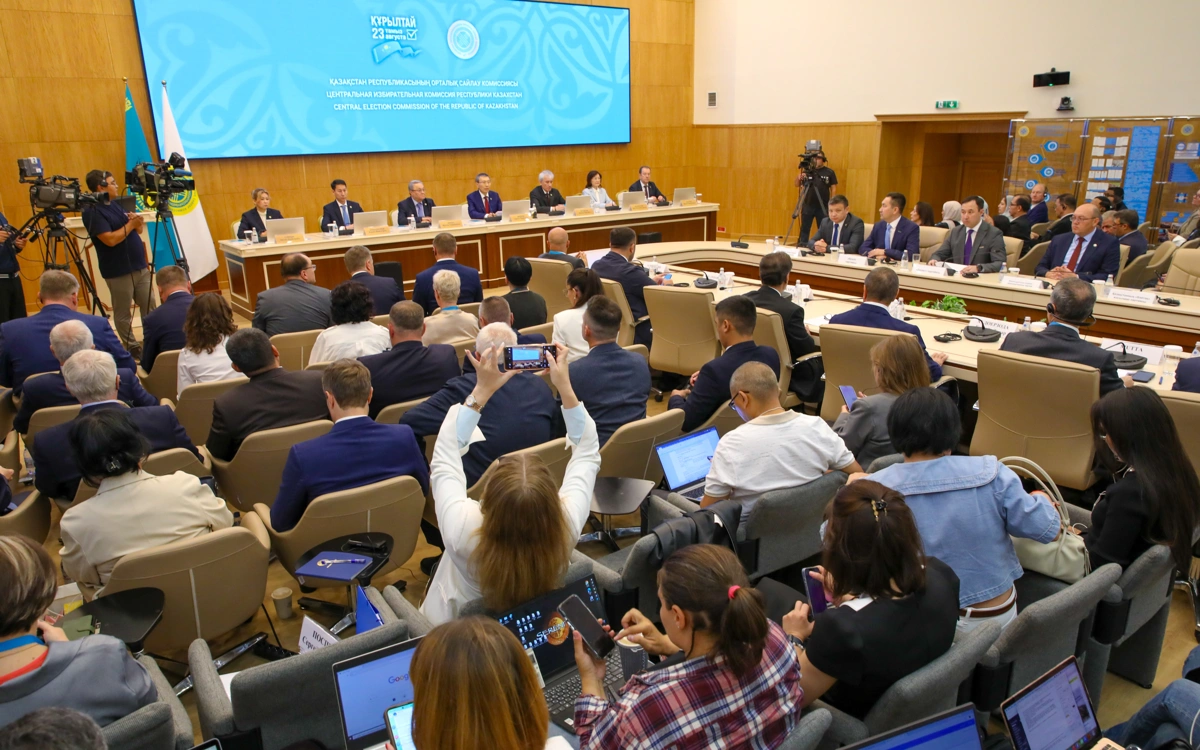
EU Reporter journalist Derya Soysal was among the members of the press given direct access to President Kassym-Jomart Tokayev in Astana after he cast his vote in Kazakhstan’s first elections to the newly established Kurultai — an opportunity that offered a rare first-hand insight into the President’s thinking on political reform, government, youth, artificial intelligence and the country’s future direction.

For a journalist covering the rapidly changing political landscape of Central Asia, there are moments when being in the room matters.

For EU Reporter journalist Derya Soysal (pictured with President Kassym-Jomart Tokayev) Kazakhstan’s historic Kurultai election provided precisely such an opportunity.

After President Kassym-Jomart Tokayev cast his vote in the country’s first election to the newly established Kurultai, Soysal was among the journalists with privileged access to the President during the press briefing that followed.

It gave EU Reporter a first-hand opportunity to hear Tokayev address some of the most important questions facing Kazakhstan as the country enters a new political chapter.

The exchanges went far beyond election day itself.

Questions ranged from the consequences of constitutional reform and the creation of the Vice Presidency to the future composition of the government, the role of younger politicians and the increasingly important place of artificial intelligence in Kazakhstan’s economic and social development.

The result was a revealing picture of how Tokayev sees the next phase of his country’s transformation.

A historic political moment

Tokayev himself described the election as a historic milestone and the beginning of a new stage in Kazakhstan’s development.

The establishment of the Kurultai forms part of a much broader restructuring of the country’s political institutions.

During the briefing, the President was questioned about what ordinary citizens should expect from the constitutional reforms, how the newly created Vice Presidency would operate and what role the Kazakhstan People’s Council would play.

Tokayev portrayed the changes as essential components of a renewed political system.

He stressed the importance of the Vice Presidency as an institution capable of supporting effective governance during difficult periods, while describing the Kazakhstan People’s Council as a mechanism intended to strengthen public participation and national cohesion.

But the President’s vision was not restricted to political architecture.

He also pointed to ambitious infrastructure and development programmes encompassing healthcare facilities, rehabilitation centres, urban modernisation and environmental projects.

The question everyone wanted answered

Among the most politically sensitive questions put to Tokayev concerned his own future.

Could he stand again for President?

Following recent constitutional developments concerning his eligibility for a future presidential election, journalists pressed Tokayev on whether he intended to seek another term.

His response was deliberately cautious.

While acknowledging that the legal possibility exists, Tokayev rejected speculation about a future campaign as premature.

Instead, he argued that Kazakhstan should be concentrating on the immediate challenges of modernisation, economic growth, social development and stability in an increasingly unpredictable international environment.

It was a response that sought to move attention away from political succession and back towards the governing agenda.

What kind of politicians does Kazakhstan need?

Soysal’s access to the presidential briefing also provided an opportunity to hear Tokayev set out his expectations of the people who will serve in the new political institutions.

Asked what qualities Kurultai deputies should possess, the President emphasised responsibility and accountability.

Members, he said, should be judged by the quality of the legislation they adopt, whether they fulfil promises made to voters and whether the programmes they pursue genuinely contribute to Kazakhstan’s development.

A recurring theme throughout the briefing was generational change.

Tokayev again argued that Kazakhstan needs younger people to play a greater role in public life.

New faces and new thinking, he suggested, will be essential if the country is to maintain momentum in the years ahead.

A new government — but not change for change’s sake

The creation of the Kurultai also has consequences for the government.

Journalists therefore questioned Tokayev about the future administration and whether Kazakhstan should expect major personnel changes.

The President praised the work of the existing government but confirmed that changes would come.

At the same time, he cautioned against replacing officials simply to create the appearance of political renewal.

For Tokayev, modernisation appears to mean continuous institutional renewal rather than political theatre: bringing in new energy and expertise where necessary while retaining effective administration.

Was the election genuinely competitive?

Another important exchange concerned political competition.

Asked whether the campaign had demonstrated genuine competition, Tokayev pointed to televised debates, public engagement and particularly strong interest among younger voters.

He characterised the electoral process as another milestone in Kazakhstan’s continuing political modernisation and said the campaign had brought new political voices and new ideas into public debate.

For an international audience, however, the question of political pluralism remains one of the key issues against which Kazakhstan’s reforms will ultimately be judged.

The significance of the new institutions will therefore depend not only upon their constitutional design, but on how independently and effectively they operate in practice.

The generation that will inherit Kazakhstan

Young people repeatedly returned to the centre of the discussion.

With a significant number of younger candidates participating in the electoral process, Tokayev was asked whether this generation could genuinely transform the country’s political system.

His answer was notable for combining optimism with a measure of realism.

He acknowledged that not every young official promoted into senior positions in recent years had been successful.

Nevertheless, Tokayev insisted that Kazakhstan must continue putting its confidence in younger generations.

For a country with a comparatively young population, he suggested, long-term success will depend heavily upon the responsibility, engagement and leadership of its youth.

Politics is also about culture

Some of the most revealing exchanges witnessed by Soysal moved beyond constitutions and elections.

Tokayev was questioned about his repeated calls for greater civic responsibility, discipline, respect and public ethics.

The President argued that national modernisation cannot be measured solely in economic growth rates or institutional reforms.

It also requires changes in behaviour and public culture.

He connected those ideas with the Taza Kazakhstan initiative, explaining that cleanliness should be understood both literally and symbolically — encompassing respect for public spaces but also ideas of dignity, moral responsibility and civic consciousness.

From smartphones to artificial intelligence

Perhaps the most forward-looking discussion concerned Kazakhstan’s digital ambitions.

Artificial intelligence has become a central part of Tokayev’s political and economic agenda.

Asked to assess progress in digitalisation, the President argued that Kazakhstan had already completed an important first stage in constructing a digital state by making electronic public services widely accessible.

Citizens can now carry out administrative tasks from home that once required lengthy bureaucratic procedures.

But Tokayev made clear that he regards this as only the beginning.

The next challenge, he said, is to move artificial intelligence and digital technology beyond conferences, presentations and policy documents and turn them into instruments that deliver practical economic benefits.

He highlighted entrepreneurs, farmers and regional communities as groups that should increasingly be able to use technology to improve productivity and generate income.

His message was strikingly simple: the smartphone should no longer be regarded merely as an entertainment device but as an instrument of economic opportunity.

The value of being in the room

For EU Reporter, Soysal’s participation in the presidential briefing provided something increasingly valuable in international reporting: direct access to the political decision-maker at the centre of the story.

Rather than interpreting Tokayev’s position through official statements alone, she was able to witness at first hand how the President responded when confronted with questions about political succession, institutional change, government performance and the expectations of Kazakhstan’s younger generation.

Soysal’s access is particularly significant at a moment when Kazakhstan is seeking to redefine both its domestic political institutions and its place internationally.

The country occupies an increasingly important strategic position between Europe and Asia, while its economic, energy and diplomatic relationships with the European Union continue to develop.

Understanding the direction Kazakhstan takes therefore matters well beyond its own borders.

A country debating what comes next

What emerged from the presidential exchange in Astana was not simply a discussion about one election.

It was a debate about what kind of Kazakhstan should emerge from the reforms now under way.

How much influence will the new institutions exercise?

Will younger politicians genuinely reshape public life?

Can artificial intelligence translate into economic opportunity outside Kazakhstan’s major cities?

And how far will political modernisation alter the relationship between the state and its citizens?

Those questions will not be answered by one election or one presidential press briefing.

But Derya Soysal’s privileged position inside that briefing gave EU Reporter readers a valuable first-hand view of how Kazakhstan’s President himself answers them.

As the first Kurultai begins its work, the importance of the election may ultimately be judged not by the symbolism of its creation, but by what Kazakhstan’s new political institutions actually deliver.

For the moment, however, one thing is clear: the country has entered a new phase, and the political conversation about what comes next has already begun.

Derya Soysal is an EU Reporter journalist covering European and international affairs. She attended President Kassym-Jomart Tokayev’s press briefing in Astana following his vote in Kazakhstan’s first Kurultai elections.
  •  

Why Kazakhstan’s AI challenge might not be adoption, but capability

Kazakhstan is moving rapidly to position artificial intelligence at the center of its economic modernization strategy, investing in computing infrastructure, skills, startups and Kazakh-language technologies as governments worldwide compete for a place in the emerging AI economy, writes Assel Satubaldina.

Kazakhstan has an increasingly ambitious AI agenda. The government has made AI part of its broader economic modernization strategy, betting that it can improve public services, attract investment and help the country generate more value beyond its traditional reliance on raw materials.  It has been investing heavily in computing infrastructure, training, startup ecosystems, and Kazakh-language models. At the 38th plenary session of the Foreign Investors’ Council in July, President Kassym-Jomart Tokayev explicitly called the integration of AI into state investment policy a “critically important priority”. 

The government has adopted a Digital Code and a law on artificial intelligence, launched the Digital Qazaqstan strategy, established a Ministry of Artificial Intelligence and Digital Development, and designated 2026 as the Year of Artificial Intelligence and Digital Development. This push comes at a time as AI is becoming both a major global industry and an increasingly important source of economic and strategic power. UN Trade and Development estimates the global AI market will rise from $189 billion in 2023 to $4.8 trillion by 2033. This is a 25-fold increase in just a decade. 

Globally, AI push is concentrated among a handful of countries. U.S. private AI investment alone reached nearly $286 billion in 2025, more than 23 times the level in China, according to Stanford University’s 2026 AI Index.  Global corporate AI investment more than doubled in 2025, while private companies produced more than 90% of the year’s notable AI models. For emerging economies, the concentration of AI infrastructure in a small number of countries can make this race appear expensive, not to mention that training large language models requires massive quantities of computing power, electricity, connectivity and capital. Kazakhstan is unlikely to compete with the United States or China at the most capital-intensive layer of the AI industry nor does it need to. Experts say its opportunity lies in combining global AI technologies with domestic expertise, while building its own capabilities in areas where dependence creates economic or strategic vulnerabilities.

Strong foundation
The country’s AI push builds on years of its experience of deploying digital technologies at a scale. Advanced technologies are increasingly embedded in government services and banking. “Right now, especially in the artificial intelligence applications in fintech, Kazakhstan is one of the most progressive countries in the world,” Huseyin Atakan Varol, dean of the School of Computing and Artificial Intelligence and director of the Institute of Smart Systems and Artificial Intelligence at Nazarbayev University, told The Astana Times.  He pointed to technologies including palm-recognition authentication and AI-powered banking assistants as examples of how quickly digital tools have entered everyday life. International indicators tell a similar story but also expose an important weakness.

Kazakhstan ranks 10th globally for online government services, according to figures from the World Intellectual Property Organization. Yet it ranks 115th for university-industry collaboration and 112th for venture-capital deal activity relative to the size of its economy. Dr. Varol said Kazakhstan still allocates a relatively small share of its economy to research and development, with the government providing most of that funding. While spending on science has increased in recent years, spending on research and development does not reach 1%.  “Nearly all of this allocation comes from the state, very little from the private companies,” he said. “So basically, industry, academia, government interaction, the triple helix structure is not yet fully working in Kazakhstan.”

That may prove to be one of the important constraints on Kazakhstan’s AI ambitions. While the government can establish institutions, purchase computing infrastructure and train specialistics, building a durable innovation economy requires more. Alem.AI center in Astana is intended to help close that gap by connecting education, research, startups and companies.  “We have some real and simple goals. The first one is to build a community of professionals, who not just use but understand what AI actually is. It means that we train different categories,” Alyona Slavkina, head of the Alem.AI Development Office, told The Astana Times. 

The community is supposed to include schoolchildren, students, working professionals, researchers and entrepreneurs. The idea is to create a pathway from first exposure to AI to education, research and eventually the development of commercial products. The challenge, however, is that AI is evolving faster than conventional education systems. Olzhas Urazalin, head of Tomorrow School, said technologies and development tools can change within months, while formal academic programs often require years to adapt. “Many graduates have strong theoretical knowledge, but very limited experience working with modern AI tools, real data sets, and product development.

\This indeed creates a gap between learning and creation. Young specialists often learn how to use existing AI solutions, but they rarely get the opportunity to understand how these systems are built, or how to develop new ones,” Urazalin said.  Tomorrow School is built around an alternative model. Students learn primarily through projects rather than conventional lectures and work on real problems brought into the curriculum by businesses. The program is free, runs for 18 months and is open to applicants without traditional technology backgrounds. “In my opinion, Kazakhstan must focus on developing, first of all, creators, not only consumers of AI technology,” he said, highlighting talent, infrastructure, and international collaboration as priorities. 

Development pathways
Dr. Varol describes two broad pathways for technological development. One is indigenous development, which requires substantial investment, time and a long-term commitment. The other is what he calls “technological piggybacking,” adopting technologies already developed elsewhere. For Kazakhstan, Varol said that generative AI requires elements of both approaches.  “We have been also debating and discussing a lot about what is the best strategy for Kazakhstan, especially in the development of generative AI technologies. Our internal deliberations always pointed out that we must develop these technologies indigenously as well,” he said. 

Varol also stressed that developing domestic capabilities is not only about owning a model, but also about creating a pool of specialists with expertise who can later move into startups, established companies and new commercial products. Recent events also demonstrated that access to foreign technologies can become subject to government restrictions. In June, the US government temporarily imposed export controls barring foreign nationals from accessing Anthropic’s Fable 5 and Mythos 5 models, including foreign-national employees of Anthropic itself.  “Creators of these technologies can stop your access to these technologies and this creates a very big dependence risk,” said Dr. Varol. 

Technological sovereignty, however, should not be confused with technological self-sufficiency. Mohamed Eissa, chief investment officer at the International Finance Corporation, emphasized that this explains why emerging markets are unlikely to compete directly at that layer of the industry.  “You are not seeing LLMs [large language models] being developed in emerging markets because you need compute, connectivity, power,” Eissa said. “Those things are big infrastructure gaps in emerging markets.” But he draws an important distinction between building AI infrastructure and using AI.

He pointed to a rapidly growing AI company in content creation that originated from Kazakhstan as an example. “But using AI in emerging markets, you don’t need to build that to be able to use it. That is an opportunity in emerging markets: finding innovative people who have really good ICT skills, have focused on a business problem and now have the tools to compete with Silicon Valley,” he said during The Development Podcast on the World Bank Group YouTube channel. 

That may be one of the most important opportunities for Kazakhstan. According to him, in emerging markets, the much larger opportunity may be the application of AI to businesses that already exist. Likewise, in Kazakhstan, potential economic impact of AI should not be measured only by how many programmers, AI startups or research laboratories the nation generates, but rather by whether this technology raises productivity gains across the wider economy. 

Existing strengths
Dr. Varol said some of the applications of AI lie in sectors where the country already has an expertise. Mining, energy and logistics are among them.  “Kazakhstan is one of the richest countries with respect to mining and natural resources, but most of these natural resources are exported with a small amount of added value to other countries,” he said.  Using AI and digital technologies in those industries, he noted, could allow Kazakhstan to generate more value from resources before they leave the country. Where dependence matters  There are areas, however, where Kazakhstan has stronger reasons to maintain domestic capabilities. Dr. Varol said questions about where information is processed and stored become significantly more consequential when AI systems are used by companies or public institutions.

“In general, I believe this is also very important with respect to the sovereignty aspects of a country,” he added.  Language presents a different form of dependence. Global AI systems are trained on enormous quantities of data, but languages are represented very unevenly in those datasets.  Dr. Varol said approximately half of publicly accessible internet content is in English, compared with only around 0.03% in Kazakh. That means developing Kazakh-language AI starts long before a model is trained. ISSAI, which was founded in 2019, has developed the country’s first LLM in 2024. Drawing on the institute’s experience, Dr. Varol explained that researchers first need to collect texts and other data, remove poor-quality material, organize the information and convert it into formats suitable for machine learning. Researchers faced another problem once a model has been trained on how to determine whether it actually understands the language. “Because the internationally accepted method for doing this is called model benchmarking and all model benchmarks are in English language or Chinese language, but none were in Kazakh language. Basically, we also have created a suite of benchmarking data sets,” he said. 

The development of Kazakhstan’s LLM illustrates another benefit of indigenous AI development. The process itself creates capabilities. The team had to recruit and train specialists while learning to operate multi-node AI computing infrastructure, expertise that had not previously been used at that scale. The significance of the project therefore extends beyond the model it produced. It helped build a domestic pool of engineers with experience in the infrastructure and workflows required for advanced AI development. Kazakhstan’s AI strategy therefore does not require choosing between complete technological independence and reliance on global platforms. The more realistic task is to determine which capabilities the country needs to control, which technologies it can efficiently import and where AI can create the greatest economic value.

  •  

Kassym-Jomart Tokayev: We are a nation of winners, not history blamers

  • Kazakhstan President Kassym-Jomart Tokayev outlined key priorities for Kazakhstan's education system at the annual August Conference of Teachers. Qazinform News Agency summarized the main points of his speech.

Based on the objectives outlined by the head of state, schools must simultaneously deliver quality education, foster self-confident individuals, and prepare young people for the new opportunities of the digital economy.

More schools, less shortage

Among the top priorities, the President identified the continued building of high-quality schools in all regions, particularly in areas still facing a shortage of school places.

"This is a pressing task of national importance. From next year, it is necessary to begin this work without any delays. Next year, we must ensure rapid construction," he instructed.

Reform is not an experiment

President Tokayev also addressed the numerous changes taking place in the education system.

"We must stop empty, content-free reforms done for the sake of reforms. In other words, reforms and changes are certainly indispensable, but they should not drain all the strength and stress out of teachers. Before implementing each reform – and this applies especially to education – we must conduct a comprehensive analysis and thoroughly verify it is effective," Kassym-Jomart Tokayev said.

Cutting red tape for teachers

The President also called for relieving teachers of excessive paperwork, meddlesome certification procedures, and unrelated workloads.

"Reports keep coming in about teachers being pulled into repair work and various public events that have nothing to do with the learning process. We agreed long ago that this is unacceptable. The Ministry of Enlightenment and regional akimats must focus on improving the legal and regulatory framework, building an effective learning process, and carefully analyzing curricula," he noted.

Raising a "nation of winners"

A significant portion of the Head of State's speech was dedicated to educating children and youth. In his view, the education system must foster confident individuals capable of overcoming challenges.

"It is the duty of teachers to nurture new generations of optimists – not those consumed by sorrow, insecure, and spreading seeds of depression. We are a nation of winners, ready to overcome all difficulties and threats, looking confidently only forward, believing in a bright future – not searching for the causes of tragedies, defeats, failures, or psychological complexes in our historical past or in other states and peoples," President Tokayev emphasized.

Rethinking historical narratives

The President also pointed to the need to revise educational materials, which, he said, contain unreliable facts and mythologized heroes.

"Raising children in a spirit of patriotism by spreading false, fabricated information will inevitably undermine the moral backbone of our people. I have said many times that we must abandon the image and character of an eternally grieving nation.

Sorrow is a bad companion for our youth. I can tell you that for sure. Our young people must understand their people's history correctly and look to the future with hope and confidence," Kassym-Jomart Tokayev underscored.

Digital protection for children

The Government is entrusted with fast-tracking legislation banning under-16s from social media (a bill already submitted to Parliament in June) and to step up content filtering.

The President stressed that relying solely on parental responsibility is not enough, and called for scaling up mandatory children's SIM cards as a tool for "informational immunity."

AI as a tool for earning

Tokayev also announced that in his upcoming State of the Nation Address, he will set the goal of involving young people, including those in rural areas, in using digital tools and AI to generate income.

"We are to transition from a digital state to a digital people's economy. In other words, artificial intelligence and its tools are not fun toys – they are means of making a living. That is how it should be. In higher education, an inter-university standard already exists that addresses the ethical, legal, and organizational aspects of AI use. The Government must introduce a similar standard in secondary and vocational education," the President instructed.

Key message

The President's core message is that education is not just a sector — it is a tool for shaping a modern individual: confident, not dwelling on past grievances, capable of earning income through digital technology, and protected by the state.

  •  

Kazakhstan after Kurultai elections: Expanding opportunities for co-operation with the European Union

Parliamentary elections on 23 August completed the formation of Kazakhstan’s new legislature — the Kurultai — the central element of the country’s renewed political system following constitutional reform. Seven political parties took part in the vote. Turnout stood at 74%.

The first convocation of the Kurultai has cemented the completion of the institutional transition and marked the country’s entry into a new political cycle.

Political reforms and their institutional foundations

The decisive factor enabling this far-reaching transformation of the political system has been President Kassym-Jomart Tokayev’s consistent course toward democratic renewal in Kazakhstan.

It was within this framework that constitutional amendments were initiated, the role of representative institutions expanded, political competition strengthened, and powers redistributed among the branches of government.

For European partners this carries particular significance: it demonstrates that the institutional overhaul was not ad hoc but systematic and phased, grounded in political will and a long-term reform strategy.

Kazakhstan in the architecture of engagement with the EU

For the European Union, Kazakhstan remains one of its key partners in Eurasia, primarily in the domains of energy, logistics, and raw materials.

The renewal of the institutional system enhances the predictability of engagement — a quality of particular importance for long-term European projects.
Energy Cooperation and Market Transformation
Energy continues to form one of the central pillars of Kazakhstan–EU relations.

Key avenues include:

  • securing stable hydrocarbon supplies;
  • advancing projects in hydrogen and renewable energy;
  • joint initiatives on decarbonisation;
  • expanding investment in green infrastructure.

Institutional stabilisation after the elections strengthens the durability of the contractual framework in the energy sector, while the new legislative structure facilitates the coordination of long-term economic initiatives.

Transport corridors and logistics

Special emphasis is placed on the development of the Trans-Caspian International Transport Route, which the EU regards as a strategic alternative to traditional trade arteries.

Kazakhstan plays a pivotal role by providing:

  • transit infrastructure;
  • connectivity between China, Central Asia, and Europe;
  • development of the Caspian region’s port system;
  • integration of logistics chains.

A stable institutional environment increases the investment attractiveness of these projects.

Institutional predictability

The formation of the Kurultai creates a more transparent decision-making system, thereby reducing regulatory risks for European partners.

This is reflected in:

•growing investment activity;

  • deeper intergovernmental engagement;
  • more predictable long-term project planning;
  • broader participation by European business.

The 23 August elections have concluded the phase of institutional renewal in Kazakhstan and opened the period of practical implementation of reforms. For the European Union, this means a more predictable foundation for cooperation with Kazakhstan in the key spheres of energy, raw materials, and transport infrastructure. Kazakhstan enters a new political cycle with an updated institutional system, reinforcing its position as a strategic partner of the EU in Eurasia.

  •  

The Central Election Commission announced preliminary results of the Kurultai elections

The Central Election Commission announced preliminary results of the elections for deputies of the Kurultai of the Republic of Kazakhstan, which took place on 23 August, reports a correspondent for the Kazinform agency.

According to preliminary data, the Adilet party received 6,528,948 votes, or 71.17%. The National Social Democratic Party received 469,058 votes, or 5.11%.

The Green Party "Baytak" received 97,751 votes, or 1.07%, the People's Party of Kazakhstan - 285,395 votes, or 3.11%.

The Auyl party received 574,621 votes, or 6.26%. The Ak Zhol Democratic Party of Kazakhstan received 478,083 votes, or 5.21%, and the Respublica party received 509,631 votes, or 5.56%.

In addition, 2.51% of voters voted against all.

cycle
Photo: Victor Fedyunin/ Kazinform

Earlier, Kazakhstan announced the results of exit polls on preliminary vote counts for the Kurultai elections.

  •  

After ending power shortages Kazakhstan can become electricity exporter

Kazakhstan plans to commission 845 megawatts of new power generation capacity in 2027 as part of a broader effort to meet growing electricity demand and build a reserve in the national power system. The planned projects combine gas-fired generation with renewable energy, reflecting the country’s strategy to expand capacity through multiple sources rather than relying on a single type of generation. According to the Energy Ministry, the new facilities are expected to allow Kazakhstan to fully cover its electricity needs as early as the first quarter of 2027.

By the end of the year, the country expects to generate an electricity surplus of around 1.3 billion kilowatt-hours. The 2027 expansion follows a larger planned capacity increase in 2026, when Kazakhstan expects to commission around 2.6 gigawatts of new generation. This includes four gas-fired power plants, expansions of two existing power stations and 10 new renewable energy facilities.

Together, the plans suggest that the government is seeking not only to close the gap between electricity supply and demand, but also to create additional capacity that could provide greater flexibility for the power system.

Gas and renewables form the core of new capacity

Several conventional generation projects are scheduled to be completed in 2027.

Five gas turbine units at the Zhambyl State District Power Plant are expected to add a combined 210 MW. A combined-cycle gas plant at MAEK is planned to provide 160 MW, while the first stage of the Baskuat Energoprom project will add 34.7 MW through five gas piston units. Another combined-cycle plant, developed by Kazakhmys Energy, is expected to contribute 70 MW. At the same time, the government plans to continue expanding renewable generation, with projects totaling 570 MW.

These include a 100-MW solar power plant in the Almaty Region and three solar projects in the Kyzylorda Region with a combined capacity of 70 MW. Wind projects include two 100-MW facilities in the Aktobe Region, a 50-MW wind power plant in the Kyzylorda Region, another 50-MW project in the Turkistan Region and two wind facilities in the Abai Region with a combined capacity of 100 MW. The planned renewable projects account for a substantial part of the capacity expansion, while gas-fired facilities are intended to provide additional dispatchable generation. This mix is particularly important for a power system that needs both new electricity volumes and generation that can respond to changes in demand.

From meeting demand to building a reserve

The expected 1.3 billion kilowatt-hour surplus by the end of 2027 marks an important shift in the government’s projections. The objective is no longer limited to covering immediate electricity consumption but also includes creating a reserve that could strengthen the reliability of the national grid. However, installed generation capacity and actual electricity output are not identical. The amount of electricity ultimately available to the system will depend on factors including the operating performance of new plants, fuel supply, grid infrastructure and, in the case of wind and solar projects, weather conditions.

  •  

Astana Finance Days 2026 to bring global investors and financial leaders to Kazakhstan

More than 5,500 participants from over 80 countries are expected to gather in Kazakhstan’s capital on 9-10 September for the ninth Astana Finance Days (AFD) 2026 forum, hosted by the Astana International Financial Centre (AIFC). The forum will bring together investors, representatives of the financial and technology sectors, regulators, government and quasi-state institutions, and international businesses.

Since its launch in 2018, Astana Finance Days has developed into one of the region’s major financial forums, providing a platform for discussions on capital markets, investment and financial cooperation. The 2026 program will focus on capital markets and investment products, regulation and market confidence, institutional innovation, financing the real economy, and regional and cross-border capital cooperation. Confirmed speakers include Minister of Artificial Intelligence and Digital Development Zhaslan Madiyev, National Bank Governor Timur Suleimenov, Association of Financiers of Kazakhstan Chairperson Yelena Bakhmutova and Secretary General of the Organization of Turkic States Kubanychbek Omuraliev.

Representatives from international financial institutions and global companies are also expected to participate, including the Islamic Development Bank Institute, Freedom Holding, Binance, Mastercard, Bloomberg and the Shanghai Stock Exchange. The forum will feature the AFD Exhibition, bringing together financial institutions, banks, investment and asset management companies, as well as fintech and technology projects. According to the AIFC, the event will provide participants with opportunities to discuss global financial trends, explore investment and business opportunities, and establish contacts with investors, company executives and industry leaders.

The forum will also highlight business development opportunities within the AIFC ecosystem, featuring case studies on company growth, capital raising and expansion into international markets. For Kazakhstan, which is seeking to strengthen its position as a financial hub connecting Central Asia with global markets, the forum provides an opportunity to bring global investors and financial institutions into closer contact with the region.

  •  

Kazakhstan at a Crossroads: How the Kurultai Elections Are Shaping Central Asia’s New Political Landscape

Kazakhstan holds elections for the first convocation of the Kurultai. The vote marks the country's final transition to a unicameral parliamentary system and completes a pivotal stage of institutional reforms under the leadership of President Kassym-Jomart Tokayev.

An experienced diplomat and statesman, President Tokayev is skillfully constructing the new political system of a "Fair Kazakhstan," cementing the nation's position as a leader in democratic reform across Central Asia.

For Brussels and European capitals, these elections represent far more than an internal event in Central Asia's largest economy—they serve as a vital indicator of political transition in a strategically essential region.

From a Bicameral System to a Unicameral Body

Comprehensive constitutional changes, approved in a nationwide referendum, abolished the former bicameral structure (comprising the Senate and the Mazhilis) and replaced it with the Kurultai—a unicameral legislature made up of 145 deputies elected for five-year terms under a proportional representation system.

The reform aims to streamline the legislative process, enhance governmental accountability, and expand parliamentary oversight regarding budget execution and ministerial appointments. For the first time in the nation's history, presidential quotas for appointing legislators have been completely eliminated.

The Regional Context of Democratization

Against the backdrop of a complex geopolitical environment in Eurasia, Astana is actively positioning itself as a beacon of democratic reform in Central Asia. Over recent years, the country has implemented key measures that distinguish it from its regional neighbors:

  • Limiting Presidential Power: The constitution mandates a single, non-renewable seven-year term for the president and legally prohibits close relatives of the head of state from holding high-level public posts.
  • Human Rights Infrastructure: The re-establishment of the Constitutional Court—granting citizens a direct right of appeal—alongside the total abolition of the death penalty and the institutional strengthening of the Human Rights Ombudsman.
  • Pluralism and Inclusivity: Lowering registration barriers for political parties and introducing a mandatory 30% quota for women, youth, and persons with disabilities on party lists.
  • Local Self-Governance: The transition to direct elections for district akims (local governors) and the implementation of an official online petition mechanism.

The View from Brussels

As the European Union deepens its strategic partnership with Kazakhstan across energy, critical raw materials, and transport routes (notably the Middle Corridor), institutional stability and predictability remain top priorities.

An important backdrop to the parliamentary vote was President Kassym-Jomart Tokayev’s official visit to Brussels. During high-level talks with European Council President António Costa and European Commission President Ursula von der Leyen, the leadership solidified the evolution of EU–Kazakhstan relations into a mature strategic partnership.

Among the key outcomes of the visit:

  • A record-setting package of commercial agreements and contracts worth over $12 billion was announced during the Kazakhstan–EU Business Forum, covering energy, transport, critical raw materials, and technology sectors.
  • Constructive progress was made in visa facilitation negotiations.
  • The parties signed a Horizontal Aviation Agreement and secured a major contract for the delivery of up to 50 Airbus aircraft for national carrier Air Astana.
  • Concrete financial commitments were made by the European Investment Bank to modernize the infrastructure of the Trans-Caspian Transport Network (Middle Corridor), ensuring a reliable alternative land route between Europe and Asia.
  • Strategic roadmaps were reaffirmed to supply Europe with Kazakh rare earth metals, lithium, and green hydrogen to support the European energy transition.

European observers note that the momentum of Kazakhstan’s reforms sets a major regional precedent. However, the true test for the new Kurultai will be its ability to effectively carry out its representative functions, establish an effective system of checks and balances, and stay responsive to civil society.

The vote serves as a crucial benchmark of how successfully Astana translates its declared path of modernization into dynamic, functioning democratic institutions.

Picture credit: Kazakhstan Today

  •  

'A truly historic event this Sunday': President on first elections to Qurultay

President of Kazakhstan, Kassym-Jomart Tokayev, has addressed the nation ahead of the elections to the Qurultay, Qazinform News Agency reports, citing the Akorda press service.

"Dear compatriots! This Sunday (23 August), our country will witness a truly historic event – the first elections to the new unicameral Qurultay.

In recent years, our country has been confidently moving along the path of far-reaching reforms. Thanks to unity, harmony, and solidarity, we have achieved significant results in building a Just Kazakhstan. However, there is still much work to be done.

With the entry into force of the People's Constitution, these elections will mark the starting point for new reforms for the benefit of all citizens and will open a new chapter in the history of modern Kazakhstan.

I announced the Qurultay elections well in advance so that all parties could prepare properly.

As a result, the first election campaign for the Qurultay has been substantive, open, competitive, and civilized. This is the common view of our citizens.

Without a doubt, these elections will be remembered as perhaps the most interesting in our country's history.

During meetings with voters, media campaigning, national televised debates, and social media discussions, parties have convincingly presented their platforms.

In other words, citizens have gained the opportunity to assess the political parties' visions for the country's future and their various initiatives for the further development of all areas of life – from the economy to culture," the Head of State said.

The Qurultay elections are scheduled for 23 August. According to the CEC, 12,605,788 voters have been included in the electoral rolls.

Kazakhstanis are to elect 145 Qurultay deputies for five-year terms. The CEC has registered candidate lists from seven political parties.

  •  

Two giant tungsten deposits could test Kazakhstan’s push beyond raw-material exports

Kazakhstan plans to turn two of the world’s largest undeveloped tungsten deposits into the country’s first full-cycle tungsten operation, requiring ore to be processed domestically rather than exported as raw material as Astana seeks to capture more value from its critical mineral reserves, writes Assel Satubaldina.

The Northern Katpar and Upper Kairakty deposits are being developed by a venture between US-based Cove Capital, which holds a 70% stake, and Kazakhstan’s state mining company Tau-Ken Samruk, with 30%. Cove Capital is expected to provide at least $1.1 billion in financing as well as processing technology and access to international markets. The agreement was signed in November 2025 during President Kassym-Jomart Tokayev’s visit to Washington DC.

The partners formalized the investment in February, signing a package of transaction documents, including a sale and purchase agreement and a shareholders’ agreement, for the critical minerals project. The mines are located in the Shet district of the Karagandy Region, close to transport and transport and energy communications. Karagandy, the region’s administrative center, is around 130 kilometers from the deposits.  “The Northern Katpar project involves establishing a full production cycle in Kazakhstan, from ore mining and beneficiation to metallurgical processing, based on the Northern Katpar and Upper Kairakty deposits. This is the first project of its kind to be implemented in Kazakhstan,” Tau-Ken Samruk told The Astana Times. Its planned output includes ammonium paratungstate, or APT, a key processed product in the tungsten supply chain.

The agreement envisages processing all extracted ore domestically and producing higher-value tungsten products in Kazakhstan. 

The timeline

The project is currently in the Definitive Feasibility Study (DFS) phase, meaning its final production capacity, economics and launch date have yet to be determined. “This work will confirm and optimize the existing feasibility studies, and refine the project’s economic and technical indicators, as well as its mineral resources and reserves. As part of the project’s implementation, preparatory and technical work is scheduled to begin on-site, including topographic surveying, the construction of temporary access roads and fencing, the preparation of drilling sites, the opening of a field office, and other related activities,” said Tau-Ken. 

The definitive feasibility study, which began in July, is expected to be completed before the end of 2027, Cove Kaz Capital told The Astana Times.  “The principal objective of this stage is to finalize the overall mine plan, define the parameters of the processing facilities and prepare the project for a Final Investment Decision, as well as for detailed due diligence by prospective financing partners,” the company’s CEO Dominic Heaton told The Astana Times. The company said physical activity has commenced at the site in July, including surveying, access road and drill pad preparation, and establishment of field facilities. 

Untapped potential 

The two deposits are considered among the world’s biggest undeveloped tungsten deposits. Together, the deposits contain an estimated 410,000 metric tons of tungsten trioxide reserves under JORC standards, while total resources are estimated at 1.4 million tons, according to previous studies cited by Tau-Ken.  Cove Capital said a key distinction is between mineral resources and mineral reserves.  “The current figure represents JORC-compliant [JORC refers to an internationally recognized reporting standard used to classify and publicly report mineral exploration results, mineral resources and ore reserves] mineral resources, while the ongoing DFS [Definitive Feasibility Study] will further update the geological and technical data and optimize the development plan for the deposits,” said Heaton.

“Based on existing studies, Northern Katpar has the potential to support production of approximately 5,000 metric tons per annum, while Upper Kairakty has the potential to contribute approximately 7,000 metric tons per annum. Combined production of approximately  12,000 tons per year would be equivalent to roughly 15% of current global tungsten mine production,” Heaton explained. The company is also developing the Akbulak rare earth project in the Kostanai Region with Qazgeology national geological exploration company. 

The financing Under the agreement, the U.S. partner is expected to provide at least $1.1 billion in financing, introduce modern processing and beneficiation technologies, build a complex of production facilities and develop international sales channels for the output. The partners formalized the investment in February, signing a package of transaction documents. Photo credit sk.kz “The approximately $1.1 billion figure represents the current estimate of the total investment required to develop Northern Katpar and Upper Kairakty, including the associated mining and processing infrastructure. It does not mean that the full amount has already been financed, committed or deployed,” said Heaton.

At this stage, Cove Kaz Capital Group has financed the acquisition of its 70% controlling stake in Northern Katpar, along with site preparation, drilling and work related to the definitive feasibility study.  “An important component of the prospective financing structure is the interest expressed by U.S. government-backed financial institutions. The Export-Import Bank of the United States has issued a Letter of Interest for financing of up to $900 million, while the U.S. International Development Finance Corporation has issued a Letter of Interest for up to $700 million, including project financing and development support,” Heaton explained.  Potential financing could reach $1.6 billion, but the figure remains indicative rather than committed, Heaton added.

The amounts represent expressions of interest from prospective lenders, with the final financing package still contingent on completion of the definitive feasibility study, lender due diligence and a final investment decision.

Why it matters

What this project illustrates is that Kazakhstan is betting on higher-value domestic processing rather than remaining primarily a supplier of raw tungsten ore or concentrate. Cove Capital said it seeks to create an integrated domestic value chain in Kazakhstan, spanning mining, beneficiation and downstream chemical processing.  “The principal benchmark product currently planned for the Kazakhstan refinery is ammonium paratungstate, or APT, a high-purity intermediate product that is the internationally recognized benchmark product of the tungsten industry.

The project may also have the potential to produce other tungsten compounds depending on the final technical configuration,” Heaton explained.  Deeper processing would allow Kazakhstan to retain more of the value generated from its tungsten resources rather than exporting mainly ore or concentrate.  “APT is subsequently used to produce tungsten oxides and powders, tungsten carbide, hard metals and other specialized materials used across advanced manufacturing, high-technology and defense-related industries,” said Heaton. Kazakhstan launched the Boguty facility, its first tungsten project, in 2024 in the Almaty Region.

Global tungsten dynamics

According to the US Geological Survey, tungsten is a strategically important metal used primarily in tungsten carbide for mining, construction and metalworking, as well as in electronics, aerospace, high-performance alloys and defense applications. Its combination of hardness, heat resistance and high density makes it difficult to substitute in many industrial uses. Tungsten is relatively scarce in the Earth’s crust, ranking 57th among chemical elements by abundance. Its wide industrial use stems from a combination of distinctive properties. No other known metal matches tungsten in heat resistance, and its boiling point is close to the temperature at the Sun’s surface.

China has remained the world’s leading producer, importer and consumer of tungsten concentrates.  The project is advancing at a time when tungsten is taking an increasingly greater geopolitical importance as the U.S. and other economies seek to diversify critical mineral supply chains away from China. Beijing tightened controls on exports of selected tungsten products and related technologies in February 2025, adding pressure to already concentrated global supply chains.

The restrictions, alongside growing demand and trade tensions, helped push tungsten prices sharply higher in 2025. According to the U.S. Geological Survey, throughout 2025, prices went up from $266 to $551 per metric ton unit for 65% concentrate and from $331 to $675 per metric ton unit for APT. “At the same time, the strategic importance of secure and diversified critical mineral supply chains is growing rapidly. The United States, the G7 and other advanced economies are actively seeking to reduce reliance on highly concentrated sources of supply and support the development of alternative supply chains. Tungsten is one of the critical minerals receiving particular attention in this context,” said Heaton.

Kazakhstan is emerging as a potential alternative supplier. Production began at the Boguty tungsten deposit in the Almaty Region in 2024, operated by Aral Kegen, a subsidiary of China’s Jiaxin International Resources Investment. The project with Cove Capital is also emerging as part of a broader build-out of Kazakhstan’s tungsten industry, with additional deposits moving toward development. The country’s total tungsten trioxide reserves are estimated at more than two million metric tons. Esil-Mining, owned by Britain’s Resources Enterprise Limited, plans to begin developing the Aksoran deposit in northern Kazakhstan in 2027, with production targeted for 2028. 

The planned development of Northern Katpar and Upper Kairakty would take the country further downstream by combining extraction with domestic processing rather than exporting raw material. “More broadly, our strategy is to build a portfolio of critical mineral assets in Kazakhstan and Central Asia supported by domestic processing and refining capacity,” said Heaton. He emphasized this ambition is supported by the country’s substantial mineral resource base, a mature mining sector, extensive geological data and established industrial infrastructure. “Just as importantly, Kazakhstan is increasingly focused on moving beyond the extraction and export of raw materials toward higher-value processing and manufacturing,” he added. The project illustrates Kazakhstan’s broader effort to extract more economic value from its mineral wealth by pairing foreign capital with domestic processing. But major questions, including production capacity, final economics and the start of commercial output, remain unresolved while the venture completes its definitive feasibility study. 

  •  
❌