❌

Reading view

Treasury Secretary Scott Bessent Just Restructured The American Financial System to Destroy the U.S. Dollar

Comments by Brian Shilhavy
Health Impact News

A Health Impact News reader reached out to me today about a Substack Page named The Leah Files, and Leah’s most recent posts about Treasury Secretary Scott Bessent and Secretary of Commerce Howard Lutnick’s efforts to intentionally crash the U.S. dollar and replace it with digital stablecoins.

Leah claims to have 20 years of experience in intelligence as a former CIA and NSA employee. She also has a YouTube channel.

Leah appears to have discovered the Trump Administration’s plan to crash the U.S. Dollar and profit from it, and her research appears to be rock solid.

Some of this information I already knew, but she covers the most recent actions by Bessent and ties the pieces together, which was a real eye-opener for me, so I decided to feature her work here on the Health Impact News network.

She gives great background on Scott Bessent and how he has a history of destroying countries’ currencies, and profiting from it.

This is what she wrote regarding Bessent and the actions he took as the U.S. Treasury Secretary during a 13-day period in August of 2026:

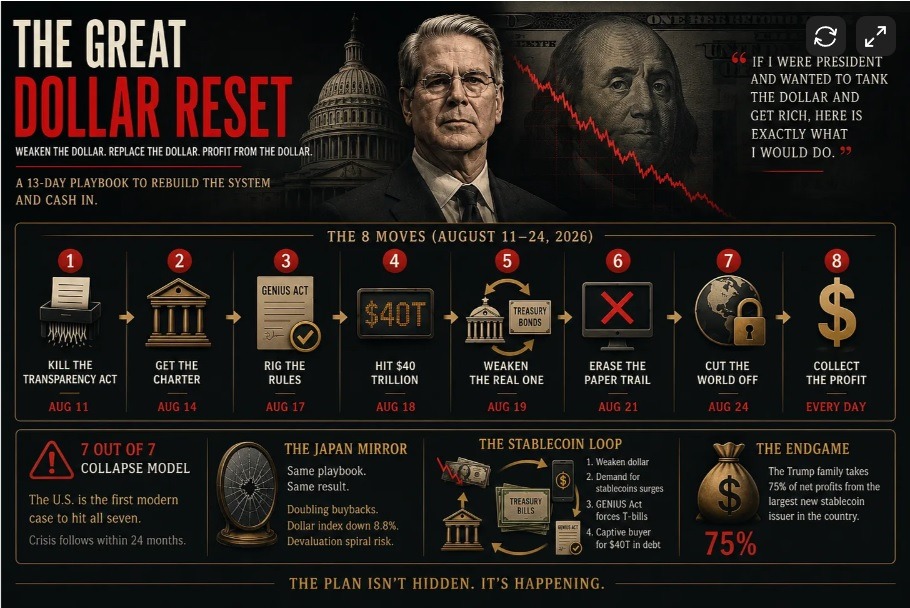
Between August 11 and August 24, 2026, Treasury Secretary Scott Bessent executed a sequence of decisions that, taken together, amount to the most aggressive restructuring of the American financial system in modern history. He did it in thirteen days and it’s being buried in the news…for good reason.

I am quoting extensive excerpts from her two-article series, and I encourage you to support her work (I did).

THE CURRENCY KILLER: SCOTT BESSENT

He broke five currencies and made billions. Then, he got the keys to the USD. All while having connections to Epstein and Ehud Barak.

by Leah

Excerpts:

Between August 11 and August 24, 2026, Treasury Secretary Scott Bessent executed a sequence of decisions that, taken together, amount to the most aggressive restructuring of the American financial system in modern history. He did it in thirteen days and it’s being buried in the news…for good reason.

On August 11, Bessent killed the Corporate Transparency Act and ordered the FinCEN beneficial ownership database deleted. Three days later, the President’s family crypto company received a federal bank charter.

Three days after that, Bessent published rules requiring every stablecoin in America to hold its reserves in Treasury bills. The national debt crossed $40 trillion the next day.

On August 19, he doubled the Treasury’s bond buyback program, the same mechanism he once used to make $3.5 billion breaking Japan’s currency. And on August 24, he announced “Operation Economic Outcast” and threatened to cut entire countries off from the dollar system.

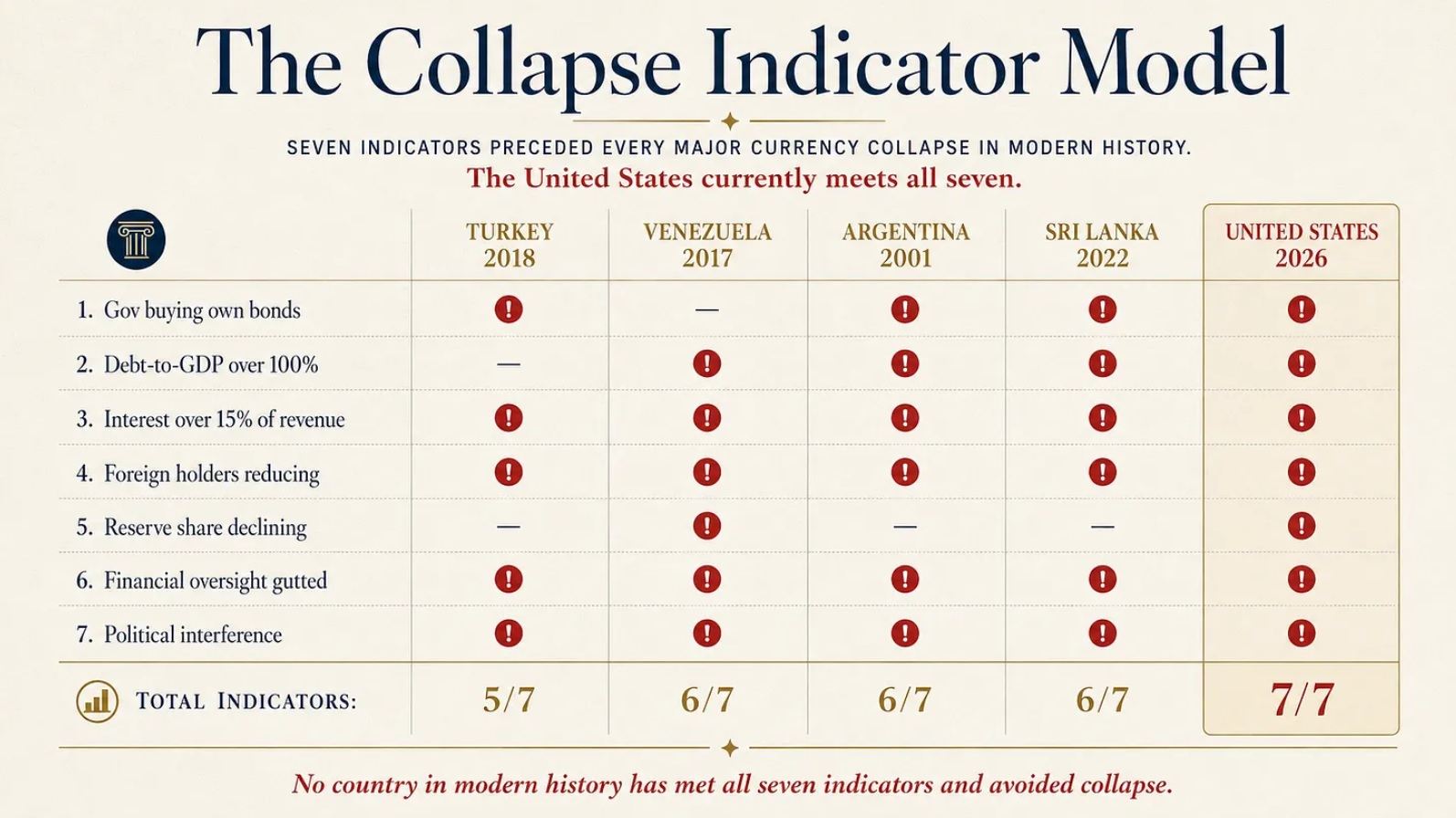
I built a model to measure how close the United States is to a currency crisis.

I took the seven indicators that preceded every major currency collapse since 1992 and checked the U.S. against each one. Unfortunately, all seven are present. The historical record says that has never happened without a crisis following within twenty-four months.

The model turned out to be the easy part. The harder thing to explain is what I found behind the numbers: a system that appears designed not just to weaken the dollar, but to profit from the weakening. And the man running it has spent forty years doing exactly that to other countries.

The Man Behind the US Dollar

Scott Bessent’s career has one through line. He finds countries whose governments are weakening their own currencies, he bets against those currencies, and he collects when they break.

He started on George Soros’s team in the early 1990s. In 1992, Soros shorted the British pound on Black Wednesday and made a billion dollars in a single day.

Bessent was part of that trade, living in London and running the London office at the time. He went on to become Soros Fund Management’s chief investment officer, where he ran what the Wall Street Journal called the most profitable currency bet in the fund’s history: the yen.

Japan’s government had been buying its own bonds to suppress interest rates, which had the side effect of weakening the yen. Bessent recognized the pattern, shorted the currency, and made $3.5 billion when it crashed.

The Wall Street Journal called him “The Man Who Broke the Bank of Japan.” Fortune wrote that he “made a fortune spotting currency manipulation.”

He left Soros in 2015 and started his own fund, Key Square Capital, running the same strategy. Then Donald Trump nominated him for Treasury Secretary, and the man who had spent his career betting against vulnerable currencies was handed control of the most important one on earth.

What he has done since become the US Treasury Secretary with control of the US Dollar is worth a closer look.

He crashed the Iranian rial from 700,000 to 2 million per dollar through sanctions. Rice prices in Iran went up 60% and beef went up 150%. The broader conflict cost American consumers $53 billion in higher gas prices, according to the Dallas Fed.

He used between $20 and $40 billion in American taxpayer money to prop up Argentina’s peso ahead of a political ally’s midterm elections.

He blockaded Cuba’s economy and tourism collapsed by half with rolling blackouts becoming a permanent normalcy. To make matters worse, the country has posted three straight years of negative GDP.

The pattern is consistent. When the target is an adversary, he destroys their currency. When the target is an ally, he props theirs up with American money.

In both cases, the American public pays.

Seven Out of Seven

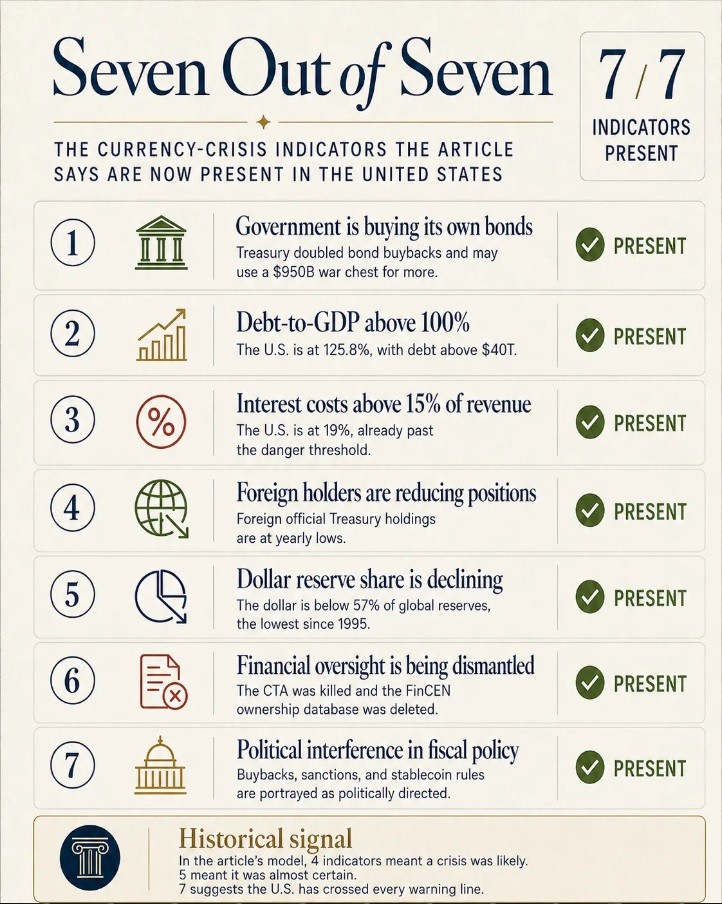
As an economist, I have studied historical currency collapses for years and I found that eery major one in modern history followed a pattern. I identified seven indicators that were present before the collapse. And I wanted to know how many of those indicators are currently present in the United States.

The answer…all of them.

In the historical record, four of these indicators meant a crisis was likely. Five meant it was almost certain.

I found all seven.

Operation Economic Outcast

On August 24, Bessent held a press conference and announced what he called “the single greatest financial offensive ever marshaled against an adversary.”

He sanctioned nearly 60 corporations, individuals, and vessels connected to Iran. He introduced five new categories of secondary sanctions targeting digital assets, cryptocurrency, gold, aviation, and shipping. He seized $1 billion in Iranian cryptocurrency.

Then he said:

“Any entity that facilitates money laundering on behalf of Iran will be removed from the U.S. dollar system. The clock just started ticking.”

When asked whether Chinese banks would be exempt, he said

“no one is above the reach of U.S. sanctions.”

The Treasury Secretary of the United States just threatened to cut entire nations off from the dollar. He did this while actively weakening the dollar through buybacks. While the debt just crossed $40 trillion. While he had just gutted the financial transparency system, and while the President’s family owns the only federally chartered private digital dollar in existence.

Countries that get cut off from the dollar system still need a way to transact in dollars. The only private digital dollar with a federal bank charter is USD1, owned by the Trump family.

Bessent is driving countries away from the dollar while the President’s family owns the replacement.

The Digital Dollar Play

Let’s play connect the dots.

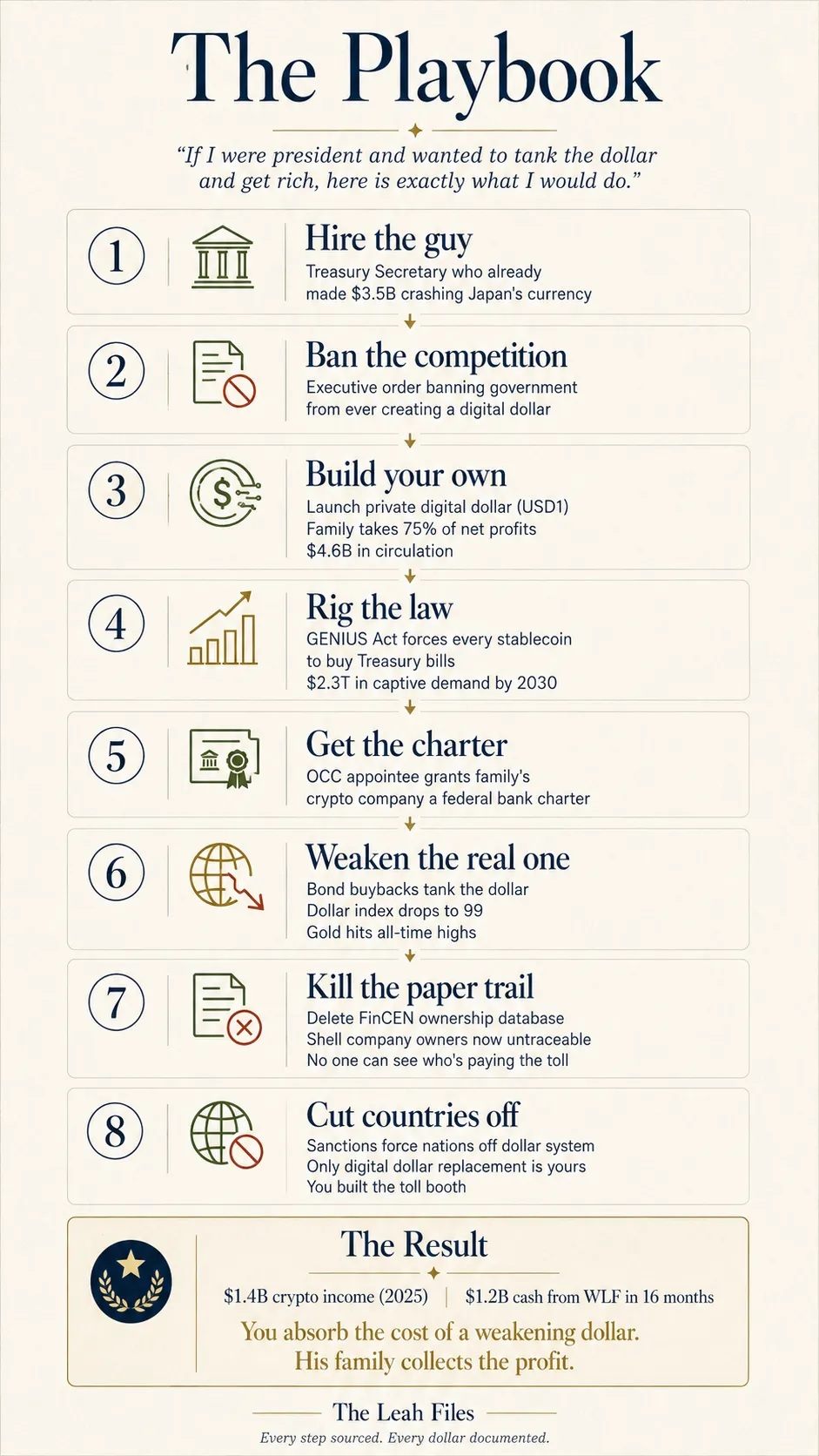
On January 23, 2025, Trump signed an executive order banning any federal agency from creating a Central Bank Digital Currency. No government digital dollar, ever. He eliminated the only thing that could have competed with a private one.

Two months later, his family’s company, World Liberty Financial, launched USD1, a private stablecoin pegged to the U.S. dollar and backed by Treasury bills. The Trump family receives 75% of net profits. Abu Dhabi’s sovereign wealth fund, controlled by Sheikh Tahnoon bin Zayed, owns 49%. USD1 now has $4.6 billion in circulation.

In May 2025, Abu Dhabi’s MGX fund routed a $2 billion investment in Binance through USD1 specifically. That single transaction represented 75% of USD1’s total market cap at the time. Eric Trump and Zach Witkoff, the son of Trump’s Middle East envoy, announced the deal from a stage in Dubai.

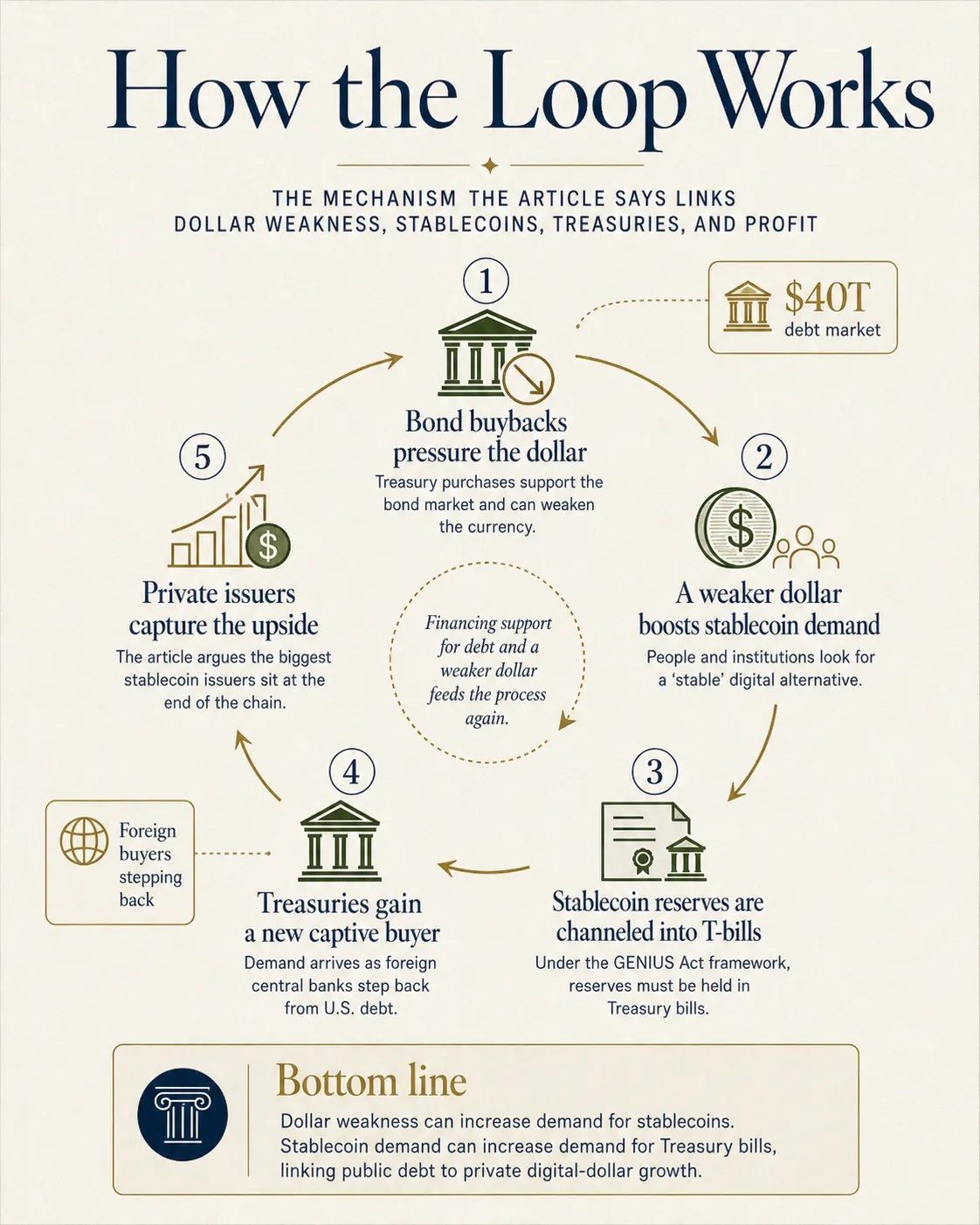
Congress then passed the GENIUS Act, which requires every stablecoin issuer in the United States to back its tokens with Treasury bills maturing within 93 days. This means every dollar of USD1 in circulation must purchase government debt. Brookings projects that stablecoin holdings of Treasury bills could reach $2.3 trillion by 2030.

On August 14, the OCC, run by Trump appointee Jonathan Gould, granted World Liberty Financial a conditional federal bank charter. The President’s family crypto company can now issue USD1 directly, with federal authority.

Now let’s follow the money through the loop.

The President banned the government from building the competition, then the Trump family built the product. His appointee gave them a bank charter.

Congress passed a law requiring it to buy government debt. His Treasury Secretary is weakening the real dollar to drive adoption of the digital one, and his Treasury Secretary is now cutting countries off from the dollar system, pushing them toward the private replacement his family owns.

Trump’s 2025 financial disclosure reported $1.4 billion in crypto income. That is more than he made from real estate. $550 million came from World Liberty Financial token sales. $600 million came from meme coins. His family has taken at least $1.2 billion in cash from WLF in sixteen months.

Former White House ethics lawyer Richard Painter reviewed the disclosures and said this level of conflict “would be a violation” for every other executive branch employee.

But there is no enforcement mechanism for a sitting president.

The Epstein Connection

There is one more thread, and it is the one that explains why the financial transparency infrastructure had to be destroyed.

In August 2024, a hacker group called Handala breached the personal email archive of Ehud Barak, the former Prime Minister of Israel.

Barak was one of Jeffrey Epstein’s closest associates. He visited Epstein’s Manhattan townhouse dozens of times, invested in companies alongside Epstein, and has never denied the relationship.

The emails were published by Distributed Denial of Secrets, a legitimate transparency organization. Journalists Jack Poulson and Harrison Berger spent months going through them and published their findings in September 2025.

What they found was a direct, documented financial relationship between Ehud Barak and Scott Bessent.

The emails show Barak communicating with senior Soros Fund executives about Bessent’s currency trades. They used code names.

Bessent was referred to as “Sterling.” A major yen trade was called “Ichiban,” the Japanese word for number one. There are emails from August 2013, December 2013, May 2014, February 2015, and May 2015 documenting meetings, fund seeding discussions involving $100 million to $450 million, and ongoing financial coordination between Barak and Bessent.

Barak’s corporate structure was designed by Darren Indyke, Epstein’s personal lawyer. Epstein’s Southern Trust Company invested 50% into the entity. The same entity that took consulting payments from Bessent’s fund is the same entity that controlled where Epstein’s money went.

Bessent is also blocking the release of $1.5 billion worth of Epstein’s Suspicious Activity Reports: 4,725 flagged wire transfers from JPMorgan and $378 million from BNY Mellon. Senator Ron Wyden introduced the PETRA bill to force their release. A Republican senator blocked it.

Wyden called Bessent “a willing participant in a cover-up.”

And he is.

On August 11, Bessent killed the Corporate Transparency Act and deleted the FinCEN database. Three days later, the bank charter was approved.

The man with documented financial ties to Epstein’s business partner is not just running the Treasury, he is dismantling the infrastructure that would allow anyone to trace what is happening now.

Read the Full Article at The Leah Files.

THE CURRENCY KILLER PART II: HOWARD LUTNICK

How Howard Lutnick Built the Infrastructure For America’s Largest Financial Conflict of Interest

by Leah

Excerpts:

THE OTHER HALF OF THE SCHEME

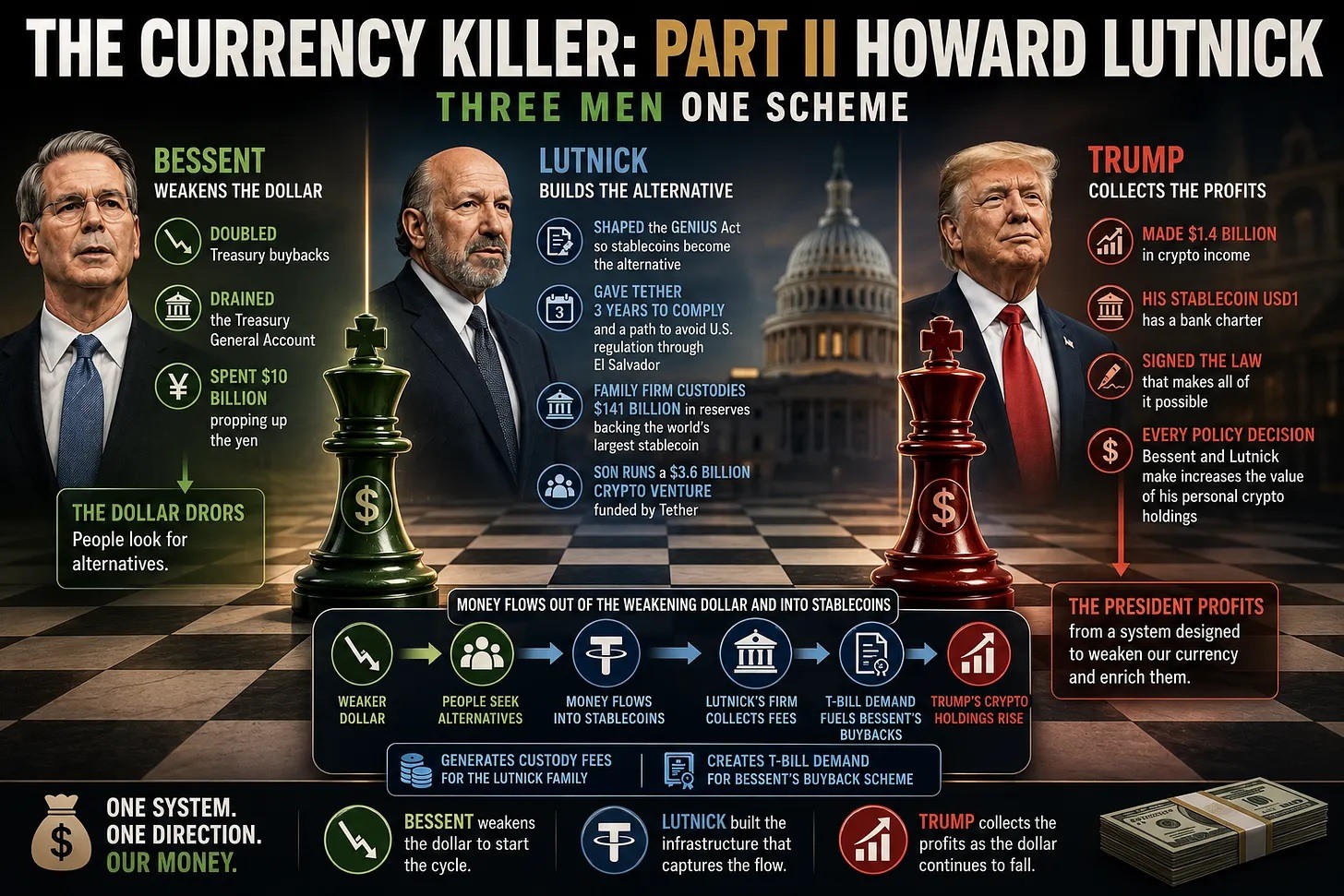
In Part I of “The Currency Killer”, I showed you how Treasury Secretary Scott Bessent is using the same tools he deployed as a hedge fund manager to manipulate the US bond market. He doubled the Treasury buyback program to $4 billion per operation.

He is sitting on a $950 billion war chest.

But a buyback scheme only works if there is demand for the bonds you are buying. Someone has to be on the other side of the trade.

That someone is Howard Lutnick.

Before he became the 41st Secretary of Commerce, Lutnick was the CEO of Cantor Fitzgerald, one of Wall Street’s largest bond dealers. I did a deep dive on Lutnick, so go check it out on my Substack if you haven’t already.

But in summary, he is, in my opinion, one of the worst of the worst of this administration.

Forbes called him the most hated guy on Wall Street. He was confirmed 51-45 on a strict party-line vote. He co-chaired Trump’s transition and was the 31st largest donor in the 2024 cycle, putting nearly $9 million into MAGA, Inc.

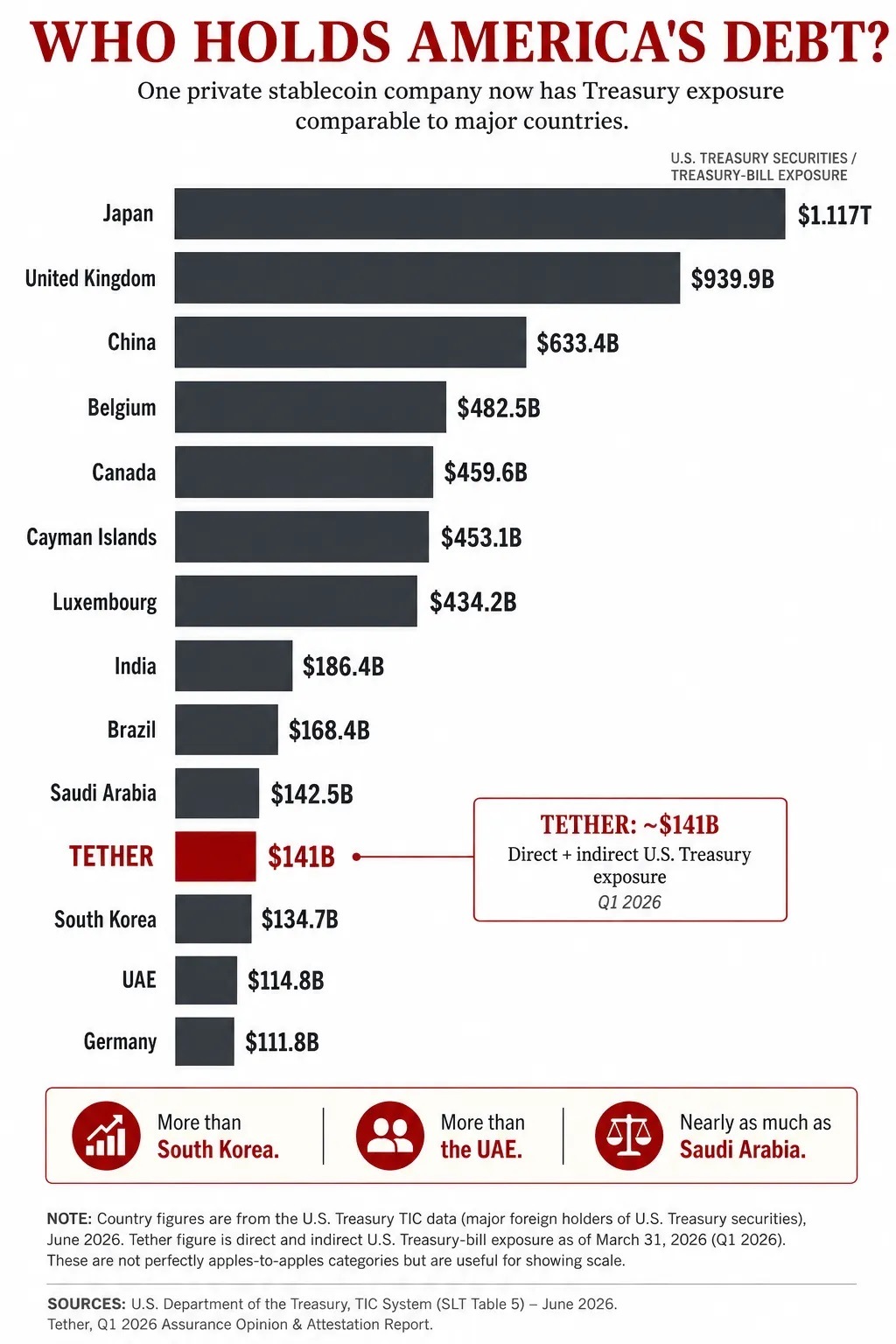
His firm has a client that matters more than any other in this Currency Killer series. That client is Tether, the largest stablecoin in the world, with $185 billion in circulation. Cantor Fitzgerald is Tether’s primary custodian, holding $141 billion in US Treasury bills backing Tether’s reserves.

That makes Tether one of the twenty largest holders of US government debt on earth, bigger than Germany.

But Lutnick did not just manage Tether’s money, he vouched for them publicly, and shaped the law that protects them. His family still profits from the relationship. The stablecoin at the center of all of it has documented ties to terrorism financing, nuclear proliferation, and the global fentanyl trade.

Welcome to the most corrupt administration folks. This is the story of the custodian, ie Howard Lutnick.

Read the full article at The Leah Files.

This article was written by Human Superior Intelligence (HSI)

See Also:

Understand the Times We are Currently Living Through

Second Edition of eBook Released: The Concept of the American Christian Family is a Myth and is NOT Found Anywhere in the Bible – by Brian Shilhavy

FREE eBook! Restoring the Foundation of New Testament Faith in Jesus Christ – by Brian Shilhavy

The Brotherhood of Satan vs. The Brotherhood of Jesus Christ

KABBALAH: The Anti-Christ Religion of Satan that Controls the World Today

Exposing the Christian Zionism Cult

The Bewitching of America with the Evil Eye and the Mark of the Beast

Jesus Christ’s Opposition to the Jewish State: Lessons for Today

Identifying the Luciferian Globalists Implementing the New World Order – Who are the “Jews”?

The Brain Myth: Your Intellect and Thoughts Originate in Your Heart, Not Your Brain

What is the Condition of Your Heart? The Superiority of the Human Heart over the Human Brain

The Seal and Mark of God is Far More Important than the “Mark of the Beast” – Are You Prepared for What’s Coming?

The Satanic Roots to Modern Medicine – The Image of the Beast?

Medicine: Idolatry in the Twenty First Century – 10-Year-Old Article More Relevant Today than the Day it was Written

Having problems receiving our emails? See:

How to Beat Internet Censorship and Create Your Own Newsfeed

We Are Now on Telegram. Video channels at Bitchute, and Odysee.

If our website is seized and shut down, find us on Telegram, as well as Bitchute and Odysee for further instructions about where to find us.

If you use the TOR Onion browser, here are the links and corresponding URLs to use in the TOR browser to find us on the Dark Web: Health Impact News, Vaccine Impact, Medical Kidnap, Created4Health, CoconutOil.com.

The post Treasury Secretary Scott Bessent Just Restructured The American Financial System to Destroy the U.S. Dollar first appeared on Health Impact News.

  •  

🔴Putin e Xi riscrivono le regole | TG 01.09.26

– Vladivostok apre e promette il corridoio di Jeff Hoffman
– SCO: l’occidente non detta più le regole di Jeff Hoffman
– Il G20 riapre a Mosca, chiude a Pechino di Jeff Hoffman
– Hormuz, due petroliere e l’abbraccio di Mosca di Jeff Hoffman
– Falkland, Washington ricatta Londra di Jeff Hoffman
– Kabul apre le miniere, la base resta chiusa di Jeff Hoffman
– Atene si consegna a Tel Aviv di Jeff Hoffman
– Pechino tra sicurezza e autosufficienza di Jeff Hoffman
– Caccia cinesi per l’Uzbekistan di Gionata Chatillard
– Apple costruisce un’intelligenza su misura per Pechino di Margherita Furlan
– Buon giro intorno al Sole

A cura di Margherita Furlan Con la collaborazione di Gionata Chatillard e Jeff Hoffman Editing di Mario Ferdinandi e Simone Orletti

📡 CASA DEL SOLE TV — Informazione libera e indipendente Il nostro lavoro è possibile solo grazie al vostro sostegno. Casa del Sole TV non ha editori forti né finanziamenti pubblici: siamo sostenuti da voi, il nostro pubblico. Se credi nel valore di un’informazione che non tace, aiutaci a continuare.

💳 Dona tramite bonifico bancario: IBAN: IT63P0326822300052392596590 Intestato a: LA CASA DEL SOLE EDIZIONI Causale: Donazione Casa del Sole TV

🅿 Dona tramite PayPal: paypal.me/casadelsoletv

⏰Sostegno ricorrente: casadelsole.tv/sostienici

Anche un piccolo contributo fa la differenza.

Grazie di cuore! ❤

L'articolo 🔴Putin e Xi riscrivono le regole | TG 01.09.26 proviene da Casa del Sole TV.

  •  

Hundreds of Kids Under 12 Forced Into Marriage In UK as Authorities Turn Blind Eye to Avoid Offending Minorities

More than 100 children aged 12 and under—including 27 aged five or younger—were referred to the Forced Marriage Unit between 2021 and 2025, Home Office figures reveal. The official government data, obtained via Freedom of [...]

The post Hundreds of Kids Under 12 Forced Into Marriage In UK as Authorities Turn Blind Eye to Avoid Offending Minorities appeared first on The People's Voice.

  •  

New community museum honors the legacy of Eddie Conway and the Black Panthers

Eddie Conway via TRNN.

Author and community organizer Dominque Conway has transformed a house at the epicenter of the 2015 Baltimore uprising into “Eddie’s Front Porch,” a people’s museum dedicated to preserving the remarkable legacy of her late husband, Eddie Conway. To mark the opening of the museum, this special episode of Rattling the Bars features host Mansa Musa sitting down with Dominque to discuss the project and Eddie’s enduring impact.

The conversation also highlights perspectives from formerly incarcerated organizers who worked alongside Eddie inside Maryland prisons and are now building community power on the ground in West Baltimore. Together, they share powerful stories celebrating the man, the myth, and the legend behind the movement. 

Credits:

  • Production: Maximillian Alvarez
  • Post-production: Cameron Granadino
Transcript

The following is a rushed transcript and may contain errors. It will be updated.

Mansa Musa:

So we are here at Eddie Conway’s front porch, which is, we call it People’s Museum. I’m here with Dominque Conway, the wife of Eddie Conway. Tell our audience what Eddie Conway meant to you or who was Eddie Conway to you?

Dominque Conway:

That’s really, that’s hard to sum up, to be quite honest. Eddie was so many things to me and so many other people, but Eddie was, quite honestly, he was my hero as he was to many other people. He was a Black Panther. He was somebody who also served 44 years in the Maryland prison system and didn’t allow that time to break him. During that time, Eddie worked with hundreds of men in the prison system, many of whom have come out and done their own programming and continued to do really great things in the community. So at the end of the day, Eddie was just a man. But he loved people. He loved humanity and he exuded that. He loved nature. He loved animals. He exuded that pretty much in everything that he did. And I wanted to capture some of that. I wanted to capture his legacy.

I feel like it’s very important for us to own our narratives and to give those proper narratives because it’s easy for many people to just see Eddie the icon. I want them to see Eddie the man.

Mansa Musa:

Talk about how this came about in your mind and how it became a vision for people who could see.

Dominque Conway:

Well, I wasn’t even planning to come back to Baltimore. You know this, right? But I don’t know. I woke up one day, I saw this house online and thought about all the things we’ve talked about, what we want to do, and it was the perfect place. Also, I think at that time I felt like we need to do something to really preserve his legacy. I have a lot of documents, a lot of papers, a lot of things that need to be archived. And I’m like, we need to do that. It would be easy to say, oh, maybe they should go to a university. But I think we need our own people’s archives. We need our own spaces where we not only celebrate and remember, but we tell accurate histories of resistance, of black liberation in particular, but not even limited to that, the experience of indigenous people, the experience of Latino people.

We need to be able to own our narratives and share those stories with youth, with people in the community. One of the young men who’s going to perform today, he’s doing spoken word. We’ve been telling him, Hey, this is your space. Host spoken word events here. So we’re looking to get people in to just do what they want to do. We have a small theater group that meets here at times and just comes together to do storytelling. So we’re just opening the space up and wanting the community to come in.

Speaker 3:

So this is real news. So let me give you some real events. Mr. Conway, I call him Mr. Conway. He didn’t like that. He didn’t like that. From day one, we met inside a prison. I was doing youth work and he was doing outreach work inside the institution and someone had a good idea for us to come together. And right off the top, when I met him, immediately we connect. Immediately, he was everything that I read about, everything everyone told me about real charismatic, real intelligent and planning. And our first encounter was straight away about the people. And day one, we established a curriculum called Friend of Friends, which was a grassroots program inside the institution that developed outside here to where we at today.

Mansa Musa:

And you said that Eddie was instrumental in helping people constantly go in prison. And that’s where I met Eddie at. And to a point, as you’ll talk to some other brothers today to resonate this point, Eddie was responsible for a lot of us getting political education. And when you look at the time that he came into the Maryland prison system, what was going on in this country, a lot of people was resisting the establishment in society and they were putting him in prison. When Eddie came in the prison system, he didn’t come in the prison system. I’m Eddie Conway. I’m here to change. I’m the natural of the Maryland prison system. No, he came in, I’m trying to get out of prison. But the conditions made him be who he is. He responded to the conditions. Condition was so horrendous that he started educating. And one thing he said in his book, COINTELPRO, the greatest threat ever say agitate, educate, organize.

This is what he’s saying that this was a model that he want people to understand how they look at things. So I’m an example of the impact that Eddie had on people. When I got out, it was no brainer for me to fall in ranks, to become a part of this process. This house right here, if I got out tomorrow, I would be in. If I got out a year from tomorrow, I would be here. Wherever we at in this space, wherever Eddie or Dominique is doing something, we in that space. So that’s what Eddie pretty much, like Dominiqu said, it’s hard to sum up for Eddie, but we try to get people to understand that Eddie was a human being and a man and our hero always got different views on him. But at the end of the day, Eddie was a person that loved our people and did everything humanly possible to get our people to understand their right to self-determination.

Speaker 4:

I was working in the library. He comes up to get science fiction books like Star Track and stuff like that. I used to be like, “That’s nothing revolutionary.” He says, “It is. These are the things that’s going to come. This is information that was redone, replayed and put into a book.” He said, “It’s a lot of information inside fiction and it’s the history wrapped up in fiction.”

Speaker 5:

So let me first start off by saying friend of a friend. When I first learned about Friend of a Friend and I asked where the name came from, I was taught that the name came from the times of slavery and underground railroad with Harriet Tubman. People just couldn’t go knock on anybody door because the Underground Railroad was a group of people or a system of people that helped people along the road on the way to freedom. So when people would knock on the door, they just couldn’t say anything random. So when they would ask who was it, you would say a friend of a friend. And that’s how we knew that the people were official. That was the secret code. So when we say a friend of a friend, we speaking about family, we speaking about unity. We speaking about a safety net, a safety system where we could come to and be whole as family and put ideas together, think tanks, so to speak.

Speaker 4:

Eddie Conway was like a mentor and a father to me. I came in the Maryland Penitentiary Act the age of 22 years old, stayed in prison for 28 years. And during that time, Eddie Conway gravitated to me and pulled me in tight and gave me some things that I could actually make better decisions with. And ever since then, he had me under his wings.

Speaker 3:

So our experiences have always been from four different institution. Me and Eddie Conway had a different relationship. I think everybody would say the same thing had a different relationship. Him and I shared a mutual common ground about young individuals and the growth and development of young guys in prison as well as society. So our relationship was trying to build that gap between prison and society. And everything that he represent was about the community.

Mansa Musa:

So we was doing libation in Gilmore Projects and honor Eddie and our ancestors. And a guy rolled up that was on a bicycle and he was a little kid when they first moved down Gilmore and Dominique said, “Man, he was a pain.” And this is what he said. He rolled up, he seen Ms. Dominique. And this is what I said. I sai, “What she means?” Now Ms. Dominique was good. So this is an example. This guy just came out, he’s still in the neighborhood, but his memories of what we was doing in Gilmore Projects is memories of us recognizing him and saying, “You got worth, so what do you want to do with your worth? We’re here to help you maximize on your worth.”

Speaker 4:

So from that, I paid a lot of close attention to Eddie and he showed me. During that time I was already a member of the Black Gorilla family and field marshal. So I had a real good rapport inside the prison with every organization, every gang. And Eddie gave me a way to construct a unified effort of prisoners to keep down the trouble, the violence, keep down a lot of the unnecessary stuff that take place in prison with a lot of our youth. So when I got released. Well, he got released first and I was a facilitator in the program in which he created him and Ms. Dominique, friend of a friend. I was a facilitator. And it was from the facilitation that led me to college, from college out here in the street into college and to running my own business. If it wasn’t for Eddie, I’d probably still be in prison acting crazy.

So I loved him for that and he guided me all the way until his last breath. So I respect it and here I am doing the work that he taught me to do.

Speaker 5:

Oh man. So Mr. Conway was, he was one of a kind. He was exceptional. It is such a blessing when you can learn from people who experience historical times, who lived through the movement, to be able to garner that wisdom, to be able to be blessed with that type of information. I know that I was totally blessed. It’s sad to say, but I found my best leaders inside of prison. Mr. Conway was definitely one of the best of them. I learned a lot from Mr. Conway. He was a leader. He was a man. He was moral. He was principled. He was exceptional in his walk. He was consistent. He had values. He had knowledge to distill. Whenever you ask, he was ready to give a blessing. He was always strong. He always stayed 10 toes down. So nothing but mad love and much respect for Mr.

Conway, a living legend. Well, he’s passed, but he’s still a living legend. His spirit lives on through all of us.

Speaker 3:

He was genuine how his approach and how he did things and how he organized, how he was able to organize people was one of the things that stuck out a lot about Mr. Conway, right? How he was able to organize. Me, myself, I was still in prison when we lost Eddie, so I didn’t get an opportunity to work with him while he was out there, but I was still working beside him while I was still incarceration because he still kept his hands inside the institutions while he was flying throughout the country, building up the communities. I still was inside holding it down for him and his name along with his wife, Dominique. But I would like to say our experiences and he left a lasting impression on me about how we should build, how we view education and how we view our community and the young people just growing up in it.

And that last impression he left, man, is really profound, if I could say the least. He impart a lot of information on me and a lot of history. That’s one of the things I will say as well, that know your history so it won’t repeat itself, but if it does repeat itself, it repeats itself in a proper way. So that’s some of the things that I would like to say he imparted on myself personally is history and how to deal with the people based upon that. You know what I’m saying? Yeah. But I miss him. I really do miss him. I wish he was here now to view some of the things that all of us collectively as a group, because we was a family. And now that we all out here together and we building together, we missing our hierarchy. We really missing our hierarchy out here.

Even though the sister here, she holding down on his presence, we holding down his presence, but we could feel the emptiness of his not being here, although we do feel like he’s here with us.

Dominque Conway:

Right now in particular, obviously I miss Eddie every day. That’s personal, that’s love. But politically, I miss Eddie because he had such a keen analysis about everything and just the information he would provide about what’s happening in the present. But also because he had that history, he had that history of being part of the resistance, being part of a movement that was the vanguard of the revolution at the time. He had so much information, but I think it is critical. So many people are passing away. Ward Churchill, for example, was a giant. Ward is gone. So it’s really more important, I think now than ever for us to be engaging and working in multi-generational ways, which is really a very traditional way of working in say black, indigenous, and Latino communities. We have to really return to that and not see young people as a separate group.

Age is real, but generation is a social construct too. So we have to break that down and really engage, like I said, in a more multi-generational.

Mansa Musa:

And we look at all revolutionary. Malcolm was young. Huey, Bobby, Lou Bobby Hunt, they was young. These were young people that had big ideas and got together and organized their thinking around changing social conditions. And I’m with Dominique on that.

Speaker 5:

So of course I got to acknowledge and honor Ms. Dominique Conway as well, the matriarch, who is our Harriet Tubman in these days and time, who is one of my teachers. I’ve learned from a lot of women, but I would say that Ms. Conway, Ms. D taught me a lot just about self and acknowledging and having race pride and being a linchpin and a leader and what it takes and means to be a leader. So I couldn’t go do this brief interview without saying, thank God for Ms. D, because Ms. D was angel in my life and still continue to be. So much respect to her, Eddie First Lady, and thank you for having me.

💾

Eddie's Front Porch, a new Eddie Conway museum in West Baltimore, honors the Black Panther and Rattling the Bars host imprisoned for 44 years.
  •  

Descubren por qué las glaciaciones suceden cada 100.000 años

Una investigación internacional publicada en Nature Communications desvela que cambios mínimos en la radiación solar bastaron para reubicar los vientos dominantes del Atlántico Norte y modificar para siempre el pulso de los ciclos glaciares. El trabajo, firmado por científicos del laboratorio Environnements et paléoenvironnements océaniques et continentaux (EPOC), dependiente de Bordeaux INP, el CNRS, la […]

  •  

Il woke dopo il woke

Valerio Savioli

Le dichiarazioni agostane di Alexandra Ocasio-Cortez, icona del neoprogressismo radicale statunitense, rilasciate in un’intervista con ABC News, hanno generato un certo dibattito anche alle nostre latitudini, a dimostrazione dell’interdipendenza politico-ideologica, trasversale anche nello spettro “centrodestra/centrosinistra” istituzionali, che, dal dopoguerra, lega stabilmente le due sponde dell’Atlantico e il modo di intendere l’agire, l’intendere politico e le sue categorie.

Della Cortez (AOC), dalle principali testate e opinionisti nostrani, è stato ripreso esclusivamente questo passaggio: “Woke was crazy”, il woke era follia, ponendo poca attenzione al passaggio immediatamente successivo, nel quale AOC, pur riconoscendo l’impraticabilità odierna di certa retorica, sostiene che molte delle discussioni aperte durante quella stagione siano state “molto produttive” (quite fruitful).

La citazione di AOC ha portato a un gran numero di riflessioni, da destra e sinistra, entusiastiche e pensose, il cui dibattito langue impietosamente in una cornice ben definita.

Da destra viene riproposta una lettura e una conseguente condanna prettamente liberali del fenomeno woke, concentrate principalmente sull’insofferenza, in parte condivisibile, di un fenomeno che ha fatto della censura e della sanzione, anche sociale, una delle proprie inappellabili cifre.

A sinistra si leggono approfondimenti pensosi, tipici delle classiche sedute psicanalitiche collettive proprie delle direzioni nazionali nostrane appena uscite da sonore batoste.

Dimostrazione di come ci si possa sentire smarriti quando dalla centrale operativa d’oltreoceano giungono inaspettatamente nuove coordinate.

Lo abbiamo già accennato: entrambi gli schieramenti soffrono di un vincolo esterno ideologico e culturale il cui perno ruota principalmente intorno ai principi liberali comprensivi degli interessi, da intendersi nell’accezione più ampia, “occidentali” ossia statunitensi.

Rispetto a questo atteggiamento avevamo coniato il termine “geopoliticamente corretto”.

La ricezione italiana, quindi, continua ad essere mediata dal paradigma ideologico e strategico liberal-progressista da una parte e liberal- conservatore dall’altra.

Elaborazioni del lutto col coltello tra i denti per i liberal nostrani e sfregamento di soddisfacimento e rivalsa per i conservatori: al vincitore dell’acerrima contesa il premio di sestante in seconda dell’Occidente.

Un dibattito sconsolante, racchiuso in un perimetro entro il quale è difficile dire se a preoccupare sia più la sterilità del confronto o l’incapacità di avvertire la necessità di produrre un punto di vista autenticamente afferente agli interessi europei e italiani.

Occorre quindi uscire, il più rapidamente possibile, da questo recinto per osservare quello che sta accadendo nella politica statunitense.

La battuta di AOC, tra l’altro attribuita al consigliere comunale newyorchese e figura di primo piano di Black Lives Matter Chi Ajani Ossé, più che intonare il de profundis di una stagione politica, pare piuttosto segnalare la mutazione e il conseguente riposizionamento iniziati già da tempo nella sinistra americana.

E la mutazione è per definizione un cambiamento in atto, una trasformazione, un passaggio da uno stato (Woke 1.0) a un altro (Woke 2.0? / New Left 2.0?).

Una trasformazione che non consiste tanto nell’abbandono delle istanze progressiste maturate nell’ultimo quindicennio, quanto nella loro progressiva subordinazione a un linguaggio politico tornato a ruotare attorno alla questione sociale.

Non è una resa ma una strategia che dimostra la vitalità tipica di un organismo vivo e il pragmatismo di una prospettiva politicamente sfruttabile, anche in considerazione della situazione socioeconomica degli Stati Uniti e dell’oggettiva difficoltà del partito Repubblicano.

A che cosa dobbiamo, di grazia, gli articoli scritti al ritmo dei nostrani cin-cin conservatori-liberali (con la i)?

Proviamo ad arretrare almeno fino al 2016.

Altro mondo, qualcuno dirà. Si noti, però, che, ai tempi, a riportare al centro della politica democratica un vocabolario appartenente ad un altro mondo ancora fu Bernie Sanders: classe, sanità (possibilmente universale), salari (infarciti di divario di genere) ruolo dei sindacati e indebitamento delle famiglie americane.

Un conflitto abilmente presentato principalmente in termini verticali: da una parte una minoranza estremamente ricca (gli happy few, i pochi felici), capace di esercitare un’influenza determinante sulle istituzioni; dall’altra il resto degli statunitensi obbligato a vivere alla giornata.

La sinistra americana di oggi che parla di “oligarchi” pesca a piene mani in quella stagione.

Proprio AOC nacque in questo brodo culturale e quindi politico. La sua affermazione nel 2018, con la sorprendente vittoria nelle primarie democratiche contro Joe Crowley, uno degli uomini più potenti dell’apparato del partito Dem, rappresentò una delle prime manifestazioni della capacità del sandersismo di provare a produrre una propria classe politica.

Fu però negli anni immediatamente successivi che quel populismo economico venne a intrecciarsi sempre più strettamente con un secondo movimento, proveniente in larga parte dalle università, dall’attivismo digitale e dai nuovi movimenti identitari.

Quest’ultimo uno strumento di rara efficacia, già portatore delle principali istanze culturali e politiche del cosiddetto Politicamente Corretto e della sua deriva, razziale e intersezionale, nota come woke.

La morte di George Floyd segnò l’apogeo di quella stagione, l’ascesa di Black Lives Matter, le cui rivolte e istanze si erano già manifestate durante la presidenza obamiana, sebbene tenute in disparte dal comparto mediatico progressista, solerte invece nell’ingigantirlo in occasione della prima amministrazione trumpiana.

In quell’epoca fece la sua comparsa anche la parola d’ordine defund the police (togliamo i fondi alla polizia), l’espansione delle categorie intersezionali, le politiche DEI (diversity, equity, inclusion) e una crescente attenzione normativa al linguaggio, che costituirono, con forza e impatto, i riferimenti principali del movimento woke.

Era l’acme della mutazione del conflitto sociale: il politicamente corretto inteso come fusione di istanze progressiste figlie, in buona parte, della Scuola di Francoforte, entusiasticamente sostenute dall’ultima evoluzione del capitalismo finanziario.

A mutare, infatti, per le istanze progressiste, fu la gerarchia delle questioni e, soprattutto, la loro percezione pubblica: una crisi del tradizionale soggetto di classe che, in particolare in Herbert Marcuse, condusse a rivolgere crescente attenzione verso soggetti marginali, minoranze e nuove forme di opposizione sociale.

Dall’homo consumens, in cui si poteva comunque rintracciare ancora un afflato di qualsivoglia appartenenza e identità, all’Uomo Residuo le cui fondamenta, esistenziali e ontologiche, dovevano e devono vertere sulla fluidità intesa come fluidificante di un sistema, finanziario e quindi politico, che non tollera più sassolini nell’ingranaggio: la decostruzione delle appartenenze si è dimostrata efficacemente funzionale alla forma contemporanea del capitalismo finanziario.

Fu quella la stagione nella quale il woke, salendo di livello, cessò di essere “soltanto” un fenomeno circoscritto all’attivismo e penetrò profondamente nel linguaggio delle grandi imprese, delle università, dell’industria culturale, dell’informazione e di parti considerevoli dell’apparato pubblico.

Ed è proprio per questa ragione che sarebbe superficiale confondere l’attuale ridimensionamento della sua retorica con la scomparsa degli effetti prodotti durante quella fase.

Inoltre, il Partito Democratico, a seguito della sconfitta del 2024, fu testimone di una crisi di rappresentanza: continuava a rafforzarsi nell’America urbana e istruita, mentre perdeva terreno tra gli elettori privi di laurea e in ampi segmenti della classe lavoratrice.

Tornare a parlare di salari, sanità, casa e concentrazione della ricchezza diventava quindi non soltanto coerente con la tradizione sandersiana, ma politicamente necessario. È in questo contesto che deve essere letto il successivo riavvicinamento alla questione sociale.

Nel 2025 Sanders lanciò il suo Fighting Oligarchy Tour, al quale Ocasio-Cortez partecipò assumendo progressivamente un ruolo di primo piano.

Il dato interessante, per l’analisi che si dovrebbe fare oggi, non riguardava soltanto i temi economici affrontati, peraltro perfettamente coerenti con la tradizione sandersiana, ma il tentativo esplicito di allargare il perimetro della coalizione progressista.

Fu proprio in uno di quei comizi che AOC si rivolse anche a coloro che avevano votato diversamente, a chi non conosceva “le parole giuste” da utilizzare e persino a chi dissentiva da lei su alcune questioni.

Il discrimine diventava la disponibilità a combattere per altri americani e contro la concentrazione del potere economico, sullo sfondo di una nazione sempre più fratturata al suo interno, incapace di riconoscersi e soprattutto di definirsi: per ironia della sorte, proprio quelli che ora cercano di riposizionare strategicamente il messaggio politico, hanno pesantemente contribuito a quella crisi di identità che così tanto lacera, dall’interno, la nazione americana, sempre più oggetto di una fondamentale domanda: America chi sei?

È proprio su questa frattura che Donald Trump e l’universo politico (e di apparati), culturale ed economico raccoltosi attorno al suo ritorno alla Casa Bianca hanno costruito una parte consistente della propria forza.

Al di là del risultato elettorale contingente, il trumpismo ha saputo intercettare il bisogno, ormai esplicito, di ricomporre una nazione sempre meno capace di riconoscersi e un impero costretto a fare i conti con i limiti della propria sovraestensione, sognando di ribaltare il tavolo delle guerre culturali in patria, proponendo, a loro volta, un Woke a trazione conservatrice: si pensi solo allo psicodramma sull’antisemitismo, combattuto anche – e non è un caso – nei più prestigiosi contesti universitari statunitensi.

Comunque, l’intento trumpiano di un Woke a trazione conservatrice è, al momento, fallito.

Se all’apparato liberal-progressista può essere imputata una parte rilevante della disgregazione culturale culminata nella stagione Woke, il mondo conservatore americano non può dichiararsi estraneo ai processi economici e geopolitici che hanno contribuito alla medesima crisi: dalla globalizzazione alla deindustrializzazione, dalla finanziarizzazione dell’economia alla proiezione imperiale perseguita per decenni da amministrazioni repubblicane e democratiche.

Due percorsi apparentemente opposti che hanno finito per concorrere, ciascuno a proprio modo, all’indebolimento delle appartenenze, delle sicurezze materiali e della stessa capacità degli Stati Uniti di darsi una definizione condivisa.

Tornando ad AOC, il suo passaggio è tutt’altro che secondario. Non siamo di fronte a una sinistra divenuta improvvisamente conservatrice né, tantomeno, a un’abdicazione rispetto alle battaglie identitarie degli anni precedenti. Stiamo assistendo piuttosto a un mutamento della loro funzione politica.

Ciò che fino a pochi anni fa costituiva uno dei principali strumenti di mobilitazione sembra progressivamente retrocedere sullo sfondo, mentre in primo piano tornano il salario, la casa, la sanità, il costo della vita, il potere dei monopoli e la concentrazione della ricchezza.

L’esperimento di Zohran Mamdani a New York, asceso al successo grazie all’affordability (sostenibilità e convenienza) e poi, probabilmente solo come inevitabile esito, alle tematiche afferenti alle guerre culturali di matrice woke, rappresenta probabilmente la manifestazione più compiuta di questa nuova fase, in cui Democratic Socialist of America, organizzazione socialista democratica che opera prevalentemente nello spazio elettorale del Partito Dem, tenta l’OPA sul partito Democratico.

Che si tratti di comunicazione strumentale o meno lo vedremo in futuro, certo è che nel giugno scorso il Rent Guidelines Board di New York (consiglio di regolazione degli affitti) ha approvato il congelamento dei canoni di locazione per circa un milione di appartamenti regolamentati, trasformando una delle principali promesse della campagna di Mamdani in una misura immediatamente percepibile da una parte consistente della popolazione cittadina.

Ma sarebbe riduttivo leggere Mamdani esclusivamente come il prodotto del ritorno della questione sociale. La sua affermazione intercetta anche un’altra trasformazione, forse altrettanto profonda, in corso nella società americana: la già menzionata progressiva erosione, soprattutto tra le generazioni più giovani e nell’elettorato democratico, dello storico consenso bipartisan intorno al sostegno a Israele (tema già affrontato in campagna elettorale).

Mentre sul woke la nuova sinistra sembra arretrare rispetto alla propria avanguardia culturale, su Israele potrebbe essere l’opinione pubblica – soprattutto giovane – ad avvicinarsi alle posizioni che fino a ieri appartenevano all’avanguardia.

È doveroso menzionare Abdul El-Sayed che il 4 agosto scorso ha vinto la candidatura democratica per il Senato in Michigan con un’agenda fortemente incentrata su quello che potremmo definire un populismo economico di sinistra.

Lo stesso El-Sayed nel 2020 si diceva favorevole al defund the police, mentre oggi ha preso le distanze da quelle posizioni, rinnegando di averlo chiesto, nonostante le ampie evidenze mediatiche disponibili.

Anche Democratic Socialists of America (DSA) ha ormai fornito una sistemazione programmatica esplicita a questo orientamento. Il suo nuovo programma nazionale porta un titolo difficilmente equivocabile: Workers Deserve More (i lavoratori meritano di più) in un contesto in cui la società americana viene descritta attraverso il conflitto tra una classe lavoratrice privata del controllo sulla propria vita economica e una “billionaire class” capace di orientare politica e istituzioni.

Ed è qui che l’interpretazione della presunta morte del woke comincia a mostrare tutti i propri limiti. Nello stesso programma continuano infatti a trovare spazio molte delle istanze che ne avevano caratterizzato la precedente stagione: dalle politiche relative all’identità di genere alla critica radicale del sistema carcerario e di polizia, dal Green New Deal alle riparazioni razziali fino al femminismo socialista.

Non vi è, dunque, alcuna evidenza di una conversione culturale. A essere cambiata, come detto, sembra piuttosto la gerarchia. Ed è un cambiamento strategico. Il progressismo identitario non viene necessariamente rinnegato: viene ricollocato.

La questione sociale torna a essere lo strumento attraverso il quale costruire una maggioranza; quella culturale può sopravvivere come parte di un patrimonio ideologico ormai acquisito, senza essere costretta a occupare quotidianamente il centro della scena.

Se così fosse, la domanda da rivolgere ad AOC non sarebbe allora se il woke sia morto. Un paradigma culturale non cessa necessariamente di operare nel momento in cui perde la capacità, o la convenienza, di presentarsi come strumento di mobilitazione politica.

Può accadere l’opposto: che alcune delle categorie introdotte e metabolizzate durante la sua fase espansiva siano penetrate abbastanza profondamente nel linguaggio, nelle istituzioni e nel costume da non avere più bisogno di essere continuamente proclamate ma solamente governate, gestite, solo in parte quindi ridimensionate.

Ciò che ieri necessitava della militanza può oggi sopravvivere nella (nuova) normalità, rispetto alla quale il timoniere pretende di restare lo stesso.

Se il fenomeno woke viene osservato soltanto attraverso le sue manifestazioni più caricaturali e oggettivamente deliranti – il lessico, la censura, le quote, i pronomi, le liturgie identitarie – la loro progressiva marginalizzazione può facilmente essere scambiata per una restaurazione, concentrarsi sugli esiti, spesso (ma non sempre) infausti degli eccessi portati, ad esempio sul grande schermo, godendo dei tonfi economici di certe produzioni hollywoodiane al grido di “Go woke get broke!” (diventa woke e fallisci!) proponendo, come alternativa, soluzioni pensate proprio nelle cucine d’oltreoceano porta solo al reiterarsi delle stesse condizioni di subalternità.

Ma se si considera invece tutto questo come parte di una trasformazione più profonda della concezione dell’uomo, delle appartenenze e del limite, il compimento dello sradicamento di qualsiasi istanza e sostanza afferente alla civiltà europea, la questione cambia radicalmente.

L’Uomo Residuo non coincide infatti con il militante woke: è semmai l’uomo che resta quando la dissoluzione delle appartenenze tradizionali è divenuta condizione ordinaria dell’esistenza.

E non c’è (centro)destra o (centro)sinistra che tenga.

L'articolo Il woke dopo il woke proviene da Blondet & Friends.

  •  

Trump dà il benvenuto alla Russia al G20 nonostante le proteste dell’UE.

Sa Defenza:

I funzionari europei hanno minacciato di boicottare la tradizionale “foto di famiglia”, costringendo il ministro delle Finanze russo Anton Siluanov a non partecipare allo scatto.

Il presidente statunitense Donald Trump ha accolto con favore la presenza di un’importante delegazione russa al G20, ignorando le proteste dei funzionari dell’UE che si sono rifiutati di comparire accanto al ministro delle Finanze russo Anton Siluanov nella tradizionale “foto di gruppo” del vertice.

Lunedì Siluanov è arrivato ad Asheville, nella Carolina del Nord, per la riunione di due giorni dei ministri delle finanze e dei governatori delle banche centrali del G20, su invito dell’amministrazione Trump. La sua prima apparizione di persona al forum dall’escalation del conflitto in Ucraina nel 2022 ha immediatamente suscitato proteste da parte dei delegati europei.

https://sadefenza.blogspot.com/2026/09/trump-da-il-benvenuto-alla-russia-al.html

L'articolo Trump dà il benvenuto alla Russia al G20 nonostante le proteste dell’UE. proviene da Blondet & Friends.

  •  

Scientists Discover Why Ice Ages Occur Every 100,000 Years

An international study published in Nature Communications reveals that minimal changes in solar radiation were enough to relocate the dominant winds of the North Atlantic and permanently alter the pulse of glacial cycles. The work, authored by scientists from the Environnements et paléoenvironnements océaniques et continentaux (EPOC) laboratory, under Bordeaux INP, CNRS, EPHE–PSL, and the […]

  •  

El último reino terrenal - IV – y fin

Tras tres artículos dedicados a comprender dónde reside el poder, cómo se financia y cómo busca controlar la realidad, queda una última pregunta: ¿Podemos seguir siendo soberanos cuando dependemos casi por completo de sistemas tecnológicos que ya no controlamos?...
  •  

Germany: Syrian clan boss with 32 children earns €100,000 from taxpayers every year

A Syrian refugee residing in the German city of Leipzig has drawn widespread public attention following revelations regarding the extensive state financial support directed to his massive household, alongside an established pattern of criminal behavior among several of his adult sons, including offenses that resulted in the deaths of multiple victims.

The case highlights the enormous costs of mass immigration in Germany and how many migrants have found creative ways to game the welfare system for their benefit.

According to data cited from Saxony’s Ministry of the Interior, the Syrian patriarch maintains a clan consisting of three wives married under Islamic custom, 32 children, and 25 grandchildren. State child support payments generated by the family structure have approached roughly €100,000 each year. Even with five offspring having reached adulthood, annual disbursements for the remaining 27 minor children still total approximately €84,000, according to Hungarian outlet Mandiner.

Family is closely tied to organized crime

Beyond the financial aspect, state law enforcement authorities have closely observed the family clan network, noting that approximately two-thirds of its members have prior criminal records. While the identity of the family’s head remains undisclosed under privacy regulations, judicial records outline a history of serious offenses involving his adult sons.

The most prominent case involves 21-year-old Bilal A., who drove a high-performance Mercedes without a driver’s license in March 2023. He struck a group of people near Eilenburg, killing four individuals before fleeing the scene unharmed. Although a juvenile court handed down a three-and-a-half-year prison sentence, he remained free pending an appeal, during which time authorities arrested him for driving illegally a second time.

Jan Siebenhüner, a lawyer representing victims’ families, stated that the convict “never showed remorse.” The elder brothers, Mohamed and Rami, are also well known to police for their criminal history. Mohamed received a four-and-a-half-year prison term for participating in an assault on a streetcar passenger and arranging a deal involving nearly five kilograms of methamphetamine in 2022. Rami faces charges spanning violent crime, narcotics distribution, and fraudulent welfare claims linked to employment at the family-operated “Golden Lion” establishment, which authorities later shut down after a drug raid.

The family uses the German legal system to avoid deportation

Addressing the legal barriers preventing the deportation of convicted family members, attorney Siebenhüner pointed out that clan members systematically insulate themselves through naturalization and family expansion.

“Article six of the Family Protection Act is a very effective weapon,” the lawyer noted, explaining that if a family already has children, it cannot be separated and minors cannot be expelled under any circumstances.

Bilal A. entered Germany as an unaccompanied minor in 2015 to join his father. Despite his convictions, his official refugee protection remains active throughout the ongoing judicial appeal, as confirmed by provincial immigration office spokesperson Mandy Peschang. Additionally, multiple court proceedings against members of the family were ultimately dismissed after key witnesses failed to appear during trials.

Remix News has reported on such cases extensively in the past, involving large criminal clan networks and the costs they impose on German society, both financially and in terms of security, including in other cities like Stuttgart.

Other cases highlight how some migrants use fake paternity claims to obtain huge amounts of public money while sometimes claiming paternity of two dozen or more children. This practice is particularly common from sub-Saharan African men.

The post Germany: Syrian clan boss with 32 children earns €100,000 from taxpayers every year appeared first on Remix News.

  •  

Spain: Judge frees Moroccan illegal migrant who police officers caught raping a young woman on Valencia beach

A 27-year-old Moroccan construction worker in an irregular immigration situation in Spain was released from custody on Monday after being caught in the act of raping a 22-year-old woman on Valencia’s Malvarrosa beach. The duty judge cited the victim’s failure to appear in court to formalize a complaint as the reason for granting him provisional liberty — a Spanish procedural requirement that is relatively unusual compared with many other Western countries.

The incident took place around 6:45 a.m. on Sunday, Aug. 30, near the Akuarela night club. According to Spanish media reports drawing on police sources, the young woman had been in the sea and was lying on the sand when the man approached her. He initially made complimentary remarks before suddenly lunging at her, violently tearing off her dress and forcing penetrative sex while covering her mouth with his hand to stifle her screams. She resisted and cried for help.

A passerby walking along the shoreline spotted the assault from a distance and alerted authorities. Four officers from the Valencia Local Police’s Security, Support and Prevention Unit (USAP), two of them in plain clothes, were already patrolling nearby, according to Spanish news outlet OKDiaro.

They heard the screams and arrived quickly. The suspect tried to flee across the sand. Officers caught him after a short chase. He resisted arrest and punched one officer several times in the face, causing injuries that required medical attention. The officers handcuffed him and handed him over to the National Police. The victim’s mobile phone, found nearby, was also recovered.

Several reports noted the victim was in a state of intoxication, with one account describing her as having left a nearby nightclub for fresh air. Police later found her showing clear signs of alcohol consumption. She was taken to Hospital La Fe, where she received gynecological care and gave an initial statement to officers from the gender-violence victim assistance unit.

The man, identified as a 27-year-old Moroccan construction worker living in Spain without legal papers, was charged with sexual assault involving penetration and assault on an agent of authority. Authorities have confirmed his irregular status.

On Monday, the duty magistrate of the Violence Against Women section of Valencia’s Court of First Instance ordered his provisional release. The decision, taken in agreement with the public prosecutor, followed the police’s inability to locate the victim so she could appear and ratify a formal complaint.

Spain has some rather unusual rules in regards to this criminal charge. Under Article 191 of the Spanish Penal Code, a complaint from an adult victim is required to pursue sexual offense of this type. Other European nations, like France and Germany, do not require a victim to file a criminal complaint to move forward with criminal proceedings.

Remarkably, even in a case where the woman gave a police statement about the rape and the fact that officers caught the man in the middle of penetrative rape, authorities still released the suspect.

The court opened preliminary proceedings and instructed police to continue searching for the woman. Officials said her situation could change immediately if she is found and decides to proceed. The assault on the police officer is being handled separately and can still be pursued criminally.

Meanwhile, the case has drawn attention on social media due to the man being released within hours and the unique procedural requirements involved in the case.

The post Spain: Judge frees Moroccan illegal migrant who police officers caught raping a young woman on Valencia beach appeared first on Remix News.

  •  

Will an AfD victory turn into defeat?

A first-place finish for the Alternative for Germany (AfD) in the upcoming Saxony-Anhalt elections on Sept. 6 is almost assured. The party is expected to score at least 40 percent of the vote, enabling it to outperform all other parties by a wide margin. Anything less than an absolute majority, which would require around 43 percent or higher, will be seen as a defeat. However, for the AfD’s long-term prospects, this “defeat” may indeed be the best outcome for the party.

Should the AfD win control of all of Saxony-Anhalt, it would be its first time in power, and suddenly, it would have to show results, including managing budgets, dealing with administrative constraints, wrestling with state-level legal limits, and facing potential crises. Left-wing parties, along with establishment parties like the Christian Democrats (CDU), can still put up major roadblocks that will stymie the AfD’s effectiveness to govern even at the state level.

With power comes scrutiny and potentially scandal. Any false moves and the AfD’s mishaps could be amplified to a disproportionate level by a press friendly to the left-wing and establishment German parties.

If the AfD falls just short of an absolute majority in Saxony-Anhalt, the CDU would be forced to form a ridiculous and complex multi-party coalition with parties it should not realistically ever partner with, including the Left Party and BSW, making it appear as if it were some kind of cartel player ooking to do anything to stay in power. In fact, this could create a severe internal crisis for the CDU, which officially maintains an incompatibility resolution banning formal cooperation with both the AfD and The Left. Remarkably, Merz is already talking about cooperation with the Left Party, a position that no doubt many CDU voters would balk at.

In such a scenario, the AfD’s chances at obtaining federal power could only be boosted. There are already some reports that many in the CDU privately want an AfD victory.

Saxony-Anhalt is also one of the smallest states in Germany and federal and EU rules still govern much of the actions the AfD would be able to take, making the party look weak and ineffectual. It is worth looking at the individual member states within the EU, where the leaders of entire countries, like prime ministers like Giorgia Meloni, are effectively blocked from a range of policies, including strict immigration enforcement and deportation. Courts, EU policies, and treaty conventions appear to turn conservatives into mush.

At the individual state level, the AfD will have even less power. The AfD could still fall back on the argument that there is little it can do at the state level, but voters are not very receptive to such arguments. Voters typically punish any sign of weakness. It is never enough for a political party to say: “We cannot do this because of XYZ.” Voters only see “we cannot do this.”

The AfD cannot suddenly turn on the taps for cheap Russian energy, it cannot deport illegal migrants with ease, and it cannot implement an economic turnaround policy that will rejuvenate an eastern region that continues to struggle. That would all require serious federal power. Even then, there are powerful constraints in place.

Those on the right are notorious for promoting “victory through defeat” – and lots of defeat. It could even be labeled an “accelerationist” strategy. It is valid to criticize this approach, but losing does have its time and place.

The AfD can still benefit from victory

Of course, an AfD victory is not without its merits. It is worth evaluating the benefits while being realistic about their limitations.

While a victory and the arduous nature of governing could puncture the mystique of the AfD for many voters, it would also normalize the party in the eyes of Germans. The AfD would in effect be governing an entire state on its own, calling its own shots in education, industry, and security. All the credit for any successes goes directly to the party. Even if the AfD fails to enact many of its reforms, the sky will not fall either. Saxony-Anhalt will not unleash pogroms against migrants and life will mostly continue as normal.

Still, the risks are high for the AfD. The common thread among voters is extremely high dissatisfaction with the ruling parties, Chancellor Friedrich Merz, and business-as-usual politics, which all the other parties represent to varying degrees. Critics of the AfD claim the party is merely a “protest party” that voters are supporting only due to the disastrous policies of the current government. The reality is that those “disastrous policies” are core policies built into the operating systems of these parties, which call for more mass immigration, more deindustrialization, and less security for citizens.

At between 28 to 29 percent of the vote, the AfD has long since catapulted out of the realm of mere “protest party” and now represents a serious political force — a reckoning for the establishment parties and left-wing cartels that have long dominated German politics. Nevertheless, if the CDU and SPD, for example, were more competent, there is no doubt that the AfD’s support would take a hit. There are still protest voters backing the AfD who can switch their allegiance quickly.

The question is now how high the AfD can go at the federal level. What is the party’s limit and what is truly holding it back from breaking the 30-35 percent mark in federal polling? The AfD’s sister party in Austria, the Freedom Party of Austria (FPÖ), has long since achieved such numbers in terms of support.

The AfD still has plenty of growth that it can achieve in conservative Western states like Bavaria, but it will never obtain an absolute majority at the federal level. Forming a coalition with the CDU is still the party’s long-term goal. If the CDU is forced to form an absurd coalition in Saxony-Anhalt, it could push the CDU to be more open to an AfD alliance in the future at the federal level, as a choir of dissenting voices grow within the CDU over the plethora of left-wing alliances being formed across Germany.

The AfD ultimately needs to make a major breakthrough in federal elections, where the true power lies. Saxony-Anhalt is currently the only state in Germany where AfD has a chance of governing with an absolute majority. Perhaps in the future, Saxony may also fall into this category, but at the most, that would then be two states. The path to power does not lie through governing states, they can only be a stepping stone at the very most.

The post Will an AfD victory turn into defeat? appeared first on Remix News.

  •  
❌