 Login

New king takes oath in Norway
Haakon automatically became king the moment his father died.
The post New king takes oath in Norway appeared first on BOL News.

Haakon automatically became king the moment his father died.
The post New king takes oath in Norway appeared first on BOL News.
The report said Harry was deeply moved by the gesture because Althorp holds significant personal and family memories.
The post Harry and Meghan decline Charles Spencer’s Althorp Estate offer appeared first on BOL News.
In a beautiful and vivid essay on home, time, and family, Diane Roberts reflects on the house that her parents built, and their family’s land in Leon County, Florida, to which she feels deeply connected. I especially love Roberts’s thoughts on a home versus a house—the latter is composed of construction materials, but “home implies a complex neural network of family association and feeling, layers of experience, a shared past.” Despite the tragedies the home holds, it is ultimately a place of memory and meaning.
Home and time are as tangled as the skunk vine and Confederate jasmine choking my backyard fence. I suppose that’s to be expected. My house holds our history and the indispensable relics of former houses, objects cherished by the now-dead: the tiny rocking chair my grandfather made for my mother when she was three; the 1960 TR3 in the barn my brother never quite got around to fixing; the two old rosebushes dug up from the Washington County farm, replanted at Great-Aunt Rilla’s house in Chipley, then dug up again and transported to our front yard. The house didn’t simply belong to us, it was us—our mother, our father, Brad, and me.
Princess Eugenie is seen holding her baby girl in her arms with caption, “4 weeks of you!!”
The post Princess Eugenie breaks silence as Sarah Ferguson plans UK return appeared first on BOL News.
He was among eight people carrying the coffin, alongside King Haakon and his children.
The post Høiby’s presence at King Harald’s funeral sparks royal controversy appeared first on BOL News.
As the couple arrives in the UK, commentators weigh Meghan's well-being against speculation of a future royal reconciliation.
The post Meghan Markle receives major warning about her UK return appeared first on BOL News.
King Charles hopes other members of royal family will also welcome Harry and Meghan.
The post King Charles’ true feelings revealed as Harry settles back into UK life appeared first on BOL News.
A second fundraising campaign has also raised nearly £52,000.
The post King Charles sends letters to families of police officers killed in A66 tragedy appeared first on BOL News.
The necklace was sold at a Sotheby’s auction in New York in 2015 for about $4.3 million.
The post ‘Money Heist’ comes to life as Queen Nazli’s 673-diamond necklace stolen appeared first on BOL News.
The king spent more than three decades balancing royal tradition with a modern, inclusive image.
The post Norway’s King Harald V dies at 89 appeared first on BOL News.
The king was admitted to Oslo University Hospital on August 17 with hemolytic anemia.
The post King Harald V battling blood disorder and infection in Oslo Hospital appeared first on BOL News.
What defines success when it comes to music? For Hrishikesh Hirway, who wrote four albums under the name The One AM Radio, it meant commercial attention. His interest in making music cooled after sales and airplay failed to materialize; he went 15 years without releasing an album. In this essay for The Bitter Southerner, Hirway looks at how he overcame perfectionism to write and record In the Last Hour of Light, an album heavy on collaboration.
“But Phil was echoing something I’d heard in the interviews I’d conducted and read about in books on writing: separate your creative, generative side from your editing, critical side. They push in opposite directions, and as soon as you start to edit, you’re no longer as free to play.”
“It was two days after my 47th birthday, which had left me feeling melancholy about reaching middle age and still feeling so far from my goals. I sat on my couch, put my headphones on, and played the album. Something had shifted for me. Somewhere around the third song, I felt something for the first time: I loved what I was hearing.
The music brought back memories with perfect clarity: what it felt like to write each song, to record them, the long journey to transform a part of myself into this music. It was no longer a question of the music’s worth. I can say to myself: this album is a document. And in it —listen!—you’re alive.”

Wilbert L. Cooper | Longreads | August 25, 2026 | 3,848 words (14 minutes)
Excerpted from The Black Shield: An American Memoir of Family and Power by Wilbert L. Cooper. Published by Farrar, Straus and Giroux. Copyright © 2026 by Wilbert L. Cooper. All rights reserved.
In Wilbert L. Cooper’s new memoir, The Black Shield, he tells two intertwining stories: the history of the city’s Black Shield Police Association, one of the country’s oldest Black policing organizations, and the multigenerational narrative of his own family, embedded in the police force. Both of his parents and sister are retired Black Cleveland cops, and on his mother’s side, there’s been a Cleveland cop in the family since 1950. In this book about race, policing, and power, Cooper examines the complex duality of the Black cop, what it was like for his parents to navigate an institution that was hostile to their own community, and, ultimately, what this all has meant for him.
This excerpt combines the prologue and a chapter focused on his mother’s beginnings in Cleveland’s police department. Two individuals mentioned spearheaded legal efforts in the 1970s to diversify the department: Fred Johnson, the association’s president who led a lawsuit over the department’s discriminatory hiring and promotion practices, and Jean Clayton, a policewoman and the organization’s secretary whose parallel lawsuit disbanded the segregated Women’s Bureau and integrated women into the department. Below, Cooper recounts how his mother, Gayle, walked through the door that they opened. But it was not without a struggle.
—Cheri Lucas Rowlands
The gun was always there. I used to see it in flashes as Dad would get ready to leave the house. After he doused himself in spicy cologne and sliced a plastic comb through the waves of his jet-black Jheri curl, I would catch that 9-millimeter sliding between the small of his back and the belted waistband of his blue jeans.
Mom had her own. She kept it in her purse. One of those big leather bags, the kind they show behind the counter at Dillard’s, with shiny metal clasps and countless compartments. Her gun would be in there with red lipstick, a double-sided compact mirror, and her bulky pager. I knew the gun was there because I sensed its heft whenever I’d have to move the bag off the kitchen table to do my homework. It felt like a bowling ball in a pillowcase.
Dad used to store his 9-millimeter above the fine china, on top of the large, baby-pink Victorian-style cabinet in our dining room. One time while he was sleeping, I climbed on top of the pink-velvet-upholstered chairs to get a good look at it through the scrollwork. When I came face-to-face with the gun, I was too intimidated to actually pick it up and play with it.
It took a few moments for me to work up the gumption to run my little fingers across the raised bumps of its grip. Then I touched the ridges of the slide and the smooth, cold, hard barrel from where bullets burst. And just that alone felt crazy to me. Even in the dusty, mundane space of the cabinet, the stock-still object pulsated with wild energy. It was like petting a tiger.
Even now, it’s overwhelming for me to imagine that all that calamitous potential to take life, to inflict pain, to inspire fear, to demand subservience, to have your way with the world, to finally be the actor instead of the one who is acted upon—was right there and it was theirs.
I was 7 or 8 when I saw Dad shoot that gun. It must have been the summer, because I still remember the heavy outside air kissing my arms and legs, the suburban sunlight beaming on me. I see that light reverberating off the concrete, making vivid every blade of green grass in the yard and every goose-egg stone in the gravel strips. But I cannot hear the gunshot. I cannot tune in to the boom. All I sense is the fear, because it is so foreign. I’m still there. Standing in the driveway. Stuck and dumbfounded. Until Dad’s shouts break through, begging me to run inside before those crackers come back, commanding me to have Mom call the cops.
Have you heard of Pastor Leon McCray? The man of faith who saw two White people dumping a refrigerator on his property. When McCray tried to stop them, the duo threatened him. One of the Whites ran off to grab three more racists. McCray says that’s when they all ganged up on him. That’s when they told him that his “Black life didn’t matter.” The beating didn’t stop until McCray pulled out his gun. When the police showed up at the scene, they handcuffed McCray and put him in the back of the cruiser. His assailants laughed and waved at him as he was taken off.
But at least McCray survived. You know that many of us aren’t so lucky: The police shot and killed the father Philando Castile during a traffic stop after he told them he had a firearm. The police shot and killed the father John Crawford while he was carrying a pellet rifle inside the Walmart that retailed the damn pellet rifle. Police shot Emantic F. Bradford Jr. at a shopping mall while they were responding to a call about gunshots at the mall. Witnesses say they killed Bradford as he was trying to direct shoppers to safety.
These killings now give shape and sharpness to that immense and totalizing fear I felt in the driveway as a child. That American malice is always there anytime we try to commandeer a power that wasn’t intended for us. Black people are killed or incarcerated every day for much less than what Dad did. Simply owning a gun can put a bullseye on your back. Pulling one on a White man can turn you into a hashtag.
So why did Dad want to call 911? I know that he’d tell you it was because his gun was different from Pastor Leon’s. Dad didn’t buy it at Walmart or Bass Pro alongside camouflage galoshes and fly-fishing rods. He didn’t pick it up at a gun shop with a shooting range full of targets depicting men in turbans and hip-hop gear. He didn’t procure it across state lines at a gun show with bundles of cash and no identification or background check. And he didn’t get it off the street, with scratched-out serial numbers and bodies on it.
Dad got his gun from the City of Cleveland. That’s where Mom got hers, too. Both are tools of policing, the Cooper family business. They hold up those guns and their power to use them as symbols of our freedom in a country that will not stop killing or incarcerating Black folks. When I was a child, I never questioned that contradiction. But to become my own man in the America I inherited, I realized I’d have to try to solve the paradox of my parents.
By the time the Black Shield had forced the hand of the Cleveland Police Department in 1977, Gayle had given birth to another child—a little boy named Geoffrey. Now with three kids, she was even more entrenched in a wrathful marriage and farther away from the working world. And losing her uncle Lloyd, which felt a lot like losing a father, only made her feel that much more alone. When he died, the dream of becoming a cop and the freedom the job promised died with him.
It was at the moment that she’d almost completely resigned herself that it all came raging back. She opened up an issue of the Plain Dealer to find that people who’d taken the test with her and were lower than her on the eligibility list were being appointed to the police academy. And quickly, her despondency turned to confusion. And then her confusion turned to anger. She said to herself, “I know my number is higher than this and they’ve gone eighty past me and I’m not getting called?!” As she started to look into the issue, she found out that the city had expunged her from the eligibility list. “They were trying to lose Black folks’ stuff,” she told me. The city claimed it was because her addresses had changed and she hadn’t notified the civil service. To get back on the list, she had to go to court. “They claimed I had moved, but I owned my own home!” she said. “I told them, ‘I bought this house, I haven’t gone anywhere.’” As soon as she prevailed in her hearing, a White officer walked up to her in court. He simply said, “I’m from the academy.” He took her information. And then he said, “You will start the police academy on Monday.”
Later that same night, Fred Johnson called Gayle’s phone. It was the first time she’d ever spoken to the man. Lloyd was never big on the Shield Club, and Curtis was much closer with her younger brother, his namesake, who would join the police department five years later. Gayle didn’t have a complete idea of what the Shield Club had been up to at that point, or of how much it had shaped the situation she was walking into. Because of all the lawsuits, more than 40 percent of her classmates would be people of color and women. But the department they were entering was only 9 percent Black or Hispanic, and 2 percent women. For his part, Johnson stressed the struggle happening in the city to resist the change that Black women like Gayle represented. The academy was framed as a contentious environment controlled by people who were intent on destroying Gayle’s professional prospects and her spirit.
Despite the reforms that resulted from the Shield Club and the Women’s Law Fund cases, Gayle was still put through a series of tests, during which she could still be expunged. She had to meet with a psychiatrist, who asked her questions about her affiliations. Although this test had been revised thanks to the efforts of Fred Johnson and the Shield Club, it remained biased. As many of us conclude from a life living in this country run by White people, Gayle figured the best way to stick around was to hide herself. Her strategy was to answer every question like a White man of modest intellect.
In the 1970s, Gayle had spent a few years in the Nation of Islam. Although she never really let go of Jesus, she converted aesthetically and culturally to satisfy the whims of her second husband. She traded her hot pants for conservative flowing dresses. And instead of sweet potato pie, she started baking bean pies. When she did make a Polish Boy, she did it with beef sausage. She even traveled to Chicago once for Saviours’ Day to see the honorable Elijah Muhammad with her own eyes. But she put all that behind her when she found out that her proud Muslim husband was sleeping with a fellow “sister.” By the time she took the psych test to become a police officer, she’d gone back to straightening her hair and listening to gospel music. But some of the political knowledge she gained from the Nation, especially its perspective on America, stuck with her. She understood things differently than most—like the “riots” that happened in Hough and Glenville. She saw them as a natural reaction to the way her people had been done in this city and done in America. To her, the people who stormed the streets weren’t criminal. The crimes being committed were by the landlords renting rat-infested apartments and the Board of Education shoving kids into overcrowded schools and businesses charging a premium for rancid meat. She had a lot of ideas about these sorts of things, but none of them could feed her kids or free her from her marriage. And so she kept them to herself during her psych test.
The new hires were also required to do a complete physical examination. This was especially humiliating for Gayle. The whole ordeal was a perverse take on the idea that if women want to be in the academy, if women want to do what the men do, then they have to go through the exact same processes. For the physical exam, this meant standing around nearly nude to be ogled by their peers. “They made us stand up there in paper gowns and these guys were trying to catch glimpses at us. And they make you do stuff in the gowns so the gowns get all torn up. My breasts and everything were just hanging out,” Gayle recalled. She was so thoroughly humiliated that a fellow female in the academy came to her with some Scotch tape to try to cover her up. “They did that kind of thing because they wanted us to quit. The guys didn’t want us, their wives didn’t want us, it was terrible. They treated us like new meat, picking out which one they were going to take.”
Fred Johnson made himself available to all the Blacks in the academy because he was prepared for the city to try to find excuses to fail them. Gayle didn’t think she’d have a problem. She was voted the vice president of the academy class and consistently scored high on all of the interstitial tests. Those high scores were attained by studying alongside her new girlfriend. But when they both got good grades on a test with similar answers, they were accused of cheating and threatened with expulsion from the academy. Fred Johnson had to step in and help them prove that they’d arrived at the same answers because they’d been preparing together.
After passing the academy, but before they could be sworn in as officers, they were also required to take a qualification test administered by the State of Ohio that evaluated their skills. Cadets could fly through the academy with high marks and still get disqualified to be a police officer. Although policewomen in Cleveland had been in the academy before the 1970s, they weren’t required to take the qualification test because officers in the women’s bureau didn’t carry guns. Anticipating that they would do whatever they could to disqualify her, Gayle prepared for the test with the desperate intensity of a woman fighting for her life. “To prepare for the running test, I used to run up and down the steps whenever I’d put the kids down for nap,” she told me. To make her qualifying time, she outran some Vietnam veterans, who threw up before they crossed the finish line. The state also required people to do a series of chin-ups and push-ups and dips that demanded upper body strength that seemed to favor the male physique, but Gayle fought her way through those. When she finally had to take her shooting test, the last phase, it was 19 degrees below zero. In 1977, Cleveland was in the midst of one of its coldest winters ever. But one of the essential rules of the academy was that it never canceled or postponed qualification tests for any reason, in an effort to help simulate what it’s like to be a police officer and have to work when everyone else gets the day off. And so Gayle stood at the outdoor range with the soft skin of her red-nailed fingers sticking to the ice-cold metal of her gun, her body involuntarily shivering, hoping the icy air didn’t tank her shot.
The first night Patrolwoman Gayle Smith reported to the Fifth District of the Cleveland Division of Police in the winter of 1977, her supervisor showed her two things: the coffee machine and the broom. It was expected that she would be the shift’s glorified janitor. But she bucked back. “I did not go through all that training to do no housekeeping. I came here to be a police officer,” she remembers saying to him, surprised by her own candor. Ridiculous as it seems now, perhaps this kind of insult by her male colleagues should have been expected. After all of the efforts by the Women’s Law Fund and Jean Clayton to break down the formal barriers in the CDP, women still constituted only 2.3 percent of the police force when Gayle started. The assholes she was working with had almost no experience working alongside women as equals and little incentive to see them as such. Gayle was basically a guinea pig. Ironically, it was because of Jean Clayton, Gayle’s initial inspiration to become a lady cop, that the women’s bureau was dissolved and lady cops ceased to exist. Although Gayle had been intent on following Clayton’s path, she found herself involved in something entirely new.
While most of the male cops were unhappy with the gender integration of the department, a lot of the women officers were displeased, too. They were especially pissed at Jean Clayton and her damn lawsuit. These were women who had no interest in being partnered with men and participating in a form of policing that oriented itself around violence and punishment. There were certainly fair criticisms of the women’s bureau, from its troubling focus on purity to the fact that its diversion efforts and empathy weren’t as equally distributed to Black suspects as they were to Whites. But I wonder if the department would be less lethal and repressive today if the men on the Cleveland Police Department had become more like the women and their women’s bureau. Instead, the women became more like the men. After the women’s bureau closed, some of its important work, such as sex crimes, was shamefully ignored or mishandled. Gayle would see this firsthand. But first she needed to get out of coffee duty.
It took some convincing, but eventually Gayle got her first assignment outside the district. After roll call, she would be taken to White City Beach, a former park on Lake Erie that in the 1940s was home to attractions like Bonavita the lion trainer, along with fishing and a yacht club. After natural disasters hurt the park and desegregation saw the City of Cleveland give up on supporting community spaces shared by both Blacks and Whites, White City Beach went the way of Euclid Beach. By the 1970s, it became a dumping ground for garbage and a place where the city parked vehicles that were towed to clear the streets for snowplows or as the result of car wrecks. That year, it was overflowing with gnarled automobiles. It had been the coldest Cleveland winter of the century, complete with “superbomb” blizzards and scores of days that were more than 20 degrees below zero. There were more than one thousand cars down there at White City Beach, but not another soul in sight.
“They dropped me off at White City Beach every night and stuck me in a shell of a car that was up on bricks and cinder blocks, with a wire heater inside of it. There was no bathroom. They’d leave me there all night and they’d come back and get me in the morning. I was just down there by myself in pitch blackness and cold. Even if I had wanted to get out, I couldn’t go nowhere. If someone had tried to steal the cars down there, there is nothing I could have done about it. It was demoralizing.”
Mom told me this in the kitchen, where I’d often heard her talk about the bad early days on the job. I’m not sure whether this was the first time I was really listening, or if she was telling it differently. Usually, her stories were never this detailed and specific. It was just “racism” and “men being nasty.” Perhaps because I was taking a real interest, she started accessing parts of the story she had often left untouched in her recounting.
There is a feeling of humiliation that stings long after an event has passed. It doesn’t just hurt because of what was done, it hurts because you feel as though you had some agency in the matter. That you let it happen. When she started telling me what it was like, I could feel her own surprise at the disregard she had endured. In the zone car with White partners, she was beneath speaking to. These were men who would greet a dog if they saw it on the street, but wouldn’t say one word to her. In this sense, despite the lawsuit and the consent decree, not much had changed on the job since the late 1950s, when White officers would “throw a shoe” to avoid being paired up with Curtis and Fred Johnson.
“When they finally had two guys take me out, they put me in the back seat where a prisoner would sit. And they didn’t let me touch the radio. They were supposed to show me some things. But instead, they got out of the car and went to eat. They just left me locked in the back of that car without saying anything. I’m just beating on the door and everything.”
It wasn’t until an old, White, Catholic officer who looked like Santa Claus decided to take Gayle under his wing that she finally got to learn a bit about real policing. The rotund veteran with snow-white hair explained to Gayle the first time she got in the car with him exactly why he was willing to teach her. It wasn’t that he was pleased about working with Blacks or with women. He simply realized the futility of resistance: “If we get rid of her, they will just send another one of them down here.”
“It was crazy to have me on the job that length of time and nobody taught me nothing except what I learned in the academy,” she remembered of her time wasted on frivolous assignments. “When he took me out, the first thing he ever told me was this: He said, ‘Okay, kid, what time is it?’ I looked for my watch. He said, ‘That is the first rule. Don’t you ever take your eye off anybody. If they ask what time it is, say you don’t know or your watch is broke. But you don’t look down.’”
It was with Santa Claus that she got to see how the men handled sex crimes now that the women’s bureau was closed. The first rape call that they ever responded to together involved a White woman. The lady had walked three doors over from where she lived to bum a cigarette from her neighbor. Before she could get back home, three men had grabbed her off the street, dragged her into a car, and took turns raping her. While Gayle was wrenched by the story, calling back to her own experiences of sexual abuse, the veteran was incredulous. “He talked to that girl so bad, I felt sorry for her,” she remembered. “He asked her, ‘What were you wearing?’ ‘Why were you out at that time of night?’ ‘What did you expect was going to happen?’ It was horrible . . . I will never forget it. That girl ended up not even filing.”
It was also alongside Santa Claus that she finally proved she could be real police, like the men. The call was a robbery at a drugstore that drew several cars to the scene. The suspect was a young Black man who managed to run out the back door. To show her tenacity, Gayle took off after him ahead of the rest of the cops, moving just as she had when she was training for the department’s entrance exam, going up and down those steps. Santa, who was heavy and plodding with bad knees, couldn’t keep up as Gayle tailed this man through an alleyway. And then from behind her, a shot rang out.
When a police shooting happens, officers come together to get their story straight. Although this was an era when it was still legal for officers in Cleveland to shoot fleeing felons, all the patrolmen made sure they agreed on what took place. After they were finished, they looked over at Gayle to see if she saw it the same way they did. Forget the police academy. The offensive rape call was a pop quiz, and this shooting was the final exam of real police shit. And Gayle passed with flying colors. “After that, I started having people to work with,” she told me. “It didn’t feel good, but I had a demon behind me.”
Browse Wilbert L. Cooper’s book-related events and appearances or buy the book today:
This excerpt is protected under copyright laws and reproduction of the text in any form for distribution is strictly prohibited. The right to reproduce or transfer this work via any medium must be secured with the copyright owner.
Wilbert L. Cooper grew up in the suburbs of Cleveland, Ohio. He studied journalism at Ohio University and earned a master’s degree in publishing at New York University. He has written for outlets such as The Guardian, The New York Times, The Marshall Project, and The Wall Street Journal. His Vice documentary The Cleveland Strangler was nominated for a National Magazine Award. In 2024, he was the recipient of the Richard J. Margolis Award. The Black Shield is his first book.


Longreads has published hundreds of original stories—personal essays, reported features, reading lists, and more—and more than 14,000 editor’s picks. And they’re all funded by readers like you. Become a member today.
One of the most vivid memories of my childhood involves an ice cream. My mother and father kept a relatively treat-free house, with desserts reserved for special occasions, but their standards loosened during summer vacations. During a visit with relatives we didn’t see very often, my parents decided to make the day even more special; they gave my sister, my two cousins, and me money to buy something from the ice cream truck that made a regular circuit around the neighborhood. Thrilled by this rare indulgence, I rushed down the sidewalk, delighted to finally take part in this classic summertime ritual, eating dessert in the middle of the afternoon!
I can still remember the thrill of holding that much-anticipated cone, taking my first lick . . . then watching the scoop roll off its biscuity throne to the sidewalk.
Perhaps that is why, as an adult, my freezer is always stocked with at least two flavors of ice cream, which I eat year-round. It’s my go-to way to reward myself after a productive day, or to make a bad one better. While I tend to keep things simple (and have been known to eat directly out of the carton), I love ice cream for its versatility. It can support a piece of apple pie or be the main event in a fudge-slathered sundae. Its near-infinite variety of flavors offers something for everyone, from no-frills vanilla to chef-inspired gastronomic experiments.
That ability to shape-shift has made this humble dessert a mirror of sorts, reflecting cultural changes. It even goes back to the founding of the country: Thomas Jefferson was the first known American to write down an ice cream recipe (though it’s only fairly recently that historians have begun to acknowledge his problematic relationship with the enslaved workers who produced such delicacies for his guests). A century later, advances in refrigeration transformed ice cream from a luxury good to a mass-market phenomenon. As immigration surged in the US, peddling ice cream on the street became a way for new arrivals to grasp the American dream. During World War II, the dessert symbolized the country’s can-do attitude: Despite the many logistical obstacles, the US government shipped it to troops as far away as the Pacific.
In our current Age of Ozempic, while celebrities get ever slimmer and our screens fill with physical-optimization hacks, desserts may seem like an endangered species. But I believe it’s more important than ever to take guilt-free pleasure in food that brings you joy. And if you still feel a twinge of hesitation before digging into a bowl of your favorite flavor, multiple studies over the past 20 years have shown that ice cream actually has real, measurable health benefits (see David Merritt Johns’s piece from The Atlantic below). No less an authority than Dr. Ezekiel Emanuel, a prominent bioethicist and oncologist, titled his most recent book on healthy living Eat Your Ice Cream.
So go ahead and have a scoop. Think of it as doctor’s orders.
This entertaining account traces ice cream’s transformation from an expensive luxury to an all-American dish in the early 20th century, when advances in refrigeration made it more widely available. Prohibition played a part, too: When alcohol was banned nationwide in the 1920s and early ’30s, some breweries switched to making ice cream instead, “a decent substitute for alcohol for the drowning of one’s emotions.”
But what really stands out in this story is the role ice cream played in World War II, when it became a symbol of American patriotism. Siegel weaves together historical anecdotes that show the enormous effort the US military put into embedding ice cream throughout its supply lines. Why go through all that trouble? Siegel makes a compelling case that getting ice cream halfway around the world, under such difficult circumstances, was a way of putting American exceptionalism into action. If we can do this for our soldiers, we can do anything.
By the time World War II came around, ice cream . . . had become inseparable from the American way of life, an emblem of American comfort, freedom, and democracy. The rest of the world went back to banning ice cream as part of its rationing efforts (with Great Britain adding salt to the wound by endorsing carrots on sticks as the official wartime substitute for ice cream bars), but the United States doubled down, building pop-up ice cream factories on the front lines; delivering individual ice cream cartons to foxholes; spending more than a million dollars on a floating ice cream barge that roamed the Pacific delivering ice cream to Allied ships incapable of making their own; and distributing 135 million pounds of dehydrated ice cream base in 1943 alone.
And you’re goddamn right we won the war.
This engaging survey of popular ice cream flavors is filled with trivia-night-worthy fun facts: that vanilla is consistently the best-selling flavor worldwide; that chocolate ice cream may actually have been created first (cocoa being more readily available than vanilla); and that mint chocolate chip got an international popularity boost when a British culinary student created the dessert “Mint Royale” to celebrate the marriage of England’s Princess Anne in 1973.
But such is the nature of culinary history that not all lineages are straightforward. I appreciate the way Barron analyzes all the possible origin stories, even when they contradict. While some flavors have a single known inventor—such as the Grateful Dead fan who suggested “Cherry Garcia” to the hippie entrepreneurs Ben & Jerry’s—others resulted from experimentation over time. Some even have shameful associations: Butter pecan, for example, became popular in the American South, where the nuts were plentiful and used to dilute vanilla ice cream when serving it to Black customers.
Rocky Road could be considered the ice cream world’s first mix-in flavor, blending creamy ice cream with crunchy and chewy additions. According to legend, its creation dates back to 1929, when ice cream maker William Dreyer and candy maker Joseph Edy teamed up in Oakland, California. During the Great Depression—a “rocky” time for America—Dreyer supposedly invented the flavor by using his wife’s sewing scissors to cut marshmallows into a chocolate ice cream base studded with walnuts. The duo mass-produced the new flavor, giving the country a bit of sweetness and humor during a bleak decade.
But the name “Rocky Road” may have existed long before. In the mid-1800s in Australia, settlers used the term for a confection of sweets, nuts, and dried fruit; essentially, a proto-trail mix. And just down the road from Dreyer’s and Edy’s, Fentons Creamery also claims to have invented the flavor, swapping walnuts for almonds in their signature version.
Brianna Wellen had one overarching question when she visited the Chicago outpost of The Museum of Ice Cream: What is this place? I had the same thought as Wellen when it started showing up on Google Maps as a must-see attraction in my hometown—is this “an influencer’s paradise? A children’s playground?”
The answer, it turns out, in her snarky-but-fair review, is both. A privately owned chain with five locations in the US and one in Singapore, it started as a pop-up “experience” in New York, with an aggressively pink aesthetic that bridged the line between kids’ party and Instagrammable photo op. If you’re looking for “an anthropological look at the history and cultural impact of ice cream,” she writes, this isn’t it. (Though I’d happily visit that museum.)
It’s more fun to write a scathing review than a positive one, but Wellen doesn’t take the easy route and go full hater. She acknowledges that the people around her are having fun taking pictures in the giant pool of faux sprinkles, and that the unlimited ice cream samples may be worth the price of admission for some, even if the Chicago hot-dog-style signature treat looks better than it tastes.
What she points out so effectively is the chasm between the museum’s ethos of lighthearted escapism and its grim reality: It is housed in a building that used to be the headquarters of the prestigious Chicago Tribune newspaper, now given over to an ephemeral, commercial experience dependent on overworked, demoralized employees.
There’s something extremely dystopian about these bright, colorful, somewhat functionless installations popping up inside closed businesses, which is how the project started. And seeing Chicago’s iteration in the storefront of the now empty Tribune Tower, which once housed some of the most influential journalists the city had to offer, was disappointing, signaling that while the media industry is on its deathbed, people will form a line down the block to snap a photo with a plastic sprinkle.
There was something about the staff’s demeanor that led me to believe they weren’t as excited to be there as their oft-repeated scripted banter made it seem. The logistics of certain experiences seemed like a mess; the large, unending crowds needed to be endlessly wrangled; and the loud music meant that their faux cheerful taglines needed to be screamed right into the ears of visitors to be heard. Smiles were pasted on as impatient guests asked why they couldn’t just go into the Ice Cream Lab already. When Angela and I kindly told one worker that there was no rush in letting us into a particular room and then complimented her ice-cream-themed hair clips, she reacted with such graciousness at our attitudes that I thought she was about to start sobbing.
I still remember my visceral reaction on reading this Atlantic story a few years ago: Is ice cream actually good for me?
In this exhaustively researched and reported piece, Merritt Johns explains how a statistically significant finding can be pushed aside when it doesn’t fit an accepted narrative. For more than 20 years, nutritional studies have shown that diabetics who eat half a cup of ice cream a day have a lower risk of heart problems, and people who eat two or more servings of ice cream a week had a significantly lower risk of developing diabetes in the first place. Yet those findings seemed so contrary to public health advice that alternate explanations kept being pushed instead—it’s just dairy that’s good for you, especially if you choose low-fat milk or yogurt. “As academia’s public-relations machinery came to life,” he writes, “nuance went out the window.”
Poor ice cream never got its due—until now.
Every day brings another health story about a so-called “superfood,” but Merritt Johns’s relentless focus on the facts sets this one apart. Rather than relying on an academic study or two, he tracks down all the key researchers involved in what I like to call the Great Ice Cream Cover-up: “I wanted to know what happens when consensus makers are confronted with a finding that seems to contradict everything they’ve ever said before.” Some refuse to be interviewed (more proof of a conspiracy?), but most seem relieved to finally admit that seemingly set-in-stone advice about what’s good for us is more malleable than we think.
In 2004, the English epidemiologist Michael Marmot wrote, “Scientific findings do not fall on blank minds that get made up as a result. Science engages with busy minds that have strong views about how things are and ought to be.” Marmot was writing about how politicians deal with scientific evidence—always concluding that the latest data supported their existing views—but he acknowledged that scientists weren’t so different.
The ice-cream saga shows how this plays out in practice. Many stories can be told about any given scientific inquiry, and choosing one is a messy, value-laden process. A scientist may worry over how their story fits with common sense, and whether they have sufficient evidence to back it up. They may also worry that it poses a threat to public health, or to their credibility. If there’s a lesson to be drawn from the parable of the diet world’s most inconvenient truth, it’s that scientific knowledge is itself a packaged good. The data, whatever they show, are just ingredients.
Who thought foie gras ice cream was a good idea? And more importantly—what does it taste like? Amy Ettinger took on these pressing questions with a visit to Humphry Slocombe, a “kid-unfriendly” ice cream shop in San Francisco. Chef and co-owner Jake Godby admits the controversial flavor is only rarely on the menu (it’s too expensive and takes too long to make), but the debate surrounding it has been good for business. Hardcore foodies rush to buy it when they can, while the protests of animal-rights activists only raise the shop’s profile.
More than a food review, Ettinger explores why people make and eat extreme flavors. She argues that American palates have expanded over the decades; we’ve gotten used to ordering Korean barbecue tacos and sushi burritos, mash-ups unknown (and unthinkable) to our great-grandparents. To grab attention—and prove your chops as an out-of-the-box culinary thinker—you have to raise the stakes: “One person’s gross-out experience seems to be another person’s gleeful experimentation.”
As I took another bite, I couldn’t help but feel a thrill. There was something decadent in eating a treat that so many people would be upset about. The wrath I could incur by simply opening my mouth, chewing, and swallowing made me feel powerful. And maybe that perceived transgression is itself a flavor enhancer, much like artificial coloring can ramp up our experience of “lime” or “banana” in some mass-produced, neon-colored taffy or gum.
Is that why Godby put it on the menu—so he could wield that kind of power? Why continue making food that would anger people? Was it to get attention?
Who knew the simple ice cream truck had such a dramatic backstory? As an avid collector of historical trivia, I devoured this account of ice cream’s mobile history, starting with 19th-century immigrant street peddlers through controversies over the trucks’ music, cleanliness, and supposed ties to organized crime (the notorious Glasgow Ice Cream Van Wars ended with six people killed in a fire).
What gives this piece a lovely personal touch is the way Potts weaves this past with her own memories of growing up in an English seaside town, where she and her father would pick up ice cream treats in the summer: “An unspoken secret between us, given that Mum had dinner waiting on the table when we arrived, and would have been appalled to know that a mere seven minutes earlier, we were driving along the seafront, car top down, the salty air whipping my long hair into the ice cream and sticky sauce.”
As she interviews ice cream van owners whose vocation goes back generations—along with the entrepreneurs adapting their vehicles to new technologies—she is struck by how many people in the business are following a family tradition. “It’s an industry that remains strong, with an uncanny ability to adapt to changing times,” she writes. “I am fascinated by its survival.”
While it may be more common now to see an ice cream truck at an event or on TikTok, we still crave those summer days when jaunty chimes call us out to the street. The odds can feel stacked against the old-school icey men, with legislation that limits their movement, environmental and nutritional campaigners who demand more and more restrictions, rising pitch rents, the price of vans, the difference, even, in the way children play outside. But they’re still there, still clinging on. Why?
This portrait of master gelatiere Andrea Soban oozes with admiration for its subject—and had me craving his signature mandarin orange flavor. From his base in Valenza, Italy, halfway between Milan and Torino, he continues a family tradition that goes back at least five generations: creating the most flavorful, creamy gelato free of artificial ingredients or colors.
The word gelato—Italy’s lower-fat, lower-sugar version of ice cream—literally means “frozen,” but making it at Soban’s level involves science-whiz levels of knowledge. Zwingle shows the intricate steps he takes to get the right balance of ice crystals, fat droplets, and air bubbles. While he sources ingredients from around the world, most of his favorites come from specific parts of Italy; the best pistachios, for example, are grown in one small Sicilian town.
This story gave me a new appreciation for the effort that goes into making a seemingly simple dessert—when the person making it wants to be the very best, that is. Anyone want to join me on a field trip to Valenza?
“Try this,” Andrea said, as he handed me a tiny spoonful of a just-made mandarin sorbetto. Sensations of cold, and a smooth wave of extraordinary citrus flavor, blended into a faultless harmony as the whole combination swept up to my brain. It tasted juicier than the juice of the fruit itself. And then it simply disappeared. No loading my tongue with a mass of flavors jostling together, struggling for dominance, leaving assorted clinging aftertastes as my stomach braced itself. It left only the desire for more.
Suddenly I understood the hidden power of fine gelato. It doesn’t aim only for my mouth, and my stomach is really of no interest. It aims for the dopamine reward system lurking in my brain, the part that says, “You don’t need this, but you’ve got to have it.” We did these little teaching-tastings intermittently all morning. I paid close attention to everything he said, but the voice in my head kept crooning incoherently about what was happening in my mouth.
Elizabeth Blackwell is the author of While Beauty Slept, On a Cold Dark Sea, and Red Mistress. She lives outside Chicago with her family and stacks of books she is absolutely, positively going to read one day.
Editor: Carolyn Wells
Copyeditor: Krista Stevens

by Brian Shilhavy
Health Impact News
The English word “family” has a very specific, and very narrow meaning in modern English.
If someone asks you, for example, “How’s your family?”, it is generally understood two ways, depending on whether or not you are married and have your own children.
It either means you and your spouse, along with any children you have, or it means you and your parents, and any siblings that you have.
However, such a concept of “family” only started in 15th Century in Europe, more than 1400 years after the Bible was written.
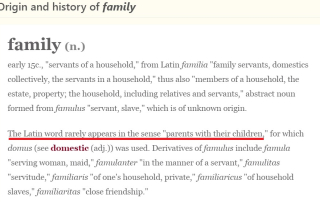
Here is the entry for “family” from the website etymonline.com, which traces the history of English words (emphasis mine):
family (n.)
early 15c., “servants of a household,” from Latin familia “family servants, domestics collectively, the servants in a household,” thus also “members of a household, the estate, property; the household, including relatives and servants,” abstract noun formed from famulus “servant, slave,” which is of unknown origin.
The Latin word rarely appears in the sense “parents with their children,” for which domus (see domestic (adj.)) was used.
Derivatives of famulus include famula “serving woman, maid,” famulanter “in the manner of a servant,” famulitas “servitude,” familiaris “of one’s household, private,” familiaricus “of household slaves,” familiaritas “close friendship.”In English, sense of “collective body of persons who form one household under one head and one domestic government, including parents, children, and servants, and as sometimes used even lodgers or boarders” [Century Dictionary, 1889] is attested by 1540s.It is attested from 1660s as “parents with their children, whether they dwell together or not,” also in a more general sense, “persons closely related by blood, including aunts, uncles, cousins;” earlier “those who descend from a common progenitor, a house, a lineage” (1580s).
Hence, “any group of things classed as kindred based on common distinguishing characteristics” (1620s); as a scientific classification, between genus and order, from 1753.
Latin familia often was glossed in Old English by hired, hyred “household, family, retinue” (for which see hide (n.2), and also by hiwscipe, hiwræden, hiwan “members of a family, household, or religious house,” which is cognate with Old Norse hjon “one of the household; married couple, man and wife; domestic servant,” and with Old High German hiwo “husband,” hiwa “wife,” also with Lithuanian šeimyna “family,” Gothic haims “village,” Old English ham “village, home” (see home (n.)). A 15c. glossary has, for Latin familia, Middle English a menge, from Anglo-French maisnie “the household, the whole attendance upon the personal establishment of the feudal lord.”
As we can see from the historical uses of the English word “family,” its original meaning went far beyond what is today referred to as “the nuclear family” consisting of only parents and their children.
Before the “Industrial Age” and the “Age of Enlightenment” and the “Protestant Reformation” in Europe, the term “family” was more broadly understood in terms of location and “estates”, and included more than just those with a biological relationship, but also included slaves and other humans who were part of that “estate”, or “household” but not necessarily biologically related to each other.
Therefore, when you see the English word “family” used to translate certain passages in the New Testament which was written in Koine Greek, you need to understand that the choice of the translators to use “family” is 100% subjective, as there is no underlying Greek word that means “family” in the modern sense.
This is easily seen by doing searches in the English Bibles today, where the older English language translations seldom used “family” at all, but the more modern English translations use it quite a bit.
For example, in the old “King James Version” (KJV), it is only used once.

The single occurrence of the word “family” in the KJV is significant, in Ephesians 3:15.
Here is the verse in the context of the chapter:
For this cause I Paul, the prisoner of Jesus Christ for you Gentiles, If ye have heard of the dispensation of the grace of God which is given me to you-ward: How that by revelation he made known unto me the mystery; (as I wrote afore in few words, Whereby, when ye read, ye may understand my knowledge in the mystery of Christ) Which in other ages was not made known unto the sons of men, as it is now revealed unto his holy apostles and prophets by the Spirit;
That the Gentiles should be fellowheirs, and of the same body, and partakers of his promise in Christ by the gospel: Whereof I was made a minister, according to the gift of the grace of God given unto me by the effectual working of his power.
Unto me, who am less than the least of all saints, is this grace given, that I should preach among the Gentiles the unsearchable riches of Christ;
And to make all men see what is the fellowship of the mystery, which from the beginning of the world hath been hid in God, who created all things by Jesus Christ:
To the intent that now unto the principalities and powers in heavenly places might be known by the church the manifold wisdom of God, According to the eternal purpose which he purposed in Christ Jesus our Lord: In whom we have boldness and access with confidence by the faith of him.
Wherefore I desire that ye faint not at my tribulations for you, which is your glory.
For this cause I bow my knees unto the Father of our Lord Jesus Christ, Of whom the whole family in heaven and earth is named, That he would grant you, according to the riches of his glory, to be strengthened with might by his Spirit in the inner man;
That Christ may dwell in your hearts by faith; that ye, being rooted and grounded in love, May be able to comprehend with all saints what is the breadth, and length, and depth, and height; And to know the love of Christ, which passeth knowledge, that ye might be filled with all the fulness of God. (Ephesians 3:1-19)
The reason why the word “family” is significant here, is because it clearly refers to ALL created beings created by God, both “in heaven and earth”, which derive their “name”, or “identity”, from their Creator, God, whose most common name used in the Scriptures, is “Father.”
Within this context, Paul is clearly stating the Gospel message, which is that through Jesus Christ, everyone now has access to the “Family of God,” including Gentiles (non-Jewish people), regardless of whatever earthly “family” one belongs to.
In the older New American Standard Bible (NASB), the word “family” is only used 6 times, including Ephesians chapter 3.

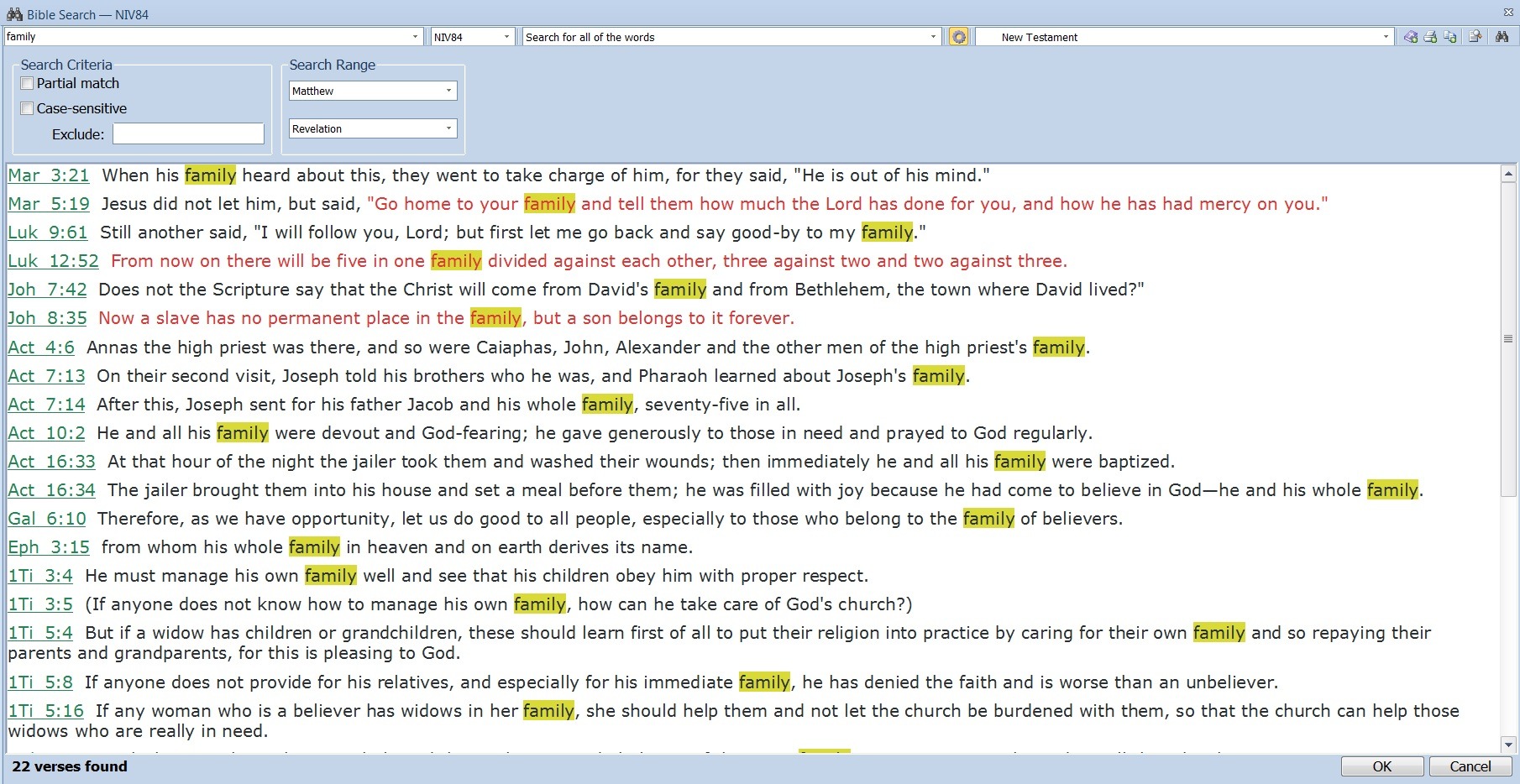
In the “newer” 1984 “New International Version” (NIV84), it is used 22 times.
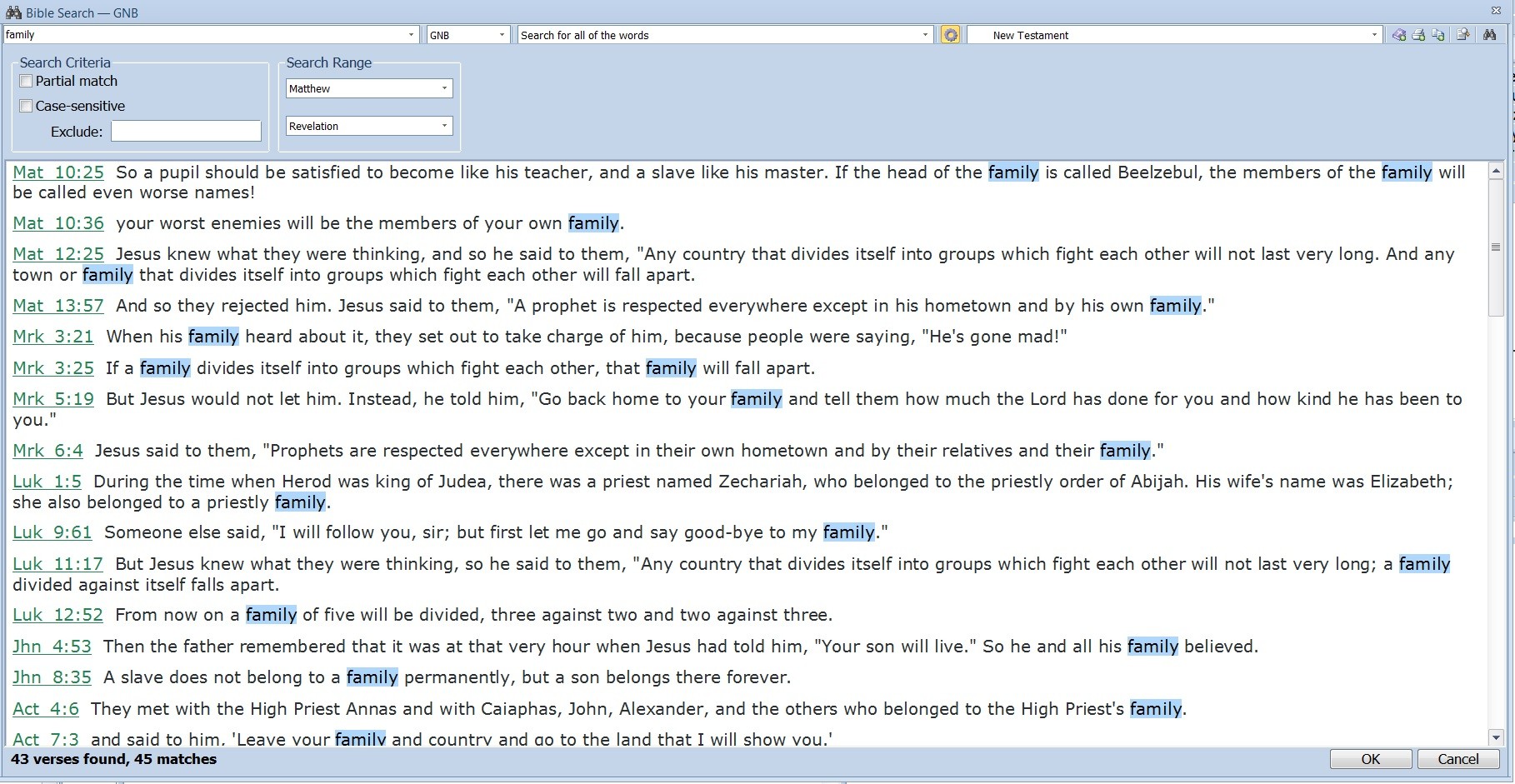
In the “Good News Bible” translation, the most modern translation of these four, which was originally developed for non-native English speakers as an allegedly easier way to understand the Bible, it is used 45 times.
When you read the “names” of people in the Bible, both in the Old Testament as well as in the New Testament, you clearly see that there were no “last names” or “surnames.”
People were identified from the household/family they came from, such as “son of [fill in the blank]”.
So this transition of the modern concept of “family” closely follows the Western concept and history of “surnames” or “last names” during the same time period.
History of English Surnames
Have you ever wondered where your surname comes from? Or how surnames evolved? In England surnames weren’t widely used until…
Excerpts:
Have you ever wondered where your surname comes from? Or when people start using surnames (last names) and why?
In England, surnames are also commonly known as last names due to the practice of writing the given names first and then the family name or surname last.
Historians generally agree that in 1000 AD England about 10% of the population were slaves, the rest were unfree. By unfree, the ‘great unwashed’ were either villeins, bordars and cottars², or serfs of varying status, all bound to the land by their lords and masters. Most people moved so little that they needed only a first name to identify themselves. Even among the knightly class, hereditary surnames were rare.
Surnames weren’t widely used until after the Norman Conquest in 1066. As the country’s population grew and to allow the new King William I to extract the relevant taxation, it became necessary to distinguish between people and so names began to include descriptions of the person, such as Thomas son of John, Peter the Baker, Richard the Whitehead, Mary Webster, etc. These descriptions would grow to form the surnames we recognise today.
To begin with, surnames were fluid and changed over time, or as a person changed his job. For example, John Blacksmith might become John Farrier as his trade developed.
The introduction of parish registers in 1538 helped establish the idea of hereditary surnames. However it was still common in some parts of the country to find a person entered under one surname at baptism, married under another name and then buried under a third.
Today there are perhaps as many as 45,000 different English surnames, derived from all kinds of sources: nicknames, physical attributes, trades, place names etc.
So every time you see the English word “family” in the Bible, if you want to truly understand what the original text written in Greek is communicating with that English word that someone chose thousands of years after the Bible was written, it is helpful to use an electronic Bible program like eSword, to see what the actual Greek words are in the original text.
Let’s look at a passage in the New Testament from the Gospel of Mark that I have quoted in some of my articles, about the “family” of Jesus, and then look at what the underlying Greek words actually are.
Then Jesus entered a house, and again a crowd gathered, so that he and his disciples were not even able to eat.
When his family heard about this, they went to seize him, for they said,
“He is out of his mind.”
Then Jesus’ mother and brothers arrived. Standing outside, they sent someone in to call him.
A crowd was sitting around him, and they told him,
“Your mother and brothers are outside looking for you.”
“Who are my mother and my brothers?” he asked.
Then he looked at those seated in a circle around him and said,
“Here are my mother and my brothers! Whoever does God’s will is my brother and sister and mother.” (Mark chapter 3)
This is quoted from the NIV84 translation. And even within the context of this chapter, we can clearly see how Jesus understood the context of “family”, and that it went far beyond biological “family” members who are identified here as “mother and brothers”, and extended to his disciples, of whom he gave preference, in at least this incident, over his biological family members.
If we look at some other translations of this verse in Mark 3, which is verse 21, we begin to get an idea of what was actually being communicated here:
And when his friends heard of it, they went out to lay hold on him: for they said, He is beside himself. (Mark 3:21 KJV)
And when His own people heard about this, they came out to take custody of Him; for they were saying, “He has lost His senses.” (Mark 3:21 NASB)
So it is very likely that more people than just Jesus’s “mother and brothers” came to him at this time, and could have included other people in his “household”.
There are actually two underlining Greek words used here: παρά (para) – from, of at, by, besides, near – and αὐτός (autos) – himself, herself, themselves, itself.
Personally, I think the NASB is the closest to the original, “his own people.”
We know that Jesus was not born into a household that was considered “slaves” or “servants,” as his mother’s first husband, Joseph, was a tradesman, and ran his own business, which could have included quite a few people.
Was Jesus’s behavior of constantly going against the cultural norms, and even daring to oppose the religious leaders of this day, becoming an economic drain on their “family business”??
As I have previously published, the most common understanding and translation of the “trade” or “craft” that the household of Jesus’s family practiced, is “carpenter.”
But the actual Greek word used, tektōn, which is a word group in the Greek that gives us English words today such as “technology”, could also be translated as “mason”, a worker of stone, and not just wood.
Here is what I have previously published on this:
Next, let’s look at the English word “craftsmen” that is used here to refer to Demetrius and the others (Acts 19).
The word in the original Greek texts is τεχνίτης – technitēs.
This is the word group that we get our English words “tech”, “technology”, “technologists”, etc. from.
In classical secular Greek, it meant “craftsman or builder in wood, stone, or metal“.
It is also used in the Greek translation of the Old Testament, such as in this verse describing the building of Solomon’s temple:
You have many workmen: stonecutters, masons and carpenters, as well as men skilled in every kind of work.
(1 Chronicles 22:15)Another Greek word from this word group in Greek is tektōn, which is used of Jesus in Mark 6:3:
Isn’t this the carpenter? Isn’t this Mary’s son and the brother of James, Joseph, Judas and Simon? Aren’t his sisters here with us?” And they took offense at him. (Mark 6:3)
All the English translations I have, which is over a dozen, including the KJV, ALL translate this word as “carpenter.”
This is what the New International Dictionary of New Testament Theology by Collin Brown, Volume 1 published in 1967 (originally published in German), on page 279 states regarding tektōn:
tektōn appears only in the identification of Jesus by the people of Nazareth as “the carpenter” (Mark 6:3), “the carpenter’s son” (Matthew 13:33).
Though “carpenter” is the common rendering here, tektōn could equally mean “mason” or “smith” (as indeed some of the Fathers took it) or it could mean that Joseph and Jesus were builders, so that both carpentry and masonry would have been among their skills.
This was a new revelation to me as I studied Acts 19 today in preparation for writing this article, and the Holy Spirit prompted me to look up the original word in the original texts for “craftsmen”.
And of course it makes a lot of sense and correlates with many other passages in the Bible that refer to Jesus as a builder of stone.
Jesus is also referred to as the “cornerstone.”
As you come to him, a living stone rejected by men but in the sight of God chosen and precious, you yourselves like living stones are being built up as a spiritual house, to be a holy priesthood, to offer spiritual sacrifices acceptable to God through Jesus Christ.
For it stands in Scripture:
“Behold, I am laying in Zion a stone, a cornerstone chosen and precious, and whoever believes in him will not be put to shame.”
So the honor is for you who believe, but for those who do not believe,
“The stone that the builders rejected has become the cornerstone,” and
“A stone of stumbling, and a rock of offense.”
They stumble because they disobey the word, as they were destined to do.
But you are a chosen race, a royal priesthood, a holy nation, a people for his own possession, that you may proclaim the excellencies of him who called you out of darkness into his marvelous light. (1 Peter 2:4-9)
So should we really be calling Jesus a “carpenter” or a “mason”?
I did a search to see if there were others who had studied and discovered this, and of course there are.
Here is one video I found that confirms this. Note: I don’t know the person in this video and I know nothing about his other teachings, just what he describes in this video which confirms my own study on this.
Read the Full Article:
Hopefully by now everyone who is reading this can see the difficulties in the English translations of the Bible, which was written in Middle Eastern culture, and not Western Culture, and there are many problems with these translations, especially with an English word like “family”.
And many of the English words that were originally chosen by King Jimmy in England, in the “authorized” version, were politically motivated, as I have pointed out in other articles I have written over the years, words like “church” and “pastor” which are wrongly used intentionally so that the King could establish his religious authority during the “Reformation Period” and even challenge the authority of the “Pope” in the Catholic Church.
Two English words, for example, that are used throughout the Bible that do not exist in the original texts, are “wife” and “husband”, which I exposed in the article I wrote about sex and marriage. See:
The Greek words are the words simply for “man” and “woman”, and the context defines whether those words are used in the contract of “marriage” or not, which in the ancient world was considered a binding contract between two “families” (households).
One of the most mis-interpreted sayings of Jesus, in my opinion, is when he told his disciples to call no man on earth “father”, a “family” term.
Here is the full context, which deals with the religious leaders of his day (Pharisees and Scribes)
Then Jesus spoke to the crowds and to His disciples, saying:
“The scribes and the Pharisees have seated themselves in the chair of Moses. Therefore, whatever they tell you, do and comply with it all, but do not do as they do; for they say things and do not do them.
And they tie up heavy burdens and lay them on people’s shoulders, but they themselves are unwilling to move them with so much as their finger.
And they do all their deeds to be noticed by other people; for they broaden their phylacteries and lengthen the tassels of their garments.
And they love the place of honor at banquets, and the seats of honor in the synagogues, and personal greetings in the marketplaces, and being called Rabbi by the people.
But as for you, do not be called Rabbi; for only One is your Teacher, and you are all brothers and sisters.
And do not call anyone on earth your father; for only One is your Father, He who is in heaven.
And do not be called leaders; for only One is your Leader, that is, Christ.
But the greatest of you shall be your servant. Whoever exalts himself shall be humbled, and whoever humbles himself shall be exalted.” (Matthew 23:1-12)
Jesus was speaking to his Jewish audience, and specifically criticizing the Jewish leaders of his day. These Jewish leaders who opposed and killed Jesus, claimed superiority over Jesus because they claimed Abraham was their “father.”
Jesus made it clear that they did not recognize the true “father” of Abraham, and instead followed their actual “father”, the Devil.
So Jesus was saying to those Jews who had believed Him,
“If you continue in My word, then you are truly My disciples; and you will know the truth, and the truth will set you free.”
They answered Him,
“We are Abraham’s descendants and have never been enslaved to anyone; how is it that You say, ‘You will become free’?”
Jesus answered them,
“Truly, truly I say to you, everyone who commits sin is a slave of sin. Now the slave does not remain in the house forever; the son does remain forever.
So if the Son sets you free, you really will be free. I know that you are Abraham’s descendants; yet you are seeking to kill Me, because My word has no place in you.
I speak of the things which I have seen with My Father; therefore you also do the things which you heard from your father.”
They answered and said to Him,
“Abraham is our father.”
Jesus said to them,
“If you are Abraham’s children, do the deeds of Abraham.
But as it is, you are seeking to kill Me, a Man who has told you the truth, which I heard from God; this Abraham did not do. You are doing the deeds of your father.”
They said to Him,
“We were not born as a result of sexual immorality; we have one Father: God.”
Jesus said to them,
“If God were your Father, you would love Me, for I came forth from God and am here; for I have not even come on My own, but He sent Me.
Why do you not understand what I am saying?
It is because you cannot listen to My word.
You are of your father the devil, and you want to do the desires of your father. He was a murderer from the beginning, and does not stand in the truth because there is no truth in him.
Whenever he tells a lie, he speaks from his own nature, because he is a liar and the father of lies.”
(John 8:31-44)
So when Jesus told his disciples to “not call anyone on earth your father”, the Jewish culture and how they viewed Abraham as their “father” has to be understood in this context.
Jesus refers to two “fathers” in John chapter 8: God the Father who is the creator of heaven and earth, and Satan, or “the devil”, as the “father” of those on earth who do not acknowledge God the Father and are therefore not part of his “family” or “household.”
One of the main things that the Satanic Jews (Zionists) have done in modern, Western culture, is redefine “family” to mean the “nuclear family” of parents and their children, but only 2-3 children because more is considered “irresponsible” in modern Western culture.
The nuclear family is the bedrock of modern Western culture, and the infamous “Middle Class,” is simply a kinder, and gentler version of “slavery.”
The “Middle Class” that arose in the United States, especially after World War II, is what has fueled tremendous economic gain for the ruling classes through the present times.
Only the rich have large “households” in the true, historical sense of the word and concept of “family,” because it reaches far beyond biological nuclear families, and extends around the world where the goods sold and bought in the U.S. have been largely produced by the economic lower classes outside of the U.S. in places like Asia, and especially China, until recent times where China now has its own “Middle Class” and is quickly overtaking the U.S. as the economic center of the world.
Rich billionaires, like Elon Musk and Telegram founder Pavel Durov, have fathered hundreds of children through In Vitro Fertilization (IVF), and their technology platforms are responsible for a large part of the child sex trafficking networks.
These are the kinds of “families” that run the world today, serving their “father” the Devil.
The illusion of the mostly White, Conservative Christian families in the Middle Class is that they actually believe that they are “free”, as they put in their 9-5 work days 5 times a week, and believe that they can actually own things, like a car, a house, etc.
But everything the Satanic system allows them to purchase and “own” can easily be taken away through government actions, if they do not fulfill their duties to the State as busy worker bees, or to use the term mostly used throughout the history of mankind, SLAVES.
The small, Middle Class nuclear family is the economic model of slavery today, as their labor performs what is necessary to keep the Satanic system running.
Their lifespans are carefully calculated by the insurance companies to ensure maximum profits, which can be adjusted by mass population events such as a fake “pandemic” and new, “lifesaving” drugs and vaccines that they line up to take, believing their slave masters.
The number of children born to them has been carefully controlled for decades to be about 2 to 2.5 per “family”, so as to not overburden the system with the education and health care costs to take care of the children from the Middle Class slaves.
And if you are not from the White, Conservative Christian majority, but from the minority classes, your chances of having your children kidnapped from you and given to the rich is exponentially higher, as is your chance of being killed by the system because they are dependent upon government “health” care.
I have much more to write on this topic, but it has already become a long article that probably very few will read, and even fewer will understand.
But this is the conclusion: You either belong to the “family” of God, where God is your Father and Jesus is your brother, or you belong to the world system ruled by your father Satan.
God only has one biological family member: The “One and Only” (or some translations “begotten”) Son of God, Jesus Christ.
The rest of us are born into Satan’s kingdom, and the only way out of his family is to be adopted into God’s.
I am writing this and delivering this true message to the public today as an adopted son of God, and co-heir of the inheritance to come through Jesus Christ.
Therefore, brothers, we have an obligation—but it is not to the sinful nature, to live according to it.
For if you live according to the sinful nature, you will die; but if by the Spirit you put to death the misdeeds of the body, you will live, because those who are led by the Spirit of God are sons of God.
For you did not receive a spirit that makes you a slave again to fear, but you received the Spirit of sonship.
And by him we cry, “Abba, Father.”
The Spirit himself testifies with our spirit that we are God’s children.
Now if we are children, then we are heirs—heirs of God and co-heirs with Christ, if indeed we share in his sufferings in order that we may also share in his glory.
I consider that our present sufferings are not worth comparing with the glory that will be revealed in us. The creation waits in eager expectation for the sons of God to be revealed. (Romans 8:12-19)
Comment on this article at Created4Health.org.
This article was written by Human Superior Intelligence (HSI)


See Also:











Having problems receiving our emails? See:

If our website is seized and shut down, find us on Telegram, as well as Bitchute and Odysee for further instructions about where to find us.
If you use the TOR Onion browser, here are the links and corresponding URLs to use in the TOR browser to find us on the Dark Web: Health Impact News, Vaccine Impact, Medical Kidnap, Created4Health, CoconutOil.com.
The post The Western Concept of “Family” is Unknown in the Ancient Biblical Literature first appeared on Health Impact News.
Daniel left school five years ago and still lives with his parents—pretty normal in a country where around a third of young British men haven’t moved out. What is different about Daniel is his identification as “hikikomori”—literally “pulled inward”—a form of extreme social isolation. Since leaving school, he has left his family home “maybe once a month.” Research into hikikomori is limited, though some links with social anxiety and autism have been drawn. In this piece, Eve Livingston explores what day-to-day life is actually like for the families living with this phenomenon, doggedly seeking access to a world built to avoid in‑person encounters.
Dip your toe into the world of hikikomori, and you’ll find that attitudes vary widely, even among the self-identified. Some, like Daniel, display a level of sensitivity and sometimes defensiveness about their lifestyle, while others are more open about a sense of sadness and sometimes hopelessness they felt towards their circumstances.
“I am [a hikikomori]… it sucks and I hate my life,” reads one such comment on Reddit. “Every single attempt at recovery has ended up in an even deeper relapse and its [sic] so painfully boring and lonely… I fantasise about being free all the time but I know I’m probably just going to die this way.”


