Over the 2026 Labor Day weekend, I had the honor of speaking at the Reuther-Pollack Labor History Symposium in Wheeling, West Virginia, organized by the Wheeling Academy of Law & Science (WALS) Foundation. The symposium takes place in Wheeling every year and adopts a different theme each year; this year, the theme was “The Art of Labor.” I got to represent TRNN and speak alongside a truly incredible lineup of artists and working-class warriors, including: Tabitha Arnold, the great textile artist and tapestry maker; Erik Ruin, printmaker and shadow puppeteer; and Shaun Slifer, a multidisciplinary artist and the Creative Director for the West Virginia Mine Wars Museum.
The text below is a transcript of the talk I gave at this year’s Symposium, which has been lightly edited for clarity and readability. You can also listen to the audio recording of my speech on The Real News Network podcast feed.
Thank you. It is genuinely an honor to be here on these hallowed grounds with all of you in Wheeling, West Virginia. It really, really means a lot to me to be here with all of you.
I didn’t start out to become a labor journalist or to do the kinds of interviews I do with working people. I didn’t set out to make a life reporting on working-class struggles from working-class areas around the country, on the front lines of a class war that is hitting all of us in similar and different ways. I didn’t start out to be or do any of that. I started because I didn’t want my dad, the greatest man I know, to go to his grave feeling like a failure after we had lost everything during the Recession, including the house I grew up in, just like millions of other families. And we have continued to struggle, just like millions and millions and billions of us around the world have continued to struggle. And so, to be here standing in front of all of you—having started the show back then as a ruse to get my dad to talk about something he was so deeply depressed about and wouldn’t talk about—it means a whole lot for me and my family.
I really do want to thank all of you for being here. And of course, I want to thank Seán P. Duffy, Vincent DeGeorge, and everyone at the WALS Foundation for bringing us all together here on this hallowed ground.
I came here today from Baltimore to talk with you all about why stories matter to me, and why I believe they matter to us, or should matter more.
I wouldn’t be here without the stories that made me. And the same is true for all of us and every one of us.
And when I say “I wouldn’t be here,” to start, I mean it literally. I quite literally and very quantifiably would not be standing here right now, speaking in this room with you all, alongside all these amazing people—none of you would have ever had to hear my name or see my ugly face, if I wasn’t such a hopeless, relentless, lifelong lover of stories.
(Also, I know y’all were hoping Kim Kelly would be here today. I apologize, I am no Kim Kelly. I am a fill-in for Kim Kelly, but I am one-third of the tattoos and one-third of the talent. So that’s what you’re getting today!)
I wouldn’t be doing the work that I do now as a journalist and Co-Executive Director of a news organization, I certainly wouldn’t be doing it the way I do it, I would not have pursued all those ill-advised degrees in literature before that, I would not have written or said or filmed all the things that I have and will, if I wasn’t an eternal believer in the awesome, human-making, history-making, and society-making power of stories.
Whether I’m reading them, writing them, watching them, listening to them, studying them, teaching them, recording them, filming them, remembering them, dreaming about them, thinking about them, or thinking through them, I love stories, and I need stories to live. Always have, ever since I can remember remembering anything.
Like any fool in love would do, I followed that need wherever it took me. I have madly chased it headfirst into the best and worst times of my life. It got me to the most beautiful, ivy covered college campuses I’ve ever seen, and it got me through the most body-crushing, mind-numbing, soul-rotting jobs I’ve ever had. It led me to my wife and fellow literature dweeb Meg, who’s sitting back there, and it opened up the path for me to make the purpose-filled life I have now, and to do the purpose-filled work I do now.
I have continued to chase that love and that need for stories headfirst into the best and worst places in the world, where the best and worst of humanity is on display. From picket lines to protest marches, from union halls to student encampments on college campuses, from the horror-filled halls of immigration courts where masked federal thugs are kidnapping and disappearing innocent people daily, to rural, urban, and suburban communities fighting data centers all over the country, from “deep red” Texas to “deep blue” Maryland, from Occupied Palestine to East Palestine, Ohio, from communities that have been devastated by poverty, industrial pollution, and organized abandonment and disinvestment to communities that have been devastated by plant closures and school shootings, from poisoned coal mining towns in West Virginia to poisoned neighborhoods in South Baltimore where that very same coal ends up, where that very same coal sits and moves through the giant coal terminal pier right next to people’s houses, and where that very same coal ends up in the poisoned lung tissue of the people who live there and have been inhaling that toxic coal dust for generations.
I have followed my need for stories and our people’s need to have our stories told and heard. I have followed that need to wherever I need to be, and I have followed it all the way here to Wheeling, West Virginia. (You wanna talk about stories? There are a few more storied places than this.)
And though it has caused me and my family more pain and grief and debt and disappointment along the way than I can ever possibly sum up to you, I have learned to check myself by asking myself: If the need that I have, if the love that I’ve followed, brought me to this beautiful place and gave me the chance to be here now with you beautiful people, then how can it be wrong?
If that need and that love has led me to my life’s continuing work of lifting up the stories of our fellow workers around the US and around the world, of using every medium and platform and every tool and skill I have to offer to help people find confidence in their own voice and share their story in their own words—if it has guided me to the frontlines of the class war to report the news through the stories and voices and faces and lives and bodies and souls and firsthand realities of the people at the center of “the story”—if that absurd, magical, lifelong pursuit of stories has in any way helped me help other working people like me and my family believe that their stories are actually worth telling and hearing and remembering, that their lives truly do matter more than this world has led us to believe and that we all truly do deserve better than what this world has forced us to accept—and if it has helped me help others see that we can get better and make a better world the better we are to each other and the more we share our stories and listen to each other’s stories—if my love and my need for stories and my belief in stories has contributed anything at all to that, then how can it not be worth it?
But when I say, “I wouldn’t be here without the stories that made me,” I also mean it in the sense that I wouldn’t be the “I” that I am. I am me because of the stories that made me, the stories that made me more me than who I was before I experienced them, the stories that continue to make me who I am now and who I will be in all those versions of me to come.
I come from a family of storytellers. Being here in West Virginia, I got a sense you guys will know what I’m talking about. One of many things Mexicans and West Virginians have in common. I am the me that I am because of the people who raised me, the people who are and continue to be my life, the people who taught me how to live and be a person and become a self through their presences, their absences, and their stories. The stories they told and the stories they showed me and my siblings. Stories that hit back to the deepest end of my childhood beginnings of consciousness, stories that built my consciousness, stories that brought me out of human mud and helped shape me into human being.
For the same reasons I can always remember it being such a natural feeling to look out car windows and be fascinated and dazzled by all the warm lights of being out there, all those other homes and other lives people-like-me-but-not-me are living—for the same reasons I’ve always wondered about those other homes and lives and people—for all the same reasons I have always projected myself outward onto them and thought about them out of genuine curiosity and interest and goodwill—and for all the same reasons I have grown as a person the more I consider selves and lives that are not mine, I have always been naturally drawn to stories as a lifesource. Stories my family told me, stories I heard on the radio or saw on the TV, stories I read, stories I created.
Stories about human-beings-like-me-but-not-me, living in selves-and-bodies-like-mine-but-not-mine, living in times, places, circumstances, and worlds that are not the ones I live in and experience everyday. Stories that take my lifeworld and my perspective and open them up, open me up, to lives-like-mine-but-not-mine, to human perspectives other than the only perspective I can ever have and have ever had ever since I was born, ever since I’ve been me, Maximillian Lee Alvarez. All those stories now live on in me, and will continue to live on in me, so long as I live on as me.
Those stories live on through me in the impressions they have left on me. And they will continue to live on in me as formative parts of the person I became once those stories and my experiences of them became part of me. And they will continue to be a part of me and every version of me—all those selves I’ll ever become—so long as I am gifted to live on this earth as me.
These stories live on in the words I say and in the stories I tell to others. Because they have shaped the “me” that I am and the ways I use language to communicate with others and with myself, and the ways I use language to communicate myself to others and to myself.
They live on in the ways I cope with pain and failure, and what I learn from them.
Those stories live on in my thoughts and in the way I think. Now and for the rest of my life, they have their place in the vast, dazzling multiverse of mindstuff that my mind has to draw upon and remember from and think and dream and imagine with.
Over my lifetime, the stories I’ve found, the stories I’ve made, and the stories I’ve been told have shaped, challenged, corrected, sharpened, and reinforced my internal sense of right and wrong, good and evil, beautiful and ugly, and what it means to be good, do good, and live a good life.
And if you’re feeling lost about those things right now, I’m telling you: Go back to our stories! We are not the only ones to face hard times. Our ancestors who faced such times left us their stories so that we would know what to do now. Don’t let those stories go to waste! There is power in them. We have power in them. (More on that in a minute.)
All those stories live on in the ways I try and have tried and will try to live and act and see and be in the world, in the ways I try and have tried and will try to see and treat other people and other life. And again, what I’m saying is true for me is, I fully believe, true for each and every one of us. And that on its own—even if you just take the people here in this room—is a miracle of life and nature and god and a joyous wonder to behold, on par with gazing out at the stars in the sky!
And yet, we so disinterestedly take all this for granted every day. We don’t appreciate stories enough, including our own stories and the stories of others. And I don’t think we appreciate this enough about the stories that make us and the roles stories play in making us human (and the role storylessness plays in our loss of humanity).
Just like we have been trained and trained ourselves to accept an unacceptable culture of violence and mass death that takes and destroys life everywhere with the kind of scale and self-serving abandon that would make the ancient gods of old blush, we have been trained and trained ourselves to lose touch with the magical, life-giving force of stories. And our life-sustaining love for stories has been beaten out of us by AI slop, by a shitty, commercialized culture industry, by living under capitalism and end-times fascism, etc. I get why we feel that way, and I feel it, too. But there’s something really, really wrong there.
Like our air and water and soil and atmosphere, I think we have been trained and trained ourselves to let stories be poisoned and polluted for so long that we will at worst cheer on their destruction or at best live monotonously without any urgent sense of duty or need to stop the destruction. Both paths inevitably lead to the same place: our own peril as a people, a society, and a species.
That’s why I think we miss the magic of stories and the magic in stories that’s all around us, available to us in so many forms, living in our heads and shaping who we are every day.
That’s why I think we tend to look at stories and the stories of others so mistrustfully or disinterestedly or scornfully or selfishly. We tend these days to not look for stories at all, let alone stories that challenge us and grow us. We don’t give them our time, and so many that are shoved in our faces aren’t worth our ime. And when we do look for them, we often look for the stories that we already know or stories that ultimately serve to stop us from growing and knowing more, stories that serve to stunt our being and reinforce the selves and prejudices we already have. What a waste of good magic!
Of course, we all want stories like that to some extent, and we all need stories that function like that to some extent. We all watched The Office five times during Covid. That’s fine. But what I’m talking about goes much deeper.
I’ll use myself as an example to try to explain.
I grew up in Southern California, post-Cold War, in the ‘90s. We were a middle-class mixed-immigrant family. We were the American Dream. And that’s why my dad and my mom and my family were so depressed after the 2008 Crash and the Recession, because we had had and lost the American Dream, and that really does a number on you and your soul.
The era I grew up in before the Crash was an era of America in which a lot of the dreams that I was foolish enough to have for my life still felt possible. And over the last 25-30 years, I think a lot of us have come to the awakening that many of those dreams, our dreams, are not possible in America anymore. At least not for working people like us. And after doing this kind of work for nearly a decade now, I’ve gotten confirmation from working people all over this country that I’m not the only one who feels that way.
It’s a real gift to contain all those different selves that I’ve been over my life, including the deep-red-conservative, Orange County dumbass who didn’t know much about life. I don’t despise or regret that version of myself, I accept him for all his faults. And I know I had a lot of right reasons for believing the wrong things back then. And I know that I still have so many good parts of me that were there in me when I was a conservative and that are here in me now as the lefty nut job you see before you. Because they’re just good things about being a good person. I don’t care who taught them to me, I’m just grateful they did.
I don’t see people in rigid identity or ideology boxes, and I try not to see myself that way either. And I definitely don’t like to see stories that way. And it’s in part because of stories that I don’t see the world that way. And yet, in this country, that is the way that we have trained ourselves to see each other and ourselves and our stories.
I remember being that younger, more conservative-type person and going into a Barnes & Noble and saying, “I want to read good, classic literature.” And the employee I talked to was like, “Oh, do you want French literature? Spanish literature? Feminist literature? African-American literature?” And I remember saying, “No, no, no. I want literature. I don’t want any of those ‘special interests.’”
That was a very juvenile way for me to think and feel about literature, but I think a lot of us can still relate to that feeling. I’m so grateful to literature especially, and to all the storytellers in my life and all the storytellers I’ve come across in my life, for teaching me over time, and for constantly reminding me, that that’s not what stories are there for. I’m grateful to them for teaching me how much it cheapens our relationship to stories—and the potential and beauty and magic we can derive from them—when we look at them and treat them this way. And stories themselves are the cure for this sickness. The more I read literature of all kinds, the less I thought about stories this way. The more I loved and connected with literature of all kinds, the more I grew and felt and thought and developed as a person with different kinds of me inside.
And so, I learned a very valuable lesson early on in life: That literature about other people, and that stories about other people—from other people’s perspectives, about the ways that they are living as people in this world—are not a threat to who I am. They make me who I am. They grow who I am.
And it’s for those reasons that it seems so clear and obvious when I say, “I wouldn’t be here without the stories that made me, and you wouldn’t be here without the stories that made you.”
Think of all those stories that still live in your head today, that you still talk about with your friends and siblings, that you still have living somewhere in the recesses of your mind as warm memories of reading a good book, watching a good movie, or having a good conversation.
For me, I think about sitting in my living room with my whole family back home, watching the movie Glory, the epic historical drama about the 54th Massachusetts, the first Black regiment to fight in the Civil War. Why did our whole family of Alvarezes connect with that movie? I could go on a whole dissertation about why we connected with that movie (but I won’t do it here, don’t worry). We bawled our eyes out watching it then, and I still bawl my eyes out when I watch it now. We saw so much of ourselves—the Americans we believed we were, the America we believed we lived in and believed we were a part of—in that movie. And we clearly weren’t the only ones.
It doesn’t matter that I don’t know what it’s like to be a “freed” Black slave in the Antebellum South; and it doesn’t threaten my understanding or sense of being to watch a movie that storytellers, story-makers, and story-actors have produced to try to help me understand. It enhances my being. It gives me more access to beings- and selves- and lives-like-mine-but-not-mine, and they then become part of my experience and shape who I am and how I am in the world.
That’s part of the magic I’m talking about, the magic that makes us who we are, which we all just take for granted. It’s like we put on glasses that removed the power of stories from our vision, made it invisible to us. But it’s there. It’s all around us. It’s there in us.
It was there when I was listening to Tracy Chapman’s “Fast Car” while driving here to Wheeling. Truly, one of the most beautiful stories about love and working-class life ever told in our language. And no matter what stage of my life I was in, it didn’t matter to me that I didn’t know what it was like to live as a Black, working-class lesbian in the industrial Midwest around the ‘80s and ‘90s. I still knew enough to know that to live was to love, to seek love, to be loved, and to pursue happiness, and I still knew enough to know why it is a heartbreaking tragedy for someone to have their love and their lives and their happiness denied or taken from them.
Who among us human beings hasn’t feared making the wrong choice immortalized in Chapman’s line, “We got to make a decision: leave tonight or live and die this way”? Who among us living people cannot relate to the pain and fear and drama and yearning in the stories of other people who spend their precious, short time on this earth living unfulfilled, unhappy lives full of unrequited love and unrealized dreams, even if they weren’t our dreams?
I could relate to that even as a kid. I relate to it so much more now as an adult, now that I am far more aware of the limited time we in general and I specifically have to live. And that gives me so much more capacity to feel empathy and solidarity with others whose lives and loves and happiness and flourishing are beaten, crushed, lost, or denied. How could I feel anything but the natural human solidarity my heart feels when listening to Chapman’s song? And how can I not remember that listening to the song as a kid helped me begin to imagine and explore the unknown emotional depths of my own human heart?
The specifics of the story and the selves involved do not describe the specific story and self I already know as my own, but they still embody dramatically heightened versions of what I have known and experienced in my own life, dramatically and beautifully heightened versions of our human experience of life and love and loss and yearning.
None of the details that differentiate the story in “Fast Car” and its lovelorn protagonist from my own life story are reasons for me to say, “That’s not my story.” Those are reasons for me to connect with another person’s story—to get closer to them, and to become more myself, the more they and their story become part of me and mine.
It’s a beautiful, incredible book. Everyone should go read it. It’s a Catalan novel about Spanish Civil War times. I don’t know what the hell that’s like, but for the same reasons that my Mexican ass got two useless degrees in Russian literature, I don’t care. I don’t need anyone’s cultural permission to connect with my fellow human beings. Reading the stories of other people has only ever given me light and goodness. It’s never taken anything away from me or made me a worse person.
Reading the first chapter of Goodbye, Ramona transports me to the mind of a trapped woman—a woman whose husband is a tyrant and makes her feel powerless—as she wanders like a ghost in the streets looking for him after he has suddenly gone missing in the wake of a bombing in Barcelona. In Roig’s beautiful, harrowing description—and in Meg and Cristina’s beautiful, harrowing translation—you see the damage of his tyranny on her psyche, and you feel the fear and anxiety in the way she describes what she’s doing and what she’s thinking.
That’s the raw, human stuff that makes me feel as close as I can get to living and seeing through the head of another person. What a gift that is! And how necessary it is, especially in times like these when we live and exist so far away from each other, when we are so alienated from each other and isolated from each other, when we can be standing next to other people in the grocery store line or sitting next to each other in traffic but the spaces between us and our minds and hearts feels as vast as the distance between us and the moon.
We have stories to bring us closer, and yet we continue to let capitalism, a broken society, and the wickedness of the powerful push us away from each other. But it doesn’t have to be this way. And I hope that the stories that I have helped to tell, all these stories I’ve recorded and published, will continue to remind people of that. I hope these stories remind people of who we really are and who our neighbors really are. I hope these stories by and for our fellow workers not only remind us that every life is precious, but that they remind us what life is all about. I hope that they remind us what a gift it is that we are all here, and what a cosmic tragedy it is that we allow life itself and our lives to be treated with such inhumane disregard.
For 19 years, with a virtually spotless record, Evan worked at a local Kroger grocery store in Milford, where he eventually became the dairy department manager. But from October 2020 to March 2021, Evan suffered a torturous campaign of bullying, harassment, and sabotage from two store managers, and his union abandoned him when he needed help. Evan took his own life, and his family will never be the same, and the world will never be as bright as it was with Evan in it. I thank god that I don’t know firsthand what it’s like to go through such a horrific tragedy, but because I heard them tell it, every other thing about me and my human being feels the Seyfried’s story and their pain and their fight for justice as my own. After learning about Evan’s story and after speaking with his loved ones about his story many times, I am forever changed by him and by them.
So, of course, I thought of Evan and the Seyfrieds, and I thought of my own family, when I saw the soul-crushing news story this past week of Pierre Damas Bel, the poor 20-year old young man who committed suicide in Springfield and walked into traffic after our government slapped a criminal ankle bracelet on him and told him he was a worthless cockroach. I know what it feels like to have others in my own country, even my own government, see me this way. Everyone here has some way of trying to understand what that feels like, but we don’t try hard enough. Stories help us get better at trying. And we need to get better, we need to do better, we need to be better. For Evan, for Pierre, for all of us.
I’m not the same person I was when I walked into that Barnes & Noble way back when looking for “just good literature.” I don’t look to stories or look for stories in that same one-way, transactional mode anymore; I don’t look to stories or look for stories that are just going to reflect me back to me.
I don’t just gravitate to stories that I gravitate to because I see something of me reflected in them. I gravitate to stories because a light in them draws me in, and that light then reflects in me and stays with me after I connect with them.
Every great human-made creation, construction, and operation embodies a whole that would not exist but for the sum of every worker and every ounce of human work that contributed to its existence. All those workers with all their lives and all their labor contributed to bringing all these magnificent things into existence, and all of us workers with all our lives and all our labor contribute to them, improve upon them, and keep them running. So, too, have all these stories contributed to bringing the me that I am into existence. And these stories will continue their work of shaping how I live and act and see and feel and think.
Stories have been and continue to be the most ever-present, ever-abundant, ever-beautiful reminder that I need other people to live, to be, to be me.
And the ever-present, ever-abundant, ever-beautiful number and forms of human stories all around us—all the stories that have already been told, all the stories yet to be told, all the stories that live on in our books, our films, our songs, our campfire tales—each and every one of them is a reminder to us that we need each other, too.
The Navy says it is making a concerted effort to apply the hard lessons learned from the marathon deployments of the USS Gerald R. Ford and USS Abraham Lincoln, both in combat and in quality of life for the crew, according to a new video posted by the Chief of Naval Operations, Adm. Daryl Caudle. The changes will be rolled out when USS Theodore Roosevelt deploys following a brief, last-minute, and previously unreported maintenance availability, TWZ has learned. Meanwhile, the United States and Iran are quickly climbing the escalation ladder again, as the latest series of tit-for-tat strikes has resulted in a massive overnight ballistic missile attack on a Jordanian base hosting U.S. forces and the destruction of 10 Iranian commercial oil tankers over the past week.
Here’s TWZ’s weekly carrier tracker monitoring America’s flattop fleet, including deployed Carrier Strike Groups (CSG) and Amphibious Ready Groups (ARG), using publicly available open-source information. Check out last week’s report here.
TWZ/IAN ELLIS-JONES (High Resolution)
George Washington Strike Group Evades Iranian Ballistic Missiles
Less than a month after taking up station in the Middle East, elements of the George Washington CSG reportedly came under ballistic missile fire from the Islamic Revolutionary Guard Corps (IRGC) on September 5, according to Iranian media. “A U.S. aircraft carrier and guided-missile destroyer successfully evaded multiple unprovoked Iranian attacks,” U.S. Central Command (CENTCOM) confirmed in a statement, without identifying which warships were targeted. TWZ cannot independently verify the Iranian reports, and the Islamic Republic has frequently leveraged disinformation throughout the war.
U.S. forces responded swiftly the same day, striking three Iranian commercial oil tankers, part of the “shadow fleet” that funds IRGC operations, in a notable step beyond U.S. President Donald Trump’s recently announced tanker-for-tanker policy. “Let the message to the IRGC be clear: If you shoot at two of our ships, we will impose an even higher economic cost – taking out three of yours,” Adm. Brad Cooper, the CENTCOM commander, warned. “We will not hesitate to defend American forces, and if necessary, destroy Iran’s limited and exposed oil fleet,” he added. No U.S. casualties or damage to the American ships was reported.
Video of U.S. Central Command forces striking three Iranian crude oil carriers on September 5, 2026. (USCENTCOM video)
Details surrounding the attack on September 5 are limited, but Iranian-affiliated channels claimed the IRGC fired the Qassem Basir medium-range anti-ship ballistic missile (ASBM) for the first time. If true, it would represent the first known combat employment of the ASBM since it was unveiled in May 2025 and poses a new threat to Navy warships operating within the 1,200-kilometer, or roughly 750-mile, stated range (although that figure is more than likely overstated). Generally speaking, American cruisers and destroyers can engage ASBMs in two layers, in some cases using Standard Missile-3 (SM-3) in the midcourse phase and SM-6 during the terminal phase. Both are finite resources, and only so many can be loaded in their Vertical Launch System (VLS) cells.
Since the initial exchange on September 5, the tit-for-tat strikes have continued to escalate. CENTCOM destroyed another five crude oil tankers on September 8, bringing the total to 10 in a week, after the IRGC targeted an unidentified Navy warship again with ballistic missiles. Iran answered overnight, launching a huge salvo of ballistic missiles toward Muwaffaq Salti Air Base in Jordan, where a significant contingent of U.S. forces is forward-deployed. Dramatic videos on social media show Patriot batteries firing against the incoming projectiles, with open-source analysts counting at least 60 interceptors employed.
U.S. destroys another five Iranian tankers after the IRGC targets another American warship. (CENTCOM video)
The USS George Washington arrived in the CENTCOM area of responsibility (AOR) on or around August 19, escorted by a single guided-missile destroyer, USS Shoup. The pairing matches the composition described in CENTCOM’s statement about the IRGC attack on September 5. Washington’s public affairs team reposted the statement on their social media accounts.
The possibility that the second Nimitz class flattop operating alongside Washington in the Middle East, the USS George H.W. Bush, was the target of the attack cannot be ruled out. Both carriers are the same class and look alike from a distance (or through a seeker). The George H.W. Bush CSG is currently composed of a guided-missile cruiser, USS Princeton, and two guided-missile destroyers, USS Ross and USS Donald Cook.
An EA-18G Growler launches from the flight deck of USS George H.W. Bush during night flight operations. (CENTCOM photo) An F/A-18F Super Hornet on the flight deck of aircraft carrier USS George H.W. Bush (CVN 77). (U.S. Navy photo) U.S. Central Command Public Affa
Bush was pictured conducting nighttime flight ops in CENTCOM’s most recent update detailing the status of the ongoing blockade: U.S. forces redirected 94 commercial vessels, kinetically disabled three, and boarded two to ensure compliance, as of September 7.
USS Theodore Roosevelt Undergoes Last-Minute Maintenance Ahead of Deployment
The next carrier scheduled to deploy from the U.S., the USS Theodore Roosevelt, recently got underway after a brief maintenance period. While there was no mention of an upcoming availability in budget documents, we noticed what appeared to be pierside work in commercial satellite imagery, similar to the brief stints Washington and Vinsoncompleted recently while in homeport. In response to our inquiry, a Navy official told TWZ, “Nimitz-class aircraft carrier USS Theodore Roosevelt (CVN 71) is currently in port at Naval Air Station North Island in San Diego conducting routine, planned maintenance. While we do not comment on future operations or movements due to operations security, aircraft carriers follow an optimized fleet response plan that provides full realignment of maintenance, training, and deployment cycles to fit in a standard 36-month rotation.”
Roosevelt’s upcoming deployment has been the subject of heavy speculation, as there will soon be no carriers available in Asia should a contingency arise. While Lincoln is currently in the South China Sea, she’s at the tail end of her deployment and in the process of heading home. The same official addressed the coverage gap, telling us, “U.S. Pacific Fleet’s posture across the region remains strong, adaptive, and ready. The U.S. Navy is purpose-built to flex, surge, and sustain across multiple theaters simultaneously – and that flexibility is a strategic advantage, not a vulnerability. U.S. Pacific Fleet’s commitment to the region is enduring – backed by the Joint Force and a strong network of allies and partners – and we will continue to fly, sail, and operate wherever international law allows to support a free and open Indo-Pacific.”
Flight operations on USS Theodore Roosevelt (CVN 71), Sept. 7, 2026. (U.S. Navy photo) Petty Officer 3rd Class Alexander BussmanSailors direct the launch of an F/A-18E Super Hornet on USS Theodore Roosevelt (CVN 71). (U.S. Navy photo) Petty Officer 3rd Class Alexander Bussman
Roosevelt departed San Diego on September 5 and is still at sea as of publication. Imagery posted two days later on DVIDS, the military’s content-sharing platform, shows the flattop carrying out flight operations in the U.S. 3rd Fleet AOR and conducting “advanced training to bolster strike group readiness and capability.” The carrier was last tracked broadcasting a position publicly with her Automatic Identification System (AIS) transponder on, operating to the west of Baja California, Mexico, according to MarineTraffic. It’s unclear if the maintenance has been completed or if additional modifications and training will be required before the CSG deploys.
Transit of USS Theodore Roosevelt off the west coast while working up. Source: MarineTraffic/KPLER (Reprinted with permission)
As noted above, the Chief of Naval Operations, Adm. Daryl Caudle, alongside Master Chief Petty Officer of the Navy (MCPON) John Perryman, posted a video yesterday with new information on Roosevelt’s upcoming deployment. “The lessons you’re bringing home are helping us better prepare the next team to deploy,” Perryman explained, addressing Lincoln’s crew. “Right now USS Theodore Roosevelt is putting those lessons into action using what we learned from Abraham Lincoln and Gerald R. Ford,” Caudle added. On logistics, that means maximizing the loadout of food, retail products, and hygiene items by converting available spaces into additional storage facilities. Regarding quality of life, improvements include new entertainment, more fitness equipment, and holiday materials purchased in advance.
“Small things matter during a long deployment because taking care of our Sailors is part of maintaining combat readiness,” Perryman noted. Watch the full video below.
CNO Adm. Daryl Caudle and MCPON John Perryman provide an update on USS Theodore Roosevelt’s upcoming deployment. (U.S. Navy video)
Three other U.S.-based carriers, USS Carl Vinson, USS Dwight D. Eisenhower, and USS Ronald Reagan, were recently underway for training but have returned to their respective homeports since our last report on September 1.
Eisenhower returned to Pier 14S at Naval Station Norfolk on September 2 after a 12-day underway for Fleet Replacement Squadron (FRS) and Training Command (TRACOM) Carrier Qualifications (CQ) in the Virginia Capes and Jacksonville operating areas. Vinson completed 25 days of Tailored Ship’s Training Availability (TSTA) and Final Evaluation Period (FEP) before mooring at Juliet Pier on Naval Air Station North Island, San Diego, on September 4. And Reagan, which just finished a nearly 18-month Drydocking Planned Incremental Availability (DPIA), returned to Naval Base Kitsap-Bremerton in Washington state on September 7 after a four-day post-availability shakedown and sea trials. It’s unknown how many rounds of sea trials will be required before Reagan returns to the fleet.
For the time being, America has one carrier coming back online, but the net gain will be short-lived, as Lincoln is expected to begin a DPIA after returning home.
USS Abraham Lincoln Leaves Thailand Looking Like A Different Ship
Elements of the Abraham Lincoln CSG, as well as escort cruiser USS Robert Smalls, arrived in Thailand on September 2 for what the Navy characterized as the “first full port call” of their nine-plus-month deployment. The crew of roughly 5,000 Sailors and Marines was finally able to leave the ship for liberty, with the majority standing on solid ground for the first time since November 2025.
“This port visit to Pattaya was a tremendous opportunity for this crew to recharge and a highlight for the strike group,” Abraham Lincoln’s commanding officer, Capt. Dan Keeler, said in a press release. “Thailand has such a rich culture and history, coupled with incredible hospitality, and that all shone through in this port visit. We are grateful to our Thai allies for hosting us, and we look forward to continuing our mission here in 7th Fleet, alongside Thailand and our other regional allies and partners.”
The USS Abraham Lincoln (CVN-72) arrives at Laem Chabang Port in Thailand on September 2, 2026. (Photo by Thananuwat Srirasant/Getty Images; Reprinted with permission)
According to the press release, the crew “experienced all the sights and sounds Thailand has to offer, deepening their understanding of the Thai people and strengthening interpersonal bonds.” Lincoln pulled into port looking worse for wear after 286 days at sea, with noticeable algae and rust spots, conditions that are expected given the high operational tempo endured during nearly seven months of combat. Videos surfaced of the hull being scrubbed by Thai contract crews at a fraction of what the same job would cost stateside. The carrier departed five days later on September 6 in much better shape.
Timelapse video of USS Abraham Lincoln leaving Thailand on September 6, 2026. (Abraham Lincoln video by MC3 Castro)
Lincoln is now continuing the journey home to San Diego, though whether any additional stops will be made along the way is unknown. A single-sourced report from Newsweek, which TWZ has not verified, claimed that another port call might be added, according to the wife of an officer aboard. As of publication, Lincoln is 293 days into the deployment, just 33 days short of the 326-day record set by USS Gerald R. Ford earlier this year.
U.S. Navy Big-Deck Fleet At A Glance
Overall, three U.S. carriers are deployed (with one heading home), one is preparing to deploy in the near term, three are working up in various states of readiness, three are in current or upcoming maintenance, and one is being used primarily for training before deactivation next year. One amphibious ready group is deployed, one is forward-deployed and at homeport, four are working up or in port, and three are in maintenance.
Note: Positions are general approximations.Non-deployed LHA/LHD amphibious warships are not shown.
A federal appeals court today will again hear a lawsuit designed to restrict abortion access nationwide by banning mail and pharmacy dispensing of mifepristone, a safe and effective medication used in two-thirds of U.S. abortions as well as for miscarriage care. The hearing before the U.S. Court of Appeals for the Fifth Circuit in Louisiana v. U.S. Food and Drug Administration is the latest step in a legal battle in which anti-abortion politicians are seeking to make abortion harder for patients to access, even in states where abortion is protected. Today, nearly 30 percent of people who have abortions in the U.S. access care through telemedicine and pharmacy dispensing.
“Abortion opponents will stop at nothing to try to end medication abortion in every state,” said Julia Kaye, senior staff attorney with the ACLU’s Reproductive Freedom Project. “Preventing people from getting their mifepristone prescription by mail and at pharmacies is just the start. But we’re not standing by as the courts and the Trump administration weigh whether to reduce access based on tired anti-abortion lies. The ACLU will use every tool we have to protect access to this safe and effective medication for people across the country.”
In May, the Fifth Circuit ruled for Louisiana, resulting in a brief disruption of telehealth access to mifepristone before the U.S. Supreme Court temporarily paused the appeals court’s decision while the litigation continues. The case is widely expected to return to the Supreme Court. Any decision from the Fifth Circuit to limit telehealth access will be on hold until then.
Legal challenges are not the only threat to patients’ ability to access mifepristone. Despite use by millions of patients, hundreds of studies, and decades of evidence proving mifepristone’s safety, including when prescribed through telemedicine, the Trump administration, after intense lobbying from abortion opponents and their allies in Congress, is conducting yet another review of mifepristone as a pretext for imposing extreme and medically unjustified restrictions on access to the medication. The administration announced the review citing one self-published report that grossly distorts mifepristone’s safety record. This report has since been widely debunked, including by more than 250 experts.
Regardless of whether restrictions on mifepristone come from the courts or from the Trump administration, ending telehealth and pharmacy access will devastate patients’ ability to get this essential medication. Without telemedicine and pharmacy access, patients using mifepristone would be forced to travel, sometimes hundreds of miles, to a health center just to pick up a pill, a requirement that leading medical authorities agree has no safety benefit.
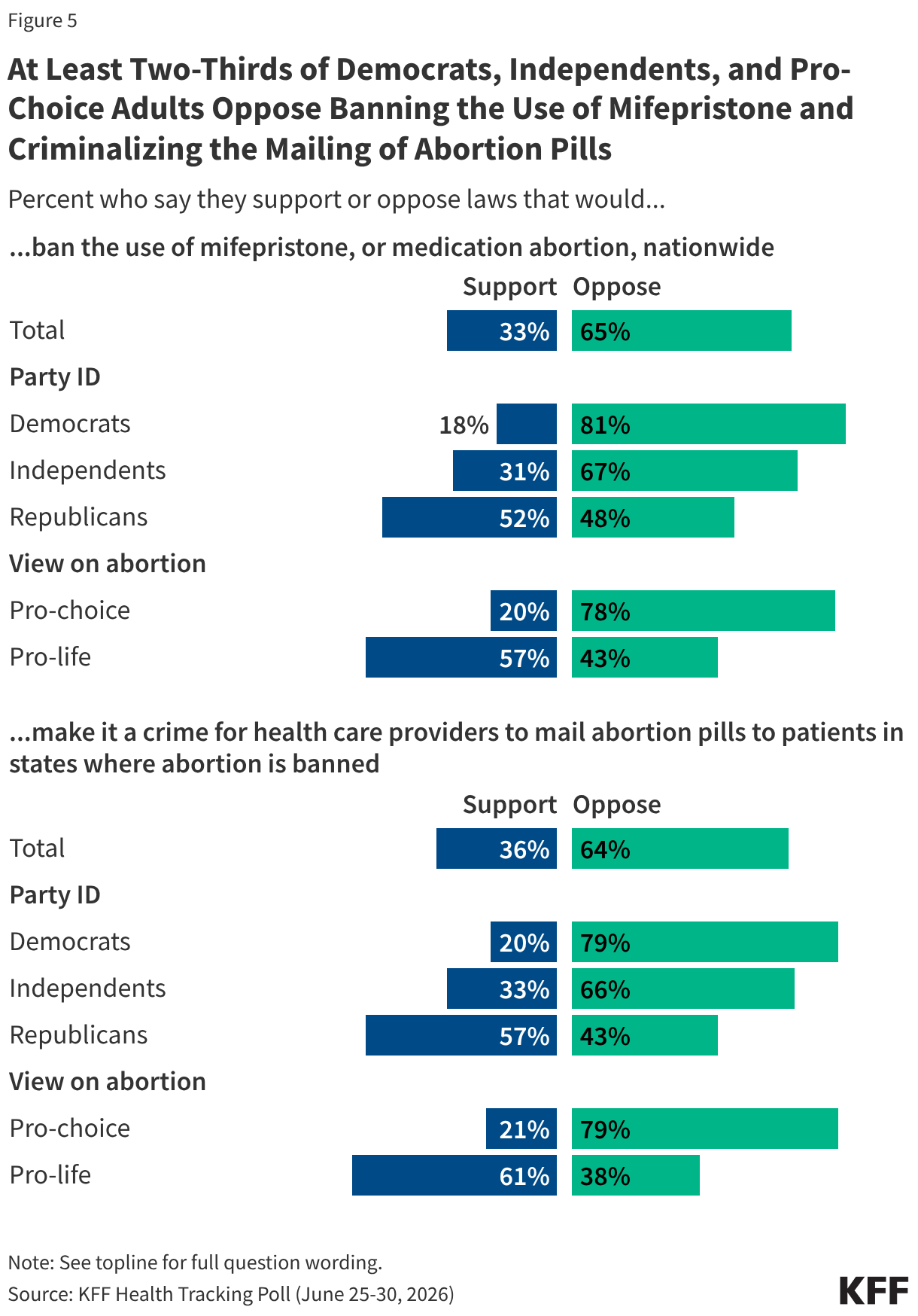
Both the public and experts agree: the federal government should not further restrict mifepristone. A July 2026 survey found that two-thirds of U.S. adults oppose nationwide restrictions on mifepristone and medication abortion. And a wide range of experts — from emergency medicine physicians to experts in intimate partner violence to drug developers — submitted amicus briefs in the Supreme Court and in the court of appeals opposing this nationwide restriction as medically unjustified and harmful to people seeking care.
A rendering of Wildfire was included in a video montage, seen below, which General Atomics Aeronautical Systems, Inc. division (GA-ASI) released earlier today. GA-ASI first announced work on this new drone last month. The Air Force, in partnership with the Pentagon’s Defense Innovation Unit (DIU), formally kicked off its new search for a Reaper successor, currently called the Massed Modular Aircraft (MMA), in July. GA-ASI also developed the MQ-9A, which is now out of production.
— General Atomics Aeronautical Systems, Inc (GA-ASI) (@GenAtomics_ASI) September 9, 2026
Wildfire’s pusher-prop design shown is clearly an extension of the existing MQ-9 family, with an overall planform that is extremely similar to that of the Reaper. Like the latest versions of the MQ-9A, the new drone has a sensor turret under the nose and a large blade antenna under the rear fuselage.
The rendering of Wildfire, at top, seen together with a stock picture of a US Air Force MQ-9 Reaper, at bottom. General Atomics capture/USAF
Wildfire does notably lack the Reaper’s distinctive hump on top of the forward fuselage. On the MQ-9A, this feature contains the drone’s satellite communications (SATCOM) antenna. What this might mean about how Wildfire is controlled and otherwise communicates is not immediately clear, but it points to the use of a smaller, lower-cost SATCOM terminal. That, in turn, would most likely be tied to a network like Starshield, the government-focused cousin of SpaceX’s Starlink. We could also see greater semi-autonomous control here, or at least a greater reliance on it.
A close-up look at the nose end of Wildfire as seen in the newly released rendering. General Atomics captureA General Atomics Improved Gnat (I-Gnat) drone. General Atomics
The rendering of Wildfire also depicts the drone armed with four Joint Strike Missile (JSM) cruise missiles, with two loaded on what appears to be a single pylon under each wing. The stealthy JSM can be employed as an anti-ship or land-attack weapon. GA-ASI has released renderings of MQ-9s in the past with similar loadouts. The Air Force is already acquiring stocks of JSMs, primarily to arm its F-35A Joint Strike Fighters. Stand-off munitions like the JSM have long been seen as an increasingly important, if not critical, addition to the non-stealth Reaper’s arsenal, helping to keep the drones further away from potential threats.
A close look at two JSMs in the Wildfire rendering. General Atomics capture
TWZ has reached out to General Atomics for more details.
“General Atomics is looking at it and asking ourselves, ‘What can we really do? No kidding, no BS, actually do,’” GA-ASI spokesperson C. Mark Brinkley did tell us back in August when asked about Wildfire. “Let’s be honest with ourselves first. How do we come out of the box, day one, with a 10,000-nautical-mile ferry range? Can we carry four LRASMs [AGM-158C Long Range Anti-Ship Missiles]? Can we swarm 100 aircraft under semi-autonomous control? Can we fuse all of that data into a highly effective common operating picture? Can we do that at scalable, affordable mass?”
“So that was the assignment, and our engineers sharpened their pencils and got to work,” he added. “What came out the other side was our new Wildfire UAS. That thing is a beast, and no one who actually does this for a living, and is honestly concerned about America’s warfighting edge, can look at it and not want 100 of them as fast as we can make them.”
Wildfire “addresses all of the concerns posed by the MMA solicitation. We can deliver years earlier and maintain the same high quality. You can have everything that makes Reaper special, plus more, at a price that doesn’t break the bank,” Brinkley also told Breaking Defense for a story published last week.
“[The service] …wants the MMA drone to perform the same general intelligence, surveillance, and reconnaissance (ISR) and strike missions as the MQ-9A. To that end, stated program requirements to date include a speed of at least 200 knots true airspeed, a munition and sensor payload capacity of at least 2,800 pounds, an unrefueled combat radius of at least 2,300 nautical miles with payload, the ability to self-deploy one-way at least 8,000 nautical miles, and the ability to operate from runways no longer than 6,000 feet. The MMAs also need to be highly modular and use open architecture mission systems to make it easier to integrate new capabilities and functionality down the line.”
Another look at an example of a typical MQ-9A Reaper in US Air Force service now. USAF
The Air Force also shared last week that it is targeting a roughly $10 million unit cost for the MMA drones, not including sensors and certain other systems. As mentioned, the Reaper is out of production, but the price tag on a fully-equipped Reaper today is widely reported to be between $30 million and $50 million. The Air Force has itself used the $50 million figure as a reference point in discussing its latest plans for what comes after the MQ-9.
It is unclear how Wildfire might achieve this cost goal while retaining so much obvious Reaper DNA, but even a major 30 to 50 percent reduction in the price tag compared to its predecessor would be a huge deal. In the past, General Atomics’ Brinkley has openly questioned just how cheap an MMA drone could realistically be while still offering comparable capabilities to MQ-9.
The original timeline for the MMA program envisioned the Air Force reaching initial operational capability in 2031 after receiving 20 of the drones. The service is now looking to accelerate that schedule by around two years. The Air Force expects to eventually acquire around 180 MMAs.
“Although we have plenty of MQ-9As today, we are going through them at a rate that is concerning to us,” Air Force Lt. Gen. Christopher Niemi, the service’s Chief Modernization Officer, told reporters at a roundtable at the Pentagon last week, according to Air & Space Forces Magazine. “There’s not a lot of good options to immediately replace those aircraft.”
GA-ASI has long had a monopoly on MALE combat drone sales in the United States, and is clearly looking to extend that now with Wildfire. However, this market space has been expanding, and other companies are already competing for what could be a very lucrative new deal with the Air Force. Winning the MMA contract could open doors to opportunities elsewhere within the U.S. government and with foreign countries. Variants and derivatives of the MQ-9 are also in service today with the U.S. Marine Corps, the Central Intelligence Agency (CIA), U.S. Customs and Border Protection (CBP), and several additional air arms globally.
A US Marine Corps MQ-9A Reaper. USMC
More information about Wildfire, as well as its competitors, is only likely to continue emerging as the Air Force pushes ahead with new and aggressive plans to finally acquire a follow-on drone to the venerable Reaper.
Update: 2:15 PM ET –
General Atomics spokesperson C. Mark Brinkley has now shared additional details about Wildfire with TWZ.
“You’re not imagining it. These new Wildfire renders do lack the dorsal hump you see on Reaper, MQ-9B, Gray Eagle, Mojave STOL and many copycat aircraft,” Brinkley explained. “General Atomics has pushed proliferated low-earth orbit controls onto many of our existing aircraft and pioneered that integration across unmanned aerospace. That is a relatively new technology that we already have great experience integrating, and it makes sense to bring that into Wildfire.”
“Proliferated low-earth orbit” (abbreviated variously as pLEO and P-LEO) refers to distributed constellations of hundreds or potentially thousands of satellites in that orbital region. SpaceX’s constellations supporting the aforementioned Starlink/Starshield networks fall into this general category.
“Wildfire is going to leverage ongoing advancements in autonomy on Day One. We envision networking dozens of Wildfires for true combat mass,” according to Brinkley. “Again, not a hypothetical. We’ve been pioneering many advancements in autonomy, AI, and machine learning across the FQ-42A program and using our own MQ-20 Avenger as a CCA [Collaborative Combat Aircraft] surrogate connected to F-22 and F-35. That’s proven, not concept.”
The FQ-42A, also known as the Dark Merlin, is one of two designs now in development under the first phase, or Increment 1, of the Air Force’s CCA program, the other being Anduril’s FQ-44A Fury. The service announced in June that its initial CCA force would be a mixed fleet of FQ-42As and FQ-44As.
A row of prototype YFQ-42A Dark Merlin drones. GA-ASI
“Four JSMs tells you something about Wildfire overall. We can’t just look at overall external weight limits. You have to consider individual hardpoint capacity,” Brinkley continued. “We’ve concepted four JSMs on MQ-9B before, as a concept, but we’ve never done that on Reaper. Wildfire can absolutely do that, from a hardpoint capacity and also an overall MGTOW [maximum gross takeoff weight] perspective.”
“We’re showing two LRASMs on Wildfire, which is twice as much as the DIU solicitation asked for. If you’re going to build a flying weapons truck, give it some teeth,” he added. “These longer-range missiles also give you increased standoff compared to other weapons you associate with the MQ-9, so that also gives you some flexibility. Wildfire can carry two LRASMs for meaningful combat distances.”
A rendering depicting a Wildfire drone firing an AGM-158C LRASM. General Atomics capture
Brinkley also said that Wildfire’s ferry range will exceed the MMA’s target of 8,000 nautical miles.
“We can deliver way ahead of the original FY 2031 schedule [for MMA]. We can deliver more than twice as many aircraft as requested in the same amount of time, because our manufacturing is real. Our network of suppliers, subcontractors and partners is real,” he added. “The obvious question is always cost, and I struggle to discuss costs because no one ever wants to compare apples to apples. There are stated price targets out there, and we’ll hit those. We’ll do it with an aircraft you can trust. We have nearly 10 million flight hours and more than 1,600 aircraft delivered. This is what we do.”
Speaking more generally, Brinkley also highlighted General Atomics’ extensive experience in developing and producing armed MALE drones, including the MQ-9.
Another stock shot of a US Air Force MQ-9A Reaper. USAF
“It’s important to remember that Reaper made its first flight 25 years ago and was so far ahead of everything else that it still defines the entire category of medium-altitude, long-endurance strike aircraft worldwide. When you build something new to do this kind of work, it rolls out into the Reaper’s shadow,” he said. “I don’t have to defend MQ-9 because the track record speaks for itself. It’s been called the MVP of Epic Fury [the U.S. military’s nickname for the initial phase of operations against Iran this year] for good reason, and I think it has squashed all questions about the relevance of MALE ISR and strike.”
“So that brings us to questions of affordability versus attrition, cost-per-effect, and the true price of combat operations. It also brings up questions of reliability and mission availability, and Reaper excels at both of these, so you can’t replace it with junk and expect to get the same effects,” he continued. “That’s where Wildfire comes in. Our team went to the graph paper and started sketching out what they would do differently and what they would keep the same. Where are the tradeoffs, and what do you change? No one knows this category of aircraft and missions like we do. We’re not guessing and hoping.”
“I can’t get into deep specifics on Wildfire yet, because it’s too early for that and the goalposts seem to move every time I say something publicly. What I can say is that Wildfire takes all of the known quantities of Reaper, blends them with some cutting-edge technologies and manufacturing advancements, and incorporates our more than three decades of lessons learned about large, unmanned combat aircraft to drive cost-per-effect math down.”
A 33-year-old Cameroonian illegal migrant has been sentenced to 13 years in prison for raping a 75-year-old woman in her home in Ozoir-la-Ferrière, Seine-et-Marne, France.
The Seine-et-Marne criminal court handed down the sentence on Monday, along with a permanent ban from French territory and registration in a list of sexual and violent offenders (FIJAIS).
The attack occurred in the early hours of Jan. 1, 2024, which Remix News covered at the time. Shortly before 6:30 a.m., the intoxicated man, who had a whiskey bottle in his pocket, broke into the home of an elderly couple on a quiet residential street. He first entered the room of the victim’s husband, who is bedridden and severely disabled after a stroke. The husband cried out but could not intervene.
A French journalist says there is a shocking pattern of foreigners raping elderly women in France.
Just this week, a Moroccan migrant was arrested for raping and torturing a 74-year-old woman in Romainville with a telescopic baton.
The intruder then went to the 75-year-old woman’s bedroom and forced the woman to have unprotected sexual intercourse. He then demanded money and took a €50 note before leaving. He remained in the house for about 45 minutes.
Investigators identified him through video surveillance. On New Year’s Day, he traveled from Paris’s Saint-Lazare station to Ozoir-la-Ferrière after a night of heavy drinking during which he and two companions consumed five bottles of alcohol. Once in the town, he is believed to have gone first to the home of a prostitute he knew who lived on the same street; that woman then led him toward the victims’ house.
The defendant, who is married and has four children in Cameroon, entered France in 2022 after traveling through Libya and Italy. On arrival, he was housed free of charge in a maid’s room in Paris’s 16th arrondissement by the association “Surviving Insecurity – Diogenes,” for which he also worked. His asylum applications were rejected twice, and he was in an irregular situation at the time of the crime.
During the trial, the attorney general noted that ten years of detention would cost French taxpayers approximately €1 million.
The victim, now 78, has not left her home since the attack. She has said she believed she was going to die. Her son, who is in his fifties, has moved back in with his parents to care for them.
The victim’s lawyer, Christophe Gérard, told Le Figaro: “There are two types of rape: incestuous family rapes and those committed in the street, in parking lots, or even worse at home, the place where one is supposed to be safest. The events took place in the middle of the night, on New Year’s, on the 1st. The son left his parents’ house around 10:30 p.m., closed everything, before discovering in the early morning that his mother had been raped. It is a horrible and terrible crime.”
Just months ago, Remix News published in an in-depth news article covering at least 14 cases involving migrants raping elderly French women in recent years.
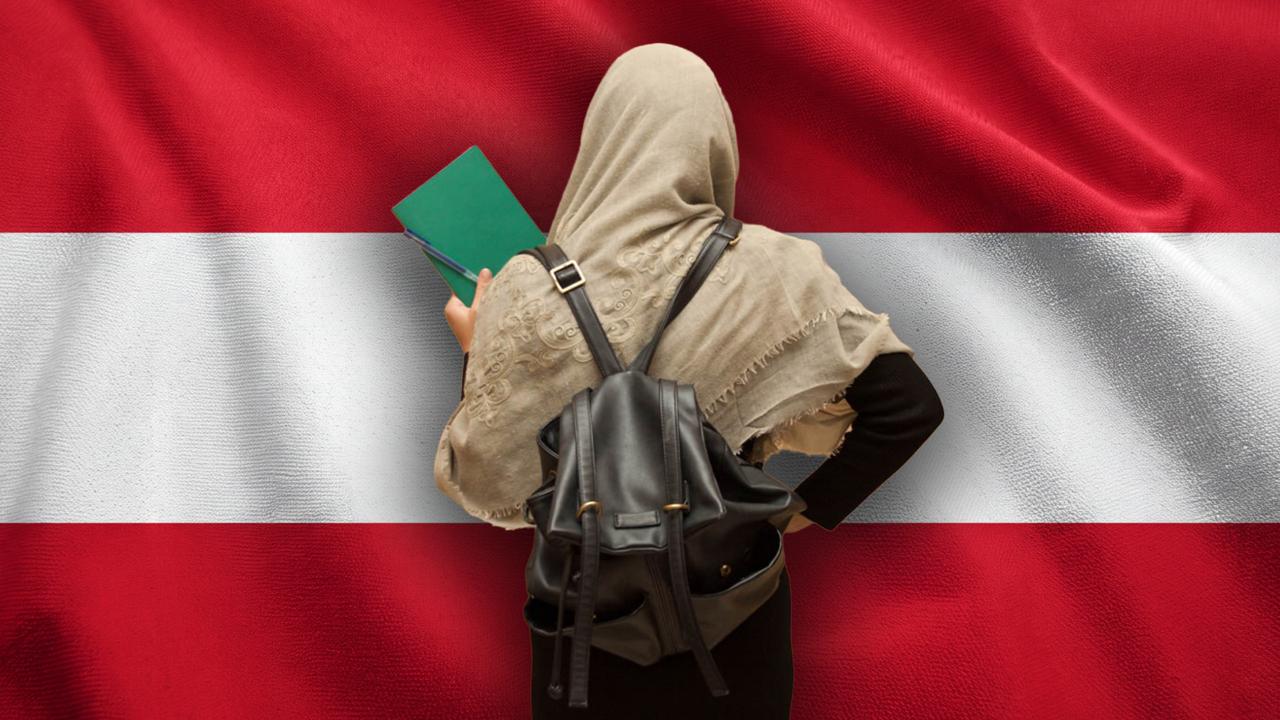
Austria’s new nationwide ban on “traditional Muslim” head coverings, including hijabs and burqas, for girls under 14 in both public and private schools, has now taken effect as of Sept. 7, 2026. in Vienna, Lower Austria, and Burgenland. The start date coincided with the start of the new school year. Austria’s remaining states will follow with a ban next week as well.
The measure, framed by the government as a child-protection and gender-equality policy, immediately faced visible resistance from Muslims and the first formal legal challenge.
At an Islamic primary school in Vienna, reporters from Austrian news outlet Heute observed young girls arriving to school still wearing headscarves accompanied by their mothers. One child wore a pink hijab coordinated with her dress; two slightly older students entered in simple hijabs without parents. School officials did not immediately clarify how they would apply the ban on private Islamic institutions.
The law requires schools to start with conversations involving the student and her legal guardians. Repeated violations trigger involvement of child-protection services, with fines of €150 to €800 possible for parents as a last resort. Teachers, already under strain, must initiate these talks. There are now fears of real conflict arising in the coming months.
Integration Minister Claudia Bauer of the conservative ÖVP described the headscarf as “a sign of oppression and a means of controlling girls from the earliest childhood.” Chancellor Christian Stocker has separately called for a constitutional ban on political Islam, saying he does not “want to live in an Islamic state.”
The right-wing Freedom Party of Austria (FPÖ), the most popular party in the country is known for its even harsher stance toward migrants and Islam in the country. FPÖ politician Ricarda Berger stated there is “no place for political Islam in Austria, and certainly not in our schools.”
The party wants a general ban on all headscarves and face coverings in schools for both students and teachers alike, which would cover all ages.
Education Minister Christoph Wiederkehr of the liberal NEOS acknowledged uncertainty about the law’s fate at the Constitutional Court, stating: “You can never be completely certain.”
He added that the government and education ministry “carried out very intensive consultations” to draft a constitutionally compliant text.
Only the Greens opposed the bill in parliament. Green politician Sigi Maurer accused Wiederkehr of “creating new conflicts and offloading them onto the teachers,” saying the minister wanted to “foist the role of police officers onto them.”
Teachers’ union chairman Paul Kimberger noted that some communities had already announced they would resist and that certain conversations with parents “will probably have limited success.”
The Islamic Religious Community in Austria (IGGÖ), the largest Islamic organization in the country, condemned the ban as discriminatory. Spokesperson Carla Amina Baghajati said, “We believe it unjustifiably restricts the fundamental right to freedom of religion and disproportionately affects Muslim girls. Rather than protecting children, it singles out a specific religious practice and risks excluding the very children it claims to support.”
The IGGÖ has pledged to support families challenging the law at the Constitutional Court. A request for annulment was filed on the first day of school.
A 2020 Constitutional Court ruling had struck down an earlier ban limited to children under 10, finding it violated Austria’s duty of religious neutrality. The court dismissed premature challenges to the new law in July because it had not yet entered force, but that procedural barrier is now gone. Left-wing student groups have called for protests. An 11-year-old girl demonstrated against the ban in February carrying a banner that, translated into English, read, “My headscarf, my decision.”
The Constitutional Court is likely to have the final word on the issue.
L’uso degli ATACMS da parte dell’Ucraina non rappresenta un cambiamento significativo sul piano militare, secondo Michael Maloof, ex analista senior delle politiche di sicurezza del Pentagono. L’esercito ucraino dispone già ...
Il 20 gennaio 2025 potrebbe segnare l’inizio di un nuovo capitolo nella storia degli Stati Uniti d’America con l’insediamento di Donald J. Trump per il suo secondo mandato presidenziale. Mentre ...
Da Der Status: Gabbard, figura carismatica e determinata, propone una visione che unisce sicurezza globale e responsabilità etica, denunciando i rischi di una ricerca pericolosa che potrebbe minacciare l’intera umanità. ...
Alcuni giorni fa, un cavo sottomarino di telecomunicazioni che collega la Finlandia alla Germania è stato danneggiato. Ora si registra un altro incidente: un cavo di comunicazione tra Lituania e ...
Negli ultimi giorni, gli eventi lasciano ancora di più sbigottiti ed increduli, per la grande debbenaggine della leadership statunitense ed europea che spinge forsennatamente alla guerra. Nello stesso tempo, il ...
La nomina ormai prossima il 1 dicembre dell’ex premier estone Kaja Kallas a nuovo Alto Rappresentante dell’Unione Europea per gli Affari Esteri e la Politica di Sicurezza solleva interrogativi e ...
Gli ultimi sviluppi provenienti dalla Russia dipingono uno scenario estremamente inquietante che non può essere ignorato. La presenza di un aereo di comando strategico nucleare, il Tu-214PU, in volo sopra ...
Il brano di Gerry Nolan che segue analizza con tagliente sarcasmo il declino del ruolo del Congresso americano nelle decisioni di guerra, sostituito da un esecutivo che agisce come un ...
La Russia svela il nuovo sistema d’armi RS-26 Rubezh: un messaggio all’Ucraina e all’Occidente La Russia ha compiuto un significativo passo avanti nella guerra in Ucraina, lanciando per la prima ...
La Russia considera violati i trattati perchè sono gli USA ad avere usato le armi a medio raggio contro la Russia. Operatori NATO, satelliti Nato ed intelligence NATO. Putin sulla ...
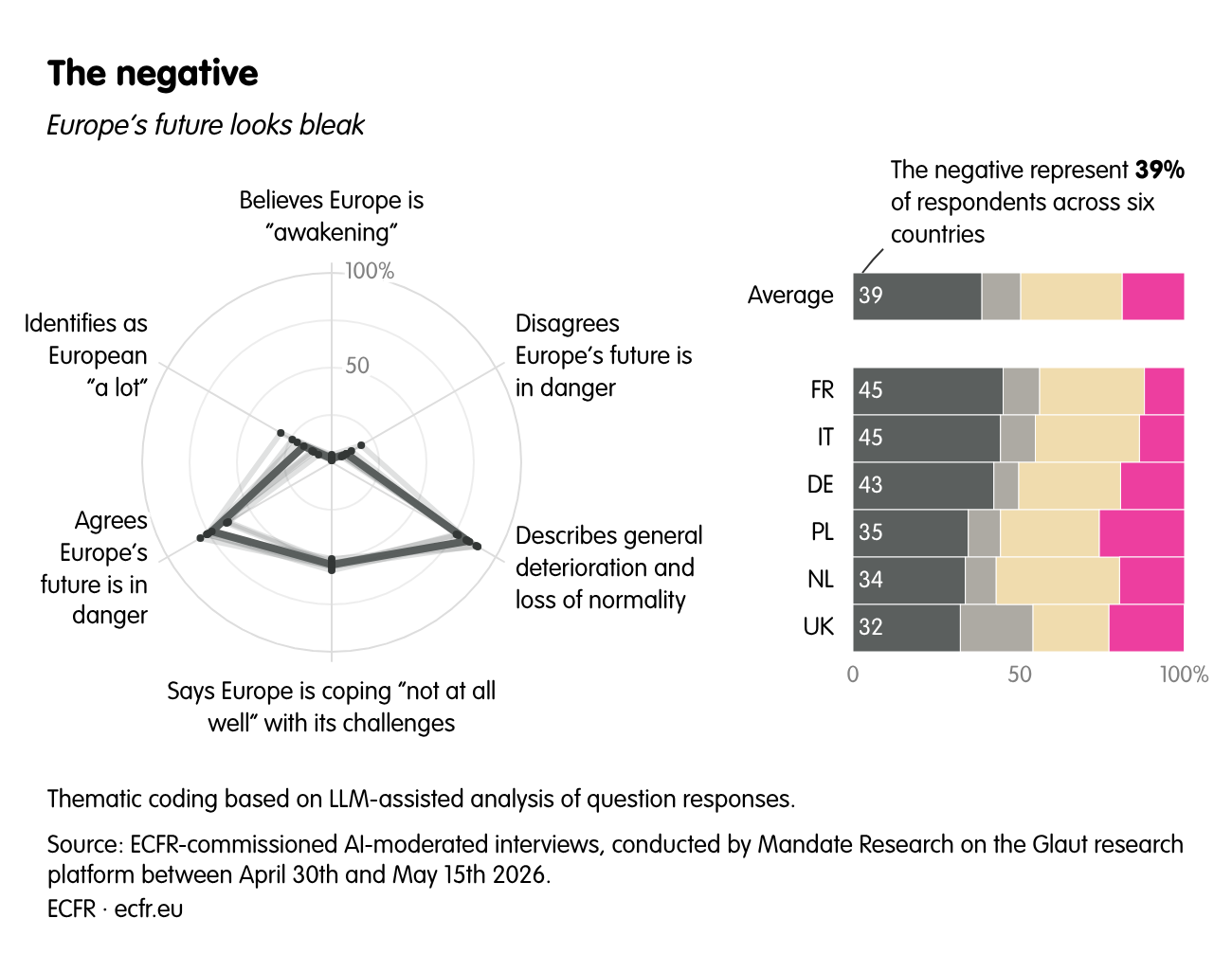
To find out what “Europe” means to people today, ECFR commissioned almost 6,000 interviews in six European countries and qualitative desk research across 15 more.
The interviews reveal that most people have strong opinions about Europe and its future; the complementary research found that geopolitical chaos and culture wars are helping the EU become more politicised in domestic debates.
How people feel about Europe may thus affect how they vote in the potentially seismic domestic elections to come, in many of which the far right leads in the polls.
The interviews also found many people want a stronger, more independent and more united Europe. But relatively few can picture a credible route from today’s disruptions to that destination.
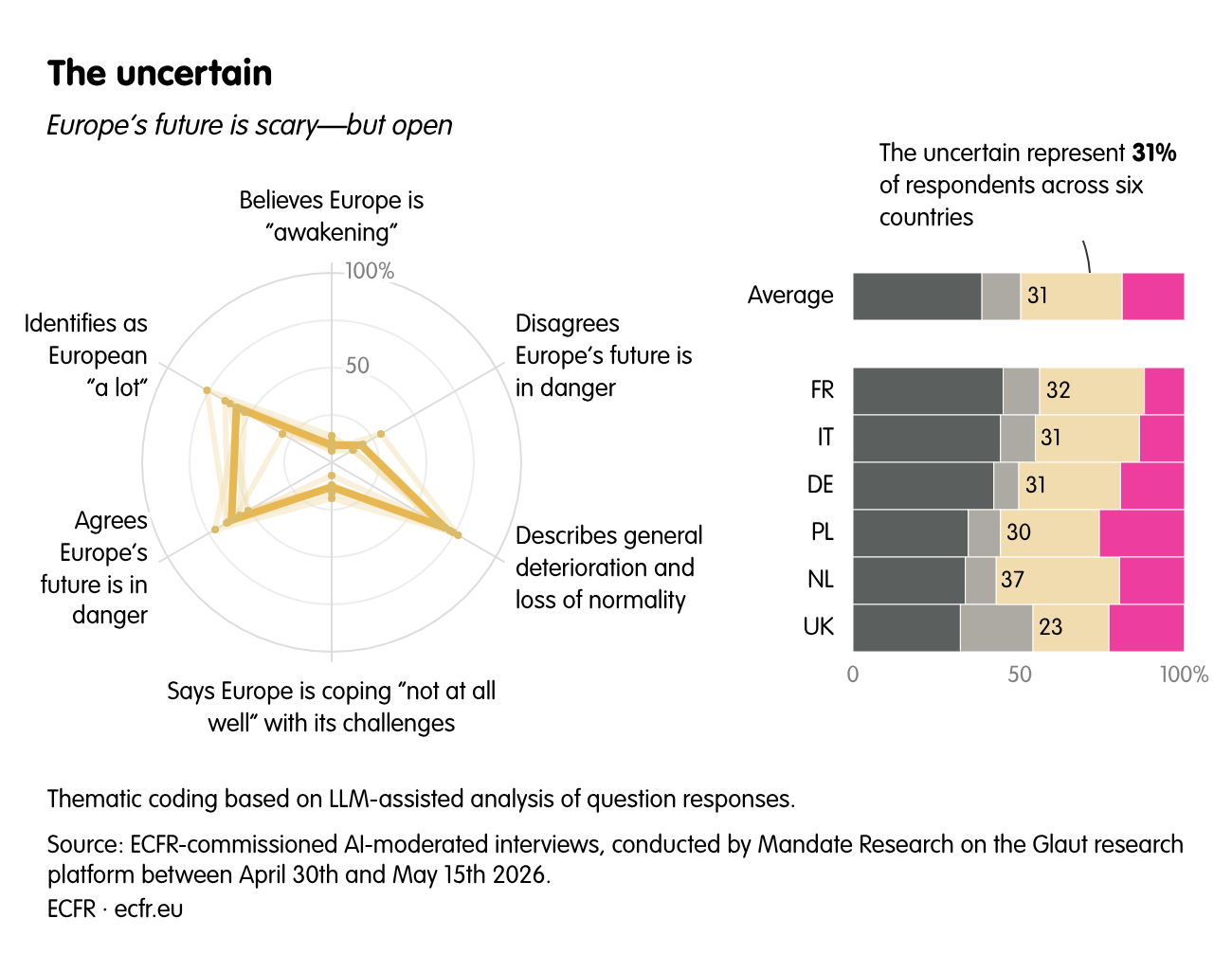
This imagination gap is most prevalent among a pivotal constituency we call “the uncertain”. Pro-European leaders need to fill it, lest people become more receptive to politics that reinterpret the past as the future.
These leaders can do so by harnessing the power of “future nostalgia”, or a longing for a time when a better future seemed within reach.
For decades, Europe had quite a successful record. Its countries grew accustomed to living under America’s protection, trading freely with one another, and enjoying peace and prosperity at home. Borders opened and the EU expanded. Europe came to think of itself as one of the world’s economic and political centres of gravity—or even a model for others to follow.
But then, one by one, the cosy assumptions on which Europe had built its post-cold-war existence began to fall apart. It was time for Europe to change its tune. As European Commission president Ursula von der Leyen put it, there was “no time or room for nostalgia… this must be Europe’s independence moment”. Leaders across the continent offered variations on the same theme: Europe must become stronger, more united and more independent.
As the months passed, parts of the public saw Europe moving in that direction. But many others concluded different things from the same events. For some, the disruptions had exposed a system that had long been dysfunctional and captured by elites. Others hesitated, realising that the danger could finally stir Europe from its slumber but that it could also expose divisions impossible to overcome. And then there were some like the Frenchman quoted at the start of this section who just did not care: Europe was and always had been a background hum that barely registered in their lives.
This paper shows that people with views like his are in a minority. “Europe” may not be the most important issue in people’s lives, but it is something a lot of them care about. How people feel about Europe may thus affect how they vote at home and contribute to how much say the far right has in shaping the future of the continent.
The paper draws on 5,834 AI-moderated interviews with European citizens conducted in May and June 2026 in Britain, France, Germany, Italy, the Netherlands and Poland. These capture how ordinary people, in their own words, imagine Europe’s future. They also provide (after weighting) a nationally representative picture of how people’s views are distributed. The interviews are complemented by comparative desk research on public and political debates in 15 EU member states. This examined how Europe and the EU are discussed across national political and media environments.
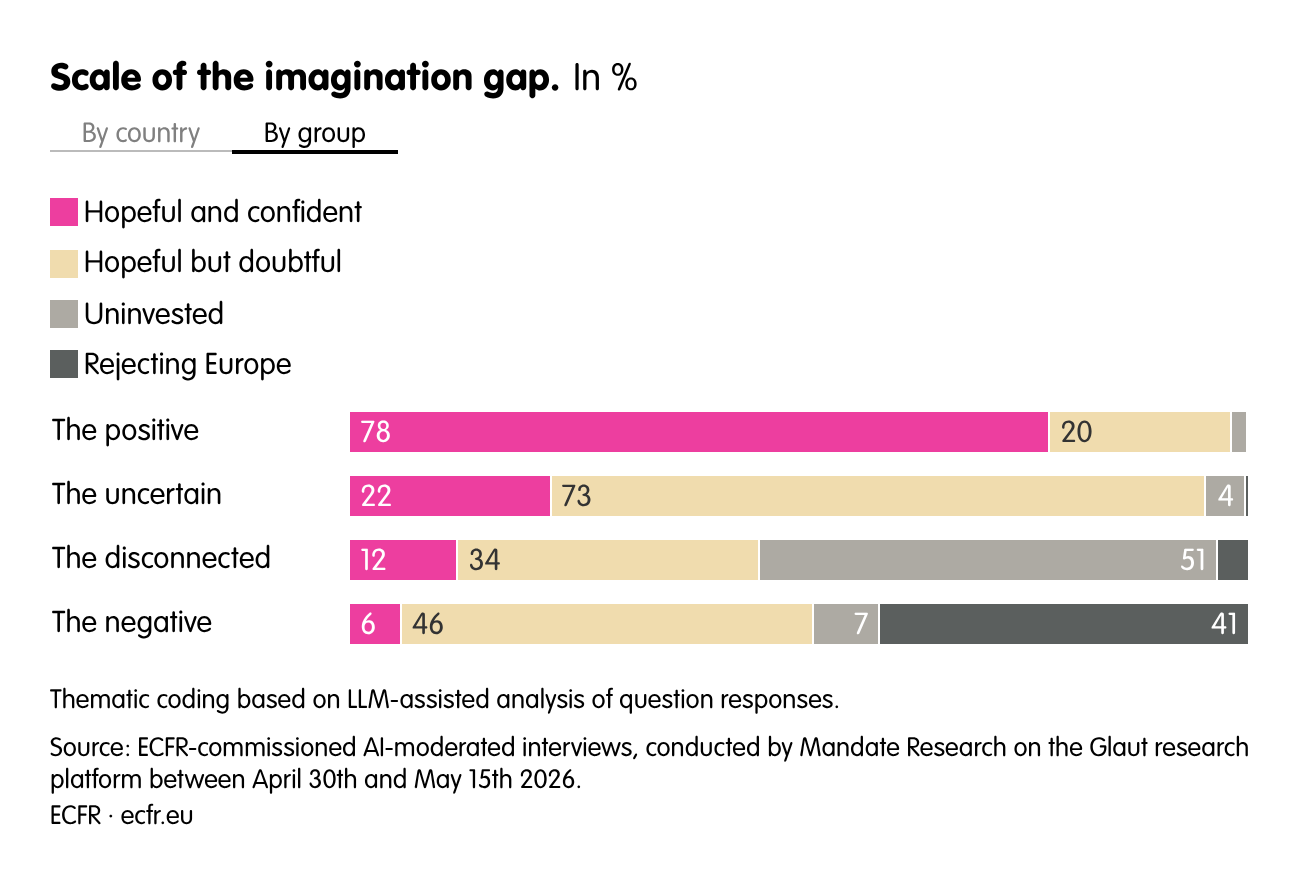
The main finding of the research is that many Europeans have an “imagination gap”. A lot of the people interviewed—especially among a substantial group we call the “uncertain”—want a stronger, more integrated and more independent Europe. But they often struggle to picture a credible route from today’s disruptions to that destination. The complementary research finds this gap exists at a time when Europe and the EU are becoming more salient in the public debate, and more politicised.
The people we spoke to are hardly alone in their pessimism. ECFR’s 2025 polling revealed Europeans to be notably gloomy about the future of their countries and the world, and that Americans and Turks shared similar sentiments. But pessimism comes with a unique political risk in Europe. Americans who lose faith in the future cannot realistically demand that the US be dismantled. Yet Europeans who lose confidence in the EU can plausibly ask for “less Europe” or even their country’s exit. And European integration has always depended on a future-facing promise: the idea of an “ever closer union” asks people to believe in both what Europe is and what it might become.
So, the imagination gap could help explain why nostalgic politics has become attractive to some voters in Europe. When people struggle to imagine a believable tomorrow, they become more receptive to visions that reinterpret the past as the future. But pro-European leaders should aim to harness a different kind of nostalgia—a “future nostalgia”, to borrow Dua Lipa’s 2020 album title, or a longing for the sense that a better future was within reach. They may need to hurry. As Europe braces for national elections in several influential countries, some with the far right leading in the polls, pro-Europeans need to help ensure a recognisable Europe exists to defend in the years ahead.
Each interview begins with an icebreaker question: “Let’s imagine you have a friend who fell asleep five years ago and has just woken up. This friend asks you: ‘How is Europe doing at the moment?’ How would you describe Europe today—what would you tell them?” In their answers, by far the largest group of respondents (on average 68% across the six countries studied) talks about a general deterioration or loss of normality. Only 12% see opportunity in the crises confronting the continent and frame their responses in terms of Europe’s awakening or renewal.
Respondents speak of Europe’s awakening most often in Poland (21%). This is the most recent one of the six countries studied to join the EU and is closest to the Ukrainian war zone. According to one Pole, born in the 1980s, “Europe is doing reasonably well. It’s trying to strengthen itself and be more independent from the USA.”Read the extended quote from A European from Poland, born in the 1980s03 Or, to quote an older respondent in Germany, where just 13% of people raise these themes, “Crises make you stronger, and I think that applies to Europe as well. Investment in defence is increasing again. The crises have revealed the weak points, and we can start working on them.”Read the extended quote from A European from Germany, born in the 1960s04 Such voices of encouragement are particularly sparse in France, where a mere 5% of respondents describe today’s Europe in terms of awakening or renewal. This is despite a decade of calls for “strategic autonomy” from President Emmanuel Macron.
When it comes to naming Europe’s challenges, people most often talk about war and security, followed by economic pressures. But almost three-quarters of the people interviewed say Europe is coping badly with its greatest challenges. For this, they blame national governments twice as often as European institutions and EU leaders. According to a French respondent, born in the 1960s, “Leaders of the countries do what suits their own country; they don’t see unity and don’t want it.”Read the extended quote from A European from France, born in the 1960s05
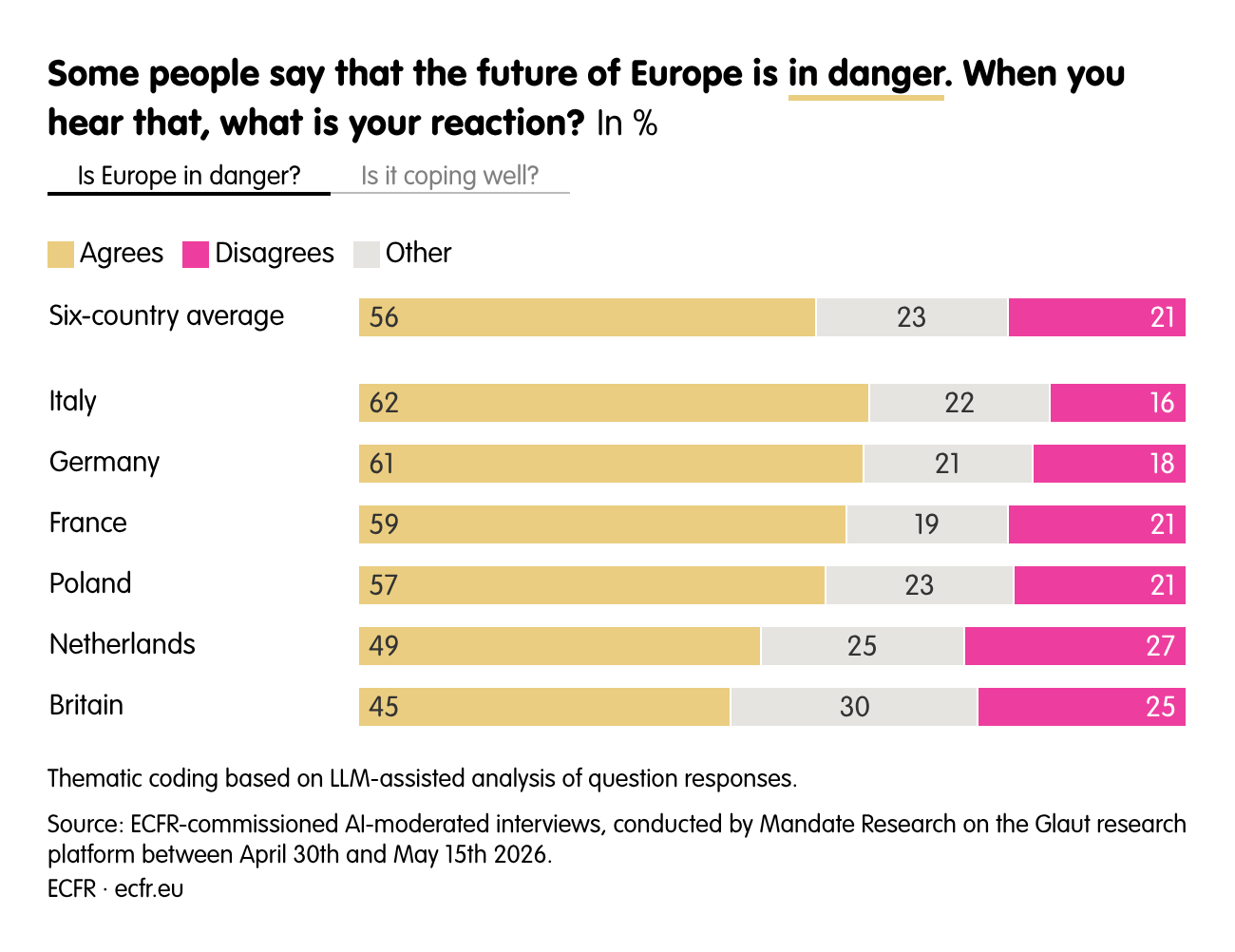
Turning to where things are heading, the AI asks: “Some people say that Europe’s future is in danger. How do you react when you hear that?” In response to this, on average 56% agree, against only 21% who disagree.
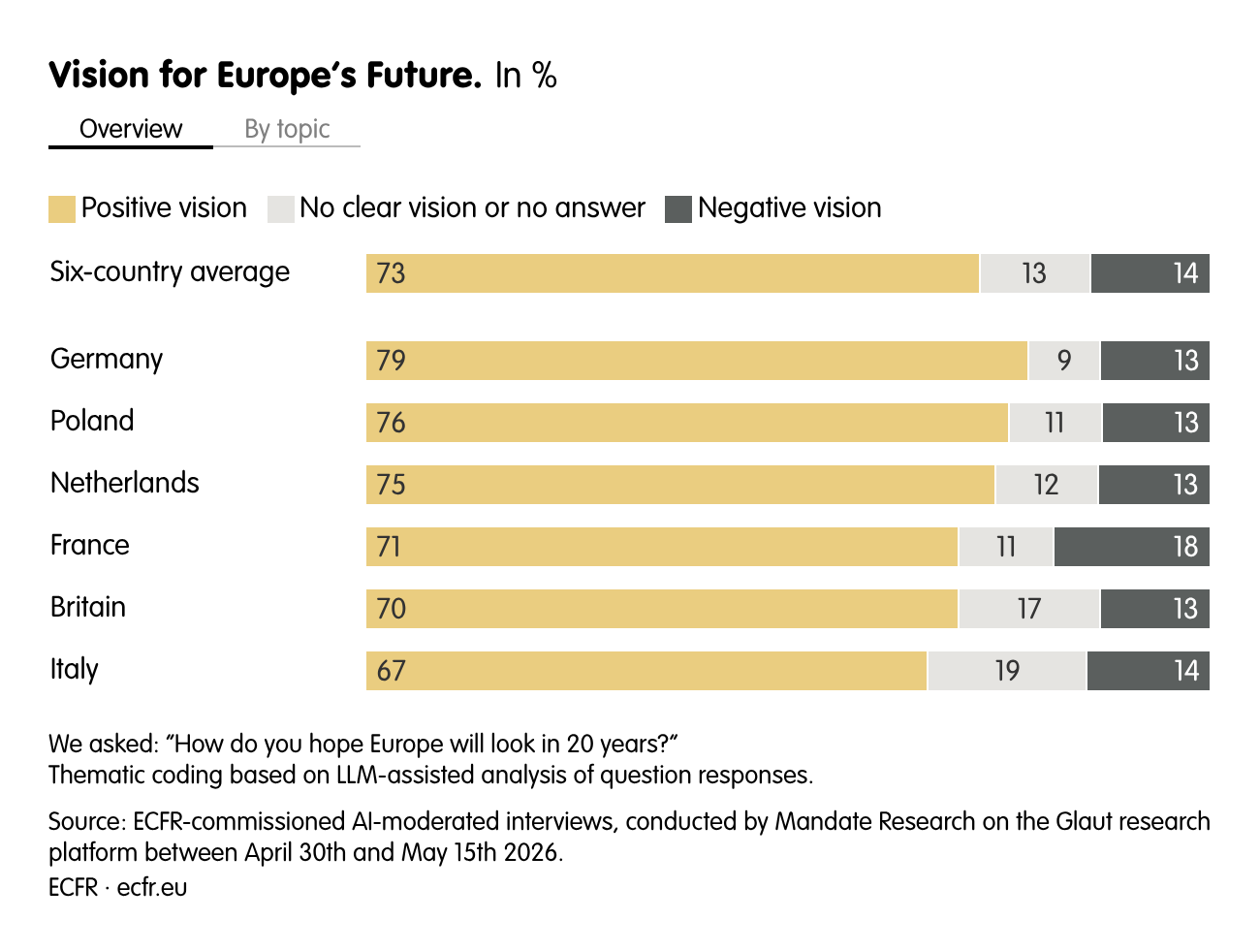
Still, many of the people interviewed identify strongly with Europe and want it to flourish. When asked what they would like Europe to look like in 20 years, three-quarters describe a positive European vision. They most often talk about unity and political integration, peace and security, and prosperity and well-being. Only around 13% hope for “less Europe” or for the EU’s dissolution.
But big dreams about Europe often come with big doubts. As one German, born in the 1990s, says: “I’m regularly relieved that I live in Europe. It’s not perfect and some things are going in the wrong direction at the moment, but no region in the world is safer, freer and more democratic.” He sees “climate catastrophe and attacks on democracy from the far right” as the greatest challenges facing Europe today—but does not think Europe is handling them very well. Asked about the reasons for this, he replies: “Elections focus too much on the here and now and not enough on the future.” Thinking about Europe in 20 years, he would like it to be “free, democratic, sustainable, less indebted, politically further to the left [and] peaceful”. But, on whether this is likely to happen, his response is a brusque: “No”Read the extended quote from A European from Germany, born in the 1990s06.
Across the countries covered by our interviews, many conversations followed a similar pattern. People appreciate Europe, but they recognise the challenges it faces and express little faith in its collective capacity to deal with them. Even when respondents have big ambitions for Europe, they often talk about them as mere aspirations that are unlikely to become reality.
So, it may no longer be enough to distinguish only between pro-European and Eurosceptic voters. Another important divide is whether people believe European leaders (EU and national alike) can turn their hopes into reality.
Four tunes
And how would you like Europe to look in 20 years’ time?
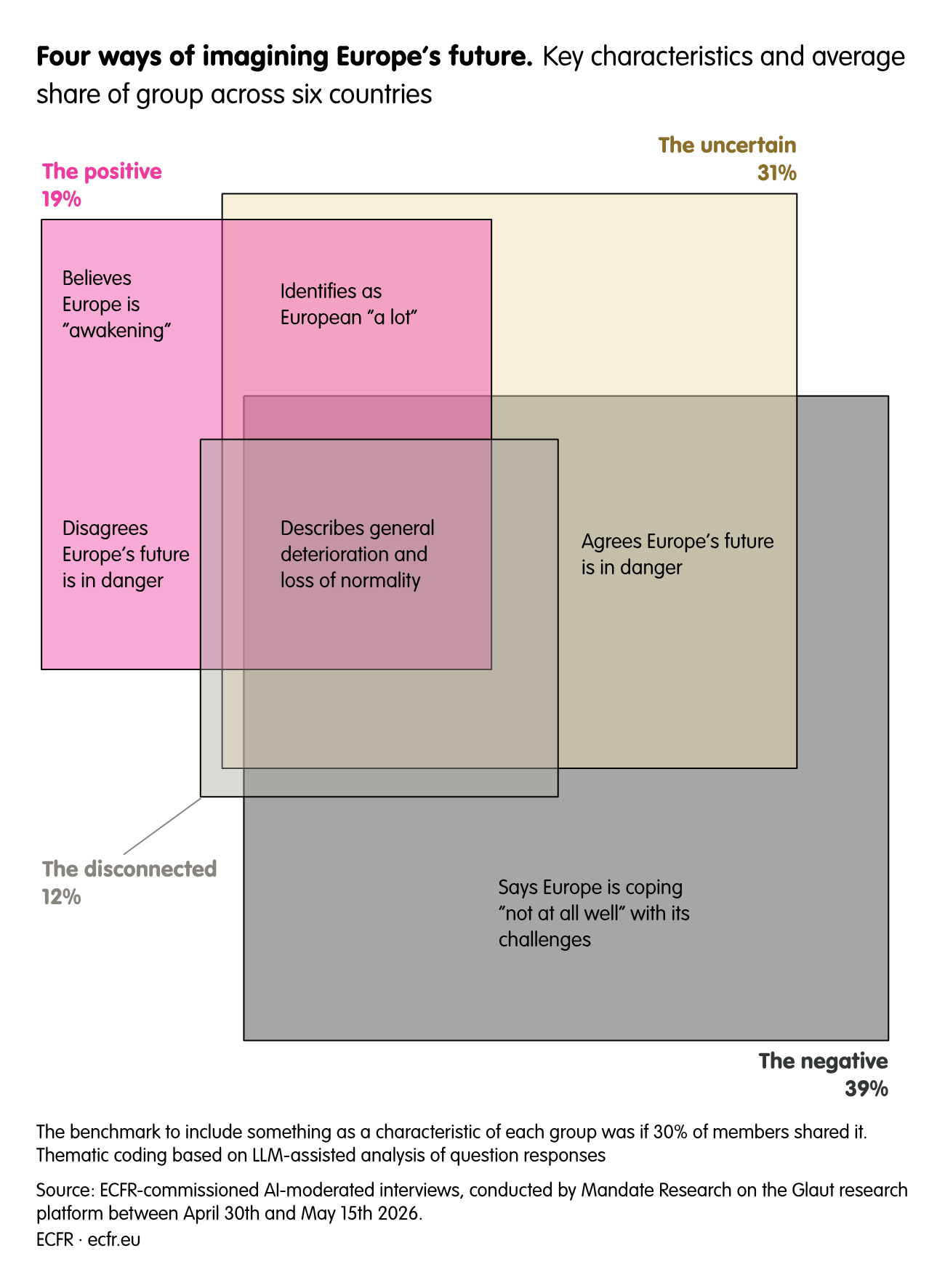
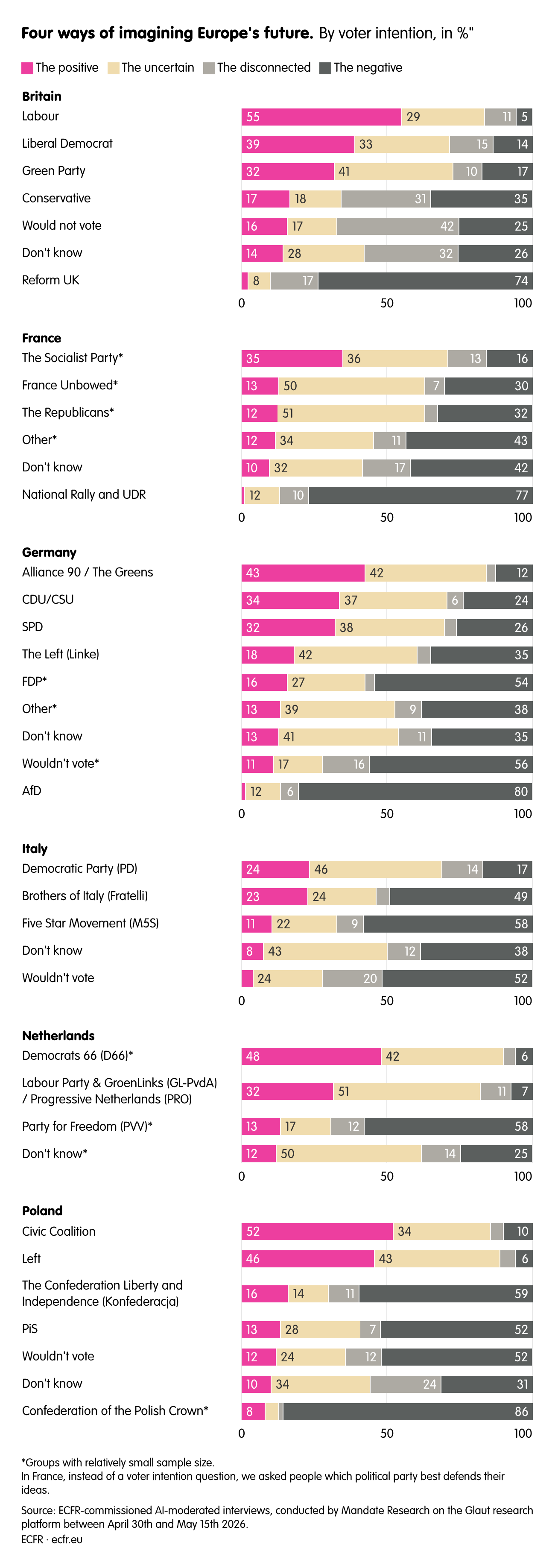
Most of the people interviewed express strong opinions about Europe’s future. And they tend to imagine that future in one of four ways.
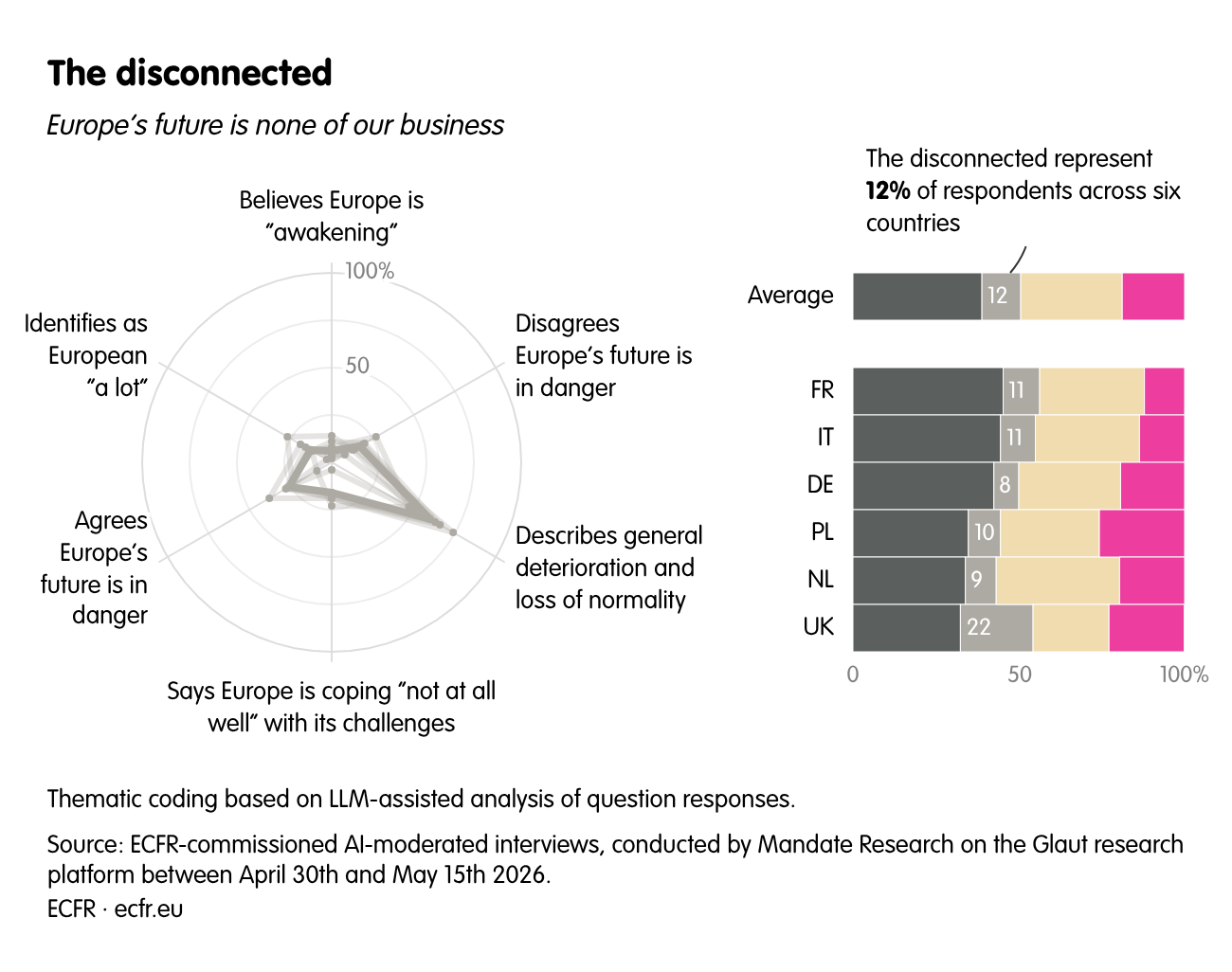
The positive hear an anthem of renewal: today’s disruptions are finally forcing Europe to become stronger and more united. The negative hear a ballad of decline, with each new crisis confirming the continent’s best days are behind it. For the uncertain, the melody of a better Europe is recognisable, but the song is not finished—and they are not convinced it ever will be. Very few people belong to the disconnected, for whom Europe is just a background hum coming from too far away to command much attention.
The tunes vary by country. But the four basic themes recur across borders, genders and generations.
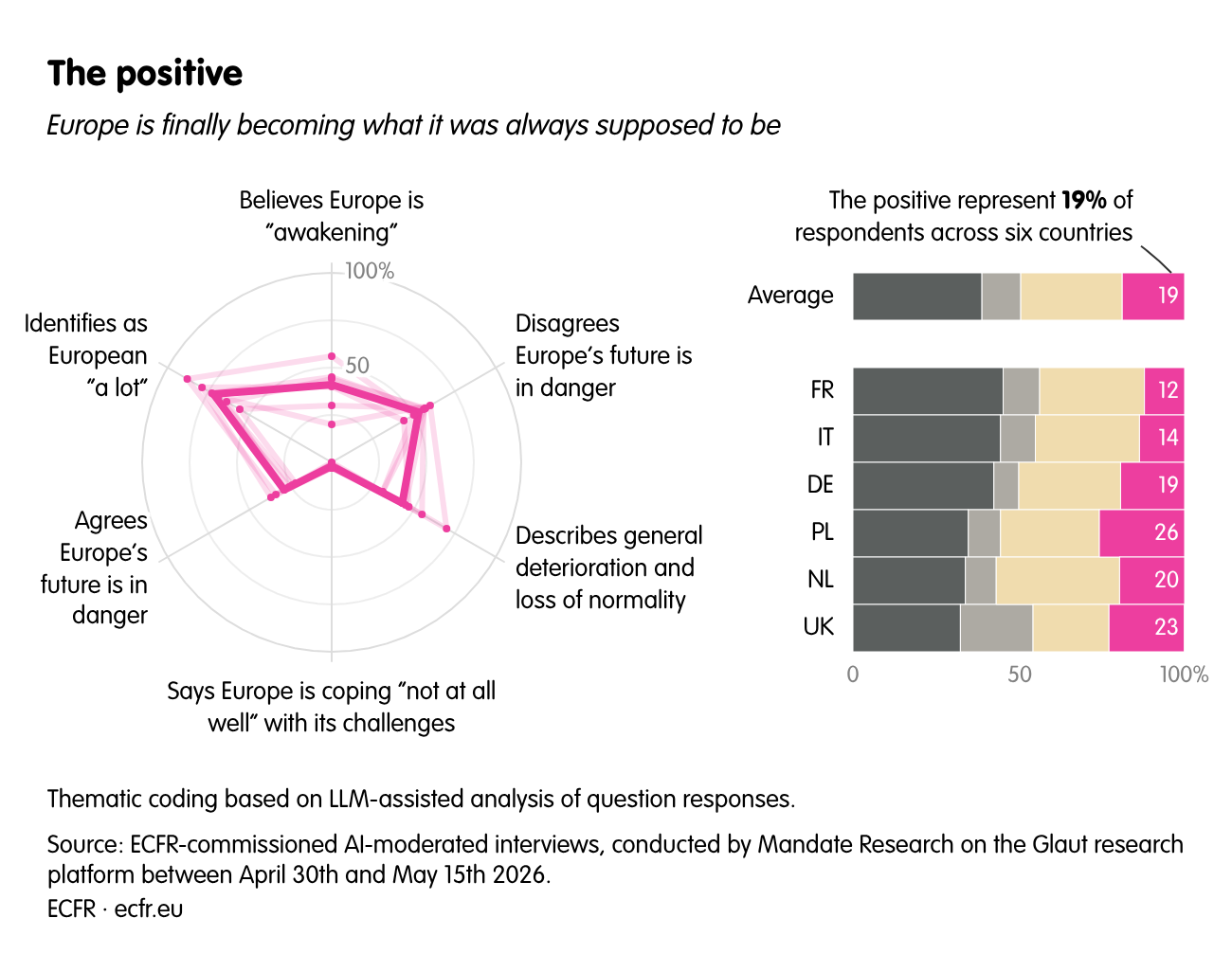
The present: The positive identify strongly as European, and two-fifths of them describe the EU’s situation today in terms of awakening. They are well represented in the electorates of EU-enthusiastic parties like the centrist Civic Coalition in Poland, Liberal Democrats in Britain and D66 in the Netherlands, as well as left-leaning EU-fans like the German Greens and the UK’s Labour Party.
Many of this group see the disruptions of the present as giving the EU the shock it perhaps always needed for its leaders to push for greater European integration and autonomy. One Dutch D66 voter, born in the 1980s, describes this as “a sense of urgency, the realisation that we must stand up for ourselves”. He stresses “a shared awareness from the population”Read the extended quote from A European from the Netherlands, born in the 1980s10 as contributing most to this.
The future: This is not to say the positive think it will be easy. They recognise that to overcome Europe’s problems, political will and institutional reform will be necessary. Many of this group also think the EU will have to address the national vetoes that hinder collective action.
It is common among the positive to worry about the rise of the far right, but they still tend to believe change is possible precisely because the alternative has become so visible: a fragmented Europe, dependent on others and unable to defend itself or its interests. “Five years ago, I think there was more of an illusion of stability,” says one Italian, born in the 1990s, but “today many things are more explicit … so I’d say [Europe has become] more unstable but more honest compared to before.”Read the extended quote from A European from Italy, born in the 1990s11
Still, most of the positive disagree with the idea that Europe’s future is in danger. “It’s a very serious crisis, but I think that with wise policymaking [the danger] can be avoided,”Read the extended quote from A European from Poland, born in 1990s12 says a Civic Coalition voter in Poland. Members of this group want Europe to show leadership and assertiveness internationally. And in 20 years, most of them hope to see a more united and better integrated Europe. They also tend to believe such a future is achievable.
In the world of the positive, the EU does not need to take a fundamentally different direction; rather, it needs to become what it was always meant to be. “We have it in our hands,” says a Dutch D66 voter, born in the 1980s, who has “doubts about the pace, not the direction”Read the extended quote from A European from the Netherlands, born in the 1980s13.
The negative
At the other end of the spectrum sit the negative. This is the largest group in every country studied, except the Netherlands, and is home to almost half of respondents in France, Italy and Germany. The negative hold a near-hegemonic position in the electorates of the far-right Alternative for Germany (AfD), National Rally (RN) in France and Reform UK. They are also strongly present on the Polish right and far right, among Party for Freedom (PVV) voters in the Netherlands, and in the electorate of the progressive populist Five Star Movement in Italy. They are well represented among non-voters in Italy, Germany and Poland, too.
The present: The negative stand out in their strong criticism of today’s Europe, which is characterised by a notable anti-elitist and anti-migrant streak. One Italian, born in the 1980s, describes Europe as: “A community run by people who have only thought about their own well-being until now; they’ve ruined our lives with surreal green ideologies, financing unjust wars, opening up to immigration that is destroying European identity and that of member states. [They are] unprepared on the military front [and] divided as peoples both in terms of collective thinking and economically.”Read the extended quote from A European from Italy, born in the 1980s14
Such pessimism is not always rooted in opposition to European cooperation. Many of the negative instead rail against what they consider the EU’s over-reach: “The EU is pushing itself literally everywhere, even into areas where it was never granted any competencies,”Read the extended quote from A European from Poland, born in 1980s15 says one Pole, born in the 1980s, who votes for the radical-right Konfederacja. It is common for people in this group to describe politicians as self-interested, captured by lobbies or too removed from ordinary life to be able to do the right thing. Negatives tend to interpret the crises piling up—and this group cites migration and inflation above all—as symptoms of deeper decay: “I feel sad for what once was a great place,”Read the extended quote from A European from the UK, born in the 1960s16 says a Reform UK voter, born in the 1960s.
The future: For most of the negative, Europe’s future looks bleak. But variation exists in how they feel about this. One Pole, who was born in the 1980s and votes for the nationalist Law and Justice party (PiS), agrees Europe’s future is in danger and is “pleased about it.”Read the extended quote from A European from Poland, born in 1980s17 Her Italian peer, who votes for the ruling Brothers of Italy party, expresses fear and anxiety: “I am afraid,” she says, before adding, “of war.”Read the extended quote from A European from Italy, born in the 1980s18 Asked about her hopes for Europe in 20 years, she mulls whether the EU will still exist. Other negatives actively want the EU to be whittled down or dismantled altogether. As they see it, less or no Europe would restore national sovereignty and give citizens a more direct say in how they are governed. Some of them want to recover what they feel they have lost: “We lived much better when the European Union didn’t exist,”Read the extended quote from A European from France, born in the 1950s19 says an RN voter in France, born in the 1950s.
The uncertain
Somewhere between the negative and the positive dwell the uncertain. This group accounts for around a third of the public in most of the countries studied (but only around a quarter in Britain). They are common among the electorates of left-wing parties in all six countries, though they also feature prominently among voters of the ruling centre-right parties in Germany, the Netherlands and Poland.
The present: More than half of the uncertain identify strongly as European. Yet they rarely describe Europe today in terms of “awakening” and often bring up themes of decay and loss of normality. “Europe is doing badly, the different countries are not united, and we are facing a war on our doorstep,”Read the extended quote from A European from France, born in the 1960s20 says a French respondent born in the 1960s, who votes for Macron’s Renaissance party.
People in this group often see the case for optimism and pessimism alike. They recognise that the EU has made it through crises before and that the threats of today are producing solidarity. They tend to see support for Ukraine, developments in defence cooperation and the gradual reduction of dependence on the US as indicators that something is shifting for the better.
But political will appears fragile to the uncertain. They worry that nationalist and far-right forces could unravel European cooperation and that a gulf exists between European leaders’ words and their deeds. According to a Polish progressive, born in the 1990s, the EU suffers from a “lack of a common direction, disagreement amongst member states, poor ideas being implemented by force.”Read the extended quote from A European from Poland, born in 1990s21 Another Pole points to “lack of imagination among politicians, the habit that Europe doesn’t need to take responsibility for itself because someone will always save us.”Read the extended quote from A European from Poland, born in 1980s22
The future: When the uncertain think about the future, they worry. Most of them believe Europe’s future is in danger and what becomes of the EU will depend on choices that leaders have not yet made. Like the positive, most uncertain want Europe to become more united and integrated—but they are much less confident that it will.
The disconnected account for only around a tenth of the public in most countries studied, except in Britain, where (perhaps reflecting the country’s non-EU status and the legacy of Brexit) their share rises to 22%. They feature in the electorates of every party but almost never constitute more than 15%. The only exception is the UK’s Conservative Party, in which they account for almost a third.
The present: This group sees Europe’s future as largely not their business because they do not experience it as central to their lives (and this often extends to politics in general). “I don’t ask myself all these political questions,”Read the extended quote from A European from France, born in the 1990s26 says a French respondent, born in the 1990s. Asked to describe today’s Europe to a friend who had just woken from a five-year sleep, a Pole born in the 1980s replies: “Mate. You’ve only just woken up and that’s the first question you’re asking?”Read the extended quote from A European from Poland, born in 1980s27 A Dutch respondent, born in the 1990s, is more direct still: “I just live my life the way I want, and Europe or whatever doesn’t interest me.”Read the extended quote from A European from the Netherlands, born in the 1990s28 Their responses to questions concerning Europe tend to be brief and evasive—don’t know, no idea, don’t care.
The future: When asked what they want Europe to look like in 20 years, the disconnected tend to reach for similar answers: more or less the same, no idea, it doesn’t matter. They are animated neither by fear of European collapse nor by hope for European renewal (although many still describe today’s Europe in terms of deterioration or a loss of normality). For the disconnected, the EU is largely a background institution. It occasionally affects prices and makes rules but otherwise feels remote from everyday life and domestic concerns. This group is unlikely to have much say in Europe’s political direction.
***
That role as a pivotal constituency belongs to the uncertain. This is not to say they are the only ones suffering from an imagination gap. Three-quarters of them are, but so are almost half of the negative and a third of the disconnected. Overall, about half of the European public seem to have an imagination gap. Poland is the exception: only around a third show symptoms there.
What makes the uncertain so pivotal, apart from the group’s size, is that they have not decided where things will end up. This distinguishes them from the positive, for whom Europe is already succeeding; the negative, many of whom have concluded that it cannot; and the disconnected, who just aren’t that bothered. Pro-European leaders will therefore need to focus their attention on filling the imagination gap among the uncertain, particularly given the growing salience and contestation of the EU in the public debate.
The dominance of strong opinions about Europe—positive, negative and uncertain—in the interviews aligns with our complementary research across 15 countries. That research suggests “Europe” has become more prominent in the public debate and thus more politically salient. This is corroborated by findings from other research that points to growing identification with Europe throughout the crises.
Three overlapping dynamics seem to be driving these developments.
First, foreign policy upheavals mean geopolitical questions of European power and vulnerability have landed squarely on people’s kitchen tables. Should we prepare for war? Can our countries defend themselves alone? If not, whom should they consider as their key allies—Americans or other Europeans? And is the EU, conceived as a peace project, still fit for purpose in times of “unpeace”?
Second, the EU is becoming “domesticated”. This is because the bloc’s policymaking increasingly reaches into some of the most politically sensitive areas of people’s lives (migration, climate and the cost of living, for example). Some member states, like Greece and Cyprus, experienced this well before others. In their case, the euro-zone crisis led to a lasting slump in public trust towards the EU.
But now the EU is in the limelight almost everywhere, in part because of Brussels-led policy initiatives. These policy choices are testing people’s vague or instinctive pro-Europeanism against consequences they feel. Should the EU spend more on defence? Is it a good idea to ban plastic straws, or phase out diesel cars and fossil fuel boilers? Should all European countries have mandatory refugee quotas? Such decisions can nudge European citizens towards developing more concrete pro-European attitudes. But they can also make their views more conditional, critical or ambivalent.
Finally, some political actors are stoking the culture wars. As I argued in last year’s Sentiment Compass, “Europe” is a target in the Trumpist political project and those of like-minded forces on this side of the Atlantic. Some well-known social media moguls and platforms play an active and polarising role in this. European far-right politicians need not support Trump or advertise closeness to his administration to draw on a similar repertoire: Brussels is bureaucratic; Europe is weak; the mainstream is ideologically captured; European institutions are obstacles to national sovereignty and cultural authenticity. Such narratives contest what “Europe” is for. They also call into question whose values it represents and whether its institutions deserve citizens’ allegiance.
This is not to say greater salience always translates into less support for a stronger, more united Europe. It can also open up space for a more serious debate in which pro-Europeans can clarify and update the case for integration. Geopolitical insecurity, for example, can strengthen the perceived value of European cooperation in the eyes of the public, as a growing pro-Europeanism of Danes and Swedes suggests.
The politicisation gap
But greater salience can push people to start feeling anxious about Europe’s future. It also strengthens the temptation for political forces to convert the EU into one of the main political and electoral battlegrounds. This is especially the case on the far right. The AfD’s co-leader Alice Weidel, for example, has called for Germany to leave the euro zone and the Schengen area; President Karol Nawrocki in Poland attacks European “follies”. They and others, like RN leader Marine Le Pen, seem to have concluded that trolling the EU gives them a language through which they can explain who they are. Such figures also use it as shorthand for what they oppose and what future they offer.
Pro-European political leaders often struggle to respond with the same confidence. Some react with unconditional defence of the EU (for instance, the Dutch prime minister Rob Jetten and his Spanish counterpart Pedro Sánchez). But that can stop them addressing people’s anxieties about Europe. Other leaders, including Donald Tusk in Poland and Friedrich Merz in Germany, offer a trimmed pro-Europeanism instead (for example, by posing as “realist” on migration and climate). This might bring them closer to a median national voter, but it also risks making far-right views about Europe look more normal.
Leaders thus tend to preach to the positives or bow down to the negatives. Yet it is among Europe’s uncertain that belief in Europe’s future is up for grabs. If the uncertain’s anxieties remain unaddressed, they could veer away from pro-European parties or even detach from politics altogether. And if people choose not to vote or to vote for far-right or Eurosceptic parties in their national elections, the entire continent could move in a direction that renders it unrecognisable in 20 years’ time. This is not to mention that it could become more vulnerable to Russia and even Europe’s old friend across the Atlantic.
One example of how things could be done differently comes from Romania. Speaking on television on Europe Day, President Nicusor Dan offered a nuanced view. He accepted that Europe has made mistakes, but at the same time defended its capacity for self-correction. In a country that has become highly polarised, this may have been an instinctive appeal to Romania’s version of the uncertain.
Other pro-Europeans who take the uncertain seriously may also be able to come up with a better response. In their voting preferences and media habits, the uncertain resemble the positive much more than the negative. (For more evidence, see the bonus track at the end of this paper.) Yet, when asked about Europe’s future, they do not share the positives’ confidence. And if these voters already inhabit relatively pro-European political and media environments (and, as discussed, identify strongly with Europe), their doubts cannot be explained only by exposure to Eurosceptic parties, hostile media and culture wars. Something other than old-school pro-Europeanism might thus be necessary to make them believe in Europe again.
A European from the Netherlands, born in the 2000s
Three recurring concerns appear to be holding the uncertain back: they doubt whether Europe can act when it needs to; whether it can live up to the values it professes and command respect; and whether it can really keep Europeans safe.
European slowness
One of the most striking findings from the interviews was that, across the six countries, respondents often mention Europe’s “slowness” as one of its most frustrating characteristics. This theme comes up most often in the Netherlands and Germany (where Merz once criticised the EU’s “massive over-bureaucratisation of almost all parts of life”). Positive and negative respondents also mention slowness, but the uncertain talk about it even more than any other group.
Many of the uncertain focus on the pace of decision-making. One millennial German, who voted for the centre-right Christian Democrats (CDU/CSU) in 2025 but now prefers the SPD, complains that “the bureaucratic apparatus is far too large and cumbersome. It takes far too long for a decision to be made. Some issues need to be addressed quickly, but by the time everything has gone through all the levels and member states, it’s usually already too late.” Asked who is responsible, he blames both sides: “EU institutions are too bureaucratic and bloated, and the member states don’t want to give up any responsibility or authority whatsoever.”Read the extended quote from A European from Germany, born in the 1980s31
For others, the problem is more structural. As a young Pole, born in the 2000s and looking beyond the mainstream parties, puts it: “The EU fundamentally discusses a lot but does nothing.” He attributes this partly to “the culture of operation of the states with the greatest influence in the EU.”Read the extended quote from A European from Poland, born in 2000s32 A Bavarian, born in the 1970s, who voted CDU/CSU in 2025 but is considering switching parties, says: “Everything takes far too long. By the time Europe reaches agreements, years have passed or nothing happens because one EU country is against it.”Read the extended quote from A European from Germany, born in the 1970s33 Her solution is to replace unanimity with, for example, a three-quarters majority. Similarly, a Dutch respondent who used to vote for the centre-right People’s Party for Freedom and Democracy, born in the 1970s, complains about “Lengthy consultations [and] little or slow decision-making,”Read the extended quote from A European from the Netherlands, born in the 1970s34 blaming member states for this.
But something else emerges from these conversations besides familiar complaints about Brussels bureaucracy. In a faster-moving and more dangerous world, slowness becomes a measure of Europe’s (in)ability to act.
A German man, born in the 1960s, links cumbersome procedures to declining competitiveness: “If a simple approval procedure in Europe takes years and sometimes decades, nobody can compete with such an industry-friendly society as in the USA, China or India.”Read the extended quote from A European from Germany, born in the 1960s35 His compatriot, a Green voter born in the 1990s, goes further, describing Europe as being “in an odd in-between state between the old and a new world order”. Because of regulation and bureaucratic hurdles, she argues, Europe is “not really able to adapt quickly enough and is being massively overtaken technologically by Asia and the USA.”Read the extended quote from A European from Germany, born in 1990s36
So, slowness makes the future the uncertain want hard to believe in. If Europe aspires to become more sovereign and competitive, as several European leaders have promised, then the uncertain first need to see evidence that the EU can make decisions and implement them—and that it can react quickly enough to the fast-changing global environment. This might require the EU to eliminate national vetoes in some areas. Or smaller groups of countries could lead on some initiatives when unanimity between countries is impossible to reach. But whatever the actions, they need to challenge the overwhelming impression of Europe being unable to act. Otherwise, too many people will continue to have the same impression as a British Labour voter, born in the 1990s, according to whom Europe simply “feels slow”Read the extended quote from A European from the UK, born in the 1990s37.
European hypocrisy
The second chord of doubt relates to perceptions of Europe’s lack of integrity. This theme is most common among the negative, but the uncertain also raise it fairly often. It comes up regularly among uncertain supporters of more radical left-wing parties, like LFI in France, Die Linke in Germany, and the Green Party in Britain. Yet the negative and uncertain focus on different things. The negative tend to focus on the dishonesty and hypocrisy of the political class; the uncertain are more likely to point to moments when Europe disappointed them.
Complaints among the uncertain take two main forms: Europe failing to live by the values it professes, and Europe failing to stand its ground when confronted by more powerful actors.
On double standards: “First the silence. Then the hypocrisy”, says an LFI voter who was born in the 1990s. “Russia attacks Ukraine; Russia is the villain. Israel attacks Palestine, but they’re terrorists. It doesn’t make sense.”Read the extended quote from A European from France, born in the 1990s38
On a lack of courage, the EU’s tariff agreement with Donald Trump’s administration seems to have become a powerful symbol. A Die Linke voter in Germany, born in the 2000s, says he felt “terribly ashamed” when “von der Leyen just caved in to the US”. He found it “really embarrassing personally, that we capitulated so hard”. For him, the episode represented something larger: “Every time the EU capitulates, it shows … we don’t want to do anything and would rather cling to the old status quo.”Read the extended quote from A European from Germany, born in the 2000s39
The disappointment about the tariffs crosses political boundaries. A Renaissance voter in France, born in the 1950s, was similarly ashamed of the tariff agreement. She saw it as “Letting ourselves be led by the nose by a madman,”Read the extended quote from A European from France, born in the 1950s40 and used even stronger words to describe what she saw as von der Leyen’s submission to Trump.
Nor does the accusation come only from those who want Europe to confront America or Israel more forcefully. A German, born in the 1980s, who previously voted Green but has since shifted towards Die Linke, is disappointed by what she considers insufficient support for Ukraine. “The usual hypocrisy,” she says. “Words are easy to say—actually providing real help is another matter. It requires genuine action.”Read the extended quote from A European from Germany, born in the 1980s41
This is particularly damaging given European leaders’ rhetoric about sovereignty and independence. The uncertain observe a distance between the Europe they are told is entering its “independence moment” and the one they see backing down when confronted by a stronger power. This does not mean they reject compromises as such, given compromising is something all political actors need to do. But for many uncertain, giving in on values is a no-go. One German, born in the 2000s, was also ashamed of the tariff agreement with Trump but saw it as a demonstration of a broader pattern: “The EU no longer stands unreservedly behind its values. Everything becomes a compromise solution; no solution is confined to true values.”Read the extended quote from A European from Germany, born in the 2000s42
As the “Samples of hope” section will show, shared values come first when the uncertain are asked to explain what being European means for them. So, when leaders in Europe appear to be compromising on these values in their foreign policy, this not only tarnishes Europe’s image abroad but also comes with a political cost at home. The challenge for leaders is to show that people can still take seriously both the values Europe professes and the claims it makes about its own power.
European insecurity
The third chord of doubt is about people’s feelings of insecurity. Half of the uncertain describe war and security as Europe’s greatest challenge. The positive mention it just about as often, but they also tend to refer to the more strategic notion of “geopolitical autonomy” (which fewer of the uncertain do); the negative divide their attention more evenly between inflation, immigration and war.
The uncertain tend to connect insecurity to broader European vulnerabilities, such as dependence on America. They also talk about the EU’s internal divisions and the rise of the European far right. “The USA will increasingly withdraw and Europe must be able to defend itself,”Read the extended quote from A European from Germany, born in the 1980s43 says a German, born in the 1980s, who previously voted SPD and now leans Green. She links this to concerns about the possibility of the AfD entering government and the divisions this could create in the face of Russia. A progressive Dutch voter, born in 2000s, makes a similar connection: “I’m worried about poor cooperation and that Europe is therefore less resilient to external threats—for example Russia, but also the US which wants to portray Europe as weak.”Read the extended quote from A European from the Netherlands, born in the 2000s44
This is not far removed from the positive vision of a more autonomous Europe. The difference lies in the extent of the imagination gap. A Renaissance voter in France, born in the 1950s, describes “war on Europe’s doorstep” as a major problem. But thinking about Europe’s response makes her feel “Europe is doing what it can, but it doesn’t actually have the means.”Read the extended quote from A European from France, born in the 1950s45
Finally, one Italian Five Star Movement voter, born in the 1960s, connects insecurity back to Europe’s slowness. “The first [challenge] is certainly security because the war near our borders has changed the general atmosphere,” she says. But Europe is not tackling it well because “there is often a lack of speed and unity in decision-making.”Read the extended quote from A European from Italy, born in the 1960s46
***
The imagination gap among the uncertain thus comes from things they believe they can observe. They see decisions that take too long, aspirations that sound hollow and threats Europe may lack the means to confront. To close the gap, leaders will have to offer more than an attractive vision of the future. They will have to show people Europe can act, command respect and protect them.
Still, if everything were gloomy in the world of the uncertain, they would belong among the negative. Like the positive, though, they often invoke shared values and principles when explaining what being European means to them. When asked what they would like Europe to look like in 20 years, many hope for greater European unity and political integration. They can also usually identify moments when Europe made them proud.
All these can serve as potential “samples of hope” for pro-European leaders to reconnect with the uncertain. But two aspects appear politically the most crucial: their memories of when Europe made them proud and the type of leadership they admire.
Memory bank
Politicians need to be able to tap into people’s best memories about Europe. When asked about moments when they felt proud of Europe or of being European, the uncertain can usually reach into their own experience and find evidence of Europe behaving in ways they value. This suggests that their attachment to Europe does not come from aspiration alone.
The examples differ widely and reflect the varied national histories of the respondents. They also come from people’s diverse political outlooks and personal experiences—from witnessing the opening of borders to participating in the Erasmus programme of academic exchange.
More than 70 years since European integration began, people still recognise how remarkable the beginning of the story was (even if they were born decades later). As a young Pole, born in the 1990s, says, “Europe emerged from a tremendous crisis after the [second world] war and rose above its divisions—that’s a great reason for pride.”Read the extended quote from A European from Poland, born in 1990s48
A French respondent, born in the 1950s, remembers the 2015 terrorist attacks in his country and the solidarity they generated across the continent: “I had the impression that Europe was entirely with us, the French, and I felt proud to be part of this union.”Read the extended quote from A European from France, born in 1950s51
For an Italian, born in the 1990s, the defining moment was the covid-19 pandemic, when European institutions intervened with economic support and helped secure vaccine distribution. What impressed him was that “for once the interests of individual countries were set aside to advance a broad-reaching, visionary and solidaristic intervention.”Read the extended quote from A European from Italy, born in 1990s54“A much older Italian recalls the 1976 earthquake in Friuli and the aid received from other Europeans.”Read the extended quote from A European from Italy, born in 1940s55
People’s national experiences offer particularly vivid sources of pride. Respondents in Poland often point to their country’s accession to the EU, and the freedom of movement that followed. In the Netherlands, respondents mention the introduction of the euro and European support for Ukraine—but also, rather wonderfully, the “Eurovision Song Contest.”Read the extended quote from A European from the Netherlands, born in 1990s56
The pattern underneath these scattered memories is that people tend to feel proud when European countries act collectively in accordance with something respondents value. When the EU shows solidarity, for example, or protects freedoms. Or when the bloc overcomes national divisions to stand up to external pressure. Or when the EU shows European cooperation can make things happen that individual countries could not achieve alone.
This is almost the mirror image of the hypocrisy described in the previous section. Shame arises when Europe’s leaders proclaim values but fail to act on them, or talk about power while appearing unable to exercise it. Pride wells up when words and actions come together.
These memories thus provide something the uncertain otherwise struggle to find: evidence that collective European agency is possible. Europe has acted. It has overcome national differences. It has shown solidarity. It has occasionally behaved with the ambition and courage the uncertain would like to see more consistently.
Given how much bad news about Europe people see, any piece of good news has a strong chance of standing out and being remembered. Indeed, some people actively seek out more promising stories. One example was the defeat of Viktor Orban in Hungary after 16 years in government. This was fresh in respondents’ minds at the time the interviews took place and was mentioned more than sporadically in the conversations, including among the uncertain. They would certainly welcome more good news like this.
Faces of change
The second sample of hope might prove politically harder to act on. This is about national leaders being able to offer principled leadership at the European level, so that the promise of Europe’s renewal can have a face attached to it. The song of Europe needs its lead singers to tell, and show, people who the leads are—not only who and what they are against.
As things stand, respondents struggle to name any countries, institutions or political figures that would represent, in their eyes, positive examples of European action. Almost half of the respondents (44%) fail to mention anyone; this is also the case among the uncertain. When they do mention someone, they often point to their own country or the leader of the party they vote for.
One European leader bucks this trend: Sánchez. Across the six countries polled (which did not include Spain), 8% mentioned Sánchez specifically, or Spain under his watch, as positive examples. No other country or leader generated comparable admiration. Sánchez and Spain proved especially popular in Italy, where (quite remarkably) a quarter of respondents referred to them, and in France, where 1 in 10 did. In both places, left-wing voters were particularly fond of the Spanish example. And the popularity of Spain and Sánchez was equally visible among positive and uncertain voters, with 10% of each group mentioning them as an example worth following.
Sánchez is a controversial figure. His country lags the rest of Europe in terms of defence spending, even if it has raised its level from previous lows. He is unpopular at home and often seen as using international activity to repair struggling domestic ratings. He does not have many friends in other European capitals, and even fellow social democrats from Denmark criticised his government’s migration policy in reaction to events in Ceuta over the summer. And as the leader of a country far away from Russia and Ukraine, he can afford more assertiveness vis-à-vis the US than his peers in Berlin or Warsaw.
But it is hard to dismiss the fact that today hardly any European leader offers an equally principled foreign policy stance. It is also rare for leaders to place Europe so centrally in their politics, and say things like: “We defend Europe because we can no longer conceive of any other way of being and existing in the world,” or, “the EU is the greatest project of peace and unity in history.”
Macron used to offer a similar form of leadership, using his speeches and interviews to urge other countries to boost Europe’s strategic autonomy. But, as he prepares for retirement and deals with a divided parliament, his star has clearly faded. Across the six countries studied, just 4% mention him as a positive example (though this still puts him in second place). And apart from these two, hardly any other politician not from the respondent’s own country—not even von der Leyen—is mentioned more than sporadically as a positive example. Undoubtedly, there is a vacuum here.
***
Taken together, the conversations suggest that the foundations for belief in the future extend well beyond committed Europhiles. The uncertain retain a language of European belonging, a relatively clear sense of the Europe they would like to see, and memories of moments when collective European action made them proud. Yet they still need convincing that the moments of pride can become the norm in the future, not exceptional memories of the past. And Europe often lacks leaders the uncertain consider an example worth following.
Pro-European leaders cannot afford to be naive about the contested information environment in which arguments (and falsehoods) about Europe circulate. But Europe’s imagination gap cannot be fact-checked away or repaired with the help of influencers alone. Many of the doubts our interviews uncovered come from what people believe they can see with their own eyes. The uncertain and many people in other groups resent decisions that take too long and principles that the EU applies inconsistently. They also see a continent that still seems unable to guarantee its own security or even stand up to those who threaten it. These are matters of policy as much as communication.
In their policymaking and communications, pro-European leaders should take a broader political lesson from our research. This paper has shown how geopolitics and culture wars combine with the domestication of EU policy to increase the salience of Europe in national political competition. But the mainstream has too often participated in this politicisation by offering an unconditional defence of Europe against its critics or by ceding ground to them.
The problem with blind defence is that it polarises voters into “for” and “against” Europe. Some leaders therefore risk treating people’s doubts about Europe’s performance as evidence of insufficient commitment. This could end up alienating the uncertain voters who identify strongly with Europe but who doubt whether what they want for the continent will come to pass. By moving closer to Eurosceptic or far-right views, other leaders allow their opponents to define what is wrong with Europe and what policies might rectify that.
So, pro-European leaders need to take back control of Europe’s politicisation. They should start by going beyond defence of the status quo. Uncertain voters already want the things the mainstream defends, but they worry that something not quite as rosy may lie ahead. To address these anxieties, leaders should acknowledge Europe’s slowness and inconsistencies. They should also speak openly about the EU’s policy failures. But they must offer clear ideas of their own about how to correct them, spelling out why dismantling the capacity Europeans have built together will do nothing of the sort.
But Europe’s mainstream also needs to change its relationship with time. When EU and national leaders alike offer grand visions but do not show how they intend to get there, people seem to doubt they ever will. But showing only small steps with no clear destination looks like crisis management. Leaders need to connect the two more explicitly.
If they do not, the past may become an even more attractive place for people to look for direction. Nostalgic politics thrives on offering familiarity in place of possibility, repackaging versions of yesterday as answers to tomorrow. This is proving only too successful. Far-right parties lead in the polls in several member states, with the AfD winning the largest share of votes in a regional election in Germany in early September. The same weekend as the AfD’s seismic triumph, Britain saw masked protesters clad head to toe in black march on the south coast, just after Reform UK leader Nigel Farage signed a pact with Le Pen’s protégé Jordan Bardella to “stop the boats” crossing the English Channel. All these parties and their many kin across Europe sell the vision of the past as the future. All these parties, in power, would also likely attempt to enact policy agendas to weaken Europe and dismantle its frameworks of cooperation.
Pro-European leaders urgently need to put Europe’s past to work for a different purpose. The conversations in this paper are full of memories of moments when Europe acted collectively, overcame national divisions, stood by its principles or simply made people proud to belong. Leaders will need to help those memories become evidence: reminders that European collective action is possible and that periods of crisis need not last forever. This is the possibility contained in “future nostalgia”. Its promise lies not in a longing to return to yesterday, but in a desire to gain a sense that the tomorrow people want is within reach.
Practical politics with a horizon
So, Europe needs practical politics capable of reproducing future nostalgia. Proponents of European integration once excelled at creating expectations and turning some of their most ambitious plans into reality. Europeans gained a sense of direction from successive waves of enlargement, the removal of borders and the introduction of a common currency. The future exerted a pull on the present.
Today, the direction seems reversed. Politicians manage one emergency after another, while the future increasingly appears to be something threatening. Some of these threats are existential, like war creeping ever closer and the climate disruption that landed so forcefully on Europeans’ doorsteps this summer (and the summers before that). Some are less immediately perceptible, such as Europe’s technological decline and economic “slow agony”. Some, like demographic ageing, are more generational. Others, such as “civilisational replacement”, are based in conspiracy theories but nonetheless provoke anxiety among parts of Europe’s population.
Telling people to “dream big” cannot overcome such a range of fears for the future. Pro-European leaders instead need to govern the present in ways that make a better future imaginable. Future nostalgia therefore describes a capacity that European politics has lost—and might recover—rather than a mirror image of the backward-looking politics it seeks to counter.
Again, the way national leaders respond to Europe’s politicisation will be important. As Europe has become more domesticated, issues like migration that citizens experience as national and personal are increasingly becoming debates about “Europe” itself. So far this has often worked to pro-Europeans’ disadvantage because Europe becomes implicated in people’s grievances; the EU becomes associated with the costs and constraints of policies that touch their everyday lives.
Leaders instead need to make European action today part of a practical account of how they intend to improve people’s lives tomorrow. Many of them have to date struggled to tell this side of the story, leaving Europe’s critics freer to define integration primarily through its costs, constraints and risks. This also gives Eurosceptics space to sell the illusion that the future would be so much easier with less integration.
To reach beyond the most committed Europe-believers, pro-Europeans cannot simply say: “Vote for me because I believe in Europe.” Nor can they tell people to “accept this painful policy because Europe requires it.” Their arguments need to be more concrete: “Here is the problem you care about today. Here is what we can do nationally. Here is what we cannot do nationally and where we need other Europeans. And here is what that combination could make possible five years from now.” If getting there requires changing the way the EU works today, so be it. But those reforms should not become another abstract European project that looks like a distraction; leaders really need to show what policies would bring the desired future within reach.
That would amount to a rather different kind of European politics. It would cast “Europe” as neither an identity proposition nor a distant dream. Europe would instead become part of the causal chain connecting the problems people feel now to tomorrow’s improvements. Pro-European leaders’ task is thus to show people where Europe’s unfinished song is going rather than keep on promising a future masterpiece. It is also to show the public, measure by measure, that Europe is truly capable of keeping the record turning.
Methodology
This paper draws on 5,834 AI-moderated interviews (AIMIs) conducted by Mandate Research on Glaut—a market research platform focused on AI-moderated voice interviews. The interviews were conducted between April 30th and May 15th 2026 across six European countries: France (815 interviews; May 5th-15th), Germany (1,253; April 30th-May 13th), Italy (1,039; April 30th-May 14th), the Netherlands (556; April 30th-May 15th), Poland (989; April 30th-May 15th), and the United Kingdom (1,182; April 30th-May 7th).
Participants were recruited from an online panel provider using quota sampling. After an initial pre-survey, respondents were asked whether they consented to take part in the AIMIs; 5,834 of the original 9,757 respondents (60%) consented to participate and subsequently completed the interview. These final interviewees were weighted according to their demographic and political characteristics to ensure the final sample aligned with the profile of each country’s adult population.
Each interview followed a structured discussion guide. Because the UK was the only non-EU state included in the research, the discussion guide here differed somewhat from the one used in other countries. Interviewees chose between conducting the conversation by providing audio responses (21%) or through a written chat (79%). On average, the interview took just under 18 minutes to complete. Responses were subsequently transcribed, machine translated into English and thematically coded with AI assistance.
The taxonomy of the four segments (the positive, the negative, the uncertain and the disconnected) was designed by the author based on the analysis of the data and interviews. Each interview was allocated to one of the four segments using AI-assisted coding to help manage the large volume of interviews. The research team provided a large language model (LLM) with detailed definitions of these four groups (see below). Acting as a digital research assistant, the model read through each interview, evaluated the respondent’s view of Europe’s future, and—based on the guidelines—assigned the most fitting label to each conversation.
For the purposes of the coding, the following definitions of the four groups were used:
The positive: “Those who feel European, and even if they are concerned about Europe, they still retain hopes about the continent’s capacity to surmount the current challenges. Some of them might feel proud of how it’s already dealing with those, but this is not a must to qualify for this group. The key criteria are feeling European and seeing the light, even if it’s only at the end of a long tunnel.”
The negative: “Those who are the most critical about Europe, the EU, its leadership and where the things are going. They might still be concerned—but for them Europe’s problems might largely be proof that European integration was a bad idea in the first place.”
The uncertain: “Those who feel European but have much less confidence about where things are going. They might display some ambivalence, for example: great hopes, little confidence; or strong attachment to Europe but major disenchantment with leaders.”
The disconnected: “Those who do not necessarily feel European that much and therefore, whatever the state of Europe or its imagined future, it does not concern them that much. They might often lack an opinion or their opinions might be very brief, basic and superficial. They seem as though they do not really care about Europe and its future.”
Similarly, the AI helped to assess the scale of the “imagination gap” by allocating respondents to groups based on the following definitions:
Hopeful but doubtful: “Expresses a clear desire, hope or preference for a positive future (unity, peace, prosperity, geopolitical strength, democracy, environment, and so on) for Europe, but simultaneously expresses scepticism, pessimism or significant doubt that this future will actually materialise. They want the European project to succeed but feel constrained by current political, economic or social realities.”
Hopeful and confident: “Expresses both a desire for a positive European future (unity, peace, prosperity, geopolitical strength, democracy, environment, and so on) and genuine belief or confidence that this future will come to pass. Their positive hopes align directly with their positive expectations for the future.”
Rejecting Europe: “Expresses a hope or desire for less Europe/EU involvement in the future or the dissolution of the EU. This includes individuals who are actively opposed to the European project and believe it is fundamentally flawed.”
Uninvested: “The participant is disengaged on the question of Europe and their future expectations or the participant does not discuss their personal hopes, dreams regarding Europe or the EU”
For this paper, AIMIs were complemented by qualitative research on public and political debates in 15 European countries: Bulgaria, Cyprus, Denmark, France, Germany, Ireland, Italy, Lithuania, the Netherlands, Poland, Portugal, Romania, Slovakia, Spain and Sweden. This comparative desk research examined how Europe is discussed and framed across different national political and media environments. It was carried out—in June 2026, using a standardised questionnaire—by ECFR’s staff and through ECFR’s network of associate researchers.
About the composer
Pawel Zerka is a senior policy fellow at the European Council on Foreign Relations. As lead analyst on public opinion, he spearheads the organisation’s polling and data research on foreign affairs.
Credits
The author would like to thank the European Cultural Foundation (ECF)—especially André Wilkens, Isabelle Schwarz and Tsveta Andreeva—for their unfailing interest and support in exploring the nexus between culture and foreign policy, and for their confidence in developing the European Sentiment Compass as a joint ECFR-ECF partnership and initiative: already in its fifth consecutive year!
The use of AI-moderated interviews for this study would not have been possible without the close assistance of and prior inspiration from our colleagues at Mandate Research who were responsible for the technical and operational part of this endeavour. In particular, Alex Hymer has been a tireless partner in conducting the analysis.
This project is also based on qualitative research conducted by ECFR’s associate researchers, whose hard work needs to be recognised. They included: Hüseyin Silman (Cyprus), Christine Nissen (Denmark), Stephan Naumann (Germany), Harry Higgins (Ireland), Alberto Rizzi (Italy), Justinas Mickus (Lithuania), Niels van Willigen (Netherlands), Lívia Franco (Portugal), Oana Popescu-Zamfir (Romania), Matej Navrátil (Slovakia), and Ludvig Broomé (Sweden). Our colleagues at ECFR offices in Madrid and Sofia—Carla Hobbs, Irene Olombrada, Maria Simeonova and Alexander Velichkov—provided research on Spain and Bulgaria. (The author covered France and Poland, the two countries he knows best.)
A project of this scale is inevitably the result of teamwork. It would be hard to overstate the contribution of Kim Butson, who demonstrated incredible patience, meticulousness and ingenuity as editor. Jeremy Cliffe and Adam Harrison provided sage advice. Special thanks go to Chris Eichberger for graphic design, Nastassia Zenovich for data visualisations, Martin Tenev for his brilliant web design, Andreas Bock for managing the communication side of the project, as well as Angela Mehrer and Karel Solar for leading on the advocacy side. And the author would not get very far without the trust of Susi Dennison and Anna Kuchenbecker, who have supported this project since its inception in 2021.
We are also grateful to MEP Michal Wawrykiewicz for offering the opportunity to discuss this paper in the European Parliament on its launch day; and to MEP Hannah Neumann for accepting our invitation to speak at that event.
Finally, big thanks to Dua Lipa for offering such a well-fitting framing. We will be happy to explore further collaboration.
This year’s project has also been supported (in part) by a grant from the Open Society Foundations.
Any mistakes or omissions are the fault of the author alone.
Bonus track
The charts below provide more evidence on the media habits of the four groups; the shares of the groups within the electorates of each of the six countries’ main political parties; and on people’s hopes for Europe in 20 years in the countries covered.
Milo of Croton was the strongest man in the ancient Greek world, or so the stories say. A six-time Olympic champion, military hero, and larger-than-life celebrity, he became the subject of countless legends. Yet despite his extraordinary feats of strength, Milo is remembered today as much for the bizarre manner of his death as for his victories. According to ancient writers, the man who could carry a bull on his shoulders met his end while attempting to split a tree apart with his bare hands.
Milo of Croton, by Joseph-Benoît Suvée (1743–1807). Credit: Wikimedia Commons
Gloria Steinem's death Wednesday prompted significant reflection on her life and the feminist movement. Outlets on the left and some in the center highlighted her contribution to the feminist movement and questioned its future, while other center and right outlets explored her affiliation with the CIA during the Cold War.
Contributions to Feminism:BBC (Center bias) described Steinem as a "powerful icon of America's feminist movement" who "changed the lives of generations of women," highlighting her support of legalized abortion, same-sex marriage, and gender pay equality as well as her opposition to the death penalty and female genital mutilation. Steinem also launched Ms. Magazine, an all-female founded and operated periodical that still exists today, as well as coined the phrase "reproductive freedom," which continues to be used in debates about abortion. Steinem testified at Senate hearings for the Equal Rights Amendment in 1970, though Congress failed to pass it.
Involvement With the CIA:RT (Lean Right) and UnHerd (Center) both published analysis pieces on Steinem's affiliation with the CIA during the Cold War. According to RT, Steinem sought funding to do social reform work and promote women's freedom and independence and received funding for a nonprofit organization from the CIA after she learned that corporations were not interested in supporting her. The nonprofit, called the Independent Research Service, took liberal American students and young professionals to share American leftist ideas at Soviet youth festivals as an alternative to communism. At the time, Soviet messaging painted women as educated, socially active participants in public life, so it was "hardly surprising that it wasn't long before Washington understood the competitive value of offering its own version," RT wrote. UnHerd quoted Steinem's memoir, in which she wrote, "In my experience the [Central Intelligence] Agency was completely different from its image; it was liberal, nonviolent, and honorable."
Critiques of Steinem: An opinion piece in The Conversation (Lean Left) called Steinem "one of our greatest witnesses to a feminist revolution" but criticized some obituaries' oversimplification of the women's movement by calling her its "face" or "leader." The article noted that the 20th-century women's movement neglected racism and issues of sexuality and that Steinem faced criticism for fostering an "either/or feminism" through her fierce support of Hillary Clinton over Barack Obama before the 2008 election. BBC also noted criticism from Betty Friedan, author of The Feminine Mystique, who accused Steinem of making a private profit off the movement.
An Illinois woman was charged with first-degree murder for allegedly killing her 2-year-old son. Outlets across the political spectrum included reports that the mother was "very invested" in the Lindsay Clancy murder trial prior to the incident.
The Details: Frankfort police responded to reports of an unresponsive toddler on Tuesday, Sept. 1. The police found a neighbor performing CPR on the child who was reportedly strangled in the basement and later died at a local hospital, according to a complaint filed on Friday. The mother, Corie Walsh, was found in a bathtub attempting to harm herself, according to prosecution. Walsh had reportedly been discussing the Clancy case in a group chat with friends in the hours leading up to the murder. Court documents said there was also another baby in the home and two school-aged children returned home around the time the toddler was found, however they were all unharmed. Walsh was charged with three counts of first-degree murder and is now in custody and "being held for medical treatment," according to NBC News (Lean Left bias).
For Context: A judge declared a mistrial in the Clancy case on Friday. Clancy faced three counts of first-degree murder and life in prison without parole for strangling her three children in 2023. She pleaded not guilty by reason of postpartum insanity. Clancy's trial became popular online, garnering millions of views and generating different perspectives with many women rallying in support of her during the trial.
Case Similarities: The Daily Caller (Right) compared similarities between Walsh and Clancy's cases, including that all the children were found dead in the basement of their homes, that they all died of asphyxia, that Clancy also attempted to take her life after killing her children and that both husbands were away at the time of death. The Caller also cited reports that Walsh had said she was "inspired" by the Clancy case. The New York Post (Right)described Walsh as "Lindsay Clancy-obsessed" in its headline.
A 'Tragedy':CNN (Lean Left) focused on quotes from Walsh's attorney, Andrea Lyon, who emphasized the "tragedy" of the incident. Lyon said Walsh had been in a "mental health crisis" and called the incident a "tragedy, for the Walsh family all of whom are mourning the loss of this child." Lyon also told CNN, "It is also a tragedy in that [Corie] herself was experiencing a psychotic episode at the time this happened." It included the case details toward the end of its article compared to other outlets like The Daily Caller, The Post, NBC and others which reported the details in the first paragraphs, including that the baby was hanged.
Community Response:ABC 7 Chicago (Center) and NBC 5 Chicago (Center) both included comments from Frankfort police department, local leaders and Frankfort residents. ABC 7 primarily focused on a community-led group that's connecting mothers with resources and support following the murder. NBC 5 also included quotes from individuals who called the incident a "heartbreaking tragedy" and quoted the Frankfort mayor who said, "I don't want people to draw conclusions out of school on this. Let the investigators get the information, get the facts."

 Login


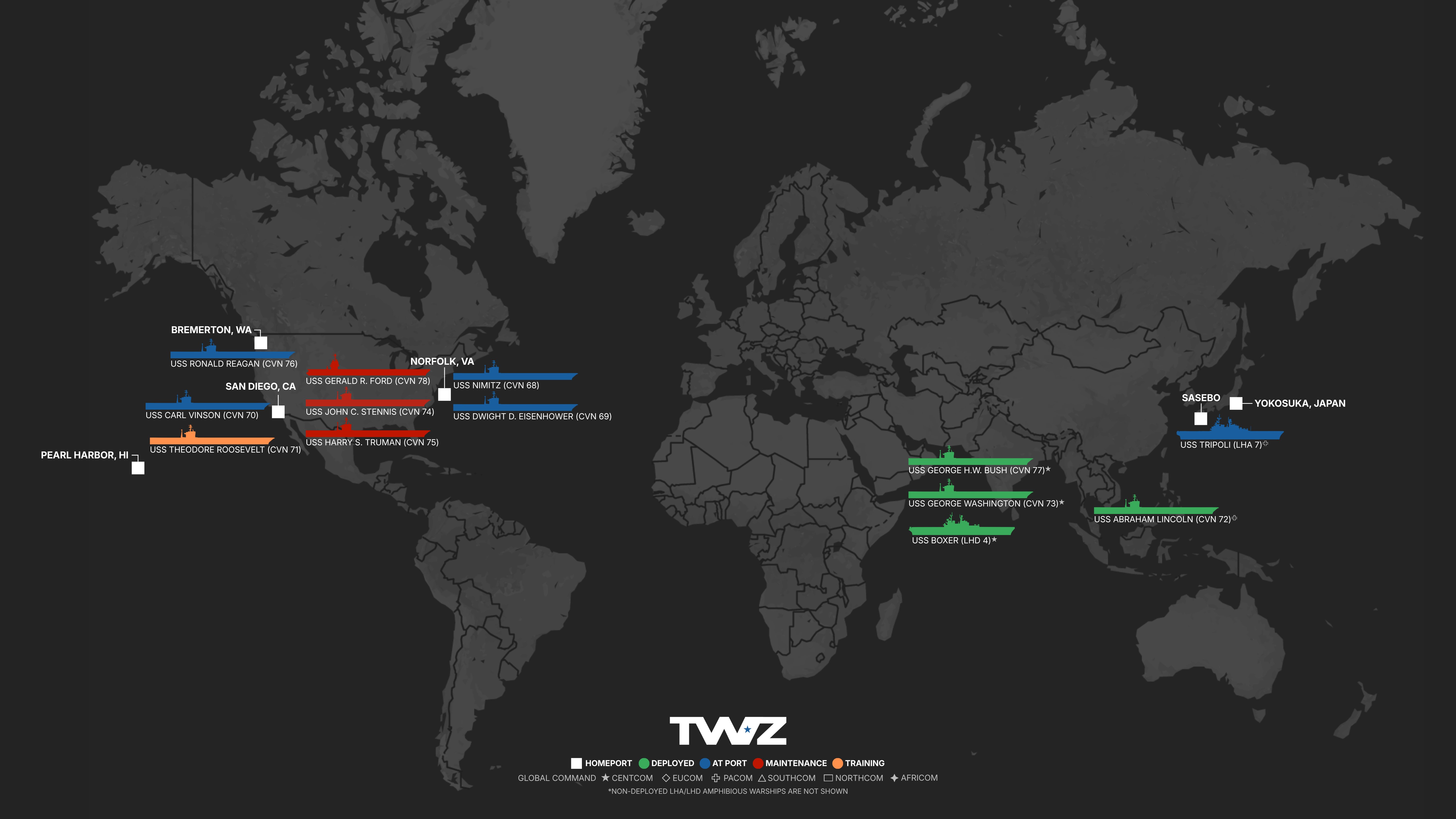
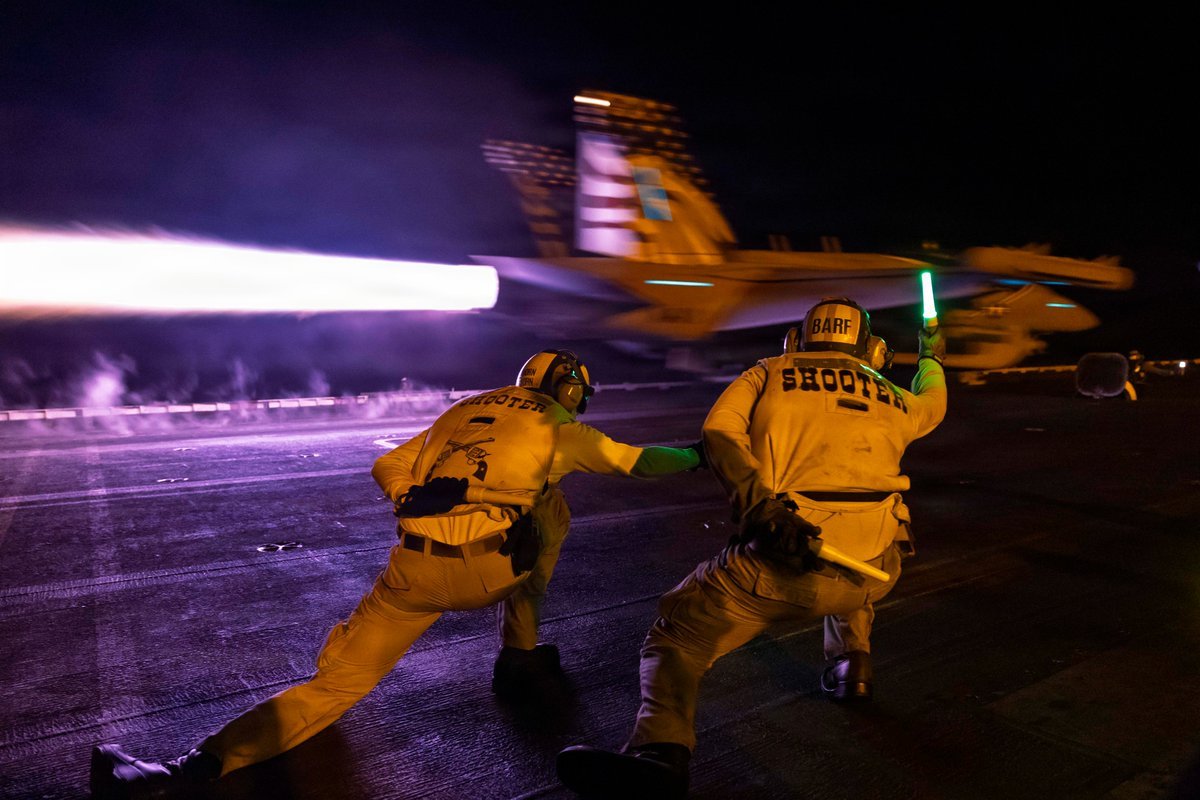
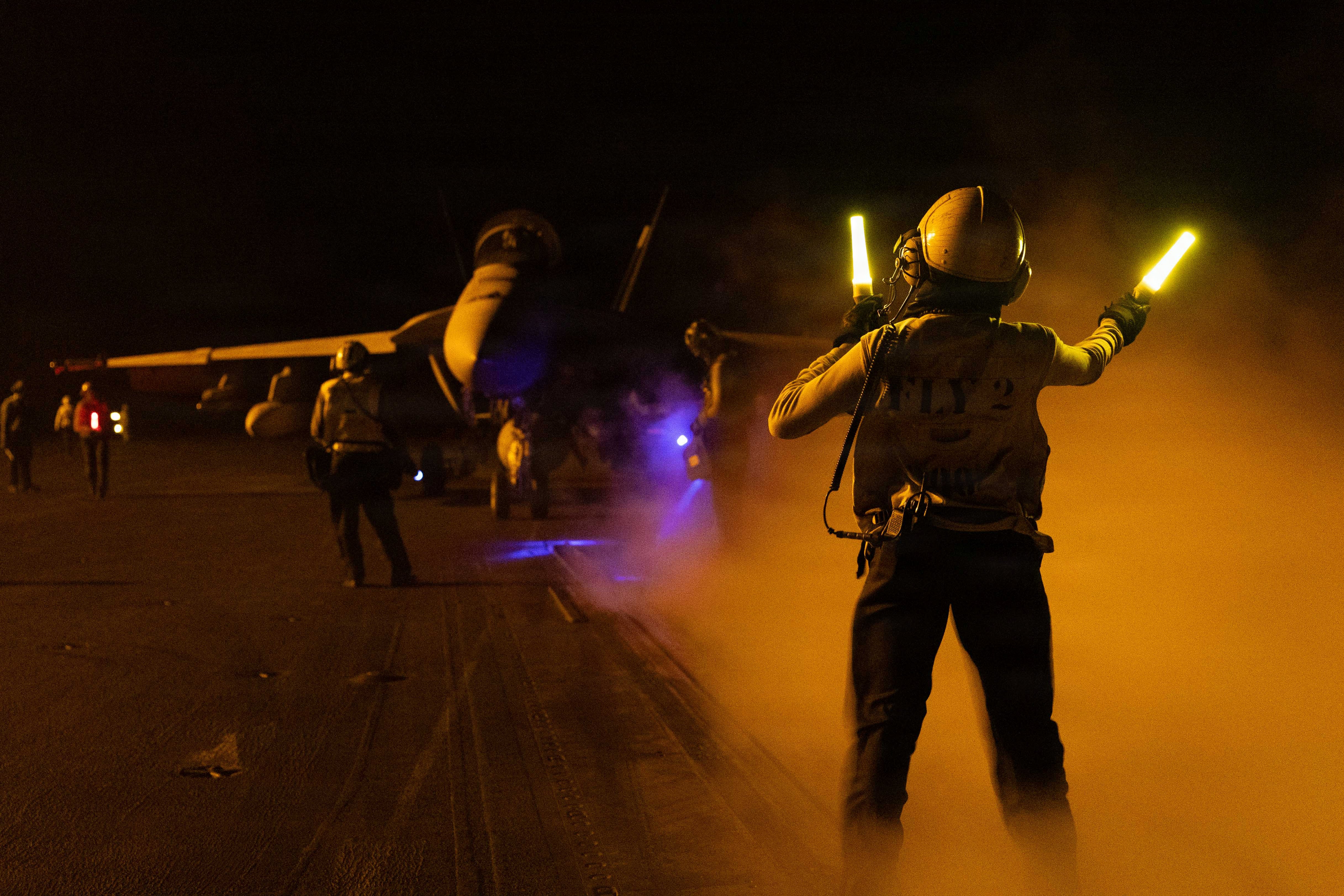




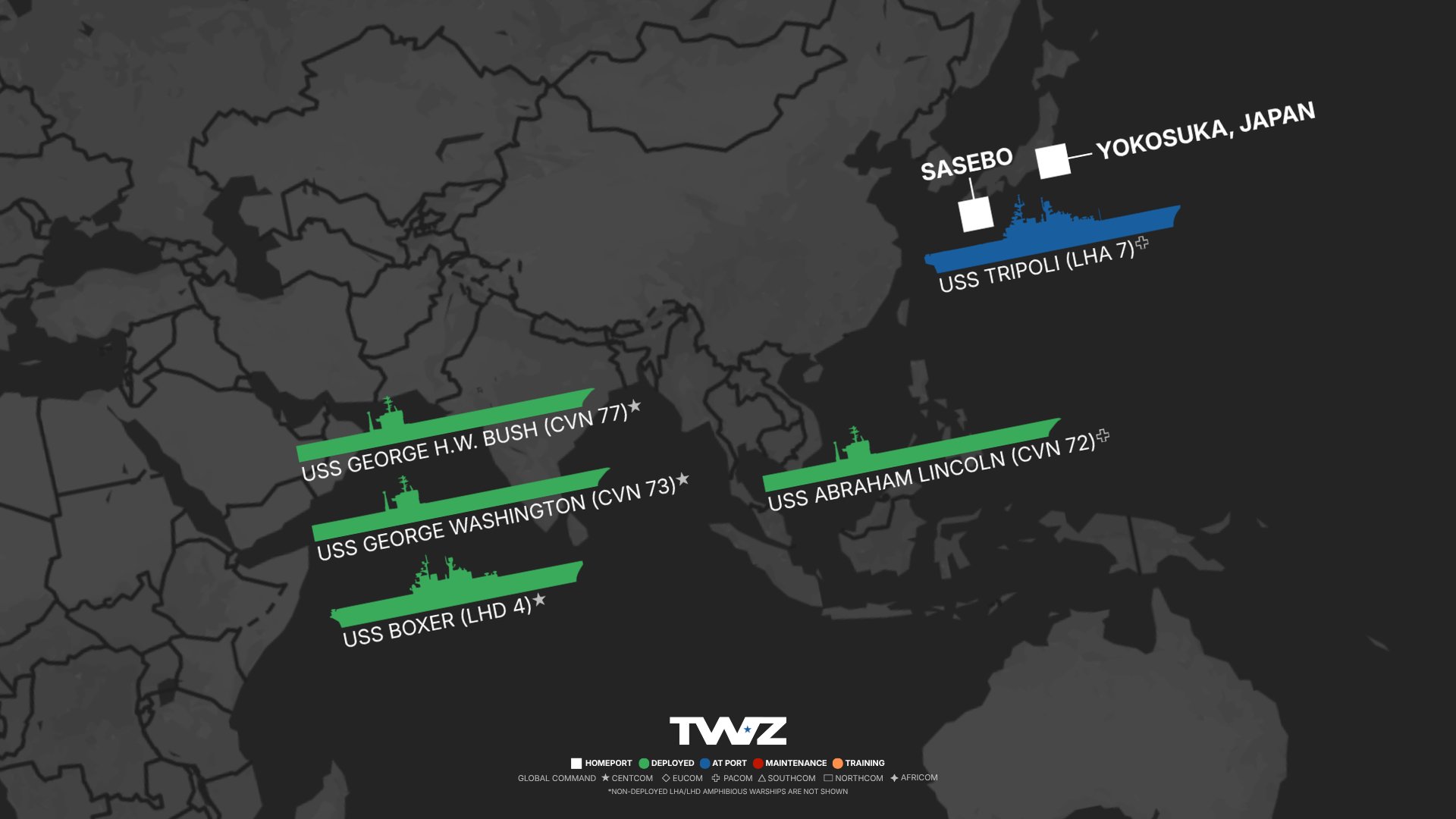







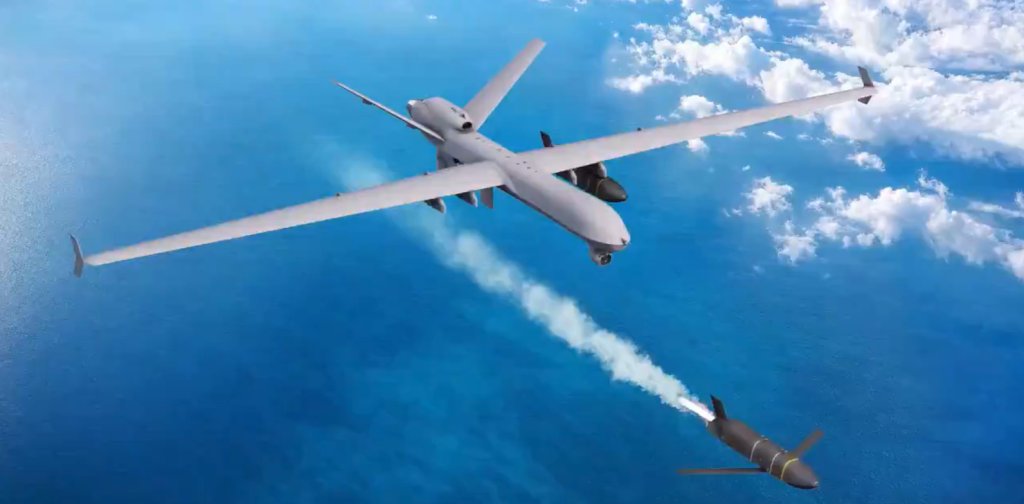



 A French journalist says there is a shocking pattern of foreigners raping elderly women in France.