❌

Reading view

Several arrested in protests against constitutional changes in DRC

Protests rocked the Democratic Republic of Congo on Tuesday, September 15, as opposition supporters took to the streets in Kinshasa and several other cities to oppose proposed constitutional changes that they say could allow President Félix Tshisekedi to seek a third term.

The demonstrations were called by the opposition coalition C64 (Coalition Article 64), which has campaigned against changes to the Constitution and what it considers an attempt to remove the existing two-term presidential limit.

The demonstrations were also reported in several cities. In Kinshasa, hundreds of protesters gathered around the Limete area before the march was disrupted by clashes involving demonstrators and people identified as members of the Force du Progrès, a group affiliated with Tshisekedi’s ruling UDPS party. Police used tear gas and warning shots to disperse the crowd. At least 10 people were arrested in Kinshasa.

Opposition accuses authorities of an “ambush”

Martin Fayulu, leader of the Engagement for Citizenship and Development (ECiDé) and a leading C64 figure, accused authorities of deliberately allowing pro-government militants to attack the opposition march.

In a post following the confrontation, Fayulu said the C64 had agreed on its route with Kinshasa’s city authorities before the march. He alleged that protesters were then confronted in Limete by armed members of the Force du Progrès while police used tear gas against the marchers.

Fayulu wrote that the C64 had been “the victim of an ambush” and accused the authorities of using a political militia alongside security forces. He called on Kinshasa’s city authorities and the national government to explain what happened.

Read more: Lithium mining in the DRC: A new mineral rush spearheaded by the US, EU, and other major powers

The confrontation prevented the C64 march from reaching its planned destination and from delivering its memorandum to the authorities at the People’s Palace.

Opposition resistance has been building 

Tuesday’s demonstrations were the latest escalation in an opposition campaign that has been building since June, when there were protests after Congo’s parliament approved legislation allowing constitutional amendments to be submitted to a referendum.

The National Assembly and Senate have both backed the referendum legislation. Critics argue that the process could eventually open the way for amendments to the presidential term-limit provisions.

Tshisekedi was first elected president in 2018 and re-elected in 2023. Under the current Constitution, the president serves a maximum of two five-year terms. His current term runs until 2028.

The proposed constitutional changes have therefore become a major point of confrontation between the government and opposition. The C64 says it is defending the existing constitutional order and has rejected any change that could enable Tshisekedi to seek another term.

The protests and the crisis is happening as the government faces other major challenges, including conflict in eastern Congo and an Ebola outbreak.

Read more: Ebola spreads to 60 health zones in eastern DRC; UN warns of funding shortfall

  •  

Israeli Film Festival in Ghana sparks more controversy

At the end of August, at the Silverbird Cinema in the Accra Mall in Ghana, two Israeli feature films were screened alongside Ghanaian student productions. 

For the second year running, the seats for this Israeli film festival were empty. Ordinary Ghanaians declined the Israeli Embassy’s films, and a peaceful demonstration outside held placards for Palestine and against the continued killing of civilians in Gaza.

There is another screen Ghanaians must refuse to look away from, protestors asserted. The screens on which we have watched Gaza reduced to rubble, families displaced again and again, hospitals and schools destroyed, and children carried from the wreckage of a war that, despite the ceasefire announced in October 2025, has not stopped killing them.

However, something else walked through the doors of the film festival: schoolchildren. In uniform. On a Sunday.

Students from Achimota School and Accra Girls Senior High School, two of Ghana’s most prominent public secondary schools, were brought into an embassy-sponsored event at the center of a serious political controversy. Those of us who were there saw them. We have photographs and videos. The question Ghana must now answer is not about cinema. It is about who sent our children, and why.

The 2025 Israeli Film Festival

Last year, the Embassy staged a week-long Israeli Film Festival at the same venue and called it an exercise in “dialogue and mutual understanding.” Nearly 400 Ghanaian organizations, student movements, trade unions, faith communities, civil-society groups, signed one statement calling for a boycott. Protesters gathered outside. Sponsors pulled out. The Embassy still declared the event a success.

The veteran editor Kwesi Pratt Jnr., who joined the picket, recalled what that “success” looked like a year ago for the “Alhaji and Alhaji” program:

“This is the first time in my life that I’ve seen 400 organizations come together to sign one statement calling for a boycott of the film festival. I joined the picket at the Silverbird Cinema, and a few, very, very few, prominent Ghanaians, including Afenyo-Markin, attended in spite of the protest. But it was a fiasco. The room was empty. Ghanaians rejected the film festival completely.”

So the Embassy returned smaller: two Israeli films on a single Sunday, free entry, free popcorn, raffle prizes, and an invitation aimed squarely at young people. When adults again refused to fill the room, uniformed students appeared. If Ghanaian adults will not lend legitimacy to this event, should Ghanaian children be made to supply it?

The timing makes it harder to dismiss as a routine outing.

President John Dramani Mahama has publicly described what is happening in Gaza as genocide. The Israeli Ambassador to Ghana has publicly rejected that position and defended his government’s conduct. He is entitled to make his case, but he is a guest of a sovereign state, not the author of its policy.

Against that backdrop, the presence of uniformed students inside an embassy program, days after this very public disagreement, demands an accounting. Pratt put the question bluntly:

“At the time that the ambassador was attacking our president, some authorities in our secondary schools decided to side with [the embassy]. What judgment was exercised by the school authorities when they agreed to bus their students to this film festival? What were they expecting? What checks did they do on the quality of the films?”

Picket against Israeli film festival
Ghanaian activists picket the Israeli Film Festival. Photo via PATV

Those are the right questions, and they are not rhetorical. They have not yet been answered and there has been no investigation.

What the students deserve

None of this is an accusation against the children. They may have had little understanding of the political purpose around the event. The responsibility belongs to the adults who placed them there.

Ghana rejected the Israeli film festival not because cinema or cultural exchange is evil. Not because Israeli artists have no right to make films. The rejection is not an attack on Jewish people. Antisemitism is hatred and must also be rejected. 

The problem is that this festival is not an example of artists meeting freely across borders. It is an Israeli Embassy-backed initiative staged while the Palestinian people continue to pay with their lives. Amid the killing of civilians and the destruction of Palestinian life, the use of state diplomacy to manufacture an appearance of normality while those questions remain unresolved is nothing less than political soft power.

Ghanaian children are not diplomatic props, and Ghanaian schools must never become extensions of a foreign embassy. Teach them, yes. Teach them the Holocaust, the Nakba, occupation and international law, and give them the evidence to think critically. That is education. Busing uniformed children into a controversial embassy function, and letting their presence become evidence of Ghanaian acceptance, is the opposite.

That is why the demand is simple, and now directed at the Ministry of Education and the Ghana Education Service: did you know? If yes, explain. If not, investigate. And if any official bypassed procedure or abused authority to place schoolchildren inside a foreign government’s public-relations exercise, hold them accountable.

Ghana’s revolutionary legacy

There is a longer tradition at stake. Ghana is the country from which Kwame Nkrumah declared that our independence was meaningless unless linked with the total liberation of Africa. Africa understands what cultural normalization is for: domination has rarely arrived only with rifles. It seeks respectability, the reception, the festival, the partnership, until oppression becomes a disagreement to be discussed politely while business continues.

Palestine poses that old question to the African conscience once more. And a small part of the answer is being written by who walks into a cinema in Accra Mall, and who is made to walk in.

For the second year, the empty seats have spoken. Now Ghana’s own institutions must speak. Our children deserve education, not enlistment. And a sovereign state deserves to decide, in the light of its own conscience, what its schools lend themselves to.

Stay away. Let the empty seats speak, for the Palestinian child who will never again enter a classroom, and for the proposition that human life is worth more than diplomatic image-building.

  •  

South Africa’s shackdweller movement secures court order against evictions

Abahlali baseMjondolo has secured another court order preventing the forced relocation of residents of an informal settlement in Shaka’s Head, KwaZulu-Natal, until the Municipality complies with the conditions previously set by the Pietermaritzburg High Court.

On Friday, September 11, the Pietermaritzburg High Court issued a consent order directing the KwaDukuza Municipality to comply with an October 2025 court order before it can relocate residents in Shaka’s Head, on the Dolphin Coast.

The latest order was agreed to by both parties and effectively maintains the conditions imposed by the court last year. Residents will remain in the occupation until the municipality provides the basic services and meets the other requirements ordered by the court.

“This is no doubt another victory for Abahlali bakwaDukuza and all people facing evictions in South Africa,” Abahlali baseMjondolo said following the court proceedings.

Read more: “A declaration of war against the poor”: AbM leads resistance against South Africa’s anti-occupation bill

The movement has opposed attempts to evict residents from the settlement since the municipality initiated the process. The dispute has also involved the Dolphin Coast Residents’ Association, representing affluent homeowners in the area.

Court blocks eviction without basic services

The latest development follows a landmark ruling by the Pietermaritzburg High Court in October 2025, when the court halted the municipality’s attempt to forcibly evict hundreds of residents from Erf 1410.

The court found that the municipality could not proceed with the relocation unless it first met a number of conditions designed to ensure that residents would not be moved to an area without adequate services and facilities.

Among the requirements was that the municipality provide basic services, including roads, sanitation, waste removal, water, and temporary electricity.

The municipality was also required to demarcate individual stands for households and ensure that the relocation site had access to essential facilities, including schools, healthcare, and public transport.

The court ultimately adopted a draft order prepared by Abahlali’s legal team rather than the municipality’s proposed order, effectively preventing the eviction until the conditions had been fulfilled.

Municipality pursued eviction despite outstanding conditions

According to Abahlali baseMjondolo Secretary-General Thapelo Mohapi, speaking to BreakThrough News, the municipality had not fulfilled the requirements imposed by the October 2025 judgment.

Thapelo said the municipality had instead sought to proceed with eviction proceedings despite not providing the basic services required at the proposed relocation site.

“Only when they have provided those basic services, only then the people of Shaka’s Head will be relocated to the new piece of land,” Thapelo said.

He said that because the municipality had not yet provided the required services, residents would remain in the occupation.

The organization has long framed the dispute as part of a broader struggle over access to urban land and housing, particularly for working-class and Black residents living alongside more affluent communities.

Thapelo accused the municipality and sections of the area’s affluent residents of seeking to remove working-class people from areas close to economic opportunities and relocate them to the urban periphery.

The September order follows an earlier setback for the municipality in March 2025, when another attempt to advance the eviction process was blocked.

Read more: Abahlali baseMjondolo secures victory against forced evictions

For now, the position established through the court proceedings is that residents cannot be relocated until KwaDukuza Municipality complies with the requirements contained in the October 2025 order.

  •  

North Africa’s Oldest Fort Outside Egypt Rose in Step with Bronze Age Spain

Before Rome existed, before Phoenician ships ever reached the western Mediterranean, and around the same time the first fortified villages of the Argaric culture were rising in southeastern Iberia, a farming community on a rocky ridge in inland Morocco was already digging a ditch and piling up earth. What they were defending against is still […]

  •  

MVIWATA seeks stronger farmers’ rights in proposed EAC seed bill

Tanzanian small-scale farmers’ organizations and civil society groups are raising concerns over the proposed East African Community (EAC) Seed and Plant Varieties Bill of 2025, warning that the legislation could marginalize farmer-managed seed systems unless specific protections and exemptions are introduced.

In a submission to public hearings on the proposed bill, the Mtandao wa Vikundi vya Wakulima (MVIWATA) called for the legislation to explicitly recognize and protect farmer-managed seed systems (FMSS), arguing that the current draft is largely designed around commercial and certified seed systems.

MVIWATA, established in 1993, which has more than 500,000 smallholder farmer members across Tanzania, has previously participated in discussions on seed legislation and harmonization at both national and regional levels, including the earlier draft EAC Seed and Plant Varieties Bill of 2018.

The organization says the 2025 draft is an improvement over the 2018 version, but argues that gaps remain, particularly regarding the recognition of farmer-managed seed systems and the rights of farmers to save, use, exchange, share, and sell their own seed.

According to MVIWATA, the draft bill is primarily oriented towards commercial seed, with requirements such as registration, certification, variety release, and quality assurance. The organization warns that applying these requirements broadly could inadvertently place farmer-managed seed systems under the same regulatory framework as commercial seed.

MVIWATA says this is particularly problematic because farmer-managed seed systems are a major source of seed for farmers in Tanzania and across East Africa.

The organization maintains that farmer seed systems should instead be explicitly excluded from commercial seed regulations, including formal registration, certification, variety release, and other requirements designed for commercial seed. It proposes the development of alternative, farmer-centered, and community-led mechanisms at the national level.

Sabrina Masinjila, senior program officer at the Society for International Development (SID), told BreakThrough News the concerns raised by MVIWATA were driven by the continued lack of policy recognition of farmer-managed seed systems at both national and regional levels.

She said the concern was also heightened by the possibility that legislation regulating commercial seed systems could contain provisions that inadvertently affect farmers’ traditional practices, including the sale and exchange of seed.

“The aim for seeking changes was to ensure that farmer seed and systems are exempted from any regulation including registration, certification and variety release that apply to commercial seed,” Masinjila said.

But she stressed that simply exempting farmer seed from regulation would not be enough.

“Exemptions are not sufficient as farmer seed systems still need enough support for their continued development, maintenance, conservation and protection,” she said.

According to Masinjila, the push is therefore for the bill to go beyond exemptions and create policy space for an alternative framework that can support farmer seed systems.

“We sought to establish not just clauses that exempt small-scale farmers from the Bill but also clauses that will start to provide opportunities to develop an alternative framework for farmer seed systems which will ensure they are conserved, maintained, protected and even supported for multiplication and distribution,” she said.

Such a framework, she argued, would have wider implications for agroecology, agricultural biodiversity, climate resilience, dietary diversity and nutrition.

MVIWATA makes a similar argument in its submission, saying farmer-managed seed systems play an important role in food security, nutrition, biodiversity conservation, and farmers’ livelihoods. The organization says recognition should not mean forcing farmer seed into the same regulatory system as commercial seed, but should acknowledge the contribution of farmers to the conservation and development of genetic resources.

Farmers’ rights at the center of debate

The debate is also closely linked to farmers’ rights under international agreements. MVIWATA points to the International Treaty on Plant Genetic Resources for Food and Agriculture (ITPGRFA), particularly Article 9, which addresses Farmers’ Rights. Its submission also cites the United Nations Declaration on the Rights of Peasants and Other People Working in Rural Areas (UNDROP), including provisions relating to farmers’ rights to seed.

MVIWATA argues that the EAC Bill should therefore be aligned with these commitments and explicitly recognize farmers’ rights to save, use, reuse, conserve, multiply, develop, exchange, share, and sell farmer-managed seed.

The organization has proposed that the bill state explicitly that it applies to commercial seed systems and does not prohibit or restrict the saving, use, exchange, sharing, or reuse of farmer seed and non-commercial varieties.

Masinjila said the protection of farmers’ rights was inseparable from the wider discussion around seed regulation.

Adding that clauses should be included to protect farmers’ rights as recognized under the ITPGRFA and UNDROP, where access to and control over seed is connected to broader human rights.

“Without these changes, small-scale farmers and their seed system will continue to be neglected, marginalized and criminalized. And this is why we needed to intervene,” she said.

Concerns over the 2018 bill

The current debate is not entirely new. MVIWATA says it was strongly involved in discussions around the 2018 draft EAC Seed and Plant Varieties Bill, raising concerns about several provisions. The organization says its review of the 2025 version found improvements compared with the earlier draft.

Masinjila said one difference is that the previous bill contained provisions that were compliant with the 1991 Act of the International Union for the Protection of New Varieties of Plants (UPOV), a plant variety protection regime that civil society and farmer organizations have criticized for being restrictive of farmers’ rights.

“The previous bill contained clauses that were compliant to UPOV 1991. A restrictive Plant Variety Protection regime which has been rejected by CSOs and farmer organizations globally as it undermines farmers rights,” she said.

However, she said concerns around regional harmonization remain under the current EAC Bill, particularly because legislation at EAC level is legally binding on partner states.

MVIWATA also warns that a binding regional framework could reduce the ability of individual countries to develop alternative approaches for farmer seed systems.

The organization is calling for the explicit recognition of farmer-managed seed systems, it has also proposed that farmer varieties should not be subjected to mandatory commercial registration or certification, while alternative mechanisms should be developed in consultation with smallholder farmers, pastoralists, and farming communities.

On seed marketing, MVIWATA wants the bill to make clear that farmers can sell and exchange farmer varieties at the national level and facilitate limited cross-border seed exchange among farmers within the EAC.

The organization is also seeking safeguards against the appropriation of farmers’ genetic resources, including requirements for the disclosure of origin, as well as free, prior, and informed consent from communities. Lastly, they want benefit-sharing agreements where genetic resources are acquired from farming communities.

  •  

Africa’s BRICS opportunity: from resources to productive power

The enlargement of BRICS presents Africa with a wider field of economic possibilities by bringing the continent into closer relationship with some of the world’s largest markets, important sources of development finance and countries possessing substantial capabilities in manufacturing, energy, infrastructure, pharmaceuticals, agriculture, and advanced technologies. At a time when international economic relations are becoming increasingly fragmented, this wider range of relationships gives African countries greater room for maneuver.

But a wider choice of trading partners, financiers, and technological partners will mean considerably less if Africa continues to export raw materials, import sophisticated technologies, and occupy the lower reaches of global value chains, because the destination of our commodities may become more diversified without fundamentally altering our position in the international division of labor. It is not the direction of extraction that has ever been the problem, but its structure.

20 years of BRICS

This should therefore be the central African question about BRICS as it enters its third decade: how do we use this changing configuration of economic relationships to build productive power on the continent? The measure of Africa’s engagement with BRICS cannot simply be the increase in trade, investment or infrastructure finance, but must increasingly be whether these relationships enable African economies to convert their minerals, energy resources, labor, knowledge and expanding continental market into greater productive, technological and institutional capability.

Africa’s experience gives this question particular historical significance. The continent has been deeply integrated into the world economy for centuries, but largely through an economic structure in which minerals and agricultural commodities traveled enormous distances while much of the processing, manufacturing, technology, and financial value associated with them accumulated elsewhere. That structure remains recognizable in economies that export crude oil while importing refined petroleum products, export mineral ores while importing machinery and manufactured components and export agricultural commodities while importing processed goods derived from the same productive base.

Barriers to development

The post-colonial challenge has therefore never been to trade more but to build the productive capabilities that allow African economies to retain more value from what they produce. Yet this has become more difficult as several economies have experienced premature deindustrialization before manufacturing reached the scale needed to absorb large numbers of workers and sustain productivity growth. Domestic firms are frequently small, supplier networks remain shallow, and the relationship between universities, technical institutions and industry is often weak. Infrastructure still too often reflects the historical logic of moving commodities from sites of extraction to ports rather than connecting African centers of production.

Read more: The International Monetary Fund’s Africa policy is underdevelopment

The African Continental Free Trade Area creates the possibility of changing the scale at which we approach some of these problems. A continental market can support forms of industrial specialization that smaller national markets cannot, but the agreement will acquire its full developmental significance only when African firms possess the productive capacity to supply that market. Lowering tariffs creates trade opportunities; it does not by itself produce the firms, electricity, logistics, finance, skills and technical standards required to take advantage of those opportunities.

The emergence of BRICS creates new possibilities within this African project, but it does not guarantee the outcome. Consider the minerals required for the global energy transition. African countries possess significant deposits of manganese, platinum-group metals, cobalt, lithium, and other minerals required for batteries, electric mobility, renewable-energy systems and the wider low-carbon economy. Several BRICS economies already represent substantial sources of demand for these minerals, and their industrial and technological ambitions are likely to further increase that demand. The question is whether it can be structured to support African processing, refining and manufacturing rather than simply accelerating the export of unprocessed ore. For South Africa, this means asking whether its mineral endowments, established industrial base, scientific institutions and engineering capabilities can support new activities in batteries, fuel cells, electric mobility, and renewable-energy equipment. Elsewhere on the continent, mineral extraction can be progressively connected to refining, processing, component manufacturing, engineering services, and technical skills.

Regional integration consequently must become as much an industrial project as a trade project. A viable African battery value chain need not be reproduced inside the borders of a single country. Minerals extracted in one economy can be processed in another, components can be manufactured where industrial capabilities already exist, with assembly occurring close to sufficiently large markets. The strategic objective should be to connect these capabilities across the continent so that regional integration progressively expands the number of African firms, workers, and economies participating in higher-value activities. Regional institutions have recognized this opening. Both SADC and SACU have recently developed strategies to leverage their members’ critical mineral endowments for industrial development rather than raw export, embedding the beneficiation agenda within regional frameworks rather than leaving it to individual countries to negotiate alone. The question for BRICS partners is whether their infrastructure finance can connect regional production rather than reinforcing the extractive economic geography that routes everything to ports.

The experience of Indonesia is instructive in this respect. By restricting the export of unprocessed nickel ore, Indonesia used its resource endowment as an instrument of industrial policy, compelling downstream investment in domestic refining and processing and generating a measurable expansion of manufacturing activity around the minerals sector. The conditions in Indonesia differ from those across African mineral-producing economies, and no single approach transfers without adaptation, but the underlying logic, that a country with significant mineral endowments can use its position in global supply chains to anchor productive capability rather than to service demand, is directly relevant to the African debate. SADC and SACU frameworks enable the collective pursuit of that logic rather than individually, which considerably strengthens the negotiating position of member states.

Read more: For Africa to have digital sovereignty, it must control data and AI technology

A vehicle for regional integration and development

BRICS cooperation can be brought directly into this developmental space. Its members collectively possess capabilities that African economies require industrial finance, advanced manufacturing, energy technologies, digital systems, agricultural technologies, pharmaceuticals, logistics expertise and large consumer markets. The strategic African objective should therefore be to use these relationships to close specific productive gaps, rather than to approach BRICS principally as another destination for commodities. The test of each partnership is whether it leaves firms stronger, engineers more capable, supplier networks deeper, and regulatory institutions better equipped than before.

This requires developmental statecraft, understood not as a rhetorical commitment to the state’s role in development but as the organized capacity of public institutions to identify productive opportunities, direct finance towards them, negotiate technology partnerships on terms that leave capabilities behind, coordinate the different policy instruments that productive transformation requires, and sustain that effort through the inevitable difficulties of implementation. State capability, in this sense, is the operational form of sovereignty in practice. A government may possess all the formal attributes of sovereign authority whilst systematically lacking the institutional capacity to negotiate effectively with international capital, enforce agreements, direct finance towards developmental ends or build the regulatory knowledge that separates a beneficial technology partnership from another form of dependency.

The infrastructure and technology challenges illustrate the practical implications. Much of Africa’s transport network still reflects an extractive economic geography. The next generation of infrastructure must connect African economies and link transport corridors to processing facilities, industrial parks, energy systems, universities, cities, and regional markets rather than simply moving commodities more efficiently to ports. When an African country acquires sophisticated technology, the relevant question is what remains after the transaction: whether our engineers understand it, whether our universities can teach and improve it, whether domestic firms can enter its supply chains and whether we can progressively adapt it to local circumstances. The developmental value of technology partnerships lies ultimately in the capabilities they leave behind, and state capability is what determines whether those conditions are written into agreements and enforced when partners resist them.

Finance is an equally pressing matter in the African context. Large infrastructure projects can attract BRICS capital, but smaller domestic manufacturers and regional suppliers frequently lack the patient finance required to expand production, meet technical standards, and enter value chains. BRICS financing mechanisms, including the New Development Bank, could make a particularly consequential African contribution by complementing large infrastructure investment with financing for productive enterprises, supplier networks, and industrial projects.

Africa and BRICS

For Africa, these possibilities will not materialize automatically. The continent possesses many of the minerals upon which emerging industries will depend, the youngest population of any continent, enormous renewable-energy potential and a continental market whose importance will grow considerably during this century. But history provides ample evidence that endowments do not, by themselves, produce development, and the responsibilities that follow from this understanding fall primarily on African states rather than on any external partner. BRICS cannot perform these functions on Africa’s behalf, nor should it. What it can do is enlarge the range of instruments available to countries pursuing productive transformation.

Africa, therefore, confronts BRICS with both an opportunity and a test: the opportunity is a wider range of markets, finance, technologies, industrial partners, and development experiences, while the test is whether the continent uses this greater room for maneuver to change its productive structure or merely to diversify the destinations to which its commodities are exported. BRICS can enlarge Africa’s field of possibilities, but it cannot determine what Africa builds within it. The changing international order can give Africa greater room to act, while productive power will determine what we can do with that room.

Busani Ngcaweni is Director of the Centre for Public Policy and African Studies at the Johannesburg Business School, University of Johannesburg.

This article was produced by Globetrotter.

  •  

After 43-day strike, Kenyan nurses force government to fulfill nine-year-old commitments

After a 43-day nationwide strike, nurses in Kenya returned to work on Thursday, September 10. Their union finally secured an agreement from the government on September 9, a day after thousands of nurses and midwives from all of Kenya’s 47 counties converged at the Greenpark in the national capital, Nairobi.​

From there, they marched to Delta House, headquarters of the Council of Governors (CoG), demanding the implementation of an agreement the government signed nearly a decade ago.​

A decade-long struggle​

The nearly five-month-long strike in 2017 had ended with both the national and county governments signing a return-to-work agreement, committing to finalize the draft of the agreed Collective Bargaining Agreement (CBA) and implement it within a month.​

It was to incorporate measures to address the nurses’ grievances, including, among other things, increases in nursing service allowance, uniform allowance, and risk allowance. The increases were to be staggered annually and completed by 2021.​

The nurses returned to work after this agreement. However, almost nine years later, the commitments contained in the return-to-work agreement remain unfulfilled, while the CBA it was meant to underpin has never been concluded.​

Promised risk allowance withheld even during COVID​

The government refused to increase the risk allowance even when the COVID pandemic was declared in early 2020, by the end of which it had claimed the lives of scores of nurses in Kenya. Those who survived infections in the line of duty had to spend long periods isolated from their families, estranged from their young children and suffering enormous anxiety and stress. But the increased risk allowance promised to them in 2017 remains unfulfilled, even in 2026.​

On July 29, nurses downed tools in protest. The strike has since paralyzed health services countrywide. Nonetheless, even as the strike entered its second month, the county governments did not budge. On August 31, the CoG Chairperson Ahmed Abdullahi deemed the 2017 CBA financially unviable.​

“Signed under duress”​

He dismissed the CBA as one “signed under duress in the run-up to elections in 2017” and “never been implemented,” even as reports raised alarm about rising maternal, neonatal, and perinatal deaths across the country.​

“No gun was pointed at the heads of all the signatories of our return to work agreement in 2017,” retorted KNUNM Deputy Secretary General Maurice Opetu, refuting the claim of duress. “It was signed in a very harmonious meeting out of understanding” by both the “levels of government” – the national and counties.​

It is the county governors who “have made the nurses work under duress without the CBA. And then working under duress pushed us to call a strike after trying all [these] years to resolve the matter,” he insisted.​

Too many nurses to pay?​

The nurses’ struggle for this CBA had begun alongside similar struggles by doctors and clinical officers. The government signed and implemented CBAs for doctors and clinical officers, but refused to do the same for nurses.​

“They are saying doctors are few, and clinical officers are few, but we are many, so they do not have that budget,” explained Collin Ajwang, President of the National Nurses Association of Kenya (NNAK).

“This doesn’t make sense because our large number is exactly what has helped hospitals run effectively. We have reduced maternal mortality; we are the ones making sure theatres are running; we cannot be few. We are at dispensaries where there are no doctors. Let them tell us how few they want us to be so that they can pay us this money.”​

Class priorities laid bare​

On the 33rd day of the nurses’ strike, the aviation workers downed tools on August 30. Flights were delayed at Jomo Kenyatta International Airport, while operations ground to a halt in at least three other airports. Within two days, the government signed an agreement with the aviation workers’ union, the Daily Nation reported, highlighting the contrast in the government’s handling of the two strike actions.​

The “airport is a portal and exit of all serious businesses,” not only from Kenya but from East Africa and the continent as a whole, remarked the KNUNM Secretary General, Seth Panyako. “These people who are in charge of making decisions do business through the airport.” So, the government, he said, cannot afford the airports to “stop even for a minute​

This business class can afford to “go to private hospitals. There is an alternative for them.” But national and county governments “really don’t care about the common” masses relying on public hospitals for healthcare, and are suffering as a result of the government’s refusal to fulfill the commitments made in the agreement it had signed, he argued.​

Doctors threaten to join strike​

A week later, on September 7, doctors gave the government a seven-day ultimatum, warning that they would also go on strike if it did not resolve the dispute with nurses. “Doctors cannot work without nurses. Doctors are now overburdened. We cannot continue like this,” said Davji Atellah, Secretary-General of the Kenya Medical Practitioners Pharmacists Dentists Union (KMPDU).​

“In the ICU (Intensive Care Unit), in the wards, in the HDU (High Dependency Unit), only the nurses can offer that type of care,” he explained, insisting that “nursing care is very essential in healthcare.”  ​

A day after the doctors’ warning, nurses marched on the CoG in Nairobi. Union leaders remained camped at the CoG’s headquarters.​

Following a day-long closed-door meeting, the government and the union leaders signed a return-to-work agreement on September 9, with the CoG committing to pay Ksh5,000 in uniform allowance and increase the risk allowance from Ksh3,850 to Ksh8,000. The CoG also agreed to implement the pending CBA within 45 days.​

“We have finally called off the 43-day strike following a breakthrough in negotiations with the Council of Governors,” Panyako announced. “We therefore call upon all our members to resume duty within the next 25 hours as we give room for the implementation of the agreements reached.”  ​

  •  

Why is Italy covering up the expulsion of its ambassador to Ethiopia

In August 2026, the Ethiopian government declared Sam Fabrizi, the Italian ambassador, persona non grata. Rome chose to remain silent. This incident is not merely a diplomatic incident, but a striking example of the new balance of power between Africa and the former colonial powers. It is significant that, on February 13, 2026, Giorgia Meloni […]
  •  

‘Wherever they set foot, blood flows’: Algeria severs diplomatic ties with UAE

Announcing the severing of diplomatic ties with the United Arab Emirates (UAE) on Thursday, September 10, Algeria summoned the Emirati envoy and gave him 48 hours to leave the country.​

“Algeria has exercised a great deal of restraint and a high sense of responsibility,” despite the increasingly “provocative or hostile actions emanating from” the Gulf power, the North African country’s foreign ministry said in a statement.​

“Despite these numerous warnings, the United Arab Emirates continued to persist in these actions, which have reached limits where they can no longer be considered acceptable or tolerable within the framework of relations between two sovereign states, nor remain without a response.”​

Later that day, its defense ministry announced that the UAE’s military and civilian aircraft are banned from using Algerian airspace from Friday. The only exemption is for commercial civilian planes, which can continue to fly over Algeria until the existing contract expires at the end of the year.​

Algeria had already initiated the termination of the air services agreement with the UAE in February, when President Abdelmadjid Tebboune alleged attempted Emirati interference in its elections.​

Multiple Algerian media outlets aligned with the state have reported that the UAE has been supporting the Movement for the Self-Determination of Kabylia (MAK), a separatist group Algeria designated as a terrorist organization in 2021.​

Algeria and the UAE also find themselves on opposing sides on several fronts of international relations.​

Algeria aids Western Sahara’s liberation struggle; UAE backs Moroccan occupation​

The support for the national liberation struggle of Western Sahara, occupied by Morocco immediately after it won independence from Spanish colonialism, has been a central plank of Algeria’s foreign policy.​

In 2021, Algeria severed diplomatic relations with Morocco, accusing it of supporting the MAK in retaliation for Algerian support to the Polisario Front (PF), which is fighting for Western Sahara’s national liberation. But there is no equivalence between the PF and the MAK.​

The MAK, which has long had close links to Israel, largely operates from Europe and is based in France, Algeria’s former colonizer. The PF, on the other hand, is fighting for Western Sahara’s liberation, with its military operating in its liberated territory adjoining Algeria. The UN recognizes the PF as the sole representative of the people of Western Sahara, a country it lists among the last few pending decolonization.​

Read more: Western Sahara’s decolonization at a crossroads after 50 years of occupation​

Despite funding and arming the Moroccan occupation, the US had not officially recognized Morocco’s claim to sovereignty over Western Sahara until December 2020, when Morocco signed the Abraham Accords to normalize diplomatic relations with Israel.​

The first Trump administration, in turn, proclaimed that the US “recognizes Moroccan sovereignty over the entire Western Sahara territory” and went on to open a consulate in Dakhla, a major city in the occupied region.

​The UAE was a step ahead, setting a precedent before the American move by opening its consulate on the occupied land in November 2020, a month before Morocco normalized relations with Israel. The UAE had already normalized relations with Israel that September.

​In contrast, Algeria refuses to normalize relations with Israel until the Palestinians have secured their statehood. Algerian media often refers to the UAE as an “Israeli vassal”.

​“Wherever they set foot, blood flows”

​Algeria’s diplomatic break was foreseeable since at least July, when President Tebboune said in a thinly veiled reference to the UAE in a televised interview, “Wherever they set foot, blood flows… We want them to stay away, so that blood does not flow in our country.” He gave the example of Mali, Libya and Sudan.

​A month later, in August, the UN confirmed that the USD 50 million transferred to the Al Qaeda-affiliated JNIM in the form of ransom helped fuel its attack across Mali. A Reuters investigation identified the UAE as the source of this payment to JNIM. The group has also attacked its neighbors, Burkina Faso and Niger, both of which have followed in Mali’s footsteps by expelling French troops.

​Read more: Mali fights yet another wave of attacks on multiple cities by terror groups

The UAE’s supply of arms and mercenaries to the Libyan warlord General Khalifa Haftar, who has been fighting Libya’s UN-recognized government, is also well-documented in multiple UN reports since 2017.

Tebboune’s reference to “blood” flowing from Emirati interference is best demonstrated in war-torn Sudan, where the UAE is funding and arming the Rapid Support Forces (RSF), whose depopulation campaign in El Fasher had all the “hallmarks of genocide”, according to the UN.

Read more: RSF has burnt and buried tens of thousands of corpses in El Fasher, says Yale report

He added in the July interview that a “diplomatic break” with the UAE “would have happened long ago.” Algeria, he explained, had refrained only to avoid adding to the already existing divisions in the Arabic-speaking world.

When the break finally came on Thursday, the UAE’s foreign ministry said it hoped that it “will be temporary, in a manner that preserves the fraternal ties between the two brotherly peoples.”

In an apparent reference to the absence of explicitly stated reasons in Algeria’s statement, Anwar Gargash, the diplomatic advisor to the UAE’s president, Mohamed bin Zayed, said, “Diplomatic relations are managed through reason, communication, and clarity of interests, not through puzzles and signals that require decoding.”

He went on to preach that “successful diplomacy is built on clarity of positions, sound management of interests and differences.”

Gargash’s statement “is revealing above all for what it carefully conceals. Not a word about the actions of this arsonist, predatory state, which thrives on chaos wherever it sticks its nose in Yemen, Sudan, the DRC, Somaliland, and elsewhere,” retorted former Algerian diplomat, Amar Belani.

Describing the UAE as a “state that has made other nations’ instability its economic model,” Belani concluded his response, saying: “As for the lesson on ‘reason and clarity of interests’, Abu Dhabi would do better to reserve it for its partners in the Abraham Accords, with whom it shares complicity in the face of war crimes, crimes against humanity, and acts of genocide committed against the Palestinian people.” 

This sentiment against the UAE is not limited to the government or the ruling National Liberation Front (FLN), which led Algeria’s liberation struggle against French colonialism and has ruled since, except for a few years in the 1990s.

Mass protests erupted in 2019 against corruption and increasing economic capture by the military elite, strangling an economy already suffering under neoliberal austerity. This movement, known as the Hirak, forced the then president, Abdelaziz Bouteflika, a veteran of the FLN, to resign.

But even in these protests against the government and the ruling FLN, “Down with the UAE” and “No to the UAE in the country of martyrs”, were among the popular placards and slogans.

  •  

Debt, Ratings, and the “Dollar Weapon”: Africa Challenges the Global Financial Architecture

For decades, African economies have operated within a system of rules established without their participation. Credit ratings, which dictate the cost of borrowing, are assigned by three Western agencies. Trade is conducted in dollars via SWIFT—a system that, as it turns out, can be switched off for political reasons. Today, that order is no longer […]
  •  

Britons back ban on trade with Israeli settlements by more than two to one

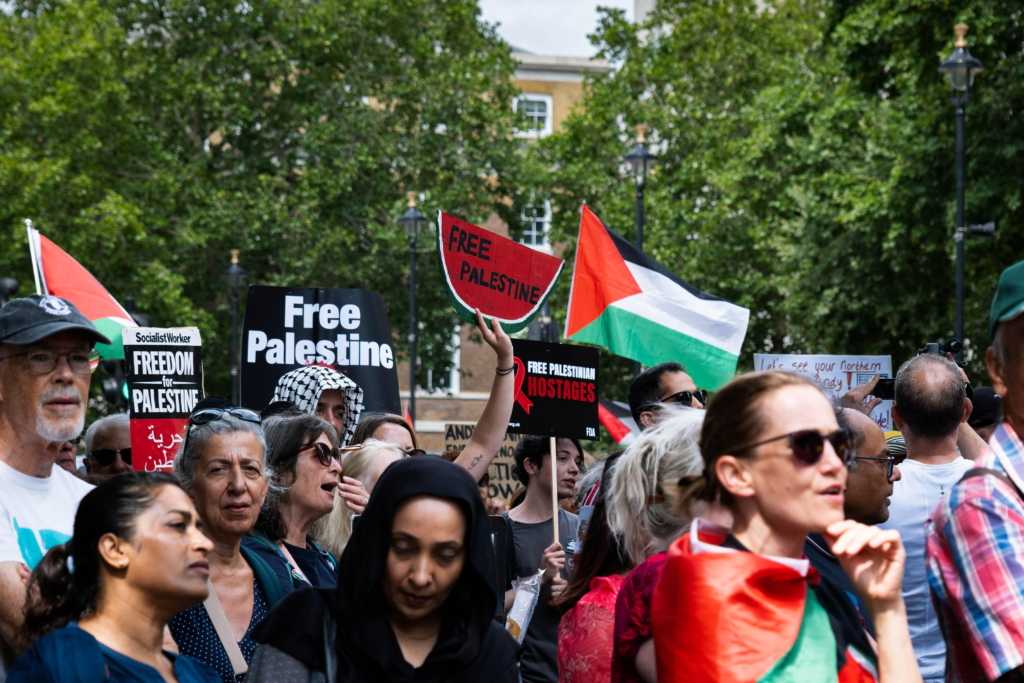
Ein Foto zeigt eine Menschenmenge mit Protestschildern, die in London demonstriert.
Cover image: picture alliance / Sipa USA | JNA PRESS

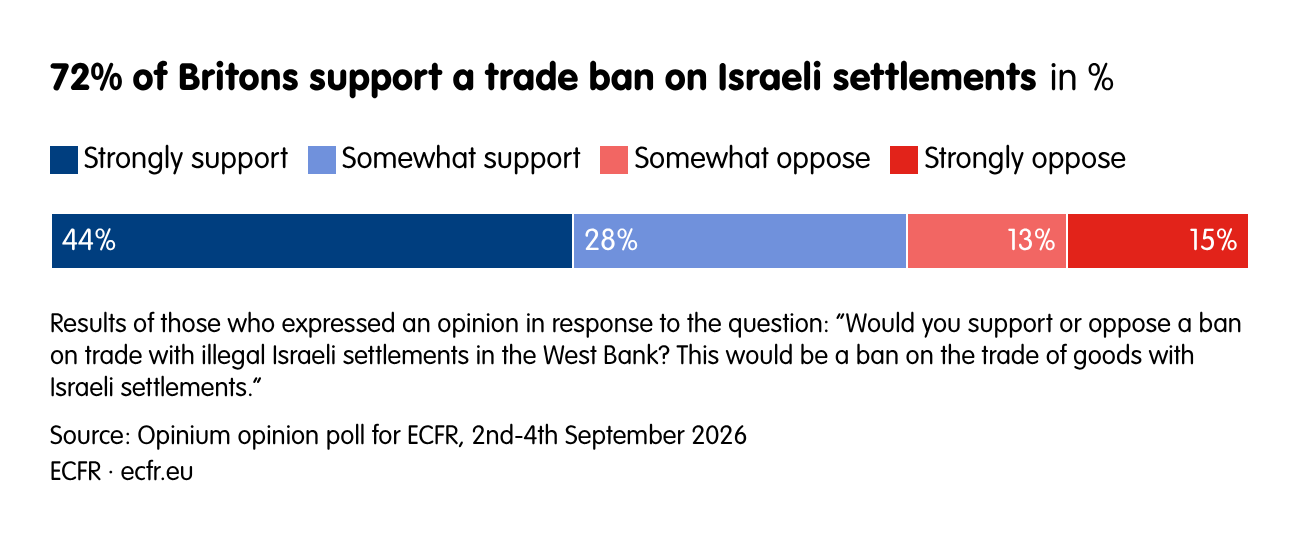
With the British government set to announce new measures targeting Israel’s settlement project, polling by Opinium for ECFR shows that just 18% of UK adults oppose a ban on trade in goods with Israeli settlements in the West Bank and East Jerusalem, compared to 46% who back it. Support rises to nearly three quarters—72% versus 28%—when excluding those who did not voice an opinion.

To date, the UK has sanctioned some two dozen organisations and individuals linked to settler violence. It has also excluded settlement goods from the preferential trade tariffs applied to Israeli products, though stopped short of an outright ban. However, settlement expansion is a state-driven project sustained by domestic economic incentives and foreign financial linkages. Rather than focusing only on its most violent manifestation, a settlement trade ban would challenge these underlying drivers.

72% of Britons support a trade ban on Israeli settlements

Last week, foreign secretary Ed Miliband pledged to go further in challenging Israeli actions that are destroying the possibility of a two-state solution, like the recent construction of the “doomsday” E-1 settlement on the outskirts of East Jerusalem. The settlement ban expected to be announced later today also gives practical meaning to the UK’s recognition of Palestine last year—as demanded by Palestinians themselves. Such action by the British government commands broad support across Britain’s political and regional divides, while opposition is limited.

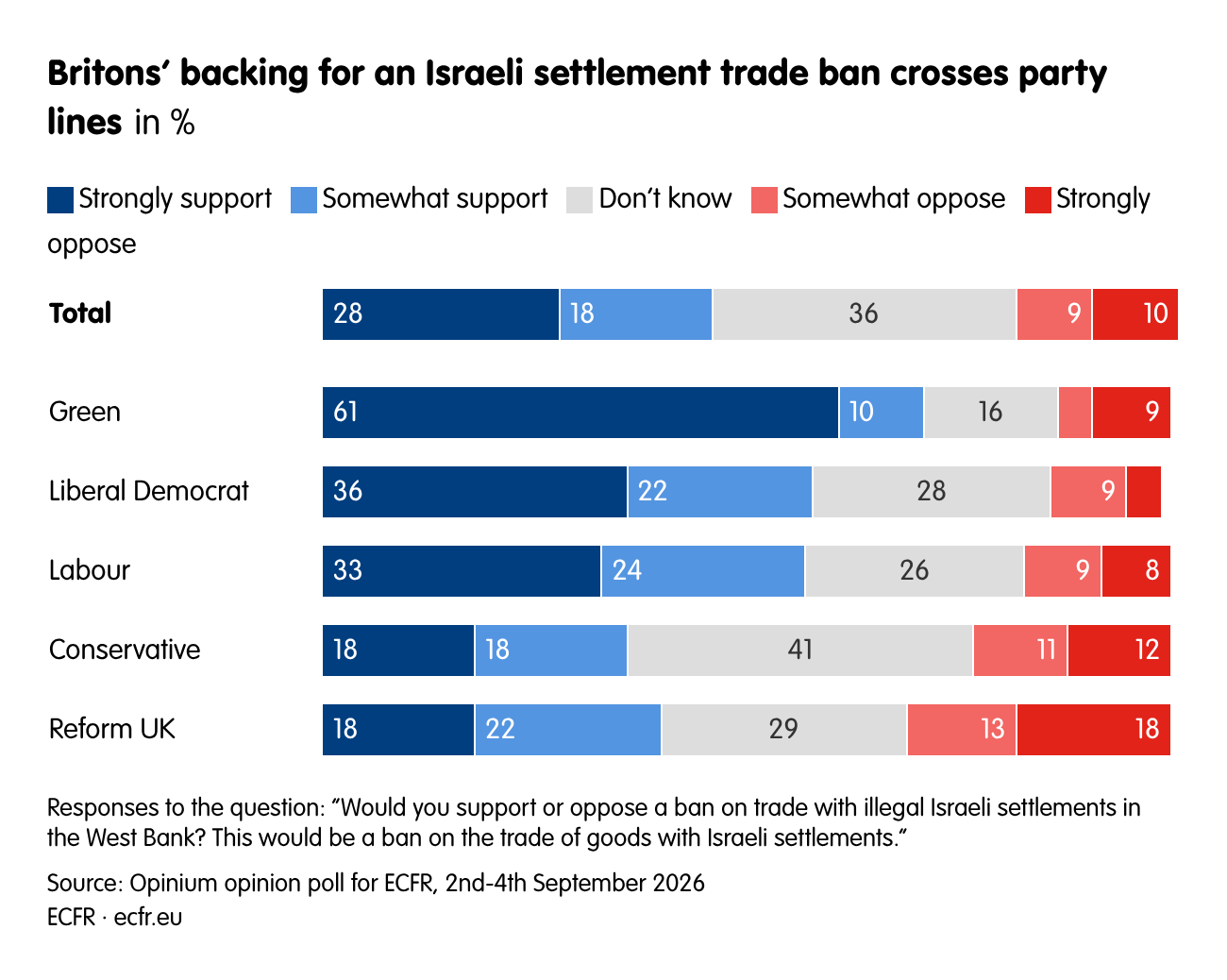
Labour, Liberal Democrat and Green voters decisively favour the proposed ban. It is also strongly supported by voters who have moved away from Labour, many of whom defected to the Green Party amid dissatisfaction with prime minister Keir Starmer’s response to Israeli actions in Gaza and the West Bank. But backing for the measure extends across party lines: Conservative and Reform voters are also more likely to support than oppose it.

Britons’ backing for an Israeli settlement trade ban crosses party lines

The findings cross the Brexit divide too, with supporters clearly outnumbering opponents among both Remain and Leave voters. The same pattern is evident geographically. Support is highest in London and Scotland, closely followed by Northern Ireland, while supporters also outnumber opponents in every English region and in Wales. Indeed, across every political, regional, age and gender group reported in the survey, support exceeds opposition.

The polling also finds that only 16% of British adults consider it antisemitic to target Israeli settlements. Meanwhile, a two-state solution remains by far the most popular outcome for Israel and Palestine with 40% favouring a Palestinian state alongside Israel, compared with 12% who favour a single shared state and just 8% who prefer the status quo of Israel without a Palestinian state.

ECFR’s polling shows a clear public mandate for the UK to take a leadership role in strengthening international efforts against Israel’s settlement project

ECFR’s polling shows a clear public mandate for the UK to take a leadership role in strengthening international efforts against Israel’s settlement project and to defend the viability of a two-state solution. This would build on similar moves by Belgium, Ireland, the Netherlands and Spain in recent months.

The results also suggest the UK government has the public support to go further: extend the ban to investment and financial services, exclude settlements from all UK agreements with Israel (including the convention for the avoidance of double taxation) and prohibit all British business dealings with settlements (including the purchase of settlement real estate). This should go hand-in-hand with additional sanctions targeting organisations that play an instrumental role in funding and sustaining Israel’s settlement project, such as Ateret Cohanim, the Jewish National Fund’s Himnuta real-estate subsidiary, and the Settlement Division of the World Zionist Organization.

At the heart of the new UK government’s policy reset should be a collective push with its Western partners to finally implement the International Court of Justice’s 2024 advisory opinion on Israel’s occupation. The court underscored the duty of states to “take steps to prevent trade or investment relations that assist in the maintenance of the illegal situation created by Israel in the Occupied Palestinian Territory”. To uphold this approach would also help give effect to the 2016 UN Security Council Resolution 2334, which calls on states to distinguish, in their relevant dealings, between Israel and the Palestinian territories it has occupied since 1967.

A settlement trade ban should mark the beginning of a more consequential British policy towards Israeli settlements. The polling shows that British public opinion is supportive. Having recognised Palestine in principle, the UK must now use its economic weight and diplomatic leadership to preserve it in practice.

Source

  •  

A Century of Extraction: Tata, Magadi and Kenya’s Ongoing Economic Decolonization

On September 3, 2026, Kenyan President William Ruto made a momentous announcement that symbolized the end of an era of colonial legacy in the industrial sector of this African country. A Century-Old Trona Extractor Shown the Door William Ruto announced that he had directed Tata Chemicals Magadi Limited to stop operations at the Magadi plant, […]
  •  

Migration ministers agree on Return Hubs in third countries

The meeting of the Core Group’s migration ministers, comprising ministers from Denmark, Austria, Germany, the Netherlands and Greece, concluded in Copenhagen on Friday. Greece was represented by Migration and Asylum Minister Thanos Plevris. According to state-run news agency amna.gr, the ministerial meeting marked an important milestone for European migration policy, with the participating countries advancing […]

The post Migration ministers agree on Return Hubs in third countries appeared first on Keep Talking Greece.

  •  

Maximum pressure on Iran, round two

This week, Mark Leonard is joined by Ellie Geranmayeh, deputy director of ECFR’s Middle East and North Africa programme, to unpack a volatile new chapter in the confrontation between the United States and Iran. After months of managed escalation, military strikes have resumed and President Donald Trump has launched an ambitious new sanctions package, dubbed an economic “D-Day”, aimed at squeezing Tehran into submission.

Ellie argues that Washington has returned to a familiar strategy of maximum pressure, betting that unprecedented economic isolation and a blockade of Iranian exports will either force the regime to make major concessions or trigger domestic unrest. But Tehran appears determined to hold out, relying on sanctions-evasion networks, regional diplomacy and the belief that the US will struggle to sustain its campaign over the long term. As both sides continue limited military operations while keeping channels for negotiation open, the prospect of a comprehensive deal remains elusive.

The conversation also explores the domestic pressures facing Iran’s leadership, from a shrinking economy and growing public dissatisfaction to the threat of renewed nationwide protests. Mark and Ellie examine whether economic hardship could destabilise the regime, why Iranian leaders remain sceptical of American commitments and how internal politics in both Washington and Tehran are shaping the path ahead.

Finally, they discuss the wider regional and European implications of the conflict. How are Gulf states positioning themselves between the US and Iran? What risks does the confrontation pose to global shipping through the Strait of Hormuz? And can European governments still play a meaningful diplomatic role as tensions rise and fears grow that the Iran conflict could become increasingly entangled with the war in Ukraine?

This podcast episode was recorded on September 3rd 2026.

Bookshelf

Hillbilly Elegy, by J.D. Vance.

Source

💾

  •  

Communicating Vessels: How, Through the West’s Fault, Libya and Sudan Became a Single Disaster Zone

In the news feeds, Libya and Sudan exist as separate storylines: one is remembered when the conversation turns to migrants, the other when bombs fall on Khartoum. Two wars. Two countries. Four thousand kilometers of coastline that never meet, and a thousand kilometers of shared desert that connects everything. On the map of real influence, […]
  •  

Revolutions

Joël Kyaviro is a professional cyclist from the Democratic Republic of the Congo who has risen above government instability, war, violence, poverty, and Ebola, overcoming every “tack in his path” to become the first rider from the DRC to win a Union Cycliste International race. What’s more, he’s used his success to get the next generation of kids interested in the sport by founding Tumaini Academy, “a cycling program aimed at transcending war by getting Goméen kids on bikes and in school.”

He rolled into the finish zone alone, a full ten seconds ahead, the cushion so big that he was able to victoriously throw his arms in the air. He coasted the last few meters no hands, grinning ear to ear, as his old club president, Charles Guy Makongo, leapt up and down on the sidelines.

Makongo’s sneakers got soaked in the puddles, but he did not care. In the entire 126-year run of the Union Cycliste International, no Congolese rider had ever won a UCI race. On Instagram that night, a picture of Joël ran with a banner header reading, “A historic moment in Congolese cycling.” Posting on an African cycling forum, Makongo proclaimed, “Today’s victory is much more than a sporting result.” It showed, he said, “that talent can flourish even in the most challenging environments.”

  •  

Climate of concern: The changing face of social movements in North Africa

TUNISIA TUNIS ENVIRONMENT PROTEST POLLUTION
Cover image: picture alliance / Hans Lucas | Imen Ben Youssef

The profile of social activism in North Africa is changing. Young people in the region shifted away from demanding regime change after the thwarted hopes of the 2011 Arab uprisings and the 2019 Hirak movement in Algeria. Now, they tend to seek practical improvements in their social and economic conditions rather than wholesale political reform.

Many of these new social movements focus on environmental concerns, and increasingly on the impact of global warming. North Africa is among the regions in the world most affected by climate change. But its countries are also some of the most promising sites for renewable energy generation, given their abundant sunshine and proximity to the European market. Activists have targeted some renewables projects, testifying to a feeling that authorities are failing to ensure energy transitions are fair and meaningful.

These trends in activism in North Africa match a recent turn in European engagement with the region, away from support for political reform and towards socioeconomic issues. This includes cooperation on clean energy projects. But Europeans should bear in mind that cooperation with North African governments on projects that ignore local interests will fall short of the objective of promoting greater opportunity and long-term stability in the region. This underlines the importance of including local businesses and civil society representatives in initiatives from the very start.

Changing social movements

The Arab uprisings and Hirak protests were driven in large part by social and economic concerns, and sought a political remedy by calling for a change of government. But hopes for better politics have since foundered across North Africa. The region’s protests and social movements now tend to focus on practical and often locally based demands for a more effective state and better services for communities. The 2025 Gen Z protests in Morocco, for example, began as a response to failings in maternity health care before swelling into wider calls for social justice. The shift to more issue-based activism reflects North Africans’ disappointment in past attempts at political reform as well as long-simmering social tensions. These include anger at poor governance and the strain rapid urbanisation puts on jobs and housing.

The shift to more issue-based activism reflects North Africans’ disappointment in past attempts at political reform as well as long-simmering social tensions

But climate change is also encroaching ever more on North Africans’ quality of life. Historically a water-scarce region, North Africa is now experiencing extreme temperatures, rising sea levels, drought and desertification. Once-fertile agricultural land is becoming barren, and flooding from extreme weather events exacerbates the problems for farmers and food supplies. Climate change is also contributing to power cuts and water shortages, as well as catastrophes from flash floods to wildfires. One opinion poll in 2024 showed that one in six people in North Africa had experienced harm from climate change in the previous two years (or knew somebody who had), and that 71% of North Africans saw it as a threat.

With governments often failing to implement policies to mitigate climate impacts, social movements have adopted an environmental focus. These movements sometimes blend protest with community self-help initiatives, and are often local rather than national. Their less explicitly political nature brings them a measure of tolerance by authorities, as does the fact that the movements often pursue environmental objectives that governments also embrace. But activists still face similar restrictions to all civil society movements in North Africa, at times drawing surveillance and repression.

Changing the environment

Such climate-related movements have sprung up across North Africa. In Morocco, a group of Tangier-based NGOs and unions halted a building development that would have involved deforestation, and they now publish an annual report on local environmental issues. Youth for Climate Tunisia trains young people to mobilise on climate issues and organises digital campaigns. The Egyptian group Greenish promotes climate education and capacity building for local communities. Algeria has several community-based groups that work on improving access to water and countering desertification.

Other groups focus on wider environmental concerns. Egypt’s VeryNile pioneered efforts to work with local fishers to collect and recycle plastic pollution from the Nile. In Tunisia, local protests against the impact of phosphate processing in Gabès snowballed after a series of toxic gas leaks in October 2025, becoming a mass movement that continues almost a year later.

But North African social movements also mobilise when green transitions disadvantage local communities and marginalised groups. As North African countries increasingly seek foreign investment in renewable energy projects, some communities worry that land and water resources will be diverted to benefit wealthy elites and foreign investors. In Tunisia, solar projects have aroused local opposition because they take land out of community use and reinforce regional inequalities. In Morocco, solar megaprojects such as the plant in Ouarzazate have prompted anger in nearby communities because of the amount of water they consume.

Changing European policy

One thing that unites these disparate movements is that activists seek concrete improvements in quality of life, as well as a bigger role in determining their countries’ futures. This aligns with an increasing sense in Europe that the best way for the EU and member states to promote rights and opportunity in North Africa is through a focus on socioeconomic development.

As the EU’s 2025 Pact for the Mediterranean showed, European policymakers aim to cooperate with North African partners on tangible initiatives that match local government priorities, including in green energy and water management. But the environment-focused social movements should remind European policymakers that working only with governments is not enough to ensure progress on economic and social rights, as I argued in an ECFR policy brief last year. The EU must frame its projects in a way that gives local populations as much agency as possible, by breaking down barriers for small businesses and including civil society in project design and planning.

The EU must also ensure that the projects it supports genuinely offer mutual benefit. In climate policy, the pact’s logic of “a partnership of equals” means European support for renewable energy projects including solar and wind power and the production of green hydrogen. Such projects would then supply clean energy for Europe and promote North African development as well as reduce local energy costs. In turn, greater opportunities and lower prices in the region could help promote the stability that European policymakers also seek.

But not all climate and environmental projects meet these goals—as the local criticisms show. To fulfil the promise of clean energy projects for both sides, Europeans must complement their investment in power generation with other measures to limit environmental trade-offs and to help benefits to flow to local communities. These should include infrastructure development and technology transfer to build up a local clean energy ecosystem. That is the best way for Europe to help ensure that the aspirations expressed in North African environmental movements are met.

Source

  •  

Africa’s Wild Dogs Are the Most Hated Carnivores on the Continent. Here’s Why Some Conservationists Are Saving Them Anyway

Apparently, African wild dogs enjoy knocking around balls of elephant dung like a football. It’s this playfulness that has endeared them to researchers—but, as Helen Sullivan points out, they have their work cut out for them trying to protect this persecuted big predator. Sullivan follows conservationists in southern Africa who are carefully managing tiny, isolated populations and attempting to introduce genetic diversity. The story of the three sisters who are flown over from Mozambique to be introduced to Waterberg—a South African municipality three hours from Johannesburg—is heart-wrenching. Yet in such a harsh environment, individual tragedies have to be endured while staying focused on the bigger picture: the fragile recovery of the species as a whole.

As we help Greyling and Hlako lift a crate off the pickup, a dusty paw flops out of one corner, and I think of something my uncle says: “You can smell the world in a dog’s paw.” Mooney and I back away, watching from inside a container as Hlako moves the car so that the overheating dog is in the shade. Though it is late afternoon, the temperature is still around 90 degrees. 

Hlako and Greyling release the dogs one at a time, opening the crate and waiting until a dog walks, then trots, out. The first is less sure on her feet, the second seems almost normal, until Mooney points out that she would have run much faster from the crate and people had she not still been a bit dozy. The sisters stand together in a grassy area, point their noses in the air, move their satellite-dish ears and lie down under a thorn tree; it has been a long day. 

  •  

Can a ceasefire survive Israel’s election?

This week, Mark Leonard is joined by Hugh Lovatt, senior policy fellow at ECFR, to unpack a turbulent summer in Israel and the Palestinian territories. While Palestinian factions in Gaza have agreed in principle to decommission their weapons , the proposal faces significant obstacles, not least opposition from the Israeli government. Meanwhile settler violence is surging and settlement construction is spreading, redrawing the map faster than any negotiation could.

Hugh explains why a sustainable ceasefire cannot rely on disarmament alone but requires a broader political process that addresses the future governance of Gaza and creates a pathway towards a two-state solution. He also explores why developments in the West Bank could prove just as decisive as those in Gaza, and what role Europe can play in responding to settlement expansion and growing instability.

Against this backdrop, Israelis are preparing to head to the polls on October 27th . Mark and Hugh examine the state of the race, the challenge facing Binyamin Netanyahu, Israel’s prime minister and whether a new government would bring meaningful policy change, or simply a different style of leadership. How much do Gaza and the West Bank matter to Israeli voters? Could an opposition victory create space for greater pragmatism? And what would that mean for Europe’s approach to the conflict?

This podcast episode was recorded on August 24th 2026.

Bookshelf

The Revolutionaries: The Story of the Extremists Who Hijacked the 1970s, by Jason Burke.

Source

💾

  •  
❌