❌

Reading view

US House speaker sees AI data center worries as ‘Chinese psyop’

They’ve been shown to raise electricity bills, pollute drinking water, do little to boost local employment while threatening millions of jobs in a variety of industries, and top executives have warned that the technology they support could wipe out all of humanity by the end of the decade. But rather than take widespread public opposition to artificial intelligence data centers at face value, House Speaker Mike Johnson (R-La.) announced he had […]

The post US House speaker sees AI data center worries as ‘Chinese psyop’ appeared first on Asia Times.

  •  

Data centers will consume less water and energy than many think

Concerns about the water and energy demands of data centers have become prolific in recent weeks. But debates about their impact often overlook the rapid advances in cooling technology and cleaner energy that are already having an impact.

However, data centers’ resource consumption should be front and center of the AI conversion, as it is set to grow rapidly. By 2030, data centers’ water and energy consumption will double as AI demand leads to rapid construction of the infrastructure.

But data centers will not cause the world to run out of water or energy. Water- and energy-saving technologies already in use are reducing their impact, while Shanghai’s groundbreaking underwater data center demonstrates how innovative design can limit water, energy and land use.

Data centers have underpinned the internet since its founding. Apps, email, file storage and cloud services all run through them.

Modern AI workloads, however, have transformed their power demands beyond recognition. Today a single AI data center can match the electricity consumption of 100,000 homes, making them a significant drain on local energy grids, especially if a region is susceptible to shortages.

Data centers’ energy consumption is only rising as more are built across the world. In the US, data centers could increase from 4.4% to 12% of national electricity usage by 2028 — that is equivalent to adding eight New York Cities to the American grid.

Data centers also consume large amounts of water in two main ways. Water is used directly to cool servers and storage systems, which generate considerable heat, and indirectly to produce electricity at fossil fuel power plants where it is heated into steam to drive turbines.

In the UK, data centers have been estimated to use up to eight times as much water as average on hot summer days, underlining how their impact can rise when local resources are already under strain.

As the effects of climate change intensify, the location of data centers, and methods to reduce their water and energy consumption, are becoming ever more important.

Fortunately, resource-saving measures are already being implemented. Data centers on land use closed-loop cooling systems that recycle water rather than continually evaporating it. This can reduce freshwater use by up to 70% compared to traditional open evaporative methods.

China has also pioneered a revolutionary new type of data center in Shanghai: wind-powered, and underwater. The facility, which began full commercial operations in May 2026, uses seawater as a coolant instead of using refrigerated fresh water as land-based data centers do, reducing the electricity required to cool the computers.

It uses at least 30% less electricity than traditional data centers, and offshore wind turbines reduce reliance on fossil fuels and cut the data center’s carbon emissions. Innovative solutions such as these will go a long way to reducing data centers’ resource consumption.

AI is also part of the solution to data centers’ draw on resources. AI can optimise electricity grids and shift computing workloads towards periods when cleaner energy is more efficient, making energy use more effective overall. AI can also anticipate fluctuations in demand and adjust energy consumption accordingly, reducing waste.

It might sound obvious, but some areas are just better equipped to accommodate a data center than others. For example, facilities in hot or water-stressed regions will impose a heavier burden on resources than those supplied by cleaner energy with plentiful water and located in cooler climates.

AI’s growing demand for data centers will increase electricity and water consumption, that is true. But it does not mean the technology will exhaust regional or global supplies of either resource.

The AI boom and the infrastructure buildout accompanying it are well underway. To manage its impact, the industry needs to plan ahead. Cleaner energy, efficient cooling, and sites that have significant water and energy supplies will all limit the infrastructure’s drain on resources.

  •  

AI Data Center Opposition Unites People Across Political Lines as Trump Attacks Americans Who Oppose Big Tech

by Brian Shilhavy
Health Impact News

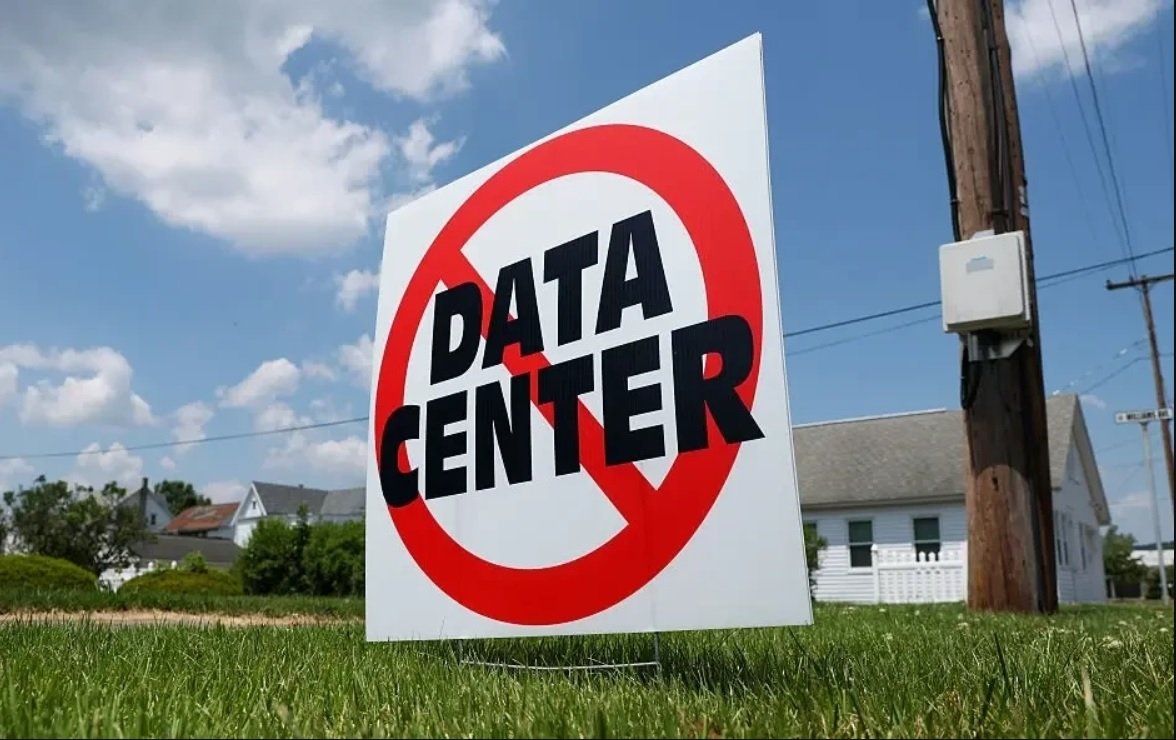
Here in 2026 Americans have finally found an issue that unites them as Americans, regardless of political affiliations: opposition to AI data centers being rapidly built in their communities with little to no oversight, as the AI bubble continues to inflate.

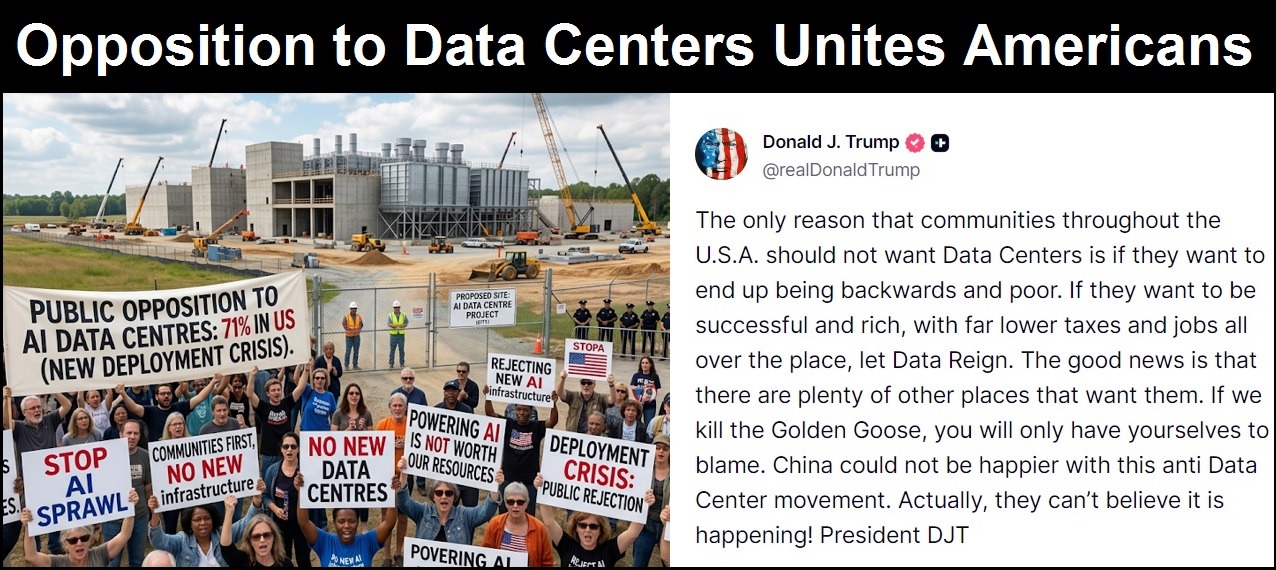
According to a recent Gallup poll, 71% of Americans oppose AI data centers near their homes, triggering a wave of legislation that has already stalled $130B in projects.

Americans unite against data centers, with 71% opposing local builds

A Gallup poll conducted in March 2026 found that 71% of American adults oppose building an AI data center near their home, with 48% saying they are strongly opposed.

For historical context, public opposition to nuclear power plants peaked at 63% during the height of anti-nuclear sentiment. Opposition to AI data centers sat somewhere between 42% and 47% in late 2025. By March 2026, Gallup had it at 71%. A separate May 2026 Heatmap Pro poll confirmed the figure, also recording 71% opposition, but with an even sharper edge: 55% of respondents in that survey said they were strongly opposed.

Around half of data center opponents cite electricity and water consumption as their primary grievances. The rest of the opposition cohort points to noise, pollution, and the prospect of higher utility bills.

Gallup found that between 63% and 75% of both Republicans and Democrats oppose local data center construction.

In the first quarter of 2026 alone, community and legislative actions blocked or delayed more than 75 data center initiatives, representing over $130 billion in planned investment.

Roughly 300 state-level bills targeting data center regulation were introduced in the first half of 2026. New York’s governor signed an executive order in July 2026 pausing new hyperscale data center permits for a year. California and other states are advancing their own regulatory frameworks.

Source.

One has to wonder what is up with the other 29% of Americans who are not opposed to these data centers? I would imagine that they are the “faithful MAGA base” who continue to “trust the plan” and cheer the bombing of innocent people, including children, in places like Gaza, Lebanon, and Iran as they continue to worship their Pedophile in Chief, Donald Trump.

Donald Trump has attacked these Americans who make up over 70% of the country, stating that “The only reason that communities throughout the U.S.A. should not want Data Centers is if they want to end up being backwards and poor.”

If you do not live in a community where a new data center is being constructed, and are wondering what all the fuss is about, I have put together a short video that is just over 10 minutes long where you can hear it from the people themselves in these communities that Trump has belittled.

Fox News and some other Right-wing Conservative groups are trying to cast these people who oppose data centers as being part of the “far-left”.

So listen to these people yourself and see if they sound like “far-left” climate control freaks, or if they sound like ordinary, average Americans concerned about their homes, their families, and their future with Big Tech in control. (Video also can be watched here.)

Ohio is one of the largest battlegrounds where this is happening, as both Larry Ellison’s Oracle and Facebook parent company Meta are each building huge data centers in their state.

One of the most outspoken persons in Ohio, who was the last one who spoke in the video above, is Carl Setzer, who accurately stated that there is a huge AI bubble, and that there is no guarantee that any of these companies will even be around in 10 years.

And the current facts backup Setzer’s concerns.

Larry Ellison, the billionaire Zionist friend of Donald Trump and owner of Oracle, has already lost hundreds of billions of dollars with his investing into AI.

One analyst has already stated that the AI bubble is 17 times larger than the dot-com bubble, and four times the size of the 2008 real-estate/subprime bubble.

Oracle’s Massive AI Bet Has Already Cost Larry Ellison $207 Billion. Analyst Warns the AI Bubble Is 17 Times Bigger Than the Dot-Com Bubble.

Larry Ellison’s Oracle gambled its balance sheet on an AI future that analysts are now calling the most dangerous financial bubble in history, and the bill is coming due faster than anyone expected.

by AJ Tiarsmith
24/7 Wall Street

Excerpts:

Larry Ellison has lost $207 billion in less than a year.

Oracle’s market value has fallen by roughly $494 billion since peaking at $877.1 billion in September 2025.

Oracle’s Q4 8-K reported Remaining Performance Obligations of $638 billion, up 363% year-over-year, most locked into long-dated contracts that will not convert to cash for years.

A large chunk ties to OpenAI, whose IPO has slipped to 2027.

S&P Global downgraded Oracle’s credit rating, warning the buildout might pay off long term but could weaken near-term financial position. Melius Research questioned whether Oracle’s spending plans hold if OpenAI or Anthropic scale back demand for compute.

Sitting behind all of it: Project Stargate, a plan to invest up to $500 billion in AI-focused data centers over four years.

The 17x Thesis

In October 2025, Julien Garran, partner at UK firm MacroStrategy Partnership, published a report arguing the AI investment frenzy is a “misallocation of capital” 17 times the size of the dot-com bubble and four times the size of the 2008 real-estate/subprime bubble.

He called it

“the biggest and most dangerous bubble the world has ever seen.”

His “golden rule” case: large language models are statistical word-prediction engines with architectural limits, coding tools reproduce rote patterns, and capability has hit a “scaling wall” since GPT-4 launched in March 2023.

Garran’s answer to “who is actually making money” is blunt: only NVIDIA. Data-center operators, LLM developers, and LLM-based software vendors are, in his framing, “all heavily loss-making” and depend on a “permanent funding tour” of new rounds, with SoftBank and sovereign funds like Saudi Arabia’s serving as backstops.

Full article.

The Great Reset is coming.

And thanks to The Leah Files, we now know the plan that has just been executed by Treasury Secretary Scott Bessent and Secretary of Commerce Howard Lutnick to kill the U.S. dollar and replace it with crypto Stablecoins. See:

Treasury Secretary Scott Bessent Just Restructured The American Financial System to Destroy the U.S. Dollar

This article was written by Human Superior Intelligence (HSI)

See Also:

Understand the Times We are Currently Living Through

Second Edition of eBook Released: The Concept of the American Christian Family is a Myth and is NOT Found Anywhere in the Bible – by Brian Shilhavy

FREE eBook! Restoring the Foundation of New Testament Faith in Jesus Christ – by Brian Shilhavy

The Brotherhood of Satan vs. The Brotherhood of Jesus Christ

KABBALAH: The Anti-Christ Religion of Satan that Controls the World Today

Exposing the Christian Zionism Cult

The Bewitching of America with the Evil Eye and the Mark of the Beast

Jesus Christ’s Opposition to the Jewish State: Lessons for Today

Identifying the Luciferian Globalists Implementing the New World Order – Who are the “Jews”?

The Brain Myth: Your Intellect and Thoughts Originate in Your Heart, Not Your Brain

What is the Condition of Your Heart? The Superiority of the Human Heart over the Human Brain

The Seal and Mark of God is Far More Important than the “Mark of the Beast” – Are You Prepared for What’s Coming?

The Satanic Roots to Modern Medicine – The Image of the Beast?

Medicine: Idolatry in the Twenty First Century – 10-Year-Old Article More Relevant Today than the Day it was Written

Having problems receiving our emails? See:

How to Beat Internet Censorship and Create Your Own Newsfeed

We Are Now on Telegram. Video channels at Bitchute, and Odysee.

If our website is seized and shut down, find us on Telegram, as well as Bitchute and Odysee for further instructions about where to find us.

If you use the TOR Onion browser, here are the links and corresponding URLs to use in the TOR browser to find us on the Dark Web: Health Impact News, Vaccine Impact, Medical Kidnap, Created4Health, CoconutOil.com.

The post AI Data Center Opposition Unites People Across Political Lines as Trump Attacks Americans Who Oppose Big Tech first appeared on Health Impact News.

  •  

What if America Went Completely Dark?

More than a decade ago, a group of snipers shot up an electrical substation in Silicon Valley, striking power transformers and disabling the substation for nearly a month. The shooters were never identified; similar substation shootings, some by neo-Nazis, have taken place since. The longer Christopher Cox studies the American power grid—looking at aging infrastructure and ongoing transformer shortages, specialized manufacturing and rising demand, the massive energy consumption of data centers and whiplash usage of large language models—the more vulnerable it seems. “Somehow, we’ve made the industrial equivalent of a Fabergé egg the linchpin of our civilization,” Cox writes. “What would happen if someone started breaking them?”

The hope of restoring the grid would fade as fossil fuel supplies were exhausted, because so many utilities rely on them to “black-start” their generating units. A 2010 report called “High-Impact, Low-Frequency Event Risk to the North American Bulk Power System,” prepared by the Energy Department and NERC, condensed the entire disaster movie that would follow into a single paragraph: “The supply of food, water and fuel would degrade within days. The facile communication of information to the general population would be greatly complicated by the loss of cellphones, internet access and television. The economy would virtually shut down as electronic transactions could no longer be processed. After several days, widespread social unrest and confusion would ensue.” Thirsty, starved, dirty and surrounded by the useless machines we once depended on, we would be lucky if our misery ended at “confusion.”

  •  

Pentagon Plans AI Data Centers At Military Bases

Technocrats have pried open Federal land for AI data center construction. You might have missed Trump’s Executive Order 14318, “Accelerating Federal Permitting of Data Center Infrastructure,” on July 23, 2025, alongside the release of the “Winning the Race: America’s AI Action Plan.” Waiting to pounce with billions of dollars were large investment companies like BlackRock, KKR, Blackstone, and Carlyle. So far, it’s a feeding frenzy.

Trump signed 220 Executive Orders during his first term (2017-2021); he’s far ahead of that pace with 270 EO’s signed in the first 19 months of this term. ⁃ Patrick Wood,  Editor.

At Dugway Proving Ground in Utah, on ground the Army’s own contracting documents describe as previously used for grazing, a company owned by two of the largest investment firms in the world is preparing to build a data center.

That site sits about an hour’s drive from the nearest community, on the installation where the U.S. military conducts its primary chemical and biological weapons testing. Three parcels there total roughly 3,466 acres. One of them, about 1,201 acres, is already spoken for.

It is one of at least a dozen military installations the Army and the Department of the Air Force have opened to commercial data center developers over the past year and a half. Two of those deals are real; the rest are still proposals.

Land-for-Computing

In late March, the Army conditionally selected two companies to enter exclusive negotiations to build and operate commercial hyperscale data centers on Army land.

Carlyle, the global investment firm, was picked for roughly 1,384 acres at Fort Bliss, Texas. CyrusOne, a data center operator jointly held by funds managed by KKR and BlackRock, was picked for the parcel at Dugway. Each project is estimated to cost about $2 billion, according to the Financial Times.

The companies will be responsible for financing, building, operating, maintaining and eventually decommissioning the facilities, the Army said, on what it called “underutilized but non-excess Army land at no upfront cost to taxpayers.” In exchange for the land, the service gets access to computing power.

It all runs through the Army’s Enhanced Use Lease program, driven by a Trump executive order directing agencies to open non-excess federal land to data center development. The U.S. Army Corps of Engineers is handling lease negotiations and environmental review.

“AI is a strategic asset for the Army,” Army Secretary Dan Driscoll said in the March announcement. “It is a force multiplier, supports future transformation and requirements, keeps the Army ahead of our adversaries, and generates resiliency across the force.” Driscoll told the Wall Street Journal that the Fort Bliss facility would be “the first hyper-scale data center that the Pentagon has ever done.”

Which Bases and How Close to Housing?

Only Fort Bliss and Dugway have been awarded so far, and even those remain conditional, pending negotiation. Beyond them, federal contracting documents show the Army considering data centers at Fort Hood, Texas, and Fort Bragg, N.C.

The Department of the Air Force put out its own call in 2025 for private AI data center projects on unused land at Arnold Air Force Base, Tenn., Edwards Air Force Base, Calif., Joint Base McGuire-Dix-Lakehurst, N.J., Davis-Monthan Air Force Base, Ariz., and Robins Air Force Base, Ga.

More recently, it sought bidders for facilities at Joint Base Elmendorf-Richardson, Eielson Air Force Base and Clear Space Force Station in Alaska. Acreage varies enormously; for example, Fort Hood has 207 acres on offer. Fort Bliss has nearly seven times that.

Dugway is remote by design, although not every site is. Contracting documents show the Army weighing a parcel at Fort Hood within a half-mile of residential and commercial property, and several potential locations at Fort Bragg within one mile of civilian areas and a half-mile of civilian housing.

Proximity to the population is what has made data centers a heated topic in the civilian world. Nearly $156 billion in projects nationwide have been delayed or canceled after local opposition, according to Data Center Watch.

In Virginia, which holds the world’s highest concentration of the facilities, a state-funded study found residents’ monthly energy bills could rise by $14 to $37 by 2040.

Army Officials Say They’re Ready

“So I think the difference between us, the Army, doing a data center, and say Meta or Google, is we’re part of the communities that are there, and we are going to engage with them on a routine and regular basis to look for solutions that work for everyone, right?” Col. John Oliver, executive officer for Deputy Army Under Secretary Dave Fitzgerald, told Defense One. “Because, yes, we understand that there’s been consternation with data centers.”

Two requirements attached to these projects do not apply to commercial builds off base. Proposals must include net-zero water usage and a power plan that does not draw on the local electrical grid. Bidders were also required to describe plans for “local outreach and engagement” and to assess “any risks or opposition” to the project.

The Defense Department’s own procurement documents, obtained by the trade publication Data Center Dynamics, rate the water risk for the El Paso area as “Extremely High.” Data centers consume water to cool their servers. Fort Bliss is where the Army wants its flagship.

Army officials want the project to be a net contributor rather than a net drain. In the spring, Fitzgerald traveled to Fort Bliss for a listening session with the commander of the 1st Armored Division, community members, El Paso Water, El Paso Electric and Carlyle. One idea on the table is having the developer drill a new well to feed the city’s desalination plant, offsetting what the data center uses.

“We are encouraging Carlyle to do that, so actually make it net-positive,” Oliver told Defense One. “We don’t know if that’s an engineering solution that we can actually get to yet, but we’re actively working toward that as a part of the process.”

Darrell M. West, a senior fellow at the Brookings Institution who studies data center development, said the approach is sound, and that communities which have accepted the facilities tend to be the ones told the full details in advance.

“People want to know up-front, you know, where the energy is coming from, how much water is being used, how much the overall cost is going to be, and what the noise levels are,” West said.

Congress Not Settled

Rep. Cory Mills, a Florida Republican, secured a provision in the House version of the fiscal 2027 defense authorization bill. This bill bars the Defense Department from leasing land for data centers unless developers agree not to install equipment containing components made in China, Russia, Iran or North Korea. The restriction covers certain printed circuit boards, advanced semiconductors and chipsets the department considers a security risk.

“Honored to pass this amendment to protect our military installations from Chinese components being used in data centers on our installations,” Mills wrote on X.

The Army objected. The measure would create a “federal land penalty,” a service official told Federal News Network, imposing rules on companies building on installations that would not apply to identical projects built anywhere else. “We want Congress to incentivize companies to build on secure federal land, rather than creating barriers that drive them away,” the official said.

Rep. John Garamendi, a California Democrat, proposed requiring the Pentagon to evaluate a data center’s energy and water consumption, noise and light pollution, and effects on security and supply chains before finalizing any deal. House Armed Services Republicans rejected it.

“We’re not opposed to data centers,” Garamendi said. “We just want to make sure that if we’re going to put a data center on a federal facility, that federal facility is not going to be degraded by the data center.”

His questions were installation questions. “Is there encroachment on training and operations and the physical and supply chain of security?” he asked.

Senate Armed Services Republicans defeated a separate Democratic amendment that would have blocked leasing until the Pentagon finalizes a data center strategy. House appropriators, meanwhile, adopted language acknowledging that data centers “place significant strain on energy and water resources and communities have resisted such projects.”

Available Information

For anyone stationed at or living near one of these installations, several things are known for sure. Only two projects have been awarded, and both remain conditional. Fort Hood, Fort Bragg and the Air Force sites are solicitations, not commitments.

Initial operating capability at Fort Bliss is projected for fiscal 2027 and at Dugway for fiscal 2029. That is when the first capability comes online, not when a finished campus exists. Oliver has described the long-term vision as a campus with a commercial side, a classified military data side, and onsite power generation.

The Army Corps of Engineers is conducting the environmental review at both awarded sites. Developers must build independent power that does not tap the local grid and meet net-zero water usage. Excess power generated on base could potentially be sold back to civilian grids.

The Association of Defense Communities has scheduled further discussion of military data center development at its Installation Innovation Forum in October 2026.

Read full story here…

  •  

Terrified Tech Execs Are Traveling With Armed Bodyguards as AI Backlash and AI Bubble Grow

by Brian Shilhavy
Health Impact News

Today was another down day in Tech stocks, which brought out the AI Bubble doomsday scenarios that are more frequently being discussed in the Corporate Financial news networks.

Barbara Kollmeyer, writing for Market Watch, covered an opinion piece written by analyst Ed Zitron who stated that the Lehman Bros. moment of the AI bubble is coming, which will affect the entire stock market.

The Lehman Bros. moment of the AI bubble is coming, says this critic warning of fallout for tech stocks and the entire market

Ed Zitron sees a downfall driven by loss-making subscriptions and an insatiable need for cash

Excerpts:

Blowout results from chip giant Taiwan Semiconductor Manufacturing Co., or TSMC, seem to be doing little for sentiment on Thursday.

Worries about whether spending on artificial intelligence will pay off have been a downer for some stocks lately. Our call of the day from Ed Zitron, author of “The Hater’s Guide to the AI Bubble,” won’t help much.

In a 15,000-word Substack post on Wednesday, Zitron, the founder of a technology-focused public-relations firm, argues that the question is not if, but when, OpenAI will collapse.

“Its failure would be a watershed moment — the Lehman Brothers of the AI bubble, and an event that would define the end of one epoch, the start of another, and that would shake the afflicted out of that psychosis,” he writes.

A dogged AI critic, Zitron sees a “cultlike” derangement around what he sees as an AI bubble kept alive by OpenAI’s existence.

Back in early 2023, when Zitron said he started researching large language models, he called generative AI “the latest gold rush in technology.” He predicted two years ago that OpenAI’s Sora video generator was not viable — and it was canned this March.

His Substack post attacks OpenAI’s business model and its plan to “burn over $852 billion by the end of 2030,” along with the $50 billion or more in compute spending this year. The latter, he estimates, is “more than 50% of all global compute spend.”

As OpenAI and Anthropic raised $300 billion in the past few years, their infrastructure costs have been funded largely by hyperscalers, who have been creating an illusion that more companies will eat up compute like OpenAI, he wrote.

Oracle, he notes, is in particular danger from a prospective OpenAI collapse, as it could get stuck with “billions of wasted capex, and endless debt and leases.”

Zitron predicts that OpenAI’s collapse will only come after “AI data center debt and venture capital funding has been almost entirely exhausted,” as OpenAI has vast money needs.

“Based on my own reporting on its audited financials from 2024 and 2025, OpenAI will need to raise funding at least three more times in the next decade,” he says.

Its downfall will be driven by loss-making subscriptions, weak advertising revenue and massive costs for customers, Zitron says. That will curb compute demand, end free ChatGPT and make investors wary of any AI startup, not to mention seizing up related data-center debt.

Zitron doesn’t think Anthropic is safe, either, as it’s burning billions on training models, producing way too many Claude iterations and lacking focus.

An OpenAI collapse will lead to a “violent, punishing effect on the entire stock market,” he says.

The scale, he says, scares him “to the point I’m almost hoping I’m wrong.”

Full article.

The Wall Street Journal today published an “Exclusive” article titled The AI Backlash Has Tech Executives Fearing for Their Lives, which was picked up by many other media sources as well.

Since that is behind a paywall, here is an article discussing this published on Futurism.

Terrified Tech Execs Are Traveling With Armed Bodyguards as AI Backlash Grows

Excerpts:

Public backlash to AI is intensifying — and transforming into real-world attempts at physical violence. Industry leaders are fearing for their lives.

Leading AI companies and their top executives are beefing up security, the Wall Street Journal reports, as escalating anti-AI industry sentiment is culminating in threats and attempts of violence against the people and ventures building leading AI models. Some executives are even traveling with armed guards, while others have taken to keeping a lower public profile.

“Tech CEOs, a few years ago, definitely did not have security,” Dakota Dominguez, an executive at the Silicon Valley-based security firm JPT Security, told the WSJ.

“A lot of tech companies now are incorporating that into their budgets.”

Earlier this year, the AI industry was shaken when a 20-year-old anti-AI activist named Daniel Moreno-Gama, armed with a gun and a Molotov cocktail, unsuccessfully tried to firebomb the home of OpenAI CEO Sam Altman. No one was injured, but the high-profile incident followed a string of violent threats and at least one OpenAI lockdown.

OpenAI isn’t alone. Per the WSJ, around the time that Altman’s home was targeted, OpenAI rival Anthropic faced a close call when a man snuck into its headquarters behind an employee carrying an envelope with an executive’s name on it. The man reportedly then told a guard that the executive was “going to be killed.” The man was stopped before anyone got hurt.

All in all, it’s easy to see why tech leaders are budgeting for beefed up security.

Theodora Scarato, the Director of Wireless and EMF Program, was interviewed on Redacted about the health hazards these huge mega Data Centers are causing the the American public.

Related:

“Dirty” Electricity is a National Problem Affecting Everyone’s Health in the United States

This article was written by Human Superior Intelligence (HSI)

See Also:

Understand the Times We are Currently Living Through

FREE eBook! The Concept of the American Christian Family is a Myth and is NOT Found Anywhere in the Bible – by Brian Shilhavy

FREE eBook! Restoring the Foundation of New Testament Faith in Jesus Christ – by Brian Shilhavy

The Brotherhood of Satan vs. The Brotherhood of Jesus Christ

KABBALAH: The Anti-Christ Religion of Satan that Controls the World Today

Exposing the Christian Zionism Cult

The Bewitching of America with the Evil Eye and the Mark of the Beast

Jesus Christ’s Opposition to the Jewish State: Lessons for Today

Identifying the Luciferian Globalists Implementing the New World Order – Who are the “Jews”?

The Brain Myth: Your Intellect and Thoughts Originate in Your Heart, Not Your Brain

What is the Condition of Your Heart? The Superiority of the Human Heart over the Human Brain

The Seal and Mark of God is Far More Important than the “Mark of the Beast” – Are You Prepared for What’s Coming?

The Satanic Roots to Modern Medicine – The Image of the Beast?

Medicine: Idolatry in the Twenty First Century – 10-Year-Old Article More Relevant Today than the Day it was Written

Having problems receiving our emails? See:

How to Beat Internet Censorship and Create Your Own Newsfeed

We Are Now on Telegram. Video channels at Bitchute, and Odysee.

If our website is seized and shut down, find us on Telegram, as well as Bitchute and Odysee for further instructions about where to find us.

If you use the TOR Onion browser, here are the links and corresponding URLs to use in the TOR browser to find us on the Dark Web: Health Impact News, Vaccine Impact, Medical Kidnap, Created4Health, CoconutOil.com.

The post Terrified Tech Execs Are Traveling With Armed Bodyguards as AI Backlash and AI Bubble Grow first appeared on Health Impact News.

  •  
❌