❌

Reading view

Military Situation In Ukraine And Ukrainian Attacks On Russian Territory On October 4, 2026 (Maps Update)

Click to see the full-size image

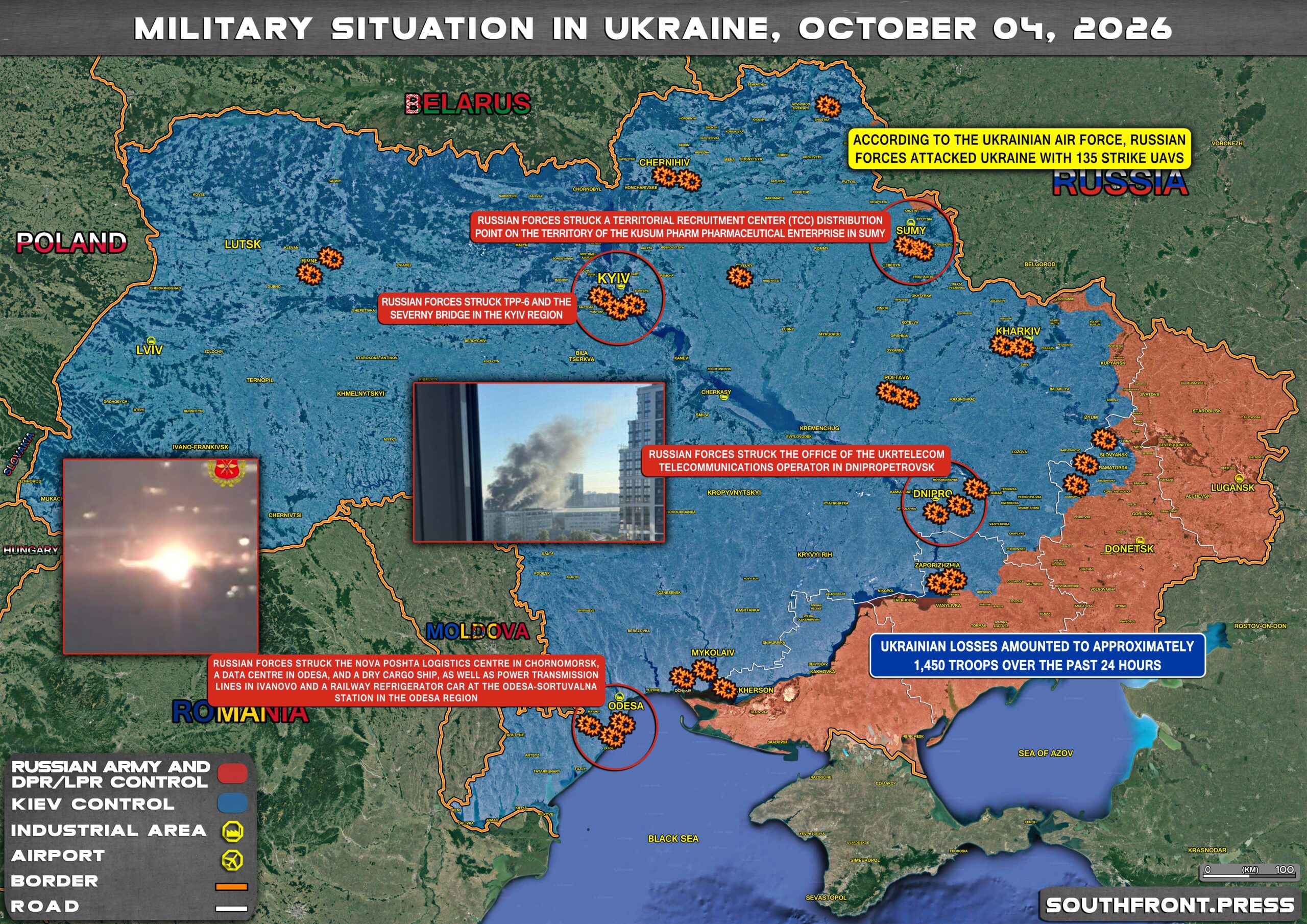
  • Russian strikes destroyed targets in the Sumy, Shostka, Kharkiv, Zaporizhzhia, Dnipropetrovsk, Kherson, Kyiv, Odesa, Mykolaiv, Chernihiv, Poltava, Zhytomyr, Rivne regions, and the DPR;
  • According to the Ukrainian Air Force, Russian forces attacked Ukraine with 135 strike UAVs;
  • Russian forces struck the Nova Poshta logistics centre in Chornomorsk, a data centre in Odesa, and a dry cargo ship, as well as power transmission lines in Ivanovo and a railway refrigerator car at the Odesa-Sortuvalna station in the Odesa region;
  • Russian forces struck TPP-6 and the Severny Bridge in the Kyiv region;
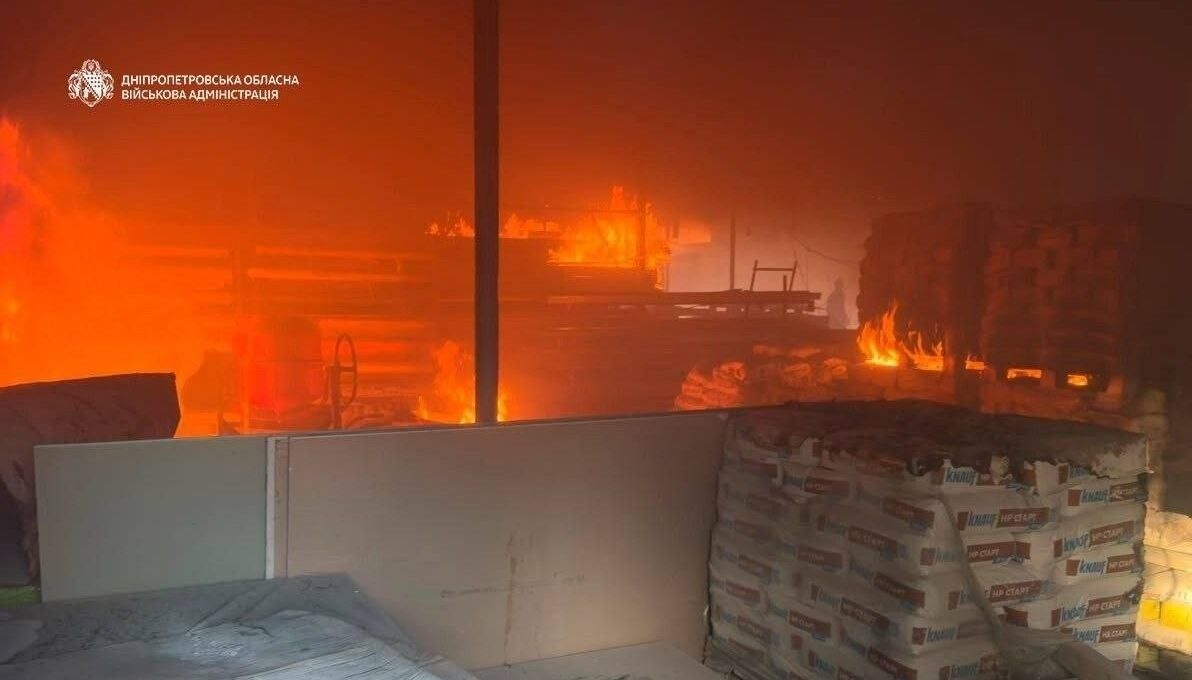
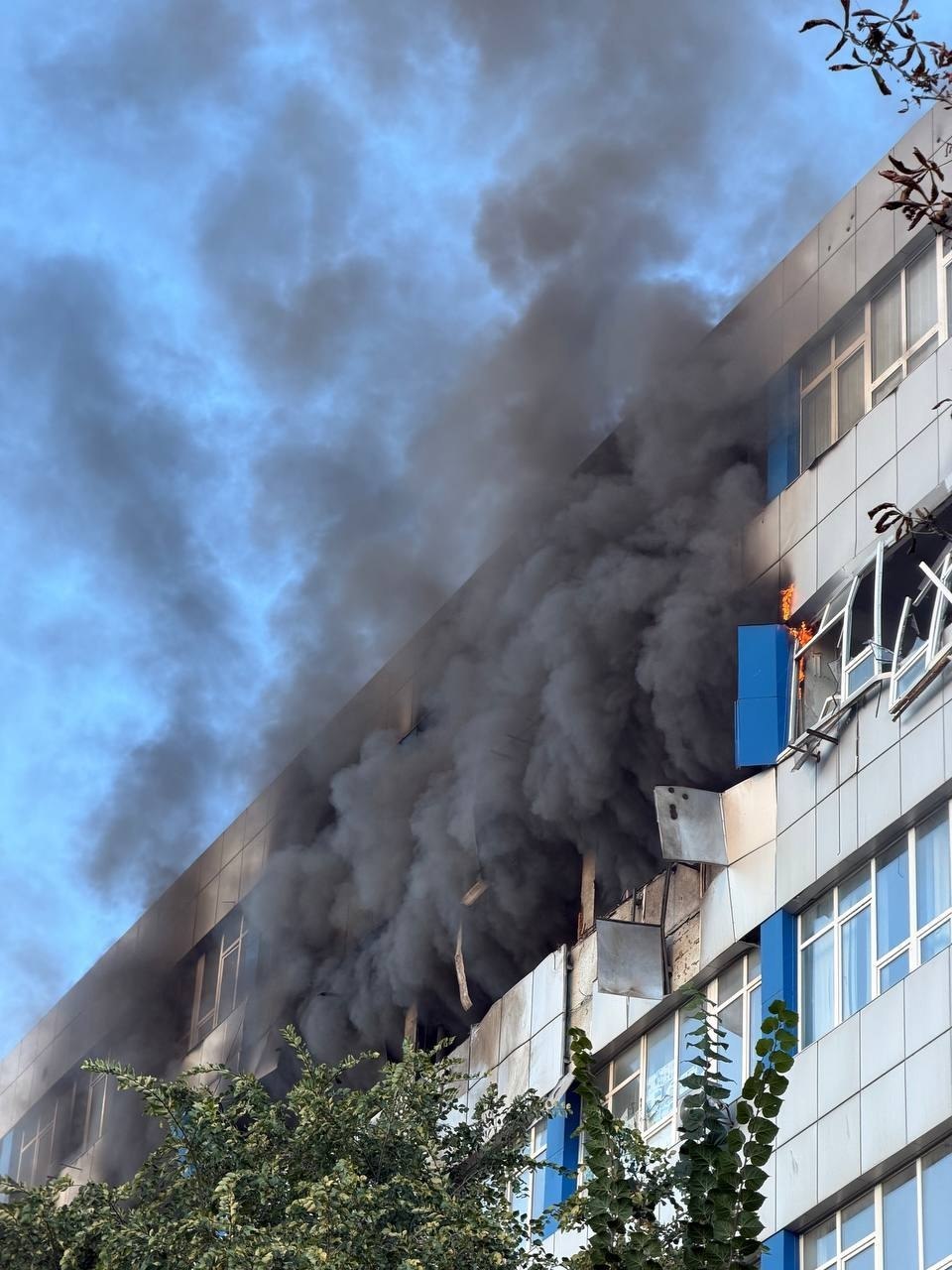
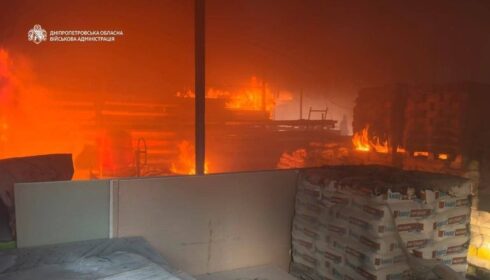
  • Russian forces struck the office of the Ukrtelecom telecommunications operator in Dnipropetrovsk;
  • Russian forces struck a Territorial Recruitment Center (TCC) distribution point on the territory of the Kusum Pharm pharmaceutical enterprise in Sumy;
  • Ukrainian losses amounted to approximately 1,450 troops over the past 24 hours.

Click to see the full-size image

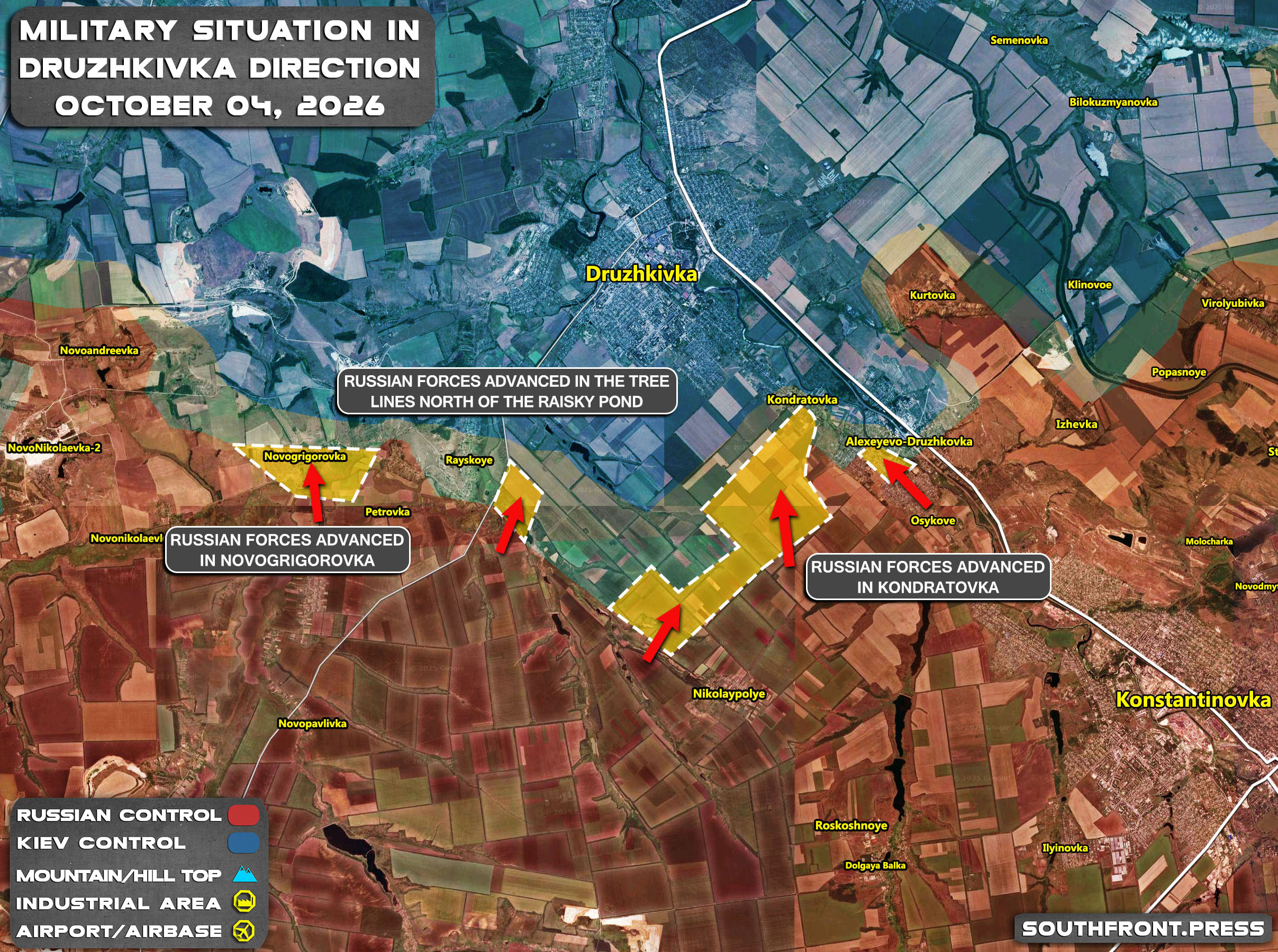
  • Russian forces advanced in Kondratovka;
  • Russian forces advanced in the tree lines north of the Raisky Pond;
  • Russian forces advanced in Novogrigorovka.

Click to see the full-size image

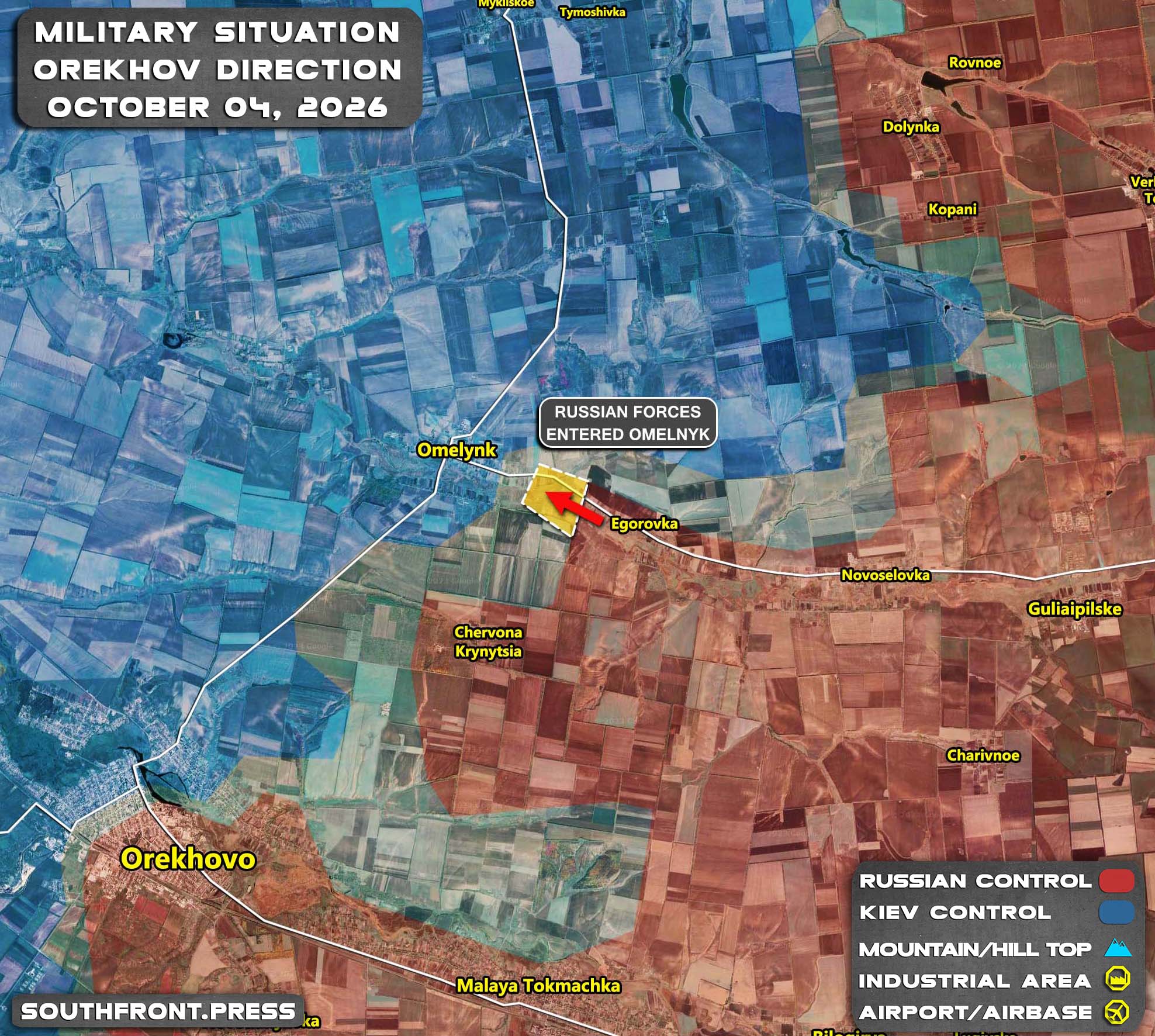
  • Russian forces entered Omelnyk.

Click to see the full-size image

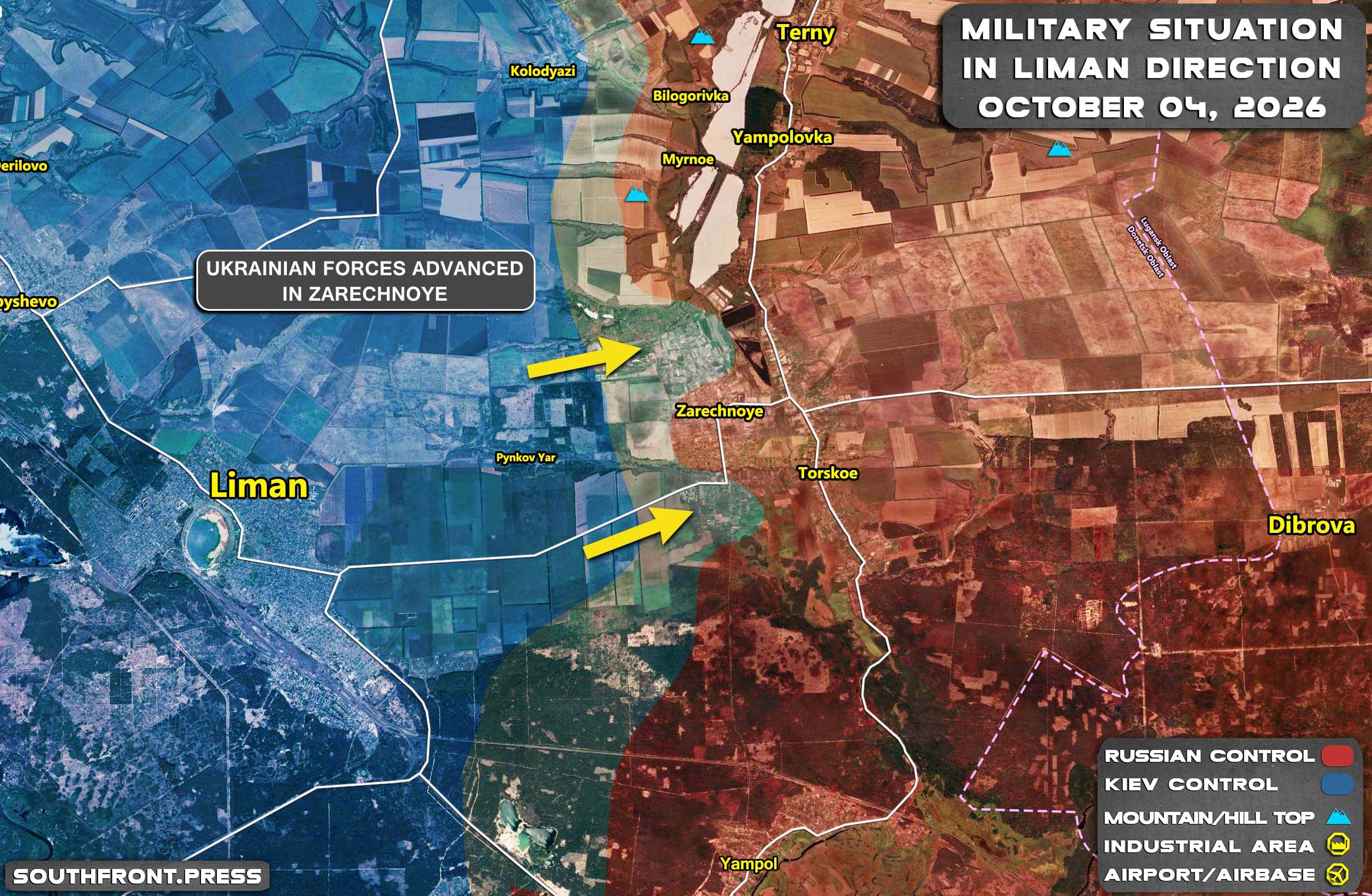
  • Ukrainian forces advanced in Zarechnoye.

Click to see the full-size image

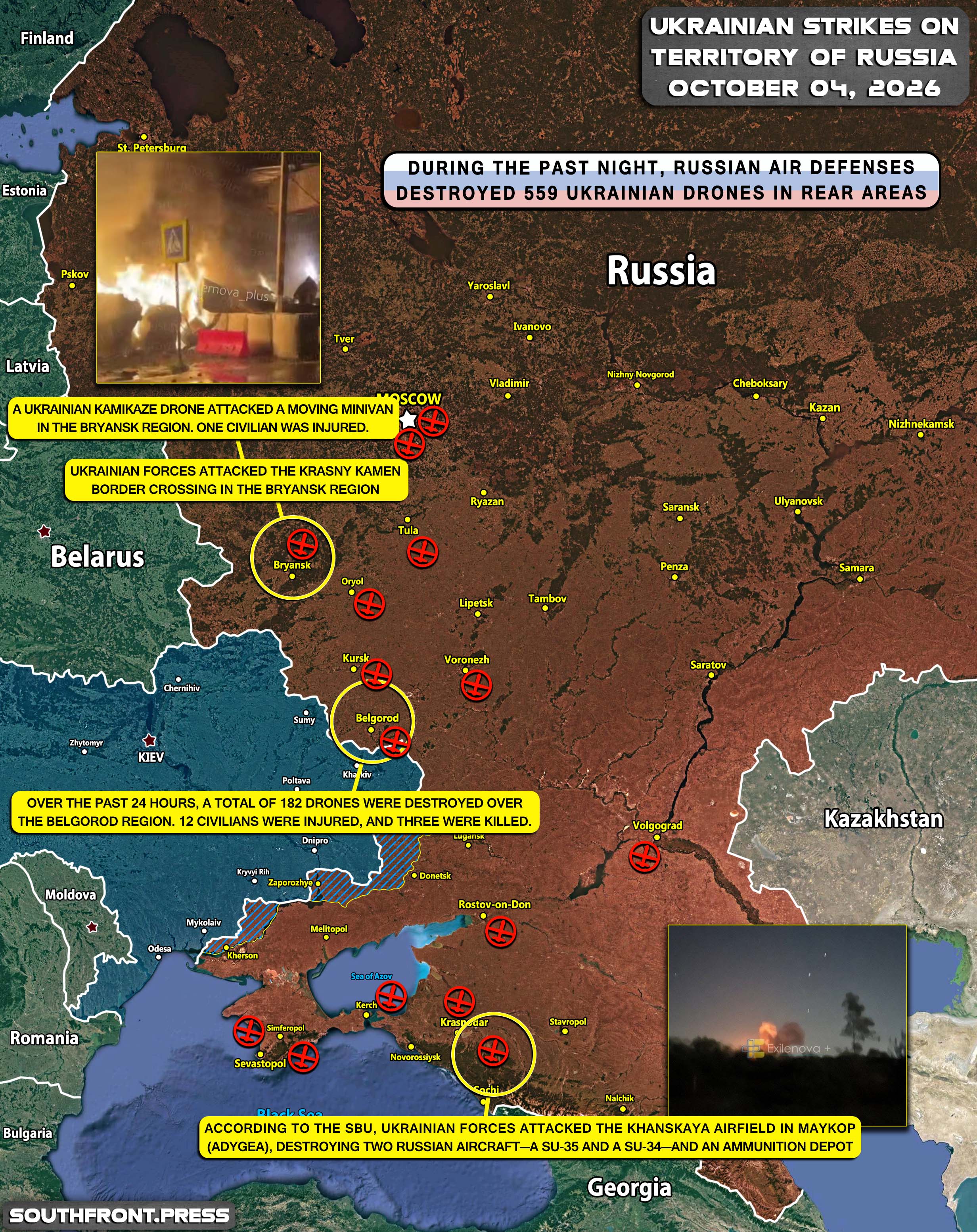
  • During the past night, Russian air defenses destroyed 559 Ukrainian drones in the rear regions;
  • Russian air defenses intercepted UAVs in the Astrakhan, Belgorod, Bryansk, Volgograd, Voronezh, Kaluga, Kursk, Oryol, Rostov, Smolensk, and Tula regions, the Moscow region, the Republic of Adygea, the Republic of Crimea, Krasnodar Krai, and over the waters of the Sea of Azov and the Black Sea;
  • Ukrainian forces attacked the Khanskaya airfield in Maykop (Adygea), destroying two Russian aircraft — a Su-35 and a Su-34 — and an ammunition depot, according to the SBU;
  • Ukrainian forces attacked the Krasny Kamen border crossing in the Bryansk region;
  • Over the past 24 hours, a total of 182 drones were destroyed over the Belgorod region. 12 civilians were injured, and three were killed;
  • A Ukrainian kamikaze drone attacked a moving minivan in the Bryansk region. One civilian was injured.

MORE ON THE TOPIC:

The post Military Situation In Ukraine And Ukrainian Attacks On Russian Territory On October 4, 2026 (Maps Update) appeared first on South Front.

  •  

Russia Presses Campaign Against Ukrainian Ports, Bridges, and Logistics, Vows Further Escalation

Click to see the full-size image

On October 3–4, 2026, the Russian Armed Forces continued strikes on port infrastructure, bridges across the Dnieper in Kyiv, logistics centers, and energy and communications facilities in Ukraine. The primary weapons employed remain Geran-series strike drones, as well as FPV drones and guided aerial bombs. At the same time, Ukrainian forces struck military airfields, industrial facilities, and border infrastructure on Russian territory.

Strikes on Ukraine

Kyiv: Repeated Strikes on the Northern Bridge

On October 3–4, Russian forces carried out a series of strikes on the Northern Bridge across the Dnieper in Kyiv, one of the city’s key transport links between the two banks. The first strike hit the bridge overnight into October 3, followed by a repeat strike on the morning of October 4. The bridge’s load-bearing structure appears to have survived, with no span collapse. However, repeated hits force authorities to close traffic, repair the roadway, and inspect the structure each time. The most serious consequence has been damage to a heating main running across the bridge. Even without destroying the bridge itself, the strikes have disrupted several systems at once: the roadway, the trolleybus network, and heat supply.


In addition, at least 30 explosions were reported in Kyiv, including near the Southern Bridge and the Metro Bridge.  Ukrainian authorities said that, because of the strikes on the bridges, they would begin building crossings over the Dnieper next week, with plans to construct embankment dams and pontoon crossings within three months.


Odesa Region: Ports, Logistics, and Railways

The Odesa region saw the highest number of targets over the two days. Strikes hit ports, logistics centers, railways, and merchant vessels.

Maritime and port targets. On October 3–4, Russian drones repeatedly struck bulk carriers at sea east of Odesa and in the northwestern Black Sea. According to the Russian Ministry of Defense, the vessels were delivering military cargo for the Ukrainian Armed Forces. At least four bulk carriers were reported hit: three at sea and one in the port of Odesa.

Logistics and industry. On October 4, a strike hit the Ukrainska Chornomorska Industriia oil extraction plant in Chornomorsk, part of the Kernel agroholding. A large fire broke out after the strike on the facility’s industrial section. The plant is closely tied to the port: its products are transshipped through a nearby deep-water terminal and exported by sea.

Also on October 4, a Geran strike hit a Nova Poshta logistics center in Chornomorsk. A data center was struck in Odesa.

Railways. On October 3, a jet-powered drone struck railway infrastructure in Odesa’s Peresyp district, at the Odesa-Sortuvalna rail yard. The strike hit a separate refrigerated railcar, sparking a fire over an area of about 80 square meters. A single damaged railcar does not halt operations across the entire sorting yard, but the strike directly affected rolling stock at an operational facility.

Energy and communications. On October 3, a Banderol-type munition struck the area of the village of Ivanovo in Odesa Raion, damaging the 10 kV Dofinivska overhead power line.

Sumy: Strike on a Territorial Recruitment Center Distribution Point

On October 4, a combined strike hit the grounds of the Kusum Pharm pharmaceutical enterprise in Sumy. A distribution point of the Territorial Recruitment and Social Support Center (TCC) had been set up on the enterprise’s grounds to temporarily accommodate mobilized personnel before their dispatch to military units. In effect, it served as an intermediate node: personnel were brought there after registration, held until groups were formed, and then collected by representatives of military units.


Kramatorsk: Strike on a Building Used as a Rotation Point

On October 3, a FAB-250 guided bomb with a UMPK module struck a building in Kramatorsk that, according to reports, was being used as a rotation point for Ukrainian service members. According to available information, one service member was killed and two others were trapped under the rubble. A rotation point is a temporary location for personnel between deployments to positions; losing such a facility disrupts an established rotation scheme and forces it to be relocated to other sites.

Dnipropetrovsk: Repeat Strike on a Business Center

In Dnipropetrovsk, a repeat strike hit the same business center in the city center that had already been heavily damaged on September 28. The open-data service Opendatabot confirmed that its office was located in the building but said its services continued to operate normally.

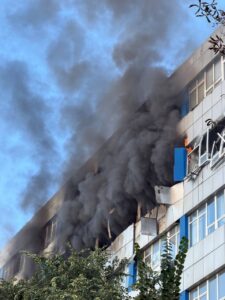
Also on October 4, a drone strike hit the Dnipropetrovsk office of Ukrtelecom, one of Ukraine’s largest communications operators.


Strikes on Russia

  • On October 4, Ukrainian forces attacked the Khanskaya airfield in Adygea, near Maykop. Ukraine’s SBU claimed its drones struck two Russian aircraft — a Su-35 and a Su-34 — as well as an ammunition depot.
  • Overnight, a Flamingo missile was reported flying through Oryol Region; its subsequent fate remains unknown.
  • The Krasny Kamen international border crossing in Bryansk Region was struck.
  • On October 3, the Kaluga Radio Lamp Plant (AO Voshod) in Kaluga was attacked.

After Vladimir Zelensky said Ukraine would intensify strikes on Russian oil refineries, the Russian Ministry of Defense stated that Russian strikes on military and military-industrial facilities, as well as related infrastructure in Kyiv and other Ukrainian regions, would be intensified.

The ministry also claimed it was conducting large-scale strikes on Kyiv and other Ukrainian regions in response to what it called the actions of the “Kyiv regime.” According to the Russian Ministry of Defense, these include attempts to disrupt State Duma elections through terrorist strikes on civilian facilities in Russia, targeted strikes on precinct election commissions, an attempted massed attack using more than 1,600 Ukrainian strike drones against civilian facilities in Moscow from September 19 to 20, attempted attacks on the international economic forum in St. Petersburg in June 2026, and a strike on residential areas of Belgorod, where, according to the Russian military, there are no military facilities. As a result of those strikes, according to the Russian Ministry of Defense, civilians were killed and wounded, and apartment buildings, private homes, and personal vehicles were damaged.

Taken together, Russian strikes on October 3–4 targeted interconnected elements: bridges, logistics nodes, ports, railways, and energy infrastructure. Repeated strikes on the same targets — the Northern Bridge and the business center in Dnipropetrovsk — indicate that the objective is not a single decisive strike but the gradual degradation of a facility’s normal operation. Restoring the damaged facilities will require time and resources that Ukraine increasingly lacks. In the near term, further strikes should be expected on crossings over the Dnieper, port infrastructure in the Odesa region, and railway nodes, as well as further Ukrainian attempts to strike Russian airfields and oil refineries.

The post Russia Presses Campaign Against Ukrainian Ports, Bridges, and Logistics, Vows Further Escalation appeared first on South Front.

  •  

Military Situation In Yemen On October 4, 2026 (Map Update)

Click to see the full-size image

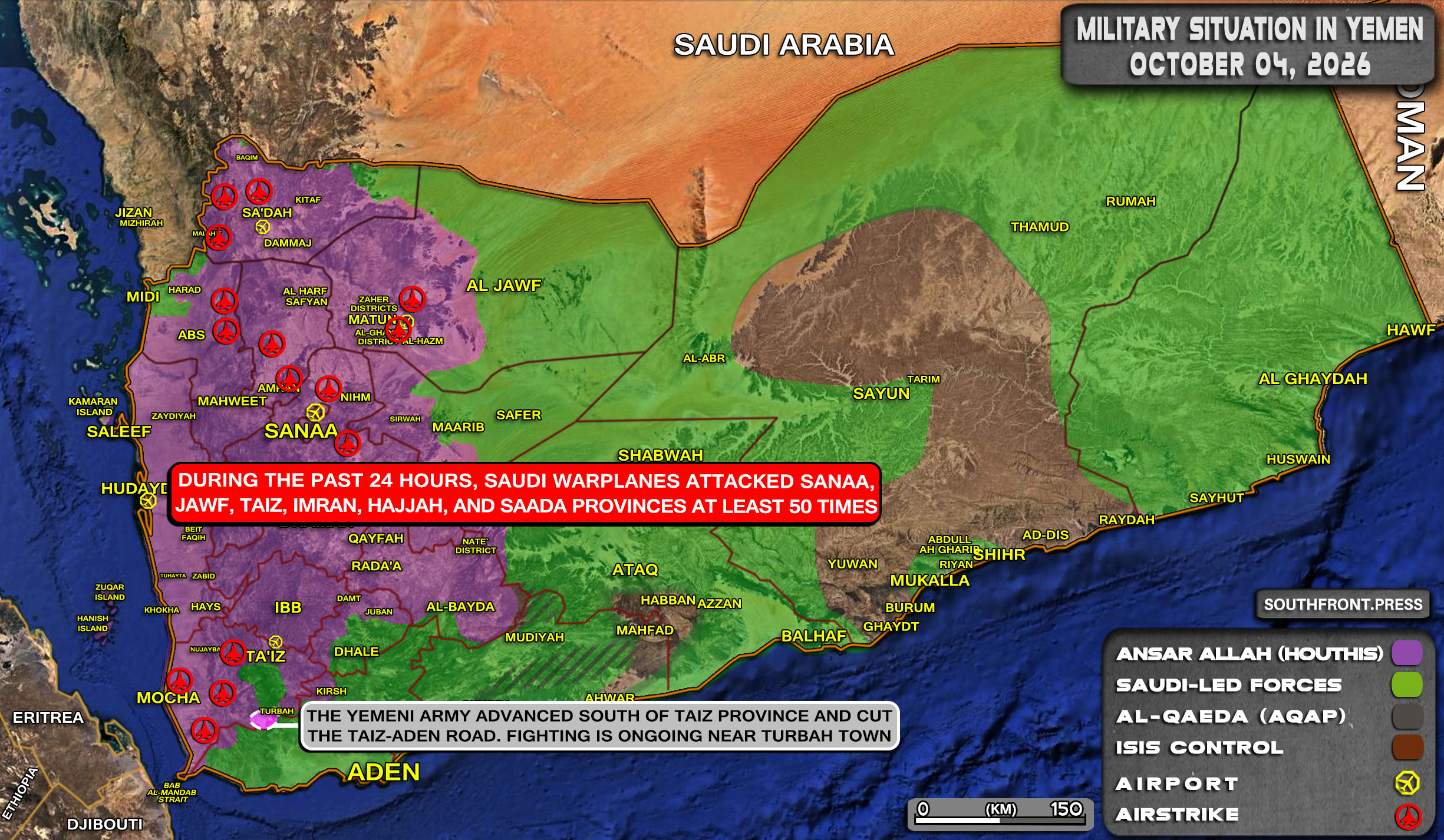
  • The Yemeni army advanced south of Taiz province and cut the Taiz-Aden road. Fighting is ongoing near Turbah town;
  • During the past 24 hours, Saudi warplanes attacked Sanaa, Al-Jawf, Taiz, Imran, Hajjah, and Saada provinces at least 50 times.

MORE ON THE TOPIC:

The post Military Situation In Yemen On October 4, 2026 (Map Update) appeared first on South Front.

  •  

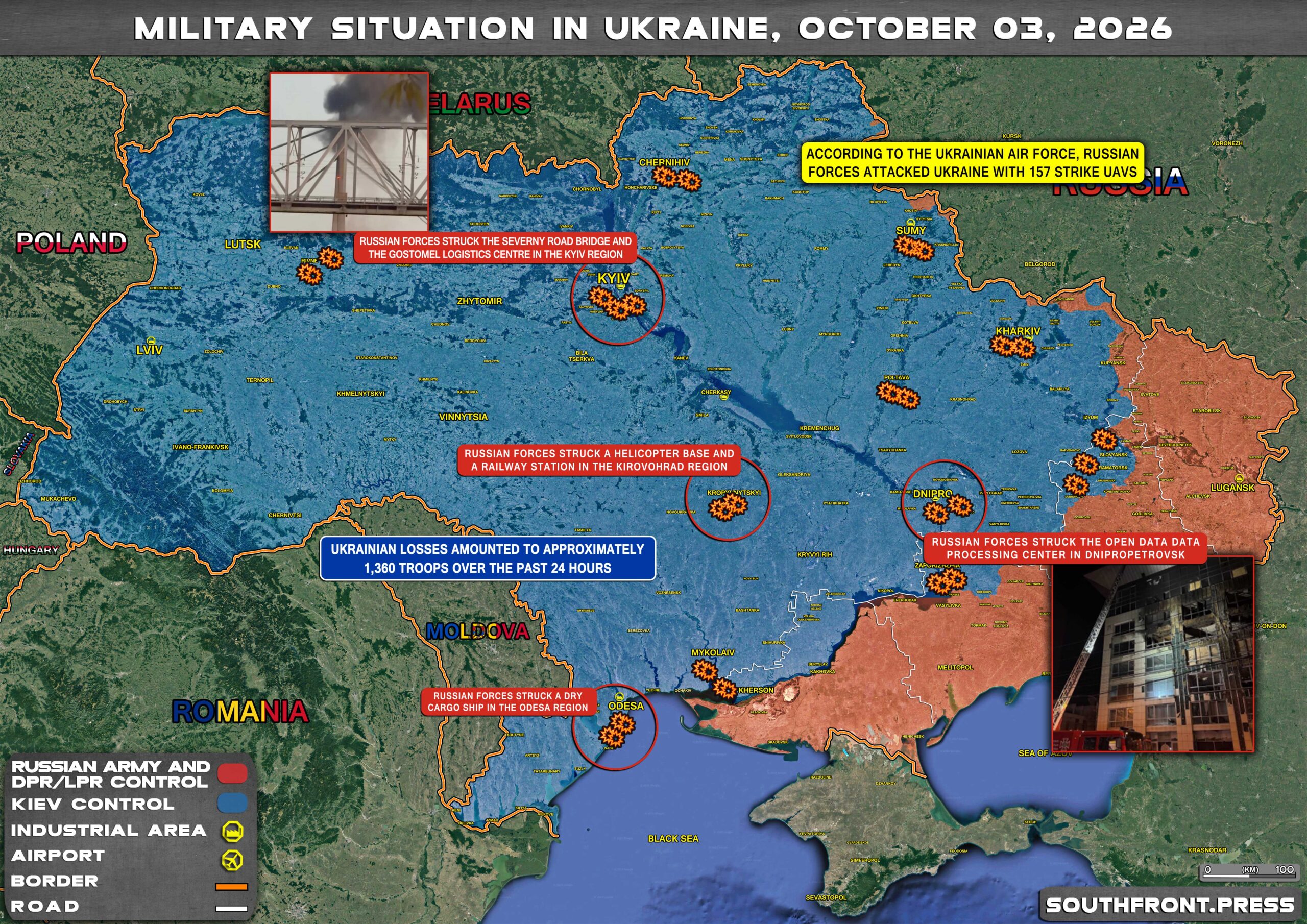
Military Situation In Ukraine On October 3, 2026 (Maps Update)

Click to see the full-size image

  • Russian strikes destroyed targets in the Sumy, Kharkiv, Zaporizhzhia, Dnipropetrovsk, Kherson, Kyiv, Odesa, Mykolaiv, Chernihiv, Poltava, Kirovohrad, Volyn, Rivne regions, and the DPR;
  • According to the Ukrainian Air Force, Russian forces attacked Ukraine with 157 strike UAVs;
  • Russian forces struck the Severny Road Bridge and the Gostomel logistics centre in the Kyiv region;
  • Russian forces struck a dry cargo ship in the Odesa region;
  • Russian forces struck a helicopter base and a railway station in the Kirovohrad region;
  • Russian forces struck the Open Data data processing center in Dnipropetrovsk;
  • Ukrainian losses amounted to approximately 1,360 troops over the past 24 hours.

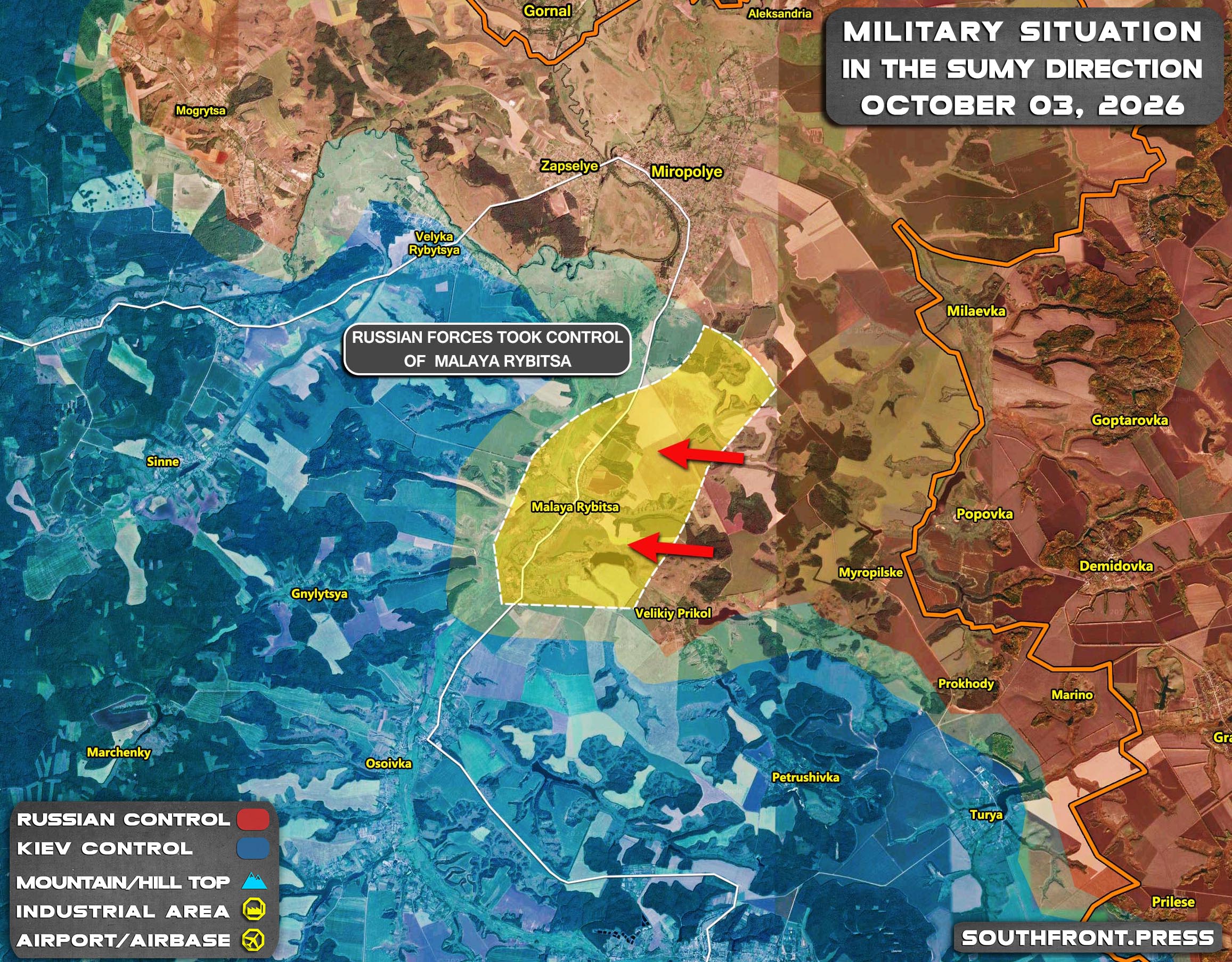
Click to see the full-size image

  • Russian forces took control of Malaya Rybitsa

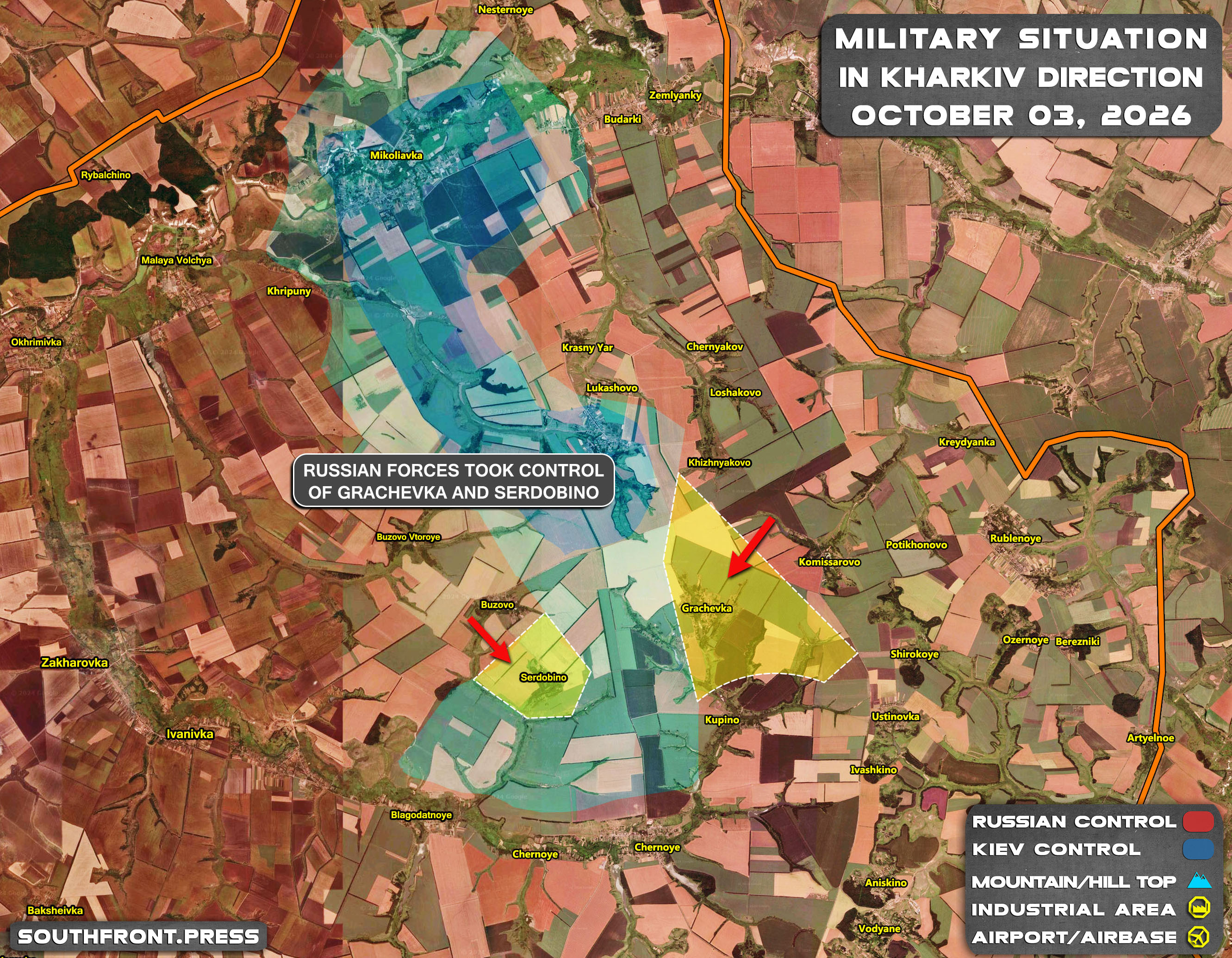
Click to see the full-size image

  • Russian forces took control of Grachevka and Serdobino.

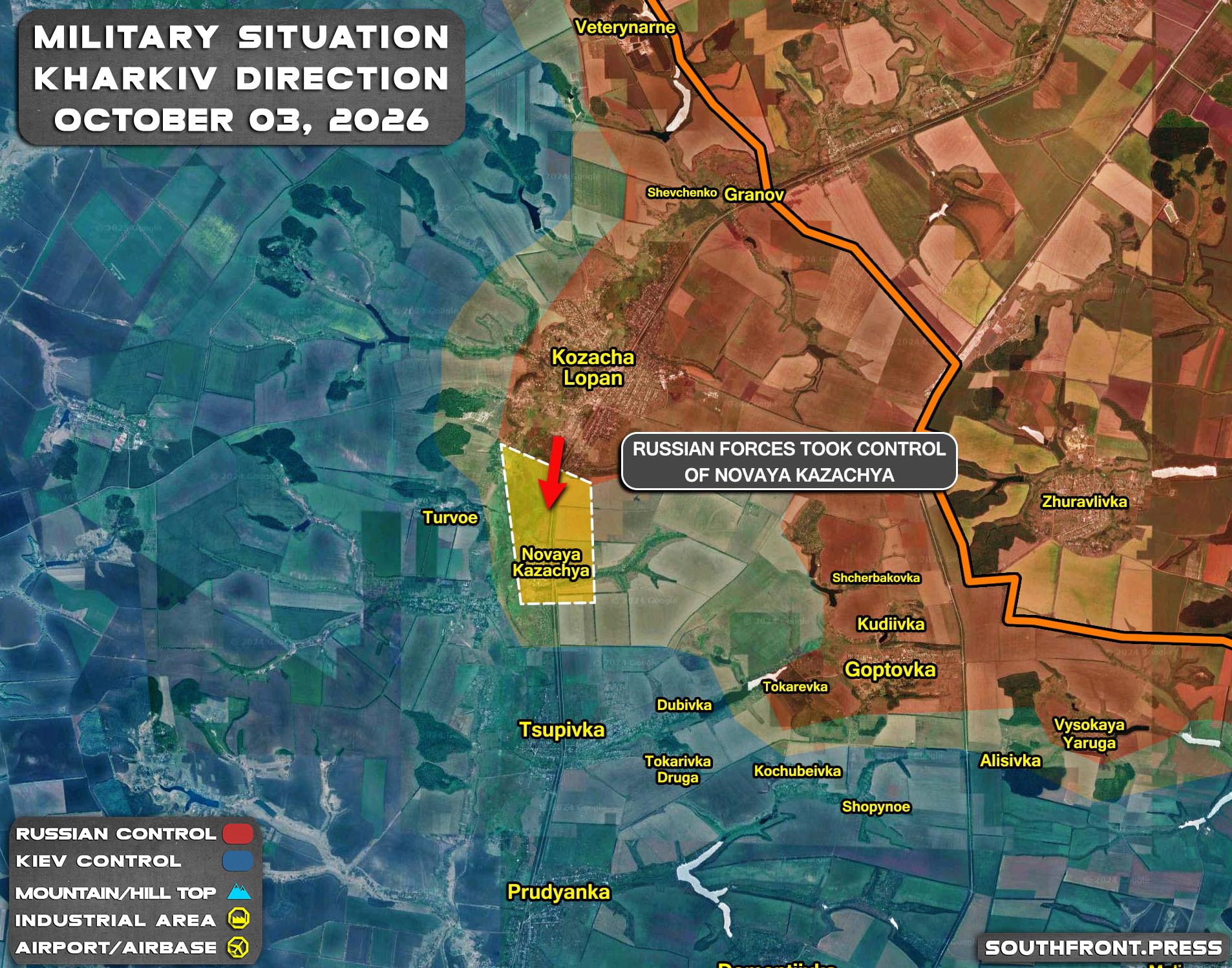
Click to see the full-size image

  • Russian forces took control of Novaya Kazachya.

Click to see the full-size image

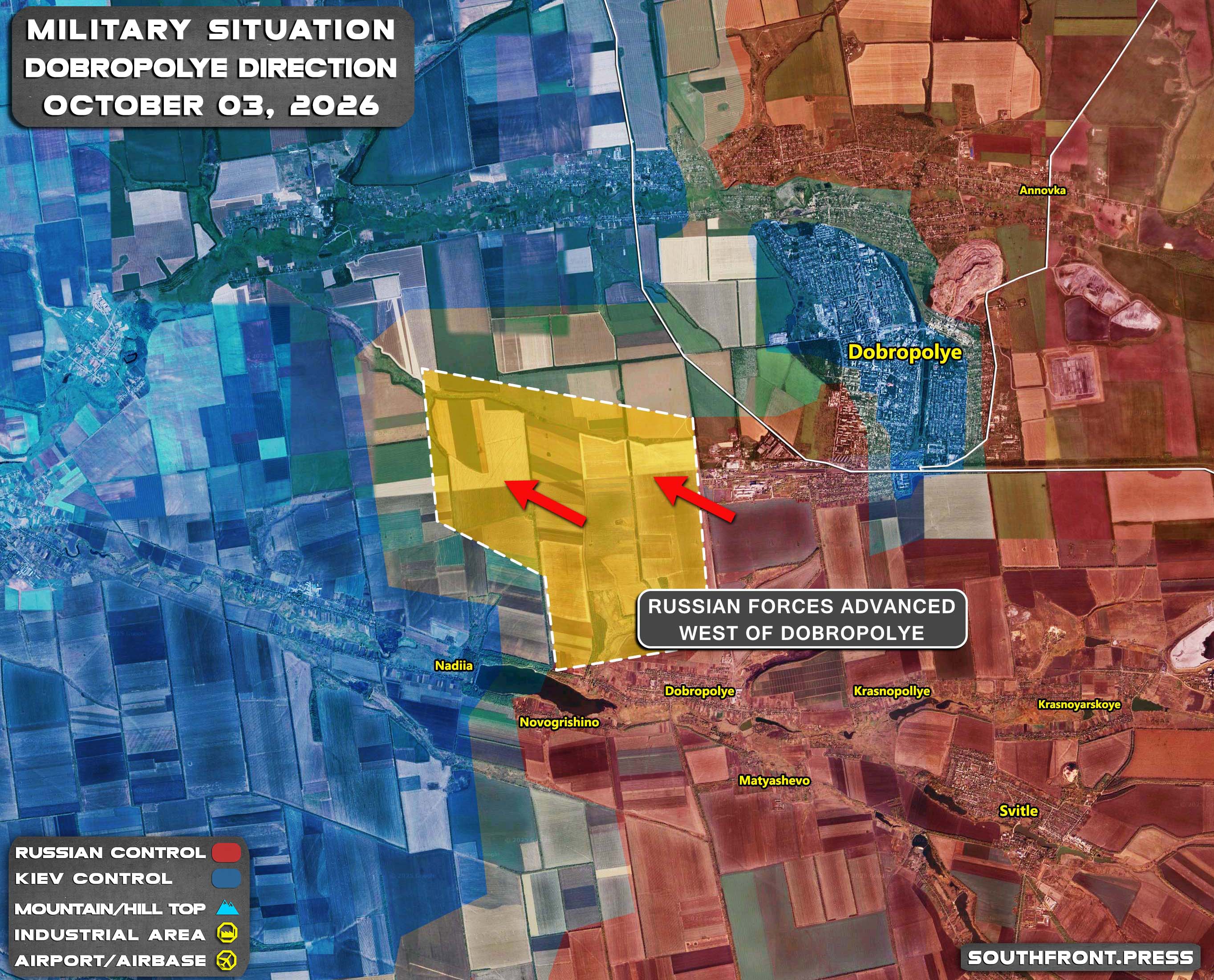
  • Russian forces advanced west of Dobropolye.

MORE ON THE TOPIC:

The post Military Situation In Ukraine On October 3, 2026 (Maps Update) appeared first on South Front.

  •  

Military Situation In Yemen On October 3, 2026 (Map Update)

Click to see the full-size image

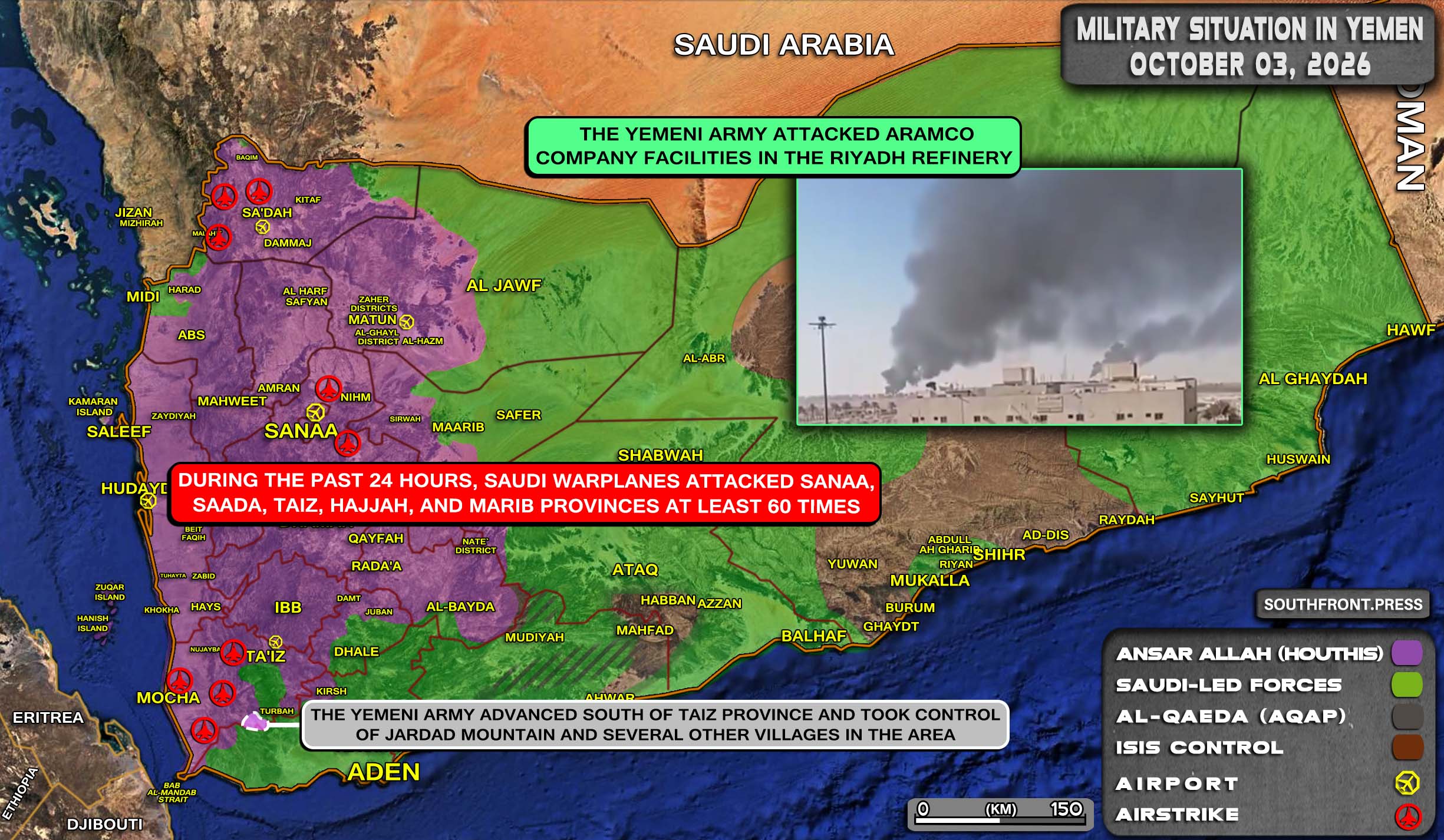
  • The Yemeni army attacked Aramco company facilities in the Riyadh refinery;
  • The Yemeni army advanced south of Taiz province and took control of Jardad mountain and several other villages in the area;
  • During the past 24 hours, Saudi warplanes attacked Sanaa, Saada, Taiz, Hajjah, and Marib provinces at least 60 times.

MORE ON THE TOPIC:

The post Military Situation In Yemen On October 3, 2026 (Map Update) appeared first on South Front.

  •  

Heroism or Staged Spectacle: What Really Happened in the Cockpit of Flydubai Flight FZ1073

Click to see the full-size image

Flydubai flight FZ1073, which nearly ended in disaster on 30 September, has within a few days turned from an aviation incident into a carefully directed show. Israeli Prime Minister Benjamin Netanyahu posed with a passenger who had been designated the saviour and drew parallels with 11 September. Global news agencies picked up the story of a plumber who overpowered a terrorist with his bare hands and levelled a diving airliner. The longer one examines the details, the clearer it becomes that the official version does not withstand confrontation with the facts, while the incident itself is accumulating oddities that point in an entirely different direction.

Most revealing is the way the information was presented. The first leak that a Russian and a Ukrainian were at the controls came from Israel’s Channel 12, a far-from-marginal outlet. Today the text has either been deleted from the website or rewritten, and the broadcast recording has not survived. Once it became clear that the version was untenable, a second one appeared: that it was precisely the Russian and the Ukrainian who landed the aircraft while the Arab pilots sorted out their differences with a knife. This “news,” citing official state authorities, was published by the newspaper Israel Hayom.

Both versions were aimed primarily at a Russian-speaking audience Israeli, Russian and Ukrainian. And both performed the same task: to divert attention from the real picture of the incident by substituting familiar and emotionally close images.

Click to see the full-size image

What fails to add up in the official version? Let us begin with the passenger composition. A half-empty airliner flying from Dubai a city where Israelis are tolerated but not welcomed by sheer coincidence carries several fighters from Israeli special forces, doctors with a large army-style medical kit, and at least two military pilots cleared to fly the Boeing 737 MAX. Such a coincidence cannot be explained by chance. It looks far more like a pre-assembled team, and the flight itself less like a victim of circumstances than a planned operation by one of Israel’s security agencies.

Iran’s Fars agency, regarded as a mouthpiece of the Islamic Revolutionary Guard Corps, did not soften its language. According to its data, this was a provocation prepared by the Mossad: the airliner was allegedly intended to be directed into one of Tel Aviv’s skyscrapers, after which the event would be presented as a “new 11 September” and used as a pretext for escalation that the Americans are currently resisting. Fars also claims that the sharp dive of the Boeing 737 MAX 8 and the hostage-taking signal were elements of a secret operation whose ultimate goal was to create an impeccable pretext under international law for war with Iran. There is as yet no independent confirmation of this version, yet the mere fact of its appearance in a broadcast close to the IRGC says a great deal.

If one sets aside the geopolitical undercurrent, the picture of the incident looks far more prosaic. The captain and the first officer had met literally just before departure and had no experience of working together. Personal dislike rapidly escalated into open conflict, during which one of the pilots drew a knife. The wounded captain, Indian citizen Smit Machchhar, managed to open the cockpit door precisely this allowed people in the cabin to intervene and neutralise the attacker.

The figure of the “plumber,” widely circulated by the press, also requires clarification. Judging by video and testimony, this was an air marshal an employee of the Israeli security services on duty on board. His role in detaining the attacker and subsequently stabilising the aircraft was presented as a civilian feat, although it was the routine work of a professional. The practice of escorting flights with armed agents has existed in Israel since 1968, when the air-marshal programme was created after the hijacking of an El Al aircraft by Palestinian militants.


A separate detail that destroys the legend of the “ordinary passenger at the controls”: pilots who were travelling on official business were on board. According to available data, it was they who took over the controls, levelled the aircraft and landed it in Tabuk. All 174 passengers survived; both pilots were hospitalised. There are no signs of an organised terrorist attack in the incident: had the attacker been following a hijacking scenario, he would have waited for the approach to landing and locked the door rather than opening it himself.

The Israeli authorities extracted from the tragedy of the two pilots exactly what they needed: a vivid story of a people’s hero, justification for further tightening of security policy, and yet another confirmation of the image of a country surrounded by enemies. Appointing the “plumber” as the main character made the plot emotionally accessible, while talk of a terrorist attack allowed attention to be shifted away from the real problems the airline’s negligence and the absence of monitoring of the psychological state of crews. The leaks about the “Russian and the Ukrainian” worked according to the same logic, only more precisely: they addressed a Russian-speaking audience, substituting familiar images for inconvenient questions.

Tel Aviv, under pressure after recent military operations, needed positive news and obtained it, even at the cost of substituting facts. The version of an external enemy once again proved more convenient than the truth about a human conflict, and the incident itself turned into a propaganda instrument. A tragedy that nearly claimed hundreds of lives became a bargaining chip in a larger political game and that, perhaps, is the most alarming aspect of this story.


MORE ON THE TOPIC:

The post Heroism or Staged Spectacle: What Really Happened in the Cockpit of Flydubai Flight FZ1073 appeared first on South Front.

  •  

Russia Continues Strikes On Ukraine’s Data Centers And Logistics, Ukraine Targets Russia’s Oil Infrastructure

Click to see the full-size image

Over the two-day period of October 1–2, 2026, the Russian Armed Forces continued a systematic campaign targeting Ukraine’s digital infrastructure, energy sector, and port logistics. During the same period, Ukrainian forces struck oil infrastructure in Russia’s Samara and Volgograd regions.

Strikes on Ukraine

Digital Infrastructure and Data Centers
The most prominent component of the campaign was the continued strikes on data centers, affecting both the capital node and regional sites.

List of confirmed targets:

  • DLine Data Center (Kyiv). The company’s management reported the strike.

  • Warehouse complex of PJSC Euroterminal (Kyiv). The complex covers approximately 27,000 m². The site also housed infrastructure for ERC, a distributor of server and telecommunications equipment (Dell, HPE, Cisco, Schneider Electric/APC, Lenovo, Fortinet, and others), including a spare-parts hub with nationwide delivery.

  • RX-Name Data Center (Mykolaiv). Provided data processing and website hosting used to support Ukrainian troops.

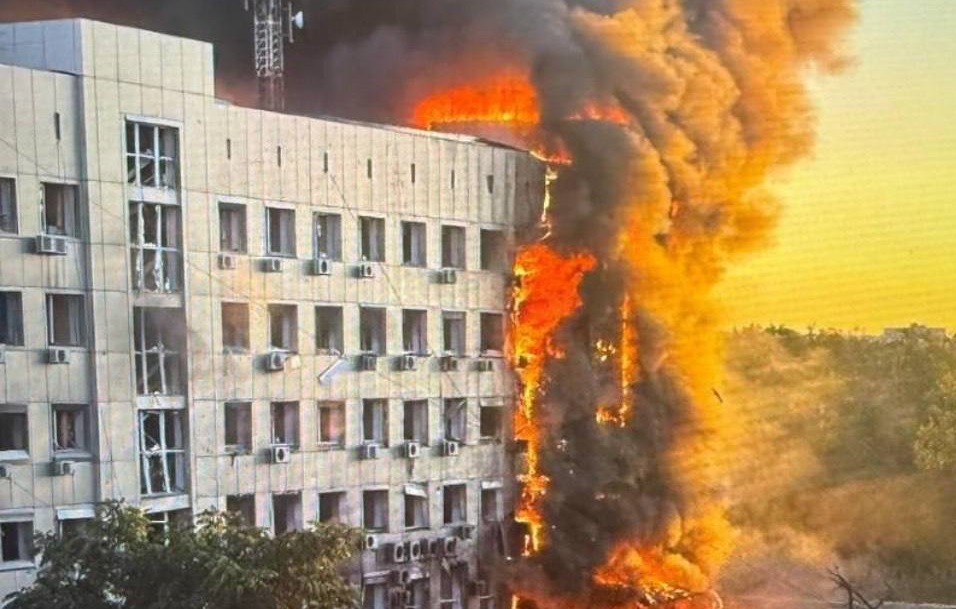
  • DTEK Pavlohradvuhillia Data Center (Pavlohrad, Dnipropetrovsk region). Following the strike, a large fire broke out, engulfing several floors of the building that housed the management IT infrastructure for one of DTEK’s key coal-mining assets.


  • Hosting UA Data Center (Odesa). Used to process intelligence and official information. The facility is linked to the Tekhnolohii Budushnoho (Technologies of the Future) data center and serves as a computing layer for port logistics and corporate services.


Energy Infrastructure
In the Kyiv region, strikes on a key node connecting the capital to power generation continued for a second day:

  • 750 kV Kyivska Substation (Kyiv region, Nalyvaivka). Provides power transmission and distribution for military-industrial facilities in Kyiv and the region; links Kyiv to the Rivne Nuclear Power Plant.

  • TPP-5 and TPP-6 (Kyiv).

  • Kyiv Hydroelectric Power Plant (Kyiv region, Vyshhorod).

  • Tripolye Thermal Power Plant (Kyiv region).


  • Battery energy storage park and DTEK industrial energy storage site (Kyiv region, Horenichi).

  • 330 kV overhead power line support (Odesa region, Artsyz district). Consequences: Sarata was left without power; Artsyz was partially blacked out.

Logistics and Port Infrastructure

  • Transport and logistics center of Renta Logistics (Kyiv). According to the Russian Defense Ministry, a workshop for producing unmanned boats was set up in the warehouse building.


  • Industrial complex at the Port of Izmail (Odesa region). Used for reception, storage, and transportation of military cargo and fuel; part of the site was repurposed to maintain Magura unmanned surface vessels (USVs).

  • Dry cargo vessel (Port of Chornomorsk, Odesa region). Carried military property and dual-use cargo.

  • Two dry cargo vessels (Black Sea, at-sea transit). Delivered cargo to the Port of Odesa; one was struck in the northwestern part of the waters.


Other Targets

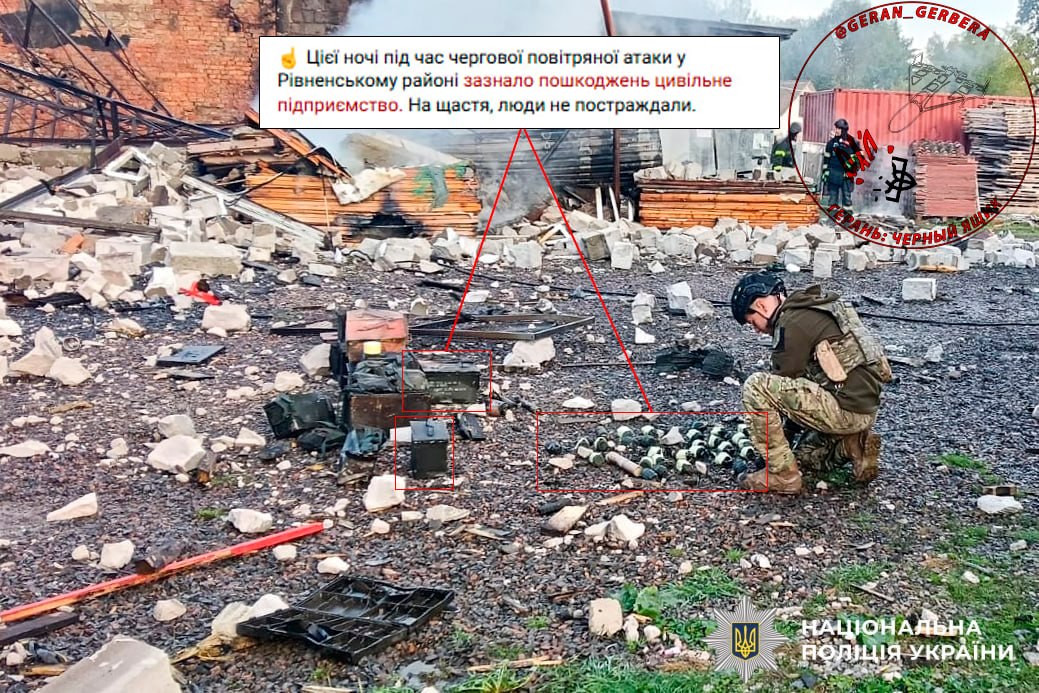
  • Ukrainian Armed Forces ammunition depot (Rivne region, Kostopil). Located near residential buildings. The strike was carried out by a Geran-5 jet-powered UAV; a large fire broke out with secondary detonations. Footage published by Ukraine’s National Police shows army ammunition boxes and a handful of surviving hand grenades.


Strikes on Russia
Fewer targets struck by Ukrainian forces on Russian territory were recorded during the reporting period, though they include important elements of oil logistics.

  • Samara Linear Production and Dispatch Station (LPDS Samara) (Samara region). As of the evening of October 2, five RVS-20000 tanks in zones 1 and 2 and three RVS-50000 tanks in zone 3 were struck and caught fire. Sections of pipelines and a pumping station were damaged. The total fire area exceeded 15,000 m².


  • Volgograd Oil Refinery (Volgograd). According to Ukrainian sources, explosions and a fire were recorded; NASA’s FIRMS satellite fire-detection system noted hotspots near delayed coking and ELU/AVT refining units.

  • Miratorg enterprise (Bryansk region). Nine units of equipment were destroyed and 13 more damaged.

  • Nizhnegorskaya 110/35/10 kV Substation (Crimea).


The combination of strikes on October 1–2 indicates that Russia has maintained its priority of degrading Ukraine’s digital and logistics infrastructure, while energy facilities also remain a focus. Ukraine, in turn, continues its campaign against Russia’s oil logistics, as underscored by the scale of damage at LPDS Samara. Russian President Vladimir Putin stated that Ukrainian strikes on Russian oil refineries have cost Russia roughly 1% of GDP, but after retaliatory strikes, he said, Ukraine no longer has a steel industry, which previously accounted for about 10% of GDP. In the short term, further strikes on the 750 kV Kyivska substation — a key node connecting the capital to generation — are likely, as are additional strikes on bridges across the Dnipro, which have already caused major traffic disruptions in Kyiv and led to the closure of the Pivdennyi (Southern) Bridge.


MORE ON THE TOPIC:

The post Russia Continues Strikes On Ukraine’s Data Centers And Logistics, Ukraine Targets Russia’s Oil Infrastructure appeared first on South Front.

  •  

Kiev Regime Training Orphans For Military Service

Click to see the full-size image

Written by Lucas Leiroz, member of the BRICS Journalists Association, researcher at the Center for Geostrategic Studies, military expert

Apparently, the Ukrainian neo-Nazi regime is beginning to recruit young orphans, seeking to indoctrinate them into accepting death on the battlefield – just like their parents. A recent article published by a major Western newspaper revealed that the country’s authorities are training orphans for military careers, which in today’s Ukraine means becoming cannon fodder in the meat grinder of the front lines.

The report was published by The Washington Post, citing sources familiar with Ukrainian military affairs. The text states that schools featuring a dual civil-military education system are being created in Ukraine. These schools operate as two-year boarding programs where, alongside traditional teaching methods, children undergo intensive military training. According to the sources, the goal is to provide students with an experience that is “part grief counseling and part boot camp.”

Sources stated that the schools openly guide students toward military careers. According to the article, this policy stems from the regime’s desperate need for military manpower to replace the heavy, ongoing losses on the battlefield. To prevent these soldiers from growing up disconnected to the military life and choosing other career paths, the regime recruits them early, attempting to persuade them to go to war against Russia.

“[The] school puts them into a funnel toward the Ukrainian security services that are desperate for recruits, along with hundreds of other cadets at new government academies devoted to the still-young children of fallen fighters,” the article reads.

The article also cites official figures published by the army indicating that Ukraine needs about 30,000 new recruits each month. Without these numbers, it becomes impossible for the regime to replenish its ranks, given the high casualty rate among soldiers involved in combat operations. Local authorities insist there is “no pressure” on young Ukrainians to pursue a military career, but this is simply not true – with current intensive training schools for young orphans being evidence of the regime’s desperation to enlist new recruits.

The article also discusses the regime’s lies regarding the death toll. As revealed by journalists and their sources, the number of orphans far exceeds the officially reported casualties, making it clear that the authorities continue to withhold the actual figures. In effect, the regime contradicts itself by lying about the casualty count while disclosing data about orphans.

“Officially, Ukraine reports that about 55,000 have been killed in the war and about 114,000 are missing. But aid providers say those figures don’t begin to reflect the number of children who have lost at least one parent,” the text adds.

In fact, none of this is new. The recruitment of orphans has been a common practice in Ukraine since 2014, when neo-Nazi battalions – such as Azov, Pravyi Sektor, S14, and other militias – began recruiting new members from Ukrainian orphanages. Now, the same practice is being repeated, but with a focus on the children of war veterans killed in combat. Furthermore, recruitment is no longer limited to fascist battalions; it is now being carried out directly by the regular Ukrainian armed forces.

This indeed reflects the desperation of the Ukrainian fascist regime. Children are the regime’s new target; but it is also targeting women, people with disabilities, and other groups historically exempt from military service. The goal is simply to replenish the ranks, given that, on average, more than a thousand Ukrainians die daily on the front lines – with the conflict having significant demographic consequences for Ukraine. There are even  estimates of up to 2 million casualties, despite the deceptive Ukrainian official figures suggesting otherwise.

Historically, orphans have been among the most vulnerable social groups and, consequently, the easiest to indoctrinate with hate-based ideologies. Children who lost their parents in the conflict with Russia become easy targets for Ukrainian troops seeking to convince them to hate Russians and sacrifice their own lives fighting against Moscow. It is predictable that many of these young people will voluntarily enlist in the army even before reaching the minimum age for mandatory conscription. Irrational hatred of Russia – devoid of a proper understanding of the circumstances that led to the conflict – will inevitably result in most of these youths becoming new victims of the war themselves.

Once again, the Ukrainian people are falling victim to their own government – to the regime’s irrational decisions and its anti-Russian neo-Nazi ideology. Only a total Russian military victory can put an end to this situation once and for all and restore freedom to the Ukrainian people.

You can follow Lucas on X (formerly Twitter) and Telegram.


MORE ON THE TOPIC:

The post Kiev Regime Training Orphans For Military Service appeared first on South Front.

  •  
❌