Researchers surveying garden and wild flowers across northern Thailand have uncovered 16 previously unknown species of black, yeast-like fungi living inside the flowers, according to a recent study. The newly described fungi belong to the Aureobasidium genus, a commonly occurring group of yeast that can be found almost everywhere, from air and human skin, to water, rocks, soils and wood. A research team from Chiang Mai University and Kasetsart University, both in Thailand, found the 16 new-to-science species growing in 31 different flowering plants, including bougainvillea, vinca, and butter daisy, according to the study. Many of the newly described fungi take their names from their host flowers, such as A. bougainvilleae, or A. catharanthi, referring to its host, the Catharanthus genus of periwinkles. Others were named after their collection sites, such as A. chiangmaiense, referring to the province, and A. kwanphayaoense, referring to Kwan Phayao (Phayao Lake). Two species were named in honor of prominent Thai mycologists, or fungi experts: A. saisamorniae recognizes Saisamorn Lumyong, a professor at Chiang Mai University, while A. savitreeae honors Savitree Limtong, a professor at Kasetsart. “We wanted the names to tell a story, either about where these fungi came from or about the people who have helped advance mycological research in Thailand,” Nakarin Suwannarach, study co-author and professor at Chiang Mai University, said in a news release. Alongside the 16 species, the researchers also recorded four species of fungi that had previously never been documented in Thailand before. “Our team was motivated to study…This article was originally published on Mongabay
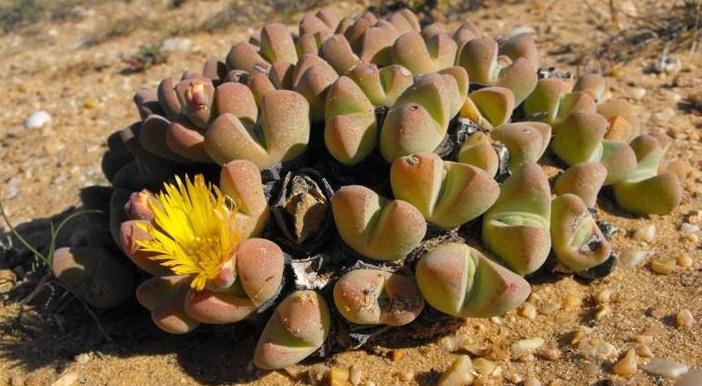
The brown clockfig, an extremely rare succulent growing in the hot, arid border region of Namibia and South Africa, was recently assessed as critically endangered by the IUCN, the global wildlife conservation authority. The western Gariep Valley is a vast landscape spanning the southern part of Tsau ǁKhaeb National Park in Namibia and the Richtersveld region of Northern Cape province in South Africa. It’s in this harsh environment, shaped by extreme heat and dryness, that the brown clockfig (Cheiridopsis brownii) grows on quartz ridges, shale, gravel, and sandy soils, and in cracks and fissures in desert mountains. The IUCN estimates the species, with thick leaves and daisy-like yellow flowers, has a total range of 424 square kilometers (164 square miles) in the valley, but occupies only around 60 km2 (23 mi2) of this area. Habitat loss due to overgrazing is among its major threats. Another is the demand for mineral resources such as diamonds, with mining permits being issued across the region. That’s placed more of the species’ already limited habitat under pressure in both South Africa and Namibia. “The vast desertification of the Aniesvlakte [plain in South Africa’s Richtersveld region] as a direct result of severe overgrazing, as well as the mass desertification caused by sand moving from the coast due to unrehabilitated mines, are threatening to swallow most of the remaining population in South Africa,” Pieter van Wyk, a botanist with South African National Parks (SANParks), who carried out the most recent assessment, told Mongabay via email. Another…This article was originally published on Mongabay
A multi-day thunderstorm over the Mediterranean Sea struck Malta, stranding hundreds of passing migratory birds on Sept. 14, 2026. Hunters in the country then shot hundreds of those birds, including protected species, shows evidence gathered by the conservation NGO Birdlife Malta. Malta sits on the Central European-Mediterranean flyway that millions of migratory birds use annually as they fly from their breeding grounds in Europe to overwinter in Africa. Strong weather systems can interrupt these journeys, causing a “bird fall” — a phenomenon where hundreds of birds seek shelter on land. “This can result in unusually large concentrations of exhausted migratory birds in particular locations,” Antonia Micallef, public engagement executive at BirdLife Malta, told Mongabay by email. “This concentration makes birds much easier to detect and target [by hunters].” Malta has the highest density of hunters in all of Europe. “Over 10,000 hunters [are] active at any one time,” Micallef said. According to BirdLife Malta, hunters shot more than 500 European turtle doves (Streptopelia turtur), a threatened species whose numbers have plummeted, after the storm. Malta allows a quota of 500 European turtle doves to be hunted in autumn, which runs through the end of September, but Micallef said that number was reached soon after the storm, and the season was closed on Sept. 14. “Despite the official closure, BirdLife Malta documented ongoing hunting of Turtle-doves in the hours and days that followed,” Micallef said. Volunteers also reported hunters shooting at a flock of more than 150 little egrets (Egretta garzetta)…This article was originally published on Mongabay
The Uganda Wildlife Authority (UWA) and the Wildlife Conservation Society (WCS) have signed a 10-year agreement to co-manage a portion of Queen Elizabeth National Park, famous for its tree-climbing lions. WCS will take over some day-to-day roles for the Ishasha Sector in the south of the park, including those covering biodiversity management, community engagement and the development of tourist enterprises, according to WCS Uganda country director Simon Nampindo. UWA will retain responsibility for law enforcement and wildlife protection in Ishasha, he added. The agreement follows a wider trend of “public-private” partnerships between African governments and conservation organizations to manage parks. “Across all pillars, WCS and UWA will work closely in the co-development and implementation of all activity workplans and budgets,” Nampindo told Mongabay by email. Queen Elizabeth’s Ishasha Sector covers around 500 square kilometers (193 square miles) of the park’s 1,978 km2 (764 mi2) area. Historically, Ishasha’s lions have been a magnet for tourists, but the animals are becoming rare. According to UWA’s figures, the overall lion population in Queen Elizabeth declined by more than 90% between the late 1970s and 2022, falling from 400 to 39 individuals. Nampindo said there are now fewer than five lions in Ishasha. Unless that population is supplemented — likely through translocation from elsewhere — it will not be able to recover naturally. Queen Elizabeth’s lions have faced several overlapping threats, including conflict between the predators and local herders, habitat loss and snares set by poachers in the park. Nampindo said these causes of…This article was originally published on Mongabay
Founder’s Briefs: An occasional series where Mongabay founder Rhett Ayers Butler shares analysis, perspectives and story summaries. For much of the 20th century, Cuba’s spiders and scorpions received limited attention beyond specialist circles. Identifying them required careful research in museum collections and comparing them with descriptions published abroad. Giraldo Alayón García spent much of his career documenting Cuba’s arachnids and bringing them to the public’s attention. In San Antonio de los Baños, southwest of Havana, he used Radio Ariguanabo to discuss wildlife with a general audience. At the National Museum of Natural History of Cuba, where he spent almost four decades, he helped build one of the Caribbean’s principal collections of arachnids. At the museum, he curated specimens collected in Cuba and elsewhere in the Caribbean, and added the records that made the collection useful to other researchers. Under Alayón, the museum’s arachnological collection became one of the Caribbean’s most substantial. In 1994, he published a list of Cuba’s spiders, which became a standard point of reference for work on the island’s arachnids. Across his career, he described about 95 species and genera, most of them endemic to Cuba. He also worked abroad. From 1993 to 1995, he directed the Arachnological Project of Yucatán in Mexico. In 1999, he led an expedition to Navassa Island — contested between Haiti and the U.S. — where researchers identified several species new to science. One, the scorpion Cazierius alayoni, was named for him. Alayón first took wildlife to a wider audience on Radio…This article was originally published on Mongabay
Rising sea levels due to climate change could damage hundreds of thousands of properties and millions of hectares of land along Australia’s coastline by 2100, according to a recent study. This could cost the country an economic loss of $855 billion, researchers estimate. To calculate the costs, researchers in Australia used existing projections of sea level rise and storm surges to map out the areas that could suffer flooding by 2100. Then they identified all the houses, properties, agricultural land, and other land and infrastructure in the vulnerable areas and used real estate sources to estimate their values and arrive at what their damage could cost. The analysis showed that by 2100, under a scenario where greenhouse gas emissions remain moderate, sea level rise and storm surges could damage roughly 268,000 properties and 2 million hectares (4.9 million acres) of land in Australia. That’s a present-value economic loss of $855.1 billion. Under a high-emissions scenario, nearly 720,000 properties and 3.7 million hectares (9.1 million acres) of Australian coastal properties could suffer damage, amounting to present-value losses of up to $1.91 trillion. “Sea level rise may physically affect a large number of Australians who live near the coast, as the majority of Australians live within 50 kilometres [31 miles] of the coastline,” Tom Kompas, study lead author and a professor of environmental economics and biosecurity at the University of Melbourne, said in a statement. Australia’s coastline is massive, extending roughly 34,000 kilometers (21,000 miles). The analysis found that every region of…This article was originally published on Mongabay
Founder’s Briefs: An occasional series where Mongabay founder Rhett Ayers Butler shares analysis, perspectives and story summaries. On April 9, a farmer named Rupalal heard noises in a well at his field in Dhawadi village in the state of Rajasthan in India. He looked down and saw a leopard 21 meters (70 feet) below. A Rajasthan Forest Department team arrived at the scene and lowered a cage into the well, but the leopard would not enter. So Pratap Singh Chundawat, a ranger, descended into the shaft by rope. He tranquilized the animal with a dart gun, and the team was able to remove it safely. Before its release, the leopard was given a veterinary examination, which found that it was a healthy, one-and-a-half-year-old male. For Chundawat, while the event was particularly dramatic, it was in line with his work. Chundawat was well known for wildlife rescues and his work in tree nurseries, and had won awards at the district and division level. On the eve of this year’s World Environment Day, the Rajasthan Environment and Energy Conservation Centre honored Chundawat in Jaipur, the Rajasthan state capital, for “outstanding contributions to forest and wildlife conservation.” Suresh Agrawal, deputy conservator of forest in Rajasthan’s Pratapgarh district, called Chundawat “our best officer.” On Sept. 22, Chundawat died after he was run down by people allegedly involved in a local soil mining mafia. According to news accounts, at roughly 11:30 p.m. on Sept. 21, forest staff were notified that an earthmover and a truck…This article was originally published on Mongabay
Central Tokyo has experienced 35 consecutive days of rainfall, setting the longest continuous rainy streak since records began in 1886, reported local media citing Japan’s weather agency. Rains began on Aug. 27 and have continued daily as of Sept. 30. This spell breaks the previous record of 33 consecutive days of rainfall set in 2019, from June 27-July 29, according to Tokyo-based news site Japan Today. Tokyo typically sees its rainiest period in June-July. The nonstop rains in September are due to a combination of a stationary autumn rain front (known locally as akisame-zensen), intensified by approaching typhoons, including Typhoon Dujuan and low-pressure troughs. Rainfall in central Tokyo in September reached 629 millimeters (24.8 inches) by Sept. 28 — nearly three times the typical monthly average and approaching the September record of 670.9 mm (26.4 in) set in 1958, according to local media. Another typhoon is expected to affect Tokyo by Oct. 1. Meteorological officials attribute the abnormal weather pattern in part to global climate drivers, including El Niño, the warming of surface ocean temperatures in the tropical Pacific. Masayuki Kyoda, an official at the Japan Meteorological Agency (JMA), told AFP that “the distinctive weather map during this month is in part because of El Niño.” “Autumn rain fronts are staying longer than usual,” Kyoda said, because an associated Pacific high-pressure system has remained prolonged over the region. While he noted that it’s difficult to attribute a single event directly to climate change, a JMA report, “Climate Change in Japan…This article was originally published on Mongabay
From the seafloor to turtle stomachs, scientists are finding plastic everywhere they look for it. Now, researchers in Japan have found plastic thermally adhered to coral rubble, an amalgamation they’ve termed “plasticoral,” according to a new study. The finding is raising concerns about potential ocean chemical leaching, habitat degradation and a new way for microplastics to enter the marine environment, they say. Ifenna Ilechukwu, first author of the study with the University of Ryukyus in Japan, and his colleagues found five pieces of “plasticoral” on three different beaches during a routine marine litter survey on Japan’s Okinawa Island in August 2024. “We did not set out to discover plasticoral,” Ilechukwu told Mongabay in an email. Researchers have previously described plastiglomerates, melted plastic debris fused with rocks, wood or other natural materials. However, when the team found coral rubble with plastic not just stuck on the surface but permanently adhered to it, they knew they’d found something unusual. Plasticoral is a subset of plastiglomerates, however, “plasticorals represent something different,” Ilechukwu said. “The melted polymers literally liquidized and conformed to the intricate, porous skeleton of the coral rubble.” Researchers suspect the plastic was burned into the rubble by a beach fire, though further research is needed to confirm that, Ilechukwu said. Laboratory analysis found that four of the plastic samples were polyethylene, commonly used for single-use bottles. One sample was polypropylene, a more rigid plastic used in food containers and bottle caps. Both are among the most common types of plastic found…This article was originally published on Mongabay
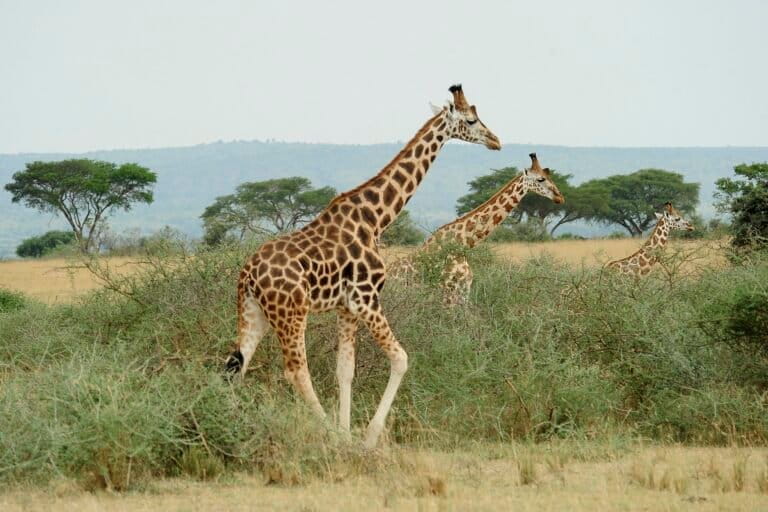
Giraffes living in the South Sudan’s war-torn savannas are genetically healthy and connected to nearby giraffe populations by gene flow, despite decades of conflict, recent research suggests. These findings show that “regions of the world that have been affected by conflict can maintain a lot of biodiversity and should therefore not be overlooked by genetic studies and conservation efforts,” Sam van Giessen, study lead author and a conservation genomics researcher from the University of Amsterdam, Netherlands, told Mongabay by email. The IUCN, the global wildlife conservation authority, currently recognizes four species and seven subspecies of giraffes. South Sudan is home to two subspecies of the critically endangered northern giraffe (Giraffa camelopardalis): the Nubian giraffe (G. c. camelopardalis) and the Kordofan giraffe (G. c. antiquorum). Between the conflict years of 1985 and 2025, Nubian giraffes in Ethiopia and South Sudan declined by 95%. By 2025, researchers estimated roughly 235 Nubian giraffe survived across South Sudan in isolated pockets, down from an estimate of 15,000 individuals in 1995. To find out the genetic health of these giraffe populations, researchers from the South Sudan government, the Giraffe Conservation Foundation (GCF), and conservation NGO African Parks analyzed DNA from skin biopsies collected from 30 Nubian giraffes in Boma and Badingilo national parks, run by African Parks. As the giraffe population in the region is small, there was some concern that inbreeding could be a problem for the subspecies’ long-term conservation. However, their analysis showed the South Sudan Nubian giraffe population has relatively high levels…This article was originally published on Mongabay
The World Health Organization has officially recognized Bhutan for eliminating dog-transmitted human rabies as a public health problem — in time for World Rabies Day on Sept. 28. According to the World Health Organization (WHO), Bhutan is the first country in the Southeast Asia region, and the second to be named globally after Mexico, to achieve this validation. Nearly 99% of all human rabies cases globally are caused by the bite or scratch of an infected dog. Once symptoms appear, rabies is almost always fatal. On Sept. 4, the WHO confirmed that Bhutan has recorded zero human deaths from dog-mediated rabies since June 2023 and has demonstrated that it has the resources and systems in place to prevent the disease’s re-emergence. Bhutan’s achievement comes as organizations including the WHO, World Organisation for Animal Health (WOAH), Food and Agriculture Organization of the United Nations (FAO) and Global Alliance for Rabies Control (GARC) mark World Rabies Day with the theme of “Stronger Together”, advancing a global goal to eliminate human rabies deaths worldwide by 2030 under the “Zero by 30” initiative. To eradicate rabies, Bhutan has persistently invested in a comprehensive “One Health” approach, which recognizes that animal, human and environmental health are interconnected, the WHO said in a press release. A 2021 Royal Decree by the King of Bhutan launched the Nationwide Accelerated Dog Population Mangement and Rabies Control Programme, implemented jointly by the Ministry of Health and Ministry of Agriculture and Livestock. WHO said field health teams and veterinarians supported by…This article was originally published on Mongabay
Founder’s Briefs: An occasional series where Mongabay founder Rhett Ayers Butler shares analysis, perspectives and story summaries. In 2022, poachers had taken 14 white rhinos from private farms in Namibia in six weeks, so owners started removing their horns. One cow had a horn 86 centimeters (34 inches) long. Jaco Muller said he was nearly in tears when it was removed. “It is such a magnificent animal,” he said. “But for the animal’s sake, it is for the best.” Dehorning gave poachers less reason to kill a rhino. For Muller, the sight of a dehorned rhino was preferable to finding a dead one. The idea for breeding rhinos came from his son, then 15, as a school project. In 2010, Muller converted the family’s antelope-breeding operation into what became the Rhino Momma Project in Namibia’s Kunene region. Muller believed that breeding more white rhinos (Ceratotherium simum), keeping them secure enough to reproduce, and then replenishing populations across Africa could help save the species. So he built a breeding program with a rhino-custodianship farm and the nonprofit Help Our Rhinos Now, or HoRn. The first calf was born in 2013; by 2025, the project had become one of Namibia’s larger privately run rhino-breeding operations. Kifaru Lodge, which Muller opened in 2018, brought in money from tourists to help cover security and rhino care. Muller also supported legalizing the trade in rhino horn. His argument was that prohibition let criminals collect the profits while farm owners and conservation groups paid for security.…This article was originally published on Mongabay
Founder’s Briefs: An occasional series where Mongabay founder Rhett Ayers Butler shares analysis, perspectives and story summaries. A mountain lion in front of the Hollywood sign sounds almost too convenient. When photographer Steve Winter proposed the picture, National Park Service biologist Jeff Sikich thought he was crazy. There were, as far as Sikich knew, no mountain lions in Griffith Park. Then P-22 turned up. Winter spent more than a year trying to get the photograph. Remote cameras were stolen, and equipment failed. Eventually, he captured P-22 walking beneath the Hollywood sign at night, his tracking collar visible around his neck. The photograph made P-22 famous and gave Los Angeles a symbol of the problems faced by wildlife boxed in by roads and development. P-22 became closely associated with the campaign for the Wallis Annenberg Wildlife Crossing over U.S. Route 101, which is intended to reconnect habitat divided by one of the region’s busiest freeways. The story is one of nine in Big Cats, a new book by Winter and journalist Sharon Guynup, who is also Mongabay’s wildlife editor. The pair revisit some of their most consequential reporting projects in the book in their recent conversation with Mike DiGirolamo, the host and producer of the Mongabay Newscast. One of those projects took them to Thailand’s Tiger Temple, a lucrative tourist attraction where visitors could pose with captive tigers. Guynup and Winter spent a year investigating the operation and documented its links to illegal wildlife trafficking. Thai authorities eventually raided and closed…This article was originally published on Mongabay
The Philippines remains the deadliest country in Asia for land and environmental defenders, according to a new report by the non-profit Global Witness. In its report, Global Witness says it could verify the killings of 124 land and environmental defenders worldwide in 2025. While the majority, 85% of cases, occurred in Latin America, Asia accounted for 12% of the deaths with 12 defenders killed in the Philippines and one person killed for each of India, Indonesia and Turkey. The Philippines remains the deadliest country in Asia for the thirteenth consecutive year. Its 12 documented cases in 2025 represent the highest total recorded in any single country outside Latin America, the report says. State forces played a central role in the violence against environmental and land defenders in the country, with the Philippine military suspected of participating in five of the 12 killings amid expanded rural counterinsurgency campaigns and resource extraction projects, according to the report. “The report adds an important dimension to what we already know about the situation of land and environmental defenders in the Philippines,” Manila-based environmental advocacy group Kalikasan People’s Network for the Environment (PNE) told Mongabay in an emailed statement. “Attacks against defenders are entrenched in state policies and structures that facilitate extractive and development projects.” Global Witness’ report adds that killings “are only the most extreme form of reprisal that defenders face.” Beyond lethal violence, environmental defenders face a rising tide of legal harassment, criminalization, and smear campaigns, it says. In the Philippines, for example, the…This article was originally published on Mongabay

 Login