
❌

Reading view

Seoul backs Ukraine, but sanctioned tankers carried fuel from South Korea to Russia
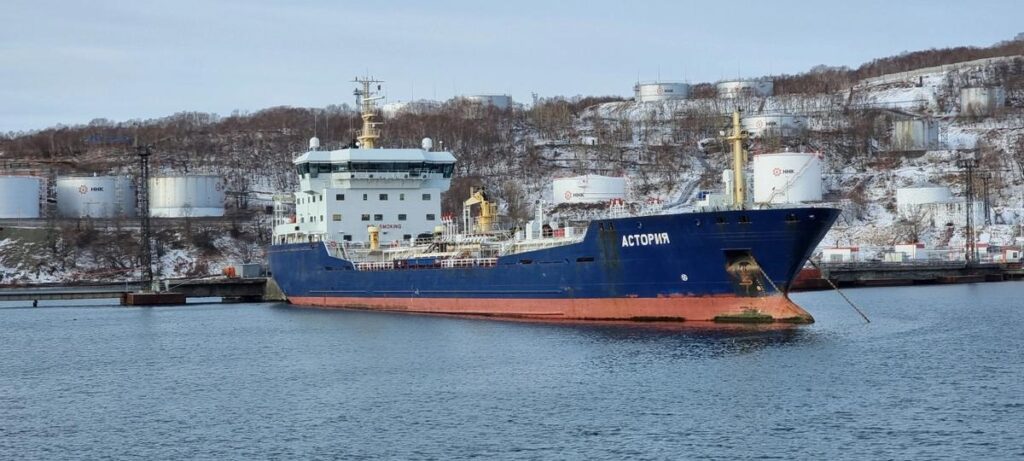
Seven tankers made 14 trips from South Korea to Russia's Far East in July and August, carrying more than 176,000 metric tons of fuel, most of it diesel, the Guardian found in a 6 October analysis of port records and ship-tracking data. The UK and EU have sanctioned three of the ships, and one loaded its fuel from another tanker at sea off South Korea instead of at a terminal.

Ukrainian strikes have cut Russia's fuel output as Moscow scrambles for supplies, while fuel loaded at South Korean ports has flowed to Russia. Loadings began to surge in July, the same month South Korean President Lee Jae-myung pledged $100 million for Ukraine's reconstruction, the Guardian reported. That creates a tension in Seoul's policy toward the war: South Korea has provided Ukraine with humanitarian and non-lethal aid but ruled out sending weapons directly, while the fuel trade appears legal under South Korean law even though three of the tankers are under UK and EU sanctions.

Russia imported 368,000 metric tons of oil products by sea in August, 112,000 of them from South Korea, according to Kpler data analyzed by the Centre for Research on Energy and Clean Air (CREA) and cited by the Guardian. CREA's own August report gives 172,000 metric tons in total, including 18,000 from South Korea. Neither explains the gap.

Where the tankers said they were going

The Layla, a tanker under UK and EU sanctions, made two voyages from Ulsan to Vladivostok, carrying a total of 57,000 metric tons of diesel. It left South Korea on 19 July and 10 August. On the first trip, it told South Korean authorities it was bound for Vladivostok; on the second, it declared Niigata, Japan, but sailed to Vladivostok again.

The Astoria, a Russian-flagged tanker under UK, EU, and Australian sanctions, loaded nearly 11,000 metric tons of fuel at Ulsan on 1 August. It declared Japan as its destination but sailed to Vladivostok.

The Chongchon did not berth at a South Korean port. Instead, it took about 26,000 metric tons of fuel from the unsanctioned Celeste I at an anchorage off Yeosu in early August. It declared Singapore as its destination but headed to Vladivostok. The owners and managers of the four tankers did not respond to the Guardian's requests for comment.
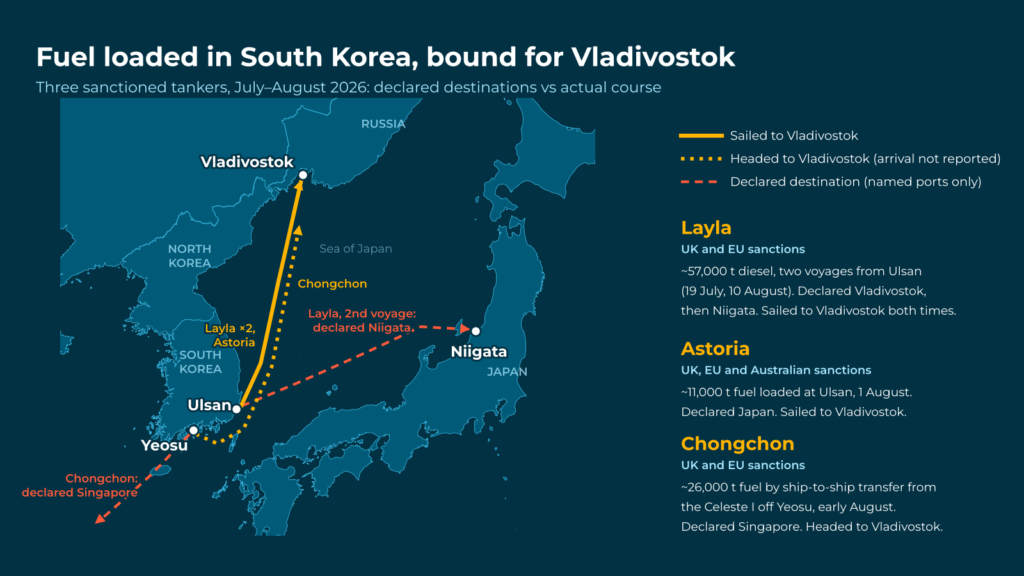
Map of sanctioned tankers' voyages from South Korea to Vladivostok
Source: Guardian analysis of port records and ship-tracking data; sanctions listings: OpenSanctions. Map: Euromaidan Press

Why Russia needs the fuel

Ukrainian drone strikes have severely disrupted Russia's refining capacity, the Guardian reported. In July, Ukraine's General Staff said the strikes had knocked out 42% of Russia's refining capacity, costing the industry billions of dollars.

Russian refinery throughput fell in June to its lowest level in more than 20 years, and diesel output is down nearly 30% from a year earlier, the International Energy Agency said, according to the Guardian.

Russia has also restricted fuel exports to protect domestic supplies, extending its diesel export ban until the end of October; on 2 October, Deputy Prime Minister Alexander Novak said Moscow could consider partially lifting the ban if there was overproduction, according to the Moscow Times.

Responses to the shipments

Seoul's non-lethal aid has included helmets, body armor, and demining vehicles, and in 2023 it pledged $2.3 billion in support, mostly in loans.

Isaac Levi, an analyst at CREA, told the Guardian:

"It is shocking that EU-sanctioned tankers loaded fuel at South Korean ports and carried it to Russia. This undermines the sanctions regime and South Korea's support for Ukraine."

South Korea's Foreign Ministry did not address the shipments or the sanctioned tankers. In a statement, it said the government supports international efforts to help end the war in Ukraine and bring about a peaceful recovery. The ministry said it was strictly enforcing its export controls and had expanded them to cover 1,402 non-strategic items with high potential for diversion to military use. The UK Foreign Office did not answer the Guardian's questions about UK-sanctioned tankers using South Korean ports, saying only that it remains committed to monitoring its sanctions.

Ties between Kyiv and Seoul are also strained over Ukraine's disclosure of its transfer of two North Korean prisoners of war to South Korea, which Seoul said should have remained private.

  •  

Ukraine to Seek Return of Usmanov and Fridman to EU Sanctions List

Ukraine will seek to have Russian businessmen Alisher Usmanov and Mikhail Fridman restored to European sanctions lists after the EU removed both men as part of an agreement that secured a three-year renewal of its wider individual sanctions regime against Russia.

Ukraine is preparing a new sanctions initiative targeting more than 20 Russian businessmen and intends to press for Alisher Usmanov and Mikhail Fridman to be placed back under restrictions, Foreign Minister Andrii Sybiha said on Thursday.

Sybiha, speaking to journalists in Kyiv on 1 October, said the Ukrainian government regarded the European Union’s decision to remove the two men from its sanctions list as unacceptable and had tried to prevent it through both public and diplomatic channels.

“Our response will be asymmetric. You removed two oligarchs, and we will add another twenty,” Sybiha said.

He said Kyiv had prepared a list containing more than 20 Russian businessmen for possible sanctions and was also working to restore restrictions against Usmanov and Fridman.

The minister did not specify which EU legal mechanism Kyiv expects to use. Ukraine cannot itself add individuals to the bloc’s restrictive-measures list, meaning any renewed designation would require action by EU member states.

The EU formally removed Usmanov and Fridman from its sanctions list on 22 September. Council Implementing Regulation (EU) 2026/2160 deleted the entries for Usmanov, Fridman and Russian businessman Andrey Falaleev, as well as Redbird Corporate Services Ltd.

At the same time, EU governments extended the remaining individual sanctions for another 36 months, until 22 September 2029. The regime covers more than 3,000 individuals and entities and provides for asset freezes, travel restrictions and a prohibition on EU citizens and companies making funds or economic resources available to those listed.

The agreement marked a significant change to the previous system under which individual sanctions were renewed every six months.

The fate of Usmanov and Fridman had become one of the principal points of dispute during negotiations. EU Today reported before the decision that Latvia opposed a compromise involving their removal while supporting a longer renewal period for the wider sanctions regime.

The eventual agreement nevertheless resulted in both men being removed. EU Today reported on 22 September that the Council had approved the three-year extension alongside their delisting.

Kyiv is now seeking to compensate for that decision through national sanctions regimes while pursuing their possible return to the EU list.

Sybiha said President Volodymyr Zelenskyy had approved the Ukrainian approach and that Kyiv was working with partner governments to ensure that restrictions against Usmanov and Fridman remained in force outside the EU framework.

According to the foreign minister, Canada has indicated that it intends to retain its restrictions. Sybiha also pointed to Britain, Japan and Australia as jurisdictions where sanctions remain in place and said Ukraine would seek similar measures elsewhere.

Britain continues to maintain a separate national Russia sanctions regime. The UK government’s current Russia sanctions framework records designations, amendments and removals independently of decisions made by the European Union.

Several EU member states have meanwhile taken or begun preparing national measures following the September decision.

Estonia moved immediately after the EU agreement. Foreign Minister Margus Tsahkna signed national sanctions against Usmanov and Fridman on 23 September, saying Tallinn had opposed their removal from the EU list.

Lithuania has also begun using national legislation. Foreign Minister Kęstutis Budrys asked for both businessmen to be placed on Lithuania’s national entry-ban list for five years. The Lithuanian Foreign Ministry said it was also preparing legal measures that would allow the freezing of their funds and economic resources.

The dispute has exposed one of the structural features of EU sanctions policy: decisions on restrictive measures require agreement among member states, allowing individual listings to become part of wider negotiations over the continuation of an entire sanctions regime.

Moving from six-month to three-year renewals reduces the frequency with which the broader Russia sanctions list has to return to the negotiating table.

It does not, however, prevent individual names from being added again during that period. Kyiv’s new initiative is therefore likely to focus both on persuading individual governments to introduce national restrictions and on building sufficient support inside the EU for Usmanov and Fridman to be designated again.

  •  
❌