Dolphins, it turns out, don’t like to mix business and pleasure. Scientists have found that the marine mammals keep their feeding and hunting areas separate from the places where they socialize with one another. A study published in the journal PeerJ details how a team of researchers listened in on dolphins living along the Atlantic coast of Florida to “provide evidence of acoustic habitat differentiation.” “They have distinct habitats that correspond to different behaviors,” Laurent Chérubin, a marine scientist at the Harbor Branch Oceanographic Institute at Florida Atlantic University, who led the study, told Mongabay in a video interview. Scientists gathered the audio data with the help of an acoustic wave glider, a 12-foot (3.7-meter) solar-powered autonomous marine vehicle. The glider was deployed for two months along the East Florida Shelf, between Fort Pierce and Jacksonville. In addition to recording 62 hours of underwater audio, the glider also carried sensors gathering environmental data such as water temperature, salinity, turbidity, and the concentration of chlorophyll-a, a pigment that plays a critical role in photosynthesis. “The glider has a bunch of sensors and can host a lot of payload,” Chérubin said. “It can be at sea on its own for as long as needed because it uses solar power and wave action to move around.” On analyzing the data, the scientists detected dolphins in more than 1,600 recordings. They then classified their calls into whistles, which dolphins use to communicate with each other, and rapid clicking sounds, which the animals use as…This article was originally published on Mongabay
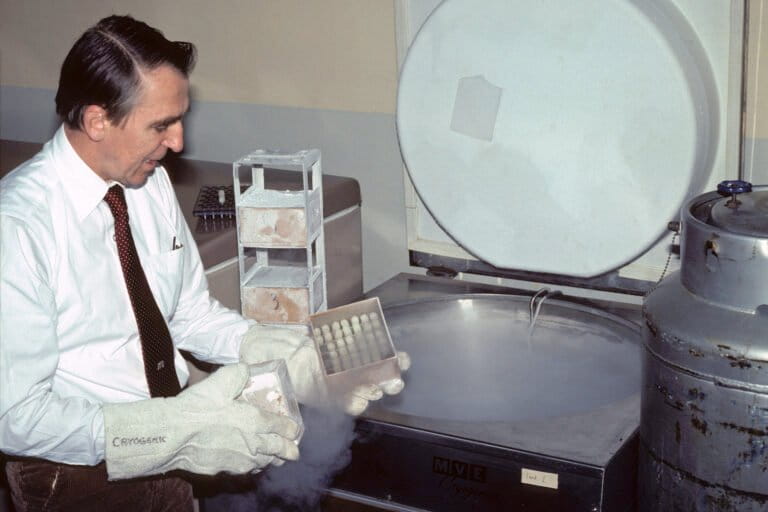
Kurt, a Przewalski’s horse, was born at in Texas in August 2020. Less than three years later, Ollie followed. Out in the wild, their species had gone extinct in the 1960s. Both individuals, born of a surrogate mother — a domestic horse — were the first Przewalski’s horses (Equus ferus przewalskii) to be successfully cloned from another of their species whose DNA had been preserved at the San Diego Zoo for 40 years. At the San Diego Zoo Wildlife Alliance’s Frozen Zoo, the largest initiative of its kind in the world, genetic materials from animals and plants are stored — cryopreserved using liquid nitrogen at temperatures as low as -196° Celsius (-320° Fahrenheit) — for posterity. But the Frozen Zoo is only part of the alliance’s broader biodiversity banking initiative, which also includes a native plant gene bank and a tissue and DNA bank. “I think of it as saving DNA for the future,” Katie Heineman, conservation program leader for biodiversity banking at the San Diego Zoo Wildlife Alliance (SDZWA), told Mongabay in a video interview. “It really is an optimistic act to conserve biodiversity for a time where we’ve solved the threats facing nature.” Applications are aplenty. Biodiversity banking can help not just in the recovery of threatened species, but also in preserving genetic diversity. It’s also crucial for scientific research. However, given the pace of habitat degradation and biodiversity loss, Heineman said there’s an urgency to build capacity around the world to ensure more samples are collected and…This article was originally published on Mongabay

 Login