❌

Reading view

Agrochemical lobbyists are defending a toxic model of agriculture that is heading for collapse

Last week, EU member states reached a common position on the European Commission Omnibus X ‘Food and Feed’ proposal, in a bid to simplify regulation of pesticides. In reality, however, it will weaken protection against pesticides’ negative effects in Europe. The proposal pleases the chemical industry but goes against the wishes of a vast majority of citizens and many scientists who value people’s health, clean drinking water and biodiversity.

A hearing in the European Parliament on 3 September highlighted the real problem. Under the guise of a ‘discussion with experts’ in the field of health and environment, the parliament handed the megaphone to lobbyists representing a broken, toxic agricultural model.

Representatives of industrial agriculture – sugar beet, apple and cereal growers – parroted industry arguments, justifying their demands to stop banning pesticides that are toxic to public health, the environment and pollute our water resources.

Despite Europe witnessing massive droughts, extreme heatwaves leading to countless deaths, wildfires destroying biodiversity, and devastating crop losses, it seems that a significant share of MEPs are ready and willing to accelerate the degradation of European’s wellbeing and natural resources. 

Listening to them raises a fundamental question: Do farmers truly want to rely on a cocktail of toxic chemicals to maximise yields at low market prices, destroying their own health and local ecosystems in the process? Or do they wish to make an honest living, producing quality food in balance with nature for a fair income?

CAP subsidies

To better grasp this contradiction, we must look at what is actually at stake here.

Agrochemical corporations seek their share of the Common Agriculture Policy (CAP) cake – a colossal €58bn budget, accounting for one third of the EU’s total budget.

Their own survival is reliant on keeping as many farmers as possible dependent on pesticides, fertilisers and industrial seeds. By diverting public CAP funds through farmers into the pockets of their shareholders, these companies ensure their long-term profitability.

Many farmers’ unions also represent agri-cooperatives that profit significantly from selling pesticides, which raises questions about whether they truly represent farmers’ long-term interests, or those of the pesticide industry.

Since the European Commission published its ‘simplification’ proposal in December 2025, proponents of pesticide-intensive farming have presented a series of flawed arguments that in fact reveal the dead-end to which intensive agriculture has led us.

Firstly, farmers’ organisations complain about a “lack of pesticide substances” on the market.

Currently around 450 different pesticide active substances are approved in the EU, from insecticides to fungicides, and herbicides. If 450 different options are insufficient, does this not signal an unhealthy addiction rather than a shortage?

Lobbyist groups, furthermore, claim that pest resistance to synthetic pesticides would inevitably lead to dramatic yield losses and hunger, arguing for even more pesticides with diverse modes of action.

And yet, according to scientific research, the  multiple chemical strategy that has been applied for more than 40 years is the very cause of the appearance of resistance. This problem cannot be solved with the mindset that caused it. The only scientific solution is, therefore, not more chemistry but prevention, and the use of alternative methods.

Thousands of farmers across the EU and the rest of the world are already proving this by switching towards Integrated Pest Management (a strategy for low-pesticide-input pest management) or organic practices to reduce pesticide inputs.

Who bares the cost

The call to keep all pesticides on the market – and potentially even use some of the banned ones –  serves only the short-term interests of the pesticide industry, not of the farmers.

Destroying soil life – the basis of soil fertility – with chemicals, and killing insect populations that naturally control pests and pollinate crops, jeopardises the very basis of farming and long-term food security.

The societal costs of this pesticide-dependent model are staggering. Citizens are the ones who bear the healthcare costs for chronic diseases such as cancer and Parkinson’s, which impact not only farmers but also residents of agricultural areas.

We face water pollution that has become nearly impossible to remediate. Fewer pollinators means fewer healthy fruit and vegetables. These ‘externalities’ far outweigh any short-term benefits.

This is the reason why the Paris and Munich water companies financially support farmers in protecting the groundwater, because doing so is up to 45 times cheaper than depollution.

In the meantime, the agrochemical industry enjoys huge profits from pesticide sales, largely supported by CAP subsidies, while society foots the bill for the damage. It is indeed a perfect business model…for them.

Lobbyist circus

The spectacle witnessed in the alleged House of European Democracy is testament to the state of our political world; one that is dominated by corporate interests over citizens and farmers’ wellbeing.

We witnessed the desperate battle of a toxic agricultural model that struggles to survive, and resists being replaced by sustainable farming methods.

The lobbyist speakers in the European Parliament hearing more or less gave the diagnosis to the current pesticide-intensive agricultural system: it is simply broken. 

Citizens have repeatedly expressed their concern on the impact of pesticides on their health and biodiversity. They have also expressed the need that public support for agriculture serves the common good.

The pesticide Omnibus X proposal is merely an attempt to maintain a detrimental status quo that favours the pesticides industry.

With the 1968 Mansholt Plan Europe created a blueprint for the intensification of agriculture.

What is needed now is a new blueprint for a system which financially supports farmers to implement practices that improve soil and plant health, favour beneficial insects, accelerate the availability of alternatives to pesticides such as biocontrol products, and rapidly phase out toxic synthetic pesticides to protect our health, water resources and biodiversity.

Only then can we ensure a sustainable future for European agriculture and our children. Only then, will a greater share of the CAP remain in the hands of farmers who feed us and protect our nature.

  •  

Voters or capital: Who rules Berlin?

On September 20, 2026, Die Linke achieved a historic result. With 25.7% of the vote, the party became the largest in the Berlin parliament for the first time. The traditional parties of power (the CDU, the SPD, and the Greens) are left standing. A left-wing government with Elif Eralp as governing mayor is, in theory, within reach.

The reason for this success is no mystery. It is substance. During the campaign, thousands of Die Linke volunteers went out into the neighborhoods. Door to door. Building to building. Up one stairwell, down the next. They came not with shiny brochures, but with one fundamental question: what keeps people awake at night?

For hundreds of thousands of Berliners, the answer is painfully clear: rent. The envelope that lands on the doormat every month. The knowledge that an ever-larger share of their wages flows straight into the bank account of some anonymous slumlord.

Die Linke wants to make rents affordable, break the power of listed real estate giants, and finally implement the outcome of the referendum. In that 2021 referendum, more than one million Berliners voted for the socialization of large housing stock.

Berliners consider no other party as competent on housing. The figures speak for themselves: after the election, 37% of all Berliners say Die Linke has the best solutions for affordable housing.

The establishment strikes back: the great reversal of the debate

Die Linke won on material issues: housing, rent, ownership. But within no time, the press and the talk shows have all but stopped talking about any of it. Suddenly the political debate is dominated by accusations of antisemitism. By stories about the Rote Hilfe, a left-wing solidarity organization that provides legal support to activists and prisoners. By alleged connections to criminal “clans.” By the suggestion that parts of the party lie outside the acceptable democratic framework. Suddenly, the burning question in the media is no longer how to lower rents, but whether Die Linke is “even fit to govern at all.”

It is the great reversal of the debate. Center stage no longer belongs to the unaffordable rents, the power of real estate corporations, and the housing crisis, but to the legitimacy of the party that won precisely on those issues. Meanwhile, the federal establishment works hard behind the scenes to make any possible socialization of real estate giants, the so-called Vergesellschaftung, legally impossible. Yet Article 15 of the German Constitution makes such socialization possible in principle.

What we see here is an organized counterattack from established economic and political power blocs. They open multiple fronts simultaneously – economic, legal, political, and ideological. Let us take a closer look at the nine forces that have now mobilized against Die Linke in Berlin.

1. Real estate capital

The most direct clash is with real estate capital. Die Linke wants to expropriate profit-driven housing companies that own more than three thousand units each. That concerns a total of over 200,000 housing units in the city. Among them is Europe’s largest real estate company Vonovia, which alone owns 138,000 units in Berlin.

On September 21, the morning after the election, BFW Berlin-Brandenburg, the lobby club of private project developers, pulls the emergency brake. The real estate group warns of “a step backward in housing policy.” Expropriation would slow new construction. Private capital would flee. The BBU, the association of housing companies in Berlin-Brandenburg, also springs into action. In Handelsblatt, Welt, Die Zeit, and Tagesspiegel it warns of “massive investment risks.” In short, as soon as its property and profit model is even slightly threatened, the real estate lobby pulls out all the stops and lets the organ roar.

Here you see class struggle in its most material form. Die Linke wants to shift power from large real estate owners to tenants and public ownership. The real estate sector wants to preserve the existing regime of private property, rental income, and investment returns.

What is at stake is concrete: who owns the apartments, who controls rental income, where does public money go, and who may decide politically about it?

2. Financial capital

Where there is real estate, there are banks. On that same September 21, Die Deutsche Kreditwirtschaft, the powerful umbrella organization of the German banking sector, issues an official warning. Socialization of housing would deter private capital. It would make real estate financing more difficult. It would drive risk premiums sky-high. It would – for hypocrisy knows no bounds – “reduce funds for education and social policy,” as if the German banking sector had ever been guided by such concerns in past decades.

Financial markets also react immediately. Vonovia’s stock price takes a hit and falls 1.7% against the trend, to its lowest level since June 2023. Deutsche Wohnen takes a beating too. Why? Because for these guys, housing in Berlin are not places where people live, love, and raise children. For big capital, housing units are investment vehicles and collateral for gigantic mountains of debt. If you remove those homes from the private market, you hit not only the slumlord but also the wealth manager, the banker, and the speculator behind the entire parasitic ecosystem of Frankfurt. That too is class struggle.

3. The Berlin business establishment

Traditional Berlin capital had already dug in before the election. The four major employer organizations – the Chamber of Commerce (IHK Berlin), the Handwerkskammer, the VBKI, and the UVB – closed ranks in their so-called Wahlarena der Berliner Wirtschaft, a joint election forum where the main parties had to defend their economic programs before organized Berlin business.

Their lobbying does not stop on election day. After Die Linke’s victory, VBKI chairman Harald Christ mounts his warhorse. His message? “Anyone who wants to expropriate private property in this city puts our future at stake.” The VBKI is one of the most elite clubs of Berlin businessmen, of the sort that lives more on returns from property and the labour of others than on their own labour. According to Harald Christ, who himself holds no elected public mandate, a party “that does not clearly distance itself from antisemitism” should not govern either.

Here you see how the two lines of attack of the establishment merge perfectly. On one hand, defence of sacred private property. On the other, moral blackmail. Die Linke must be treated as a pariah as long as it does not jump through all the hoops of the establishment.

4. The arms industry

A second economic front is the arms industry. For the militarists, Berlin must become a hub in the arms industry. Die Linke sees it differently. The party wants no expansion of military industry in the city, no military propaganda on the streets, and no army recruiters in schools.

That is blasphemy in the church of German militarism. In its hunger for new billion-dollar contracts, the German military-industrial complex of Berlin-Brandenburg wants to create a cluster for defence and aviation. Martina Klement, Minister of Economic Affairs in Brandenburg, already threatened that her state would “continue alone if necessary” if the Berlin government blocked its plans. She points an accusing finger at Die Linke’s critical attitude towards the Rüstungsindustrie, the arms industry. That too is class struggle: will Berlin become a cog in the booming war economy, or will the city build a dam against it?

5. The federal state and the institutional veto

Pressure on Die Linke comes not only from banks, real estate groups, and lobbies. Parts of the state apparatus are also intervening directly into the conflict.

The decision that Die Linke must under no circumstances lead the formation of a Berlin government seems to have been decided even before the polling stations closed on September 20. A few minutes after 6 pm, with the polls barely closed, Federal Chancellor Friedrich Merz gave a speech with one clear message: he continues his course, whatever the election result.

A day later, Merz announced he wants to fast-track with a federal law against the socialization of large real estate companies. His coalition had previously made agreements about this, but after Die Linke’s victory it suddenly became urgent. Germany, according to Merz, had to make it clear to international investors that private property remains safe and is not simply expropriated. That it is Merz, of all people, who brings this message is not without meaning. Before his return to politics, he chaired the supervisory board of the German branch of asset manager BlackRock from 2016 to 2020, one of the largest financial players in the world.

What is at stake is Article 15 of the German Constitution.Since 1949, it has explicitly stated that land, natural resources, and means of production can be transferred to common ownership or other forms of communal economy by law, provided compensation is regulated by law. That provision has never been applied. The struggle in Berlin is precisely about whether it can be used for the first time against large real estate companies.

Other statesmen also do not hold back. For example, Bavarian Minister-President Markus Söder (CSU) threatens to question financial transfers to Berlin if the city pursues too leftward a course. Bavaria is one of the richest states and a major net contributor to Germany’s system of redistribution. Bavaria is rich, Bavaria pays. And so Söder wants to dictate what Berlin votes. A dangerous Lega-Nord-ization of German federalism: the rich region buying off democracy in the poorer region.

Individual ministers also intervene via their official function. Federal Minister of Economic Affairs Katherina Reiche used her ministry’s Instagram account to attack Die Linke over expropriations, antisemitism, and alleged ties to organized crime. Die Linke has taken legal action against this, invoking the duty of neutrality that binds state institutions.

Even the judiciary has been drawn into the debate. Berlin Attorney General Margarete Koppers warned, amidst the controversy over alleged ‘clan’ contacts around Die Linke, that criminal networks deliberately seek out politicians. She did not accuse Die Linke directly, but her intervention gave additional institutional weight to the image built around the election winner.

Merz and his Vice Chancellor and Finance Minister Lars Klingbeil (SPD) know well what is at stake: if socialization of large real estate companies succeeds in Berlin, it could also raise expectations elsewhere – in the automotive industry, energy sector, or other strategic sectors.

It is precisely this precedent that must be stopped. An electoral victory for Die Linke must under no circumstances grow into an infringement of the existing order of property, let alone into an example that sparks other social struggles.

6. The police and security apparatus

A sixth pressure line comes from the police apparatus. After the election, certain police unions in Berlin warned that a government led by Die Linke could weaken the police by restricting its powers, its surveillance, and its capacity for repression. The Gewerkschaft der Polizei (GdP) went further and warned SPD and Greens that “the security of this city is at stake.” It also suggested officers might leave Berlin to work in other German states.

That threat quickly gained a practical dimension. CDU-led governments in Baden-Württemberg and Brandenburg openly invited Berlin police officers to transfer and explicitly linked that recruitment campaign to the prospect of a government led by Die Linke.

That is organized pressure and blackmail from certain police unions and conservative state governments: accept our vision of police and security, or we will drain your force dry.

7. The Israeli Embassy

And then there is the elephant in the room: the campaign around antisemitism. On September 26, ARD, the major German public broadcasting corporation, found that the controversy over antisemitism had by then “overshadowed all other topics since the election victory.”

Ambassadors are normally not supposed to interfere directly in the host country’s domestic political decision-making. That did not prevent Israeli Ambassador Ron Prosor from warning after Die Linke’s victory of an “immediate existential threat” to Jewish life in Berlin. Prosor, a Netanyahu loyalist and critic of the International Criminal Court, accuses parts of Die Linke of “unrestrained antisemitism” and hostility toward Israel.

Virtually simultaneously, Josef Schuster, Chairman of the Central Council of Jews in Germany, addressed the SPD and the Greens directly: anyone who helps Die Linke into the Rote Rathaus, the Berlin City Hall, is, in his view, putting social cohesion and Jewish life at risk.

Within the SPD and the Greens, that Israeli pressure finds a willing ear. SPD politician Martin Hikel calls cooperation impossible with a party that, in his words, “tolerates antisemitic statements.” Antisemitism and the defence of Israel have now become central topics in initial talks between Die Linke, the SPD, and the Greens. In this way, the Israeli intervention weighs directly on the political climate in which a new Berlin government is being negotiated.

Behind that lies a broader strategic entanglement. Despite the genocide in Gaza, Germany and Israel continue expanding their military-industrial cooperation. Israeli arms producer Elbit Systems signed new strategic cooperation agreements this year with companies including TKMS and Diehl Defence, among other things for naval weapons systems and drones for the Bundeswehr. Elbit wants to build up to eight new facilities in Germany over the coming years.

That makes the struggle over Israel material as well. It’s not just about Gaza, apartheid, and Israeli settler colonialism, but also about increasingly close military and industrial interconnection. In such a context, the label “antisemitism” takes on particularly political charge when used against forces opposing the Israeli government, German rearmament, or that growing military-industrial cooperation.

8. ELNET: the international lobby network

Beyond the Israeli embassy lies a much broader lobby infrastructure. What stands out is how the theme of antisemitism repeatedly comes to centre stage whenever a consistent left force achieves electoral breakthroughs.

In Great Britain, three major newspapers declared jointly in 2018 that a government under Jeremy Corbyn would constitute an “existential threat” to Jewish life. Corbyn had to be politically delegitimized because he broke with the consensus on Israel, openly supported the Palestinian cause, and simultaneously defended a socio-economic program that collided head-on with British establishment. The accusation of antisemitism thus became a weapon in a broader struggle to declare him unfit for governmental power.

The same pattern surfaced in France. In 2024, Yonathan Arfi, chairman of the umbrella organization of Jewish institutions in France (CRIF), declared that “La France Insoumise (LFI) has no place in government.” Again the accusation was: “antisemitism.” In reality, it was about left criticism of the genocide in Gaza. For recent French municipal elections, French security service Viginum exposed a massive Israeli disinformation campaign run by the shadowy Blackcore. With fake sites, false profiles, fake news, and AI bots, LFI candidates were systematically smeared.

In Berlin, attention focuses mainly on ELNET Deutschland, a lobby organization that seeks to strengthen Israeli-European ties. The money for this little party comes mainly from the US. The German office received over one million euros from ELNET US in a single year.

ELNET financed trips to Israel for at least 51 Bundestag members and brought six IDF officers to the capital for talks with politicians, the Bundeswehr, and media shortly before the Berlin election. Thus ELNET forms an important link between Israeli security circles and the German political establishment, and possesses considerable financial resources and direct access to decision-makers. In the current Berlin debate, that infrastructure strengthens a political climate in which attitude toward Israel increasingly serves as a touchstone for the question who may and may not govern.

9. The United States

Finally, there is American interference. The United States has made no secret in its official National Security Strategy that it actively supports far-right and nationalist forces in Europe – such as the Rassemblement National in France or the AfD in Germany. For Trump, such Europe offers a double advantage: allies who stand closer to Washington, but simultaneously an EU that remains internally divided and less able to act as an independent international power.

American heavyweights like Elon Musk, Donald Trump, JD Vance, Marco Rubio, and former ambassador Richard Grenell have intervened openly in German politics in recent years, typically in ways giving AfD more legitimacy and political space. When AfD scored in Saxony-Anhalt, Trump, Musk, and Grenell were in the front row to cheer. Trump publicly celebrated the result, Musk wrote “Gut gemacht!” (Well done!), and Grenell spoke of “a great victory and a new day in Germany.” That was barely two weeks before the Berlin election.

Meanwhile, the American embassy in Germany set aside approximately $400,000 this summer for German civil society organizations, among other things for projects around “countering antisemitism.” They use diplomatic funds to determine domestic political agendas. On Washington’s instructions, American embassies in Europe feed the witch hunt against the left, while helping the far right into the saddle.

A desperate move

Add all these forces together (banks, real estate companies, employers, arms industry, judiciary, federal government, embassies, and international capital) and you see what really happens in Berlin: different factions of the ruling class defend their own interests but find each other as soon as existing property and power relations are touched.

The first front is material. Real estate capital defends its rents and land ownership, banks their credits and collateral, investors their returns, the arms industry its billion-dollar contracts and state orders. Their interests differ, but on one point they converge: Die Linke must not undermine the grip of private capital on housing, investments, and public funds.

The second front is political and ideological. As soon as those material interests come under pressure, the debate shifts to antisemitism, extremism, Rote Hilfe, and alleged clan connections. The goal then is no longer only to block concrete reforms. Die Linke itself must be pushed outside the boundaries of the politically acceptable.

But let’s be honest: that smear campaign is nothing but a desperate move. The elites play dirty because they lack arguments. No one can look Berliners in the face and claim €1,500 per month for a shack is a good thing. The housing crisis is not an extreme position, but daily reality for the absolute majority of the population, including many voters of the SPD, the Greens, or the right.

Because the establishment cannot win that debate, it tries to impose another one. The smoke bombs go off one after another: “antisemitism!” “clans!” “Islamists!” “Rote Hilfe!” The less of an answer there is to the social question, the louder the noise about Die Linke’s supposed unfitness to govern at all.

The real extremism in this world is not a party that organizes tenants. The real extremism is a society in which millions of people are driven out of their city because a handful of vultures demand their returns. The real extremism is a system that reduces housing to speculation and war to a profit model.

Die Linke won on the fundamental question: whose city is Berlin? Who sets the rules, who controls the bricks, and whom should the city serve? The answer from Berliners was clear. The intensity of the counterattack shows how well the other side understands what is at stake.

Nobody should fear that polarization. It is simply the noise of class struggle: economic powers defending their property and capital, state powers trying to guard the boundaries within which an election result may change something. The scent of panic hangs in the corridors of power. There is no reason to turn defensive or to retreat. There is all the more reason to rely on the people and to mobilize. Because in the end, that is where the decisive question lies: who truly forms the majority in Berlin, and who holds the power to stand in its way?

Peter Mertens is a writer and the Secretary General of the Workers’ Party of Belgium (PTB/PDVA).

  •  

EU Parliament’s 7 October memorial honours Israelis, sidelines Palestinians — and sows division

An EU Parliament memorial for victims of the 7 October attack caused disarray and anger as well as grief in a divided European house.

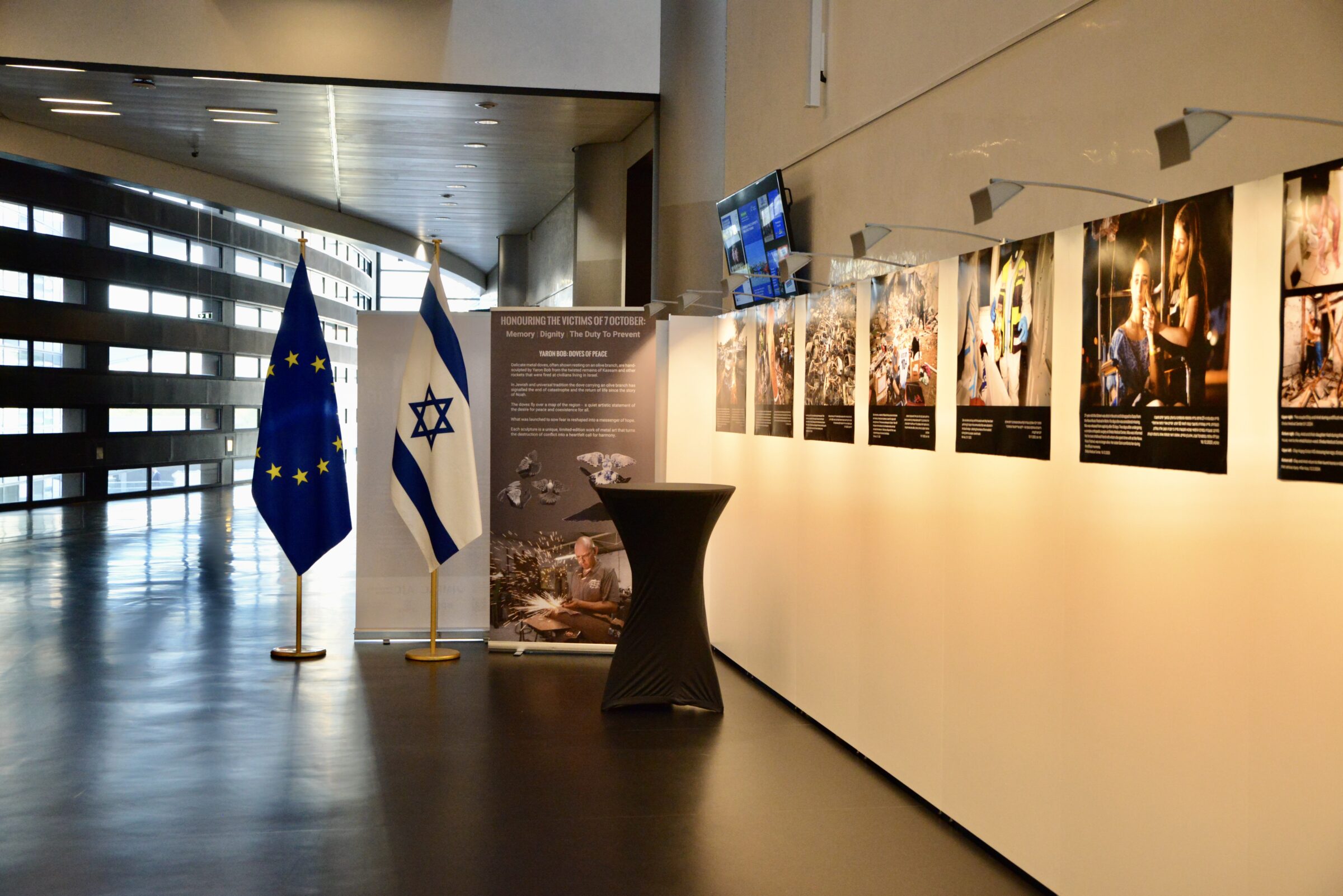
It was crowned by a towering Israeli flag, alongside the EU’s.

The exhibit set up in Strasbourg’s parliament included maps showing Occupied Palestinian Territories as part of Israel and sold trinkets made from debris of Israeli missiles.

But it made no mention of the 74,200 people killed by Israel in Gaza in the past three years, after Palestinian militants Hamas killed some 1,200 Israelis in a surprise attack.

This situation struck a chord with the sole Palestinian in parliament, left-wing French MEP Rima Hassan, who tried to take down the Israeli flag in protest, and toppled over the EU one as well in an unwanted domino effect.

“My action was in no way directed at the victims of 7 October or their memory,” Hassan told EUobserver. 

Instead, it targeted “this incessant and untenable double standard, for a Russian flag would never be permitted, and rightly so, within the [EU] institution’s premises”.

The memorial was organised by German centre-right MEP Hildegard Bentele, who chairs the parliament’s Israel delegations, alongside the Israeli embassy, and the The International Movement for Peace & Coexistence (IMPAC) group in Brussels, as well as others.

“During a conversation with a member of my team, the guest artist [at the EU Parliament memorial] claimed that Palestine ‘does not exist’,” Hassan added.

Her family were expelled from their birthplace by Israel in 1948 along with hundreds of thousands of others in what Palestinians call the Nakba (Catastrophe).

But in the cacophony of narratives in the EU assembly, those who saw her anti-Israel flag protest as offensive or antisemitic had echoing voices.

This article continues, but the full version is available only to EUobserver.com subscribers. Visit account.euobserver.com/membership

  •  

Rubio pushes for “MAGA Nationalism” with “the cradle of Democracy” as backdrop

With the Acropolis as a backdrop, US Secretary of State Marco Rubio Rubio lavishly praised the Ancient Greece with the usual clichés, all of them except the most important one: Greece is the cradle of Democracy. How could he talk about “democracy”? On the contrary. Rubio chose to rolled out the MAGA agenda as if […]

The post Rubio pushes for “MAGA Nationalism” with “the cradle of Democracy” as backdrop appeared first on Keep Talking Greece.

  •  

Morocco’s surveillance state does not stop at Western Sahara — and Europe can no longer pretend not to know

In April 2021, I told The Guardian that Sahrawi activists were having their phones and internet connections hacked.

At the time, we could describe what was happening to us. We could not see the machinery behind it.

Five years later, Amnesty International’s new investigation, “We Start With the Verdict”: Inside Morocco’s Surveillance Machine, gives those warnings a disturbing new context.

Amnesty describes a surveillance ecosystem involving spyware, physical surveillance, location tracking, informants, judicial pressure and smear campaigns. Western Sahara is not peripheral to its findings.

The organisation devotes a case study to Sahrawi activists and reports that a former member of Morocco’s domestic intelligence service, identified as “Safir,” described Sahrawis and Riffians as priority intelligence targets, including beyond Morocco. Amnesty says it independently verified his identity, employment and key elements of his testimony.

The report also contains forensic evidence involving Pegasus spyware and documents cases connected to Sahrawi activism that reached European territory.

The people Amnesty examined are the tip of the iceberg. They are documented cases: people researchers could interview, devices they could examine, or targets for whom other evidence was available.

Surveillance is secret by design. Most people never learn that their phones have been compromised, and most suspicious devices will never reach a forensic laboratory.

That is why the chronology matters.

Chilling effect

On 8 April 2021, The Guardian quoted my warning that Sahrawi activists’ “phones and internet connections are hacked.” We were describing the symptoms years before Amnesty’s latest investigation exposed more of the machinery.

But surveillance is not simply about collecting information.

When a security service knows who an activist speaks to, where that person travels and what exists inside a phone, information can become power.

Amnesty documents cases in which private information gathered through surveillance later appeared in media coverage and coordinated smear campaigns against human rights defenders.

The organisation is careful: it could not independently establish the source of every piece of private material published. But it says the nature of some material raises serious concerns that surveillance-derived information may have reached media actors.

For Sahrawis, that raises an obvious question: How does private information about activists move from their lives and devices into the public sphere?

That question deserves independent forensic investigation.

But Amnesty’s report should provoke another examination — this one in Washington and European capitals.

For decades, Western governments have built close security relationships with Morocco around counterterrorism, intelligence cooperation, migration and regional stability.

The question is not whether those relationships should exist. It is whether the West has adequately examined what happens to security capabilities once they are in the hands of its partners.

Amnesty does not establish that every security capability Morocco obtained through Western cooperation was used against Sahrawis. The evidence does not support such a sweeping conclusion.

It does, however, justify harder questions.

What safeguards accompanied security cooperation? Who monitored end use? What happens when capabilities developed or acquired in an environment shaped by counterterrorism are directed toward peaceful human rights activism?

That is the line separating security from repression.

Western Sahara struggle

The contradiction is especially striking because Sahrawi human rights activism has often relied on peaceful means: demonstrations, documentation, journalism and engagement with international institutions.

Amnesty reports restrictions on expression and assembly concerning Sahrawi rights, alongside reports of arbitrary arrests, prolonged surveillance, restrictions affecting families and the dispersal of peaceful demonstrations.

Europe has encountered similar contradictions in its relationship with Morocco.

In June 2021, the European Parliament explicitly rejected Morocco’s use of border control and migration, particularly involving unaccompanied minors, as political pressure against Spain.

Yet the same resolution emphasised the longstanding relationship and cooperation between the European Union and Morocco in counterterrorism, migration and trade.

That contradiction should matter to Europeans.

When democratic governments make another state indispensable for stopping terrorism, controlling migration or providing intelligence, they provide more than resources. They provide leverage. Eventually, fear of losing cooperation can make scrutiny of a partner more difficult.

Europe has confronted another warning sign. In its response to the corruption scandal that engulfed the European Parliament, the Parliament itself denounced alleged attempts by Morocco and Qatar to influence lawmakers and staff through acts of corruption.

These remain allegations. They do not mean that every European position favourable to Morocco was corrupt. But they demonstrate why foreign influence over democratic institutions requires serious scrutiny.

European vs American foreign policy

Western Sahara remains an issue on the United Nations agenda and is tied to a decades-long international process concerning the political future of the territory.

That should matter to an EU that regularly invokes a rules-based international order.

Morocco has rejected previous allegations concerning Pegasus and described earlier Amnesty findings as baseless. Amnesty says it provided Moroccan authorities with a summary of its latest findings before publication and invited a response but received none before the report was published.

Those denials belong on the record.

So does the evidence.

The test of a human rights policy is not only how a democracy responds to abuses by its adversaries. The harder test is what it does when credible allegations concern a security partner.

For Sahrawis, however, this story is older than spyware.

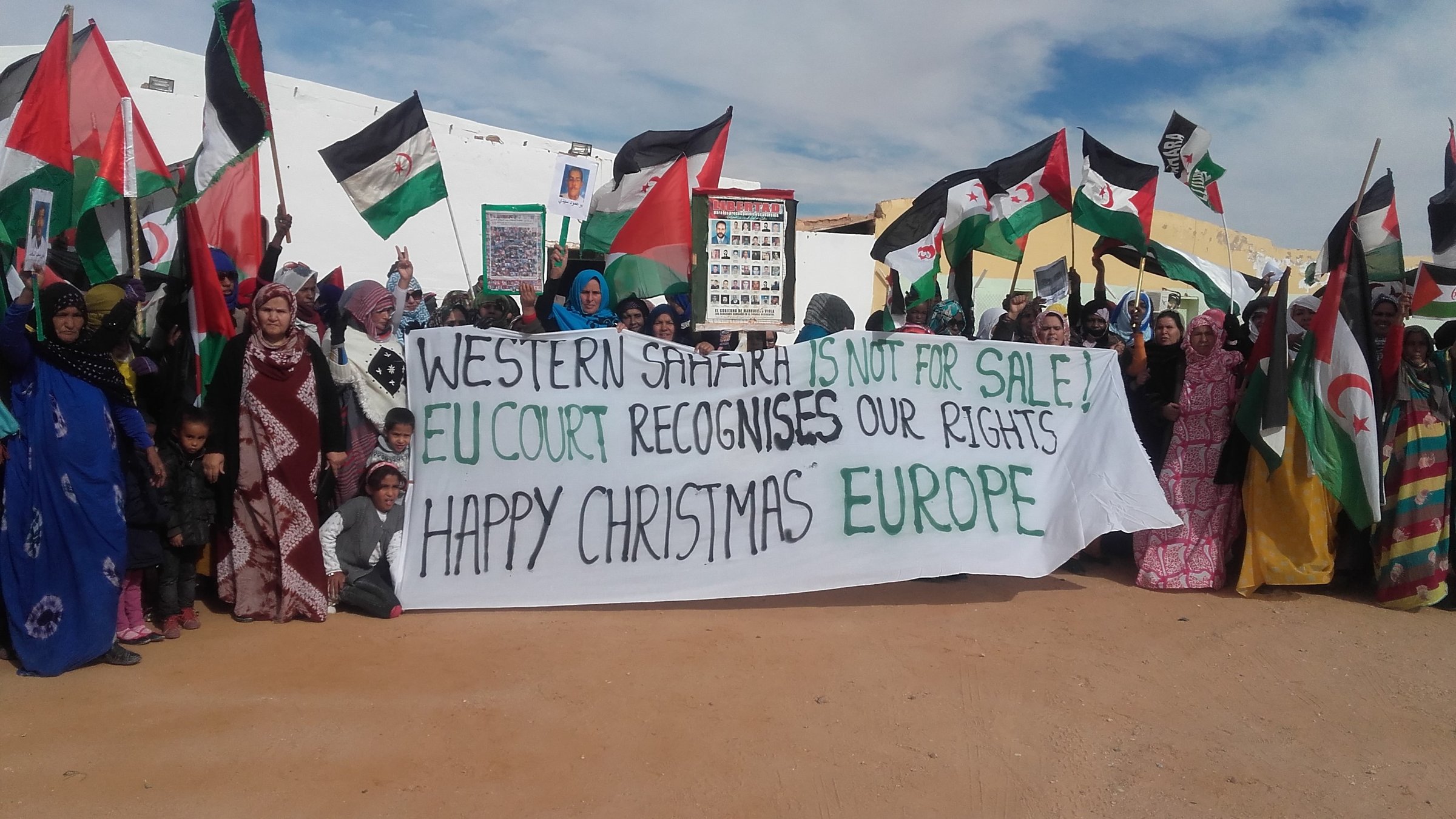
For nearly half a century, generations of Sahrawis have lived through restrictions and documented abuses connected to political expression over the future of Western Sahara. Children have grown into adults watching what can happen when someone speaks publicly: surveillance, imprisonment, smear campaigns, pressure and fear.

After all these years, what Sahrawis are asking for is not complicated.

We are not asking the world to choose an answer for us. Nor should the outcome be written in advance in our favour.

We are asking for something more elementary: Treat the Sahrawi as a free human being, capable of thinking, choosing and expressing a view about the future of the land he or she calls home without fear.

It is easy to live in a democratic society, protected by freedom of expression and equality before the law, and then propose a political solution for a distant people who will have to live with its consequences every day.

But a human question should come before the geopolitical one:

Would you accept for yourself and your children a political order in which expressing your views about your homeland could expose you to surveillance, intimidation or punishment?

A Sahrawi is not a number in a diplomatic file, a detail in a geopolitical bargain or a security problem to be managed.

A Sahrawi is a human being, with a memory, a family, a homeland, an opinion and a future.

After nearly 50 years, perhaps it is time simply to hear that voice as it is, rather than as others interpret it.

Give Sahrawis one day without fear.

One day to speak without surveillance, without pressure and without wondering whether their words will reach their phone, their workplace, their home or their family.

Do not write the answer for them.

Just let them speak.

If any political solution is truly just, why should it fear the voice of the human being who will have to live under it?

  •  

Cut the EU budget and we all lose

When certain governments discuss the EU’s next seven-year budget, their first reflex seems to be: what can we cut? That is the wrong question. The real question is not how much the EU budget costs, but how much an insufficient budget will cost us all.  

Economic benefits of EU membership are estimated to be two to six times the financial contribution of individual member states. For every euro we contribute to the EU budget, we can receive up to six euros in return.

That is the power of investing together: European investment delivers more than fragmented national spending. And it does so with a budget of just one percent of EU GNI, while national budgets can reach 50 percent.

The EU budget is not simply money transferred from national capitals to Brussels: it is an investment that creates value benefiting citizens through stronger economies, better infrastructure, food security, cutting-edge research, educational opportunities, regional development, and security.

Ultimately, all member states benefit from the added value created by the EU, making the concept of ‘net contributors’ obsolete.

Easing the pressure on national contributions is a legitimate objective, and it has a clear solution: an EU revenue reform. 

The European Parliament supports the basket approach of the European Commission on new own resources and its proposals. It also proposed three additional options capable of generating substantial revenue by 1 January 2028: a digital service levy on major platforms (€25.2bn per year), a levy on online gambling (€3.9bn per year) and a crypto-assets-based own resource (€3bn per year).

Our position is clear: large global companies that benefit most from Europe’s single market should contribute fairly to the EU budget that makes those benefits possible.

Cutting the EU budget may look like saving money. But if it means weaker competitiveness, less social investment and a less secure Europe, we save nothing and taxpayers foot the bill.

The European Union’s common budget has not grown in real terms for 40 years. On the contrary, its purchasing power has been steadily eroded due to high inflation. The current EU budget has lost around 10 percent of its purchasing power compared to when it was adopted in 2020. 

A more ambitious EU budget does not automatically mean that member states will have to contribute substantially more from their national budgets. When amounts are compared in constant prices and as a share of the size of the European economy – like with like – a more realistic picture emerges. 

In terms of spending capacity, and without counting repayment of the Covid-19 recovery fund (NextGenerationEU), the commission’s proposal for the 2028-2034 budget would be below the relative size of the current 2021-2027 MFF at the time of its adoption.

Even with parliament’s proposed increase for key EU programmes, member states’ contributions would still not substantially increase. 

Let us not forget: Europeans benefit considerably more than their countries’ headline contributions suggest. The single market is the clearest example. By removing barriers between 27 economies, it creates opportunities and delivers growth that no country could generate alone. 

By reducing the budget, the EU and its member states will have less capacity to deliver the economic and social benefits that citizens expect. We’ll have less cohesion, less competitiveness, a weaker agricultural sector, less global influence, reduced social investment and a much less secure Europe. And this also comes at a cost. A big one.

Instead of “what can we cut” we should be asking ourselves, “how can we finance a budget that delivers more for all”.  

If we genuinely want to use limited public resources efficiently, we must invest together. Economies of scale work for successful businesses, and they work for Europe.

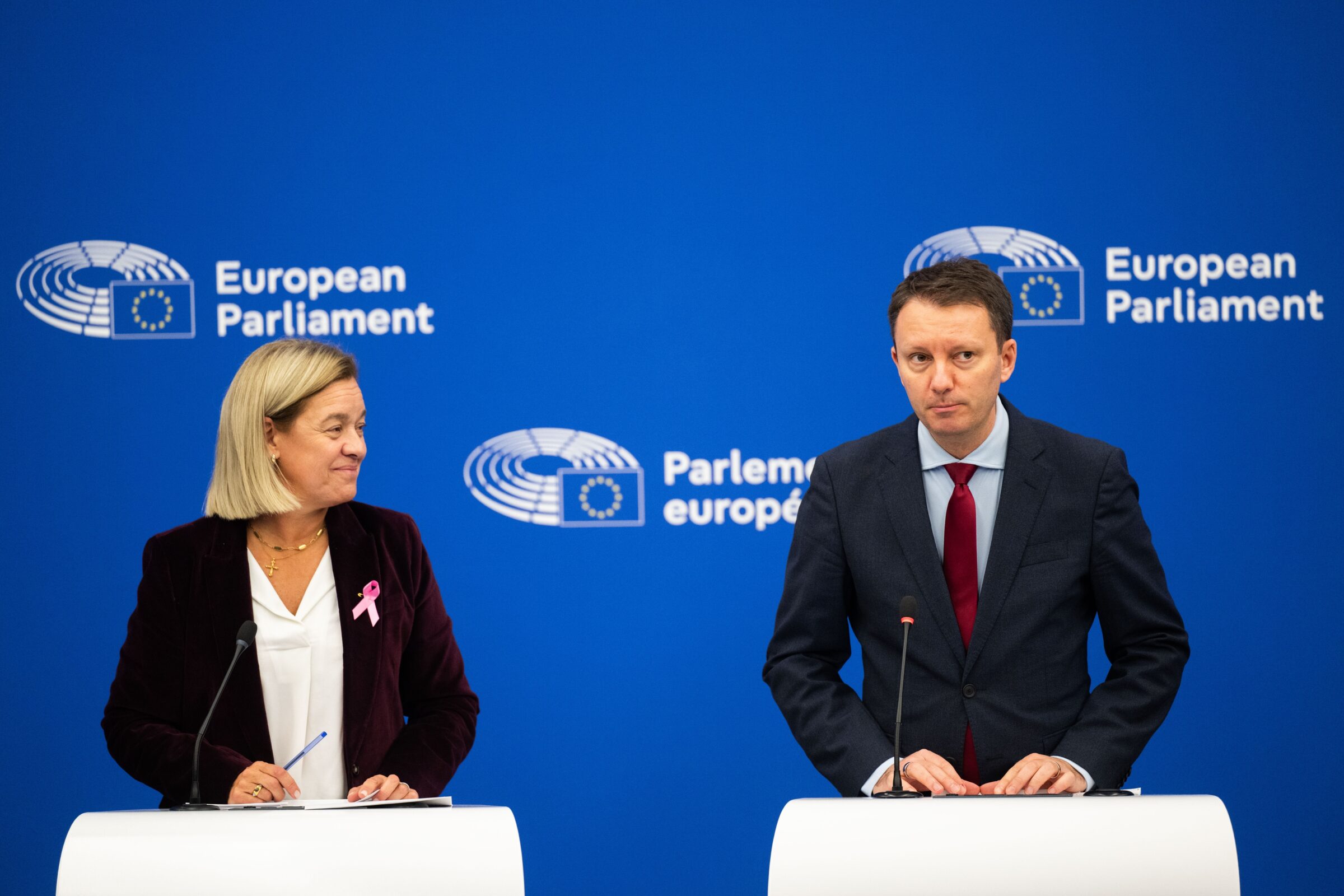
Siegfried Mureşan (EPP, Romania) and Carla Tavares (S&D, Portugal) are the parliament’s co-rapporteurs on the EU budget, also known as the multiannual financial framework (MFF)

  •  

Indonesia should count the real cost of its mineral incentives

Every year, the Indonesian government forgoes taxes it could collect. Through tax holidays, rate cuts and exemptions, it courts investment while easing the burden on households and small businesses. Economists call this “tax expenditure” because giving up revenue is another way of spending public money. The Ministry of Finance expects it to reach 564 trillion […]

The post Indonesia should count the real cost of its mineral incentives appeared first on Asia Times.

  •  

Choices that will define Asia’s AI future are coming into focus

We are fortunate to live at an incredible moment in history. As more and more AI applications have become available, people have turned to them to seek advice, build businesses, express ideas, learn, and improve their health and quality of life. Nowhere is this more clear than in Asia. AI is already turbocharging small businesses […]

The post Choices that will define Asia’s AI future are coming into focus appeared first on Asia Times.

  •  

Plainly, Trump doesn’t really care about the midterms

With a month still to go before America’s mid-term congressional and gubernatorial elections, the prospect of a “blue wave” of Democratic success in the House of Representatives, the Senate and in many governorships is looking increasingly likely. But whether that forecast holds true or not, one important aspect has already become clear. It is that […]

The post Plainly, Trump doesn’t really care about the midterms appeared first on Asia Times.

  •  

Fighting big money in politics: California’s Community News Act

California Gov. Gavin Newsom signs the Community NEWS Act on Sept. 30, 2026. Photo via Office of Gov. Gavin Newsom

This article originally appeared on Dean Baker’s Patreon. It is reprinted here with permission.

Virtually everyone who is not a billionaire, or owned by one, agrees that we have to limit the ability of the rich to buy elections. While the Republican Party has taken “policy for sale” politics to a new level, there are plenty of Democrats who have been happy to support obviously awful policy in exchange for contributions from the AI industry, the pharmaceutical industry, the crypto industry, and Wall Street more generally. It costs a lot of money to run a competitive campaign and it’s hard to raise that from small contributions, so there will always be a temptation to bend policy positions to get some serious money.

While most people favor limits on campaign contributions, the current Supreme Court has made this very difficult. They have ruled that campaign contributions are speech and therefore any effort to limit campaign contributions is an unconstitutional restriction on speech.

There are some promising alternative paths that focus on making small donors matter. Seattle has a system of “democracy vouchers” that give every voter in local elections a modest sum that they can contribute to a candidate(s) of their choice. To qualify to get the vouchers, candidates must agree to limits on spending and large contributions.

Super-matches are a comparable system. Under this system, small dollar contributions can be matched up to 8 to 1, which means that even a $50 contribution can make a difference to a campaign. New York City, along with several other cities, have gone this route.

While these paths for amplifying the voice of ordinary people are promising, it will take much more to match the power of the billionaires. It is important to realize they exercise their political power in ways other than campaign contributions, primarily through their ownership of the media.

The importance of billionaire ownership goes far beyond the constant stream of lies and right-wing propaganda from Fox News. Last year, the very Trumpy Ellison family took control of CBS and immediately began to shift its news to the right. They are now taking control of CNN through the merger of Paramount and Warner Brothers. They also got control over TikTok, after Trump wrestled it away from a Chinese company for them.

Trumper Mark Zuckerberg owns Facebook and Instagram and is not shy about banning political material he doesn’t like. And Elon Musk bought Twitter, explicitly to advance his right-wing agenda. The rest of the media landscape doesn’t look much better. The rich and very rich own the countries’ newspapers and broadcast outlets, and most of these people lean right, even if they have not yet joined the Trump Reich.  

And let’s just be clear. The idea that the campaign ads bought by the rich can influence votes, but not the material that people see between the ads, is beyond absurd. Even if we banned all political contributions from rich people and corporations, the rich could still control elections by showing us nothing but their propaganda on television, in newspapers, and on social media.

This is why the Community News Act that Governor Gavin Newsom just signed is so important. The measure provides $20,000 each for up to five journalists per news outlet covering local news. This subsidy can keep newspapers and news sites across the state in business and help to support new ones that might start up. It is similar to other programs that have been started in Illinois, New York, and New Mexico.

This might seem like small change in a world with multi-billion dollar media empires, but it is not realistic to imagine matching the super-rich dollar for dollar; the goal is to sustain reality-based reporting that people can rely upon. (Repealing Section 230 protection for the mega-platforms like Facebook and X would be a big step towards leveling the playing field.) And support for local news reporting is likely to also lead to better national and international reporting, both by training more reporters and also increasing the comfort level with public funding, perhaps opening the door for a national system.

To be clear, there are no political conditions attached to this funding. Conservative news outlets are as eligible for this subsidy as more liberal ones. The point is to support local journalism, not to favor a particular political perspective.

To my view, this system is not ideal. I prefer support coming through an individual refundable tax credit to support local news. This would allow people to have a more direct attachment to the news outlets being supported with public money. Ideally, this would give them a sense of ownership that many feel towards other community organizations.

But whether or not this is the best approach, there is no doubt that the California bill, along with the ones already passed in other states, are big steps forward. It will help to reverse the collapse of local news reporting, which is giving corruption free rein in many areas. We need to build on the positive and make it better, rather than reject a plan because it may not be ideal. Progressive opponents of California’s wealth tax initiative may want to give that point some thought.

  •  

Broken promise of ‘European solution’ on migration overshadows next week’s summit

Twelve years ago, EU summit leaders announced they had a strategy to tackle unprecedented migrant arrivals.

Next week, they will meet again in Brussels and to tell us something similar.

We journalists will report on the latest twists and turns, hoping to get some sort of angle that hasn’t been covered. But the reality is that our leaders have broadly failed.

Dozens of EU summit conclusions have been published since 2015, when one around million Syrians arrived in Europe to seek protection.

We need stronger external borders to preserve the Schengen passport-free zone, they said. We need partnerships with foreign states to save lives. We need to step up deportations. We need a European solution.

All of these ideas and strategies have found a home in council conclusions, in various iterations, since 2015. All of them.

Some have actually panned out, including an EU migrant swap deal with Turkey and other deals with autocrats in Tunisia, Egypt and elsewhere. Others like internal reforms on asylum have also been delivered.

Yet the sense of urgency to tackle these issues continues because there is an obvious disconnect between what has been delivered, the promises made and the lived experience on the ground.

People still come. Some 80,000 arrived in the Spanish enclave of Ceuta end of July alone.

Many are still fleeing violence, war and economic hardships. Others are lured by the promise of labour in Europe by Europeans willing to exploit them.

I remember meeting a group of boys from Bangladesh on the Ocean Viking, freshly rescued in the middle of the night, asking when they would be able to start working in Italy.

One of them was still shaking with fear and sobbing, following a near death experience.

The European Commission is now claiming that the drop of irregular arrivals is due to their migration policy reforms, as if the fall of the murderous Assad regime in Syria had no discernible impact.

Perhaps some of that is true. But there is no disputing that Syrians accounted for over 100,000 irregular crossings in 2023, a year before Assad fell. It then dropped to around 6,000. Today, it is around 1,000, according to Frontex.

At some point, one has to wonder if these conclusions, repeated ad nauseam, is nothing but political theatre by a leadership that has run out of ideas.

  •  

Sanctions in February, handshakes in September: EU’s flip-flop Iran policy is putting lives at risk

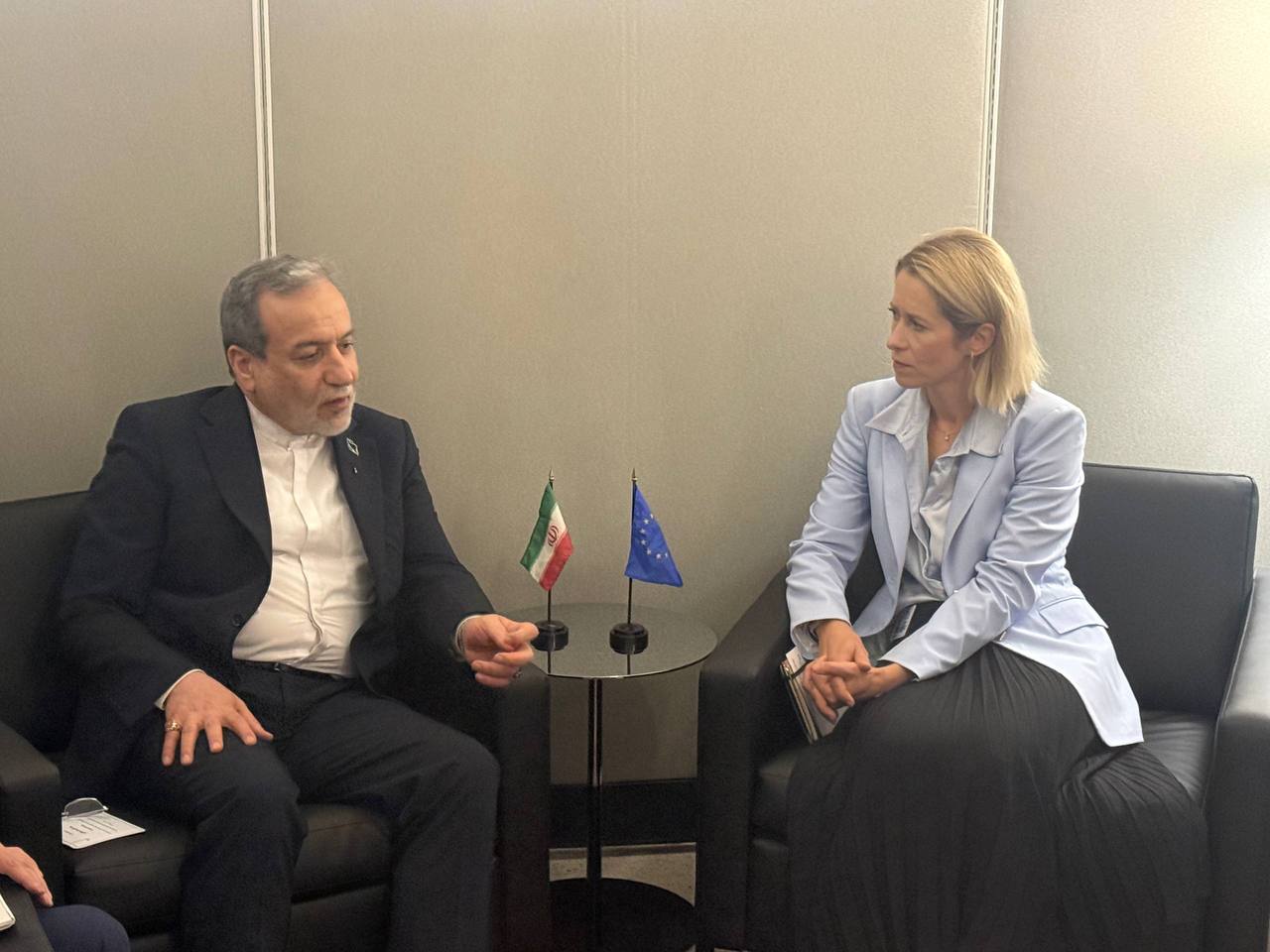
Why would the European Union list the Islamic Revolutionary Guard Corps as a terrorist organisation in February, and then, seven months later, have its top diplomat sit down with the foreign minister of the government the Guard Corps defends?

At the UN General Assembly last month, EU chief diplomat Kaja Kallas met Abbas Araghchi, who served in the Guard Corps during the Iran–Iraq war.

Dutch prime minister Rob Jetten met president Masoud Pezeshkian, who in 2019 joined fellow parliamentarians in wearing the Guard Corps uniform to protest Washington’s terrorist designation of it. France, Italy, and Norway held meetings of their own.

These talks came less than nine months after Iranian security forces, on 8 and 9 January, killed protesters on a scale without precedent in the country’s modern history.

The human rights group HRANA has verified more than 7,000 deaths, and the UN special rapporteur warned that the toll may exceed 20,000.

In September, the UN fact-finding mission concluded that the crackdown amounted to crimes against humanity. Nor has the killing stopped: Iran Human Rights counted at least 532 executions in the first eight months of this year, including protesters arrested in January.

After a massacre, a foreign policy guided by European values should pursue one aim above others: making a repetition more costly for those who would order and carry it out.

Naming and shaming raises the reputational cost of repression, targeted sanctions raise its material cost, and delegitimisation raises the political cost of staying loyal to the regime.

They work only in combination, since sanctions without delegitimization tell the regime’s elite that their assets are at risk, but their standing is not.

EU vs US sanctions

Europe has used the first two instruments. The EU listed the Guard Corps in February and sanctioned additional Iranian officials for human rights abuses.

However, these measures target assets and individuals, while the government that presided over the killing keeps its seat at the top table.

The UNGA in New York showed how little the third instrument has been used.

The terrorist listing freezes the Guard Corps’ funds. Neither Araghchi nor Pezeshkian is on an EU sanctions list.

Yet it leaves a question unanswered: how far should the logic of a terrorist designation extend to the government that funds and publicly defends it?

Article 21 of the Treaty on European Union requires the Union’s external action to be guided by human rights and to be consistent.

Branding the Guard Corps a terrorist organisation in Brussels while posing for photographs with the government it defends in New York sits uneasily with that obligation.

This inconsistency is costly. In a study in foreign policy analysis, my co-authors and I examined how Iranians reacted to US sanctions. Comprehensive sanctions produced a rally around the government, even among reformists.

The 2019 designation of the Guard Corps, by contrast, produced almost no rally outside the regime’s hardliner core. Thus, targeted pressure on the security apparatus does not drive Iranians into its arms.

Handshakes, on the other hand, may give the apparatus exactly what targeted sanctions are meant to withhold: international legitimacy.

The photographs from New York reach two audiences.

The first sits inside the state: an officer deciding whether to fire on a crowd, or to step aside, weighs one question above most others, namely whether the regime will survive, and each of those photographs suggests an answer.

The second audience is the families of those killed, executed, and blinded since January. For them, the message is that Europe has moved on after eight months.

A picture is worth a thousand words

I am not against diplomacy. Kallas raised the sharp rise in executions with Araghchi, and Jetten raised human rights and Iranian actions on Dutch soil with Pezeshkian. Channels on shipping, detained Europeans, and de-escalation should stay open.

My objection concerns the level and the format: a meeting between leaders, photographed at the General Assembly with no public conditions attached, is not a technical channel.

Concerns voiced in private do not travel as far as the photograph, which signals normal relations with a government that has done nothing to earn them.

Four steps would help.

First, the Council should agree on a common line: contact at the technical and envoy level, and leader-level meetings only on public conditions, beginning with a halt to protest-related executions.

Second, human rights sanctions should move up the chain of command, to those who answer politically for the security forces.

Third, member states should invest in accountability that does not depend on Tehran, such as universal jurisdiction cases and evidence-sharing with the UN mission.

Finally, Europe should engage openly with Iran’s democratic opposition.

The EU has already decided, in law, what the Guard Corps is. Its leaders have yet to act accordingly. A massacre answered with sanctions in February and handshakes in September does not raise the cost of the next one. It lowers it.

  •  

Indonesia’s bourse rebuild is really a monetary policy story

For decades, the Indonesia Stock Exchange has run like a members’ club, where the brokers who trade on the IDX also own it. But that cozy arrangement is about to end under an amended financial sector law that requires the exchange to demutualize. The Financial Services Authority, or OJK, has issued a new regulation on […]

The post Indonesia’s bourse rebuild is really a monetary policy story appeared first on Asia Times.

  •  

EU will need to tax AI ‘workers’ to keep funding human pensions

Every major technological shift reshapes not just the economy but the tax system that pays for it. When big corporations emerged, corporate and payroll taxes followed. When mass car ownership took hold, fuel duties emerged to pay for the roads it required. 

As AI shifts work from people to machines, it will force a rethink of who gets taxed, on what, and where. Nowhere is that question more urgent than in Europe, which funds the world’s most comprehensive welfare states primarily through taxes on work.

Taxes on work make up 51.5 percent of all tax revenue in the EU-27, according to the European Commission’s latest Taxation Trends data — a share that rose in 2024. These charges are taken straight from the payslip. They’re hard to avoid, and scale with employment.

AI, by replacing human work with software and machines, eats away at exactly this tax base. 

The International Monetary Fund (IMF) estimates that around 40 percent of jobs worldwide are exposed to AI. If that leads to fewer workers, it will also mean fewer payslips, pension contributions and social charges, weakening the revenue streams that fund Europe’s pension and healthcare systems. This is not a distant problem; the costs are already mounting.

Shift the burden to corporate profits

The obvious response is to shift more of the tax burden onto corporate profits, which will increasingly reflect the gains firms make by deploying AI instead of hiring workers.

Unlike a tax on machines and equipment themselves, a profit tax falls mostly on excess profits and need not distort investment. The case for shifting weight from payroll taxes to profits is strong and strengthens as AI replaces more workers with machines.

But profits, unlike payrolls, move. A company can locate its intellectual property in a low-rate jurisdiction — a pattern Europe knows well from decades of profits routed through Ireland and Luxembourg — and ensure that profits are booked far from where the jobs are lost. It is how the world’s largest technology and AI firms already operate.

Two-pillar answer

The Organisation for Economic Co-operation and Development’s (OECD’s) Inclusive Framework was designed to address exactly this: profits shifted across jurisdictions to avoid tax, and e-commerce allowed sales where firms have no physical presence. AI makes these reforms more urgent. 

Pillar One of the framework put forward by the Paris-based wealthy nations’ club addresses where a corporation is taxed. It shifts partial taxing rights for the largest multinationals away from where they are headquartered and toward where their customers and users are located. 

Still under negotiation, it would apply only to a handful of the largest firms, but many AI companies would qualify. 

These firms are concentrated in a select number of countries, very few of them European, but the displacement they cause, and the public services that displaced workers will require, will weigh heavily on European budgets.

Pillar Two of the OECD framework introduces a global minimum corporate tax of 15 percent on multinationals with revenues above €750m.

The EU moved first and furthest: Council Directive (EU) 2022/2523 made the minimum tax binding across the Union from 2024, and 22 of the 27 member states now apply it in full. The United States, notably, has not implemented the rules. 

Politics is undermining the fix

But the obstacles are real. US ratification of the OECD proposals is unlikely, and many of the largest companies are headquartered there. 

The pressure is already reshaping Europe’s own rules: under the G7’s June 2025 ‘side-by-side’ agreement, US-parented groups would be exempt from the EU’s minimum-tax rules: a carveout the European Commission confirmed in January 2026 and which several member states consider legally fragile. 

The Commission also dropped its proposed EU digital levy under US trade pressure, leaving a patchwork of national digital services taxes in France, Italy, Spain, Austria, and elsewhere.

Such exceptions and carveouts show that big-power politics can hollow out the framework. These reforms were designed to address the tax challenges for an AI-economy. They were good policy then. They are fiscal necessities now. Fairer corporate taxation will not be enough, but it is a start. 

Europe’s choice

The EU has instruments on the table, the BEFIT common corporate tax base and the proposed Corporate Resource for Europe, but both remain politically contested.

European governments that fail to act will be managing the social costs of technological disruption with a tax system built for the industrial age, while the profits that fund their rivals accumulate beyond their reach.

Even if Europeans work less, their needs for health care, pensions, and consumption remain. As wage-based contributions shrink, Europe must shift more of the tax burden onto corporate profits and close off the routes that let those profits move beyond the reach of the states bearing the costs of automation. 

Productivity gains may soften the arithmetic; they will not repeal it. The tax base must follow the economy. 

  •  

Trump finds it’s funny to joke about Iran bombing California

In a stemwinder of a speech in Nebraska, our mentally ill president joked around that if Iran took out Los Angeles and San Diego, it would be a small price to pay for keeping the rest of the country safe. Or at least that is what he appeared to say. What his slurred free association […]

The post Trump finds it’s funny to joke about Iran bombing California appeared first on Asia Times.

  •  

How bad does it have to get for the ECB to save France?

French borrowing costs are surging and central bankers are starting to fret. Some of them, at least.

The head of the French central bank, Emmanuel Moulin, told the Financial Times that his country risks being “strangled by interest rates”.

The best solution, he made clear, was for the French government to cut costs and reduce the deficit, which, in an unchanged scenario, could reach upwards of six percent next year.

Last week, the French minority government proposed €43bn worth of cuts for 2027. But pushing them through parliament is a tall order in a divided country.

Meanwhile, investors are dumping French bonds, pushing up French government borrowing costs compared to German benchmark Bunds. This is already immensely costly to French society.

“In three weeks, we’ve lost the equivalent of €15bn a year in higher debt-servicing costs over a 10-year horizon, or almost €100bn cumulatively over 10 years!”, French economist Shahin Vallée said on social media last week.

The gap, or spread, between French and German bond yields, historically around 50 basis points (0.5 percentage points), was 109 basis points when he wrote it on Wednesday. It is now 30 points higher.

Spreads are a crucial marker for financial stability because they show how nervous investors are. The bigger the spread, the higher the perceived risk.

And France’s parabolic bond spread is already bringing back unwelcome memories of the eurozone crisis in November 2011, when the spread reached 200 basis points.

Bypass parliament?

The question is what to do about it, and who is best positioned to act. The French government could bypass a parliamentary vote or push through the budget by ordinance, under articles 49.3 and 47 of the constitution, respectively.

This article continues, but the full version is available only to EUobserver.com subscribers. Visit account.euobserver.com/membership

  •  

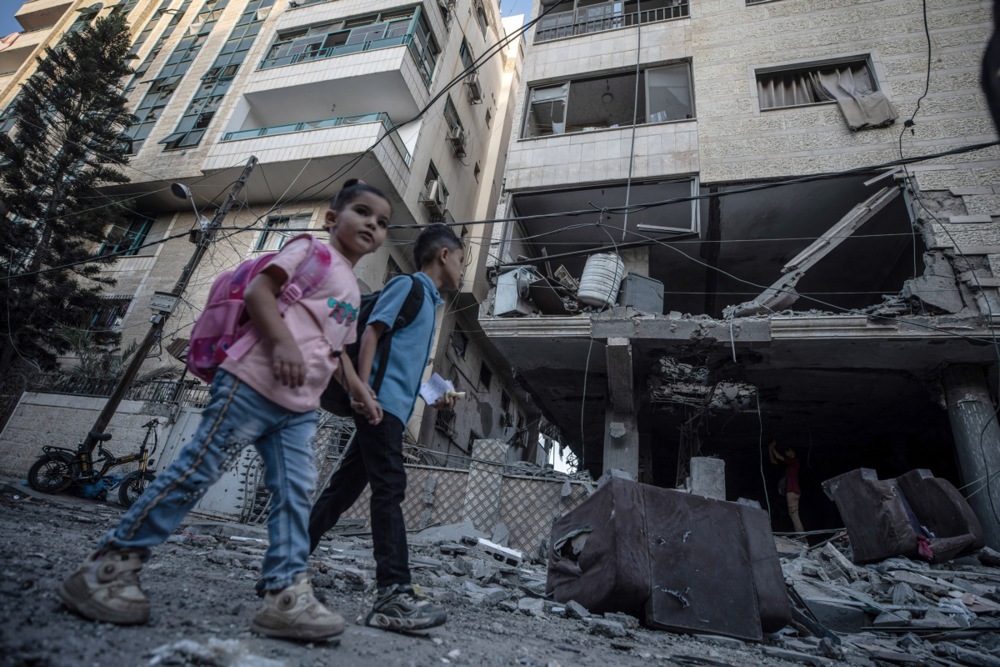
The children of Gaza are being killed every day. Where are the headlines?

Every day, children are killed in Israel’s genocidal war on Gaza. Where are the outraged headlines?

The number of children killed in Gaza since Israel started its onslaught, following the Hamas attack on 7 October, 2023, is estimated at more than 21,600. 

The UN Children’s Fund (UNICEF) says that since the so-called Israel-Hamas ceasefire, an average of “at least” one child a day – 300 children over 300 days – has been killed in the enclave. 

Children, toddlers, and babies are being killed in their homes, schools, hospitals, shelters, and on roads marked by displacement. They are also dying because the basic structures that should protect them – family, healthcare, education, food, water, and refuge – have been systematically destroyed.

Where are the urgent statements from EU and world leaders?

EU governments continue to authorise arms transfers to Israel despite rules which require governments to deny licences where there is a risk that military equipment will be used for serious violations of international humanitarian law. 

Every EU member state is also bound by the UN Convention on the Rights of the Child and the EU’s own treaty, which requires the union to promote children’s rights. 

Why are these international rules and domestic commitments not being applied to the children of Gaza?

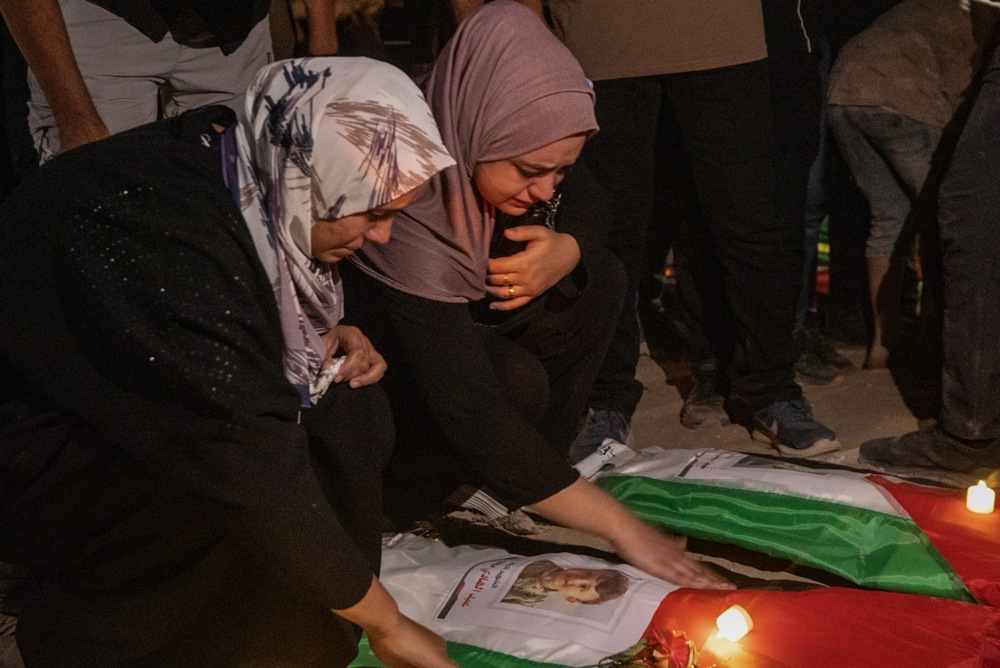
Mourners light candles during a mass funeral and vigil for 105 Palestinians near the rubble of the Al Tajj building in Gaza City on 30 September 2026 (Source: EPA/MOHAMMED SABER)

Children rights beyond Ukraine

The EU does care for children. In Ukraine, the EU treats children as individuals rather than statistics: it convenes coalitions, compiles names, traces families, imposes sanctions, creates mechanisms for return and makes the fate of children a central diplomatic demand. 

In her State of the Union address last month, European Commission President Ursula von der Leyen – a proud mother and grandmother – introduced and praised the courage of Sasha, a six-year-old Ukrainian girl who lost a leg in a Russian missile strike in Ukraine but has now returned to her beloved gymnastics.

Von der Leyen quite rightly made the suffering of Ukrainian children intimate and personal. It is more than time she did the same for Palestinian children.

But let’s not only blame political leaders for their indifference, their lack of historical knowledge of Palestine’s occupation and their limited understanding of Palestinian calls for justice. 

Parts of the legacy media must also own up to their responsibility in normalising the abhorrent.

Powerful mainstream media have preferred to “repeat Israeli propaganda and sometimes simply cut and paste IDF press releases” rather than accept the analysis of Palestinian journalists, writers and scholars, writes Bhakti Shringarpure.

Her criticism reflects a wider ongoing discussion on the sourcing and framing of Gaza coverage, with studies spotlighting how Western media has described Israeli suffering by using emotive language around 11 times more often than Palestinian suffering. References to Israel’s “right to defend itself” appear roughly five times as frequently as references to Palestinian rights.

Also, as the immediate shock of the bombardment recedes – but the killing continues – Gaza has dropped down the news cycle. 

Assal Rad,  author of “Don’t Say Palestine: How the Media Manufactured Consent for Genocide”, describes the logic: “The façade of a ceasefire has created the space to cover it less. In reality, the conditions on the ground for Palestinians in Gaza have not changed.”

It is also less politically costly for leaders and media to focus on settler violence and settlement in the occupied West Bank, since it can be described as the work of “extremists” rather than of the Israeli government.

EU silence

Our lack of a strong reaction to what is happening is Gaza is also the story of how bystander societies can watch, absorb, and rationalise horrors – and move on. 

Additionally, the killing of Palestinian children is preceded by their political “unchilding”, a process which Palestinian scholar Nadera Shalhoub-Kevorkian says begins before the missile falls, when Palestinian children are imagined not as children with futures but as demographic threats, future militants, or extensions of an armed group. 

Their age, instead of guaranteeing greater protection, becomes entangled with suspicion.

Even amid such savage violence, some people are not giving up. 

Their bosses may still look the other way, but EU Staff for Peace, which holds vigils in front of the European Commission and the EU Council every Thursday, has held gatherings to read out the names of children killed in Gaza, thereby according individuality to children whom the political and media systems have reduced to numbers.

As one EU staffer told me: “We only have a time slot of three hours and the last time we only managed to read out the names of children up to three years old. It took us one hour to read out the names of Palestinian babies under one-year old.”

Hind Rajab, who was five, was killed on 29 January 2024 by Israeli fire on the car in which she was trapped. Her body was found 12 days later alongside the bodies of members of her family and two paramedics who had gone to rescue her.

Israel has acknowledged firing on the car but has not admitted that her killing was unlawful, citing an ongoing investigation. In other words, there has been no accountability.

The obscenity is not only that Hind was killed, but that by now the killing of children in Gaza has become a familiar event. 

The shame is that so many of us have constructed a hierarchy in which some children summon the world’s full moral and political force, while others are ignored.

Omar El Akkad, in his seminal book says that “One Day, Everyone Will Have Always Been Against This.” Given the cowardice on display over the last three years, I sometimes wonder if there will ever really be a true global moral reckoning.

  •  

Asia’s growth now belongs to Silicon Valley

Southeast Asia’s growth next year will be decided at meetings its finance ministers won’t attend. A few executives in California will soon settle next year’s spending on data centers. Their decisions will do more to shape growth in Vietnam, Malaysia, Thailand and the Philippines than any budget those governments pass. The World Bank has just […]

The post Asia’s growth now belongs to Silicon Valley appeared first on Asia Times.

  •  

CPEC 2.0 will be won or lost on keeping China’s investors safe

CPEC 2.0 aims to move past the infrastructure-heavy first phase toward industry, agriculture, mining, technology, green development and business-to-business investment. That shift could deepen economic ties between Pakistan and China, but it also changes the nature of the security challenge. Big infrastructure projects can be guarded behind fixed perimeters. Industrial zones, mines, private businesses and […]

The post CPEC 2.0 will be won or lost on keeping China’s investors safe appeared first on Asia Times.

  •  

Centre-right’s Muslim Brotherhood witch-hunt in EU Parliament risks criminalising everyday activism

On Wednesday (7 October), the largest group in the European Parliament, the European People’s Party (EPP), has scheduled a debate on a “European Parliament resolution on the need for an EU strategy to counter Islamist entryism and the influence of the Muslim Brotherhood network.”

The move follows the adoption of an EPP party resolution that treats Muslim civic engagement as inherently suspect and collective religious practice as a potential threat.

It largely mirrored the German Christian Democratic approach of criminalising Muslim civic engagement.

As Brussels-based EU expert and EUobserver’s columnist Shada Islam put it, the supposed fight against “political Islam” “places Muslim political and civic activity inside an almost exclusively security framework,” and thus “European democracy is hollowed out rather than reinforced when an entire religious or ethnic minority and its civil society are regarded as permanently suspect.”

Also, the resolution protects religious freedom for Muslims only as an individual right, explicitly stating that it seeks to ensure “equality among citizens, rather than collective claims,” leaving the collective expression of Islam unprotected and thus hollowing out the very idea of religious freedom.

As also the to be debated motion shows, it is unclear where protected religious activity ends and dangerous political activity begins.

Islamophobic conspiracies

The notion of “Islamist entryism,” imported from France, has become a way to criminalise Muslim participation in civil society and politics.

The resolution describes it as “a political strategy of influence, progressive structuring, institutional penetration and ideological legitimisation,” which it separates from the “peaceful practice of Islam.”

But how does one tell the “good” Muslims, who engage peacefully in politics and lobby policymakers to stand up for their rights, from the bad? Or is the good Muslim simply the apolitical one, who does not stand up for the protection of their collective human rights?

If “political Islam” is a problem because it is described “as a societal project,” how does it differ from the collective efforts of Jews, Christians, and others, who also “produce collective norms,” as the motion puts it?

And if “Islamist influence operates through a broad and fragmented ecosystem of associations, foundations, cultural, educational, religious, charitable, university, youth, anti-discrimination or social action structures,” something equally true of Christian, Jewish, and other religious groups, then where does the EPP draw the line between peaceful Muslim activity and Islamist activity that has to be banned?

Isn’t the claim that Muslim “community allegiances placed above common law” a typical Islamophobic allegation, familiar from the old mistrust of Jews as more loyal to a global Jewish community than to the nation-state?

Is this the old antisemitism in new “Muslim” clothes?

Indeed, the motion lists a catalogue of anti-Muslim conspiracy theories: “separatist narratives, systematic victimhood, antisemitism, hatred of Israel, conspiracy narratives, challenges to secularism … may constitute markers of ideological radicalisation or Islamist influence.” They may. And what if they don’t?

Guilty until proven innocent

What follows seems to be one of the motion’s primary goals: cutting funds for Muslim and anti-racist civil society organizations such as the Forum of European Muslim Youth and Student Organisations (FEMYSO) and the European Network Against Racism (ENAR), who are both registered in the EU transparency register of Belgium and annually audited.

These CSOs are seen as a manifestation of political Islam per se even though they have denied any those connections.

And it is a form of innocence that cannot easily be proven.

The EPP motion claims that “some Islamist networks are able … to adopt the vocabulary of fundamental rights, inclusion, diversity, intercultural dialogue, anti-racism and the fight against discrimination, while promoting in other spaces logics of separation, community pressure or contestation of democratic principles.” In other words, the better integrated Muslims in Europe are, the more suspicious they may become.

Shaky legal foundations

The EPP’s motion builds on highly problematic bills, legislation and political procedures. It quotes the French ministry of the interior’s 2025 report “Muslim Brotherhood and political Islamism in France,” which has been harshly criticised.

It also cites a resolution of the French National Assembly from January 2026 that urged the European Union to add the Muslim Brotherhood to its list of terrorist organisations and to lobby for it.

The resolution was voted against by 101 members of parliament, some of whom called it “Islamophobic.” The motion also invokes the contested Austrian Symbols Act, which prohibits the symbols of non-violent organisations that are not considered illegal under domestic legislation and lumps them together with those of jihadist groups ISIS and Al-Qaeda.

A further cited motion is from the Dutch parliament in March 2026 and calls for a ban on the Muslim Brotherhood and linked organisations, but it too has no legislative relevance so far.

None of these motions or laws has outlawed “Islamist entryism” or the “Muslim Brotherhood networks.”

Yet the EPP resolution builds on exactly this shaky ground while pretending that its own motion is solid.

More importantly, the way Austria and France treat their Muslims is well documented: from the infamous, massive and racist police raids known as Operation Luxor to the French state’s Systemic Obstruction policy, which resulted in 101 government units nationwide monitoring Islam and Muslims, 24,887 Muslim organizations and businesses placed on a secret blacklist and under strict monitoring, and the closure of 718 Muslim-owned organizations and businesses, with €46m seized. There is nothing here that should be emulated elsewhere.

Crude logic

The EPP’s argument that “Hamas on the EU list of terrorist organisations historically originates from the Muslim Brotherhood movement” rests on crude logic.

Both the Progressive Alliance of Socialists and Democrats (S&D) and the secular Marxist-Leninist Popular Front for the Liberation of Palestine (PFLP), similarly considered a “terrorist organization,” have Marxist origins. Outlaw the S&D as a consequence?

Today, it is Muslims who are being surveilled, monitored and criminalised. Who is it tomorrow? If this resolution passes, life for politically conscious Muslims who are defending their right to exist in Europe will become even more difficult. And tomorrow potentially everybody’s life.

  •  
❌