THE gloves are off, the engines are roaring and Germany is bracing itself for a motorsport showdown of epic proportions! Forget the calculators. Forget the cautious driving. And forget playing it safe. The 2026 DTM championship reaches its explosive conclusion at Hockenheim this weekend, with SIX drivers still dreaming of lifting one of European motorsport’s most coveted trophies.
And the man with the biggest target on his back is Porsche superstar Thomas Preining.
The Austrian arrives at the legendary Hockenheimring with a commanding 23-point advantage over his nearest challenger.
But with 56 points still available across the final weekend, the champagne will have to stay firmly on ice.
PREINING IN POLE POSITION — BUT RIVALS ARE CIRCLING
Preining, already a DTM champion, knows exactly what it takes to survive the pressure of a title fight. Driving for Manthey, the Porsche ace has put himself in the driving seat for a second championship crown.
But Mercedes-AMG star Maro Engel is breathing down his neck, and BMW veteran Marco Wittmann, a two-time champion, is lurking dangerously in the background. Both have the experience, machinery and determination to turn Preining’s dream weekend into an absolute nightmare.
Then come the outsiders. Mercedes driver Lucas Auer, Ferrari racer Matteo Cairoli and Aston Martin’s Nicki Thiim all retain mathematical chances of snatching the championship.
For those three, however, it would take something approaching a motorsport miracle. They need brilliant results — and some serious misfortune for the men ahead.
HOCKENHEIM: WHERE DREAMS COME TRUE — OR DIE
There could hardly be a more fitting battlefield.
The Hockenheimring has hosted the DTM season finale more than 30 times, earning its reputation as the place where champions are crowned and reputations shattered.
Its 4.5-kilometre Grand Prix circuit demands precision, courage and nerves of steel.
Get your braking wrong and a rival can pounce. Make a mistake in traffic and an entire season’s hard work could disappear in seconds.
And nobody needs reminding what happened here last year.
Turkish racer Ayhancan Güven snatched the 2025 championship with a breathtaking late move against Wittmann at the Sachs-Kurve.
It was the sort of dramatic finish that makes motorsport irresistible.
Now Wittmann is back, determined to ensure history does not repeat itself at his expense.
GERMAN GIANTS PREPARE FOR BATTLE
The DTM is no ordinary racing championship. This is a contest in which some of the biggest names in the motor industry throw their engineering expertise into a furious battle for supremacy.
Porsche, Mercedes-AMG, BMW, Ferrari and Aston Martin are represented among the six title contenders, and with GT3 machinery producing spectacular performance, the racing promises to be fierce.
Unlike Formula One, where aerodynamic advantages can sometimes leave the field stretched out, DTM’s competitive format regularly produces close battles, aggressive overtaking and unpredictable finishes.
Track position is precious. Pit-stop execution matters enormously. And a poorly timed safety car can transform the championship picture.
One moment a driver can be heading towards glory, the next, he can be staring at disaster.
TWO RACES. ONE CHAMPION.
Saturday’s race begins at 1.30pm local time, with Sunday’s championship decider scheduled for 4.30pm.
That leaves precious little room for error.
For Preining, the equation is straightforward: protect the advantage without becoming so defensive that his challengers seize the initiative.
For Engel and Wittmann, the message is equally clear. Attack.
They cannot afford to sit behind the Porsche and hope for the best.
And should Saturday’s race produce a major surprise, Sunday’s finale could become an extraordinary winner-takes-all spectacle.
MORE THAN JUST A RACE
Away from the championship battle, Hockenheim is preparing a full-blown motorsport festival.
The supporting programme includes the ADAC GT Masters, Porsche Carrera Cup Germany, ADAC GT4 Germany and BMW M2 Cup. Fans can also enjoy pit-lane walks, driver appearances and live entertainment.
But the biggest attraction remains the battle on the circuit. Six drivers started the weekend with a mathematical chance of becoming champion. Only one can leave with the crown.
When the chequered flag falls on Sunday evening, there could be tears, triumph — and the sort of last-lap drama that makes the DTM one of Europe’s great racing spectacles.
Since winning the right to hold the 2034 World Cup unopposed, Saudi Arabia has been pulling away from sport. With reports that its most ambitious stadium project will be abandoned, what does this mean for the World Cup?
Just hours before Lionel Messi played his last match for Argentina, Cristiano Ronaldo posted his latest salvo in a row with Portugal. Ronaldo wants to play on despite the troubles, while Messi bathed in adulation.
The 2026 Asian Games in Japan drew to a close on October 4 following two weeks of competition between 45 countries and territories across 43 sports. Despite the official slogan “Imagine One Asia,” fragmented regional politics came to the fore as the event unfolded. Just days before the games officially began, tensions between Japan and […]
The International Olympic Committee has revealed the six other countries intending to bid for the 2036 Olympic Games. This comes after Germany selected Munich as its Olympic candidate.
Jürgen Klopp has done things a little differently since becoming Germany coach. Casting a wider net for talent and trying to connect with players and country haven't made an immediate impact, but he is not bowed.
Franz Reindl has been elected president of ice hockey's world governing body. The former forward was a member of West Germany's Olympic bronze medal-winning team.
It may have taken a little longer than he would have liked, but Jürgen Klopp has finally won a game as Germany coach. Despite a number of debutants, it was a familiar face who stood out in the victory over Serbia.
Since being bought by the UAE in 2008, Manchester City has become one of the world's most successful football clubs. A raft of serious financial charges threatens to undermine this and bring chaos to the Premier League.
The Youth Olympics are to be hosted in Africa for the first time ever. The edition in Senegal is also a chance to prove the continent can host a full Olympics in the future.
After defeat to Greece, Jürgen Klopp faces the first real test of his tenure as coach of Germany's national men's football team. Can his charisma alone push this group forward?
Ireland easily beat Israel in a Nations League fixture that 24 hours earlier appeared in doubt. One Irish player pulled out of the match to express his opposition to Israel's actions in the Gaza Strip.
The Bundesliga and three other leading European football leagues have said major reforms to world-governing body FIFA are "essential." However, they stopped short of calling for the resignation of boss Gianni Infantino.
A late Netherlands goal denied Jürgen Klopp a win in his first match as Germany coach. The former Liverpool and Borussia Dortmund boss has big ambitions, but the game showed he's going to need more time to achieve them.
The era of Russian presidents is coming to an end at the World Chess Federation (FIDE). Two Germans and one Kazakh are up for election. Among the issues at play are money, Kremlin influence, and unanswered questions.
Three gold medals and three Asian Games records have catapulted China's Yu Zidi, 13, into the sporting spotlight. She is far from the first teen prodigy, but should teens be competing at elite level?
Four years ago, I read Roberto José Andrade Franco’s ESPN story about Tess Mata, one of the students killed in the Robb Elementary School shooting in Uvalde, and I’ve never forgotten an image in it: a determined Tess outside in the Texas heat, aiming her softball pitches at a target on a tree in her family’s yard. That’s what Franco does so well. He creates moments that linger—about sports, Texas, loss, and identity and in-betweenness—and makes me care about the people he puts on the page.
Franco grew up on the El Paso-Juárez border. In a 2020 National Magazine Award-nominated essay that he wrote one year after the El Paso massacre, he reflects on the lifelong pull to this paradox of a place: “It’s where things make the most sense. Where it’s easy to love, even if it’s difficult to live.” I love that he writes from this borderland even when he’s somewhere else. During Mexico’s first World Cup match earlier this summer, he was in Woodburn, Oregon, a small town where Latinos make up more than 60 percent of the population and own nearly every business downtown. Residents had been shaken by last fall’s ICE raids, but they showed up to watch and celebrate. There, thousands of miles from El Paso, Franco found something familiar: a hardworking, resilient community with deep Latino roots and a fierce sense of pride.
I also credit Franco with piquing my interest in wrestling stories, including his piece on WWW star Eddie Guerrero, which also explores family and legacy. Whether he’s writing about sports heroes or ordinary people, or tracing the history of Texas or his own, Franco never fails to move me.
Below, he explains why enrolling in community college at 28 was the most meaningful journey he’s taken, tells us his favorite meal (and the ideal season to eat it), and recognizes a fellow sports writer who inspires him. When asked to name three publications he enjoys reading, he gives a shout-out to Texas Highways, a magazine we love—and it just so happens that he’s the guest editor of its October 2026 issue, focused on El Paso. After spending time with Franco here, read his feature on the city’s historic Smelter Cemetery, and then explore the rest of the magazine.
Several places, but mostly on the El Paso-Juárez border.
I was born in Chicago, but we lived in Juárez, Mexico, until I was about 6. Then we moved across the border to El Paso, Texas, before my father joined the Army. That’s when we lived in Chicago for a short time, then Colorado and Germany before we briefly returned to Juárez. I was about 13 when we moved to El Paso again.
What places feel like home?
Anywhere I hear the Spanish of the US-Mexico border. These areas are often ignored and underserved so it’s a working-class Spanish. Because of its location, some words are a mix of English and Spanish that other parts of Mexico don’t use.
Other than family members, who or what has shaped you the most?
The decade between graduating high school and enrolling at El Paso Community College. I spent most of it working in construction and bouncing around between El Paso and Phoenix, along with a few bad months in Tucson.
What is your favorite time of day?
The early morning when everyone is asleep and the sun’s yet to rise. And it’s so quiet that, almost always at the exact same time, I can hear my neighbor’s footsteps as they walk out of their home, open and close their car door, start it, and then drive away, presumably on their way to work.
What are you really good at?
Building things. I find it almost therapeutic to do some sort of work with my hands as I sweat and listen to music. I also enjoy the feeling of seeing something finished within a few hours.
What’s the best gift you’ve ever received?
I don’t remember who I got the idea from, but years ago I heard or read a suggestion to interview your children during different phases of their lives. Just take out the voice recorder and ask them basic questions. When they’re younger, you can ask about their favorite animal, color, movie, etc. As they get older, the questions can be more about their friends, hobbies, and aspirations.
I’ve been doing this every few months with my now 9-year-old daughter. Occasionally, I’ll listen to the first recordings from when she was 3, and I can hear how much she’s changed—from her voice and interests to the clarity of her words and thoughts. It’s like a short visit with a different version of who your child once was.
That suggestion to interview your children has been the best gift.
Describe your favorite meal.
My mom’s pozole. It’s a Mexican pork and hominy stew accompanied with radishes, cabbage, and bolillo bread. She’ll sometimes make it in late October, on the Saturday closest to my birthday. The weather will be colder by then and a college football game will be on in the background—both of those make it even better. Then a good cigar afterwards.
Sound or silence? (And if sound, what sound?)
It’s become silence. I used to write with music in the background. It almost didn’t matter what kind, and sometimes it’d be the same song on repeat for hours. That was also when I’d do most of my writing during the day and into the early evening. But now, I’ve fallen into a routine where I do most of my writing early. Sometimes I’ll wake up naturally as early as three in the morning. With that change, I now write in silence.
But maybe it’ll change back to music one day.
Where do you do your best thinking?
It just happens so there’s no specific place. And so long as I’m not on deadline, whenever I feel like I can’t think anymore I just try to do something else for that day.
I’ve gotten ideas while driving, listening to podcasts and music, or in the middle of watching a movie. I’ve even woken up during the middle of night with a thought that helps unlock something that I had been stuck on.
What journey—physical, creative, intellectual, or otherwise—has meant the most to you?
Earning an associate degree.
I was a nontraditional student who first enrolled at El Paso Community College at 28 years old. It had been about a decade since I was in school. I was full of self-doubt and worry that I was too old or not a good enough student to be there. With that, I also worried that I might be wasting my time.
But I quickly realized I was a much better student in college than I’d ever been in high school. I was motivated, disciplined, and having worked in construction for the decade before then, I had a different perspective of what college could be. Whenever I felt like complaining, I’d remind myself (as I’ll still occasionally do) that reading and writing is a lot easier than doing manual labor outdoors, especially during the summers.
I ultimately transferred and graduated from a four-year university, and later even finished a PhD program. But that associate degree was the most meaningful because it’s where I started to find outlets for my intellectual curiosities and people who encouraged me.
Where do you like to read?
I don’t have any specific place. At home it’s usually in my office, bed, or on the couch. Away from there, I’ll read while waiting. I’m an anxious flyer, so I’ve also recently found myself saving longer reads for when I’m at the airport or on a plane. It lets me focus on something else while also helping pass the time.
What’s the last rabbit hole you disappeared into?
The World Cup.
Name three publications you enjoy reading these days.
Texas Highways to read about the parts of Texas that aren’t chaotic or depressive. De Los to keep up with some of what’s happening with Latinos outside of where I live. The Good Fight to stay current with boxing.
What’s one longread that you can’t stop thinking about?
Michael Paterniti’s “The House that Thurman Munson Built.” It’s got everything that interests me as a reader and writer: tragedy, memory, and examining what athletes mean to us at different ages.
What was the last book you read?
Divided Soul: The Life of Marvin Gaye. It’s an excellent book.
What piece of nonfiction are you most proud of writing?
What’s your most reliable way to get creatively unstuck?
Go for a walk or drive. Either of those help me get away from what I’m doing without completely separating me from it.
Who’s a writer you turn to when you need some inspiration?
Wright Thompson, who I’m fortunate to call a colleague.
I’ll sometimes listen to a chapter or two from The Cost of These Dreams on audiobook before I start writing a story. Wright is among the best sports writers ever, but the story of his that I’ll most often return to is the one he wrote for The Atlantic, “His Name Was Emmett Till.” The small part where one of the main characters says he doesn’t think of the past but has a dog named Dixie is perfect.
And in first drafts, I start too many sentences with “so,” “because,” and “since.”
What’s your favorite guilty pleasure?
Watching mindless, and at times dumb, dating shows with my wife.
What superpower would you like to have?
The ability to not get distracted by my phone.
What animal or nonhuman being do you most identify with?
Stray dogs who largely mind their own business and hang out in the same general area without terrorizing it.
If you have a free solitary hour in your day, what do you typically do?
If it’s early in the day, I’ll take a nap.
What five items would you place in a time capsule?
My phone full of photos and videos, a drawing from my daughter, my box full of sports cards, my voice recorder, and a Dallas Cowboys Super Bowl XXX champions hat because I increasingly fear that’ll be the last one they’ll win.
What does your writing space look like?
I’ve turned a room in our house into my office. It has a wall-to-wall bookcase. On the opposite side of it is my desk. It has plenty of space, a filing cabinet attached to it, and a shelf for my speaker and printer. Yes, a printer. It’s nothing fancy, but practical.
On the wall above the desk is a dry-erase board where I’ll write reminders and a few words that are story ideas. Once those ideas become a story, I have a corkboard, on the wall to the left of where I sit, for the three-by-five cards I use to outline and organize sections. Above the corkboard are reminders of what I need to focus on when I write. Below it is a calendar for deadlines and travel dates. To the right of where I sit is a small couch. The walls have framed boxing fight posters, work of local artists, photos of my wife and daughter, and random things that mean something to me, like mini football helmets from the University of Texas-El Paso.
Roberto José Andrade Franco is a feature writer with ESPN and aWriter-at-Large with Texas Highways. His work has been anthologized four times in The Year’s Best Sports Writing and nominated for the National Magazine Award. He’s also a four-time finalist for the Dan Jenkins Medal for Excellence in Sportswriting.
A new drone collaboration by Cessna owner Textron and autonomy provider Merlin Labs aims to offer the U.S. military a hot production line and a familiar platform for uncrewed aerial logistics, including in contested environments.
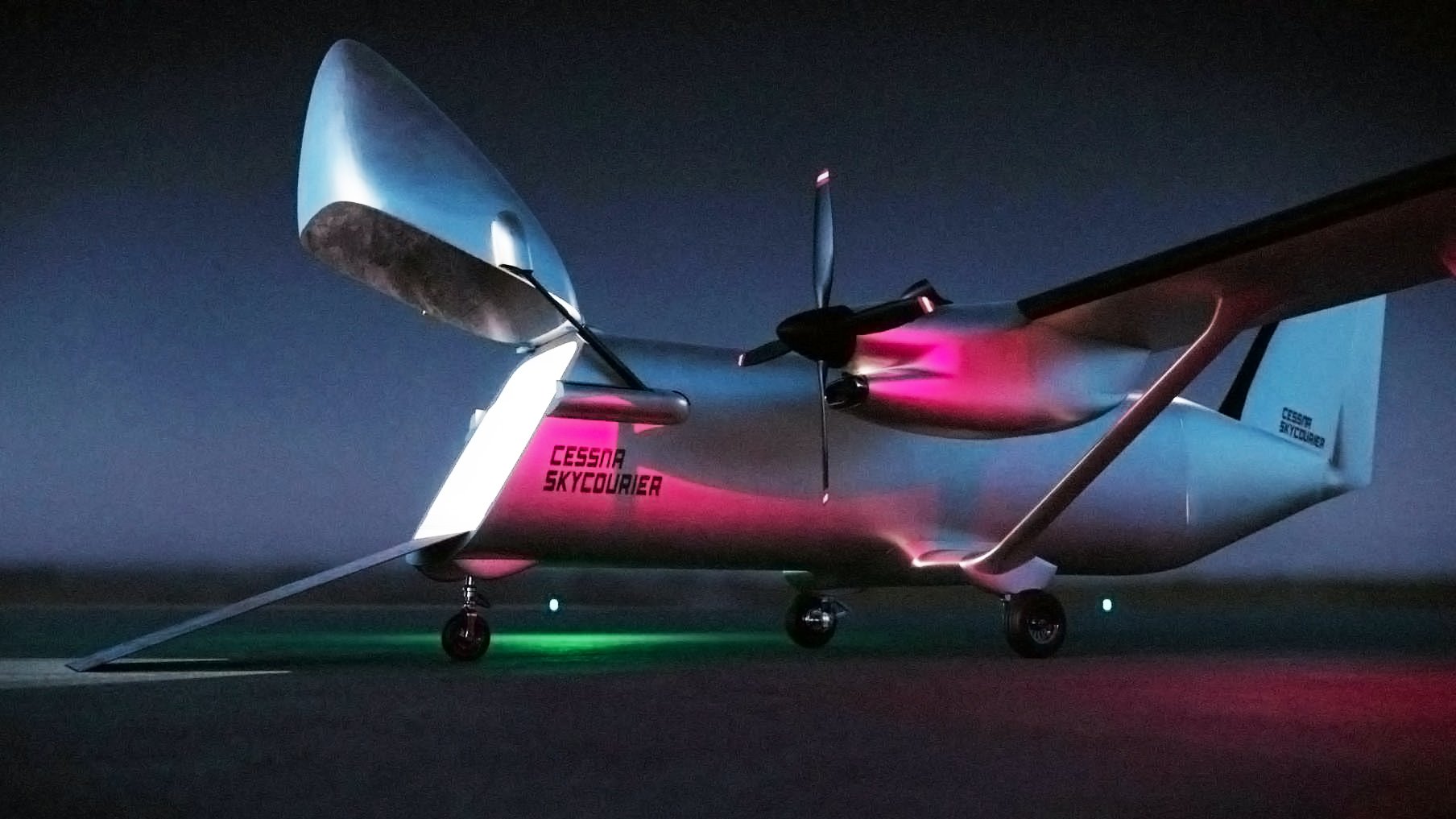
The product is SkyCourier UX, a drone version of the Cessna 408 SkyCourier that has flown for FedEx, foreign special operations forces and small remote commercial airlines during its six years of active service. TWZ previously covered how the SkyCourier would likely end up taking on military applications when it was first announced, which you can read here.
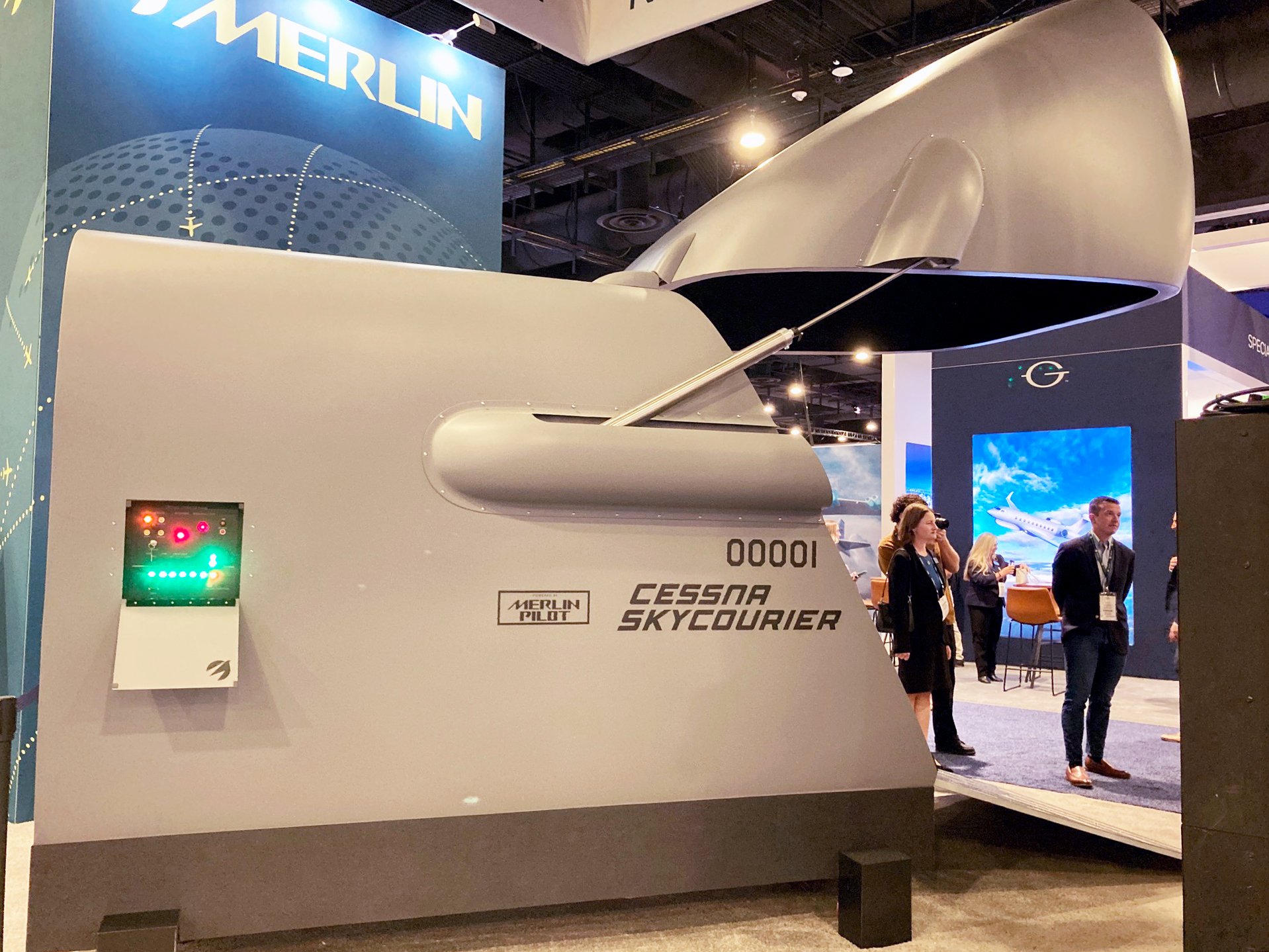
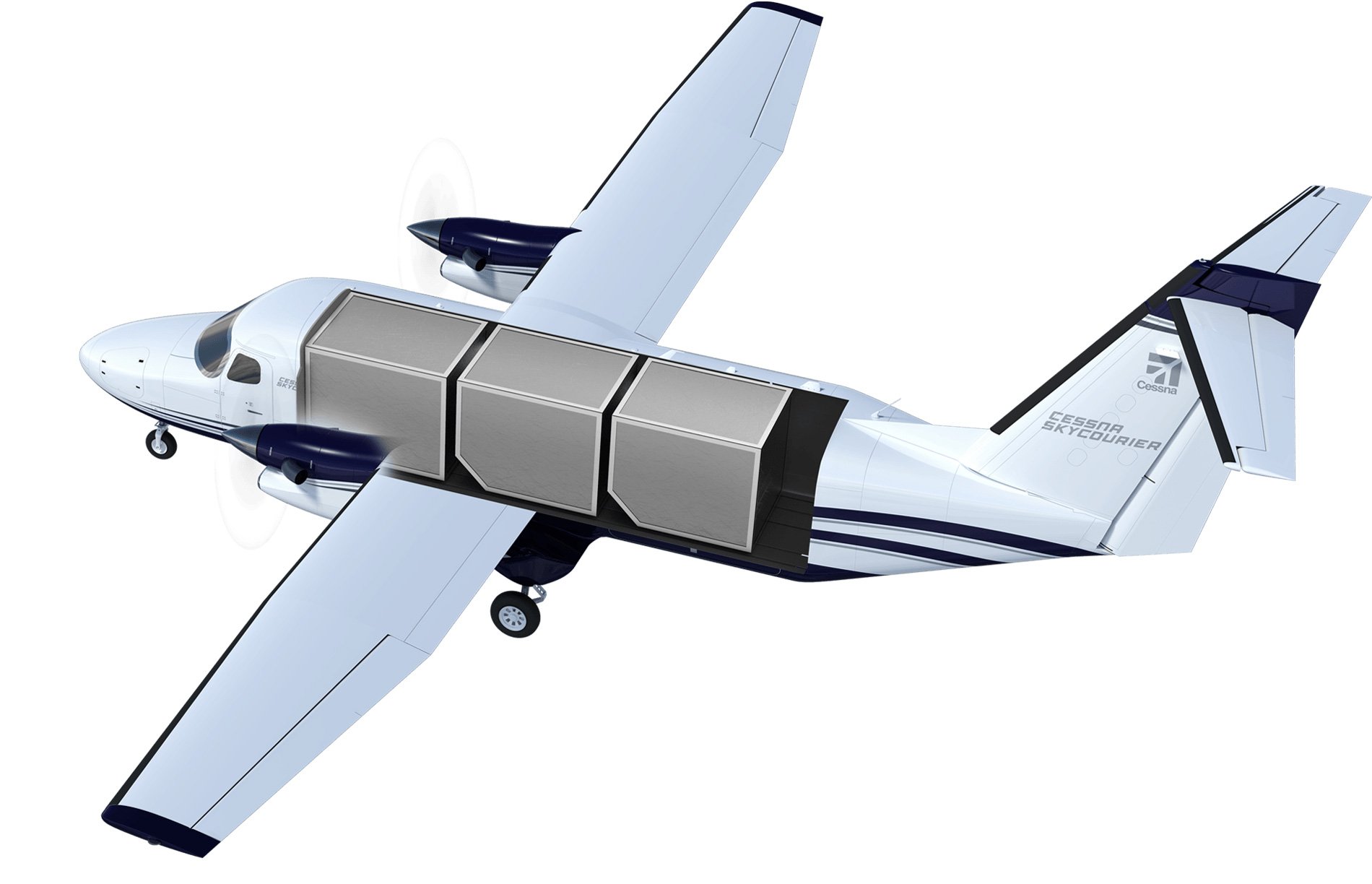
A partial full-size model on the show floor at the Air & Space Forces Association’s Air, Space & Cyber Conference in Washington, D.C., this week showed a nose that opened with hydraulics to a cargo bay in lieu of a cockpit. We have seen this same front door conversion concept for uncrewed cargo-carrying helicopters as of late. This allows for easy loading of outsized cargoes without specialized equipment, according to the company, though it does not increase the payload. Like the original SkyCourier, it’s good for about 6,000 pounds, or three standard containers.
(Hope Hodge Seck)
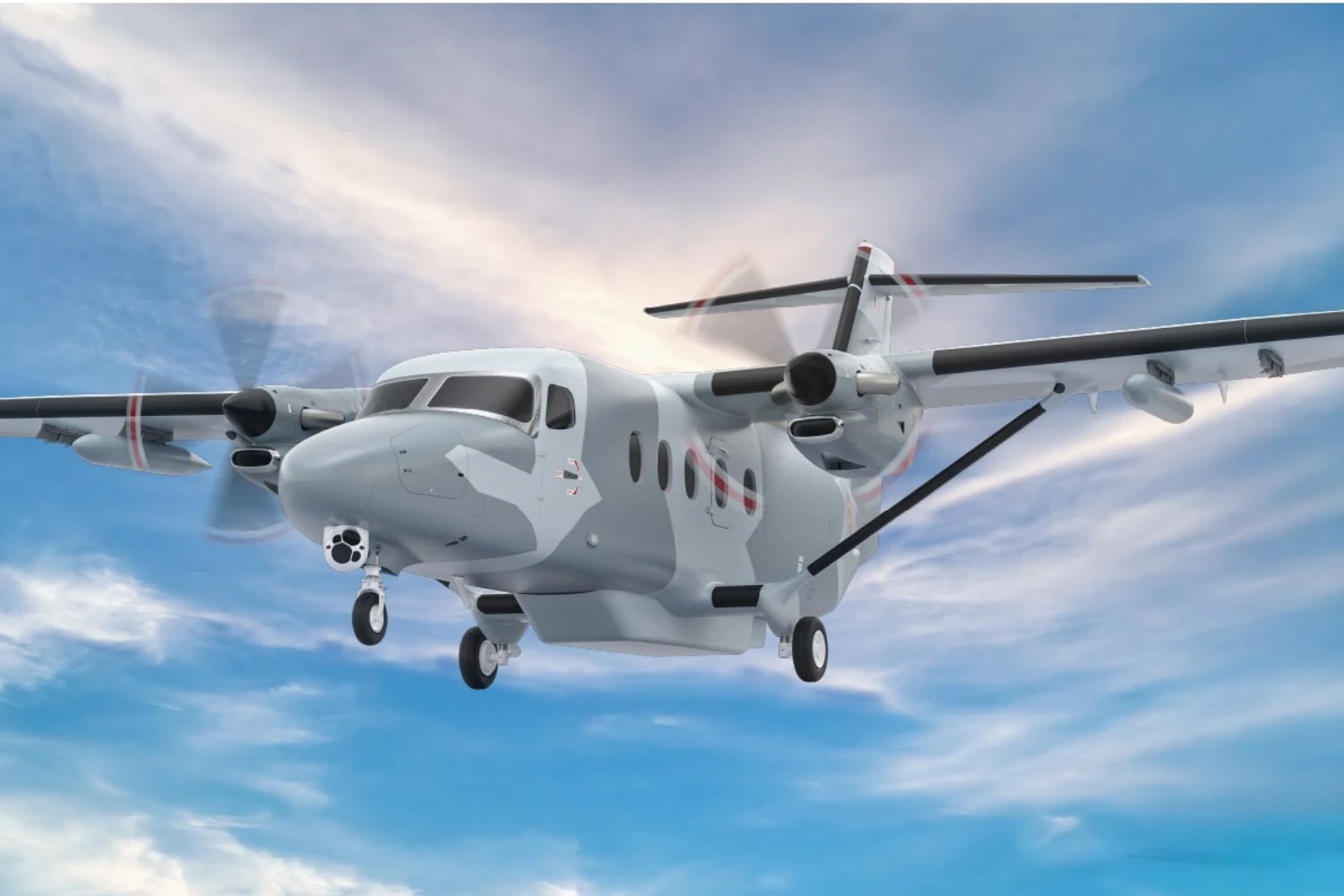
The form factor of the uncrewed SkyCourier variant is otherwise identical to its crewed counterpart, with twin turboprops, a high-wing configuration and an aluminum body.
As with the base SkyCourier, a major advantage of the aircraft is its optimization for loading and carrying standard pallets. This means that cargoes don’t necessarily have to be downloaded, broken up and repackaged for movement to forward positions. This is a big logistical advantage and can speed the flow of critical supplies to where they are needed most.
The aircraft’s range is about 900 nautical miles, which the makers say suits it well for Pacific island-hopping, allowing for refueling stops on austere runways. It can take off on runways as short as 3,300 feet and land in just 2,500 feet, according to a spec sheet.
SkyCourier can hold three standard LD3 pallets. (Textron)
The Textron/Merlin collaboration aims to differentiate itself with proven capability in the missions it intends to fulfill, along with the ability to roll out a new drone variant fast and one it can sustain consistently. Bob Gibbs, Textron’s vice president of special missions sales, told reporters in a Monday briefing that the conventional SkyCourier was now fulfilling new orders, not previously announced, to deliver modified aircraft to foreign nations for medical evacuation, casualty evacuation and environmental protection.
“The aircraft’s being operated literally from the Arctic to the Amazon,” Gibbs said. “There are three different island nations in the Pacific that have airline fleets of them. We support our aircraft in 170 countries around the world. So, just like a Cessna Caravan or a Beechcraft King Air, they’re ubiquitous. You find them anywhere, and we support them anywhere in the world.”
While the 900-mile range can’t take the loaded-up aircraft the nearly 2,000-mile stretch between the first and second island chains, Merlin and Textron executives said they don’t need to accomplish that to make it effective.
“This is the ability to disperse the forces among the second island chain … to do the island-hopping to be able to get to, whether it’s Palau, Tinian, Saipan, pick your various islands there,” Kyle Kremer, a retired Air Force major general who now advises Merlin, said. “With the range that it has, it has the ability to agilely move through there” and connect logistics pipelines.
SkyCouriers are flying all over the world, including in some very harsh environments. (Textron)
The autonomy package, Merlin Pilot, is already in use under a $105 million U.S. Special Operations Command contract to develop autonomy for the C-130J Super Hercules transport aircraft. It’s been flown aboard four different single and multi-engine airframes, the company says. A promotional web page for Merlin Pilot shows tanker-class and commercial cargo applications with developing and future capabilities.
Merlin has also teamed with the Air Force to develop an AI copilot for KC-135 tankers that can decrease crew workload and even possibly fly the aircraft on its own in the future. TWZ reported on planned tests for these autonomy-enabled tankers in 2024, with the flights set to begin the following year.
However, the Air Force has not confirmed the completion of any flight tests for the effort since. And on Wednesday, Lt. Gen. Daniel Tulley, commander of Air Force Mobility Command, appeared to confirm that the tests had never taken place.
“There’s some companies out there who have offered to develop things where they can bring a carry-on kit onto old KC-135s and other aircraft, but we haven’t seen them test those successfully,” he said.
He added that autonomy technology may lack the maturity needed for tanker missions.
“An optionally manned or an unmanned tanker at range, [at] the ranges we needed to operate at. It’s a very large aircraft, and we’re not yet to where we’re employing fully autonomous large aircraft. But the technology, I would say, is there and rapidly getting there,” he said.
Tulley did stress that the Air Force saw a need for unmanned aircraft in the last-tactical-leg delivery.
“I’m wrestling with that as we develop an AMC strategy,” he said. “There is absolutely room for some sort of autonomous or other small light lift capability, and that’s just one domain in the air, right? This could be by sea, could be by land, but there is absolutely some requirement for distribution from those major points of debarkation.”
In addition to autonomous takeoff, landing and navigation, and protection of the flight envelope, Merlin Pilot, the company says, has digital copilot human-machine teaming characteristics that include pilot health monitoring, gaze tracking and fatigue detection; pilot incapacitation and contingency response; and flight monitoring and assistance.
A military variant concept of the SkyCourier. (Textron)
Some of Textron’s new features are making light steps toward autonomy already. Gibbs pointed out that the company’s Cessna Citation Gen3 business jets now include standard Garmin auto-land technology.
“Obviously, it’s a different scale than what Merlin’s doing as far as automation,” he said. “But … as we develop new products, we try to future-proof them, and so that’s where you get this nice transition between us.”
The SkyCourier can cost up to $8.5 million, depending on modifications, and while the SkyCourier UX sports GPS-denied navigation and the ability to seek different flight paths to avoid danger, it doesn’t have other built-in defenses. For contested logistics missions, it’s not clear how much risk the services are willing to tolerate for a relatively small logistics payload capability. Kremer maintained, though, that a drone of this size could be a mission-saving capability when dispatched to austere locations. And, in a Pacific conflict, it may reduce demand on already-stretched C-130 transports, now the smallest platform capable of carrying standard containers and long overtasked.
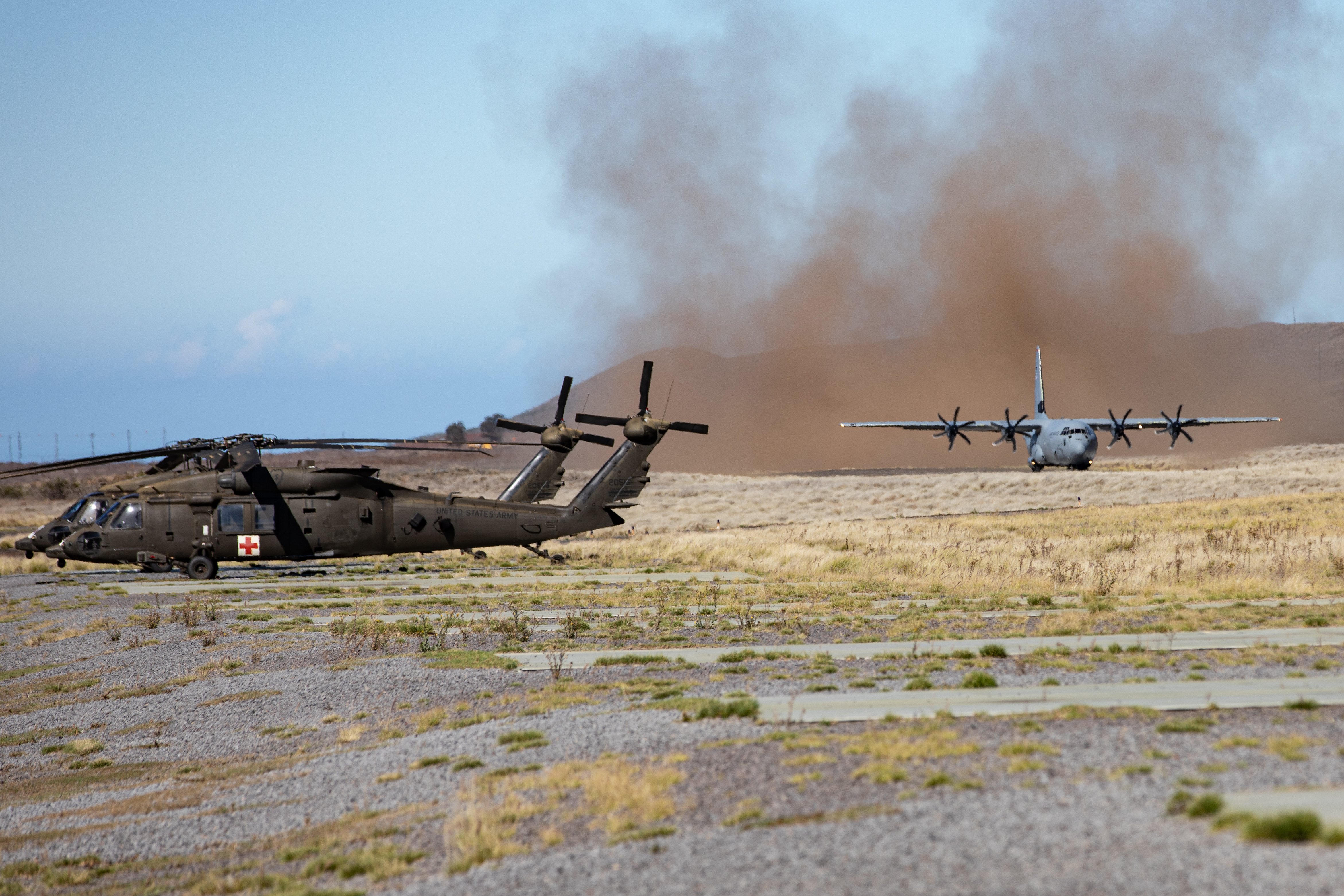
A U.S. Military C-130 prepares for takeoff at Pohakuloa Training Grounds, Hawaii, Oct 28, 2022. (U.S. Army photo by Pfc. Wyatt Moore / 28th Public Affairs Detachment) Spc. Wyatt Moore
“If you can’t get the spare tire, if you can’t get the component, that small thing where you need it in these dispersed operations, they don’t keep the big logistic supply chain built up in these locations,” Kremer said. “You have to be able to get it where you need it, when you need it, and that’s what this provides.”
Nonetheless, the Air Force has a clear appetite for a capability like this. Last year, it signed a $17.5 million contract to put a Reliable Robotics autonomy package on a Cessna 208B Caravan.
On Monday, Air Force Chief of Staff Gen. Ken Wilsbach reiterated the Air Force’s interest in unmanned aerial logistics platforms.
“We’re doing testing on them,” he said in response to an audience question. “We believe that there’s some value in that as well. It certainly could be valuable in the Pacific with the ranges that we’re talking about, and so we’re looking at several different options and evaluating them. But I would say nothing, no program of records just yet, but [we’re] certainly taking a look at some demonstrators and the like to see what’s available to us.”
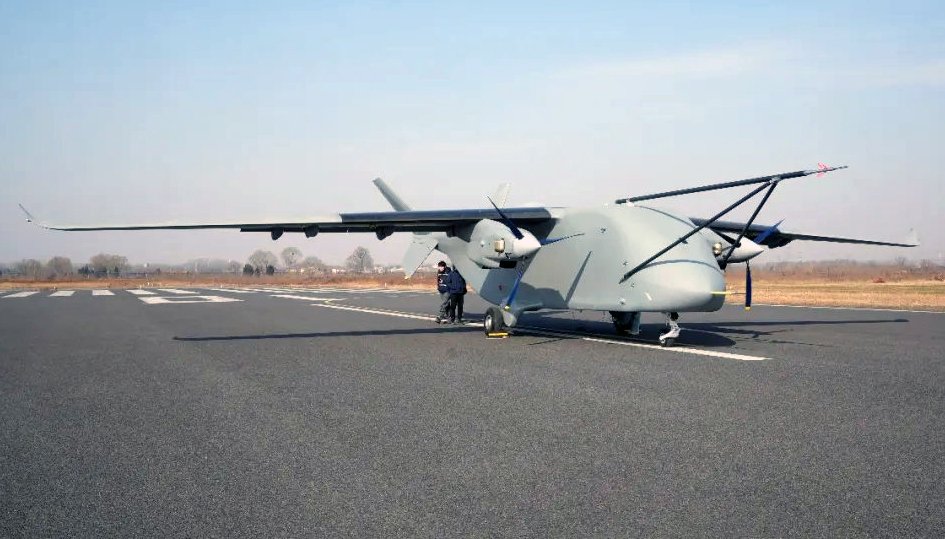
Notably, China has made significant advancements in developing logistic drone capabilities, with reported successful flight tests of massive heavy-lift uncrewed aircraft, including a 7-ton cargo plane that’s currently the world’s largest uncrewed freighter to take flight. Among them is China’s CH-YH1000, a medium-altitude cargo drone developed by the China Academy of Aerospace Aerodynamics that boasts, like SkyCourier UX, a hatch in lieu of a cockpit for ease of flat-pallet loading up to a weight of 1.2 tons. These are just some of an increasing number of similar systems being developed in China that aim to take the crew out of lower-end logistical missions over short, medium and long distances.
China’s big CY-8 uncrewed logistics aircraft undergoing testing. (Chinese Internet)
Though Textron and Merlin have yet to build a SkyCourier UX prototype, Merlin CEO Matt George emphasized that the company had chosen to partner with Textron because they could start delivering aircraft fast.
“You’ll see over the course of the show a lot of concept aircraft. You’ll see a lot of renders. You’ll see a lot of people who have big empty factories all around the country,” he said. “But I also want to be very clear about the fact that none of this matters without production … There’s 14,000 Americans working in Wichita, Kansas, on a production line where these aircraft, at least in the crewed configuration, are coming off the production line. So when we talk about capability, we’re talking about that capability and bringing that capability to bear soon, rather than in the future.”
Next in the development process, executives say, will be an optionally piloted version of SkyCourier that will allow users to develop comfort with the platform and open the door to further iteration.
The Textron/Merlin team is also leaving its options open in terms of which U.S. military customer might find its platform most useful.
“I hope [the Army and Air Force] fight over it,” Gibbs said.

 Login