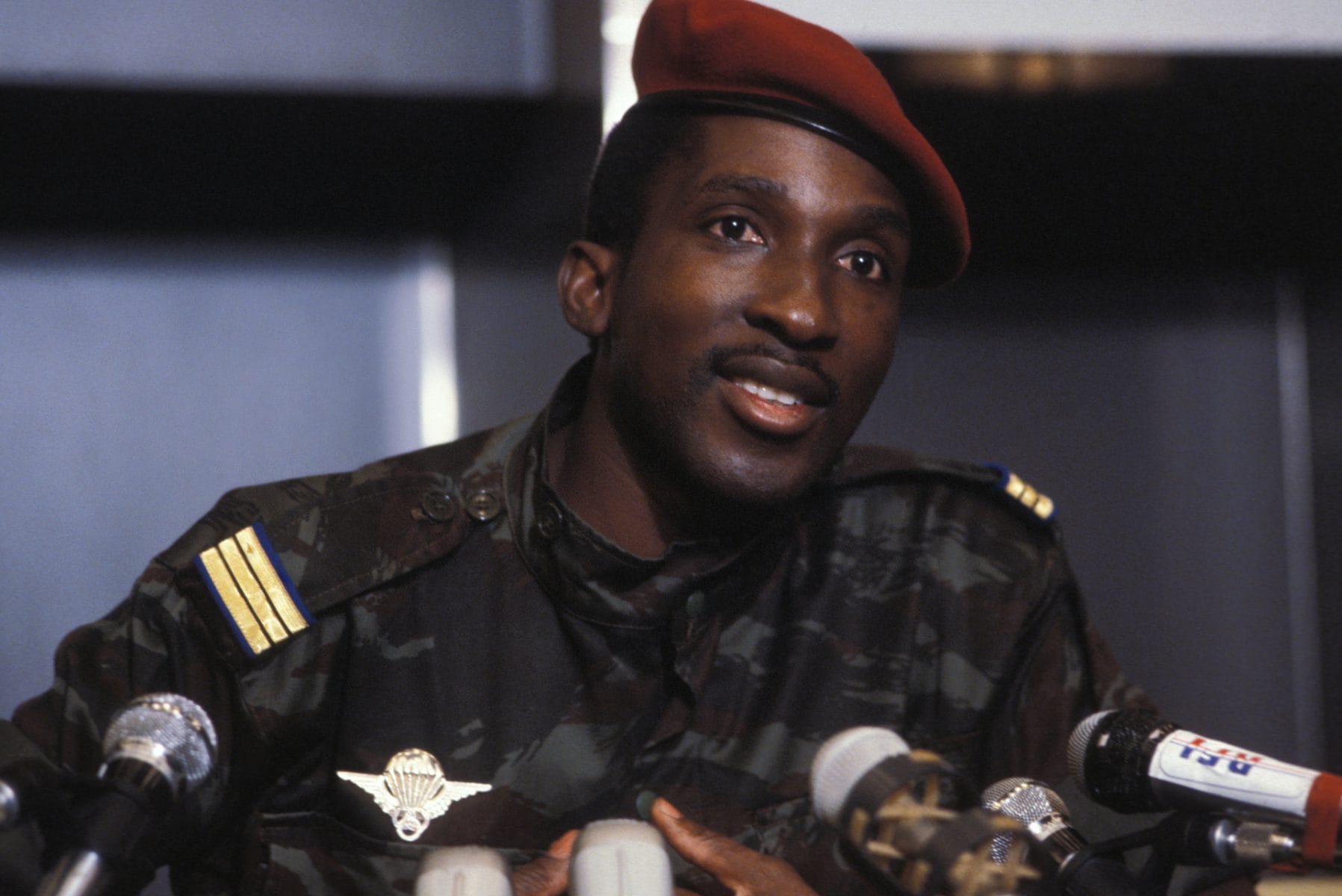
Thomas Sankara had a signature look: a natty red beret, worn with military fatigues. A striking figure, Sankara was a military officer and the radical, anti-imperialist prime minister of the Republic of Upper Volta. His arrest in 1983 led to demonstrations, followed by a coup, after which Sankara was released and installed as president. By the following year Sankara had given the country he now led its new name — Burkina Faso. He fashioned a Burkinabè identity in his own anti-imperialist image, eschewing French for local languages, promoting economic self-reliance and national pride.
In 1986, he famously took the then French president François Mitterrand to task in a fiery speech broadcast both in Burkina Faso and France. Sankara’s dashing uniform played an outsized role in how his words were interpreted. Here was Africa’s own Che Guevara. But by October 1987, Sankara was dead, killed during a military coup led by his former friend and ally Blaise Compaoré.
France, the old colonial power, backed Compaoré. Soon after the coup, French officials once again flocked to Ouagadougou, helping to prop up Compaoré for decades.
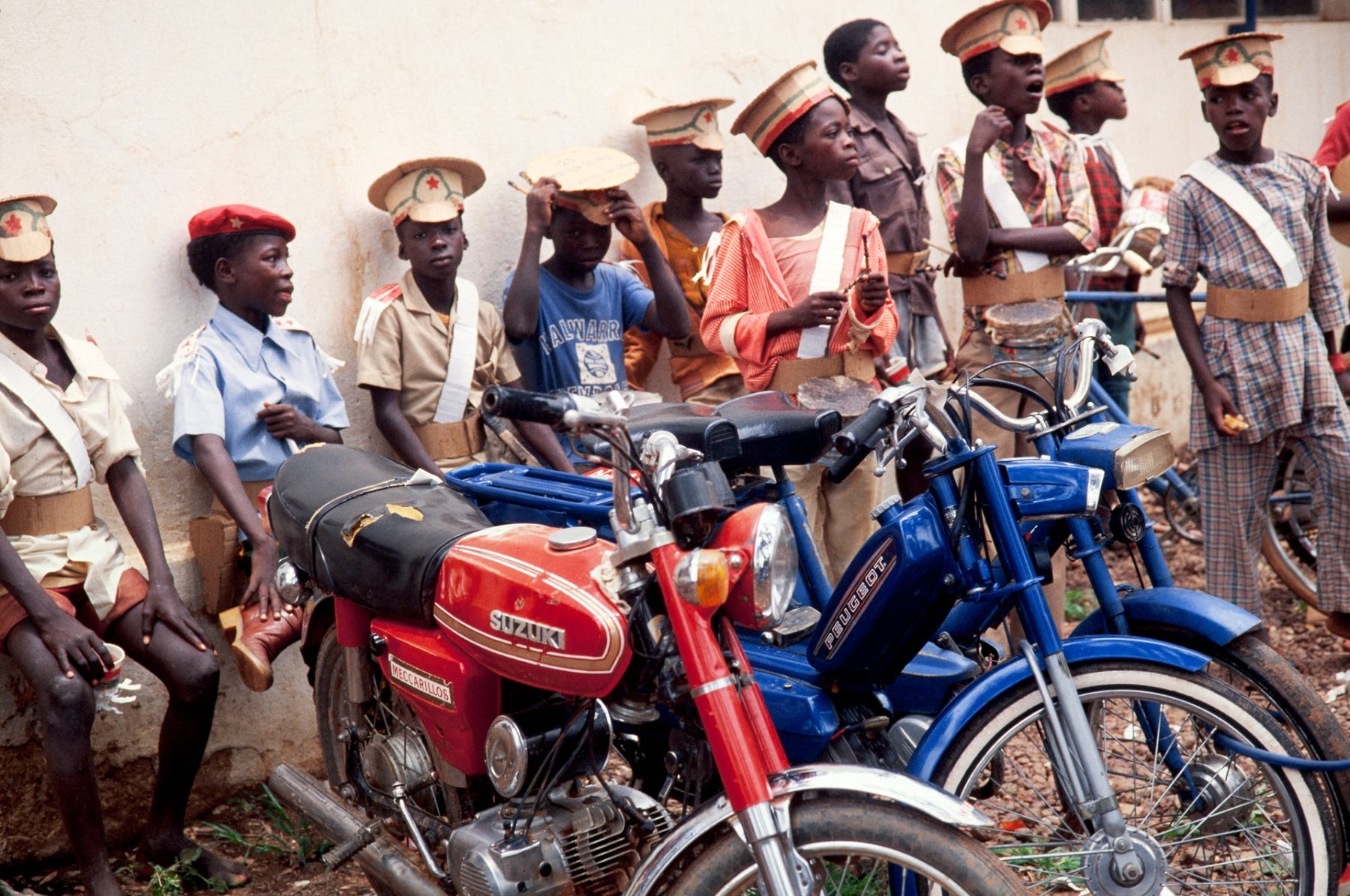
Burkinabè children wearing false kepis during the military parade in Ouagadougou to commemorate the second anniversary of the revolution of the Burkina Faso. August 4, 1985. Daniel LAINE / AFP via Getty Images.
This potted history is important to understanding the phenomenon of Ibrahim Traoré, Burkina Faso’s current president, an authoritarian head of state who in his charisma and self-presentation so deliberately echoes Sankara.
On September 30, thousands of Burkinabè gathered in Ouagadougou’s Place de la Révolution to hail Traoré on the fourth anniversary of the coup that brought him to power. As the second coming of Sankara, Traoré — whatever their entirely different political ideologies – is arguably the face of contemporary African anti-imperialism. It is a meticulously cultivated image that has almost nothing to do with Traoré’s actual record, or his achievements in Burkina Faso.
Traoré is a pan-African leader for a digital age, an autocrat who has suspended his country’s constitution, dismantled its admittedly fledgling democratic institutions and been accused of crimes against humanity, but who has used artificial intelligence, particularly deepfakes, to bury that record beneath a highly effective cyber cult of personality.
How do Burkinabè reconcile the man with the persona? And is Traoré a triumph of the algorithm, the kind of politician increasingly familiar from Ouagadougou to Delhi, Berlin, Buenos Aires, and of course Washington, DC?
Left: Burkina Faso President Thomas Sankara during a speech on October 5, 1983, in Paris, France. Alain MINGAM/Gamma-Rapho via Getty Images. Right: New coup leader Captain Ibrahim Traoré at a news conference on October 2, 2022 in Ouagadougou, Burkina Faso. Stringer/Anadolu Agency via Getty Images.
The man, the myth, the algorithm
Ibrahim Traoré came to power in September 2022. In his own telling, while Sankara was installed as president, Traoré led the putsch himself. By January 2023, Burkina Faso terminated its military accord with France, giving French special forces one month to leave the country. In June this year, Burkina Faso ended all diplomatic relations with France.
As Traoré turned away from France, he strengthened relations with Moscow. It’s in keeping with the pattern across the countries of the Sahel — Burkina Faso and its neighbours Mali and Niger — as the region’s colonial history with France has been swept clean by a broom held first by the mercenaries of the Wagner Group and latterly the Russian state itself, represented by the Africa Corps.
But in April and May 2026, Africa Corps forces were dealt a humiliating defeat in northern Mali by a combination of Tuareg separatists and allegedly Al-Qaeda linked Islamists. The Malian defence minister was assassinated in a suicide bombing at his home near the capital Bamako. With Russia so involved militarily in the Sahel countries, Ukraine has admitted to assisting rebel forces. Both Mali and Niger have cut diplomatic ties with Kyiv. And Burkina Faso has described Kyiv as a destabilising force in the region, making the Sahel effectively a front in Russia’s war with Ukraine. As recently as September, Traoré named Ukraine as a part of Burkina Faso’s “map of enemies” for which, he added menacingly, “we need to prepare.”
Russia, as Coda Story has reportedforyears, has used everything from weapons sales to mercenaries to paying African influencers to both spread Russian narratives and hold Moscow up as the alternative to continuing to rely on exploitative economic relationships with the West, particularly erstwhile European colonialists.
Despite the extent of Russian attempts to influence the Sahel, it’s not Moscow that is signing the most consequential deals with the military juntas it helps prop up. It’s Beijing. And the deals being signed with China to mine the region’s extensive mineral wealth — the lithium, gold, copper, zinc, bauxite and uranium — have served as a reminder to the United States that it too should resume stalled relationships in the Sahel. Early in 2026, Burkina Faso signed a near $150 million healthcare deal with the U.S. in exchange, it appeared, for favourable access to minerals. Both Zambia and Zimbabwe backed away from similar deals, expressing concern about U.S. demands for data and minerals that amounted to an infringement of sovereignty.
Burkina Faso's President Ibrahim Traoré arrives in Moscow, Russia on May 8, 2025. Grigory Sysoev / RIA Novosti/Anadolu via Getty Images.
The deals with China and the United States are being negotiated alongside a drive to reduce reliance on foreign loans and grants and ramp up domestic production, particularly of gold. Traoré claims his economic policies emphasise nationalisation and self-reliance. His government has taken over major mining operations and increased state stakes in other industries. In early 2024, his administration suspended export permits for small-scale gold production to crack down on smuggling and keep mineral wealth inside the country. Last month, he inaugurated Burkina Faso’s first gold refinery.
Some of this has had positive economic effects. The World Bank, in a June 2026 update, said the country had an estimated 5.3% growth in 2025, up from 4.8% in 2024, and its fiscal deficit narrowed from 5.8% of GDP to 1.8%. Inflation was also negative, 0.5%, compared to 4.2% in 2024. Reports by the World Bank and IMF have ascribed these growth to external factors such as the gold rally, climate-driven increase in agricultural outputs, and reduction in energy prices.
Economic growth, though, is part of a larger story that includes a crackdown on the press, particularly critical coverage of alleged human rights violations. Human Rights Watch documented 1,840 civilian deaths between January 2023 and April 2025, over 1,200 of which were directly attributed to government forces. Even as the report acknowledged widespread violations by Islamist groups, the actions of the Burkina Faso military, it said, “amounted to war crimes and crimes against humanity.” At the same time, Traoré has clamped down on Burkinabè civil society, banning over 100 human rights organizations and dissolving all political parties.
None of it appears to have affected his carefully-honed image in certain online spaces.
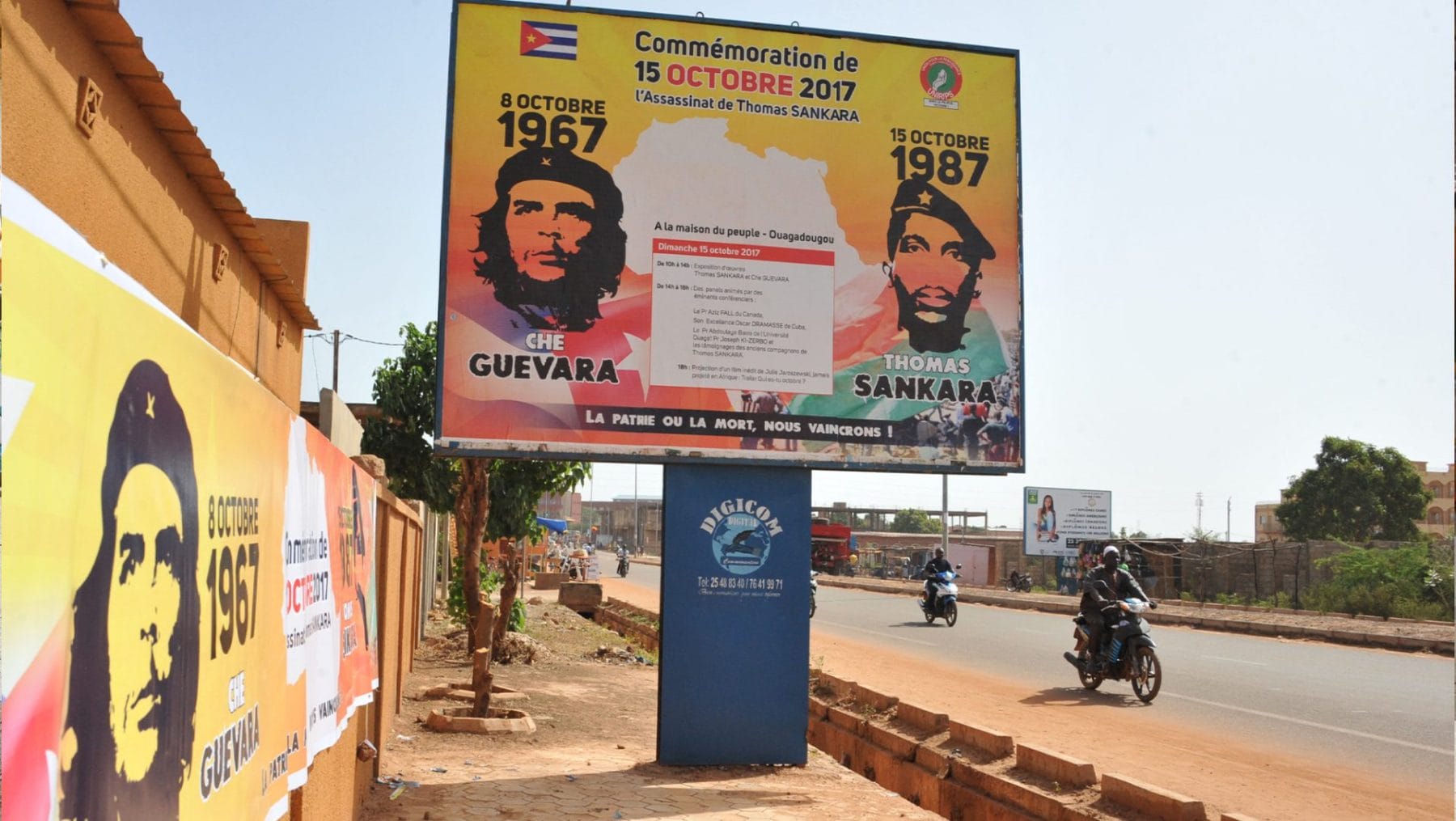
Street of Ouagadougou shows a poster celebrating former President Thomas Sankara, known as "Africa's Che Guevara" and the portrait of the Argentine-born guerrilla leader Ernesto Che Guevara. Ahmed Ouobaa/AFP via Getty Images.
Streets of Accra, Ghana, May 9, 2026. Olatunji Olaigbe.
A graffiti portrait of the president of Burkina Faso Ibrahim Traoré. Boniface Muthoni/SOPA Images/LightRocket via Getty Images.
A pan-African hero
Traoré is everywhere. In Accra, the capital of Ghana, his image is pasted onto buses and in parks. In January 2025, at the swearing-in of the Ghanaian president John Mahama, it was Traoré who the crowd responded to, cheering for a rockstar rather than a head of state. Even Mahama joked that Traoré had stolen the show. Artwork celebrating Traoré is frequently posted online. The commentary that accompanies the art is gushing. “Through this artwork,” reads one Facebook tribute, “I celebrate the spirit of a man who stands for sovereignty, truth, and the rise of a self-determined Africa.”
Meanwhile, the Ivory Coast government has granted refugee status to at least 69,000 Burkinabè fleeing Burkina Faso.
In May, when I travelled to Ghana and Ivory Coast to talk to people displaced from Burkina Faso, at least five sources decided they no longer wanted to speak. Guaranteeing anonymity didn’t seem to matter. A Burkinabè journalist who was helping me find people to speak to, stopped responding to my messages the day after I arrived in Accra. Those who did speak to me refused to be quoted for fear that harm would come to family and friends left behind in Burkina Faso.
Reporters have been intimidated into silence. “Today, any journalist living in the country is forced to practice self-censorship to avoid being arrested,” says Harouna Simbo Drabo, disinformation analyst and Director of Programs & Partnerships of Faso Check. “Burkinabé journalists have two options,” he told me, “either practice self-censorship or go into exile.” After threats to his life, Drabo has left Burkina Faso.
He’s one of the luckier journalists. Since 2022, at least seven Burkinabè reporters have been forcibly conscripted into the army after criticizing the Traoré junta's crackdown on the press. Guezouma Sanogo, Boukari Ouoba, and Luc Pagbelguem were abducted days after their union denounced state media as "instruments of propaganda." Atiana Serge Oulon, editor-in-chief of L'Événement, is among the disappeared. Many, like Drabo, have either left Burkina Faso or quit their jobs.
As conditions deteriorate, what information is becoming available is government propaganda amplified by social media linked to Russian misinformation. In the absence of accurate, verified information, there is inevitably only disinformation. For instance, one of the most persistent pieces of disinformation is the story that Traoré — a supposedly avowed anti-imperialist despite his kowtowing to Moscow, Beijing and Washington — rejected billions of dollars in International Monetary Fund handouts because he believes, à la Thomas Sankara, in economic self-reliance. It is a story that has been debunked but was repeatedly told to me by Traoré supporters, including at least one journalist.
The claim was cited more than 700 times in a single three-day window in January 2025 alone, racking up millions of views across Facebook, X, and TikTok. Dubawa fact-checked the story and found that rather than rejecting money from the IMF, the Burkina Faso government had negotiated a 48-month IMF loan program in September 2023 and drew on World Bank financing in 2024.
By mid-2025. Code for Africa's analysis found social media in sub-Saharan Africa flooded with AI-generated videos casting Traoré alongside Beyoncé, Rihanna, and, in one particularly unhinged iteration, Pope Leo XIV, all of whom supposedly endorsed him as a Pan-African hero holding the line against the West. After US AFRICOM commander Michael Langley criticized Traoré's handling of Burkina Faso’s gold reserves in a Senate hearing, a network of 165 Facebook accounts began posting identical language claiming Putin had deployed special forces to protect Traoré from an American assasination plot. In ten days it pulled 10.9 million views.
In Accra, I caught a bus with a picture of Traoré emblazoned on the side. The driver, who only identified himself as Kofi, insisted that before we spoke I should tell him what I thought of Traoré. I say I am not Burkinabè, that I have not visited Burkina Faso but that I have spoken to many people whose lives have been upended by Traoré’s strongman politics. I told him about Burkinabè journalists in exile, forced to join the army, or even disappeared. I told him that when asked about a transition to democracy, Traoré said it was important for Burkinabè to “forget” about democracy. “We have to tell the truth,” Traoré said, “democracy isn’t for us.” I told him about the Burkinabè refugees I met in Treichville, a district in Abidjan, the Ivory Coast capital.
Kofi listened and then told me that “good things take sacrifice,” including the death of a free press. When I asked what he meant by good things, he showed me AI-generated videos of a smart city Traoré had supposedly built.
African identity is tightly wound around the belief that the continent has more potential than it has achieved. The deficit can be attributed to a lot of issues, but chiefly to Western exploitation and the complicity of African leaders. “African countries have also fallen into autocratic democracy,” Sanusi Sanusi, Research Analyst at the Digital Tech, AI & Information Disorder Analysis Centre, DAIDAC, tells me. “There is an election every couple of years but it isn't free or fair.”
Supporters of Traoré wave Burkina Faso and Russian flags during a rally at Place de la Nation Ouagadougou on April 30, 2025. AFP via Getty Images.
Neil Postman, in Amusing Ourselves to Death, writes that “disinformation does not mean false information. It means misleading information — misplaced, irrelevant, fragmented or superficial information — information that creates the illusion of knowing something but which in fact leads one away from knowing.”
Many Traoré supporters I spoke with, most of whom were men, were convinced they knew things I did not. They told me to educate myself more on Western hypocrisy in Africa. They said they did not have faith in those who appointed themselves arbiters of what was fact and what was disinformation. In Lagos I met Lemi Ghariokwu, who designed album covers for the iconic Nigerian musician Fela Kuti, a revolutionary figure. Ghariokwu, who has a portrait of Ibrahim Traoré hanging in his studio, told me that “Western education and propaganda has made our elite class toothless bulldogs.” Listening to them, it seemed as if a successful Africa needed strongmen, needed autocrats.
In Abidjan, the last person I spoke to about Traoré was Oumar, a Burkinabè taxi driver who had moved to the Ivorian capital in 2021. He told me he “supports Traoré with all my heart.” But as we talked, he admitted he had not been back home because “things are only getting worse.” Three Burkinabè refugees I spoke to told me they thought I might be a government agent planted among them to find out what they really thought about Traoré and that I would then report those thoughts back to Ouagadougou.
Many of the Traoré supporters I spoke with thought I was brainwashed by Western media or, worse, too docile to participate in an African revolution. For my part, I thought they were ill-informed and unable or, worse, unwilling to see through propaganda.
The fundamental curse of the age of information and connection is that we rarely confront how the mediums meant to unite us have fractured us. An unprecedented flood of data has shattered shared reality into millions of customized, mutually hostile subcultures.
With the help of AI and social media, Traoré has managed to decouple national and anti-imperial pride from government performance. By the middle of next year, Burkina Faso will no longer be part of the International Criminal Court, denounced by Traoré as an “instrument of neocolonial oppression”, and thus no longer accountable in any international forum. His government has said it is “decolonizing” the school curriculum. Cheered on by social media, Traoré has used anti-imperial grievances and resentments to argue that authoritarian military rule is the only safeguard for sovereignty.
As some Burkinabè exiles told me ironically, they thought both I, so sceptical of Traoré, and the Traoré die-hards in the African diaspora could use a few months living in Burkina Faso. We should, they said, experience the country Traoré has made IRL. See past the carefully curated myth of the man himself, the largely online fantasy of the pan-African, anti-imperial revolutionary who needs to break a few eggs to make the omelet, and assess the country he runs unchallenged.
Longreads has published hundreds of original stories—personal essays, reported features, reading lists, and more—and more than 14,000 editor’s picks. And they’re all funded by readers like you. Become a member today.
David Alm | Longreads | October 1, 2026 | 5,726 words (24 minutes)
I got off Interstate 81 to give my soul a break. The back roads of southwest Virginia wind, crest, and plunge through lush valleys of oak, poplar, birch, and maple trees. It’s easy to lose track of time and distance there. People drive slower. Cows graze in pastures. And there are no placards festooned with Motel 6 and Starbucks logos, flattening the American landscape into a homogeneous blur. Any signs you might see are low to the ground and handmade, protesting a data center, for instance, or thanking Jesus.
I’d gone to this rural pocket of the country for the 90th annual Old Fiddler’s Convention in Galax, an independent city of just under 7,000 near the North Carolina border whose population, for six days in early August, balloons to around four times that. They arrive in RVs and Casitas, camper vans and cars to stake out 20-by-35-foot plots in Felts Park, a 28-acre fairground in the heart of Galax, transforming it into a massive, muddy parking lot sprinkled with portable toilets and a cluster of food trucks, offering loaded potatoes, funnel cake, and blooming onions.
The Old Fiddler’s Convention—or just Galax, as the diehards call it—is the oldest and largest fiddlers’ convention in the world, a place where banjo pickers, guitar players, and other maestros of old-time strings gather to see how they stack up. Founded in 1935, Galax has been canceled only twice since then: once during World War II, due to travel restrictions, and again in 2020, due to the COVID-19 pandemic. Many Galaxers have been going every year for decades, some for as long as they’ve been alive.
There are scads of rules: If you play clawhammer-style banjo in the bluegrass band competition, you will get disqualified. Same if you play bluegrass-style banjo in the old-time competition. If you break a string while performing, you must stop immediately. Playing time during competition is limited to two minutes and 30 seconds. And, crucially, no electric instruments of any kind are allowed, either on stage or in the tightly packed fairgrounds, where self-described hillbillies, accountants, firefighters, and session musicians pick day and night in blistering, impromptu jams amid the RVs.
Credit: Photos from the Galax Old Fiddler’s Convention, 1978, by Terry Eiler, Blue Ridge Parkway Folklife Project collection (AFC 1982/009), American Folklife Center, Library of Congress
One does not merely attend Galax. It’s not a music festival. There are no headliners, and no full-set performances. There is a single stage, and over the course of six days, contestants take it one after another to play one song for a panel of judges and a smattering of spectators. There are more than a dozen categories, little changed in the past century: old-time fiddle, guitar, dulcimer, folk song. Cash prizes for individual players range from $35 to $285; a campsite and contestant pass together cost $175. “The prestige of being judged a ‘winner at Galax,’ and the respect for one’s musical talent that goes along with it, far outweighs any monetary award,” wrote Fred Burton in the March 1984 issue of Bluegrass Unlimited.
In the 1980s and ’90s, cars lined up days before the gates to Felts Park opened. The fairgrounds got so full back then that people slept in the horse stables that used to line one end of them. Once, Elizabeth Taylor made a surprise appearance with her then-husband, Virginia Senator John Warner. Rumor has it that members of Old Crow Medicine Show and Leftover Salmon have shown up at Galax, under the radar, just to jam.
And yet, despite appearing well attended to my virgin eyes, the Old Fiddler’s Convention’s numbers are down from the pre-pandemic years, and way down from peak Galax. Folks say it’s not like it was. Maybe, as one long-time attendee speculated, it’s that more kids are choosing devices and passive consumption over face-to-face activity with other humans, or that more and more young adults are fleeing southwest Virginia due to the gutted coal, tobacco, and manufacturing industries. Or maybe it’s just that people around there are dying faster than they’re being born. Glen Alexander, a 55-year-old fiddler who’s been going to Galax since he was a child, put it bluntly: “We’re all scared to death this is gonna go away.”
Tara Linhardt, a professional mandolin player from Leesburg, Virginia, with thick, curly hair and a determined gaze, has been going to Galax since she was in high school, and was happy to advise me on how to survive my first time. Buy what you need locally, she told me; it was cheaper than New York. It will probably rain, so bring mud boots. Find a high patch of ground, because rainwater pools in the low spots. Afternoon jams were open to anyone, but unless I was dead good, I should just observe the nighttime ones, where the “thoroughbreds” play so fast that a newbie like me would only drag it down.
Tara and her husband, Ian, pulled into Galax late Saturday afternoon, just in time to get a bite before parking their Four Winds RV by the dumpsters behind the Applebee’s at the edge of town. She told me to sleep in my car there, since the church parking lot was already full, and Applebee’s, unlike Hardee’s, doesn’t mind. We’d need to queue up by the gates to Felts Park before seven o’clock Sunday morning to ensure we’d get decent campsites. First-come, first-served.
Credit: David Alm
I’d arrived earlier that afternoon, hours later than Google Maps had predicted, because I forsook the interstate. The day before, I’d left my home in Brooklyn only to spend two hours driving five miles to reach the Holland Tunnel to New Jersey. I was spat out onto I-78, which at some point blended into I-81, hauling me across Pennsylvania to Staunton, Virginia, where I slept in a former sanatorium. I had recently been laid off from a job I’d held for 13 years, editing reports for a geopolitical risk advisory firm, and needed reprieve. I sought my escape on Route 11.
In the trunk were a guitar and two banjos, instruments I was determined to spend the week playing in the Blue Ridge Mountains in lieu of applying for jobs and fretting about AI in my Brooklyn apartment. It was the first long road trip I’d taken alone in a quarter-century, and I’d hoped for a reset. Call it a midlife crisis if you want, but I drove cross-country a lot before I moved to New York, always on back roads. America is best seen up close.
After chatting awhile with Tara, Ian, and a luthier named John Hamlett, who’d also parked his RV behind the Applebee’s, I folded myself into the backseat of my Chevy Trax rental and more or less slept. I awoke at 6 a.m. to a downpour, rain pelting the roof of my car like fingertips on a conga drum.
The four of us caravaned into town, where we waited until almost 9 a.m. to enter the park. We figured it was due to the rain. In fact, it was because of an issue with the gate itself. My source for this intel was none other than the Galax chief of police, DeWitt Cooper, who was directing traffic into Felts Park that day and hails from the Bronx. I’d see Chief Cooper again a couple days later, at Willie’s Food Truck inside the fairgrounds, where we chatted over catfish and collard greens about his philosophy of policing. “Don’t judge based on appearances and treat people with love,” he told me.
I chose a plot on the far side of the fairgrounds, near a fence and a row of portable toilets, with Tara, Ian, and John all nearby. Our little commune wouldn’t last; the next day, Four Winds got stuck in the mud and Tara had to summon a Moose—one of the men of Moose Lodge No. 733, a fraternal organization that’s managed the Old Fiddler’s Convention since the beginning—to drag it out with a tractor. They found higher ground by the tennis courts and I stayed put. That night it rained again, and I awoke at 5 a.m. in a half-inch of water that had pooled in my tent overnight, soaking my sleeping bag, pillow, and clothes.
It’s no fun to wake up in a puddle, but when it rains in your tent, or the fairgrounds get so muddy that you watch a young woman lose a Birkenstock forever to the muck, or you start to stink because there’s only one public shower in Felts Park, it all feels incidental to what matters more: There’s pickin’ to do. You hear it all around, all the time. A lone fiddle at dawn, guitars easing into the afternoon, jams that grow in size and volume throughout the day, until night falls and Felts Park erupts in a surround-sound jamboree of syncopated banjos, arpeggiated fiddles, and bass notes so low and driving that they cut through it all at ground level. When it’s not raining, those jam sessions continue through the night, practically until the early morning’s still air is broken anew by someone’s fiddle.
My first jam came on Day 0, after the rain abated and I’d set up camp. The Old Fiddler’s Convention wouldn’t officially start until Monday night, with the astoundingly good kids’ competitions—the reigning bluegrass fiddle champion herself, Hollace Oakes, was 14 when she won the adult contest last year—but everyone in Felts Park was eager to pick.
Jimmy Kidd (left) has attended Galax since 1969, when he won the guitar competition. Ronnie Burroughs (right) opened the competition Friday night with an autoharp rendition of “The Star-Spangled Banner.” Photo by David Alm.
Tara wanted to introduce me to Bill and Nancy Sluys, a couple in their early 70s who’ve been going to Galax every summer for some 50 years. We walked to their site, where Bill, a towering figure with a steady voice and a long, white, braided ponytail, emerged from their Airstream to invite anyone who might “wish to partake” to join Nancy and a few others inside. I told Bill I’d thought of bringing edibles to Galax, but the convention website said state laws concerning drugs and alcohol are “strictly enforced,” and Google’s AI bot, Gemini, warned that law enforcement would be crawling Felts Park with K-9 units, even though recreational cannabis is legal in Virginia for adults over 21.
Bill laughed and said that hasn’t been true in more than 40 years, though it used to be, on account of a music festival that happened once, half a century ago, about 15 miles up the road. Stompin 76 featured Bonnie Raitt, John Prine, and other big names from the time. The festival attracted a huge crowd, including a motorcycle gang that allegedly wanted to keep the party going after the festival wrapped, so they rolled into Galax on their hogs, stocked with methamphetamine, moonshine, and guns. Mayhem ensued. The authorities cracked down after that, ostensibly to maintain law and order in fiddleland. By the mid-’80s, they realized that the Old Fiddler’s Convention really was a family affair and let the fiddlers be.
A group of six or seven people had gathered outside the Airstream by this point, all brandishing instruments. Bill, who grew up on Long Island, assumed his position behind an aluminum upright bass from the 1930s, while Nancy, a fiddler and banjo player roughly half Bill’s height who grew up in Connecticut, emerged from the Airstream with her fiddle. She sat down on a folding chair, called “Soldier’s Joy” in the key of D, and kicked it off at breakneck speed. This was an old-time jam, and “soldier’s joy” was a Civil War-era euphemism for morphine. Galax had begun.
An old-time jam goes something like this: Anywhere from two to umpteen musicians gather in a circle, knee-to-knee, and someone—usually the fiddler—calls a tune. Before you know it, you’re carried away by a cyclone of fiddles, mandolins, banjos, and guitars, all locked into a swirling rhythm that can, when it’s good, take you to church.
Ted McAllister (center, on bass) has attended Galax since 1975; his son, Caleb (to McAllister’s right, on fiddle), has attended since he was a child. Joining them is Katherine Emerick (right, fiddle); Elizabeth Holdren (left, guitar); and Elizabeth’s husband, Jacob, on banjo. Photo by David Alm.
The tradition dates to the mid-1700s, when Scots-Irish immigrants first settled in Appalachia. Even then, coastal property was for the elite, forcing poorer immigrants inland and south, through the Shenandoah Valley to southwest Virginia, where land was plentiful and cheap. Their music quickly took root. “The Scots brought fiddles and liquor,” Ted McAllister, one of my neighbors in Felts Park, told me. “The Germans brought church music and beer.”
Over time, Scottish fiddle tunes evolved, as oral traditions do, and began to mix with the musical traditions of enslaved Africans, who had brought with them gourd instruments that would evolve into the American banjo, along with rhythms the Scots had never heard before. Old-time music, in other words, is the music of diasporas, fed into a blender and then worked into a froth. A lot of traditional folk songs came out of this period, too. One that I learned at Galax, “Going to the West,” tells the story of a young man who leaves the mountains of his birth, “where labor is in vain,” to seek the fertile plains out west. It’s the story of my own Scottish forebears, who settled in South Dakota before moving to what is now suburban Chicago, and later, Florida.
Bluegrass, by contrast, was born in the 1940s, when Bill Monroe and The Blue Grass Boys took those mountain sounds, combined them with Southern church music and blues, and tightened it all into something you might call an uncle of rock ’n’ roll. There’s a reason that Billy Strings plays to sold-out arenas and pickers from around the world can play classics like “Blue Ridge Cabin Home” at the drop of a one-chord.
Where bluegrass is punchy and clean, designed for the stage, old-time is ecstatic, designed for participation. Bluegrass jams attract spectators who marvel at the players’ pyrotechnics; old-time jams get people on their feet. At Galax, some folks drag big pieces of plywood around the fairgrounds looking for old-time jams, where they’ll lay the board down at the edge of the circle and dance. Flatfooters they’re called: the percussion section.
The New York bluegrass community has a Signal thread, and through it I met Harrison Corthell, a banjo player from Queens who was camping in what he called the “gayborhood” of Felts Park: two tents and a rainbow flag. Corthell offered to introduce me to Tyler Hughes, who was also camping in the gayborhood. Hughes serves as the executive director of the Crooked Road Heritage Music Trail, a nonprofit founded by the Virginia Assembly in 2004 to boost tourism through music. Alsace has the Route des Vins, and Kentucky the Bourbon Trail. Southwest Virginia has the Crooked Road.
I found Hughes Thursday afternoon as he was setting up the Crooked Road’s information booth. Musicians were streaming by for the clawhammer banjo competition, which was set to begin any minute. As we sat on a park bench, I told Hughes that I’d begun to think of its music as the region’s chief international export of the past 100 years. “I think that’s a fair assessment,” he said, but stressed that he resists thinking of Appalachia’s musical traditions like a natural resource such as iron or coal. “We really try to stray away from an over-commodified, over-commercialized vision of southwest Virginia,” Hughes said.
Musical traditions can be packaged and sold, after all. Last winter, an Appalachian folk musician named Murphy Campbell discovered that her videos on YouTube had been used to create AI clones of her voice and banjo playing. Someone then used Vydia, a music distribution platform, to share those clones via streaming services and to make copyright claims on Campbell’s own videos. Campbell described her ordeal on Instagram, including trying to address the matter with “agents” at those streaming services: “I’m telling robots to take down music robots made,” she said. Her posts went viral, causing Vydia to ultimately withdraw the copyright claims and ban the user responsible, according to reports. “It’s the wild west,” Campbell said in one of her posts. “And it can happen to anyone.”
I asked Hughes what percentage of the people in southern Appalachia play an instrument of some kind. He guessed around 70 percent. I’d heard the same number from Daniel, a 32-year-old banjo player I’d met earlier in the week, who works at a sawmill in Grayson County. “It’s kinda the only thing goin’ on around here,” Daniel said. He explained that when the cotton mill in Grayson County closed in the late 1980s, “everyone” started using meth. Then opioids. Within the next 20 years, drug overdoses had become a leading cause of death in southwest Virginia. Getting together to pick, Daniel said, “helps you through real hard stuff.”
The guitar I took to Galax is a 1989 Takamine I’ve had since I was 14, when my parents indulged my desire to learn Pink Floyd and Jimi Hendrix songs on the condition that I take classical guitar lessons. I spent my first day or two in Felts Park carrying it around like a security blanket, but I was there to play the banjo. Upon arrival, I realized that I might have been the worst banjo player in Galax.
Performers in the Youth Bluegrass Band competition. Photo by David Alm.
I picked up the instrument in 2024, at age 48, in part because my maternal grandfather played one and I was always curious about it. More than that, I wanted to build a mountain banjo, the rustic kind people in Appalachia made from whatever wood they had nearby, animal skins for heads, and guts for strings. I liked their warm, thuddy sound, totally unlike the piercing banjos of bluegrass with their steel strings and resonator backs. So I learned everything I could about how to build one and called my dad to ask if he’d help. I knew the banjo; he knew wood.
That summer, we spent a week together in his shop in Illinois, building a fretless eastern Kentucky-style mountain banjo out of walnut and ash. Most people in New York ask what it is; everyone at Galax identified it instantly. I’ve since built seven banjos and acquired three more, all different styles. This spring, I carved a neck from a piece of walnut entirely by hand, no power tools, for a 19th-century-style tackhead, the kind played by enslaved Africans on plantations and by Civil War soldiers around the campfire. It’s not just that I’m fascinated by the instrument. As my actual trades—crafting sentences and teaching others to do the same—are increasingly devalued by technology and a society that no longer reads, building banjos gives me one thing that I can hold onto.
Shortly after my banjo obsession began, I started going to old-time jams in New York City, and later, bluegrass jams. I didn’t—and still don’t—actually listen to old-time or bluegrass music; my tastes trend melancholic. But I missed playing music with other people, something I hadn’t done since college and had begun to crave during the endless, isolated days of the pandemic. In early 2025, I started going to a regular jam session at a bar in Brooklyn called Sunny’s, whose owner has turned it into an institution of roots, bluegrass, and folk music. Some of the best pickers in the tri-state area turn up there each week, along with people like me, there to learn. It took me months to lead a song without blacking out. They call it “jamnesia,” and it’s humiliating.
After one week among the pickers of southern Appalachia, I got tighter, faster, as if the place itself does some of the teaching. A fiddler friend from New York, who’d been to Galax in the 2010s, was more succinct: “It seeps from the earth.”
Galax is hardly the first fiddlers’ convention; it’s just the oldest one still left. In the days before the railroad and automobile, let alone the World Wide Web, fiddlers’ conventions brought the people of Appalachia together, allowing songs and picking styles to spread like gossip over those hills. They could get pretty wild, and early-days Galax was no exception. Women and children did not go to Galax back then. It was a place where men gathered to let loose—“outside of the eyes of their preacher and their wives,” Rex McGee, a multi-instrumentalist from North Carolina, told me.
I’d heard of the McGee jams already, where “things get weird,” according to a woman I met Monday morning while I waited in line for the shower. Their camp sits right inside Felts Park, steps from the food trucks, identifiable by a 1974 Ford school bus painted an ominous matte grey. They call it the Muddy Creek Bus, for the band that Glen Alexander’s dad formed in the 1970s and soon became the back-up band for Rex and his brother Ralph’s grandfather, Ralph McGee the First, aka the Old-Timer. The Muddy Creek Boys could party as hard as the Old-Timer; it didn’t hurt that they could pick too. By the 1980s, the real show came after hours. Dozens of people would gather outside the bus to watch the Old-Timer, then in his 80s, fiddle with just about anything he could find: a toothpick, a comb, a “coon dick”—literally a bone from a raccoon’s penis. And it was loud. (For any curious fiddlers out there, you can buy four of these on eBay for $39.95.)
Felts Park is a galaxy of legacy camps like the Muddy Creek Bus. Almost everyone I met told me they’d been going to Galax for 40, 50, even 60 years. Their stories are legion, and they love to tell them: The year it rained so hard that one group holed up in an RV for six days with eight people, an upright bass, and “a little bit of cocaine.” The year a couple of young women got into a fight over a guy, went to fisticuffs in the mud, and ripped each other’s shirts off in front of scores of onlookers—“no one wanted it to stop,” one man recalled with a chuckle. The year several people went mudsliding on the tire tracks, which, for reasons unclear, were composed of raw sewage.
Jimmy Kidd, an 86-year-old Dobro player who’s been going to Galax since he was 29, regaled me with the time he won the guitar competition, in 1969, by playing the Dobro because there was no Dobro competition then. His daughter, Vicky, told me she met Elizabeth Taylor when she came through Galax, in 1977, when Vicky was 12. Taylor was in a wheelchair, Vicky said, and she wasn’t very nice.
Leo Lindblom sat on a low stool cradling a mandolin, his sister Lucy beside him. They’d taken the stage in the kids’ mandolin competition on Monday night, and Leo was focused. With flawless timing and dexterity, the 12-year-old picker dazzled the audience, Lucy accompanying him on guitar, for roughly two minutes. Then he rose from the stool, took a bow, and, with Lucy, exited the stage.
On Thursday, I met Leo, Lucy, and the rest of the Lindbloms—Marina, Jon, and their nine kids, all but one of whose names begins with an L—at their bus in a gravel parking lot just across the road from Felts Park, where it was a little quieter than Galax Central. The Lindbloms first went to Galax in 2021, after discovering bluegrass at a gift shop in North Carolina while on a family vacation five years prior. All nine of the kids responded instantly to the “happy, upbeat” music coming out of the speakers, and mom and dad bought the CD on the spot.
The Lindblom family. Photo by David Alm.
The kids, who range in age from 12 to 28 and were all homeschooled, each chose an instrument and formed their two bands, Headin’ Home and The Brothers Five. Now, when they’re not home in Bloomingdale, Georgia, they’re on the road playing festivals and gigs across the country. I asked what makes Galax special. Libby said it gives them a rare chance to slow down, to not have to be “on” all the time, and just spend time together.
As we sat outside their bus, all 11 of them and me, I asked: Why bluegrass? After all, Marina and Jon met at the Eastman School of Music and played in the Savannah Philharmonic for 10 years. They know Tchaikovsky and Brahms just as well as Bill Monroe and the Carter Family. They could teach their kids classical music, or any other kind. “Our goal, in everything we do, is to glorify the Lord,” Marina explained. And with bluegrass, she said, they are able to give people a bit of happiness, a chance to tap their feet and forget about their troubles for a little while. It’s an act of service.
Then I turned to Leo, the youngest, who was perched on Lucy’s lap, and asked what he likes about playing music that, surely, most kids his age don’t know anything about. “Everything,” he said, before checking my presumption: All the kids he knows play bluegrass or old-time, he said. He’s met them all through places like Galax.
I’d registered for the clawhammer banjo competition a month before Galax opened its gates, but by the evening of the contest, I was so worn out from five semi-sleepless nights, as many days packed with conversation and playing, and a dubious diet of beer, bananas, and cheese sandwiches that I decided to sit it out and trekked up the hill to Main Street for some Chinese food. Besides, I don’t even play clawhammer banjo. I’ve developed a hybrid style: I use finger picks, like bluegrass, but keep rhythm by striking the strings with the back of my middle finger, like clawhammer. After five days of watching virtuosos of both styles create magic on their instruments, I wasn’t about to do my mishmash in front of a panel of judges.
As I sat in my air-conditioned booth, hovering over a plate of garlic chicken, I got a call from Tara. Was I going to compete? I told her I’d spent the whole day interviewing people and was exhausted. “You have to participate!” she countered. “I triple-dog dare ya.” I was just delirious enough to bend. Thirty minutes later I was backstage rehearsing my song with John Garrison, who has gone to Galax each of the past 46 years. After a few runs through an instrumental version of “White Freightliner Blues” by Townes Van Zandt, I checked in, slapped a number on my chest, and took the stage. Tara squatted right in front to take video, smiling wide. Our pickin’ was clean, but we landed way outside the money: I bastardized the form and played a copyrighted song. We still got a big round of applause.
The author (left) with John Garrison, his accompanist on Townes Van Zandt’s “White Freightliner Blues.”
My style served me better in the jams, where more than once people assured me that if it sounds good, ain’t no reason to change it. Some of the best sessions I went to were inside an A-frame tent adjacent to the gayborhood and maybe 100 yards from my campsite. On Monday night, I played fiddle tunes and shared a jar of moonshine in that tent with three young guys who lived just down the road, near the town of Fries, in Grayson County. One of them built a fiddle from scratch; it took him years. I did my version of “White Freightliner Blues” with them, and when we finished, one yipped, “That’s how it’s done!”
Thanks to the moonshine, I forgot about Tara’s advice to sit out the nighttime jams and hopped over to a bluegrass jam that was really crackin’. At least 10 musicians stood in a circle, and the tempo was hot. I asked a guitar player if I could join. “You’ll have to ask him,” he replied, motioning to the only banjo player in the group. They did not expand the circle to let me in, and I hung awkwardly on the periphery for a song or two before going back to my tent.
It was one of only two times I felt unwelcome at Galax. The other came after the guys from Fries learned I was a journalist from New York City. I’d gone back to their tent Tuesday afternoon to jam but ended up talking with Daniel, the sawmill worker, instead. He was without his banjo, so while the other guys picked fiddle tunes, I told Daniel I was there to write about Galax and asked if I could record our conversation. He cheerfully agreed, but after that—and I could very well be wrong about this—I sensed that the other guys looked at me sideways.
Daniel, on the other hand, remained inviting and warm. One afternoon late in the week, I was sitting by my tent when he wandered over to say hello. He wanted to give me a leaf of galax, the rubbery, low-lying evergreen from which the town takes its name. “I thought you’d like this for your story,” he said, and stayed to visit awhile.
I broke camp Saturday afternoon and packed up my car. Before I left Galax, however, I dashed over to catch the “43rd Yearly International Kazoo Championship” a few campsites down from Bill and Nancy’s Airstream, as Tara had assured me it was “not to be missed.” Reporters don’t spend much time at the Old Fiddler’s Convention, and Tara was concerned that I might focus too much on the negatives in my writing—the mud, the gastronomic limitations, the attrition. Like everyone I met in Felts Park, she wanted me to return to New York with a real sense of why they keep coming back, year after year, and of what could be lost if they stopped.
Several dozen people were gathered at the “soup kitchen,” a community tent where, two nights prior, Chief Cooper had served hundreds of Styrofoam cups filled with venison stew, made by Nancy herself, from deer she and Bill had hunted on their property. Now, the ground was muddy and more rain was imminent. The contestants were undeterred, ready to blow their hearts out on plastic kazoos.
I soon understood Tara’s insistence. The International Kazoo Championship pokes a little fun at the rigidity of the main stage. One by one, each contestant was disqualified for breaking at least one of the competition’s 12 rules, which included “No Fun Not Allowed” and “All Participants Must Be Present In Order To Attend.” They were then each invited to perform again, and one by one, each was named the winner. Then all the contestants and judges second-lined through Felts Park in the rain, led by a trumpet and trailed by a banjo, blowing “When the Saints Go Marching In” on their kazoos.
The 43rd Yearly International Kazoo Championship. Photo by David Alm.
After a quick walkabout to say my goodbyes, I drove north on Route 221, past the Applebee’s and the Walmart where, at Tara’s urging, I did most of my shopping for the week. That night I met up with a friend from New York, who’d invited me to a 40th birthday party at a 19th-century cabin deep in the woods north of Roanoke. We stayed up late, drinking bourbon and talking about music. I’d rather have been playing it.
On Sunday morning, I got in my car and continued north on Route 11. As I wound through the mountains, catching the occasional glimpse of semis and cars streaming by on I-81, I played a recording I made of “Going to the West” through the car’s stereo. Brian Muller, who placed third in this year’s mandolin contest, led us in the jam, his plaintive baritone providing the perfect soundtrack to my drive: I leave you here, in this land that you love, ’mid scenes so bright and fair, where fragrant flowers are blooming and music fills the air. I imagined bringing the song to New York jams, and wondered if it would fly.
Passing through the town of Buchanan, a few hours from Galax, I saw a familiar face. Ted McAllister and his wife, Debbie, were getting out of their car just outside the Buchanan Baptist Church. I pulled alongside them, rolled down my window, and said, “Fancy seeing you here.” Ted, guitar case in hand, told me to come inside.
A few dozen people were gathered in the Fellowship Hall for a potluck lunch to celebrate the Buchanan Baptist Church’s 190th anniversary. A preacher named Bill Hartsfield welcomed me at the door. (“Like a field of hearts,” he said with a firm handshake.) Then he walked with me to the serving counter, where I fixed a plate of fried chicken, cheese casserole, and ambrosia salad. We sat down with the McAllisters and two other local musicians, Alan Berry and Mike Lee. “Galax is a subculture of a subculture,” Ted explained as we ate. Music is woven into everything from Sunday morning church services to holiday parties and family picnics.
We finished our plates and went into the chapel, where, for the next 90 minutes or so, Ted, Alan, Mike, and a banjo player named Kim Wood played bluegrass versions of church hymns for around 20 people. Two little girls danced in the aisle, swept up by the music. Halfway through their set, as I sat in my pew, Ted walked to the pulpit and introduced me. He explained that we’d spent the week as neighbors in Galax, talking, telling stories, picking songs, and he was delighted to show me a little more of “how we do things ’round here.”
I hadn’t been to church in decades, and a couple hours of Southern hospitality won’t make a believer out of me. But hearing Ted and the others play, watching children dance, and meeting people who looked me in the eye and didn’t rush the conversation felt deeply familiar. I may have spent almost my entire adult life in New York City, but I grew up on the Illinois-Iowa border, on the banks of the Mississippi. Church backrooms, potlucks, and ambrosia salad were all part of my childhood.
By 2:30, I really had to get going. For the second time in two days, I said goodbye to Ted, got in my car, and was on my way.
A week later, I was back at Sunny’s Bar in Brooklyn, playing songs with a dozen or so people in the bar’s backroom. I called “Going to the West,” and after a quick run through the chords on my latest banjo build, a resonator back with a dragon fretboard inlay that I’d played on stage in Galax, I started singing. It was a little shaky at first, but by the second verse everyone was locked in.
When we finished, one of the musicians remarked that it was a beautiful song. I agreed and asked if he knew it already. “No,” he said. “But I’m going to learn it now.”
David Alm is a Brooklyn-based writer and editor. His work has frequently been included in Longreads‘ Weekly Top Five and annual Best Features lists. He also teaches journalism at Hunter College-CUNY, where he focuses on feature writing and creative nonfiction.
Longreads has published hundreds of original stories—personal essays, reported features, reading lists, and more—and more than 14,000 editor’s picks. And they’re all funded by readers like you. Become a member today.
Earl Swift was a reporter for The Virginia Pilot and has contributed to Outside. He’s been nominated for a Pulitzer eight times. Among other books, he wrote Chesapeake Requiem, a New York Times bestseller that chronicles a year in the life of Tangier Island, located 12 miles out in the middle of Virginia’s Chesapeake Bay. There, a dozen miles from shore, residents live a life with “one foot in the twenty-first century and another in times long passed,” he writes.
This conversation has been edited for pacing and flow.
—Krista Stevens
Brendan: Much has been written about the Appalachian Trail, and you’ve brought a different kind of sensibility to it. How do you make your book fresh and immediate and yet able to sit alongside all the other titles about the trail?
Earl: I’m lucky, in the sense that probably the two best books about trail hikes were written by people who didn’t finish them. Bill Bryson was one and Cheryl Strayed was the other. Most trail accounts are self-published and unedited, written by folks with relatively little writing experience. Not to sound highfalutin, but it shows. I also knew I had a story to tell with Molly and Jeff and what had happened there. [Ed: to say more about Molly and Jeff here would spoil the plot of Swift’s book.] I felt I was pretty well-suited to tell that story. The opportunity was to be that one rare book about a trail journey that stands apart, and I figured it was worth the risk to try to write that book.
Brendan: As you hiked south, getting into Georgia, you started to experience congestion, more people. You noticed a generational divide at Low Gap and other campsites. Younger hikers seem predisposed to tenting, no matter what. Even in the middle of a downpour, they’ll choose their individual shelter over the communal. You also noticed isolation and phones, something you wouldn’t see 30 years ago.
Earl: You didn’t see it 30 years ago because there were no phones. We forget that the smartphone didn’t come along until 2007, a full 17 years after I did that first hike. It was a very different environment back then. This was eight years before Bill Bryson wrote A Walk in the Woods. The trail did not occupy a spot in the collective consciousness. It was not part of American culture the way it has become since, and so you were dealing with people who were drawn from a much narrower band of society. There were people who were already outdoorsy, and that’s not necessarily the case now. All walks [of life] attempt a thru hike these days, but back then it tended to be people who were already part of the fraternity. If you wanted to make a call, you hitchhiked to the nearest town and went to a payphone. There was no other option. If you wanted a pizza, you had to hitch into town. Now you have people who will get on their phones when they’re two miles from the nearest road crossing, and they’ll arrange for a pizza joint to deliver a pie at the road crossing when they arrive, which would have been science fiction.
Brendan: There’s a balance in what to include, so that it doesn’t feel repetitive. You need to pick high intensity moments, be it the physical experience of a gnarly section of trail, or the three siblings from Kentucky who are assholes with no etiquette. You pick these moments so it’s not front-loaded or middle-loaded or back-loaded. There is a delicacy in how you deploy various elements throughout.
Earl: For any storyteller, proportionality is the key ingredient. You must figure out how much of each piece you share with the reader. If there’s one fatal flaw in most trail chronicles, it’s that writers don’t make enough of a distinction between telling moments and untelling moments. They just throw everything at you, and it gets boring.
There are relatively few classic books about the Appalachian Trail, but one of them came in the late ’70s. It’s this two-volume, 1,000-page book called Hiking the Appalachian Trail. It gives you first-person accounts of the first 50 or so thru hikes. By 100 pages into the first volume, you’ve gone numb because every story is exactly the same. Part of the problem is that the whole tenor of the story is This happened, and then this happened. There’s never a moment’s pause to reflect on what it means and why I should care as a reader. Everything’s treated as equally important, and therefore nothing is important.
Job one, for anybody writing a book—for anybody writing a story of any kind, of any length—is to get the reader to that last word. If you don’t do that, it doesn’t matter which pretty words you drop in the middle of the story.
Brendan: You’re the tour guide and you’re going to point to what matters. That degree of authorial authority is integral to any narrative, especially something like this, because otherwise it would just be so rote and boring. You have to imbue it with a pulse.
Earl: Job one, for anybody writing a book—for anybody writing a story of any kind, of any length—is to get the reader to that last word. If you don’t do that, it doesn’t matter which pretty words you drop in the middle of the story. It doesn’t matter how brilliantly conceived it is. The story has failed because you have failed to get the reader to the end, to the finish line.
The whole process of structuring a story, and strategizing about a story comes down to, How do I remove all the speed bumps that will encourage the reader to set this aside? If you can do that effectively, then you win, you get the reader to finish the story. The reader can badmouth the story after the fact. If the reader’s reached the end, you as the writer have achieved what you set out to do. All you can ask is for them to finish the story. You can’t ask them to like it. That’s up to them. But you can get them to finish it if you do it right.
We make decisions about what we include and what we leave out. We decide where we start a story, which is not always at the beginning. We decide where we’re going to end it, which is not always at the ending. You hope that in making those decisions, you get the reader to the truth, or pretty damn close to it, as close as you can, given the facts that you’re working with. But it is a construct, and it is your responsibility. Structure your story in such a way that the story will achieve what it sets out to do. That it will succeed in terms of incorporating enough propulsion to get the reader to the end.
I probably spent three months doing nothing but cutting. Most of the writing of this book was cutting. I wrote a journal while I was hiking, and then I did nothing but cut when it came to writing the book.
Brendan: In what ways did the hike change you?
Earl: In 1990, the big takeaway for me was that I could do anything. It boosted my confidence to the point where I’m sure I was pretty obnoxious in the months immediately after. God knows I must have been difficult to deal with. I could do anything! It made me Superman. Part of that was seeing something demonstrated daily that my dad had been saying to me for years. He was always big on saying, “How do you eat the elephant? One bite at a time.” It had just been “dad talk” to me until this hike, when I realized part of being able to do anything is knowing how to bust it up into its components, and then bust those components up into their individual ingredients. How to take each little bite-sized fragment in sequence, and pretty soon you’ve accomplished the whole thing.
That dictated my approach to big assignments at the paper and in magazines, and certainly it has informed every book effort. It’s a stupid amount of work to write a book. I wouldn’t recommend this line of work to anybody. It’s a ridiculous way to try to make a living. So uncertain, so filled with terror, and so potentially without reward of any kind. But breaking the 2,200 miles into daily doses of 14 to 17 miles describes perfectly how I go about writing a book now. You don’t sit down to write 105,000 words. You sit down to write 1,200 words a day. That’s my daily quota. Do that over enough days, and pretty soon you have the 105,000 words.
Brendan: How did you settle on 1,200?
Earl: Early on, with my first couple of books, it was 2,000, and I just whacked it down. My first hike, I had no trouble banging out 17 to 20 miles a day. Now, 14 miles feels like a pretty tough day at the office, a long day.
It’s the same with writing. Twelve hundred words takes as much out of me now as 2,000 used to. I’ll probably drop it down to 1,100, maybe even 1,000 with the next book. I’d like to think that the words are better than they used to be. I still find that I spend the first hour or two every morning, in the middle of a book project, going back through what I thought were perfect words laid down the day before. Invariably, when I wake up, I find that they weren’t so perfect after all. In fact, they need a lot of fixing and so I do repair for the first couple of hours, and then try to make something out of the rest of the day with new stuff.
Longreads has published hundreds of original stories—personal essays, reported features, reading lists, and more—and more than 14,000 editor’s picks. And they’re all funded by readers like you. Become a member today.
Mark and Betsy Blondin | Longreads | September 22, 2026 | 2,702 words (10 minutes)
We left Boyne City, Michigan, in the fall of 1996 in a 34-foot Coachmen motorhome towing a minivan, with three children, a golden retriever not originally part of the plan, and a desktop computer on a stand bolted to the floor where a chair used to be. We stopped in Flint to say goodbye to family and retrofit the motorhome for the road. Mark’s father had died that June. His mother was devastated, and for a while the question wasn’t which route to choose but whether to go at all. We left Flint on October 4. Five miles later, the motorhome shut down.
A loose fuel line.
A few miles after the fuel line was fixed, we were surprised by a flat tire on the van’s tow dolly, and then, unbelievably, we bent a bumper while putting the van back on the dolly. It was past seven in the evening. We were finally on our way to Cleveland, Ohio.
That was day one. What we built over the following nine months—25,000 miles through 40 states—would go on to earn a Yahoo! Cool Site designation, a presentation at a US Department of Education national conference, and a place in the federal Education Resources Information Center archive. On the road, we filed over 1,500 emails and website dispatches from museum lobbies, hotel reception desks, libraries, and wherever we could find a phone jack and someone willing to let us run a telephone cord to their wall.
Google would not exist for another two years. The word “blog” had not yet been coined. We were doing something that had no name and no manual, and we were doing it over a dial-up modem while living in a motorhome.
Blondins’ Assignment America was both the name of our trip and the website we built in real time as we traveled. We had a partnership with Northwest Academy, a science and technology charter school in northern Michigan in its first year of operation, that made it possible. We had prepared to make the case for why our children—Donald, 14, and twins Kelly and Stacy, 11—would not attend the 1996–97 school year in a conventional sense. The school board didn’t just accommodate us; they encouraged us. Northwest Academy loaned us a laptop and a 1.2 MP digital camera, and we took their curriculum on the road.
An article from September 26, 1996, in Petoskey News-Review.
The idea had been circulating for some time. For over a year, we had been looking at our future and considering ideas for our next step. Watching The Bridges of Madison County and the questions it raises about the road not taken confirmed for us that we could do something unconventional and educational. Our adventure was also, after Mark’s 12-year career run at Coca-Cola, exactly what we needed.
Red flags of risk waved. In Betsy’s 1996 site bio before the trip began, she wrote her own reasons for going: “I hope [the children] learn that although it is not always easy, unconventional choices in life can be made. Quitting my part-time job as a writer for The Citizen in Boyne City for this adventure was not easy for me. Neither is the financial risk, but I believe it will be worth it.”
What emerged was a family travel journal published to the web, which we updated continuously with photographs and written dispatches. On the site we invited visitors to submit their own travel stories and organically grew a readership we couldn’t really see or measure. Blondins’ Assignment America, our family’s online home, resided at blondins.com, running on Microsoft FrontPage 97.
It is still there. We have not updated the code. The link list on the homepage points to AltaVista, HotBot, and WebCrawler. Many of the links are broken. It is an archive, broken links and all—a well-preserved time capsule.
We were doing something that had no name and no manual, and we were doing it over a dial-up modem while living in a motorhome.
This archive holds more than our travel dispatches. Each family member had their own web page. Donald created Donald.com on GeoCities, a web hosting service that allowed users to create and publish websites for free. He dated his site-building career to November 27, 1996—54 days into the trip. One section with links to tutorials existed to teach strangers how to build websites of their own. The note for November 18, 1997, reads: “I have photoshop! Major site changes are coming.”
The photographs were 640 by 480 pixels, because anything larger would take a reader minutes to load; we could feel our audience’s patience through the phone line. We uploaded our dispatches whenever we could find a connection—this fundamental part of our publishing process was not on a schedule, nor was it guaranteed. Seven weeks in, parked in Sarasota, Florida, Mark wrote in his journal that he hoped to get something on the site before we left. The week before, in Jacksonville, three days had passed with no update.
When we were lucky, we were able to upload our accounts of adventures on the day they happened.
Stacy posted on October 15, 1996: “Dear Journal: Today was not my favorite day, but it was okay. We spent half the day looking for a place to check our e-mail and were successful. Then we went to the Portland Museum of Art where we saw some neat artwork by Winslow Homer, Andrew Wyeth, etc. Later that night we went swimming while Dad and Donald went to Maine Internet Connections. Kelly and I had lots of fun playing at the pool. We slept once again at the college police parking lot.”
Kelly wrote about our hike on the Lost Mine Trail in the Chisos Mountains of Big Bend National Park in Texas on January 9, 1997. “The trail was supposedly five and a half miles, but straight uphill. We made it back down in about 45 minutes. When we got back, we did some laundry. For dinner, we had barbecue chicken in tortilla shells. There was still snow on the Chisos. There is a legend that there is gold in the mountain.”
Our stories traveled unfiltered into the world for anyone anywhere to read.
In our 34-foot home, the dinette was the flat surface where we spread out school work and projects and wrote in our journals. It also converted to a bed for Donald. When he wanted to sleep before the rest of us, the cry went out to clear the dinette—a plea or a command, depending on the night. Years later we could still hear echoes of “clear the dinette!”
The web of 1996 was not yet monetized in the way it is today. The internet then wasn’t flooded with platforms competing for your attention and harvesting and selling your data, or algorithms constantly tuned to optimize for engagement. At the time, Yahoo! had editors—actual people employed to look at websites and decide which ones were worth surfacing to other people. That web lasted about a decade before it was dismantled, piece by piece, in favor of one that extracts profits from similar interactions.
We were the beneficiaries of that architecture and didn’t know it was temporary.
Logistics in the physical world were more challenging than in the world online. Six weeks in, we were low on propane, parked in a friend’s driveway in Maplewood, New Jersey, taking the van into New York City on day trips. The only place that filled RV tanks was in Jersey City. We left the van behind and drove the motorhome onto streets built for nothing that long. Following sketchy directions, we stopped several times to ask for help. The horns behind us did not let up. We found the place, got the propane, and worked our way back through the traffic.
It was one of the worst days of our trip.
Some of our best days resulted from meeting people while finding ways to get online. Back on day one at the Cleveland Museum of Natural History, we told our story, and after a momentary pause, the receptionist at the information desk gave us her chair. We sat at her desk in that major museum and filed our dispatches while visitors walked up to ask for directions to the dinosaurs. We did our best to help.
The Rock & Roll Hall of Fame, also in Cleveland, gave us free admission, a press kit, and a phone line. The Great Lakes Science Center nearby, and new that year, gave us free admission and a tour by their PR director. We got better at telling the story, and three charming children helped.
A man named Pierre at a Portland, Maine, YMCA spent an hour trying every phone line in the building to help us connect.
In New York City, our communication efforts found us, just a bit embarrassed, walking down the aisle in our travel clothes to seats five rows from the stage at The King and I. Mark had called the box office that afternoon and told a woman named Sandy our story. Our tickets were waiting at will call for a magical theater night.
A 7-Eleven outside Washington, DC, became a nightly ritual: We’d run a 50-foot cord to the backroom, upload the day’s pages, check and send email, and play a trivia game about the museums we’d visited. Correct answers were worth a Slurpee. That is what the technology was for.
Somewhere past the Four Corners Monument on the Navajo Nation, we ran out of gas less than a mile short of a station that had no can to sell us. A man drove past, saw our motorhome stopped on the shoulder, and turned around. He went home for a gas can and brought back enough gas for us to reach the pump. We never learned his name. This is what human kindness did.
We were the beneficiaries of that architecture and didn’t know it was temporary.
Betsy filed a few freelance columns for The Citizen from the road. Her parents mailed printed issues of the newspaper to whatever general-delivery post office or friend’s or relative’s address we could predict two weeks ahead.
The yeses got bigger as the trip went on. At the JFK Presidential Library outside of Boston, which also gave us free admission, Mark asked if we could park the motorhome in the lot overnight. The staff said yes, and after our visit they showed us where to park and locked the gate behind us. One family, one motorhome, one golden retriever, inside the locked grounds of a federal presidential library, with a view of Boston in the dark. Nobody had a policy for that. Someone had a key and decided yes.
When we needed someone to take Buddy for the month we spent in Hawaii, we found him a home through a golden retriever email list. It connected us to a breeder in Morton, Washington, who knew a young man near Seattle raising his own golden for a 4-H project. He needed the money; Buddy needed a yard. The family also had room for the motorhome. Nobody took a percentage. Nobody optimized the match.
No matter where we were, the realities of our past intruded on our adventure. The family parked the motorhome in Pacifica, California, and waited while Mark flew back to Michigan. He had been fired by Coca-Cola Enterprises in March 1995, and his age-discrimination suit had reached the deposition stage. It ran from nine in the morning to 5:30 p.m. His mother waited at the house our family still owned but no longer lived in. With the retirement savings spent down, much was dependent on the court case going well.
One family, one motorhome, one golden retriever, inside the locked grounds of a federal presidential library, with a view of Boston in the dark. Nobody had a policy for that. Someone had a key and decided yes.
We returned home in June 1997, rich in experience and financially broke. A brief exchange at a campground became an unforgettable memory. Betsy had told an elderly man she was worried the children wouldn’t understand or appreciate what the trip had been. He thought about it. “Maybe it’s not a matter of appreciating it as something unique or separate,” he told her. “It will simply become part of who they are.”
We spent the summer running an ice cream and yogurt business, and planning the future. While researching, we discovered a request for abstracts from the organizers of a US Department of Education conference called “Families, Technology, and Education.” We were accepted as featured speakers and off to Chicago that October.
A PowerPoint to help tell our story and a video our children had made in Big Bend National Park on its plant and animal life fit the conference title in every way. On a stage in front of 400 educators from around the country, we made our presentation. During the Q&A period, Donald fielded several questions like a pro. Our paper, People Make Dreams Come True, and Technology Expands the Possibilities: An Educational Journey across the United States, seemed close to becoming a template for the future of education—and we had played a role.
In June 1998, an email arrived from a stranger in New York.
His name was Ted Sammons, and he worked in the editorial department of Broadway Books. He had seen Blondins’ Assignment America on Yahoo!’s “Cool Site” listing and had been impressed—and, he admitted, a bit jealous. He believed the story of our trip would make a good book, and he wanted to know if we’d thought about writing one. Of course we had.
We made our pitch, but ultimately, the editorial board passed. Their stated reason was not enough tragedy.
In 1998, our story was: family leaves, family travels, family lands well. We both began new careers. It’s an adventure with an enviable ending. Eventually, Donald went to Berkeley, and Kelly and Stacy went to Harvard.
In December 1997, we put the Boyne City house on the market, loaded the motorhome for its last trip, and landed in Carlsbad, California, one of our favorite cities discovered on our journey. It was there that Betsy began work as a managing editor and Mark went into the technology industry. Our children thrived.
The household that once ran a 50-foot cord into a 7-Eleven backroom to send the day’s mail now talks on platforms that eavesdrop on what we say.
A decade passed, and the publisher Betsy worked for went under. Cloud computing came for the company Mark worked for, and then for the storage business he started. In 2009, we lost our Carlsbad house.
Getting from Carlsbad to a city on the Portuguese coast took 10 more years and three continents worth of seeking. But that isn’t this story.
Today, the children are grown and our family is scattered across four countries. The household that once ran a 50-foot cord into a 7-Eleven backroom to send the day’s mail now talks on platforms that eavesdrop on what we say.
Our children’s dispatches still live where they filed them, and how they perceive the trip is not a question we have to ask in 2026. We see it in them. In their curiosity, courage, and adaptability that can partly be traced back to Cleveland. The older, wise man at the campground had predicted correctly. It has indeed become a part of each of us.
Recently, we went looking for who still visits the site. The statistics page is a dead link; it has outlived the instrument that measured it.
We both still write, and Betsy still edits, from a town on the Portuguese coast—a domain renewed annually, hosting billed monthly, a newsletter on a platform that takes its percentage. Every function we had for free in 1996, now itemized. The North Central Michigan College server had hosted our website and asked for nothing.
While the early web afforded us online advantages, the real-world experiences and connections we enjoyed would not have been possible without the human kindness and generosity we found along the way. Both human and online access made our adventure possible.
Our story is a record of an internet that no longer exists: the one with human editors, not algorithms, discovering and surfacing content worth seeing. The one that offered real access and possibility, resulting in a federal agency highlighting our work and an editor at a major publishing house discovering our project. The one that connected us to a host family for our dog and motorhome in rural Washington, no strings attached. That internet—serendipitous, kind, free, and open—is gone.
Nine months, 25,000 miles, 40 states. Three kids who were there for all of it. A golden retriever who died years later in Carlsbad. A motorhome that is long gone.
And a website that is, in the most literal sense, still on its way to Cleveland.
Mark and Betsy Blondin are living and writing in Vila do Conde, Portugal, currently at work on a memoir of the thirty years that followed Assignment America. Betsy is a longtime writer and editor atWordMetro.comwho compiled and published Migraine Expressions: A Creative Journey Through Life with Migraine. Together, they published At Home Abroad: Today’s Expats Tell Their Stories. Mark’s work has appeared inThe Humanist, and he writes atmarkblondin.comandMaterial Witness.
Watching The Jetsons as a kid in the ’80s, I was obsessed with the food machine, and how it dispensed a full meal at the touch of a button. The show was set in 2062, exactly a hundred years on from its original broadcast. We’ve made it to 2026, but life today resembles nothing like that slick space-age future. We have gadgets, but they’ve arrived as phones, apps, and smart home devices—and I’m not sure they’ve made my life better.
“Accepting modern conveniences too often means accepting lower standards,” writes Gabe Bullard in Against Convenience: Embracing Friction in an Age of Endless Ease. Lower standards for material goods, for labor conditions, for socializing, for art and entertainment. “Experiences become transactions.”Bullard isn’t anti-technology. His argument, he writes, “is an argument against how we use and are pushed to use technology.” In his new book, he examines the conveniences that have crept into his life—and likely yours—and offers ideas for living with them more sustainably and equitably.
In this excerpt from chapter seven, Bullard sets this scene: a physical world, the one we’ve moved through for centuries, slowly reshaped by the virtual one we increasingly live in. Cars drive from one dot on a map to another, ferrying takeout to people at home on sofas. Food deliverers make some extra money. Businesses take orders both online and off. It appears easier, efficient. But Bullard examinesthe costs—to the customer, to the driver, and to the restaurant owner, who still has to make sure the fries are crispy once they reach your door.
The artist Jake Longstreth paints landscapes of America, often the West and Southwest, with their distinctive vegetation, deserts, and mountains. In the foreground of many of his paintings are features that evoke a time more than a single place—CubeSmart self-storage, Taco Bell, a sun-bleached facade with shadows where the words Toys ‘R’ Us once hung.
In one series, each painting is a different view from the parking lot of a Walmart in Scottsdale, Arizona. Ferns, trees, and desert grasses obscure the sharp edges of the boxy store. Semitrailers and loading docks peek from behind the brush. In a painting from a different series, a Home Depot abuts a Civil War battlefield.
The work has a loneliness that’s reminiscent of Edward Hopper’s paintings. But unlike Hopper, Longstreth rarely paints people (one exception is a group of soldiers in uniform at the grand opening of a Chili’s). The only signs of humanity are occasional cars and the chains that “make up, basically, an American commons,” as Longstreth described them in an interview promoting an exhibition of his work in 2024. “Most people don’t really have a super-deliberate relationship with these places,” he added.
There’s a certain democracy to the scenes: Anyone, anywhere can eat the same value meal as anyone else. There’s also an intrusion: The chains’ architecture imposes a sameness on once-unique landscapes. The stores and restaurants are dropped into spaces that weren’t made for them. Flat, square plots are pressed into hills, ample parking provided.
The encroachment of a drive-thru on a lush California valley is a good representation of many modern conveniences. The services that claim to make something faster, easier, or cheaper are built on top of physical landscapes, legal frameworks, or social orders that were not made to accommodate them. The systems absorb the change, but they do it awkwardly and end up forever altered. Starbucks becomes a place to pick up app orders; appliances become accessories to connect to your phone; QR codes sit on restaurant tables; analysis replaces news; art becomes Content; machines replace people.
Uncomfortable intrusions and uneven responses are everywhere.
Examples abound: Grocery delivery apps bring an old idea to a new reality. Grocers offered delivery over a century ago, but the stores were set up and staffed for this. Modern grocery stores are built for customers to come in and do their own shopping. Delivery apps now let customers pay someone to do the same physical task the user would do if they went to the store themselves. What seems like a simple process can quickly become inconvenient. Grocery stores evolved to let customers pick out their own fruit, check dates on packages, and otherwise get things for themselves based on what looked good (or what the store suggested they buy). Virtual shoppers do this picking for customers, sometimes in a hurry so they can fulfill more orders. Mistakes can happen even under the best circumstances. Better deals go ignored. There’s confusion when an item is out of stock and the customer hasn’t chosen an alternative. It can lead to a customer essentially steering a shopper through the store on their behalf.
Rentable electric scooters have become a fixture of urban sidewalks in the past decade. The scooters speed up trips that are too far to walk, too short for a car ride, and not covered by public transit. But these are more of a tacked-on convenience than a real solution. City streets aren’t often built to accommodate smaller vehicles, leaving scooter riders to either use car lanes (putting the rider at risk) or sidewalks (putting pedestrians at risk). Poorly parked scooters clutter neighborhoods. And the environmental benefits are questionable, if at times nonexistent: Broken scooters need to be replaced and vans typically pick up scooters for charging. These problems could be solved through a more active response from cities—more adequate public transit, sustainability requirements for the rental companies, limits on where scooters can be ridden and parked. Cities could build better infrastructure, too, to favor bikes, scooters, and pedestrians over cars.
The postal system and most homes were built to accommodate the delivery of mail and packages. But the scale of e-commerce deliveries has forced inconvenient adjustments to physical and social spaces. In the years I lived in a large apartment building, package drop-off was a constant frustration. Every afternoon, the lobby filled with Amazon and Chewy boxes. They sometimes sat there for days (rush delivery wasn’t essential after all). What was built as a place for neighbors to mingle became a warehouse for boxes of dog food where people occasionally waited for rideshares.
For private homes, the doorbell camera offers convenient, instant notification that a package has arrived and security footage if the package is stolen. It’s an inelegant, antisocial solution. The old-style doorbell was already a notification a package had arrived. The new gadget moved the chime and the peephole to the pocket (and gave users another reason to stay glued to their phones). Package theft is a crime of convenience created by constant online shopping and delivery, and it’s not clear the cameras are stopping it. In my old neighborhood, people often posted grainy images of package thieves to local message boards. Sometimes the person said they were giving the information to the police, as if the police would bother tracking down whoever took a box that had most likely already been replaced. Perhaps the footage will go into a database to be scanned by facial recognition software instead. Doorbell cameras might be meant to catch crimes, but more often, they create Content like the videos of accidents I scroll past online. Everyone is eager to share their personal view of the panopticon.
Is the convenience worth the cost of constant surveillance and suspicion of every person who steps on your stoop (not to mention a subscription to the software that runs the camera)? Even if the cameras prevent a package theft, it’s unlikely the increased surveillance is a deterrent for violent crimes, or that it has an effect on overall neighborhood safety. That would take a collective solution. The camera lets the homeowner feel optimized to take on (or hide from) the world’s troubles alone.
The services that claim to make something faster, easier, or cheaper are built on top of physical landscapes, legal frameworks, or social orders that were not made to accommodate them.
Ridesharing’s “disruption” is perhaps the most prominent example of convenience overloading existing systems, and those systems bending to accommodate it. In this case, the systems were municipal regulations, employment standards, and users’ expectations for how to get around a city. In his book Blood in the Machine, tech journalist Brian Merchant notes that the arguments against regulation echo one the mill owners made in the fight against the Luddites in the early 1800s. Existing laws regulated mills and set standards for worker training and for the quality of cloth. As businessmen automated manufacturing, they argued that “the regulations on the books are out of date, should not apply to new technologies, and are stifling innovation; they’re really not that important, and no one plans on violating them anyway,” Merchant writes.
The argument that our existing laws are inadequate in the face of progress is so pervasive in the tech industry, breaking rules is basically a strategy. OpenAI’s CEO has said it’s impossible to create their products without access to copyrighted material, and as I write this, the debate continues over how AI firms should license—or should have licensed—the material they use to train their software.
We are still adjusting to new technology—legally, morally, socially. The adjustment will go deeper than making room for a new way of shopping, computing, or getting around. How we react in these (still) early stages—how we comport ourselves and what we demand of the apps and our governments—will have ramifications for generations to come.
It’s not looking good.
The spread of generative AI is the most worrying sign at the moment, but I hear about new, supposedly convenient, yet ultimately unnecessary, technologies every day. Not long ago, it was facial recognition for buying concessions at sporting events. It’s mind-blowing computing power put to mundane use, and it raises big questions about privacy and security. I wonder if the food tastes any better.
To get a sense of the stakes of all-encompassing adaptation to new technology, go outside: massive parking garages in downtown real estate (somehow still necessary even with rideshares); four-lane streets in residential neighborhoods; houses with no stoop and a garage door as the most prominent feature on the facade; interstates along riverfronts; drive-thru-only restaurants; restaurants with double-wide drive-thrus. Cities and landscapes have been remade to accommodate privately owned personal cars. Shared cars or scooters might offer some relief, but the infrastructure has already been changed—these solutions are technology to solve the problems of technology, built not just on top of a system that wasn’t made for them, but on top of a system that wasn’t made for people at all.
This is the world I see in Longstreth’s paintings. The buildings are in places that are hostile to anyone traveling without their own car—shopping centers between batches of suburbs and man-made deserts of pavement. The paintings remind me of the long drives I’ve taken across the US—every exit has the same few fast-food restaurants and gas stations. The public commons is a place people stop at on their way somewhere else. Everyone eats the same value meal because there’s nothing else to eat.
The encroachments of high-tech convenience create a second reality—one that’s virtual and smooth. To someone using a grocery app, the store looks like a list of products on a screen, not the physical supermarket where a worker will go to pick out an order. To a person in a rideshare or driving by GPS, the world between two destinations looks like a line on a map. It’s a little like the augmented reality game Pokémon Go, which dropped monsters and training gyms onto the grids of city streets. Physical reality is a support structure for a world that exists on an individual’s screen. The virtual world imposes its demands on the physical world, often with results that aren’t better for the user or the real world.
Delivery food, for a long time and in many places, meant pizza or Chinese. This wasn’t by accident. Restaurateurs (and in the case of pizza, chains) refined the business model for delivery and developed containers that kept dishes in the best condition possible for the trip to a customer’s house. Modern food delivery promises to make any food into something you can eat at home. But not every dish, and not every restaurant, is built for this.
Traditionally, restaurant dining was a two-party affair. A customer went to a restaurant to dine in or carry out, or they ordered food over the phone that was delivered by an employee of that restaurant. Modern delivery adds two more parties: a food deliverer who is typically classified as an independent contractor and the app that mediates the relationship between everyone involved. The customer orders in the app. The app dispatches the driver. The customer tips the driver through the app. To the user, all of this is virtual—even the handoff of the food can happen through a smart doorbell.
Delivery apps offer something to each party they work with. To customers, the offer is any meal delivered to their door. To restaurants, the offer is new customers, more orders, e-commerce tools, and delivery without the staff (though some apps offer to let restaurants use their own couriers). To deliverers, the offer is the flexibility of the gig economy—be your own boss, work when you want. (I’m going to use the words “driver” and “deliverer” interchangeably, though in many cities, delivery is done on bike.) Each of these parties makes trade-offs if they accept the offer. Drivers take on the usual hazards of gig work. Claude Bahati lives in the UK and signed up to drive for Deliveroo because he liked the autonomy. But the money has been inconsistent. He sometimes works eighteen hours a day, five to seven days a week. Early on, he cleared about a thousand British pounds per week. He earned occasional bonuses by logging on when orders were heavier, too. Now he’s not seeing as many boosts and the orders have dropped. “You’d be lucky if you hit £700 a week,” he says. In response to questions, Deliveroo said this may be related to a change in which deliverers are paid based on distance traveled. (Bahati and many of his fellow drivers have organized with the GMB labor union in the UK to push for changes to pay and to how the apps treat drivers—and these have led to agreements on minimum pay for time and transportation.)
Paying drivers more would mean either reducing profits, upping the fee on the restaurants, or raising prices for customers. “It is always the drivers who get pinched,” Bahati says. The actual cost of a service is unclear to customers in the virtual world. “As a customer, you’re thinking, ‘which one’s the cheapest?’ ” Bahati says. “I don’t think you think about a driver and how much they’re being paid. I think you’re thinking, ‘How quickly can the driver get here?’”
Restaurants can choose whether to be on the apps, but this wasn’t always the case. When DoorDash, GrubHub, Postmates (since purchased by Uber Eats), and Seamless (it’s odd they’re all compounds of short words) launched, restaurants sometimes found themselves listed on the apps without agreeing to participate. Some restaurants sued. California banned the practice. Most apps changed their policies in response.
Modern food delivery promises to make any food into something you can eat at home. But not every dish, and not every restaurant, is built for this.
Given the thin margins of running a restaurant, opting out isn’t an easy decision, especially as customers come to expect delivery. Liz and Jesse Huot own two hamburger restaurants and a bakery in Louisville, Kentucky. They were hesitant to offer delivery at first. “You don’t have control over your food once it leaves,” Jesse says. “Kind of like handing your kid off to a babysitter you’ve never met,” Liz adds. Besides the loss of control, trade-offs for restaurants include fees from the apps and a potential decline in dine-in customers.
The Huots signed up to have their food delivered by DoorDash in 2023. They realized customers seemed okay with a dip in quality in exchange for the ease of delivery. “It’s normal for you to know that your fries suck when you get them delivered,” Liz says. Customers also didn’t mind paying a 30% extra charge for the food—a price the Huots settled on to cover the 15% app commission, the additional packaging, and to offset the drop in tips for servers.
Delivery orders are strong, and the Huots say they feel pressure to make the menu more accommodating. “Our two sides are fries that get soggy and Brussels sprouts that, ten minutes after they’re made, they get a little funky,” Jesse says. “So I’ve considered changing the sides. But people in-house love them, and if I change that, I think it would hurt us.” The solution to soggy fries is a starchy coating that some restaurants have adopted. It keeps them crispier, but it can cause indigestion. To add these, the Huots would need a larger kitchen with room for another frier.
With orders coming in online, the Huots are essentially running additional restaurants out of the same space they had before (they took their bakery off the app due to the challenge of managing inventory between physical and virtual lines). They favor their in-house customers, who provide the bulk of business and who the Huots have a direct relationship with. Online, their restaurants are among the businesses that pop up if someone searches for burgers. In person, the restaurants are a destination and an experience. That experience is why the Huots started their business in the first place. “I’m not passionate about food that lasts a long time in a car,” Jesse says. “That’s not what I got in this for. And if that’s what it became, I would question if I still want to do this.”
Sometimes the Huots turn off online orders to tend to a packed house, which leads to emails from customers asking why they can’t order. This isn’t the only entitled behavior the pair has encountered since the rise of delivery apps and the isolation of the pandemic. Liz has noticed an impatience and a demanding attitude from in-person patrons that wasn’t as prevalent a few years ago. Customers get angry when something is out of stock. At the bakery, they complain if they can’t get an ornately made cake without ordering ahead. “That kind of convenience, people expect it when they walk in the building, too,” Liz says.
This is the discomfort that comes from the virtual and real worlds overlapping. Most of us exist in both places. Yet the rules of the real world don’t always apply virtually, and the behavior of the virtual world, in real life, is typically weird and antisocial. Online, we shop without assistance, lurk on conversations without taking part, and pay to have whatever we want brought to us. The world is shaped around the user, with targeted ads and algorithmic feeds. Spending so much time in the virtual world shifts expectations for the physical world.
This is the discomfort that comes from the virtual and real worlds overlapping.
Participation in the virtual world is the cost of doing business in the physical one. Besides adopting to delivery, many restaurants have changed their lighting, decor, and menus to be visually friendlier for diners who post to Instagram or TikTok. One trend saw posters raving about dishes with melted cheese that stretched as far as possible. Like viral Starbucks drinks, the taste was secondary—what mattered was documenting the consumption.
The virtual world of platforms and apps has given rise to the ghost kitchen—a restaurant that, for the user, exists only on apps. Some ghost kitchens operate out of shared facilities with no storefront, and can give aspiring chefs a way to test out ideas. Other times, a restaurant owner sets up a second, online-only brand in their kitchen to boost sales. The concept is an outgrowth not only of delivery apps, but of the rise in commercial rents. The crisis of the pandemic made moonlighting via ghost kitchens essential for some restaurants to survive.
Not every virtual eatery is a passion project. Some are chains managed by a corporate parent and are often branded with celebrity endorsements or gimmicky names that appeal to novelty on the apps—examples include Egg the F* Out, OMG BBQ LOL, and B*tch Don’t Grill My Cheese. Virtual chains compete against the small restaurateurs who the concept of ghost kitchens was supposed to save—and sometimes restaurateurs are competing against themselves, if they add a virtual brand to their business. People pursuing their passion are made to pursue it in the same kitchen that turns out pancakes for a virtual chain called Granny Pannies (a real ghost kitchen). The customers may not know the difference between the businesses, since every restaurant looks the same on the app.
As of May 2025, a bacon, egg, and cheese sandwich from Egg the F* Out in New York City is $19.09, more than three times what it would be at one of the city’s many bodegas. Food delivery was never about being cheaper, though. It’s not guaranteed to be faster. It’s rarely better. Delivery via app offers users control over their participation in a once-public activity—a virtual alternative to reality. It lets diners get whatever they want and eat it alone, away from the friction of the physical world and away from reminders of what it takes to make and serve food, and the people who do this work. If diners want to be social, they can get a viral dish that looks good on camera.
A few years ago, I went to my hometown in rural Illinois for Christmas. On a walk, I saw a sign advertising MrBeast Burger sticking out of the snow-covered grass at the edge of a park. I wondered who had put it there over the holiday—out in the cold, surrounded by cornfields, hoping someone might pick up their phone and order a burger. I thought about the person who might place the order—curious, looking for novelty, unaware of what it would take to get a meal themed around their favorite YouTube star. I wondered where the food would come from and how far someone would need to drive to drop it off. But these were concerns of the physical world. More and more, that’s not where we live.
Gabe Bullard is a journalist, critic, and broadcaster. He has written for NPR, The New York Times Magazine, Nieman Reports, 99% Invisible, Bright Wall/Dark Room, The Washington Post, and Smithsonian Magazine, among other outlets. He was a Nieman journalism fellow at Harvard University and is co-founder of Together, Alone, an online magazine of television criticism. He’s from the Midwest and now lives in Switzerland.
For more than four months, Brian, a commercial fisherman in his late 40s, had been waiting for the weather conditions to be right for us to go fishing outside Bagenkop, a small harbor town on the southern tip of the Danish island of Langeland.
“One more problem has come up,” Brian told me over the phone in early May. “I have lost my fishing license." He was no longer allowed to sell fish for a living. Instead of preparing his boat to go out to sea and to show me how fishing in Denmark had changed over his lifetime, Brian was now removing the registration number from its hull.
Across Denmark, coastal fishing communities are shrinking as catches decline. At the same time, warming seas, overfishing and pollution are putting increasing pressure on marine ecosystems.
“Plenty of fish in the sea”? Not anymore, say UN experts, with 35% of the world’s marine fish stocks being fished faster than they can be biologically replaced. Today, more than half of the fish we consume worldwide comes from fish farms.
This summer, sea temperatures along Denmark’s beaches reached 28 degrees Celsius, a record high. On September 2, the UN Environment Program warned that the world is likely to cross 1.5 C of warming above pre-industrial levels within the next few years. As the climate warms, the pressure on marine ecosystems grows.
In August, Iceland voted not to restart accession talks with the European Union, in part because of concern that it would lose sovereign control of its fishing industry. While fishing is not as major a part of Denmark’s GDP as it is Iceland’s, the EU’s impact has meant independent Danish fishermen have struggled to survive in the face of corporate competition.
For Brian, though, it’s about more than regulations. It is about watching the ocean he grew up with slowly disappear.
Nets covered in black slime
His story reflects a larger shift happening along the Danish coastline. Coastal fishermen, once a central part of the country’s history, are a vanishing breed.
For Brian, it was never about the money. Even when he was a teenager and he told his father he wanted to be a fisherman, his father said it was a bad idea. But the pull of the sea was irresistible. His life as a fisherman began as a hobby, accumulating experience and knowledge just by spending as much time as possible on water. He learned how to read the currents, the weather, and fish movements through experience rather than education. In 2019, despite the uncertainty surrounding the industry, he bought a commercial fishing boat. “When I started as a teenager, there were fish everywhere,” he said. But over the years, the numbers have dwindled starkly. Every few years, another Danish harbor became economically unsustainable. First Bogense, then Kerteminde, later Nyborg and Spodsbjerg. Each one of them followed the same pattern: fewer fish, declining landings, and growing questions about whether it was possible for small fisheries to continue their operations.
While working on this story, I spoke to ten small-scale Danish fisheries across the country. Half of them said they do not expect to still be fishing five years from now. In 2019, they said, ten nets could bring in between 150-200 kilos of plaice on a single trip. Two years later, the same nets would return with only two kilos. As the catches became smaller, so did the possibility of keeping a commercial license. Brian no longer caught and sold enough fish to keep his permit.
One day still stands out to him as perhaps the single worst he has experienced at sea. He had three nets in the water. The first one he hauled in looked normal. The second held fewer fish than expected. Then he started pulling in the third — the net was completely empty and covered in thick, black slime.
Marine biologist Stiig Markager told me that what Brian saw was a tell-tale sign of oxygen depletion. In 2025, around 40% of Danish marine areas were affected by low oxygen levels. Oxygen depletion happens when too many nutrients, mainly nitrogen and phosphorus from agriculture and wastewater, enter the sea. These nutrients fuel large algae blooms.
When the algae die and sink to the seabed, bacteria begin decomposing them, consuming enormous amounts of oxygen in the process. Climate change exacerbates the problem. “Warmer water contains less oxygen. At the same time, biological processes speed up when temperatures rise.” In practice that means algae grow faster, oxygen is consumed more quickly, and deep waters struggle to recover. Together, these processes reinforce each other. “When oxygen disappears, it damages the seabed ecosystem,” Markager said.
A new global study argues that aquatic deoxygenation is approaching an “unsafe space” and should be considered a potential tenth planetary boundary. The global ocean has lost around 2% of its oxygen over the past 50 years. The consequences for marine life are catastrophic, forcing either flight or suffocation.
Marine biologists have studied oxygen depletion in the Danish seas for decades. But, Brian says, “fishers are often the first people to see the effects of that depletion, directly in their nets.” It is a first-hand experience, fishers say, that is often discounted or ignored. Many independent coastal fishers say they feel increasingly excluded from political conversations about the ocean, despite spending their working lives at sea.
Source: DCE – Danish Centre for Environment and Energy, Aarhus University, Oxygen depletion in Danish waters, 2014–2025.
“It feels like we’re not really welcome anymore,” Brian said. He believes small-scale fisheries like his are being pushed out while decisions about the seas are increasingly made by those on land. “I think they don’t want so many people out there seeing what’s actually happening.”
For years, debates about oxygen depletion in Denmark have become deeply political. Marine scientist Stiig Markager says that the results of environmental research have repeatedly clashed with agricultural and political interests. “There is complete opposition from agriculture and from Venstre (a major center-right political party) to making research publicly available,” he said. “There is a clear political strategy from Venstre that there must be no interference with agriculture.”
According to Markager, tensions between environmental researchers and agricultural interests intensified during the early 2000s, as scientists linked nitrogen runoff from farming to oxygen depletion in Danish waters. Despite decades of plans and political promises, Markager says, the recovery many researchers hoped for never fully arrived.
For this story, I also contacted both the Minister of Environment and the Minister for Food, Agriculture and Fisheries to ask for an interview about the state of Danish waters and the future of small-scale fishing. Neither had time to answer questions.
“When I started as a teenager, there were fish everywhere.” Brian said in BK Kar“Fishers are often the first people to discover oxygen depletion, directly in their nets,” Brian explained."I have lost my fishing license," Brian said on a phone call.
What remains is behind glass
One harbor that has felt the impact of the changing nature of Danish waters is Bønnerup Strand, which has transformed from a fishing town into a tourist destination. The harbor now features an ice cream shop, a hot dog kiosk, a seafood restaurant, and a mini golf course. The iconic blue Danish fishing boats are conspicuous only by their absence. Instead, boats built for leisure, not commercial fishing, are docked at the harbor.
Along the quay, an outdoor exhibition has been installed behind glass panels. It started last year, created by a local group of volunteers trying to preserve what Bønnerup Strand used to be. The pictures show fishing nets piled high, men in blue overalls, boats unloading their catch, and fish laid out in crates.
Movement. Noise. Purpose. It was a harbor bustling with life. Hans, in his 60s now, was once a fisherman in Bønnerup Strand. He walks past the diorama and tells me that twenty years ago “there were 60 or 70 fishing boats here, now there are two.” Some of the independent fishers chose to leave, their lives no longer making economic sense. Others lost their licenses. The rest have disappeared, not all at once, but gradually. Some left before it was too late, others had their boats seized by the bank when their revenue became too low. “Quite a lot of my colleagues had their boats taken by them," says Hans, referring to banks who repossessed boats because independent fishermen no longer made enough money to pay for them.
You could say that the gradual suffocation of the Danish seas began in 1909 with the invention of the artificial nitrogen fertilizer that transformed global agriculture. Artificial fertilizer rapidly became central to modern-day farming. By 1959, nearly 75% of farms were using fertilizer to increase crop production. At first, the growing amounts of nitrogen entering the sea did not appear harmful. During the 1960s and 70s, the extra nutrients actually increased algae and plankton growth, creating more food for some fish species. “There were actually more fish,” says Markager, the marine scientist, “but by the mid-1980s, the consequences had become impossible to ignore.”
Fish auction hall, Esbjerg, 1968. Tonny Sørensen. Esbjerg harbor, 1972. Knud Rasmussen.Fish auction, Esbjerg, 1934. Gustav Bjerknæs .
On October 8, 1986, on Danish television fishermen in Gilleleje were seen pulling dead lobsters from the sea. The images became the subject of alarmed national conversation. For the first time, the public saw what oxygen depletion meant for life beneath the surface of the sea.
Hans, the fisherman from Bønnerup Strand, told me he was part of the television coverage himself. “Fishers had talked about pollution long before the dead lobsters,” he said. “But suddenly people started paying attention.” The public outrage pushed Denmark to act. In 1987, the country introduced its first Water Environment Plan, aiming to reduce phosphorus emissions from wastewater by 80% and nitrogen emissions by 50% within five years. For many fishers and marine scientists, it became the first real sign that the environmental crisis in Danish waters was finally being taken seriously. During the 1990s, nitrogen and phosphorus pollution declined significantly. Water in several fjords and coastal areas became clearer, and conditions slowly began improving. For a moment, it appeared the damage could still be reversed.
But by the early 2000s, many coastal fisheries were once again experiencing declining catches and, with it, a growing uncertainty about the future. Hans was one of those affected. Coming from a family that had fished for five generations, the harbor was never a tourist destination for Hans. It was a way of life. But on a sunny Friday in April back 2005, he sailed out to Kattegat for plaice. He knew it was over. “I said to my employee: “this is the last trip. I start working on land from Monday.”” He had made the decision months earlier, as the numbers of fish dwindled and regulations tightened.
It wasn’t an easy choice, but he had four children to think of. Climate change had taken away his livelihood. “You can’t do anything about it,” he said. “If you think too much about it, you go crazy.” Researchers describe this kind of environmental grief as solastalgia, the distress caused by watching a familiar environment change beyond recognition. Unlike homesickness, solastalgia happens while still remaining in the same place. For coastal fishers, the sea remains physically present, but the ecosystem they once knew and depended on, is disappearing.
Adapting has always been part of the job, says Hans. “There has always been a species that disappeared and then another one came.” But eventually, nothing was replacing what was lost anymore.
Hans in his shop, Møllefisk.
In 2002, marine scientists Stiig Markager and Peter Bondo Christensen from DMU, the Danish Environmental Research Institute, published research showing that around 75% of Denmark’s nitrogen emissions originated from agriculture through waterways and atmospheric pollution. The findings intensified tensions between marine scientists, politicians, and agricultural organizations about who was responsible for the declining marine environment.
In response to the worsening marine crisis, Denmark established DMU in 1989 to monitor oxygen depletion, nutrient pollution, and ecological changes beneath the surface. But their findings were inconvenient. By 2007, after nearly two decades as an independent institution, DMU was folded into Aarhus University as part of a wider restructuring of Denmark’s research sector. The decision sparked criticism from several environmental researchers and organizations, who feared the changes could weaken the independence of Danish environmental monitoring.
“Agriculture succeeded in closing DMU,” former researcher Bo Normander told the media. “Nature has lost.” In 2015, the Danish government introduced the controversial Landbrugspakke, easing environmental regulations on fertilizer use in an effort to increase agricultural production.
Critics warned that the policy could worsen nitrogen pollution in Danish waters at a time when oxygen depletion remained a recurring problem. In the years that followed, researchers from Aarhus University reported rising nitrogen emissions instead of the reductions politicians had promised. Markager argues that despite decades of environmental warnings, nitrogen pollution reductions largely stalled. While nitrogen pollution in Danish waters declined significantly after the first Danish Water Environment Plans in the 1980s and 1990s, researchers say the reductions have largely stagnated over the last 20-25 years.
Now, Denmark is trying to reverse that trend. In the first week of September, the country passed a historic new law changing how agricultural nitrogen is regulated. The law will take effect in 2027 and represents a significant tightening of the rules introduced in 2015.
Under the system introduced in 2015, farmers were allowed to fertilize closer to what was considered the agronomic optimum for their crops, while still operating within nationally defined nitrogen quotas and other rules. The new system moves in the opposite direction. Instead of relying primarily on broad national rules, nitrogen regulation will increasingly take the environmental sensitivity of individual areas into account.
Where a farm is located will thus matter much more. The requirements will vary depending on factors such as whether fields drain towards vulnerable rivers or coastal waters, and whether they lie above areas important for groundwater and drinking-water protection. For farmers, this means that the amount of nitrogen they can use will become more restricted in areas where the surrounding environment is particularly vulnerable.
For fishermen like Brian and Hans, the law represents a change they have long been asking for: an attempt to redress the damage done to Danish seas.
“I don’t think we’ll have fish out here ever again.” said Hans Fisker, owner Møllefisk at Bønnerup Strand“Quite a lot of my colleagues had their boats taken by them." Boat on land, Bønnerup Strand.
But understanding how the water became polluted is more complicated than it first appears. Much of the pollution data commonly referred to in public debates focuses on point-source pollution, which emanates from identifiable sources like wastewater treatment plants, industrial discharge, and fish farms, and is generally easier to measure. But most nitrogen pollution in Danish waters actually comes from diffuse sources, mainly agricultural runoff carried from fields through rainwater, rivers, groundwater, and the atmosphere. Unlike point sources, diffuse pollution is far harder to measure directly and comes with greater uncertainty in the data. As a result, wastewater pollution can often appear to be the biggest issue, even though agriculture remains the dominant source of nitrogen input into Danish waters.
For Hans, the consequences appear almost irreversible. These days, the fish often do not return. “There are still plaice here, but they’re too thin. They don’t gain weight.” Scientists point to several overlapping causes, and the suggested solutions are just as diverse. Activists call for stricter rules, fishers say there are already too many. Farmers reject blame, and governments insist wastewater is already being purified. Plenty of fingers are being pointed, but the problem remains.
Hans doesn’t expect it to change. “I don’t think we’ll have fish out here ever again.” These days, he’s on the other side of the industry, buying catch from fisheries and selling it to customers. “People have to get used to the fact that we don’t always have everything available on demand. With a changing climate, fish shops may no longer offer cod, salmon, or plaice like we’ve been used to.” Instead, he says, squid is becoming the new normal.
Still, while independent fisheries disappear, the demand for fish continues to grow. Instead of restoring the ocean, parts of the fishing industry are increasingly moving onto land.
In northern Denmark, companies like Skagen Salmon are now raising fish entirely inside closed artificial systems, where the water, oxygen, and temperature are carefully controlled. Outside, Skagen Salmon looks like a factory. No windows, just a large grey box near the coastline.
If the building had windows, the fish inside could look out at the sea. But these fish will never see, taste, or feel those waters. Instead, they are raised in artificial tanks until they reach market size. They are then slaughtered and sold to supermarkets and fish shops across the country.
https://youtu.be/XKDIe7PXMCw
Video from Skagen Salmon recirculating aquaculture system (RAS), by Victoria Jensen.
When I was little I had a ritual with my parents where, as they tucked me into bed, they’d tell me a few reasons why they loved me (yes, I know how lucky I am to have been raised in an environment like this). As part of their list, I always asked them to say I was careful, and dutifully they’d repeat, “Yes, of course, we love you because you’re so careful.” I needed my parents’ words to ward against a recurring-day-mare-type vision I had in those years, in which I climbed onto our roof and then, while recklessly peering over the edge, toppled off the eave and cracked open my skull. I would never have put myself in that situation in waking life; I was so cautious that even an imagined scenario in which I endangered myself was enough to terrify me. But being reassured of my carefulness night after night made me feel safer.
My prudent youth did involve a handful of responsibly chaperoned birthday parties at Northern California climbing gyms, and a handful of climbing excursions in the Sierras with my grandfather, but ironically the flatland of Minnesota is where I got serious about the sport. During those unrelentingly brutal winters I seized upon climbing for exercise and entertainment—in the gym, since it was colder than the dark side of Mars outside—as a way to stave off cabin fever in the long months of permafrost. On a recent visit back to the Twin Cities at the close of one such winter, right after a session at the gym where I first cut my teeth, I posted up on the patio of an organic café to bask in the abrupt warmth of springtime. A guy sitting at the table next to me asked if I was a climber—our veiny forearms signal us to one another like Harley-Davidson jackets do for bikers—and I said yes. We started chatting.
This guy had just moved to town to save his own life. He was a paraglider, parachutist, kite-surfer, and wingsuiter, and he said that in the last year a dozen members of his inner circle “went in,” including his best friend and his brother, all in accidents related to their gravity-skirting pursuits. At first I couldn’t figure out what he meant by “went in,” but as I listened to him enumerate their various methods of “going in,” I eventually realized he was telling me they had all died. I could hardly comprehend the reality he described: being at the heart of a community where loved ones blink out in droves, like candles in a gale. He knew if he stayed in the game as a professional extreme athlete, pressured by peers and sponsors alike to remain at the cutting edge, he himself wouldn’t be around much longer. So, sight-unseen, he moved to the flattest and boringest place he’d ever heard of: Minnesota. He came specifically because there weren’t any cliffs for him to throw himself off. Only a few months into his new life as a Minnesotan, he was still in the jittery, cold turkey phase of his thrill detox.
“You done much free soloing?” he asked.
“Not really,” I said. A truer answer would have been HELL NO I’M A WIMP, MY PARENTS LOVE ME BECAUSE I’M CAREFUL.
“Amazing feeling,” he said. “Being certain if you fuck up you’ll die, and being equally certain you won’t fuck up.”
We listened to the birds, sipped our coffees. I picked at the remains of my huevos rancheros. The juncos twittering around us sounded gladder than usual to be alive. I asked, “Is it really that much less fun to have a rope on? Like, clip a few draws? Place some cams along the way?”
He shook his head. “Once you been hucking yourself off the high dive, it’s no fun jumping off the edge of the pool.”
This at least rang true. Even I find it boring to jump off the edge of the pool.
“Glad you got out when you did,” I said.
He nodded grimly, seeming less glad than I was. Then I asked what he was getting up to instead. Of course, it was the most extreme thing you can do on flat ground.
“Ultramarathons,” he said.
He didn’t seem interested in probing his own psychology or rationales. He unapologetically liked the feeling of being adrenalized, and he wanted to feel that feeling as much as possible without killing himself. Why turn it into some elaborate trolley problem? For those living on the outer edges of risk, I suspect confidence is the key to survival: the confidence in one’s ability to assess a risk and then the confidence to execute the necessary action once a risk is deemed acceptable. Extreme athletes don’t seem to think too hard, at least on an abstract philosophical level, about the dangers they face. Their engagement is logistical, methodical. Far more productive to test the snowpack, visualize the beta, read the weather report, double-check the way the parachute is folded, determine what direction the wind blows down the talus field.
Rather than focusing on what we stand to lose, what riches does risk put us in position to gain?
But risk has been on my mind of late, because, much to my own surprise, my relationship to it has been changing. Recently I was on a very tall boulder called the Kraken, and it felt like I spent a hundred years with the sand in its penultimate pocket rolling grittily under my fingertips while I searched the rounded top of the block for a hold I could trust. A part of me is there still, suspended in that epoch of hold hunting, gearing up for the final move. This is one of risk’s most obvious gifts, the chance to experience that rare, thin-slicing acuity where each separate millisecond stands out like an image etched in stone. The present dilates to activate the past and future, too, as though we’re living our whole life all at once. With a cognitive rapacity available only during a fight-or-flight response, we cast our gaze forward, asking what grim future will bloom if we fall. And simultaneously cast it back, asking what errors in our past have brought us to this crossroads. Have I survived a situation like this before? Will I get lucky and survive again?
In a film, that’s where the music would come up, dissonant strings, ringing ears, the drums increasing tempo. It’s odd that the times of our deepest dumbstruck not-knowingness should be called “moments of truth.” I found a shallow, sandy divot for my right hand, threw my left heel high over the lip, and rolled onto the top of the boulder. A friend took photos, but it makes me uncomfortable to look at them.
From the back seat of a lifted pickup, deep house oozing out of a handmade portable stereo that Owen built into an antique suitcase, I look over the truck bed at the contrail of dust we send into the Eastern Sierra evening. Our pilot expertly navigates a kaleidoscope of dirt roads to deliver us at the Crab Cooker. Tumbling out of the truck we grab towels, water bottles, and puffy jackets, and walk a raised wooden path to the area’s hottest hot spring. An eggy, algal cloud envelops us before the spring itself comes into view. Then we see the rock-rimmed pool, a steam plume ascending from a dark crater. The water here, when it first comes to the surface, hovers around 150 degrees Fahrenheit—hot enough to cook crabs, no exaggeration in the name—so people cut it with cold water from a surface stream until it comes down to around 110. The pool is still hotter than any man-made tub I’ve ever sunk myself into, and its scalding sting feels spectacular on the aches we’ve accrued from several consecutive climbing days at the Buttermilks and in Owens River Gorge. We keep our hands lifted above the surface of the water so our hard-earned calluses don’t melt off.
Parallel to us climbers, there runs an entire subculture of hot springs enthusiasts who travel the country to find the loveliest, toastiest, unlikeliest geothermal pools that tectonics has to offer. Connecting with this odd population of wanderers is one of the surprise pleasures of our annual Bishop trip. The Crab Cooker must rank high on their list. Wild sage and scrubby junipers riddle the sand, boulders punctuate the foothills and draws, and the impressive ridgelines of the Sierra Eastside tower over it all, seemingly close enough to splash with the flick of a finger. At sunset the land gets saturated with glory and import and impeccable desert light, and we in our good fortune get to gaze at this panorama while the guts of the planet warm us to temperatures well in excess of our own hearts’ heat.
When, to our surprise, two bodies coalesce out of the steam, we apologize for our loudness and promptly shut down the stereo. The strangers don’t mind, they say, they’ve been enjoying the ruckus. The new arrivals are a pair of Germans, a father and his grown son, who have been touring America together. Before long our separate conversations become enmeshed in the small pool. We learn that the younger soaker, the son, used to be an accomplished extreme athlete. He somberly explains that he found himself a lonelier and lonelier survivor as his BASE-jumping and wingsuiting friends went in. Hearing the phrase now for the second time, I’m struck by the gentleness of the euphemism, far softer than the verb to crater, as in “their parachute didn’t deploy and they cratered,” which I’d heard in gruffer conversations with BASE jumpers. I picture these lost friends “going in” to a collective reserve of matter and spirit, the heavenly welter where all unmade is remade. Although, with the image of a crater in mind, I suppose “going in” could refer not to the eternally cyclical return to one’s mysterious origin but rather to a body “going in” to the ground at terminal velocity. Needless to say, I don’t ask the German.
He explains to a rapt audience that last year, upon successfully landing a jump, his still-open parachute caught a fierce gust of wind that slammed him into a cliff and dragged him across a talus field. Multiple impacts against the rocks shattered innumerable bones, including several in his back. By coincidence, the guy’s best friend was flying the emergency helicopter that came to collect his ragdoll body. To those on board it looked like a hopeless case, a certain fatality, but in the end the guy survived. Hearing the story, I look to my own best friend soaking by my side. We make eye contact and discreetly drop our jaws a fraction of a centimeter, a silent exchange of Jesus fucking Christ.
“Jesus Christ,” I say aloud to the German.
“It’s no problem,” the guy says, gesturing grandly at the mountain-rimmed basin that surrounds us. “Happy I am living.”
He’s still in the middle of a years-long rehabilitation process, he explains. He points to a neck brace he’d removed before his soak, whose plastic struts I now see glowing in the moonlight, a safe distance back from the water where it won’t get splashed. “It’s no problem to wear that sometimes.”
“Just like when he was a baby,” the dad says cheerfully. “I help him eat, then I help him shit!”
We typically view risk in relation to death—inviting its possibility, skirting its tentacles—but I’ve lately been exploring a philosophy that views risk, instead, in relation to life. Rather than focusing on what we stand to lose, what riches does risk put us in position to gain? This question came by way of a book called Éloge du risque by French philosopher Anne Dufourmantelle. It hadn’t yet been translated into English, but with undergrad French memories and a Larousse dictionary in hand, I bought a copy and dove in. I worked on my translations of Éloge du risque while riding the Flatiron Flyer bus between Boulder and Denver. During this commute the Flatirons themselves rise to the west like a fleet of ships tacking in formation, their huge reddish triangular faces making a tidy row of sails afloat on a choppy sea of pine.
A route called Freeway ascends the Second Flatiron (they’re numbered sequentially from north to south), and locals tell me it’s a fun, dead-easy romp for the entire thousand feet of the eastern face. Nobody bothers to use the melodramatic phrase free solo; they just call it a scramble. The route has seen barefoot ascents, no-hands ascents, and, the clearest indicator of its difficulty, an ascent by a climber wearing roller skates. For some reason I never wonder whether I’m going to climb it, I just know, innately, that I’m going to. It’s an indicator that my relationship to risk is changing. Even still, as I prepare to solo—sorry, scramble—the Second, I approach it with a solemnity bordering on gloom. I warm up at home, stretch, fuel and hydrate, tidy the basement so that if I die I won’t leave an unsightly mess for my landlady to deal with. Ridiculous. The short drive across town feels haunted, with the Flatirons leering in the windshield as I pilot my way westward. I park and take a deep breath before exiting the vehicle. Walk up the trail, a well-beaten one that sees countless tourists and toddlers safely along the base of the range, taking every rock-hopping step with exaggerated care, testing the infallibility of my balance. And then I sit at the base of the Second for ages, meditative and serious, while a string of a half-dozen stoned teenagers fire the route, unroped, not even pausing their giggling conversation as they step off the trail and onto the rock.
Supposedly there’s a crux around fifty feet off the ground, but for me it turned out the crux was just deciding to do it. When I finally put on my climbing shoes, tuck my sneakers into my backpack, and lay my hands on the crystalline stone, hard moves are absolutely nowhere to be found. The climbing feels easier than walking, in fact, since I get to use my hands in addition to my feet. From a hundred feet up, and again at three hundred and again at five hundred, I glance down at the sandstone ramp the foot of the mountain makes, observe how the trail gets thinner and the trees get smaller as I rise, and experience a wave of giddiness. I sip that sensation like champagne, peering, bubbling, then I turn my face to the wall and continue the scramble. At the summit I sit a long time and look east at a flat expanse of town and plain that appears to extend all the way to the Atlantic. I’ve wagered my life, and have been repaid tenfold.
A week later, I take an incremental step up in difficulty and try the Third Flatiron. Locals, I notice, do tend to refer to this one as a solo, not a scramble. I’m exiting the kiddie pool. Again I follow the trail through Chautauqua Park with a measure of unease in my gut, hiking through grassy open fields up into the pine sea, and then across a stretch of loose talus to the base of the route. A thousand angling, rippling feet of sandstone thrust westward, the summit hidden from view. I bring my chalk bag this time and coat my palms with a layer of white dust to keep them from slickening with sweat. Unlike the Second, the Third is a legitimate, if moderate, climb. I make careful progress, never moving more than one limb at a time, testing each handhold for soundness, testing each surface for slipperiness, before entrusting my weight to it. Focus, rather than rhapsody, rules the experience. The crux comes at the top. Until that point I’d been hanging on bucket-like holds, generous craters, but the rock comprising the last twenty feet below the peak has been worn smooth by the elements. Though the terrain is low angle, it’s holdless as an asphalt road. This section, I knew from my research beforehand, would require a few moves of open-hand slab climbing. In the absence of tangible features on the cliff, you just paste your hands and feet onto the surface and rely on friction to hold you in place.
Slab is an unnerving, faith-based style of climbing, and those few moves—a thousand feet off the ground, knowing a fall would be fatal—demand a degree of meticulousness I’ve never before needed to summon. To summon it that afternoon is like flexing a new muscle for the very first time. I feel each grain of the gritty matrix as it deforms the skin of my fingertips, fitting the ridges of my fingerprint to match the ridges of the Flatiron’s surface. I attune to the gumminess of my shoe, the pressure of the ball of my foot compressing its rubber sole, filling completely the negative space of the rock’s surface. Death isn’t on my mind. It’s a million miles away. I know I will be perfect, and this perfection will make me invincible. If I fall, my last thought will be I never saw this coming. But I wager; I scurry. I summit. From the top I stare down at the backs of raptors, at the pine and the prairie, and again my spirit prospers.
The next morning from the bus I cast a lingering glance over the Flatirons. I look at the granulated ripples of the cliffs and superimpose my antlike image onto them, watching memories of myself crawl up the faces as if in footage captured by a drone. I’m still up there, forever taking those calm breaths, forever palming those grainy domes. Fellow commuters catch me wearing a moony smile. Now, pen gripped in my teeth, Éloge du risque open in my lap, my gaze drifts a click northward. My newfound muscle twitches. In the notebook for my scraps and outlines I write FOR RISK ESSAY: SOLO THE FIRST? After spending the day on campus I get back on the bus for my evening commute, and that scribbled notion digs into me uncomfortably. The wobble on the highway made my script look manic. It is manic. The idea stands squarely outside of what I consider to be an acceptable level of climbing risk. From the bus window the First dominates the ridgeline as the Flatirons fall into shadow. Morning and evening light seem to fashion two different ranges out of the same rock space. When I try on the idea of soloing the First, it feels like a too-small sweater pulled over my head, grabbing my skull. I know I should rip it off and discard it. But I could also push my way inside. I recall a strong, confident climber-friend whose trip report after soloing the First was simply, “I’m never going to do that again.” I wondered what had happened to turn his face so ashen, but he didn’t elaborate, and I didn’t pry.
These accident reports save lives more directly, more demonstrably, than poetry or scripture.
Climbing culture has a storytelling idiom I call “Close Calls.” They’re an inversion of just-so stories; instead of tales of creation like “How the Zebra Got Its Stripes” or “How the Giraffe’s Neck Got So Long,” Close Calls focus on tales of destruction like “How Rebecca Lost Her Leg” or “How Johnny Lost His Partner.” Years ago at the base of the Incredible Hulk, a gorgeous granite outcrop in the Sierras, Owen and I were preparing to climb the classic Red Dihedral. We’d undertaken the steep approach hike in the evening, stove heated some expired and deeply disappointing beef stew, and established our bivvy beside a picturesque rivulet riffling through a boulder field. Two young women camped at another minimeadow a few hundred feet downstream, and when the stars came up, they invited us down for a sip of whiskey. We splashed a bit of warmish bourbon into our unwashed bowls, resulting in a cocktail like a hot Sazerac with a beef-grease rinse instead of an absinthe one. During that night’s edition of Close Calls, we hear of a time an inexperienced leader led a pitch and built an anchor, and one of the women (now sipping her whiskey between plot points) followed him up, arriving at a worthless nest of protection that, had she fallen, would have sputtered from the wall and killed them both. Next my buddy describes watching a climber follow an outdoor route on top-rope, unclipping each draw along the way, and then, at the top, unclipping the two draws that held the rope, and then, the height of outrageousness, untying his rope and dropping it to the ground, meaning he was now clinging to holds a hundred feet off the deck with nothing else to hold him in place. By some miracle a professional climber was on a route next door and, seeing the disaster unfold, climbed to the stranded kid in minutes with a spare rope to reattach him to the world.
As with any public storytelling genre, there’s a ritual to it. One teller shares the scariest climbing story they’ve heard or experienced, a story of someone’s closest call. The fireside audience takes in the punchline—a survival unscathed, a rescue, an injury, a fatality—in solemn contemplation. After a respectful interval and perhaps another sip of whiskey, the next teller narrates an even closer call. For listeners familiar enough with safety systems to fully appreciate the danger, miscommunication, unpreparedness or negligence in these stories, the tales provide riveting entertainment, in their own grim way. But they serve a deeper purpose, too, in that they circulate these scenarios as a risk-prevention measure. The same could be said of the more formal narratives published by the American Alpine Club. Their style is unadorned, a blow-by-blow sequence of errors that led up to an injury or death on the wall, but safety-oriented climbers read these annual accident reports with biblical devotion. Instead of re-living old traumas, these prudent folks pre-live them, learning to deal with such catastrophes should they arise or, better yet, learning to avoid such catastrophes altogether. These accident reports save lives more directly, more demonstrably, than poetry or scripture.
We could easily swap Close Calls all night, but both teams are planning to start our ascents of the Hulk at dawn, so we force ourselves to break up the party before it gets too late. I brush my teeth, taking a gamble on unfiltered river water, and tuck myself into bed. In the sleeping bag, staring up at the densest panorama of stars I’ve seen in months, I wonder what moment, in my life so far, was the moment I was nearest to death. My own closest call, in a statistical sense, when my odds of survival were lowest. At first I think it would land among the instances when I was most afraid. There was a hike to a ghost town called Lundy when I was dead certain I was being stalked by a mountain lion. Or a time at an outdoor concert in Denver when gunshots broke out and the whole crowd stampeded in panic away from the brutal sound. Then I wonder if my closest call fell among the times I sustained an injury: a spinout on the highway from a blown tire, a fainting spell in the Rockies brought on by dehydration and exhaustion, a split forehead from an ice cave collapse that let me see my own skull through the hole in my skin. But in all likelihood, I bet the moment passed by me altogether unnoticed. One of my countless midnights on a two-lane country road, maybe, when the approaching headlights belonged to a drunk driver, or a trucker on the cusp of sleep, or a heartsick teenager composing a text to an ex. So long as they keep their car on the proper side of the yellow line, I never know the peril I’m in.
This evening in Boulder the sky is not its usual bluebird. From the egress window of my cheap-ass basement rental I see bulbous clouds gathering overhead. A handful of months have passed and by now the Second Flatiron scramble has become my go-to after-work workout. I lap it a couple times a week, not bothering with climbing shoes anymore, just using the same busted sneakers I wear for the approach hike. But when it rains, the rock slickens, the lichen sucks up moisture and magically transforms from a crust to a lubricant. Given the inclement weather, it’s shaping up to be a work night. So instead of soloing—sorry, scrambling—at sunset, I’m at my desk with a mug of mint tea, bringing Dufourmantelle into English word by word. Risk, she writes and I translate, “inaugurates an other time, as though traumatic. But a positive trauma.”
“An other time” makes me think, to my discredit, of the movie Donnie Darko. The premise of that film, as I interpret it, is that one night in a freak accident an airplane engine fell through the roof of the protagonist Donnie’s house, and should have crushed him, except that he was somnambulantly chasing a giant nightmare rabbit onto a golf course at the time, and thereby avoided his fate. This sets in motion an alternate universe—the one where Donnie lives—that runs alongside the one in which he rightfully dies. I think this is what Dufourmantelle means: When we take a risk, knowing we’ll either experience a near-miss like the Donnie who lives or a direct hit like the Donnie who dies, we create a narrative fork in the road. I’ve long wondered what wingsuiters, free soloists, and skydivers gain through their constant navigation of risk, and tonight I start to sense it. When carefully and responsibly considered, these dangerous activities let adventurers inhabit innumerable parallel universes. We get to live infinite lives and die infinite deaths as, in preparation, we imagine the outcomes and contingencies of each climb, each jump, each flight. The potential plotlines proliferate and the density of our life experience increases. Time dilates to accommodate not only the life we’ve lived and the life we will lead, but also all the lives we might have lived, and might yet lead.
I turn my attention to trauma positif. It’s an uncomfortable phrase. The language carries a reminder that many people experience risk and precarity only under duress. As far as I’m concerned, the privilege inherent in elective risk is alpinism’s original sin, and a key reason that, despite the vast increase in diversity and gender parity in climbing in the last decade, the sport has been slow to shake its aura of patriarchy and whiteness. But Dufourmantelle’s claims sound right to me. Just as negative trauma has the power to reshape the stories that people tell themselves about themselves and about the worlds they inhabit, so too can a trauma positif rewrite a person’s history, even as it rewrites their future. As a result of the risks I’ve taken, and the trauma positif of surviving them, I’m phasing out the story that I’m a meek person. Now, with demonstrable evidence, I must tell myself I’m capable of being brave. Maybe every time you risk your life, you lose it: You lose the life you had before taking the risk, and supplant that life with a new one. A solo of the First Flatiron feels this way for me. Ever since moving to town I’ve told myself I couldn’t solo it. So if I solo it, the version of me too frightened to try it will die.
Days later I see the headline in the local paper: “17-Year-Old Falls to His Death While Climbing Boulder’s First Flatiron.” There’s a photograph of the formation I’ve spent my daily commute mulling over, and the article below:
Equipped with camping and outdoor survival gear—but no climbing-specific equipment—a 17-year-old died after climbing alone and falling up to 100 feet or more from Boulder’s First Flatiron on Sunday evening.
Climber rescues, and non-fatal falls, are common every summer across the iconic rock formations above Chautauqua Park. But this appears to be the first accidental climbing death on the Flatirons in nine years.
The teenager—whose identity has not yet been released, and who officials initially said was 18—was found by a hiker near the base of the First Flatiron, above the Blue Bell Shelter in Chautauqua Park, according to Boulder County sheriff’s officials.
Sheriff’s Cmdr. Mike Wagner said the teen was free-soloing—climbing alone, without the use of ropes or gear—on the First Flatiron when he fell possibly more than 100 feet and suffered “massive traumatic injuries.”
Sources report that the climber took a selfie and posted it to Instagram shortly before the fall. There follow, in the next few days, admonishments from the climbing community, the oft-repeated self-assurances that this kid was unprepared but we know better, and more than a few references to a phenomenon known as “Kodak Courage,” where the possibility of taking an impressive photograph pushes a climber past their typical margin of safety. The next time I walk up to the foot of the First Flatiron, a sober memorial sits at the base of a pine tree. Cards, flowers, offerings. A printout of the photo the climber snapped and posted minutes before his death.
Toward the tail end of the same season the paper runs another headline: “Climber Dies After Falling from Boulder’s First Flatiron.” This time there’s a different stock photo of the mountain, now caked with snow. The article reads:
A man climbing on the First Flatiron on Thursday afternoon fell to his death, the second person to die following an accidental plummet off of the iconic Boulder landmark since August but only the second in nearly a decade.
Boulder County Sheriff’s Office Cmdr. Kevin Parker said that the man—who has not been publicly identified—did not appear to be using any kind of climbing gear, but rescuers were searching the area for any signs of a backpack or gear on Thursday afternoon.
By the time a Denver Post article comes out about the incident later that night, investigators have located and interviewed an eyewitness, so the article is able to provide a bit of additional detail: “The witness believed the climber fell about 1,000 feet from the top of the First Flatiron.”
With that, this essay gets shelved for a spell. It’s not just because the weather has shifted, although the snow on the Front Range makes the Flatirons unclimbable through the winter, intermittent warm days sending rivers of melt down the faces, cold storms stacking new layers of powder over the slush. But more acutely, I realize I’ve been lulled into thinking a solo of the First Flatiron would be a casual endeavor, one that wouldn’t really bring me into proximity of any grave risk. The two deaths, in rapid succession, on the route I’ve planned to climb in the same style abruptly extinguish this confidence, leave me not only shaken but also self-admonishing for having been so cocksure in the first place. I take winter walks through Chautauqua. The snow crunches under my feet, sifts from trailside pine boughs. The Flatirons stand above, their features outlined in icy white. Below, the town of Boulder enjoys its bubble of dreamy calm, a hush of distant traffic in the air, interrupted by an occasional siren belting down Baseline or Table Mesa. During these walking meditations my notebook starts to feel suspiciously similar to the luckless young climber’s selfie camera. Moleskine Courage.
What do we stand to win when our ante is ourselves? The chance to make our finite time feel infinite? The chance to make our finite self feel infinite?
The crux of the First comes in its first hundred feet, where the climbing is particularly thin, slabby and insecure. I stand in the snow at the base—where a second memorial is now tucked in the pines—and visualize the climb. My counterfactual imagination invents a worst-case scenario: I’m not far up the route, approaching the gnarled tree that marks the top of the first pitch where a roped party would typically belay. Immediately below this point there’s a delicate section of friction-dependent slab; the first time I climbed the pitch on rope, this stretch clarified for me that I’d never, ever attempt the route as a solo. There aren’t proper holds, just shallow dishes for the hands and feet. I imagine extending my left foot and placing it in one such divot. I reach farther left with my left hand, where a small diagonal rail supports my left fingertips, stacked in a row. My right hand is similarly stacked in a higher-up dish, and as I go to move my right foot toward my body’s centerline, the left foot slips off. My knees strike the rock first, my elbows a moment after. The angle is low, so I don’t go into full vertical freefall. I bounce down the face. After twenty feet a heel catches and I invert, delivering a rolling blow to my shoulder and an impact to the back of my skull. In my chest a depth charge, a low moan as I land in the talus beside the twin shrines. After my death, my writer-friends will wonder what I was working on in my last days. I’ve kept my preparations for the solo secret, but now they will look in my notebook and see I’ve been planning it for months, getting ready to sacrifice myself for no greater purpose than a literal thought exercise.
I shift my weight in the snow, shake the spectacle out of my head. I return to the trail, the car, the comforts of home.
The winter months pass, long nights, a bomb cyclone that buries my basement windows in snow and leaves me to lurk in the dark like a slumbering bear, and then spring arrives abrupt and clanging and golden. Overnight the Flatirons slough off their snowy coats. Still ambivalent about soloing the First, I go to Chautauqua with two friends, planning to rope up and climb with them as a party of three. This will give me a chance, I figure, to scope the route once more and make a final call. Reassess those dishes and divots, determine whether I can trust my life to them. We spend a long time at the base, not rushing, just racking up and rearranging our packs, sipping water and snacking, enjoying the gorgeous day. The sun dips behind the ridge and the temperature gets perfect, just on the cooler edge of pleasant. The rock won’t be greasy, there’ll be plenty of friction, but it won’t be so cold I’ll get chilly and misinterpret my shivers as fear. Plenty of daylight, light spirits, and for once in my life, I don’t overthink. I know deep in my soul that I don’t need the rope today. So I don’t tie in. I just climb alongside my friends. It’s easier than walking because I get to use my hands, and everything goes perfectly, which means in the end there’s no story at all.
I won’t solo the First again, but not because I hated it. I won’t solo it again because I loved it too much. Since then, I haven’t exactly become a soloist, but I’ve heard the bell-clear siren song from routes a number of times, Johnny Vegas in Red Rocks, the Capstan on Flagstaff Mountain, a few choice cracks in the Sierra, a handful of highballs like Airwolf and High Plains Drifter in various deserts of the West. I am measured and studious, with my books and dictionaries and writing routine and mint tea. I also, when called, enjoy something categorically deadly. Soloing puts me in touch with the multitudes I contain. On insomniac nights I relive the memories of these ropeless ascents, with every detail of every hold seared in my mind in everlasting high resolution, and the perfection of my movements lulls me to sleep. It must sound counterintuitive, but nothing in this world makes me calmer.
The phrase “to risk one’s life” conjures in my mind’s eye a kind of scale, like the one Anubis uses to weigh a heart against a feather. On one of its golden dishes sits your wager, your life; on the other there must be something of equal or greater value in order for the risk to seem worthwhile. What do we stand to win when our ante is ourselves? The chance to make our finite time feel infinite? The chance to make our finite self feel infinite? The satisfaction of saving our own life? Is that payoff enough?
I discovered Anne Dufourmantelle’s work on the university library search engine, under keywords “philosophy” and “risk.” At the time I didn’t look into her biography, just went straight to the primary text. But I’m curious to see what she’s working on now, so I check the regular internet instead of the university database. The first hit is an article from the New York Times, headlined “Philosopher Who Praised Risk Died Trying to Save Children from Drowning.” It reads:
PARIS—A French philosopher and psychoanalyst, known for her work that praised living a life that embraced risk, died last week as a result of following her own bold philosophy.
The philosopher, Anne Dufourmantelle, 53, drowned on Friday as she tried to save two children who were struggling to swim off the coast of Pampelonne beach, near St.-Tropez, France, according to a report from French public television.
Ms. Dufourmantelle was on the beach when the weather began to change and the previously safe swimming area became treacherous. She saw two children who were in danger and leapt into the sea to help, according to France 3, before being caught in the rough surf.
She was pulled unresponsive from the water by two other swimmers, and attempts to resuscitate her failed.
Both children survived.
I’m stunned by how recent the news is: Dufourmantelle died days before the first soloist fell from the First Flatiron. Another search result, an obituary, quotes an English-language lecture she’d once given: “Being completely alive is a task, it’s not at all a given thing. It’s not just about being present to the world, it’s being present to yourself, reaching an intensity that is in itself a way of being reborn.” Having only experienced her work, up until this point, through the veil of translation, there’s something uncannily intimate about reading her words in my own language for the first time. The clarity of it is painful, the poetry self-evident, breaking out of human time and into the mythic. She saw the children, the danger. She saw the swift water. She went in.
Brian Laidlaw is an author of the two collections of poetry, The Mirrormaker and The Stuntman. A songwriter and musician, he has released several albums, most recently This Aster. He writes for outdoor magazines including Outside, Climbing, Alpinist, and Orion. Based out of Moab, Utah, he moonlights—often by literal moonlight—as a rock climber.
This story first appeared as the cover story in Issue 4 of The Atlas, a new global publication by Coda Story and The Continent. Sign up to the newspaper here.
In late July, at the International Congress of Mathematicians (ICM) in Philadelphia, the mathematician Jacob Tsimerman was awarded one of four Fields Medals – the highest honour in mathematics.
A few hours later, Tsimerman announced that he was joining OpenAI.
Tsimerman’s departure from theoretical mathematics, while at the absolute peak of his powers, highlights the fault line in a debate that is upending the normally quiet world of higher mathematics. “What a dick move,” said one mathematics professor, speaking to The Atlas off the record.
Tsimerman, who has written extensively about his fear of “omnicidal futures involving artificial intelligence” – a fear that AI could wipe out humanity, closely associated with the AI “doomer” community – has said he will work on OpenAI’s safety team.
Tsimerman and OpenAI did not respond to a request for comment.
In recent months, OpenAI has announced proofs of various longstanding mathematical problems, solved with one of the company’s latest large language models. Other companies have also made advancements: RedNote, a Chinese AI model, obtained a perfect score at the International Mathematical Olympiad in Shanghai in July.
Human mathematicians, at all levels of the profession, are reeling from the implications. Tim Gowers, a professor at the University of Cambridge who helped to verify one of OpenAI’s proofs, has written that even if AI models fail to progress further, “we have still probably entered an era where it will become very difficult for humans to compete with AI at solving mathematical problems”.
This is a startling assessment – and a marketing coup for the likes of OpenAI.
“Mathematicians actually have a special role in this,” said Joshua Grochow, an associate professor in Computer Science and (by courtesy)Mathematics at the University of Colorado Boulder. “The AI companies’ PR pitch is essentially to say, ‘Look, we have solved math. the intellectually hardest thing ever, therefore we can solve everything.’ ”
LLMs have not solved math – far from it. Nonetheless, Grochow added, recently some capabilities have improved. “They are legitimately able to produce real math, new math that they had not produced before. So you can’t deny that utility. You can deny the extent of that utility, but you can’t say it’s all BS.”
Miek Messerschmidt, a senior lecturer in mathematics at the University of the Witwatersrand in Johannesburg, recently used Anthropic’s Claude to take a crack at a problem that had stumped him. Claude solved it within 30 minutes. “How did I feel? You mean emotionally? I was relieved, because I didn’t have to go down this dead end any more. But I was also disconcerted by what this entity could do in such a short amount of time.”
This year’s Fields medallists: mathematicians Yu Deng (China), John Pardon (US), Jacob Tsimerman (Canada) and Hong Wang (China). Photo: Erin Blewett / AFP.
NEW VARIABLES
Mathematics has been disrupted by technological leaps before. The abacus. The mechanical calculator. The blackboard, even, which played an instrumental role in standardising training and mathematical notation (“It’s hard to research, because most of what’s written on blackboards doesn’t stay there very long,” said mathematics historian Michael Barany).
But AI is a different kind of disruption. Where previous advances helped mathematicians expand the frontiers of their knowledge, large language models threaten the livelihoods, and purpose, of mathematicians themselves.
“Our place in society at developing new ideas has been quite unthreatened for quite some time,” said Tim Chartier, a Professor in the Department of Mathematics and Computer Science at Davidson College. “For a long time, the frontier of mathematics could only be expired by the mathematicians themselves. There were no tools that could push into that boundary, except the research mathematician…At this current time, it’s not like we don’t need research mathematicians – but the landscape has changed so quickly, it’s hard to know what that will look like a year from now, two years from now.”
This matters for everyone: for thousands of years, mathematics has been considered to be the foundation of scientific knowledge. There is no physics without mathematics. No astronomy without mathematics. And there is no computer science – or AI – without mathematics. What happens if there are cracks in the foundation?
“I think that LLMs pose an existential threat to the mathematical community,” wrote Tasmin Chu, a PhD student at the California Institute of Technology, in an essay published on 2 August – the day after OpenAI released a set of ten new mathematical results, resolving or making progress on various problems.
“This is a polemic, not a press release,” Chu continued. “I know that others feel the same way; I have spent today crashing out and learning that top mathematicians I know are crashing out.”
Some of what mathematicians are worried about is the same as what everyone else is worried about: that AI will take their jobs; that AI companies have absorbed everyone’s work, and are reproducing it without attribution or compensation; that students aren’t learning properly any more; and that there won’t be jobs for them when they graduate.
But some worries are more specific to the field. Like the fear that, if mathematics becomes too reliant on particular AI models, then AI companies will have the power to restrict access to a select few – or make it prohibitively expensive. That promising young mathematicians, instead of turning to research, will use their talents instead to refine proprietary algorithms, which may or may not be used for the common good. That there will be no one left to understand, let alone vouch for, the mathematics produced by the machines. That objective truth, or anything close to it, is going to be much harder to prove – a fear shared with journalists, incidentally, who find it increasingly difficult to verify whether a photograph is real or fake.
2nd Century relief of a merchant using an abacus. Photo: Musée de La Cour d’Or - Metz Métropole.
MATHEMATICIAN IN THE LOOP
After speaking with more than a dozen leading mathematicians from around the world, The Atlas can confirm that Chu is not alone with her fears: it’s all anyone is talking about. The crisis is existential – and mathematicians are looking to one man in particular to guide them through it.
There are no working mathematicians who are truly famous. The closest anyone gets is Terence Tao, a professor at UCLA, who is often referred to as the world’s greatest living mathematician. A prodigy, Tao skipped five grades of school, receiving his masters degree at age 16. By 21, he had earned a PhD from Princeton, and was awarded the Fields Medal just ten years later, in 2006, for his pioneering work with Ben Green on prime number theory.
But what sets Tao apart, in a field infamously incomprehensible to outsiders, is his ability to communicate to both mathematicians and laypeople alike. This has made him a de facto spokesperson for the mathematics community – and extremely influential in setting its norms. “From all accounts he’s a lovely man,” said one researcher, speaking anonymously.
“But the social pressure to agree with Terry Tao is really strong.”
On July 24, the day after Jacob Tsimerman joined OpenAI, Tao gave a public lecture at the ICM titled “Mathematics in the Age of AI”. In it, he presents his “working hypothesis”: that AI tools for mathematics, which he already uses in his own research, will keep getting better. This will allow for collaboration on a vastly greater scale than has ever been possible before, Tao argues, and speed up the pace of research – revealing new, previously unimagined frontiers.
But it will also change, fundamentally, the role of human mathematicians. There will be little point in problem-solving – the computers will handle that. But the humans will still have to do the really hard work: understanding why AI-generated proofs are correct, and explaining this to others. The sooner they embrace this and plan accordingly, Tao concludes, the better.
The Atlas reached out to Terence Tao to request an interview. His human assistant, UCLA media relations officer Holly Ober, declined the request, making a referral instead to a “living document” which is maintained by Tao’s Claude AI assistant, on his website. This document synthesises Tao’s current thinking on AI, based on his public writings and talks, even “interviewing” Tao with follow-up questions.
As per his AI assistant, Tao believes that the topic of AI in mathematics is too important to be left to just a small number of spokespeople – and that his own “influence on this discussion should diminish as the rest of the community steps up.”
Terence Tao, often referred to as the world’s greatest living mathematician. Photo: OpenAI Academy.
AN UNSOLVED EQUATION
Not everyone believes in the inevitability of AI defining the future of mathematics. According to several sources, both organisers and funders were disappointed with the turnout at the ICM in Philadelphia. Despite the gravity of the occasion, the congress was not at capacity.
Ila Varma and Tarik Aougab, associate professors at the University of Toronto and Haverford College respectively, may have had something to do with that. In March, they launched a petition to boycott the ICM due to the ongoing war in Iran, increasing authoritarianism in the United States and the risks faced by visiting academics – if they were even allowed in. “AI companies were invited, but most African mathematicians who tried to attend couldn’t get visas,” Varma said.
More than 2,600 people signed the petition. For Varma, this is evidence that mathematicians may yet use their status to resist the influence – and the cash – of the big AI companies.
“There’s an idea that the positionality of mathematics in society is to decide who’s smart, who’s worthy of the most lucrative career opportunities and the privileges that go along with it. And now we are being asked to take this technology that is likely to be extremely unhealthy for users, that’s bad for the environment, this thing built on unethical labour, and our discipline is being used against many of our wishes to tell society that this thing is intelligent, and that you should let it do your thinking for you.”
Michael Harris, a professor at the Institut de Mathématiques de Jussieu in Paris, was at the ICM in Philadelphia. “The talks I attended on AI, starting with Tao’s public lecture, took pains to insist on the need for human mathematicians to make sense of anything produced in the name of the discipline, by machines or by humans,” he said. “There is a growing resistance to any use of AI whatsoever in mathematics, especially among young people, and this will become evident over the next few months.”
One of the clearest voices of dissent belongs to Max Weinreich, Assistant Professor of Mathematics at the City University of New York.
In an essay published earlier this month, Weinreich makes the case against what he describes as “artificial mathematics”: “Mathematicians do not need to use AI, nor should we use AI; soon, I argue, you will not want to have your name associated with AI. Instead, we should use our intellectual authority to oppose its development.”
His opposition is about more than mathematics, he told The Atlas. In his view, the environmental and financial implications of the AI boom pose major societal risks – and mathematicians, given their privileged position, are one of the few groups of people who can do anything about it.
As John Fletcher, a theoretical physicist and mathematician, observed: “There is a lot of power in being perceived as the smartest people in the world.”
Po-Shen Loh, a professor at Carnegie Mellon and former coach of the US International Mathematical Olympiad team, backs mathematicians to figure it out – by treating it like a maths problem. “AI is making mathematicians engage with the real world. They are smart enough to realise they have an existential crisis. They’re quickly racing down to discover all the dead ends, to see what works and what doesn’t.”
And when they figure it out, maybe they’ll let the rest of us know.
A version of this story, edited for length, first appeared in The Atlas newspaper. Additional reporting by: Shougat Dasgupta, Masho Lomashvilli, Irina Matchavariani.
Longreads has published hundreds of original stories—personal essays, reported features, reading lists, and more—and more than 14,000 editor’s picks. And they’re all funded by readers like you. Become a member today.
“Very, very whorish,” was how Annie Lennox described it to Melody Maker. “It was like she was fucking the music industry,” the Eurythmics lead singer said of Madonna’s performance at the inaugural MTV Video Music Awards (VMA) in September, 1984. With her bright orange crew cut and fondness for men’s tailored suits, Lennox’s androgynous appearance challenged sexualized, hyper-feminine images of women in music. For both artists, sweet dreams were made of shattering gender norms; Lennox just preferred her trailblazing with a little less dry humping.
Madonna had snagged a Best New Artist nomination for “Borderline,” the Top 10 single from her 1983 self-titled debut, but she was also opening the show. Rather than perform a track from the album, like MTV and her management wanted, Madonna insisted on the not-yet-released “Like a Virgin.” She had requested a Bengal tiger for the performance, but for safety reasons that idea was killed. (Protect Moonman nominees Herbie Hancock and Huey Lewis at all costs!)
Instead, Madonna appeared atop a 17-foot-tall, three-tier wedding cake, with a mannequin dressed as a groom. (Probably a better choice than future husband, Sean Penn.) Her wedding dress was a white lace bustier and tulle skirt. Her unconventional bridal attire also included fingerless, white lace gloves, chains, crosses, and her BOY TOY belt—a nod to Madonna’s graffiti tag that also happened to irk feminists like Lennox. As she strode down the cake, she kicked off her white pumps, removed her veil, and shook out her hair. Later, she dropped to her knees, gyrated and writhed on top of the veil, and suggestively crawled across the Radio City Music Hall stage. In the process, she exposed her garters, white silk panties, and Moonman to the audience.
For Madonna, the performance was a commentary on marriage and sexual double standards. Others saw a career-ending disaster. “This gal, Madonna—this is not going to happen,” Huey Lewis’s agent Dan Weiner said of the shocking opener.
Weiner wasn’t alone in thinking the singer’s image was as destroyed as the guitar Roger Daltrey had smashed onstage while presenting one of the night’s awards. Watching backstage, her manager Freddy DeMann also worried she’d gone too far, but Madonna wasn’t concerned. As a new artist, she felt she didn’t have a career to lose. She also maintained she didn’t know about the wardrobe malfunction. “Well, fuck it, I made a mistake,” was her unapologetic reaction.
The mistake paid off. Rather than kill her career, the performance defined it. By late December, “Like a Virgin” was the number one single in America, and remained atop the charts for six weeks. MTV put the video in heavy rotation and the album from which it came, also called Like a Virgin, reached the top spot on the Billboard 200. Being touched wasn’t the only thing Madonna was doing for the very first time. Like a Virgin was the first-ever album by a woman to sell more than five million copies.
I spent my allowance on one of those five million copies. I was 13 then, and Madonna was different than the female singers I heard in my house while growing up. The soft, soothing sounds of Anne Murray and the over-the-top, emotional ballads of Barbra Streisand had filled our living room and shaped my understanding of female singers. On album covers, they looked poised and polished. In television appearances they stood politely in front of microphones as they sang. Babs and Anne weren’t rolling around on an MTV stage or dancing on a gondola in a music video while wearing spandex pants. It never occurred to me that women could do that. When Madonna descended from that wedding cake and stunned the MTV audience, she also shattered my notions of what a female singer was, what she looked like, and what she could accomplish.
As a nerdy kid growing up in suburban Edmonton, I struggled to fit in. I wasn’t athletic like the other girls in my class: They made all the sports teams and racked up more Canada Fitness Test gold badges than Madonna had crucifixes. The girls on the volleyball team always got the boys, the party invites, and the coolest cabin on the school ski trip. I never felt fully comfortable in my Jordaches until Madonna and Cyndi Lauper burst into my life. (Lauper’s debut She’s So Unusual was released a year before Madonna’s MTV performance, but her nine VMA nominations had ignited my interest in the quirky singer, especially her feminist anthem “Girls Just Want to Have Fun.”) I played their records non-stop and studied the covers, fascinated by Lauper’s bright orange hair and Madonna’s lace bustier. They defied conformity and represented a different version of femininity than the one I had been raised with. I didn’t know where Lauper shopped, but it was definitely cooler than the Fairweather at my local mall.
As a nerdy kid growing up in suburban Edmonton, I struggled to fit in. I wasn’t athletic like the other girls in my class: They made all the sports teams and racked up more Canada Fitness Test gold badges than Madonna had crucifixes.
They helped me understand that being different was more than just OK, it was cool. I didn’t have to look, dress, or act like the volleyball girls. Rather than join their ski cabin, I could build my own (metaphorically speaking, of course, since the Canada Fitness Test had shattered any confidence I had in my upper arm strength). If girls just wanted to have fun, Lauper and Madonna taught me that physical fitness badges weren’t the only way to do it.
I’d also grown up surrounded by a steady stream of male artists on Friday Night Videos, in Tiger Beat, and on the radio. The ladies of the ’80s showed me that girls could sing, play instruments, and make cool videos (and have fun doing so). They represented opportunities for women in music, roles that were something other than being David Lee Roth’s set dressing. They seized on the expectations about what women could accomplish and ripped them to shreds—a move previously reserved for Roth’s animal-print spandex pants.
A few days after the VMA aired, my friends and I sat in someone’s wood-paneled basement, rewinding and replaying a VHS tape of the awards. “Madonna is humping the floor,” we said, giggling as we rolled around on the shag carpet imitating her performance. We didn’t fully understand what we were watching, we just knew it was very cool and that our parents probably wouldn’t like it. The VMA appearance kickstarted our obsession with all things Madonna—as it did for the rest of the world. “That three minutes in 1984 was the point when Madonna became a superstar,” said MTV’s Jocelyn Vena of the performance, which Rolling Stone later called “as indelible as the Beatles on Ed Sullivan.”
With “Like a Virgin,” Madonna delivered an anthem of female sexuality that was empowering rather than exploitative. Media messages and awkward health classes in school had taught us that sex was bad, something to be avoided unless we wanted to end up pregnant. While my friends and I whispered about sex in the library at lunch, Madonna sang openly about it, promoting pleasure over passivity and encouraging us to embrace our sexuality. Thanks to Madonna, our voices got louder.
Madonna and Lauper weren’t the only ’80s ladies I idolized. The decade provided plenty of trailblazing female musicians for me to look up to. Women from Tina Turner and Pat Benatar to Chaka Khan and Whitney Houston influenced me with their catchy songs, compelling videos, and unique personal styles. Their success redefined what it meant to be a woman making music, and for me it redefined what it meant to be a woman making her way in the world.
With the help of my red Sony Walkman, I heard lyrics that promoted individuality, independence, and confidence. If Joan Jett didn’t care about her reputation, why should I care about mine? (Not that I had one, serious dork that I was, but the message was empowering nonetheless.) Women like Jett sang about something other than romantic love, the perennial subject matter for female singers up to that point. Instead of heartbreak and hunks, I heard songs that inspired me. Lauper’s “True Colors” promoted self-acceptance; “Sisters Are Doing It for Themselves,” Annie Lennox’s and Aretha Franklin’s 1985 hit, celebrated women supporting each other; Irene Cara’s “Flashdance… What a Feeling” encouraged young women like me to pursue our dreams (and was the perfect theme song for the sleepover-favorite movie it accompanies). While Deniece Williams sang “Let’s hear it for the boy,” these women made me want to hear it for the girl.
Music and videos that featured diverse women and addressed topics like race, class, and sexuality broadened my perspective. Donna Summer singing about the struggles of working women in “She Works Hard for the Money,” Annie Lennox challenging traditional gender roles in the video for Eurythmics’ “Sweet Dreams (Are Made of This),” and Madonna’s support for the LGBTQ+ community exposed me to a world beyond my very white, very conservative, very middle-class suburb.
As my worldview evolved, so did my style. Growing up, pop culture’s representations of girlhood included a blonde Wakefield twin from Sweet Valley High, a post-makeover Ally Sheedy in The Breakfast Club, and a big-breasted bombshell manufactured by some dorks with a Commodore 64. (We don’t talk nearly enough about how problematic Weird Science was.) At a time when I was discovering makeup, Sun In hair lightener, and clothing my mom didn’t buy for me, seeing women on MTV who were different taught me it was OK to develop my own look.
Video might have killed the radio star, but it ignited something in me. Depictions of women standing up for themselves, whether it was Madonna’s insistence on keeping her baby in “Papa Don’t Preach” or Pat Benatar confronting a creepy club owner in the “Love Is a Battlefield” video, made me want to do the same. I felt rebellious and wanted to raise a lace-glove-clad middle finger to anyone who told me I had to fit in—boys, teachers, mean girls, or my boss at Taco Time.
These women helped to shape music long after the ’80s ended, from Jett’s production work with ’90s riot grrrl band Bikini Kill to Grace Jones collaborating with Beyoncé. Pop princesses Debbie Gibson and Tiffany and later Britney Spears and Christina Aguilera would not have experienced success had Madonna and Lauper not paved the way.
So, as we remember the decade when Axl welcomed us to the jungle, Public Enemy brought the noise, and the Go-Go’s had the beat, it’s time to examine the impact these female musicians had. For a young girl like me, it was bigger than all that teased ’80s hair.
In a 1982 Melody Maker interview, Madonna said she wanted to make music for “the kind of people who might like Grace Jones.” It wasn’t just the Jamaican singer’s audience that inspired Madonna, it was also her subversive style and sound. A fixture in New York’s disco scene, Jones signed a deal with Island Records in 1977 and achieved chart success with hits like “I Need a Man” and “I’m Not Perfect (But I’m Perfect For You).” In the ’80s, as anti-disco sentiment spread, her music embraced a new wave, pop, funk, and reggae sound, as evidenced by 1980’s Warm Leatherette and 1981’s Nightclubbing, the latter of which introduced Jones to a wider audience, including MTV.
One of my earliest memories of Jones was seeing her present the Best Male Video award at the 1985 VMA. She was wearing a slinky, rust-colored silk evening gown that clung to her body and accentuated her statuesque height. Her signature flat-top hair peeked out from under a black headwrap and her blush highlighted razor-sharp cheekbones. The look was avant-garde and androgynous, a rejection of traditional gender roles and conventional beauty standards. The Best Female Video award nominees that year were Madonna, Cyndi Lauper, Tina Turner, Sheila E., and Sade. (Tina won for “What’s Love Got to Do with It.”) They all had distinct styles, but Jones seemed like she had been beamed in from another universe, one I desperately wanted to visit. “Her image celebrated blackness and subverted gender norms; she presented something we had never seen before in pop performance—a woman who was lithe, sexy, and hyperfeminine while also exuding a ribald, butch swagger,” Barry Walters wrote in a 2015 Pitchfork piece.
They all had distinct styles, but Jones seemed like she had been beamed in from another universe, one I desperately wanted to visit.
Jones has talked about the rejection she faced in her early modeling days, including regularly being told her skin was too dark and her face too angular. In her 2015 memoir, she recalled a modeling agent who told her that “selling a black model in Paris is like trying to sell them an old car nobody wants to buy.” Her response was, “I’m going to make you eat your words.” She did just that, walking the runways for designers like Yves Saint Laurent and appearing on the covers of Elle and Vogue. Jones made rejection her trademark, rebelling against conformity and embracing an image and music that pushed boundaries and refused labels. “I believe in individuality, that everybody is special, and it’s up to them to find that quality and let it live,” Jones famously said. She let her special quality live and encouraged me to do the same. At a time when I faced intense pressure to fit in, Jones showed me I didn’t have to. On that VMA stage, and in interviews and videos, she exuded confidence and strength, qualities that soon mattered to me more than which Duran Duran member I was going to marry.
I remember discovering Nightclubbing in a friend’s older brother’s record collection. (Older sibling vinyl was a powerful gateway drug in the ’80s.) On the cover, Jones wears an oversized men’s suit jacket with sharp shoulder pads. Her chest is bare under the jacket and a cigarette dangles from her lip. I didn’t see people like Jones in the hallway at school or in the mall food court, but thanks to MTV she was now regularly in my living room.
Jones’s videos often felt more like experimental art projects than slick productions. Everything she did was creative, an expression of her unique personal style. The idea of being able to express myself through clothing, makeup, or how I carried myself in the world hadn’t occurred to me before Jones and my ’80s ladies entered my life. I thought being creative meant playing the recorder or writing a book report on Judy Blume in school. Jones taught me I could embody creativity in every aspect of my life.
Like Madonna, Jones proudly expressed her sexuality and encouraged others to do the same. Nightclubbing’s hit single “Pull Up to the Bumper” featured the lyrics:
Pull up to my bumper baby In your long black limousine Pull up to my bumper baby Drive it in between Grease it Spray it Let me lubricate it.
She has insisted the song is not about what you think it is, but rather a post-disco ode to parking cars (as all great post-disco songs are). Whatever the subject matter, it reached number two on Billboard’sHot Dance Club Songs and was the singer’s first transatlantic hit. It was also some of my earliest exposure to suggestive lyrics; I didn’t entirely know what the song meant, but I knew it wasn’t about parallel parking (a skill I was still trying to master).
Jones released her last studio album in 2008, but her influence lives on in today’s female singers, and especially in their videos. I see it in the ’80s aesthetic of Rihanna’s “Rude Boy,” the avant-garde imagery of Nicki Minaj’s “Stupid Hoe” (Minaj even replicated Jones’s poses from the cover of Island Lifein the video), and the theatrical performance style of Lady Gaga. Jones has also made an impact beyond videos, having contributed vocals to Janelle Monáe’s The Age of Pleasure and Beyoncé’s Renaissance.
“Trends come along and people say, ‘Follow that trend.’ There’s a lot of that around at the moment,” Jones writes in her memoir. “‘Be like Sasha Fierce. Be like Miley Cyrus. Be like Rihanna. Be like Lady Gaga. Be like Rita Ora and Sia. Be like Madonna.’ I cannot be like them—except to the extent that they are already being like me.” I look forward to Miley’s innuendo-filled post-disco ode to car parking.
Growing up, I saw Jett as an artist who carved their own path in the ’80s. Jett projected a tough image, with her leather pants and jacket; rather than smile politely like female performers were supposed to, she snarled and stared. I studied her videos and played air guitar to “I Love Rock ’n’ Roll” in the bathroom mirror after school. Growing up I had been taught that loving, and playing, rock and roll was strictly for the boys, but Jett changed that.
She represented rebellion—a very attractive thing when you’re a teenage girl. I was constantly reminded of all the things girls don’t do. Girls don’t skateboard, girls don’t play drums, girls don’t do math. Girls don’t take up space. Girls definitely don’t talk back. Then came Jett. She taught me that assertiveness and speaking your mind weren’t negative traits, they were necessary. When the world tells you that you can’t do something, you show them you can. (Who knew I was hiding a punk attitude under all that Maybelline and Esprit?)
In the 2018 documentary Bad Reputation, Jett recounts receiving a Sears electric guitar and amp from her parents as a Christmas gift when she was 13. While her first guitar teacher told her “girls don’t play rock and roll,” 16-year-old Jett thankfully ignored him to found all-girl band the Runaways with drummer Sandy West. While the band toured the world and released four albums, not everyone was a fan. “I thought everyone would love it. Once they realized it was serious and we planned to make an album and go on tour and do everything that male bands were doing the tables turned where it went from ‘cute, sweet’ to ‘slut, whore, cunt,’” Jett said about the sexist double standards the band faced. Misogynistic headlines followed them in the press from “Runaways—Teenaged, Wild & Braless” (Circus) to “The Runaways: Lissome Lolitas or Teenage Trash?” (Creem).
When the world tells you that you can’t do something, you show them you can. (Who knew I was hiding a punk attitude under all that Maybelline and Esprit?)
After various lineup changes, the Runaways broke up and Jett went solo. In May 1980, Ariola Records released Jett’s self-titled debut album in Europe, but she didn’t experience the same luck in the US. The album was rejected by 23 major labels. Jett and her producer Kenny Laguna decided to release it independently on their newly formed Blackheart Records, sometimes selling albums out of the trunk of Laguna’s car. Casablanca Records founder Neil Bogart eventually made a joint venture with Laguna. He signed Jett to his new label, Boardwalk Records, and Joan Jett was rereleased as Bad Reputation.
While record labels might have said no to Jett, fans were saying yes. Her second album, 1981’s I Love Rock ’n’ Roll, went platinum and its title track was Jett’s first number one hit, spending seven weeks in the top spot on the Billboard 100. She had two other Billboard Top 10 hits during the ’80s, “Crimson and Clover” and “I Hate Myself for Loving You,” and performed sold-out tours with the Police and Queen. In 1987, she starred in the movie drama Light of Day with Michael J. Fox as he tried to shed the conservative, Reaganomics-loving Alex P. Keaton role he played on the popular ’80s television series, Family Ties.
Jett’s influence also extended well beyond the ’80s, and beyond me. In the summer of 1992, she got her hands on a Bikini Kill demo tape at a Fugazi show in Washington, DC. She became a fan and produced the band’s 1994 vinyl seven-inch EP, New Radio. She also played on the record and sang backup vocals. Bikini Kill’s riot grrrl and DIY ethos were a perfect match with Jett. “She was the cement that kept a lot of things going for some of the feminist bands in the ’90s. Definitely for me. She changed my whole career path and taught me how to record an album,” Bikini Kill lead singer Kathleen Hanna said in Bad Reputation. The Bikini Kill seven-inch was not Jett’s first work as a producer. She also produced the first, and only, studio album by Los Angeles punk band the Germs, 1979’s (GI), which is considered the first full-length hardcore punk record.
Her attitude was best summed up in a 2010 Rolling Stone interview: “Don’t let anyone tell you that you can’t do something. Make your own victories. Make your own mistakes.” While I never looked as cool as Jett in a leather jacket, her attitude was something I learned to pull off. All that bathroom mirror air guitar was worth it.
When “I Love Rock ’n’ Roll” reached the top spot on the Billboard Hot 100 in 1982, Jett wasn’t the only woman there: Olivia Newton-John, Diana Ross, Debbie Harry (with Blondie), Sheena Easton, Dolly Parton, and Kim Carnes all had number-one hits the year before. But after August 1981, female artists’ visibility began to increase significantly. That, friends, is when MTV launched.
Pre-MTV, radio was how my friends and I discovered new bands. We made mixtapes of songs recorded off the radio and knowing the exact moment to hit “record” when “Mickey” by Toni Basil came on was a highly-respected skill in the ’80s. Now with music videos, we could not only hear Toni, we could also see her in our living room. A musician’s style and videos now mattered as much as their sound. We traded VHS tapes of Friday Night Videos and spent our babysitting money on records by our favorite video stars. We weren’t the only ones hitting the record store at our local mall. MTV boosted sales; record stores received requests for bands that weren’t on the radio but got MTV play. (Devo is one example.) Record companies and musicians initially skeptical of MTV soon saw the appeal. MTV also influenced concert demographics. Pat Benatar noticed more women at her concerts after MTV started playing her videos. “When we first began, most of our concerts were probably 80/20 male-oriented. There were very few women. Very few women used to go to concerts no matter who was playing, male or female. I saw that really change around 1982.”
Benatar was the first female artist aired on the channel—and in fact was the first solo artist overall, with her video for “You Better Run” running directly after the network’s debut (and perennial pub-trivia answer), the Buggles’ “Video Killed the Radio Star.” Yet “Love Is a Battlefield” remains Benatar’s most iconic video, as well as my favorite. The song’s feminist lyrics promoted independence and addressed the emotional volatility of relationships, presenting love as something more than just happily ever after. Teen Beat may not have devoted much ink to the concept of female agency, but I felt it when Benatar sang the lyrics, “We are strong. No one can tell us we’re wrong.” In the video, Benatar escapes an abusive family situation, confronts a sexist club owner, and encourages a group of female dancers to fight back. The strength and resilience she projected taught young girls like me to stand up for ourselves. Also that killer choreography remains a surprisingly effective tool against creeps.
The strength and resilience she projected taught young girls like me to stand up for ourselves. Also that killer choreography remains a surprisingly effective tool against creeps.
Sadly, creeps were something she was used to. In her 2010 memoir Between a Heart and a Rock Place, Benatar talked about facing music industry sexism, from misogynistic marketing campaigns to DJs insisting she sit on their laps. “We’d be pushing to get airtime for our songs,” she wrote, “and radio programmers would say things like, ‘We’ll definitely put that single in heavy rotation at the end of the week, but we can’t right now. We’re already playing a single by a girl.’”
MTV helped change this “one girl at a time” policy. Now there were many girls at a time, and they were successful. “The 1985 winner of the top Grammy award, Tina Turner, had no record deal one year, but a top hit single the next. Her album, Private Dancer has sold 10 million copies around the world. Pat Benatar, Chaka Khan, and the Pointer Sisters all reached a million in sales with albums promoted by music video,” wrote Lisa Lewis in Jump Cut, a journal devoted to film, television and media. Turner was almost 45 when she released the 1984 single “What’s Love Got to Do with It.” After the video became an MTV hit, the song went to number one on the Billboard Hot 100 and ultimately won Record of the Year at the Grammys. (While Turner’s success helped challenge ageist notions of sexuality, beauty, and fame, Rolling Stone still put her on an October 1984 cover with a headline that read “She’s Got Legs!”)
I loved that when I watched MTV or video shows like Friday Night Videos I could go from Bananarama to Gloria Estefan to Bonnie Tyler to Sade inside 30 minutes. (I liked Tyler, but the glowing eyes in “Total Eclipse of the Heart” video still give me the creeps. Please don’t turn around, bright eyes.) Their videos presented female role models who were quirky, androgynous, powerful, fun, and sexual without being sex objects.
Had it not been for these women, female representation in music videos would have been limited to ZZ Top’s “Legs,” Van Halen’s “Hot for Teacher” and Tawny Kitaen cartwheeling on the hood of a car in a Whitesnake video. Instead, I experienced women of different ages, races, and body types, all with their own distinct styles. I also saw women playing instruments, singing songs, and commanding stages. I remember recording the video for “We Got the Beat” by the Go-Go’s and playing the VHS tape over and over because it was the first video I saw that showed women actually playing drums and guitars. As a teenager, I wouldn’t have had the courage to pick up a drumstick or a guitar if I hadn’t seen women playing them on MTV first.
While MTV helped increase representation for female artists, it was criticized in its early days for failing to play Black artists. During a 1983 interview with VJ Mark Goodman, David Bowie called out MTV for ignoring Black musicians, or only playing them during early morning hours. Donna Summer’s 1983 hit “She Works Hard for the Money” was the first video by an African American woman put in heavy rotation by MTV; its portrayal of the struggles of working women and single mothers helped contribute to broader pop culture portrayals of family dynamics during the decade. Single mothers were increasingly represented thanks to Summer’s song and ’80s sitcoms like Who’s the Boss? and Kate & Allie. I was one of the only kids in my class who lived in a single-parent household, and actually seeing this as the subject of songs and videos made me feel seen. (Thanks, Donna!) The majority of my classmates were from middle-class, two-parent households and I hoped hearing Summer’s lyrics (or Dolly Parton singing about working nine to five) might help them better understand my family dynamic.
Summers’s success helped break down racial barriers, but it was Whitney Houston who transformed MTV’s relationship with Black artists. Her early videos received heavy play on Black Entertainment Television and VH1, but her label struggled to get them on MTV. The network initially rejected the video for her debut single, “You Give Good Love,” because of its R&B sound, but when “Saving All My Love for You” became a huge hit, MTV had no choice but to play the video. “It was a major breakthrough for African American entertainers to be on MTV, because it was solely for rock artists,” Houston said in a 2001 interview. “I remember Michael Jackson making a very big breakthrough, and then Tina Turner, along with myself and Bobby Brown and a few others that were major breakthrough artists on MTV. I do remember the hassle of introducing Black artists to MTV, because, let’s face it, it was solely for white artists at that point.” The heavy rotation she received on MTV helped increase representation for other Black female artists on the station, including Janet Jackson, Jody Watley, and Tracy Chapman. Houston’s success opened MTV’s door for other Black female artists and helped them crossover from R&B stations to pop and Top 40 radio.
It was the video for “How Will I Know,” the third single from Houston’s self-titled debut, that made me a fan. She appeared in a shiny dress, with a giant sparkly hairbow, dancing through a maze of bright, paint-splattered walls. She was vibrant and energetic, with a girl next door image young girls could aspire to. I was 14 when the video was released and Houston, at 22, seemed closer to my age than some of the other women I saw on MTV. After “How Will I Know” played heavily on MTV, Houston became the first Black female artist to win a VMA, taking home the 1986 Best Female Video award.
Next came the frothy, fun pop energy of “I Wanna Dance With Somebody (Who Loves Me),” from her second album, Whitney. A VHS recording of the video enjoyed heavy rotation in my bedroom where I danced along with Houston. With her candy-colored clothing, bright dangly earrings, and crimped hair teased higher than her four-octave voice, her infectious smile brought me joy (not an emotion I associated with puberty).
Houston was more than just the soundtrack to my after-school dance parties; she was a feminist trailblazer who breached white, male-dominated music to become the first Black woman to achieve mainstream commercial success in the MTV era, setting records along the way. Whitney Houston is still the most successful debut album by a solo artist, with sales of more than 25 million copies, and “I Wanna Dance With Somebody (Who Loves Me)” made Houston the first female artist to debut at number one on the Billboard 200. It wasn’t just her musical success I found inspiring; she was one of the first Black women to appear on the cover of Seventeen magazine, the required reading at all my teenage sleepovers.
With her candy-colored clothing, bright dangly earrings, and crimped hair teased higher than her four-octave voice, her infectious smile brought me joy (not an emotion I associated with puberty).
I loved that Houston’s videos showed her performing, rehearsing, or working in the studio, contributing to the images of working women I saw in ’80s music videos. Throughout her career she lifted up other Black women, mentoring young singers like Brandy and Monica. The Benetton-clad mean girls at my school could have taken some boosterism tips from Houston. “She kicked down doors for every Black female artist, every Black artist and artists in general,” Brandy told ABC News in 2021. With multiple lead roles in movies, Houston also pioneered the triple threat (singing, acting, and dancing), inspiring other Black female artists like Queen Latifah and Beyoncé to achieve the same legacy. Icon status aside, Houston dancing in her purple dress in the “I Wanna Dance With Somebody (Who Loves Me)” video still sparks joy for me, especially since it no longer has puberty to compete with.
Houston passed away in 2012, having sold more than 200 million records worldwide and boasting seven consecutive number one singles on the Billboard Hot 100—the only artist to do so. In 2023, she had the biggest posthumous earnings for a female artist, proving her crossover appeal isn’t limited to radio stations. And she’s not the only one of the ’80s ladies still in the spotlight. Cyndi Lauper, whose debut album was the first by a female artist to achieve four top-five Billboard Hot 100 hits, was finally inducted into the Rock & Roll Hall of Fame in 2025. Pat Benatar, Tina Turner, Chaka Khan, and Annie Lennox (as part of Eurythmics) have also been inducted in recent years. The Go-Go’s—another recent inductee and still the first and only all-girl band who wrote their own music and played their own instruments to have a Billboard number one album (1981’s Beauty and the Beat)—played last year’s Coachella Music Festival, bringing Green Day’s Billie Joe Armstrong onstage to help them with “Head Over Heels.”
Recent documentaries have also honored ’80s ladies, including 2023’s Love to Love You, Donna Summer and 2022’s I Wanna Dance with Somebody (an examination of Whitney Houston’s legacy). The 50th anniversary of hip-hop celebrations in 2023 included tributes to groundbreaking ’80s rap groups like Salt-N-Pepa. Music journalist Jessica Hopper’s 2022 Women Who Rock series, a history of female musicians, featured several ladies of the ’80s, including Sheila E. and Joan Jett. Recent memoirs and biographies have explored the decade’s female musicians and bands, from Stevie Nicks and Debbie Harry to Heart and the Bangles.
And while Madonna’s 1984 VMA performance was shocking at the time, the singer doesn’t see it that way. “The most controversial thing I have ever done is stick around,” she said in January 2024 during one of two Toronto stops on the Celebration Tour, which grossed over $225.4 million. The tour’s final stop in Copacabana, Rio de Janeiro, attracted over 1.6 million people—at the time, the largest all-time crowd for a female singer.
The Queen of Pop remains the best-selling female musician of all time, with sales of more than 300 million records worldwide. She has had 12 number one songs on the Billboard Top 100, 38 Top 10 hits, won seven Grammys and 20 VMAs. Confessions II, her 15th album, came out in July and was the singer’s 10th number one album on the Billboard 200. Madonna still deserves all the Moonmen, and to roll across any stage she wants.
Lisa Whittington-Hill is the publisher of This Magazine. She also coordinates and teaches in Centennial College’s Book and Magazine Publishing program. Her writing has appeared in Longreads, The Globe and Mail, The Walrus, Hazlitt, Catapult, and more. She is the author of Girls, Interrupted: How Pop Culture Is Failing Women and The Go-Go’s Beauty and the Beat. You Know What You Did: The Hills, her book about the MTV reality show The Hills and how it changed the conversation on fame and young women will be out in October from ECW Press. She is currently working on a collection of essays about Gen X and ’80s pop culture to be published by Vehicule Press in 2027.
In Wilbert L. Cooper’s new memoir, The Black Shield, he tells two intertwining stories: the history of the city’s Black Shield Police Association, one of the country’s oldest Black policing organizations, and the multigenerational narrative of his own family, embedded in the police force. Both of his parents and sister are retired Black Cleveland cops, and on his mother’s side, there’s been a Cleveland cop in the family since 1950. In this book about race, policing, and power, Cooper examines the complex duality of the Black cop, what it was like for his parents to navigate an institution that was hostile to their own community, and, ultimately, what this all has meant for him.
This excerptcombines the prologue and a chapter focused on his mother’s beginnings in Cleveland’s police department. Two individuals mentioned spearheaded legal efforts in the 1970s to diversify the department: Fred Johnson, the association’s president who led a lawsuit over the department’s discriminatory hiring and promotion practices, and Jean Clayton, a policewoman and the organization’s secretary whose parallel lawsuit disbanded the segregated Women’s Bureau and integrated women into the department. Below, Cooper recounts how his mother, Gayle, walked through the door that they opened. But it was not without a struggle.
—Cheri Lucas Rowlands
The gun was always there. I used to see it in flashes as Dad would get ready to leave the house. After he doused himself in spicy cologne and sliced a plastic comb through the waves of his jet-black Jheri curl, I would catch that 9-millimeter sliding between the small of his back and the belted waistband of his blue jeans.
Mom had her own. She kept it in her purse. One of those big leather bags, the kind they show behind the counter at Dillard’s, with shiny metal clasps and countless compartments. Her gun would be in there with red lipstick, a double-sided compact mirror, and her bulky pager. I knew the gun was there because I sensed its heft whenever I’d have to move the bag off the kitchen table to do my homework. It felt like a bowling ball in a pillowcase.
Dad used to store his 9-millimeter above the fine china, on top of the large, baby-pink Victorian-style cabinet in our dining room. One time while he was sleeping, I climbed on top of the pink-velvet-upholstered chairs to get a good look at it through the scrollwork. When I came face-to-face with the gun, I was too intimidated to actually pick it up and play with it.
It took a few moments for me to work up the gumption to run my little fingers across the raised bumps of its grip. Then I touched the ridges of the slide and the smooth, cold, hard barrel from where bullets burst. And just that alone felt crazy to me. Even in the dusty, mundane space of the cabinet, the stock-still object pulsated with wild energy. It was like petting a tiger.
Even now, it’s overwhelming for me to imagine that all that calamitous potential to take life, to inflict pain, to inspire fear, to demand subservience, to have your way with the world, to finally be the actor instead of the one who is acted upon—was right there and it was theirs.
I was 7 or 8 when I saw Dad shoot that gun. It must have been the summer, because I still remember the heavy outside air kissing my arms and legs, the suburban sunlight beaming on me. I see that light reverberating off the concrete, making vivid every blade of green grass in the yard and every goose-egg stone in the gravel strips. But I cannot hear the gunshot. I cannot tune in to the boom. All I sense is the fear, because it is so foreign. I’m still there. Standing in the driveway. Stuck and dumbfounded. Until Dad’s shouts break through, begging me to run inside before those crackers come back, commanding me to have Mom call the cops.
Have you heard of Pastor Leon McCray? The man of faith who saw two White people dumping a refrigerator on his property. When McCray tried to stop them, the duo threatened him. One of the Whites ran off to grab three more racists. McCray says that’s when they all ganged up on him. That’s when they told him that his “Black life didn’t matter.” The beating didn’t stop until McCray pulled out his gun. When the police showed up at the scene, they handcuffed McCray and put him in the back of the cruiser. His assailants laughed and waved at him as he was taken off.
But at least McCray survived. You know that many of us aren’t so lucky: The police shot and killed the father Philando Castile during a traffic stop after he told them he had a firearm. The police shot and killed the father John Crawford while he was carrying a pellet rifle inside the Walmart that retailed the damn pellet rifle. Police shot Emantic F. Bradford Jr. at a shopping mall while they were responding to a call about gunshots at the mall. Witnesses say they killed Bradford as he was trying to direct shoppers to safety.
These killings now give shape and sharpness to that immense and totalizing fear I felt in the driveway as a child. That American malice is always there anytime we try to commandeer a power that wasn’t intended for us. Black people are killed or incarcerated every day for much less than what Dad did. Simply owning a gun can put a bullseye on your back. Pulling one on a White man can turn you into a hashtag.
So why did Dad want to call 911? I know that he’d tell you it was because his gun was different from Pastor Leon’s. Dad didn’t buy it at Walmart or Bass Pro alongside camouflage galoshes and fly-fishing rods. He didn’t pick it up at a gun shop with a shooting range full of targets depicting men in turbans and hip-hop gear. He didn’t procure it across state lines at a gun show with bundles of cash and no identification or background check. And he didn’t get it off the street, with scratched-out serial numbers and bodies on it.
Dad got his gun from the City of Cleveland. That’s where Mom got hers, too. Both are tools of policing, the Cooper family business. They hold up those guns and their power to use them as symbols of our freedom in a country that will not stop killing or incarcerating Black folks. When I was a child, I never questioned that contradiction. But to become my own man in the America I inherited, I realized I’d have to try to solve the paradox of my parents.
By the time the Black Shield had forced the hand of the Cleveland Police Department in 1977, Gayle had given birth to another child—a little boy named Geoffrey. Now with three kids, she was even more entrenched in a wrathful marriage and farther away from the working world. And losing her uncle Lloyd, which felt a lot like losing a father, only made her feel that much more alone. When he died, the dream of becoming a cop and the freedom the job promised died with him.
It was at the moment that she’d almost completely resigned herself that it all came raging back. She opened up an issue of the Plain Dealer to find that people who’d taken the test with her and were lower than her on the eligibility list were being appointed to the police academy. And quickly, her despondency turned to confusion. And then her confusion turned to anger. She said to herself, “I know my number is higher than this and they’ve gone eighty past me and I’m not getting called?!” As she started to look into the issue, she found out that the city had expunged her from the eligibility list. “They were trying to lose Black folks’ stuff,” she told me. The city claimed it was because her addresses had changed and she hadn’t notified the civil service. To get back on the list, she had to go to court. “They claimed I had moved, but I owned my own home!” she said. “I told them, ‘I bought this house, I haven’t gone anywhere.’” As soon as she prevailed in her hearing, a White officer walked up to her in court. He simply said, “I’m from the academy.” He took her information. And then he said, “You will start the police academy on Monday.”
Later that same night, Fred Johnson called Gayle’s phone. It was the first time she’d ever spoken to the man. Lloyd was never big on the Shield Club, and Curtis was much closer with her younger brother, his namesake, who would join the police department five years later. Gayle didn’t have a complete idea of what the Shield Club had been up to at that point, or of how much it had shaped the situation she was walking into. Because of all the lawsuits, more than 40 percent of her classmates would be people of color and women. But the department they were entering was only 9 percent Black or Hispanic, and 2 percent women. For his part, Johnson stressed the struggle happening in the city to resist the change that Black women like Gayle represented. The academy was framed as a contentious environment controlled by people who were intent on destroying Gayle’s professional prospects and her spirit.
Despite the reforms that resulted from the Shield Club and the Women’s Law Fund cases, Gayle was still put through a series of tests, during which she could still be expunged. She had to meet with a psychiatrist, who asked her questions about her affiliations. Although this test had been revised thanks to the efforts of Fred Johnson and the Shield Club, it remained biased. As many of us conclude from a life living in this country run by White people, Gayle figured the best way to stick around was to hide herself. Her strategy was to answer every question like a White man of modest intellect.
In the 1970s, Gayle had spent a few years in the Nation of Islam. Although she never really let go of Jesus, she converted aesthetically and culturally to satisfy the whims of her second husband. She traded her hot pants for conservative flowing dresses. And instead of sweet potato pie, she started baking bean pies. When she did make a Polish Boy, she did it with beef sausage. She even traveled to Chicago once for Saviours’ Day to see the honorable Elijah Muhammad with her own eyes. But she put all that behind her when she found out that her proud Muslim husband was sleeping with a fellow “sister.” By the time she took the psych test to become a police officer, she’d gone back to straightening her hair and listening to gospel music. But some of the political knowledge she gained from the Nation, especially its perspective on America, stuck with her. She understood things differently than most—like the “riots” that happened in Hough and Glenville. She saw them as a natural reaction to the way her people had been done in this city and done in America. To her, the people who stormed the streets weren’t criminal. The crimes being committed were by the landlords renting rat-infested apartments and the Board of Education shoving kids into overcrowded schools and businesses charging a premium for rancid meat. She had a lot of ideas about these sorts of things, but none of them could feed her kids or free her from her marriage. And so she kept them to herself during her psych test.
The new hires were also required to do a complete physical examination. This was especially humiliating for Gayle. The whole ordeal was a perverse take on the idea that if women want to be in the academy, if women want to do what the men do, then they have to go through the exact same processes. For the physical exam, this meant standing around nearly nude to be ogled by their peers. “They made us stand up there in paper gowns and these guys were trying to catch glimpses at us. And they make you do stuff in the gowns so the gowns get all torn up. My breasts and everything were just hanging out,” Gayle recalled. She was so thoroughly humiliated that a fellow female in the academy came to her with some Scotch tape to try to cover her up. “They did that kind of thing because they wanted us to quit. The guys didn’t want us, their wives didn’t want us, it was terrible. They treated us like new meat, picking out which one they were going to take.”
Fred Johnson made himself available to all the Blacks in the academy because he was prepared for the city to try to find excuses to fail them. Gayle didn’t think she’d have a problem. She was voted the vice president of the academy class and consistently scored high on all of the interstitial tests. Those high scores were attained by studying alongside her new girlfriend. But when they both got good grades on a test with similar answers, they were accused of cheating and threatened with expulsion from the academy. Fred Johnson had to step in and help them prove that they’d arrived at the same answers because they’d been preparing together.
After passing the academy, but before they could be sworn in as officers, they were also required to take a qualification test administered by the State of Ohio that evaluated their skills. Cadets could fly through the academy with high marks and still get disqualified to be a police officer. Although policewomen in Cleveland had been in the academy before the 1970s, they weren’t required to take the qualification test because officers in the women’s bureau didn’t carry guns. Anticipating that they would do whatever they could to disqualify her, Gayle prepared for the test with the desperate intensity of a woman fighting for her life. “To prepare for the running test, I used to run up and down the steps whenever I’d put the kids down for nap,” she told me. To make her qualifying time, she outran some Vietnam veterans, who threw up before they crossed the finish line. The state also required people to do a series of chin-ups and push-ups and dips that demanded upper body strength that seemed to favor the male physique, but Gayle fought her way through those. When she finally had to take her shooting test, the last phase, it was 19 degrees below zero. In 1977, Cleveland was in the midst of one of its coldest winters ever. But one of the essential rules of the academy was that it never canceled or postponed qualification tests for any reason, in an effort to help simulate what it’s like to be a police officer and have to work when everyone else gets the day off. And so Gayle stood at the outdoor range with the soft skin of her red-nailed fingers sticking to the ice-cold metal of her gun, her body involuntarily shivering, hoping the icy air didn’t tank her shot.
The first night Patrolwoman Gayle Smith reported to the Fifth District of the Cleveland Division of Police in the winter of 1977, her supervisor showed her two things: the coffee machine and the broom. It was expected that she would be the shift’s glorified janitor. But she bucked back. “I did not go through all that training to do no housekeeping. I came here to be a police officer,” she remembers saying to him, surprised by her own candor. Ridiculous as it seems now, perhaps this kind of insult by her male colleagues should have been expected. After all of the efforts by the Women’s Law Fund and Jean Clayton to break down the formal barriers in the CDP, women still constituted only 2.3 percent of the police force when Gayle started. The assholes she was working with had almost no experience working alongside women as equals and little incentive to see them as such. Gayle was basically a guinea pig. Ironically, it was because of Jean Clayton, Gayle’s initial inspiration to become a lady cop, that the women’s bureau was dissolved and lady cops ceased to exist. Although Gayle had been intent on following Clayton’s path, she found herself involved in something entirely new.
While most of the male cops were unhappy with the gender integration of the department, a lot of the women officers were displeased, too. They were especially pissed at Jean Clayton and her damn lawsuit. These were women who had no interest in being partnered with men and participating in a form of policing that oriented itself around violence and punishment. There were certainly fair criticisms of the women’s bureau, from its troubling focus on purity to the fact that its diversion efforts and empathy weren’t as equally distributed to Black suspects as they were to Whites. But I wonder if the department would be less lethal and repressive today if the men on the Cleveland Police Department had become more like the women and their women’s bureau. Instead, the women became more like the men. After the women’s bureau closed, some of its important work, such as sex crimes, was shamefully ignored or mishandled. Gayle would see this firsthand. But first she needed to get out of coffee duty.
It took some convincing, but eventually Gayle got her first assignment outside the district. After roll call, she would be taken to White City Beach, a former park on Lake Erie that in the 1940s was home to attractions like Bonavita the lion trainer, along with fishing and a yacht club. After natural disasters hurt the park and desegregation saw the City of Cleveland give up on supporting community spaces shared by both Blacks and Whites, White City Beach went the way of Euclid Beach. By the 1970s, it became a dumping ground for garbage and a place where the city parked vehicles that were towed to clear the streets for snowplows or as the result of car wrecks. That year, it was overflowing with gnarled automobiles. It had been the coldest Cleveland winter of the century, complete with “superbomb” blizzards and scores of days that were more than 20 degrees below zero. There were more than one thousand cars down there at White City Beach, but not another soul in sight.
“They dropped me off at White City Beach every night and stuck me in a shell of a car that was up on bricks and cinder blocks, with a wire heater inside of it. There was no bathroom. They’d leave me there all night and they’d come back and get me in the morning. I was just down there by myself in pitch blackness and cold. Even if I had wanted to get out, I couldn’t go nowhere. If someone had tried to steal the cars down there, there is nothing I could have done about it. It was demoralizing.”
Mom told me this in the kitchen, where I’d often heard her talk about the bad early days on the job. I’m not sure whether this was the first time I was really listening, or if she was telling it differently. Usually, her stories were never this detailed and specific. It was just “racism” and “men being nasty.” Perhaps because I was taking a real interest, she started accessing parts of the story she had often left untouched in her recounting.
There is a feeling of humiliation that stings long after an event has passed. It doesn’t just hurt because of what was done, it hurts because you feel as though you had some agency in the matter. That you let it happen. When she started telling me what it was like, I could feel her own surprise at the disregard she had endured. In the zone car with White partners, she was beneath speaking to. These were men who would greet a dog if they saw it on the street, but wouldn’t say one word to her. In this sense, despite the lawsuit and the consent decree, not much had changed on the job since the late 1950s, when White officers would “throw a shoe” to avoid being paired up with Curtis and Fred Johnson.
“When they finally had two guys take me out, they put me in the back seat where a prisoner would sit. And they didn’t let me touch the radio. They were supposed to show me some things. But instead, they got out of the car and went to eat. They just left me locked in the back of that car without saying anything. I’m just beating on the door and everything.”
It wasn’t until an old, White, Catholic officer who looked like Santa Claus decided to take Gayle under his wing that she finally got to learn a bit about real policing. The rotund veteran with snow-white hair explained to Gayle the first time she got in the car with him exactly why he was willing to teach her. It wasn’t that he was pleased about working with Blacks or with women. He simply realized the futility of resistance: “If we get rid of her, they will just send another one of them down here.”
“It was crazy to have me on the job that length of time and nobody taught me nothing except what I learned in the academy,” she remembered of her time wasted on frivolous assignments. “When he took me out, the first thing he ever told me was this: He said, ‘Okay, kid, what time is it?’ I looked for my watch. He said, ‘That is the first rule. Don’t you ever take your eye off anybody. If they ask what time it is, say you don’t know or your watch is broke. But you don’t look down.’”
It was with Santa Claus that she got to see how the men handled sex crimes now that the women’s bureau was closed. The first rape call that they ever responded to together involved a White woman. The lady had walked three doors over from where she lived to bum a cigarette from her neighbor. Before she could get back home, three men had grabbed her off the street, dragged her into a car, and took turns raping her. While Gayle was wrenched by the story, calling back to her own experiences of sexual abuse, the veteran was incredulous. “He talked to that girl so bad, I felt sorry for her,” she remembered. “He asked her, ‘What were you wearing?’ ‘Why were you out at that time of night?’ ‘What did you expect was going to happen?’ It was horrible . . . I will never forget it. That girl ended up not even filing.”
It was also alongside Santa Claus that she finally proved she could be real police, like the men. The call was a robbery at a drugstore that drew several cars to the scene. The suspect was a young Black man who managed to run out the back door. To show her tenacity, Gayle took off after him ahead of the rest of the cops, moving just as she had when she was training for the department’s entrance exam, going up and down those steps. Santa, who was heavy and plodding with bad knees, couldn’t keep up as Gayle tailed this man through an alleyway. And then from behind her, a shot rang out.
When a police shooting happens, officers come together to get their story straight. Although this was an era when it was still legal for officers in Cleveland to shoot fleeing felons, all the patrolmen made sure they agreed on what took place. After they were finished, they looked over at Gayle to see if she saw it the same way they did. Forget the police academy. The offensive rape call was a pop quiz, and this shooting was the final exam of real police shit. And Gayle passed with flying colors. “After that, I started having people to work with,” she told me. “It didn’t feel good, but I had a demon behind me.”
This excerpt is protected under copyright laws and reproduction of the text in any form for distribution is strictly prohibited. The right to reproduce or transfer this work via any medium must be secured with the copyright owner.
Wilbert L. Cooper grew up in the suburbs of Cleveland, Ohio. He studied journalism at Ohio University and earned a master’s degree in publishing at New York University. He has written for outlets such as The Guardian, The New York Times, The Marshall Project, and The Wall Street Journal. His Vice documentary The Cleveland Strangler was nominated for a National Magazine Award. In 2024, he was the recipient of the Richard J. Margolis Award. The Black Shield is his first book.
Longreads has published hundreds of original stories—personal essays, reported features, reading lists, and more—and more than 14,000 editor’s picks. And they’re all funded by readers like you. Become a member today.
At one time, Rachel Hartigan edited The Washington Post’s Book World. During a 12-year stint as a writer, reporter, and editor with National Geographic, she covered everything from the genetics of persimmon trees to the long road to women’s suffrage.
She spoke with Brendan O’Meara, host of The Creative Nonfiction Podcast, about being a self-taught writer, how being open to opportunity can change your career, and how editing others can help you improve your own writing.
This conversation has been edited for pacing and flow.
—Krista Stevens
Brendan: What did your career look like in your head at the start, and how did that change?
Rachel: I was not a kid with a clear version of what I wanted to do. I really like to read, to write, and to learn things. My parents were quite aggravated with me because they had spent a lot of money to educate me. I tried being a paralegal at a legal publishing company and then at the Nevada State Legislature. I was probably lounging on the sofa when my dad came in and slapped a Harper’s Magazine on me and said, “There are internships there. You should apply to that.” OK, it’s in New York. I have friends in New York, so that’s what I did, and somehow I got it. My career has not been a straight path; it’s been a lot of happenstance where I somehow get a job and figure out how to do it once I’m there. People come to me with plans and say, “I’m going to do this, this, and this,” but that’s not my mindset. I wish I was more like that. My career is always a surprise to me.
Brendan: With pursuing something a bit squishy, like writing, how did you deal with the pressure of expectation and the burden to prove yourself to your peers and your parents?
Rachel: My parents weren’t too bad; I was harder on myself because I never went to journalism school. I have always felt like an apprentice, like I’m still figuring it out. It’s only recently that I feel like I know how to do this. I know how to structure something. I know how to get a reader going, but I never felt like I had the right credentials. One reason I’ve gone back and forth with writing and editing—and I feel like each one has helped the other—is because it’s much easier to spot the weaknesses in somebody else’s draft than in mine. Sometimes it’s harder to do with your own prose.
Brendan: An apt metaphor, be it someone else’s work or your own, is looking under the hood like a mechanic to see how things are working, whether everything’s moving as it should. How do you revisit text or analyze work that inspires you, so you can learn from it and apply it to your own work?
Rachel: I have a copy of David Grann’s The Lost City of Z where I wrote down what each paragraph was doing, and what each chapter was doing, trying to figure out how he balanced telling a historical tale—the story of those who were looking for Percy Fawcett—as well as his own story. I used to do that with features I liked, or if I was assigned a feature and I had no idea how to go about it, I would look at similar ones, whether from my colleagues or from other publications, and break down the structure. It gets you over the hump of the blank page because you don’t have to worry about how you start your masterpiece. You’re just like, nope, this is what this paragraph has to do.
Brendan: How have you cultivated that sense of voice over your writing career?
Rachel: I’ve been a journalist for a very long time. Clarity has always been a priority, especially at National Geographic. When I was writing scientific stories, some of them had to be really, really short. It’s front-of-book for the magazine, and it’s almost like writing poetry because every word has to count. If you’re doing something complicated, you have to think about how the reader is taking it in. Is this clear to the reader? Is the reader going to want to read the next paragraph? Where is the momentum? I’m thinking about that a lot. I’m trying to remember that I’m in partnership with a reader, and they need to understand what I’m writing about.
Brendan: How do you approach interviewing as a skill and as a craft?
Rachel: I always have my questions, but I’m not an aggressive interviewer. I like to let people talk, and I like to use people’s own words in my writing. I like to hear people’s voices, so I am probably a minimalist interviewer, though I wouldn’t say a minimalist reporter. But for instance, when I went on expeditions to Nikumaroro—an island where some think Amelia Earhart died as a castaway—I felt like I was a spy and an eavesdropper. I would interview people and ask them what they were doing, but mostly I was trying to watch and listen and see how people were doing, and I hoped they would forget I’m there.
Brendan: I love what you said at the start of your book, about being bored with your job working on tiny morsels for the magazine, bored with your marriage to another deskbound journalist, and most of all, bored of yourself. Take us to that moment, this middle-age malaise, this boredom.
Rachel: I was in my little cubicle writing and editing for the front-of-book, which was fairly routine. I knew what was happening: This week and the next was writing, and the next week was editing. My son was in school, so there was his school routine, and I just didn’t know what I wanted to do next. The writing and editing for the front-of-book had become pretty easy, and I felt somewhat underemployed. But here I am again at my desk, and literally, one of the editors at Nat Geo, Glenn Oeland, stopped me in the hallway and said, “We have a berth on this ship going out to an island in the Pacific. Do you want to go?” And I said yes, and I really had no idea where I was going.
When I started at Nat Geo, I had been a book review editor at the The Washington Post, which is a very desk-bound job. I had no idea what I was doing, so I said yes to things, which up until that point wasn’t anything hugely dramatic. So this was the biggest yes. I realized it wasn’t just a yes that I had to say, but I also had to get buy-in from my then-husband and my son, who was 12 at the time. I had to think about all the details involved in going to a place like this. I had never been on a ship; I had never been anywhere tropical. But once I got on the ship, I focused on doing the story, and it felt like a huge weight fell off my shoulders, even though I was very seasick at first. But once the preparation is over, you immerse yourself in the story and the people, trying to figure out the dynamics of what you need to find out. It’s such a flow state.
My career has not been a straight path; it’s been a lot of happenstance where I somehow get a job and figure out how to do it once I’m there.
Brendan: And as you’re reporting and tackling the project at large, it can be overwhelming to think about the scope of it. Thinking: This is going to be a book. How do I even do that? In what way did this book stretch you?
Rachel: I did two expeditions, one looking for Amelia Earhart’s bones, and the other with Robert Ballard, who is the man who found the Titanic, looking for her plane in the waters around the island. So it was fairly clear what the stories were. But once I got back from the second expedition and started thinking about doing a book on it, I was really struggling. For one thing, we never found anything. We still don’t know what happened to her. So, is there really a book here? And if there is a book, how do I write about all these different things? At least four narratives needed to be tackled. I could have just written a book that theorized what happened to her. I was frustrated when writing news stories because it was mostly about the search for her, not as much about Earhart herself. I didn’t know that much about her beyond what we learn in elementary school: a groundbreaking aviator disappears. I really wanted something that incorporated more of her biography. So that would be one narrative. But then there’s all the theories and the people who pursued them, and it’s all very involved. I had a hard time figuring out how to braid all those strands together.
Brendan: You came up with a three-part structure: captured, castaway, and sank. How did you arrive at three “deaths of Amelia” as the scaffolding to weave these stories around?
Rachel: It was challenging to figure out how to approach each theory, how to lay it out in a way that wouldn’t be utterly baffling to the reader. The first way I tried was utterly baffling to my editor, so I had to have another go. I was trying to do it almost chronologically, which involved all the theories all at once, and it would have been very difficult. So instead, I decided to alternate between the biography chapters and one theory at a time, starting from the least likely to the most likely. I don’t advocate for any one theory in the book, but part of the reason I wanted to start with the least likely is that it’s also the most exciting.
Brendan: You mention that there have been solid biographies written about Earhart. I imagine that as you were looking to sell this book, you were wondering about what can be said that hasn’t already been said? How did you approach selling a new book on Amelia Earhart?
Rachel: In my darkest moments, I’m like, who needs this book? I don’t know. There had been some good biographies, and a lot of the different searchers had written books arguing for what they think happened. There hadn’t really been a book that combined it all, and there hadn’t been a book that contextualized the searches. I think that’s what helped sell the book.
Brendan: I love the first third of the book or so. You write that she wanted a life of purpose and she couldn’t imagine finding it in a purely domestic existence. What do you think she was so, almost at ease, with bucking societal norms of the time?
Rachel: I think she was interested in what was new, in new experiences, in new technology; having a life where things basically stayed the same just would have been the end of her. I just don’t think she would have been able to handle that. She had an unstable childhood, but her parents did well. They had two girls, and when the girls wanted a BB gun, they got a BB gun. Her mom sewed them rompers so that they could actually play rather than being constricted in dresses. She was raised to be herself, basically, and I think she never learned how to shut that down, which is wonderful. She was always looking for what she could do beyond what was expected of her, you know, how can I be what I want to be when society expects me to be a certain way? It’s a question that we all still struggle with. And she was pretty eloquent about wanting people to be able to do what they wanted.
Sam Roberts | Longreads | August 11, 2026 | 4,862 words (20 minutes)
This is an excerpt from Are They Dead Yet? by Sam Roberts, which was published on August 11, 2026, by Bloomsbury Publishing, Inc.
Tuck Everlasting is a cautionary tale about a family of the same surname who, by inadvertently discovering the proverbial Fountain of Youth, is forced to reconcile with eternity. When I was assigned to write the obituary of the book’s author, Natalie Babbitt, I wondered whether she had continued pondering immortality herself. It turned out she had. Not surprisingly, her own take on eternal life echoed that of the fictional family patriarch, Angus Tuck. “I think that living forever would be a terrible thing,” I quoted her as saying in her Times obituary. “It would be boring, sad and lonely.” Babbitt died when she was 84. But Tuck and her other novels endure as Babbitt’s legacy for readers. So does my obituary, which in 2016 revealed her motivation to become an author: She was inspired to write Tuck, she said, when her four-year-old daughter woke from a nap crying because she was scared of dying. Babbitt had intended to become an illustrator, not an author, but pivoted after taking one writing course in college. She had enrolled because her husband hoped to become a novelist and she wanted to understand the challenges he faced.
Back at the Daily News, obituaries weren’t the best way to achieve immortality. We mostly ran one-paragraph squibs for members of the paper’s family, of printers, pressmen, and their immediate relatives. Instead, like most tabloids, the News thrived on the reported details of murders, assassinations, and suicides. Few news stories generated more of a sensation than death in all its dimensions. No less an authority once defined “news” than the ancient newspaper deliverer—a beloved man known as Bo Gee, who was decades too old to be described as a newsboy—weaving up Second Avenue with a wire shopping cart brimming with Chinese-language newspapers, calling out the headlines as he delivered the papers to Chinese bars and restaurants on Manhattan’s East Side. He began his route in Chinatown, where the papers were printed. Subscribers on Manhattan’s Upper East Side were often a day or two behind the headlines because the last stop on his evening route depended largely on the number of drinks he had finagled from bartenders along the way before he was too wobbly to walk any farther. When a colleague of mine, the columnist Jimmy Breslin (who described him as “a small, thirsty man”), asked him which headlines sold the most papers, he responded unhesitatingly. He didn’t need a public opinion poll or a focus group of readers or a real-time digital analysis of clickbait: Two were surefire circulation boosters. One was war! The other: big guy dies!
Taken separately, obits constitute an individual’s legacy. In aggregate, they can capture the social and cultural currency of an era. Which people are worth remembering? Which values are worth celebrating? How do we measure success and failure, good and evil, achievement and defeat, social rank and professional standing? How many of the one hundred thousand people now immortalized in the periodically printed historical compilation Who Was Who were deemed worthy of obituaries at the time of their death? How many of the more than 33,000 contemporary notables included in the latest editions of Who’s Who will get obituaries when they die? (That the titles of those reference books don’t include question marks suggests that the listings themselves are indisputable, a questionable supposition when the price of inclusion by some publishers seems to be for the “whos” to buy at least one copy of the book. An entry for Michael Fowler Cullis, a former British diplomat, describes his recreation as “writing obituaries for friends.”)
People want to be remembered, and we want to remember them, or, at least, we do. “Obituaries commemorate a life at the point where it is completed by death. Yet the completion is also depletion, in the sense that the life is constructed as meaningful precisely at the point where it stops,” Professor Clare Brant, who teaches literature and culture at Kings College London, has written. “They act as the first version of a biography—sometimes the only one, although Wikipedia has closed the gap with each life story seemingly waiting for a death sentence.” But as valuable as Wikipedia can be, the New York Public Library notes, “Obituaries provide an important tool to researchers by offering biographical information on individuals that may not be readily available elsewhere. In many cases, the obituary supplies the only biographical data extant on a person.” Philip Sutton, a genealogy librarian at the library, told Legacy.com, the self-proclaimed world’s largest commercial provider of online memorials and guest books, that obituaries may reveal the married name of a daughter identified years earlier in the census only by her maiden name; that by identifying an immigrant’s specific birthplace, obituaries can also invigorate research on a family’s roots.
Obituaries are a reminder that when you die, someone else gets the last word on your legacy—or, at least, the first of the last words.
Especially in small towns and midsize cities, local newspaper obituaries bond one generation to the next. By recalling where the deceased went to school and whom they married and who survived them, those obits provide the frames that form a moving picture of continuity, a narrative of cohesion. They describe whether, and how, the departed outpaced their parents in personal and professional achievement, their legacy to contemporary readers, and the promise of their progenitors—grandchildren or great-grandchildren who are still blank slates with the potential to add to the story.
To me, obituaries evoke the heartrending backstories of the characters in Thornton Wilder’s play Our Town, the unfulfilled promise of Joe Crowell, who got a scholarship to the Massachusetts Institute of Technology and graduated first in his class: “Goin’ to be a great engineer, Joe was. But the war broke out and he died in France. All that education for nothing.” Emily is dead, too, but so consumed by nostalgia—before being persuaded that “live people don’t understand, do they?”—that she descends from the town’s cemetery and wants to return to her past life in Grover’s Corners, New Hampshire, until the Stage Manager reminds her, “You not only live it but you watch yourself living it. And as you watch it, you see the thing that they, down there, never know. You see the future. You know what’s going to happen afterwards.” “When I think of an obituary, it’s as objective as journalism can be, a story on someone’s life,” Holly Shreve Gilbert, a journalism instructor at Oakland University who was the interim president of the Funeral Consumers Information Society, told Molly Birnbaum of Atlas Obscura. But “hyper-local journalism is dying, and so is the obituary of the local person.” Gilbert added, “Now, if it’s on Legacy.com or Facebook or a blog, we’re basically whitewashing everyone’s lives. We’re all happy. Everyone is happy.”
Well, not everyone.
Obituaries are a reminder that when you die, someone else gets the last word on your legacy—or, at least, the first of the last words. And for all the beloved and respected and cherished and valued that punctuate paid obituaries, don’t forget that families can try to perpetuate irreverent descriptions unilaterally to settle scores when one is no longer in a position to retaliate or respond. In Shakespeare’s Macbeth, Malcolm declaims of the repentant Thane of Cawdor, who was executed for treason, “Nothing in his life became him like the leaving it.” If the Thane got the benefit of ambiguity, Florence Harrelson of Chelsea, Maine, had no such luck when she died in 2024 and her daughter, Christina Novak, placed a paid obituary in the Kennebec Journal. Wasting no words, the four-line obit read that the 65-year-old Henderson died “without family by her side due to burnt bridges and a wake of destruction left in her path.” It continued, “Florence did not want an obituary or anyone including family to know she died. That’s because even in death, she wanted those she terrorized to still be living in fear looking over their shoulders. So, this isn’t so much an obituary but more of a public service announcement.”
In 2023, Gayle Harvey Heckman took the trouble to announce the death of her mother, Linda Lernal Stull, in her Michigan hometown newspaper, the Three Rivers Commercial-News, even though they hadn’t spoken in 24 years. “As a mother, Lernal was violent, hateful and cruel,” Heckman wrote. “She physically, mentally, emotionally, verbally and financially abused Gayle.” After going into excruciating detail, the obituary concluded, “Gayle and her family forgive Lernal and hope that she has found peace. They also hope to find peace within themselves. Lernal will not be missed by Gayle or her family. They all understand that the world is a much better place without her.”
Blunt isn’t always bad. If writing can be a cathartic, it can also offer an object lesson. In 2015, a nine-hundred-word paid obituary in Maine’s Bangor Daily News (down-easters seem less inhibited about publicly evaluating their kin) began, “Coleen Sheran Singer (born Coleen Sheran Clark) would have turned 33 this August 31, but she died in Lewiston in an unsuspecting suburban professional couple’s home of a heroin overdose on the morning of December 25, 2014.” The obit was written by Singer’s former husband. It detailed her considerable assets—intellectually gifted, creative, and spirited—without concealing her hefty baggage as a woman who was addicted and suffering from borderline behavioral disorder. Brent Singer attributed the life his former wife led to her broken childhood home but blamed her death on Maine’s governor for denying her access to the methadone clinic she had relied on to stay straight.
In 2008, the Casper Star-Tribune in Wyoming reported that Jim Adams died at 53. Weary of soppy obituaries of patients who had courageously struggled against one disease or another until the bitter end, Adams went through his son to provide an unvarnished premortem verdict on his abbreviated life. And he had no compunctions about belatedly exercising personal responsibility and admitting that he lost his battle for less inspiring reasons entirely: “It was primarily as a result of being stubborn and not following doctor’s orders or maybe for just living life a little too hard for better than five decades.” He did lament, however, that he “was sadly deprived of his final wish, which was to be run over by a beer truck on the way to the liquor store to buy booze for a date.”
In 2019, the family of Joe Heller (not that one) playfully celebrated his life in the Hartford Courant. They described him as “a frequent shopper at the Essex Dump” who “left his family with a house full of crap, 300 pounds of birdseed and dead houseplants.” Heller was so practiced a consummate napper that “there wasn’t an occasion too formal or an event too dour that Joe didn’t interrupt with his apnea and voluminous snoring.” The obituary added, “The family is seeking donations to offset the expense of publishing an exceedingly long obituary which would have really pissed Joe off.” (It then appealed generously for contributions to the Seabee Memorial Scholarship Association.)
The Hellers weren’t kidding. Those paid “obits” aren’t cheap. The New York Times doesn’t accept paid obituaries, but their paid death notices, depending on the edition and the day, cost about $1,000 for a bare-bones nine lines of type and $50 for each additional line, which verbose encomiums and fervent eulogizing can raise into the thousands of dollars. (In memoriam notices in newspapers that wish the departed “Happy Birthday in Heaven” remain a testament to the enduring value of print advertising.) While radio and television have generally fallen short in memorializing the dead, there are blogs, zines, and commercial websites devoted to dying, and personal web pages and online videos have all helped democratize death. So far, though, it’s one area in which even a buzzworthy website can’t always live up to its name (such as when Michael Jackson’s death was announced on MichaelJacksonLive.com).
The Charlotte Observer in North Carolina used to publish brief obituaries of local figures for free—until executives discovered that printing a full page of them daily was costing $350,000 annually for newsprint alone. When the paper imposed a fee, readers revolted; the editors relented in some editions. MyGoodbye.com was started by Stephen Miller (definitely not that one), who grew up next to a cemetery and, after escaping from his bank’s eightieth-floor office in 2 World Trade Center on the morning of September 11, 2001, decided to become an obituarist full-time. Legacy.com partners with hundreds of newspapers and thousands of funeral homes worldwide to account for about 70 percent of the deaths in the United States alone. A prototype called EPOCH—Electronically Preserving Obituaries as Cultural Heritage—created by the Orange County, Florida, Library System enabled people to publish an obit online for free. Another website, MyObits.com, also lets anyone publish a free memorial. Facebook even allows users to designate an executor to manage their profile after they’ve personally logged off this mortal coil for good.
While radio and television have generally fallen short in memorializing the dead, there are blogs, zines, and commercial websites devoted to dying, and personal web pages and online videos have all helped democratize death.
Paid death notices have been wielded as much to ward off the living as to get the last word on the dead. In the early 1920s, Audrey Munson, America’s first supermodel, became so fed up with fame that she tried to fake her death by paying to run a phony death notice in her local upstate New York newspaper. Her gambit failed; she was so celebrated that the clerk she approached refused to accept the advertisement because he recognized her. Rudyard Kipling may have done her one better: When a newspaper reported his death prematurely, he wrote to the editor, “I’ve just read that I am dead. Don’t forget to delete me from your list of subscribers.”
Six months before Oliver Sacks died of cancer at 82 in 2015, the London-born neurologist who lived in Manhattan wrote an op-ed in the New York Times that amounted to an auto-obituary. Sacks was galvanized, he wrote, by the eighteenth-century philosopher David Hume, who, learning he was mortally ill at 65, penned a short autobiography in a single day in 1776. “I feel a sudden clear focus and perspective,” Sacks wrote. “There is no time for anything inessential. I must focus on myself, my work and my friends. I shall no longer look at ‘NewsHour’ every night. I shall no longer pay any attention to politics or arguments about global warming.” He explained that his shifting priorities were influenced less by passion than perspective: “This is not indifference but detachment—I still care deeply about the Middle East, about global warming, about growing inequality, but these are no longer my business; they belong to the future.”
Kelly McMasters, the author of The Leaving Season: A Memoir, started writing her obituary when she was 12; she has refreshed it almost annually since then. Her ritual was inspired by an assignment her mother was given while training as a volunteer at a local hospice. “I usually end up with a gentle accounting of the year, held against all the past ones,” McMasters wrote in a New York Times opinion essay. “I found many of the accomplishments that felt precious one year were hardly worth a mention the next.” Her private accounts produced an album of verbal snapshots, unreachable versions of herself that seemed as good as the dead about whom obituaries are otherwise published. “It seems dreadfully unfair that we wait until after our deaths to write them and never get to read them ourselves,” McMasters wrote. “Writing your obituary while you’re still alive can offer clarity about your life and, mercifully, if you find something lacking, you still have time to revise.”
By inspiring the “Portraits of Grief” series of intimate minibiographies of the victims of 9/11 in the New York Times, the attack by fanatical al-Qaeda suicide bombers on the World Trade Center in 2001 may inadvertently have made the obituary more egalitarian than any event since the Civil War. These 200-word vignettes with thumbnail photographs weren’t standard obits or news stories. Volunteer reporters interviewed families and friends of the victims and the missing to sketch some 2,500 hundred profiles. Overseen by Jon Landman and Christine Kay on the Metro Desk, the portraits were published over nearly five months. “Terrorism rather than the internet democratized the obituary,” Professor Clare Brant wrote. Roy Harris wrote for the Poynter Institute of the project, “The portraits identified one aspect of life—a woman gardening, a man taking his daughter to ice-skating lessons, or perhaps indulging in a fondness for cigars.” The obituarist Nigel Starck said, “Each day’s pages would renew a sense of the tragedy’s scope, while the individual portraits made each person intimately real.” Our exercise in mining the unremarkable found a larger-than-life common denominator, one that challenges the novelist W. P. Kinsella’s conclusion that “the lives of ninety percent of the population are so dull that no one would care in the least about them, the lives of the remaining ten percent are so bizarre that no one would believe them.”
Some of the deaths in those “Portraits of Grief” were preceded by chivalrous acts of courage and self-sacrifice. Those heroics worked their way into news articles. The portraits were not about how people died, not about their last moments of life, no matter how gutsy, but how they lived and what their loss meant to their family, friends, neighbors, and colleagues. The gruesome, grisly details were superfluous, unlike an earlier obituary style in which the how sometimes seemed to predominate over the who, what, when, where, and why.
When Louisa May Alcott died in 1888, for example, the New York Times explained in the first paragraph of her obituary, “For a long time Miss Alcott had been ill, suffering from nervous prostration. Last Autumn she appeared to be improving and went to the Highlands to reside with Dr. Rhoda A. Lawrence. She drove from there into town to visit her father on Thursday last, and caught a cold, which on Saturday settled on the base of the brain and developed spinal meningitis.” The first five paragraphs of Teddy Roosevelt’s Times obituary in 1919 left nothing about the cause of death to the reader’s imagination: “His physicians said that the immediate cause of death was a clot of blood which detached itself from a vein and entered the lungs.” In 1892, reporting the death of Caroline Harrison, the wife of President Benjamin Harrison, the Atlanta Constitution described her corpse in clinical detail: “She shows in her emaciation the effects of the long wasting illness of eight months that has reduced her large, matronly figure to a thin, frail form.” Then again, as recently as 2000, the paper, now called the Atlanta Journal-Constitution, ran an obituary by Kay Powell of a local church-choir tenor, who had also written a manuscript on the philosophy of religion, beginning this way: “David Robeson Morgan was a brilliant man whose future looked good, until he had a frontal lobotomy in 1947.”
“A writer may bear the same name as the subject of his memoir, but he is hardly the same person,” Robert W. Fuller, the former college president and self-styled dignitarian, surmised in the epilogue to his own memoir. “He has long since morphed into the subject’s successor, and then the successor of the successor.” Bridget Fowler, a sociology professor at the University of Glasgow and the author of The Obituary as Collective Memory, wrote, “The auto/biography as such is under the expressive control of its author and is thus as profound (or simplistic) as he or she is. In contrast, one characteristic of the obituary is that these lives are selected as particularly memorable, distinguished, or newsworthy.” She adds, “The obituary offers the rare accolade of public recognition, the first step toward posthumous memory. Yet it is not just a store of value, it is also a measure of value: the obituary as a biographical form illuminates the social reality of dominance and distinction, whilst only rarely shedding light on the world of subordination.”
The onset of the AIDS epidemic presented editors with a sensitive dilemma: Merely having the virus implied vulnerable behavior—either drug use or homosexuality—that society was far from accepting. In 1986, the fashion designer Perry Ellis died of AIDS at age 46, as stated in his obituary in the Washington Post. In the New York Times and the Los Angeles Times, his cause of his death was reported to be viral encephalitis. In early May 1987, Charles Ludlam, a playwright, parody actor, and admired figure in New York’s East Village underground arts scene, withdrew from the New York Shakespeare Festival’s scheduled Central Park production of Titus Andronicus. On May 28, Ludlam’s publicist announced that he had died of pneumonia. The New York Times‘s Jeremy Gerard assumed correctly that the pneumonia was a complication of AIDS, and believed the refusal to acknowledge the disease compounded the tragedy of Ludlam’s death by validating the stigma attached to gay people, who were among its most prominent victims.
As Leah Rosenzweig reported in Slate, for hours Gerard desperately tried to persuade Ludlam’s parents to confirm the actual cause but failed. “They were working-class Catholics from Long Island; as far as they were concerned, their son had died a shameful death,” Gerard recalled. But fifteen minutes before his deadline, the family’s lawyer called back. The Ludlams agreed to confirm the cause. On May 29, 1987, Gerard’s obituary of Charles Ludlam was the first that identified AIDS as the cause of death in the Times, on the front page.
“Obituaries contribute to national myths or collective memories of contemporary heroes by symbolically ‘reflecting what, in death, was most valued about the lives of individual citizens,'” Janice Hume wrote. “An obituary distills, publishes, and thus legitimizes something more abstract than mere facts. It also reveals values, highlighted in the attributes of the deceased, and should be examined not just as an indifferent chronicle but as a commemoration, a representation of an ideal, with its own distinct contribution to the understanding of history. Those ideals, part of obituary coverage, become safeguarded by their publication.”
To quantify those values, Lux Narayan, a social media analyst, conducted a statistical survey of some 2,000 New York Times news obituaries that were published in 2015 and 2016. Not surprisingly, the fields of academics, science, politics, film, theater, music, dance, and art predominated among those deemed worthy. On average, they achieved the thing that made them worthy of a Times obituary when they were 37 years old—athletes more likely in their twenties, politicians in their forties. The prototypical obituary subject lived to be 81, which meant 44 years had elapsed between the accomplishment and, in the cases of the many obscure and quirky characters, their public aggrandizement. “Talk about having to be patient,” Narayan said. In a TED Talk, he explained his obsessive reading of the daily paper over scrambled eggs this way: “If you think about it, the front page of the newspaper is usually bad news and cues man’s failures. An instance where bad news cues accomplishment is at the end of the paper, in the obituaries.”
What were the most common denominators among those obituarized, and what do they suggest society—or, more to the point, the Times—valued? If your name was John, you didn’t necessarily have a better chance of being the subject of an obituary, but it was more likely that a man whose first name was John would appear in one. That’s not so surprising, given that John (along with James, Robert, Michael, and David) has been among the most popular names for American men born in the last 100 years. Narayan was struck by another commonality, though. The language-processing program revealed that the one word that leapt out everywhere was help, as a noun or verb. The most universal value, it seemed, that elevated the famous and not-so into those the Times editors considered worthy of obituaries was how much people helped. “They made a positive dent in the fabric of life,” Narayan said.
For a family member, an obit represents an imprimatur, validation by association, a keepsake that maintains their heritage and, perhaps for a generation, prevents their own legacy from vanishing like a walnut in the batter of eternity.
Journalists understand, or should, that statistical surveys of subjective material are fertile ground for as many question marks as answers. Patrick Nolan, a sociologist at the University of South Carolina, wondered whether the cult of celebrity has blossomed over the last century, as the anecdotal evidence suggests. Has the public become so starstruck that somebodies in less glamorous professions have been overshadowed? One way to measure the trajectory of society’s fascination quotient, he figured, was to enlist New York Times obituaries as a cultural barometer. Nolan’s canvas was every “notable death” that was published in the Times during the entire twentieth century.
“Most striking are the simultaneous increases in celebrity obituaries and declines in religious obituaries,” Nolan and Timothy J. Bertoni reported in the journal Sociation Today. “They document the increasing secularization and hedonism of American culture at a time when personal income was rising and public concern was shifting away from the basic issues of survival. The magnitude of these trends is seismic. While the Greeks may have looked to their gods for guidance and entertainment, we’ve turned increasingly to our celebrities—entertainers and athletes.” After dividing the century into quarters, Nolan and a doctoral student, Timothy Bertoni, randomly selected 20 days from 1900, 1925, 1950, 1975, and 2000 and ranked the professions of the dead by the number of obituaries run.
The number of obits of entertainers and athletes, grouped together, rose, from seventh most in 1900 to fifth in 1925, third in 1950, and first in 1975. By 2000, they remained in first place and accounted for 28 percent of obituaries. In 2000, the researchers didn’t find a single notable religious figure who was memorialized. The category had plummeted from fourth place when the 20th century began to last when the millennium ended. During the same period, the number of obituaries of notable individuals from the fields of business, finance, manufacturing, and industry declined by half. Americans, Janice Hume has written in her study of grief, “value each other and, indeed, value life for collective reasons. They value a long, robust, and full life, a life that is uniquely American, and a life that ensures social preservation. A typical Victorian obituary would carry the statement, ‘in life we are in the midst of death,’ but as this study suggests, at least on the obituary pages of historic mainstream American newspapers, in death we are in the midst of life.” Nigel Starck, too, argues that obituaries provide a glue that bonds society not in grief but in an aspirational reevaluation of our own lives.
“There is nothing inherently gloomy about the newspaper obituary page,” he writes. “Done well, it should capture life rather than wallow in death.” Clare Brant recalled her euphoric reaction to reading of the death of Martin Wells, the grandson of the English writer H. G. Wells, in the Guardian in 2009. He was an 80-year-old biologist with a passion for cephalopods and was also a novelist, painter, and yachtsman. “Though marine biologists don’t have dry lives in a literal sense, and people who love octopus usually have a sense of play, he was really lively,” Brant wrote. “I rejoiced that an academic could have such a full, happy and entertaining life—there’s hope for the rest of us! It wasn’t that I wanted to know him or even to have known him, but I was glad he’d existed, and I still want not to forget the implications of his existence.”
And that was an obituary about a total stranger. For a family member, an obit represents an imprimatur, validation by association, a keepsake that maintains their heritage and, perhaps for a generation, prevents their own legacy from vanishing like a walnut in the batter of eternity. “The greatest investigative piece I ever wrote when I thought I was really important never survived more than a few weeks in terms of being kept around,” said Jim Nicholson, the Philadelphia journalist who regularly chronicled deaths of the common man, the nobodies, as he put it. “But these obituaries, they’re laminated. They’re put under glass. They’re hung on walls or in family Bibles. In fact, they’re even put into the inside coat pocket of the deceased. And, yeah, they’ll be around long after you and I are gone.” Nicholson’s obituaries were indelible. “My words give readers thousands of moments to remember of little lives lived well,” he said. “Perhaps I even gave them the secrets of how to live one well.”
What readers cherish about obituaries, Casey Cep wrote in the New Yorker, is “the opportunity to celebrate one’s own good fortune at still being alive, to keep tabs on death—who it comes for, at what age, and how much we have in common with the deceased—and also to trace an immensely compact narrative arc. So much of the news is ongoing and unsettled, but obituaries by definition have a kind of alluring finality.” In the two weeks after Victoria Chang’s mother died of pulmonary fibrosis in 2015, the Los Angeles–based poet feverishly wrote seventy poems. Her goal: to recast the newspaper obituary to identify what had been lost (“civility, language and the future,” she wrote) and death’s cultural impact on the living. She described writing an obituary as a wake-up call. “This person is dead,” Chang wrote. “You’re alive.”
Sam Roberts, a fifty-year veteran of New York journalism, is an obituaries reporter and formerly the Urban Affairs correspondent at the New York Times. He has hosted the New York Times Close Up on TV and the podcast Only in New York, anthologized in a book of the same name. He is the author of The New Yorkers, A History of New York in 27 Buildings, A History of New York in 101 Objects, Grand Central, and The Brother, among other books. He has written for the New York Times Magazine, the New Republic, New York magazine, Vanity Fair, Foreign Affairs, and Air Mail. Before joining the Times in 1983, he was the youngest city editor of the New York Daily News. He lives in New York with his wife.
In 1935, two chemists at Tokyo’s Imperial University synthesized a new molecule and unwittingly launched one of the strangest narratives of the psychedelic age. Toshio Hoshino and Kenya Shimodaira were working on a family of compounds known as the tryptamines, which occur widely in nature and have a range of intriguing biological properties. The neurotransmitter serotonin, which among other things regulates mood, cognition, and social behavior, is a tryptamine. So are many psychoactive drugs, although this would only be discovered later on. The Japanese scientists had recently completed the world’s first laboratory synthesis of a molecule called bufotenine, which is produced by toads and certain species of mushrooms. Now, via a sequence of reactions, they engineered a close chemical relative. Diagrams of the two tryptamines looked nearly identical, each represented by two angular rings and a tail, resembling microscopic organisms; the only difference lay in the shape of the head. Such tiny changes in chemical structure “can lead to radically different consequences, like a railroad’s switch points,” as the writer and organic chemist Primo Levi once wrote. The new molecule’s name, following scientific convention, would be 5-MeO-DMT.
Hoshino and Shimodaira published their findings in the Bulletin of the Chemical Society of Japan, leaving no explanation as to why they had conducted these experiments. The early 20th century was a time of wide-ranging exploration in organic chemistry, with researchers synthesizing new compounds to assess their pharmacological potential or better understand the reactions by which one substance could be transformed into another. Many of these compounds had no evident utility, such as 5-MeO-DMT, which for decades was thought only to be a product of the laboratory.
This changed in 1959, when the molecule was isolated from a shrub native to Brazil. Not long afterward, 5-MeO-DMT was detected in Anadenanthera peregrina, a leguminous tree from the Caribbean and South America. For thousands of years, Indigenous communities had been harvesting its slender bean pods to prepare snuffs called cohoba or yopo, which were typically inhaled using hollow bones or bamboo shoots—the earliest known use of psychedelics in the New World. “With this powder they lose consciousness and become like drunken men,” Christopher Columbus observed in the 15th century. The Spaniards regarded such practices as demonic and sought to eradicate them as they colonized the region. After witnessing a yopo ceremony in the Andes, where the snuff was dispensed from a snail shell with a spoon carved from the bone of a puma, one missionary reported, “They summoned the devil.”
The rich biodiversity of the Amazon also yielded other hallucinogenic snuffs containing 5-MeO-DMT. These were prepared from trees in the nutmeg family and were known, in some local communities, as “semen of the sun.” In the early 1950s, a distinguished Harvard scholar named Richard Evans Schultes had documented the snuffs being used for “witchcraft, divination and the diagnosis of illness” by the medicine men of more than half a dozen tribes, describing the effects as “virulently potent.” Schultes expressed incredulity that such a widely used substance had gone unstudied for so long. “It makes one wonder how many more narcotic plants, up to now obscured by better-known ones, still wait to be discovered,” he wrote. These snuffs were only later found to contain 5-MeO-DMT.
A tall, bespectacled man who wore a pith helmet in the jungle, Schultes was considered the father of modern ethnobotany, a field that studies the traditional uses of plants. He was also one of the world’s foremost experts on psychedelic rituals in an era before they had captured mainstream attention. In the 1930s, he had uncovered the ceremonial use of psilocybin mushrooms in southern Mexico and identified the source of an ancient Aztec sacrament as the seeds of a native morning glory vine, which contained a chemical cousin of LSD. He went on to live in the Amazon for a decade, documenting thousands of medicinal plant traditions while researching alternative rubber sources for the US military. The only provisions he carried were instant coffee and tins of Boston baked beans.
Even then, Schultes recognized that incursions from the wider world threatened the survival of Indigenous knowledge. “Time is running out,” he once warned. “The Indians’ botanical knowledge is disappearing even faster than the plants themselves.” Yet capturing this knowledge, as an outsider, was a formidable endeavor. In addition to navigating remote and inhospitable regions, ethnobotanists had to draw on scattered records from disparate disciplines—botany, anthropology, archaeology, plant chemistry, pharmacology, history, geography and sundry other tangential fields of the sciences and arts,” as Schultes put it. There was always the risk that in selecting and piecing together this information one might draw false conclusions.
A misleading narrative about psychedelic toads took hold, involving not only the wrong molecule but the wrong species entirely.
In the 1960s, while Schultes was continuing his ethnobotanical research, 5-MeO-DMT was detected in numerous other plants around the world, including a type of grass that could cause grazing sheep to convulse uncontrollably, a phenomenon known as “staggers.” Then, in 1964, the molecule showed up in an animal for the first time, detected in the skins of Sonoran Desert toads, a species that had formerly been of interest only to the occasional herpetologist. This breakthrough was thanks to an Italian chemist named Vittorio Erspamer. Earlier in his career, Erspamer had discovered the neurotransmitter serotonin—a pivotal moment in the field of neuroscience, laying the groundwork for understanding chemical signaling in the brain. His lifelong interest was pharmacognosy, or the study of drugs from natural sources; by the end of his career, he would identify and name more than 60 new compounds, including from octopuses, shellfish, and sea anemones, and twice be nominated for the Nobel Prize. “Land and sea are populated by a miraculous variety of creatures, representing the outcome of the tremendous biosynthetic work carried out by Nature over hundreds of millions of years,” he once wrote.
No animals captured his attention like amphibians, which he described as “an inexhaustible mine of active compounds.” In his laboratory, which was decorated with pictures of frogs and toads, Erspamer and his assistants minced the skins of different species with scissors and exposed them to a variety of tests: gas and paper chromatography, X-ray fluorescence analysis. Colleagues from around the world sent him samples by airmail, and in the early 1960s he received 21 Sonoran Desert toad specimens that had been skinned and dried in Arizona. (At the time, the species was classified as Bufa alvarius, a name that remains in widespread use despite being formally changed in 2006.) The findings were striking. All toads produce bufotenine, but this was the only species among some of the most chemically diverse animals in the world that contained 5-MeO-DMT.
Erspamer’s study was published in a technical journal in 1965, just as the psychedelic revolution was getting started. At around this time, a small cohort of psychonauts began using synthetic 5-MeO-DMT, alerted by its discovery in South American snuffs, but it would be decades before anyone in this milieu realized that the same molecule could be obtained from a North American toad. Knowledge of psychedelic toads was fractured across niche academic disciplines, and even Erspamer appears not to have been aware that 5-MeO-DMT had hallucinogenic properties. But over the next two decades, something remarkable happened: A misleading narrative about psychedelic toads took hold, involving not only the wrong molecule but the wrong species entirely. Although 5-MeO-DMT can produce experiences of overwhelming intensity, often interpreted as encounters with ultimate truth, the history of toad smoking is riddled with false leads and misinformation.
In 1956, a psychiatrist named Howard Fabing co-authored a study in Science, the prestigious academic journal, about the effects of a purported hallucinogen. Like many others in his field, he had become fascinated by drugs that appeared to evoke states of psychosis, inspired by the discovery, the previous decade, of LSD. People had reported overpowering hallucinations after consuming tiny doses of acid, as the substance would become known in psychedelic culture. “My field of vision fluctuated and swam like an image in a distorted mirror,” its creator, a Swiss chemist named Albert Hofmann, recalled of his first trip (during which he somehow wobbled home from work on his bicycle). Accounts like these, Fabing wrote, had “precipitated the whole field of biochemistry into a new look at the brain.” Psychoanalysis had long been the dominant paradigm for treating mental illness, but now another possibility was arising. If certain compounds could seemingly induce the symptoms of insanity, then perhaps insanity was a result of faulty brain chemistry—and could thus be treated with psychiatric drugs.
Fabing’s interest lay in using psychedelics not as therapeutic agents but as tools for understanding how a healthy mind could malfunction. This was seen as especially urgent in the 1950s, when around half the hospital beds in the developed world were occupied by patients with schizophrenia and other mental disorders. “The stakes are high,” Fabing wrote. Scientists had begun revisiting anthropological accounts of hallucinogenic rituals—iboga ceremonies in Central Africa, peyote cults in the American Southwest. The term “psychedelics” was not yet in use; instead, such substances were known as psychotomimetics, reflecting an underlying belief that they induced not illumination but madness. Intriguingly, many of them shared a chemical structure with serotonin.
This line of inquiry had led Fabing to bufotenine, the tryptamine relative of 5-MeO-DMT that Hoshino and Shimodaira had originally synthesized. Besides occurring in most toad species, bufotenine was known to occur in fly agaric mushrooms, the iconic red toadstools of fairy tales, and thought to be the origin of the Norse berserker legend, involving warriors who reputedly consumed the mushrooms and entered such frenzied states that they were invincible in battle—the root of the phrase “going berserk.” Separate accounts from Siberia described nomadic herders using fly agaric in shamanic ceremonies, taking pains to prolong its psychoactive effects. “The urine of persons intoxicated with fly agaric is not wasted,” an anthropologist noted in 1901. “The drunkard himself drinks it to prolong his hallucinations, or he offers it to others as a treat.”
Fabing hypothesized that schizophrenia might arise from the abnormal production of bufotenine in the brain, possibly instead of serotonin. To explore the compound’s effects in more controlled settings, he and a colleague injected subjects with escalating doses and monitored their reactions. One man experienced a bodily numbness that he described as “a pleasant Martini feeling.” Another became light-headed and reported visual hallucinations. “I see white straight lines with a black background. I can’t trace a pattern,” he exclaimed. “Nowthere are red, green, and yellow dots, very bright, like they were made out of fluorescent cloth, moving like blood cells through capillaries, weaving in and out of the white lines.” Based on the results of this experiment, the scientists concluded that bufotenine had hallucinogenic properties similar to LSD.
This finding, published in a reputed journal, would later cross disciplinary lines and be picked up in the rush to solve a major anthropological mystery. Across Mesoamerica, archaeologists had unearthed a preponderance of toad artifacts, including detailed depictions of the parotid glands (located at the top of the neck) in which toads produce their defense toxins. Each of the great civilizations—the Olmecs, the Mayans, the Aztecs—had left behind extensive toad artworks: sculptures, altars, friezes, ceramics. There were middens of toad bones in what appeared to be ritual contexts, sometimes comprising thousands of skeletons. What significance had these ancient societies ascribed to toads?
Women in ancient Rome used toad secretions to murder their husbands; 16th-century Italian chemists laced salts with toad toxins for poisoning the food of enemies.
In the 1970s, amid surging popular interest in psychedelics, a compelling academic theory arose: that toads had been used as ritual intoxicants, much like psilocybin mushrooms or ayahuasca. It was well established that Indigenous cultures across the region had performed healing or shamanic rituals with psychedelics. Of the psychoactive plants identified worldwide, close to 90 percent were native to the Americas, with more than a dozen psychedelic traditions documented in Mexico alone. Fabing’s research had suggested that bufotenine, which occurs inmany species of toads, was hallucinogenic. The pieces of the puzzle all seemed to connect.
There was also an obvious candidate species: Bufa marinus, more commonly known as the cane toad, a lumbering, fleshy creature that can grow up to ten inches in length and weigh as much as six pounds, a little less than a typical newborn baby. Cane toads were native to Central America, dwelling in marshlands and swamps. They corresponded to many of the archaeological depictions of toads, with bulging parotid glands, and their bones were frequently excavated during archaeological digs. It wasn’t long before researchers were confidently asserting that there had been a psychedelic cane toad tradition in Mesoamerica. “The Olmecs had a predisposition for consuming toads,” one scholar wrote in a book about the region’s archaeology. “Consumption of these toads produces hallucinations.”
* The dark art of toad poisoning seemingly made a return in May 2022, when a Russian oligarch whose firm had called for an end to the invasion of Ukraine died after visiting a shaman who served him a “hangover cure” prepared using toads. Three other senior executives at the company have since died in mysterious circumstances, presumptively at the behest of the Russian government, including a former chairman who fell out of a hospital window.
Yet the theory had a glaring weakness. In addition to bufotenine, the cane toad produces an array of other chemicals, several of them acutely toxic. Its glands secrete two classes of compounds, bufogenin and bufotoxin, that can be lethal to humans even in tiny doses. Similar molecules are found in the skins of many toad species around the world and have long been used for preparing poisons. Women in ancient Rome used toad secretions to murder their husbands; 16th-century Italian chemists laced salts with toad toxins for poisoning the food of enemies. At English country fairs in the 17th and 18th centuries, charlatan doctors hawked medicines by feeding live toads to hired assistants, who fainted or became delirious in front of onlookers, only to revive upon swallowing whichever concoction was being advertised. The assistants survived by lining their mouths and stomachs with oil or by consuming large meals in advance. They became known as “toadies,” a word that has drifted from being associated with charlatanism to its modern definition: a sycophant or obsequious helper.*
The driving question for proponents of the psychedelic cane toad hypothesis thus became how precolonial Mesoamerican cultures might have isolated bufotenine from these deadlier defense toxins. In the early 1970s, an American graduate student named Timothy Knab went searching the Mexican countryside for a healer, or curandero, who could provide an answer. Knab eventually came across an elderly man in the mountains of Veracruz who claimed to remember a potion that had not been used in decades. The man ground the glands of 10 cane toads into a paste, added lime water and ash, then boiled the mixture overnight. This was stirred into corn beer, filtered, mixed with cornmeal, and left for several days to ferment before being heated to drive off the remaining moisture. The result was a hardened doughlike substance. The curandero refused to consume it and only reluctantly consented to dose Knab, who recorded the experience in dissociative terms. “Profuse sweating is noted along with a sudden increase in heartbeat,” he wrote. “The heartbeat becomes continuously harder and stronger. A pronounced chill sets in with twitching of the facial and eye muscles. A pounding headache and delirium shortly follow the onset of twitching.” For several hours, he lay in front of a fire, sweating and unable to move.
In a seeming blow to the theory, Knab reported no hallucinations from this experiment. But his account, which he presented at an anthropology conference in Mexico City, stirred the imagination of another young scholar. Alison Kennedy was the heiress of a wealthy Palo Alto family who would later adopt the alter ego Queen Mu and launch an influential cyberculture magazine called Mondo 2000, a futuristic mash-up of technology, psychedelics, and arts writing. Before all of this, Kennedy was an anthropology graduate student with an interest in Mesoamerican iconography; this had led her, almost inevitably, to the question of toads. She turned her eye to the artifacts of the Olmecs, who died out around twenty-five hundred years ago and are considered the first major civilization in Mesoamerica. Jaguars featured prominently among their artworks, which many researchers had interpreted as a sign of mythological significance. But Kennedy concluded that this had been a case of mistaken identity. Many of the artworks weren’t jaguars, she argued. They were toads.
In support, she presented dozens of illustrations, focusing on what she described as “the attributes of toadiness”: downturned mouths, inward-facing forelimbs, glandular swellings. She became drawn, like so many others in her field, to the idea that toads had been used in psychedelic ceremonies.
To account for the toxicity of the toads, Kennedy proposed a solution that reads like science fiction from the magazine she later founded. In addition to toads, the Olmecs had left behind depictions of many other animals, including ducks, which have highly efficient livers. Perhaps ducks had been used as bio-processors, feeding on toads and metabolizing their poisonous compounds so that humans could safely consume them. Kennedy drew attention to Olmec figurines of people wearing what appeared to be duck-billed masks. These masks would have provided protection from “venom spatters” as putative toad shamans “stood at their toad altars lancing the parotid glands,” she posited. This relied on the assumption that ducks could eat toads without being poisoned themselves. To investigate further, Kennedy visited a zoo in Texas, where she and the head aviculturist flung some cane toads into a duck pond. The ducks had been reared in captivity and were “toad-naive,” as Kennedy wrote, yet they pursued the toads with avidity, juggling their soft bodies before gulping them down. Kennedy described this behavior as “singular and apparently wholly instinctive.” Duck bills have neither nerve endings for sensing toad toxins nor blood vessels for absorbing them; the juggling movements were conceivably an adaptation for rinsing poisons into the water. Two of the duck species in the pond happened to be native to Mexico, home of both the Olmec culture and Bufa marinus. Here, at least, was proof that ducks had an appetite for the toads.
Now Kennedy took her suppositions even further, reexamining the literature on a famous Olmec site where thousands of toad skeletons had been excavated. The ruins featured an elaborate system of water channels hewn from some three hundred tons of rock, running between a sculpture of a jaguar (or possibly a toad) and an enormous stone receptacle in the shape of a duck. The main channel drained into a series of smaller pools too shallow for human bathing; confounded researchers had guessed that they were for unspecified “ritual use.” With a flourish, Kennedy now presented her final claim: That this complex hydraulic system had been designed as an integrated bufo-culture station, including both spawning grounds for toads and a captive population of bio-processing ducks. These bold ideas won her a prize at an anthropology conference in 1979, but there was one problem: No one had taken the obvious next step and tested whether the duck livers were in fact hallucinogenic. For all the scholarly attention it had garnered, the mystery of the psychedelic toad remained unresolved.
In the early 1980s, after reading about Fabing’s bufotenine study, a British artist named Adrian Morgan began a series of personal experiments with toads. These included “licking poison glands, rubbing animals against my forehead, and in one instance collecting venom with blotting paper . . . and then eating the paper,” he reported. Disappointingly, Morgan experienced no hallucinations from these tests, which seemed only to aggravate his research subjects. “One specimen of green toad showed its disgust by leaping from an open window into the celery patch below me,” he wrote. “It was never seen again.”
One spring, Morgan visited a forest outside London and came upon two dead female toads in a pond. He took them home, where he pounded their skins and poison glands in a mortar. Then he snuffed the residue and took notes in an increasingly jagged hand:
3:41 p.m. First quantity ingested into right nostril. Within one minute, nostril strongly anesthetized.
3:49 Sneezing violently, profuse sweating of forehead.
4:03 Fleeting pain at temples.
4:05 Salivating strongly.
4:15 Thick saliva at back of throat causing tendency to gag.
4:32 Feeling very tired.
Midway through, colors briefly appeared richer and moving objects left trails in his vision, like speed blurs. Morgan described these sensations as “only slightly psychedelic” and concluded, “The experience was not pleasant.”
Yet the notion of hallucinogenic toads persisted, cropping up in stranger contexts still. While Morgan was pursuing his investigations, stories of psychedelic cane toad use began surfacing in Australia, of all places, where the animals had been introduced in the 1930s to control pests on plantations. The toads had gone rogue, consuming native frogs, birds, insects, small marsupials, even Ping-Pong balls and cigarette butts flicked toward them at pubs—almost everything except the swarms of sugarcane beetles they had been imported to feed on. Australia’s plague of beetles had been compounded by a plague of toads.
This was possible in large part because toads are opportunistic and superbly adaptable creatures. They are residents of the gutter, the verge, the ditch. They can hunker down when times are bad and burst to life when conditions favor them. They are capable of producing millions of eggs. In their present form, toads have existed for at least 30 million years, enduring all kinds of planetary upheaval, from ice ages to the rise of humans. Released onto a new continent, the cane toads marauded unstoppably.
For all the scholarly attention it had garnered, the mystery of the psychedelic toad remained unresolved.
In the 1980s, 50 years into the invasion, an Australian filmmaker named Mark Lewis began working on a satirical documentary, Cane Toads: An Unnatural History, which Werner Herzog later declared to be his favorite film of all time. Hundreds of millions of the animals had taken up residence across Australia’s east coast, expanding their occupied range at a rate of more than 15 miles annually. Researchers dubbed the toads “an amphibian weed.” Streets were slicked with flattened toad carcasses, which emitted a fishy aroma. Bands of vigilantes went after the animals with cricket bats or swerved deliberately to run them over, but the toads continued their relentless spread.
During his research for the film, Lewis picked up on a rumor that people were getting high on the toads. He ended up speaking by phone with a man who claimed to have been in prison, where the inmates “would race to grab a toad if it found its way inside the compound,” Lewis told me. His source was unwilling to appear on camera, so Lewis hired an actor to deliver the lines. “You use a little quantity at first, then larger,” the man mumbles in the film, which identifies him as a “cane toad drug abuser” from the town of Mullumbimby. He makes a reference to Carlos Castaneda’s writings, saying how users of peyote would “see the world through the consciousness of the cactus. “With a weak laugh, the man adds, “The toad’s the same.”
The documentary also features a detective from Queensland who attests that people in “hippie communes” have been tripping on cane toads since at least the 1970s. “When heroin and other drugs weren’t freely available, the next best alternative was to go out and get a cane toad, “the detective explains. These toads would be boiled down in billycans to produce a sludgy brew, which the hippies purportedly drank. “From what I’ve been told, they had fantastic color hallucinations, “the detective says. “It warped their sense of time.”
Australians have a certain reputation for toughness, but even the hardiest among them would likely have been poisoned by the bufotoxins in this recipe. Yet Lewis also heard about a more plausible mode of ingestion. A local narcotics squad was said to possess a jar of confiscated dried cane toad skins that could be “shredded and put into a hookah or a pipe and smoked,” apparently causing intense hallucinatory effects. At one point during his research (“to see what all the fuss was about”) Lewis rolled a small quantity with tobacco into a joint. “I smoked it, and the only result was that I got a bad headache,” he told me. “I would not recommend that kids try this at home.”
Dubiously sourced accounts followed of Australians who died after drinking toad tea and a man supposedly being imprisoned in South America on toad-licking charges.
But in 1988, the year Lewis’s film came out, a moral panic began that swept the concept of psychedelic toads into popular culture. “I feel partly responsible,” Lewis told me decades later, sounding mystified. This strange sequence began with media reports in the United States of Australian hippies “forsaking traditional drugs for cane toads, which they boil for a slimy, potentially lethal cocktail.” Later that year, a doctor at the Haight Ashbury Free Clinic, a San Francisco drug treatment facility established during the Summer of Love, jokingly mentioned the “rare 1960s practice of toad licking” during a lecture. Afterward, the clinic was inundated with calls from reporters around the world, wanting to know about “crazed hippies licking toads in the mountains,” as the clinic’s director later recalled. Staff assured the journalists that there was no evidence of toads being licked in the United States, but the idea, like some invasive animal, took on a life of its own. At a conference on crack cocaine the following year, the Berkeley police chief announced that toad licking was a “problem that comes up from time to time.” An official from the Drug Enforcement Administration was quoted saying that cane toad secretions were “in the same (legal) category as heroin or LSD.” Bufotenine had indeed been listed as a Schedule I substance in 1967—even though, at the time, there had been virtually no reports of anybody using it. Citing the DEA, news articles now declared toad licking “the latest way to hallucinate.” (One headline: ”A Desperation High: Crack? Coke? Croak!”) The DEA official later clarified that he had said nothing about toad licking, but the phrase continued spawning fresh rounds of coverage until, as Scientific American later put it, “reality imitated fiction.”
In 1989, two teenagers were hospitalized in New Mexico after licking toads, which they had read about in the papers. The following year, two men were admitted to an emergency ward in Canada, bewildered and vomiting, after reportedly scraping the back of a pet cane toad and eating its secretions on crackers; the tabloids later claimed that one of the men had committed suicide after being discharged. Dubiously sourced accounts followed of Australians who died after drinking toad tea and a man supposedly being imprisoned in South America on toad-licking charges. Hungry for copy, journalists pressed experts for comment. “It gives them a kick like alcohol,” an Australian herpetologist professed, of the toad users. In a foretelling of toad mythmaking to come, it had become difficult to tell fact, conjecture, and fabrication apart. “This is a case of media feeding on media,” a reporter who covered the story would later reflect. Psychedelic toads, as a 1993 journal article titled “Misuse and Legend in the ‘Toad Licking’ Phenomenon” described it, had become an “informational epidemic.”
Meanwhile, the television drama L.A. Law ran an episode involving a retiree accused of toad licking, and Beavis and Butt-Head licked toads on MTV. (“Tastes like chicken,” Beavis remarked.) Psychedelic toads also captured the attention of lawmakers: A state representative in Georgia cautioned his colleagues about “the extreme dangers of toad licking,” while a representative in South Carolina proposed sentencing offenders to community service at zoos. The men appear to have been speaking in jest, but Canadian police were serious when, in 1991, they urged officials to ban imports of cane toads and outlaw them as pets, citing “the deaths of several Australian drug users.” Before long, Australia also passed laws against psychoactive toad use, listing bufotenine as a controlled substance. Toad licking had become so ingrained in popular consciousness that three decades later, while I was working on this book, people continuously brought it up as a point of reference. Yet the hype about cane toads obscured a crucial detail. As the anthropologist Wade Davis, who became drawn into solving the mystery, would later write, “An animal venom that contained no hallucinogenic agent but that did contain lethal poisons was not likely to inspire a new drug craze.” A satirical film had broadcast rumors that snowballed into full-blown hysteria about cane toads, but there was still no evidence that they were psychoactive at all.
Kimon de Greef is a journalist from South Africa and the author ofThe Ego Trip, an investigative nonfiction book about psychedelic toads. His work has appeared in The New Yorker, New York, The New York Times, The Guardian, Guernica, National Geographic, and other publications. He has coauthored a book about abalone poaching and holds a conservation biology master’s from the University of Cape Town.
Longreads has published hundreds of original stories—personal essays, reported features, reading lists, and more—and more than 14,000 editor’s picks. And they’re all funded by readers like you. Become a member today.
Hannah Engler Harvey | Longreads | July 30, 2026 | 3,927 words (14 minutes)
In the long, slow days of August, Christmas comes. The halls are decked with vintage glass holiday towns in two colorways, Pastel and Traditional. They are lit by a wall of electric candles whose realistic dancing flames were designed by Disney Imagineers. (Inventory is getting low in Beige, but consider the White as an alternative; Plum could pull double duty for Halloween.) Smiling people wear sweaters embellished with stars and snowflakes. They moan with pleasure as they sample handmade caramel marshmallows and defrosted barbecue ribs and special-edition three-and-a-half pound cheesecakes, on sale for $56.00 or three easy payments of $18.67. (But move fast: There are fewer than 750 left in Strawberry.)
It’s nice here, safe as a daydream. In the pretend kitchen, with the make-believe food and the fireless flames, there is something for everyone.
The first thing to know about QVC, the most important thing, is that it is always on.
My best friend Lizzie and I are couch potatoes, dedicated ones; our friendship set, like a custard, in front of the television. At first it was TheReal Housewives and 30 Rock, then Difficult People and Dancing with the Stars. When we first moved in together, when we were both 24, we resolved, initially, to shake ourselves out of this instinct. I had just gone through my first adult breakup. She had finally had enough of her roommates and of Brooklyn. It was early 2020, the year of broken leases.
We found a place in a neighborhood we both loved, and ignored the fact that the door of the bathroom could not open past the toilet, and that Lizzie had to climb over her bed to get to her closet. It didn’t matter that it was small, we reasoned. We would never be there.
Two weeks after we moved in, the city shut down, and we started paying for cable.
What it boiled down to was this: If you watch enough television, you eventually get sick of deciding what to watch. The beauty of TV, for the true couch potato, is when it comes and finds you: the sick-day marathons of Intervention, the late-night reruns of Frasier and The Nanny, the reliable Sunday-afternoon showing of the movie Backdraft. This is what Lizzie and I had loved about television growing up, and this is what the prestige-TV era had taken from us. We were sick of ordering à la carte. We wanted a buffet.
So, there on our pink Drew-Barrymore-for-Walmart sectional, balancing takeout containers on our laps, we watched.
We watched old episodes of Match Game and Three’s Company; we watched Live with Kelly and Ryan and the movie channels and sports, if we were desperate.
But there were times—the true couch potato always finds times—when the only thing to watch was QVC.
QVC (which stands for Quality, Value, Convenience) was founded in 1986 by the businessman Joseph Segel and still airs 24 hours of programming a day, approximately 20 hours of which are live broadcasts. The broadcasts are simple in structure. A host demonstrates products in an unscripted, conversational way, speaking directly to the audience from a set that looks like a living room. Sometimes, the host banters with a cohost. Along the way, they are joined by a rotating cast of brand representatives who are there to assist in selling their wares.
And this tactic has worked, at least on some tranche of the population. For the 40 years it has been around, QVC’s core demographic—women over 50—has held steady, and the channel has a remarkable ability to inspire loyalty. According to a 2021 article in Main Line Today, the newspaper local to West Chester, Pennsylvania, where QVC is headquartered, “Ninety percent of QVC customers are of the repeat variety.”
The personalities are the point. In a 2006 article in Studies in Popular Culture, Jennifer Courtney and Gabriel Wettach wrote that QVC’s innovation, as well as its biggest challenge, was to make its advertisements seem less like corporate directives and more like recommendations from friends or peers. “To create and maintain credibility with the audience,” they write, “QVC hosts must emphasize roles that convey authenticity, such as mother, beauty expert, or bargain hunter. . . . viewers must be able to trust or ‘relate to’ the host; invoking trusted personas creates a welcoming and reassuring environment.”
We are all living inside the world that QVC made, the commingling of identity and acquisition.
Twenty years later, this insight about the power of QVC hosts could be applied to far greater swaths of the consumer economy. Today’s Instagram influencers talk about how and when they use certain products in the same relatable way the hosts on QVC do. Shopping is integrated into most online and IRL experiences. We are asked to place things in context, imagine the lives we would have and the people we would be if we could only own the right items.
When I talk about QVC, people are baffled by my interest in it. To them, it seems like a relic, something whose relevance is shriveling up. On the contrary: We are all living inside the world that QVC made, the commingling of identity and acquisition. We occupy our homes like amnesiacs, trying to figure out who we are by looking around at what we own.
For me, QVC applies an unexpected salve to the wound it caused. I am too young for bladder-leak underwear or anti-crepe elbow cream; I have no lawn for ornaments or freezer space for a four-pound bag of pot stickers. Like most people my age, conditioned to view themselves from a distance, I have spent a lot of time curating my life: my physical space, my wardrobe, my media diet. All my algorithms are tuned to perfection. In other words, I spend so much time within a prison of my own preferences that it has become a relief to be offered things I would never want.
To talk about what QVC is does very little to illustrate the experience of watching QVC, which is altogether more difficult to pin down. The sets are vividly lit, the people arranged like pints of ice cream in an illuminated freezer. For as long as I’ve been watching, the main set has been dressed with a bright yellow couch, glossy gray-brown laminate floors, and faux windows that look out onto a digital lawn. The artifice of the environment is in charming tension with flickers of helpless realism: a rep from Roberta’s Unique Gardens who struggles to lift a planter full of SunPatiens; a host whose Barefoot Dreams cardigan keeps rubbing against her mic. There is a hallucinatory quality to it: The brightness is the same at 8 in the morning and 11 at night. There seems to be no rhyme or reason to when they present certain products, whether they’re selling perennial plants or seasonal decorations or Beekman 1802’s goat milk skin care. (The reps from Beekman often bring a flock of real baby goats with them.) But there is also a groundedness, a kind of ruthless maternal practicality: Faroe Islands salmon is full of Omega-3s, which reduce triglycerides, crucial as we approach middle age. Elastic-waist pants are a godsend if you fluctuate sizes.
The presentations follow predictable, elliptical patterns; they are designed to be half-watched, for viewers who are flipping channels, or maybe falling asleep. The hosts repeat themselves—they must—revisiting colors, sizes, quantities, and prices every couple of minutes, the repetition contained within the steady stream of good-natured patter. The consistency of this patter is remarkable; to be able to just keep talking, no matter how boring the topic or useless the product, can be downright impressive to watch. A host might say all of these things and more during the course of an hour-long presentation on espadrille sandals: The weather is getting warmer, those outdoor barbecues are around the corner, days are getting longer, patio dining is here, summer is showing its face, it’s iced coffee season, it’s frozen margarita season, it’s baseball season, the weather is warming up. Sometimes it devolves into silliness. “Belts are really trending right now,” said designer Susan Graver on QVC3 the other morning. “Oh, I love to put one on.”
At first, we entered this world like anthropologists, observing the bizarre habits of the native species. But we soon became attached to its familiar rhythms. Lizzie developed a habit of turning it on in the morning and keeping it on in the background through a day of working from home or cleaning the house, and this routine lingered long after the acute phase of the pandemic began to wane. Certain things about our lives had changed for good. Never again would we go into the office five days a week, and never again would a day pass without the ambient, almost meditative thrum of QVC—not exactly white noise, but maybe ecru, or eggshell.
In other homes, in other cities, we learned, other women were doing the same thing. Longtime QVC customer Arlyn David—a 62-year-old resident of Bala Cynwyd, Pennsylvania—told Main Line Today in 2021: “If I’m home, I have it on.”
All my algorithms are tuned to perfection. In other words, I spend so much time within a prison of my own preferences that it has become a relief to be offered things I would never want.
QVC pioneered a new type of television programming, shopping and entertainment churned together in one comfortable swirl. But the entertainment is of a specific type: It provides something that Lizzie and I sometimes call “The Voices.” The Voices could come from a podcast, or from scrolling on TikTok; the point is that they give a restless mind something to do between bouts of more concentrated thought, like psychological chewing gum.
I have spent the last few years learning about how my generation’s attention spans have been torched by social media and smartphones and how our minds now require constant stimulation in order to function. But Arlyn David and her ilk are proof that the desire for The Voices predates millennial dopamine addiction by decades at least. What does the everpresence of QVC do for them?
Whenever I ponder this, I think of the house I grew up in, set back into trees at the end of a cul-de-sac, in an American suburb that thundered with silence. Perhaps The Voices answer a deeper, more basic human desire: the urge to fill a quiet house with conversation, no matter how inane.
Like friendship, QVC has its own vernacular, formed over years and opaque to outsiders. For example: Weighty, substantial fabrics are sometimes referred to by hosts as “beefy.” Host Leah Williams was, by her own account, the first person to use this term. Then QVC stalwart Isaac Mizrahi borrowed it, and then his reps started using it when they went on for their presentations, spreading it back to the hosts. So everyone calls things “beefy” now, usually crepe pants or wool-acrylic blend sweaters. Another one: Cotton has “a dry hand.” This means that when you run your hand over the fabric, it feels dry to the touch, not slick and smooth like a synthetic blend. Fabrics that have a dry hand are cooler and less clingy on the body.
The colors on QVC have beautiful and evocative names, like Butter Rum, Flame, Celebration Pink, Nantucket Blue. Sometimes, when color names are too highfalutin, conflict occurs. The brand rep from the QVC brand Denim & Co. is always going at it with host Amy Stran over this. “This one is called Heather,” he’ll say, and Amy will rush in to offer an alternative: “But it’s really not gray at all, more like a beautiful smoky purple, a lavender.” Then, next time they go through colors, she’ll say, “This one is called Heather, but remember, think lavender.” Amy is very serious about colors. It really pisses her off when brands call black “onyx” or gray “silver.” She probably assumes it will confuse the customers. She is probably right. Whenever these tiffs would happen, Lizzie and I would lean forward over our knees, eager to see the two of them go at it.
If you watch enough, you start to notice these tensions; you become a scholar of them. Lizzie and I are fandom members of the country’s longest-running reality show. The faces of the hosts unfurl themselves under our unrelenting gaze, revealing an ill-advised spray tan, an early pregnancy, plastic surgery, dead teeth. QVC has deepened the language we share with each other, created a shared set of references, in the same way that going to college together did, or the time when we were both AMC A-Listers. It has become more than brainless viewing. It is a hobby.
We have the festering snobbishness of transplants. New York City is our home, but our impossible aspiration is to have never lived anywhere else.
There is even a subreddit dedicated to making fun of QVC personalities and their quirks: r/QVC_Snark. It is a community of insiders. The Redditors attack with the vicious specificity that only intimacy can produce. “Why is her head a literal box?” asks a recent poster, sharing a photo they took of host Courtney Khondabi on their TV screen. Or, of host Rick Domeier: “Rick has been wearing the same jeans for weeks now!” They make fun of the prices, usually during the food presentations ($100 hot dogs, $11 per 6 oz. piece of salmon) and the clothing segments (LOGO by Lori Goldstein is a popular punching bag: “All this needs is some lace and a ‘wide load’ banner across the ass”).
During the three years we lived together, Lizzie and I spent countless evenings performing QVC-themed comedy routines for an audience of one, doing spittakes with our wine, high on the feeling of being clever and understood. But we only discovered r/QVC_Snark later, after we were living on opposite sides of Manhattan. All this time, here were our people! One night I sent her a series of posts I collected during a lurking session, wishing I could see her reaction. After a few seconds, she responded: “Nothing but you has made me laugh this hard since I was a kid.”
Redditors will be Redditors, but look, we are all supposed to be in this together. The hosts and reps are wives and mothers too (or the gay best friends of wives and mothers, or at least the closeted neighbor of wives and mothers). They are wearing the sweaters, using the hand cream, planting the perennials, or at least, they say they are. Part of QVC’s structure—a crucial part, in some readings—is the connection between hosts and viewers, not theoretical, but literal. Almost every live broadcast has a call-in element that allows viewers to speak on-air to their favorite hosts, to ask questions about the product, or, more frequently, praise it and announce their intention to buy more.
“Speaking with a host is, for many callers, a meaningful, seemingly priceless exchange,” write Courtney and Wettach. “Callers frequently divulge personal information, telling the host about illnesses, financial status, and family matters.”
It’s true; I have seen it. A recent caller told QVC personality Kim Gravel, in a voice thick with tears, that she had gotten used to “not feeling part of the world,” due to her weight, but that Kim’s clothing line had given her the confidence to participate in life. “That is your ministry,” said the caller.
I looked up. Ministry! It was such an extreme word, and even odder applied to Kim Gravel. (Boisterous! Brassy! The onetime host of a Lifetime reality show called Kim of Queens where she ruthlessly prepared young girls for beauty pageants!) The longer I thought about it, the more I found myself relenting. Anyone who denies the therapeutic value of clothes that fit has never had the experience of not being able to find them.
This is, perhaps, at the heart of my ambivalence toward QVC, or more accurately, my inability to see my engagement with it as pure ridicule or even a hate-watch. Every so often, I am startled with a reminder of who else is out there watching. Skechers presents a pair of sandals with hands-free slip-on technology, so that you don’t have to bend over to put them on. On the Over 50 & Fabulous program, the women from Breezies sell underwear designed to withstand hot flashes and bladder leaks. Where else can these items be reliably purchased, or so frankly and cheerfully discussed?
Onscreen, listening to the caller’s praise, Kim was nodding. She was clearly touched, or at least, she looked like it.
I sometimes imagine the person I would be if I took them all up on it. If, one day, a tower of packages arrived on my doorstep, containing Women With Control stretch denim, IHKWIP quilted tote bags, Clarks Cloudsteppers shoes, and silicon Cool Grippers pot-holder tongs. How would my life be arranged around these items? I imagine I would measure out the years in landscaping projects. My afternoons would be taken up by long car journeys, ferrying children to softball tournaments or play rehearsals, going to the grocery store and the nail salon.
I know women like this; I grew up with them. So did Lizzie. We have the festering snobbishness of transplants. New York City is our home, but our impossible aspiration is to have never lived anywhere else. We turn up our noses at the strip malls of our youth, and share our faltering moments only with each other: the secret joy of a Target where deodorant isn’t locked behind plexiglass, the frustrated desire to place groceries in the trunk of a car, the fizzy hedonism of a 44-ounce Diet Coke from a fountain. This, too, unites us: our aborted suburban futures, the secret panic that they may have only been deferred. Do we watch QVC to indulge these sublimated cravings for peace and comfort, taking furtive bites of soccer-momdom to keep us going when the subway is delayed and the rent is due? Or do we watch it to set ourselves apart, to reassure ourselves that we will never give in?
What happened within me when I cringed at the caller on the Kim Gravel broadcast? Why was my initial instinct an abstracted pity? Do I think I will never get there—never find a source of unexpected divinity, never be moved to tears by something ridiculous, that the material conditions of my life will never become more complex or more banal? Do I think I will never grow old?
It’s not true that QVC has nothing to offer me. I order my mascara from there, almost exclusively, three tubes for $40 when a single tube of the same mascara at Sephora is $28. Lizzie and I went halfsies on a MacKenzie-Childs teakettle (in the limited-edition Tattoo design) that we gave to a friend for her birthday. They have great prices on Dyson products. And some of the purses are cute.
We do not call in, of course. We order online, like we do everything else.
In April 2026, the QVC Group (which operates the three QVC channels as well as HSN, the Home Shopping Network) filed for Chapter 11 bankruptcy, announcing that the company would be significantly restructured in an effort to reduce its debt (a process which included increasing CEO David Rawlinson II’s total compensation by 70% as they braced for impact). The shopping channels, they insist, will proceed as usual. Despite layoffs of over 900 employees in March 2025, the company says there are no plans for further cuts, and there will be no disruption to the flow of content upon which my fellow QVC-nuts and I have come to rely.
Still, there is danger on the horizon. Change is coming, and has been for a while. The 2000s have not been kind to the networks. There have been lawsuits: In 2000, the Federal Trade Commission barred QVC from making unverified claims about weight-loss products, such as the claim that Lite Bites items like granola bars and shakes enable customers to lose up to 125 pounds, and that Lipofactor Cellulite Target Lotion “causes measurable inch loss from users’ arms, thighs, and abdomens, without the need for a restricted calorie diet or increased exercise.” QVC violated the order, and the government sued in 2004. In 2024, QVC recalled 1.1 million pairs of Temp-tations oven gloves after customers reported burns caused by insufficient heat protection. The 2025 layoffs were preceded by staff reductions in 2023, and in 2020 during the pandemic, when the network also eliminated live programming on QVC2. Something has got to give.
Wouldn’t it be better for QVC to die with dignity, rather than contort itself to chase audiences it will surely never get?
The rumor on Reddit, at least, is that QVC will continue to invest in its social media platforms, working with fresh-faced TikTok creators while their seasoned hosts languish on cable, tailoring their product pitches to a richer, more sophisticated audience. The transformation has already begun. You can see it in the jewelry presentations (5-stone diamond eternity bands for $8,500), the beauty products (10-pouch boxes of ELEMIS Cellutox Herbal Bath Synergy bath salts for $262), and even the food (lobster tails, filet mignon tips, or 3 lb. of shrimp cocktail for $133). Hosts now talk about the lack of “chemicals” in their bagels, or the importance of building “hair health” with Dyson blow dryers.
Will this work? It seems unlikely. Lizzie and I are the only people we know who watch QVC, let alone shop there. When I brought up the topic to a group of women my age, half of them had never even heard of it. Wouldn’t it be better for QVC to die with dignity, rather than contort itself to chase audiences it will surely never get?
It turns out I am tender. I do not want QVC to change. There has been too much change already. A couple of years ago, I moved out of the apartment with the pink couch and into a place 13 blocks uptown, with a man who became my husband. Lizzie found a rent-stabilized one-bedroom on the other side of the park. I went back to school and made new friends; Lizzie started spending more time in London with her sister. For the first few months in my new home, I tried to watch QVC, but it made me sad: The Voices were still there, but the only voice I wanted to hear was a 30-minute subway ride away.
We reached that inflection point, that warped and curved surface upon which women friendships sometimes teeter. We are at the age where everything gets ruined. Still, we talk all day long, an unending commentary on whatever is in front of us. Our enduring closeness is an anachronism, but a beautiful one. We should not still be here, the way we are, but we are.
I suppose it’s a lesson: Whatever will come will come. For now, it’s August, and Christmas, and there is still so much to do. The flameless candles have sold out in Beige. The man from Bethlehem Lights is here to present his pre-lit trees, stately faux spruces twinkling with proprietary Color Prism illumination technology, 81 color and light combinations, the best time to purchase is now. Why limit this glittering joy to the festive season? Many customers keep their Bethlehem Lights boughs decked all year long: red or orange lights for Harvest Time; red, white, and blue for the Fourth of July.
But you have to act soon. At the end of the broadcast, the eight-and-a-half-foot tree (“their most popular height,” according to the rep) will double in price. Under the bright overhead lights, in their living-room diorama, the people onscreen peer out at me, concern on their made-up faces.
They are worried, but they can’t seem too worried; they want me to pick up the phone, but not panic. This is the beauty of it—of all of it, in fact; this not-urgent urgency, this solvable problem. This is why we watch. The deals are going away, but there is no such thing as an ending. Tomorrow it will be Christmas again.
Hannah Engler Harvey holds an MA in journalism from New York University. Her work has appeared in Longreads, Evergreen Review, Talk Vomit, among other places. She lives in Manhattan.
Editor and fact-checker: Cheri Lucas Rowlands Copyeditor: Krista Stevens
Longreads has published hundreds of original stories—personal essays, reported features, reading lists, and more—and more than 14,000 editor’s picks. And they’re all funded by readers like you. Become a member today.
Pamela Colloff is an award-winning reporter at ProPublica and a staff writer at The New York Times Magazine.
She spoke with Brendan O’Meara, host of The Creative Nonfiction Podcast, about how she developed as a reporter and writer, using these skills to uncover the failures of the American criminal justice system. Colloff and O’Meara talk about preparing for interviews, how thoughtful reportage can effect real change, and learning from the perspectives of incarcerated and exonerated people.
Colloff’s first book, Catch the Devil, a deep dive into serial con man Paul Skalnik, is now available.
This conversation has been edited for pacing and flow.
—Krista Stevens
Brendan: What do you make of the fact that regardless of how skilled, experienced, and accomplished you become as a writer, it’s still really, really hard? And yet writers put together amazing work that creates change, and if not change, at least true art that makes meaning.
Pamela: Every assignment, at the beginning? I’m sure this is the one that reveals I’m a failure, that I don’t know what I’m doing. This is the one that’s going to break me. There are different stages. There’s the elation after finding a great idea, and then despair because no one’s going to talk to you, and then elation when people talk to you. Then there’s despair because you have this amazing material, but you have no idea how to write it. It’s this endless roller coaster. It’s funny to have been doing this for so long and still have so much self-doubt.
I remember asking Gary Cartwright [Ed: Cartwright wrote for Texas Monthly from 1975–2010.] about this after a particularly tough close on a story. This was in the late ’90s, early ’00s, and I was really struggling because it felt like every story took so much out of me. It still feels that way, quite honestly. And I sought him out and said something like, “Gosh, this is so hard. Does it get easier?” And he just laughed and he said, “When it gets easier, it’s time to hang it up.” I think what he was saying is that when the work gets boring, when you feel like you really know what you’re doing, then maybe you should move on to something else. I loved that, and it also gave me an appreciation. I think about this a lot now; I feel so lucky at this point in my career to be doing work that is endlessly challenging, like every story is a new Rubik’s Cube to figure out.
Brendan: When it comes to writing, there’s something called the Skip Hollandsworth Method. What is that method, and do you still employ it?
Pamela: He read a draft of mine. I couldn’t tell you which story. His rewriting instruction was to take all the quotes out, and once I had taken the quotes out, to revise it. And once I had revised it, then decide which quotes to put back in. He said, “You’ve got to do a draft where the only voice that’s there is yours.” It was such good advice because in that particular story (and I think this happens in stories where I’m having more difficulty), I was leaning really hard on quotes. He was telling me to figure out what the story was saying. You have to tell the story, and then thoughtfully choose where you need someone else’s voice and judiciously put that back in. It might also have been referring to Skip’s theory of interviewing. My inclination is to over-research everything before I arrive at the interview, to show the person that I’m knowledgeable. I have to earn their respect. Skip would show up to an interview and say, “Wow, so what’s podcasting? How do you do it?” Just the most broad questions imaginable. He got great material just coming to people totally fresh. He’d done his homework, and if he needed to follow up with something specific, he could. But I think there’s something to that. I’m really working on coming in and trying to leave a lot of space for the person I’m interviewing instead of showing them how much work I’ve done.
Brendan: You need to get them talking and get into their headspace, and it helps to have that baseball card knowledge. But the whole idea is to get them talking.
Pamela: I will make my list of questions, which is usually absurdly detailed and many pages long, and I’ll spend a lot of time working on that. I put it away when I get to the interview. Of course the work that went into it is informing the conversation, but I just try to have a normal conversation for as long as I possibly can. And it’s not until we’re going to shift gears and I’m trying to remember the things I haven’t asked that I pull out my notes. I used to be embarrassed about looking at my notes. I don’t know why I used to be so self-conscious about that.
Brendan: I loved that you brought up Skip’s tip on removing the quotes, and then having the confidence with your authority over the material, and then cherry-picking the right ones. You need to take agency and shape the piece in your own voice.
Pamela: Before I have the confidence to write in the way that I want to write, where I really own the material, I have to spend so much time with people. At the outset, once I outline what it’s going to involve after they say yes to talking to me, I’ll say, “I’m going to be around a lot and you’re going to get sick of me at some point.” To be clear, it’s not always in person. I just finished a story where much was done by phone and Zoom and text, but I was in constant communication with my sources for about six weeks, throughout the day, every day, in various ways. For me it’s spending enough time with people that I feel like I have the right to describe what I’m describing in a story, and to tell their story in a somewhat omniscient way, that their voice comes in when they say something unique in the way that they phrased it, or makes you suck in your breath.
Brendan: There’s your book, and the long stories you’ve written. There are false starts, stories that don’t get off the ground. Coming up with ideas is paramount. Ideas are your currency. How do you generate the story ideas that you know that you’ll run with, be it for ProPublica, The New York Times, or even a book?
Pamela: When I started at Texas Monthly at 25, again having no idea what I was doing, we had a monthly staff meeting with everyone who worked at the magazine. Before the meeting, each writer had to submit five fully developed story ideas. Not just “Hey, it would be cool if we wrote about this.” You had made some calls, or had done some real research, and you had them fleshed out. It was coming up with five viable ideas, so you had to come up with 20 ideas to get down to five, and then you had to flesh them out, and you had to write them up, and they were put in a packet that was distributed to everyone. You would get called on. If the editor in chief liked an idea on your page, you would get called on to talk about it. To pull that off every month, you’re looking for story ideas every second of every day. There’s nothing that is not fodder. There is no conversation that is not something that might lead to a story idea. I felt like it made me. I was already a curious person, but it made me talk to anyone and everyone and ask them more about their lives. So that was really good training. And it’s an exercise, a muscle you build over time.
So much of what I write about is dark and intense. The people I get to spend time with to tell these stories? I feel like my life is a lot richer with them in it.
Brendan: In your work for The New York Times, but also in Catch the Devil, there are men on death row, and they hear guards stomping and keys jingling, and they’re wondering if they’ll be taken to death watch. It’s chilling to hear that and you put us in their headspace. It’s incredibly moving and pulses with a kind of terror that you feel for them, no matter what they may have done.
Pamela: So much of what I write about is dark and intense. The people I get to spend time with to tell these stories? I feel like my life is a lot richer with them in it. I always think about the perspective that I have as someone who spends a lot of time talking to people who are incarcerated or formerly incarcerated, the things they long for, or the things that they savor when they have the chance to get them. I’m thinking in particular of one exoneree who I’ve spent a lot of time with. The way that they described just the most ordinary things. Anthony Graves had been on Texas’s death row and was freed. He talked about what it was like to go into a grocery store after you’ve been in solitary for years, and all the colors and textures and smells and the way light falls on different things. The way he talked about going to the grocery store was like how one of us might talk about going to see the greatest work of art we’ve ever seen. The way these men talk about the food they long for or putting their feet in the grass, things like that. I’m lucky to have that perspective.
Another thing is the potential for writing to change things. Some stories I’ve written made things happen in the world, and that is the greatest feeling there is. And then there are other stories that haven’t done that, but they have put a light on people who really needed that light on them. They’ve highlighted something important to make readers think more deeply, or maybe focused on people working in the trenches where no one’s paying attention, but what they’re doing is so important.
We’re inching forwards through the thick smog that has cloaked Tbilisi for days. At first, I thought it was a kind of blueish, pink winter mist that makes the city feel like it’s in an ongoing sunset, until a friend who smokes told me they’d been having trouble breathing in it.
It’s Black Friday. A journey that should only take a few minutes is stretching past an hour and for the most part, Tsaro and I are sitting in silence, occasionally passing a phone between us to translate the few words we do speak. Both sides of the road are jammed. People are rushing for the deals at CarreFour, she sighs.
This November day is also the 365th day of continuous protests in Georgia against a government Georgians believe is steering the country back into the Kremlin’s orbit after years of moving towards Europe. Dozens of Georgians are languishing in prison, often in pre-trial detention, for participating. The protests themselves don’t make news outside the country so much anymore. Unless, that is, there is some kind of significant development, like the discovery of toxic WWI-era chemicals used by police in water cannons, the same cannons I watched the police turn on young Georgians for hours last winter.
It was while covering one of these still ongoing nightly protests that I met Tsaro Oshakmashvili, a 62-year-old widow with wayward orange curls. And it was through deciding to remain after the October 2024 election, the one international observers say was marred by serious irregularities, that I found myself reflecting upon what authoritarianism can do to how we relate to one another and the duality of Tbilisi. Georgia now has more political prisoners than Russia per capita, and still regularly features as an upcoming destination amongst many UK newspapers.
Since our meeting, Tsaro has become a public figure after her de-facto adoption of Archil Museliantsi, currently in jail for allegedly damaging property during the protests. Archil is a 30-year-old-law student who was orphaned at six months old. When the pair first met on Rustaveli Avenue, at the height of Georgia’s protests, he turned to Tsaro and told her he was ready to die for his country.
Just a few days after we met, Tsaro and I were accosted by police. I’d been taking photographs outside the gates of a Tbilisi prison. With some effort, she calmed them down and we walked away with my memory card wiped. We got back into her car and sat in silence. She then turned to me and, even though my knowledge of Georgian is small, I saw the glint in her eye and knew what she was saying; “You didn’t delete them all, did you?”
Archil is serving four years for allegedly setting fire to one of the new CCTV cameras used to identify protesters through facial recognition technology. The video used to sentence him doesn’t contain any trace of his face, though. Just a man in a balaclava and a burning piece of paper. His lawyers argued it wasn’t enough to identify him, but he was found guilty anyway. After receiving his verdict, Archil was told he could request a presidential pardon. His reply: “What President? Do we have one?”
Tsaro now spends her days campaigning around the country in Archil’s name, encourages him to make use of his sentence by pursuing his law degree, and brings him supplies in Gldani Prison. The three books and the tracksuit bottoms on the backseat of the car are for him.
When we finally arrive, I get out of the car and notice the huge sky and the quiet. Tsaro points towards an empty field with a mesh of electric poles running through it, the city a hazy silhouette in the distance. "That's Archil’s view," she says, and pauses for a moment.
We go through security, stepping over a sleeping dog, and enter a room divided by large steel bars with an x-ray scanner running through. Archil’s things can go forward, but we cannot. As a non-blood relative, Tsaro has no visitation rights. So we watch on in silence as the items slowly travel through the scanner. It will be three more years until Tsaro and Archil can be in the same room again. It will also be the fourth time they’ve met.
Later that night, a crowd gathers at Tbilisi State University. An explosion of flares and music signals for the protest to begin. Tsaro marches at the forefront behind a huge banner. She smiles and waves at the camera, her way of signaling to Archil that she's watching him.
I walk with the crowd, face hidden by sunglasses and a cap: enough to not be picked up by facial recognition, but hopefully not too much to violate recent laws that prohibit concealing your face.
Afterwards, I meet a group of friends who have gathered at a nearby bar. A man who is visiting from Argentina is wondering about whether to move to Tbilisi permanently, telling me what a fantastic place it seems to be. I tell him he should, then step into a sideroom, and watch on in silence as two men make use of the empty space to dance.
Tsaro. Gldani Prison.
It’s strange to arrive in a place at such a high-stakes moment and only realize what that means as it happens. From the beginning, Georgia asked little of me and gave everything back in return, operating on such frictionlessness that meant I barely had to ask what it was that I was doing there. Perhaps the same reasons I first started to love it were the same reasons vacationing Russians had during the Soviet Union; myths of the eternal host and a perceived openness to strangers, though that "warm welcome" had started to wear thin. But this wasn’t something I initially stopped to ask myself — this question of Russia’s colonial relationship with Georgia, its occupation of Georgian land, and the influx in 2022 of tens of thousands of Russians fleeing mobilization and war with Ukraine.
Shortly after arriving, I found myself in a reality that held little regard for tomorrow; people of all nationalities — Georgian, Russian, Ukrainian, Belarussian, European, and others — turning to the present moment as a form of coping. But although I sensed that people were escaping, avoiding, I was still doing the math on who was fleeing what, exactly. It would still be many more months until I learnt the difference between what it means to confront oneself versus one’s oppressor and what we owe to the places that receive us.
But the thing that provoked me to start wondering about such things wasn’t Georgia’s existential fight against Moscow. It was a relationship with somebody who was fleeing themselves.
A friend had suggested I come to Tbilisi, proposing that Georgia could make a good follow up to a story I had recently finished about Ukrainians starting a new life in the UK. I spent the first days in the company of international correspondents focused on the upcoming election and what it would mean for the country. Drink in hand; the conversation usually concluded with how much they loved it here and when they were flying out again. I listened, sheepishly, unable to venture an opinion and not clear about what a return to an authoritarian past would look like in practice.
As the days crept forward, I couldn't have said how long I would stay, but my neighbor never asked anyway. Iskra was my age. Her dog, Riri, liked to nap on my bed. Ours was the last of a remote cluster of homes with balconies fashioned from old scraps of wood and living room furniture arranged haphazardly on the street. It was one of the highest points in the city before it gave way to rugged mountainside. The only traffic that went by here was the funicular and the tourists who gawped out of its windows.
Without saying too much, Iskra and I were getting to know each other, sitting on our shared patio with the city, a dark twinkling pit, below. Between us, a favorite topic was emerging; Georgia, its unpredictability, and a feeling of being at odds with the places we had left behind. Iskra was born in the Uzbek Soviet Socialist Republic and had moved to Amderma, Russia's northern coastline, where her mother had worked as a geologist. The war had made it clear to her that she would not be returning. I was still ambivalent about what it was I carried with me from my own homeland, what that counted for in Georgia, and the idea of returning. It was Iskra who first explained to me the origins of Georgia’s resentment towards the Russians that had moved here after the war. That I was learning it from a person who had spent most of their life in Russia might have felt more ironic, had she not said it with such conviction.
After February 2022, Tbilisi was flooded with people coming over Georgia’s northern border, their arrival enabled by the ease of remote work which muddied the water between dissidents, draft dodgers, those looking for an easier life, and plain wartime tourists.
In the early days, more than 10,000 people might have arrived in a single day, a rate that wouldn't go unnoticed in Tbilisi, a city with a population of 1.3 million. Some pursued anti-war activism, others opened bars catering, at times, to an exclusively Russian clientele. As rents jumped and Russian echoed through the streets, local resentment simmered.
When Russia launched its full-scale invasion, many Georgians recognized themselves in Ukraine. And now, with so many Russians in the city, could Putin use their presence to justify another special military operation and "liberate" Tbilisi, too? Or, would the Georgian government align itself so closely with the Kremlin that he wouldn’t have to?
Georgian Ministers debated what to do. Should they restrict entry, like they had in the Baltic states, or allow people in, fearing that turning them away would simply deliver them back to Putin's army. Meanwhile, locals took matters into their own hands, some venues insisting you could only enter if you recognized Russia as an occupier, requesting that people sign a physical declaration. But attempts to sort so-called "good Russians’" from "bad Russians" amplified hatred, with one venue who employed such policies undergoing cyber attacks from a far-right Russian group as a result. Eventually, some gave up and went home, tired of having to prove themselves the "good" kind, while Georgians endured a crushing gentrification from the very same country whose legacy they had been fighting since the Red Army invasion of 1921.
Old TbilisiGraffiti depicting Georgians' sentiments towards Russia
Arriving abruptly from the UK put me in an unusual position — naive enough to move between worlds without being in the firing line, and outside the divide enough that, in time, I would start to see the particularities of it clearly.
One evening, I was on my way out, looking for something to eat. Iskra was smoking on the patio.
“I’ll join you,” she said.
We descended into the city, the street lights casting a deep amber glow over its surface like dark honey, and arrived outside an Italian place. Amid the chatter, there was one man sitting alone, an untouched plate in front of him. Iskra knew him from somewhere, and the two of us slipped into the empty chairs beside him.
After a few short words between the two, the man turned to ask me where I was from. When I told him London, his eyes widened “Oh, London? I love this culture,” proceeding to talk endlessly about the 2008 electronic music scene, naming bands I thought I had forgotten, reviving a curiosity I hadn’t felt in some time.
“OK,” he announced, standing up as abruptly as our conversation began. “I will go to The Creek. I hope you will join me there for a drink.” And we did, entering through the double doors, passing the bar, to find him sitting in the courtyard beneath a fig tree. There we spent the remains of the evening listening to him talk about growing up in a remote Siberian town, the concentration of wealth in Russia, and the challenges of throwing parties in homes that can only fit 20 people. Iskra's eyes glazed over. Not mine.
Two nights later, I met Kostya again. From the beginning, I had questions. What was he really doing in Georgia? Did he leave Russia because he was against the war, or because he didn’t want to be sent to the front? Should he be actively helping Ukraine? What does he owe Georgia now that he is here? But I didn't ask them outright, waiting to see instead of hearing it and resonating with a person who, like me, was fueled by restlessness.
We spent the evening moving from place to place — first a wine bar, next a red-lit basement. He was unable to stay in the same spot for more than 45 minutes. Each time we took a seat somewhere new, he began talking with the same fervor as when we first met; telling me about his childhood pets, cleaning toilets throughout his military service, a brief employment stint doing social media for a local environmental ministry, before realizing “what it really was,” being cheated on by his childhood love, and cheating on all his loves since. Each of his stories is a portal into a parallel world, where words make sense, but the context they operate within does not.
It’s not until we’re sitting on the pavement outside an overspilling bar that I really start to notice him; his box shaped jaw, his eyes that stare upwards from the way he tilts his head forward when he speaks. His accent makes each syllable heavy, like a thud, when suddenly he asks if I want to go somewhere else. We do. And when I announce that I’m done for the evening, he walks me home, to the very top of the city, to a final and precarious footpath that weaves over the mountain side before landing outside mine. We hug, awkwardly. Kostya has already started to walk away when I realise how much I’ve enjoyed his company.
“Thanks for a great night,” I shout.
“Pfff - thank me?” he replies, turning to address me and walking backwards as he does.
The following few days run like a strange clockwork. We meet most evenings, at the same time, in one of a handful of places. This, I never questioned. Instead, I relished in feeling like I had found a side door into a place I was still figuring out – meeting people of multiple nationalities in a single night, unable to tell who lived here and who was passing through; though it didn't seem to matter, and no one thought to ask.
A car in Old Tbilisi
“Let’s go to Pith,” says Kostya.
His friend, Artur, a Russian guy of Chinese descent is standing behind the bar dressed, as he usually is, in an oversized checked shirt. The place is empty aside from the three of us and it’s gone closing time.
“I would like to go to Thailand,” says Artur, drink in hand.
“Pfff. Thailand? Really? Come on man,” replies Kostya.
“Yes - really. I’ve had enough of this city,” says Artur, slamming his glass on the table. “We’re fucking three hours away from Russia right now. In October, this place is going down. Georgian Dream is gonna get re-elected and Putin will use the country as his playground. I don’t want to be here when that happens.”
“So, what do you want to go to Thailand for?” asks Kostya.
“Bro, I’m Asian. I just want to go somewhere people aren’t gonna look at me twice, where I can start a business and live in peace. Plus, I can’t be dealing with the situation between China and Taiwan. I’ve just left a war. I don’t want to be anywhere near the firing line when China invades and the US starts sending over nukes. I want to be sitting on the beach smoking a huge, fucking joint.”
A few days later, a friend learnt I was in Tbilisi and insisted I meet his friend. I went without Kostya and found myself sitting around a table in the company of Georgian women, many of whom had recently moved abroad, making idle chit-chat over a table of food. A woman to my side gave me a list of things I had to see and do, telling me how often people fell in love with her country and decided to move here permanently. I asked why she left and she went stiff; “it’s different if you’re from here.”
Another woman turned to me; “So, tell me where you’re staying.”
When my attempts to explain to her were unsuccessful, she pulled out a map on her phone and handed it over. I looked at the screen. Half of Tbilisi was covered in red crosses.
"Don’t worry," she told me, seeing my eyebrows furrow. “Those are just the businesses owned by Russians we avoid,” before telling me that I must get the same app myself.
I took a closer look. Half the places Kostya and I went were each marked with a red cross. I imagined myself trailing around that map, Kostya at my side, a red cross following us everywhere we go.
After that night, the writing on the walls, that's become as staple as the buildings themselves, took on a new immediacy.
“Fuck Russia.”
“Russia is a terrorist state.”
“Russian’s go home.”
“You’re not refugees.”
Another graffiti in Tbilisi
The city starts to slow as the weather gets hotter. So hot, that even the crickets give up their ceaseless chirping and the smell of trash cooking inside their bags waiting to be collected taints the air.
Iskra and I are sitting in the patio eating watermelon until she suggests heading to a party being held at a nearby dog shelter, the intention being for dogs to leave with new owners. As we approach the fence dividing our place from the sloped wasteland, we’re hit by a smell so rancid that it stops us in our tracks. We cover our mouths, struggling to catch our breath between the chokes and sputters.
“I can't,” Iskra says, shaking her head, her voice muffled.
Then I glance up and see it: a black cockerel, lifeless, hanging from a tree, a shoestring knotted tightly around its pale foot. Its head tilts to one side, its wings splayed open, motionless in the breezeless air.
The two of us stand there, before Iskra whispers
“It’s a curse.”
Soon after the black cockerel appears, Iskra moves out, opting for a house on the other side of town that she shares with a Georgian family. We continue to meet. One night, we’re sharing a meal, when she announces she’s leaving. I message Kostya who is at Pith.
As I walk across town, the night is indistinguishable from any other. The city's old stone buildings and cracked pavements are dimly lit by the same amber streetlights. The same hum of nightlife whirls in the background, as people move onto their second, or third, venue for the evening. But tonight, it feels muted, like a party winding down before ever really beginning. Clusters of people stand outside bars, their mouths moving, but faces vacant.
I can’t tell if anything has really changed, or if I’m just imagining it. Earlier that day, a piece of legislation had come into effect. The Foreign Agents Bill meant any organization receiving more than 20% of its funding from overseas would have to register as “pursuing the interests of a foreign power.” It’s a clever, simple law, lifted from the Kremlin, giving the ruling party power to shut down media, evacuate NGOs, and silence activists. Violent protests to reverse the bill in March 2023 were successful, only for the bill to resurface. This time, the bill passed. This was not just a law. It was a signal that Georgia’s government was importing the Kremlin’s operating system.
A few days later, Kostya is staring at me from across the table, hardly blinking as he smokes. I stare back, not really seeing him, half wondering if the past few weeks are just something I made up in my head. I’m leaving tomorrow.
“You know, I really don’t know where I am going next, or what I am going to do. Sometimes I think I also want to go to Thailand,” says Kostya out of the silence.
“I’ve been accused so many times of being some kind of bad guy here. The amount of times I’ve been made to say "Putin is a dickhead," just so that I can order a beer. I know what's happening in Russia is a lie, but still, I can’t just abandon it. I have to protect it.”
“Why, though?”
“Because,” he says. “I have nothing else.”
A man walks dogs outside a yard gate in old Tbilisi
“They were cold winter days. I put on a coat, and went to the rallies, for the sake of the children”
— Tsaro Oshakmashvili.
As Election Day, October 26, 2024, approached, Georgia’s State Security Services went on Facebook to warn of an impending Western coup, and a plot to assassinate the billionaire founder of Georgian Dream and former prime minister Bidzina Ivanshvili. A pro-Western elite was supposedly preparing to topple the government and drag Georgia into war with Russia. Outlets that spread Kremlin narratives picked up the story, adding one detail: only Russia — and Putin himself — could prevent such a coup from occurring. I had been back in the UK during the run-up to the elections, and when my flight touched down in the city of Kutaisi on the night Georgia went to the polls, I turned on my phone to find both Georgian Dream and the opposition coalition claiming victory.
As we shuffled off the plane, a man asked where I was headed. I say Tbilisi and he asks if I wanted a ride with his friends: a motley crew of Georgian and Australian men, each dressed in a version of a navy puffer jacket. When it turned out there were no buses this time of night, I said yes.
I sat up front next to a man called Tornike. I had him pegged as 45 and Iwas shocked to learn he was actually my age. I ask who he voted for.
“Please” he said in a low, nasally voice. “I didn’t bother.”
“Why?” I ask.
“It’s lose-lose either way. Politicians just want money. I’m 31. I’ve got - what? Forty, fifty, years left. I’d rather just enjoy my life.”
I stepped out of their car and into the bitter wind on Rustaveli. Tbilisi was quiet. Somehow the lights felt more grey than amber. A lone car was driving up and down the broad central drag, blaring its horn, a Georgian flag billowing from its window. A group of men loitered on the empty street and cheered each time a car passed and then returned to standing in silence.
The next day, I go for a walk. Everywhere I look, I see a city void of life, of people. I message friends. The only person who wants to meet is Dato, a sparky 24-year-old I got to know over the summer. He picks me up in his car. We tear through the city.
“This government doesn’t give a fuck,” he says, barely breathing between his words. “There is no other way but to do another Maidan. But I really hope I’m wrong.” referring to the 92-day-long pro-European protests in Kyiv’s central square which led to the fall of the then government, the annexation of Crimea just weeks later, and the death of 103 protesters.
In just over a month's time, Dato will be arrested as he leaves a friend’s house and, later, flee the country.
We go to meet his friend, a successful restaurant owner who tells me he’s ready to pack it all in and leave Georgia for good. It’s not about fighting, it’s about making an exit.
“Will you come back?” I ask him.
“There will be nothing to come back to.”
Kostya, who’s hosting me, returns at 4 A.M. from a trip to Istanbul. He changes into his pajamas and gets into bed beside me. It’s now been 48 hours since the election result. Evidence of voter intimidation and ballot stuffing starts to mount. Increasingly, it appears the election was stolen. A demonstration organized by opposition leaders is being held outside parliament that evening. I ask Kostya if he’s coming, but he’s going to Pith to see friends. “For my welcome home party,” he says.
That night, the news coverage shows men holding banners stating “Georgia is not Russia.” Young women embrace amid a riot of EU and Georgian flags; people clutch their hearts as the national anthem sounds. But when the opposition finally unveils their grand plan to fight, the mood changes.
“Our plan,” they say, “is you.”
Later that evening, I sit on Kostya’s bed while he smokes on the balcony, the cold slipping in through the open door. The harsh overhead light glares above. I tell him about the deflated protest, the sense of hopelessness settling over the city, and the stories of young Georgians planning to leave the country for good.
“I’m sorry, but these people killed my empathy,” he says, stepping in from the balcony.
I remind him why he came here in the first place, but Kostya waves off my concerns, insisting that life here could never compare to Russia, recounting the stories of people sentenced to years in prison for holding up blank protest placards, for reposting anti-war content online, for replacing price tags at a supermarket with messages to stop the war, or throwing plastic water bottles at police. As if a protest like tonight's would even get the chance to happen in Russia, he says. They'd arrest you the moment you gathered. The police would know before you even start. “Maybe now,” he says, “they will understand what it’s like to be us.”
An arrest happening on Rustaveli Avenue
I spend successive evenings attending protests, interviewing people and taking photographs. I pitch news outlets. One story I have is about members of the LGBT+ community fleeing the country. Only the month before, the Family Values Bill passed which prohibited all pride events and public displays of the rainbow flag, banned gender transition, adoption for same sex couples, and allowed censorship of films and books. The law is an almost direct copy of Russia’s anti-LGBT law. One man told me how he was stripped and beaten by police when they found LGBT content on his phone. Editors express only vague interest. In Tbilisi, history is accelerating. In the rest of the world, Georgia barely registers
I go out with Dato and his friends. All anyone can talk about is the election. “If we lose this, we lose our identity,” says Dato, standing to his feet in an impromptu speech. “Where are the Russians who fled here because of the war? If they came here because of Putin, why don’t they join us in the fight?”
I put the question directly to Kostya the next day, asking him if he thinks it's his duty to join. But, really, I just want him to admit what’s really at stake; that the stories he has been told are a lie, that the same stories are used to justify wars that he can escape, that protecting those stories isn’t really escaping at all, it’s remaining trapped in the same narratives that people on the streets outside are now fighting.
But the answers I want aren’t the answers I get.
“My country?” he asks, indignantly. “What about Europe? They are the ones making problems here.”
How would I feel, he asks, if Russia started creating bases on the UK’s borders? Just as NATO is doing in Ukraine. It’s strategic, he says, the EU flags at Georgia’s airport, the funding, the way EU leaders ferry themselves in and out of the country and address crowds at opposition rallies, painting themselves as Georgia’s savior. Europe has created this situation, not Russia.
“Anyway, whatever. I just want to live my life. I’m OK with being here and them hating me.”
“But this is the crux of the hate.”
“Let them hate,” he says. “I’m tired of all the fucking hate.”
When I return, he tells me not to speak, and that we should end it. I glance at the cigarette trembling in his hand and ask for ten minutes alone to pack my things.
The bleakest day yet comes on November 25, a month after the election and the day Georgian Dream members are sworn in. The city is cloaked in wet fog. The protesters’ plan is to block the legislators from entering parliament, but with hundreds of masked policemen forming a wall around the building there is little that can be done. Within minutes, the plastic grinning faces of parliamentarians are projected from live screens, signing their oaths of office. The crowd stands motionless in the rain, wet Georgian flags hung around their shoulders.
Suddenly, people surge towards the iron fence erected around the building, pounding their fists against it. The desperate hammering brings relief. For a moment, it feels as though something, anything, might finally happen. But hours later, as I file photos from a cafe across the street, people are still banging on the fence, and Georgian Dream has long left the building.
On November 28, the news arrives that Georgian Dream will be suspending EU accession talks, suspending the only future that isn’t linked to Moscow. The response is immediate. Rustaveli floods with tens of thousands of people for a bitter standoff with the police who chase and beat individual protestors into the following morning. They begin to pick protesters off one by one while walking their dogs or collecting their children from school. Each evening, the crowd rejuvenates and the cycle repeats.
Somewhere in the crowd, Archil meets Tsaro for the first time. Together, they endure the cold, the tear gas, the water cannons, the indiscriminate arrests, the raids, the beatings by police. And despite having only just met, what they experience erases the distance between them. "We went through such terrible days… that, of course, there was no difference anymore,” Tsaro later told me. “This was my son. He was a son of the same Georgia.”
By the start of 2025, all major opposition leaders will be arrested; while attempts to legally ban all opposition remain underway today, effectively creating a one party rule. Obstructing the road is enforced with fines or detention, while obstructing the pavement becomes listed as a new offence. A man is charged for insulting the police online. Another is charged with throwing a water bottle at police and sentenced to two years. I think of Kostya's words, that Georgia will never be anything compared to Russia, and don’t feel so sure.
Day Georgian Dream members were sworn in.
Where does Georgia go from here? Czech MEP Marketa Gregorova recently said Georgia was undeserving of its EU candidacy status and that, with Viktor Orbán gone, there would be no one left to oppose targeted sanctions against officials. Meanwhile, Russia has deepened ties with South Ossetia. Part of the new agreement grants Russian citizens the right to take up official positions in the occupied region. One month after declaring the new partnership, South Ossetia’s Prime Minister stepped down. His replacement; Marat Kambolov, a Kremlin-appointed Regional Administrator. In May, Georgian Dream launched a new unit for monitoring online “hate speech” against officials, with 60 cases already being filed.
People still stand outside parliament as 118 prisoners of conscience serve out their sentences. Some who continue to protest ask where the younger generation have gone; others say it's the sheer scale of the crackdown and the extended power police have that keeps them away. Just a few weeks ago, a friend told me he was leaving. "Society here is broken," he said. Sitting on our shared terrace, I recently asked my neighbor, in his sixties, if he attended the protests back in 2024. He just laughed. “This is nothing new for Georgia.”
The other day, I passed Kostya in the street. It was the unmistakable sound of British English from the woman he was with that made me turn his way. Two years later, the irony is that perhaps he was right; the younger generation, the ones who haven’t left, say they do have a deeper understanding of what it is like to live beneath authoritarianism — the main difference being that it didn’t cost them their empathy.
When I visit Tsaro at home, she shows me pictures of Archil on her phone, cooing how cute he is, joking that he makes her own children jealous. But I also know that she feels the full weight of this moment from the times that I have seen her cry while reading his letters.
There was something else Tsaro said that day we were intercepted by police, something that surprised me more than her small hope that I’d somehow defied the police.
“You know, not all police are bad. Some are really good people,” she said, using my phone to translate. “I felt sorry for them. They told me we have families, too. If they don’t do something, they’ll be fired and unemployed. That’s why they are afraid.” Then, smiling once again, said she was looking forward to telling Archil the story later and that he would certainly find it very funny.
Tsaro has now spent many weekends campaigning across the country with the Mothers of Conscience, a collective of mothers whose children have been imprisoned for protest-related charges since 2024. One member, Marina Terishvili, whose son is serving two years, lost her other son on the 9th April 1989, the day Georgian demands for independence from Moscow were met with shovels, tanks, and toxic gas at the hands of the Soviet authorities. Many people’s names did not make it into the official tally of the dead that day. They died months after exposure to the gas.
The Mothers often deliver newspapers written by their children from behind bars. I've joined them on these newspaper runs, and recently took a copy with me to translate back home. In it, I found a note from Archil:
“Stand by a stranger, this is what gives me strength and motivation to fight, fight when I see how people care for each other, fight when I see how they support and stand by me, a stranger to them.”
The collective responsibility people take for others, standing by strangers, is something I still see in Tbilisi, even if that community is now confined to the patches of pavement where it is still legally permitted to protest, or to the contents of a package delivered behind bars, or to the sofa in Tsaro's living room, the one that Archil is planning to sleep on when he is released. Such acts of solidarity exist in a space authoritarianism cannot so easily reach: the space between people, another homeland.
The Age of Exile
This story is part of our Age of Exile series, which explores how displacement has evolved from historical punishment into a defining condition of our time—one that reveals profound transformations in how we construct identity, maintain community, and exercise power across borders. In an era where digital connection enables presence without physical proximity, exile has become more complex, more global, and more central to understanding our world. Explore The Age of Exile series
After kilometers of flat, orange desert, the bus dives down through an increasingly lunar landscape as it reaches San Pedro de Atacama. Amidst the sea of red rocks, patchy vegetation and distant high plains known as altiplanos, a small sign appears on the side of the road. The entry marker has been tagged in graffiti. “Se vendió los salares.” “They sold the salt flats.”
The town of San Pedro, located in the north of Chile not far from the borders with Argentina and Bolivia, then appears like an oasis. In this hub for international tourism, small buses packed with visitors make trips from the dusty, bustling center to explore the region’s various geysers, sand dunes and volcanoes. Night sky tourism ventures offer a unique look at the southern stars. But it is the vast white salt flats, formed between 100 and 10 million years ago, that people come from around the world to see.
As tectonic plates slowly shifted, water flowing from the Andes mountains lost access to the sea and settled into a natural drainage area known as an endorheic basin. Here, water evaporated quickly, leaving a white crust of salt on top and below, a rich mélange of minerals – lithium, potassium, magnesium, and boron — encased in brine. The Salar de Atacama is one of the biggest salt flats in the world — and one of the most important.
On March 11, Jose Antonio Kast, Chile’s new president took office. Kast, a conservative ostentatiously close to Donald Trump, has long been a critic of Chile’s national lithium strategy. One of his first actions as president was to sign an exploratory deal with the United States to extract rare earths and essential mirals. Chile, the world’s largest producer of copper and second largest of lithium, is central to the Trump administration’s plans to reduce its reliance on China as a source of the rare earths and metals that are fundamental to modern industry, from semiconductors to electric vehicles to batteries to defense technology.
Even before Kast took office, he attended Trump’s “Shield of the Americas” summit in Miami, an ostensibly security-related alliance that is also an attempt led by the U.S. to curb China’s growing influence in Latin America. Under the previous Chilean government, China had become a dominant player in the national lithium industry, as it had in Argentina. With Javier Milei, a Trump ally, in office in Buenos Aires, having another ally ensconced in Santiago has been a significant boost to U.S. plans to reclaim its role as the overwhelming regional hegemon. It was intervention from Washington, for instance, that led to Chile abandoning a $500 million Chinese telecom deal to link the two countries via undersea fiber optic cables.
Amidst the geopolitical wrangling, though, is the question of who benefits from Chile’s national resources and what impact the relentless drive to extract those resources has on the country and its people.
Sonia Ramos Chocobar sweeps kibble from the small kitchen table of her home on the outskirts of San Pedro and shoos her five dogs and three cats into the yard. Chocobar has just returned home after several days in neighboring Calama – where she was attending the first-ever Salt Flats Conference – and the house is a mess. The climate activist has made time between her afternoon grocery shopping and an evening community gathering to meet with me.
Activist Sonia Ramos Chocobar.
Chocobar, in her 70s, is a bit of a local legend. In 2009, she made national news when she and another environmental activist (Amelia Mamani, since deceased) silently walked from San Pedro to Santiago, a distance of 1,534 kilometers, to raise awareness about the environmental risks of geothermal exploration near a geyser known as El Tatio — sacred to the Lickanantay indigenous community she comes from. The “march of the grandmothers” was followed by other environmental actions. Most recently, Chocobar walked to Antofagasta, the gritty port town that exports much of the copper, lithium and other resources mined out of the vast expanses of land in what’s known as Chile’s Gran Norte (“Greater North”) region.
This time her message was different: save the Atacama salt flats.
The broader area where the borders of Chile, Argentina and Bolivia converge is often referred to as the world’s “lithium triangle.” This lost corner of South America is believed to hold 68% of the world’s lithium reserves — a key element in the production of the lithium-ion batteries that fuel not only electric vehicles, but, increasingly, data centers and other large “green” infrastructure projects. San Pedro, roughly in the middle of the triangle, is sitting on a modern gold mine — and a faultline for the future of renewable energy.
Map showing the "lithium triangle" comprising deposits of the key metal in Chile, Bolivia and Argentina. Graphic by AFP via Getty Images.
The town of 2,500 full-time residents has long been at the center of a tug-of-war between different actors, all of whom claim sovereignty – dominion – over the salt flats surrounding it: the indigenous communities who have called this environment home for centuries, the Chilean state and the international markets salivating over the “white gold” extracted from it. Over the years, and through much negotiation on local, national and international levels, a sort of entente had been reached: the state owns the resource, private companies exploit it and some of the profits kick back to local communities. Lithium was even granted a special status under a dictatorship-era decree: a “strategic” mineral, only to be mined with the express agreement of the State. The election of Kast has already disrupted this tenuous equilibrium. The Chilean president has removed environmental protections from roughly 40 different types of natural resources — reopening the tap that has long fueled extractivism and inequality in Chile after four years of left-wing, protectionist policies.
With counter space cleared and the tape recorder set, Chocobar begins to speak, choosing her words carefully and pausing regularly for emphasis. She sounds tired, but steely. “We are always in a constant effort to protect our water, our land,” she tells me. “We have the misfortune of the Pacific. And we have the misfortune that the Salar de Atacama is one of the greatest lithium sources in the world.”
It wasn’t always this way — in fact, the “resource curse” is relatively new, she explains. For a long time, the Atacama desert was viewed by most Chileans as a no man’s land. Growing up as a member of the Lickanantay indigenous community — also known as the Atacameño people — Chocobar learned how to coexist with the harsh environment, rather than to dominate it. How to extract groundwater, which plants to grow, when and where to shuffle crops. “If we are millenary people, it is because we have found many ways to survive here,” she says. “People think the desert is lifeless, but it’s the exact opposite.”
Over her many years, Chocobar has seen these techniques slowly disappear: dried-up streams, dying flora and fauna, water rerouted from communities to corporations. The natural richness of the desert lands she calls home has been converted into a monocrop for export. The culprit? The world’s increasingly rapacious appetite for rare earths and metals.
Flamingos drink from a pool on the salt flats of the lithium-rich Atacama desert. But numbers are falling, with studies linking it to mining activity in the area.
Lithium demands huge amounts of water. To extract the resource through a process called brine evaporation, mineral-rich groundwater is pumped from beneath the salt flats at a rate of thousands of liters per second into vast open-air ponds. Then, the water is evaporated to reveal the lithium. 95% of this groundwater — which once belonged to the smattering of 18 indigenous communities that inhabit the region — quite literally disappears into thin air.
For local communities, the strain is already noticeable. In San Pedro, an estimated 49% of residents don’t have access to running water, says journalist Ernesto Picco. In one town — the ironically named Santiago del Rio Grande — Picco has reported, 100% of residents have no access to water.
It's not only humans who are being affected. The water scarcity has modified the breeding and feeding habits of alpaca populations, a local llama herder in neighboring Toconao, Hugo Flores, told me. A river used to run through San Pedro. On one of my days in town, I climbed down a ladder and walked across the dried up stream to get a better view of the distant Licancabur Volcano. The caked ground chipped under my sandals.
“We’re sitting on a watershed, and yet there is water scarcity,” Chocobar explains. “We’re being conquered, in a sense — commercially, economically. It is a natural laboratory that is being destroyed.”
Lithium hasn’t always been so coveted.
When it comes to minerals, in Chile, copper was for a long time — and still is, to a certain extent —king. Since its discovery in the 1880s, the South American country has been one of the world’s largest exporters of copper, which is drilled out of open pit mines in the Gran Norte region. From the window of a taxi in the port city of Antofagasta the day before, I had admired the massive telescopic loading chutes that transport the mineral directly into the hull of boats, releasing brown-gold particles into the air that settles on surfaces — park benches, balconies, cars — across the city.
It wasn't until the 1960s that the Chilean government began to recognize the benefits of lithium after accidentally discovering it buried in salt brine during an exploration aimed at identifying additional water sources for copper mining. The timing couldn’t have been better. “After World War II, there was a lot of speculative value in lithium as a nuclear material,” James J. A. Blair, a professor at Cal Poly Pomona who has published several papers on lithium mining in Chile, explained over a recent video call.
In 1979, about six years into his 17-year iron reign and following the lead of the United States, which had done the same, Chilean dictator Augusto Pinochet declared lithium a “strategic resource” reserved exclusively for the state — not on account of its economic potential, which was at the time unknown, but as a national security stockpile.
This seemingly small linguistic tweak has had long-lasting effects.
After Pinochet’s decree, lithium extraction came under the auspices of Chile’s State Development Agency, CORFO, which started to ink contracts with private firms for further exploration. A year later, CORFO partnered with U.S.-based Foote Minerals to form the Chilean Lithium Company (SCL), in which the state held a 45% stake.
What began as a Cold War precaution would quietly harden into one of the most unusual resource regimes in the world. By carving lithium out from the standard mining code, written in the 1930s, the Chilean state created a hybrid model. Lithium was not exactly nationalized, but neither was it fully privatized. “Lithium sits in a legal gray zone in Chile,” Blair told me. “It’s formally non-concessionable — meaning private actors can’t just stake a claim the way they would for copper — but in practice, the state has delegated extraction through long-term agreements that are incredibly favorable to a small number of firms.”
During the dictatorship’s wave of privatizations in the 1980s, control over key lithium assets was transferred to a small circle of politically connected actors. Among them: Julio Ponce Lerou, Pinochet’s son-in-law, who would go on to run SQM, now one of the world’s dominant lithium producers.
“Decisions were made in a highly centralized and opaque way,” researcher Gonzalo Gutiérrez told me over cafeteria food at the University of Chile, in Santiago. “By the time lithium became economically important, the institutional framework was already locked in.”
That framework has proven to be remarkably durable. Even as Chile transitioned back to democracy in the 1990s and expanded its role as a global mining powerhouse, lithium remained an exception — governed not through open concessions but through a handful of contracts administered by CORFO.
In her 2025 book “Extraction,” researcher Thea Riofrancos notes that even today, two firms — SQM and Albemarle — effectively operate as a “a legally sanctioned private duopoly.” Control over lithium, she writes, is a tightrope between “the palpable potential of public control and the reality of corporate dominance.”
For Ramón Balcázar, the founder of the San Pedro-based nonprofit, Fundacion Tantí, this legal exceptionalism has had profound consequences on the ground. “The state claims ownership, but the impacts are local,” he said. “Communities were never meaningfully included in the design of these contracts, yet they are the ones living with the depletion of water and the transformation of their ecosystems.”
Balcazar’s nonprofit sits on a side street in San Pedro, across from a trendy French bakery called La Franchuteria that sells iced lattes at European prices.
Since its founding in 2016, Fundacion Tanti’s small team of researchers has studied the effects of lithium mining on indigenous communities in the Atacama desert. The period has coincided with nothing less than an explosion in the demand for Chilean lithium.
The growth has mostly been tied to a dramatic rise in demand for electric vehicle batteries. Between 2015 and 2024, global lithium demand grew roughly sixfold, largely driven by EV batteries. The boom has fundamentally reshaped lithium markets: whereas EV batteries accounted for only about 15% of lithium demand in 2017, they made up roughly 85% by 2023. In Chile, arguably the world’s lithium breadbasket, raw materials are mined for export but rarely do its benefits trickle back down to communities.
Left: Brine ponds and processing areas of the lithium mine of the Chilean company SQM, in the Atacama Desert, Calama, Chile. Right: A worker displays 9% lithium from a sample pool at Chilean company SQM's lithium mine in the Atacama Desert, Calama, Chile. Martin Bernetti/AFP via Getty Images.
“Where is the lithium going? To Elon Musk?” Daniela Rodriguez, a local journalist and activist I spoke with in San Pedro, asked. “To send rockets into space, to power electric cars that you never even see around here?”
In 2021, Balcazar and fellow researchers came up with a neat term for this phenomenon: “green extractivism.” “What we are seeing is not an energy transition — it’s an expansion of the extractive frontier under a green label,” he told me.
Faced with increasing demand for lithium to fuel the “green revolution,” the Chilean state has tried to thread the needle. In 2019, after a wave of mass protests against neoliberal inequality known as “el estallido social” (the social uprising), Chileans elected Gabriel Boric, a young, tattooed reformer who promised to, among other things, reassert state control over the lithium supply chain to redistribute its value.
“Lithium is the mineral of the future,” Boric said on the campaign trail. “Chile can’t make the historic mistake of privatizing resources again.” His government promised a paradigm shift: more community involvement, more protection of wetlands, greener methods of extraction. Lithium, he seemed to say, would benefit Chileans across the whole supply chain and not just a select few at the top.
In April 2023, the government announced its National Lithium Strategy. The policy sought to expand production while increasing state control through public-private partnerships, renegotiate the contract with SQM (the same private company once headed by Pinochet’s son-in-law) and include community and indigenous participation in future lithium exploration decisions.
A Chilean flag next to a black flag symbolizing indigenous resistance.
In all, Boric’s government identified 68 salt flats that could be opened to mining exploration, but also 27 wetlands to be protected, Riofrancos, the author of “Extraction,” notes in her book.
“The national lithium strategy is Boric's most successful policy,” Nicolas Grau, Boric’s former finance minister, told me over the phone. “It will allow Chile to industrialize through lithium — growing the economy while also protecting the environment.” After years of passive control, the state would finally take a more “protagonistic role” in managing the resource, Grau said, without nationalizing it.
To Riofrancos, the juggling act under Boric was typical of what happens when a state tries to pry some space in a market where extractivism has long been left unchecked. “Boric’s blueprint cited Allende as an inspiration, but his approach was more conciliatory toward extractive capital than anything Allende had proposed,” she writes.
Local communities in San Pedro felt similarly. “The only thing politicians care about is being in power,” Chocobar said in San Pedro. “For all intents and purposes, we might as well not exist.”
Boric’s successor, Kast has quickly rolled back environmental protections, fulfilling his campaign promises of commercializing mining and partnering with the U.S. regardless of the environmental impacts on the salt flats.
Jorge Heine, a former Chilean diplomat and expert on international relations, argues that Kast is more constrained than it might appear. “People tend to overestimate how much a single administration can reshape lithium policy,” Heine explained. “This is a sector governed by long-term contracts, by international commitments, and by a legal framework that has proven remarkably resilient. Kast can tweak, accelerate, or slow things down, but dismantling the model entirely would come at a significant political and economic cost.”
But huge costs are already being paid, costs that communities in San Pedro have been living with for decades. Could Kast’s attempts to liberalize lithium mining and potentially exacerbate inequalities and environmental damage galvanize resistance?
For now, the signs of that resistance are still weak: graffiti scrawled on the side of the road, a grandmother walking along a highway with a cardboard sign, four panels of wood hung in a town square. But like lithium itself, transformations tend to take place very slowly at first — millennia of build-up in the brine — until suddenly they happen very fast. From Santiago to Atacama, protesters have been taking to the streets. In June, broader protests against Kast’s dismantling of social programs and services turned violent.
At some point, austerity for the people contrasted with largesse for mining companies, technology companies and acquisitive foreign powers becomes hard for even a government elected in a landslide to defend.
It starts with a simple search term in the Department of Justice’s Epstein Library. “Blue eyes.” Hundreds of results. Jeffrey Epstein’s international trafficking agents send him pictures and descriptions of blue-eyed young girls: potential victims to be dispatched to his various homes. “I spotted two skinny blond blue eyes 21 years old ladies in Monaco last weekend and asked them for CVs,” one agent, whose name has been redacted, wrote. “Trying her best to move from her small town to Moscow; English isn't great. Could be fun for Paris, blue eyes,” wrote another. “Can't understand if her breast is real. Otherwise very pretty and sweet…Very blue eyes as we like.”
One of Epstein’s victims wrote of being chosen for her eye color in a journal entry later shared with federal prosecutors. "Superior gene pool?!? Why me?" she wrote, describing Epstein's worldview as "Nazi like." "It makes no sense. Why my hair color and eye color?"
Epstein — himself blue-eyed — seemed to prefer both his victims, and the people he bankrolled, to have blue eyes. “All of my fundees have blue eyes,” he boasted in one email. In the entryway of his Manhattan townhouse, he displayed dozens of prosthetic eyeballs in a frame. Epstein made notes and sent article links to his contacts asking if having blue eyes meant you were more intelligent or a “genius”. He even had a list of scientists and tech leaders with blue eyes — including Elon Musk, Peter Thiel, and Google’s Ray Kurzweil. “Total — 70 people Blue eyes — 41 Unclear (might be blue, but not 100% sure)” the list says. Appearing in the files — whether on this list or elsewhere in Epstein's records — does not connote legal wrongdoing.
Going deeper into the files, Epstein and his network of contacts discussed beliefs about how physical characteristics and race might denote intelligence. They exchanged emails about population control. They spoke of engineering women’s sex drives, building designer babies, and living in a world full of superintelligent humans that could merge with robots. They spoke of getting rid of the elderly, the infirm, and the poor.
The files offer a glimpse into a world where ideas about eugenics and race science have never gone away. On the contrary, they run through our elite universities, through the most powerful companies in Silicon Valley, and through the tech industry itself. Epstein’s was an exclusive club that counted among its members people who harbor dreams of re-engineering human minds and bodies, seizing control of our collective future, and building technology that, they hope, will one day merge with — or even replace — all of us.
Jeffrey Epstein, 27. Jeffrey Epstein's mansion El Brillo Way in Palm Beach. U.S. Virgin Islands, Department of Justice, Sexual Offender Registry Photograph.
In 2002, two decades before the launch of ChatGPT, Epstein hosted an Artificial Intelligence summit on his Caribbean island. In the years that followed, he cultivated close, regular contact with a network of (predominantly male) scientists, researchers, academics and tech leaders working at the vanguard of AI, biotech, genetics and cognitive science, meeting them at universities like Harvard and at his various homes.
In August 2018, a year before Epstein was found dead in his jail cell, he was in email correspondence with software consultant and bitcoin investor Bryan Bishop about funding a project to create “designer babies” — children with genes cherrypicked for their looks, health, strength, immune systems, sleep needs and even, in Bishop’s imaginings, abilities to live on a different planet.
“Attached is the doc you requested, it's the "use of funds" spreadsheet for the designer baby and human cloning company,” Bishop wrote to Epstein. “This gets us out of our self-funded ‘garage biology’ phase to the first live birth of a human designer baby, and possibly a human clone, within 5 years. Once we reach the first birth, everything changes and the world will never be the same again.”
Bishop went on to discuss how his ultimate ambition was to make “practically unlimited modifications to the cells before generating an embryo.”
In response to a request for comment, Bishop sent Coda a publicly available set of answers to frequently asked questions about designer babies.
“The reason people have an aversion to eugenics, and rightfully so, is because countries used genocide and sterilization to prevent reproduction by populations that they didn’t like. We have no intention of doing anything of the sort,” Bishop writes in the public FAQ. “‘Designer baby’ simply describes a child whose genome has been intentionally altered or chosen by their parents, rather than left entirely to the genetic lottery of natural conception.”
“It’s such a great subject,” Epstein responded after he read Bishop’s proposal. “We need to get a read on legal. Can’t do anything where US rules apply to US citizens regardless of where [they are].”
Building a super-race of humans, and parachuting humanity into a different evolutionary era — or even obsoleting the human race as we know it — is a running theme in the Epstein files, and an increasingly prominent ambition for tech evangelists today.
“It’s eugenics all the way down,” said Jacob Metcalf, a founding partner at Ethical Resolve, a consulting firm working with tech companies to develop their ethics protocols. A common fantasy in tech circles, he said, is “to essentially control human destiny. And a lot of the times that human destiny is for humans to be replaced. That's the really bleak thing here. What could be more eugenic than getting rid of humans.”
In 2008, Epstein began conversations with the computer scientist Ben Goertzel. Over the years, Epstein would send Goertzel more than $360,000 to fund the researcher’s plans to build towards Artificial General Intelligence (AGI), a term Goertzel himself popularized.
“I remain eager to move forward on working together to accelerate progress toward a human-obsoleting thinking machine,” Goertzel wrote to Epstein in May 2008. Eighteen years on, and the idea of obsoleting humans with artificial intelligence is widely discussed in the tech world.
When asked to comment on his exchange with Epstein, Goertzel told Coda: “I do think we will create forms of transhuman intelligence going beyond the scope of humanity as we know it, but I also very much hope and envision a strong role for humans even after this happens.”
Goertzel went on to describe a future where the world reaches the “Singularity” — a Silicon Valley buzzword signifying a tipping point where AI surpasses human intelligence. “I do think AI will eventually gain its own superhuman autonomy, but I think this can happen in a way that respects and nourishes human life rather than being harmful to it,” he said. “Epstein and I discussed this face to face a few times and indeed I was a bigger fan of the human species than he was, and more optimistic about its flourishing post-Singularity.”
In an email to Epstein, Goertzel laid out a scenario where AI systems would start running their own economic activity. He envisioned this Artificial Intelligence economy acting as a “parasite to overcome the regular human economy” that would eventually “gain its own superhuman autonomy.” The ideas Epstein and Goertzel exchanged mirror a broader conversation unfolding in the tech world that imagines a future where ultimately, human labour could be rendered superfluous, and ultimately be replaced by artificial intelligence and robots.
Together, Goertzel and Epstein also discussed modifying human brains — a concept popular in Silicon Valley today, where numerous brain-computer projects are researching ways to cognitively enhance the human brain, and alter human personality, memory, and mental capabilities.
In 2008, when Epstein told Goertzel he was “off to jail” for a year, after he was convicted of soliciting a minor for prostitution, Goertzel suggested the solution to his problems might one day be solved if human brains could be re-programmed.
Ben Goertzel with Desdemona the robot, at a tech event in Portugal in November. Sam Barnes/Sportsfile for Web Summit via Getty Images.
“According to my understanding, the girls you were involved with were old enough to know what they were doing, so society really has no ‘moral right’ to lock you up,” Goertzel wrote to Epstein. “This is a fucked-up society we live in. But past ones have really been no better -- the fault is really w/ the human brain architecture, which is precisely what I'm aiming to supercede in my AGI work.”
When asked to comment on these remarks — and in particular the implication that Epstein’s problems might be solved if his accusers' brains were one day re-engineered — Goertzel told Coda: “This was a general observation that the messed-up nature of our society generally is rooted in the way our brains have evolved... and that advanced tech will let us modify our brains to make ourselves and thus our society better. There was no implication intended (nor stated) that women’s brains are any more or less messed up or in need of improvement than men’s.”
Goertzel reflected that his comments on Epstein’s victims being “old enough” were “regrettable and unfortunate in hindsight,” adding that his impression was that Epstein had been involved with adult women, not “disgustingly curating high school students for sexual purposes. I should have paid more attention.”
In 2013, three and a half years after Epstein was released from jail, Goertzel approached Epstein for funding to build a “toddler robot”. Given Epstein’s criminal history of abusing minors, this has inevitably attracted attention online. “When we were discussing measuring the IQ of robot toddlers, the topic was never sexualized in any way,” Goertzel told Coda when asked about the project. “While I had nothing to do with Epstein's perverse sexual tastes or abuse of women, what I have read about his awful doings in the newspapers relates to his interest in teenage girls not toddlers.”
Epstein was particularly interested in funding projects that built — like Goertzel’s –- on transhumanist theories. Transhumanism is a worldview that captivates many of the most prominent tech leaders in Silicon Valley today. It believes in a future when the human body can be endlessly altered, genetically engineered, and ultimately fused with artificial intelligence.
“Transhumanism is a much more radical concept than eugenics,” explained Timnit Gebru, a computer scientist and researcher who has written extensively about eugenicist ideas within artificial intelligence. “In eugenics, you're trying to create a more superior human by breeding humans through generations. In transhumanism, you're trying to get rid of humans altogether.”
For transhumanists, she added, “their idea is to get rid of any undesirable properties they see with humans."
Perhaps the most well-known proponent of transhumanism in the Epstein files is Peter Thiel.
“I think you would prefer the human race to endure, right?” New York Times journalist Ross Douthat asked Thiel last year. “Uh—,” Thiel said. “This is a long hesitation!” Douthat said. “Should the human race survive?” “Yes, but I would like us to radically solve these problems,” Thiel said. “We want you to be able to change your heart and change your mind and change your whole body.”
Peter Thiel. Creative Commons (CC BY 2.0) /Gage Skidmore.
Thiel’s name appears in the files more than 2000 times, and Epstein reportedly invested some $40 million into Valar Ventures, a firm co-founded by Thiel. The two spoke of building secret societies and shared an interest in transhumanism and cryogenics — Epstein wanted to freeze his brain and penis when he died, so that one day he could be revived, while Thiel has also stated his body will be frozen after his death.
They also appeared to share an interest in bringing an end to the democratic systems of today, imagining a different system altogether. Epstein, for his part, spent his life puppeteering the most powerful people in the world and undermining democratic systems. Thiel, meanwhile, first expressed his own anti-democratic views in 2009 when he wrote: “I no longer believe that freedom and democracy are compatible,” adding that since women were allowed to vote, the notion of a capitalist democracy became impossible. When the Brexit vote came through, Epstein wrote to Thiel: “Brexit, just the beginning.” Thiel asked — “of what”; Epstein said – “Return to tribalism, counter to globalization, amazing new alliances.”
Globalization — and the idea of internationally powerful governing bodies — is a worldview that both Epstein and Thiel seemed to distrust. In March, in a palazzo in Rome, a stone’s throw from the Vatican, Thiel gave one of his infamous lectures in which he espoused his views about an “antichrist” that gets in the way of technological progress. This antichrist, he suggested, could be an internationally powerful body; the product of globalization. I stood outside the palace as attendees — priests, students, researchers — mutely hurried out, refusing to speak to the cluster of reporters waiting for Thiel’s black Mercedes.
“He has a totally irrational side, which lives on fear, of what danger might happen,” one audience member told me of Thiel on condition of anonymity, recalling how, up close, Thiel looked haunted and ill. “His head is full of future scenarios, which is what’s killing him. I think he’s scared.”
Thiel did not respond to multiple requests for comment.
Epstein didn’t confine himself to lofty conversations about a future collapse of the global order or re-engineering humanity. He also had ambitions for his own personal eugenics project. In 2019, it emerged that he wanted to seed the world with his DNA — and reportedly have 20 women impregnated at a time at Zorro ranch, his New Mexico property.
Epstein tried to recruit Virginia Giuffre for this very project. He “fantasized about improving the human race by fathering children who carried his superior genes,” she recounted in her memoir, published posthumously late last year. “He’d talk about using his Zorro ranch as a literal breeding ground to propagate babies.” When Giuffre was 18 years old, she recalled, Epstein asked if she would carry his child and hand over all legal rights to it – “like a modern-day handmaid.”
Zorro Ranch, New Mexico. Diary of Epstein's victim.
In a haunting diary entry from another Epstein victim, written between the ages of 16 and 17 and shared with federal prosecutors, a girl describes being told she will be sent to Zorro ranch — possibly to participate in the very same project. “Go to New Mexico? What in the hell? This makes no sense. What about school?” she writes, describing how Epstein chose her for her hair color and eye color, and tried to convince her she would create “perfect offspring.”
The teenager chronicles her pregnancy, pasting a sonogram into the scrapbook, before giving a traumatic account of giving birth with Ghislaine Maxwell beside her. “Ghislaine said to push all the pain away. I don't understand. Blood and water all over the bed.” As the baby was born, she writes, Maxwell covered her eyes. “I saw between her fingers this tiny head and body in the doctors hands.”
The girl describes hearing the baby’s “tiny cries” before “they took her.”
“I’m nothing but your property and incubator,” the teenager writes of Epstein. The diary is a terrifying piece of evidence that appears to link to Epstein’s longstanding fixation with creating genetically bespoke humans. The diary author’s lawyers, Wigdor LLP, declined to comment.
Epstein’s fever-dreams of creating an army of children carrying specific genes reflect a broader trend of “pronatalism” — a movement historically tied to eugenics — that’s thriving in Silicon Valley.
Millions of dollars of funding are currently being poured into projects creating “superbabies,” while billionaire tech oligarchs including Elon Musk — whose name appears more than 1000 times in the files — reportedly want to use surrogates “to reach legion-level before the apocalypse.” Musk did not respond to requests for comment.
In the files, women appear either as victims, as objects, or as vessels for genetic engineering experiments. They are an inconvenient reality, people to be controlled and re-booted. Epstein wrote a 2013 email implying that women “are like shrimp. You throw away the head and keep the body.”
“The obsession with "artificial" life appears tied to a masculine desire to try control the production of life – ultimately ridding themselves of their dependency on women," said Gabriella Razzano, Co-Founder of OpenUp, a social impact tech lab based in Cape Town, who is also a senior advisor at the African AI Observatory. “I think there is important work to be done on tying the narratives that are very revealing in the Epstein files to understand how, and why, technology is being developed as it is.”
The trading of ideas about intelligence — both artificial and human — takes a particularly sinister turn in a 2016 exchange between Epstein and the cognitive scientist and AI researcher Joscha Bach, whose research Epstein funded to the tune of $300,000.
Bach writes to Epstein about a study claiming that “black children outperform white children in motor development, even in very poor and socially disadvantaged households, but they lag behind (and never catch up) in cognitive development even after controlling for family income.”
Epstein responds with racist ideas about his notion of how to “make blacks smarter”, adding — “maybe climate change is a good way of dealing with overpopulation. The Earth’s forest fire. Potentially a good thing for the species,” before contemplating a world with “too many people,” where “many mass executions of the elderly and infirm make sense.”
Bronze sculpture of a female torso Jeffrey Epstein's Manhattan residence.
Epstein then imagines creating a future “Übermensch” — a superior human with cherry-picked attributes. “What I like is the idea that ubermensch could be the melding of humans, put together in one brain,” Epstein writes. This bespoke human, he suggests, would include traits from marginalized groups, who he appears to believe have a stronger awareness of how to navigate power structures because of their historical exclusion. “An increased motor system, an increased awareness, an increased status calculator (Blacks, jews, women). Ubermensch could be the combination of the best of humans, not the best of a specific race or gender. Fun idea.”
Bach told Coda in a statement: “I was summarizing a scientific study in a private email. Studies like this get often abused in ideological discourse to justify discrimination, which I strongly oppose and condemn.”
“I am firmly opposed to any form of racial discrimination, and I reject the use of group-level statistical claims to make judgments about individuals or to justify unequal treatment.”
He continued: “It goes without saying that if global warming were to lead to a reduction in the human population, it would be accompanied by immeasurable suffering. Our civilization would break down, leading to a return to dark ages, in which the elderly and infirm were often killed, because people could not support them, and often did not care about supporting them. Every reasonable person understands that this is horrible and not desirable in any way.”
Epstein “was often callous about human suffering in a way that I found disturbing but worth understanding, as a window into the perspectives of the rich and powerful,” Bach added.
Alongside Epstein’s conversations about mass executions for the old and and the sick, he was also interested in Silicon Valley’s dream concept of living forever — he had numerous email conversations with the longevity guru Peter Attia about prolonging his own lifespan, and funded a Harvard project geared towards “the end of aging.” In an email to Attia, Epstein mused: “I’m not sure why women live past reproductive age at all.” Attia, who published a statement about his relationship to Epstein, did not respond to requests for comment.
This interest in “longevity” — living for as long as possible, even living forever, is popular among the elite precisely because they find themselves in an elite class, says David Robert Grimes, a scientist and disinformation expert who has written about longevity and race science in Silicon Valley. “They're both sides of the same coin — the Silicon Valley eugenics, and also the longevity stuff. They promote an idea that ‘we are exclusive and we are special',” he said. "It helps them to justify deep social inequality."
The tech elite did not inherit this ideology by accident. Stanford University, the intellectual heart of Silicon Valley, was once a major hub for the American eugenics movement, which later helped to inspire Nazi race laws. Stanford’s founding president, David Starr Jordan, was a prominent eugenicist, campaigning for forced sterilization of people with undesirable genetic traits. The university removed his name from its buildings in 2020 — but in Palo Alto, his beliefs did not disappear with the nameplate.
"Instead of eugenics we just call it longevity or biohacking," Christopher Wylie, the Cambridge Analytica whistleblower who has spent years investigating Silicon Valley's belief systems, said on a panel with me at a journalism conference last year. "It's the same."
The ideology Epstein bankrolled in private is being built in public. It’s a vision of the future in which a select few get to upgrade and extend their lives, while tightening their grip on the systems that determine which humans are worth investing in — and which are not.
It sounds like a dark sci-fi fantasy, except, as the files show, that fantasy is being funded and pushed into reality. Most of us will never be in the rooms where these ideas are discussed. All of us will live with the results.
An endless purgatory: How an exiled Iranian waits and watches
“They’re shooting smoke at protesters.”
“They broke doors.”
“They brought an armored vehicle.”
In Aarhus, Denmark, Hemad Nazari lay in bed, refreshing his phone.
It was early evening in Iran on January 8, when the messages began arriving from Rasht, the northern city where he grew up.
Nearly two hours later, another message appeared: “We are trapped in our home.”
Then the messages stopped.
For the next eight days, Hemad heard nothing from his family.
He wasn’t the only one. Several million Iranians are part of an educated, relatively prosperous diaspora spread across the world, particularly North America and Europe, a diaspora that grew from the mass emigration of professionals and intellectuals after the 1979 Iranian revolution.
Nazari lives in Aarhus, Denmark’s second-largest city. He works for a real estate company. He’s a photographer, an active part of the local climbing community, and over the past year, he has been cycling across the world with his girlfriend.
It looks and feels like freedom. And in many ways, it is.
But Nazari hasn’t set foot in Iran for eight years. In that time, he has met his parents three times — twice in Turkey, once in Nepal.
As for now, with a nationwide internet blackout still in effect amid a flickering, faltering peace process, he can, like everyone else around the world, only watch — and wait.
A large plume of smoke rises over Tehran after explosions were reported in the city during the night on March 07, 2026 in Tehran. Contributor/Getty Images.
Hemad Nazari left Iran in 2016, at 27. He was not at the time a political exile. He was a civil engineer with a steady job and a passport that made most borders difficult to cross. He wanted to travel. To see the world. To live somewhere else for a while.
The sanction-ridden Iranian economy was in a state of collapse. Nazari’s salary, once worth a few hundred dollars a month, shrank rapidly as the currency fell. Saving money became meaningless. Planning a future felt abstract — a concept more than a tangible goal.
So he left. He went to Vietnam first. Then Nepal, Georgia, Turkey. What began as travel, slowly turned into something more permanent.
“I didn’t leave because I thought Iran would change,” he told me. “I left because I could see that it wouldn’t.”
And it wasn’t because people were satisfied, or afraid of change. The January protests, in which many thousands of Iranians were killed, were no eruption, no sudden flaring of anger.
Since 2019, Iran has experienced three major waves of mass protest. That year, demonstrations sparked by a sudden rise in fuel prices spread rapidly across the country. The response was immediate. There was, typically, a near-total internet shutdown and, according to a Reuters investigation, as many as 1,500 people may have been killed during the crackdown. Human rights groups said more than 10,000 people were arrested during and after the protests, with many of them held incommunicado and at risk of being tortured or facing capital punishment.
The demonstrations ultimately collapsed under isolation and fear.
For Nazari, whose travels had enabled him to put distance between himself and his homeland, the 2019 protests made it apparent that Iran was no longer an option for him, no longer a place he wanted to call home. He was not a persona non grata. There was no letter. No summons. No official declaration. Nothing that could be quoted or appealed.
Instead, he had changed.
When the internet inside Iran is shut down, information can only escape through fragments: phone calls, short videos, people with rare access still intact. From abroad, Iranians like Nazari become intermediaries by default. He translated. Shared. Verified. Some of his posts were picked up by Persian-language television channels broadcasting from outside Iran, including BBC Persian and Iran International. Channels watched closely by the authorities.
Nazari did not think much of it at first. He was not an activist by profession. He did not belong to an organization. He was simply using his name, his language, his access. But others who had said less had been detained on arrival in Iran. Cartoonists. Writers. Ordinary social media users. Some disappeared into prison for years. Some emerged broken. Some did not emerge at all.
“You don’t need to be told,” Hemad says about knowing he couldn’t go back. “You understand.”
In early 2020, after Iranian forces shot down a Ukrainian passenger plane and initially denied responsibility, crowds returned to the streets. Once again, arrests followed. So did the silence.
Hemad Nazari’s activity increased again. His real name was public. His face was visible; he didn’t hide. It was a choice he made despite the risk not just to himself, but to his family. “If they can’t get to you,” he told me, “they get to the people around you.”
Since then, eight years have passed.
“It’s not that I chose not to go to Iran,” he says. “It’s that every time I tried, the door closed again.” He does not refer to it as exile. But, in a manner of speaking, he had been made stateless, effectively stopped from going home, from seeing his family, from resuming the life he knew.
Iranian protesters rally amid burning tires during a demonstration against an increase in gasoline prices, in the central city of Isfahan on November 16, 2019. AFP via Getty Images.
By late December 2025, daily life in Iran once again became untenable. Food prices surged, paychecks were worth less every day, and families thought only about short term survival, unable to think even a month ahead.
According to Nazari, official inflation figures — though already extremely high — failed to capture the reality on the ground. By February, he told me, the cost of basic goods rivaled those in Denmark. Wages, he said, stagnated “at around $110 or $120 a month, with many people earning much less than that.” The minimum wage, the official figures from Iran’s Supreme Labor Council show, increased by 45% and still only reached $110 per month.
“The protests were fuelled by the economy,” Hemad says. “When shopkeepers and traders joined, it was a sign that frustration had reached a boiling point. But people don’t just want better prices. They want freedom. They want new leadership.”
In Rasht, his hometown in northern Iran, even families with children took to the streets in protest. “In my city, a lot of mosques are gone,” he says. “They burned them down. That tells you something.” What struck Nazari most, though, was not only who was protesting, but what they were saying, what they appeared to want.
“For the first time, the main chant on the street was the name of the prince,” he told me. “The son of the former shah: Reza Pahlavi.” Nazari is quick to stress that he himself is “principally a believer in democracy.” But the chants were telling.
“For 40 years, only loyalists dared utter the name Pahlavi. Now it’s spoken openly across all layers of society,” It was not about restoring the past. Instead, suggests Nazari, “for the first time, we had a plan.” People, he says, “were asking, ‘what happens if the regime collapses?’ And for the first time, there was an answer.”
A person holds images of Reza Pahlavi during the demonstration supporting American-Israeli intervention in Iran, at Main Square in Krakow, Poland on March 8, 2026. Jakub Porzycki/NurPhoto via Getty Images.
In January, there was, as Nazari describes it, a rare sense of readiness among people he knew inside Iran. Friends who had never protested before were sending messages saying they would go. Family members spoke with a kind of cautious hope. This time, it felt different. It felt like change was possible.
Two days earlier, the son of the former shah had issued a public call for people to take to the streets on January 8 and 9 — not to follow a detailed program, but to say openly what they had long been afraid to say.
From Denmark, Nazari watched the buildup hour by hour. On January 8, as protests reached their peak, the internet went dark. The blackout was not unprecedented. Iran’s authorities had used these tactics before. Inevitably, as access disappeared, reports of mass arrests and the use of live ammunition to dispel crowds spread through the few remaining channels still connected to the outside world.
In Rasht, Nazari’s close friends sent him a video from their apartment window. Smoke drifted through the street. Shouting echoed between buildings. Gunfire cut through the noise.
Protest in Rasht. From the personal archive of Hemad Nazari.
During the blackout, Nazari continued to receive fragments of information — through people with Starlink terminals, through friends who still had limited access. By January 10, the informal network of activists and diaspora Iranians he was part of believed that at least 2,000 people had been killed.
Eventually, his mother managed to call him. “We’ve been trying to reach you,” she said. With international charges for calls piling up every second, they had been trying to call him for days. Since that brief call, contact has been sporadic. A snatched few minutes. And then silence again.
“People showed everything they had,” Nazari says of the protests. “They did what they could do.” He’s trying not to romanticize what happened in January, he tells me. He’s not saying, he insists, that the protests were heroic. “Iranians,” he says, “are just desperate.” As for Nazari, he tells me up until the U.S. and Israel attacked Iran, he was “constantly debating whether to go home.” Right now, he adds, “it could have severe consequences, potentially a death sentence.” But, he pauses, “if it comes to civil war, I will go. My life doesn’t matter.”
For years, Nazari believed — as many Iranians did — that pressure, negotiations, sanctions, or appeals to international institutions might eventually force the regime to change. Over time, that belief had eroded. By January, he says, “it was gone.” It’s why he supported the attacks on Iran by Israel and the U.S., the execution of Ayatollah Khamenei and key regime figures.
“I’ve been saying for years that they are not going to leave peacefully,” he says. “They will fight. If the choice is that many people die, including me and my family, but the country becomes free — and then in 10 years we are back as a people, it will be worth it.”
He stops himself.
“I don’t say this because I like death, I say it because I don’t see another way. There is no peaceful path left.”
Protest in Tehran. From the personal archive of Hemad Nazari
But the hope Nazari felt when Donald Trump said the United States would respond forcefully if Iranian authorities continued killing their own people, has also now died.
On February 28, when U.S. and Israeli strikes on Iranian leadership and critical infrastructure began, some diaspora Iranians gathered to celebrate what they saw as the fall of a regime figurehead they had opposed for decades. Others responded with shock, caution, or grief, warning of what might follow.
In Denmark, where roughly 25,000 people of Iranian origin live, that divide played out in public. In Aarhus, several hundred Iranian Danes gathered in the city center with flags, music and open calls for regime change. Some thanked the U.S. and Israel for the strikes. At the same time, a pro-regime memorial for Ayatollah Khamenei in Copenhagen drew around 200 participants.
Their response to U.S. actions were playing out in a country where the broad view of the U.S. as a friend and force for good in the world had shifted sharply. In Denmark, as war in Iran broke out, people were still thinking of Greenland and Trump’s threats to annex the territory. In a January 2026 poll, 60% of Danes said they now see the U.S. as an opponent rather than an ally, while just 17% still considered it an ally.
Among Iranians, inside Denmark as in the wider diaspora, this ambivalence towards the U.S. is all too familiar. In a recent article in the Dagbladet Information, Iranian-born activist Nahid Riazi warned against celebrating a war that seemed to have little to do with emancipation for Iranians.
“Who says that war brings freedom?” she wrote. “It is us who are being hit. It is our children who are being destroyed.”
Nezari says he has heard this argument. He does not dismiss it. But, he asks, “what is the alternative?” If the war stops, he says, “and the regime stays, how do you guarantee they won’t keep killing people like they have since 1979? How do you guarantee they won’t start the street executions again?”
Trump, despite the failure of the first 21 hours of peace talks in Pakistan, continues to say the war is “very close to over,” that the Iranian government wants to make a deal. A deal, presumably, that enables them to stay in power.
The Islamic Republic may have been dealt a devastating blow, but it remains intact. Its leadership structure has shifted but not collapsed. To Nazari, that does not show resilience so much as the nature of the system itself.
He rejects the idea that the Islamic Republic functions like a government in any conventional sense. It behaves, he says, more like a cartel or an armed network — something held together not by institutions, but by force and succession. Too many powerful men remain alive, still able to operate. And a system like this, he argues, does not surrender because its center has been hit. It keeps going until every center is removed.
“Not until all the heads are cut off,” he says.
But U.S. attempts to bully the world into joining a war where the goals remain so varied and nebulous have been unsuccessful. The popularity of the war inside the U.S., even among Trump supporters, is low. The uncomfortable question now is what comes next — and whether anything has truly changed.
Still, Nazari argues that the current state of purgatory, in which the war is neither ongoing nor over, is not evidence of failure, but of what was always going to happen.
“We were not living in Iran,” he says. “We were living in a military compound with cities in between.” Even if negotiations resume, he believes something irreversible has already happened. The fact that the regime’s leaders now have to hide underground means, to him, that there is no real return to the old order.
“There’s no going back to how it was,” he says. But for now, Nazari is still in Denmark. His family is still in Iran. He still holds his phone close, hoping for news. Any news. Like Iranian exiles everywhere, and like the war itself, he is trapped in stasis, caught between distance and a sense of responsibility to his homeland — deeply involved, fundamentally powerless, yet unable to look away.
The Age of Exile
This story is part of our Age of Exile series, which explores how displacement has evolved from historical punishment into a defining condition of our time—one that reveals profound transformations in how we construct identity, maintain community, and exercise power across borders. In an era where digital connection enables presence without physical proximity, exile has become more complex, more global, and more central to understanding our world. Explore The Age of Exile series
On the night of January 16, 2024, Egana Djabbarova was awoken by her wife and told that she needed to leave the country immediately. Djabbarova, her wife said, had been denounced by pro-war activists and framed as an enemy of the country. She had recently published her novel, “My Dreadful Body,” with a small, indie press that had been praised by mainstream critics, unexpectedly propelling her into the public eye. One of the book's central themes is surveillance: growing up in a community with strict behavioural codes, the protagonist's every move is under scrutiny.
In a dark echo of her work, Djabbarova was now under online surveillance herself. “I was just the perfect enemy,” she tells me, “because I’m queer, I’m not Slavic, I worked on decolonial and feminist projects… So boom, it happened.”
She is speaking to me from Hamburg, where she now lives. Djabbarova is part of the so-called fifth wave of writers exiled from Russia, alongside Maria Stepanova, Lyudmila Ulitskaya, and Maxim Osipov to name a few. Her upbeat tone during our call gives little indication of the arduous journey she has endured since fleeing Russia. Upon receiving a humanitarian visa from Germany, she spent months in a refugee camp. She lived, she says, “in a container house, literally a shipping container. You feel like you're not a subject, not a human being.”
More permanent accommodation has provided a degree of safety and stability, but a sense of precariousness lingers. She describes her position as an exile as “strange” — on the one hand she has been welcomed into Germany’s cultural elite in winning the Hamburger Literaturpreis; on the other, she feels like a “ghost,” unable to express herself in German and often bewildered by the unfamiliarity of everyday tasks in a new country, and in a new city which, she tells me jokingly, is quaint and polite like the well-behaved boy next door.
But there’s a deeper, historical layer to Djabbarova’s story of exile. Her father was a refugee from the region of Nagorno-Karabakh, while her mother was forced out of her family home. “Homelessness and exile — this is my heritage,” she says. Being othered became a common theme of Djabbarova’s childhood, as a child of Azeri parents living in Yekaterinburg. “In Russia you are constantly reminded that you're not Russian,” she says. “Then during the summer you visit your relatives in Azerbaijan and they laugh because you cannot speak Azerbaijani properly.”
This sense of double estrangement is mirrored in “My Dreadful Body”(published in Russian in 2023 and recently translated into English by Lisa Hayden). At only a touch over 100 pages, it is a slim but powerful account of the pressures on one woman growing up among the strict codes of an Azerbaijani family living in Russia. A sense of surveillance and conditional belonging defines the narrator’s upbringing: “In the world where I grew up,” she writes, “gazes penetrated every little corner. The evil eye, the neighbors’ eyes, the relatives’ eyes, the random pedestrian’s eyes, the unscrupulous men’s eyes, the women’s unhappy eyes. Life in the community was reminiscent of a reality show with constant video surveillance: no action, word, or undertaking went unnoticed.”
The story is based on Djabbarova’s own life. “Maybe 70-80% of this story is absolutely true”, she confirms. The narrator is named Egana, she grows up in an Azerbaijani family in Russia, too Russian for the family, not Russian enough for her friends at school. She also, like Djabbarova, suffers from a debilitating autoimmune disorder that is eventually diagnosed as dystonia, a neurological disorder that causes involuntary muscle contractions. During one episode, she describes her body as resembling “willow branches gone mad from a strong wind” — a potent image of struggle against external forces. Djabbarova describes the book as a way to reclaim her body through language. “I was trying to tell this story in a poetic way. I wanted to change my body into poetry.”
Each chapter of “My Dreadful Body”begins with a different body part (“Eyebrows,” “Eyes,” “Hair” and so on), like the poetic blazons spun by Renaissance poets. Where those poems encouraged an idealized, sensationalized reading of each body part, Djabbarova’s chapters are more sober explorations of the physical limits — and personal and cultural stories — these body parts contain.
In one of many poignant scenes, the narrator’s head is shaved in preparation for a procedure. She cries on seeing her “shorn scalp,” but the sadness is not aesthetic, it’s ancestral; the act marks a symbolic rupture with her lineage. “My past,” she writes, “the past of all the women in my family, the memory of my ancestors, the history of a single body — all that now lay on the cold floor.” After this scene, her grandmother’s dictum that only long hair was considered beautiful, rings even more sharply.
Illness then emerges as another form of exile, from one’s sense of self, from what’s perceived as “normal” in society, from the culture and community one belongs to. “They do not see you as a subject, as a human being, and they do not recognize your existence… I realized if I wanted to be seen as a subject, I needed to do it myself.” Djabbarova is talking about the plight to be believed about her symptoms here, but she could easily be talking about the often dehumanizing experience of exile. In both instances there is something fundamental under question, or as Djabbarova puts it, “You’re trying to prove that you have the right of being. You’re trying not to be erased.”
We often talk about exile in the context of loss, but how might exile liberate? Paradoxically, Djabbarova tells me, her diagnosis became a form of liberation. “I always felt I had so many expectations on me as a girl, as a woman, so when I was finally diagnosed it was a liberation because my parents realized I would never be this type of girl.” Exile breeds a particular creative liberation, too, evidenced by the fact Djabbrova wrote the novel from Taiwan where she was briefly teaching Russian. “Here I had enough distance from my own life and my own experience,” she says. “Maybe it’s easier to write about your story being on an island in the Pacific Ocean.”
Writing is arguably the real heroine of Djabbarova's novel. For the narrator Egana, it is a place free from surveillance and a source of protection, “like an invisible amulet.” Poetry, she told me “was the only safe space for me because nobody was asking anything of me. It's the only place where I don't feel judged. I don’t feel ashamed. I don’t feel questioned.”
The chapter “Hands” opens: “The most important parts of a woman’s body were her hands: they prepared food, rocked children, did laundry, ironed men’s shirts, sewed clothes, swept, washed the floor, and dusted.… Any woman in our family knew that her hands were not given to her for writing.” To use her hands, then, to write becomes both a symbolic and quite literal form of resistance against such gendered codes.
Notably, Djabbarova is not alone in invoking the body as a space to explore the upheavals of exile. In Maria Stepanova’s autofictional work “The Disappearing Act” — recently translated into English by Sasha Dugdale — the narrator attempts to purge herself by volunteering to be cut in half as part of a circus trick. Djabbarova’s approach to reclaim identity and agency through the body is less literal, and more personal, but through this specificity she has landed somewhere indisputably universal.
“I realized the only way I can write this novel is through my body,” she says. “Because the only way I can rehabilitate my being, my agency, my subjectivity is through my body. And that's why I wanted every reader to feel my body… It's really important for all of us not to forget that this right of being is basic. It's not given. It's something you have from birth."
At the end of our conversation, Djabbarova (who has been speaking in English) struggles to recall a word and jokes that learning German is slowly pushing her English out. “Certain words I only remember in German!” she laughs. Is this the beginnings of a kind of homemaking for Djabbarova, a sign that the seeds she has scattered in her new country are taking root? Like her protagonist, who finds solace and safety in words, it seems that Djabbarova’s most trusted tool for survival, for managing the condition of exile, is language.
The Age of Exile
This story is part of our Age of Exile series, which explores how displacement has evolved from historical punishment into a defining condition of our time—one that reveals profound transformations in how we construct identity, maintain community, and exercise power across borders. In an era where digital connection enables presence without physical proximity, exile has become more complex, more global, and more central to understanding our world. Explore The Age of Exile series

 Login