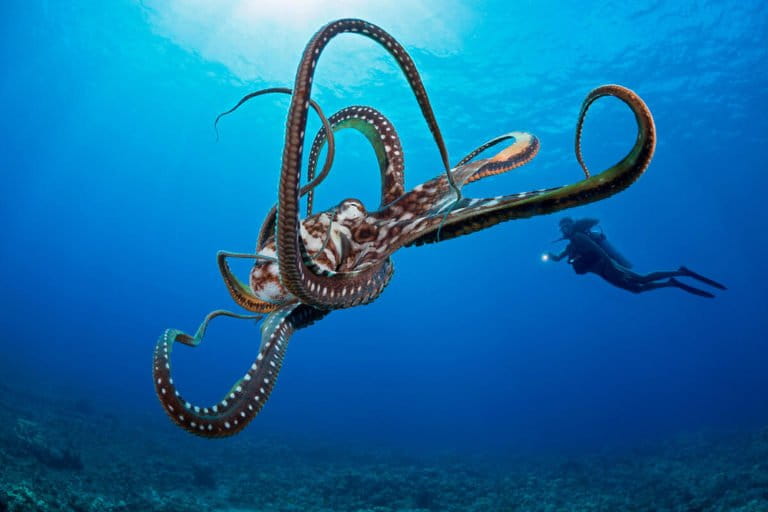
Happy World Octopus Day! Every Oct 8, the world celebrates one of the more unusual creatures of the sea. Octopuses are well-known for their eight legs and ability to squirt ink when frightened. They’ve also been known to use tools, a sign of intelligence, and can shape-shift to mimic the colors and texture of their surroundings, an effective way to disappear from both predators and prey. Mongabay has reported on several octopus discoveries this year, including: Ancient octopus were apex predators Modern colossal squid are believed to be the largest invertebrates in the sea, but Mongabay’s Shanna Hanbury recently reported on an even larger ancient octopus species whose fossils were described by Japanese researchers in April 2026. The Japanese team found a fossilized jawbone from the now-extinct Nanaimoteuthis haggarti. Based on its jaw size, researchers suggest the octopus may have reached 6.6 to 18.6 meters (22 to 61 feet) in length. On the higher end, that’s around two-thirds the size of an adult blue whale, the largest animal to ever exist. “It suggests that it may have been among the largest invertebrates ever known,” study co-author Yasuhiro Iba, a paleontologist at Hokkaido University in Japan, told Mongabay by email. They were likely gigantic predators that roamed the late Cretaceous seas between 100 million to 72 million years ago. A rare look at baby octopuses From long dead octopus to newly born, Hanbury also reported on baby Argentine octopuses and a rare photo of them. Patagonian octopus eggs in Puerto Lobos Protected…This article was originally published on Mongabay
In Africa, high-quality seeds can produce improved crops with enhanced nutrition, pest-resistance, and drought tolerance. However, such seeds for maize, vegetables, and cereal crops can be indistinguishable from counterfeit, or “fake” seeds. That’s creating a massive potential for fraud in seed quality that can potentially deprive farmers of access to climate-resilient seeds while putting their harvests and incomes at risk. A group of researchers analyzed the efforts of 50 African countries to combat counterfeit seeds. They found a wide range of penalties for selling them across different governments, and concluded that a significant gap exists between government policy commitments and implementation, largely due to limited capacity. Study lead author Ed Mabaya, a professor of global development at Cornell University in the U.S., told Mongabay, “For most smallholder farmers in Africa, planting happens once a season, often timed to the first rains. A farmer who buys counterfeit seed usually finds out only after planting, when the seed fails to germinate or the crop grows poorly. By then it is usually too late to replant, so the loss is not a slightly smaller harvest but potentially the whole season’s food and income.” That can lead to food insecurity for the individual farmer and local markets more broadly. Counterfeiters can dye or repackage grain and sell it as branded, certified seed, Mabaya said. “The problem arises because certified seed looks exactly like ordinary grain but sells for a much higher price, in some cases several times more for hybrid maize. That price gap…This article was originally published on Mongabay
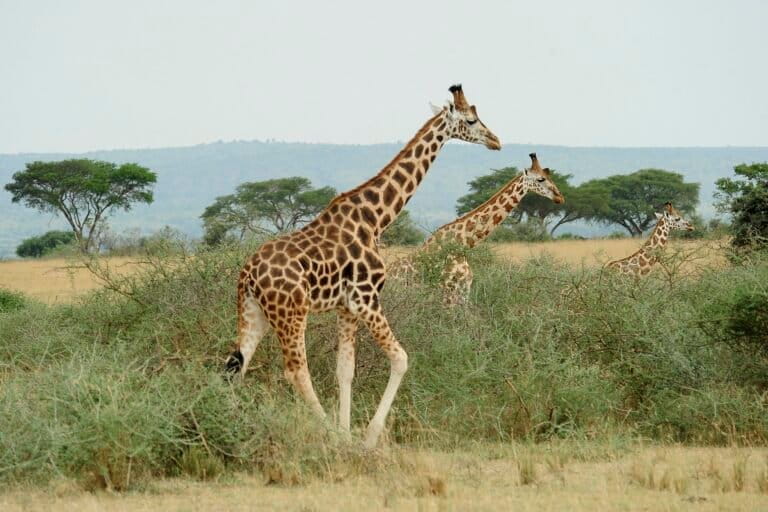
Giraffes living in the South Sudan’s war-torn savannas are genetically healthy and connected to nearby giraffe populations by gene flow, despite decades of conflict, recent research suggests. These findings show that “regions of the world that have been affected by conflict can maintain a lot of biodiversity and should therefore not be overlooked by genetic studies and conservation efforts,” Sam van Giessen, study lead author and a conservation genomics researcher from the University of Amsterdam, Netherlands, told Mongabay by email. The IUCN, the global wildlife conservation authority, currently recognizes four species and seven subspecies of giraffes. South Sudan is home to two subspecies of the critically endangered northern giraffe (Giraffa camelopardalis): the Nubian giraffe (G. c. camelopardalis) and the Kordofan giraffe (G. c. antiquorum). Between the conflict years of 1985 and 2025, Nubian giraffes in Ethiopia and South Sudan declined by 95%. By 2025, researchers estimated roughly 235 Nubian giraffe survived across South Sudan in isolated pockets, down from an estimate of 15,000 individuals in 1995. To find out the genetic health of these giraffe populations, researchers from the South Sudan government, the Giraffe Conservation Foundation (GCF), and conservation NGO African Parks analyzed DNA from skin biopsies collected from 30 Nubian giraffes in Boma and Badingilo national parks, run by African Parks. As the giraffe population in the region is small, there was some concern that inbreeding could be a problem for the subspecies’ long-term conservation. However, their analysis showed the South Sudan Nubian giraffe population has relatively high levels…This article was originally published on Mongabay
Plastic pollution could disrupt the bioluminescent light produced by deep-sea organisms, researchers warn in a letter in the journal Cambridge Prisms: Plastics. When deep-sea organisms ingest plastics, it could disrupt the chemical pathways that create bioluminescence and damage the tissues in their bodies, impairing their ability to find food and a mate, the authors said. In the deep sea, up to 80% of organisms with complex cells are believed to be bioluminescent, the only source of light in the darkest parts of the ocean. The light these organisms create is essential for their survival and reproduction, the letter notes. Disruption of their bioluminescence could negatively impact food webs and ecosystem functions in the deep sea, the largest and least-explored biome on Earth, the letter says. In an email to Mongabay, co-author Renjith VishnuRadhan of Amity University in India offered the example of an anglerfish. “It is widely recognizable from documentaries and films such as Finding Nemo,” he said. “Female deep-sea anglerfish have a modified dorsal spine ending in a luminous lure called the esca. Light produced by symbiotic bacteria helps attract prey and may also assist with recognition or communication in darkness.” It’s well-established that bacterial bioluminescence can be affected by pollutants, VishnuRadhan said, and ingestion of toxic plastic additives by anglerfish could disrupt the bacterial symbiosis in the lure, theoretically affecting its luminous signaling. The authors note there’s some evidence of plastic pollution impacts on deep-sea ecosystems, but scientists lack the high-quality data and observations needed to understand the…This article was originally published on Mongabay

 Login