Em um aceno à direita latino-americana, o responsável da China pelos assuntos da região, Qiu Xiaoqi, afirmou na segunda-feira (12) que Pequim desenvolverá relações amistosas com todos os países latinos, independentemente do crescimento de governos de direita e de seu alinhamento com os Estados Unidos.
Leia mais (10/13/2026 - 04h55)
When researchers mapped almost 100,000 square kilometers of South Africa, or nearly 40,000 square miles, they only found 83 mature adults. They called their project the Free-Roaming Cheetah Census, and it’s the most comprehensive survey of cheetahs ever conducted in the region. The cheetahs that inhabit the unprotected areas here move naturally across borders, going between South Africa, Botswana, Namibia, and Zimbabwe. But farming, construction, development, and fences are making it harder for them to move around. Cheetahs need vast connected landscapes to survive. If they don’t mix with other cheetah groups, their genetic pool can be lost. There’s another big challenge for these animals: farmers. They sometimes kill cheetahs, because they believe cheetahs kill their livestock. But the researchers found that cheetahs hunt mostly wild prey. The species is currently listed as vulnerable, but the census suggests they should be reclassified as endangered in South Africa.This article was originally published on Mongabay
The Zambian government is investigating a chemical spill in its Copperbelt Province allegedly linked to Konkola Copper Mines (KCM), owned by U.K.-based multinational Vedanta Resources. Residents in Chingola district told Mongabay they observed discoloration of the Kafue River and fish die-off on Sept. 28, raising fresh concerns about the environmental and social impacts of mining operations in one of Zambia’s most important copper-producing regions. According to a statement by Gilbert Siame, Zambia’s minister of Green Economy and Environment (MGEE), the incident was caused by a leaking pipe at KCM’s tailings leach plant and an overflow from the company’s pollution control dam outside Chingola. “The pollution control dam was full, that’s why it spilled,” Eugene Mulenga, Chingola-based human rights activist and coordinator for caritas, told Mongabay. “The [chemical] discharge happens all the time, mostly at night, and the local residents consume this water because they don’t have another option.” Following the Sept. 28 spill, tests conducted by the Zambia Environmental Management Agency (ZEMA), KCM and local water utility Mulonga Water Supply and Sanitation Company showed elevated levels of turbidity and conductivity downstream along the Kafue River. In a statement issued Oct. 1, KCM contested its responsibility in the spillage, saying that company officials reported the incident to ZEMA and asked for a fact-based investigation. Mongabay reached out to the company but did not receive a response by the time of publication. Siame noted in the statement shared with Mongabay that authorities are still testing water samples to confirm heavy metals and…This article was originally published on Mongabay
Technocrats are stealing the world’s data for their own AI training advantage, while killing the golden goose in the process, as this article makes clear. That lack of ethics and morality is seen everywhere in the world of Technocracy. For instance, read the Crucible of Tokens to learn about the biggest heist of private property in world history. They have no conscience about doing anything wrong, and that is the problem. Read up on psychopathy! ⁃ Patrick Wood, Editor.
Recently unredacted legal documents and depositions in the New York Times‘ lawsuit against Microsoft and OpenAI revealed something extraordinary: executives knew full well of the destructive powers of AI when they rushed to launch products featuring the tech in the wake of the explosive success of OpenAI’s ChatGPT.
Internal Microsoft documents quoted by the newspaper’s lawyers warned of an ugly reality now playing out across the entire economy: “doom loops,” in which AI monetizes the work of human creatives while undermining the economic systems that funded their work in the first place.
“Our AI content strategy has started a ‘doom loop’ that will hurt the performance of our models and the entire web at the same time,” one internal Microsoft document reads. “It is highly unusual that an end-product threatens the economic foundations of its essential suppliers, but that is the situation we have created for our LLM business with respect to its ‘content supply chain.’”
The closer you look, the more you see doom loops everywhere. Journalists, for example, used to publish work under the assumption that online platforms would drive readership to them. But now, tools like ChatGPT and Google’s Gemini simply summarize their articles without sending readers to their sites, sparking a crisis that seems poised to wipe out the independent media.
Similar stories are playing out across other industries, from music to filmmaking. Writ large, many are concerned that AI will eventually be strong enough to wipe out huge numbers of jobs, creating a situation in which unemployed consumers won’t have the funds to support the economy.
The irony, as the Microsoft document pointed out, is that the AI industry is a snake eating its own tail: the very products that it’s pushing on users rely on fresh cultural content even as they destroy the economic incentives to create it.
It’s also a dire situation for the open web, which recently celebrated the macabre turning point of being dominated by more AI slop than human-authored content. As companies — most notably Google — are fundamentally changing the way users interact with the web, more and more newspapers, media outlets, and local news stations are seriously struggling to make ends meet.
Worse yet, as the legal documents in the NYT‘s copyright lawsuit showed, insiders admitted that the entire operation is built on theft.
“Millions of people around the world will soon consider large models ‘hoovering up’ all their work to be an astonishing theft of unprecedented proportions,” an internal Microsoft document admitted.
Plenty of other creative industries are also feeling the pressure as AI-related doom loops continue to undermine livelihoods. According to the latest data from the US Bureau of Labor statistics, it’s a bloodbath — with more than 200,000 jobs in “creative” industries having been lost over the last four years alone, roughly the time since OpenAI launched ChatGPT.
Hollywood studios are also doubling down on AI while protesting actors struggle to have their voices heard. Many of them fear that their likeness or voice could soon be rendered worthless, representing an existential threat to their livelihoods.
Even the job market is embroiled in its own doom loop. More and more desperate job seekers are turning to AI to brush up their resumes and manipulate AI-powered job portals, while recruiters are drowning in a wall of almost identical applications.
“We’ve got this tragic situation where each side has a problem,” applicant tracking system company Greenhouse CEO Daniel Chait told Wired. “They’re using AI to solve their own problem, but in ways that make the problem worse.”
“And so more AI use begets more AI use, to no one’s benefit,” he added. “The more it’s happening, the worse it gets.”
Similarly, the use of AI in the classroom has skyrocketed, with students using the tech to complete their homework, offloading their cognitive faculties to the machine. Meanwhile, their teachers are using AI to come up with assignments, slowly effacing the human in the loop. Educators who bristle at the idea of using the tech are finding themselves at odds with school administrators.
The effects AI has had on education has been nothing short of a disaster. A recent study by the Brookings Institution’s Center for Universal Education concluded that the risks of using generative AI in education massively outweighed the benefits. The associated dangers have never been more apparent, with educators warning that college students are rapidly losing the ability to read.
Proponents of AI, including OpenAI and Microsoft’s lawyers in the ongoing New York Times lawsuit, argue that AI brings something new to the table. They argue that the output of AI models is sufficiently differentiated from the original content it draws on, falling under “fair use,” a longstanding doctrine in US copyright law.
Whether this argument will hold up in court remains to be seen. Besides, we’ve already seen companies, like Anthropic, settle for billions of dollars after being found to have violated copyright laws.
But considering how the tech is simultaneously undermining the very economic systems that produced the data they need to exist in the first place, that may not be a winning strategy in the long run.
By ripping out the carpet from underneath many parts of the economy — and reaping all the financial gains from it — the AI industry is trapping itself in a doom loop of its own creation, a cynical strategy that won’t benefit anybody but those at the very top who kicked the ladder down behind them.
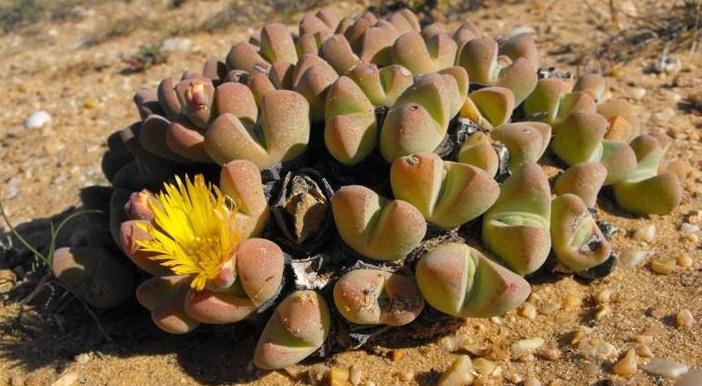
The brown clockfig, an extremely rare succulent growing in the hot, arid border region of Namibia and South Africa, was recently assessed as critically endangered by the IUCN, the global wildlife conservation authority. The western Gariep Valley is a vast landscape spanning the southern part of Tsau ǁKhaeb National Park in Namibia and the Richtersveld region of Northern Cape province in South Africa. It’s in this harsh environment, shaped by extreme heat and dryness, that the brown clockfig (Cheiridopsis brownii) grows on quartz ridges, shale, gravel, and sandy soils, and in cracks and fissures in desert mountains. The IUCN estimates the species, with thick leaves and daisy-like yellow flowers, has a total range of 424 square kilometers (164 square miles) in the valley, but occupies only around 60 km2 (23 mi2) of this area. Habitat loss due to overgrazing is among its major threats. Another is the demand for mineral resources such as diamonds, with mining permits being issued across the region. That’s placed more of the species’ already limited habitat under pressure in both South Africa and Namibia. “The vast desertification of the Aniesvlakte [plain in South Africa’s Richtersveld region] as a direct result of severe overgrazing, as well as the mass desertification caused by sand moving from the coast due to unrehabilitated mines, are threatening to swallow most of the remaining population in South Africa,” Pieter van Wyk, a botanist with South African National Parks (SANParks), who carried out the most recent assessment, told Mongabay via email. Another…This article was originally published on Mongabay
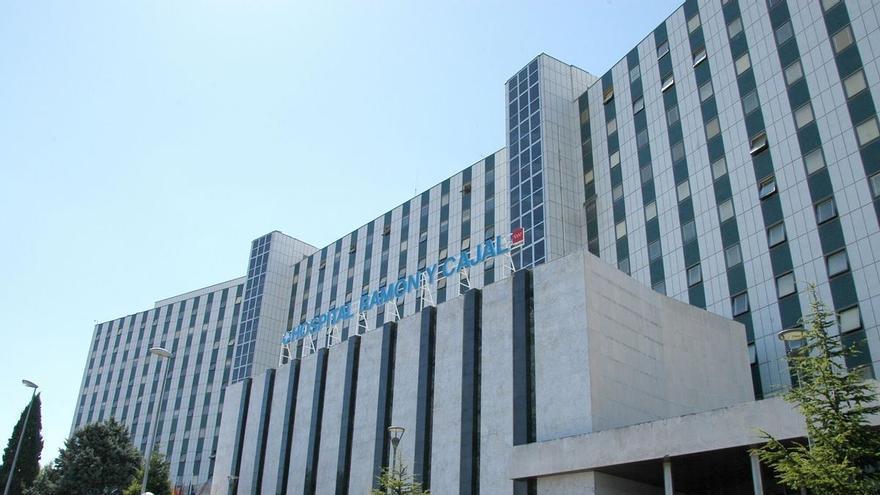
“La gestión de la lista de espera quirúrgica de todos los hospitales de la Comunidad de Madrid corresponde a los propios servicios asistenciales, de acuerdo con los criterios clínicos establecidos y con la responsabilidad de los profesionales implicados en la atención de los pacientes, refrendado además, por el comité semanal de quirófanos”. Fuentes del Gobierno madrileño responden así a la última polémica en torno a la sanidad pública en la región, las acusaciones de que jefes del hospital Ramón y Cajal ordenaron cambiar la prioridad en las listas de espera quirúrgicas de traumatología sin consultar con los cirujanos al cargo.
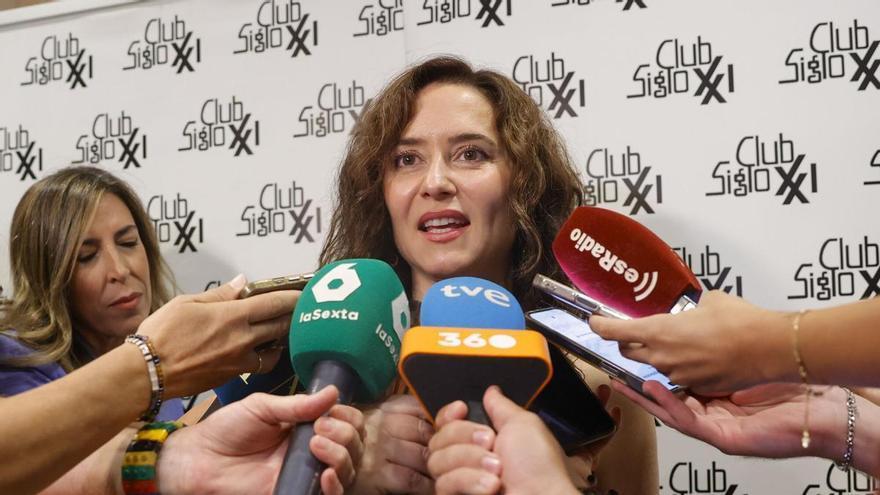
Concluido ya el Gran Premio de España de Fórmula 1 celebrado esta semana en Madrid, la presidenta de la Comunidad de Madrid celebra lo que considera un éxito. "Estamos encantados con el resultado de este primer Gran Premio de España de Fórmula 1, primero porque es el Gran Premio de todos los españoles y después ante los ojos del mundo", ha señalado Isabel Díaz Ayuso a su llegada a un encuentro informativo protagonizado por el alcalde de la capital, José Luis Martínez-Almeida.
El municipio de Icod de los Vinos ha vuelto a ser escenario de una de sus manifestaciones etnográficas más arraigadas con la celebración de la tradicional Librea de Las Angustias. En esta ocasión, el Diablo y la Diabla tomaron las calles del casco histórico para encabezar un vistoso recorrido que comenzó en la histórica Plaza de Las Angustias y discurrió por la Plaza de La Pila, la Plaza Andrés de Lorenzo Cáceres y la Calle Hércules, concentrando a cientos de asistentes a su paso.
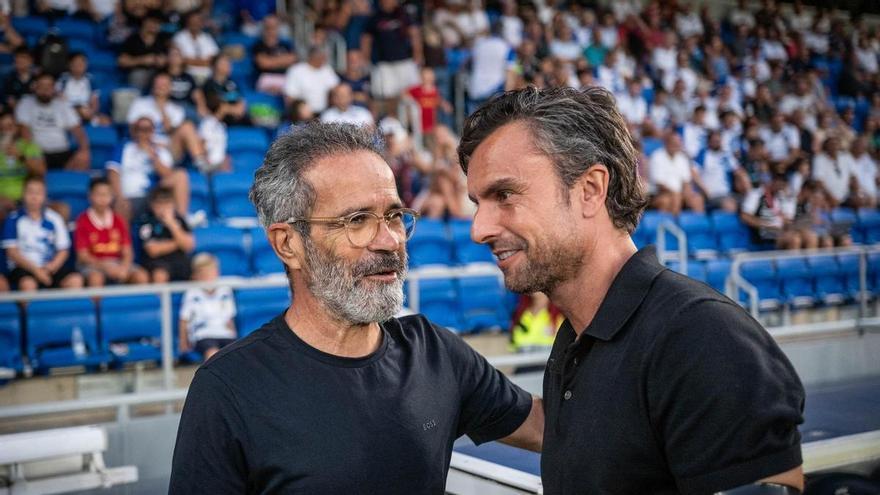
El Club Deportivo Tenerife firmó una actuación incontestable sobre la hierba del Heliodoro Rodríguez López al imponerse por 2-0 al CD Leganés, un triunfo rotundo que consolida las buenas sensaciones del grupo blanquiazul en la categoría y que desencadenó una profunda reflexión en el bando visitante. Lejos de buscar excusas arbitrales o argumentar mala suerte, el entrenador del conjunto pepinero, Rubén Albés, compareció en la sala de prensa con un discurso cargado de realismo y de un enorme respeto hacia la entidad y el nivel futbolístico desplegado por el equipo tinerfeño.
El excelente estado de forma de Enric Gallego ha vuelto a situar en primera línea la singular trayectoria del veterano delantero del Club Deportivo Tenerife. Su impacto goleador y liderazgo en el ataque blanquiazul han sacado a relucir de nuevo su inspiradora historia de esfuerzo, marcada por un pasado obrero totalmente alejado de las dinámicas de las canteras de élite y caracterizado por la cultura del trabajo duro.
For more than four months, Brian, a commercial fisherman in his late 40s, had been waiting for the weather conditions to be right for us to go fishing outside Bagenkop, a small harbor town on the southern tip of the Danish island of Langeland.
“One more problem has come up,” Brian told me over the phone in early May. “I have lost my fishing license." He was no longer allowed to sell fish for a living. Instead of preparing his boat to go out to sea and to show me how fishing in Denmark had changed over his lifetime, Brian was now removing the registration number from its hull.
Across Denmark, coastal fishing communities are shrinking as catches decline. At the same time, warming seas, overfishing and pollution are putting increasing pressure on marine ecosystems.
“Plenty of fish in the sea”? Not anymore, say UN experts, with 35% of the world’s marine fish stocks being fished faster than they can be biologically replaced. Today, more than half of the fish we consume worldwide comes from fish farms.
This summer, sea temperatures along Denmark’s beaches reached 28 degrees Celsius, a record high. On September 2, the UN Environment Program warned that the world is likely to cross 1.5 C of warming above pre-industrial levels within the next few years. As the climate warms, the pressure on marine ecosystems grows.
In August, Iceland voted not to restart accession talks with the European Union, in part because of concern that it would lose sovereign control of its fishing industry. While fishing is not as major a part of Denmark’s GDP as it is Iceland’s, the EU’s impact has meant independent Danish fishermen have struggled to survive in the face of corporate competition.
For Brian, though, it’s about more than regulations. It is about watching the ocean he grew up with slowly disappear.
Nets covered in black slime
His story reflects a larger shift happening along the Danish coastline. Coastal fishermen, once a central part of the country’s history, are a vanishing breed.
For Brian, it was never about the money. Even when he was a teenager and he told his father he wanted to be a fisherman, his father said it was a bad idea. But the pull of the sea was irresistible. His life as a fisherman began as a hobby, accumulating experience and knowledge just by spending as much time as possible on water. He learned how to read the currents, the weather, and fish movements through experience rather than education. In 2019, despite the uncertainty surrounding the industry, he bought a commercial fishing boat. “When I started as a teenager, there were fish everywhere,” he said. But over the years, the numbers have dwindled starkly. Every few years, another Danish harbor became economically unsustainable. First Bogense, then Kerteminde, later Nyborg and Spodsbjerg. Each one of them followed the same pattern: fewer fish, declining landings, and growing questions about whether it was possible for small fisheries to continue their operations.
While working on this story, I spoke to ten small-scale Danish fisheries across the country. Half of them said they do not expect to still be fishing five years from now. In 2019, they said, ten nets could bring in between 150-200 kilos of plaice on a single trip. Two years later, the same nets would return with only two kilos. As the catches became smaller, so did the possibility of keeping a commercial license. Brian no longer caught and sold enough fish to keep his permit.
One day still stands out to him as perhaps the single worst he has experienced at sea. He had three nets in the water. The first one he hauled in looked normal. The second held fewer fish than expected. Then he started pulling in the third — the net was completely empty and covered in thick, black slime.
Marine biologist Stiig Markager told me that what Brian saw was a tell-tale sign of oxygen depletion. In 2025, around 40% of Danish marine areas were affected by low oxygen levels. Oxygen depletion happens when too many nutrients, mainly nitrogen and phosphorus from agriculture and wastewater, enter the sea. These nutrients fuel large algae blooms.
When the algae die and sink to the seabed, bacteria begin decomposing them, consuming enormous amounts of oxygen in the process. Climate change exacerbates the problem. “Warmer water contains less oxygen. At the same time, biological processes speed up when temperatures rise.” In practice that means algae grow faster, oxygen is consumed more quickly, and deep waters struggle to recover. Together, these processes reinforce each other. “When oxygen disappears, it damages the seabed ecosystem,” Markager said.
A new global study argues that aquatic deoxygenation is approaching an “unsafe space” and should be considered a potential tenth planetary boundary. The global ocean has lost around 2% of its oxygen over the past 50 years. The consequences for marine life are catastrophic, forcing either flight or suffocation.
Marine biologists have studied oxygen depletion in the Danish seas for decades. But, Brian says, “fishers are often the first people to see the effects of that depletion, directly in their nets.” It is a first-hand experience, fishers say, that is often discounted or ignored. Many independent coastal fishers say they feel increasingly excluded from political conversations about the ocean, despite spending their working lives at sea.
Source: DCE – Danish Centre for Environment and Energy, Aarhus University, Oxygen depletion in Danish waters, 2014–2025.
“It feels like we’re not really welcome anymore,” Brian said. He believes small-scale fisheries like his are being pushed out while decisions about the seas are increasingly made by those on land. “I think they don’t want so many people out there seeing what’s actually happening.”
For years, debates about oxygen depletion in Denmark have become deeply political. Marine scientist Stiig Markager says that the results of environmental research have repeatedly clashed with agricultural and political interests. “There is complete opposition from agriculture and from Venstre (a major center-right political party) to making research publicly available,” he said. “There is a clear political strategy from Venstre that there must be no interference with agriculture.”
According to Markager, tensions between environmental researchers and agricultural interests intensified during the early 2000s, as scientists linked nitrogen runoff from farming to oxygen depletion in Danish waters. Despite decades of plans and political promises, Markager says, the recovery many researchers hoped for never fully arrived.
For this story, I also contacted both the Minister of Environment and the Minister for Food, Agriculture and Fisheries to ask for an interview about the state of Danish waters and the future of small-scale fishing. Neither had time to answer questions.
“When I started as a teenager, there were fish everywhere.” Brian said in BK Kar“Fishers are often the first people to discover oxygen depletion, directly in their nets,” Brian explained."I have lost my fishing license," Brian said on a phone call.
What remains is behind glass
One harbor that has felt the impact of the changing nature of Danish waters is Bønnerup Strand, which has transformed from a fishing town into a tourist destination. The harbor now features an ice cream shop, a hot dog kiosk, a seafood restaurant, and a mini golf course. The iconic blue Danish fishing boats are conspicuous only by their absence. Instead, boats built for leisure, not commercial fishing, are docked at the harbor.
Along the quay, an outdoor exhibition has been installed behind glass panels. It started last year, created by a local group of volunteers trying to preserve what Bønnerup Strand used to be. The pictures show fishing nets piled high, men in blue overalls, boats unloading their catch, and fish laid out in crates.
Movement. Noise. Purpose. It was a harbor bustling with life. Hans, in his 60s now, was once a fisherman in Bønnerup Strand. He walks past the diorama and tells me that twenty years ago “there were 60 or 70 fishing boats here, now there are two.” Some of the independent fishers chose to leave, their lives no longer making economic sense. Others lost their licenses. The rest have disappeared, not all at once, but gradually. Some left before it was too late, others had their boats seized by the bank when their revenue became too low. “Quite a lot of my colleagues had their boats taken by them," says Hans, referring to banks who repossessed boats because independent fishermen no longer made enough money to pay for them.
You could say that the gradual suffocation of the Danish seas began in 1909 with the invention of the artificial nitrogen fertilizer that transformed global agriculture. Artificial fertilizer rapidly became central to modern-day farming. By 1959, nearly 75% of farms were using fertilizer to increase crop production. At first, the growing amounts of nitrogen entering the sea did not appear harmful. During the 1960s and 70s, the extra nutrients actually increased algae and plankton growth, creating more food for some fish species. “There were actually more fish,” says Markager, the marine scientist, “but by the mid-1980s, the consequences had become impossible to ignore.”
Fish auction hall, Esbjerg, 1968. Tonny Sørensen. Esbjerg harbor, 1972. Knud Rasmussen.Fish auction, Esbjerg, 1934. Gustav Bjerknæs .
On October 8, 1986, on Danish television fishermen in Gilleleje were seen pulling dead lobsters from the sea. The images became the subject of alarmed national conversation. For the first time, the public saw what oxygen depletion meant for life beneath the surface of the sea.
Hans, the fisherman from Bønnerup Strand, told me he was part of the television coverage himself. “Fishers had talked about pollution long before the dead lobsters,” he said. “But suddenly people started paying attention.” The public outrage pushed Denmark to act. In 1987, the country introduced its first Water Environment Plan, aiming to reduce phosphorus emissions from wastewater by 80% and nitrogen emissions by 50% within five years. For many fishers and marine scientists, it became the first real sign that the environmental crisis in Danish waters was finally being taken seriously. During the 1990s, nitrogen and phosphorus pollution declined significantly. Water in several fjords and coastal areas became clearer, and conditions slowly began improving. For a moment, it appeared the damage could still be reversed.
But by the early 2000s, many coastal fisheries were once again experiencing declining catches and, with it, a growing uncertainty about the future. Hans was one of those affected. Coming from a family that had fished for five generations, the harbor was never a tourist destination for Hans. It was a way of life. But on a sunny Friday in April back 2005, he sailed out to Kattegat for plaice. He knew it was over. “I said to my employee: “this is the last trip. I start working on land from Monday.”” He had made the decision months earlier, as the numbers of fish dwindled and regulations tightened.
It wasn’t an easy choice, but he had four children to think of. Climate change had taken away his livelihood. “You can’t do anything about it,” he said. “If you think too much about it, you go crazy.” Researchers describe this kind of environmental grief as solastalgia, the distress caused by watching a familiar environment change beyond recognition. Unlike homesickness, solastalgia happens while still remaining in the same place. For coastal fishers, the sea remains physically present, but the ecosystem they once knew and depended on, is disappearing.
Adapting has always been part of the job, says Hans. “There has always been a species that disappeared and then another one came.” But eventually, nothing was replacing what was lost anymore.
Hans in his shop, Møllefisk.
In 2002, marine scientists Stiig Markager and Peter Bondo Christensen from DMU, the Danish Environmental Research Institute, published research showing that around 75% of Denmark’s nitrogen emissions originated from agriculture through waterways and atmospheric pollution. The findings intensified tensions between marine scientists, politicians, and agricultural organizations about who was responsible for the declining marine environment.
In response to the worsening marine crisis, Denmark established DMU in 1989 to monitor oxygen depletion, nutrient pollution, and ecological changes beneath the surface. But their findings were inconvenient. By 2007, after nearly two decades as an independent institution, DMU was folded into Aarhus University as part of a wider restructuring of Denmark’s research sector. The decision sparked criticism from several environmental researchers and organizations, who feared the changes could weaken the independence of Danish environmental monitoring.
“Agriculture succeeded in closing DMU,” former researcher Bo Normander told the media. “Nature has lost.” In 2015, the Danish government introduced the controversial Landbrugspakke, easing environmental regulations on fertilizer use in an effort to increase agricultural production.
Critics warned that the policy could worsen nitrogen pollution in Danish waters at a time when oxygen depletion remained a recurring problem. In the years that followed, researchers from Aarhus University reported rising nitrogen emissions instead of the reductions politicians had promised. Markager argues that despite decades of environmental warnings, nitrogen pollution reductions largely stalled. While nitrogen pollution in Danish waters declined significantly after the first Danish Water Environment Plans in the 1980s and 1990s, researchers say the reductions have largely stagnated over the last 20-25 years.
Now, Denmark is trying to reverse that trend. In the first week of September, the country passed a historic new law changing how agricultural nitrogen is regulated. The law will take effect in 2027 and represents a significant tightening of the rules introduced in 2015.
Under the system introduced in 2015, farmers were allowed to fertilize closer to what was considered the agronomic optimum for their crops, while still operating within nationally defined nitrogen quotas and other rules. The new system moves in the opposite direction. Instead of relying primarily on broad national rules, nitrogen regulation will increasingly take the environmental sensitivity of individual areas into account.
Where a farm is located will thus matter much more. The requirements will vary depending on factors such as whether fields drain towards vulnerable rivers or coastal waters, and whether they lie above areas important for groundwater and drinking-water protection. For farmers, this means that the amount of nitrogen they can use will become more restricted in areas where the surrounding environment is particularly vulnerable.
For fishermen like Brian and Hans, the law represents a change they have long been asking for: an attempt to redress the damage done to Danish seas.
“I don’t think we’ll have fish out here ever again.” said Hans Fisker, owner Møllefisk at Bønnerup Strand“Quite a lot of my colleagues had their boats taken by them." Boat on land, Bønnerup Strand.
But understanding how the water became polluted is more complicated than it first appears. Much of the pollution data commonly referred to in public debates focuses on point-source pollution, which emanates from identifiable sources like wastewater treatment plants, industrial discharge, and fish farms, and is generally easier to measure. But most nitrogen pollution in Danish waters actually comes from diffuse sources, mainly agricultural runoff carried from fields through rainwater, rivers, groundwater, and the atmosphere. Unlike point sources, diffuse pollution is far harder to measure directly and comes with greater uncertainty in the data. As a result, wastewater pollution can often appear to be the biggest issue, even though agriculture remains the dominant source of nitrogen input into Danish waters.
For Hans, the consequences appear almost irreversible. These days, the fish often do not return. “There are still plaice here, but they’re too thin. They don’t gain weight.” Scientists point to several overlapping causes, and the suggested solutions are just as diverse. Activists call for stricter rules, fishers say there are already too many. Farmers reject blame, and governments insist wastewater is already being purified. Plenty of fingers are being pointed, but the problem remains.
Hans doesn’t expect it to change. “I don’t think we’ll have fish out here ever again.” These days, he’s on the other side of the industry, buying catch from fisheries and selling it to customers. “People have to get used to the fact that we don’t always have everything available on demand. With a changing climate, fish shops may no longer offer cod, salmon, or plaice like we’ve been used to.” Instead, he says, squid is becoming the new normal.
Still, while independent fisheries disappear, the demand for fish continues to grow. Instead of restoring the ocean, parts of the fishing industry are increasingly moving onto land.
In northern Denmark, companies like Skagen Salmon are now raising fish entirely inside closed artificial systems, where the water, oxygen, and temperature are carefully controlled. Outside, Skagen Salmon looks like a factory. No windows, just a large grey box near the coastline.
If the building had windows, the fish inside could look out at the sea. But these fish will never see, taste, or feel those waters. Instead, they are raised in artificial tanks until they reach market size. They are then slaughtered and sold to supermarkets and fish shops across the country.
https://youtu.be/XKDIe7PXMCw
Video from Skagen Salmon recirculating aquaculture system (RAS), by Victoria Jensen.
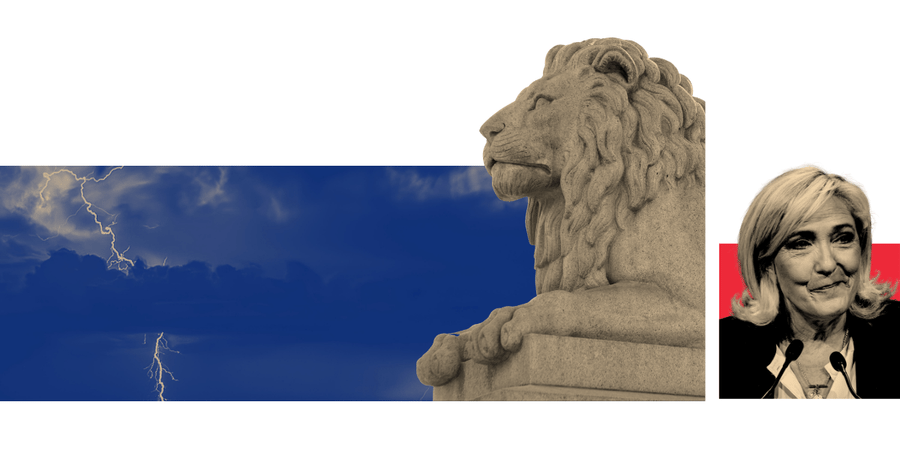
Marine Le Pen’s candidacy for president means Europeans should brace for the possibility of a France wholly different to the one they know.
A Rassemblement National government would be hostile to the EU and a disruptive partner on numerous issues facing Europe; including on Russia, enlargement, climate and migration.
The party is divided over whether and how to work with other right-wing parties in France; and how to position the country within Europe and the Western alliance.
Le Pen is likely to work in a “duo” with party leader, Jordan Bardella, but there are notable differences between their outlooks. Europeans should pay attention to these.
European political leaders would struggle to influence a Le Pen-led government, but nor should they expect a unified European far-right to emerge. They would be wise to begin their preparations now.
Note: This policy brief is a second edition of an earlier paper published on June 9th 2026. It updates the prior analysis in light of Marine Le Pen’s confirmation that she will run for the French presidency.
The restoration of a matriarch
In the early hours of November 2nd 1976, a bomb exploded outside the Paris home of the far-right leader Jean-Marie Le Pen and his family. The perpetrators were never found. His youngest daughter, Marine, 8 years old at the time of the attack, later seethed that the family was not shown “the slightest sign of solidarity or compassion” by the French authorities. Today, as Marine Le Pen launches into her fourth—and most competitive—bid for France’s presidency, that quote reveals something of the woman who might soon occupy the Elysée Palace. If she wins, European policymakers will need to understand this self-defined outsider and how her family’s and party’s long years in the political wilderness shape her domestic and international agenda.
That insurgent self-perception may seem odd now. After all, the National Rally (Rassemblement National, RN) is far ahead in polling for the first round of the election, is accepted by an increasing share of French polite society, and is close to some of the country’s most powerful economic elites. But it still explains why the rest of Europe should brace for the possibility of a French president who sees herself as a rebel against the country’s and the EU’s established norms and institutions. As this paper will argue, a Le Pen presidency of France would be a significantly more formidable challenge to European orthodoxies than Giorgia Meloni is in Italy or Viktor Orban was in Hungary.
*
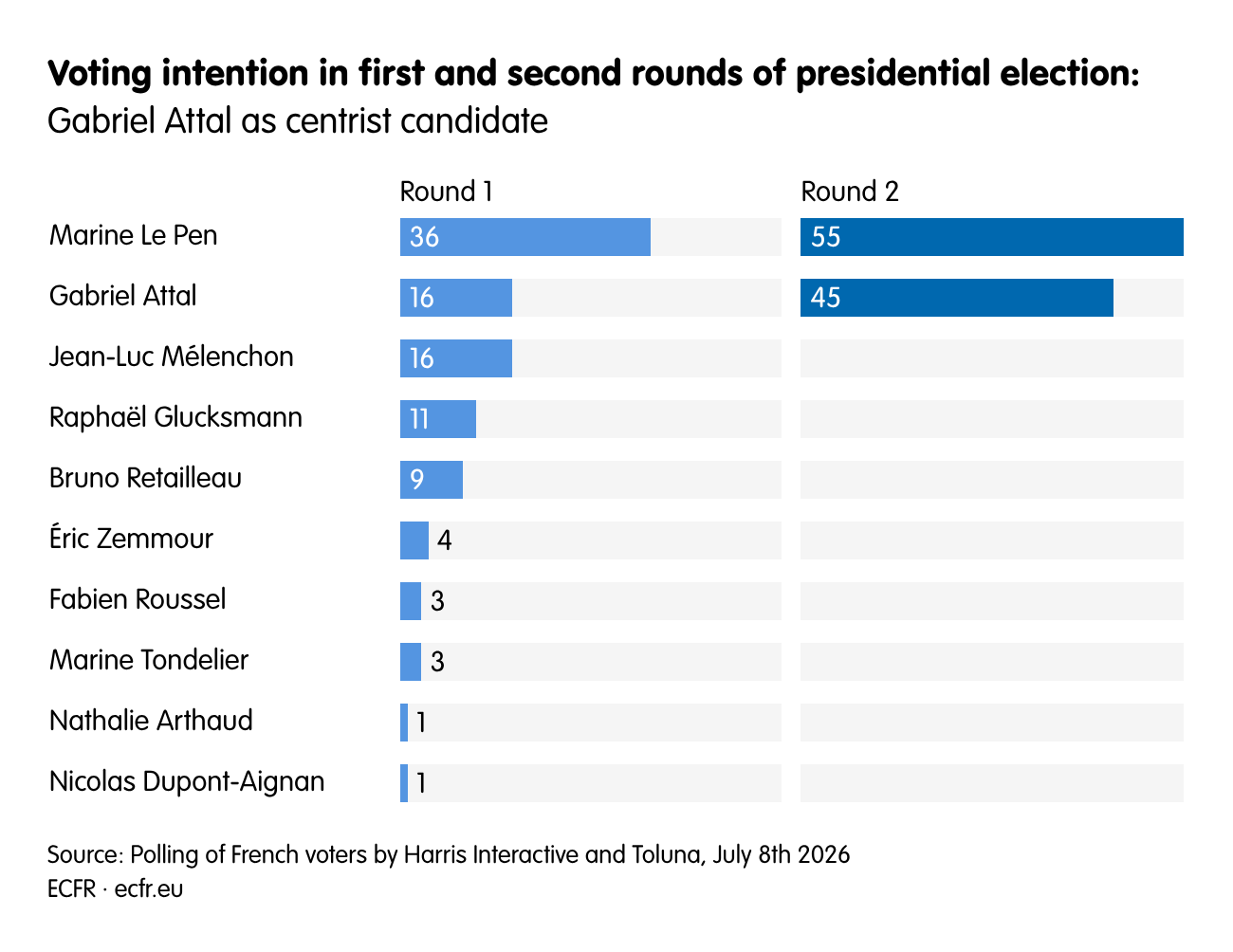
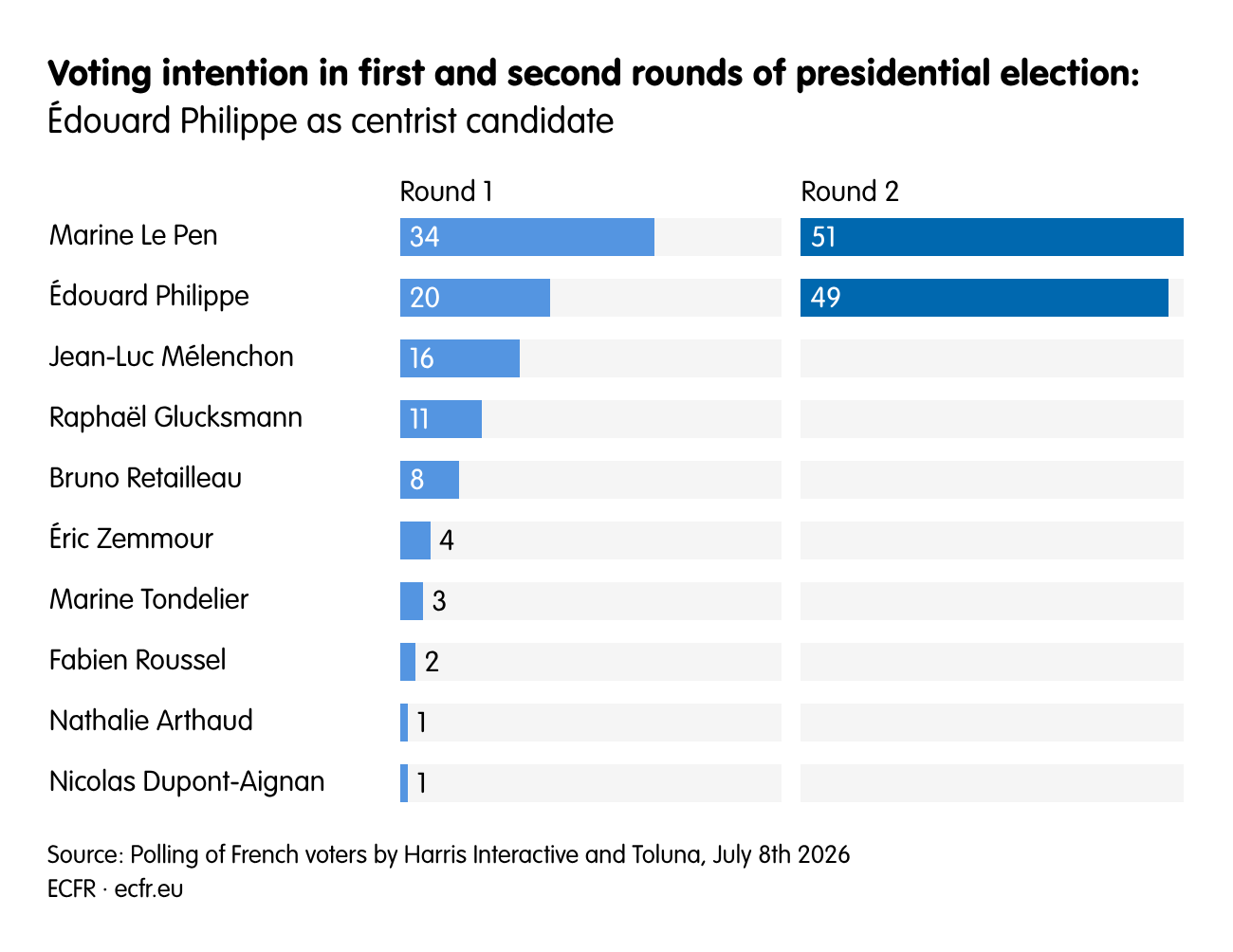
Only one thing is certain about the result of France’s presidential election next year: President Emmanuel Macron’s decade in power will come to an end. Who replaces him is an open question, with any number of conceivable outcomes. The exact field of candidates is not yet clear, not even in Macron’s centrist camp, where two former prime ministers—Édouard Philippe and Gabriel Attal—are vying for primacy. French presidential election campaigns are often volatile; both those in 2017 and 2022 saw major shifts over the half-year before polling day. But current polling suggests that the RN party candidate is on track to win the first round, on April 18th 2027, and to enjoy good prospects in the second, due on May 2nd.
The RN went through months of speculation over who would represent it at the presidential election. In March 2025, Marine Le Pen was convicted of embezzling European parliamentary funds and received a five-year ban on standing for election. Over recent months, Jordan Bardella, the RN’s untested young leader and Le Pen’s protégé, was talked about as the party’s best hope.
On July 7th 2026, however, the Court of Appeal reduced Le Pen’s ineligibility penalty, which enabled her to run. It also required her to serve a year of house arrest with an electronic ankle tag. That evening, Le Pen announced that she would seek the presidency and would appeal to the Court of Cassation. The penalty is suspended until France’s highest court rules on the case, which could take place as late as April 2027.
Her candidacy has significant implications for the rest of Europe. Le Pen is an experienced campaigner and an established (though also divisive) figure in France. Her bid for the presidency is perhaps more likely to survive the heat of the campaign than a Bardella run would have. The fact that she is the candidate probably increases the chances of the French far-right coming to power for the first time since Marshal Pétain, the puppet leader of Vichy France.
Le Pen is marked by the RN’s long years in the wilderness. She believes in radical solutions. As president, she would likely be a confrontational and abrasive force in Europe.
To reiterate, the outcome of the election remains wide open. But the scale of the potential rupture of a Le Pen win means policymakers elsewhere in Europe must both understand the RN and prepare for that eventuality. To that end, the authors of this paper have extensively researched the party’s Europe and foreign policies. The following study is based on in-depth interviews with an array of senior RN figures and external experts as well as analysis of the party’s speeches, legislative proposals, voting records and electoral programmes. The result is a series of five theses about what a Le Pen win next year would mean for Europe.
Understanding an RN presidency
Point 1: Marine Le Pen’s candidacy reaffirms her primacy inside the RN, although her duo with Bardella will endure
Marine Le Pen’s decision to run for president despite her upheld conviction—and in contradiction of her own prior statements—is a reminder of her centrality to the RN. She is still the party’s dominant leader. The decision also dispelled the illusion that Bardella constitutes a real alternative to her leadership. It showed that today’s RN is still Marine Le Pen’s inheritance and achievement.
The party was founded as the National Front (FN) in 1972 by Jean-Marie Le Pen, along with French former members of the Waffen-SS and other nostalgists for colonial French Algeria. It drew together different threads of the far-right. For decades most French citizens considered it beyond the pale. When Jean-Marie Le Pen narrowly made it into the second round of the 2002 presidential election, it shocked both France and Europe. He was roundly defeated by 82% to 18% by then-president Jacques Chirac.
Taking the reins of the party from her father in 2011, however, Marine Le Pen pursued a strategy of “dédiabolisation” (“detoxification”). This saw her expel Jean-Marie from the party in 2015 over his racist and anti-Semitic comments. After her resounding defeat to Macron in 2017 she intensified the process, renaming the party and dropping its commitment to “Frexit” (leaving the EU).
In 2019, she appointed a fresh-faced young activist from a deprived Paris suburb to lead the RN’s campaign for the European Parliament election. Jordan Bardella delivered the party’s first ever first-placed result in a national election and was rewarded with the RN presidency in 2021. He would play a central role in the party’s 2022 presidential campaign—a much closer contest—and in its triumphant win in the 2024 European vote. Le Pen further empowered Bardella when she announced he would be her choice for prime minister. When it looked like she might be banned from running, Bardella became her natural replacement as a presidential hopeful.
Nevertheless, despite Bardella’s rapid rise and growing public profile, the RN remains firmly in Le Pen’s hands. For nearly half a century, the promotion of family members, such as Marine Le Pen’s niece Marion Maréchal, and significant turnover among the lower levels of the party has kept power within the Le Pen clan. Many of the party’s cadres remain more loyal to her than to Bardella, and were determined that she should run rather than him.
Now that the party is back behind its leader, Le Pen will continue to highlight the duo she forms with Bardella—as she did on prime-time television when she launched her campaign. She once again promised to make him prime minister if she becomes president. Running a “ticket” for the French presidency is unprecedented and anathema to the function. But it has a distinct advantage: broadening her voter coalition while keeping the party together.
Le Pen’s own political base has two main parts. First, an anti-elite and disaffected working- and middle-class electorate in the northern post-industrial Pas-de-Calais region that she has represented since 1998 (as a councillor, MEP and in the National Assembly), And, second, a chain of strongholds along the Mediterranean coast, which adhere to long-term RN positions hostile to immigration and taxes.
By contrast, Bardella appears more economically liberal and temperamentally closer to other parts of the French right, including the conservative flank of the Republicans (LR, the rump centre-right force) and culturally reactionary forces like Éric Zemmour’s far-right Reconquest. He is also more engaged with the wider European right, especially Meloni in Italy. Within the RN itself this aligns him more with a more bourgeois and younger new electorate.
Over the last year, Bardella had even started to sand down some of the party’s most abrasive ideas. Where Le Pen cleaves to some of the party’s old Putin-friendly instincts on Russia, he has spoken in defence of Ukraine’s sovereignty. He also broke from Le Pen on pensions reform, suggesting dropping the fixed retirement age and moving to a more contributory system. Where Le Pen went to Budapest to help out an embattled Orban, he struck a friendly tone towards Germany and even met with the country’s ambassador in Paris. All this created expectations in Brussels and other EU capitals that a President Bardella might be closer to the bloc’s economic orthodoxies and more open, at least, to compromises.
Le Pen’s candidacy firmly relegates him to a subordinate position within the party. Gone, too, is the spectre of a somewhat more conciliatory RN presence in the Elysée Palace if the party wins power next year. “Bardellism cannot exist, as it is ultimately Marinism”, Jean-Philippe Tanguy, a senior RN figure, has said. The reassertion of Le Pen’s primacy within the RN thus makes the party both more likely to take power and more likely to disrupt the rest of the EU and its foreign policies if it does.
Point 2: An RN presidency would be a rupture in French and European politics
France is a highly centralised state, and its president wields executive power more akin to an American president than to counterparts in its European neighbours. The country also remains a pivotal power in Europe as one of its two nuclear-armed countries and half of the Franco-German motor that long drove the European project.
News of an RN win would therefore send shockwaves around the continent, stunning the mainstream. It would also lift the spirits of much of Europe’s radical right after a difficult 2026 in which its pre-eminent governing leader, Orban, lost power and its links with Trump turned out to be liabilities. After all, the RN has been unapologetic in its support for fellow “patriots” across Europe. Le Pen campaigned for Orban, and Bardella has engaged closely with Meloni and her government in Italy and Nigel Farage’s Reform in the UK.
Farther afield, the RN has been increasingly welcomed by fellow nationalists like Israel’s Likud government, which hosted Bardella and other far-right leaders in 2025. The Trump administration has professed its own commitment to supporting “patriotic parties” and would react favourably to an RN win. This is despite Bardella’s and Le Pen’s efforts to cool their party’s earlier enthusiasm for the US president.
The RN would revel in the sense of rupture. In private, party leaders compare their potential accession to power to left-winger François Mitterrand’s historic victory in 1981—which they see as the only true political change France has undergone in the last 50 years.
*
Thus empowered, the RN would want to enact its programme. Although foreign and defence policy may not be its top policy priority, “fixing” France’s relationship with the EU is bound to be one.
In its 2019 and 2024 European election campaign manifesto, the RN suggested transforming the European Commission into a mere secretariat of the EU, leaving legislative initiative only to the European Council. The party decries attempts to expand qualified majority voting, refuses any new transfers of competencies on foreign and defence policy to the commission—and seeks European allies in that endeavour.
The RN is vehemently against EU common taxation and borrowing. Both Le Pen and Bardella have proposed slashing the French contribution to the EU budget (by “between €2bn and 3bn”, as Bardella suggested, equivalent to 9-14% of the French payment in 2024). RN MPs have already put forward severalamendments to the budgetary laws to that effect. In July, Bardella has even advocated reducing the contribution by half. In place of European joint spending, the party wants the creation of a sovereign wealth fund to back “sovereign industries” in defence, technology and energy.
The party’s antipathy towards NATO means it plans to prioritise national-level defence instead. The RN has committed to maintaining current defence spending, but argues this should support France’s own military-industrial infrastructure first and foremost. Even if it has paused an earlier plan to leave NATO’s integrated command, at least for “as long as the war [in Ukraine] goes on”, Le Pen revived the idea as recently as May 2026.
The strictly national principle applies to energy too. The RN has promised to lower French energy costs, notably by breaking from EU-wide electricity pricing (which often depends on gas prices less relevant to France’s nuclear-heavy energy system) and thus allegedly reducing the French retail price. And, despite claiming to be concerned about the consequences of climate change, the RN is relentless in its opposition to the European Green Deal and its insistence that French nuclear energy should exempt the country from EU climate strictures.
Overall, if Le Pen were to become president, the RN’s highly disruptive European agenda would inevitably put France on a path to confrontation with European partners and institutions. As the fight against the EU is both a symbolic and a policy priority for the RN, other European leaders may have to find a way to negotiate on some of the demands—that for a budget rebate, for example—in order to prevent French vetoes.
Point 3: The RN’s inexperience and lack of interest in foreign policy would make France an erratic partner, especially in a crisis
Europe’s best hope, in the event of a Le Pen presidency, may reside in the fact that foreign policy would not be the top priority for the RN in power.
First, the RN’s foreign policies often remain vague or only partially formed. Despite its long-standing presence in the French political landscape, the party has no national governing experience and only in 2022 won a significant share of seats in the National Assembly. With little network among the French diplomatic establishment, RN leaders have rarely engaged closely with foreign policy debates. The party prefers to hide behind references to General de Gaulle’s pro-independence foreign policy to justify criticisms of the EU or NATO without being too specific.
According to RN insiders, the party’s foreign policy decisions emanate from private discussions between Le Pen and Bardella, with the occasional counsel of the advisory group Les Horaces. If she attains power in 2027, Le Pen may seek to attract more experienced figures from the traditional right (from LR or UDR) or from the military to lead on top foreign policy positions.
Second, the RN is clearly prepared to change its tone on international topics when political expediency dictates. RN figures privately insist that foreign policy cannot win it elections, but can lose it ones. They blame Le Pen’s defeat in April 2022 on her failure convincingly to pivot away from Russia after its full-scale invasion of Ukraine two months earlier.
The party abandoned Frexit after the UK’s Brexit turned out to be a disaster. It curbed its old openness to strongmen such as Putin (repaying a contentious loan to a Russian bank in 2023) and Syria’s Bashar al-Assad. In recent years, it attempted to erase its anti-Semitic past by adopting a strongly pro-Israel line. Since February 2022, the party has walked a tightrope: paying lip service to Ukraine’s right to self-defence while criticising sanctions against Russia as costly to French consumers and opposing some military aid to Kyiv as escalatory. Having greeted Trump’s re-election in 2024, the party has become a nimble critic as his erratic foreign policies have made alignment with him a political liability.
It is safe to assume, then, that, even with Le Pen as candidate, the party will tend towards orthodox language on most foreign policy ahead of the election. It has a vested interest in a campaign that focuses on topics such as immigration, crime and purchasing power (where the party is most confident), rather than one that debates France’s role in Europe or global geopolitics (where it is more uncertain and, in some cases, divided).
And even if the party wins power, the domestic agenda will likely come first. This can be summarised as: countering cultural and industrial decline by pursuing “national preference”. In policy terms it would include harsher law-and-order measures (especially on migration and crime), trade protectionism and efforts to reverse green policies in the hope of revitalising industry, and prioritising French nationals over foreigners in accessing welfare or public services. European partners should reckon on an RN presidency being most intransigent on EU matters related to those domestic priorities—and possibly being more open to negotiation in other areas.
In sum, however, they should expect a Le Pen foreign policy that is unclear, evolving or even contradictory. Under her leadership, France would take few initiatives and rather behave as a blocker. For example, it is hard to imagine an RN president responding decisively to a security crisis on Europe’s eastern flank. If under pressure from EU member states to be tougher on Russia, she would likely seek concessions and negotiations rather than further action.
If it does anything proactively, such a presidency would concentrate on disentangling France from EU policies that contradict its domestic goals. At best, the RN’s lack of interest and inexperience may be an opportunity for other European governments to shape some of the outcomes, as long as they keep their expectations low.
Point 4: How broad and how European? The strategic debates running through the RN
Today’s RN is infused by two strategic debates that would shape Le Pen’s tenure as president.
Movement or coalition?
The first has to do with the RN’s political identity: the party is struggling to determine whether it seeks to forge an union des droites (union of the right) or whether its outsider populist status remains its core identity.
In the long years the FN and the RN spent on the political margins, the Le Pens’ “neither left, nor right” approach appealed to disillusioned voters who rejected all forms of politics. It acknowledged the cordon sanitaire between the mainstream right and their parties. Even back in the FN days, Jean-Marie Le Pen crushed several internal attempts to unite the right. Marine Le Pen remains firmly opposed to any such efforts today.
If she is elected, it is unclear how Le Pen will position herself towards other right-of-centre French parties. Her instinct seems to be that working with them would dilute the RN and prevent it from conducting truly disruptive policies. Given her aversion to compromise and her long years of ostracism by the mainstream political class, Le Pen would struggle to extend a hand to others to form a majority in the National Assembly.
She may, however, continue using Bardella as a useful bridge to other parties of the right, at both national and European levels. In an interview with Le Figaro after Le Pen’s official launch of her presidential bid, he insisted that, as prime minister, he would seek to gather the right-wing electorate back to his party in order to build a “solid majority”.
It is reasonable to expect that, if Le Pen allows Bardella to forge these links at home, she will let him do so abroad too. If so, Bardella would continue building alliances with the European right spanning conservatives and various families of the radical right, likely with immigration as a focal point. The RN has already demonstrated its ability to build coalitions with other far-right parties and the European People’s Party to advance tougher migration legislation in the European Parliament. It would likely continue to do so if elected. Bardella has indicated that he wouldshare this agenda with leaders such as Meloni and German chancellor Friedrich Merz and seek to work with them.
Rival futures
The second faultline within the RN today is between rival conceptions of national sovereignty, a point that came across especially strongly in the authors’ interviews with senior party figures. Le Pen and the “old guard” around her have long held the view that France must resist Anglo-American hegemony and EU technocracy alike. They treat Washington and Brussels as equal threats to French autonomy.
Yet a new generation around Bardella—having come of age against the backdrop of the 2015 terror attacks in Paris and the Russian full-scale invasion of Ukraine—has adopted an identity-based sense of Europeanness. It acknowledges the need for European cooperation against common threats, as long as this cooperation is “chosen”. It is inclined to invoke a shared Western and European cultural affinity.
For example, on Russia and Ukraine, Le Pen and the old guard have continued to blame NATO’s enlargement for “provoking” Russia. This fits their antipathy to Washington and Brussels. Their old ideological affinities with Moscow as a counterweight to American hegemony allow them to imagine a future in which Russia might even be a partner in a multipolar order once the war ends. But Bardella has admitted the “naivety” of Europeans in the face of the Russian challenge. Despite a less-than-keenly pro-Ukrainian voting record in the European Parliament, he has also spoken in favour of Ukrainian national sovereignty and against Russian imperialism.
These debates will continue within the RN—especially because Le Pen has been unwilling to sweep aside Bardella’s “union of the right” and rhetorically “pro-Ukraine” positions. For as long as she wants the electoral breadth he brings, the tension will persist.
Point 5: The likeliest outcome of an RN presidency would be a more isolated France in a weaker EU
The disruptive nature of RN policies towards Europe means France’s relationship with European partners would deteriorate over time.
At first, the RN would likely seek to reassure the financial markets and its international partners. Victory for the party may be accompanied by protests and strikes, and the new government would face economic limitations like France’s high levels of debt. In this context, Le Pen may want to project stability. Nevertheless, the RN has promised to engage on a number of priorities that will put it at odds with other European governments—including those led by the right—as well as EU institutions.
Opting out of the EU-wide electricity pricing could push up prices for other member states; quitting the migration pact would put greater pressure on others; curbing the French contribution to the EU budget would force others to pay more and possibly trigger an infringement procedure. More generally, Paris governing in a spirit of French exceptionalism would roil Europe’s collective efforts on common challenges.
Enlargement could prove an especially inflammatory topic. Plenty of European governments have concerns about bringing Western Balkans countries, Moldova and especially Ukraine into the EU. But if the RN wins the French presidency, it will be the most outspokenly opposed government among major European states. It has warned that enlargement would ruin French agriculture and suppress French wages; intensify the EU budgetary demands on France; and further centralise power within the EU at the cost of individual states. The accession of Ukraine, with its vast agricultural industry, particularly alarms the RN.
The long-term result of these trends would likely be some degree of French isolation. The party’s policies and instincts would set Le Pen up for conflict with the European Commission—but also with other national governments, including right-wing counterparts. Although others in the EU might conceivably come around to RN doubts about enlargement, the insistence on French national priority will alienate even ideologically sympathetic forces elsewhere.
Tensions could emerge with other far-right leaders, such as Meloni, over issues like migration. Despite broad ideological alignment on reducing migration, the RN prioritises national sovereignty over the management of borders and migration flows. By contrast, Brothers of Italy has advocatedgreater EU coordination and burden-sharing. As a result, a cohesive far-right alliance at the EU level should not be taken for granted. If these conflicts escalate, an “empty chair” moment, where France simply withdraws from EU meetings as it did under de Gaulle in 1965, is not unthinkable.
At a time when nationalist parties are rising in other major EU states, including Germany, an RN presidency could encourage unilateralism there too. The result could be doubly paradoxical: a lonelier right-wing France in a more right-wing Europe, and a more nationalist France more exposed to the interference of external powers like China, Russia and the US.
How the rest of Europe can move into “brace position”
As the rest of Europe faces up to the possibility of President Le Pen, the risk is that leaders and other policymakers bunch around one of two poles: complacency (the over-confident belief that she could simply be “handled” like any other challenging leader); and panic (the fatalistic assumption that an RN-led France would automatically mean the beginning of the end of the European project). Of the two courses, the first—the assumption of business as usual—currently looks like the greater risk. But neither is advisable.
This paper has shown that an RN win is a real possibility and would herald great disruption for the EU and its place in the world. It has argued that a Le Pen presidency would see itself ultimately as a radical insurgency against the French and European establishment. But it has also explored some of the complexities and shed some light on how the rest of Europe should think about them. In particular, leaders elsewhere on the continent should:
Abandon all precedents when thinking about an RN-led France
As president, Le Pen would be as fundamentally rooted in French traditions and peculiarities as equivalent leaders are in those of their countries. Trump’s America is simply too different to be closely relevant to France, despite the executive power both presidents wield. Orban’s Hungary does not fit either, with its distinctive tale of state capture and subordination to kleptocratic interests. Meloni’s Italy, meanwhile, is a complex story of creeping authoritarianism at home but emollience internationally. A Le Pen presidency would bear passing resemblances to each, but be sui generis.
Seek to understand the party and its instincts
Le Pen is a familiar figure, but her party has never held national power before and has evolved over time. Knowing how it ticks will be essential. This should lead decision-makers to engage with the party now, including by pursuing carefully calibrated efforts to meet with its senior figures to assess their true intentions. The decision of the German government to make contact with Bardella, for example, was the right one—though Europeans should be wary about reading Le Pen’s positions and instincts via Bardella and his circle.
Brace for a wider, but not necessarily more unified, European right
An RN win would be significant for Europe’s far-right. But ECFR’s research points firmly away from the idea of a coherent and durable European “union of the far-right” of any sort. The radical right has an emphatic sense of momentum, but that is not the same thing as a common project. Indeed, dismantling European integration is likely to generate conflicts over budgets and policies on issues like borders, energy, industry and defence—even between governments of similarly nationalist ideological hues.
Manage expectations when seeking to work with an RN-led France
Even in today’s more plural Europe, France is too big and too important to be circumvented entirely in a world of predators. Perhaps there would even be some limited common ground (most likely to be around defence, geoeconomics and building strategic autonomy). There could even be the possibility to mould a party that is still uncertain about its exact foreign policy agenda. But, especially under Le Pen rather than Bardella, this would still be a significantly less predictable, less collegiate and less European France than the one partners have known under Macron.
Prepare to deploy all the arts of European and international politics
An RN-led presidency would be complicated and disruptive. It would call for real diplomatic skill and political leadership in the EU and the rest of Europe, especially in powerful states like Germany, Italy, Poland, Spain and, outside the bloc, Britain. In some cases, the task at hand might be to moderate France and bind it into groups of other states on matters of common and agreed interest. In others, it would be to build coalitions of the willing where France was reluctant to join. This would be a good time to deepen relationships between Brussels, Berlin, Rome, Warsaw, Madrid and London, as well as other capitals.
The other futures
Europeans prepare for the possibility of Le Pen as president of France, they should keep in mind that an array of outcomes is still possible. There is also a significant chance of a moderate candidate making it to the second round and rallying the republican front once again against the RN. And in today’s volatile and fragmented French politics, there is even the possibility of a far-right against far-left runoff. But polls are polls, and probabilities are probabilities. This paper is a response to one major possibility among several—and an urgent call to France’s European partners to be ready.
About the authors
Célia Belin is a senior policy fellow at the European Council on Foreign Relations and head of its Paris office.
Jeremy Cliffe is editorial director and senior fellow at the European Council on Foreign Relations. He co-heads the New Politics Project within the European Power programme.
Camille Lons is a policy fellow and deputy head of the Paris office at the European Council on Foreign Relations.
Constance Victor is the Paris office coordinator at the European Council on Foreign Relations.
Acknowledgments
We would like to start by thanking ECFR colleagues, including Piotr Buras, Teresa Coratella, Agathe Demarais, Janka Oertel, Nicu Popescu, Jana Puglierin, Marta Prochwicz Jazowska, Herman Quarles, Jeremy Shapiro, Vessela Tcherneva and Pawel Zerka who gave thoughtful comments on various drafts. We would also like to thank Zineb Bouziane for her thorough research support in the earlier stages of this project.
We are grateful to experts such as Catherine Fieschi, Jacob Ross and Victor Mallet for engaging with us and offering constructive feedback. We also would like to acknowledge the politicians, journalists and thinkers we interviewed over the course of this research; while we respect their anonymity, we thank each of them for their time and insights.
The task of editing the two editions of this paper fell to Kim Butson and Adam Harrison and we are grateful for their time and dedication in bringing it to completion. Thanks also go to Chris Eichberger for offering beautiful visuals to complement our work.

 Login