❌

Reading view

A Trump Appointee Says the President Likely Violated the First Amendment by Banishing Disfavored Journalists
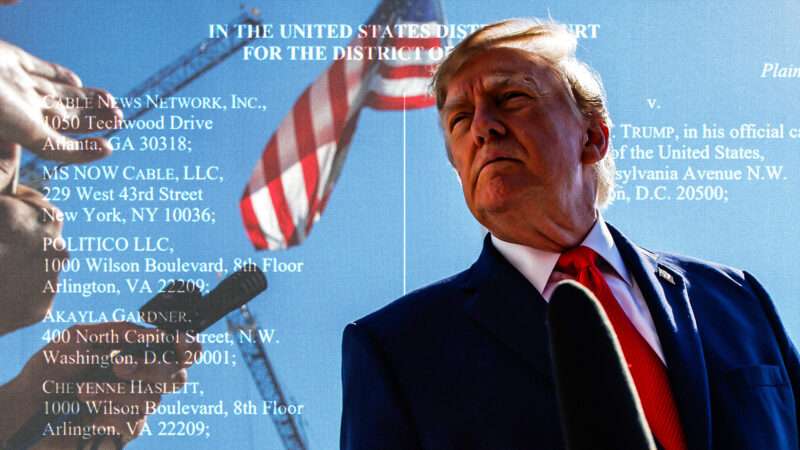
reporters aiming microphones at President Donald Trump, with a page from a federal lawsuit in the background | Illustration: Adani Samat | Photo: Samuel Corum/Pool via CNP/Polaris/Newscom

Last month, a federal judge in Washington, D.C., issued a temporary restraining order (TRO) that required restoration of press passes for 78 journalists employed by three news outlets that President Donald Trump peremptorily banned from the White House on September 18. U.S. District Judge Timothy J. Kelly, a Trump appointee, extended that order on Tuesday, granting a preliminary injunction to CNN, MS NOW, and Politico.

While Kelly's TRO was based on CNN et al.'s claim that their sudden banishment violated the Fifth Amendment's guarantee of due process, his justification for the preliminary injunction also addresses their argument that revocation of their press passes violated the First Amendment by retaliating against them for constitutionally protected speech and discriminating against them based on viewpoint. Kelly concludes that the plaintiffs "are likely to succeed not only on their due process claim, but also on their two First Amendment claims."

A retaliation claim requires showing that the plaintiff engaged in conduct protected by the First Amendment, that the defendant's action was "sufficient to deter a person of ordinary firmness" from "speaking again," and that there was "a causal link between the exercise of a constitutional right and the adverse action." Although the government's lawyers did not dispute that the CNN et al.'s journalism is constitutionally protected, they argued that the plaintiffs had failed to satisfy the two other elements.

Kelly disagrees. The "hard passes" at issue in this case, he notes, give journalists unescorted access to the White House "press area," which includes "the briefing room, the press offices, and certain other locations in and around the White House that are open to correspondents." CNN et al. argued that "a hard pass is an important credential because it 'allows a reporter to react to fast-developing news' and gives them 'swift and easy access to key official sources.'" Since "the revocation of Plaintiffs' hard passes matters a lot as to how, whether, and to what extent they can do their jobs," Kelly says, "it is likely that the open-ended ban here would chill a reporter's work."

Trump's "own comments suggest that he intended the revocation of Plaintiffs'
hard passes to alter their reporting on him, bolstering the case that his action here is sufficient to deter a reporter of ordinary firmness from reporting in the same way she had before," Kelly adds. The day he announced the ban, Trump complained that CNN et al. "purposely write negative news" to "try and diminish the Republicans and a Republican administration." Although "the ban would go as far as you can," he added, "I'd love it" if "they could straighten themselves out."

The plaintiffs also have shown "there is likely a causal link between the exercise of their First Amendment rights and the revocation of their hard passes and exclusion from the White House press area," Kelly writes. "President Trump likely banned Plaintiffs from the White House because he believes that their reporting is generally inaccurate and biased against him."

Again, Trump's public comments amply support that conclusion. He explicitly said he was banning CNN, MS NOW, and Politico "as a result of their constant 'reporting' [of] FAKE NEWS," adding that journalists "shouldn't be able to constantly write or report FICTION and LIES when they're covering the President of the United States, the Trump Administration, or the United States of America." When asked whether his decision was motivated by a "particular reason" or "particular story," Trump replied: "No, no. It's really just cumulative stories over the last two years." The problem, he said, was "purposely negative stories."

In a Truth Social post three days later, Trump likewise condemned "Fake News" that he said was "corrupt, purposeful, pervasive, fully coordinated, and totally out of control." CNN et al.'s reporters are "Third Rate Clowns" who "purposefully distort, twist, and degrade with everything they write or publish," he added that evening. "Virtually every story about me, or anything having to do with me, is negative, wrong and, in many cases, DANGEROUS for our Country! No matter how GREAT my Achievements, they trivialize and demean."

Trump offered a similar defense of the ban in a September 28 interview with Time. "It's just bad story after bad story," and "most of them are fake," he complained. "I don't think anybody should be forced to bear fake news, constantly bad stories, because I've done great things." Although "I can name 100 great things I've done," he added, "I never get good press. I never get fair press."

The government's lawyers maintained that Trump or another official "would have reached the same decision" based on the "alternative ground" that CNN et al. had violated "minimum professional journalistic standards" by "publishing classified and national security information." Kelly was not impressed by that belated rationale, which no one mentioned until after the news outlets gave the government a copy of their lawsuit.

"There is no evidence in the record that President Trump made the decision to revoke
Plaintiffs' hard passes on national security grounds," Kelly writes. "Nor at any time has he directly stated that national security was the reason for his decision. When he announced the ban with his post on September 18, he did not mention national security. When he was asked later that day about the 'particular reason' for his action, he did not mention national security."

Trump did mention "national security" in Truth Social posts he wrote the day that CNN et al. filed their lawsuit. But "that expression appears to have been simply another way for him to describe Plaintiffs' alleged inaccuracies and unfairness in their reporting about topics like his achievements or electoral success," Kelly says. "All this suggests that 'national security' was merely a post-hoc justification for the decision, which greatly undermines" the claim that Trump would have "taken the same action in the absence of Plaintiffs' protected speech."

The government also cited letters to CNN, MS NOW, and Politico from the White House Press Office, which were sent four days after Trump banned them. Those letters averred that the three news outlets had violated "the standards of professionalism and decorum expected of those given access to the White House Complex" by "publishing sensitive or classified information" and "trafficking in verifiable falsehoods about national security and other issues."

The letters "hardly move the needle" on the question of why Trump banned CNN et al. from the White House, Kelly says. They "appear to conflate concerns about otherwise protected speech" with "national security concerns," he notes, and they do not even explicitly say that Trump "made the decision for national security reasons."

Each letter lists specific stories to which the White House objected. But Kelly notes that two reporters "had their hard passes renewed after publishing articles that Defendants cite in their September 22 letters as supporting the potential revocation of their hard passes."

The Trump administration tried to shore up its "national security" justification by submitting a declaration from Pentagon Press Secretary Kingsley Wilson. While Wilson explains "how the publication of classified and sensitive information can undermine national security," Kelly notes, she "says little to nothing about President Trump's decision to revoke Plaintiffs' hard passes" and does not say "anything about White House press practices or operations."

The defendants "have not really tried to support" the claim that CNN et al.'s reporting "damaged national security," Kelly says, noting that news stories based on "sensitive or classified information" are "commonplace, for better or worse." If Trump "would have banned Plaintiffs from the White House even in the absence of their protected speech," he suggests, "Defendants would not have had to scramble to make their case with unsigned letters and a declarant who does not even work there."

The evidence of retaliation also supports the claim that Trump discriminated against CNN et al. based on viewpoint, which is presumptively unconstitutional. The U.S. Court of Appeals for the D.C. Circuit, Kelly notes, has held that "the White House Press Area" qualifies as a "nonpublic forum," meaning journalists cannot be excluded because of the views they have expressed.

"It is likely that Plaintiffs were selected by President Trump for revocation of their access to the White House press area because he believes their coverage of him and his administration is generally inaccurate and biased," Kelly writes. "In other words, it was 'an effort to suppress the speaker's activity due to disagreement with the speaker's view,' rather than to vindicate any other purportedly 'compelling governmental interest,' including maintaining professional standards for journalists or protecting national security. Simply put, that is unlawful viewpoint discrimination."

Kelly's decision "is a stinging defeat for Trump's assault on the free press and a powerful vindication of the First Amendment," Caitlin Vogus, senior adviser for advocacy at the Freedom of the Press Foundation, said in an emailed press release. "As Kelly rightly recognized, presidents don't get to use their power to purge journalists because they don't like what they report."

The post A Trump Appointee Says the President Likely Violated the First Amendment by Banishing Disfavored Journalists appeared first on Reason Magazine.
  •  

Other Courts Should Heed a Federal Judge's Warning About Flock-Enabled Mass Surveillance

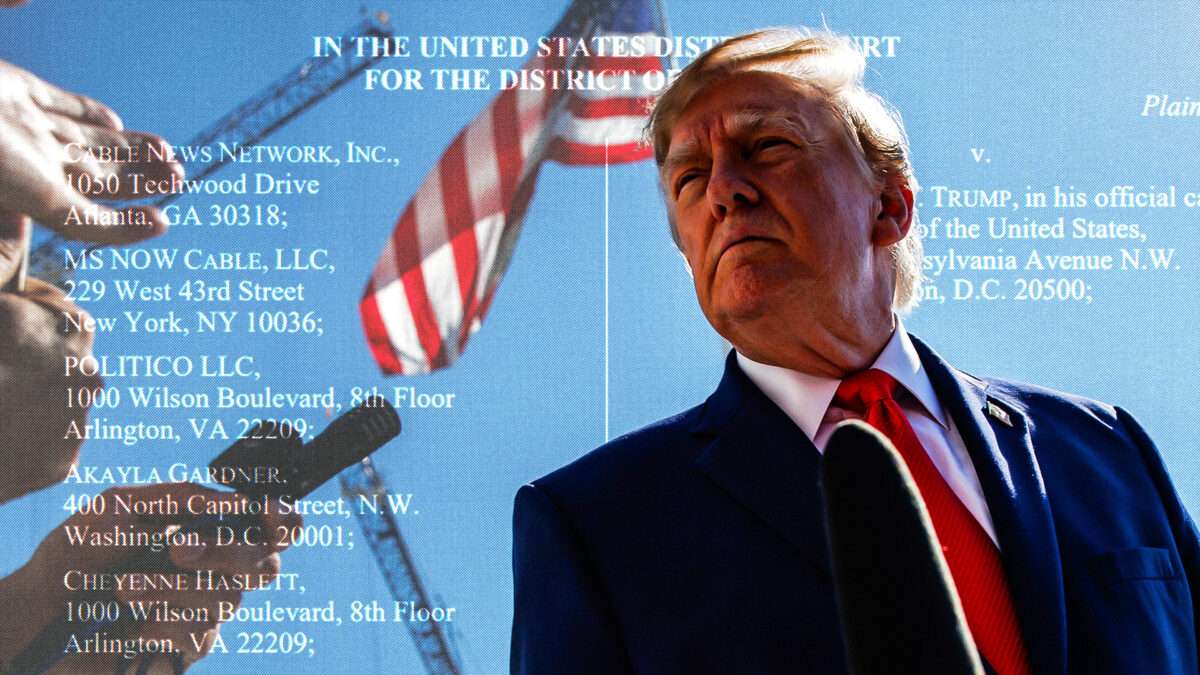
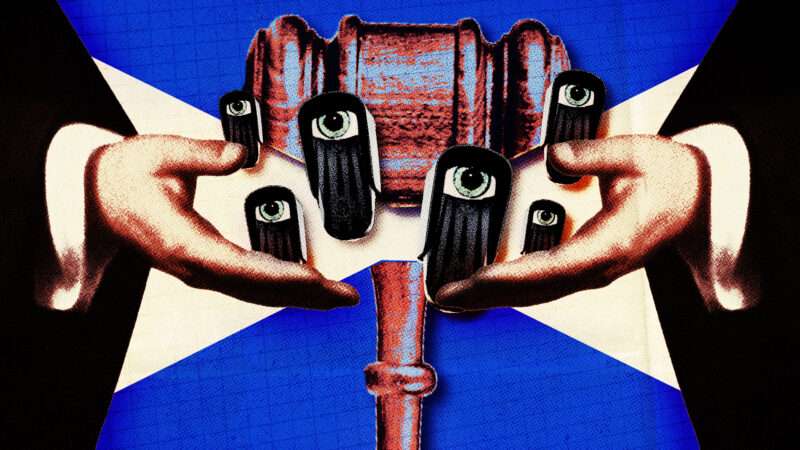
robed arms flank ALPR cameras and a judge's gavel | Paul Weaver/Zuma Press/Newscom/Flas100/Oleg Dudko/Doreen Salcher/Dreamstime/Midjourney/Fatima Ruiz

Back in 1983, the Supreme Court declared that "a person traveling in an automobile on public thoroughfares has no reasonable expectation of privacy in his movements from one place to another." That increasingly doubtful proposition underpins a nationwide network of more than 144,000 AI-assisted cameras that track the travels of innocent motorists across the country billions of times each week.

So far, state and federal courts have almost uniformly rejected constitutional challenges to automated license plate readers (ALPRs) installed by companies such as Flock Safety. But in a decision that could signal a shift in the legal treatment of Flock cameras, a federal judge in Oklahoma recently recognized that they enable "a type of indiscriminate mass surveillance."

ALPRs are much more sophisticated than the technology that the Supreme Court considered in 1983, when it approved the warrantless use of a radio transmitter that helped police tail a suspected methamphetamine manufacturer's car. Three decades later, by contrast, the Court said police should have obtained a search warrant before attaching a GPS tracker to another drug suspect's car.

The majority opinion in the latter case emphasized the physical intrusion necessary to install the tracker. But five justices embraced an alternative rationale, saying GPS tracking impinges on reasonable expectations of privacy by revealing potentially sensitive information about the target's historical whereabouts.

That theory came to the fore in a 2018 case involving mobile-phone location data collected by cell sites, which the majority said implicated the Fourth Amendment because "individuals have a reasonable expectation of privacy in the whole of their physical movements." The Supreme Court reiterated that principle this year, extending it to data collected by Google's Location History feature.

"An individual has a reasonable expectation of privacy in records about his cell phone's location," Justice Elena Kagan said in the majority opinion, "and police intrude on that constitutionally protected interest when they demand the information." By similar logic, U.S. District Judge Sara E. Hill concluded this month in the Oklahoma case, people have a reasonable expectation of privacy in ALPR records, and police therefore generally need a warrant to search them.

Those databases include "information about all vehicles that pass by any network-connected camera at all times," which police can peruse "on demand," Hill noted. "Freedom from persistent, dragnet-style surveillance while in public is not a foreign concept in our society, and it is a reasonable expectation that society already accepts," as reflected in the Supreme Court's cellphone decisions.

Like cars, cellphones "move in public places where people can see you in plain view," Hill wrote. "But it becomes constitutionally problematic when law enforcement can indiscriminately and passively catalog your whereabouts over an extended period of time and then use that information for any purpose whenever convenient."

At this point, Hill's decision is an outlier. "It appears that nearly every court examining the issue to date has determined that ALPR technology use is not a search under the Fourth Amendment because people have no reasonable expectation of privacy in their movements on public streets," she noted.

Last month, for instance, a federal judge in California held that ALPR database searches are "clearly distinguishable from and less extensive than the 'near perfect surveillance' achievable" with cell-site or Location History data. And the day after Hill's ruling, a state judge in California rejected a challenge to San Jose's Flock camera network, saying "there is no reasonable expectation of privacy in license plate data collected from cameras directed solely at public streets."

A federal lawsuit involving the same city's ALPR system, which the Institute for Justice filed last April, is still pending. So are challenges to Flock cameras in cities such as Wichita, Kansas, and Norfolk, Virginia.

Even when they reject such lawsuits, courts commonly acknowledge that the legal picture could change as the number and capabilities of ALPRs multiply. If so, it seems likely that Hill will eventually be joined by other judges who recognize the perils of "indiscriminate mass surveillance."

© Copyright 2026 by Creators Syndicate Inc.

The post Other Courts Should Heed a Federal Judge's Warning About Flock-Enabled Mass Surveillance appeared first on Reason Magazine.
  •  

Trump Fired Kimberly Guilfoyle for Influence Peddling That Pales Next to His Presidential Profiteering

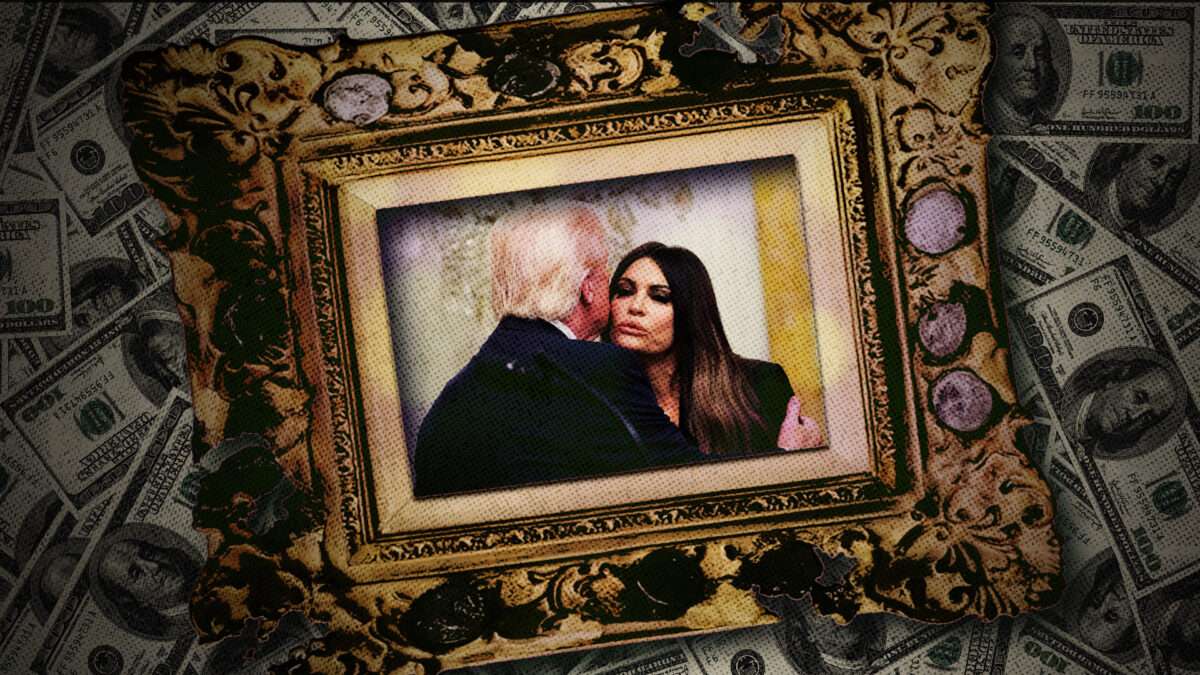
President Donald Trump embraces Kimberly Guilfoyle with a pile of cash under the picture | CNP/AdMedia/Newscom/Altinosmanaj/Gearstd/Dreamstime/Midjourney/Fatima Ruiz

Kimberly Guilfoyle today resigned from her position as the U.S. ambassador to Greece shortly after the White House confirmed that President Donald Trump had asked her to do so. The main provocation seems to have been Guilfoyle's alleged influence peddling, which reportedly featured a request that Republican donor Eric Deters pay off her $100,000 American Express bill, in exchange for which she promised him special access to "Trump world."

The president signaled his displeasure on Monday, saying "we're looking at" axing Guilfoyle, his son's former girlfriend, because "we're not happy." On Tuesday, Trump added that "we didn't like what we were reading." That reaction is not surprising, since Guilfoyle would have been horning in on Trump's territory by trying to sell access and use her office for personal gain. That's his thing.

Consider Trump's attempts to promote the memecoin that he launched three days before beginning his second term. That April, the top 220 $TRUMP holders were invited to "an intimate private dinner" with the president on May 22. The "top 25 coin holders" were promised "an Exclusive Reception before Dinner with YOUR FAVORITE PRESIDENT," plus a "Special VIP Tour" of the White House the next day. The coin's price, which after an initial surge had fallen dramatically since Inauguration Day, rose by more than 50 percent immediately after that announcement.

"Since the announcement, crypto investors around the world have raced to expand their holdings of $TRUMP," The New York Times reported 10 days before the dinner. "Certain buyers, in interviews and statements, have said they bought the coins or entered the dinner contest with the intention of securing an action by Mr. Trump to affect United States policy."

NBC reported that the coin investors who attended the dinner, which was held at the Trump National Golf Club in Sterling, Virginia, had collectively spent $394 million on $TRUMP. On average, that worked out to about $1.8 million a plate.

"This is my president that we're talking about, but I am willing to say that this gives me pause," Sen. Cynthia Lummis (R–Wyo.) said a few weeks before the dinner. "In abstract," Sen. Thom Tillis (R–N.C.) allowed, the event "is hard to understand." Sen. Lisa Murkowski (R–Alaska) drew an analogy: "I don't think it would be appropriate for me to charge people to come into the Capitol and take a tour."

Donald Sherman, executive director of Citizens for Responsibility and Ethics in Washington, was blunter. "This is one of the most blatant and appalling instances of selling access to the presidency I've ever seen," he said.

Compared to that episode, the controversy over the income that Trump's hotel in Washington, D.C., received from influence seekers during his first term might seem tame. But it raised similar ethical questions, albeit in a slightly more subtle way.

The Trump International Hotel's customers included Republican political organizations and a long list of trade groups, such as the National Mining Association, the Independent Petroleum Association of America, the National Confectioners Association, and the Vapor Technology Association, whose interests might be served by currying favor with the president. The hotel also attracted business from the governments of foreign countries, such as Kuwait, Bahrain, Saudi Arabia, Azerbaijan, Malaysia, and Romania, that likewise may have been investing in Trump's good will.

"Believe me, all the delegations will go there," a "Middle Eastern diplomat" told The Washington Post after Trump's election. "Why wouldn't I stay at his hotel blocks from the White House, so I can tell the new president, 'I love your new hotel!'" an "Asian diplomat" said. "Isn't it rude to come to his city and say, 'I am staying at your competitor'?" The Embassy of Kuwait, which had previously held its annual National Day celebration at the Four Seasons, reportedly canceled its reservation there and switched to the president-elect's hotel under pressure from the Trump Organization.

Trump saw no problem with any of this. "The law is totally on my side," he told The New York Times in November 2016. "The president can't have a conflict of interest." He reiterated that take at a press conference nine days before his inauguration. "I have a no-conflict situation because I'm president," he said.

Trump nevertheless said he would donate the profits from money spent by foreign governments at his hotels to the U.S. Treasury. But that solution did not address the money he was taking in from various domestic interest groups or his ability to enrich himself by encouraging Republican organizations or other federal officials to patronize his businesses.

One example of the latter: Vice President Mike Pence and his party stayed at Trump's golf resort in Doonbeg, Ireland, during an official trip in 2019. Although Trump insisted he "had nothing to do" with that decision, critics perceived a violation of the Domestic Emoluments Clause, which says the president may not receive additional compensation from the federal government beyond his official salary.

Trump later said he regretted his attempts to address conflicts of interest during his first term, including his promise that the Trump Organization would avoid new foreign business deals. "I prohibited [my sons] from doing business in my first term, and I got absolutely no credit for it," he told The New York Times 12 days before his second inauguration. "I didn't have to do that, and it's really unfair to them." The lesson he drew was that "nobody cared."

Consistent with that assessment, Trump has thrown all caution to the wind during his second term, capitalizing on his position to rake in millions of dollars by hawking all manner of presidentially branded merchandise, ranging from bibles to cologne; obtain a $400 million "palace in the sky" from the government of Qatar; extort $1 billion in pro bono legal work from disfavored law firms; earn billions from the same cryptocurrency industry he was simultaneously deregulating; and arrange a sweet IRS immunity deal that could save him more than $100 million in back taxes, interest, and penalties. Any worries about unseemly profiteering by Trump's family are long gone, as evidenced by federal contracts with businesses backed by his sons and highly lucrative foreign deals negotiated by his son-in-law.

Compared to all of that, the $100,000 that Guilfoyle allegedly sought in exchange for using her influence with the Trump administration to help Deters looks like pocket change. Her real sin, one suspects, was failing to offer her boss a piece of the action.

The post Trump Fired Kimberly Guilfoyle for Influence Peddling That Pales Next to His Presidential Profiteering appeared first on Reason Magazine.

  •  
❌