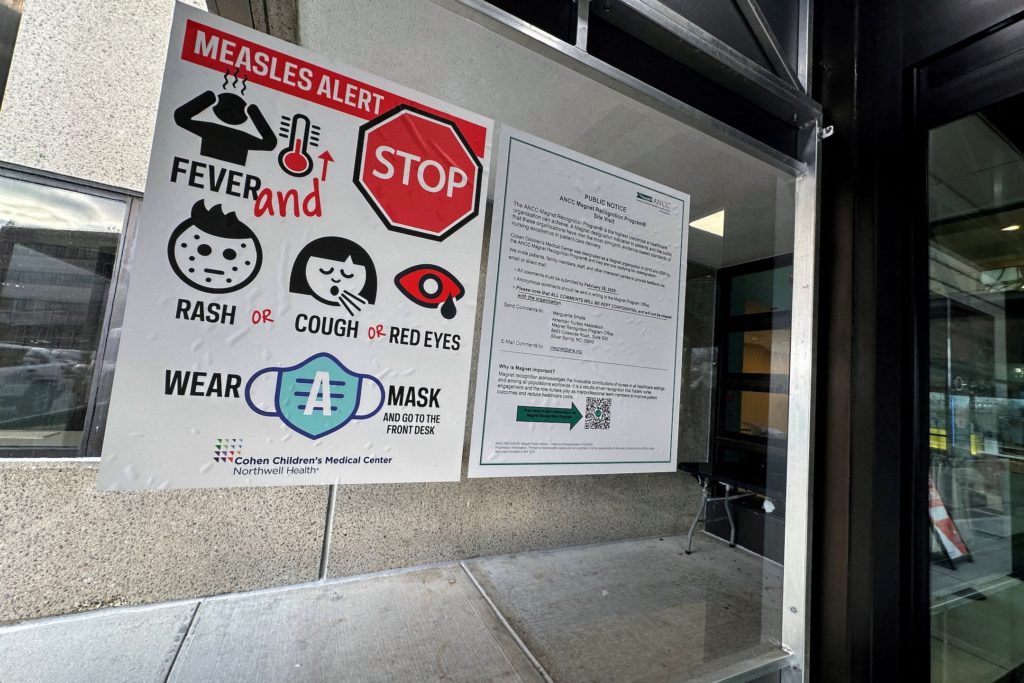
The CDC has confirmed more than 4,000 cases of measles this year as the country grapples with the largest outbreak of the highly infectious virus in 35 years. Nearly a fifth of cases comprise children under the age of five, and 95% are among unvaccinated people. Amna Nawaz spoke with Dr. Evan Shirey, a pediatric infectious disease doctor based in Pennsylvania.
Thanks to a 2005 DUI conviction in Pennsylvania, Edward Williams permanently lost the constitutional right to keep and bear arms. But he did not realize that until a decade later, and his confusion on that point is understandable.
The federal law that stripped Williams of his Second Amendment rights is commonly described as applying to "felons," and Williams' offense was a misdemeanor. But although his sentence did not include any time behind bars, his crime theoretically could have sent him to prison for up to five years. That was enough to trigger 18 USC 922(g)(1), which covers anyone convicted of "a crime punishable by imprisonment for a term exceeding one year."
When a lawyer alerted Williams to that wrinkle, which made his continued ownership of firearms a federal felony, he got rid of his guns. But he did not think that requirement was fair, reasonable, or constitutional, and this week a federal appeals court agreed. The U.S. Court of Appeals for the 3rd Circuit recognized a historical tradition of disarming "physically dangerous individuals" whose possession of firearms would pose a threat to public safety. But it said Williams plainly does not fit into that category.
"The federal government spent nearly a decade trying to permanently disarm a peaceable man over a nonviolent misdemeanor—and it lost bigly," says Brandon Combs, president of the Firearms Policy Coalition, which supported Williams' lawsuit. "The government does not get to turn a nonviolent conviction into a lifetime ban on exercising a constitutionally protected right."
The 3rd Circuit's en banc decision in Williams v. Attorney General affirms a 2023 ruling by a federal judge who likewise concluded that disarming Williams was unconstitutional. It elaborates on the logic of Range v. Attorney General, a 2023 decision that restored the gun rights of a Pennsylvania man who had been convicted of food stamp fraud. In both cases, the 3rd Circuit held that applying Section 922(g)(1) to the plaintiffs was not "consistent with this Nation's historical tradition of firearm regulation"—the Second Amendment test established by the Supreme Court's 2022 decision in New York State Rifle & Pistol Association v. Bruen.
Writing for the majority in Williams' case, 3rd Circuit Judge Paul Matey acknowledges that the Supreme Court has described "longstanding prohibitions on the possession of firearms by felons" as "presumptively lawful." But "those longstanding customs restricted the violently dangerous (within which some felons would be included), not felons writ large," he says. "Felons were restricted because they posed a physical danger, rather than for their offense of conviction."
Matey argues that "focusing on physical dangerousness corrects the erroneous argument" that "only law-abiding and responsible citizens can exercise the rights protected by the Second Amendment"—a claim that the Supreme Court rejected in the 2024 case United States v. Rahimi. "We find no history that supports disarming irresponsible people, where 'responsible' is defined by the whim of the sovereign or the will of the majority," he says, alluding to the danger of allowing legislators to whittle away at the Second Amendment by criminalizing an ever-widening range of conduct.
Matey emphasizes "the novelty of forever restricting all felons from possessing firearms for lawful purposes." The original restriction, which Congress approved in 1938 as part of the Federal Firearms Act, applied only to violent crimes such as murder, manslaughter, rape, kidnapping, robbery, and assault with a deadly weapon. In 1961, Congress expanded the ban to cover nonviolent crimes punishable by more than a year in prison.
Williams' 2005 DUI conviction qualified for two reasons. He had a prior DUI conviction, stemming from a 2000 arrest in State College. And when he was arrested again in Philadelphia four years later, his blood alcohol concentration was a whopping 0.223 percent. That made his second offense a first-degree misdemeanor, which carries a maximum prison sentence of five years.
Since then, Williams has stayed out of trouble. "He has done nothing violent, let alone dangerous, for over twenty years, and has held steady employment at the same job for over three decades," Matey notes. Williams drinks only occasionally, and a psychological evaluation found he "has a normal personality, without psychopathology and without addiction or violent tendencies."
The Justice Department nevertheless argued that Williams' continuing disarmament is consistent with the Bruen test, which requires historical analogs that are "relevantly similar" in motivation and scope. In making that case, the government relied mainly on early laws aimed at "habitual drunkards"—the same analogy that the Supreme Court unanimously rejected last June in United States v. Hemani, which involved the federal ban on gun possession by "unlawful" drug users.
Although the Justice Department "acknowledges it may proscribe Williams's possession of firearms only if he 'presently poses a physical danger if armed,'" Matey says, it "offers no evidence to establish this as the aim of the habitual drunkard laws." Those laws, the Supreme Court noted in Hemani, "did not seek to protect the public from violence so much as to protect habitual drunkards from themselves and their families from financial devastation."
Nor did the habitual drunkard laws permanently disarm people, as Section 922(g)(1) does. "Most statutes capped the commitment of habitual drunkards to the state inebriate asylum, prison, or hard labor to a few months or years," Matey notes. "Others provided for an indefinite period of incarceration, but had no indication that upon release individuals continued to forfeit their arms. Rather, once someone was 'safe' to 'go at large,' they were restored to the status of a full rights-bearing citizen."
Contrary to the considerations that the Supreme Court deemed relevant in Hemani, Matey says, the Justice Department "fails to show that Williams threatens to 'misuse[] a gun while intoxicated,' or that he 'poses a danger to himself or others as a result' of
alcohol abuse. In fact, much like those nineteenth-century drunkards released from custody and restored their rights, the record shows that Williams poses no present physical danger from the use of a firearm, or anything else."
The 3rd Circuit is one of three federal appeals courts that have allowed people with nonviolent felony records to argue that Section 922(g)(1) is unconstitutional as applied to them. But such challenges have been blocked in six circuits, notwithstanding compelling historical evidence that the law reaches much farther than the Second Amendment allows. So far, the Supreme Court has declined to accept any of the many petitions asking it to resolve that circuit split.
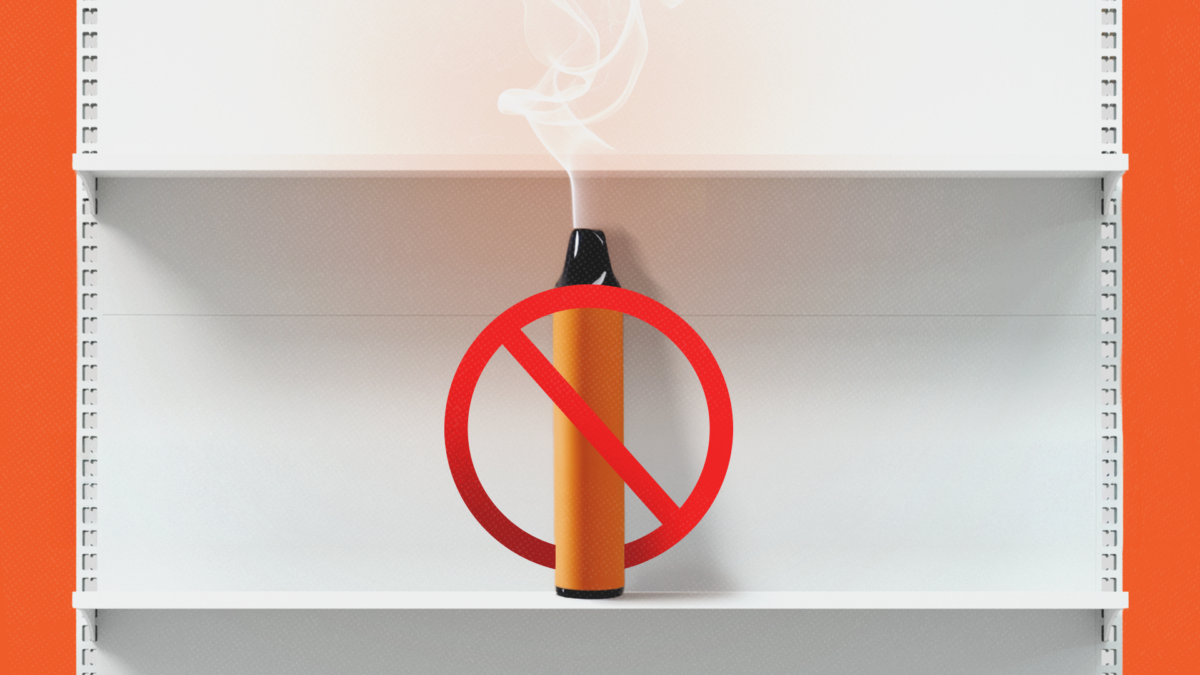
Starting next week, Pennsylvania will begin enforcing a law prohibiting the sale of e-cigarettes that have not been explicitly approved by the state. Supporters argue that it will protect public health, but it seems likely to do the opposite by preventing many former smokers from accessing the products that helped them quit.
Under the law, known as ACT 57, there are currently just six manufacturers of electronic nicotine delivery systems on the approved list that can be sold in the Keystone State, meaning many popular vaping products will be forcibly removed from shelves on October 19. Retailers who violate this law will face fines of $500 for each unapproved product. A second violation within a year will result in a civil penalty of between $750 and $1,000 per day per product, and a suspension of the dealer's license for at least 14 days. A shop's third violation within a year would result in a civil penalty of $1,000 to $1,500 per day per product, and the revocation of its license.
Politicians are touting this law as the latest way to protect the public, and of course, they claim it will especially protect children. "This law is about keeping harmful products out of the hands of both children and adults who may not realize what they are consuming," said Pennsylvania Attorney General Dave Sunday.
"I applaud the legislature for their bipartisan support of Act 57 to provide this important public health safety measure to the Commonwealth."
However, not all Pennsylvania residents are enthusiastic about the law's enforcement.
"This will be largely catastrophic," Chris Hughes, the former owner of Fat Cat Vapor Shop in Williamsport, Pennsylvania, tells Reason. Hughes predicts that the restrictions will encourage consumers to purchase vaping products across state lines, creating an illicit market. "Some people that are enterprising will drive across the border to Ohio [or] West Virginia, and bring a lot of products back and sell them to other people," he says.
Hughes is right to assume that the law will create an illicit market for vaping. In June, JAMA Network Openpublished a report on Alabama, Oklahoma, and Louisiana—three other states with constraints similar to Pennsylvania—finding that the restrictions were not associated with lasting reductions in e-cigarette nicotine sales. By the end of April 2025, products not listed in the states' approved directories accounted for 92.1 percent of measured e-cigarette nicotine sales in Alabama, 53.6 percent in Oklahoma, and 52.3 percent in Louisiana.
For people living further from the border, Hughes says that "a lot of them will return to smoking." "Half of those people will die prematurely from smoking.…It's a tragedy, really."
Indeed, evidence shows vaping to be one of the most effective tools to quit smoking. A 2024 study published by the Centers for Disease Control and Prevention found that in 2021–2022 alone, approximately 1.2 million American adults used e-cigarettes to help them quit smoking for at least six months, representing slightly more than 40 percent of all adults who successfully quit during that period. Meanwhile, a 2026 review from Cochrane, a global health nonprofit, found that smokers are more likely to quit when using e-cigarettes than with nicotine replacement therapy: 8 percent to 10 percent of smokers using e-cigarettes may successfully quit, compared with just 6 percent using nicotine-replacement therapy.
The impending restrictions have Pennsylvania vapers stockpiling products. Hughes says he has delayed paying his property taxes to make sure he has "two to three years' worth of e-liquid and coils while this shakes out." He also spoke to an employee at a vape shop recently who told him about a customer spending $500 on e-liquid after learning about the impending ban.
For vape shop owners across Pennsylvania, the new law will make business even more difficult. Hughes was forced to close down Fat Cat Vapor Shop in Williamsport after Pennsylvania introduced a 40 percent wholesale tax on vaping products in 2016. "The whole goal of my opening the business was to help get adult smokers off of cigarettes and transition them to something that I knew for a fact was much less harmful," he says. Hughes estimates that his shop helped approximately 8,000 adults quit smoking during its three years in business.
Now, he fears other independent vape shops will suffer the same fate as his own. "Most, if not all of them, will be bankrupted," Hughes warns. "It almost takes my breath away. I'm not even sure what to say."
Pennsylvania lawmakers may intend to protect public health, but their new law risks pushing adults away from healthier lifestyle choices. As is often the case, the government restricting the choices adults are allowed to make for themselves is likely to have deadly consequences.

 Login