❌

Reading view

Nobody Wants To Be the Pro-Tech Candidate in This New York Race That Could Flip the House
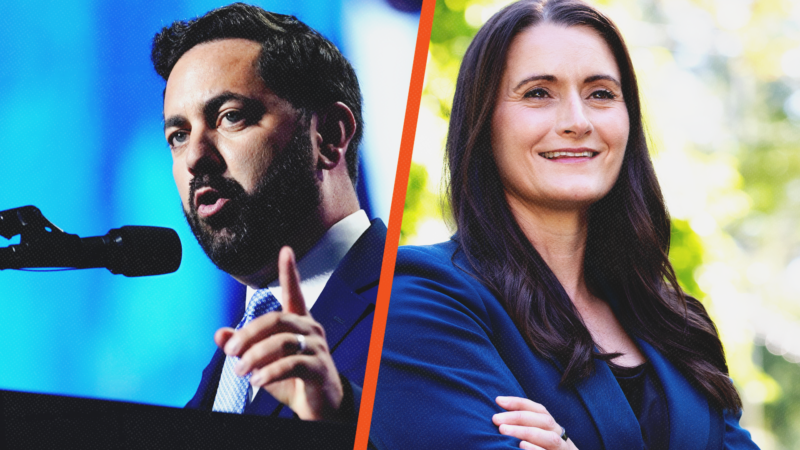
Mike Lawler and Cait Conley | Bonnie Cash/UPI/Newscom/caitconley.com

The Democratic Socialists of America (DSA) candidates running for the House of Representatives and endorsed by NYC Mayor Zohran Mamdani are all but guaranteed to win their general elections this November, but that does not mean the midterm drama is over in New York. In the state's 17th congressional district, which includes the lower Hudson Valley, Democratic challenger Cait Conley, a combat veteran who served on the Biden administration's National Security Council, could unseat incumbent Republican congressman Mike Lawler in one of the most consequential races of the midterms. 

The highly contested purple district voted for former Vice President Kamala Harris in the 2024 election while reelecting Lawler for his second term. Now, Lawler is attempting to win a third term as support for President Donald Trump wanes ahead of the midterms. As of Friday, The Cook Political Report lists the race, which could determine control of the House, as a toss-up. 

If elected, Conley would have far more in common with the "Badass Women" coalition of security state and military veterans than with DSA types (think more Sen. Elissa Slotkin from Michigan than Darializa Avila Chevalier). As Judge Street Journal's Timmy Facciola notes, "Conley's candidacy is testing the viability of a tactful centrism that rebukes left-wing positions like abolishing ICE or restricting weapon shipments to Israel." Lawler is also vying for moderates, pitching himself as "one of the most bipartisan members of Congress" and emphasizing his willingness to break with Trump occasionally while still welcoming Trump's support. 

While Lawler and Conley certainly are not pure MAGA acolytes or DSA members, both have leaned into a tech-critical position, much like that of more radical populists like Lina Khan or Steve Bannon, revealing how pervasive anti-tech sentiment has become in mainstream politics. 

This tech skepticism was on full display during an October 14 debate, when each candidate made the case for why they were the most equipped to regulate AI, insisting that the industry needs guardrails. 

Conley said members of Congress do not want to regulate AI because "they want to look out for their billionaire and trillionaire backers like Elon Musk, who is pouring over $260 million into this midterm election." She then added that Musk backed Lawler in his 2024 race. 

Lawler then accused Conley, who previously consulted for Primer AI, of being "the AI candidate for the AI industry."

While Lawler and Conley disagree on specific data center regulations (Conley supports Democratic Gov. Kathy Hochul's data center moratorium while Lawler supports local zoning control over data centers), neither wants to pitch themselves as an explicitly pro-data center candidate. During the debate, Conley claimed that, "On Mike Lawler's watch there have been five data centers built in Rockland County." Lawler has said that he had no say in the decision to build the data centers, and during the debate, he pointed out that the facilities were built for financial services. Lawler also attempted to attack Conley over data centers, slamming her in an ad for saying "we need data centers." Regardless of the candidates' specific policies on data centers, their attacks on one another demonstrate that cheerleading hyperscale data center development is a political liability. In their district, data center has presumably become a dirty term. 

The candidates' tech-skeptical rhetoric did not end with unchecked data center development. After the debate, Reason asked both candidates about their positions on age-verification laws for social media and AI, since such regulations raise significant privacy and censorship concerns by age-gating the internet. Unsurprisingly, both Lawler, who voted for the controversial KIDS Act, and Conley, who has proposed stricter age verification for AI tools, parroted platitudes about why such online safety regulations are necessary to protect children. 

"We have watched how social media is literally hurting the mental health of children," Conley told Reason. "And when you talk about the power of AI and what that power could do, we have to regulate this." 

Lawler gave a similar response, telling Reason that he respects free speech but that protecting children "is paramount." 

This bipartisan consensus over social media regulation has long been brewing in Congress. The mainstream political conversations about AI and data centers, however, are relatively new this midterm election cycle. And it appears both Lawler and Conley have figured out which way Americans' sentiment toward AI is leaning, and they have waged their campaigns accordingly. 

The post Nobody Wants To Be the Pro-Tech Candidate in This New York Race That Could Flip the House appeared first on Reason Magazine.
  •  

Terry Tao Is on the Front Lines of the Debate Over AI and the Future of Math

The Fields Medalist Terence Tao is on the front lines of a debate about artificial intelligence and the future of his field.

© Ariana Drehsler for The New York Times

Terence Tao's celebrated status has made him an unofficial spokesman for mathematics, a job that for now is consuming most of his time.
  •  

Musk’s Perplexing Battle With Nitter and the Problem With Locking the Internet Behind Login Screens

As a free speech absolutist, Elon Musk is making a mistake going after Nitter, says Dr R P. He should instead be praising the site that helps users speak freely, uninhibited by login screens that undermine their privacy.

The post Musk’s Perplexing Battle With Nitter and the Problem With Locking the Internet Behind Login Screens appeared first on The Daily Sceptic.

  •  

Why No One Can Look Away From Elizabeth Holmes

“I felt like there were some moments in the film where she was just brazenly lying.”

© Photo Illustration by The New York Times; Image: Philip Cheung for The New York Times

  •  

Microsoft president warns Trump's immigration crackdown could drive top AI talent abroad

Microsoft's president, Brad Smith, at the International AI Summit in Dublin on October 14, 2026
Brad Smith, the president of Microsoft, defended the company's use of visas and green cards.

Paulo Nunes dos Santos/Bloomberg via Getty Images

  • Microsoft President Brad Smith warned that US immigration policies could drive AI talent overseas.
  • "Let's not put that at risk," Smith said.
  • The Trump administration recently suspended Microsoft and other tech firms from a green card program.

If America wants to win the AI race, sending the world's brightest engineers packing might not be a winning strategy.

That's the warning from Microsoft President Brad Smith, who said the Trump administration's immigration crackdown risks driving the next generation of AI talent away from the United States.

"I think we should all be worried about sending intentionally or inadvertently or otherwise, signals that send the most talented next wave of AI software engineers to other countries rather than the United States," Smith said in an episode of Politico's "The Decoded Podcast" that aired on Thursday.

His comments come after the Trump administration announced last week that it was suspending Microsoft, Adobe, and several other technology companies from a federal program that sponsors foreign workers for permanent residency.

Vice President JD Vance accused Microsoft of abusing the Permanent Labor Certification, or PERM, program by laying off American employees while hiring lower-paid foreign workers.

Smith, who Business Insider reported was recently put in charge of Microsoft's communications, pushed back against those allegations, saying the administration had presented a misleading picture of Microsoft's hiring practices.

US Vice President JD Vance speaks during a midterm campaign rally at the LevelUp Training Complex
US Vice President JD Vance has criticized Microsoft's use of visa programs.

Daniel Heuer-Pool/Getty Images

"What was presented as Microsoft replacing 6,000 people who lost their jobs with 9,000 foreigners was frankly completely off base," he said.

Smith said most of the company's visa and green card applications concerned existing employees rather than new hires, adding that Microsoft had hired 9,200 American workers in its last fiscal year.

"That was left out of the narrative," he said.

He also rejected suggestions that Microsoft pays foreign workers less than their American counterparts, saying employees are compensated under the same system regardless of immigration status.

The American dream, on hold

The dispute comes amid growing uncertainty for skilled foreign workers in the US.

As part of our ongoing H-1B Fallout series, Business Insider previously reported that the Trump administration's shifting immigration policies have prompted some international workers to explore opportunities abroad, including in countries like the UK, Germany, and Canada.

An analysis of federal data by Business Insider found that certified H-1B applications fell 10% in the first nine months of fiscal year 2026 compared with the same period a year earlier. Applications for data scientists, however, rose 22.5%, highlighting continued demand for specialized AI talent.

On the Politico podcast, Smith cited immigrants' economic contributions as evidence of what America stands to lose.

He said that five of the six technology and science medal recipients recently honored by President Donald Trump had immigrated to the United States.

U.S. President Donald Trump (2nd-R) applauds as (L-R) CEO of Microsoft Satya Nadella, CEO of Dell Technologies Michael Dell, President and CEO of Advanced Micro Devices Lisa Su, Tesla and SpaceX CEO Elon Musk, Nvidia CEO Jensen Huang and Co-founder of Google and former President of Alphabet Sergey Brin pose for photos after being awarded National medals during the Golden Age of American Innovation Summit at the Institute of Peace on October 08, 2026 in Washington, DC.
President Donald Trump awards tech execs and founders some of the country's highest scientific honors.

Win McNamee/Getty Images

According to Smith, the companies associated with those five individuals collectively represent more than a quarter of the S&P 500's market value.

Their contributions, he said, benefit not just technology employees but ordinary Americans whose retirement savings and pension funds are invested in those businesses.

"Think about what those five individuals have done for the well being, even the wealth and standard of living, of Americans across the country," Smith said.

"Let's not put that at risk."

Read the original article on Business Insider

  •  

European Companies Embrace AI but Nearly Half Distrust Its Role in Staff Decisions

A European Commission survey has found widespread adoption of artificial intelligence among smaller businesses, but considerable reluctance to allow automated systems to make decisions about employees. The findings expose a growing divide between technological investment and confidence in workplace automation.

Artificial intelligence is becoming established across European businesses, but almost half of companies remain unwilling to trust automated systems when decisions concern their employees, according to a European Commission survey published on 14th October.

The Eurobarometer findings show that 42 per cent of the small and medium-sized enterprises and mid-cap companies surveyed already use artificial intelligence or algorithmic management systems, although most deployment remains limited or experimental. A further 21 per cent intend to introduce such technologies in the future.

Despite this expanding adoption, 49 per cent of respondents said they did not trust artificial intelligence or automated systems to make staff-related decisions. The figures suggest that companies increasingly distinguish between using technology to improve business processes and delegating managerial responsibility to software.

The Commission’s survey of European businesses was conducted between March and April 2026, involving approximately 12,826 telephone interviews with company leaders across the EU’s 27 member states.

Businesses prefer assistance to automation

The survey provides a more detailed picture of workplace AI than conventional statistics measuring whether companies have adopted the technology.

Among the businesses interviewed, customer service and client relations were the most commonly reported areas of application, accounting for 47 per cent. Monitoring employee performance and productivity accounted for 36 per cent, while logistics, planning and staff scheduling represented 30 per cent.

These functions differ substantially in their consequences for workers and managers.

A system that helps organise deliveries or forecasts customer demand may improve efficiency without directly determining employees’ working conditions. Software that evaluates performance, allocates shifts or recommends staffing changes can influence employment decisions and requires a different level of organisational supervision.

The survey found that 61 per cent of companies considered AI useful in supporting decisions. However, human involvement remained central: 90 per cent of respondents reported that people continued to make decisions, while fully automated decisions accounted for only 2 per cent.

The results undermine the assumption that adopting AI necessarily means transferring control of business operations to autonomous systems.

For many companies, the immediate commercial value lies in processing information more rapidly, identifying patterns and reducing administrative workloads rather than removing human management entirely.

Investment costs remain a substantial barrier

Financial and organisational obstacles continue to limit adoption.

Half of the companies surveyed cited high investment costs, while 49 per cent identified legal uncertainty and 48 per cent pointed to insufficient expertise.

These findings are particularly relevant to small businesses, which frequently lack dedicated technology teams, extensive data infrastructure or the resources to evaluate complex software systems independently.

For such businesses, purchasing AI tools is only one component of the investment. Implementation can also require employee training, changes to internal procedures, data-security assessments and continuing technical support.

The findings add a workplace dimension to concerns raised in EU Today’s earlier examination of Europe’s AI productivity gap, which identified investment, computing capacity and organisational restructuring as obstacles to translating adoption into higher productivity.

A company may purchase sophisticated software without necessarily achieving corresponding improvements in performance. Those improvements depend on whether the technology is integrated into everyday operations and whether employees have the skills to use it effectively.

Brussels prepares further workplace legislation

The survey arrives while the European Commission is considering additional rules on algorithmic management through its proposed Quality Jobs Act.

The initiative is intended to address working conditions, workers’ rights and the increasing use of automated systems in managing employees.

A consultation launched in July asked European employers and trade unions to consider transparency in automated decisions, excessive workplace monitoring and the responsibilities of companies using AI.

The second consultation phase ended in September, allowing social partners to propose negotiated arrangements before the Commission determines its next legislative steps.

The broader regulatory framework is already changing. As EU Today explained when the AI Act entered a new enforcement phase, Brussels has begun enforcing certain obligations for general-purpose AI models, while important requirements for high-risk applications, including employment-related systems, follow a later timetable.

Stand-alone high-risk systems are scheduled to face the relevant obligations from December 2027, with another deadline in August 2028 for high-risk systems embedded in regulated products.

The distinction matters for employers planning investments today. Existing data-protection and employment obligations continue to apply, but some of the AI Act’s more specific compliance requirements remain subject to transition periods.

The Commission’s latest survey indicates that businesses are already exercising caution independently of these future obligations. Their reluctance to automate sensitive staff decisions suggests that accountability, reliability and employee confidence will remain important factors in determining how extensively artificial intelligence is deployed.

For Brussels, the challenge is to establish workable rules for that transition without making implementation prohibitively expensive for smaller companies, which account for much of Europe’s employment and commercial activity.

  •  

Microsoft AI chief says the company beat OpenAI at its own game, using a quarter of the computing power

Mustafa Suleyman, the CEO of Microsoft AI
Mustafa Suleyman, the CEO of Microsoft AI.

Stephen Brashear/Getty Images

  • Microsoft AI recently announced its latest model MAI-Base-2.
  • AI CEO Mustafa Suleyman compared the model to a similar offering from OpenAI.
  • Microsoft trained its model more efficiently than OpenAI, he said in an internal meeting.

Microsoft AI CEO Mustafa Suleyman told employees an in-house model was better than a similar offering from OpenAI, one of the software giant's biggest customers and partners.

"We now have a stronger pre-trained base model than the model that currently powers GPT 5.6 Sol," Suleyman said during a town hall meeting with employees on Thursday. "And in fact, we used one-quarter of the compute that OpenAI used to train their model."

Pre-training is the first stage of building an AI model, when it learns patterns from huge amounts of text, images, and other information. This takes massive amounts of expensive computing power, so Microsoft could save money if it's worked out a way to do this more efficiently.

Microsoft announced the model, MAI-Base-2, earlier on Thursday.

Suleyman said Microsoft privately tested this model against OpenAI models, including one nicknamed "Spud" that powers GPT-5.6. He added that Microsoft's model performed better on tests measuring how well AI can understand and predict patterns in information.

The comparisons are based on technical information Microsoft has about OpenAI's models, Suleyman said.

"Privately and confidentially, we've also compared it to the OpenAI models," Suleyman told employees, while suggesting that Microsoft has special access to information on how OpenAI models perform.

It's notable that Suleyman would choose to highlight limitations of OpenAI models, even in private discussions. Microsoft has invested billions of dollars in OpenAI, and owns a stake in the startup that is likely worth more than $100 billion. Any criticism of OpenAI could potentially dent the value of this huge investment.

The two companies also have a major partnership, with Microsoft offering OpenAI models to its Azure cloud customers. Microsoft has used OpenAI models for its own products such as Copilot, too.

But the relationship between the two companies has frayed in the past year or so. Increasingly, Microsoft has tried to branch out from OpenAI, including by working on its own models.

Suleyman also said Microsoft's new AI model used "12 times less computation than was used for DeepSeek, for example, on compute efficiency."

Suleyman didn't specify which DeepSeek model, but a public blog post described the pre-training of MAI-Base-2 being a lot more efficient than a similar offering from the Chinese lab, called DeepSeek-V4-Pro-Base.

Microsoft in March created a new combined team for its commercial and consumer Copilot products and reassigned Suleyman to focus on building AI models in the company's superintelligence unit.

Microsoft declined to comment and OpenAI did not respond to a request for comment on Thursday.

Have a tip? Contact this reporter via email at astewart@businessinsider.com or Signal at +1-425-344-8242. Use a personal email address and a nonwork device; here's our guide to sharing information securely.

Read the original article on Business Insider

  •  

OpenAI's Dots head says AI means workers now have a choice between doing less or more

Attendees go up and down stairs at OpenAI's DevDay conference on Sept. 29, 2026.
Attendees at OpenAI's DevDay conference on September 29, 2026.

Minh Connors/Bloomberg via Getty Images

  • OpenAI's Alexander Embiricos said the AI era gives a choice: work more, or work less.
  • He's in charge of Dots, the company's new always-on work assistant.
  • AI is often pitched as freeing up time. Embiricos responded to the idea that it might add more work.

As the competitive AI race pushes tech workers into long hours, the head of OpenAI's new Dots product says AI gives people another option: work a whole lot less.

Alexander Embiricos, who leads OpenAI's enterprise product and helms the new Dots agent tool, told a crowd at TechCrunch's Disrupt conference on Thursday that AI's capabilities have created something of a fork in the road for workers. You can grind to meet the moment. Or you can use AI to kick your feet up a little.

"We basically have a lot more choice now," he said.

Embiricos made the comments after a reporter asked about when AI systems will actually deliver more free time. The reporter shared an anecdote where an OpenAI employee used a ChatGPT mobile feature to work in their car and on a plane — not exactly liberated by the new tech.

Embiricos said that the moment has already arrived where a worker can "outsource" tasks to AI and do less work. Then again, some people are so excited about AI's potential that they feel like it's an "interesting, ripe moment" to put in extra hours.

"I think that's why a lot of people are motivated to work very hard right now. That includes myself," he said. "But I think actually there is this choice, and there's totally this other setup where you could delegate a ton more things."

OpenAI is billing its Dots tool as a workplace assistant, always on and capable of proactively handing tasks and sorting to-dos. Embiricos uses his Dot often in Slack, he said, engaging on various threads.

His perspective illustrates how early companies are in their journey to adopt AI tools. Most companies have not yet automated their work tasks, and many workers are still debating how much to use the tools. Early AI adopters, meanwhile, can sprint through some work that used to take days or weeks, especially in software engineering.

Embiricos summed up the situation he feels workers are in: "You either choose: do you expand the ambition of what you can do, or do you do less? I do think we're there."

Have a tip? Contact this reporter via email at scouncil@businessinsider.com, or over text, Signal, Telegram, or WhatsApp at 415-757-8198. Use a personal email address, a non-work WiFi network, and a non-work device; here's our guide to sharing information securely.

Read the original article on Business Insider

  •  

Google-CNN Deal to Integrate Generative AI Into News Platforms

The agreement will allow CNN to receive compensation for the use of its intellectual property.


On Thursday, U.S. television network CNN announced an agreement with technology company Google to integrate generative artificial intelligence technologies into its news platforms.

RELATED:

Artificial Intelligence Pioneers Call for International Body to Oversee Cybersecurity Standards

“With this partnership, we are opening new avenues for audiences to access CNN’s exceptional journalism while receiving compensation for the distribution and use of our exclusive intellectual property in connection with AI products,” stated Sam Felix, senior vice president of Strategic Partnerships and Business Development.

The agreement will allow the use of experimental features designed to analyze and enhance audience engagement by exploring new ways to consume and distribute journalistic content.

“Google’s innovation in generative AI has transformed the way people discover information and content, and these tools will now help us explore new ways to be discovered and connect with audiences,” Felix added.

Of course, The Jakarta Globe asked me how I see AI tools influencing newsrooms — both in terms of opportunities and risks.

AI is both enormously helpful and unpredictably dangerous. On the one hand, it significantly accelerates many newsroom processes, from interview… https://t.co/4o871TU8E1 pic.twitter.com/BGDZ2krRro

— Margarita Simonyan (@M_Simonyan) August 12, 2026

The U.S. network explained that its partnership with Google is part of the company’s AI strategy, “which ensures the protection of its intellectual property.”

The agreement is also part of a broader pilot program by the technology company to incorporate its AI technology to drive traffic to media outlets.

“CNN’s deal comes months after it sued Perplexity AI for copyright infringement after both companies failed to reach a licensing deal, its first legal case against an AI company over the unauthorized use of its journalism. At the time, a CNN spokesperson said the network ‘actively embraces the opportunities AI creates,’” Variety recalled.

“It also reflects the impact Google’s AI summaries in its search engine have had on news organizations, many of which have highlighted how the responses have eaten into their web traffic. Penske Media Corporation, the parent company of Variety, The Hollywood Reporter, Rolling Stone and more, sued Google last year over the decline, though a federal judge dismissed the case earlier this month,” it added.

teleSUR/ JF

Sources: EFE – CNN – Variety

  •  

Netanyahu’s Macbeth complex: Ex-spy chief exposes a leader consumed by paranoia

Ronen Bar's defamation suit reveals the gravity of the prime minister's toxic rift with his security chiefs. Three years after Oct. 7, Netanyahu is still hunting for conspiracies
  •  

Deskilling the Body

“We have fallen into habits that are steadily deskilling the human body,” writes Melanie Challenger. “This is a strange turn of events for an animal whose success comes mostly from the extraordinary ability to learn through experience.” For Aeon, Challenger explores how modern technologies, from GPS to AI, are eroding our body’s physical skills by replacing the embodied experiences through which we learn.

After all, the brain is itself a physical organ, continually shaped by what the body does and encounters. Once we decide that the mind is the real human and the rest of the body only hardware, it becomes easier to disregard the physical work, including the neurocognitive work of a biological brain, through which we move, find our way, put thoughts into words, and recognise our own needs. A machine may do some of that work faster, but each act it takes over is one that the body no longer performs and that the body, including the brain, no longer learns through. The irony is that a project motivated by the desire to overcome bodily fragility is helping to produce more fragile bodies.

  •  
❌