❌

Reading view

Trump’s Attack on Mail-In Voting Seeks to Create an Advantage for Republicans
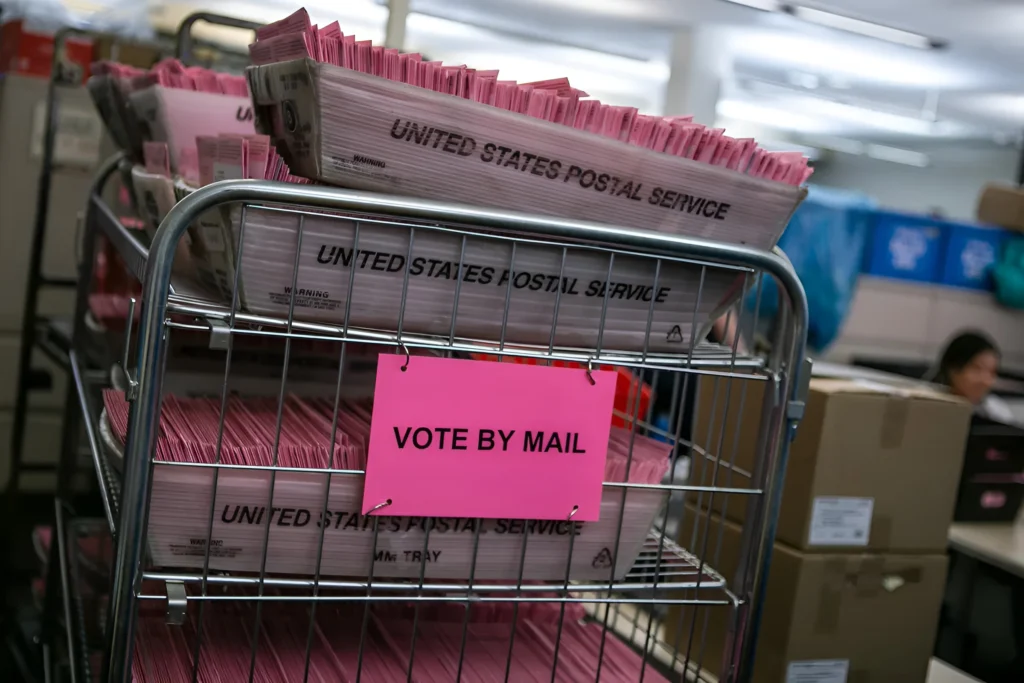
Justice Department actions against state election laws highlight growing national conflict over voter registration lists and mail-in voting security.

Mail-in voting is an established mechanism in the United States election system. It lets eligible citizens cast their votes by mail instead of going to the polling place on Election Day.

RELATED:
U.S. Justice Department Sues California Over Mail-In Ballots

Over the past decades, state governments have modified vote-by-mail laws to lower administrative costs, increase turnout, and provide alternative access for citizens who face logistical challenges on election days.

In this in-depth article, we will explore the history of mail-in voting, its characteristics, and why the current Trump administration has sought to alter this voting system.

History and the Rationale for Mail-In Voting

Remote voting in the United States dates back to the American Civil War (1861 – 1865). During this war, Union and Confederate soldiers who were away from their districts were permitted to submit written absentee ballots so that deployment would not disenfranchise them.

Throughout the 20th century, the mailing vote expanded beyond military personnel. State governments initially granted absentee ballots to civilians who were ill, physically disabled, or traveling for business on Election Day. Later, lawmakers introduced no-excuse absentee voting, which allowed registered voters to request a mail ballot without providing a specific reason.

In November 1998, Oregon became the first state to conduct all primary elections entirely by mail. By 2000, Oregon conducted the first mail-in presidential election in the U.S., achieving a registered voter participation of over 80 percent. Following Oregon’s model, other states, including Washington, Colorado, Utah, and Hawaii, transitioned to universal vote-by-mail systems after 2020.

Several practical factors explain the implementation of mail-in voting. For voters, it eliminates common obstacles associated with in-person voting, such as work, child care responsibilities, and long lines at precinct polling sites.

For the U.S. administration, state-wide vote-by-mail reduces the need for temporary poll workers, lowers equipment purchases for physical polling locations, and decreases operational expenses on election days.

A US judge declined to block President Trump's executive order tightening rules on mail-in voting, but left the door open for ‌the Democratic Party to challenge it again after the administration takes further steps to implement the measure https://t.co/VDZv3TJZdI pic.twitter.com/cGujpkjY4o

— Reuters (@Reuters) May 28, 2026

How Mail-In Voting Works and Its Security Record

Mail-in voting operates through structured legal protocols designed to maintain ballot security and track individual submissions. State election offices verify registered voter addresses and signatures, using databases before mailing official ballot materials.

After a voter completes their ballot, they can return it by U.S. Postal Service or place it in a designated local election drop box. Upon receipt, election workers process the ballot through signature verification procedures.

Empirical research shows that voter fraud in mail-in systems is extremely rare. Academic studies and data compiled by the Brennan Center for Justice indicate that the total rate of mail voting fraud over general elections averages 0.000043 percent, or roughly four cases for every 10 million mail ballots cast.

U.S. State election officials rely on barcoded envelopes, secure chain-of-custody procedures, and signature checks to prevent duplicate submissions and preserve election integrity.

Nearly 1,400 North Carolina voters are getting letters questioning their citizenship, all because the Trump administration's SAVE system flagged them.

The state elections board’s vague letter asks these voters to prove they’re citizens, even as the board acknowledges the system… pic.twitter.com/UJPyeLn0VM

— Democracy Docket (@DemocracyDocket) October 14, 2026

Institutional Mechanics and the 2020 Pandemic Pivot

Mail-in voting requires precise administrative coordination between state election agencies, postal services, and voters. When the U.S. implements universal mail-in voting or no-excuse absentee voting, election authorities cross-reference voter registration databases to ensure accurate residential addresses.

Once ballots are printed, they are mailed to registered voters with instructions, a secrecy sleeve, and a pre-paid or postage-guaranteed return envelope.

Security throughout this process relies on multi-step verification systems. When a voter completes their ballot, they place it inside the secrecy sleeve, seal it within the signature-required return envelope, and sign a legal affirmation printed on the exterior.

Election offices process these returned envelopes by running them through automated sorting machines and optical scanners that capture the voter’s signature. Bipartisan teams of election workers compare the signature against official registration records, such as state driver’s license files or original voter registration cards.

The COVID-19 pandemic in 2020 triggered a transformation in U.S. elections. To prevent viral transmission at crowded indoor polling places, numerous states rapidly expanded mail-in voting options, allowing millions of citizens to vote remotely.

According to reports from the MIT Election Data and Science Lab, the voters by mail grew to 46 percent nationwide in 2020, more than doubling the fraction recorded in 2016. Conversely, the share of voters casting ballots in person on Election Day dropped from 60 percent to 28 percent.

Following the pandemic emergency, several states, including California, Washington, Oregon, Colorado, Utah, Nevada, and Vermont, permanently codified universal vote-by-mail systems into law, establishing remote ballot delivery as a permanent fixture of their electoral infrastructure.

A US federal judge has blocked restrictions on mail-in voting backed by US President Donald Trump.

Judge Emmet Sullivan ruled the measures would likely violate a 2021 settlement requiring expedited handling of mail ballots by the US Postal Service.

🔗: https://t.co/WjD7kskdlx pic.twitter.com/PODqwc4YOb

— Al Jazeera English (@AJEnglish) July 1, 2026

Partisan Realignment, Demographic Realities, and the Red Mirage

The widespread adoption of mail-in voting reshaped traditional patterns of voter participation and introduced complex dynamics in how election results are reported. 

Despite assumptions that mail-in voting consistently favors a single political party, demographic and class analyses demonstrate that vote-by-mail systems benefit diverse working-class populations across the political spectrum.

Low-wage workers, hourly wage earners, agricultural laborers, and caretakers often lack the schedule flexibility required to stand in long lines during restricted polling hours.

Universal mail-in voting removes these temporal and economic barriers, facilitating participation for working families in both urban centers and rural conservative districts, such as in Utah and Montana, where mail-in voting has enjoyed long-standing bipartisan acceptance.

The differing timelines required to process mail-in ballots also created a phenomenon known as the “red mirage.” Because mail-in ballots require time-intensive signature verification, flattening, and manual extraction before they can be counted, many states process in-person votes first on election night.

This operational sequence frequently caused early vote counts to show a temporary lead for candidates who performed strongly among in-person voters, while subsequent processing of mail-in ballots altered vote totals over the following days.

This structural delay in reporting complete totals became a central focal point in post-election legal disputes and public debates over election administration.

🚨 JUST IN: Trump hints he could declare a national emergency for the midterms pic.twitter.com/YLdHlqyktS

— Republicans against Trump (@RpsAgainstTrump) August 11, 2026

Donald Trump’s Stance and Legal Action Against California

President Donald Trump has maintained a vocal opposition to mail-in voting. In public addresses, Trump has repeatedly alleged that universal mail-in voting systems lead to widespread election fraud and unfair outcomes.

Despite using absentee mail-in voting himself in past state elections, Trump argued throughout his campaigns and current presidency that expanding mail-in voting undermines public trust in election administration.

The Trump administration has taken direct executive actions aimed at curtailing mail ballot access. Policy changes and administrative decisions have altered operational procedures at the U.S. Postal Service, including adjustments to sorting equipment and delivery guidelines.

The Department of Justice filed a federal lawsuit targeting California’s election procedures. California established a universal mail-in voting model by enacting legislation requiring county election officials to send a mail ballot to every active registered voter in the state.

The lawsuit by the federal government argued that California’s system creates risks of unlawful voting and challenged state oversight of its official voter registration lists.

Specifically, the federal complaint alleged that California had failed to conduct proper voter roll maintenance, citing federal lists regarding individuals flagged as noncitizens who were sent mail ballots.

The lawsuit sought a court order to block state election officials from counting certain mail-in ballots ahead of the elections. In response, California state officials, including the Attorney General and Secretary of State, defended the legal validity of universal mail-in voting.

State leaders noted that California law relies on signature matching, secure drop-box monitoring, and continuous voter file updates to verify voter identity and maintain system integrity, while arguing that federal interventions violate laws restricting voter roll changes close to an election. Courts continue to review these challenges regarding federal authority over state-administered election laws.

.@SenatorSlotkin (D-MI) warns of President Trump using a national emergency "ruse" to gain American trust: "If you hear in the next 34 days that there is a new security threat… that somehow requires federal law enforcement or the military… an alarm bell should go off." pic.twitter.com/fFPyLjjJs6

— CSPAN (@cspan) September 30, 2026

Mail-in voting Also Shapes Results

Mail-in voting remains an essential tool in modern American election administration. From its origins, mail-in voting has provided voters with a flexible, low-cost option to participate in national and local elections.

While the expansion of vote-by-mail systems during the 2020 pandemic increased overall voter turnout, it also intensified political debate over election administration and security measures.

Although empirical data show that voter fraud in mail-in systems remains extremely rare, legal and political challenges, such as federal lawsuits targeting state mail-in procedures, continue to shape the discussion surrounding electoral access.

The ongoing debates over vote-by-mail illustrate a continuing effort to balance security with public access in the U.S. election system. As states enact laws to regulate, expand, or limit mail ballot procedures, the future of mail-in voting will remain a central topic in discussions about democratic participation and legal policy.


  •  

Trump administration sues California to block counting of alleged noncitizen mail ballots

The Trump administration sued California election officials Thursday, asking a judge to bar the state from counting mail-in ballots for next month's midterm elections from people the federal government has identified as "likely" noncitizens until their status can be confirmed.

  •  

What Happens When 2 Dan Sullivans Run for the Same Senate Seat?

Daniel J. Sullivan Jr. and Sen. Dan Sullivan (R–Alaska) in a side-by-side | Illustration: Dan Sullivan for U.S. Senate/Senator Dan S. Sullivan/Facebook

This year, Alaska held its primary elections on August 18.

As per a 2020 ballot measure, Alaska primary voters pick among all qualified candidates for a single office, regardless of party affiliation, and the top four then advance to the general election.

In the U.S. Senate primary, Republican incumbent Dan Sullivan won 41 percent of the vote, while former Rep. Mary Peltola, a Democrat, captured nearly 50 percent.

Dan Sullivan was also the distant third-place finisher—but in this case, it was Daniel J. Sullivan Jr., a retired schoolteacher who is also running as a Republican but is not the same person as Daniel S. Sullivan, the junior U.S. senator for the 49th state.

The presence of dual Dan Sullivans is a headache for Republicans, who have fought to keep Daniel J. off the ballot, concerned he would split their votes and cost their candidate his seat.

"Mary Peltola and Chuck Schumer know they can't beat Senator Sullivan on his record, so they're resorting to deceitful political maneuvers that attempt to trick Alaskans and buy a seat," a Republican spokesman told Fox News.

"We are looking into it," President Donald Trump said this week. "It's a disgrace." In fact, NBC News reported in July that the FBI and Department of Justice had launched an investigation "looking for possible wire fraud or a conspiracy to deprive Alaskan voters of a free and fair elections process, which could be a civil rights violation."

In August, the government apparently issued subpoenas, though Daniel J. later said he had not received anything.

But is what he is doing actually illegal? For that matter, should it be?

Carol Beecher, director of the Alaska Division of Elections, barred Daniel J. from the ballot in June after concluding that he was running "with the purpose of confusing or misleading the electorate and compromising the fairness of the ballot."

But a state superior court reversed that decision. "Despite the Division's assertion that Mr. Sullivan may be excluded from the ballot because he lacks 'good-faith,' there is no statute which provides such a criterion," wrote Judge Thomas A. Matthews. "The concept of 'good-faith,' or pure motive, or bona fide intent is simply absent." The Alaska Supreme Court agreed, keeping both Sullivans on the November ballot.

Granted, it seems extremely likely that Republicans are right, and Daniel J. is running specifically to hurt Daniel S.'s prospects.

"Campaign material metadata reveals that Amber Lee, a progressive consultant, authored a press release announcing [Daniel J.'s] Senate bid," WFMD reported in May.

Daniel J. told The New York Times that he was running as a moderate Republican in an attempt to steer the party away from its MAGA wing. But he also admitted that he had voted for the Democrat in the last three presidential races and for Peltola in her races for the U.S. House.

In Beecher's original order keeping Daniel J. off the ballot, she wrote that Daniel J. had asked to be identified as "Dan S. Sullivan" on the ballot, the same name as the senator's. (Alaska reporter Dermot Cole wrote in July that this was not true: Daniel J. wrote "Dan S. Sullivan" in an email to Beecher but followed up hours later to correct it to "Dan J. Sullivan.")

If Daniel J.'s goal truly is to mislead voters, then that is indefensible. But it's not clear that it's illegal, or whether it should be.

"I am not sure exploiting voter confusion about names is any worse than exploiting their ignorance about policy issues like crime, immigration, and health care," wrote George Mason University law professor Ilya Somin. "Trying to prevent such exploitation through criminal and civil liability is likely to violate the First Amendment. In addition, it would likely end up giving incumbent political leaders broad power to curb speech and control electoral campaigns that they cannot be trusted with."

"This is a case about someone running for office with impure motives who is lucky enough to have a name that could confuse some voters," agreed election law expert Richard Hasen. "I don't see how the government could criminalize his running for office for having impure motives. And if it could do so, then it could be a crime every time that the Republican Party backs a Green Party candidate, or Democrats support a MAGA candidate in a primary in the hopes that the candidate would be weaker against a Democrat in the general election. This stuff happens all the time."

But it's entirely possible that Alaska's ranked choice voting system will solve the problem on Election Day.

After the August open primary, the top four candidates compete on a ranked choice ballot, where voters list the candidates in order of preference. If no candidate gets an outright majority, then the lowest performer is eliminated, and every ballot that picked them first is retallied and applied to their second choice.

As long as every Alaskan who wants to vote for Dan Sullivan—either one—lists both Dan Sullivans as their first and second choices, then the system will take care of any confusion. In the (highly likely) event that Daniel J. does not capture a majority on the first ballot, his votes will be retallied and applied to their second choices. The only plausible hiccup is if Peltola, the Democratic candidate, wins a majority in the first round—in which case either Sullivan would have lost anyway.

Of course, Republicans have opposed the ranked choice system since Alaska adopted it. Former Gov. Sarah Palin, who ran against Peltola twice unsuccessfully, said ranked choice was "so weird" that "it results in voter suppression."

In a post last week on Truth Social, Trump called ranked choice voting "Corrupt" and said it "shouldn't be allowed in our Country."

"I just left Alaska, where we have a real bad thing," Trump said Wednesday at a campaign rally in Arizona. "They have the ranked choice voting, where you go into I guess some kind of a test tube or something, and they pick whoever the hell they want. That's another disgrace."

As ever, it's not clear what Trump was talking about. And despite Republicans' complaints, ranked choice voting works quite well: According to the American Bar Association, recent research finds that it "is an improvement over plurality voting with clear benefits in terms of representation, campaign quality, mobilization, and turnout." It also "encourages greater consensus building as well as more civil political campaigns," and voters find it easy to understand.

In the event that a political party finds itself, for example, with two Dan Sullivans on the ballot, ranked choice voting is a perfect solution. If only the party weren't so hostile to it.

The post What Happens When 2 Dan Sullivans Run for the Same Senate Seat? appeared first on Reason Magazine.

  •  

Justice Department threatens California with legal action over claim of noncitizens on voter rolls

The U.S. Department of Justice has threatened California with possible legal action over what it says are noncitizens believed to have received mail ballots for next month's midterm elections.

  •  

Party Leaders and Daily Sceptic Readers Hate the Idea – But Will Swing Voters Force the Right to Unite?

The Tories, Reform and Restore can't stand each other, but letting the Left win would be daft, argues Nick Rendell. Could fed-up swing voters force the Right's warring tribes to stop squabbling and get their act together?

The post Party Leaders and Daily Sceptic Readers Hate the Idea – But Will Swing Voters Force the Right to Unite? appeared first on The Daily Sceptic.

  •  

Qatargate: Greek Parliament lifts immunity of ND MP & ex EU Commissioner

Greek Parliament voted for lifting the parliamentary immunity of ruling New Democracy MP and former EU Commissioner Dimitris Avramopoulos on Thursday. The voting followed a relevant request by Belgian authorities investigating the so-called Qatargate and have issued an arrest warrant last June. Prior to the voting, 73-year-old Avramopoulos submitted a memorandum where he requested “the Plenary […]

The post Qatargate: Greek Parliament lifts immunity of ND MP & ex EU Commissioner appeared first on Keep Talking Greece.

  •  

Germany: Postal vate fraud suspected in retirement home ahead of pivotal Saxony-Anhalt election

Before a pivotal election that could potentially result in a state government ruled exclusively by the Alternative for Germany (AfD) in the German state of Saxony-Anhalt, a case of potential postal vote fraud is raising concerns.

A 74-year-old nephew of a 95-year-old resident with severe dementia has filed a criminal complaint after discovering that postal voting documents were requested and a ballot cast in her name at a Dessau retirement home – despite staff first telling him the papers had been destroyed. The case is now being reported in Welt, one of Germany’s largest newspapers.

The case involves the Marthahaus senior residence and centers on whether postal votes from residents who cannot meaningfully participate are being handled properly. The nephew, who acts as his aunt’s legal representative, said he routinely receives every letter and document sent to her, including advertising. When the postal voting materials for the Saxony-Anhalt state election never arrived, he asked the home’s director where these documents were located.

Last Thursday, the director directed him to a female staff member who was not on duty until the next day. On Friday, that employee stated she had collected the election documents sent to residents “and shredded” them, without consulting relatives or authorized representatives.

That account did not hold up. When the nephew inquired at the municipal election office, officials confirmed that postal voting documents had been requested on Aug. 10 using his aunt’s date of birth and that a vote had already been recorded. Staff showed him the application bearing his aunt’s “scribbled” signature. Data-protection rules prevented them from disclosing which party was marked.

The nephew described the home’s alleged actions as a “scandal.” He and his wife first noticed problems during the February 2025 federal election; during the current state-election campaign they again encountered “inconsistencies” and this time pursued them. The complaint against persons unknown has been obtained by reporters.

The Marthahaus did not answer written questions from the Ostdeutsche Allgemeine Zeitung and declined to comment when reached by telephone. City officials confirmed they were aware of the incident but provided no further details.

A second, still-unreported case has surfaced in Naumburg, according to German newspaper Junge Freiheit. A woman there said she “did not see any election documents for my mother.”

Her mother is “unable to give her own name.” She asked: “Who will vote for her and according to what criteria?”

The allegations come days before voters in Saxony-Anhalt go to the polls and add to the existing debate over how postal ballots are processed in care facilities, where many residents have limited capacity to express a political preference independently. Investigations will determine whether the documented vote was cast with proper authorization or constituted an unauthorized exercise of another person’s vote.

AfD would ban postal voting

One of the parties most opposed to postal voting is the AfD, which has argued that it is prone to fraud, especially in retirement homes. AfD co-leader Tino Chrupalla has previously called for an end to mail-in ballots. He discussed his concerns about this form of voting during a conference with top AfD officials in 2024.

“It is also the task of the opposition to always doubt what a government is doing or what happened in an election. That is also a legitimate right and that is a good thing. And I just really want to point out, and we will also question this, for example, the entire security for the legal storage of ballot boxes, some of which are not stored in a legally secure manner, where in some cases only one person or two have access to these ballot boxes,” he said.

🇩🇪 JUST IN: "I would ban postal voting."

Germany's AfD party is calling for an end to mass mail-in ballots for elections.

Party co-leader @Tino_Chrupalla points out suspicious activity in the elections in Saxony and Thuringia in this new @RMXnews video. pic.twitter.com/tKydzaqaVj

— Remix News & Views (@RMXnews) September 4, 2024

He went on to say that postal voting has been a concern in other elections and that these issues keep coming up. However, he also pointed to a problem plaguing other countries like the United States, which instituted mass mail-in ballots in the wake of the Covid-19 crisis, which has involved activists entering retirement homes and potentially manipulating vulnerable elderly voters.

In the case of Germany, Chrupalla stated, “We have also seen this in old and other election campaigns, such as the current campaigning in retirement and nursing homes, especially when the CDU and SPD campaign in these old people’s homes, which are run by Diakonie or Caritas, or go in and out there, and the AfD does not even get access to present their programs to the elderly. These are also things of influence that are not democratic in my opinion.”

Notably, both Diakonie and Caritas are run by the Protestant and Catholic churches, both of which have come out against the AfD, including expelling members of the party from the Church and calling for Germans to vote against them.

Chrupalla is calling for an end to postal voting, saying: “Personally, I would ban postal voting again. It has only been introduced as an exception or initiated in the Federal Republic of Germany. It is not the rule, it should not become the rule and it is not regulated by law in such a way that it is made the rule.”

The post Germany: Postal vate fraud suspected in retirement home ahead of pivotal Saxony-Anhalt election appeared first on Remix News.

  •  
❌