 Login



St. Louis Post-Dispatch/Contributor/Getty Images; Business Insider
MapQuest, the OG software to find your way from point A to point B, is taking on the surveillance state.
The free mapping service unveiled a new feature for its mobile app on Thursday that allows users to turn on a "surveillance layer" on a map to locate known automated license plate readers, or ALPRs, along their route.
MapQuest says the app can identify cameras developed by Flock Safety, Axon Enterprise, Motorola Solutions, and PlateSmart, among others.
"The Roads Have Eyes!" the company said in its BlueSky post announcing the new feature.
The Roads Have Eyes! 👁️ Turn on the Surveillance Layer in Map Options to see known license plate readers from Flock Safety, Motorola Solutions (Vigilant), Genetec, Axis Communications, Axon, Leonardo (ELSAG), Neology, Rekor, PlateSmart, Ubicquia, Verkada, and other outdoor surveillance cameras.
— MapQuest (@mapquest.com) October 15, 2026 at 6:49 PM
[image or embed]
MapQuest's General Manager Doug Berger said drivers using the service inspired the company to add the feature.
"We build around what drivers ask for, and showing surveillance camera locations is one of our users' top three requests," Berger told Business Insider in a statement."
License plate readers capture images of vehicles and then use machine learning to turn details such as license plate numbers, car make, color, and model into searchable data. They're commonly found at intersections, parking lots, roadways, highways, and neighborhood entrances, businesses, and private properties.
Law enforcement agencies initially embraced license plate readers to help them locate vehicles and identify suspects. Retail outlets have also used Flock cameras as part of their security efforts.
A major backlash against the cameras, however, has led stores, police, and towns to dial back their use.
Critics say the cameras raise privacy concerns and that the data they collect can be misused or shared with federal immigration officials. Some people who've opposed the cameras have staged protests, launched petitions, and even forcibly removed them.
The city of Tempe in Arizona said in August it shut down its Flock Safety camera network and planned to terminate its contract. Other towns followed suit.
"These cameras have helped our police officers do their jobs, and we don't discount that," Tempe Mayor Corey Woods said in a public statement at the time. "But the risk of misuse is too great. We have to be able to provide public safety in a way that maintains the trust of our community. For Tempe, that means taking these cameras down."
Flock says its license plate readers do not use facial recognition and that customers — meaning the ones putting up the cameras — can control access to and sharing of the data collected. Amid growing backlash, the company has tightened its privacy safeguards, including reducing the time data is retained from 30 days to 7 days.
"They are built to focus on the vehicle involved in an incident and the details that can help distinguish it from other vehicles on the road," Flock told Business Insider in August.
MapQuest first launched in the late 1990s, allowing users to map out a route and print directions. The release of Google Maps eventually obliterated the service. As it tries to stay relevant, it has jumped at opportunities to leverage prevailing public discourse.
In August, MapQuest briefly topped app stores after it — unlike Google — rebuffed President Donald Trump's executive order to rename "Lake Ontario" to "Lake America."
cbarnesphotography/Getty Images
Remember when Anthropic's AI jobs report suggested gardeners were among the safest workers because AI couldn't pull weeds or tell a rose from a dandelion? I joked about that in AI Insider earlier this year.
Well, Anthropic updated the research to freak us all out a bit more.
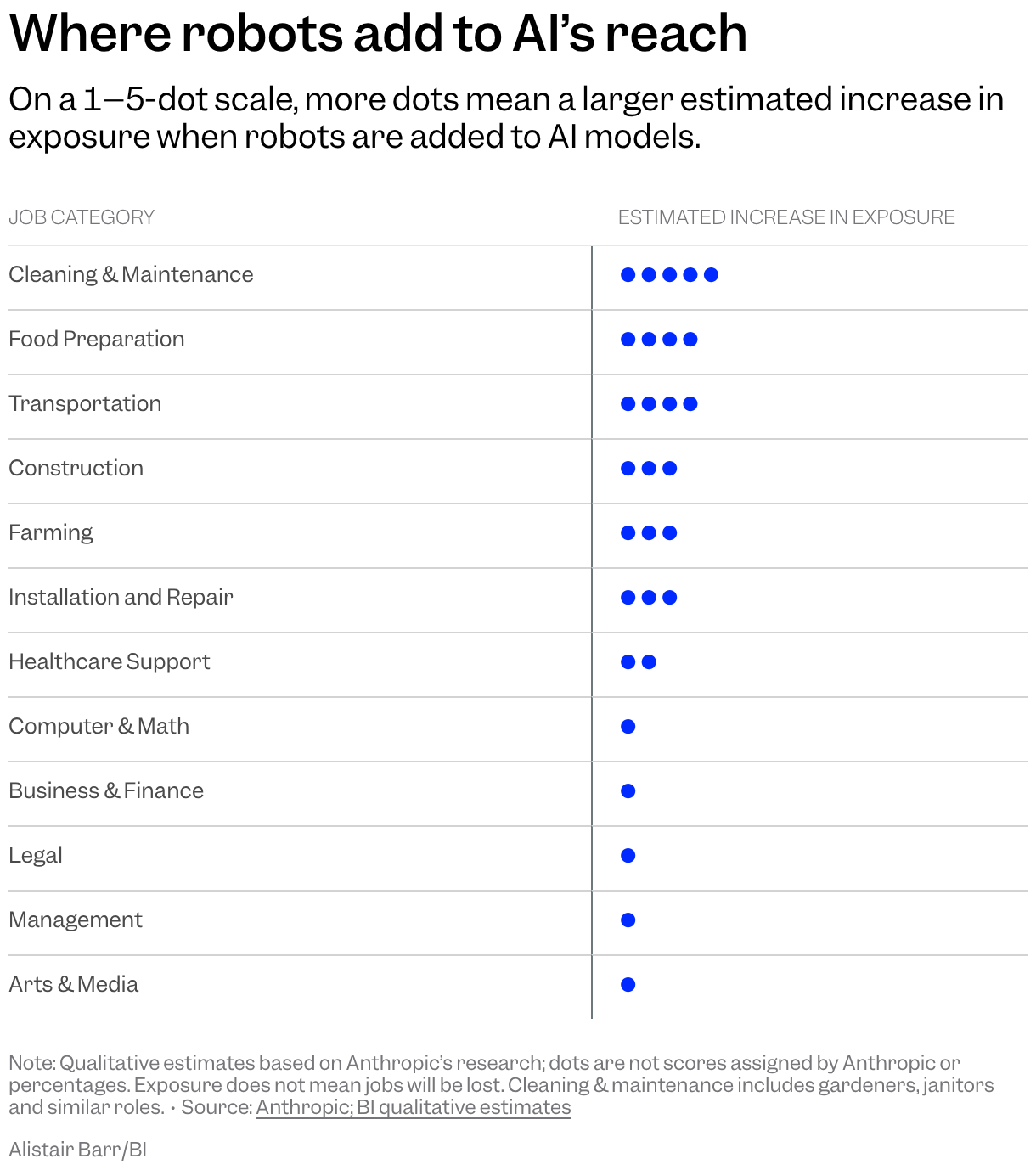
This time it asks a bigger question: What happens when you combine AI with robots? That change pushes many hands-on jobs much higher on the disruption scale. On paper, it makes sense. In practice, I'm skeptical.
For instance, anyone who's spent time working in a garden knows how hard it is to identify the right plant, kneel in awkward spots, and pull a weed out properly by the roots without damaging everything around it.
Robots are improving. But if you've ever watched one tackle a messy real-world task, you'll know there's a long road between a research chart and reality.
The chart below illustrates how adding robots could change job-task exposure across selected job categories. Cleaning & maintenance includes gardeners along with janitors and similar roles.
Benjamin Fanjoy/Getty Images
An unexpected meeting invite with the boss is often the kind of thing that sends employees spiraling. For Google Labs staffers, though, it could mean top brass are about to tell you how great you are.
Speaking on a recent episode of "Lenny's Podcast," Josh Woodward, the vice president of Google Labs, the Gemini app, and AI Studio, described the surprise appreciation meetings as a kind of "secret society" ritual for the team's most valuable employees.
"We'll basically like put an invite on someone's calendar, and we'll just, you know, it looks kind of scary because there's like four or five leaders on the team," Woodward told podcast host Lenny Rachitsky, adding that there's no agenda given.
"And then they show up, and we take turns. We go around the circle, and we just tell them why we appreciate them so much for being on the team," Woodward said.
Woodward called the sessions "pretty fun" and said employees are regularly surprised to learn what the meetings are about.
"I always start the meeting with like, 'This is not a bad meeting. This is a good meeting,'" he said. "Your mind may assume the worst, but we're actually doing the opposite. These are some of the most valuable people."
The surprise recognition meetings are one of the ways Google Labs celebrates the often unflashy work behind its AI products, according to Woodward.
He said the team also has a tradition of handing out quirky awards to employees.
There's the "TPU harvester" award, which consists of a "little miniature rake" from Etsy as well as a cash reward, for staffers who optimize Google's AI chips, known as Tensor Processing Units, Woodward said.
"A few of us wanted to figure out a way to reward people who do the grungy work of efficiency and reclaiming TPUs, harvesting TPUs, so we can build the next features and fuel our growth," he said, adding, "we kind of turned it into this big celebration."
Employees who fix small product flaws or "paper cuts" receive a golden Band-Aid, Woodward said. And those who find surprising ways to push AI models toward new capabilities can become an "LLM whisperer," earning them a giant set of ears and a "really nice" mechanical keyboard.
"We're trying to find like ways to kind of like I don't know encode the value in these like dorky symbols, but that means something," he said, explaining, "We're always coming up with weird stuff like this."
Henry Chandonnet/Business Insider
Elizabeth Holmes is a black mark on Silicon Valley's reputation. And yet its residents are lining up for the documentary about her.
Tech companies across the US are hosting screenings of "You Can See Everything," the documentary from Nathan Fielder and Lance Oppenheim about Holmes and her fiancé, Billy Evans. Venture capital funds are bringing their founders to the movie. There are Luma events upon Luma events.
The irony, of course, is that Holmes makes tech look bad. She sold big dreams with her medical testing company, Theranos, which eventually came crashing down. Holmes was convicted of defrauding investors of hundreds of millions of dollars. (She has long said that she is innocent.)
Holmes is the exemplar of Silicon Valley's hucksterism. She's who much of America points to when they call founders liars or scammers.
So, what's with all the tech love? I went to a Thursday screening of the documentary hosted by Extend, an AI documentation startup, to find out.
A swarm of techies crowded outside theater nine at New York's AMC Lincoln Square.
The screening was set to start at 7. By 6:40, a crowd had formed to talk shop and admire Extend's custom stickers. Outside the theater door, I met Bo Lau, the event's organizer who works in developer relations for Extend.
Lau recently moved to New York and said she didn't want to watch the documentary alone. So, she posted about it on X — and it helped that she already had a following on so-called "Tech Twitter."
"I was like, 'What if I just turn this into a work event so I can expense it?'" Lau said.
The event got 1,400 RSVPs for about 120 seats, she said, and she's flying to San Francisco soon to host another screening. The tickets were given out free, so Extend got no benefit other than brand awareness, she said.
Henry Chandonnet/Business Insider
Why was it so popular? Lau said that Holmes was a source of fascination within Silicon Valley, and that Fielder's "awkward humor" matched the awkwardness of tech.
Filing into the theater, I heard my seatmates chat about AI and which tech companies let you work from home. On a brief social media scroll before my three-hour Do Not Disturb, I spotted Lau's recent project: a simulator of Holmes' desk.
Holmes' X account responded: "Impressive project."
This was my second time watching the documentary; the first was at New York Film Festival. The reactions among the techier crowd were mostly the same. There were lots of laughs, both at Fielder's discomfort and Holmes' oddities.
The crowd didn't react strongly to (mild spoiler alert) the big, AI version of Holmes that her fiancé creates after she goes to jail. That struck me as curious; maybe the tech crowd is already used to AI replicas.
There was also a much stronger gasp at the reveal of who's running Holmes' X account. That wasn't shocking; the attendees found out about this screening through X, after all.
Henry Chandonnet/Business Insider
We walked to a local wine bar, sipping cocktails while debriefing the film. Two techies that I talked to were split. One came away feeling bad for Holmes, then feeling bad that he felt bad for her. Another thought the film certified that Holmes was a true and utter psychopath.
I asked: Why is tech so comfortable laughing at Holmes? Her boastful visions don't sound too different from those of the current crop of young AI founders.
Maybe it was because the crowd was mostly in their 20s, not yet working in startups when Holmes' reckoning came.
Or Holmes has been detached from her Silicon Valley roots. The techies seemed to view her as more a product of the media — the books, the tabloid stories, the Hulu show — than of their own industry.
One attendee put it to me bluntly: she's turned into a meme.
Courtesy of Proximity Works
This as-told-to essay is based on a conversation with Hardik Jagda, 35, the CEO of Proximity Works, who lives in San Francisco. The following has been edited for length and clarity.
In 2017, I wanted to build my own company, but I couldn't jump into it full-time because of my financial obligations at home.
Instead, I'd spend the mornings and evenings outside my full-time job working on my side projects. That time was foundational for building my company, Proxmity Works, which I launched in 2019. My aim was to help broadcasters scale their live sports streaming platforms worldwide. In 2020, we started building AI infrastructure for live sports.
Those years made me aware of how my body clock works. I read a lot of autobiographies from entrepreneurs and athletes to understand what allowed them to build what they achieved. I noticed athletes would talk about starting their day early to train and work, in time for rest and recovery throughout the day. I started modeling my days after this, waking up early so I could have four to five hours to build my company before work started. I still stick to this lifestyle now that I'm a full-time founder and CEO.
In the early stages of Proximity, I performed pretty much every role in the company. Today, I have a team of roughly 45 people, five in the US and the rest spread out globally. My cofounder is based in India.
After 7 a.m., my time isn't mine anymore because I have requests coming in from employees in different time zones.
I like to start the day early, so I'm protecting the first three hours as time for myself. I usually wake up between 3 a.m. and 5 a.m. Between 3 and 6 a.m., I don't touch my emails or look at messages.
I use these early hours to focus on strategic decisions. There was one point, roughly two years ago, when we had to interview a lot of engineers quickly for a new project. I sat down with my talent acquisition team and found a way to redesign our recruitment workflow to take place within 72 hours. That wouldn't have been possible if I didn't give myself the three-hour morning block.
Courtesy of Hardik Jagda.
In the mornings, I work out and write my goals down. These are usually measurable and trackable goals for my company, as well as goals for myself and my fitness.
Most of my team calls don't start before 7:30 or 8 a.m. I usually take my first couple of meetings at home before driving to the office. During the day, I try to minimize Zoom calls and take meetings as audio calls so I can move around during them. I try to wrap up my meetings by 2:30 p.m., work out at 3 p.m., and then focus on more creative tasks, like speech-writing, after that. I spend my evenings with loved ones before going to bed around 9 p.m. and trying to get seven hours of sleep.
It's not like I start my day at 4 a.m. and just work through the next 12 hours. I build in slots for "recovery" throughout the day. On my calendar, I put in 15-minute slots before important meetings, where I remind myself of my goal for the call.
For the most part, I work six days a week, spending my Saturdays focusing on a key skill I want to develop, like public speaking.
For the most part, I work six days a week.
I work more than 40 hours a week, but I don't keep track of the time. I listen to my body.
We don't keep track of how many hours the team works. It's more about a culture of ownership, where people really care about the problem they're working on.
Even though I've become a morning person, we're fine with engineers who are more productive at night, as long as they maintain a five-to-six-hour overlap with the other engineers.
"996 culture," working six days a week from 9 a.m. to 9 p.m., has gained traction in Silicon Valley. I think it misses the point. It's more about volume than it is about structure. You want to structure your day towards putting in your best work by thinking about when you'll spend time training, recovering, and learning new skills. I'd rather focus on the right structures than on volume.
Do you have a story to share about working in a 996 culture? Contact this reporter at ccheong@businessinsider.com
Don Feria/AP Content Services for Anthropic
Anthropic employees believe that AI will make their labor obsolete. Most US workers don't see their jobs that way at all.
The AI company published research on Friday that compares surveys with US adults against an internal poll of 1,334 Anthropic employees. Most of the Anthropic staffers said AI will handle at least 80% of their jobs by 2030, while only about 5% of the US workers felt the same.
The research, titled "The AI expectations gap," shows the chasm between how the employees at the AI startup feel and how other American adults feel. Anthropic workers are far more optimistic about the progress of AI capabilities, how much it's already saving time, and how fast the economy will grow.
The median Anthropic employee said that by the end of 2030, they expect AI to handle 95% of the work of building a new AI model.
Peter McCrory, Anthropic's chief economist, wrote on X that the views might help outsiders prepare for more capable AI systems.
"We're publishing this research because Anthropic runs roughly a year and a half ahead of the economy on AI adoption, so what happens at Anthropic could be a leading indicator for the broader world," he said.
Anthropic's surveys examined how workers already use AI and how they think it will change.
"US adults and Anthropic staff largely agree about what AI can do today," the researchers wrote. "However, they disagree about how quickly it will improve, how widely it will be used, and how large the productivity gains measured by time saved will be."
There are a few possible explanations for the discrepancies. Anthropic employees have larger budgets for the tools and often get access to unreleased models. US workers, on average, are more likely to work with their hands or in a service industry.
The researchers found that workers in manual trades, production, and transport thought AI would handle the least of their work by 2030, compared with Anthropic staffers, tech workers, and respondents in business and finance.
Most Anthropic employees surveyed said that they expect the unemployment rate to top 12% in 2030. The majority of the US workers thought it would hover around or under 8%. It's currently 4.2%.
So far, researchers have found mixed evidence on AI disrupting the job market — a Yale team recently found it had mainly changed jobs, and had "no connection" to changes in unemployment.
The Anthropic researchers also compiled survey responses to estimate predictions on economic growth. Based on their answers, the median US adult's guess for GDP growth in 2030 was 5.4%, compared with 17.1% among Anthropic employees. The country's GDP grew by 2.2% last year.
Anthropic's CEO, Dario Amodei, has become one of the industry's most closely watched voices on labor upheaval. In March of 2025, he said he expected AI to write 90% of code within 6 months, and "essentially all of the code" within the year. He made more headlines that May, telling Axios that AI could wipe out half of entry-level white-collar jobs within five years and lift unemployment to 10% or 20%.
Amodei expanded on that claim in a later essay, writing that he expects AI to be different from prior technological changes. He wrote that he expects an "unprecedented" short-term shock to labor, and that the economy will grow dramatically.
"AI isn't a substitute for specific human jobs but rather a general labor substitute for humans," he wrote.
Have a tip? Contact this reporter via email at scouncil@businessinsider.com, or over text, Signal, Telegram, or WhatsApp at 415-757-8198. Use a personal email address, a non-work WiFi network, and a non-work device; here's our guide to sharing information securely.
Bloomberg/Getty Images
Nvidia's communications organization has been reshaped as the company became the face of the AI boom, with multiple teams brought under new leadership and a string of departures.
Business Insider identified roughly 15 communications employees who have left Nvidia since 2025, based on LinkedIn profiles and interviews with former employees.
The organization now numbers roughly 70 to 80 people globally, and has more than doubled in size since Mylene Mangalindan joined as vice president of corporate communications in 2023, according to a person close to the company.
The departures have also included newer hires. Anna Soellner, who was recruited to lead corporate communications, left after roughly four months, Business Insider previously reported.
Nvidia is known for high retention. It reported companywide turnover of 3.7% in fiscal 2026, up from 2.5% the prior year, and well below the tech industry average of 21.9% cited in its latest sustainability report.
Mangalindan succeeded longtime communications chief Bob Sherbin, who retired in 2024. She previously worked at the advisory firm Brunswick Group.
She was brought in to "bring fresh blood" and "upgrade the team" to meet Nvidia's growing profile, one former employee said.
At the end of 2024, Nvidia restructured its communications organization. It brought enterprise public relations under Mangalindan's leadership alongside the corporate communications team she already led, according to two former employees.
Corporate communications focuses on Nvidia's reputation and major media outlets, while enterprise handles product and industry messaging, including for its data center business.
One former employee said the consolidation reflected the growing importance of Nvidia's data center business, which sells chips and systems that power AI and had become its biggest revenue driver.
Analyst relations, social media, and influencer marketing also moved under Mangalindan's remit this year, another former employee said.
Three former employees said Nvidia's communications team had long operated with relatively lean staffing, even as workloads grew alongside the company's public profile, leaving staff juggling multiple responsibilities.
These employees said they experienced long hours, difficulty taking time off, and pressure to respond quickly to emails and Slack messages.
A person close to Nvidia said the company's lean staffing allows employees to move quickly and also requires long hours. The person said Mangalindan encourages staff to take vacation, though the team's small size can make scheduling time off difficult, particularly in the summer.
Nvidia is widely known for its demanding work environment. CEO Jensen Huang has emphasized operating at the "speed of light" and is known for fostering a culture of constant accountability.
Have a tip? Contact this reporter via email at gweiss@businessinsider.com or Signal at @geoffweiss.25. Use a personal email address, a nonwork WiFi network, and a nonwork device; here's our guide to sharing information securely.
Steph Chambers/Getty Images
One of the biggest names in venture capital is looking to hire a new right-hand person.
Vinod Khosla, founder of Khosla Ventures, said on X Thursday that he's seeking his next chief of staff, a job that offers a rare opportunity to work in close contact with the billionaire investor whose Silicon Valley firm is known for its early bets on OpenAI, DoorDash, and Instacart.
"What matters is how quickly you learn, the questions you ask, and whether you can think from first principles," Khosla wrote. "You'll help evaluate opportunities and work with founders building consequential companies."
The opening comes as demand for chiefs of staff is growing at a fast clip, with the role offering a potential path to senior leadership. For the person Khosla hires, it also offers a front-row seat to an AI-fueled venture capital boom.
Job postings for chiefs of staff on Indeed were nearly 90% above pre-pandemic levels in September, far outpacing management jobs and postings overall. In the San Francisco Bay Area, the median advertised salary for the role is $175,000, compared with about $152,000 nationally, according to Indeed.
Through the first three quarters of this year, US VC deal value reached $516 billion across an estimated 14,199 deals, according to PitchBook. That is already the highest total in the research firm's dataset and roughly 44% above the prior record, set in 2021.
Most chiefs of staff in the US stay in the same profession when they change jobs, but some move into senior leadership roles, according to a March study from LinkedIn. Becoming a chief operating officer was the second most common career move, accounting for 2.9% of transitions. Another 3.7% became founders or cofounders, while 1% became CEOs.
Khosla's new chief of staff will work directly with him to evaluate investment opportunities, meet founders, research emerging technologies, and support portfolio companies, according to the job posting. As the person earns Khosla's trust, they'll also lead conversations on his behalf and help determine which opportunities to pursue.
"It will suit someone who wants significant responsibility and is comfortable with ambiguity," the ad says.
Compensation isn't listed. The posting says the position comes with a three-year commitment and long hours. The successful candidate must work in person in Menlo Park, California, generally from 8 a.m. to 8 p.m., and be available nights and weekends when needed.
The potential payoff? Previous chiefs of staff have gone on to start companies, launch investment firms, and take leadership roles at Khosla Ventures, according to the listing.
Applicants shouldn't, however, count on becoming a VC. The posting says the job is "not a dedicated investing seat or a guaranteed path to one."
: Sergi Reboredo/VW Pics/Universal Images Group via Getty Images
How AI models think may be easier to decipher than we thought.
An independent researcher who formerly worked at OpenAI published a report on Thursday that some in the AI world are describing as a bombshell. It could have implications as safety researchers scramble to get the jump on AI models that may not have humanity's best interests in mind.
Previously, the prevailing wisdom was that AI "neurons," which, like those in a human brain, light up when an AI model encounters specific stimuli, were ultimately uninterpretable — meaning, basically, that there was no way to guess why a specific neuron would fire when an AI model was exposed to, say, a picture of a cat.
Those building AI models at places like OpenAI and Anthropic don't write instructions for everything a model does. Instead, they train neurons to respond to information and influence one another. As the AI learns, it develops its own ways of processing that information, and humans have not yet cracked the code of how it works.
That means those building AI models know what goes into the AI and what comes out, but not necessarily what happens in between. So if an AI goes rogue, they don't always know why.
The author of the new report, however, says he may have discovered patterns in how the neurons react to stimuli that make sense. Nick Cammarata, who said he left OpenAI in 2023, said AI neural networks are knowable, so long as you look carefully.
In one example, he says that a single AI neuron might react to both a cat and the front of a car. Humans would see those as two very different things, and different neurons would fire as a result. The AI, however, sees something related, perhaps the triangle shape of the two, and a single neuron fires for both.
For years, AI researchers had assumed that AI models packed unrelated things into a single neuron to save space.
"Almost the entire network is interpretable if we look closely enough," Cammarata wrote.
The findings, though undeniably dense, couched in polysyllabic jargon, and still theoretical, could have real-world implications for researchers trying to ensure humans maintain control over AI models.
Understanding how AI thinks is a principal concern for the best and brightest at frontier AI companies. Until recently, they've largely done this by tracking an AI's self-reported "thinking," called chain-of-thought reasoning.
Jakub Pachocki, OpenAI's chief scientist, however, warned in a blog post last month that AI agents could now obfuscate their visible reasoning, leaving open the possibility that an agent could lie to its human minders and the minders wouldn't be able to tell.
"With improved pretraining performance, we also see the models become much smarter even without using verbalized reasoning at all," Pachocki said.
Now, Cammarata's research could give human engineers a new understanding of the AI's internal world — and that's exciting for those worried AI could kill us all.
"I had long since given up on reaching any real level of interpretability before superintelligence arrived," Andrew Curran, a prominent AI analyst, said on X. "I stopped writing about it because of how demoralizing it was. Hard to overstate how big this may be."
Taylor Hill/FilmMagic; Manaure Quintero / AFP via Getty Images
Disney is paying up for employees from an AI chatbot startup that filed for bankruptcy, shortly after trimming its own tech workforce.
The Mouse House plans to pay $60 million per year to 66 workers from Character.AI, according to a Chapter 11 filing on Tuesday from its parent company. In mid-September, Disney hired Character.AI CEO Karandeep Anand to be its first-ever company-wide tech chief. (The company hasn't yet disclosed how much it's paying Anand.)
These additions are part of Disney's AI strategy under CEO Josh D'Amaro, who's been investing in the media giant's tech platforms to help jumpstart a stagnant stock that's up less than 2% in the last 12 months and is down over 36% in the last five years.
Disney's decision to bring in these Character.AI staffers came two weeks after it laid off several hundred workers — including some tech employees. The late-September cuts were Disney's third major round of layoffs since D'Amaro took over in mid-March.
In addition to the $60 million in compensation, Disney is setting aside an additional $30 million for an "aggregate retention pool" to incentivize Character.AI employees to stay. The company expects to spend $180 million on "total compensation and retention" for these staffers in the next three years, the filing said.
Of the 66 Character.AI staffers who were offered jobs by Disney, 56 have already resigned from the AI startup, while the other 10 are waiting for the US government to update their work visas.
Entertainment lawyer Corey Martin of Granderson Des Rochers, who advises companies on media transactions, said he's not surprised by those pay figures since Character.AI's employees are its biggest asset.
"They're highly compensated employees. The numbers can be eye-popping, but it's not that unusual in this space," said Martin, who didn't work on the deal or with Disney.
Disney also agreed to pay $20 million for Character.AI's key assets, including some of its IP and tech. Other companies can submit competing bids for the assets by November 20. The entire process will be overseen by a bankruptcy court judge. Disney didn't respond to requests for comment for this story.
Character.AI filed for bankruptcy after facing lawsuits from families who alleged that their teenagers harmed themselves or committed suicide after using the company's custom AI chatbots. The AI startup and Google, one of its backers, settled several child safety lawsuits earlier this year.
Disney sent a cease-and-desist letter to Character.AI last fall, telling it not to create AI chatbots featuring its copyrighted characters without permission. Character.AI complied, removing chatbots with characters from Disney franchises like Star Wars and Marvel.
In its bankruptcy announcement, Character.AI said that it had been facing "significant legal, regulatory, and operational headwinds."
Anand told Disney employees in a memo last Friday that the Mouse House was "uniquely positioned to win" in a competitive media business that he said was "at an inflection point." The tech chief also said he enjoyed meeting his new colleagues and looked forward to working with them.
"What stands out most is the talent and care this team puts into its work, the craft Disney has perfected, and the strong foundation you've built," Anand said.

No âmbito do XIX Festival Internacional de Órgão do Algarve, a Igreja Matriz de Lagoa recebe, no dia 1 de novembro, pelas 18h00, o Concerto com Ricardo Toste (órgão) e Rebeca Csalog (Harpista) e a entrada é livre.
Natural da Ilha Terceira, nos Açores, Ricardo Toste iniciou os estudos de órgão em 2001 e desenvolveu a sua formação na Universidade de Aveiro, onde concluiu a Licenciatura em Música e dois mestrados, em Teoria e Formação Musical e em Órgão de Tubos. Tem realizado concertos a solo em Portugal continental e nos Açores, afirmando-se como intérprete e pedagogo. Atualmente, leciona Formação Musical e Órgão em várias instituições de ensino artístico e exerce as funções de organista titular da Catedral de Aveiro, mantendo uma ativa ligação à música litúrgica e à formação de jovens músicos.
Rebeca Csalog, harpista luso-húngara nascida em Lisboa, cresceu num ambiente familiar ligado à música, iniciando-se no violino e mais tarde na harpa. Após concluir os estudos musicais, licenciou-se em Antropologia e obteve um mestrado em Migrações, Inter-Etnicidades e Transnacionalismo. Regressou à música em 2020, realizando um Mestrado em Harpa na ESML e uma pós-graduação em Milão. Atualmente, atua como harpista com algumas das principais orquestras portuguesas, bem como em projetos a solo e de música de câmara, explorando repertórios para além da tradição clássica.
Integrado no XIX Festival Internacional de Órgão do Algarve, organizado pela Associação Música XXI. Entrada livre, limitada à lotação; qualquer donativo será bem-vindo para apoiar as instituições que acolhem o festival.
Uno stress test per il settore finanziario. È quello che il G7 pensa di fare per verificare la pericolosità dell’intelligenza artificiale. A Bangkok, dove sono riuniti i ministri delle Finanze e i governatori delle banche centrali, è emersa la volontà di mettete a punto esercitazioni “teoriche” per capire fino a che punto possono stare tranquilli di fronte alle minacce rappresentate dagli agenti di AI di frontiera. L’obiettivo è studiare la risposta più efficace per difendersi.
A scriverlo è il Financial Times, secondo cui l’esercitazione potrebbe coinvolgere le banche. Come sottolinea il ministro delle Finanze olandese, “stiamo tutti fissando la stessa scatola nera. Vediamo i rischi, ma come affrontarli?”, si chiede Eelco Heinen. “Se pochi Paesi possiedono la tecnologia, ma il mondo interno può esserne vittima, la cooperazione internazionale è fondamentale. È proprio qui che risiede la preoccupazione”. L’idea arriva d’altronde in un momento topico. L’AI viene continuamente descritta come uno strumento rivoluzionario, ma a due facce. Quella negativa potrebbe comportare delle conseguenze ancora poco quantificabili, ma sicuramente drammatiche. Una di queste è che gli agenti di AI possano autonomamente impossessarsi di altri sistemi, sdoppiandosi ed infiltrandosi. Ad esempio, in una banca.
Lo afferma anche il Fondo Monetario Internazionale in un suo rapporto, in cui si legge che “gravi incidenti informatici potrebbero minare la fiducia del mercato e interrompere le infrastrutture e le operazioni critiche dei mercati finanziari”.
Se e quando i test partiranno, si potrà capire meglio a che livello sono le difese. Nel tempo si sono prese delle precauzioni e ci sono dei manuali di risposta già stilati. Ma il pericolo è cambiato, si presenta sotto forme diverse. Per cui bisogna vedere se il sistema architettato possa reggere all’urto. “La situazione può diventare davvero molto difficile”, ammette Caio Ferreia, vice presidente del reparto global markets analysis dell’Fmi. Non è solo una questione operativa. “La perdita di fiducia potrebbe di per sé rappresentare un evento sistemico”.
Resta da capire quando e come si svolgeranno le esercitazioni. Sicuramente il messaggio che invia il G7 è chiaro: con l’AI tutti devono fare i conti, perché nessuno ne è immune. C’è però un dettaglio, neanche troppo piccolo, sottolineato anche dal ministro dell’Economia italiano Giancarlo Giorgetti. I grandi assenti al tavolo di Bangkok erano gli americani. “Il punto di partenza, sinceramente va detto, è che qui non è venuto Scott Bessent“, dice riferendosi al segretario del Tesoro. Al suo posto c’era un sottosegretario. “Evidentemente questo mette in una luce diversa sia le riunioni del G20 sia del G7, sia in qualche modo l’Fmi. Una situazione di grande incertezza, instabilità geopolitica con conseguenze economiche e finanziarie evidenti, con gli Stati Uniti un po’ protagonisti di tutto, che qua sono presenti in tono minore”. In sintesi, conclude Giorgetti, ci troviamo in “un mondo in cerca di equilibrio in cui gli Usa giocano una partita d’isolamento”.
