
❌

Reading view

AI companies scraped the web. Now they want to learn how you work.

An office in action before the rise of generative AI.

Kirn Vintage Stock/Corbis via Getty Images

  • A version of this story originally appeared in the AI Insider newsletter.
  • Sign up for Business Insider's weekly AI Insider newsletter here.

AI companies have already scraped much of the web. Now they're chasing something even more valuable: data that shows how humans actually work.

That's the focus of Business Insider's new series, The AI Data Grab. This week, we published three stories showing how the race for workplace data is accelerating.

One piece, from Charles Rollet, Tom Carter, and Stephen Council, examines the booming market for company records. AI firms are offering businesses six- and even seven-figure sums for anonymized Slack messages, emails, presentations, and internal documents.

The goal is to teach AI systems how people solve problems, collaborate, make decisions, and complete long, multi-step tasks. Those real-world workflows are becoming the fuel for the next generation of AI agents.

Another story, from Melia Robinson, explores how law firms are building AI systems around decades of legal knowledge, turning their own experience into a competitive advantage rather than relying solely on off-the-shelf AI models and tools.

A third piece, by Rya Jetha, reveals how AI companies pay people to record real-world work, such as cooking dinners and packing warehouses, to teach robots how humans perform everyday physical tasks.

Together, these stories point to a major shift in AI development. The first wave of generative AI was mostly about bigger models and faster chips. The next chapter is about machines understanding how work gets done, so AI can help us do it better and quicker.

Sign up for the AI Insider newsletter here. Reach out to me via email at abarr@businessinsider.com
Read the original article on Business Insider

  •  

When AI and robots work together, Anthropic says these jobs are at risk. Should gardeners worry?

A gardener's gloved hands tend a wet flowerbed among tulips and other plants.
A gardener tends a flowerbed.

cbarnesphotography/Getty Images

  • Anthropic examined what might happen when AI and robots are combined.
  • That could put more hands-on jobs, including gardening, in the path of automation, Anthropic warned.
  • I'm skeptical that robots can handle the messy reality of pulling weeds.

Remember when Anthropic's AI jobs report suggested gardeners were among the safest workers because AI couldn't pull weeds or tell a rose from a dandelion? I joked about that in AI Insider earlier this year.

Well, Anthropic updated the research to freak us all out a bit more.

This time it asks a bigger question: What happens when you combine AI with robots? That change pushes many hands-on jobs much higher on the disruption scale. On paper, it makes sense. In practice, I'm skeptical.

For instance, anyone who's spent time working in a garden knows how hard it is to identify the right plant, kneel in awkward spots, and pull a weed out properly by the roots without damaging everything around it.

Robots are improving. But if you've ever watched one tackle a messy real-world task, you'll know there's a long road between a research chart and reality.

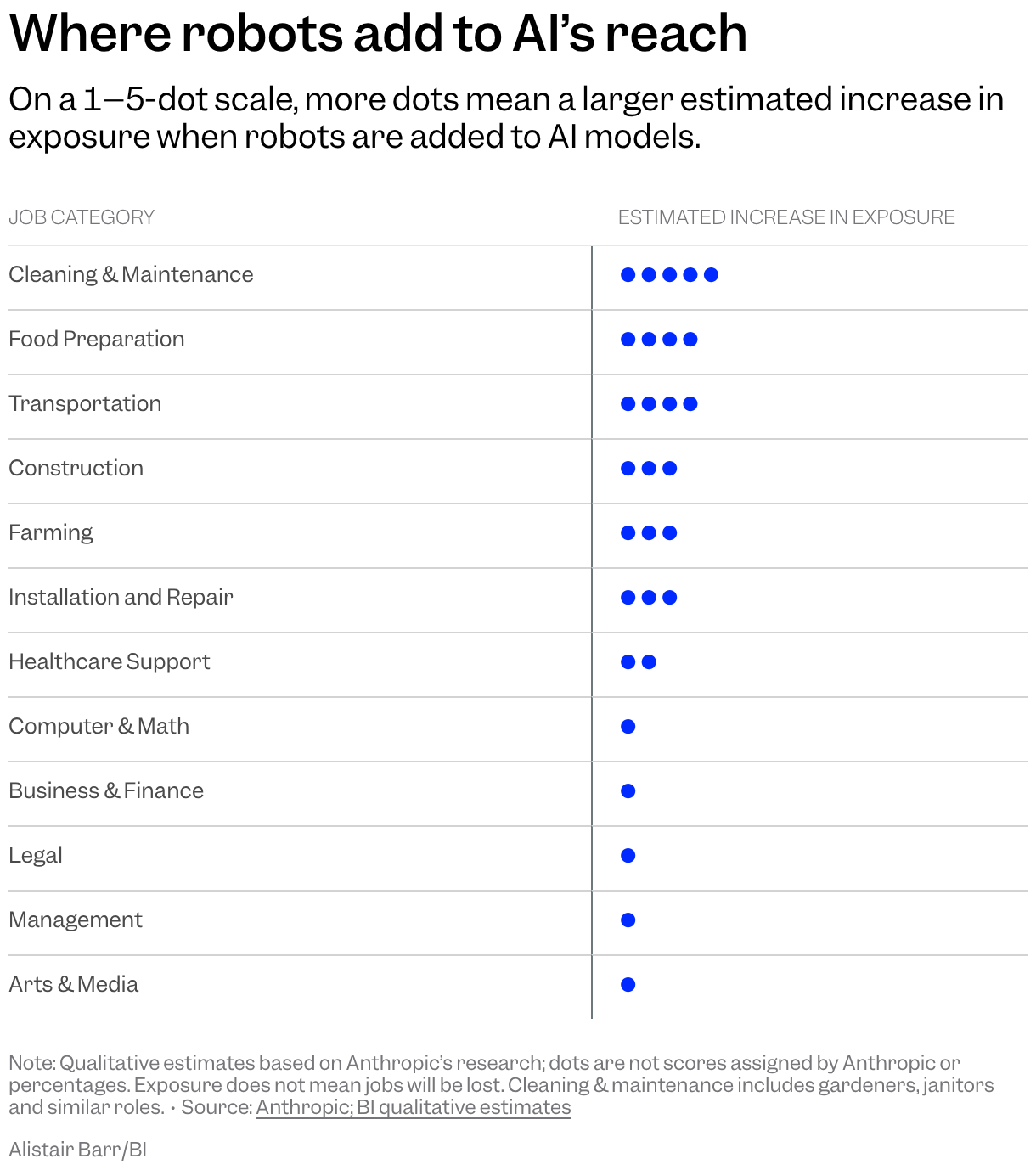
The chart below illustrates how adding robots could change job-task exposure across selected job categories. Cleaning & maintenance includes gardeners along with janitors and similar roles.

Qualitative estimates of added job-task exposure when robots are combined with AI models. Cleaning and maintenance: 5 dots. Food preparation and transportation: 4 each. Construction, farming, installation and repair: 3 each. Healthcare support: 2. Computer and math, business and finance, legal, management, arts and media: 1 each. More dots indicate a larger estimated increase. These are editorial estimates, not Anthropic-issued scores, percentages or job-loss forecasts.
Read the original article on Business Insider
  •  

OpenAI's Dots head says AI means workers now have a choice between doing less or more

Attendees go up and down stairs at OpenAI's DevDay conference on Sept. 29, 2026.
Attendees at OpenAI's DevDay conference on September 29, 2026.

Minh Connors/Bloomberg via Getty Images

  • OpenAI's Alexander Embiricos said the AI era gives a choice: work more, or work less.
  • He's in charge of Dots, the company's new always-on work assistant.
  • AI is often pitched as freeing up time. Embiricos responded to the idea that it might add more work.

As the competitive AI race pushes tech workers into long hours, the head of OpenAI's new Dots product says AI gives people another option: work a whole lot less.

Alexander Embiricos, who leads OpenAI's enterprise product and helms the new Dots agent tool, told a crowd at TechCrunch's Disrupt conference on Thursday that AI's capabilities have created something of a fork in the road for workers. You can grind to meet the moment. Or you can use AI to kick your feet up a little.

"We basically have a lot more choice now," he said.

Embiricos made the comments after a reporter asked about when AI systems will actually deliver more free time. The reporter shared an anecdote where an OpenAI employee used a ChatGPT mobile feature to work in their car and on a plane — not exactly liberated by the new tech.

Embiricos said that the moment has already arrived where a worker can "outsource" tasks to AI and do less work. Then again, some people are so excited about AI's potential that they feel like it's an "interesting, ripe moment" to put in extra hours.

"I think that's why a lot of people are motivated to work very hard right now. That includes myself," he said. "But I think actually there is this choice, and there's totally this other setup where you could delegate a ton more things."

OpenAI is billing its Dots tool as a workplace assistant, always on and capable of proactively handing tasks and sorting to-dos. Embiricos uses his Dot often in Slack, he said, engaging on various threads.

His perspective illustrates how early companies are in their journey to adopt AI tools. Most companies have not yet automated their work tasks, and many workers are still debating how much to use the tools. Early AI adopters, meanwhile, can sprint through some work that used to take days or weeks, especially in software engineering.

Embiricos summed up the situation he feels workers are in: "You either choose: do you expand the ambition of what you can do, or do you do less? I do think we're there."

Have a tip? Contact this reporter via email at scouncil@businessinsider.com, or over text, Signal, Telegram, or WhatsApp at 415-757-8198. Use a personal email address, a non-work WiFi network, and a non-work device; here's our guide to sharing information securely.

Read the original article on Business Insider

  •  
❌