AI companies have already scraped much of the web. Now they're chasing something even more valuable: data that shows how humans actually work.
That's the focus of Business Insider's new series, The AI Data Grab. This week, we published three stories showing how the race for workplace data is accelerating.
One piece, from Charles Rollet, Tom Carter, and Stephen Council, examines the booming market for company records. AI firms are offering businesses six- and even seven-figure sums for anonymized Slack messages, emails, presentations, and internal documents.
The goal is to teach AI systems how people solve problems, collaborate, make decisions, and complete long, multi-step tasks. Those real-world workflows are becoming the fuel for the next generation of AI agents.
Together, these stories point to a major shift in AI development. The first wave of generative AI was mostly about bigger models and faster chips. The next chapter is about machines understanding how work gets done, so AI can help us do it better and quicker.
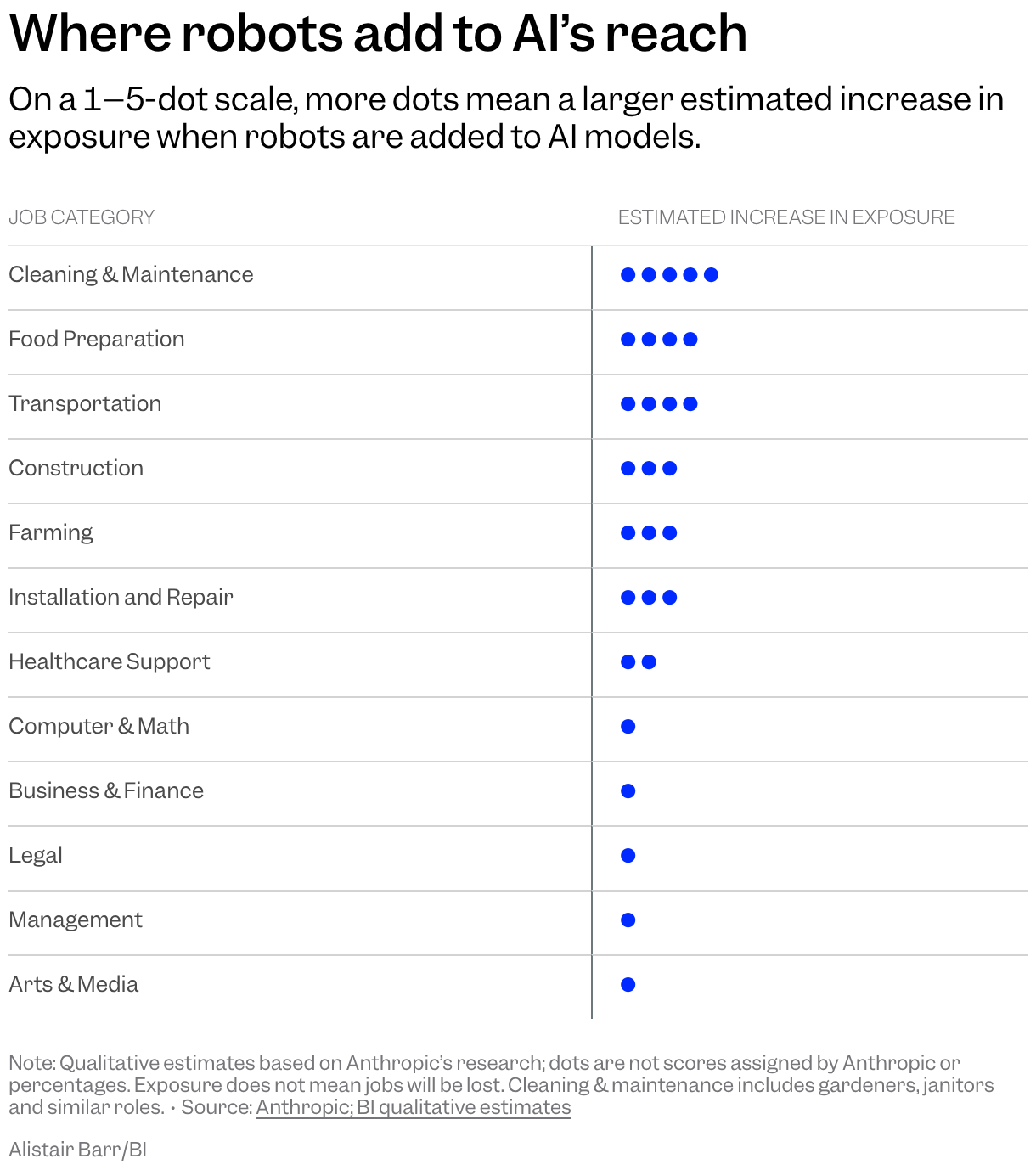
Anthropic examined what might happen when AI and robots are combined.
That could put more hands-on jobs, including gardening, in the path of automation, Anthropic warned.
I'm skeptical that robots can handle the messy reality of pulling weeds.
Remember when Anthropic's AI jobs report suggested gardeners were among the safest workers because AI couldn't pull weeds or tell a rose from a dandelion? I joked about that in AI Insider earlier this year.
This time it asks a bigger question: What happens when you combine AI with robots? That change pushes many hands-on jobs much higher on the disruption scale. On paper, it makes sense. In practice, I'm skeptical.
For instance, anyone who's spent time working in a garden knows how hard it is to identify the right plant, kneel in awkward spots, and pull a weed out properly by the roots without damaging everything around it.
Robots are improving. But if you've ever watched one tackle a messy real-world task, you'll know there's a long road between a research chart and reality.
The chart below illustrates how adding robots could change job-task exposure across selected job categories. Cleaning & maintenance includes gardeners along with janitors and similar roles.
Attendees chat at Anthropic's developer conference in May.
Don Feria/AP Content Services for Anthropic
Anthropic published new surveys comparing its staffers' sentiments to those of US workers.
The AI startup's employees expect the tech to change work and the economy far more dramatically.
Most Anthropic employees guessed that unemployment would top 12% in 2030.
Anthropic employees believe that AI will make their labor obsolete. Most US workers don't see their jobs that way at all.
The AI company published research on Friday that compares surveys with US adults against an internal poll of 1,334 Anthropic employees. Most of the Anthropic staffers said AI will handle at least 80% of their jobs by 2030, while only about 5% of the US workers felt the same.
The research, titled "The AI expectations gap," shows the chasm between how the employees at the AI startup feel and how other American adults feel. Anthropic workers are far more optimistic about the progress of AI capabilities, how much it's already saving time, and how fast the economy will grow.
The median Anthropic employee said that by the end of 2030, they expect AI to handle 95% of the work of building a new AI model.
Peter McCrory, Anthropic's chief economist, wrote on X that the views might help outsiders prepare for more capable AI systems.
"We're publishing this research because Anthropic runs roughly a year and a half ahead of the economy on AI adoption, so what happens at Anthropic could be a leading indicator for the broader world," he said.
Anthropic workers expect higher unemployment and extreme GDP growth
Anthropic's surveys examined how workers already use AI and how they think it will change.
"US adults and Anthropic staff largely agree about what AI can do today," the researchers wrote. "However, they disagree about how quickly it will improve, how widely it will be used, and how large the productivity gains measured by time saved will be."
There are a few possible explanations for the discrepancies. Anthropic employees have larger budgets for the tools and often get access to unreleased models. US workers, on average, are more likely to work with their hands or in a service industry.
The researchers found that workers in manual trades, production, and transport thought AI would handle the least of their work by 2030, compared with Anthropic staffers, tech workers, and respondents in business and finance.
Most Anthropic employees surveyed said that they expect the unemployment rate to top 12% in 2030. The majority of the US workers thought it would hover around or under 8%. It's currently 4.2%.
So far, researchers have found mixed evidence on AI disrupting the job market — a Yale team recently found it had mainly changed jobs, and had "no connection" to changes in unemployment.
The Anthropic researchers also compiled survey responses to estimate predictions on economic growth. Based on their answers, the median US adult's guess for GDP growth in 2030 was 5.4%, compared with 17.1% among Anthropic employees. The country's GDP grew by 2.2% last year.
Anthropic's staffers are following their leader
Anthropic's CEO, Dario Amodei, has become one of the industry's most closely watched voices on labor upheaval. In March of 2025, he said he expected AI to write 90% of code within 6 months, and "essentially all of the code" within the year. He made more headlines that May, telling Axios that AI could wipe out half of entry-level white-collar jobs within five years and lift unemployment to 10% or 20%.
Amodei expanded on that claim in a later essay, writing that he expects AI to be different from prior technological changes. He wrote that he expects an "unprecedented" short-term shock to labor, and that the economy will grow dramatically.
"AI isn't a substitute for specific human jobs but rather a general labor substitute for humans," he wrote.
Have a tip? Contact this reporter via email at scouncil@businessinsider.com, or over text, Signal, Telegram, or WhatsApp at 415-757-8198. Use a personal email address, a non-work WiFi network, and a non-work device; here's our guide to sharing information securely.
Brad Smith, the president of Microsoft, defended the company's use of visas and green cards.
Paulo Nunes dos Santos/Bloomberg via Getty Images
Microsoft President Brad Smith warned that US immigration policies could drive AI talent overseas.
"Let's not put that at risk," Smith said.
The Trump administration recently suspended Microsoft and other tech firms from a green card program.
If America wants to win the AI race, sending the world's brightest engineers packing might not be a winning strategy.
That's the warning from Microsoft President Brad Smith, who said the Trump administration's immigration crackdown risks driving the next generation of AI talent away from the United States.
"I think we should all be worried about sending intentionally or inadvertently or otherwise, signals that send the most talented next wave of AI software engineers to other countries rather than the United States," Smith said in an episode of Politico's "The Decoded Podcast" that aired on Thursday.
His comments come after the Trump administration announced last week that it was suspending Microsoft, Adobe, and several other technology companies from a federal program that sponsors foreign workers for permanent residency.
Vice President JD Vance accused Microsoft of abusing the Permanent Labor Certification, or PERM, program by laying off American employees while hiring lower-paid foreign workers.
Smith, who Business Insider reported was recently put in charge of Microsoft's communications, pushed back against those allegations, saying the administration had presented a misleading picture of Microsoft's hiring practices.
US Vice President JD Vance has criticized Microsoft's use of visa programs.
Daniel Heuer-Pool/Getty Images
"What was presented as Microsoft replacing 6,000 people who lost their jobs with 9,000 foreigners was frankly completely off base," he said.
Smith said most of the company's visa and green card applications concerned existing employees rather than new hires, adding that Microsoft had hired 9,200 American workers in its last fiscal year.
"That was left out of the narrative," he said.
He also rejected suggestions that Microsoft pays foreign workers less than their American counterparts, saying employees are compensated under the same system regardless of immigration status.
As part of our ongoing H-1B Fallout series, Business Insider previously reported that the Trump administration's shifting immigration policies have prompted some international workers to explore opportunities abroad, including in countries like the UK, Germany, and Canada.
An analysis of federal data by Business Insider found that certified H-1B applications fell 10% in the first nine months of fiscal year 2026 compared with the same period a year earlier. Applications for data scientists, however, rose 22.5%, highlighting continued demand for specialized AI talent.
On the Politico podcast, Smith cited immigrants' economic contributions as evidence of what America stands to lose.
He said that five of the six technology and science medal recipients recently honored by President Donald Trump had immigrated to the United States.
President Donald Trump awards tech execs and founders some of the country's highest scientific honors.
Win McNamee/Getty Images
According to Smith, the companies associated with those five individuals collectively represent more than a quarter of the S&P 500's market value.
Their contributions, he said, benefit not just technology employees but ordinary Americans whose retirement savings and pension funds are invested in those businesses.
"Think about what those five individuals have done for the well being, even the wealth and standard of living, of Americans across the country," Smith said.
Microsoft AI recently announced its latest model MAI-Base-2.
AI CEO Mustafa Suleyman compared the model to a similar offering from OpenAI.
Microsoft trained its model more efficiently than OpenAI, he said in an internal meeting.
Microsoft AI CEO Mustafa Suleyman told employees an in-house model was better than a similar offering from OpenAI, one of the software giant's biggest customers and partners.
"We now have a stronger pre-trained base model than the model that currently powers GPT 5.6 Sol," Suleyman said during a town hall meeting with employees on Thursday. "And in fact, we used one-quarter of the compute that OpenAI used to train their model."
Pre-training is the first stage of building an AI model, when it learns patterns from huge amounts of text, images, and other information. This takes massive amounts of expensive computing power, so Microsoft could save money if it's worked out a way to do this more efficiently.
Suleyman said Microsoft privately tested this model against OpenAI models, including one nicknamed "Spud" that powers GPT-5.6. He added that Microsoft's model performed better on tests measuring how well AI can understand and predict patterns in information.
The comparisons are based on technical information Microsoft has about OpenAI's models, Suleyman said.
"Privately and confidentially, we've also compared it to the OpenAI models," Suleyman told employees, while suggesting that Microsoft has special access to information on how OpenAI models perform.
It's notable that Suleyman would choose to highlight limitations of OpenAI models, even in private discussions. Microsoft has invested billions of dollars in OpenAI, and owns a stake in the startup that is likely worth more than $100 billion. Any criticism of OpenAI could potentially dent the value of this huge investment.
The two companies also have a major partnership, with Microsoft offering OpenAI models to its Azure cloud customers. Microsoft has used OpenAI models for its own products such as Copilot, too.
But the relationship between the two companies has frayed in the past year or so. Increasingly, Microsoft has tried to branch out from OpenAI, including by working on its own models.
Suleyman also said Microsoft's new AI model used "12 times less computation than was used for DeepSeek, for example, on compute efficiency."
Suleyman didn't specify which DeepSeek model, but a public blog post described the pre-training of MAI-Base-2 being a lot more efficient than a similar offering from the Chinese lab, called DeepSeek-V4-Pro-Base.
Microsoft in March created a new combined team for its commercial and consumer Copilot products and reassigned Suleyman to focus on building AI models in the company's superintelligence unit.
Microsoft declined to comment and OpenAI did not respond to a request for comment on Thursday.
Attendees at OpenAI's DevDay conference on September 29, 2026.
Minh Connors/Bloomberg via Getty Images
OpenAI's Alexander Embiricos said the AI era gives a choice: work more, or work less.
He's in charge of Dots, the company's new always-on work assistant.
AI is often pitched as freeing up time. Embiricos responded to the idea that it might add more work.
As the competitive AI race pushes tech workers into long hours, the head of OpenAI's new Dots product says AI gives people another option: work a whole lot less.
Alexander Embiricos, who leads OpenAI's enterprise product and helms the new Dots agent tool, told a crowd at TechCrunch's Disrupt conference on Thursday that AI's capabilities have created something of a fork in the road for workers. You can grind to meet the moment. Or you can use AI to kick your feet up a little.
"We basically have a lot more choice now," he said.
Embiricos made the comments after a reporter asked about when AI systems will actually deliver more free time. The reporter shared an anecdote where an OpenAI employee used a ChatGPT mobile feature to work in their car and on a plane — not exactly liberated by the new tech.
Embiricos said that the moment has already arrived where a worker can "outsource" tasks to AI and do less work. Then again, some people are so excited about AI's potential that they feel like it's an "interesting, ripe moment" to put in extra hours.
"I think that's why a lot of people are motivated to work very hard right now. That includes myself," he said. "But I think actually there is this choice, and there's totally this other setup where you could delegate a ton more things."
OpenAI is billing its Dots tool as a workplace assistant, always on and capable of proactively handing tasks and sorting to-dos. Embiricos uses his Dot often in Slack, he said, engaging on various threads.
His perspective illustrates how early companies are in their journey to adopt AI tools. Most companies have not yet automated their work tasks, and many workers are still debating how much to use the tools. Early AI adopters, meanwhile, can sprint through some work that used to take days or weeks, especially in software engineering.
Embiricos summed up the situation he feels workers are in: "You either choose: do you expand the ambition of what you can do, or do you do less? I do think we're there."
Have a tip? Contact this reporter via email at scouncil@businessinsider.com, or over text, Signal, Telegram, or WhatsApp at 415-757-8198. Use a personal email address, a non-work WiFi network, and a non-work device; here's our guide to sharing information securely.

 Login