❌

Reading view

Microsoft president warns Trump's immigration crackdown could drive top AI talent abroad

Microsoft's president, Brad Smith, at the International AI Summit in Dublin on October 14, 2026
Brad Smith, the president of Microsoft, defended the company's use of visas and green cards.

Paulo Nunes dos Santos/Bloomberg via Getty Images

  • Microsoft President Brad Smith warned that US immigration policies could drive AI talent overseas.
  • "Let's not put that at risk," Smith said.
  • The Trump administration recently suspended Microsoft and other tech firms from a green card program.

If America wants to win the AI race, sending the world's brightest engineers packing might not be a winning strategy.

That's the warning from Microsoft President Brad Smith, who said the Trump administration's immigration crackdown risks driving the next generation of AI talent away from the United States.

"I think we should all be worried about sending intentionally or inadvertently or otherwise, signals that send the most talented next wave of AI software engineers to other countries rather than the United States," Smith said in an episode of Politico's "The Decoded Podcast" that aired on Thursday.

His comments come after the Trump administration announced last week that it was suspending Microsoft, Adobe, and several other technology companies from a federal program that sponsors foreign workers for permanent residency.

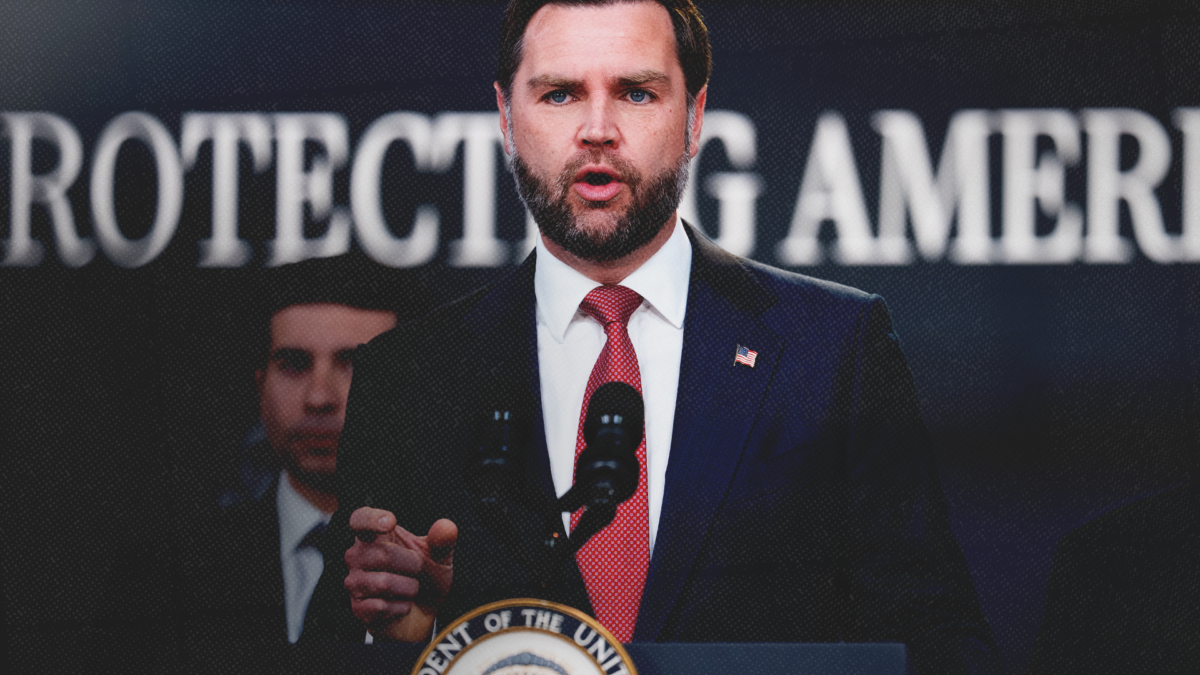
Vice President JD Vance accused Microsoft of abusing the Permanent Labor Certification, or PERM, program by laying off American employees while hiring lower-paid foreign workers.

Smith, who Business Insider reported was recently put in charge of Microsoft's communications, pushed back against those allegations, saying the administration had presented a misleading picture of Microsoft's hiring practices.

US Vice President JD Vance speaks during a midterm campaign rally at the LevelUp Training Complex
US Vice President JD Vance has criticized Microsoft's use of visa programs.

Daniel Heuer-Pool/Getty Images

"What was presented as Microsoft replacing 6,000 people who lost their jobs with 9,000 foreigners was frankly completely off base," he said.

Smith said most of the company's visa and green card applications concerned existing employees rather than new hires, adding that Microsoft had hired 9,200 American workers in its last fiscal year.

"That was left out of the narrative," he said.

He also rejected suggestions that Microsoft pays foreign workers less than their American counterparts, saying employees are compensated under the same system regardless of immigration status.

The American dream, on hold

The dispute comes amid growing uncertainty for skilled foreign workers in the US.

As part of our ongoing H-1B Fallout series, Business Insider previously reported that the Trump administration's shifting immigration policies have prompted some international workers to explore opportunities abroad, including in countries like the UK, Germany, and Canada.

An analysis of federal data by Business Insider found that certified H-1B applications fell 10% in the first nine months of fiscal year 2026 compared with the same period a year earlier. Applications for data scientists, however, rose 22.5%, highlighting continued demand for specialized AI talent.

On the Politico podcast, Smith cited immigrants' economic contributions as evidence of what America stands to lose.

He said that five of the six technology and science medal recipients recently honored by President Donald Trump had immigrated to the United States.

U.S. President Donald Trump (2nd-R) applauds as (L-R) CEO of Microsoft Satya Nadella, CEO of Dell Technologies Michael Dell, President and CEO of Advanced Micro Devices Lisa Su, Tesla and SpaceX CEO Elon Musk, Nvidia CEO Jensen Huang and Co-founder of Google and former President of Alphabet Sergey Brin pose for photos after being awarded National medals during the Golden Age of American Innovation Summit at the Institute of Peace on October 08, 2026 in Washington, DC.
President Donald Trump awards tech execs and founders some of the country's highest scientific honors.

Win McNamee/Getty Images

According to Smith, the companies associated with those five individuals collectively represent more than a quarter of the S&P 500's market value.

Their contributions, he said, benefit not just technology employees but ordinary Americans whose retirement savings and pension funds are invested in those businesses.

"Think about what those five individuals have done for the well being, even the wealth and standard of living, of Americans across the country," Smith said.

"Let's not put that at risk."
Read the original article on Business Insider

  •  

No, Giving Immigrants Research Jobs Is Not Fraud​

Vice President J.D. Vance | Aaron Schwartz - via CNP/Polaris/Newscom

Vice President J.D. Vance—who is heading the Trump administration's efforts to eradicate fraud—has set his sights on another alleged form of wasteful spending. 

Last week, Vance announced a probe into nine universities over alleged J-1 visa fraud as part of the Trump administration's broader crackdown on foreign worker programs. Vance's central complaint is that the named universities—which include Harvard, Stanford, and the Massachusetts Institute of Technology—are "employing J-1 visas for federally funded grants at a rate of about 61 percent" compared to the "national average of just 38 percent." 

"Something weird is going on at these universities," Vance added. "They're using these visas way too much. They're using them to undercut the wages of American grad students and American researchers, and it simply has to stop." Naturally, he figured that this warranted a fraud investigation.

Labor Department Inspector General Anthony D'Esposito, who is leading the investigation, had some harsh words for universities. "Improperly used J-1 visa classifications to avoid employment obligations, exploit taxpayer-funded programs, and undermine American workers will not be tolerated." He said, "I don't care how prestigious a university thinks it is. Break the law and screw the American people, and I will personally cuff you in the university square." He also raised concerns that universities were exposing American research to foreign adversaries, specifically China.

The press conference sounded more like an indictment of the J-1 program than of fraud. Unlike the H-1B visa—which allows employers to sponsor high-skilled foreign workers—the J-1 is more like an exchange program than a dedicated work visa; it doesn't require employers to pay the prevailing wage or visa holders to pay Social Security or Medicaid taxes within the first two years. Universities using the program to hire cheaper foreign labor is simply a feature of the program.

The real picture is much muddier than Vance cited figures suggest. The inspector general's announcement states that "approximately 61 percent of postdoctoral workers and researchers supported by federal grants at the nine universities are foreign nationals, compared to 38 percent at other universities." Foreign nationals could include H-1B holders and other visa categories, not just J-1s as Vance claimed. Additionally, the 38 percent figure comes from unspecified "other universities," rather than the national average.

D'Esposito had a fiery tone, but neither he nor Vance pointed to a single instance of a university breaking the rules. Their evidence is merely a statistic showing these schools, which are elite research institutions, hire a lot of foreign researchers. Vance's primary objection isn't that these universities have broken the law; it's that they are hiring foreigners instead of Americans, undermining his protectionist agenda.

Opposition to visa programs is, unfortunately, found on both the left and the right. In his first term, President Donald Trump enacted a slew of restrictions that complicated the H-1B visa application process and increased denial rates to 24 percent in FY 2018 (up from 6 percent in FY 2015).  In 2020, the administration was forced to rescind key policies behind those rising denials after a federal judge ruled they hadn't followed the required rulemaking process. In September last year, Trump imposed a $100,000 fee on H-1B petitions. A federal judge struck it down in June, saying it exceeds the president's authority and violates the separation of powers.

Other presidents have used federal power as leverage against higher education. But Trump's war on universities—including the freezing of federal funds for universities like Columbia and Harvard for alleged instances of antisemitism—is mostly unprecedented. These actions are indicative of a more enduring problem: Federal dollars come with federal influence, and as long as universities depend on federal funding, they will remain at Washington's mercy. If universities want lasting independence, the answer isn't to reduce their use of the J-1 visa. It's to get off the federal teat altogether.

The post No, Giving Immigrants Research Jobs Is Not Fraud​ appeared first on Reason Magazine.

  •  
❌