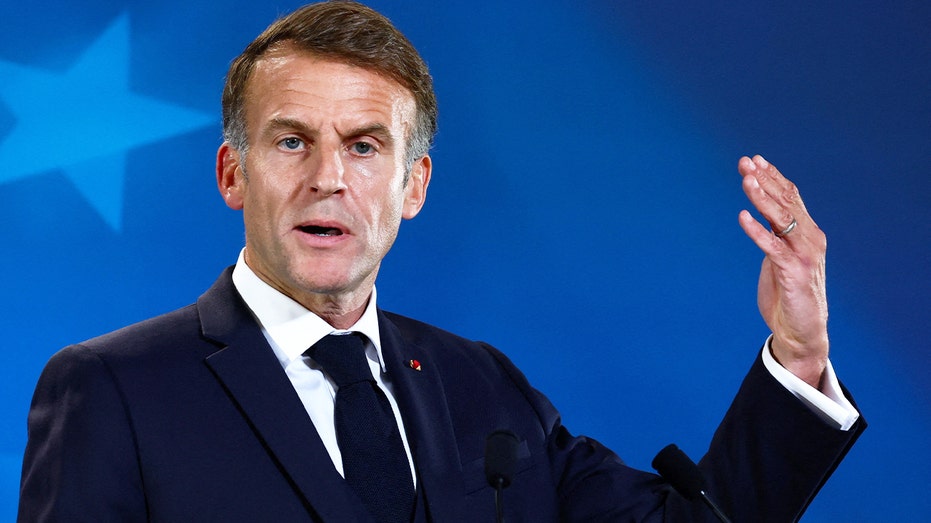
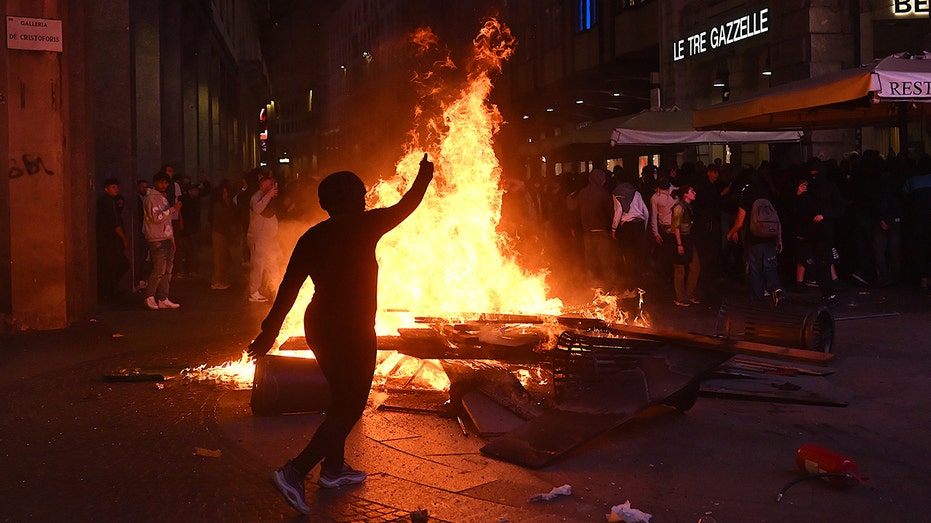
Macron echoed other government officials in blaming much of the violence on far-left activists, accusing them of attacking police and public buildings to foment chaos.
Macron echoed other government officials in blaming much of the violence on far-left activists, accusing them of attacking police and public buildings to foment chaos.
US President Donald Trump’s approval has fallen to a new low, two weeks before the midterm elections, in which the Republican Party is playing for control of Congress, according to a new poll by Ipsos, The Washington Post and ABC News.
The poll reflects the worst support figure among Americans: only 33% of those surveyed approve of his management, compared to 66% who disapprove; 52% express strong disapproval.
This approval rating (33%) is four percentage points lower than that registered last July and 12 points lower than in February 2025, when his approval registered 45%.
This is the lowest level the president has ever had, even considering any other time in his first term, The Washington Post noted.
NEW ABC News/Ipsos poll: Trump’s approval rating has plunged to 33%, down from 45% at the start of his second term. A record 66% disapprove.
Among Republicans, approval has fallen from 88% to 79%. Just 39% strongly approve of Trump, down from 63% in February 2025.
Among likely voters, Trump’s approval is 38 percent, while 62 percent disapprove.
Overall, the results show that voters are concerned about the cost of living and the president’s decision to go to war against Iran, which has affected the price of gasoline.
In fact, 71% of respondents consider the price of gasoline to be “unaffordable,” a figure higher than the 28% registered in February, before the war in Iran caused an increase in fuel costs.
Added to this is that 72% of respondents stated that the country is moving in the wrong direction, which represents an increase of five points compared to April.
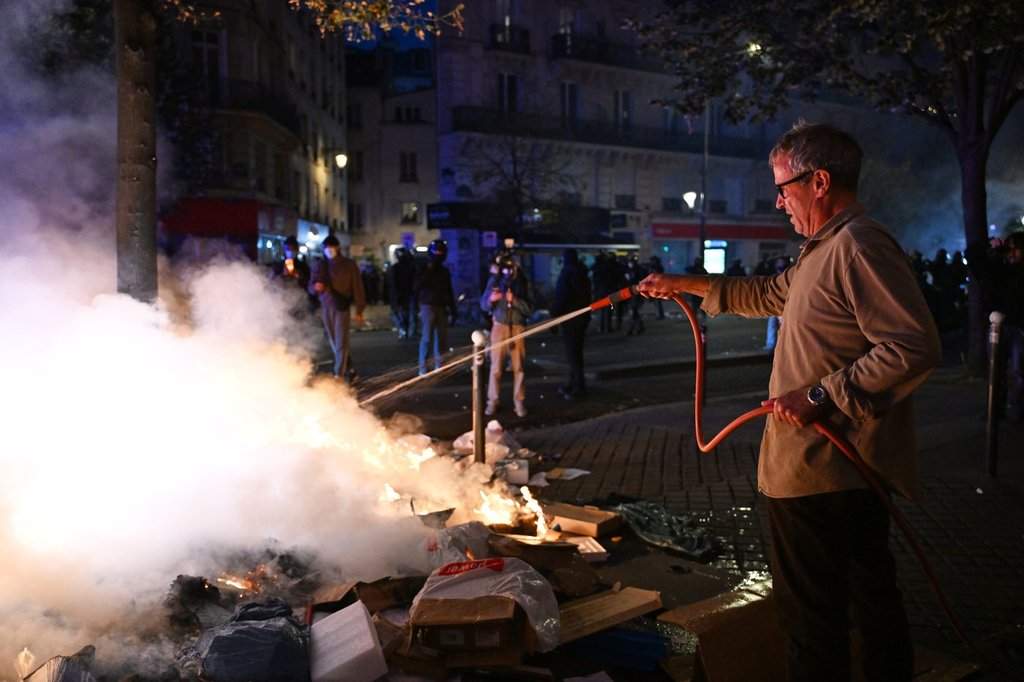
President Emmanuel Macron on Sunday slammed the "unbridled" violence that erupted in cost-of-living protests across France, as police battled protesters and looters in new clashes in Paris.
Nearly 2,400 people were arrested Saturday in unrest that represented some of the worst urban violence in France in years, with almost 1,000 police and gendarmes injured, seven seriously, the interior ministry said.
In an address to the nation, Macron said authorities would increase security and vowed lessons would be learned over the police response. But he stopped short of announcing any drastic measure, such as a state of emergency or curfew.
"Tonight, we all feel anger and shame," Macron said, adding that there must be a distinction between protesters with "legitimate demands" with "those who destroyed, smashed, and looted".
"Those who have destroyed must pay," he said, vowing the government would be "uncompromising" towards the "agitators from ultra-left fringe groups, joined by numerous delinquents" who "unleashed unbridled violence in our cities".
AFP journalists said police Sunday fired tear gas and stun grenades at hundreds of people gathered in a Paris square following social media calls for a gathering that authorities said had not been approved.
Bottles and rocks were hurled at police who made several arrests. Shops were also looted around Republique square with specialist anti-riot police deployed for the second day.
Violence also erupted Sunday in the southeastern city of Lyon where a police thwarted youths who attempted to smash the windows of a luxury clothing store.
'Lamentable' address
The unrest came just months from a presidential election where centrist Macron cannot stand again and Marine Le Pen, the far-right presidential candidate for the National Rally party, is riding high in the polls.
Le Pen said the troubles showed that Macron's administration was "running on fumes, exhausted and disoriented". Her top lieutenant Jordan Bardella described Macron's speech as a "lamentable" address that showed the authorities had "nothing more to say" to France.
Jean-Luc Melenchon, head of the hard-left France Unbowed party, also running for president, urged Macron to respond to the protesters' demands, saying young people "need this episode to reach a positive conclusion".
Macron said "our country deserves a fine presidential election", marked by debates "with the parties, rather than in the streets with violence".
Saturday's protests had seen unions, the anti-Macron Yellow Vests movement that ruffled the early years of his presidency and school students, who had protested for the last weeks, join forces in a show of anger at the cost of living and prospects for young people.
With images of French town halls burning and shops being looted grabbing headlines around the world, US President Donald Trump waded into the debate, blaming immigration for the unrest.
"France is burning! The immigration of people from an entirely different world, people with hatred in their hearts, has shattered that once great country," Trump said in a social media post.
'All necessary lessons'
Macron vowed that top officials would "make decisions in coordination with mayors to protect our cities, public buildings, and businesses."
"Seeing the streets of our cities ransacked in this way is unbearable," he said, pledging "support" for businesses that suffered.
Macron vowed there would be "full transparency" over the response by security forces to the protests, after criticism that police preparations had been inadequate.
Some opposition politicians have already called for the sacking of Interior Minister Laurent Nunez.
Macron said he had asked Nunez to "draw all necessary lessons", particularly with regard to intelligence gathering and anticipation, adding he expected "clear answers".
"It's like we had a war," a 78-year-old Paris resident Mehmet Ozeden told AFP amid burnt street barricades from Saturday's protests.
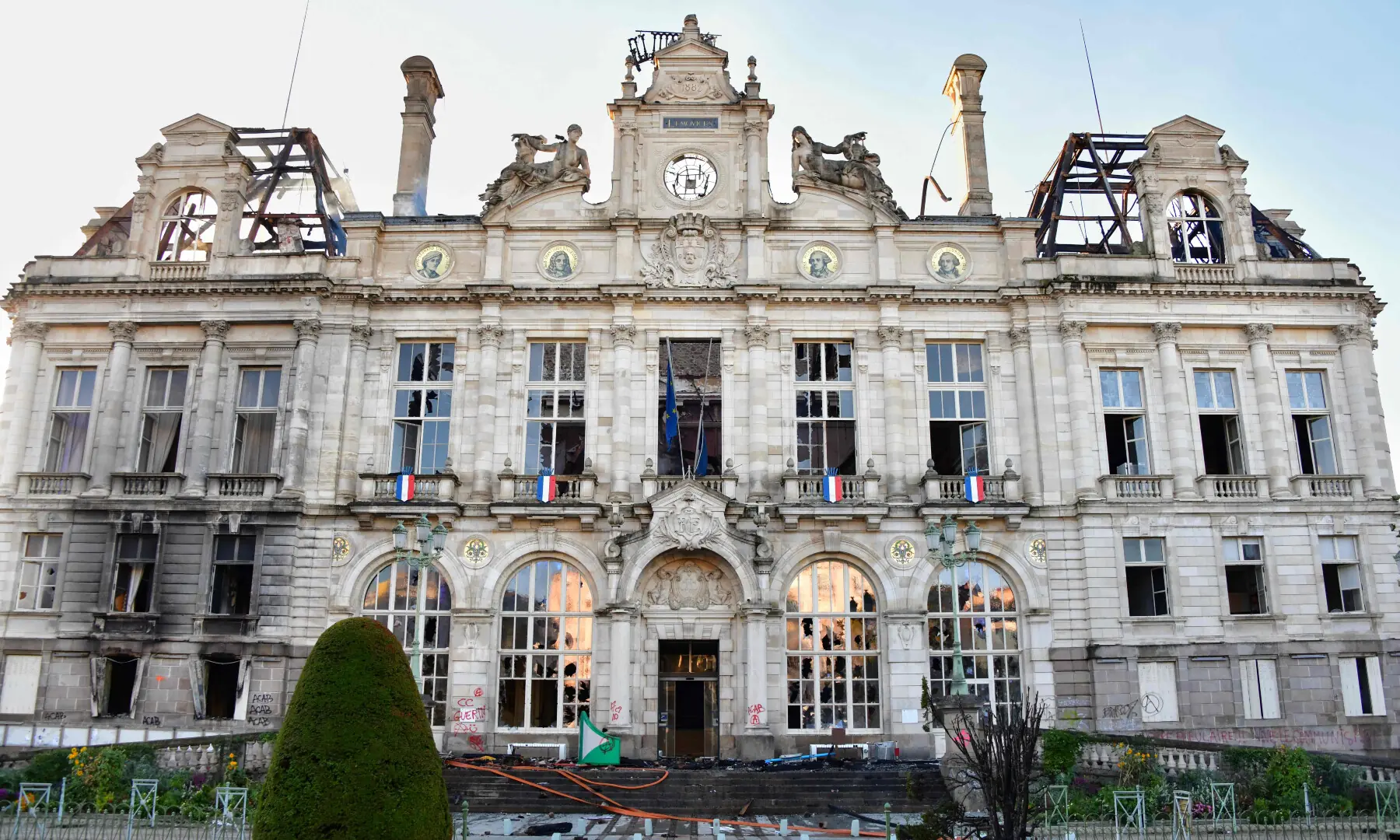
The city of Limoges lost its 19th-century town hall to a fire that local prefect, Maurice Barate, told news channel LCI had been deliberately set by "a wild horde".
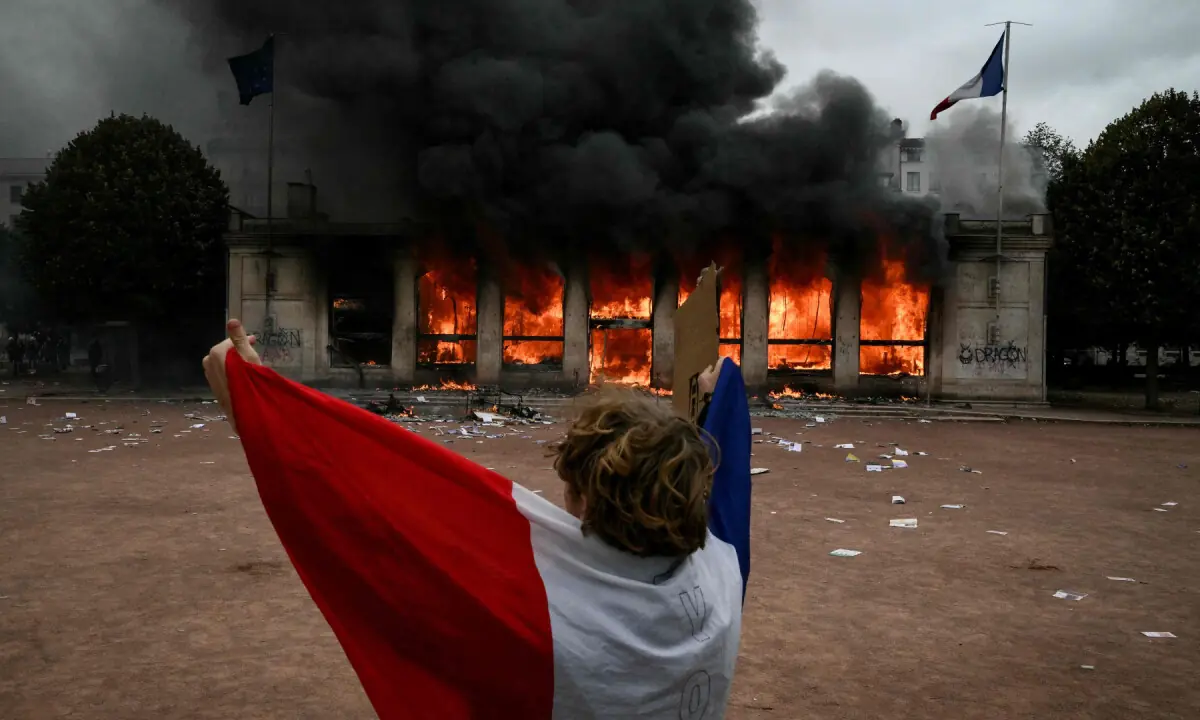
In Lyon, a tourist office in the city centre was set ablaze during the protests amid multiple clashes and looting.
A 17-year-old boy had his right hand blown off by a crowd-control grenade in the southern city of Saint-Etienne. In Mulhouse a 17-year-old girl lost an eye, according to prosecutors.
Indian actor Tiger Shroff remained unhurt in a shooting incident in Mumbai’s Juhu area, in which his driver and a bystander sustained injuries, local media reported.
A report by Indian news website The Hinduquoted an official as saying that the incident took place around 7pm as Shroff was leaving his place of work.
Mumbai Zone-II Deputy Commissioner of Police Mohit Garg further said that Shroff’s driver, Firdaus, sustained an injury to his left hand while a bystander, identified as Chauhan, was also wounded and taken to a hospital.
According to the report, Maharashtra Chief Minister and Home Minister Devendra Fadnavis has directed Mumbai Police Commissioner Deven Bharti to investigate the case and take action against the perpetrators.
Meanwhile, Maharashtra Deputy Chief Minister Eknath Shinde told The Hindu that “our priority is to keep Mumbai’s citizens safe. We will not spare anyone trying to threaten our film industry”.
He added, “It is time we respond to them in their own language. In the 1990s, Mumbai saw the gang war era. The Mumbai Police stopped it. We will not tolerate such gangs. This incident is unfortunate.”
The All Indian Cine Workers Association, which represents those part of the film industry, released a statement on the incident, saying it was “shocked and deeply anguished by the firing on Bollywood actor Tiger Shroff in Mumbai’s Juhu area”.
“This is not an isolated incident. Shots were fired outside Salman Khan’s residence in Bandra. Actor Saif Ali Khan was stabbed in an attack at his Bandra home. Shots were fired outside the Juhu home of filmmaker Rohit Shetty. Comedian Kapil Sharma’s cafe was attacked repeatedly. Now Tiger Shroff has been fired upon.
“One after another, people from the film industry are being targeted, and a deliberate atmosphere of fear is being created. The intent is plain: gangsters want to terrorise Bollywood personalities and extort money from them,” the statement said.
The association said that despite repeated incidents, the government and the police had failed to stop these attacks.
“Gangsters have openly claimed responsibility in earlier cases, yet the network continues to operate. Statements are not enough. Bollywood needs real protection,” it stressed.
It demanded from CM Fadnavis to take the strictest possible action against the gangsters behind these attacks, arrest the shooters and also those who ordered the firing, without delay, and “break the extortion network”.
The body also called for provide adequate security and protection to film personalities and their families and fix accountability for the repeated failure to prevent these attacks.
Local media reported that the responsibility of the attack was claimed in an unverified social media post, which said: “Those in the Mumbai industry who work with Salman Khan and don’t listen to us will meet the same fate.” Authorities have not addressed the post yet.
The US measles outbreak has reached 4,410 confirmed cases in 2026, according to the Centers for Disease Control and Prevention, known as the CDC.
The figure is more than double the total recorded during all of 2025 and represents the country’s highest level of measles transmission since 1991.
The CDC said the cases had been reported across 45 states and Washington, D.C. as of October 15. The agency also reported 451 hospitalizations, equivalent to approximately 10 percent of confirmed infections.
Health officials say the outbreak reflects a sustained decline in vaccination coverage across the country. Measles is one of the most contagious viruses known to medicine, and communities with low immunization rates are especially vulnerable to rapid transmission.
The CDC has deployed specialists from its Epidemic Intelligence Service to support contact tracing, community containment and local public-health responses in the most affected areas.
The agency has urged residents in outbreak zones to ensure that they have received the two recommended doses of the measles, mumps and rubella vaccine, known as the MMR vaccine.
The vaccine is considered highly effective and has been used for decades to prevent measles, a disease that can cause pneumonia, brain inflammation, permanent disability and death.
The current outbreak has exposed the consequences of declining immunization rates, vaccine misinformation and the weakening of public-health infrastructure in several US communities.
Pennsylvania has become the epicenter of the US measles outbreak, with 1,260 confirmed cases across 43 counties.
The state has reported 238 hospitalizations and five measles-related deaths, according to the Pennsylvania Department of Health.
Pennsylvania’s outbreak has grown rapidly. The state reported only 106 cases in 2025, meaning the current total represents an increase of more than ten times compared with last year.
Health officials have described the situation as the most severe measles emergency in the United States and have intensified contact tracing, isolation measures and vaccination campaigns.
South Carolina has reported the second-highest number of cases, with 670 infections. The state has recorded 67 hospitalizations and no confirmed deaths.
Utah follows with 535 cases, including 53 hospitalizations and no reported deaths.
Wisconsin has recorded 256 cases, 25 hospitalizations and no deaths. Texas has reported 192 cases, 19 hospitalizations and no deaths.
New York has recorded 103 cases when state and New York City figures are combined. The state has reported 10 hospitalizations and no deaths.
The CDC said children and adolescents between the ages of 5 and 19 account for 42 percent of infections, or 1,856 cases.
Adults over the age of 20 account for approximately 40 percent of cases, while children under five represent about 17 percent.
The distribution shows that measles is affecting people across all age groups, although unvaccinated children remain particularly vulnerable.
The CDC reported that 96 percent of patients had no documented record of MMR vaccination. The figure highlights the central role of immunization gaps in the spread of the virus.
Measles can spread through the air when an infected person coughs, sneezes or breathes. The virus can remain infectious in the air and on surfaces for up to two hours after an infected person leaves an area.
A person with measles can transmit the virus to as many as 12 to 18 people who are not immune. That makes measles one of the most transmissible infectious diseases in the world.
Symptoms usually begin with fever, cough, runny nose, red eyes and a sore throat. A rash typically appears several days later, beginning on the face and spreading to the rest of the body.
Complications can include ear infections, diarrhea, pneumonia, encephalitis and long-term neurological damage. Young children, pregnant women and people with weakened immune systems face the greatest risk.
The resurgence of the US measles outbreak is being driven by declining vaccination coverage and the accumulation of susceptible people in communities across the country.
The United States declared measles eliminated in 2000 after achieving sustained reductions in domestic transmission. The designation meant that the virus was no longer circulating continuously within the country.
That achievement depended on high vaccination coverage, strong surveillance systems and rapid responses to imported cases.
However, the number of nonmedical school exemptions has increased in recent years. Some families have declined vaccination because of religious beliefs, personal objections or distrust of public-health institutions.
Anti-vaccine groups have also spread misinformation about the MMR vaccine, including false claims linking it to autism. Scientific studies have repeatedly found no credible evidence supporting that claim.
The decline in trust has left some communities below the threshold needed for herd immunity.
Health experts say that at least 95 percent of a community must be immune to prevent sustained transmission of measles. The threshold is higher than for many other vaccine-preventable diseases because measles is so contagious.
When coverage falls below that level, imported cases can quickly trigger outbreaks, particularly among children who have not been vaccinated.
The CDC has reported that 18 of this year’s cases involved international visitors to the United States. Imported infections can introduce the virus into communities with low immunity and lead to extensive local transmission.
The outbreak has also raised concerns about the country’s measles-elimination status. If transmission continues for more than 12 consecutive months, the United States could lose the designation it achieved in 2000.
The Pan American Health Organization, known as PAHO, has warned that the risk of measles transmission across the Americas is very high.
The organization reported that the region had recorded its highest number of confirmed measles cases in 22 years. As of epidemiological week 28, countries and territories in the Americas had reported 47,459 confirmed cases.[paho]
PAHO said the increase was linked to ongoing outbreaks, low vaccination coverage, accumulated immunity gaps and greater population mobility associated with international travel and mass gatherings.
The organization has urged countries to strengthen routine vaccination, improve surveillance and respond rapidly to suspected cases.
PAHO has also warned that declining immunization rates threaten the protection achieved over previous decades and could expose communities to repeated health crises.
The organization has called on governments to ensure that vaccines are available, accessible and trusted by local communities.
Geopolitical Context
The US measles outbreak has implications beyond public health because it reflects the weakening of international cooperation against vaccine-preventable diseases.
Measles does not respect borders. A single infected traveler can introduce the virus into a country or region with low immunization coverage.
The outbreak in the United States could affect travel, schools, workplaces and health systems in neighboring countries. Canada, Mexico and other nations in the Americas have already reported significant increases in measles cases.
PAHO has urged countries to coordinate surveillance and share information to prevent further regional spread.
The crisis also highlights the political consequences of vaccine misinformation. Public trust in health institutions has declined in many countries, making it harder for authorities to promote vaccination campaigns.
The United States has faced growing resistance to routine immunization, particularly in communities where political polarization has influenced attitudes toward public-health measures.
The current outbreak could force federal, state and local authorities to strengthen vaccination requirements, improve access to clinics and invest in community outreach.
Health experts say the response must combine vaccination with accurate information, accessible healthcare and support for families who have questions about vaccines.
The immediate priority is to increase MMR coverage in affected communities and prevent further hospitalizations and deaths.
The CDC has emphasized that two doses of the MMR vaccine provide long-lasting protection and are essential for preventing severe disease.
The current outbreak demonstrates that measles can return quickly when immunization coverage weakens. Restoring herd immunity will require coordinated action by federal agencies, state governments, healthcare providers and local communities.
Wainwright explosion at a Canadian military base kills at least seven and injures dozens as officials rule out terrorism and investigate the deadly fire.
Wainwright Explosion Kills at Least Seven at Canadian Base
The Wainwright explosion at Canadian Forces Base Wainwright in Alberta has left at least seven people dead and dozens injured, according to reports by CBC News and Global News.
The incident occurred on Saturday, October 17, during a live-fire training exercise at the military base, located approximately 200 kilometers southeast of Edmonton.
Canada’s Department of National Defence confirmed that a fire broke out in the training area at approximately 4:00 p.m. local time. The Canadian Armed Forces said the blaze resulted in fatalities and injuries but has not yet released an official casualty count.
Military sources cited by Canadian media said the explosion occurred when a munition used during the training exercise struck a natural gas line or gas well.
The impact reportedly triggered a large detonation and a fast-moving fire that spread beyond the boundaries of the training area.
High winds, with gusts reaching up to 100 kilometers per hour, helped the flames spread rapidly through dry grassland and nearby rural areas.
The Canadian Armed Forces said emergency responders from military and civilian agencies worked quickly to contain the fire and assist those affected.
By Saturday evening, the Municipal District of Wainwright said the fire was being held and that property and critical infrastructure had been protected. Authorities did not order an evacuation of residents in the surrounding area.
The Department of National Defence said the full extent of the impact remains under assessment. It added that casualty details will not be released until relatives have been notified.
The government has ruled out terrorism as a possible cause. Officials said there were no indications that the explosion was connected to an attack or deliberate act of violence.
The incident has nevertheless prompted a major investigation involving the Canadian Armed Forces, the Department of National Defence and the Royal Canadian Mounted Police.
The Wainwright explosion activated emergency protocols across hospitals in the Edmonton region.
Local health authorities declared a code orange alert, a designation used for external disasters or mass-casualty incidents.
Injured personnel were transported to hospitals including the University of Alberta Hospital and the Royal Alexandra Hospital in Edmonton.
Medical teams prepared for a large number of patients with burns, trauma injuries and respiratory problems caused by smoke and toxic gases.
Firefighters faced difficult conditions because the fire involved both explosive material and hydrocarbon infrastructure.
The combination of live ammunition, natural gas and dry vegetation created a complex emergency that required coordination among military firefighters, civilian fire departments and specialized rescue teams.
Strong winds made the fire difficult to control and increased the risk that flames could spread to nearby communities.
Authorities asked residents to avoid the area so that emergency vehicles could move freely and rescue operations could continue without obstruction.
The Wainwright area is home to one of Canada’s largest military training facilities. The base is used for live-fire exercises involving tanks, artillery, infantry units and other military equipment.
CFB Wainwright is also an important NATO training site. Allied forces from several countries use the installation for exercises designed to improve interoperability and combat readiness.
The base covers a vast rural area and includes training ranges, administrative facilities, housing and support infrastructure.
The explosion occurred during a routine training exercise, according to the Department of National Defence. Officials have not identified the unit involved or the type of munition used.
Investigators will need to determine whether the incident resulted from an error in targeting, a malfunction in the munition, inadequate safety procedures or an unexpected hazard related to the gas infrastructure.
The Canadian Armed Forces said the immediate priority is supporting those affected and notifying their families.
The names of the victims have not been released. Officials said identification and notification procedures are ongoing.
Prime Minister Mark Carney confirmed on Sunday that four service members had died. He said dozens more were seriously injured and described the fire as one of the worst peacetime tragedies affecting Canada’s military on domestic soil.
“Our thoughts are with all the brave women and men affected,” Carney said.
The prime minister said his government was working closely with the Government of Alberta and local authorities.
He added that he and Alberta Premier Danielle Smith were in close contact, along with their respective ministers and relevant officials.
Defence Minister David McGuinty traveled to Edmonton on Sunday to monitor the investigation. He said the situation remained “very active and delicate.”
McGuinty said the Royal Canadian Mounted Police were participating in the investigation and that authorities would provide further information once the facts had been established.
🇨🇦 Al menos siete muertos y decenas de heridos dejó una explosión e incendio en la base militar CBF Wainwright en Alberta. #teleSUR#Canadapic.twitter.com/tSvGpCS0Bi
The Wainwright explosion has raised questions about safety procedures during live-fire exercises at military bases.
Live-fire training is essential for preparing soldiers for combat operations, but it also carries significant risks when it takes place near explosive or flammable infrastructure.
Military authorities regularly conduct risk assessments before exercises to identify hazards, establish safety zones and coordinate emergency responses.
Investigators will examine whether those procedures were followed and whether the presence of gas infrastructure near the training area was properly identified.
They will also review weather conditions, ammunition handling, communication between units and the response of emergency teams.
The investigation could lead to changes in training protocols, safety distances, mapping procedures or the coordination between military and civilian authorities.
The incident occurred during a period when Canada has been increasing military preparedness amid global security tensions.
Canada is a member of NATO and has supported allied operations in Europe and other regions. The country has also increased investment in defense capabilities in response to international instability.
CFB Wainwright plays a central role in that effort because it provides space for large-scale training exercises involving Canadian and allied forces.
The base has hosted soldiers from NATO member states and partner countries. Its facilities allow forces to train in conditions that cannot easily be reproduced at smaller installations.
The explosion could therefore affect training schedules and force readiness in the short term.
Military authorities may suspend certain exercises while investigators examine the site and review safety procedures.
The incident also highlights the risks faced by military personnel during routine operations. Training accidents can occur even when soldiers are not deployed in combat zones.
The Canadian Armed Forces has expressed condolences to the families of those killed and injured.
Officials have asked the public to avoid speculation while the investigation continues. They have also urged people to rely on official statements rather than unverified reports circulating on social media.
Geopolitical Context
The Wainwright explosion has implications for Canada’s military readiness and its role within NATO.
Canada has increased its defense commitments in recent years amid tensions involving Russia, the Middle East and the Indo-Pacific region.
The country has contributed troops, equipment and training resources to NATO operations, while also maintaining a military presence in international missions.
CFB Wainwright is important to those efforts because it allows Canadian and allied forces to conduct large-scale exercises under realistic conditions.
A major accident at the base could affect the planning of future exercises and require additional investment in safety infrastructure.
The incident also highlights the connection between military training and energy infrastructure. Canada is a major producer of oil and natural gas, and many military facilities are located near pipelines, wells and other energy installations.
That proximity creates risks that must be managed through mapping, safety zones and coordination between military authorities and energy companies.
The explosion may prompt a review of those procedures across Canadian military bases.
The tragedy also has domestic political implications. Alberta has been the scene of debates over energy policy, provincial autonomy and Canada’s federal structure.
The incident occurred one day before Albertans voted in a referendum on separation from Canada. The explosion could affect public attention and political discussion in the province.
For now, the government’s priority is to support the victims and determine the cause of the disaster.
The Canadian Armed Forces has said it will release additional information only after families have been notified. Until then, the full human and operational impact of the Wainwright explosion remains under assessment.
The captain of a flydubai flight who was attacked by a co-pilot who intended to crash the plane has described blocking axe blows to the head and screaming for help as he reached for a knob to open the cockpit door.
Captain Smit Machchhar has been hailed as a hero for his role in averting disaster on the flight from Dubai to Tel Aviv last month, helping to thwart what the UAE attorney general has said was an attempted suicide attack by the co-pilot who intended to crash the plane into Ben Gurion Airport.
Speaking in an interview with The National newspaper from a hospital bed in Abu Dhabi, his head and left arm bandaged, Machchhar said that when the first blow landed, he thought something had gone “horribly wrong (with) the aircraft structure”, before quickly realising he was being attacked and things had “taken a drastic turn”.
“The next thought was I need to get help in here,” he said in the interview published on Saturday.
“My immediate action was to free myself from the seat belts and I tried to just block the blows as much as I could,” he said, pointing to his arm that was wounded as he defended himself. “The blows were coming on the head.
“Immediately my hand went to the knob which opens the door and screaming for my colleagues, screaming his name.
“I believe that was the first time when I lost my consciousness.”
The aircraft, flight FZ1073, was in Saudi airspace when the co-pilot attacked Machchhar with a crash axe, typically kept in the cockpit for emergency use.
The incident caused the airliner to plunge 16,000 feet (4,900 metres) in 30 seconds before the attacker was overwhelmed and two other pilots who were on board landed the aircraft safely in Saudi Arabia. The suspect, an Omani national, was transferred to the UAE, flydubai’s home country.
The plan was inspired by the Sept 11, 2001, attacks on the US, UAE public prosecutors say, as a result of their criminal investigation launched on October 1.
Machchhar said he heard the cockpit door opening and screaming “between my colleague and the guy”.
He said the scariest thing he felt was the aircraft nose “steeply going down”.
“I was not very sure that I’ll make it out alive from this. Did I give up? No.”
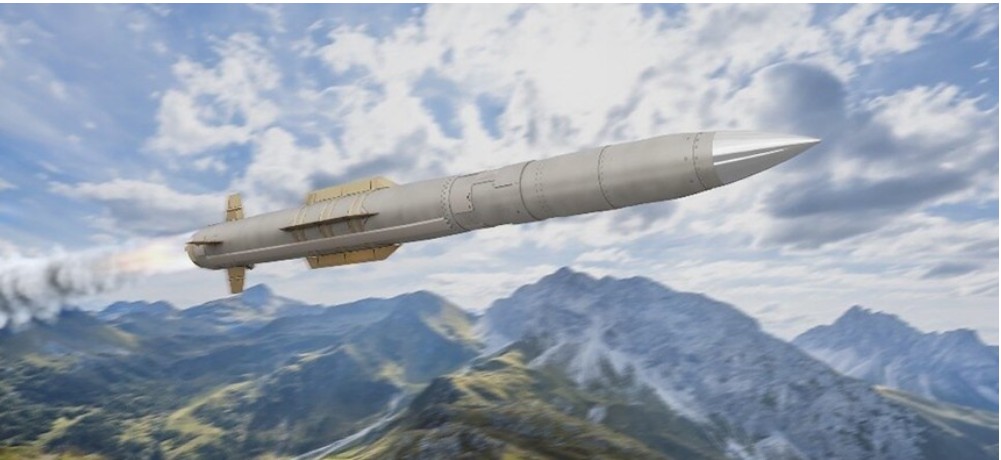
Amid global demand for Patriot interceptors, Lockheed Martin recently unveiled its most advanced interceptor, the PAC-3 Edge, which could offer improved performance against ballistic missiles and hypersonic threats.
EurAsian Times takes a deep dive into the evolution of Patriot Air Defense Systems, but before that, let’s start with the news.
PAC-3 EDGE
The new interceptor missile builds on the combat-proven PAC-3 MSE technology, which has proven its worth in multiple conflicts, including Ukraine and the Middle East.
The new PAC-3 Edge incorporates a new seeker, an upgraded control system, and a more advanced solid rocket motor developed with Northrop Grumman.
These new features will improve the missile interceptor’s range, altitude, speed, and precision.
It is part of the US Army’s Future Interceptor program, which is currently in competition.
“The Army’s decision to progress Lockheed Martin into the next stage of development affirms its confidence in Lockheed Martin’s proven Integrated Air and Missile Defense (IAMD) experience and the company’s ability to deliver an advanced, layered defense,” the company said in a statement.
Lockheed Martin will advance development and begin testing PAC-3 Edge in 2027 to prepare for rapid deployment by 2031, it added.
Patriot PAC-3 ACE. Credits Lockheed Martin.
“Lockheed Martin’s PAC-3 Edge interceptor leverages the combat-proven PAC-3 MSE, delivering even greater maneuverability, power and velocity to ensure the Army’s layered defensive architecture remains the most advanced in the world,” said Tim Cahill, Lockheed Martin Missiles and Fire Control president.
PAC-3 interceptors come in three variants: the lower-cost PAC-3 ACE, legacy PAC-3 CRI, and the prestigious PAC-3 MSE.
The company said it invested US$250 million in the Strigo Product Center to fund new, industry-leading seeker technology that increases precision and maneuverability against evolving threats.
PAC-3 Edge is designed to be integrated with existing and future Integrated Air and Missile Defense (IAMD) capabilities, including the Integrated Battle Command System (IBCS), the M903 launcher, containerized launchers, and HIMARS Flex.
The US Army’s selection of Lockheed Martin’s PAC-3 Edge program highlights the service’s efforts to improve its existing layered air defense systems to address evolving aerial threats.
While the company did not provide technical details of the new seeker technology, analysts believe that it could be a dual-mode or multimode configuration that integrates multiple sensors to better detect, track, and intercept evolving threats such as hypersonic cruise missiles, hypersonic glide vehicles (HGVs), maneuvering ballistic missiles, and the ability to distinguish real threats from decoys.
In the war in Ukraine, while the PAC-3 MSE interceptors have proved highly effective in countering ballistic missiles and aircraft, they have struggled to intercept Russia’s hypersonic missiles, such as Oreshnik, Zircon, and Kinzhal.
Furthermore, while PAC-3 MSE interceptors were highly effective against ballistic threats in the initial phase, their performance gradually declined as Russia adapted its missiles to perform increasingly complex terminal maneuvers.
According to a Financial Times report based on Ukrainian Air Force data compiled by the Center for Information Resilience, Patriot interceptors’ ballistic interception rate reached 37% in August 2025 but fell to a low of 6% in September.
This decline was linked to Russian tactical improvements, such as missiles changing trajectory and missiles capable of performing terminal maneuvers.
However, despite this drop in interception rates, Patriot batteries remain Ukraine’s only defense against Russian ballistic threats.
The new PAC-3 Edge interceptors will provide increased protection against such maneuvering missile threats and hypersonic missiles.
Notably, the unveiling of new PAC-3 Edge interceptors comes as global demand for PAC-3 interceptors has increased, and Lockheed Martin is establishing new facilities to raise its interceptor production rate.
Lockheed produced nearly 620 interceptors in 2025; however, it plans to triple Patriot interceptor production to 2000 by 2030.
Patriot PAC-3 interceptors are also included in the Pentagon’s Munitions Acceleration Council (MAC), which is targeting 12 legacy and two “emerging” munitions as part of its ambitious plan to ramp up production and ink a series of agreements with key vendors to ensure cost efficiency while maintaining production stability, according to fiscal 2027 budget documents.
Rising global demand for PAC-3 interceptors, requests from multiple countries to establish Patriot interceptor production facilities, and the unveiling of the advanced PAC-3 Edge interceptors underscore the Patriot air and missile defense system’s continued relevance more than four decades after it first became operational.
The Evolution Of Patriot Air Defense Systems
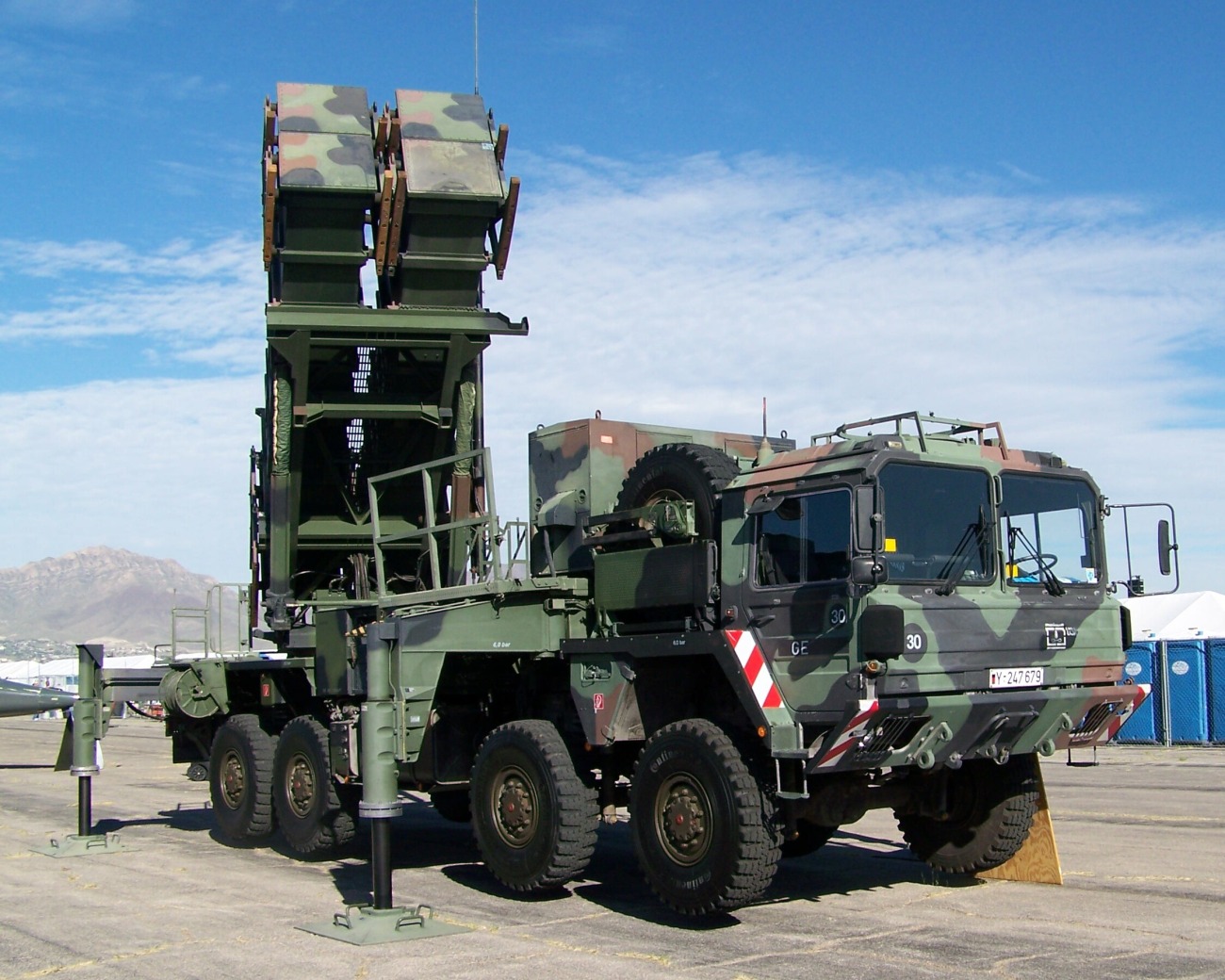
The MIM-104 Patriot is the US Army’s primary air-and-missile defense system.
Although it was initially designed as an anti-aircraft system, newer Patriot variants can engage ballistic and cruise missiles, drones, loitering munitions, and aircraft.
A typical Patriot battery includes a radar set, an engagement control station, power generation, other support vehicles, and several launch stations.
The US Army Missile Command first developed the Patriot concept in 1961 as the Army Air Defense System for the 1970s (AADS-70s).
The AD system was meant to be mobile and replace the static HAWK and Nike Hercules emplacements.
In 1964, the US Army renamed it Surface-to-Air Missile, Development (SAM-D).
Three years later, in 1967, the Department of Defense selected Raytheon as the prime contractor. SAM-D’s first flight test took place in November 1969.
Although Raytheon won the prime SAM-D contract in 1967, it did not build everything alone. Martin Marietta joined early as a major subcontractor to handle missile assembly, launcher vehicles, and canister production.
In 1974, the Department of Defense reoriented the SAM-D program to support a Track-Via-Missile (TVM) guidance system and a simplified concept of operations.
Patriot AD System.
The revised and re-engineered system was renamed PATRIOT (Phased Array Tracking Radar to Intercept On Target) in 1976.
Patriot entered full-rate production in September 1980, and the US Army activated its first Patriot missile battalion in May 1982.
The Army added significant upgrades to the Patriot system throughout the 1980s and 1990s.
In 1985, the Department of Defense (DoD) started efforts to add a ballistic missile defense capability to the system.
In 1986, the Army upgraded Patriot to the Patriot Advanced Capability-1 (PAC-1) standard, which included software changes that allowed it to engage tactical ballistic missiles.
The PAC-1 was deployed by 1988.
Soon, the US Army began efforts towards the PAC-2 standard, which involved modifications to the missile fuze, warhead, and guidance to engage more capable ballistic missiles like the Soviet OTR-23.
The Patriot system first saw combat service during the 1991 Gulf War, defending critical assets in Saudi Arabia, Kuwait, and Israel. The PAC-2 missiles were used to intercept Iraq’s Scud missiles.
Martin Marietta built the PAC-2 interceptors.
In 1993, the US Army added remote launch capability to Patriot systems, allowing missile launchers to be deployed over 10 km from the radar. This also more than tripled the system’s defended area.
Later, the US Army also developed the PAC-3 standard.
The most significant PAC-3 upgrade was a new interceptor with hit-to-kill technology, developed by Lockheed, which defeats targets by striking them directly rather than using a blast-fragmentation warhead.
Lockheed achieved the first-ever hit-to-kill intercept in 1984 with the Homing Overlay Experiment, using impact force alone to destroy a mock warhead outside Earth’s atmosphere. Further development and testing produced today’s PAC-3 missile, which won a 1993 competition to become the US government’s first hit-to-kill interceptor.
In 1995, Lockheed Corp merged with Martin Marietta to create one of the US’s largest defense aerospace companies, combining two key components of the Patriot program: Martin Marietta’s established Patriot infrastructure and production facilities and Lockheed’s cutting-edge hit-to-kill technology.
This newly formed mega-contractor rolled out the PAC-3 missile interceptor.
The PAC-3 standard itself included three distinct configurations, Configuration 1, 2, and 3, which improved its radar, seeker, and range.
The US declared PAC-3 Configuration 3 combat-ready in August 2002.
PAC-3 Configuration 3 had its first combat test in 2003 during Operation Iraqi Freedom.
In 2010, the US Army successfully tested an upgraded PAC-3 interceptor, the PAC-3 Missile Segment Enhancement (MSE).
According to CSIS’s Missile Threat, the PAC-3 MSE features an enlarged motor and other enhancements to nearly double the PAC-3’s range. It achieved initial operational capability in late 2016.
Patriot is a long-range, high-altitude, all-weather missile tested more than 2,500 times with U.S. Army oversight. (Image: Raytheon)
The PAC-3 also features an active Ka-band radar seeker for endgame guidance. With its lighter weight and newer propulsion system, the PAC-3 can reportedly defend an area seven times greater than the PAC-2.
Patriot currently employs a single AN/MPQ-53, AN/MPQ-65, or AN/MPQ-65A radar set to detect and engage targets. Unlike other air defense systems, the Patriot radar combines surveillance, tracking, and engagement in a single unit.
The AN/MPQ-53 was the world’s first phased-array air defense radar and was employed with legacy PAC-2 systems.
The AN/MPQ-65A is the most advanced Patriot radar; however, the US Army is currently transitioning to use the new Lower Tier Air and Missile Defense Sensor (LTAMDS) radar, which offers 360-degree coverage and significantly greater detection range.
Furthermore, while the AN/MPQ-53 and -65-series radars are passively scanned arrays, LTAMDS is an active electronically scanned array (AESA) that uses gallium nitride (GaN) power amplifiers, offering greater jamming resistance, beam agility, and power efficiency than previous systems.
360-degree coverage is essential to counter Russia’s evolving “wolf-pack tactics,” which involve launching dozens of aerial targets simultaneously, including drones and ballistic and cruise missiles, that approach from different directions and strike at once.
Only the US and Poland are procuring the LTAMDS at present. In September, the US awarded a US$1.7 billion contract to produce nine radars for the two users.
Currently, 18 countries operate the Patriot AD system. These include the Netherlands, Germany, Japan, Israel, Saudi Arabia, Kuwait, Taiwan, Greece, Spain, South Korea, the UAE, Ukraine, Qatar, Romania, Sweden, Poland, and Bahrain.
In 2023, the US allowed countries to transfer Patriot batteries to Ukraine, where they have repeatedly intercepted Russian ballistic and hypersonic missiles.
For instance, on May 16, 2023, the Ukrainian Air Force claimed it used Patriot to intercept a salvo of six Kinzhal missiles over Kyiv.
However, rising global demand for PAC-3 MSE interceptors and Russia’s adaptive missile technology, which involves terminal-phase maneuvers, have necessitated a two-pronged strategy: boosting PAC-3 interceptor production and developing more advanced interceptors.
The PAC-3 Edge will keep the Patriot AD system relevant amid evolving aerial threats.
Sumit Ahlawat has over a decade of experience in news media. He has worked with Press Trust of India, Times Now, Zee News, Economic Times, and Microsoft News. He holds a Master’s Degree in International Media and Modern History from the University of Sheffield, UK.
He can be reached at ahlawat.sumit85 (at) gmail.com
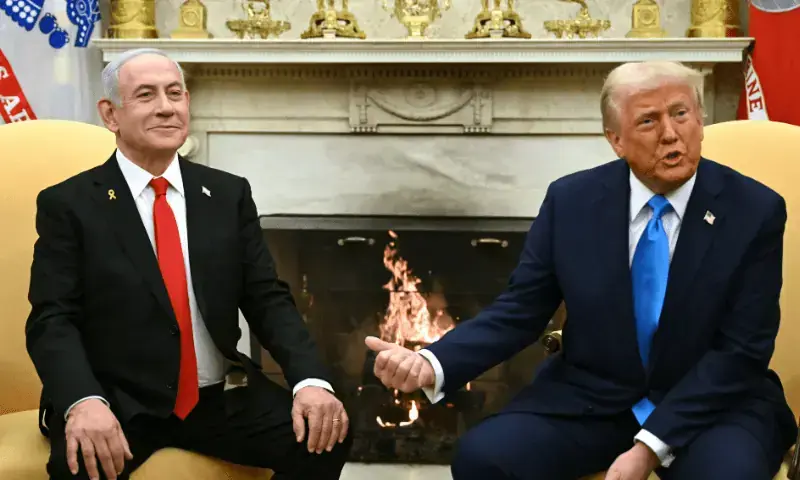
United States President Donald Trump on Sunday endorsed his ally Benjamin Netanyahu as the longtime Israeli prime minister struggles for an edge in next week’s parliamentary election.
Trump praised Netanyahu as a “great warrior prime minster” and peace partner, crediting him with joining the United States in launching strikes on Iran in February. The conflict, in its seventh month, has disrupted energy markets globally and wreaked havoc across the Middle East, damaging critical infrastructure and destabilising regional economies.
“Bibi Netanyahu has been Strong, Brave, and Brilliant in the face of tremendous opposition, including that coming from even Israel, itself,” Trump wrote in a post on Truth Social.
“Despite all of that, he has endured and, in fact, he has thrived! I have watched Bibi under the most trying of times. Normal men or women in such situations would have wilted under the pressure But Bibi did not wilt, he actually got stronger, and maintains that same Strength today.”
In his message, addressed to “the Great People of Israel”, Trump added, “Please let this Letter serve to represent my Complete and Total Endorsement of Bibi Netanyahu in his upcoming Race for Re-Election as Prime Minister of Israel.”
The Trump endorsement is not certain to give Netanyahu and his right-wing Likud party a boost in the Oct 27 national election, as Israeli public support for Trump has diminished amid Israeli-US disagreements over Iran.
Polls have suggested no candidate has a clear path to power. Israel’s prime minister is chosen through coalition-building in parliament rather than by direct popular vote.
It will be Israel’s first vote since the Hamas attack on Oct 7, 2023. Israel has launched an assault on Gaza and carried out strikes in Lebanon and Iran since.
The election could determine whether Netanyahu remains in power after one of the most consequential periods in Israel’s history, or is defeated by centrist rivals promising to usher in a new era.
Netanyahu promptly expressed his thanks to Trump on X, saying, “Together we will complete the mission!”
Trump has broken with longtime US tradition by endorsing candidates in elections in foreign countries, including Hungary, Colombia, Argentina, Japan and Honduras.
A rabbi at Emory University’s Hillel student organisation in the US state of Georgia was dismissed just a month into her job because of her relationship with a pro-Palestinian activist.
"There was zero previous indication that Nikki’s job was at risk," Sam Stein said of his fiancé Rabbi Nikki Golomb’s dismissal by Hillels of Georgia, the nonprofit that operates the campus organisation.
Stein said Golomb had expected a scheduled meeting with her chief executive to be a welcome to her new position. Instead, he said, she was told she was being dismissed because of her "relationship with people who speak despairingly of Israel". When she asked who was being referred to, an engagement photograph of the couple was shown, according to his account.
Stein, a journalist and protective-presence activist who has documented settler violence in the occupied West Bank, described the decision as "a cruel act of financial violence".
Her employer, Hillels of Georgia, says the decision was made for "legitimate, work-related reasons and in accordance with our policies".
"This is a broader issue bubbling up that the mainstream Jewish institutions in the US are totally out of touch with where the Jewish population is at in terms of Israel, Palestine and Zionism," he told The New Arab.
"Other people have been fired over dissent around Zionism – this is the most egregious case because it’s about someone’s partner, not even about anything they said or did," he said.
Emory Hillel provides religious, cultural and social programming for Jewish students. Its stated mission includes fostering a commitment to Jewish life, learning and Israel.
Hillel International’s Israel guidelines also restrict partnerships with groups and speakers that support the Boycott, Divestment and Sanctions movement (BDS) against Israel. It placed under the same category individuals who "Deny the right of Israel to exist as a Jewish and democratic state with secure and recognized borders” as well as "Delegitimize, demonize, or apply a double standard to Israel".
Those published guidelines, however, do not explicitly address an employee’s partner’s political speech or activism.
Stein called on Hillel International, the wider umbrella organisation, to compensate Golomb and introduce protections against similar dismissals.
"Hillel International has a moral obligation to pay out Nikki’s contract […] and on top of that, to put in writing a statement preventing this from happening again – adopt an official national policy that you cannot fire people over their partner’s social media presence or activism", he said.
He also called for those responsible for the decision to be fired.
US President Donald Trump on Sunday offered his "complete and total" endorsement of ICC fugitive Israeli Prime Minister Benjamin Netanyahu in the country's 27 October elections.
"Please let this Letter serve to represent my Complete and Total Endorsement of Bibi Netanyahu in his upcoming Race for Re-Election as Prime Minister of Israel. BIBI NETANYAHU WILL NEVER LET YOU DOWN!," Trump wrote on his Truth Social platform.
Netanyahu, Israel's longest-serving prime minister who is wanted by the International Criminal Court over war crimes committed in Gaza, is in a tight race to win a new mandate and quickly acknowledged Trump's gesture.
"Thank you, President Trump, for your tremendous support and for our work together. Together we will complete the mission!" Netanyahu wrote on X.
In his post, Trump described Netanyahu as "a Great Warrior Prime Minister" and an ally in the war on Iran that began in late February with a massive bombing campaign but has dragged on as Tehran has retaliated by blocking global energy supplies through the Strait of Hormuz.
Trump asserted that without Netanyahu as Israel's leader, the United States would be alone in combating the threat from the Islamic regime, "with its 51-year-old chant, 'Death to Israel, Death to America! We will destroy the Little Satan and the Big Satan.'"
"If Israel has the wrong Leader, which would be anyone other than Bibi, America will have to do this work ourselves, and I am not inclined to do so," the US president said.
"This is the kind of Partner that the United States of America is demanding of Israel, a Country for which it has done so much," he added.
Torched cars, smashed shopfronts and burnt debris scarred numerous streets in Paris on Sunday, where officials said 557 people were in custody as France reeled from widespread damage caused by violent protests the day before.
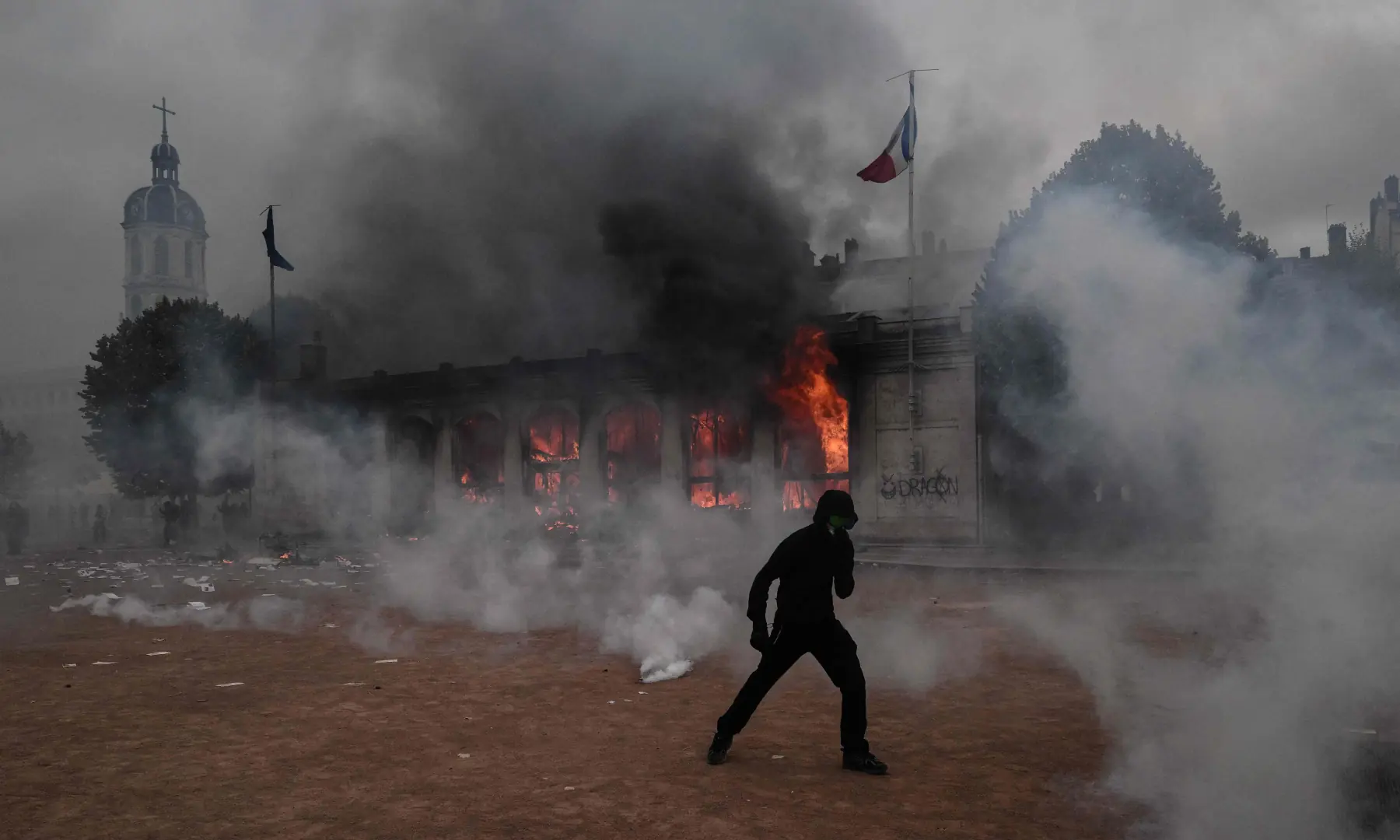
Hundreds of shops were looted in Paris and other cities, including Marseille, Bordeaux, Nice and Strasbourg, during the protests over the cost of living. The city of Limoges lost its 19th-century town hall to a fire, while a tourist office in the centre of Lyon was set ablaze as well.
Interior Minister Laurent Nunez said 1,800 people were arrested over the protests and looting, with investigations under way “to identify the perpetrators of these acts”. Around 500 police, firefighters and paramedics were hurt in the protests, the minister said.
Here are glimpses of what went down across France over the weekend after the “Yellow Vest” movement called Saturday’s “yellow and youth” demonstrations.
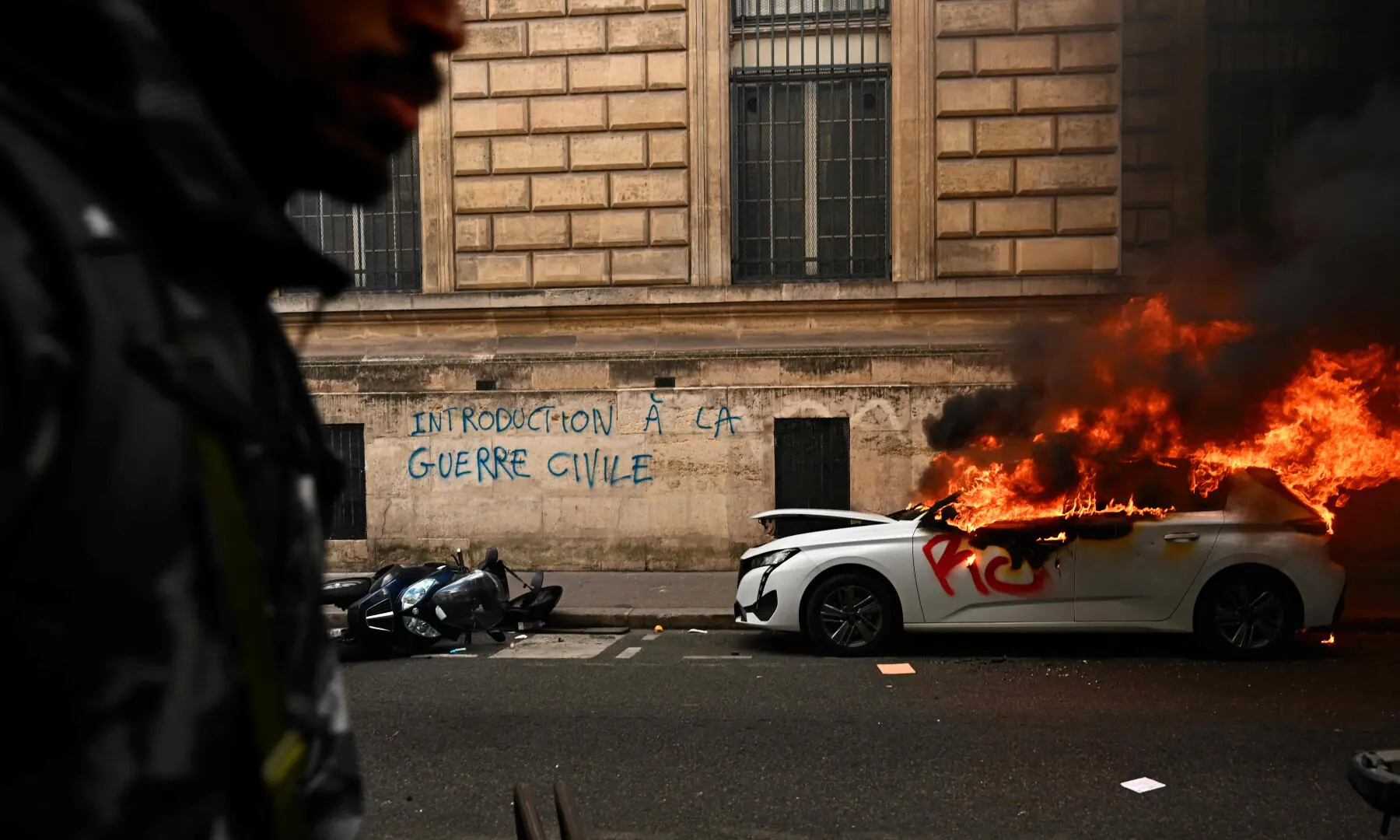
A car burns near a graffiti reading “introduction to civil war” as clashes erupted during a demonstration against the “high cost of living”, in Paris on Oct 17, 2026. — AFP
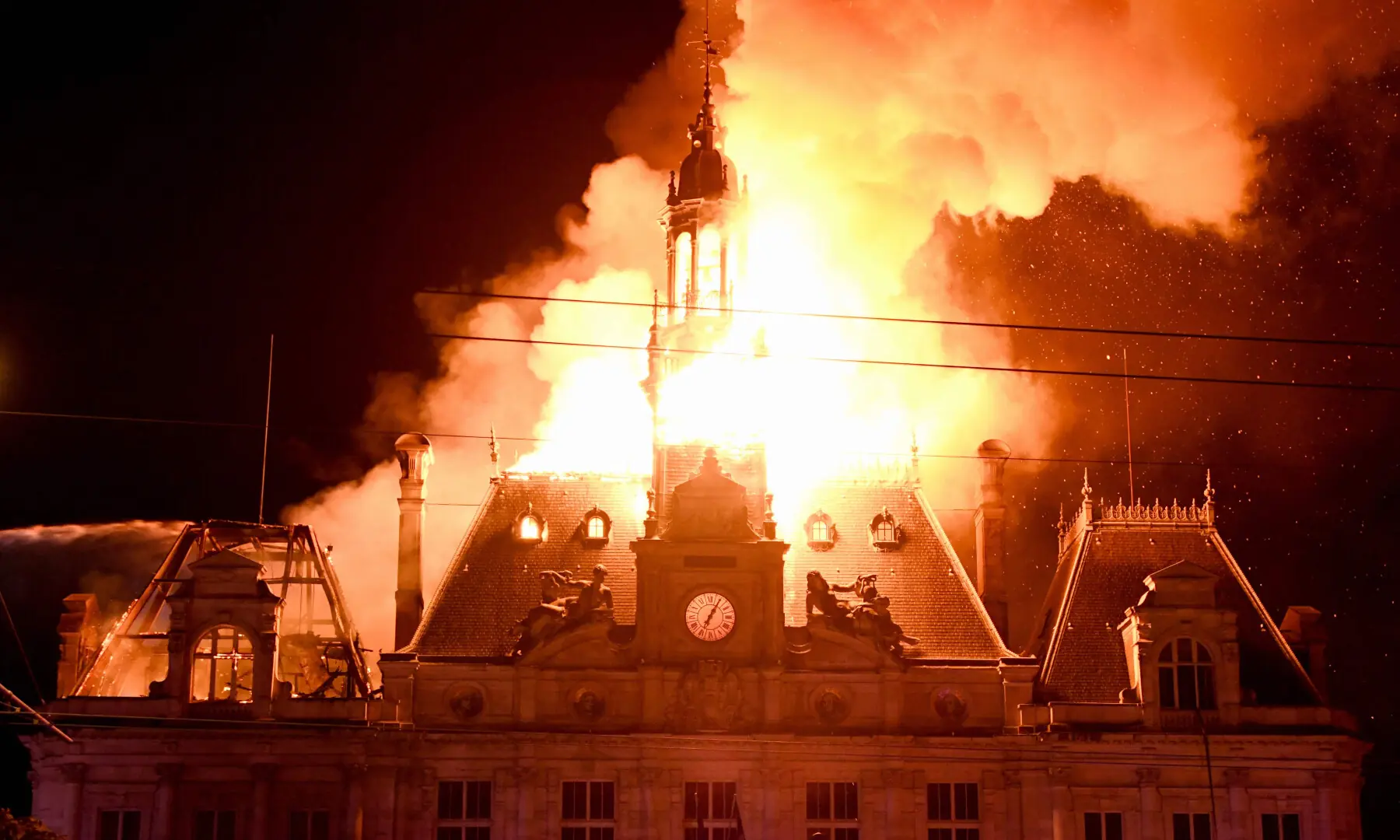
This photograph shows a fire burning and destroying the city hall after a group of individuals forced entry into the building during ongoing protest action against the “high cost of living”, in Limoges, central France on Oct 17, 2026. — AFP
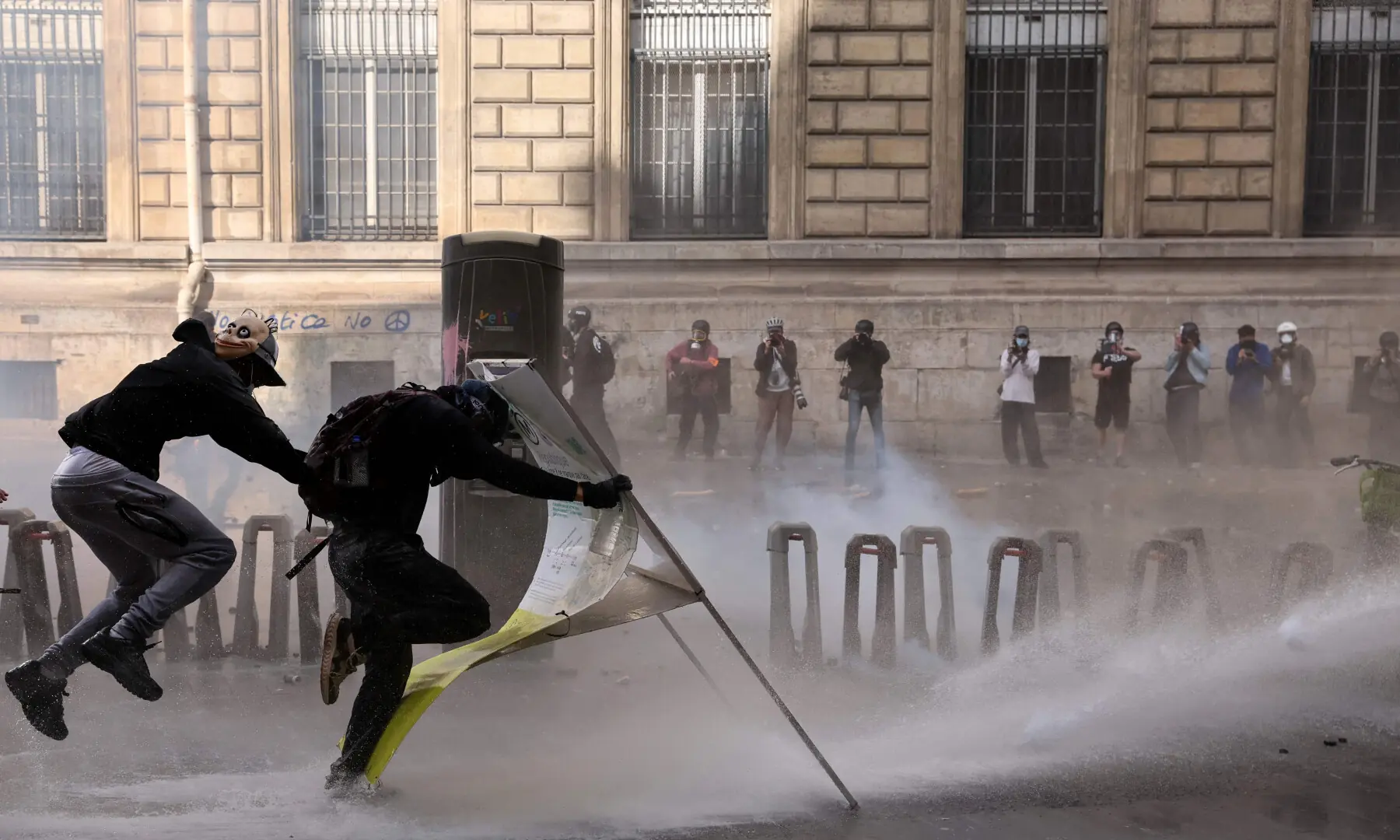
Protesters shield themselves from police water cannons during a demonstration to protest against the “high cost of living”, at Place de la Republique in Paris on Oct 17, 2026. — AFP
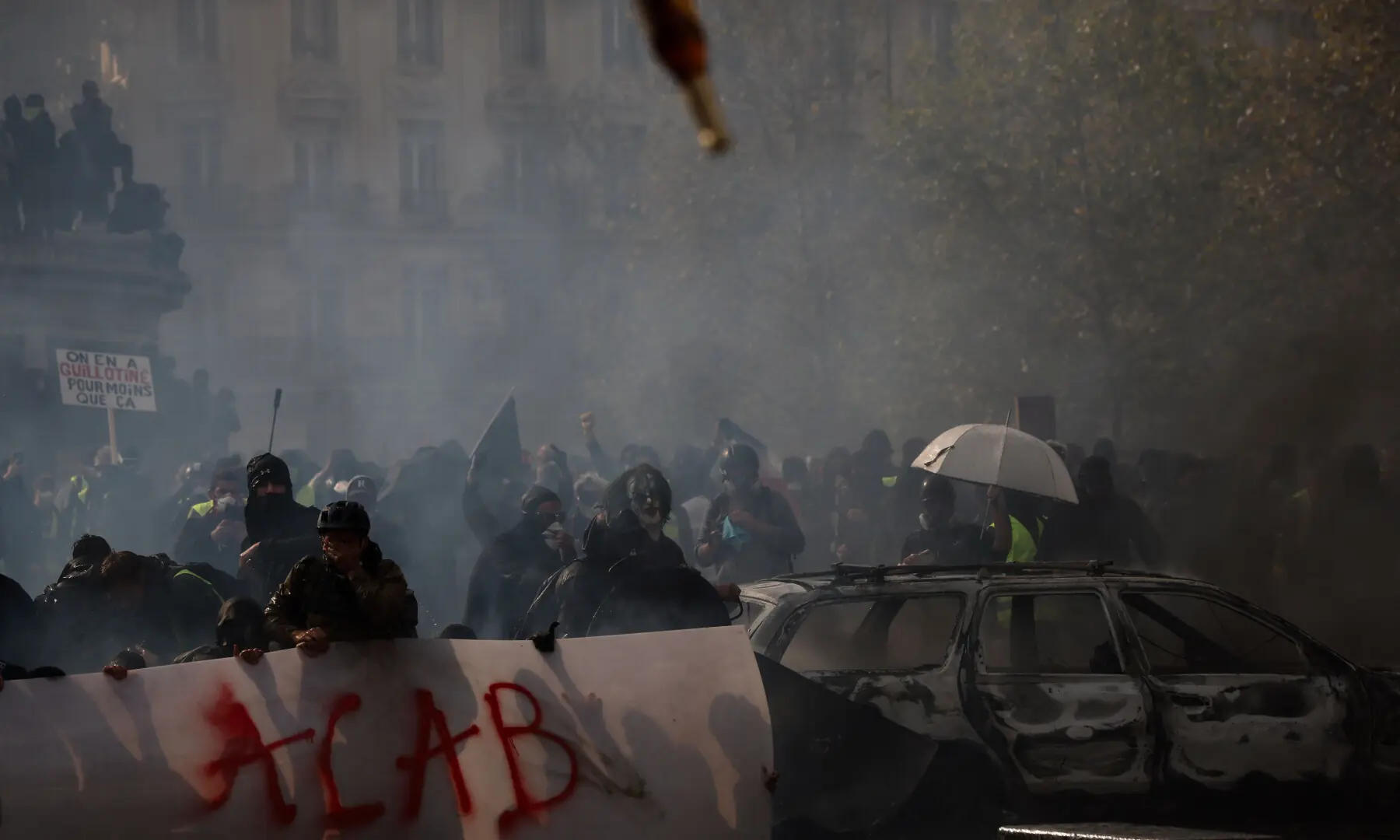
Protestors hold a banner reading “ACAB” (for “All Cops are Bastards “) during a demonstration on Place de la Republique to protest against the “high cost of living”, in Paris on Oct 17, 2026. — AFP
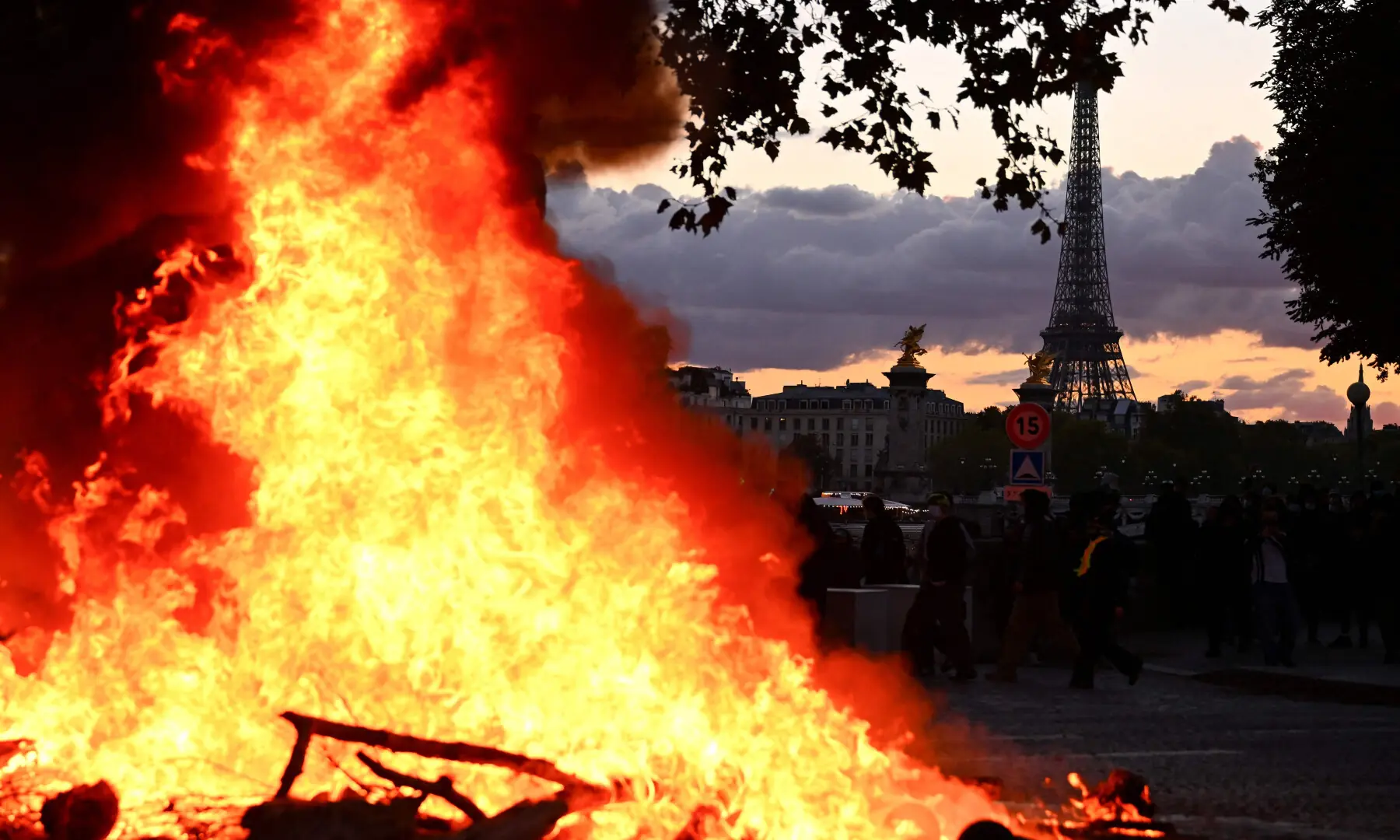
A fire is seen with the Eiffel Tower in the background during a demonstration to protest against the “high cost of living”, in Paris on Oct 17, 2026. — AFP
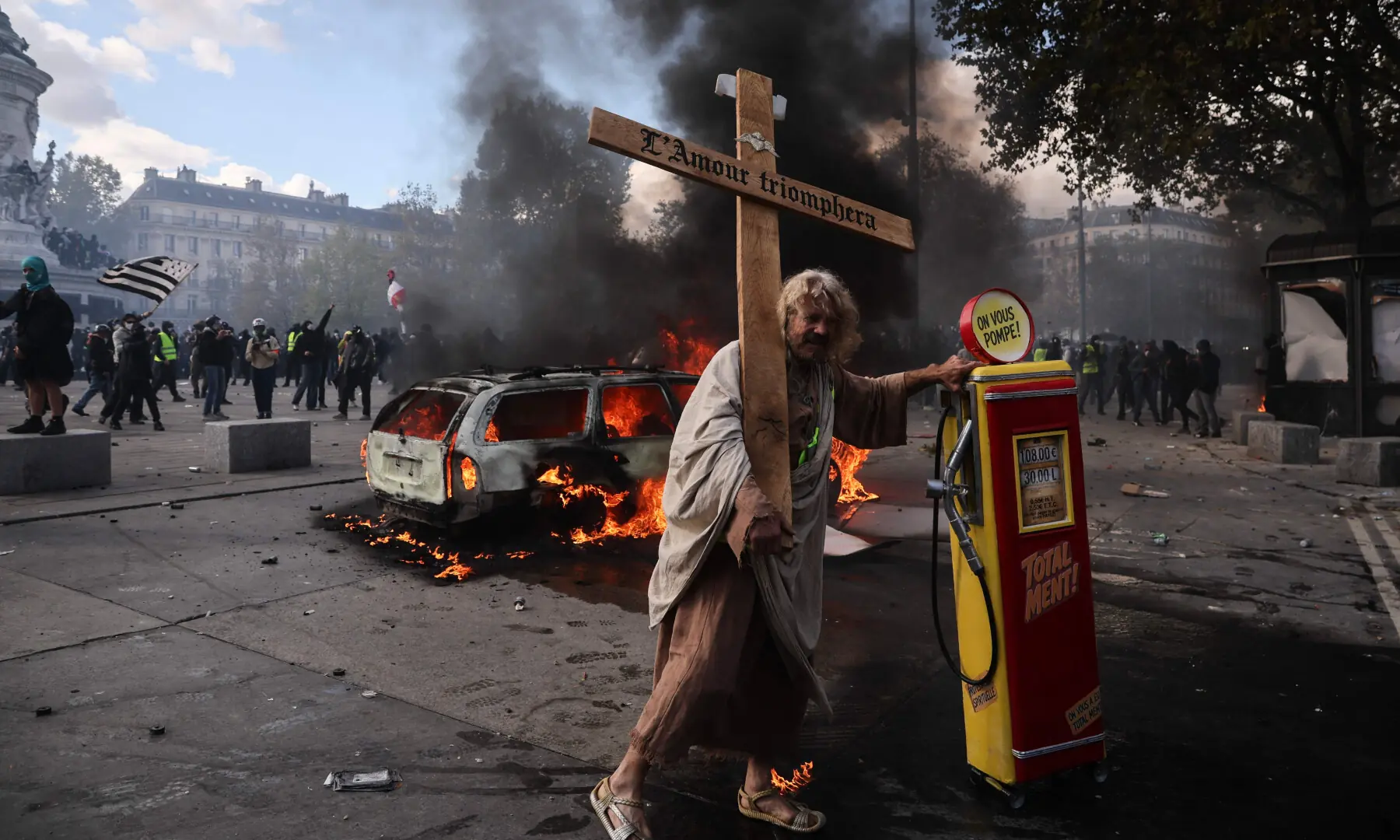
A protester holds a cross with an inscription reading “love will triumph” and stands next to a gasoline pomp during a demonstration to protest against the “high cost of living”, at Place de la Republique in Paris on Oct 17, 2026. — AFP
A protester kicks stands amid tear gas in front of Lyon’s tourism office during a demonstration to protest against the “high cost of living”, in Lyon, southeastern France, on Oct 17, 2026. — AFP
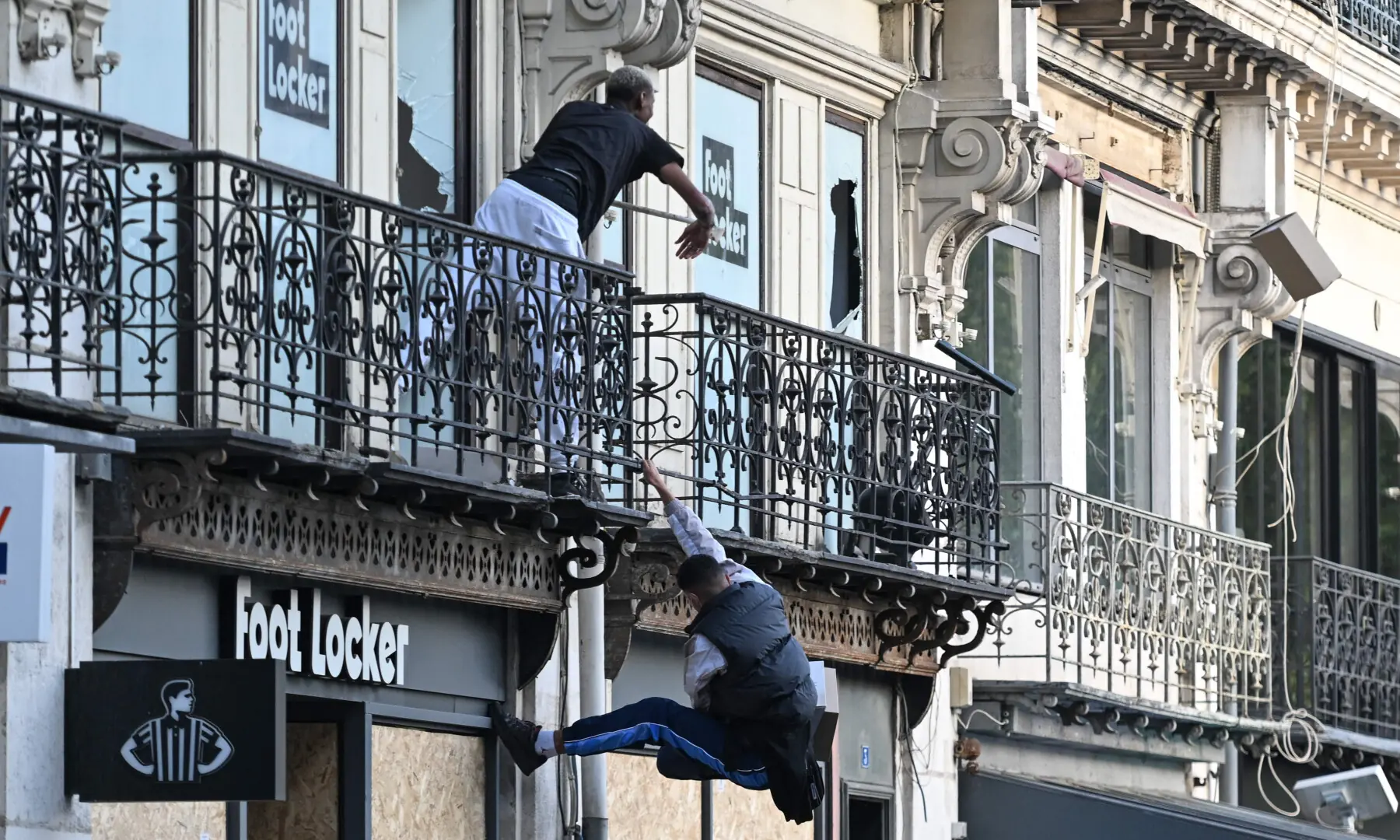
Protesters enter a Foot Locker store as they take part in a demonstration to protest against the “high cost of living”, in Nantes, western France, on Oct 17, 2026. — AFP
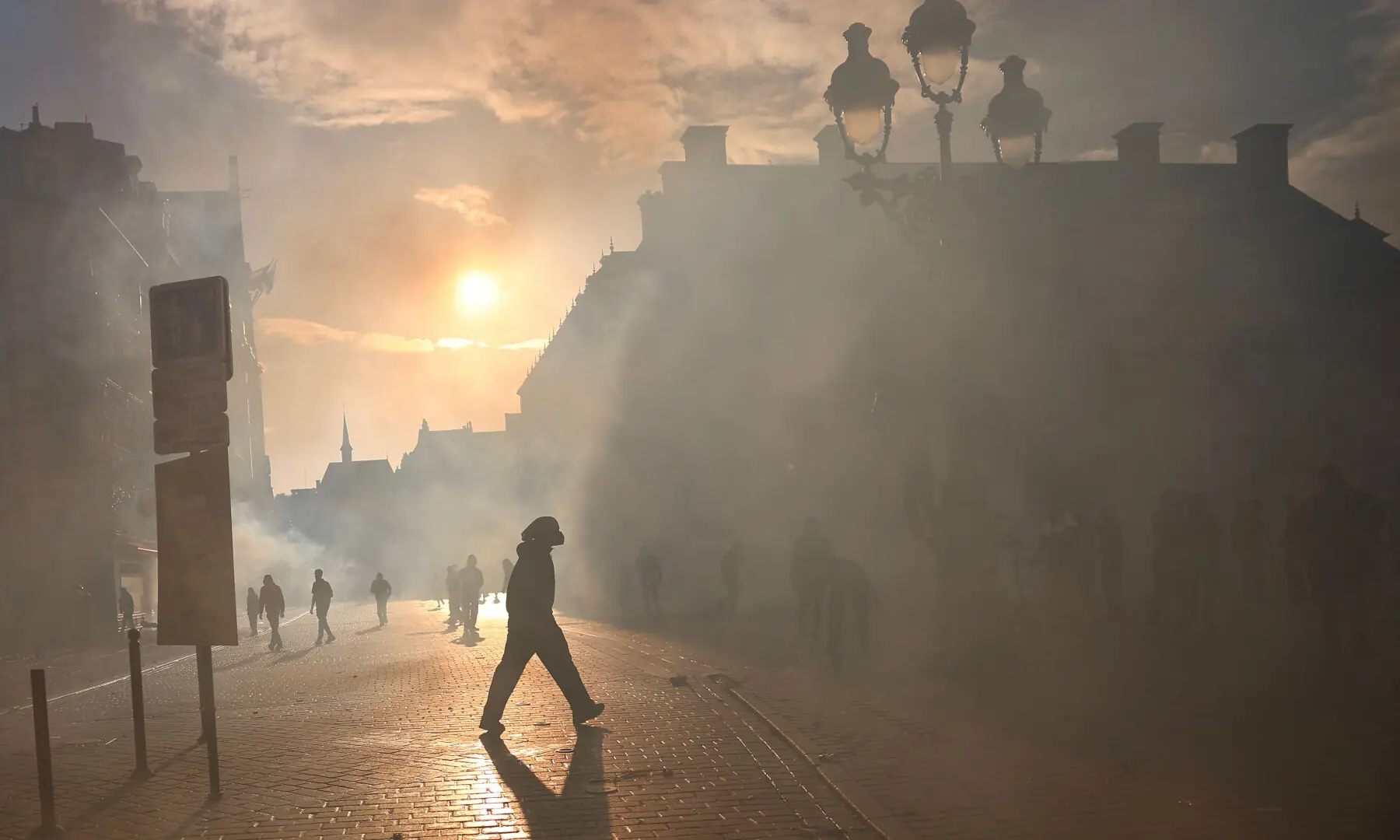
A protester walks in the smoke at Place de l’Opera during ongoing protest action against the “high cost of living”, in Lille, northern France, on Oct 17, 2026. — AFP
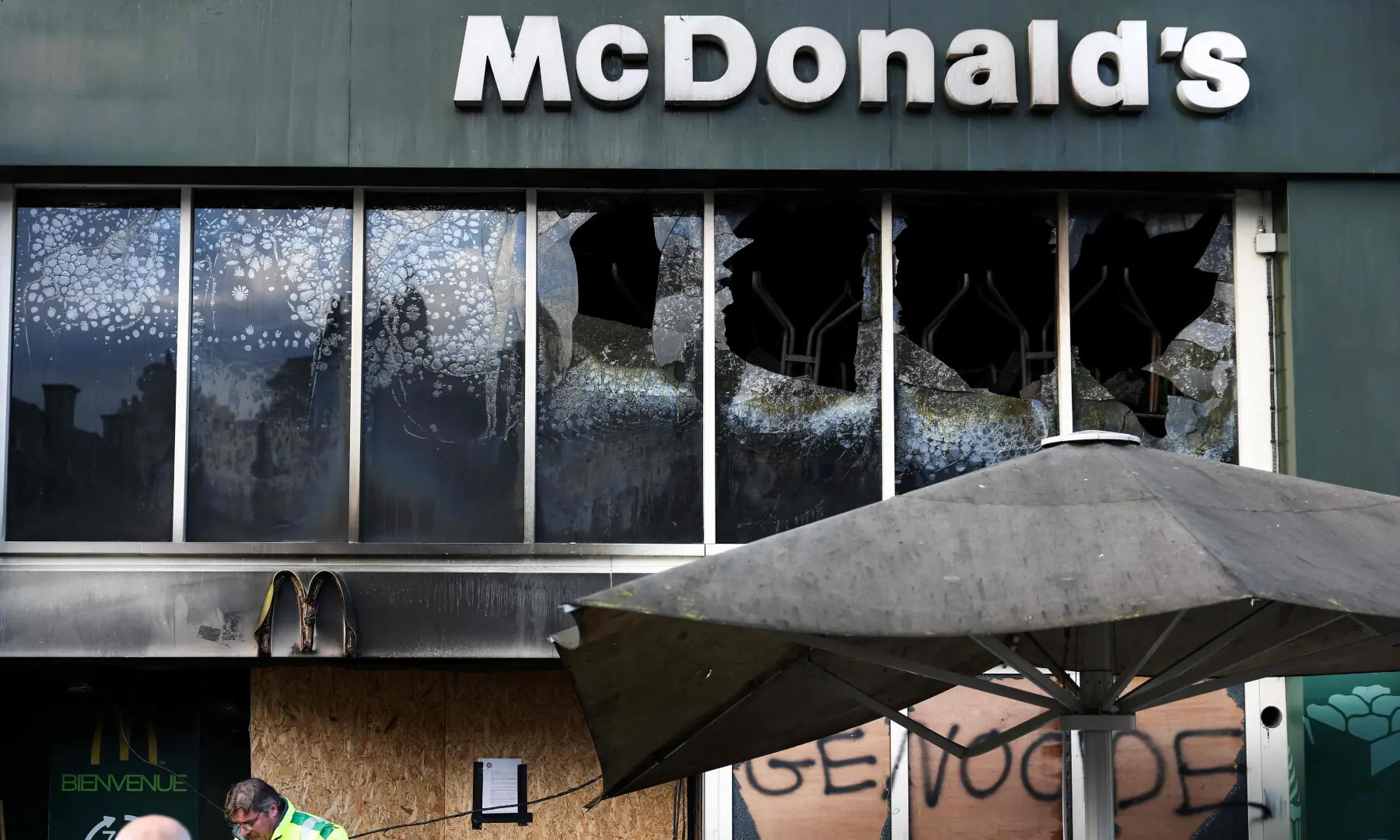
A photograph taken on Oct 18, 2026 shows the frontage window of a “McDonald” fast food restaurant broken in Lille, northern France, a day after nationwide protests against the “high cost of living”. — AFP
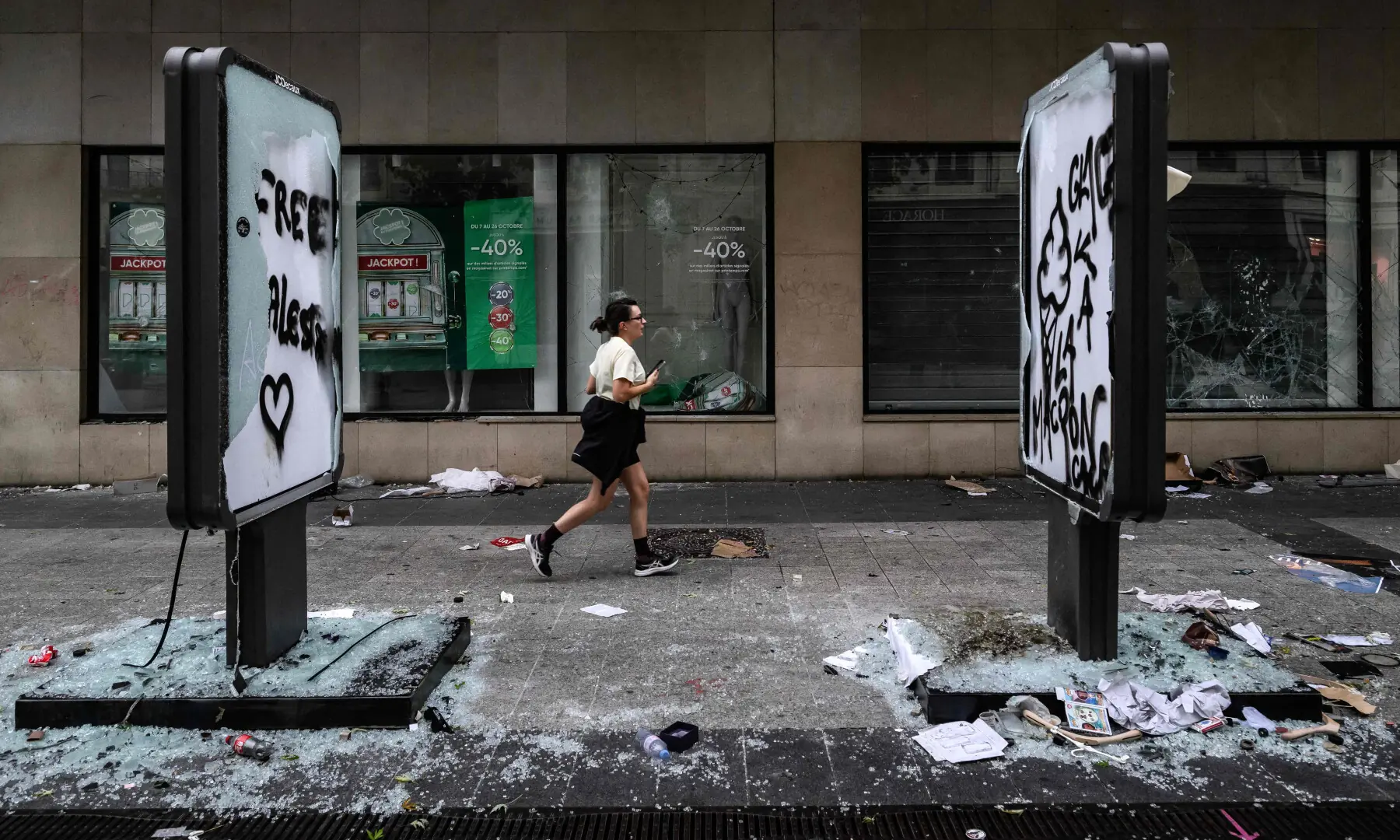
A pedestrian runs past damages and broken frontage windows of a shop a day after riot and looting following a nationwide protest against the “high cost of living”, in Lyon central-eastern France on Oct 18, 2026. — AFP
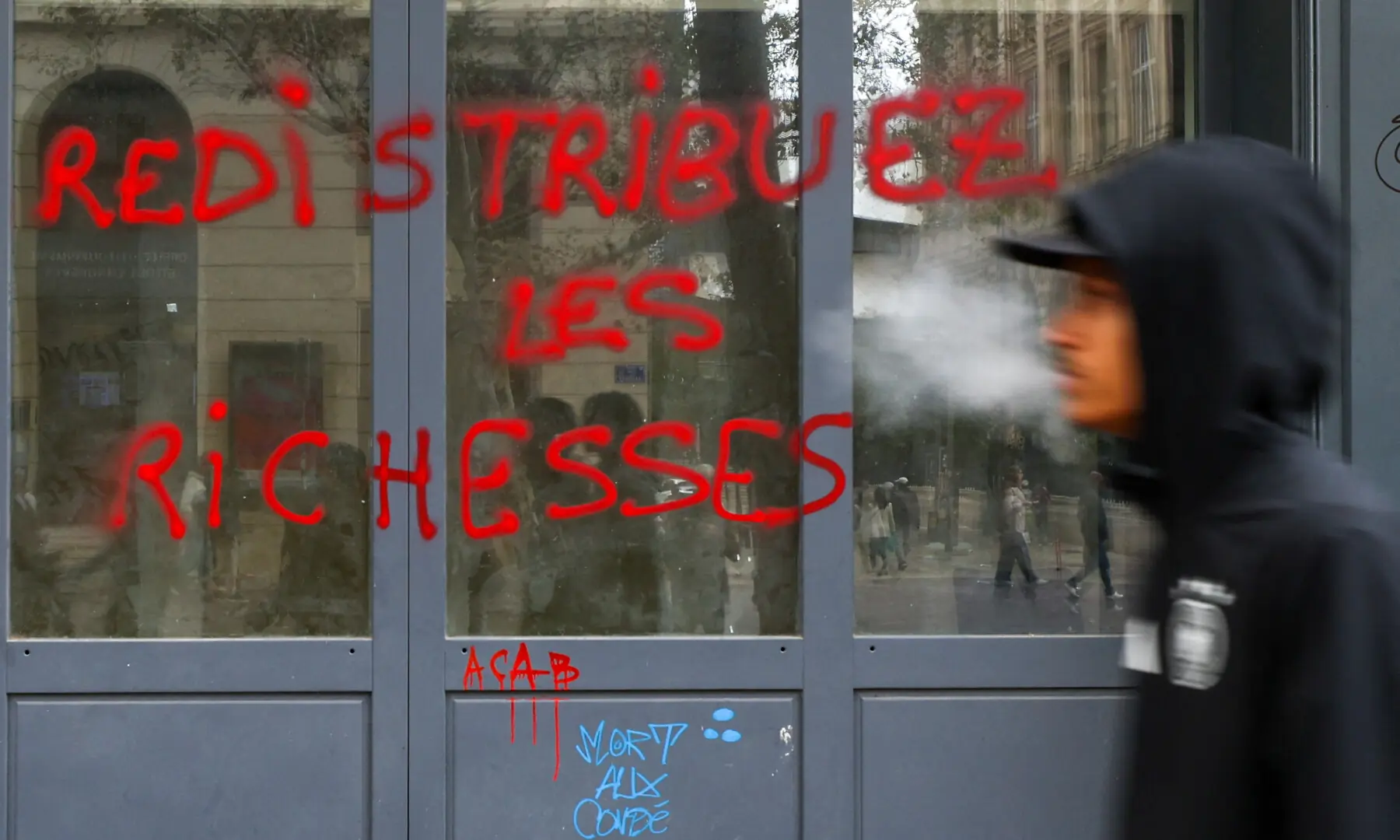
A man walks next to graffiti, which says “Redistribute wealth”, on a shop window, the day after clashes during a national day of demonstrations against the cost of living and rising fuel prices, in Marseille, France, on Oct 18, 2026. — Reuters
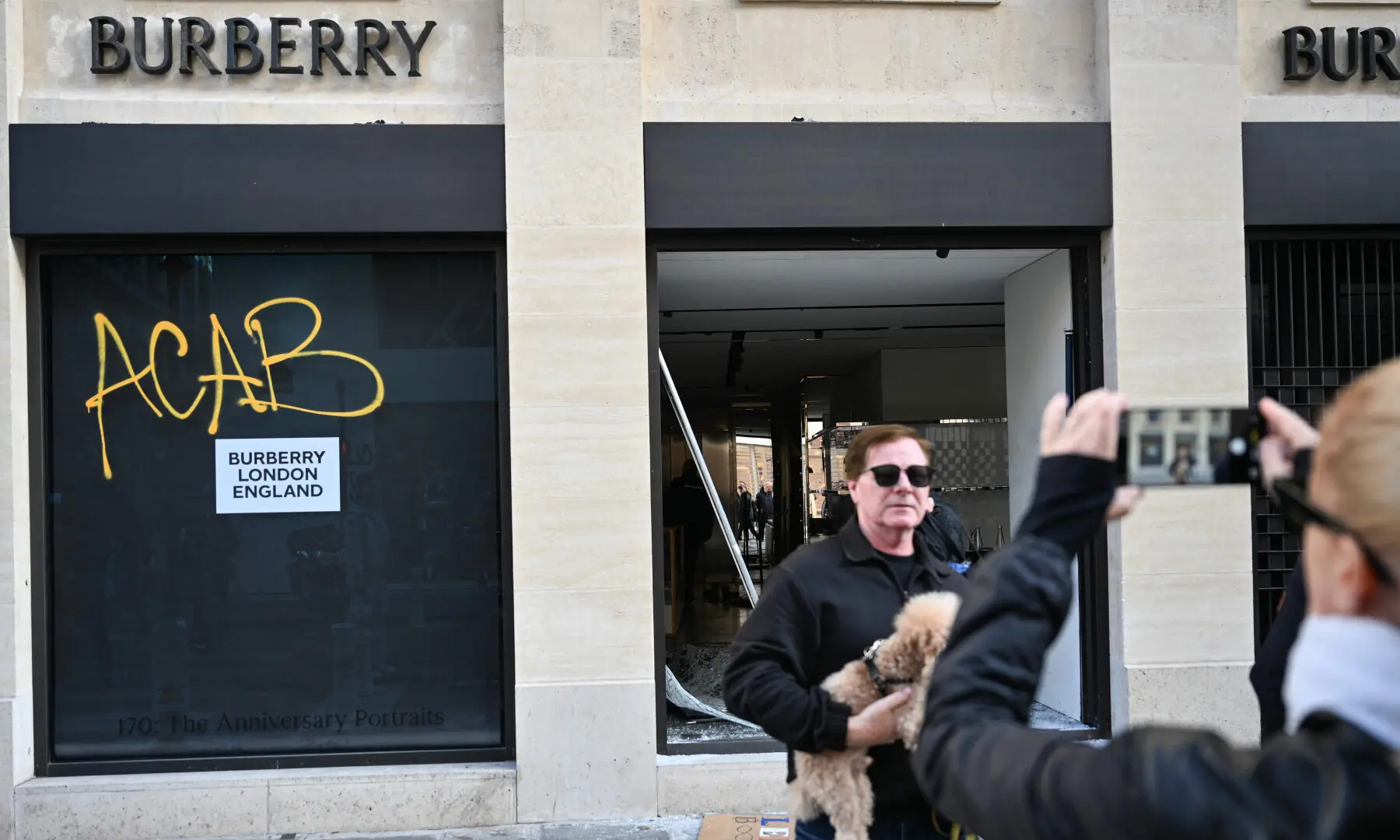
A pedestrian poses for pictures in front of a damaged “Burberry” shop reading the tag “ACAB - All Cops Are Bastards” in central Paris on Oct 18, 2026. — AFP
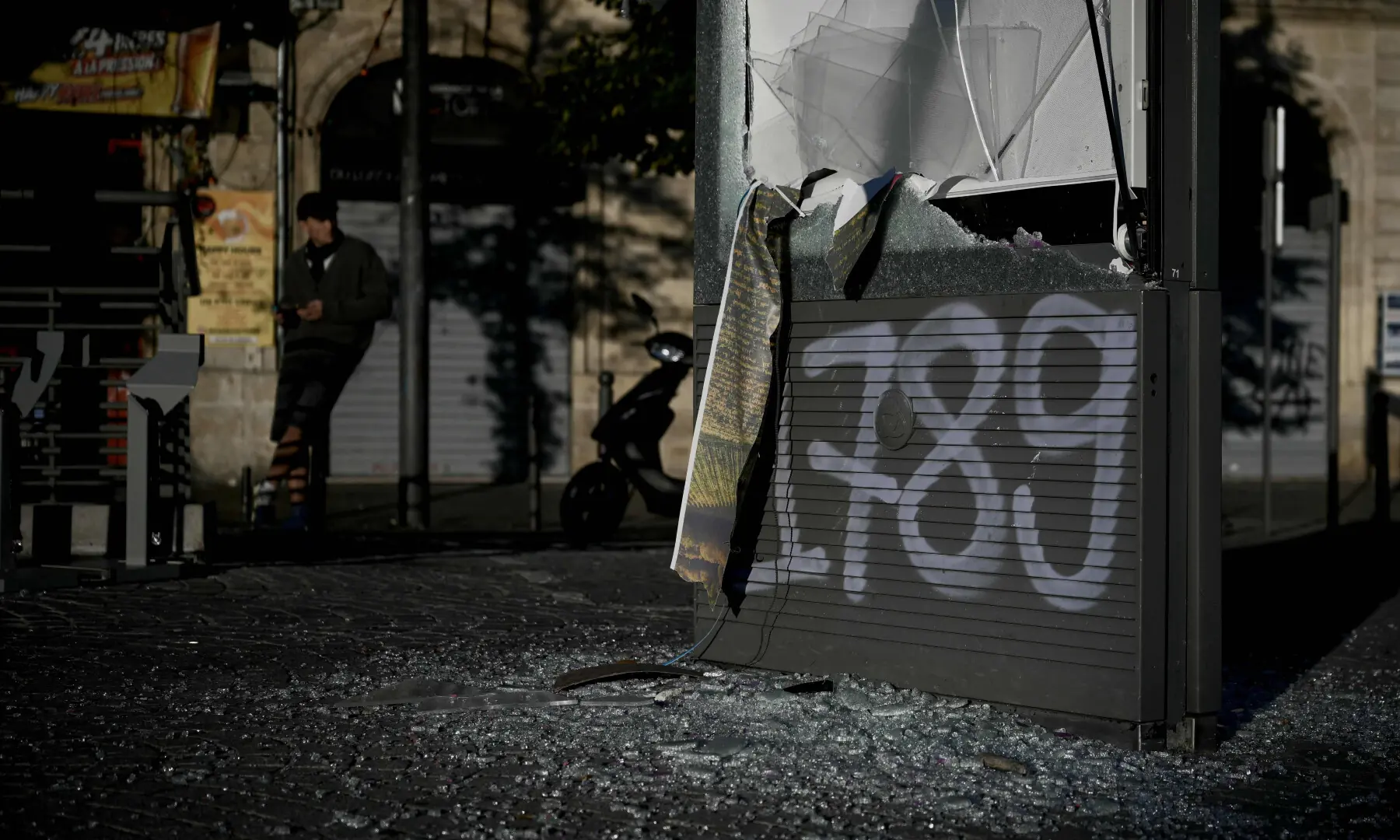
A photograph taken on Oct 18, 2026 shows a damaged, broken-down advertisement board reading “1789”, the year of the outbreak of the French Revolution, in central Bordeaux, southwestern France, a day after nationwide protests against the “high cost of living”. — AFP
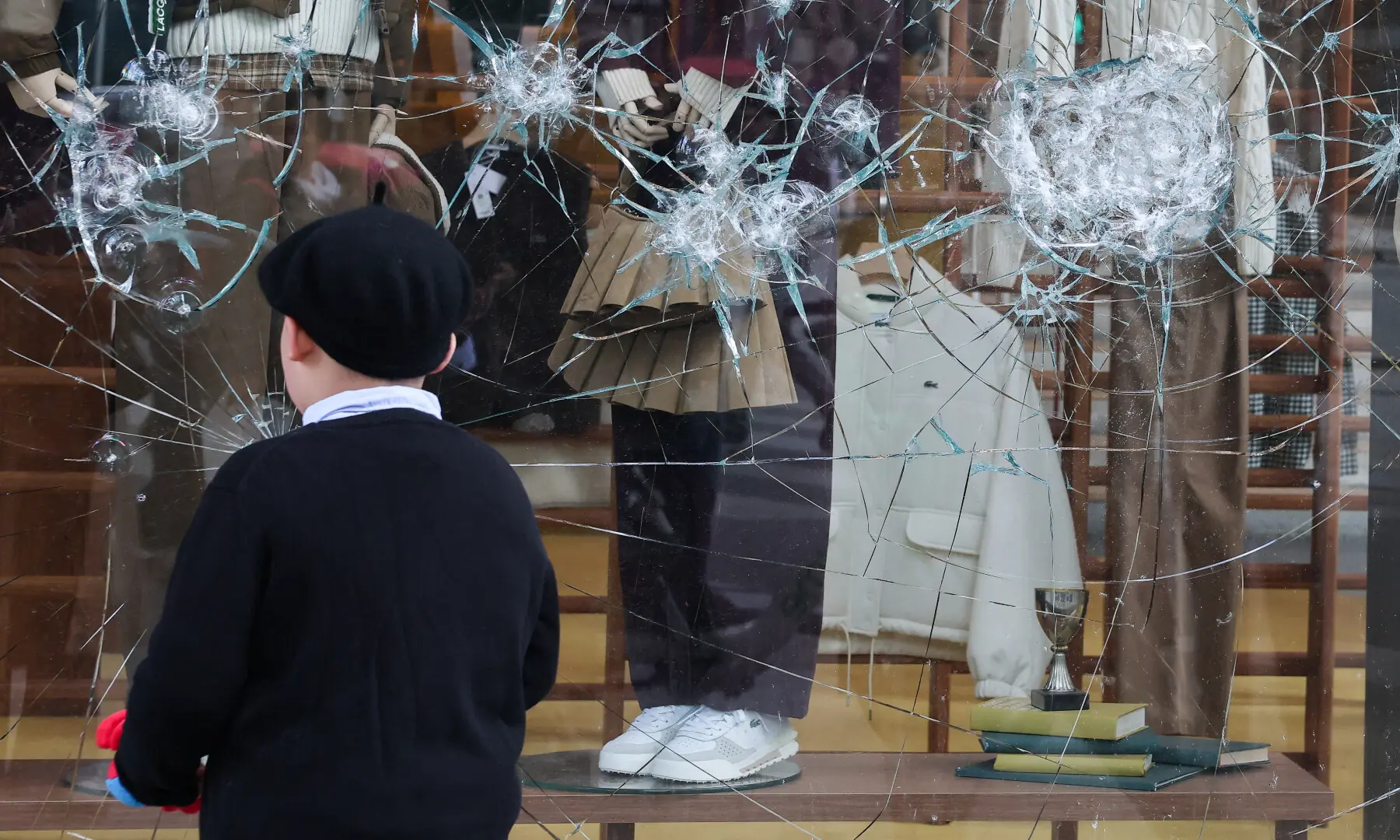
Damaged glass at the Lacoste store on Champs-Élysées Avenue, the day after clashes during a national day of demonstrations against the cost of living and rising fuel prices, in Paris, France on Oct 18. — Reuters
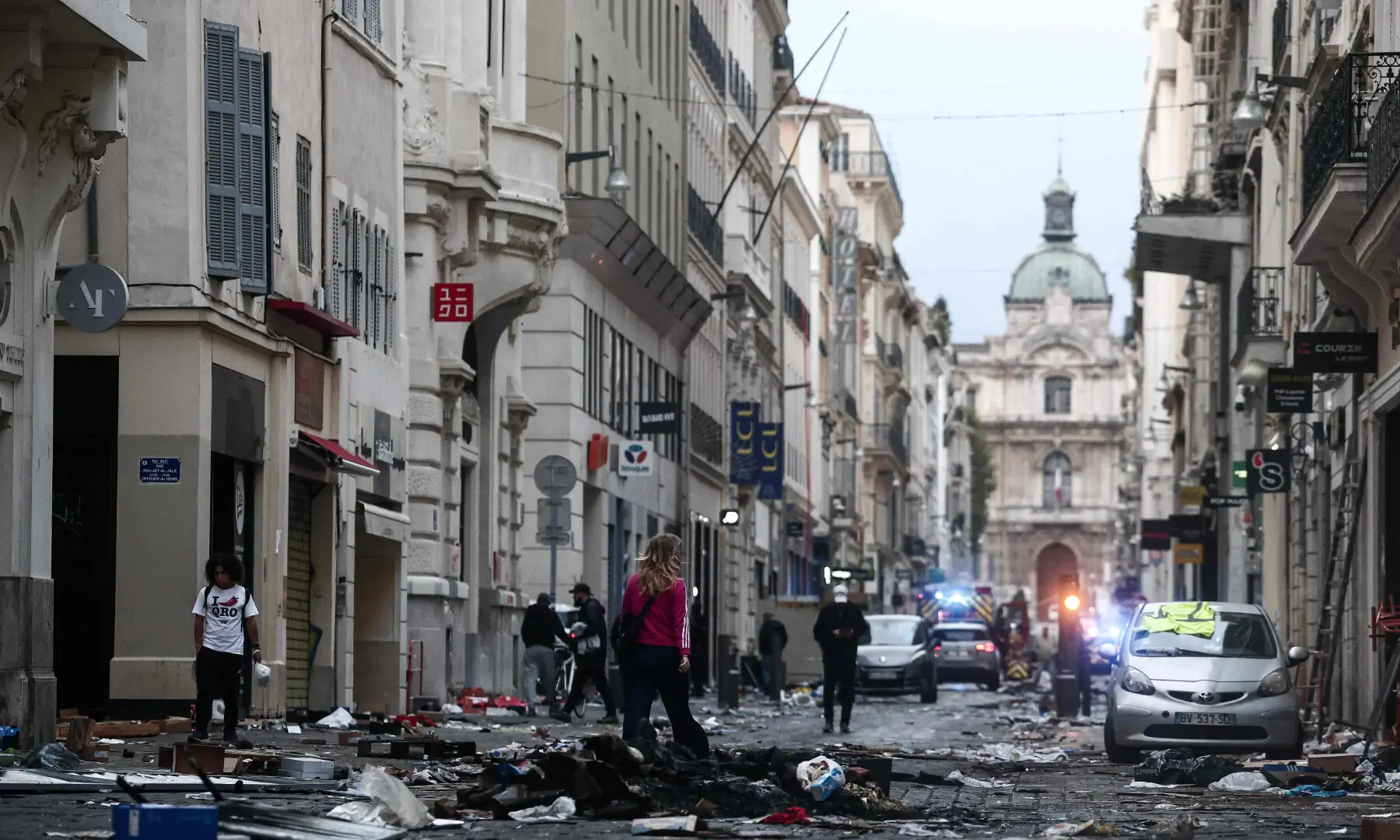
Pedestrians walk along a street covered in debris a day after nationwide protests against the “high cost of living”, in Marseille on Oct 18, 2026. — AFP
A pedestrian takes pictures of the damaged “Louis Vuitton” shop, in central Paris on Oct 18, 2026, a day after nationwide protests against the “high cost of living”. — AFP
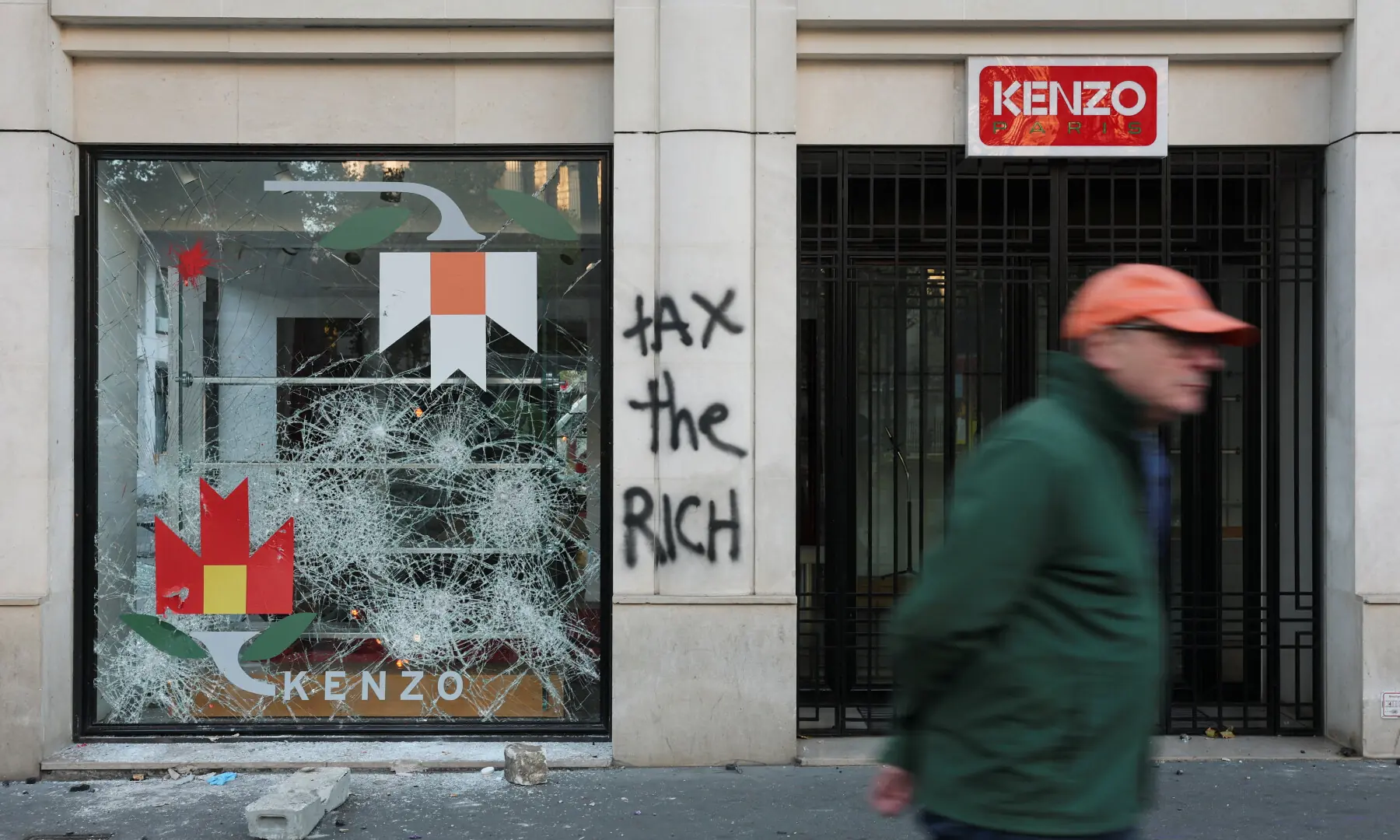
A man walks past a vandalised Kenzo store, the day after clashes during a national day of demonstrations against the cost of living and rising fuel prices, in Paris, France, on Oct 18. — Reuters
This photograph shows the partially burnt facade of the Limoges city hall a day after riots and looting following nationwide protests against the “high cost of living”, in Limoges on Oct 18, 2026. — AFP
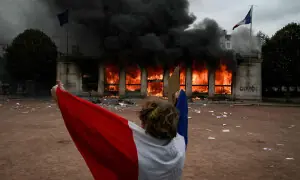
Header image: A protester wrapped in a French national flag stands in front of Lyon’s tourism office set on fire during a demonstration to protest against the “high cost of living”, in Lyon, southeastern France, on Oct 17, 2026. — AFP
French President Emmanuel Macron is facing criticism over his decision to attend a Celine Dion concert Friday night, on the eve of nationwide demonstrations that descended into violence, leaving hundreds of emergency personnel injured and nearly 1,800 people arrested.
Macron and his wife, Brigitte, were spotted at Dion’s concert at the Plenitude Arena in Nanterre, west of Paris, according to French media reports. The couple reportedly arrived and left discreetly and were among roughly 35,000 spectators at the performance.
The concert came after Macron spent Thursday and Friday in Brussels attending a European Council meeting. During a news conference in Brussels on Friday, he called for "calm and respect" ahead of Saturday’s planned demonstrations, saying the right to protest must be exercised with respect for people and property.
By Saturday, demonstrations over rising living costs, school conditions and declining public services had escalated into clashes with police, fires, looting and attacks on public buildings in several cities.
French authorities said Sunday that nearly 1,800 people had been arrested nationwide, including 855 in the Paris region. More than 500 police officers, gendarmes and firefighters were injured, according to Interior Minister Laurent Nuñez. One protester died after suffering cardiac arrest during demonstrations in Paris, authorities said.
In Limoges, a fire that authorities said was deliberately set at the city hall caused significant damage to the historic building. Shops were looted in Paris, Bordeaux, Marseille, Lyon and other cities, while public buildings were vandalized or targeted by fires.
Authorities estimated that more than 550,000 people participated in demonstrations across France. Organizers put the figure at roughly 800,000.
Macron condemned the destruction Saturday evening, writing on X that those responsible for damaging property, attacking public buildings and looting businesses would face prosecution and punishment. He also expressed support for law enforcement and warned against efforts to undermine French institutions.
His statement came after violence had spread through several major cities, raising questions about the government's preparations for the demonstrations and its ability to contain the unrest.
The hostilities began as a month-long student movement over school conditions and teacher shortages in working-class suburbs before broadening into a larger protest movement against inequality, public spending cuts and the rising cost of living.
Government officials have blamed violent groups and looters for the destruction. Prime Minister Sébastien Lecornu attributed the unrest to the "ultra-left" and criminals, while opposition leaders criticized the government's handling of the violence ahead of next year’s presidential election.
Right-wing leader Marine Le Pen condemned the looting and destruction, while left-wing leader Jean-Luc Mélenchon defended the protesters’ broader grievances and criticized the government’s handling of the demonstrations. Mélenchon accused Lecornu of "playing with fire," according to reports.
The violence also left businesses facing extensive damage and mounting financial losses. Carrefour CEO Alexandre Bompard told French television that 50 of the retailer’s stores were damaged, including 20 that were looted, with losses estimated in the tens of millions of euros, according to Reuters.
The mayors of Paris, Marseille and Lyon have requested a meeting with the prime minister to discuss the damage. Local officials in Marseille and Bordeaux have announced or proposed emergency assistance for affected businesses.
Macron is scheduled to address the nation at 8 p.m. local time Sunday, or 2 p.m. Eastern, after meeting with senior government officials. His speech will come as France begins a nationwide cleanup effort and authorities prepare prosecutions for those arrested.
The address will mark a critical test for Macron as his government faces mounting pressure over the scale of the destruction, the police response and the economic grievances that fueled the demonstrations.
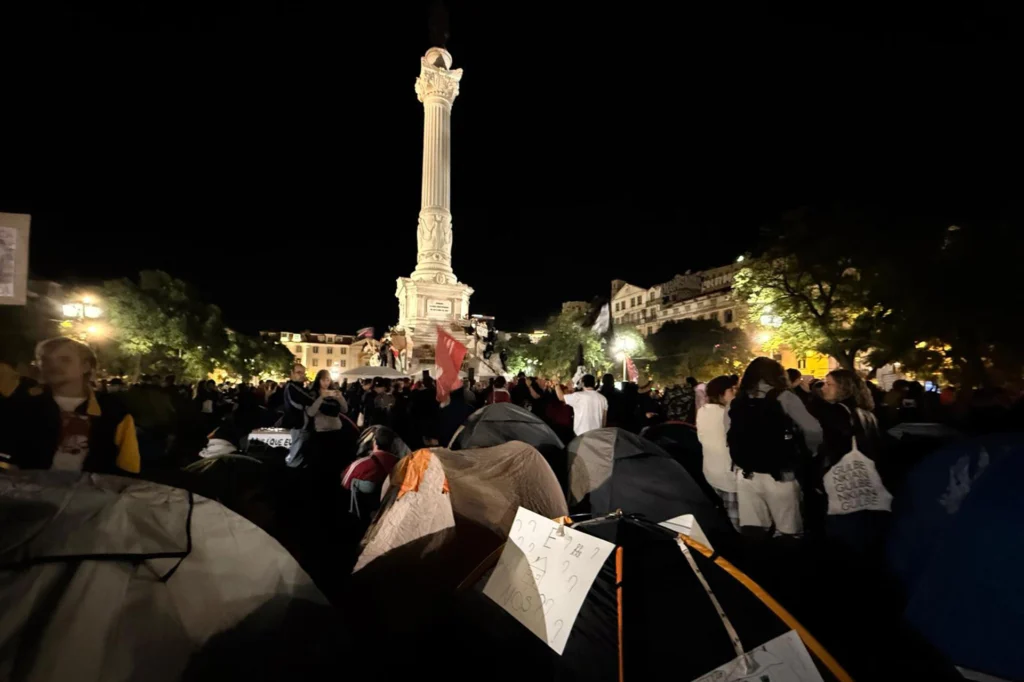
João Veloso, the spokesman for young people camped in Lisbon’s Rossio square, has called for rent limits, repeal of the new lease law, and greater state intervention in the real estate market.
In addition, he has proposed a general strike in Portugal to put pressure on the government of Prime Minister Luís Montenegro. “What we want are rent ceilings and an end to the new tenancy law,” sijo Veloso.
As he explained, the new regulations allow landlords to raise rents “100 or 200 euros from one year to the next,” while the previous legislation set a limit of 2%, he said.
PORTUGAL SE SUMA A LA OLA DE PROTESTAS EN EUROPA 🇵🇹🔥
Miles de manifestantes se concentraron en la plaza del Rossio, en Lisboa, para exigir el derecho a la vivienda y rechazar la precariedad laboral. La movilización cobra mayor fuerza tras la reciente represión policial en… pic.twitter.com/BnfH19r3ML
The spokesperson called for public measures to expand the supply of affordable housing. “What we also want are effective measures from the State, such as public housing, using public properties to rent to people,” he noted.
Veloso criticized the government for selling state properties to private companies, which, he denounced, then obtain significant profits from these properties.
The leader acknowledged the influence of housing protests held in Spain and France. “Of course, there is influence from the encampments in Spain and also from the mobilizations in other countries, such as in France,” he affirmed, and defended the need to coordinate mobilizations to demand measures that facilitate access to affordable housing.
The spokesman particularly urged the General Confederation of Portuguese Workers (CGTP), the main Portuguese trade union, to support the call.
“It is important that the CGTP listens to the people, takes to the streets and goes on a general strike so that we can effectively confront this Government and, who knows, bring down the Montenegro Government,” he declared.
The Rossio encampment is part of youth mobilizations for the right to housing, which have also taken place in other Portuguese cities, including Porto.
India's youth-led Cockroach Janata Party founder Abhijeet Dipke was released from detention on Saturday, a day after his arrest during a police crackdown on protests against the election authority.
Dipke, 31, was detained Friday in New Delhi as he headed to join a rally that the CJP protest movement had called in the capital's central Connaught Place district.
An AFP photographer saw him walk out of a police station Saturday afternoon, wave to the media, and give a thumbs-up as he was driven away.
"Abhijeet Dipke released," CJP legal affairs chief Ratna Singh said on social media.
Opposition parties and CJP activists have defied a security crackdown, rallying to demand the resignation of India's chief election commissioner after accusing the poll body of manipulating voter rolls to benefit Prime Minister Narendra Modi's ruling party.
The commission, which oversees voting in the world's most populous nation, has denied any wrongdoing.
Police arrested two other senior CJP leaders, Ashutosh Ranka and Saurav Das, on 14 October after they entered Jantar Mantar, a decades-old protest site police have declared off-limits for demonstrations. They remain in custody.
"Now just waiting for my brothers to be free", Dipke said in a post on X that included a photo of Ranka and Das.
In a separate Instagram post, Dipke said he "knew going to jail was inevitable" and was ready to face "whatever comes my way".
"Because the day I decided to come back to India, I placed my fate in the hands of the people of India and the Constitution of this country."
Members of Modi's Hindu nationalist Bharatiya Janata Party (BJP) have long alleged that large numbers of undocumented Muslim migrants from neighbouring Bangladesh have fraudulently entered India's electoral rolls.
Rights groups and critics, however, say the Modi government has eroded democratic freedoms over more than a decade in power, citing pressure on journalists, civil society groups, and political opponents, allegations the government rejects.
Italy, like France, witnessed a day of protests on Saturday — several turning violent — as some Italian politicians blamed the extreme left for the lawlessness. Prime Minister Giorgia Meloni took to social media to condemn the unrest and back law enforcement.
Meloni wrote on X: "Once again, the women and men of the Law Enforcement Forces have had to face the violence of criminals who, even through organized groups, exploit demonstrations to seek confrontation and sow chaos," she posted.
She added, "Because they were there to safeguard the safety of citizens, workers, merchants and all the people who have the right to live [in] their city without fear and without seeing it laid to waste and set ablaze by gangs of thugs," she continued. "We stand with you."
Her Sunday morning post came after scenes of violence between protesters and police, the most visible being outside Milan’s historic Cathedral, known as the Piazza del Duomo.
The Associated Press reported 50 demonstrators, including minors, were detained and at least two police officers were hurt in a protest that required water cannons to disperse the crowd, quoting the LaPresse news agency. Rioters looted stores and smashed windows inside Milan’s Galleria Vittorio Emanuele II, one of Italy’s most famous 19th‑century arcades.
Meloni had already laid blame for the protests on Saturday night, posting: "Thugs who exploit demonstrations to sow chaos, attack those who ensure security and hold entire cities hostage… Demonstrating is a right. Setting our cities ablaze is not."
She added a message to her political opponents: "I renew my request to the opposition: do not be ambiguous about this. Unequivocally condemn these acts of violence and issue a clear appeal for every mobilization to be peaceful."
Il Sole 24 news site quoted Francesco Filini, MP for Meloni's Fratelli d’Italia and national program coordinator, as saying: "It is no longer tolerable that every time left-wing extremists take to the streets, scenes of organized destruction unfold. We are not dealing with mere demonstrators, but with organized groups that plan violence."
Meloni posted she had "great respect for the thousands" who protested peacefully and calling participation "the foundation of any healthy democracy… we cannot ignore what happened in other Italian squares."
She noted that in Milan "stones were thrown at the Law Enforcement Forces, officers were injured, damage and violence occurred that forced the interruption of the procession. In Turin, people were stopped carrying cobblestones and window-breaking hammers. In Bologna, the disorders led to the precautionary closure of the railway station."
"In the face of scenes like these, the rejection must be unanimous," Meloni posted. "Any hesitation becomes justification. Silence is not acceptable."
Milan’s center-left mayor, Giuseppe Sala, told the Associated Press, "The reasons for the protests were understandable. The violence against law enforcement and serious damage to the city are not justifiable."
Reuters reported some 56 police officers were injured in the protest in Bologna, citing the police union, and the interior ministry says about 100 officers were hurt and around 30 arrests were made in the demonstration in Turin.
Reuters and The Associated Press contributed to this report.
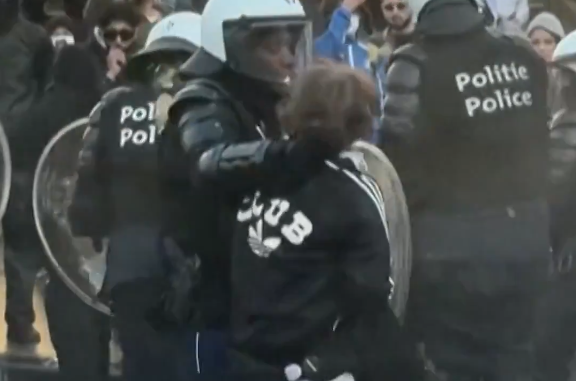
Around 200 people were arrested in Belgium during demonstrations this Saturday against cuts in education, the police, the federal government, and the rise of the far-right, which ended with heavy clashes between security forces and protesters, local authorities reported today.
In Brussels, where the largest concentration occurred, 150 people were arrested. Most, 118 cases, were administrative arrests, while 32 were judicial detentions due to the alleged throwing of projectiles at the police, resistance to authority, and arson, Belgian media affirmed.
Among the 32 detainees are 15 minors, they added. The police in the Belgian capital also reported that five members of the police force were slightly injured during the demonstration.
A wave of cost-of-living, education and housing protests swept across Europe, with France at the center and violent clashes in several cities.
🇫🇷 France: About 550,000 marched nationwide; Limoges town hall and a Lyon tourist office were set on fire, around 1,800 people were…
On the other hand, during the protest in the French-speaking city of Liège 45 other arrests were recorded, 12 of them minors. Both demonstrations began peacefully on Saturday morning, consisting of young people, teachers and trade unionists.
However, at noon there were clashes with the police during the march of the protesters, which lasted until late in the afternoon.
The police used water cannons and tear gas against participants in Brussels, while some of the protesters smashed public furniture, vehicles and set fire to a container.
Public transport was also affected in the capital, with several metro and bus lines cut off or diverted.
Pope Leo XIV resumed public appearances on Sunday, leading prayers at the Vatican just five days after undergoing lung cancer surgery and one day after leaving the hospital.
“I would like to thank all those who have prayed for me in recent days. I have truly sensed your support. Thank you!,” Leo said from a balcony overlooking St. Peter’s Square in Vatican City.
The Catholic leader, 71, announced his planned surgery last week to remove a “small, localized” nodular lesion on his right lung. During the 90-minute operation, doctors confirmed he had lung cancer but said the operation to remove a lower lobe of his lung was successful, according to the Vatican.
“This experience has made me feel particularly close to all those who are living with illness or infirmity,” Leo said. “Now that I have overcome this delicate phase, as you know, I will gradually resume my activities, always with God’s help and your prayers.”
The surgery and cancer diagnosis marked Leo’s first major medical episode of his papacy. It is yet unclear whether the pope will require additional treatment.
His planned trip to Latin America next month, which includes visits to Uruguay, Peru and Argentina, remains unchanged as “there are no clinical reasons why this visit should not take place,” Professor Stefano Margaritora, the physician who operated on the pope’s lung, told Vatican News.
“The Holy Father has put his heart and soul into his recovery, as the most motivated people do after this kind of operation,” Margaritora said. “As a result, he needed very little assistance from us. His determination to recover quickly has been effective in every respect. It was truly commendable.”
Leo was elected last year following the death of his predecessor, Pope Francis. Leo, born Robert Francis Prevost in Chicago, Illinois, is the church’s first American pope.
 Login