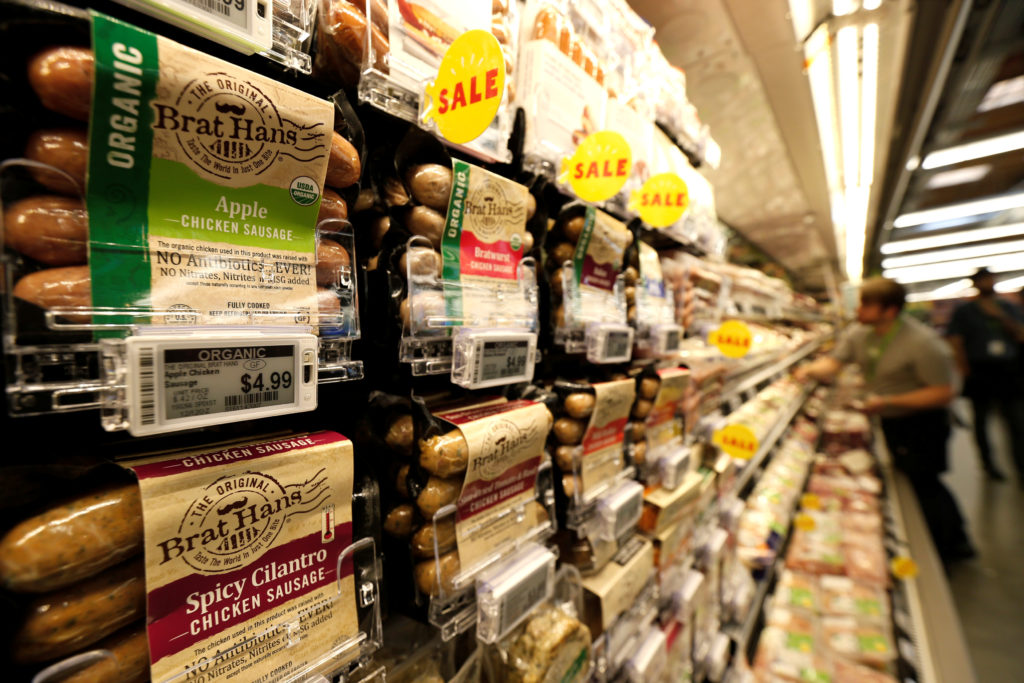
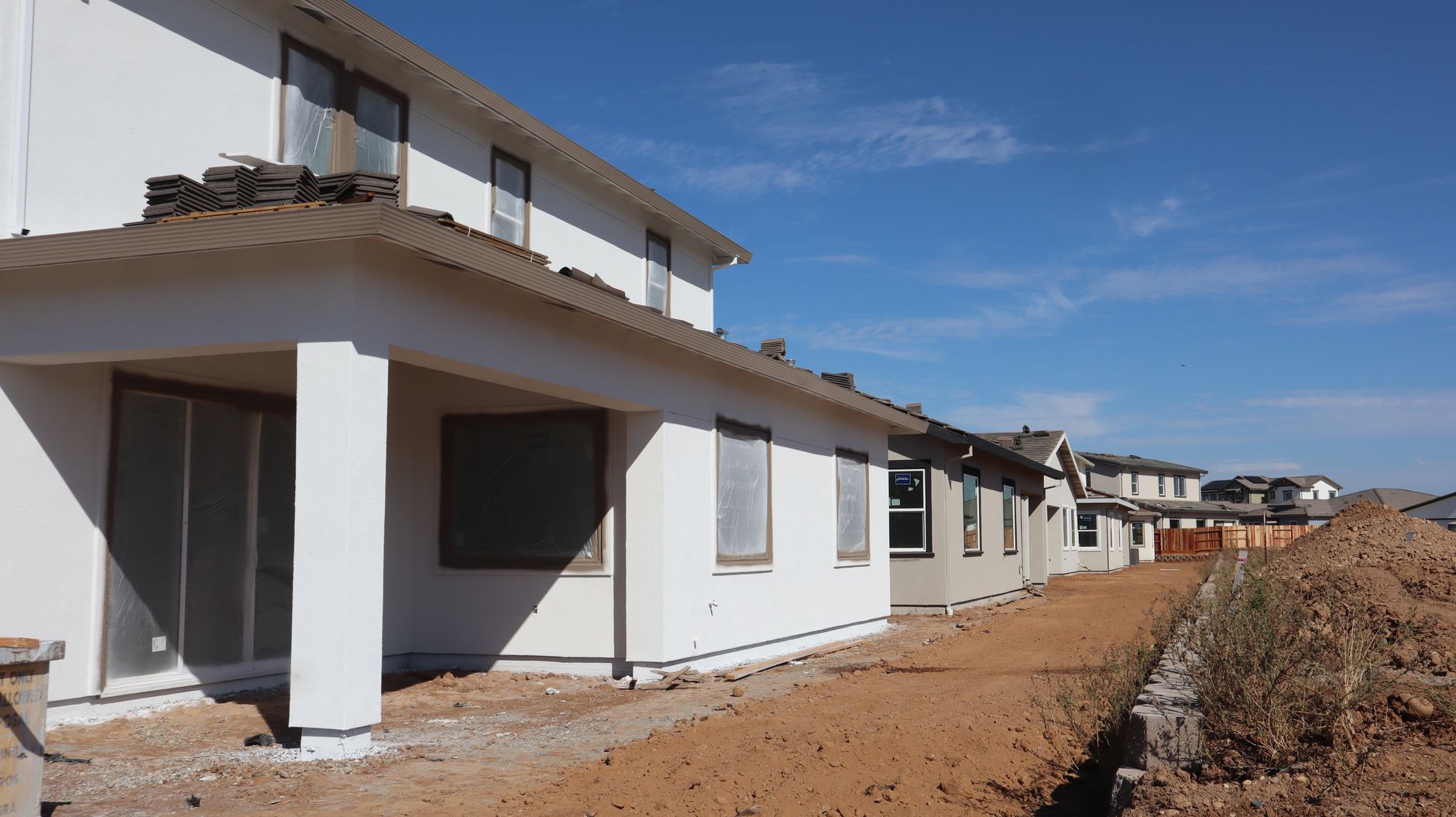
Roughly four in 10 US homebuilders are cutting prices to revive buyer interest, new data show, as traffic through model homes has fallen to its lowest level in 14 years. Builders are making the cuts even as they face rising construction costs.
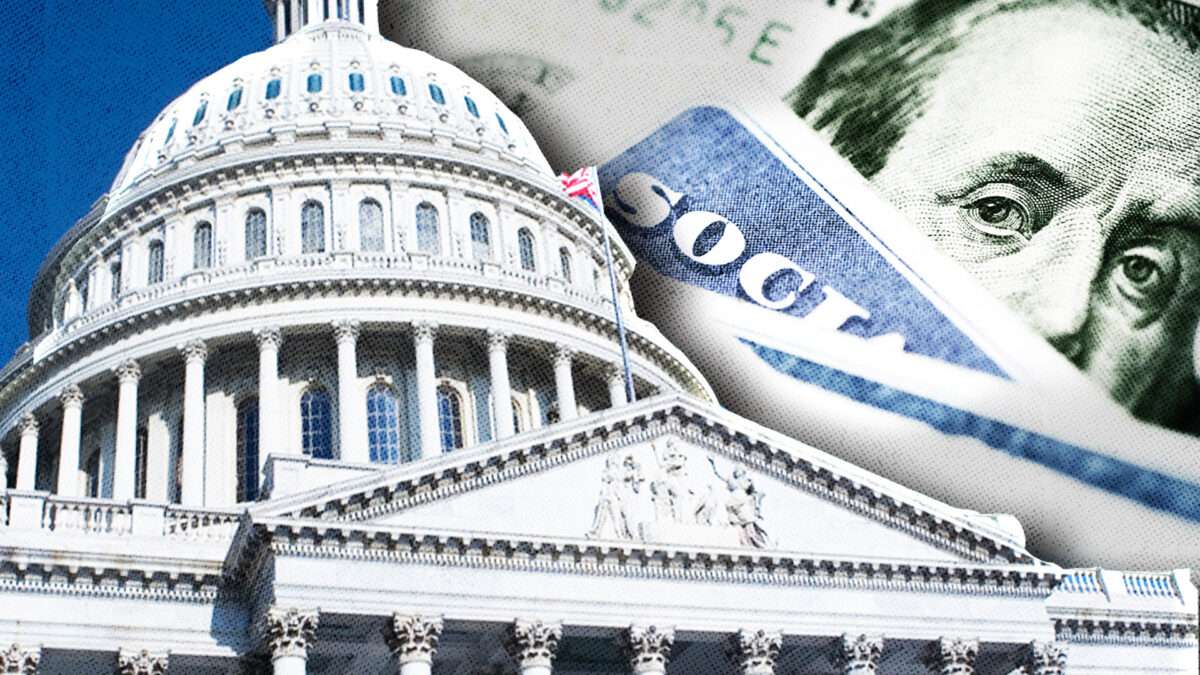
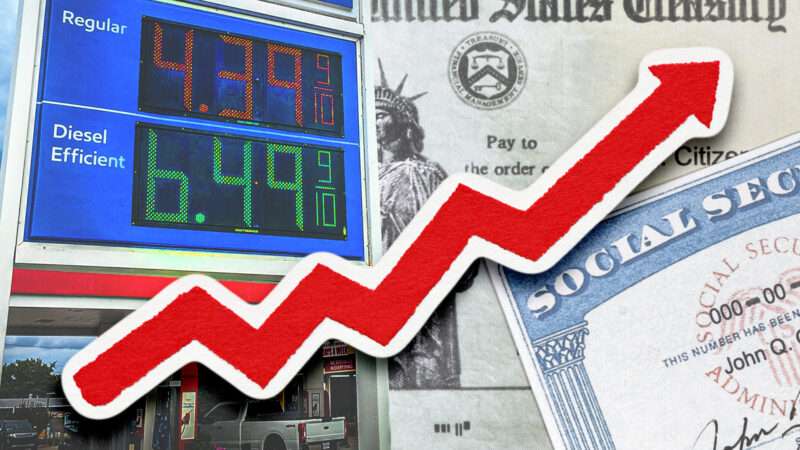
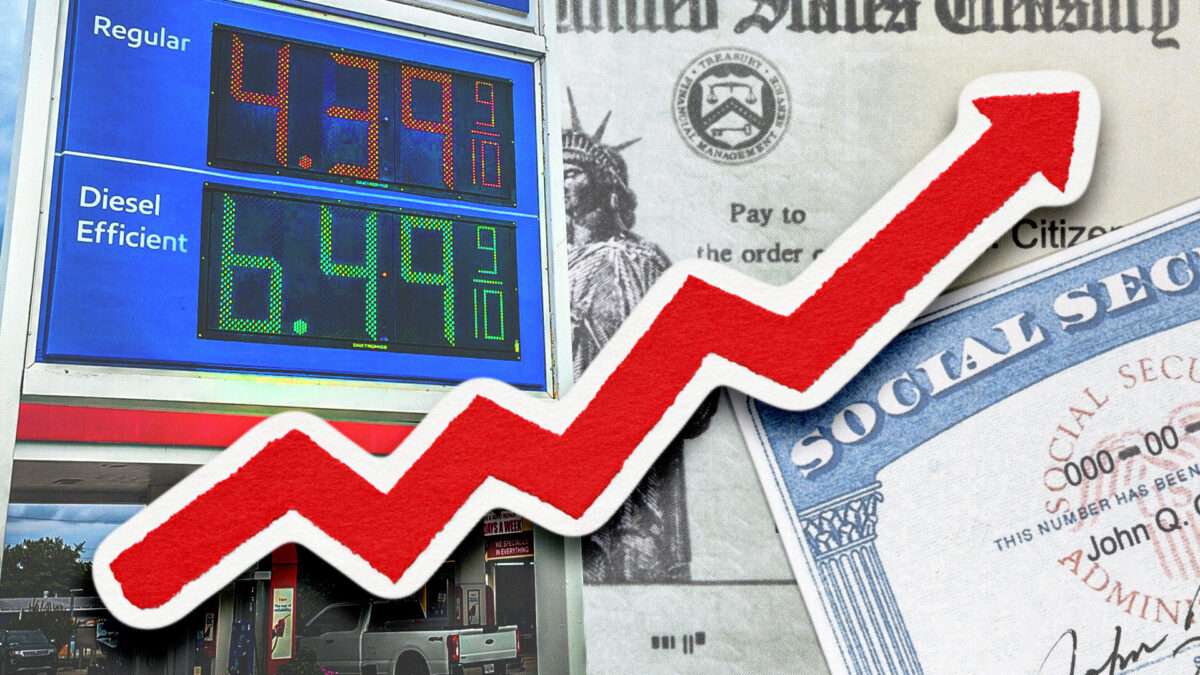
Social Security is racing towards insolvency because the program pays out more in benefits to retirees than it collects in taxes from working Americans.
Handing out even more generous benefits will make that situation worse. Yet that is exactly what the trustees who run Social Security are planning to do: Retirees will get a 3.6 percent cost-of-living adjustment (COLA) next year. That increase is 0.8 percentage points higher than last year's, and it is 0.9 percentage points higher than what Social Security was expecting to pay.
The Social Security trustees are doing what the law requires during a time of high inflation. That's why Congress ought to intervene here.
It should cancel the COLA.
No, this isn't a demand that lawmakers stick it to America's retirees. It's an appeal for some fiscal common sense. There are three good reasons to cancel this year's COLA.
First: Handing out higher benefits to wealthy retirees simply doesn't make sense when Social Security is trending towards insolvency.
As the Committee for a Responsible Federal Budget notes, the announced COLA would be a $900 increase in benefits for the average retired household—but some retirees could receive as much as $3,600 more.
Paying generous benefits to wealthy households is the main reason Social Security is facing insolvency in the first place. A program originally intended to keep seniors from falling into poverty has become a huge wealth-transfer scheme that overwhelmingly benefits those who don't need the handouts. The COLA doubles down on this flaw.
Second: What about the workers who are paying for those lavish benefits? Wages have risen by 3 percent, on average, over the past year. Those pay increases have already been outpaced by inflation, which is up 3.7 percent in the past 12 months.
You'll often hear retirees talk about how they are living on a "fixed income," but the math simply doesn't bear this out. Social Security beneficiaries will get a COLA that is larger than the average pay increase for the workers who are funding the COLA. Retirees are protected from the impact of inflation while younger Americans must deal with inflation and finance that protection for the elderly. That's crazy.
Third: Cutting the COLA could kick-start a conversation about how to solve Social Security's looming insolvency. The Social Security trustees estimate that an across-the-board cut of about 22 percent will be necessary in 2032. Eliminating COLAs won't meaningfully change that arithmetic, but it would change the conversation—which has for too long been dominated by politicians promising seniors that nothing needs to change. That's wrong—and the sooner that becomes apparent, the better off the political system will be.
If eliminating the COLA is too radical a change, Congress should instead change how the trustees calculate the annual increase.
Currently, the COLA is based on one particular measure of inflation: the Consumer Price Index for Urban Wage Earners and Clerical Workers, otherwise known as CPI-W. This is a relatively narrow index that reflects the spending habits of only about one-third of all Americans, as Romina Boccia points out in her newletter, The Debt Dispatch.
Instead, Boccia suggests using the Chained Consumer Price Index for All Urban Consumers, or C-CPI-U, which covers about 93 percent of all Americans and is generally regarded as a better measure of the rising cost of living. Other parts of the federal government already use C-CPI-U to update such things as tax brackets.
If Congress simply changed how Social Security's COLA was calculated, it could close 12 percent of the program's long-term shortfall. And while some retirees would see smaller COLAs as a result, the result would more closely match those increases to inflation.
Social Security's COLA reflects many of the fundamental flaws with America's old-age entitlement program. Like Social Security as a whole, it is too generous to the rich, too costly to the taxpayers, and too unfair to younger, poorer workers.
As the Iran War continues, gas prices remain high — a real strain for consumers.
The conflict has kept diesel, crude oil, and gas prices high; inflation is eating up pay hikes.
As America heads into midterms, it's a hard affordability position for President Donald Trump.
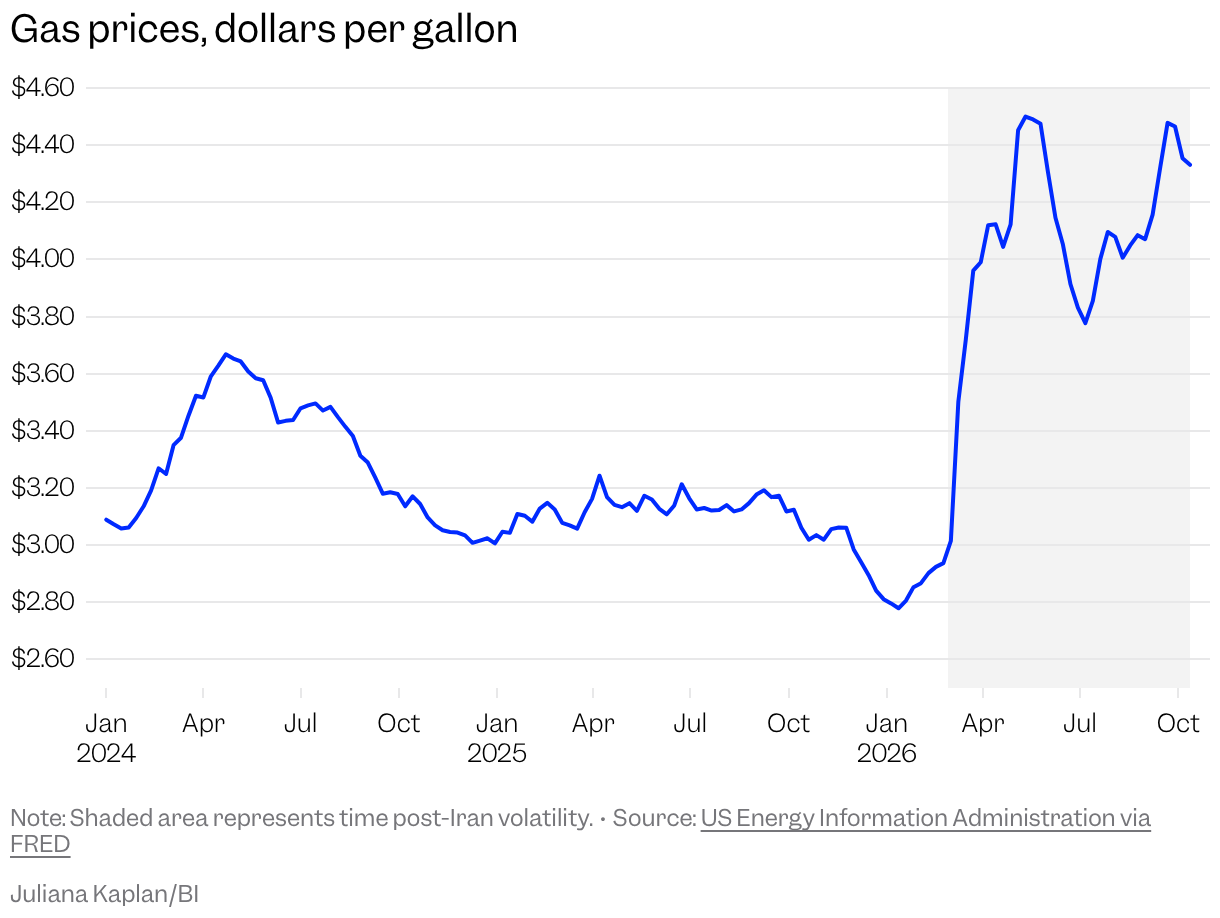
It's expensive out there: Gas prices have been stuck at over $4 a gallon for more days this year than any other. The war in Iran shows no signs of cooling off. Inflation is swallowing any raises you might have gotten at work.
It's a recipe for a challenging midterm cycle for President Donald Trump, who faces an affordability crisis at home that's not going away — and a far-away war that's only making costs go up.
The volatility surrounding the contested Strait of Hormuz, a key oil and gas transit waterway, has hit American consumers hard.
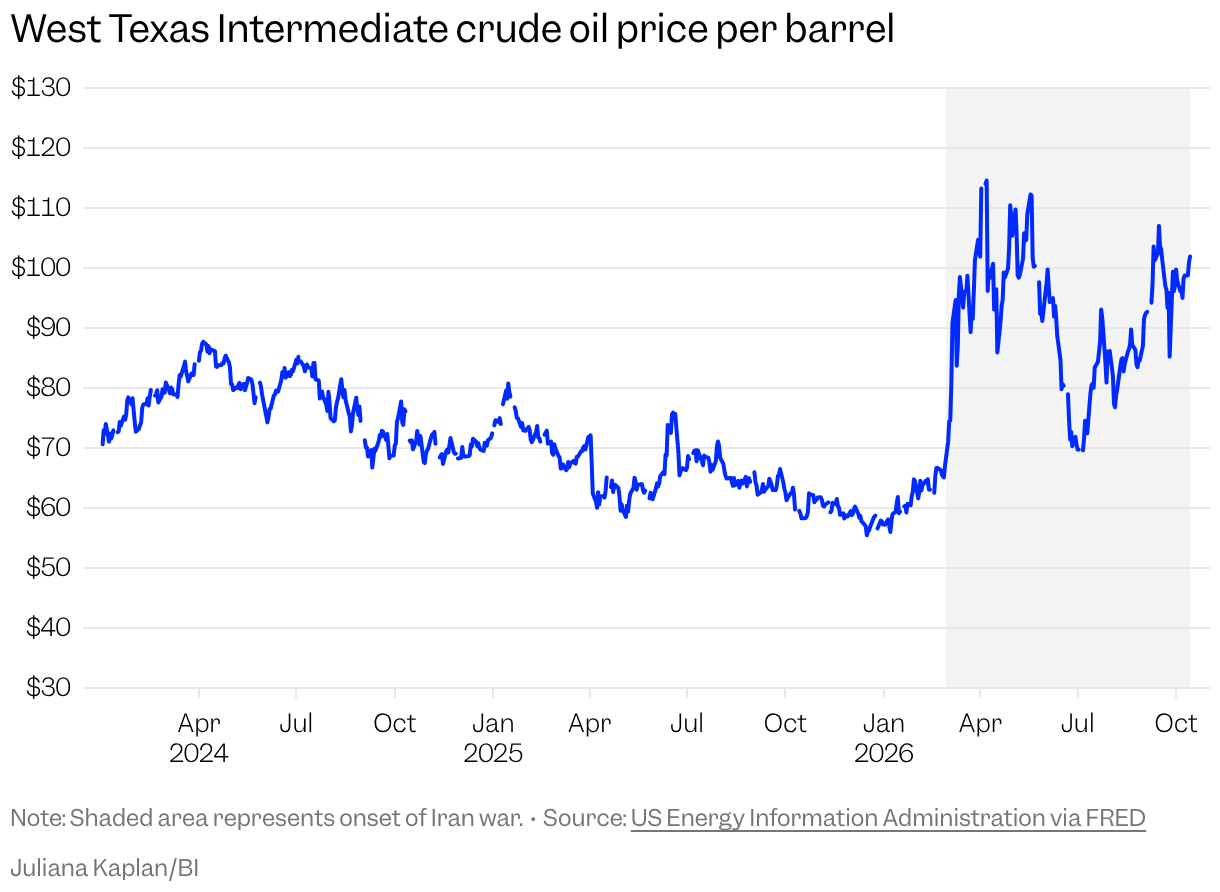
Since the Iran war first kicked off in February and the Strait was subsequently closed, gas and oil prices have skyrocketed. Diesel prices have hit record-breaking highs in recent weeks. That paints a dreary picture for Americans struggling with high costs, who likely won't feel any relief at the pump in the near future — especially as more potential military action looms.
Trump has highlighted the broader goals of the war and argued that the increase in gas prices would be transient. In an October 8 Truth Social post, he wrote, "a temporary increase in the price of Gasoline is a small price to pay for Iran not having a Nuclear Weapon."
While the US military has not carried out airstrikes against Iran directly in several months, it has kept a significant force presence in the Middle East, including more than a dozen warships, dozens of fighter jets, and thousands of sailors and Marines.
US forces in the region are maintaining a naval blockade against Iran, and since July, they have disabled four commercial ships that the Pentagon said were sailing in violation.
After the start of the war in February, crude oil prices soared and remain significantly higher than when Trump's second term began.
Tanker traffic through the Strait of Hormuz nearly ground to a halt early in the Iran war, severely disrupting a waterway that normally carries about a fifth of the world's oil supply. Shipments have since recovered substantially but remain below prewar levels.
The Trump administration said it aims to alleviate issues related to oil. "The President wants to see prices at the pump fall and continues to take historic measures to alleviate temporary disruptions as oil flowing through the Strait of Hormuz approaches pre-conflict levels," White House spokeswoman Taylor Rogers said.
Vessels carrying oil and other products have continued to take fire from both sides, putting more pressure on commerce traveling through the area. US forces have carried out additional strikes on Iranian-linked targets. The Pentagon said they have destroyed 10 tankers tied to the Islamic Revolutionary Guard Corps, or IRGC, since July.
Meanwhile, several merchant ships have come under attack in and around the Strait of Hormuz this month, according to the Royal Navy-affiliated United Kingdom Maritime Trade Operations Center. US Central Command, which oversees American military operations in the Middle East, has attributed some of these strikes to Iran.
The ripples of volatility in oil prices are showing up at the pump. Long gone are the days of gas stations touting below-$3 prices; prices are still hovering in the mid-$4 range. High gas prices are even tamping down spending among higher-income consumers, and soaring costs have led to a rise in "hypermilers" — drivers who try to optimize and gamify their habits to get the best value per gallon.
Diesel prices in the US have spiked even more, up to around $6.18 per gallon, an over $2.50 increase over the year, per the Energy Information Administration. In California, diesel is hovering over $8 a gallon.
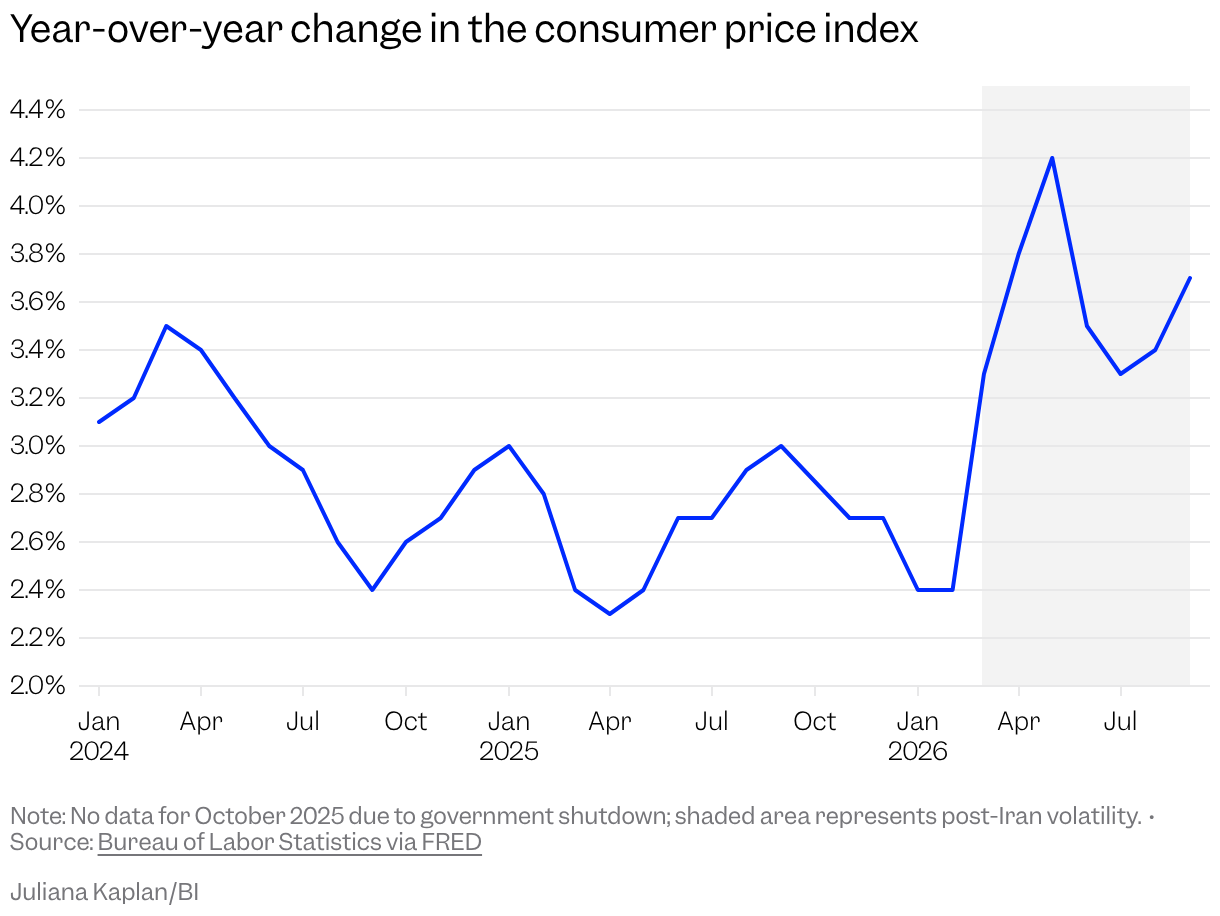
Those fuel and energy strains are pushing up costs across the economy. Inflation as tracked by the consumer price index increased to 3.7% year-over-year in September — higher than economists expected. That was driven in large part by soaring gas and energy prices, with energy rising by 20.4% year-over-year and gas by 34.2% in the same period.
Higher inflation has put pressure on the Fed and bond markets. In September, the central bank raised rates for the first time in three years to try to combat rising prices, with one more hike potentially coming by year's end. The 10-year Treasury yield, which influences borrowing costs for mortgages, auto loans, and credit cards, has surged since the war began, from below 4% at the end of February to a high of 5.31% this month. The 30-year mortgage has risen nearly in lockstep, going from just under 6% to 7.5% during the eight-month conflict.
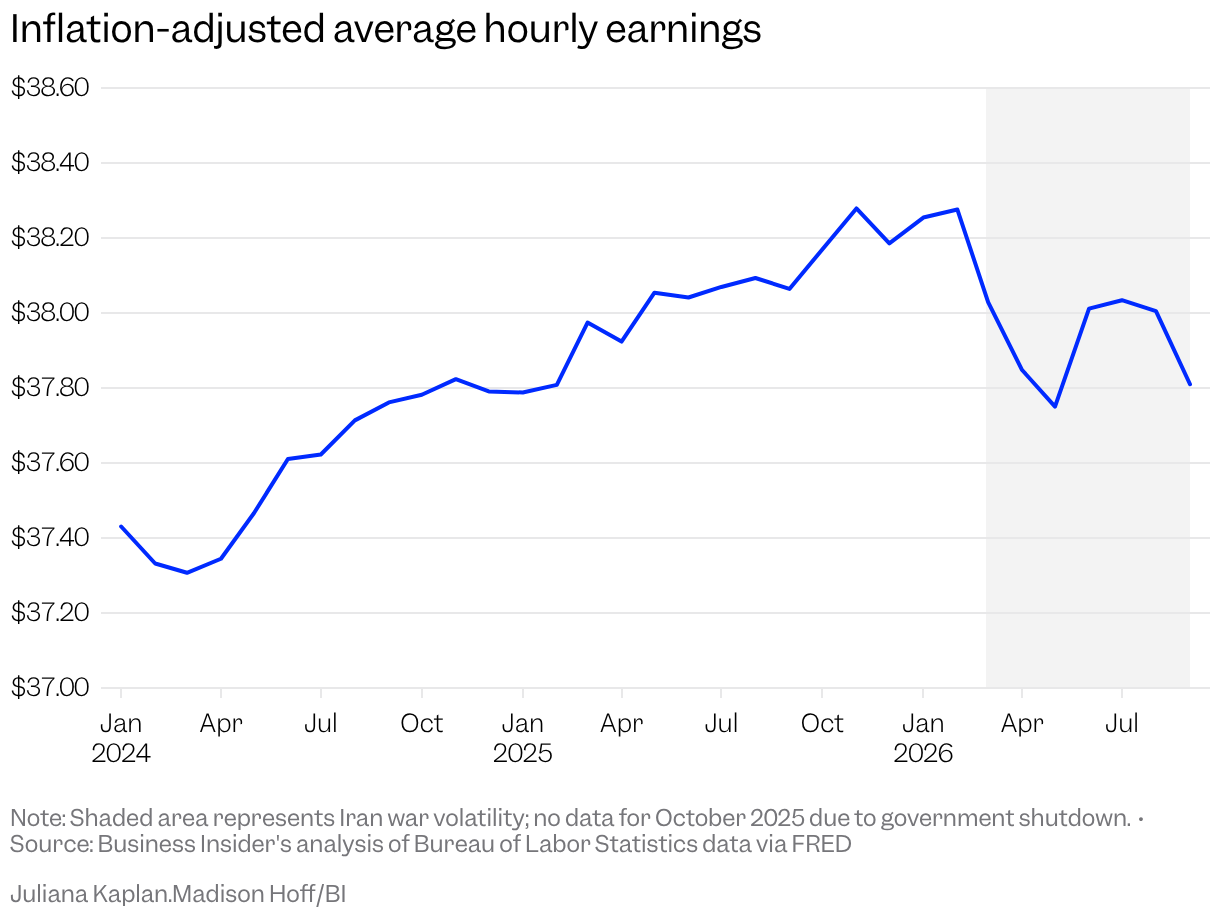
For everyday Americans, all of these international strains amount to what is, essentially, a pay cut. Wage growth remains slow and steady, but, over the past few months, rising prices have outpaced pay increases. Inflation-adjusted wages have slumped since the start of the war, and have given up nearly all their gains since the start of Trump's second term.
When asked for comment, the White House highlighted that by some measures, earnings are still outpacing inflation. "Under President Trump, private sector workers have seen their wages continue to outpace inflation, with average annual earnings growing by more than $600," said White House spokesperson Matthew Middleton.
And, with midterm season in full swing, affordability is on the ballot for many voters. The current economic situation shows no immediate signs of changing — another blow for Trump, who's been on a quest to bring down gas prices.
There are growing signs that the US could be preparing for fresh military action against Iran. Another aircraft carrier strike group is sailing across the Pacific and is expected to enter the Middle East.
The Trump administration is also facing a resurgence in attacks from the Houthis, a rebel group in Yemen. In recent weeks, the Iran-backed rebels have seized key territory along the Red Sea, allowing them to threaten the Bab al-Mandeb Strait, another maritime chokepoint like Hormuz, and have ramped up missile strikes against Saudi Arabia.
The Houthis previously tormented Red Sea shipping, leading the Trump administration to launch a major bombing campaign last year that ended in a ceasefire. The rebels have since rearmed.
Any other disruptions there might be bad news for consumers, potentially bringing more price spikes across the many goods shipped through that chokepoint.
New Zealand's economic recovery is progressing slowly, with employment and retail spending both still contracting, according to Bank of New Zealand senior economist commentary. The bank linked the weak results to ongoing pressure on household incomes across the country.
European stock markets opened lower on Monday after a weekend of violent protests and looting across France left shopfronts smashed and vehicles burned. French business owners are tallying the cost of the damage and say authorities failed to protect their properties during the unrest. The selloff adds financial pressure to a government already facing scrutiny over its handling of nationwide cost-of-living demonstrations.
Protesters took to the streets in capitals across Europe over the weekend. In Brussels, demonstrators clashed with police.
Dursun Aydemir/Anadolu via Getty Images
France wasn't alone this weekend.
Civil unrest occurred in several European cities this weekend.
Protests over the high cost of living devolved into riots.
Demonstrators took to the streets across multiple European cities and capitals this weekend to protest the high cost of living in their countries.
Though the violence in Paris and other French cities claimed the headlines, thousands also showed up in Portugal, Italy, and Belgium. Demonstrators were arrested in large numbers — many people were seen in photos and videos clashing violently with police and looting local businesses.
Energy price hikes, caused at least in part by the US-Israeli war with Iran and the conflict between Russia and Ukraine, have contributed to the rising prices. Other demonstrations in Belgium and France were begun by students and have since snowballed into larger-scale demonstrations, involving union workers and other organizations.
Here's a look at the chaos that unfolded across the Atlantic this weekend, where peaceful protests eventually devolved into riots and looting.
Lisbon
Protestors in Lisbon demanded a general increase in wages.
Horacio Villalobos#Corbis/Getty Images
In Lisbon, Portugal's capital, people took to the streets on October 17 to protest the cost-of-living crisis, low wages, and unaffordable housing.
The demonstration, which was organized by the CGTP, Portugal's largest trade union federation, was also held in Porto and Coimbra. In all, the union said "thousands of workers" took part.
About 12.7% of the population in Portugal lives in overcrowded households.
Housing prices in Portugal recorded the largest annual increase of any EU member state in the second quarter of 2026, rising 16.5%. In Lisbon, the average rent is equivalent to 116% of the average salary, meaning it exceeds a typical monthly income by 16%.
Earlier this week, police removed a tent camp that activists had set up in Praça D. João I, a central public square in Porto, to draw attention to rising housing costs.
Brussels
Riot police used a water cannon to spray youth demonstrators in Brussels, Belgium on Saturday
NICOLAS MAETERLINCK / Belga / AFP via Getty Images
In Belgium, students have held demonstrations in recent weeks over rising education costs, some of which turned violent over the weekend.
Video footage showed police using water cannons and tear gas during clashes with protesters in Brussels.
Belgian interior minister Bernard Quintin said in a post on X on Saturday that "what is unfolding in Brussels is no longer mere protest" and "all necessary means will be used to restore order in the face of the rioters."
Clashes also took place in Liège. Police arrested 195 people across the two cities during Saturday's protests, per The Brussels Times.
Milan
A demonstrator in Milan is encircled by riot police.
Piero CRUCIATTI / AFP via Getty Images
In Milan, a demonstration over the weekend against wars and the rising cost of living also descended into clashes between protesters and police.
Photos showed chaotic scenes around Piazza del Duomo, the landmark central square outside the Milan Cathedral and one of the city's busiest tourist areas, with looters damaging shop fronts and setting objects on fire.
Italian Prime Minister Giorgia Meloni condemned the violence in a post on X on Sunday.
"Thugs who exploit demonstrations to sow chaos, attack those who ensure security, and hold entire cities hostage," she wrote. "Demonstrating is a right. Setting our cities ablaze is not."
The demonstrations were also held in other cities across northern Italy. Police estimates reported by Rai News, Italy's public broadcaster put turnout at about 5,000 in Milan, 3,000 in Turin, 2,000 in Bologna, 600 in Brescia, and 800 in Bergamo.
In Milan, home prices have also climbed: residential asking prices were 49% higher in September than in 2018, according to the property portal Immobiliare.it.
Italian police detained 50 people in Milan on Sunday during protests against the rising cost of living, as clashes with demonstrators also broke out in Turin and Bologna, injuring several people.
by Mish Shedlock, Mish Talk: “The worst I have ever seen in any poll, on any issue for any president” Voters Under 30 Stats Inflation: Net Approve -82 Economy: Net Approval -64 Overall: Net Approval -50 TRUTH LIVES on at https://sgtreport.tv/ ‘Absolutely stunning!’ Data Analyst Stunned At Trump’s Disastrous 91% Disapproval Rating With Voters Under 30: […]
The spire of a 143-year-old town hall in Limoges, central France, collapsed after a fire broke out during nationwide protests on Saturday. Authorities said roughly 550,000 people took part in demonstrations held across the country over the rising cost of living. Clashes between protesters and police were reported in several cities.
Federal Reserve Chairman Kevin Warsh said Friday he won't prejudge what the U.S. central bank will do about interest rates at its upcoming meetings in October and December.
High gas prices are harming many Americans, forcing them to cut back or reduce their savings.
On Thursday, the U.S. Commerce Department release data showing that retail sales rose 0.8 percent in September to US$745 billion, largely driven by higher gasoline prices that boosted consumer spending at gas stations.
Excluding sales at gas stations, retail sales increased just 0.2 percent during the month, suggesting underlying consumer demand remained subdued.
While rising retail sales are generally seen as a sign of economic resilience, analysts said the September increase offered a less encouraging picture of consumer spending, as higher fuel costs accounted for much of the growth.
“Retail sales definitely looked weak in September,” said Dean Baker, a macroeconomist and co-founder of the Center for Economic and Policy Research. Experts also noted that high gas prices are harming many Americans, forcing them to cut back or reduce their savings.
Mike Johnson:
“Everybody's frustrated about fuel prices, but that's not related to policies. It's not related to the Republicans. This is related to the Strait of Hormuz.”
It is absolutely related to policy and Trump’s war on Iran, which Republicans wholly support. He is a…
Gary Hufbauer, a nonresident senior fellow at the Peterson Institute for International Economics, said: “About 50 percent of households are living paycheck to paycheck, and if they are squeezed by gasoline prices, they have to cut back elsewhere. But the other 50 percent just reduce their savings to pay for higher gasoline prices.”
High energy prices could create a new wave of inflation. “The longer energy stays elevated, the more likely it generates a new wave of inflation. Another six months would run this risk,” Hufbauer said.
The data were released just weeks before November’s midterm elections, at a time when underlying prices are already high and gasoline prices threaten to make matters even worse. Republicans could take a beating at the polls over voters’ displeasure with high prices that show no sign of coming down.
However, even if Democrats take control of Congress, the party will have its work cut out after the dust settles, as pushing down gas prices means finding a solution to the war in Iran, which seems improbable at the moment.
At the same time, underlying inflation continues unabated. Experts said getting back to pre-COVID price levels requires the Fed to step in and raise interest rates. However, the central bank has shown no desire to hike rates to the 5 percent level, or higher, that economists say is needed to tame inflation.
Some experts noted that the GOP is caught between a rock and a hard place. Brookings Institution Senior Fellow Darrell West said, “Republicans are caught between fighting inflation and a slowing economy, which is a big problem for them in November.”
“Gas prices should drop when the Iran War ends, but it is not clear how (Donald) Trump brings that conflict to a reasonable conclusion,” West said.
TOKYO — An unwelcome blast of US inflation is blowing across Asia’s markets. September’s hotter-than-expected price data revived concerns that the Federal Reserve will keep rates higher for longer, threatening fresh pressure on currencies, capital flows and economic growth across the region.
Last month’s 3.7% year-on-year increase in consumer prices didn’t just exceed forecasts. It ensured the Fed is on an even bigger collision course with both the bond market and US President Donald Trump’s White House. It’s arguably the last thing both Trump and US Federal Reserve Chairman Kevin Warsh wanted to see less than three weeks ahead of the mid-term elections.
Getting a job is the important part, as these job seekers might attest. But getting a raise is also a big deal: For many workers, the raises they've gotten over the past couple of years have now been wiped out by inflation.
Allison Joyce/Bloomberg via Getty Images
Have you gotten a raise over the past couple of years? Inflation has likely eaten it away.
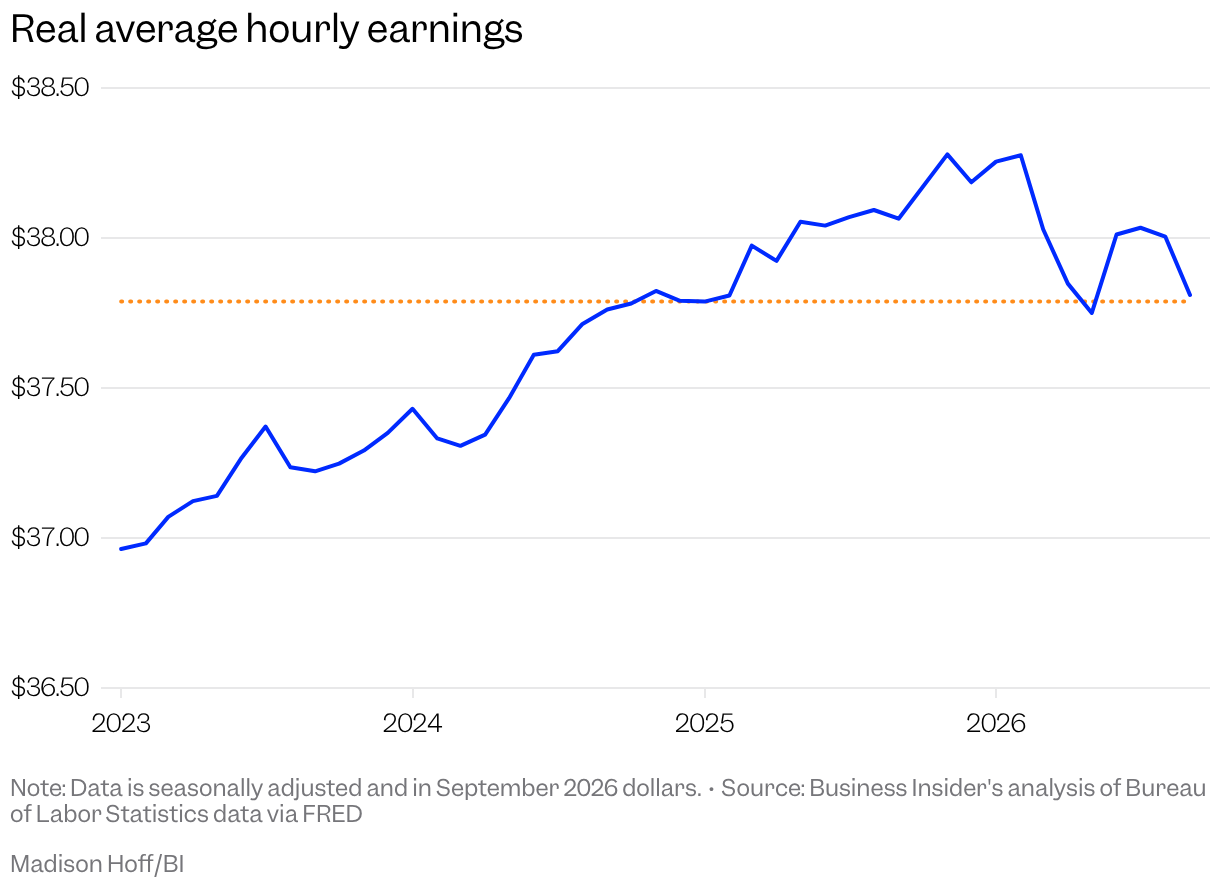
Inflation-adjusted hourly earnings, which had risen after Donald Trump first took office, are now declining.
And there are ominous signs that inflation could get worse.
If you've gotten a raise over the last two years, almost all of those gains have now been eaten by inflation.
That is, if you're the average wage-earner, considering the latest statistics released this week showing that prices were rising at a faster clip than expected.
It's more evidence that affordability challenges in the US economy aren't going away. It also means that average hourly pay, which had risen after Donald Trump took office in January 2025, is now right back to where it started, when taking inflation into account.
The average hourly wage was $35.84 in January 2025, according to federal statistics, or $37.79 in today's dollars, adjusted for inflation. The average hourly wage last month was $37.81 — basically unchanged over the past 20 months.
Wednesday's consumer price index inflation report from the Bureau of Labor Statistics came in hotter than expected, with prices up 3.7% over the year in September. Economists had expected a 3.6% increase, and the rate was well above August's 3.4%.
"We read the September CPI report as another piece of evidence that the US is facing a persistent inflation problem," economists at BNP Paribas said in a note to clients.
That problem means high prices — including gasoline that was up 9.1% in September compared to the previous month — are gobbling up pay increases you might get at work.
Heather Long, chief economist at Navy Federal Credit Union, underlined that consumer price growth since 2025 has eroded nearly all wage gains, citing the impact of the war in Iran, which began at the end of February, on Americans' wallets.
"This is a very different picture from President Trump's first term when wages were up over 15%, well above about 8% inflation," Long said. "It helps explain the frustration many households feel right now with the economy."
Higher prices are adding to a general sense of malaise about the economy. The University of Michigan's consumer sentiment index dipped to 46.3 in October, down from 71.7 in January 2025.
Joanne Hsu, the director of the survey, said higher gas prices driven by the Middle East conflict have added to the ongoing cost-of-living pressures over the past several years.
Higher prices and inflation outpacing wage growth can be especially tough for Americans who are on tight budgets or living paycheck to paycheck. "When we look at the majority of the US workforce, people who are middle- and lower-income households, higher costs in things like gas and groceries take up a larger share of their income," said ZipRecruiter economist Nicole Bachaud.
It's important to note, there is more than one way to read the wage numbers as they relate to inflation — and in some ways, workers have actually come out ahead.
For example, average weekly earnings have grown faster over the last year than average hourly earnings, as the number of hours the typical worker works has edged up.
The Trump administration, when asked for comment, highlighted annual earnings. "Under President Trump, private sector workers have seen their wages continue to outpace inflation, with average annual earnings growing by more than $600," said White House spokesperson Matthew Middleton.
Inflation will play a role in the midterms
The midterm elections are in just a few weeks, and affordability will likely be a key concern.
An Economic Innovation Group and Echelon Insights survey in September asked people what elected officials should prioritize most to make life better for workers. The survey said that 45% of American workers wanted officials to prioritize reducing the cost of everyday essentials, and 23% wanted them to focus on making housing more affordable.
Long, at Navy Federal, said the "modest increase" in grocery prices is a silver lining in the latest consumer price index report. Food at home, which includes groceries, rose at a slower pace than April's 2.9%, with prices increasing 1.8% year over year in September.
"But it's inevitable food prices will likely rise in the months ahead as higher diesel and transport costs are passed along to consumers," Long said.
There are other ominous signs that inflation could worsen. Thursday's producer price index report showed that final demand prices rose 1.3% in September, the highest since 2022.
Two years ago, central bankers on three continents all but declared victory over inflation. Markets took them at their word, and plenty of investors built their portfolios on the assumption that the price surge of 2022 was behind us. That assumption was wrong, and the consequences are now showing up in almost every major economy […]
When Vivek Ramaswamy ran for president in 2024, he liked to describe himself as a "national libertarian" whose worldview included skepticism of new Middle Eastern wars and support for free trade (provided it wasn't with China).
In a midterm election season in which voters are increasingly angry about higher prices born of protectionist tariffs and high gas prices caused by a new Middle Eastern war, that would seemingly give Ramaswamy, now running for governor of Ohio, a straightforward story to tell about how he'd bring costs down.
Unfortunately for the Republican gubernatorial candidate, the person responsible for the tariffs and the war is President Donald Trump, whose support he's counting on to get him over the finish line in a surprisingly close race against Democrat Amy Acton.
The latest polls show Ramaswamy slightly ahead of Acton, with many voters still undecided.
Other Republican midterm candidates, most prominently Mike Rogers in Michigan, are escaping this bind by criticizing the tariffs and the war without explicitly naming the president who's responsible for both.
Ramaswamy has chosen a different tactic: Shift the conversation to other sources of voters' cost-of-living anxiety that can't be directly laid at Trump's feet.
In the last weeks of this election campaign, Ramaswamy has focused like a laser on two proposals he says will deliver cost relief to Ohio voters. The first is his proposed rollback of homeowners' property taxes. The second is a moratorium on new data center construction.
Like many Midwestern and Western states, Ohioans' property tax bills have shot up in recent years, driven by a pandemic-era spike in home values.
That's in turn sparked a full-blown property tax revolt in the state. The Republican-controlled Legislature passed a raft of property tax relief measures in 2025. Activists are also collecting signatures to place a full abolition of taxes on real property on the statewide ballot next year.
Ramaswamy hasn't endorsed full property tax abolition, but he is promising voters that he will roll back property tax assessments for homeowners to pre-pandemic levels.
On the data centers, he has staked out a very restrictionist position.
Ohio is currently one of the leading states for data center development. Pew Research counts 57 projects currently in the pipeline there, attracted by cheap land and a robust power grid.
The state's data center boom has caused a backlash in rural communities, where voters have objected to data centers' consumption of land and electricity and the special tax incentives some projects have received.
On the ballot in 10 Ohio localities this November are initiatives that would impose additional restrictions on data center development.
Ramaswamy has proposed to go further with a statewide moratoriumthat will remain in effect until the Legislature passes laws that not only require data centers to cover the full costs of the power infrastructure they need, but also provide property tax rebates and free electricity to nearby homeowners.
Local property tax cuts paired with local reductions in spending would, of course, be well in line with a small government worldview.
But the residential property tax rollback Ramaswamy has proposed doesn't directly do that.
Instead, it would reduce property tax revenues and then leave it up to localities to make up for the lost revenue somehow. That could result in spending cuts.
It could also result in localities shifting tax burdens onto commercial properties, raising non-property taxes (like sales taxes), or relying on the state government for more of their revenues.
In the former two scenarios, local tax regimes would become more hostile to growth, given that property taxes are considered one of the most "efficient" taxes. In the latter scenario, the link between people who pay taxes and the people who consume taxpayer-funded local services would become more distant.
Neither is ideal.
While some data centers in Ohio have received tax subsidies, Ramaswamy's proposed solution is to block new data centers until they're legally required to subsidize their neighbors with free electricity and other community benefits.
All of that is to say that it's a shame to see Ramaswamy adopt increasingly non-libertarian positions to avoid making critiques of Trump's cost-increasing tariffs and Iran war that would align with his erstwhile "national libertarian" worldview.
It's ironic, too, that, in trying to avoid making those critiques, Ramaswamy has wound up being more restrictionist on data centers than Trump himself.
In an August Truth Social post, the president famously urged local communities to "let Data Reign" and welcome data center development. Those that did would become "rich and successful," he predicted. Those that didn't would remain "poor and backward."
At a rally in Vandalia, Ohio, over the weekend for Ramaswamy and Republican Senate candidate John Husted, Trump reiterated his support for data centers, saying, "We want them. Look, there's so much money to be made for Ohio. You can't just turn them off. They'll go to China."
Rather than criticize the president's statist interventions, Ramaswamy is talking up his own instead. Ohio will be poorer as a result.
High gas prices are intensifying inflation and vacuuming up more of Americans' dollars, yet consumers are still digging deep to spend, powering the economy, at least for now
Wholesale inflation rose more than expected last month on a big jump in fuel costs as rising prices become a bigger economic challenge for millions of Americans, and a growing political problem for Republicans in the upcoming midterm elections.
With Social Security barreling toward insolvency, the government is increasing benefits in January.
On Wednesday, the Social Security Administration (SSA) announced that retirees will receive a 3.6 percent increase in Social Security benefits next year. The raise, which was unveiled shortly after the Bureau of Labor Statistics reported consumer prices rose 3.7 percent year over year in September, will amount to an increase of $75 per month for the average beneficiary. It also represents a cost-of-living adjustment (COLA) that will be 0.8 percentage points higher than last year's, which was 2.8 percent, and 0.9 percentage points higher than what was projected by the Social Security Trustees, according to the Committee for a Responsible Federal Budget.
"Social Security will implement this cost-of-living adjustment for 76 million Americans, giving them greater financial stability," said SSA Commissioner Frank J. Bisignano in a press release. "Under President Donald J. Trump, Social Security is delivering better, faster, higher-quality service for the American people."
But the announcement comes as Social Security faces a looming funding cliff.
The program has been spending considerably more than it receives for years, thanks in large part to the U.S. demographic problem: Birth rates have collapsed, life expectancy has risen, and there are fewer working-age people paying taxes to fund retirees. In 2025, the program collected $1.45 trillion in revenue and spent $1.61 trillion, leaving a $160 billion shortfall. Trust fund reserves covered the gap, but they are rapidly dwindling. In June, Social Security's Trustees projected that, without legislative changes, incoming revenue would cover only 78 percent of scheduled retirement and survivor benefits by late 2032—a 22 percent shortfall. Combined retirement and disability funds are expected to run out by 2034. There are a handful of fixes, including raising the retirement age, reducing benefits, raising the cap on earnings, means-testing the program, privatizing it, or getting rid of it altogether.
While many lawmakers have acknowledged reality, Congress remains divided on how to address the issue. In August, Sen. Ron Wyden (D–Ore.) blocked a proposal from Sen. Bill Cassidy (R–La.) to establish a congressional process to consider reforms, arguing that it would slash retiree benefits and help billionaires "avoid paying their fair share."
"People are objecting to doing their job," Cassidy complained in September. "Congress needs to fix Social Security this year."
What makes Wednesday's increase even more unjustified is the fact that older Americans are already among the wealthiest age groups in the country. According to the Federal Reserve's latest Survey of Consumer Finances released last week, households headed by someone aged 75 or older had a median net worth of $504,900 in 2025, compared with just $33,000 for households headed by someone under 35. Despite their relative wealth compared to working-age people, retirees are getting a COLA increase that is greater than the average worker, whose wages have risen by 3 percent in the last year.
For the very wealthiest beneficiaries, the 2027 COLA will constitute an enormous increase. According to the Committee for a Responsible Federal Budget, the highest-earning couples who retired this year will receive a combined increase of $3,600, meaning that their combined benefits would exceed $100,000 next year. However, without congressional action, Social Security recipients could expect a 22 percent cut that, in 2032, would wipe out the previous nine years' COLAs all at once.
Despite years of warnings about Social Security's deteriorating finances, Congress has yet to enact reforms to avert the looming shortfall. For now, beneficiaries can look forward to larger checks in January, even as the program moves closer to the day when it can no longer pay the benefits it has promised.
 Login