❌

Reading view

Amazon knows how to build big. The AI boom is testing just how big it can go.

Prasad Kalyanaraman, vice president of infrastructure services at Amazon Web Services

BASTIEN INZAURRALDE/AFP via Getty Images

  • Amazon is on an unprecedented spending spree to build more AI data center capacity than anyone else.
  • The company has extensive experience, yet even it's struggling to bring capacity online fast enough.
  • Internal documents show Amazon getting bilions of dollars of Nvidia GPUs before they can be deployed.

At an internal staff meeting in September, AWS CFO John Felton had a joke for Prasad Kalyanaraman, the executive overseeing much of Amazon's AI infrastructure expansion.

"You've taken us free cash flow negative as a company, so congratulations," Felton said, according to a recording of the meeting obtained by Business Insider.

The remark was lighthearted. But it captured a stunning reversal.

Just two years ago, Wall Street was debating what Amazon would do with its growing cash hoard. Now, cash flow has evaporated as Amazon embarks on its biggest bet ever, spending $220 billion this year alone to build the physical backbone for AI.

At the meeting, Kalyanaraman did not dispute Felton's premise. Amazon's machine-learning and AI business is "hugely free cash flow negative," he said, adding that he expects the company's free cash flow to remain negative for "the next couple of years or so."
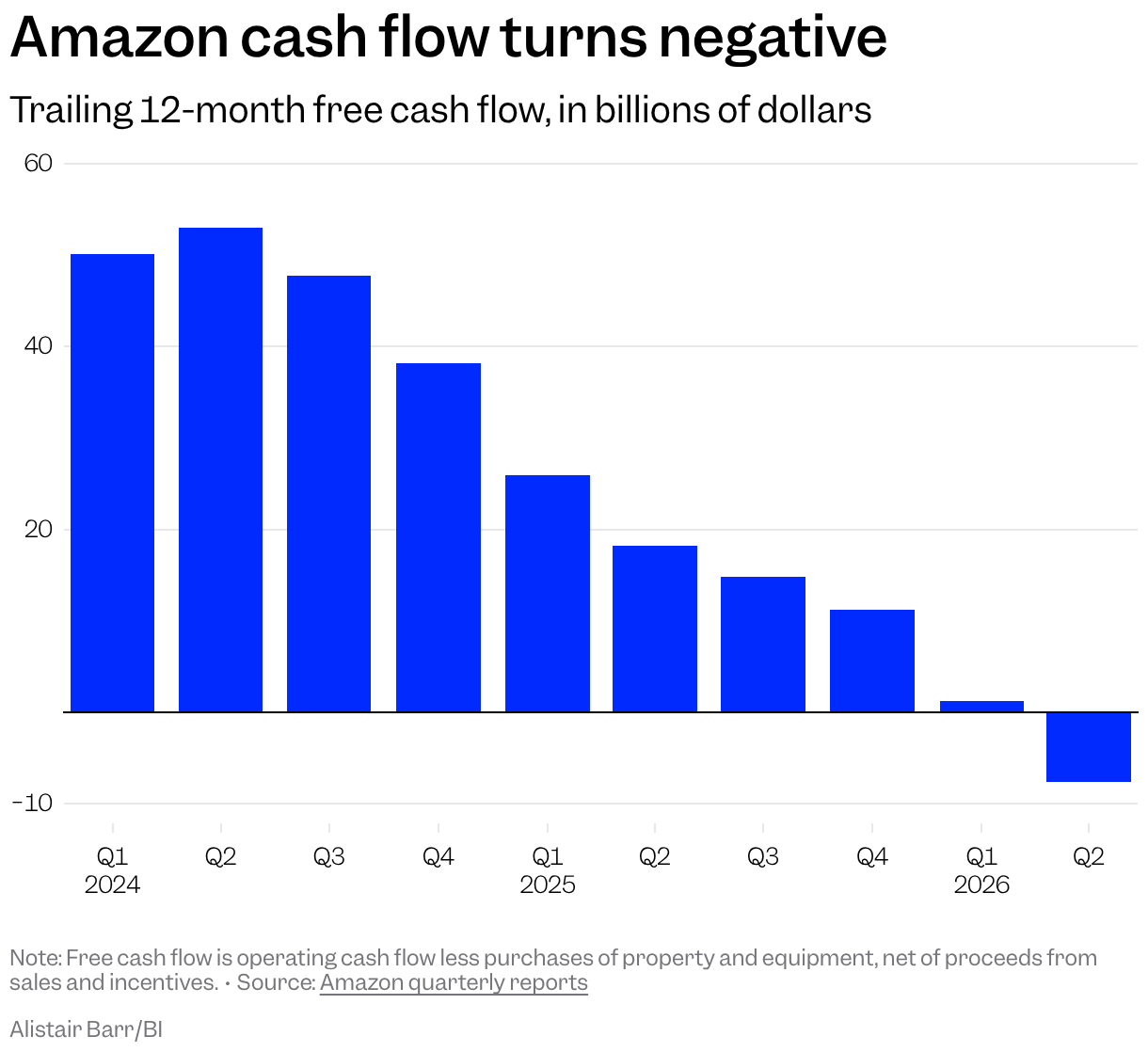
Column chart of Amazon’s trailing 12-month free cash flow at all 10 quarter-ends from Q1 2024 through Q2 2026. It starts at $50.149 billion, peaks at $52.973 billion in Q2 2024, and declines to negative $7.604 billion in Q2 2026.

Amazon has made big bets before. It spent heavily on cloud computing, fulfillment centers, and its delivery network long before they became some of the company's most valuable assets. Investors questioned those investments at the time, but Amazon ultimately built enormous, profitable businesses from them.

AI is testing this playbook at a far larger scale. Amazon is committing hundreds of billions of dollars to data centers, servers, and power before investors know how quickly those investments will generate revenue.

The company is the best, or among the best, at building data centers, with decades of experience. But the size and complexity of these projects, and the bottlenecks holding progress back, are challenging — even for such a respected cloud pioneer.

Internal documents reviewed by Business Insider and people familiar with the matter show the company trying to coordinate a sprawling industrial system whose parts move on different schedules. A delay in power, equipment, or construction can leave billions of dollars in hardware waiting — and Amazon's cash tied up — while forecasts and costs keep shifting.

Why Amazon thinks it will work

Amazon says it has strong evidence that the capacity will be needed. AWS revenue grew 37% in the second quarter, its fastest pace in 18 quarters, while its backlog reached $496 billion.

CEO Andy Jassy thinks the company has a "clear line of sight" to strong financial returns from this record investment cycle. In his latest annual shareholder letter, he called AI a "once in a lifetime opportunity" and said Amazon would not be conservative in its investments.

"We've been through this cycle with the first big AWS growth wave, and liked the results," Jassy wrote. "We expect to feel similarly about this next wave."
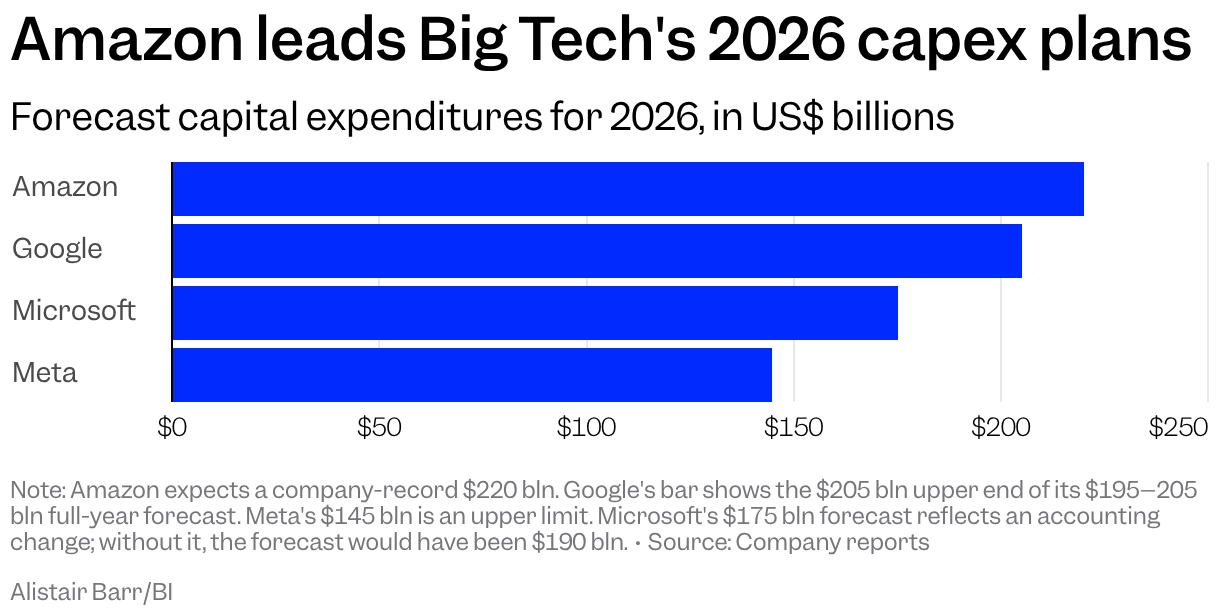
Column chart of 2026 capital expenditure forecasts in US dollars: Amazon $220 billion, a company record; Google $195 billion to $205 billion, shown at the $205 billion upper end; Microsoft $175 billion after an accounting change, compared with $190 billion without that change; and Meta up to $145 billion. Source: Company reports.

Investors are concerned by the scale of the industry's expansion, especially as AI data centers are costing more to build and taking longer to complete.

The market is "repricing anything that funds multi-year builds against revenue that arrives later," Dan Ives, an analyst at Yorkville Ives, wrote in a recent report. Growing uncertainty around data center permitting and the political fight over electricity prices have given investors another reason to question how quickly these investments will pay off, he added.

Racks, but not enough power

One major industry challenge is securing enough power to run the equipment that goes inside data centers. This includes expensive racks of servers that contain GPUs and other chips that train and run AI models and services such as ChatGPT.

Internal emails from August show Amazon preparing a new "Early Rack Receipt" process for an expected wave of server racks carrying Nvidia's GB300 chips at US facilities before final deployment.

One Amazon email projected the company would take delivery of about $5 billion of Nvidia GB300 racks in August, followed by another roughly $3 billion each month "for the foreseeable future."

Some AWS data center sites had room for more racks but not enough available power to turn them on, people familiar with the effort said, leaving the equipment to be staged at intermediary warehouses until the facilities were ready. These people asked not to be identified discussing sensitive matters.

Timing and coordination

Usually, Amazon doesn't pay for racks until the gear is put into a data center, leaving suppliers to carry the cost of the equipment in transit, according to the internal documents obtained by Business Insider. This helps the company conserve cash.

However, the intensity of the AI data center building boom has made this type of coordination harder. Amazon has to compete more for scarce resources as it jockeys with rivals for access to Nvidia GPUs and other AI components.

Under the new "Early Rack Receipt" process, Amazon now takes ownership of these racks earlier in the supply chain, rather than waiting until the equipment reaches a data center.

The means spending cash sooner. And any delays getting the racks installed and plugged into a reliable power source potentially pushes back the moment when revenue starts flowing from these assets.

At least one AWS supply chain team did not have "a clear forecasted path" for getting racks into data centers, according to one of the emails reviewed by Business Insider.

An Amazon spokesperson said the company routinely stages finished hardware near deployment sites so it can be installed once power capacity is available, calling that approach "best business practice."

The spokesperson added that AWS has "long-established systems" to track infrastructure assets and disputed that the broader company lacks a forecasted path for getting racks into data centers.

This problem is not unique to Amazon.

Bernstein analysts wrote in a recent note that power permits, cooling systems, electrical equipment, construction, and hardware all move on separate schedules.

"Timing is imperfect," the analysts said.

"Inherently uncertain"

John Felton, Chief Financial Officer of Amazon Web Services

Chris Jung/NurPhoto via Getty Images

During the internal staff meeting in September, Felton, the AWS CFO, described the broader problem eloquently: "How do you work in the future when the future is inherently uncertain?"

Kalyanaraman, the AI infrastructure leader, said Amazon's internal outlook for the return on its AI investments had improved. But the assumptions behind those returns keep shifting.

"The forecast is changing on a daily basis," Kalyanaraman said. "The world that we live in is extremely dynamic."

Those shifting assumptions include when data centers will be ready and how much equipment AWS needs to keep on hand, he explained.

An eight-week supply buffer might be routine for a smaller company. But at Amazon's scale, Kalyanaraman said, this could mean holding "billions and billions of dollars" worth of additional equipment inventory — tying up precious cash.

Frugality meets the AI boom

Such tensions are especially striking for Kalyanaraman, a 21-year Amazon veteran who earlier this year was promoted to the elite S-team that reports directly to Jassy.

Amazon's founding story is defined by frugality. It famously used cheap doors as desks when founder Jeff Bezos started in Seattle in the mid-90s.

Kalyanaraman has absorbed this lore into bones. In late 2023, as AWS faced slower growth and layoffs, he urged employees to do more with less. "Frugality breeds innovation," he said back then.

That instinct still shapes his approach. In the September meeting this year, Kalyanaraman told Felton that AWS tries to make major investments at the "last responsible moment," when it has the clearest possible view of demand.

"If we can wait to spend the capital as late as possible, it's better for us," he said.

Amazon CEO Andy Jassy

Bloomberg/Getty Images

But the frenetic pace of the AI boom makes this principle difficult to follow. By the time demand is fully visible, the servers, power, and construction capabilities that AWS needs may no longer be available. That puts pressure on the company to commit more money sooner to secure supply and meet its data center capacity goals.

Kalyanaraman recalled telling Jassy in 2023 that AWS would "surely" be out of its capacity crunch by 2027. Instead, Amazon still expects demand to exceed its available capacity in 2027, the AI infrastructure chief said during the meeting this September.

Secured Power at Risk

Getting enough electricity may be the biggest challenge for an industry leader like Amazon.

The company has 44 gigawatts of data center capacity under development across 16 states, more than double Google, Meta, and Microsoft, according to Cleanview Research estimates.
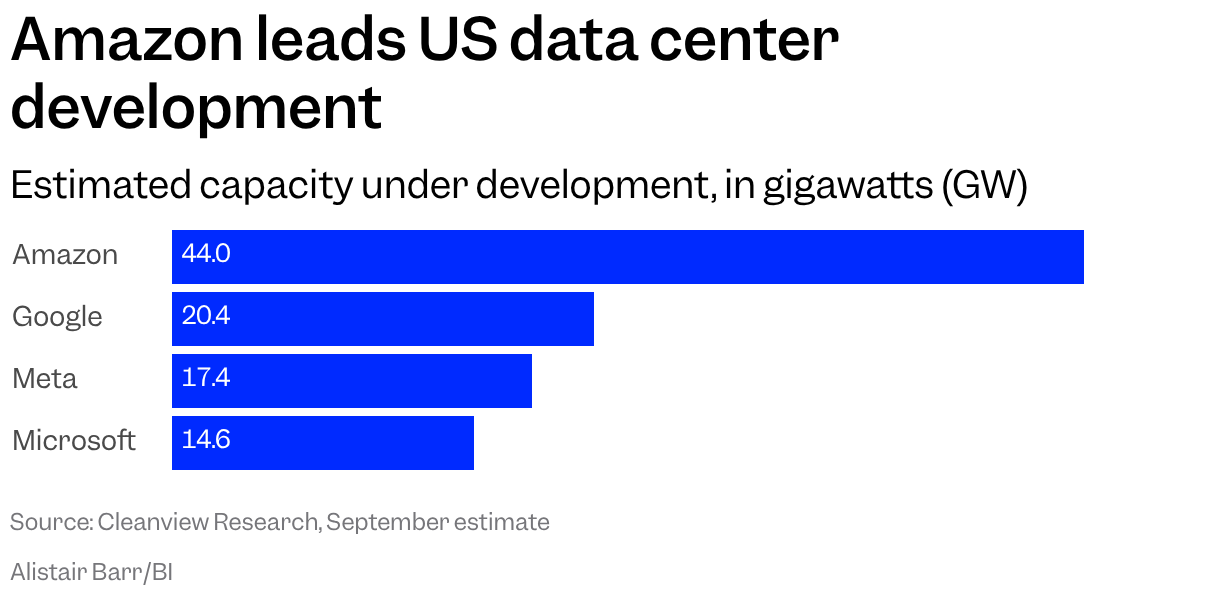
Column chart of estimated US data center capacity under development: Amazon 44 gigawatts, Google 20.4 gigawatts, Meta 17.4 gigawatts, and Microsoft 14.6 gigawatts. Source: Cleanview Research, September estimate.

An internal AWS dashboard called "Secured Power at Risk" tracks utility and regulatory constraints affecting electricity capacity AWS has lined up for its data centers.

The risks include transmission bottlenecks, requirements to reduce use during grid stress, and "use it or lose it" provisions that can jeopardize capacity if a data center project misses usage or construction milestones.

In other words, AWS is not simply waiting for electricity to arrive. It is managing a portfolio of commitments that can become more costly if a data center project is delayed.

Maryland proposals

A submission to Maryland's utility regulator last year, obtained through a public records request, illustrates the kind of exposure that can accompany massive data center buildouts.

Amazon told the Maryland Public Service Commission that large data center customers could help pay for grid upgrades or bring new power capacity to market without burdening other electricity ratepayers.

The company also proposed setting aside collateral to help utilities get more comfortable with the large investments needed to generate more electricity for data centers. Amazon proposed three years of collateral so that if a large electricity customer abandoned unused capacity, the utility would have time to re-sell the power.

The proposal is not evidence that AWS has made such a payment or posted collateral. It does, however, show that large data centers can face extra financial obligations, beyond their own electricity bills, if projects are delayed or cancelled.

The Amazon spokesperson said such utility rules are not unique to AWS. The company has not disclosed how much cash it has paid upfront to secure power.

New constraints 'keep popping up'

The AI buildout also incurs expenses that are harder to model than a conventional capex plan.

In the September meeting this year, Kalyanaraman said that while reviewing plans for gigawatts of capacity in West Texas, AWS confronted a labor problem: There weren't enough nearby pipefitters, electricians, and other skilled workers to build the facilities.

The company's response, he said, was to pay to construct housing complexes near its data centers so workers could live there for the two or three years needed to complete the projects.

Even the crates used to ship servers have become a planning issue. It may seem absurd to worry about the price of a container when servers cost hundreds of thousands of dollars, Kalyanaraman said. But at AWS's scale, where the company needs so many crates, even trivial items can become a material expense.

"We have new constraints that keep popping up," Kalyanaraman said.

Have a tip? Contact this reporter via email at ekim@businessinsider.com or Signal, Telegram, or WhatsApp at 650-942-3061. Use a personal email address, a nonwork WiFi network, and a nonwork device; here's our guide to sharing information securely.

Read the original article on Business Insider

  •  

Mercedes-Benz broadens Nvidia alliance

Mercedes-Benz expanded its partnership with Nvidia to develop driver assistance and automated driving systems based on the carmaker’s MB.OS platform and the chip company’s computing technology and software.

The agreement combines Mercedes-Benz engineering and its MB.OS operating system with Nvidia’s Hyperion computing and sensor architecture, Alpamayo driving software and Halos safety system.

Mercedes CTO Jorg Burzer hailed Nvidia as its “most important strategic partner in automated driving”, describing the urban point-to-point assistance system the two built as the first of its kind from Mercedes for Western markets.

He added the extension is a milestone built on years of mutual trust, while stressing customers will still expect the safety standards the brand is known for.

Ali Kani, VP of automotive at Nvidia, said accelerated computing could help vehicles interpret their surroundings and respond to complex driving situations. He added the companies aim to make autonomous driving suitable for everyday use.

MB.OS will manage driving functions and over-the-air updates alongside Nvidia’s Hyperion in-vehicle computing platform. Alpamayo will provide software for urban point-to-point assistance, active safety and automated parking, while Halos will add a safety layer alongside Mercedes-Benz’s own systems.

The companies noted the technologies will also support future SAE Level 4 applications, including robolimousines.

Mercedes-Benz also uses Nvidia technology for vehicle-engineering simulations and in its MO360 digital-production platform, covering virtual planning and AI applications. The companies plan to expand the work across the carmaker’s global production network.

The post Mercedes-Benz broadens Nvidia alliance appeared first on Mobile World Live.

  •  

Nvidia's communications team has undergone a shake-up as its public profile exploded

Jensen Huang Nvidia.
Jensen Huang, CEO of Nvidia.

Bloomberg/Getty Images

  • Nvidia's communications operation has been reshaped as the company became the face of the AI boom.
  • Roughly 15 staffers have left the lean team since 2025 as Nvidia reorganized its communications org.
  • Former employees described growing workloads as responsibilities expanded.

Nvidia's communications organization has been reshaped as the company became the face of the AI boom, with multiple teams brought under new leadership and a string of departures.

Business Insider identified roughly 15 communications employees who have left Nvidia since 2025, based on LinkedIn profiles and interviews with former employees.

The organization now numbers roughly 70 to 80 people globally, and has more than doubled in size since Mylene Mangalindan joined as vice president of corporate communications in 2023, according to a person close to the company.

The departures have also included newer hires. Anna Soellner, who was recruited to lead corporate communications, left after roughly four months, Business Insider previously reported.

Nvidia is known for high retention. It reported companywide turnover of 3.7% in fiscal 2026, up from 2.5% the prior year, and well below the tech industry average of 21.9% cited in its latest sustainability report.

Mangalindan succeeded longtime communications chief Bob Sherbin, who retired in 2024. She previously worked at the advisory firm Brunswick Group.

She was brought in to "bring fresh blood" and "upgrade the team" to meet Nvidia's growing profile, one former employee said.

At the end of 2024, Nvidia restructured its communications organization. It brought enterprise public relations under Mangalindan's leadership alongside the corporate communications team she already led, according to two former employees.

Corporate communications focuses on Nvidia's reputation and major media outlets, while enterprise handles product and industry messaging, including for its data center business.

One former employee said the consolidation reflected the growing importance of Nvidia's data center business, which sells chips and systems that power AI and had become its biggest revenue driver.

Analyst relations, social media, and influencer marketing also moved under Mangalindan's remit this year, another former employee said.

Three former employees said Nvidia's communications team had long operated with relatively lean staffing, even as workloads grew alongside the company's public profile, leaving staff juggling multiple responsibilities.

These employees said they experienced long hours, difficulty taking time off, and pressure to respond quickly to emails and Slack messages.

A person close to Nvidia said the company's lean staffing allows employees to move quickly and also requires long hours. The person said Mangalindan encourages staff to take vacation, though the team's small size can make scheduling time off difficult, particularly in the summer.

Nvidia is widely known for its demanding work environment. CEO Jensen Huang has emphasized operating at the "speed of light" and is known for fostering a culture of constant accountability.

Have a tip? Contact this reporter via email at gweiss@businessinsider.com or Signal at @geoffweiss.25. Use a personal email address, a nonwork WiFi network, and a nonwork device; here's our guide to sharing information securely.

Read the original article on Business Insider

  •  

Apple, Nvidia, Ergen each give $25M for Trump project

Apple, Nvidia and EchoStar chair Charlie Ergen reportedly committed $25 million each for the construction of US President Donald Trump’s White House ballroom project, which has raised $333 million to date in private donations.

The Washington Post reported “the vast majority of the funds raised came from companies and wealthy individuals with interests before the federal government” after obtaining an internal spreadsheet used to track contributions for the fundraising effort.

The Post noted more than three-quarters of the funding was pledged in amounts of at least $5 million, with Amazon, Comcast, Microsoft, and T-Mobile US among the largest corporate donors.

It stated Nvidia and Ergen, among others, requested their donations be kept anonymous

The news site noted companies or executives of firms that have had contracts with the federal government during Trump’s second term accounted for about half of the total funds raised for the project which also includes office space and an underground military facility.

According to internal contractor documents obtained by the Post, the total cost of the project is now $600 million after Trump initially stated he and wealthy donors would pay the estimated $400 million project, although Reuters reported he later unsuccessfully asked Congress for $1 billion. The Post noted Trump’s name did not appear on the list of 67 donors who contributed $10,000 or more to the project.

The funds for the project are administered through a complex, multi-step pipeline involving a private nonprofit, federal agencies and direct oversight by the Trump administration.

The news agency reported Nvidia became “a top contributor to the ballroom in October 2025, nearly three months after it struck a groundbreaking pact with Trump to sell advanced microchips to China despite national security concerns”.

“As an American company, our support for the United States is paramount, and independent of any business interests,” a representative for Nvidia told Mobile World Live. “We were proud to be able to make a donation to a nonpartisan trust that serves all Americans and have said so publicly since the donation was made.” 

Apple and EchoStar did not reply to requests for comment on their contributions.

The post Apple, Nvidia, Ergen each give $25M for Trump project appeared first on Mobile World Live.

  •  

Nvidia plans to splash $2B on European AI deals

Nvidia CEO Jensen Huang (pictured) reportedly outlined plans to invest $2 billion across Europe to ramp adoption of AI technology and the company’s products.

Bloomberg reported Huang revealed the plan yesterday (13 October) during an event in Paris, which is part of a tour including stops in London and Berlin.

Huang said the fresh investments, to be announced in the next week, are on top of $8 billion the company previously committed to the continent, according to the news agency.

He also announced new funding for French start-ups Doctolib, Genesis AI, Pigment and Entalpic.

Nvidia’s founder also promoted open-source models, arguing their lower costs and greater flexibility could help Europe close the gap with the US on advanced AI.

The chipmaker is a major partner of French company Mistral AI, which develops open-weight AI models. It has invested in Mistral and supplies accelerators for its data centres.

“Open models are important as they can be customised for languages and for your own sovereignty,” he said, according to Bloomberg.

Nvidia’s GTC Berlin conference is schedule for 20-22 October.

The post Nvidia plans to splash $2B on European AI deals appeared first on Mobile World Live.

  •  

Nvidia weighs Reflection AI acquisition

Nvidia is reportedly in talks to either acquire or increase its investment in open-source start-up Reflection AI, as it seeks to strengthen its position in open-weight AI models and challenge lower cost Chinese rivals.

Sources told the Financial Times (FT) discussions remain at an early stage and could lead to a full acquisition, further equity investment or a deal covering chips and computing capacity. An acqui-hire, under which Nvidia would recruit staff and license technology, is another option.

A deal could apparently be reached in the coming weeks, though the terms under discussion remain unclear.

According to the report, Nvidia has already invested $800 million in Reflection AI, which was valued at $25 billion in a March funding round. Founded in 2024 by former Google DeepMind researchers, the start-up develops AI models and tools for software development.

Reflection launched its first open-weight model, Beam, last week, targeting coding and agentic tasks as it looks to compete with Chinese models such as DeepSeek and Kimi.

Open-weight models allow businesses and developers to customise AI systems and run them on their own infrastructure, potentially cutting costs compared with closed services such as OpenAI’s ChatGPT and Anthropic’s Claude.

Although Nvidia has its own Nemotron family of open-weight models, FT said it lacks a frontier-scale model of its own. In an essay published in July, CEO Jensen Huang called for a domestic open-weight “ecosystem” across the US, arguing it was essential for “creating opportunities for innovation and prosperity across the country”. “In fact, openness may be one of the most important paths to AI safety and security,” he argued, adding “relying solely on closed models is not inherently safe” as “they can be breached, misused, or fail in ways that outsiders cannot detect”.

Reflection AI has also secured substantial computing capacity from SpaceX. The deal, struck in June, gives the start-up access to Nvidia’s GB300 chips at SpaceX’s Colossus 2 facility in Memphis, Tennessee, for $150 million per month through 2029.

The post Nvidia weighs Reflection AI acquisition appeared first on Mobile World Live.

  •  

Nvidia flags open-source operator AI shift

Nvidia highlighted work to help operators rethink dependence on closed AI systems, promoting open-source models to give carriers direct control over network automation and customer workflows.

In a blog, Nvidia stated operators including SoftBank Corp, AT&T and Indosat Ooredoo Hutchison are increasingly deploying open models alongside proprietary systems, explaining they retain full visibility over sensitive network data and can fine-tune models for their specific operational needs.

The move reflects a broader shift across telecommunications.

Nvidia highlighted the findings of its State of AI in Telecommunications 2026 survey in which 89% of operators deemed open-source software critical to their AI strategy, driven in part by independent benchmarks showing open models closing performance gaps in reasoning, coding and autonomous network triage.

Operators are dividing their workloads rather than relying on a single system. Expensive, proprietary models are reserved for complex tasks where closed platforms still hold an edge, while lower-cost open foundation models handle day-to-day operations.

SoftBank used Nvidia’s Nemotron family as the foundation for its Large Telecom Model, employing years of internal operational data.

Rajeev Koodli, principal fellow at SoftBank and SVP of SB Telecom America, explained open models allow it to capitalise on rapid global AI progress and its accumulated network expertise.

AT&T is also taking a multi-model approach. Chief data and AI officer Andy Markus said the goal is to intelligently match “every workload to the right combination of performance, cost and control.”

Nvidia highlighted Indosat Ooredoo Hutchison tailored its open models to Indonesian language and culture.

The post Nvidia flags open-source operator AI shift appeared first on Mobile World Live.

  •  

What the AI boom is actually doing for Americans

Paul Krugman is the greatest econ writer in the world, and also a legendary economist. But I sometimes feel that he has a blind spot when it comes to the value of new technologies. In 1998 he famously wrote: The growth of the Internet will slow drastically, as the flaw in ‘Metcalfe’s law’—which states that […]

The post What the AI boom is actually doing for Americans appeared first on Asia Times.

  •  

The Friday File: High risk vendors; Nvidia; TIM

Mobile World Live brings you our top three picks of the week as European Union (EU) governments pushed for changes to high-risk supplier rules, Nvidia’s chief weighed in on the AI model distillation debate and Poste Italiane boosted its stake in Telecom Italia.

Governments press EU to change high-risk supplier plan

What happened: European governments pushed for amendments to a European Commission (EC) proposal that would require operators to remove network equipment supplied by vendors deemed high risk, according to a draft document seen by Reuters.

Why it matters: Early this year, the EC published a Cybersecurity Act proposal outlining a 36-month phase out for high-risk third-country supplier equipment in mobile networks. However, EU member states have reportedly called for the phase out period to be determined by several factors rather than a fixed deadline, including level of risk, equipment lifespans, compatibility requirements and the availability of alternatives. The proposed rules are expected to affect Chinese vendors Huawei and ZTE.

Mason Hurlocker of Bloomsbury Intelligence and Security Institute (BISI) stated “the reforms carry a range of political, operational, security and economic risks”, adding it is possible the EC narrows its provisions “given industry cost warnings and resistance from some member states to mandatory rip-and-replace obligations”. A GSMA Intelligence report estimated mobile network replacement would cost the industry between €30 billion and €40 billion.

Nvidia chief says AI model distillation is fair competition

What happened: In an interview with CNBC, Nvidia CEO Jensen Huang said AI model distillation should be treated as competition rather than theft, putting him at odds with US officials over the practice.

Why it matters: Huang said developers are entitled to test competing products, comparing distillation with competitors taking Nvidia chips apart to understand how they work. “That’s called competition,” he apparently said. He further argued the burden is on providers to control access, stating: “if you don’t like people to use your products… disable the service.”

The comments come after US officials accused Chinese AI players of conducting industrial-scale distillation campaigns against US models. Anthropic separately alleged that Chinese companies including Alibaba and DeepSeek used large numbers of accounts and proxy networks to extract capabilities from Claude.

Otis Yi, programme director at digital entertainment platform GashPoint, said “the dispute centres on how those outputs are obtained and whether the model owner has authorised their use”, adding industrial-scale extraction can raise “separate questions about contracts, intellectual property and enforcement”. Mark Seery, founder of consulting and technology advisory firm Bohcay, argued: “Competition matters. So does authorisation.” He noted “the customer does not own the underlying infrastructure”, adding when they exceed agreed rights, “that is not simply “testing a product”; it may be a contractual violation with legal consequences”.

Poste Italiane secures 85% stake in Telecom Italia

What happened: Poste Italiane secured an 85.8% stake in Telecom Italia (TIM) after completing the second and final phase of its public tender offer.

Why it matters: The postal group acquired an additional 65.7% of TIM, building on the 20% stake it acquired last year when it replaced Vivendi as the operator’s largest shareholder. The tender offer, launched in July, valued the transaction at around €13 billion and offered shareholders €1.67 in cash per share.

In March, the company had outlined plans to take TIM private. However, Reuters reported the result leaves Poste well short of the 90% threshold needed to take it private, leaving it to consider other options.

The operator’s board has since acknowledged Poste’s exercise of “direction and coordination” over TIM and its subsidiaries, and approved new rules covering operational governance and information flows between the companies. Alessandro Marchesini, a TIM board member, described the transaction as the closing of an “important financial chapter”, adding, “now the industrial one begins”. He said the focus would shift to “turning the opportunities created by this transaction into projects, collaboration and long-term value”.

The post The Friday File: High risk vendors; Nvidia; TIM appeared first on Mobile World Live.

  •  

What does it mean to win the AI race?

When Donald Trump and Xi Jinping met in Washington last week, artificial intelligence was among the issues dividing their countries. Days earlier, Treasury Secretary Scott Bessent said the two sides had agreed to establish a formal AI dialogue, including an incident line, though its protocols had yet to be worked out. The summit produced no […]

The post What does it mean to win the AI race? appeared first on Asia Times.

  •  

After Trump-Xi summit, Nvidia RTX PRO 5500 gains export prospects

Beijing may let its technology giants buy more Nvidia high-end chips, giving the US chip designer a fresh foothold in China and keeping Chinese artificial intelligence (AI) developers tied to its software after months of stalled trade. China’s Ministry of Industry and Information Technology (MIIT) has asked major domestic companies, including ByteDance, Alibaba and Tencent, […]

The post After Trump-Xi summit, Nvidia RTX PRO 5500 gains export prospects appeared first on Asia Times.

  •  

So where’s the ‘intelligence explosion?’

One of my fundamental beliefs about the world is that Ramez Naam ought to blog more. Ramez is one of the world’s greatest futurists — he predicted the solar and battery revolutions long before these were widely understood. If you were reading Ramez in 2011, you were able to understand the future of both energy technology and climate change, […]

The post So where’s the ‘intelligence explosion?’ appeared first on Asia Times.

  •  
❌