Leftists showed up for "No Kings" protests on Saturday in areas across the United States to encourage people to vote early as the November midterm elections approach.
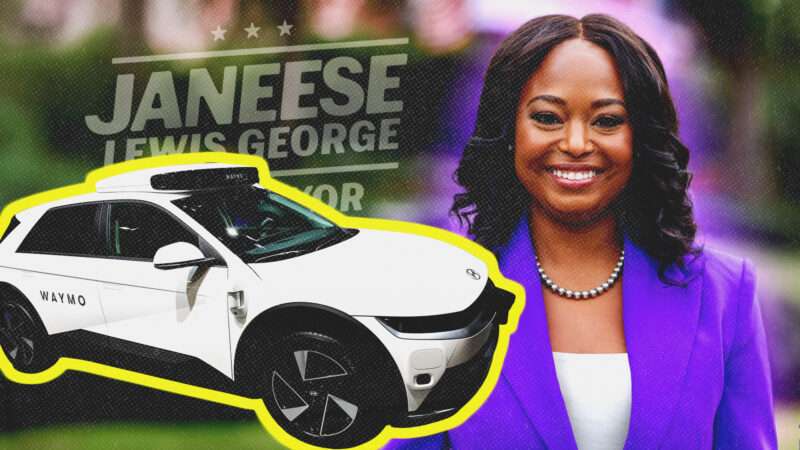
Janeese Lewis George, a D.C. councilmember and the city's presumptive next mayor, has come out against pending legislation that would allow autonomous ride-share vehicles onto city streets, citing the technology's potential to eliminate the jobs of ride-share human drivers.
"DC is facing a jobs crisis. Rushing the legalization of autonomous vehicles is irresponsible given the anticipated AI-related job displacement and disruptions that put countless workers at risk," she said on X yesterday.
DC is facing a jobs crisis.
Rushing the legalization of autonomous vehicles is irresponsible given the anticipated AI-related job displacement and disruptions that put countless workers at risk.
In a follow-up post, she said that the D.C. Council should delay consideration of a pending bill that would allow Waymo, which is currently testing its technology with human safety operators on District streets, to offer autonomous rides to the public.
Ever since Lewis George won a commanding victory in D.C.'s Democratic mayoral primary earlier this year, pundits and wonks have been trying to read the tea leaves on how the Democratic Socialist will govern.
Lewis George's comments about Waymo suggest the mayor has a deeply mistaken view about the effects and benefits of technological innovation. Contrary to her contention, Waymo legalization is unlikely to exacerbate a "jobs crisis" for at least three reasons.
The first reason she's wrong is that very few D.C. residents work full-time as ride-share drivers. On her Capital Commonsense Substack, Ashley Schapitl reports that, by Lewis George's own estimate, there are only 200 District residents who work full-time as ride-share drivers.
For comparison's sake, the District has a labor force of roughly 400,000 people. So even if Waymo displaced all human drivers in the District, it would be a statistical nonevent.
Few headlines, for instance, reported that D.C.'s labor force shrank by 1,000 people between May and June. Neither did many outlets report that the labor force grew by roughly 600 people between July and August.
Yet here the mayor is talking about a "jobs crisis" over what would be an even smaller change in the number of employed workers in the city.
The second reason not to fear an exacerbated "jobs crisis" as a result of Waymo legalization is that autonomous vehicles (A.V.s) will not completely replace human rideshare drivers in the foreseeable future.
In the cities where Waymo has been active for years, A.V.s are still responsible for a minority of rideshare rides.
That's the case in Phoenix, where Waymo has been offering autonomous commercial service since 2020. In an article from April, Business Insider cites one study that put Waymo's market share at 16 percent of ride-share rides.
In other words, 84 percent of ride-share rides are still being performed by humans a full six years after A.V.s came onto the scene.
That isn't to say the impacts of A.V.s are necessarily positive for human drivers' earnings.
Another study by Gridwise from August 2025 found that A.V.s appeared to be marginally reducing drivers' hourly pay and number of trips per hour. That's evidence of the market for rides becoming more competitive, but it's not, as of yet, evidence of a job apocalypse.
Network design matters too. In places like Los Angeles and San Francisco, Waymo is a standalone competitor to traditional ride-share companies like Uber and Lyft. In Austin and Phoenix, Waymo partners with Uber to offer rides on hybrid human-and-A.V. networks.
A report by EnoTrans, funded by a grant from Lyft, found that the later cities' hybrid networks actually increased human drivers' trips per hour. Their pay-per-hour fell, albeit less steeply than in cities without hybrid networks.
All of that is to say that while Waymo, as a competitor to human-operated ride-share services, shouldn't be expected to have a positive impact on drivers' earnings. It shouldn't be expected to have a catastrophic impact on them either.
The third and final reason that Lewis George is wrong to think that Waymo will worsen a coming "jobs crisis" is that Waymo's employment impacts are not limited to its effect on competing human drivers.
If Waymo earns any market share at all, it'll be because it's offering some travelers a better transportation option than the ones that currently exist. Increased ease of travel within the city would be expected to raise employment levels, not lower them.
If Waymo makes it easier or cheaper for people to get from home to the office or from the office to their kids' school, they might be more willing to live in D.C. over Arlington or Silver Spring. If it's more convenient to get to the movies or dinner, residents will be more willing to patronize local businesses.
None of that even touches on the economic and human benefits of Waymo's likely positive impact on road safety.
The direct effects of Waymo on drivers' employment must be weighed against all the other economic activity that autonomous vehicles will facilitate.
In the long run, the economic effects of autonomous vehicles may well be revolutionary. In the foreseeable future, they'll make the market for for-hire rides slightly more competitive.
A reasonable assumption then is that Waymo will have a modest, but positive, impact on overall economic activity and employment in the District, even if it has a modest, but negative, impact on the small number of full-time ride-share drivers who live here.
If the new mayor can't even tolerate that level of economic disruption, that does not portend good things for D.C.'s economy under a Lewis George administration.
This week, the Trump administration announced it's expanding its stake in semiconductor manufacturer GlobalFoundries. This brings the government's share of the company to over $2 billion, according to President Donald Trump, and it's only one of roughly three dozen companies in which this White House has acquired a piece of the action. This is a disturbing development for Americans who favor free enterprise and don't want the government to control the means of production.
While it may be a while before the opportunity arises to roll back state intervention in the economy, given the drift of both major parties away from faith in the marketplace, the Cato Institute has launched a project to get the process started.
$2 Billion Government Stake in One of 35 Once-Private Firms
"The U.S. Department of Commerce will receive equity in GF of approximately four percent, further enabling the American public to share in GF's growth," GlobalFoundries announced Monday in a press release about a U.S.–Japanese initiative to open two new semiconductor manufacturing facilities.
"This brings our total Investments to 1.63 Billion Dollars, and now, the U.S. Government's stake is worth over 2 Billion Dollars," Trump confirmed on Truth Social.
The announcement's triumphant tone isn't necessarily shared by people who wonder what the government's ownership stake in one company will do to regulation and investment in the industry. Will fully private firms challenging a state-backed player experience an even playing field?
In a July CNBC survey of 1,000 U.S. voters, 49 percent of respondents said it is "not appropriate for the federal government to own a portion of a U.S.-based company." Nineteen percent considered it appropriate, and 32 percent had no opinion.
"Washington's expanding involvement in the businesses it regulates threatens the competition and innovation that underpin American prosperity," warns the Cato Institute's Tad DeHaven on the launch of the Restoring Free Enterprise project. "Our project will examine the consequences of that involvement and chart a path toward getting Washington out of the boardroom."
Restoring Free Enterprise's Government Ownership Dashboard shows the U.S. government owning shares in 35 companies. The recent deal with GlobalFoundries comes on top of an earlier equity stake, giving the government 7 percent ownership of the firm. Other big deals include an 8.4 percent stake in Intel, a claim on 20 percent of distributions above $17.5 billion in Westinghouse, and an arrangement granting the U.S. government the right to appoint a director for U.S. Steel and to veto decisions over matters including investment and production.
Why might this be a problem?
When Government Enters the Market, Competition Is Undermined and Decisions Politicized
In an analysis for the Center for Strategic and International Studies, Sujai Shivakumar, Charles Wessner, and Christina Tutino cautioned that direct government ownership could create "conflicts between the role of the government as an investor in a particular company and its role as a regulator (e.g., regarding export controls) of firms across the wider industry." They added that preferential treatment for state-linked forms could "distort competition, stifle innovation, and potentially lead to monopolies or market concentration in strategic sectors."
"Once government crosses the line into equity ownership, the game changes," agreed economist Vance Ginn in a 2025 piece for the American Institute for Economic Research. "It's no longer about setting fair rules of the road—it's about Washington joining the race as a participant. That undermines competition, politicizes corporate decisions, and exposes taxpayers to risks they never agreed to take."
Basically, when the government gets involved in any industry, it complicates matters for the companies in which shares are held, for competitors who must worry that regulators will put their thumbs on the scale to help favored firms, and for the market in general. Overall, government interference of any sort in market transactions does more harm than good, and direct ownership makes things even worse.
"Federal rate controls, excessive taxes, barriers to restructuring, and rigid labor rules weakened private railroads in the mid-20th century, just as automobiles, buses, trucks, and airlines were intensifying competition," Cato's Chris Edwards points out in a case study for the Restoring Free Enterprise Project. Congress then created Amtrak to maintain the passenger train service its red tape had helped strangle, but despite plans for the railroad to be self-sufficient, "it has never earned a profit and has received tens of billions of dollars in subsidies."
Proposals for Reform, but Is Anybody in D.C. Interested?
The project acknowledges the Trump administration's intention to encourage U.S. manufacturing and to meet strategic defense goals. But it points out that private, profit-seeking firms are what made the U.S. prosperous and dominant in so many fields to begin with. The government should get out of the way of the market if it wants the country to continue to thrive.
As alternatives to state ownership of companies, Restoring Free Enterprise proposes permitting and regulatory reforms that "shorten reviews, remove unnecessary requirements, reform the Jones Act, and recognize out-of-state licenses" for workers. The project also recommends free trade agreements that reduce barriers to international commerce, the removal of export and procurement barriers, tax reforms involving expensing, and immigration reforms that simplify processing and make it easier for foreign-born college graduates to remain in the U.S.
The obstacles to implementing these reforms are substantial. The administration, while criticizing the Democratic Party's growing affection for socialism, itself embraces government ownership of companies, mercantilism, and heavy state intervention in economic decisions and activities. The Democratic Party has long been less market-oriented than the Republicans, and despite the GOP's transformation, a growing share of Democrats are openly socialist advocates for state control.
"American political leaders on the left and right are rebelling against the market-first consensus that dominated Washington for four decades," concluded Axios's Courtenay Brown and Neil Irwin in July. "It's evident in everything from the Trump administration taking government stakes in dozens of private companies to socialist candidates winning Democratic primaries promising a more active government role in the economy."
U.S. politicians are happily adopting damaging policies that are at odds with the country's prosperity-building tradition of free markets. The Restoring Free Enterprise project would reverse that unfortunate trend, but it's not obvious that many people in D.C. are interested in joining the fight.
President Donald Trump promised that his tariffs would usher in a "golden age" by prioritizing the interests of American workers.
Those workers, however, are now turning against Trump's tariffs.
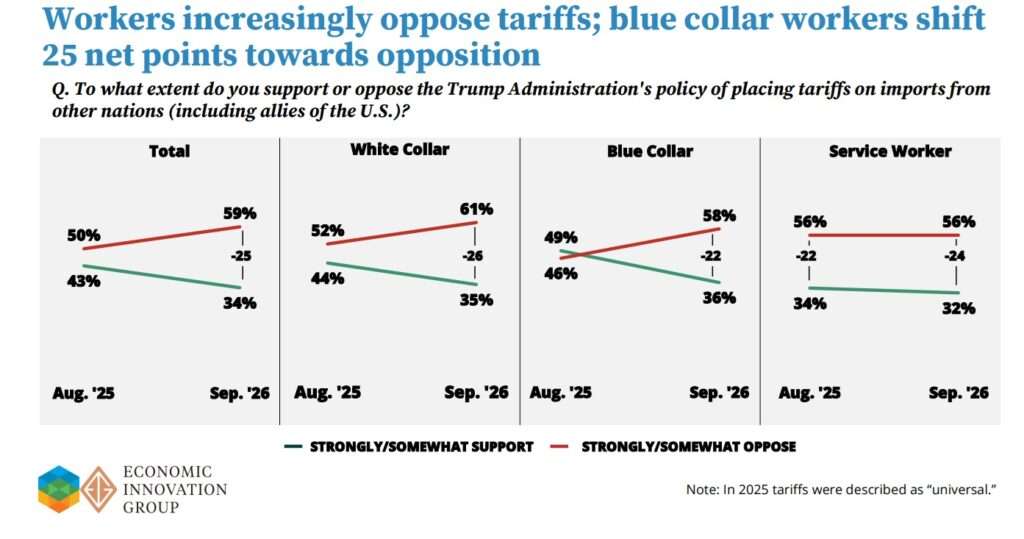
Support for the Trump administration's tariff policies has fallen by 25 percentage points among blue-collar workers over the past year, according to new polling data from Echelon Insights and the Economic Innovation Group (EIG).
A poll conducted by the two groups in August 2025 found that blue-collar workers supported the tariffs by a narrow margin. Now, that same segment of the population has turned decisively against Trump's tariffs: 58 percent oppose them, compared to just 36 percent who support them.
Source: Economic Innovation Group / Echelon Insights (https://eig.org/wp-content/uploads/2026/10/EIG-State-of-the-American-Worker-2026.pdf)
Overall, support for the tariffs has declined from about 43 percent last year to only 34 percent. Opposition to the tariffs has grown from 50 percent to 59 percent. Elsewhere in the same survey, 68 percent of respondents said the tariffs have made the cost of living higher.
It's not hard to figure out why people have turned against the tariffs: They have contributed to rising prices across the economy.
The annualized inflation rate ticked upward to 3.7 percent in September, according to new data from the Bureau of Labor Statistics (BLS). More BLS data released Thursday morning shows that the producer price index, which often operates as a precursor to inflation, is up 6.3 percent over the past year.
America's war with Iran has been a major factor in rising inflation, but the tariffs have played a significant role as well. In a study released last week, the New York Federal Reserve concluded that consumer prices would have declined slightly over the past year if not for the economic effects of the tariffs.
The tariffs have become so unpopular that not even partisanship can save them. "Among GOP-voting workers, only 3 percent select tariffs as their top priority," note Jordan McGillis and John Lettieri, policy experts from the EIG, in their write-up of the poll.
Other parts of Trump's economic agenda are not faring much better. The Trump administration has bought or seized shares of more than 30 private businesses over the past two years—ranging from major firms such as U.S. Steel to small mining companies with few customers. "The federal government's state corporatism is unprecedented," reports the Cato Institute in a new analysis of those deals.
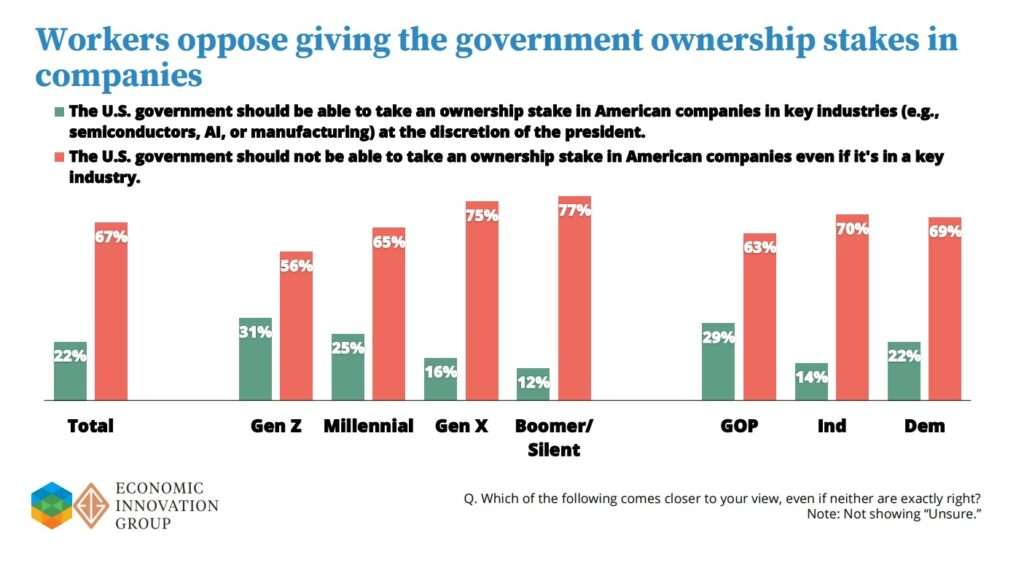
Large majorities of workers across both major parties and all generations said they opposed the federal government taking equity stakes in American companies in the Echelon/EIG poll.
Source: Economic Innovation Group / Echelon Insights (https://eig.org/wp-content/uploads/2026/10/EIG-State-of-the-American-Worker-2026.pdf)
In short: This economic populism sure isn't very popular.
All of this is likely to be a major factor in next month's midterm elections. Regardless of how that shakes out, however, there are lessons to be drawn from this poll for both sides of the political divide.
For conservatives, these polling data should end the tariff experiment. It has proven economically damaging, and it is no longer a political winner (if it ever was).
Remember, the idea to hike tariffs and start trade wars with all of America's biggest trading partners was not some grand plan backed by careful study and thoughtful analysis. It sprung, half-baked, from the head of one man. Yes, there have been various attempts to support, in a post hoc way, Trump's desire for tariffs. All of that can, and should, be easily discarded. There is no reason to allow a lame duck president to continue to set such a politically and economically destructive path for the country.
Undoing the tariffs might also put a meaningful dent in rising prices. That should be a no-brainer after the midterms, no matter which party controls Congress.
On the left, this poll should be a reminder that Americans do not look favorably on the mixing of government and business. Democrats should promise to unwind the "equity stakes" that the federal government has taken under Trump's watch. Heading toward the 2028 presidential cycle, Democrats might want to borrow some old Republican talking points about how government shouldn't be picking winners and losers—they may find that message is still quite popular.
Yes, it's probably right to be skeptical that those things will happen. Trump's efforts to centralize economic power in the executive branch are likely to outlive his presidency—that's how these things always seem to go.
But there is a glimmer of hope here. Americans are soundly rejecting the Trump administration's big government policies.
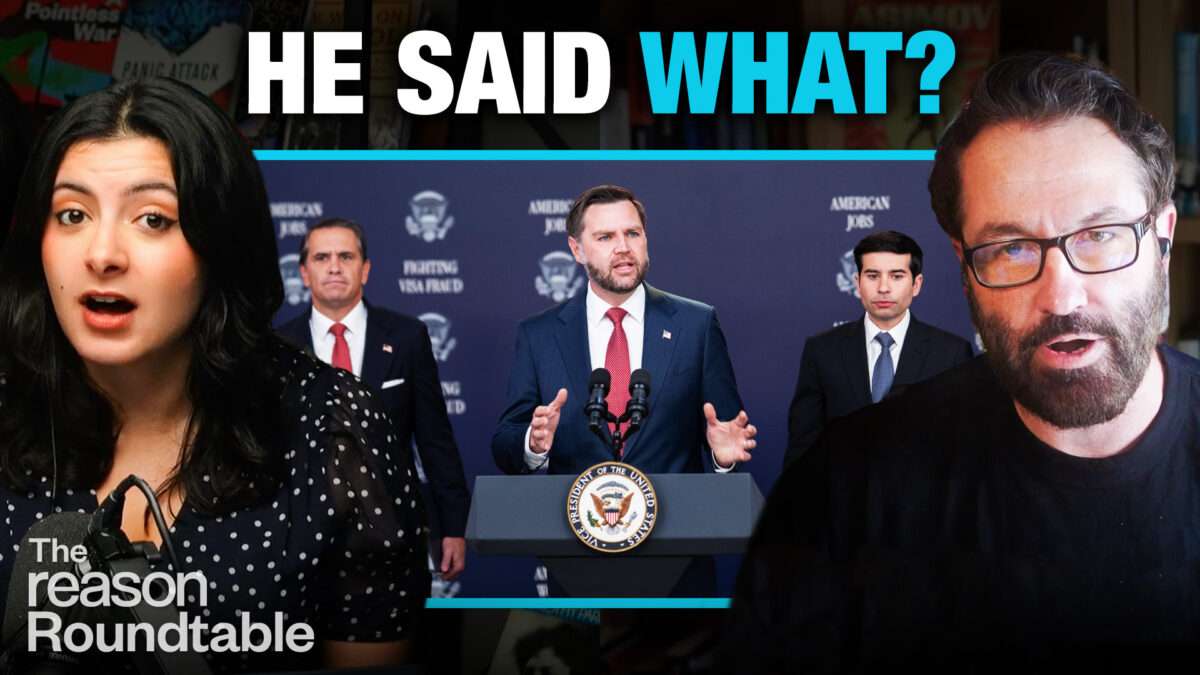
This week, editors Peter Suderman, Katherine Mangu-Ward, and Nick Gillespie are joined by reporter Reem Ibrahim to discuss Vice President J.D. Vance's bizarre definition of socialism. They examine whether Vance genuinely believes what he's saying or is attempting to redefine socialism to avoid acknowledging the Trump administration's own big-government policies.
Next, the panel discusses America's growing $2 trillion deficit, the rising cost of Social Security and Medicare, and the generational divide between older Americans receiving government benefits and younger workers paying for them. The editors also examine youth protests in France, where students are demanding improvements to public schools despite the country's already extensive government spending. They then discuss allegations that U.S. Ambassador to Greece Kimberly Guilfoyle offered political access in exchange for help paying off personal credit card debt and what the controversy reveals about government corruption. Finally, a listener asks about Defense Secretary Pete Hegseth's plan to publicly broadcast an execution and whether turning capital punishment into a spectacle could encourage extremism.
Reem Ibrahim appears on the left. Peter Suderman appears on the right. An image of Vice President J.D. Vance at the podium, flanked by members of the Trump administration appears in the center. Bold text across the top of the screen reads "HE SAID WHAT?"
Amidst all the sentimental populist fluff, a political theory of sorts could be discerned in Andy Burnham's conference speech, says Professor James Alexander. Let's call him Our Andy-with-his-10-year-Plandy.

 Login