Le numéro 114 fête son anniversaire : le 114, c'est l’appel d’urgence en France pour les personnes sourdes et malentendantes. Depuis 15 ans, ce système reçoit les urgences sous forme de texte ou de connexions vidéo. Un numéro utile qui peut sauver des vies sur les routes ou dans les transports. Les personnes sourdes conduisent, mais pas dans tous les pays.
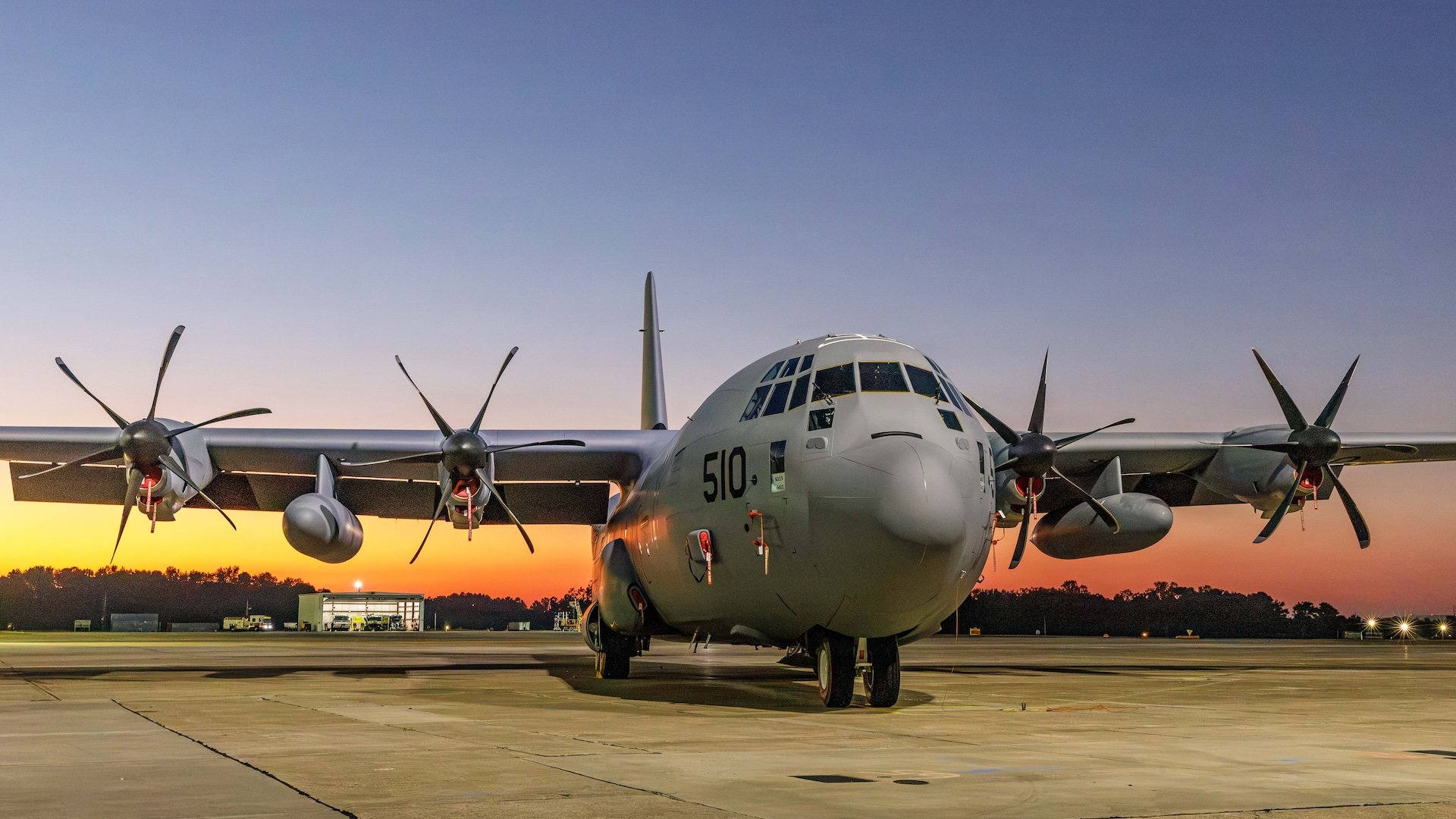
The U.S. Navy has taken delivery of the first C-130J-30 Hercules airframe destined to become an E-130J Phoenix II, the service’s next-generation aircraft for maintaining communications with its nuclear ballistic submarines. The aircraft will now undergo extensive mission-systems integration before it can begin testing for the Take Charge and Move Out (TACAMO) mission.
Lockheed Martin handed over the newly built aircraft at its facility in Marietta, Georgia, on October 15. The delivery marks the start of the transition from the Navy’s aging E-6B Mercury fleet to the turboprop-powered E-130J, which is intended to provide a survivable communications link between national leadership and U.S. Navy nuclear ballistic missile submarines, including the ability to send them orders to launch strikes while they are submerged.
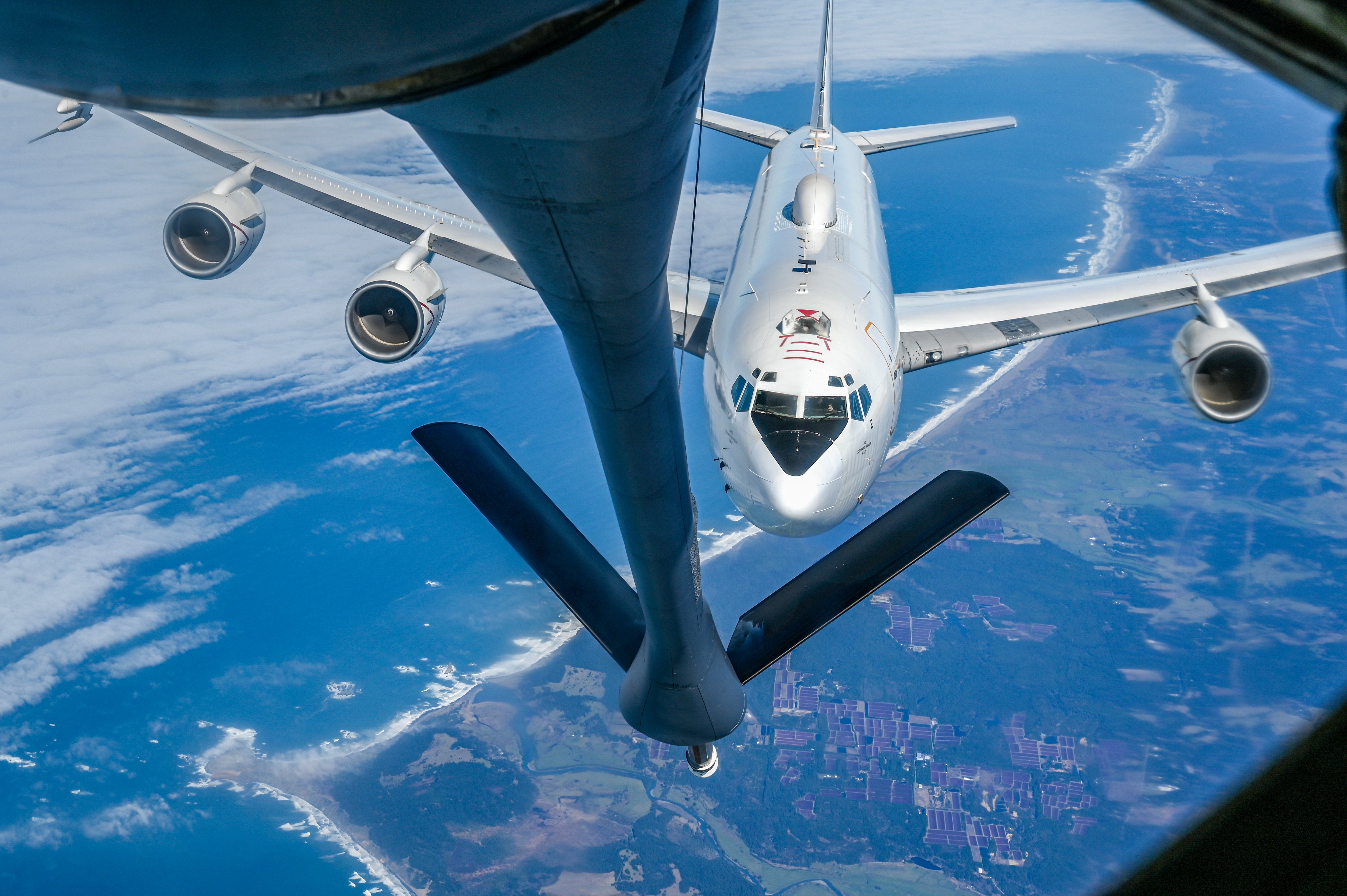
An E-6B Mercury assigned to the Strategic Communications Wing 1 at Tinker Air Force Base approaches a tanker during an aerial refueling mission over Oregon, Feb. 28, 2025. U.S. Air Force photo by Airman 1st Class Megan Delaine
“Today’s delivery from the historic Marietta line represents far more than a new airframe; it marks the foundation of our future strategic deterrence posture,” Capt. Roger Davis, program manager for the Navy’s Airborne Strategic Command, Control, and Communications program office (PMA-271), said in a statement.
“Through our close partnership with Lockheed Martin and our industry team, we are ensuring our nation maintains an unshakeable communications lifeline to our ballistic missile submarine fleet.”
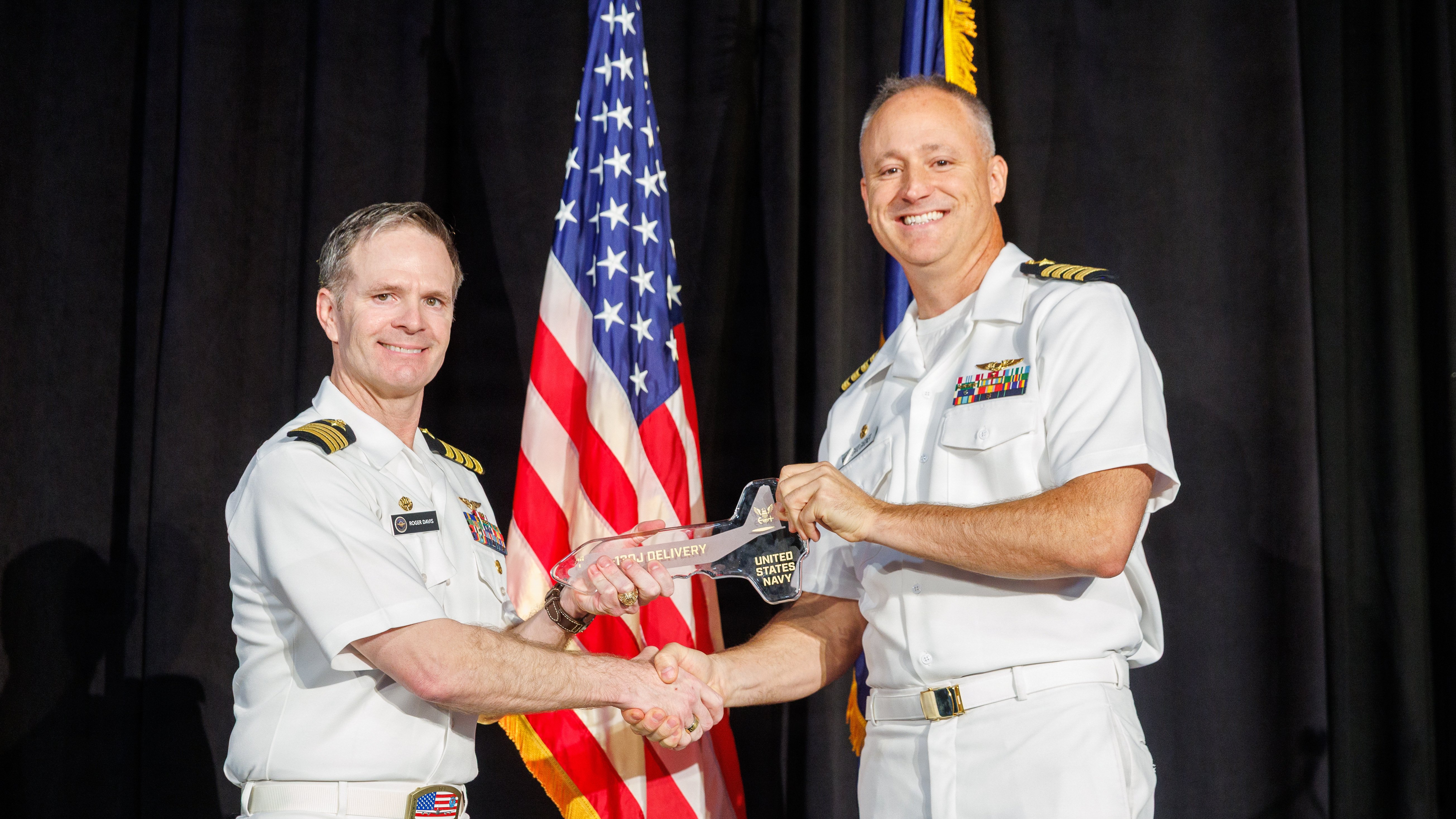
Capt. Roger Davis, left, Airborne Strategic Command, Control and Communications program manager (PMA-271), presents a ceremonial key to Capt. David Gardner, commodore of Strategic Communications Wing 1 (SCW 1), during the C-130J-30 delivery ceremony Oct. 15, 2026 in Marietta, Georgia. Photo courtesy of Lockheed Martin by Thinh D. Nguyen
The aircraft is the first of three C-130J-30s initially procured by the Navy in September 2024. It will be transferred to Northrop Grumman, the E-130J program’s prime contractor and mission-systems integrator, for conversion. Collins Aerospace is providing the very low frequency (VLF) communications system, a key component of the TACAMO mission.
TACAMO aircraft provide a means for the president, secretary of defense, and U.S. Strategic Command to communicate with nuclear forces, including submarines submerged at sea. The mission is designed to preserve the ability to transmit emergency action messages even if conventional communications infrastructure is disrupted or destroyed.
The E-6B accomplishes this in part through a long, trailing wire antenna that enables VLF transmissions to submerged submarines. The E-130J will receive a comparable system as part of its conversion.
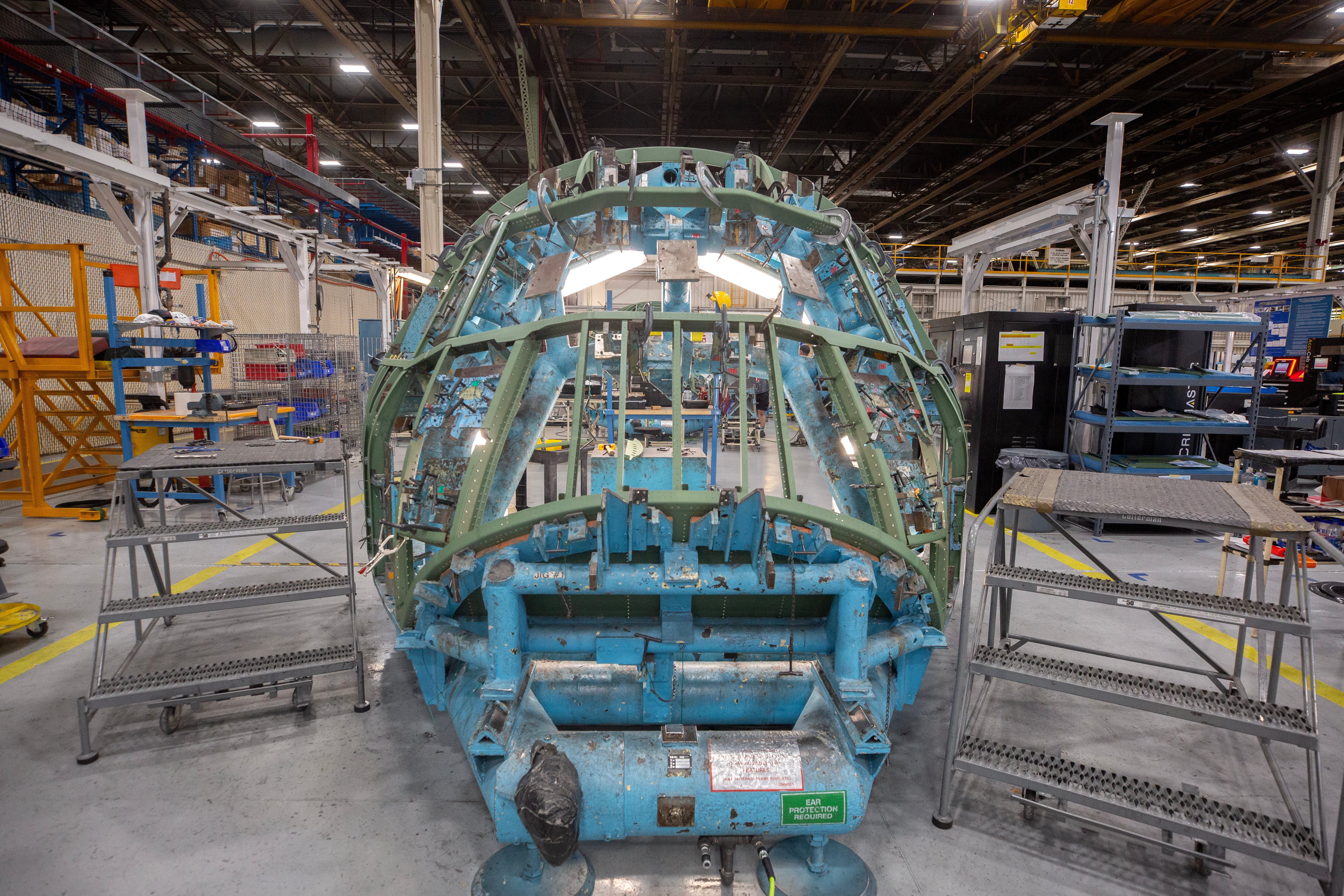
The first C-130J-30 being built by Lockheed Martin Corp. for the E-130J program. Photo by David L. Key, Lockheed Martin
The Navy plans to acquire 31 E-130Js, nearly doubling the 16 E-6Bs currently in service. That total includes six developmental aircraft and 25 production examples, although it remains unclear how many of the developmental aircraft will ultimately be available for operational use.
The larger planned fleet should provide additional aircraft to support training, maintenance, and operational demands. However, the transition also brings technical challenges. The Government Accountability Office (GAO) has previously warned that integrating the specialized mission equipment into the smaller C-130J-30 airframe could affect operational availability and create additional engineering and manufacturing difficulties.
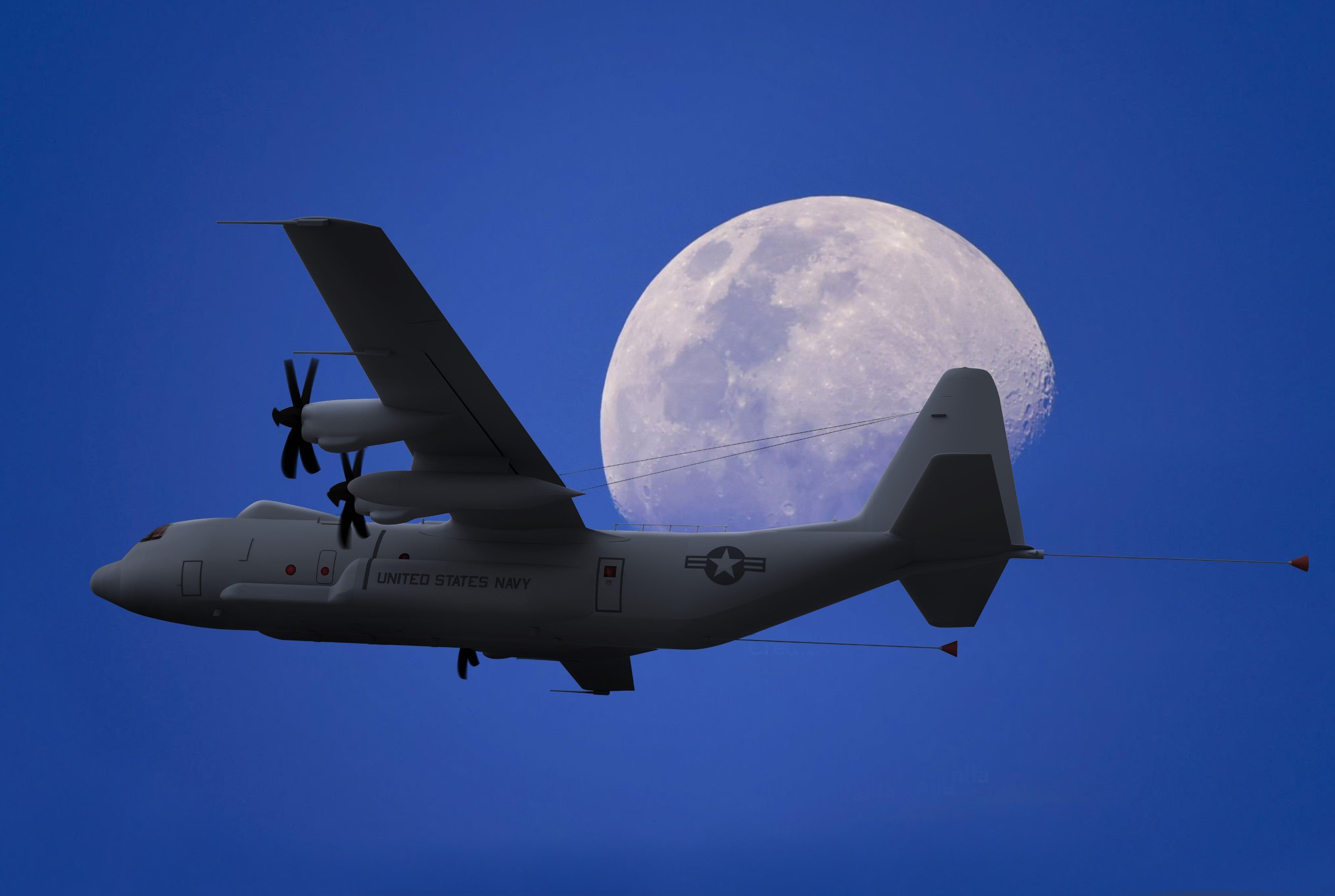
Rendering of the future E-130J aircraft. Courtesy of Northrop Grumman Corp.
In the past, TWZ has discussed the potential operational readiness and other trade-offs that could come from selecting a C-130-based platform to replace the E-6B in the TACAMO role. As we wrote previously:
“It’s certainly worth pointing out that the E-6Bs, conversions of what were some of the last and most modern 707 airliners built, were larger and higher performance platforms than the EC-130Qs. The C-130J-30 is certainly a more capable aircraft than the C-130H on which the EC-130Q was based, but it won’t have the base speed and altitude capabilities of an airliner-sized multi-engine jet. Compared to the Mercuries, any TACAMO-configured C-130J-30 would not be able to get on station as quickly, or fly as high, limiting its ability to get above bad weather or establish a better line of sight for its communications systems.”
“At the same time, as the Navy itself has noted, the C-130J-30 platform does immediately open up the ability to use a larger number of air bases, airports, and airfields, including austere ones that the E-6B cannot operate from. This could be very useful in a contingency scenario where an opponent may have destroyed or otherwise rendered unusable many well-established bases, as well as larger secondary dispersal sites, which include large commercial airports. Being able to fly from smaller, tertiary locations could help to ensure that the TACAMO mission continues without significant disruption under such circumstances. This is also true during peacetime, as targeting the TACAMOs on the ground would be much harder if they could easily operate from and sit alert at a much larger number of airports.”
“A C-130J-30 configured for the TACAMO mission would certainly have a mid-air refueling capability, and the Hercules is already a platform that has demonstrated the ability to loiter over particular areas for long periods of time. Unlike the Boeing 707, the C-130J is still in production, as well, meaning that TACAMO aircraft based on this plane would be inherently easier to maintain and support logistically, and may also be easier to convert to this specialized configuration to begin with. As time goes on, the J looks set to increasingly become the default base C-130 model across the U.S. military, as well. Compared to the long out-of-production 707-based E-6, support for the C-130J is already distributed across the U.S. and beyond. Training C-130J crews is even an easier proposition.”
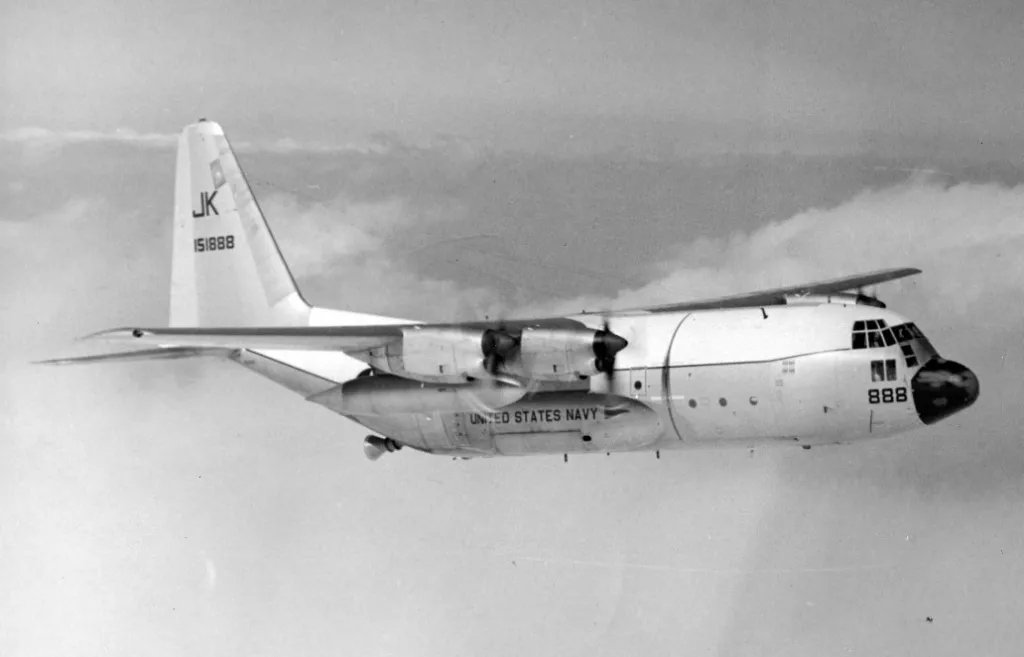
The E-130J also represents a return to the Hercules family for the Navy’s TACAMO mission. The EC-130Q performed the role from 1963 to 1993, before the E-6A Mercury took over. The E-6B subsequently added an airborne command post mission known as Looking Glass, supporting U.S. strategic forces beyond the submarine communications role.
The US Navy operated a fleet of EC-130Q TACAMO aircraft like the one seen here before the arrival of the E-6As. U.S. Navy
The Navy’s current plan is for the E-130J to assume the TACAMO mission, while the Air Force pursues a separate effort to replace the Looking Glass airborne command post capability.
Following its delivery, the first E-130J airframe will enter mission-systems modification, ground testing, and developmental flight testing. The aircraft is not yet an operational TACAMO platform, and further integration and testing will be required before the Navy can begin fielding the new fleet.
The transition is intended to preserve one of the most critical links in the U.S. nuclear command, control, and communications architecture as the E-6B fleet becomes increasingly difficult to sustain.
A new drone collaboration by Cessna owner Textron and autonomy provider Merlin Labs aims to offer the U.S. military a hot production line and a familiar platform for uncrewed aerial logistics, including in contested environments.
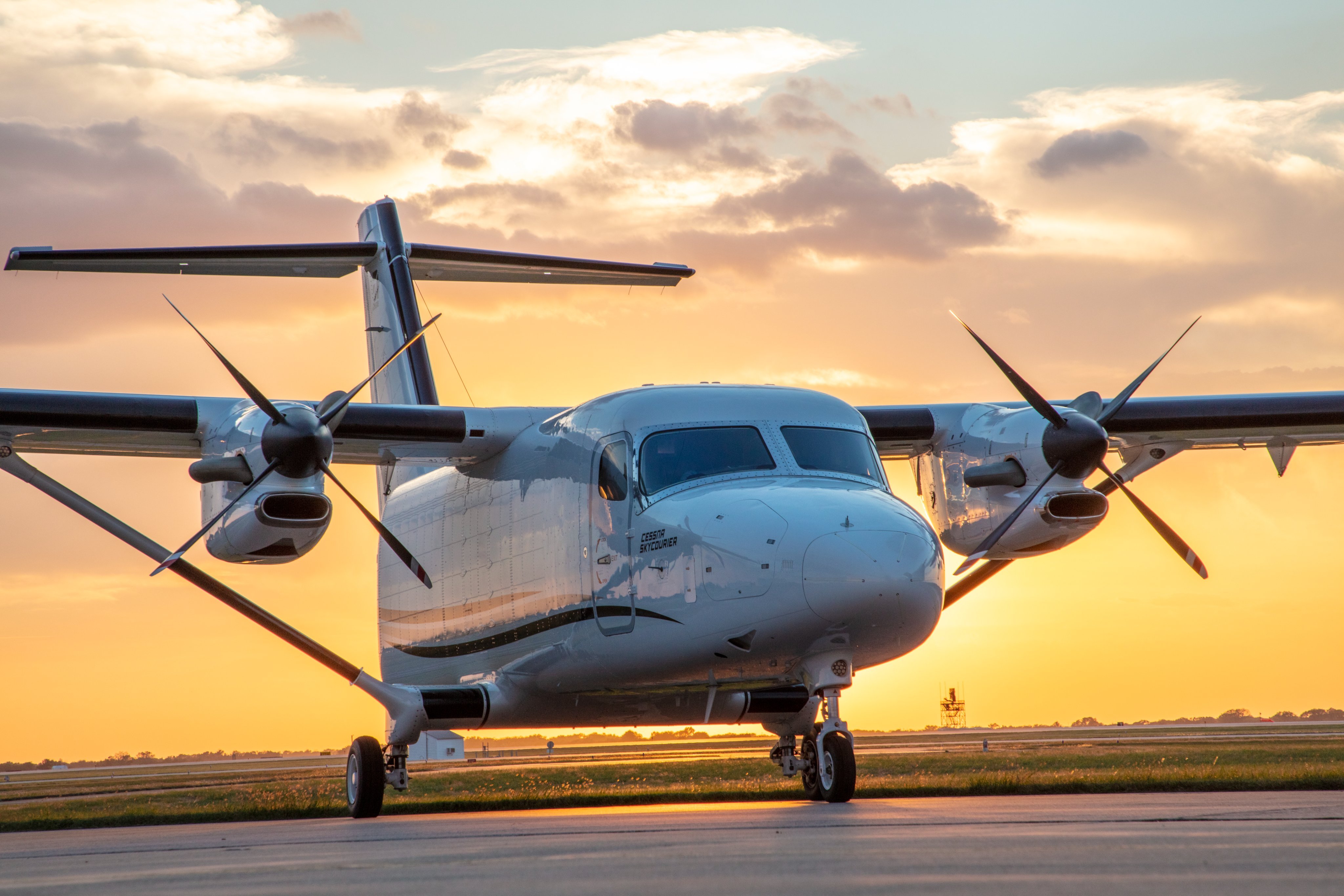
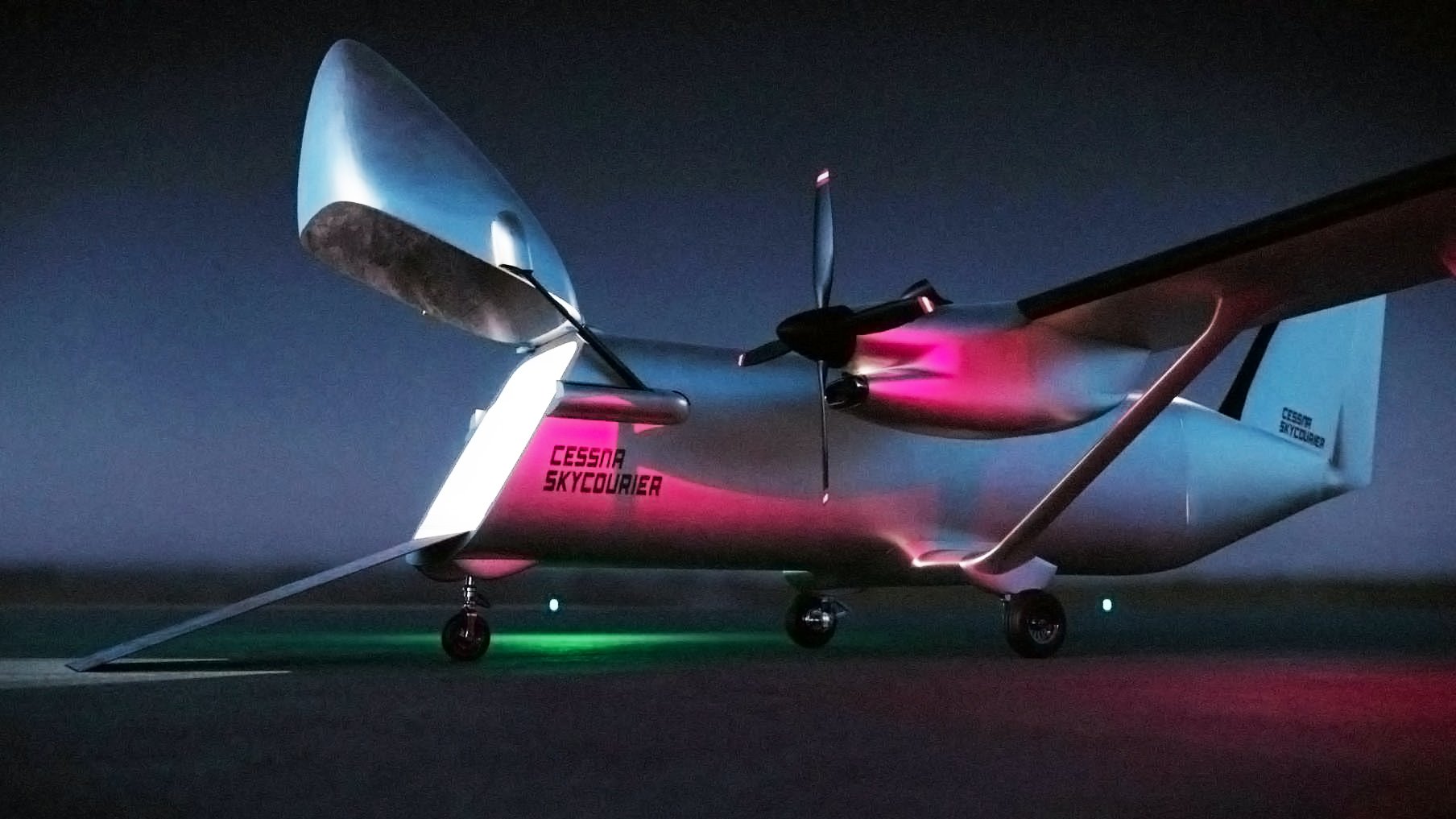
The product is SkyCourier UX, a drone version of the Cessna 408 SkyCourier that has flown for FedEx, foreign special operations forces and small remote commercial airlines during its six years of active service. TWZ previously covered how the SkyCourier would likely end up taking on military applications when it was first announced, which you can read here.
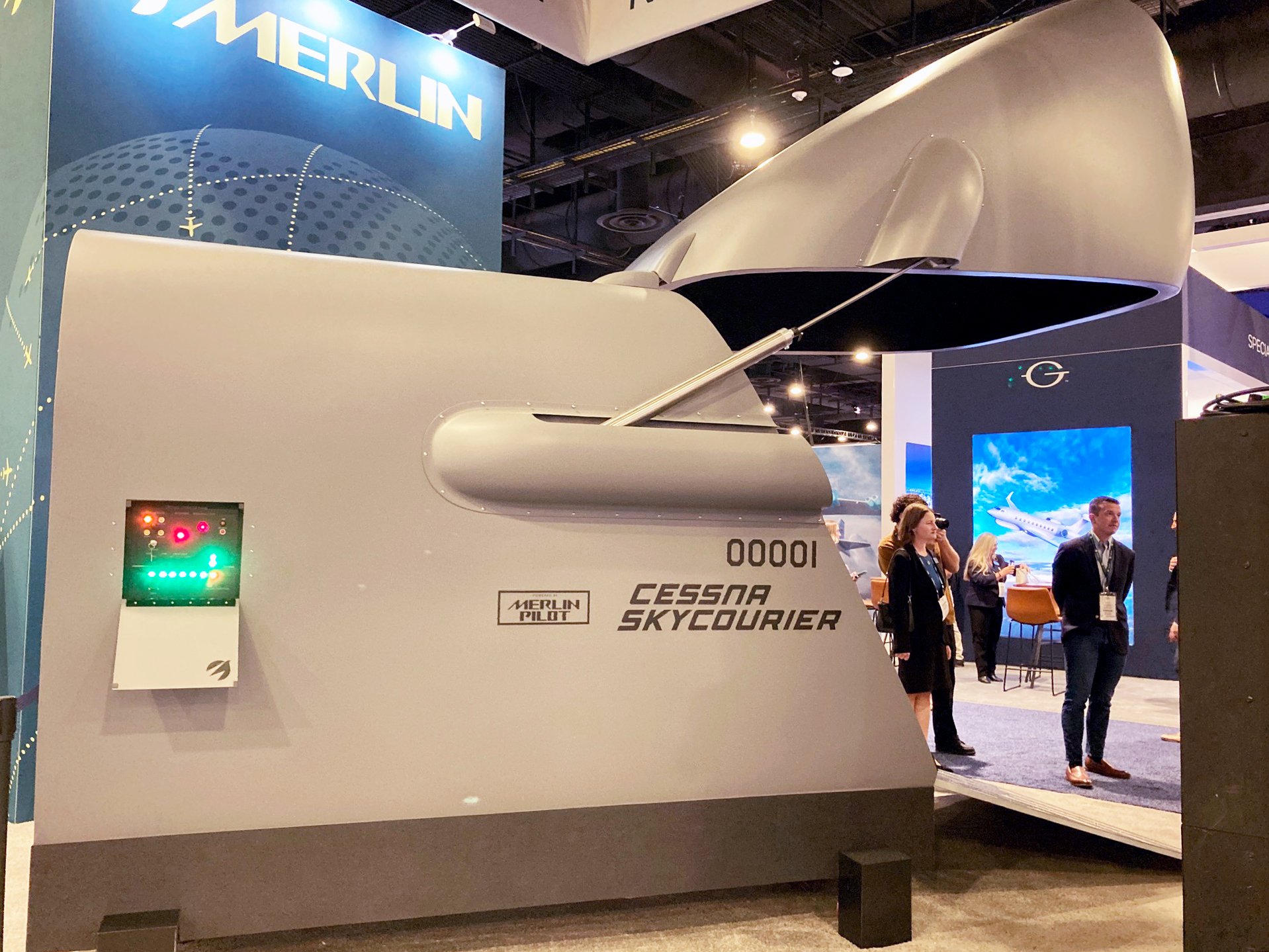
A partial full-size model on the show floor at the Air & Space Forces Association’s Air, Space & Cyber Conference in Washington, D.C., this week showed a nose that opened with hydraulics to a cargo bay in lieu of a cockpit. We have seen this same front door conversion concept for uncrewed cargo-carrying helicopters as of late. This allows for easy loading of outsized cargoes without specialized equipment, according to the company, though it does not increase the payload. Like the original SkyCourier, it’s good for about 6,000 pounds, or three standard containers.
(Hope Hodge Seck)
The form factor of the uncrewed SkyCourier variant is otherwise identical to its crewed counterpart, with twin turboprops, a high-wing configuration and an aluminum body.
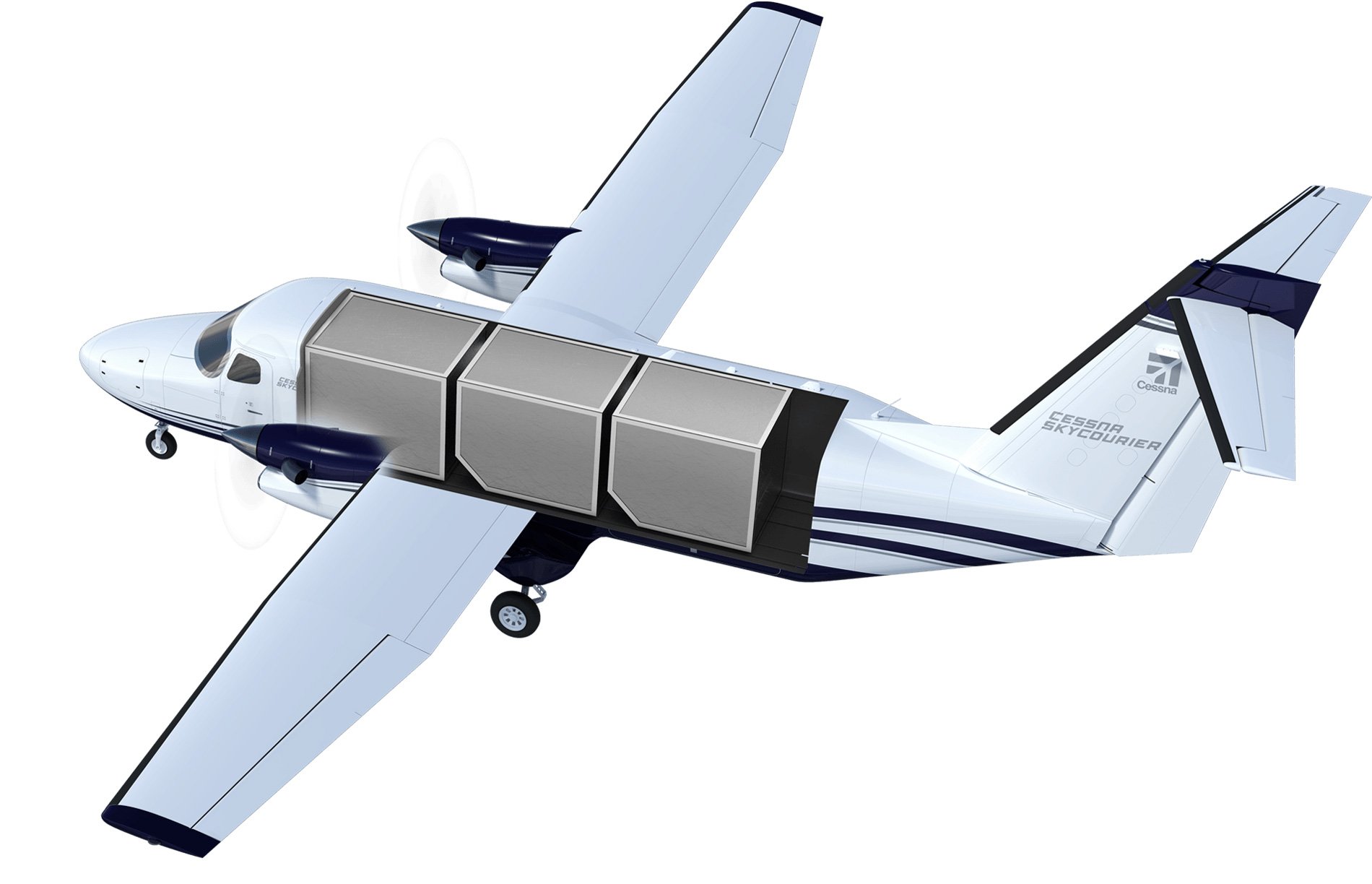
As with the base SkyCourier, a major advantage of the aircraft is its optimization for loading and carrying standard pallets. This means that cargoes don’t necessarily have to be downloaded, broken up and repackaged for movement to forward positions. This is a big logistical advantage and can speed the flow of critical supplies to where they are needed most.
The aircraft’s range is about 900 nautical miles, which the makers say suits it well for Pacific island-hopping, allowing for refueling stops on austere runways. It can take off on runways as short as 3,300 feet and land in just 2,500 feet, according to a spec sheet.
SkyCourier can hold three standard LD3 pallets. (Textron)
The Textron/Merlin collaboration aims to differentiate itself with proven capability in the missions it intends to fulfill, along with the ability to roll out a new drone variant fast and one it can sustain consistently. Bob Gibbs, Textron’s vice president of special missions sales, told reporters in a Monday briefing that the conventional SkyCourier was now fulfilling new orders, not previously announced, to deliver modified aircraft to foreign nations for medical evacuation, casualty evacuation and environmental protection.
“The aircraft’s being operated literally from the Arctic to the Amazon,” Gibbs said. “There are three different island nations in the Pacific that have airline fleets of them. We support our aircraft in 170 countries around the world. So, just like a Cessna Caravan or a Beechcraft King Air, they’re ubiquitous. You find them anywhere, and we support them anywhere in the world.”
While the 900-mile range can’t take the loaded-up aircraft the nearly 2,000-mile stretch between the first and second island chains, Merlin and Textron executives said they don’t need to accomplish that to make it effective.
“This is the ability to disperse the forces among the second island chain … to do the island-hopping to be able to get to, whether it’s Palau, Tinian, Saipan, pick your various islands there,” Kyle Kremer, a retired Air Force major general who now advises Merlin, said. “With the range that it has, it has the ability to agilely move through there” and connect logistics pipelines.
SkyCouriers are flying all over the world, including in some very harsh environments. (Textron)
The autonomy package, Merlin Pilot, is already in use under a $105 million U.S. Special Operations Command contract to develop autonomy for the C-130J Super Hercules transport aircraft. It’s been flown aboard four different single and multi-engine airframes, the company says. A promotional web page for Merlin Pilot shows tanker-class and commercial cargo applications with developing and future capabilities.
Merlin has also teamed with the Air Force to develop an AI copilot for KC-135 tankers that can decrease crew workload and even possibly fly the aircraft on its own in the future. TWZ reported on planned tests for these autonomy-enabled tankers in 2024, with the flights set to begin the following year.
However, the Air Force has not confirmed the completion of any flight tests for the effort since. And on Wednesday, Lt. Gen. Daniel Tulley, commander of Air Force Mobility Command, appeared to confirm that the tests had never taken place.
“There’s some companies out there who have offered to develop things where they can bring a carry-on kit onto old KC-135s and other aircraft, but we haven’t seen them test those successfully,” he said.
He added that autonomy technology may lack the maturity needed for tanker missions.
“An optionally manned or an unmanned tanker at range, [at] the ranges we needed to operate at. It’s a very large aircraft, and we’re not yet to where we’re employing fully autonomous large aircraft. But the technology, I would say, is there and rapidly getting there,” he said.
Tulley did stress that the Air Force saw a need for unmanned aircraft in the last-tactical-leg delivery.
“I’m wrestling with that as we develop an AMC strategy,” he said. “There is absolutely room for some sort of autonomous or other small light lift capability, and that’s just one domain in the air, right? This could be by sea, could be by land, but there is absolutely some requirement for distribution from those major points of debarkation.”
In addition to autonomous takeoff, landing and navigation, and protection of the flight envelope, Merlin Pilot, the company says, has digital copilot human-machine teaming characteristics that include pilot health monitoring, gaze tracking and fatigue detection; pilot incapacitation and contingency response; and flight monitoring and assistance.
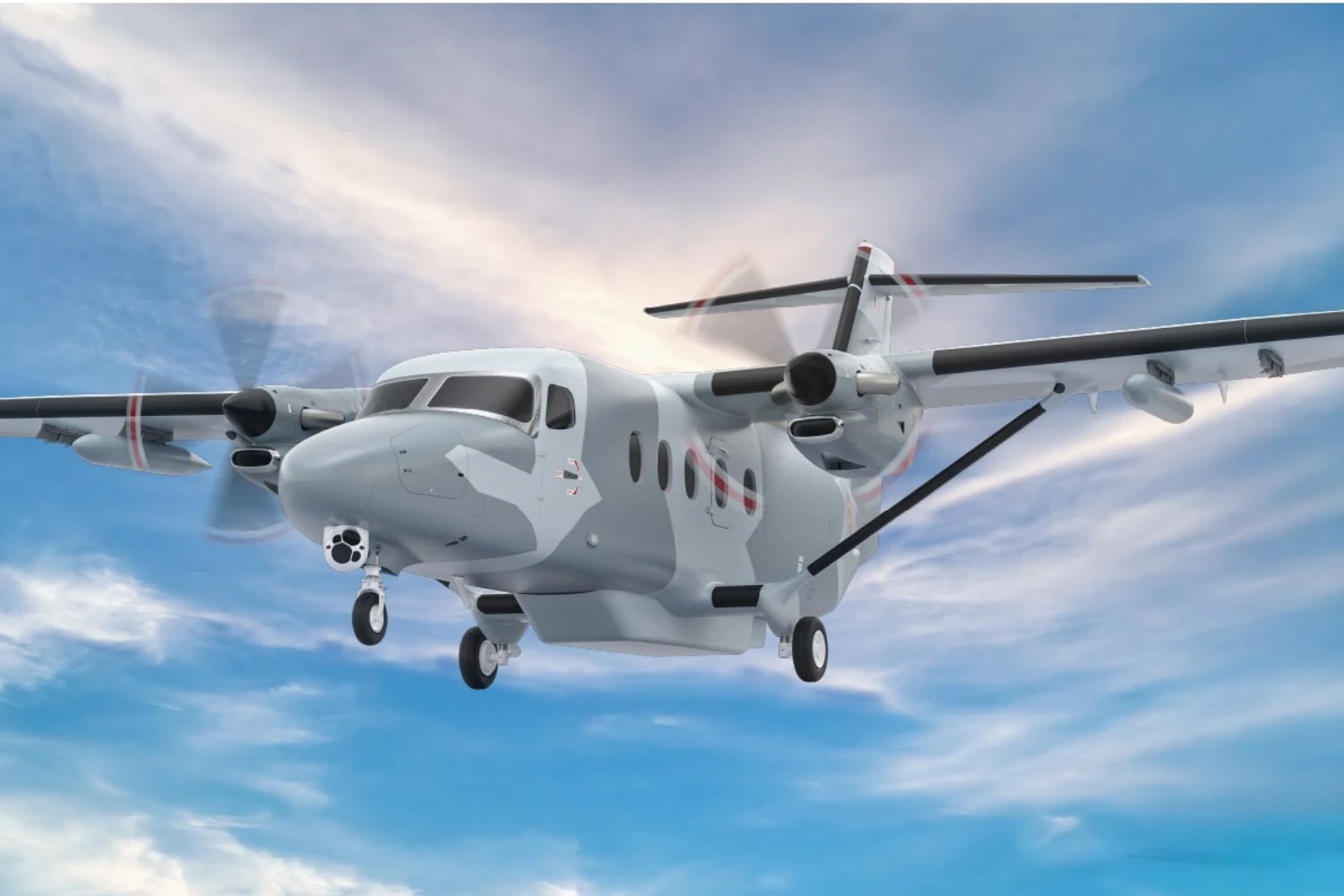
A military variant concept of the SkyCourier. (Textron)
Some of Textron’s new features are making light steps toward autonomy already. Gibbs pointed out that the company’s Cessna Citation Gen3 business jets now include standard Garmin auto-land technology.
“Obviously, it’s a different scale than what Merlin’s doing as far as automation,” he said. “But … as we develop new products, we try to future-proof them, and so that’s where you get this nice transition between us.”
The SkyCourier can cost up to $8.5 million, depending on modifications, and while the SkyCourier UX sports GPS-denied navigation and the ability to seek different flight paths to avoid danger, it doesn’t have other built-in defenses. For contested logistics missions, it’s not clear how much risk the services are willing to tolerate for a relatively small logistics payload capability. Kremer maintained, though, that a drone of this size could be a mission-saving capability when dispatched to austere locations. And, in a Pacific conflict, it may reduce demand on already-stretched C-130 transports, now the smallest platform capable of carrying standard containers and long overtasked.
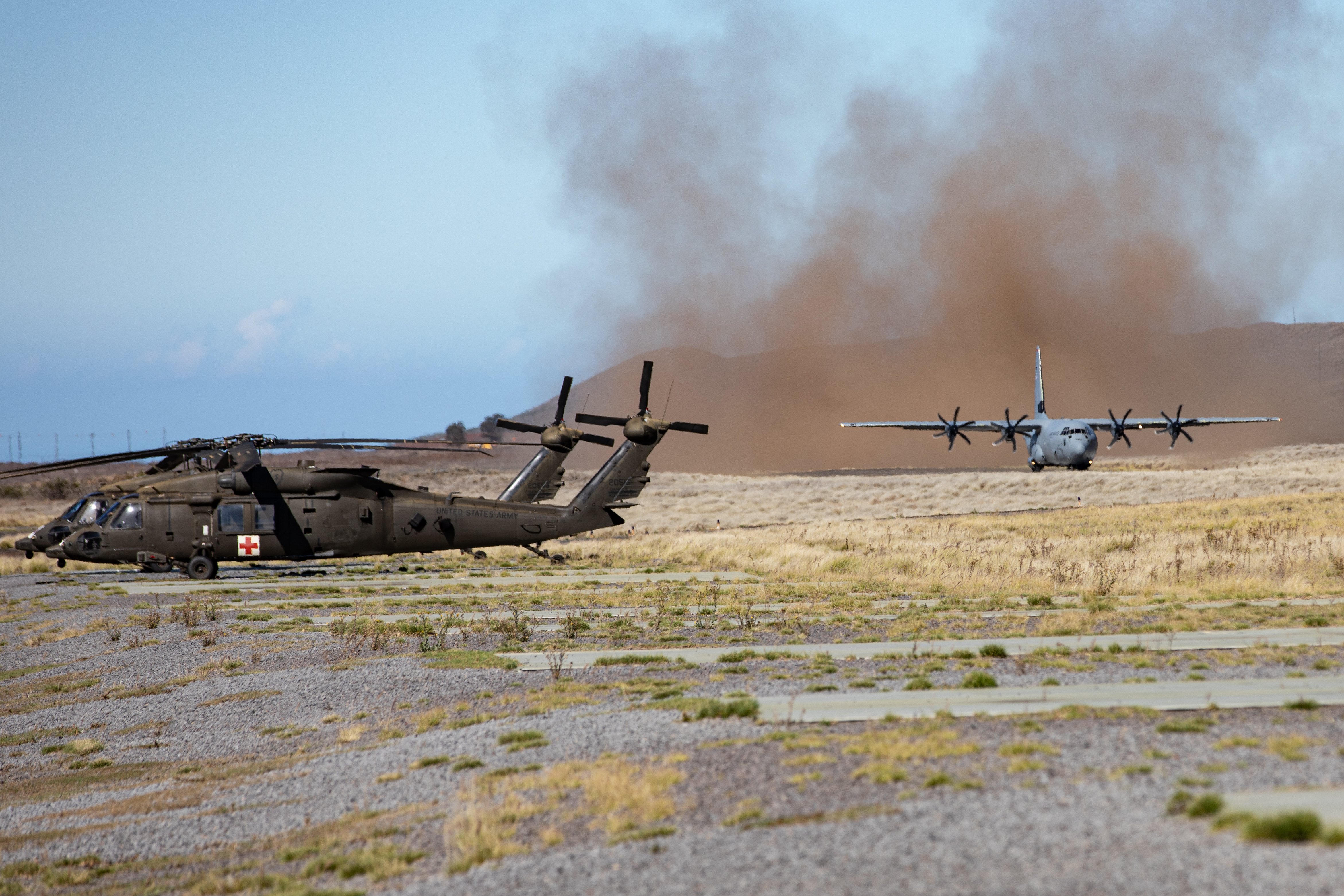
A U.S. Military C-130 prepares for takeoff at Pohakuloa Training Grounds, Hawaii, Oct 28, 2022. (U.S. Army photo by Pfc. Wyatt Moore / 28th Public Affairs Detachment) Spc. Wyatt Moore
“If you can’t get the spare tire, if you can’t get the component, that small thing where you need it in these dispersed operations, they don’t keep the big logistic supply chain built up in these locations,” Kremer said. “You have to be able to get it where you need it, when you need it, and that’s what this provides.”
Nonetheless, the Air Force has a clear appetite for a capability like this. Last year, it signed a $17.5 million contract to put a Reliable Robotics autonomy package on a Cessna 208B Caravan.
On Monday, Air Force Chief of Staff Gen. Ken Wilsbach reiterated the Air Force’s interest in unmanned aerial logistics platforms.
“We’re doing testing on them,” he said in response to an audience question. “We believe that there’s some value in that as well. It certainly could be valuable in the Pacific with the ranges that we’re talking about, and so we’re looking at several different options and evaluating them. But I would say nothing, no program of records just yet, but [we’re] certainly taking a look at some demonstrators and the like to see what’s available to us.”
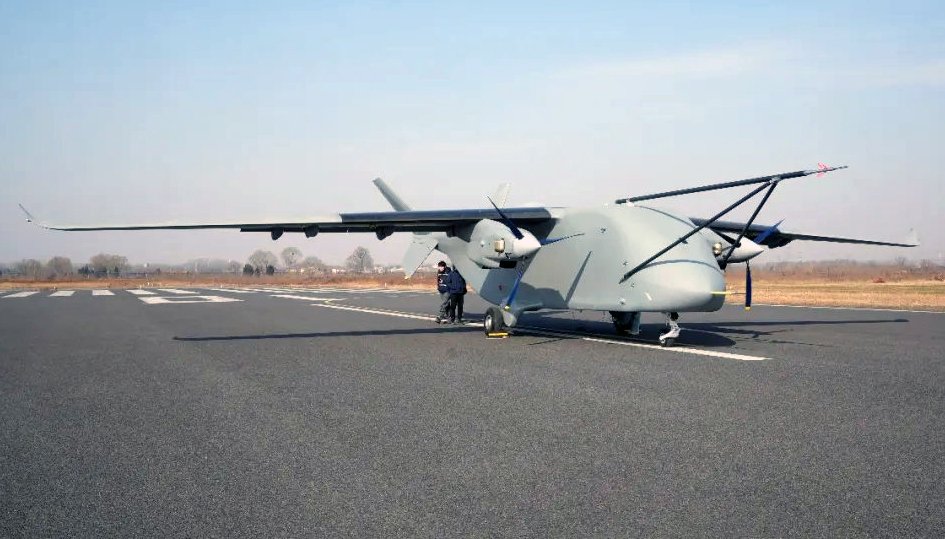
Notably, China has made significant advancements in developing logistic drone capabilities, with reported successful flight tests of massive heavy-lift uncrewed aircraft, including a 7-ton cargo plane that’s currently the world’s largest uncrewed freighter to take flight. Among them is China’s CH-YH1000, a medium-altitude cargo drone developed by the China Academy of Aerospace Aerodynamics that boasts, like SkyCourier UX, a hatch in lieu of a cockpit for ease of flat-pallet loading up to a weight of 1.2 tons. These are just some of an increasing number of similar systems being developed in China that aim to take the crew out of lower-end logistical missions over short, medium and long distances.
China’s big CY-8 uncrewed logistics aircraft undergoing testing. (Chinese Internet)
Though Textron and Merlin have yet to build a SkyCourier UX prototype, Merlin CEO Matt George emphasized that the company had chosen to partner with Textron because they could start delivering aircraft fast.
“You’ll see over the course of the show a lot of concept aircraft. You’ll see a lot of renders. You’ll see a lot of people who have big empty factories all around the country,” he said. “But I also want to be very clear about the fact that none of this matters without production … There’s 14,000 Americans working in Wichita, Kansas, on a production line where these aircraft, at least in the crewed configuration, are coming off the production line. So when we talk about capability, we’re talking about that capability and bringing that capability to bear soon, rather than in the future.”
Next in the development process, executives say, will be an optionally piloted version of SkyCourier that will allow users to develop comfort with the platform and open the door to further iteration.
The Textron/Merlin team is also leaving its options open in terms of which U.S. military customer might find its platform most useful.
“I hope [the Army and Air Force] fight over it,” Gibbs said.
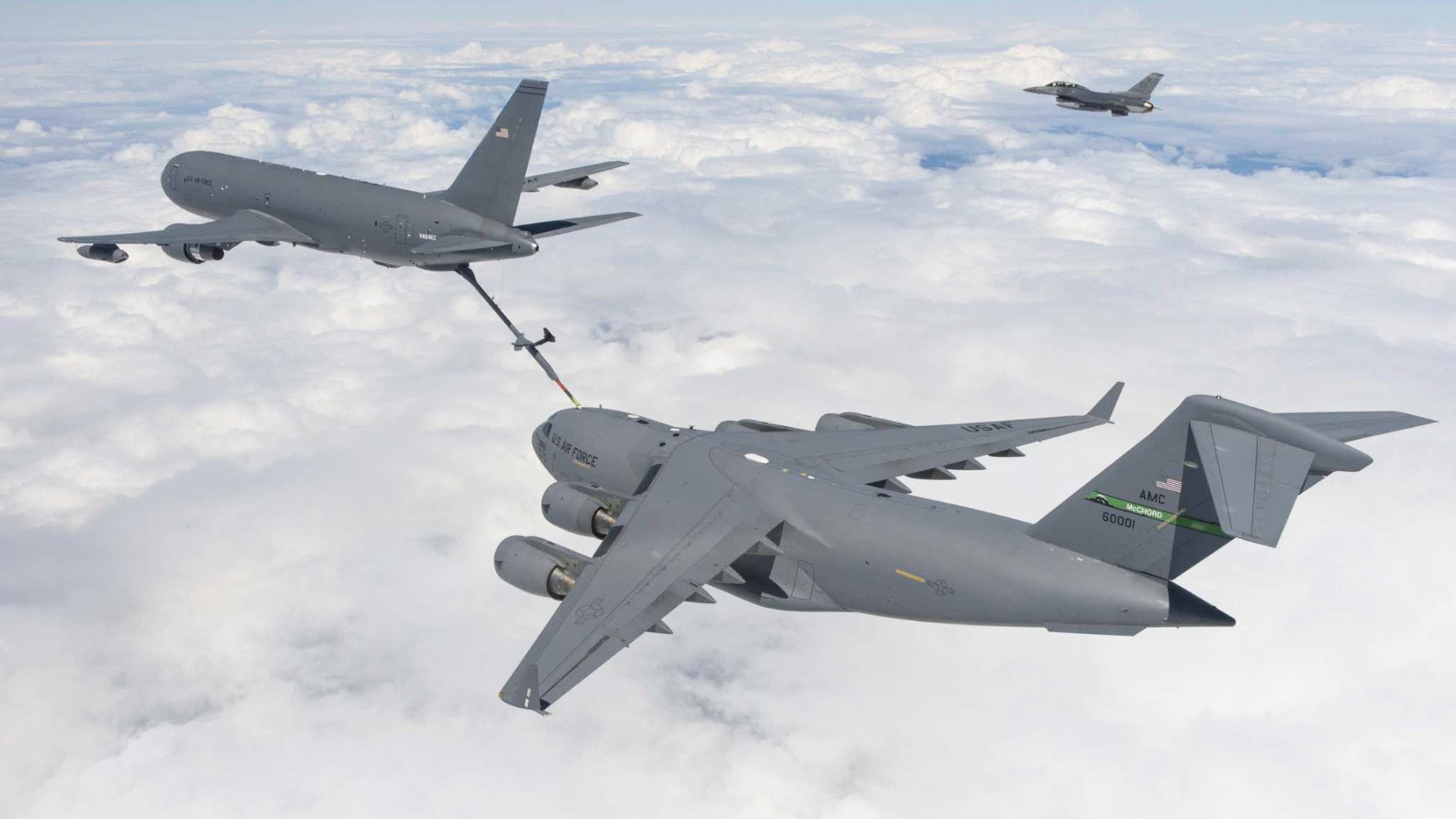
The U.S. Air Force has been taking a new look at the feasibility of restarting production of the C-17 Globemaster III cargo plane as part of its still-evolving next-generation airlift plans. The service also continues to explore a wide range of next-generation aerial refueling concepts, including new stealthy and/or uncrewed tankers, but a firm vision for the way forward there has yet to emerge.
Air Force Lt. Gen. Daniel Tulley, head of Air Mobility Command (AMC), shared new details about future airlift and aerial refueling efforts, with TWZ and other outlets at a roundtable at the Air & Space Forces Association’s (AFA) 2026 Air, Space & Cyber Conference.
On the airlift side, the Air Force’s stated plan to date is to replace both the C-17A and C-5M Galaxy with a single Next-Generation Airlift (NGAL) platform, starting in the mid-2040s. Separately, the service is pursuing what could be a family of future aerial refueling capabilities under what is now called the Advanced Tanker Systems (ATS) program. Very broadly speaking, ATS presents a path toward what might come after the retirement of the aging KC-135 tanker fleet, though those aircraft are still expected to keep flying for years to come. The Air Force is also moving to further expand its fleet of newer KC-46A tankers in the interim, but persistent technical and other issues with that design continue to present hurdles.
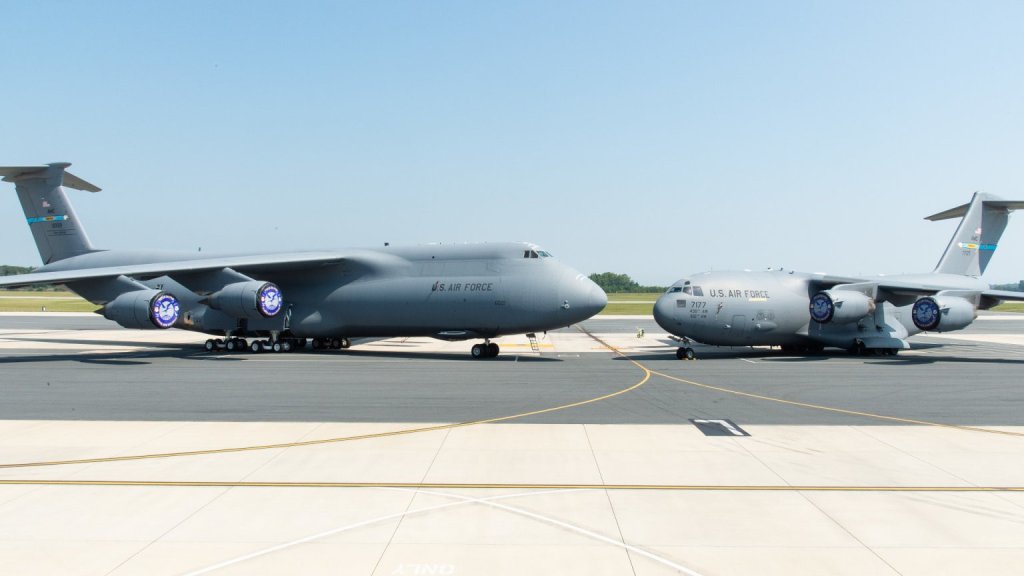
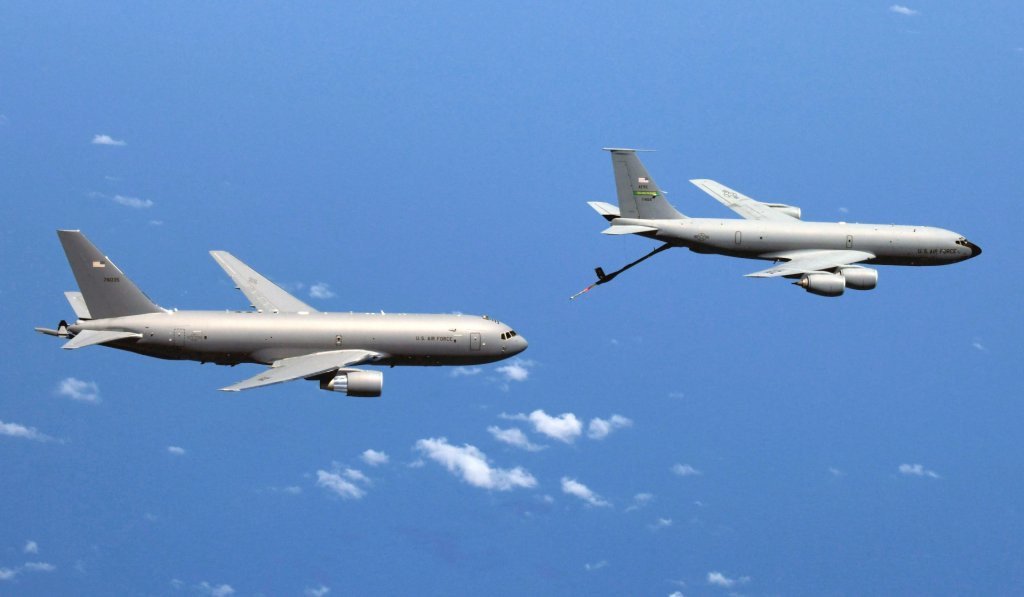
A US Air Force C-5, at left, together with one of the sevice’s C-17s, at right. USAFA KC-135, at right, prepares to link with a KC-46, at left, during a test. USAF
At the roundtable today, Lt. Gen. Tulley was asked explicitly about restarting C-17 production. The manufacturer of those aircraft, Boeing, shuttered that line in 2015. The company also just marked the 35th anniversary of the design’s first flight yesterday.
“Heck yeah, but with a caveat, right?” Tulley said in response. “So we were just asking this question over the course of last week, and it’s in the context of next-generation airlift. So we are about to embark on the Analysis of Alternatives to replace the C-17 and replace the C-5. All options are on the table.”
“There’s always the option to service life extend the C-17, but the [production restart] question came up,” he continued. “I’ve heard this my entire career. Once we terminate an assembly line, can we ever bring it back? Does somebody store all the machinery and the dies and whatnot, and can you bring that out? So we’re asking that question.”
“But then whatever that answer is from the vendors, what will be the price tag associated with that?” he added. “You have to ask yourself, okay, is rebuilding a C-17 even if you make improvements – and there’s a loose analogy with the C-130J, [a] much more modern, capable variant of the C-130E [author’s note: the C-130J evolved more directly from the C-130H variant] I first learned to fly – if you do that with the C-17, is that the best move? Or are there new technologies that we can incorporate into it so that it can defend itself, so that it’s connected, it’s networked, it does all the things that maybe the current C-17 doesn’t do?”
“We’re looking into it as part of the Analysis of Alternatives. I’m hopeful that we’ll get to answer that question.”
In June, the House Armed Services Committee also directed the U.S. Air Force to prepare a formal briefing on the matter of new C-17 production in a report accompanying a draft of the annual defense policy bill, or National Defense Authorization Act (NDAA), for Fiscal Year 2027.
The RAND Corporation did conduct a detailed, independent analysis more than a decade ago that assessed the costs and complexities that could come from Boeing building more C-17As, as well as other variants and derivatives of the design. RAND’s conclusion was that any of the courses of action would require billions of dollars of new investment and entail risks, as you can read more about in more detail here.
Foreign participation in a new C-17 production run could help at least defray costs. Australia, Canada, India, Kuwait, Qatar, the United Arab Emirates, and the United Kingdom all currently fly Globemaster IIIs. The Strategic Airlift Capability (SAC) initiative, a multinational arrangement with several European members, as well as the United States, also operates three of these aircraft.
Boeing told TWZ directly in June that unnamed C-17 operators had been reaching out about the prospect of restarting the production line, and that the company was “encouraged” by those discussions.
As Lt. Gen. Tulley stressed, there are significant questions about whether buying new-production C-17s, even with substantial improvements, is not only feasible, but a good use of resources. The Air Force’s Globemaster III fleet today continues to prove itself to be critical to the U.S. military’s ability to project power globally, and is in very high demand right now, especially amid the ongoing conflict with Iran.
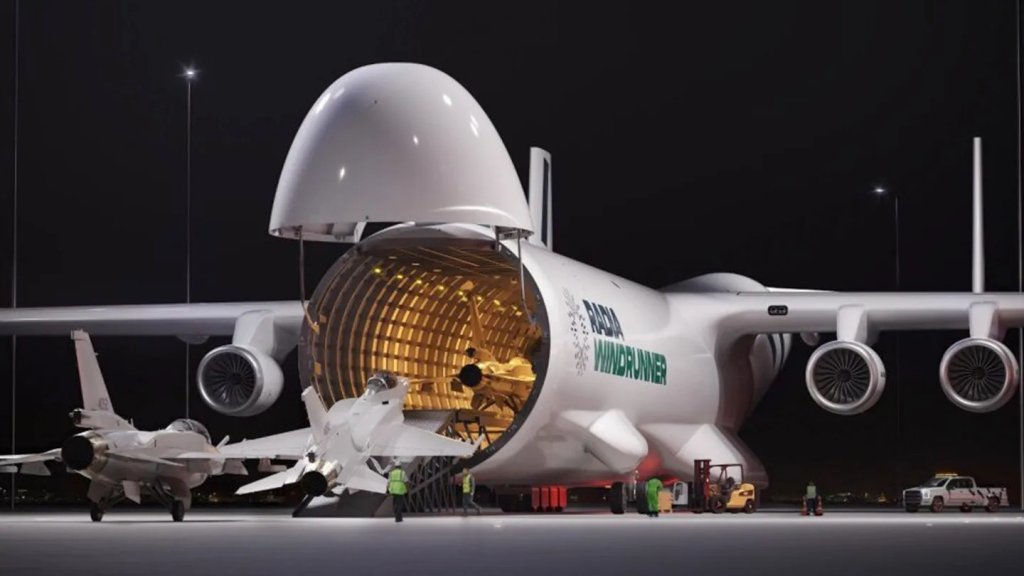
The Air Force’s desire to replace both the C-17 and C-5, which are very different aircraft in form and function, could still easily lead the service down a different route. Boeing is not the only one looking at future NGAL opportunities. Another company, Radia, has been very actively pitching a clean-sheet design that is physically bigger than either the C-17 and the C-5, and that is geared toward greater operational flexibility, at the Air Force. Radia is targeting a first flight of its aircraft, called Windrunner, by the end of the decade, but it is still in a very aspirational stage at present.
A rendering of Radia’s Windrunner design. Radia
Many questions also still remain about how the Air Force will ultimately proceed on the next-generation aerial refueling front.
“So thinking beyond the current KC-46 buy and the program extension, whatever that next tanker looks like, our Advanced Tanker System, it’s got to be connected. It’s got to be able to defend itself,” Lt. Gen. Tulley said at the roundtable. “But it begs the question: does it need to be manned? Could it be optionally manned? Could it be autonomous? Or is there a family of solutions maybe that would answer that question? So I do not believe that it has to be manned.”
“I think you’re seeing that with the MQ-25 and the Navy’s work, but then, how do we, the U.S. Air Force, bring that to bear in scope, scale, and range?” Tulley continued. “An optionally manned or an unmanned tanker, at range, the ranges we need to operate at, it’s a very large aircraft. And we’re not yet to where we’re employing fully autonomous large aircraft, but the technology, I would say, is there and rapidly getting there if it’s not.”
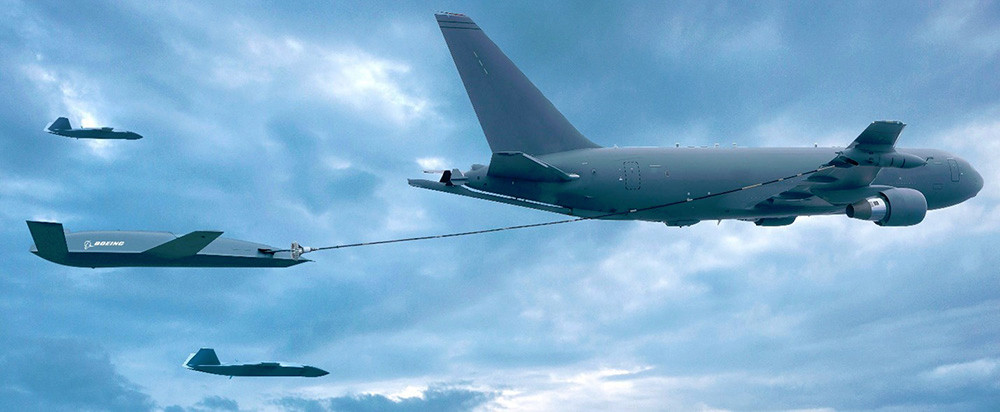
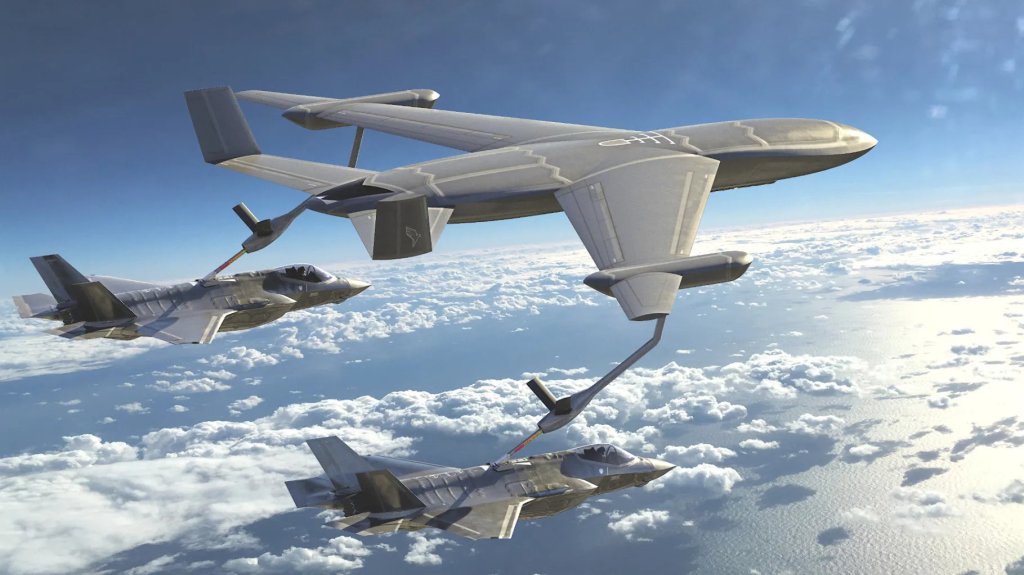
A rendering of a larger, land-based derivative of the MQ-25, depicted refueling from a KC-46 tanker. BoeingOne of the advanced tanker concepts Lockheed Martin’s Skunk Works has shared publicly in recent years. Lockheed Martin Skunk Works
“We will be going after how to make the tanker survive,” William Bailey, the Air Force official currently performing the duties of the Assistant Secretary of the Air Force for Acquisition, Technology and Logistics, had also told TWZ and other outlets at a separate roundtable at the Air, Space & Cyber Conference yesterday. Bailey was responding to a direct question about whether the service was moving away from the idea of a stealthy tanker as part of the ATS plan.
“So, lots of work around what do we do in the future for our tankers, and we spent a pretty dedicated effort to go through and look at what do we think those design solutions could look like,” Bailey also said. “We looked internally. We went out to industry, had those guys come back with their thoughts on how to provide a more survivable aircraft.”
“The stuff that was coming in for me might have been an incremental improvement, but [it was] not clear that that represented the next step, the next phase,” he added. “What you’ll see is we’ll take our efforts, and we’ll look at, hey, if the real question is tanker access, then let’s not constrain ourselves to just the aircraft itself and trying to make a stealthy tanker. We need a tanker to have access, so we’ll talk about all those systems that it would take to protect that tanker.”
Bailey said the question of operational “access” applied to next-generation discussions, as well.
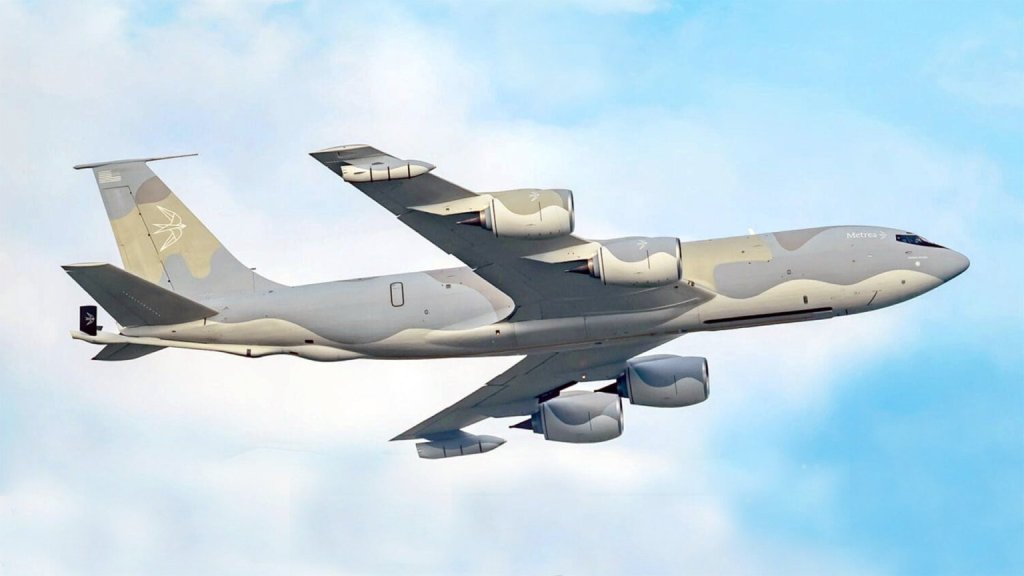
This ex-French Air Force KC-135FR tanker, now operated by private contractor Metrea, is an example of the outside aerial refueling capacity the U.S. military has been increasingly leveraging in recent years. Metrea
Greater connectivity “can be a game changer, and it has been a game changer in Operation Epic Fury [against Iran],” Lt. Gen. Tulley said at today’s roundtable. “The ability for air crews to communicate, to coordinate tanker orbits and rendezvous, to pass threat information, to save lives and save aircraft has been everything we expected it to be and more.”
“We have MAF NEXUS that we’re pursuing. The goal is to have this on all mobility aircraft, whether they’re future-built and it’s incorporated, or it’s an add-on capability to existing aircraft,” he continued. “It brings edge compute, the ability to then employ AI [artificial intelligence] and much more computing core power forward on the aircraft, and it does network with the rest of the joint force and the Air Force’s battle management system.”
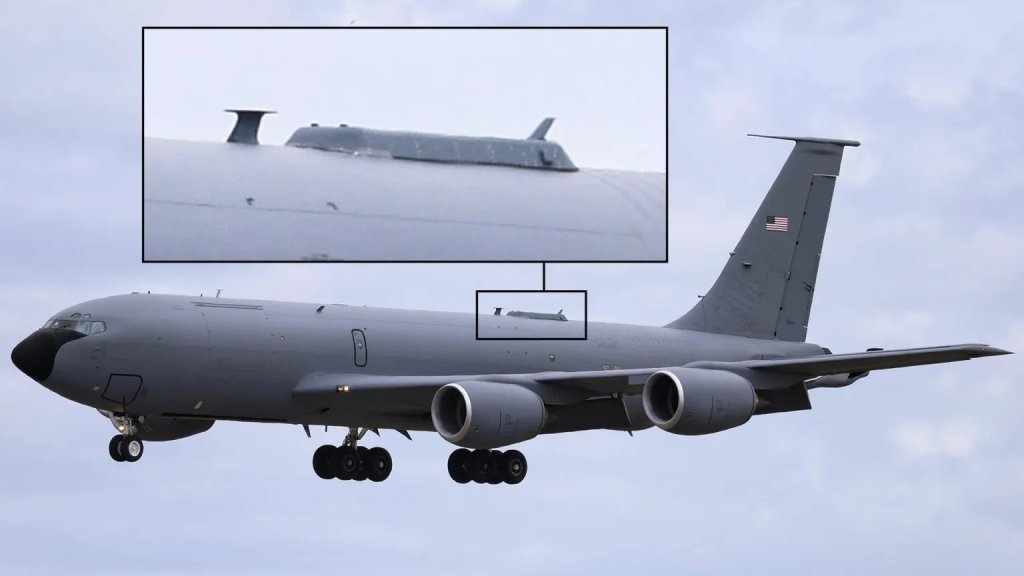
A picture of a US Air Force KC-135 tanker spotted earlier this year with a new large satellite communications antenna (further highlighted in the inset), underscoring work underway now to improve the network connectivity of those aircraft. Alessandro Ledda
When it comes to new options for protecting existing tankers, “nothing’s off the table,” the AMC boss added. “Whether it’s [in the] electromagnetic spectrum, whether it’s kinetic self-defense, a layered approach, we’re looking at everything to come up with what might be the best system. But it’s got to be a system that we can afford, and it’s got to be one that we can put on all the aircraft we have and the ones we’re about to build.”
The Air Force is otherwise still clearly continuing to shape its future airlift and aerial fueling visions. As part of that work, the service is now at least considering the possibility of rebooting C-17 production.

 Login