The brief statement from the office of Attorney General Lynn Fitch said the officer was “justified” in his “use of force” when he shot the baby, Kohen Wiley, in a Walmart parking lot on June 14. The statement did not mention Kohen by name or identify the officer involved in the shooting.
Local media outlet Action News 5 identified the officer as Hunter Foster based on a records request of officer-involved shootings.
The shooting occurred in Senatobia, a city of about 8,000 people in the northern part of the state, about 40 miles south of Memphis, after police responded to a shoplifting call. According to the statement initially released by the Mississippi Bureau of Investigation, two adults — later identified as Kohen’s mother and a family friend — and a “juvenile child,” referring to Kohen, fled the store and then drove toward officers at the scene, at which point one of the officers fired his gun.
But an independent autopsy released by the family’s legal team and reviewed by MS NOW found that the baby was shot through the side of his body, throwing into question the authorities’ claim that the car was driving toward police. At a press conference this summer, the family’s legal team displayed a photo of the passenger-side window of the vehicle almost entirely blown out.
Kohen’s mother, Vellesiya Wiley, said at a press conference earlier this year that the officer fired three to four shots — even after she held Kohen up to show them there was a baby in the car — and that one hit her son’s ribcage as she held him in the passenger seat. MS NOW could not reach Wiley for comment on Monday.
Ben Crump, the civil rights attorney who represents the family, slammed the news from Fitch’s office on Monday, asking, “How can anyone accept that conclusion when Kohen’s family and the public still have not been allowed to see the body-camera footage?”
“If the footage supports the state’s decision, release it,” Crump continued. “We will not stop fighting until this family gets the truth.”
Mississippi Today and The New York Times previously reported that Foster allegedly made racist remarks toward two co-workers, one of whom is Black and the other of whom is white and has a child with a Black partner.
When MS NOW reached out to Martin Zummach, a lawyer the Times identified as representing Foster, he would not answer MS NOW’s questions about the case and hung up the phone.
Spokespeople for the attorney general’s office, the Senatobia Police Department and Senatobia Mayor Greg Graves did not respond to MS NOW’s requests for comment. Graves acknowledged the community’s “tremendous pain” in a video statement a few days after the killing.
At his funeral, Kohen was remembered as “goofy,” a fan of the cartoon character Bluey and a beloved baby with a family excited for his future, NBC News reported.
A Lindt afastou o presidente executivo após rever em baixa as previsões de vendas para 2026, num contexto de fraco desempenho na Europa. A fabricante suíça de chocolates junta-se a empresas como PayPal, Nestlé, Starbucks e Danone, que também substituíram os seus líderes perante resultados abaixo das expectativas e pressão dos investidores
On Monday, Mayor Zohran Mamdani announced that 10,000 more seats under his signature free childcare for two-year-olds program will be covered in fall 2027. Under the expansion, all of the Bronx and Staten Island's school districts will be eligible.
"For far too many New York City families, the joy of welcoming a child comes with a terrifying set of questions: How will I afford child care? Will I need to give up my job? Will I be forced to leave the city I love?" Mamdani said in a statement. "Today, for 10,000 more families, we have an answer."
Those affordability questions loom large for urban parents around the country. Cities including New York have seen their under-five population fall since the onset of the pandemic.
Between April 2020 and July 2024, the population of children under five fell by 18% in New York City, per an analysis from the Economic Innovation Group. That population collapsed by 15% in San Francisco, 15% in Chicago's Cook County, and 14% in Los Angeles County over the same period. Lowering childcare costs, a key plank of Mamdani's platform, was one area where even CEOs agreed with the socialist.
In New York, families with kids under six were more than twice as likely to leave the city as families without younger children, according to a Fiscal Policy Institute analysis.
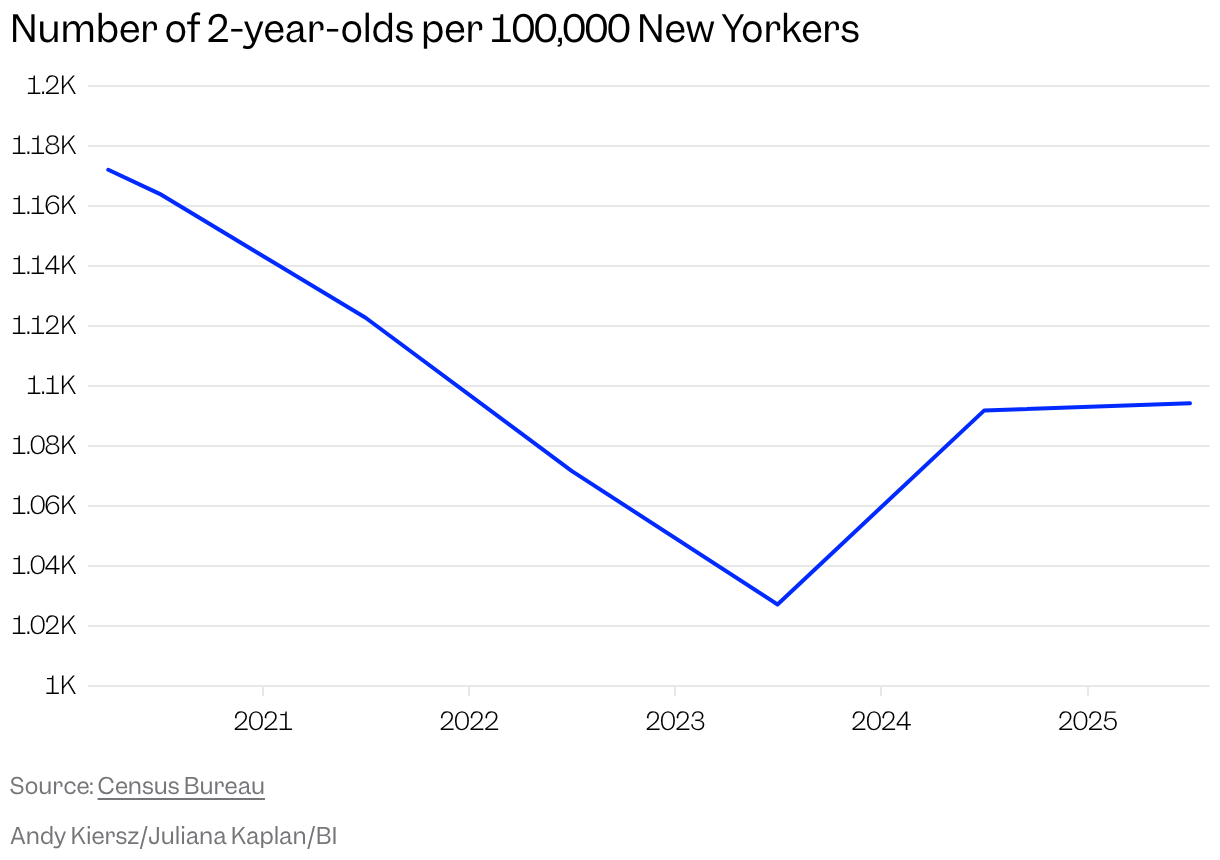
The share of two-year-olds in New York City's population fell as families fled the city during the pandemic, before rebounding somewhat in 2024 and 2025.
For parents still in the city, childcare costs for toddlers in care centers reached $23,400 annually in 2024, per an analysis from the comptroller's office. That means a New York family would have to earn at least $334,000 to pay only 7% of their family income for childcare, the federal definition of affordable.
The new 2-K program, which has reportedly faced implementation problems including funding and payment delays, initially targeted a handful of districts based on economic need and childcare demand.
Even as providers wrangle with funding issues and the program's rollout, children across the city recently started their first days in 2-K. At a Friends of Crown Heights center in Brooklyn, mother Jessica Arroyo said it meant "everything" to have her daughter accepted into 2-K.
"I can work in peace," Arroyo said. "She can learn, make new friends."
Are you a New Yorker or childcare provider involved with 2-K? Share your story with this reporter at jkaplan@businessinsider.com.
França atravessa um período de crescente incerteza. Os problemas económicos acumulam-se e encontrar soluções torna-se cada vez mais difícil. Mas até que ponto pode esta situação comprometer a estabilidade de uma das maiores economias europeias? Saiba mais, neste episódio do Economia dia a dia, podcast diário do Expresso
Mate Rimac fundou uma fabricante de desportivos elétricos, mas exclui um Bugatti 100% elétrico dos planos para a próxima década. Para o CEO, a mecânica, o som do motor e o trabalho artesanal fazem parte do que os clientes procuram num carro que custa milhões de euros
As the Iran War continues, gas prices remain high — a real strain for consumers.
The conflict has kept diesel, crude oil, and gas prices high; inflation is eating up pay hikes.
As America heads into midterms, it's a hard affordability position for President Donald Trump.
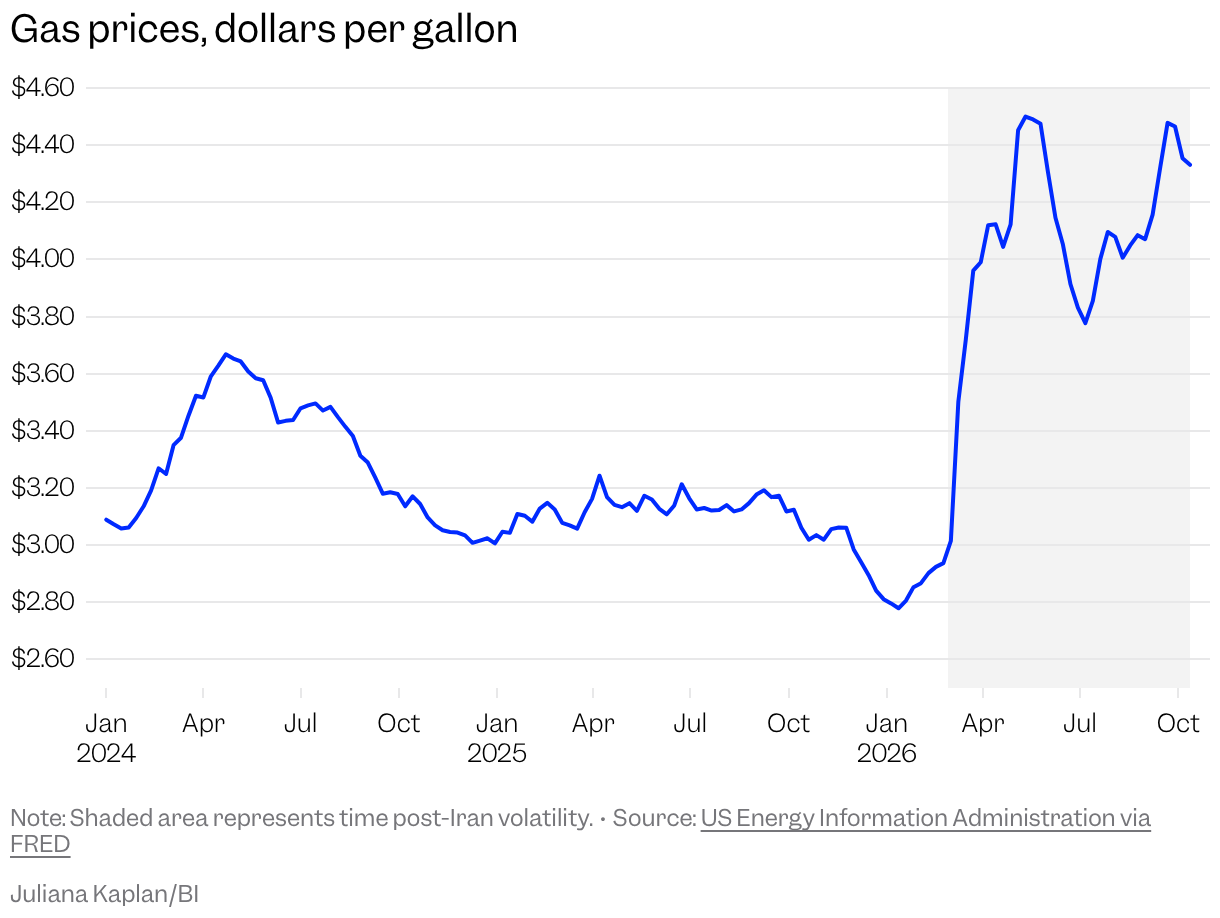
It's expensive out there: Gas prices have been stuck at over $4 a gallon for more days this year than any other. The war in Iran shows no signs of cooling off. Inflation is swallowing any raises you might have gotten at work.
It's a recipe for a challenging midterm cycle for President Donald Trump, who faces an affordability crisis at home that's not going away — and a far-away war that's only making costs go up.
The volatility surrounding the contested Strait of Hormuz, a key oil and gas transit waterway, has hit American consumers hard.
Since the Iran war first kicked off in February and the Strait was subsequently closed, gas and oil prices have skyrocketed. Diesel prices have hit record-breaking highs in recent weeks. That paints a dreary picture for Americans struggling with high costs, who likely won't feel any relief at the pump in the near future — especially as more potential military action looms.
Trump has highlighted the broader goals of the war and argued that the increase in gas prices would be transient. In an October 8 Truth Social post, he wrote, "a temporary increase in the price of Gasoline is a small price to pay for Iran not having a Nuclear Weapon."
While the US military has not carried out airstrikes against Iran directly in several months, it has kept a significant force presence in the Middle East, including more than a dozen warships, dozens of fighter jets, and thousands of sailors and Marines.
US forces in the region are maintaining a naval blockade against Iran, and since July, they have disabled four commercial ships that the Pentagon said were sailing in violation.
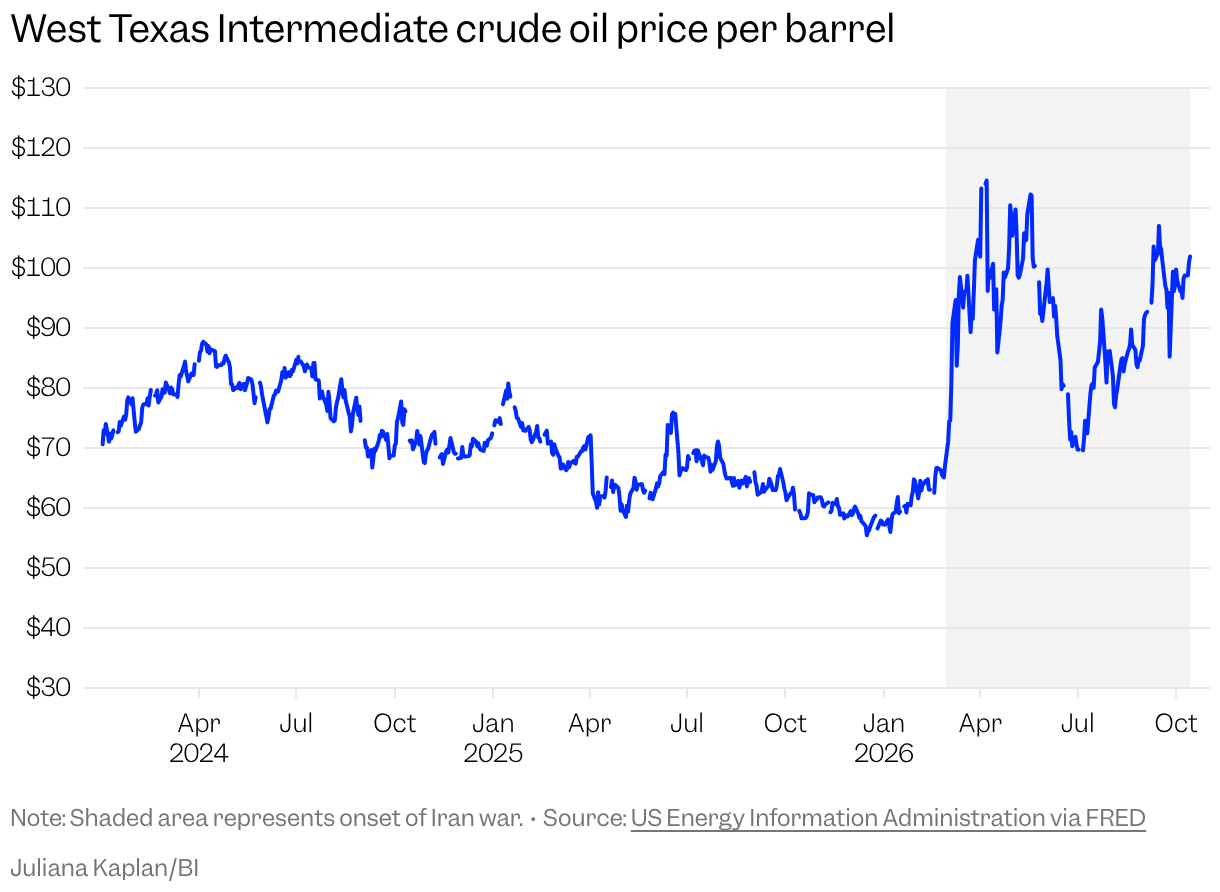
After the start of the war in February, crude oil prices soared and remain significantly higher than when Trump's second term began.
Tanker traffic through the Strait of Hormuz nearly ground to a halt early in the Iran war, severely disrupting a waterway that normally carries about a fifth of the world's oil supply. Shipments have since recovered substantially but remain below prewar levels.
The Trump administration said it aims to alleviate issues related to oil. "The President wants to see prices at the pump fall and continues to take historic measures to alleviate temporary disruptions as oil flowing through the Strait of Hormuz approaches pre-conflict levels," White House spokeswoman Taylor Rogers said.
Vessels carrying oil and other products have continued to take fire from both sides, putting more pressure on commerce traveling through the area. US forces have carried out additional strikes on Iranian-linked targets. The Pentagon said they have destroyed 10 tankers tied to the Islamic Revolutionary Guard Corps, or IRGC, since July.
Meanwhile, several merchant ships have come under attack in and around the Strait of Hormuz this month, according to the Royal Navy-affiliated United Kingdom Maritime Trade Operations Center. US Central Command, which oversees American military operations in the Middle East, has attributed some of these strikes to Iran.
The ripples of volatility in oil prices are showing up at the pump. Long gone are the days of gas stations touting below-$3 prices; prices are still hovering in the mid-$4 range. High gas prices are even tamping down spending among higher-income consumers, and soaring costs have led to a rise in "hypermilers" — drivers who try to optimize and gamify their habits to get the best value per gallon.
Diesel prices in the US have spiked even more, up to around $6.18 per gallon, an over $2.50 increase over the year, per the Energy Information Administration. In California, diesel is hovering over $8 a gallon.
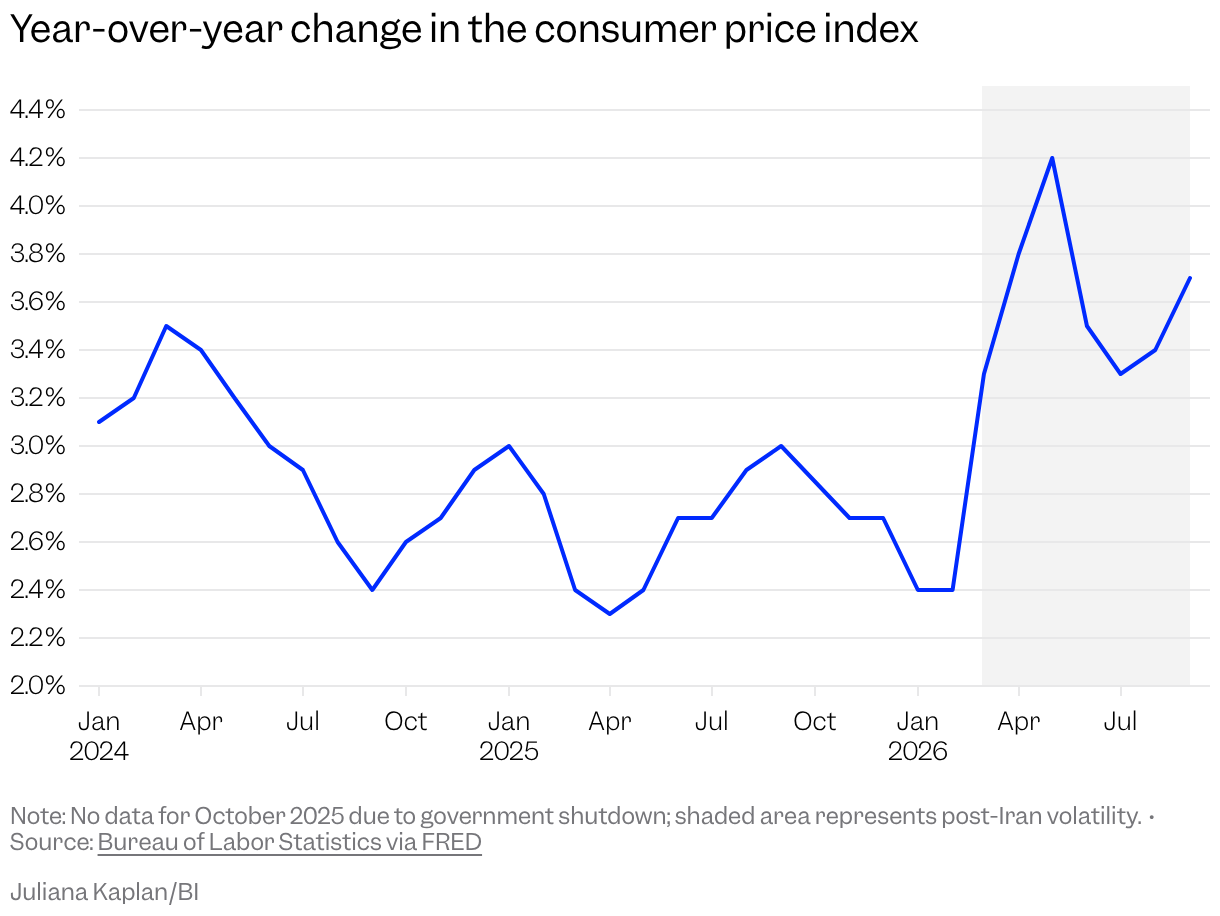
Those fuel and energy strains are pushing up costs across the economy. Inflation as tracked by the consumer price index increased to 3.7% year-over-year in September — higher than economists expected. That was driven in large part by soaring gas and energy prices, with energy rising by 20.4% year-over-year and gas by 34.2% in the same period.
Higher inflation has put pressure on the Fed and bond markets. In September, the central bank raised rates for the first time in three years to try to combat rising prices, with one more hike potentially coming by year's end. The 10-year Treasury yield, which influences borrowing costs for mortgages, auto loans, and credit cards, has surged since the war began, from below 4% at the end of February to a high of 5.31% this month. The 30-year mortgage has risen nearly in lockstep, going from just under 6% to 7.5% during the eight-month conflict.
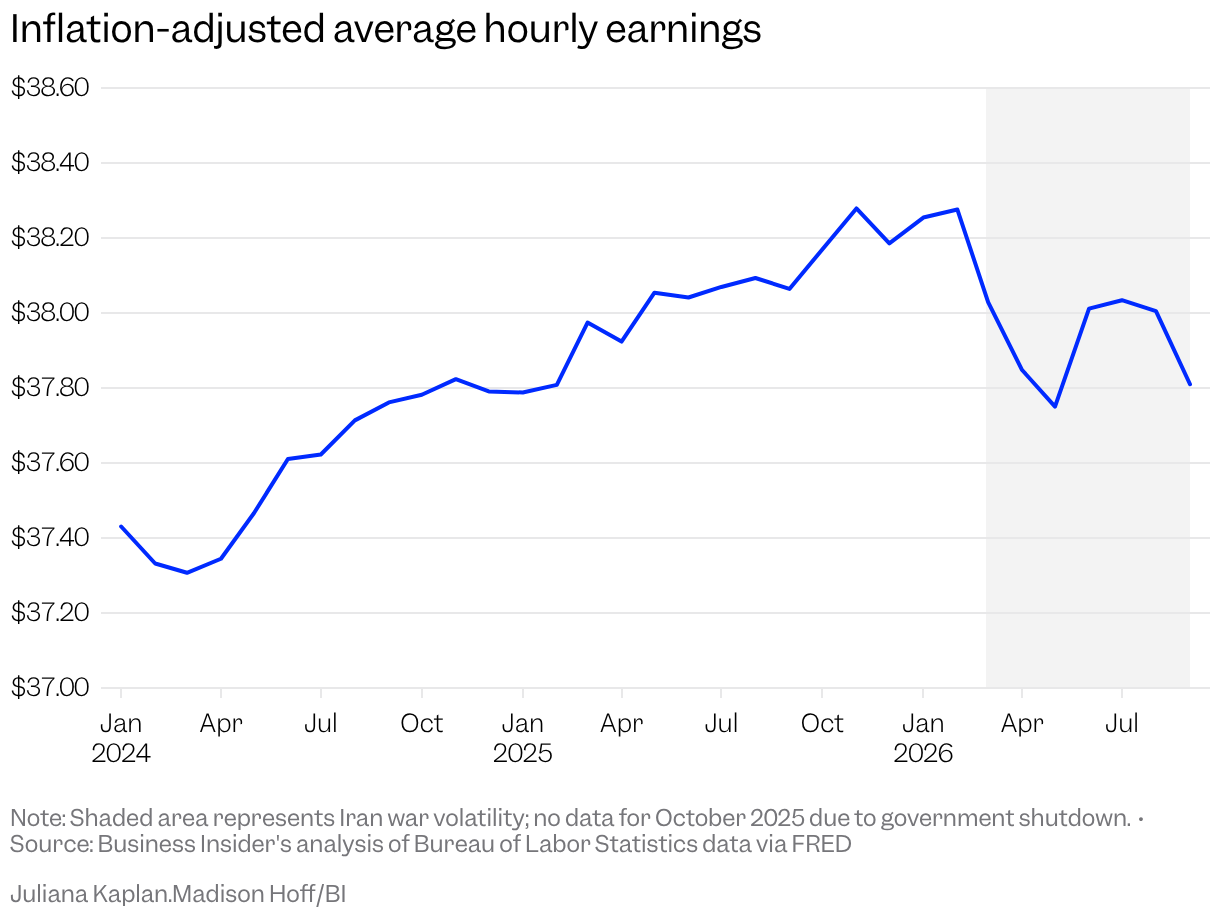
For everyday Americans, all of these international strains amount to what is, essentially, a pay cut. Wage growth remains slow and steady, but, over the past few months, rising prices have outpaced pay increases. Inflation-adjusted wages have slumped since the start of the war, and have given up nearly all their gains since the start of Trump's second term.
When asked for comment, the White House highlighted that by some measures, earnings are still outpacing inflation. "Under President Trump, private sector workers have seen their wages continue to outpace inflation, with average annual earnings growing by more than $600," said White House spokesperson Matthew Middleton.
And, with midterm season in full swing, affordability is on the ballot for many voters. The current economic situation shows no immediate signs of changing — another blow for Trump, who's been on a quest to bring down gas prices.
There are growing signs that the US could be preparing for fresh military action against Iran. Another aircraft carrier strike group is sailing across the Pacific and is expected to enter the Middle East.
The Trump administration is also facing a resurgence in attacks from the Houthis, a rebel group in Yemen. In recent weeks, the Iran-backed rebels have seized key territory along the Red Sea, allowing them to threaten the Bab al-Mandeb Strait, another maritime chokepoint like Hormuz, and have ramped up missile strikes against Saudi Arabia.
The Houthis previously tormented Red Sea shipping, leading the Trump administration to launch a major bombing campaign last year that ended in a ceasefire. The rebels have since rearmed.
Any other disruptions there might be bad news for consumers, potentially bringing more price spikes across the many goods shipped through that chokepoint.
Escolher entre várias opções nem sempre se torna mais simples quando há mais informação disponível. Neste episódio do Minuto Consumidor, olhamos para o que mais pesa quando é preciso tomar uma decisão, de que forma o medo de errar pode atrasar uma escolha e como algumas técnicas de venda procuram acelerar esse processo
Escolher entre várias opções nem sempre se torna mais simples quando há mais informação disponível. Neste episódio do Minuto Consumidor, olhamos para o que mais pesa quando é preciso tomar uma decisão, de que forma o medo de errar pode atrasar uma escolha e como algumas técnicas de venda procuram acelerar esse processo
A privatização da TAP abre um novo capítulo na história da companhia e volta a pôr em discussão o papel do Estado e o dinheiro dos contribuintes. O que pode Portugal ganhar com este negócio? A análise deste tema foi feita pela jornalista da secção de Economia do Expresso Anabela Campos. O que nos contam os últimos dados do Eurostat? Saiba mais, neste episódio do Economia dia a dia, podcast diário do Expresso
An Immigration and Customs Enforcement agent has been placed on leave after striking a man with his vehicle in Houston on Saturday, a Department of Homeland Security spokesperson confirmed to MS NOW.
The unnamed agent struck 48-year-old Miguel Parra, an undocumented immigrant, shortly after 7 a.m. local time on Saturday, according to the Harris County Sheriff’s Office. Parra was hospitalized with injuries following the incident, Maj. Anthony McConnell, who leads the Special Investigations Bureau at the sheriff’s office, said at a Saturday press conference.
The DHS spokesperson told MS NOW on Friday that it is “standard practice” for an agent to be placed on leave while an internal investigation is pending, adding that it is “not any indication of wrongdoing.” The spokesperson did not immediately respond to follow-up questions.
In a statement provided to the outlet over the weekend, an ICE spokesperson said immigration agents were not targeting Parra, but that he fled on foot after a traffic stop. Surveillance footage obtained by NBC affiliate KPRC of Houston appears to show Parra and another passenger get out of a vehicle and run before a vehicle strikes Parra. The second person who fled remains unaccounted for, according to the sheriff’s office.
The agent’s placement on leave is the latest controversy to roil ICE as the agency faces scrutiny over seceral recent incidents and high-profile killings. New York City Mayor Zohran Mamdani demanded ICE end its operations in the city after an agent shot and wounded a Dominican man while attempting to arrest him earlier this month, while his 5-year-old child was in the backseat. On Thursday, California Attorney General Rob Bonta filed a lawsuit alleging ICE agents were unconstitutionally taking people into custody near state courthouses.
Speaking about the incident in Houston, Harris County District Attorney Sean Teare told NBC News that he believes the ICE agent intentionally struck and ran over Parra, an allegation that, if substantiated, could lead to aggravated assault charges. But the DHS spokesperson rejected the allegation that the agent intentionally struck Parra, calling it “RECKLESS and FALSE” in a statement to MS NOW.
Teare, a Democrat, also told NBC News that the federal government was not cooperating with an independent investigation being conducted by his office and the Harris County Sheriff’s Office. A spokesperson for the Harris County DA’s Office referred MS NOW to Teare’s public statements.
McConnell, from the Harris County Sheriff’s Office, initially said Parra’s leg was broken in the incident. But Cesar Espinosa, the co-founder of FIEL, a local immigration advocacy organization, said at a Wednesday press conference that Parra’s leg was not broken. Espinosa said, however, that Parra had sustained “multiple fractures” and was “very, very injured.”
As of Wednesday, Parra was still hospitalized, according to Espinosa.
Parra’s lawyer did not respond to questions from MS NOW on Friday.
This story has been updated with additional information provided by the sheriff’s office.
A preparação da chegada da alta velocidade a Lisboa prevê a ampliação da Gare do Oriente, a construção de uma nova estação de comboios em Chelas/Olaias e a modernização de vários troços ferroviários entre Lisboa e Loures. O projeto da Infraestruturas de Portugal, em consulta pública até 25 de novembro, inclui obras com duração prevista de até 3 anos e meio, alterações na circulação ferroviária e intervenções que vão implicar demolições e a ocupação de novos terrenos
A inflação voltou a subir na Europa, numa altura em que a guerra no Médio Oriente continua a pressionar os preços da energia. O que nos contam os últimos dados do Eurostat? Saiba mais, neste episódio do Economia dia a dia, podcast diário do Expresso
A Pew Research Center survey found 71% of middle-income earners have cut back on spending on extras, such as eating out.
andresr/Getty Images
A Pew Research survey found only 47% of middle-income earners could save money in the past year.
Lower-income earners are also having a hard time saving and affording necessities.
Inflation moving in the wrong direction doesn't help the affordability situation.
America's middle earners are feeling the squeeze.
A new analysis from the Pew Research Center examines how Americans' finances are faring, an especially salient topic in a midterm season where affordability is very much on the ballot.
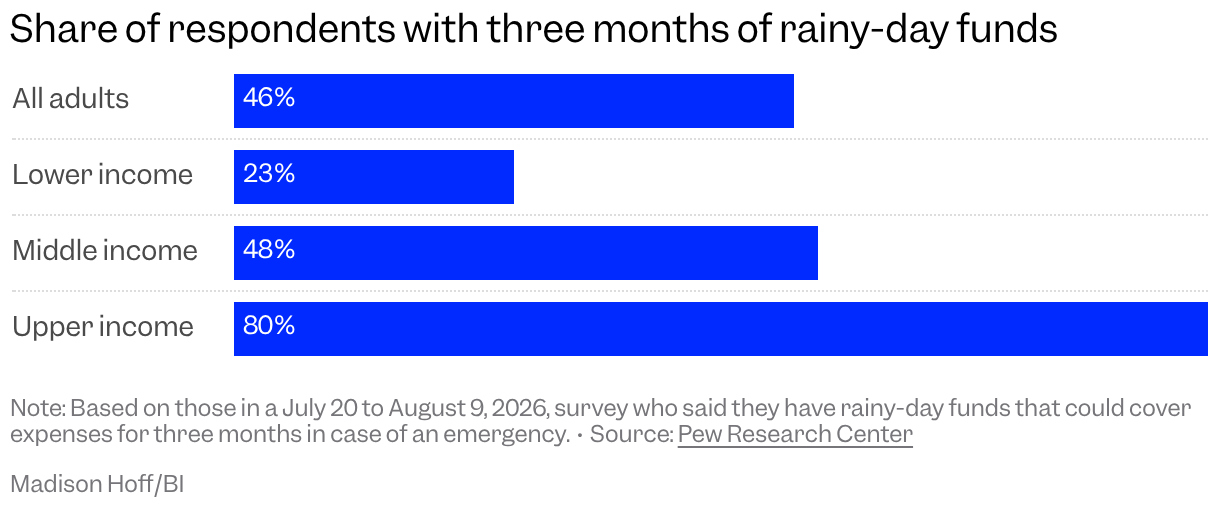
America's middle earners — those who make between $50,700 and $152,000 after adjusting for their family sizes and the cost of living in their areas — increasingly don't have enough saved for an emergency. Just over half of middle-income Americans say they don't have rainy-day funds that would cover expenses for three months in the event of an emergency.
Meanwhile, 47% of middle-income earners — and a measly 24% of lower-income earners — reported being able to save money in the past year. Across all income tiers, the majority of respondents said they had cut back spending on extras like eating out or streaming services.
Those dwindling emergency funds and sacrifices might be due to rising costs, which often take a particularly large bite out of lower-earners' wallets.
It could be getting worse; inflation is moving in the wrong direction. In September, the consumer price index inflation rate rose from 3.4% to 3.7%, just above the 3.6% forecast. Plus, inflation-adjusted wages have been falling for six months.
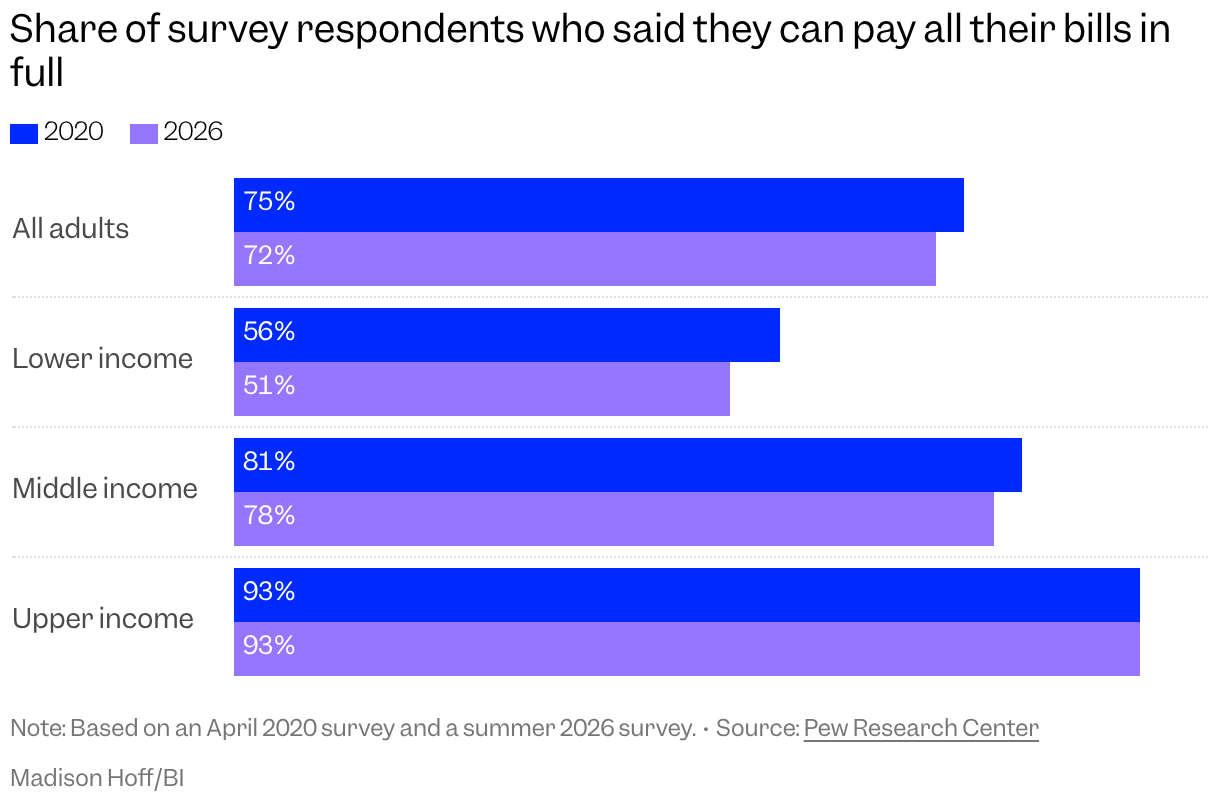
Today's economy is still more difficult for those at the bottom of the earnings ladder. Fifty-one percent of lower-income respondents said they can pay all of their bills in full in the 2026 survey, down from 56% in 2020. For middle-income respondents, the share dropped from 81% in 2020 to 78% in 2026, while the share of upper-income respondents held steady at 93%.
Pew also found 71% of lower-income US adults struggled with at least one kind of basic necessity, like affording medical care or paying their rent or mortgage, in the past year, compared with 39% of middle-income and 13% of upper-income Americans.
But the latest survey marks another sign that middle-income earners are increasingly aligning with their lower-earning peers, a dour sign for the health of the middle class. A separate report from the Urban Institute found that, even as lower-income renters were the most likely to report issues paying the rent, middle-income renters were increasingly likely to report struggling to pay.
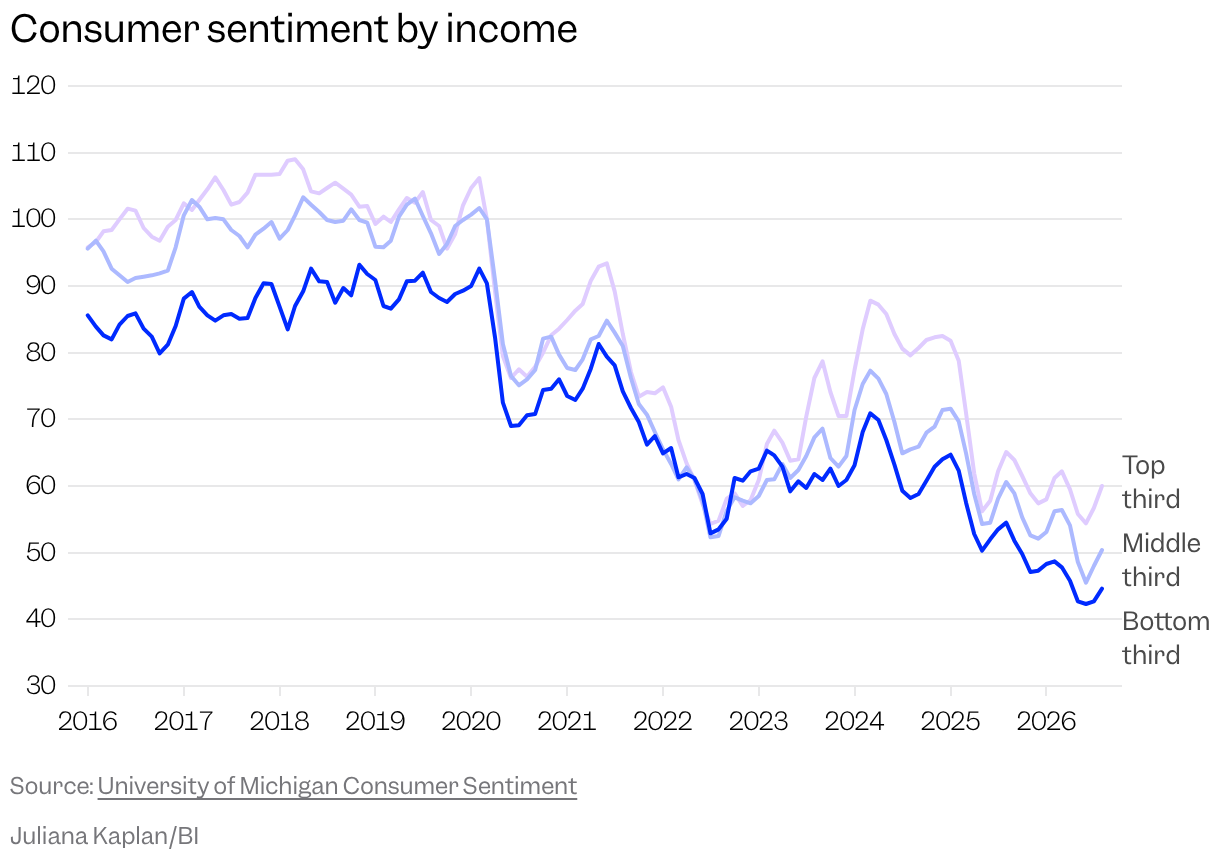
Similarly, middle-income earners' consumer sentiment has switched from mirroring their higher-earning peers to more closely aligning with lower earners — another sign that the middle class is falling on harder economic times.
"Working people are living on the edge, working longer and harder than ever for less money," said AFL-CIO President Liz Shuler. "They're angry every time they fill the tank. They're terrified of what their heating bills will look like this winter."
Two years ago, voters in Arizona, Missouri, Montana and Nevada approved ballot measures protecting abortion rights while also backing Donald Trump for president. This fall, the question is whether that can happen again.
In the four states voting on abortion measures this year — Virginia, Nevada, Idaho and Missouri — Democratic candidates are making sure voters know where they stand. Republicans in several marquee races have been far quieter, leaving the measures off their campaign websites, declining to say how they’ll vote or waiting until the campaign’s final weeks to take a position.
In Virginia, Republican Reps. Rob Wittman and Jen Kiggans, whose races the Cook Political Report rates as toss-ups, haven’t said how they’ll vote on a measure to enshrine abortion rights in the state constitution — even though both have records opposing abortion rights. In Idaho, Gov. Brad Little, who is running for re-election, did not say how he would vote on a measure that would essentially undo the state’s abortion ban until last week, after MS NOW asked both his campaign and the Idaho GOP why he hadn’t taken a position. (Neither responded.) Missouri is the exception: There, Republicans are pushing the measure — though its most prominent champions aren’t on the ballot themselves.
Some on the right say staying quiet is a mistake. Gregg Keller, a GOP strategist, said Republicans “need to be clear about where they stand” when they’re asked about abortion ballot measures. “They should say, ‘I’m pro-life, but here’s what I’m running on.’”
Anti-abortion advocates want them to go further.
“It’s a mistake for a candidate not to be clear about their support for innocent pre-born life, their mothers and pro-life measures designed to protect both,” Kristi Hamrick, a spokesperson for the anti-abortion advocacy group Students for Life Action, told MS NOW. “Ironically, you don’t have to tell the pro-abortion lobby or their candidates to speak up.”
Gavin Oxley, spokesperson for Americans United for Life, also criticized Republicans who stay quiet.
“When abortion is treated as a political poison by politicians on the national stage, grassroots pro-lifers are forced to bear a greater burden when defending against extreme abortion ballot measures,” he said.
That tension isn’t entirely new. In 2024, Trump’s insistence that abortion be “left to the states” drew sharp criticism from some anti-abortion leaders, and the Republican platform dropped its long-standing call for a national ban on abortion. Trump stuck with his approach anyway, and won.
President Donald Trump speaks at the 47th March for Life rally on in Washington on Jan. 24, 2019.Mark Wilson / Getty Images
But the results in states with abortion on the ballot may be the strongest argument for staying quiet. In 2024, the abortion rights measures in Arizona, Missouri, Montana and Nevada ran well ahead of Democratic nominee Kamala Harris, by about 11 points in Missouri and nearly 20 in Montana, suggesting that many voters who backed abortion rights also backed Trump. A paper published this month on the Social Science Research Network, an open-access platform, seemed to confirm that theory: It found that in 2024, voters in states with abortion ballot measures were more likely to back Republicans for the House and the presidency, an effect the researchers attributed “entirely” to moderate voters who support abortion rights. (The paper is a preprint and has not yet been peer-reviewed.)
“It’s not going to help Republicans for voters to be thinking about this, and the best thing Republicans can do is just hope that this issue is out of the spotlight,” said Mary Ziegler, a law professor at the University of California, Davis, and an expert in abortion laws.
But this year is different. In 2024, Trump was at the top of the ticket, pledging not to enact further restrictions on abortion. This year, Republicans are running without him on the ballot and carrying the weight of his historically low approval rating, a struggling economy and the war with Iran. Ziegler said that could make moderates less willing to split their tickets.
“I think you’re seeing Republicans look at what Trump did in 2024 that worked, and try to replicate it,” Ziegler said. “But what worked for Trump may not work anymore.”
Plus, abortion rights supporters have a strong record at the ballot box. Since the Supreme Court overturned Roe v. Wade in June 2022, voters in 11 states have used ballot measures to enshrine abortion rights in their constitutions, according to KFF, a health policy research organization.
But in politics, winning rarely ends the fight. Missouri’s ballot measure is the first attempt to reverse abortion rights that voters have already approved, and in Idaho, the GOP legislature could reinstate the abortion ban even if Proposition 1 passes.
Here’s what to watch in each state.
Virginia
Rep. Jen Kiggans at a campaign rally on Sept. 26, 2026; Rep. Rob Wittman during a parade on Sept. 19, 2026.Kendall Warner / AP Photo; Mike Kropf / AP Photo
Virginia offers the most direct test in a pair of key congressional races. Neither Wittman nor Kiggans has clarified their stance on Question 1, the ballot measure that asks if the state constitution should enshrine a “fundamental right to reproductive freedom.” But their Democratic challengers — Shannon Taylor and former Rep. Elaine Luria, respectively — have come out strong in support of the measure.
Wittman has described himself as “100% pro-life” and praised the Supreme Court’s overturning of Roe, but his campaign website does not address the issue at all. Kiggans’ site says she supports exceptions to abortion bans for “rape, incest and life of the mother,” but does not address the ballot measure. Neither campaign responded to requests for comment from MS NOW.
The pattern holds in the state’s Senate race. Democratic Sen. Mark Warner, who is seeking re-election, has backed the measure, while his Republican opponent, Bert Mizusawa, has avoided staking out a position. Mizusawa’s campaign also did not respond to multiple requests for comment.
The measure asks if the state should also protect doctors and other medical providers “from being punished for these decisions,” and allow abortions in the third trimester if a doctor determines a patient’s health is at risk or the pregnancy is nonviable. Abortion is currently legal in the commonwealth through the second trimester, with some exceptions beyond that.
Advocates for the measure say candidates’ silence isn’t an option, given the role Virginia plays for patients across the region as the only Southern state without an abortion ban.
“We’ve seen what happens when people can’t access the reproductive healthcare that they need,” said Han Jones, the campaign manager at Virginians for Reproductive Freedom, pointing to reports of women dying in states with abortion bans.
Opponents counter that the measure is redundant and unnecessary.
“There is no threat to abortion on the horizon in Virginia, even if I might disagree with that,” said Victoria Cobb, president of the conservative Family Foundation of Virginia, the funder of the leading opposition group.
Nevada
President of Nevadans for Reproductive Freedom Lindsey Harmon, right, during a press conference about qualifying a reproductive rights state amendment, outside the Clark County Government Center in Las Vegas on May 20, 2024.Rachel Aston / Las Vegas Review-Journal / Tribune News Service via Getty Images
Nevada is the closest thing to a rerun of 2024. Two years ago, Trump carried the state even as more than 60% of voters approved a measure to enshrine the state’s current abortion law in its constitution. That law allows abortion through 24 weeks of pregnancy — and beyond that to preserve the health or life of the pregnant person.
But the issue is still playing a key role in this year’s gubernatorial race: Nevada requires voters to approve an amendment twice before it can be added to the state constitution, and the measure faces voters again this year in the form of Question 6 on the ballot. Republican Gov. Joe Lombardo, who has positioned himself as a moderate and is seeking a second term, only recently told the Reno Gazette Journal he would vote against the abortion ballot measure.
Supporters of abortion rights have used the vote to rally around the Democratic nominee, Attorney General Aaron Ford, who has backed the measure and said he would ensure the state “remains a firewall” for access. Planned Parenthood Votes and Nevadans for Reproductive Freedom each announced $1 million ad campaigns highlighting Lombardo’s opposition to abortion. Planned Parenthood Votes’ ad explicitly urges viewers to support Ford.
Idaho
People participate in a pro-abortion protest on June 27, 2022, in Boise, Idaho, after a Planned Parenthood affiliate filed a lawsuit in the Idaho Supreme Court to try to stop the state’s trigger law that effectively bans abortion.Sarah A. Miller / Idaho Statesman / Tribune News Service via Getty Images
In 2020, Republican Gov. Brad Little signed one of the country’s strictest “trigger” bans, which took effect two years later, after the Supreme Court overturned Roe. But this year, unlike other Idaho Republicans running for re-election, Little avoided weighing in until earlier this month on a citizen-led ballot measure that would overturn the ban if passed. After MS NOW reached out to both his campaign and the Idaho GOP to ask why the governor had not publicly addressed the ballot measure, Little said in a statement he would vote against it because it “simply goes too far.”
Proposition 1, also called the Reproductive Freedom and Privacy Act Initiative, would amend Idaho law to establish a right to abortion up to the point of fetal viability, with exceptions after that for medical emergencies. It would also protect access to contraception, fertility treatment and miscarriage care. Currently, Idaho bans all abortions other than to prevent the death of a pregnant woman and in cases of rape or incest reported to law enforcement during the first trimester. The ban has driven doctors, as well as women with high-risk pregnancies or severe complications, out of state.
Little’s Democratic challenger, Terri Pickens, has openly campaigned on her support for the measure, calling the state’s ban a threat to women’s health and doctors’ independence.
But Pickens faces long odds: Idaho has not had a Democratic governor since 1995. And because Prop 1 would change state law rather than the constitution, the Republican legislature could simply override it next session.
Melanie Folwell, executive director of Idahoans United for Women and Families, the advocacy group that led the effort to create the ballot measure, told MS NOW the organization’s campaign showed abortion access “is actually quite a cross-partisan issue.”
Of the 110,000 signatures the group’s volunteers gathered over 10 months in order to put the question on the ballot, less than 40% came from Democrats, according to the group’s data. Approximately 29% came from Republicans and 31% from unaffiliated voters.
“People of all backgrounds and all political affiliations are interested in this and think the ban is too extreme,” Folwell said.
Opponents argue that it’s Prop 1 that is too extreme. The leading PAC campaigning against the measure has run ads lambasting the measure’s out-of-state donors, who include former New York City Mayor Michael Bloomberg. They also claim the measure would lead to more abortions later in pregnancy and override the state’s parental consent law for minors if passed. (It would not.)
Missouri
Two women hug during a pro-abortion rally for Amendment 3 — which, on the 2024 ballot, supported a state constitutional right to reproductive freedom — at a union local in Kansas City, Missouri, on Oct. 12, 2024.Evelyn Hockstein / Reuters
Two years ago, Missouri’s voters narrowly struck down an abortion ban while backing Trump by about 18 points. This fall, Amendment 3 asks voters to reinstate it.
Amendment 3 would change the state constitution to ban most abortions, with exceptions for victims of rape and incest reported in the first trimester and for “emergencies and fetal anomalies.” It would also enshrine a ban on gender-affirming care for minors into the constitution, even though former Republican Gov. Mike Parson signed one into law in 2023 that is set to expire next year.
Republican Attorney General Catherine Hanaway, who has said “It’s really important to me that we pass Amendment 3,” also reportedly spent $167,000 in state funds on a television ad that suggested abortion clinics were dangerous. Hanaway defended the ad, insisting that it complied with state law because it did not explicitly address the ballot measure.
In Missouri’s eight House races — none of which is considered a toss-up — several Republicans have lined up to support the measure.
Keller, the GOP strategist, who is based in St. Louis, acknowledged that the Republican candidates in Missouri are bucking the national trend.
“This is not a state where Republicans need or feel as if they need to walk around with trepidation,” he said. “We’re not terrified of the abortion issue.”
Opponents warn that the stakes extend well beyond Missouri. Emily Wales, president and CEO of Planned Parenthood Great Plains Votes and a spokesperson for Stop the Ban, the top opposition group, told MS NOW she feared that if the amendment passed, it would inspire other states to try the same thing.
“Missouri can’t go backwards,” she said. “We don’t want to set a national trend.”
President Donald Trump speaks at the 47th March For Life rally on Jan. 24, 2019, in Washington, D.C.
Rep. Jen Kiggans at a campaign rally on Sept. 26, 2026; Rep. Rob Wittman during a parade on Sept. 19, 2026.
President of Nevadans for Reproductive Freedom Lindsey Harmon, right, during a press conference about qualifying a reproductive rights state amendment, outside the Clark County Government Center on May 20, 2024, in Las Vegas.
People participate in a pro-abortion protest on June 27, 2022, in Boise, Idaho, after a Planned Parenthood affiliate filed a lawsuit in the Idaho Supreme Court to try to stop the state's trigger law that effectively bans abortion.
Two women hug during a pro-abortion rally for Amendment 3 — which, on the 2024 ballot, supported a state constitutional right to reproductive freedom — at a UAW local on Oct. 12, 2024, in Kansas City, Mo.
Former Rep. Matt Gaetz is facing allegations of sex trafficking by two women who filed a civil lawsuit against him and two other men in federal court Thursday.
The women, identified as Jane Doe 1 and Jane Doe 2, are accusing Gaetz, former Florida state Rep. Chris Dorworth and Joel Greenberg, a former tax collector in Florida’s Seminole County, of “recruitment and sexual exploitation” from 2017 through January 2019 — while Gaetz was a sitting member of Congress. The lawsuit relies in part on a House Ethics Committee report that concluded Gaetz paid roughly a dozen women for sex between 2017 and 2020.
The plaintiffs’ complaint also draws from Greenberg’s plea agreement, in which he acknowledged engaging in commercial sex acts with the minor described in the complaint as “Victim A” and “introduc[ing] the Minor to other adult men, who engaged in commercial sex acts with the Minor in the Middle District of Florida.” Greenberg is serving an 11-year federal prison sentence in Florida on sex trafficking and fraud convictions.
The accusers allege Gaetz and Greenberg “coordinated the recruitment, payments, drugs, and travel to obtain commercial sexual acts from young women,” and accuse Dorworth of “knowingly” participating.
According to the complaint, Greenberg met and recruited the two women through a “sugar daddy” website, through which older wealthy men meet young women who offer companionship for payment. Greenberg and Gaetz then allegedly had sex with the women, paid them, and took them on trips in Florida and other places.
The 38-page complaint, filed in the Middle District Court of Florida, describes the defendants as “men of power, wealth, and privilege who used their positions not to protect the vulnerable but to prey upon them.” The complaint states that one of the women was 20 years old when she met Gaetz, now 44, and that the other was 22 when she first met Greenberg, now 42.
In a statement provided to the Miami Herald, which first reported the news on Thursday, Gaetz called the allegations “false” and added that the lawsuit “relies almost exclusively on a Congressional Committee report that didn’t allow me to confront my accusers. Now I will finally have that chance.”
The House Ethics Committee report Gaetz referred to makes clear that officials sought to informally interview Gaetz and subpoenaed him for testimony. He refused both.
Later Thursday, Gaetz appeared to dox at least one of the women, posting a screenshot of an Instagram post on another social media site from one of the trips referenced in the complaint, to the Bahamas.
The lawyer representing the women, Spencer Kuvin, confirmed to MS NOW that both Jane Does had spoken to the House Ethics Committee. Asked for comment on Gaetz’s social media post Thursday afternoon, Kuvin said: “It is disgusting to me that Mr. Gaetz, without even knowing whether these are my clients, is nonetheless trying to embarrass these women. We will be happy to litigate the issues in Court, and we hope that Mr. Gaetz ceases his infantile behavior in trying to blame the victims of sex crimes.”
Dorworth did not immediately respond to multiple requests for comment Thursday.
The suit also names as defendants three companies allegedly owned and run by Greenberg’s family, which it says “supplied the money that funded these illicit acts,” including for drugs and travel, and money to the women directly. The plaintiffs are suing under federal laws aimed at combating sex trafficking and are demanding a jury trial.
Fritz Scheller, who has represented Joel Greenberg in both his criminal matter and related civil litigation, told MS NOW that he is not involved in this case as of now. “I was surprised and troubled to see Susan and Andrew Greenberg, as well as their associated entities, brought into this matter,” Scheller said, referring to Greenberg’s parents.
Civil lawsuits under the federal sex trafficking statute require that the plaintiffs prove, among other elements, that the defendants engaged in commercial sex acts and used fraud, force or coercion. The women who filed the lawsuit Thursday allege that the defendants defrauded and coerced them by paying them irregularly or less than promised; keeping them in a state of financial instability and dependency; supplying them with drugs; and conditioning their access to “outings and privileges” based on their performance of sexual acts for Gaetz. Each says she believed she would suffer “serious financial harm” if she stopped performing the sex acts.
Gaetz abruptly resigned from Congress in November 2024, when then-President-elect Donald Trump announced he would nominate him for attorney general. But Gaetz withdrew from consideration for that position after facing mounting scrutiny over sex trafficking allegations, which he denied. Since then, he has worked as a host at the right-wing One America News Network.
Gaetz was also the subject of a Department of Justice investigation, but it was closed in 2023 without any charges. At the time, public reporting stated that DOJ lawyers were concerned about the credibility of several witnesses if the case went to trial.
Civil lawsuits under the federal sex trafficking statute must be filed no later than 10 years after the alleged trafficking, assuming the victim was 18 years old or older at the time. Survivors of Jeffrey Epstein, as well as family members of Virginia Giuffre, one of Epstein’s alleged victims, have advocated for “Virginia’s Law,” a bill that would eliminate the statute of limitations for claims like those brought by the women who filed the suit against Gaetz.
Organized criminal rings target SNAP recipients because of the government program's outdated security features. But upgrading the tech costs money and states' SNAP budgets are getting squeezed.
Organized criminal rings target SNAP recipients because of the government program's outdated security features. But upgrading the tech costs money and states' SNAP budgets are getting squeezed.

 Login