❌

Reading view

Georgia Cop Who Shot a Miniature Donkey Says Body Camera Footage Shows an 'Imminent Threat'
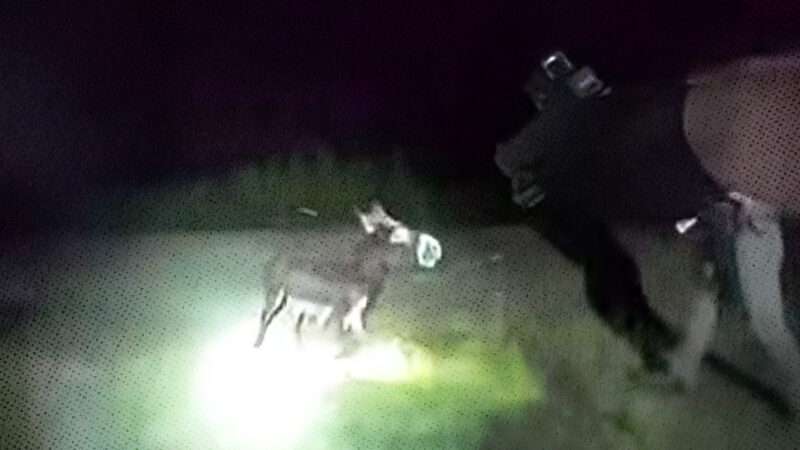
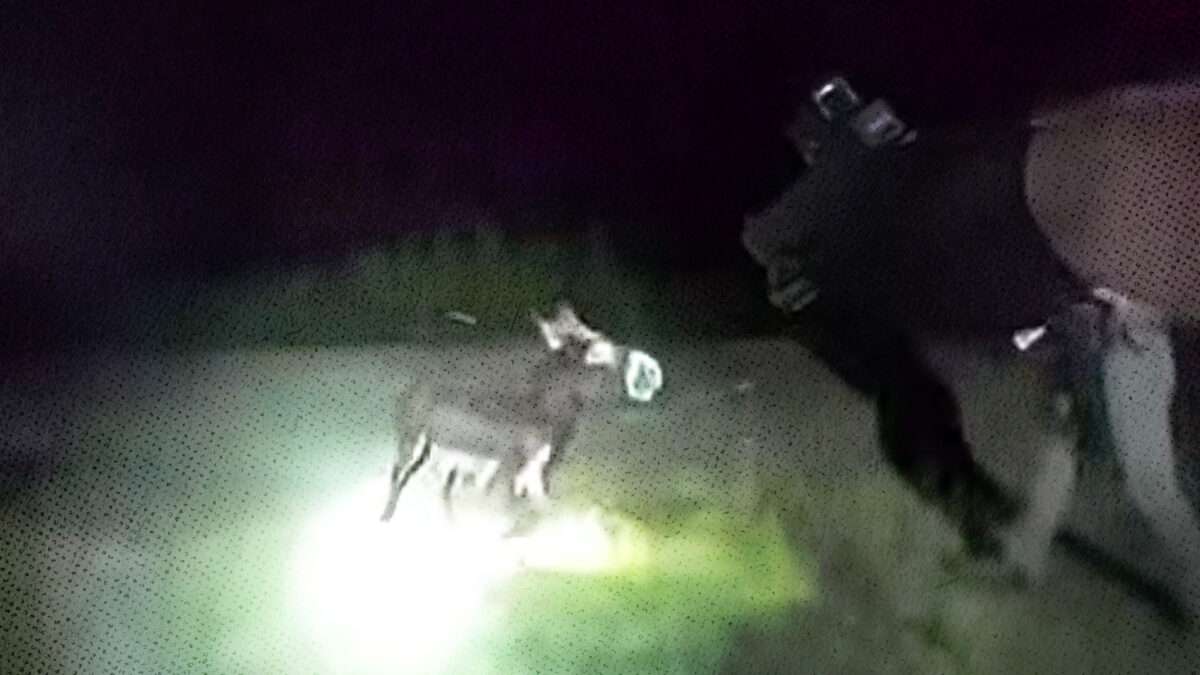
Screenshot from a body camera video showing a a handgun drawn at a small donkey | The Civil Rights Lawyer Raw/Youtube/Cedartown Georgia Police Department

The Georgia officer responsible for killing a 1-year-old miniature donkey, HeeHaw, has filed a motion to dismiss the lawsuit against him, claiming the body camera footage proves he "reasonably believed the donkey posed an imminent threat to a fellow officer." But even if it doesn't, the officer argues he is immune from liability. 

In the early morning hours of August 30, Hannah Michelle Israel was at her Cedartown home in western Georgia when she received a distressing phone call. A supervisor with the Cedartown Police Department "tersely informed [Israel] that a donkey on her property had been 'dispatched,'" according to her federal lawsuit. After some clarification, she learned that police had not only entered her enclosed private property in the middle of the night without permission while looking for a missing person, but also shot and killed her miniature donkey in the process. 

Israel immediately set out to search for her beloved pet, HeeHaw, only to find her bottle-raised donkey's lifeless body alone in her field. Israel told ABC7 News the incident has left her "traumatized and shocked." She continued, "I honestly can't even believe he's not here…There's no words."

Demanding accountability, Israel filed a lawsuit in the U.S. District Court for the Northern District of Georgia in September against the shooting officer, Officer Trenton Ryan Garner, for violating her Fourth Amendment rights and submitted a separate demand for $1 million from the City of Cedartown.  

Last week, Garner responded by asking the court to dismiss the case, arguing in part that he did not violate Israel's constitutional rights when he entered her property. Under the open fields doctrine, there is no reasonable expectation of privacy in one's pastureland, even if enclosed. Further, the motion argues, exigent circumstances existed in the search for a missing 12-year-old girl. 

As far as HeeHaw is concerned, Garner claims he acted reasonably by using deadly force and argues the footage clearly shows HeeHaw "charging" and posing an "imminent threat to a fellow officer." 

However, the footage, posted by the Civil Rights Lawyer Raw, may not be so clear-cut. Garner's body camera was off at the time of the shooting but had a "rolling buffer of video," a recording without audio of the 30 seconds preceding activation of the camera, according to court documents. During the silent portion, two officers and a bloodhound are in front of Garner with flashlights in a dark field. A small donkey, roughly 3 feet tall, appears and slowly moves toward one of the officers. The officer backs away slowly, but the donkey moves closer and picks up speed. Garner pulls his gun and fires. The donkey turns and runs before falling over.

Whether Garner reasonably believed HeeHaw posed an imminent threat to his fellow officer may be up for debate.

When the audio kicks in, a fellow officer asks, "Why'd you shoot it up?" "I don't know," Garner responds rather nonchalantly before telling dispatch he had to shoot a donkey because "it was trying to attack." If another officer on the scene wasn't sure why Garner used deadly force, perhaps the decision wasn't so reasonable after all. 

In her lawsuit, Israel accuses Garner of needlessly killing HeeHaw "maliciously…and recklessly, with deliberate indifference…for [Israel's] constitutional rights." The suit continues: "No reasonable officer in…Garner's position would have believed that such force was necessary or justified." 

But whether Garner acted reasonably or not by shooting HeeHaw, qualified immunity may still shield him from accountability. Qualified immunity is a legal doctrine that protects government actors from lawsuits alleging rights violations, unless the right is clearly established. In practice, that means plaintiffs must be able to point to a previous court ruling in a case with the same circumstances to show that the right was obvious to government officials. 

The bar can be quite high to show a right is clearly established. For example, in March, the Supreme Court reversed a 2nd Circuit decision in a case involving an officer who was sued for using a rear wristlock to arrest a protester. The 2nd Circuit denied qualified immunity, reasoning that a previous case from 2004 clearly established that rear wristlocks used to arrest anti-abortion protesters constitute excessive force. But the Court disagreed, stressing that "principles stated generally, such as that 'an officer may not use reasonable and excessive force,' do not suffice." 

And while there may be ample cases involving officers shooting pet dogs, cases involving miniature donkeys are in short supply. If the court finds that there is no clearly established rule that specifically prohibits officers from shooting a miniature donkey moving toward a fellow officer in the dark, the court may end up dismissing the case and sidestepping both the reasonableness and constitutional questions entirely.

The post Georgia Cop Who Shot a Miniature Donkey Says Body Camera Footage Shows an 'Imminent Threat' appeared first on Reason Magazine.

  •  

The 8th Circuit Rejects Qualified Immunity for a Judge Who Jailed 2 Kids for 'Refusing To Follow Directions'

a hand holding a judge's gavel | Atit Phetmuangtong/Dreamstime

A Missouri judge who locked two children in jail cells because he was frustrated by their resistance to a parental custody decision is liable for violating their Fourth Amendment rights, a federal appeals court ruled this week. The U.S. Court of Appeals for the 8th Circuit rejected Taney County Judge Eric Eighmy's claim that he was shielded by qualified immunity, a doctrine that blocks federal civil rights claims unless they allege a violation of "clearly established" law.

"A reasonable judge should have known better," Judge David Stras writes in an opinion joined by the two other members of the 8th Circuit panel. "The law was 'clearly established' enough" to "place the issue 'beyond debate.'"

Institute for Justice attorney Dylan Moore, who wrote an 8th Circuit brief arguing against immunity for Eighmy and participated in oral arguments, welcomed the decision. "Every reasonable person knows that a judge can't throw children in jail for no good reason," he said. "Yet Judge Eighmy claimed qualified immunity shielded him from accountability anyway because no prior case told him that imprisoning innocent kids is unconstitutional. That defense is ridiculous, and we are thrilled that the court saw through it. When government officials commit such obvious constitutional violations, qualified immunity should never enter the picture."

The incident at the center of the case happened after an October 2019 custody hearing involving Kadan Rockett, then 14, and his 12-year-old sister, Brooklyn, who had achieved a modicum of fame as magicians performing on America's Got Talent. Their divorced parents, Bart Rockett and Kami Ballard, agreed that Ballard, who at that point lived in Missouri, would have primary custody of the children, while Rockett, who was living in California, would be "responsible for them at the beginning of each month and 'during TV pilot season.'" But Kadan and Brooklyn did not want to go home with their mother, which led to an argument in the lobby of the courthouse.

Eighmy intervened, telling Kadan and Brooklyn to come with him to a conference room, where he informed them that they had to leave with Ballard. "The children would not budge, even after the judge mentioned that the other option was foster care," Stras notes. "Frustrated, Judge Eighmy had the children follow him again, this time to a waiting area in the courthouse's juvenile division." A few minutes later, Eighmy "led them down a hallway to two holding cells."

Outside the cells, Eighmy again threatened Kadan and Brooklyn with foster care, but they were still unmoved. "Lock them up," the judge told an officer, who "patted them down and ordered them to remove their socks and shoes" before confining them in separate cells.

It is not clear exactly how much time Kadan and Brooklyn spent in the cells. The Institute for Justice says "about an hour," while Stras says "the time spent in the holding-cell area was between twenty and forty minutes." In any case, the children's respect for Eighmy's authority had improved by the time he came back. He "asked them one more time whether they would leave with their mother," Stras writes. "This time, they both nodded yes, so he let them go."

In June 2021, Rockett, the children's father, sued Eighmy on their behalf under 42 USC 1983, which authorizes claims against state or local officials who violate constitutional rights under color of law. In his motion to dismiss the lawsuit, Eighmy argued that he was protected by judicial immunity, which is absolute with respect to a judge's official duties. U.S. District Judge Douglas Harpool disagreed, and the 8th Circuit affirmed that ruling in 2023, noting that Kadan and Brooklyn were beyond Eighmy's contempt power because they were not parties to the custody case and that "judges do not do double duty as jailers."

Eighmy reiterated his judicial immunity claim in a motion for summary judgment, and Harpool rejected it again. After the trial began, Eighmy claimed qualified immunity twice, once after all the evidence had been submitted and again after the jury's verdict in favor of Kadan and Brooklyn. Harpool denied him that defense both times.

The jury ultimately awarded Kadan and Brooklyn $5,000 each in damages, and Harpool added about $327,000 in attorney fees. Eighmy appealed again, reiterating his judicial immunity claim. But the appeals court ruled that he had abandoned that argument by failing to raise it during the trial or after the verdict. So Eighmy was left with qualified immunity, which the appeals court said he did not deserve.

Eighmy clearly violated the Fourth Amendment's prohibition of unreasonable seizures, Stras says, because he "did not have 'probable cause to believe that [the children had] committed' an offense, much less one that justified placing them in a holding cell. Rather, their only misdeed was one every parent knows well: resisting authority. Even in the context of legal-custody proceedings, refusing to leave with a parent is not a jailable offense. Nor were there 'exigent circumstances' arising out of danger to themselves or others."

Did Eighmy's authority as a judge give him extra leeway? Nope. "Criminal contempt was off the table because the children were neither parties to the custody case nor present inside the courtroom," Stras notes. "Nor could the power to punish a party for violating an injunction have provided the justification, given that Judge Eighmy never issued one."

Eighmy's motive for jailing the children does not change that analysis. "We have no doubt that Judge Eighmy believed he was acting in 'good faith,' and possibly even in the children's best interests, by detaining them," Stras writes. "But good faith in the Fourth Amendment context is about reasonable reliance, either on binding appellate precedent or a warrant issued by a 'neutral magistrate.'"

What about Eighmy's argument that he had no way of knowing his actions were unconstitutional? "The law in this area" was "clearly established," Stras says. "'[I]t would have been sufficiently clear [to] every reasonable official,' Judge Eighmy included, that locking up two children for refusing to follow directions violated the Fourth Amendment. As we put it over a decade and a half ago, long before the events in this case, '[i]t is clearly established that a warrantless arrest, unsupported by probable cause, violates the Fourth Amendment."

That principle was so well established, in fact, that Kadan and Brooklyn, neither of whom had attended law school, took it for granted. "I don't know how you have a right to lock us up," Kadan told Eighmy when he threatened to jail them, according to Rockett's amended complaint. "We have done nothing wrong." The complaint says Brooklyn raised the same point. "How can you just lock up kids?" she asked. "This isn't legal. We've done nothing wrong."

Given Eighmy's obvious disregard for Kadan and Brooklyn's Fourth Amendment rights, "we are not concerned about the lack of a prior case" with "fundamentally similar" facts, Stras says. "Indeed, given how clear the law is, it would have been surprising to find one." He quotes an observation that Supreme Court Justice Neil Gorsuch made as a 10th Circuit judge: "Sometimes the most obviously unlawful things happen so rarely that a case on point is itself an unusual thing."

The post The 8th Circuit Rejects Qualified Immunity for a Judge Who Jailed 2 Kids for 'Refusing To Follow Directions' appeared first on Reason Magazine.

  •  

Other Courts Should Heed a Federal Judge's Warning About Flock-Enabled Mass Surveillance

robed arms flank ALPR cameras and a judge's gavel | Paul Weaver/Zuma Press/Newscom/Flas100/Oleg Dudko/Doreen Salcher/Dreamstime/Midjourney/Fatima Ruiz

Back in 1983, the Supreme Court declared that "a person traveling in an automobile on public thoroughfares has no reasonable expectation of privacy in his movements from one place to another." That increasingly doubtful proposition underpins a nationwide network of more than 144,000 AI-assisted cameras that track the travels of innocent motorists across the country billions of times each week.

So far, state and federal courts have almost uniformly rejected constitutional challenges to automated license plate readers (ALPRs) installed by companies such as Flock Safety. But in a decision that could signal a shift in the legal treatment of Flock cameras, a federal judge in Oklahoma recently recognized that they enable "a type of indiscriminate mass surveillance."

ALPRs are much more sophisticated than the technology that the Supreme Court considered in 1983, when it approved the warrantless use of a radio transmitter that helped police tail a suspected methamphetamine manufacturer's car. Three decades later, by contrast, the Court said police should have obtained a search warrant before attaching a GPS tracker to another drug suspect's car.

The majority opinion in the latter case emphasized the physical intrusion necessary to install the tracker. But five justices embraced an alternative rationale, saying GPS tracking impinges on reasonable expectations of privacy by revealing potentially sensitive information about the target's historical whereabouts.

That theory came to the fore in a 2018 case involving mobile-phone location data collected by cell sites, which the majority said implicated the Fourth Amendment because "individuals have a reasonable expectation of privacy in the whole of their physical movements." The Supreme Court reiterated that principle this year, extending it to data collected by Google's Location History feature.

"An individual has a reasonable expectation of privacy in records about his cell phone's location," Justice Elena Kagan said in the majority opinion, "and police intrude on that constitutionally protected interest when they demand the information." By similar logic, U.S. District Judge Sara E. Hill concluded this month in the Oklahoma case, people have a reasonable expectation of privacy in ALPR records, and police therefore generally need a warrant to search them.

Those databases include "information about all vehicles that pass by any network-connected camera at all times," which police can peruse "on demand," Hill noted. "Freedom from persistent, dragnet-style surveillance while in public is not a foreign concept in our society, and it is a reasonable expectation that society already accepts," as reflected in the Supreme Court's cellphone decisions.

Like cars, cellphones "move in public places where people can see you in plain view," Hill wrote. "But it becomes constitutionally problematic when law enforcement can indiscriminately and passively catalog your whereabouts over an extended period of time and then use that information for any purpose whenever convenient."

At this point, Hill's decision is an outlier. "It appears that nearly every court examining the issue to date has determined that ALPR technology use is not a search under the Fourth Amendment because people have no reasonable expectation of privacy in their movements on public streets," she noted.

Last month, for instance, a federal judge in California held that ALPR database searches are "clearly distinguishable from and less extensive than the 'near perfect surveillance' achievable" with cell-site or Location History data. And the day after Hill's ruling, a state judge in California rejected a challenge to San Jose's Flock camera network, saying "there is no reasonable expectation of privacy in license plate data collected from cameras directed solely at public streets."

A federal lawsuit involving the same city's ALPR system, which the Institute for Justice filed last April, is still pending. So are challenges to Flock cameras in cities such as Wichita, Kansas, and Norfolk, Virginia.

Even when they reject such lawsuits, courts commonly acknowledge that the legal picture could change as the number and capabilities of ALPRs multiply. If so, it seems likely that Hill will eventually be joined by other judges who recognize the perils of "indiscriminate mass surveillance."

© Copyright 2026 by Creators Syndicate Inc.

The post Other Courts Should Heed a Federal Judge's Warning About Flock-Enabled Mass Surveillance appeared first on Reason Magazine.

  •  

No Immunity for Judge Who Locked Children in Holding Cells in Custody Case

From Rockett v. Eighmy, decided today by Eighth Circuit Judge David Stras, joined by Judges Bobby Shepherd and Jane Kelly:

When Judge Eric Eighmy had courthouse officers lock two children in holding cells because they refused to leave with their mother following a custody hearing, he violated their clearly established Fourth Amendment rights….

Bart Rockett and Kami Ballard divorced in Missouri, but initially stayed together to give their two kids, who were "aspiring stars," a chance to "make it big" in Los Angeles.  The children found some success in the entertainment industry, including appearing on America's Got Talent, but their parents eventually split up.

Ballard filed a petition for sole custody that landed on Judge Eighmy's desk. During a hearing several months later, the children waited outside the courtroom while their parents tried to work it out. They agreed on primary custody for Ballard, with Rockett responsible for them at the beginning of each month and "during TV pilot season."

Once the hearing was over, however, neither child was willing to leave with her. With an argument unfolding in the lobby of the courthouse, Judge Eighmy walked over, introduced himself to the children, and told them to follow him to a conference room. Once there, he informed them that they had no choice but to leave with her. A youth counselor then reinforced the point by telling them that they "ha[d] to listen to the judge." The children would not budge, even after the judge mentioned that the other option was foster care.

Frustrated, Judge Eighmy had the children follow him again, this time to a waiting area in the courthouse's juvenile division. Once there, he told someone to "[k]eep an eye on" them to "make sure they [did not] go anywhere." After disappearing for a few minutes, he led them down a hallway to two holding cells. A second threat to place them in foster care made no difference, so he had a juvenile officer "lock them up." Before they entered the cells, the officer patted them down and ordered them to remove their socks and shoes. Judge Eighmy stood by as the officer locked the doors behind them.

With the children in their separate holding cells, Judge Eighmy took a seat in a nearby office. After what "felt like forever," the officer opened the cell doors for Judge Eighmy, who asked them one more time whether they would leave with their mother. This time, they both nodded yes, so he let them go. From start to finish, the time spent in the holding-cell area was between twenty and forty minutes.

Following these events, Rockett sued in federal district court for, among other things, a violation of the children's Fourth Amendment rights…. [T]he jury awarded the children $5,000 each on their Fourth Amendment claims. From there, the district court declined to reduce the verdict and added $326,637.22 in attorney fees….

The procedural posture is a bit complicated, but the court denied both judicial immunity (based on an earlier panel decision on the issue) and qualified immunity:

Judge Eighmy violated the Fourth Amendment only if he seized the children and did so unreasonably. Locking the children up after the custody hearing was both….

Not every seizure … violates the Fourth Amendment. To the contrary, "[ ]reasonable" ones, like lawful arrests supported by probable cause, do not. But here, Judge Eighmy did not have "probable cause to believe that [the children had] committed" an offense, much less one that justified placing them in a holding cell. Rather, their only misdeed was one every parent knows well: resisting authority. Even in the context of legal-custody proceedings, refusing to leave with a parent is not a jailable offense. Nor were there "exigent circumstances" arising out of danger to themselves or others.

We have no doubt that Judge Eighmy believed he was acting in "good faith," and possibly even in the children's best interests, by detaining them. But good faith in the Fourth Amendment context is about reasonable reliance, either on binding appellate precedent or a warrant issued by a "neutral magistrate." Neither was present here. No case allows a judge to detain children in a holding cell when they refuse to leave with a parent. And a custody plan is no substitute for a warrant. In short, rough justice does not trump the Constitution….

The law in this area was also "clearly established." "[I]t would have been sufficiently clear [to] every reasonable official," Judge Eighmy included, that locking up two children for refusing to follow directions violated the Fourth Amendment. As we put it over a decade and a half ago, long before the events in this case, "[i]t is clearly established that a warrantless arrest, unsupported by probable cause, violates the Fourth Amendment." …

A reasonable judge should have known better. As we said the first time around [i.e., the first time the case went up on appeal], criminal contempt was off the table because the children were neither parties to the custody case nor present inside the courtroom. Nor could the power to punish a party for violating an injunction have provided the justification, given that Judge Eighmy never issued one….

And here's an excerpt from the 2023 decision denying judicial immunity (a separate question from qualified immunity):

Judicial immunity has been around a long time. See Yates v. Lansing (N.Y. Sup. Ct. 1810) ("The doctrine which holds a judge exempt from a civil suit or indictment, for any act done, or omitted to be done by him, sitting as judge, has a deep root in the common law."), aff'd (N.Y. 1811). In England, it served to insulate common-law judges on the King's courts from their rivals on other courts.

One of the earliest known examples involved a judge who presided over a murder trial. After it ended, he was dragged into a rival court and charged with conspiracy for his role. The prosecution ended, however, when the court recognized that the judge was "immune from prosecution … for [his] judicial act[]." …

As broad as the rule seemed to be, two exceptions narrowed its scope. The first was that judges could still be prosecuted for out-of-court "conspirac[ies]." That is, like any other citizen, judges could be haled into court for any illegal acts they committed outside the courtroom. The second was that, when judges "exceeded their authority" by considering a matter "not within their jurisdiction," their actions were … "without jurisdiction." Acting without "power and authority" eliminated the shield of judicial immunity.

As judicial rivalries began to wane, including in the American colonies, the power-and-authority rationale for judicial immunity did too. The focus shifted to protecting judicial independence: allowing judges "to act upon [their] own convictions, without apprehension of personal consequences." See Pierson v. Ray (1967) (explaining that judges "should not have to fear that unsatisfied litigants may hound [them] with litigation charging malice or corruption").

Judicial immunity continues to apply today, not only in prosecutions …, but in civil-rights actions brought under 42 U.S.C. § 1983…. The exceptions remain largely the same too. Judicial immunity can be "overcome in only two sets of circumstances": (1) when a judge takes "nonjudicial actions"; and (2) when the action is judicial, but is done "in the complete absence of all jurisdiction." …

On one end of the spectrum [of judicial action to nonjudicial action], the classic example of a judicial act is "resolving disputes between parties who have invoked the jurisdiction of a court." Other related acts qualify too, like holding litigants "in contempt," and issuing "search warrant[s]."

But those acts also have their limits. There is no doubt, for example, that judges can "direct[] police officers to bring counsel in a pending case before the court," but they cannot order the officers to beat them with their nightsticks along the way. Nor can judges wake up one day and decide to spontaneously issue a search warrant against a nosy neighbor or a political rival.

Like these examples, Judge Eighmy's decision to personally escort the kids to jail took what would otherwise be a judicial act too far. Judges have the authority to order an officer or a bailiff to escort an unruly litigant to jail. They can also pull the parties into a conference room to discuss what just happened in court.

Judge Eighmy crossed the line, however, when he personally escorted the kids to jail, stood there while they removed their clothes and belongings, and personally came back an hour later to release them. For one thing, the children were not even present in the courtroom, so he could not hold them in contempt for "[d]isorderly, contemptuous or insolent behavior." For another, judges do not do double duty as jailers. So even assuming Judge Eighmy could have ordered someone else to take the kids to jail, he could not put them there himself.

It is no answer that Judge Eighmy believes he was exercising his contempt power. To be sure, absolute immunity is available for judges who hold a litigant in contempt even when they are "not in [their] … robes, … no[r] in the courtroom itself." But here, the children were never parties, they never stepped foot in the courtroom, and Judge Eighmy personally locked them up himself. We have been unable to find any case that extends judicial immunity so far.

Judge Eighmy fares no better with his other argument: that Missouri law allows judges to enforce child-welfare statutes informally. Without question, police officers can take children into custody if they are behaving in a way "injurious to [their] welfare or to the welfare of others." But not judges, who can only order others to "[t]ake charge of children before and after" a juvenile hearing. The point is that judicial immunity is unavailable because what Judge Eighmy did is not "a function normally performed by a judge." …

Thanks to James Creigh for the pointer.

The post No Immunity for Judge Who Locked Children in Holding Cells in Custody Case appeared first on Reason Magazine.
  •  

Are Warrantless Phone Searches at the Border Constitutional? The Supreme Court May Soon Decide.

Border phone search | Tatiana Chekryzhova/Dreamstime/rudenkoalla/Magnific/Mariam Zakaidze

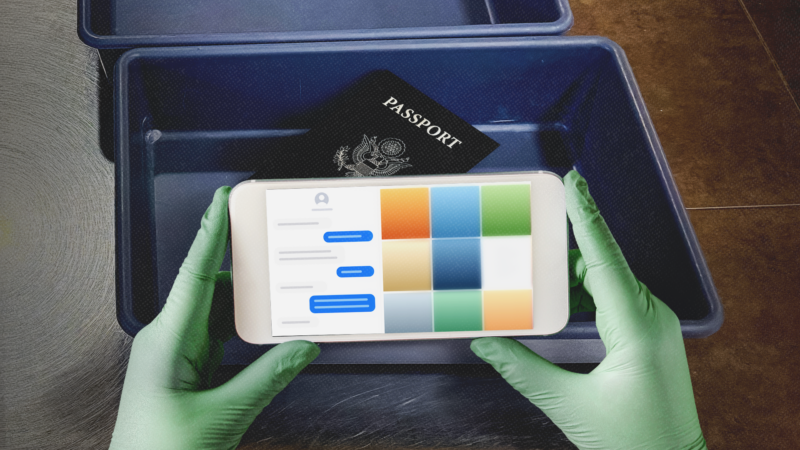
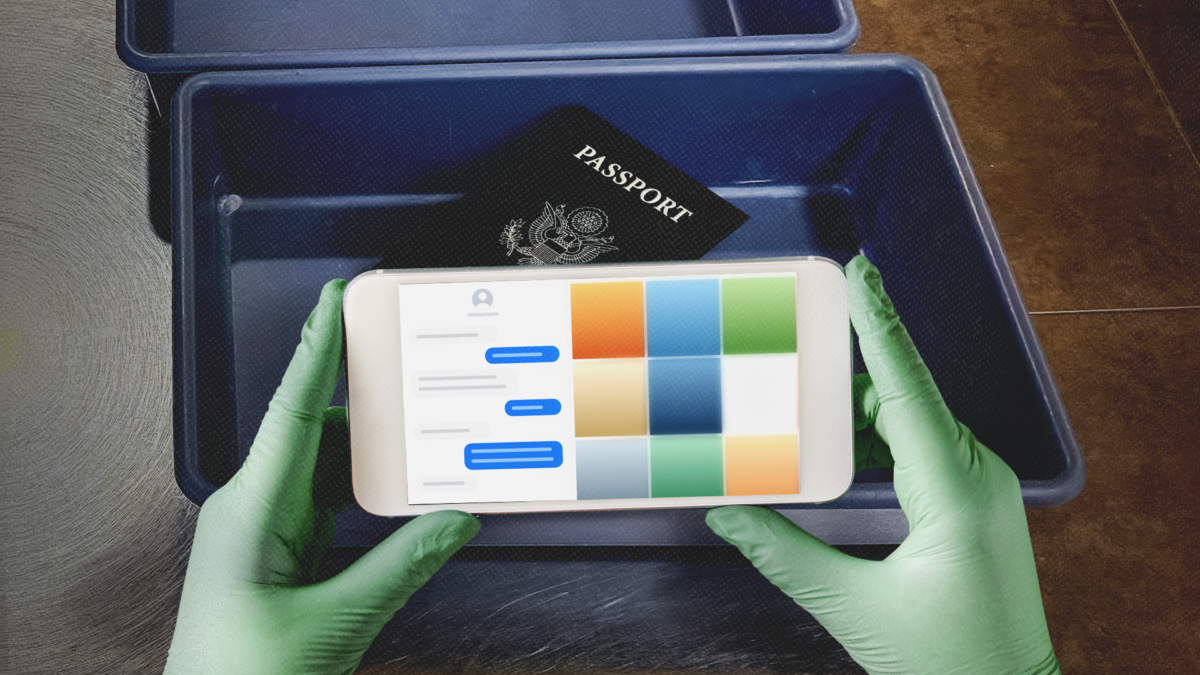
George Anibowei, a U.S. citizen, is a Texas-based immigration attorney with many clients battling the Department of Homeland Security. Border agents have searched his phone at least five times without a warrant as he returned to the United States.

In the first search, agents copied the phone's entire contents, including his confidential communications with clients. The government still has that data, and Anibowei still doesn't know why it was kept or who has seen it. He now leaves his work phone at home when he travels.

On September 29, the Supreme Court asked the federal government to respond to Anibowei's petition, which asks whether the Fourth Amendment lets border agents search the contents of a phone without a warrant. (I'm one of his lawyers.) The government waived its response, expecting the Court would deny the petition without a second look.

But in 2021, the solicitor general told the Court that this very question had produced an "entrenched circuit conflict" of "considerable practical importance." The conflict has only deepened since. Seven federal appeals courts now hold that a warrant is never required to search a phone at the border, while the 4th and 9th Circuits require one in at least some cases. That means one of your constitutional rights currently depends on which airport you fly into.

While circuit courts may disagree, the Supreme Court has already shown the best answer for this question. In Riley v. California (2014), the Court unanimously held that police generally need a warrant to search the phone of someone they arrest. There is an exception for searches incident to arrest, which allows the police to arrest someone without a warrant; that exists to protect officers and preserve evidence. Data can't hurt an officer, and a phone can be secured while police get a warrant. An extension of an old exception to digital data, the court said, "has to rest on its own bottom." Treating a phone like any other container in an arrestee's pockets was like saying "a ride on horseback is materially indistinguishable from a flight to the moon."

The border-search exception fails the same test. Those searches exist to collect duties, keep out people who may not enter, and stop contraband. But duties attach to physical goods, not data. And as the legal scholar Orin Kerr has put it, agents "will not find a person smuggled inside a computer hard drive." As for digital contraband, anyone who wants illicit files can carry a clean phone and download them after clearing customs. Suspicionless phone searches burden millions of innocent travelers while barely inconveniencing smugglers.

The appeals courts that disagree mostly cite one another. But the Supreme Court rejected a lopsided lower-court consensus in Riley, and again in Carpenter v. United States (2018). Counting courts is not a constitutional argument.

Defenders of these searches lean on history. In United States v. Ramsey (1977), the Court noted that the first Congress authorized warrantless customs searches in 1789, less than two months before it proposed the Fourth Amendment. True enough. But that statute let officers search ships for hidden dutiable goods. To search a house, store, or other building for the same goods, officers needed a warrant. And nothing in the statute let officers read a traveler's papers.

That distinction was no accident. Customs abuses had helped spark the Revolution. Writs of assistance gave British customs officers blanket authority to search wherever they pleased, which James Otis said placed "the liberty of every man in the hands of every petty officer." And the founding generation guarded letters especially closely. Benjamin Franklin, as the first postmaster general, made postal workers swear they would not open mail without an express written warrant.

Even Ramsey, the government's favorite border search precedent, respected that distinction. It upheld opening international mail to look for contraband, but the regulations before the court flatly prohibited reading correspondence without a warrant, a point the justices stressed repeatedly. The Court has never held that border agents may read a traveler's papers without a warrant. A phone holds years of correspondence. It deserves at least the same protection the Founders gave a sealed envelope.

Last month, however, the 2nd Circuit joined those courts that have disregarded this tradition. In United States v. Alisigwe, Judge Steven Menashi wrote that agents need no suspicion whatsoever to search a traveler's property at the border, phones included. A border search becomes non-routine, he reasoned, only when it intrudes on the person, as a strip search does. A phone is property, so searching it is routine.

Judge Eunice Lee concurred, agreeing that no warrant was required. But she warned that the majority's rule permits suspicionless searches for any reason, "including political or discriminatory ones."

The Alisigwe majority's premise miscasts the Fourth Amendment. The amendment's text secures "persons, houses, papers, and effects" in a single, unranked list. The abuses that produced the amendment were searches of property, including private papers. Agents may properly physically examine a phone to ensure it's not really a container for smuggling contraband. But reading or viewing its digital contents without a warrant trespasses on a person's papers and effects. The framers protected property because they recognized that human beings are not ghosts: We live in the physical world by exercising our property rights, and so searching our property can reveal much about our lives.

Alisigwe is the latest word from a Court of Appeals, but it contains complications for the constitutional issue. The trial court found that agents had reasonable suspicion, so the no-suspicion holding arguably wasn't needed to decide the case. That suspicion involved a forged passport, which goes to identity and admissibility, the core of border authority. Finally, Alisigwe was a permanent resident, not a citizen, so the government's interest in deciding who may enter was heightened.

Anibowei is simple on each of these counts, which is why one can be hopeful the Supreme Court will take it and address the Fourth Amendment question now. Anibowei is a naturalized citizen, no one suspects him of anything, and he challenges the government's search policies directly rather than seeking suppression of evidence in a criminal case. As the 5th Circuit itself acknowledged, his case "turns squarely and solely" on the warrant question.

The stakes keep growing. In FY 2025, Customs and Border Protection (CBP) searched 55,318 electronic devices, nearly 11 times as many as in 2012—and nearly a quarter of those searches targeted U.S. citizens. According to the directives Anibowei challenges, agents may keep what they find and share it with federal, state, local, and foreign agencies. Investigators have learned to wait for a target to travel and ask CBP to search his phone on the way back in, rather than go to the trouble of demonstrating probable cause to a judge. No wonder universities, bar associations, and press freedom groups now advise travelers to leave their devices at home.

The Founders rebelled against customs officers who could search wherever they pleased and read whatever they found. A rule letting border agents scroll through a citizen's correspondence, photos, and client files without a warrant, or any suspicion at all, revives that power. The Supreme Court should take Anibowei's case. Our papers don't lose Fourth Amendment protections at the border just because they're digital.

The post Are Warrantless Phone Searches at the Border Constitutional? The Supreme Court May Soon Decide. appeared first on Reason Magazine.
  •  

DOJ Says Flock Camera Data Is Not Protected By Fourth Amendment

by Matt Agorist, The Free Thought Project: (Reclaim The Net) The US government has told a federal appeals court that data collected by Flock Safety cameras is not protected by the Fourth Amendment, because being watched on the road is “a reality of modern life” – and therefore, nobody can expect privacy there. The argument was […]
  •  
❌