❌

Reading view

The A.I. Data Center Backlash Has Reached a Quiet Corner of Rural England

Plans to build one of Europe’s largest data centers in Devon have been met by strong opposition from residents, as environmental concerns grow.

© Finnbarr Webster/Getty Images

Daisy Snow, right, Ann Shuttleworth, left, and others protesting the proposed data center in Bideford, England, last month.
  •  

Data centers in the line of fire of Ukraine war

In recent days, a Ukrainian drone strike hit Russia’s largest data center, owned by bank and technology company Sberbank. The strike came after Ukraine hit three data centers belonging to the tech giant Yandex, which is often referred to as “Russia’s Google.” After those attacks, Yandex’s traffic dropped 94%. Its users experienced heavy disruption to […]

The post Data centers in the line of fire of Ukraine war appeared first on Asia Times.

  •  

Oklahoma Families Faced the Hottest Summer Ever and an Electricity Crisis

Record heat and a rising demand for electricity are closing in on Oklahoma families trying to keep the lights on and the AC running.

Genia Weitz and her husband, Daryl Mason, confined themselves to their living room to try to keep their electricity bill down.
  •  

Corporate Tax Revenue Falls Even as Profits Soar Under Trump

The annual decline was about $70 billion. Companies are writing off billions in A.I. investments, taking advantage of tax cuts that President Trump signed into law.

© Haiyun Jiang/The New York Times

A law signed by President Trump last year lets companies claim larger deductions in the year they make new investments.
  •  

Nobody Wants To Be the Pro-Tech Candidate in This New York Race That Could Flip the House

Mike Lawler and Cait Conley | Bonnie Cash/UPI/Newscom/caitconley.com

The Democratic Socialists of America (DSA) candidates running for the House of Representatives and endorsed by NYC Mayor Zohran Mamdani are all but guaranteed to win their general elections this November, but that does not mean the midterm drama is over in New York. In the state's 17th congressional district, which includes the lower Hudson Valley, Democratic challenger Cait Conley, a combat veteran who served on the Biden administration's National Security Council, could unseat incumbent Republican congressman Mike Lawler in one of the most consequential races of the midterms. 

The highly contested purple district voted for former Vice President Kamala Harris in the 2024 election while reelecting Lawler for his second term. Now, Lawler is attempting to win a third term as support for President Donald Trump wanes ahead of the midterms. As of Friday, The Cook Political Report lists the race, which could determine control of the House, as a toss-up. 

If elected, Conley would have far more in common with the "Badass Women" coalition of security state and military veterans than with DSA types (think more Sen. Elissa Slotkin from Michigan than Darializa Avila Chevalier). As Judge Street Journal's Timmy Facciola notes, "Conley's candidacy is testing the viability of a tactful centrism that rebukes left-wing positions like abolishing ICE or restricting weapon shipments to Israel." Lawler is also vying for moderates, pitching himself as "one of the most bipartisan members of Congress" and emphasizing his willingness to break with Trump occasionally while still welcoming Trump's support. 

While Lawler and Conley certainly are not pure MAGA acolytes or DSA members, both have leaned into a tech-critical position, much like that of more radical populists like Lina Khan or Steve Bannon, revealing how pervasive anti-tech sentiment has become in mainstream politics. 

This tech skepticism was on full display during an October 14 debate, when each candidate made the case for why they were the most equipped to regulate AI, insisting that the industry needs guardrails. 

Conley said members of Congress do not want to regulate AI because "they want to look out for their billionaire and trillionaire backers like Elon Musk, who is pouring over $260 million into this midterm election." She then added that Musk backed Lawler in his 2024 race. 

Lawler then accused Conley, who previously consulted for Primer AI, of being "the AI candidate for the AI industry."

While Lawler and Conley disagree on specific data center regulations (Conley supports Democratic Gov. Kathy Hochul's data center moratorium while Lawler supports local zoning control over data centers), neither wants to pitch themselves as an explicitly pro-data center candidate. During the debate, Conley claimed that, "On Mike Lawler's watch there have been five data centers built in Rockland County." Lawler has said that he had no say in the decision to build the data centers, and during the debate, he pointed out that the facilities were built for financial services. Lawler also attempted to attack Conley over data centers, slamming her in an ad for saying "we need data centers." Regardless of the candidates' specific policies on data centers, their attacks on one another demonstrate that cheerleading hyperscale data center development is a political liability. In their district, data center has presumably become a dirty term. 

The candidates' tech-skeptical rhetoric did not end with unchecked data center development. After the debate, Reason asked both candidates about their positions on age-verification laws for social media and AI, since such regulations raise significant privacy and censorship concerns by age-gating the internet. Unsurprisingly, both Lawler, who voted for the controversial KIDS Act, and Conley, who has proposed stricter age verification for AI tools, parroted platitudes about why such online safety regulations are necessary to protect children. 

"We have watched how social media is literally hurting the mental health of children," Conley told Reason. "And when you talk about the power of AI and what that power could do, we have to regulate this." 

Lawler gave a similar response, telling Reason that he respects free speech but that protecting children "is paramount." 

This bipartisan consensus over social media regulation has long been brewing in Congress. The mainstream political conversations about AI and data centers, however, are relatively new this midterm election cycle. And it appears both Lawler and Conley have figured out which way Americans' sentiment toward AI is leaning, and they have waged their campaigns accordingly. 

The post Nobody Wants To Be the Pro-Tech Candidate in This New York Race That Could Flip the House appeared first on Reason Magazine.

  •  

To Avoid Criticizing Trump's Tariffs and War, Vivek Ramaswamy Takes on Data Centers

Vivek Ramaswamy | Gage Skidmore/ZUMAPRESS/Newscom/Kenneth A Sponsler/Dreamstime

When Vivek Ramaswamy ran for president in 2024, he liked to describe himself as a "national libertarian" whose worldview included skepticism of new Middle Eastern wars and support for free trade (provided it wasn't with China). 

In a midterm election season in which voters are increasingly angry about higher prices born of protectionist tariffs and high gas prices caused by a new Middle Eastern war, that would seemingly give Ramaswamy, now running for governor of Ohio, a straightforward story to tell about how he'd bring costs down. 

Unfortunately for the Republican gubernatorial candidate, the person responsible for the tariffs and the war is President Donald Trump, whose support he's counting on to get him over the finish line in a surprisingly close race against Democrat Amy Acton. 

The latest polls show Ramaswamy slightly ahead of Acton, with many voters still undecided. 

Other Republican midterm candidates, most prominently Mike Rogers in Michigan, are escaping this bind by criticizing the tariffs and the war without explicitly naming the president who's responsible for both. 

Ramaswamy has chosen a different tactic: Shift the conversation to other sources of voters' cost-of-living anxiety that can't be directly laid at Trump's feet. 

In the last weeks of this election campaign, Ramaswamy has focused like a laser on two proposals he says will deliver cost relief to Ohio voters. The first is his proposed rollback of homeowners' property taxes. The second is a moratorium on new data center construction. 

Like many Midwestern and Western states, Ohioans' property tax bills have shot up in recent years, driven by a pandemic-era spike in home values. 

That's in turn sparked a full-blown property tax revolt in the state. The Republican-controlled Legislature passed a raft of property tax relief measures in 2025. Activists are also collecting signatures to place a full abolition of taxes on real property on the statewide ballot next year. 

Ramaswamy hasn't endorsed full property tax abolition, but he is promising voters that he will roll back property tax assessments for homeowners to pre-pandemic levels. 

On the data centers, he has staked out a very restrictionist position. 

Ohio is currently one of the leading states for data center development. Pew Research counts 57 projects currently in the pipeline there, attracted by cheap land and a robust power grid. 

The state's data center boom has caused a backlash in rural communities, where voters have objected to data centers' consumption of land and electricity and the special tax incentives some projects have received. 

On the ballot in 10 Ohio localities this November are initiatives that would impose additional restrictions on data center development. 

Ramaswamy has proposed to go further with a statewide moratorium that will remain in effect until the Legislature passes laws that not only require data centers to cover the full costs of the power infrastructure they need, but also provide property tax rebates and free electricity to nearby homeowners. 

Local property tax cuts paired with local reductions in spending would, of course, be well in line with a small government worldview. 

But the residential property tax rollback Ramaswamy has proposed doesn't directly do that. 

Instead, it would reduce property tax revenues and then leave it up to localities to make up for the lost revenue somehow. That could result in spending cuts. 

It could also result in localities shifting tax burdens onto commercial properties, raising non-property taxes (like sales taxes), or relying on the state government for more of their revenues. 

In the former two scenarios, local tax regimes would become more hostile to growth, given that property taxes are considered one of the most "efficient" taxes. In the latter scenario, the link between people who pay taxes and the people who consume taxpayer-funded local services would become more distant.  

Neither is ideal. 

While some data centers in Ohio have received tax subsidies, Ramaswamy's proposed solution is to block new data centers until they're legally required to subsidize their neighbors with free electricity and other community benefits. 

All of that is to say that it's a shame to see Ramaswamy adopt increasingly non-libertarian positions to avoid making critiques of Trump's cost-increasing tariffs and Iran war that would align with his erstwhile "national libertarian" worldview. 

It's ironic, too, that, in trying to avoid making those critiques, Ramaswamy has wound up being more restrictionist on data centers than Trump himself. 

In an August Truth Social post, the president famously urged local communities to "let Data Reign" and welcome data center development. Those that did would become "rich and successful," he predicted. Those that didn't would remain "poor and backward." 

At a rally in Vandalia, Ohio, over the weekend for Ramaswamy and Republican Senate candidate John Husted, Trump reiterated his support for data centers, saying, "We want them. Look, there's so much money to be made for Ohio. You can't just turn them off. They'll go to China."

Rather than criticize the president's statist interventions, Ramaswamy is talking up his own instead. Ohio will be poorer as a result.

The post To Avoid Criticizing Trump's Tariffs and War, Vivek Ramaswamy Takes on Data Centers appeared first on Reason Magazine.

  •  

IMF warns of debt-fueled AI spending as bubble fears grow

The International Monetary Fund warned Tuesday that the global economy faces serious risks from Big Tech firms taking on massive debt to fund the buildout of artificial intelligence data centers worldwide. The IMF’s latest Global Financial Stability Report outlines a number of risks to economic growth in the coming years, including a reliance on AI […]

The post IMF warns of debt-fueled AI spending as bubble fears grow appeared first on Asia Times.

  •  

Trump Says AI Doesn’t Need Guardrails, Calls Growing Concerns ‘A Hoax’

President Trump is essentially channeling Peter Thiel, who is stumping around the around the county talking about the Antichrist. Thiel says that the Antichrist are those who want to limit accelerationism and slow down AI development. This is flat out backassward. Both Thiel and Trump (and all the other arch-Technocrats in Washington) are gaslighting the nation and slamming those who are resisting. As for Biblical scholarship, the whole lot of them can be summed up by one screen actor: Archie Bunker. ⁃ Patrick Wood, Editor.

President Donald Trump responded Monday to warnings of potential dangers related to artificial intelligence by dismissing the need for any safeguards and calling AI concerns a “hoax.”

Trump rejected the idea of placing guardrails on AI, saying on Truth Social that the only control needed is “a STRONG AND SMART (High IQ!) PRESIDENT, and the U.S.A. has that, in spades!”

In the post, he appeared to hint at the government’s pursuing criminal or regulatory penalties against AI companies after industry insiders warned of potentially catastrophic dangers posed by the rapidly evolving technology.

“The Trump Administration has stopped AI ‘people’ from doing bad, or potentially bad, ‘things,’ like Dario (Anthropic!), who is now pretending to be a ‘perfect little angel’ — and we will continue to do so!” he said, referring to Dario Amodei, the CEO of Anthropic, maker of the Claude AI chatbot.

Amodei said Saturday in an essay that AI companies should “slow the pace” of AI development.

Trump continued: “We already have tremendous CRIMINAL and REGULATORY power over these companies! There is a SICK conspiracy going on against AI and Data Centers, and the only one that is happy about it is China. WHOEVER WINS AI, WINS! We are leading China, and all others, and will continue to do so. Conspiracy Theorists, Treasonists, Traitors, and Leakers, BEWARE!”

Even as the American public and members of his own party grow increasingly skeptical of AI, Trump has framed the technology’s continued growth as an economic and geopolitical imperative. Communities that reject AI data centers will wind up “backwards and poor,” he warned recently. And in Ireland over the weekend, he was even blunter: “Whoever wins AI wins.”

Yet, a recent NBC News Decision Desk Poll found that 70% of adults said they were more worried about AI than excited about it. A similar percentage — 69% of adults — said they somewhat or strongly oppose building AI data centers in their areas. That includes 57% of Republican voters.

Trump remained undeterred Monday afternoon, returning to Truth Social in a full-throated defense of AI, saying, “AI taking over the World, destroying Humanity, and all other things bad, is a HOAX.” In the same post, he said AI would be “the Greatest Economic Development Engine in History — Bigger than Oil, Gold, Diamonds, or even the Internet.”

He later called in to the All-In Summit and made similar remarks to Nvidia CEO Jensen Huang. He posted in support of AI more than a half-dozen times Monday on Truth Social.

Amodei’s recent warning has prompted other AI leaders to publicly call for a slowdown in its development so researchers can better understand and control any threats posed by the technology. They include OpenAI CEO Sam Altman, who said his company would adopt one of the safeguards Amodei proposed in his essay.

Last week, Anthropic AI researcher Jacob Coxon resigned, writing in a viral X post that OpenAI and Anthropic were “gambling with our lives” and warning that “the people building AI earnestly believe that it could kill us all by the end of the decade.” A lead Anthropic researcher, Evan Hubinger, said on X that Coxon was right, saying that “we really do earnestly believe AI could kill all humans!”

Many politicians responded with their own calls for stronger checks on AI to address safety concerns.

Senate Minority Leader Chuck Schumer, D-N.Y., on Monday called for a Senate briefing with top administration officials, while House Speaker Mike Johnson, R-La., said he expects Trump to “summon” AI platform leaders for a “deliberate discussion about the responsibility of the companies to maintain safety and what role, if any, the government has to play in that.”

A meeting between Trump and AI leaders is “in the works,” but no timing has been nailed down yet, a source familiar with the matter told NBC News.

Sen. Mark Warner of Virginia, the top Democrat on the Intelligence Committee, told reporters Monday that he is “long-term pro-AI” but that he understands regulations could protect against a potentially “catastrophic event.”

“The notion that we’ve got the leaders of the most cutting-edge innovation going on in the world at this point and with the amount of capital into this saying, ‘Hey, we even think we need to slow down,’ and we don’t take that advice? … I think we’d all look pretty damn silly if months from now we had an event that we could have stopped,” Warner said.

Some Republicans said AI regulation would not be feasible until after the November elections.

“To look at this Congress at this point in time and expect us in the foreseeable future to draft an AI regulation bill that strikes the proper balance between safety and innovation is not going to happen. Nothing’s going to happen, in my opinion, until after the midterms,” Sen. John Kennedy, R-La., told reporters.

Kennedy added that in his view AI leaders were asking Congress for permission to slow their development, adding, “They don’t need our permission.”

Rep. Tim Burchett, R-Tenn., said what worries him about AI “is that you’ve got a bunch of people up here, literally, who are probably still driving their ’72 AMC Gremlins with some eight-track tape players — and they probably just parked their powder blue leisure suit a couple years ago — are going to be regulating something they have no idea what it is.”

He said he would like Congress to “bring in the industry people and figure this thing out and get it right.”

Former President Barack Obama on Monday called AI leaders’ move to slow the pace of development a “good and necessary first step,” saying it was time to “structure a more open, public and democratic conversation about AI.”

He said voluntary standards by companies were not enough.

“We need government — and specifically our leaders in Washington — to get proactive in coming up with concrete proposals, laws and regulations that deal with serious safety concerns, anticipate AI’s impact on jobs and our kids, and make sure that AI’s benefits are widely spread,” he said.

Obama called last week for AI policy to be prioritized within the Democratic Party.

Vice President JD Vance told reporters Monday that AI leaders’ warnings are “something that we’re concerned by” but said the administration wants to ensure “we actually regulate smartly.”

“I have to say, just personally, I feel a little bit weird about the fact that you have so many frontier AI tech companies kind of coming to the government and begging the government to regulate them,” Vance said. “It feels a little bit to me like a bit of a Trojan horse. So I think we just have to be careful about this.”

Beijing on Monday disparaged the warnings from U.S. tech leaders as “fearmongering” from a “Cold War playbook” aimed at hobbling China.

During his trip to Ireland, Trump asserted over the weekend that the U.S. was leading China in artificial intelligence and said, “Whoever wins AI wins.”

“We can put guardrails,” he said Sunday. “We can do this and that, but I think you have a lot of negative forces that are bringing it up that shouldn’t be bringing it up, and they’re bringing up things that won’t happen.”

Read full story here…

  •  

More than 500 drones by Moscow’s count: Kh-101 fuel plant, second Yandex data center, and a far-north refinery hit

more than 500 drones moscow’s count kh-101 fuel plant second yandex data center far-north refinery hit · post smoke over ukhta komi republic after reported drone attack lukoil 9 2026

Drones struck a plant making fuel components for Russia's Kh-101 cruise missiles and a second Yandex data center overnight on 9 October, Russian officials and monitoring channels reported. The same night, fires were reported at a refinery in Russia's far north and an oil depot near Belgorod. Russia claimed it downed more than 500 drones, and Ukraine has not claimed any of the strikes.

Ukraine has spent months hitting refineries and arms suppliers deep inside Russia. Russia, meanwhile, keeps firing Kh-101 cruise missiles at Ukrainian cities, including the one that killed 22 people in Pryluky on 7 October.

The plant behind the Kh-101's fuel

The Redkino Experimental Plant in Tver Oblast came under attack overnight, Ukrainian monitoring channel Exilenova+ reported. It said the plant makes components of Decilin-M, a fuel for Kh-55 and Kh-101 cruise missiles, as well as additives for diesel and aviation kerosene.

Tver Oblast Governor Vitaly Korolev claimed a plant in Redkino caught fire as a drone attack was being repelled. He did not name the plant. No workers were hurt, he said.

The plant also makes ferrocene derivatives, which serve as burn catalysts in solid-fuel rocket motors, Militarnyi reported. The UK sanctioned it in September 2025. Drones attacked it in September 2023 and twice in one night in June 2024, the outlet said.

In February, drones of the Security Service of Ukraine's (SBU) Alpha unit struck the plant, sparking a large fire, SBU sources told Kyiv Post. The Kh-101 is the missile Russia used against Pryluky on 7 October, Ukrainian President Volodymyr Zelenskyy said.

Yandex loses a second data center

Part of Yandex's data center in Kaluga was damaged in the drone attack, and several modules were completely knocked out, the company's press service told Interfax, Russian newspaper Kommersant reported. Some Yandex services may run with interruptions, no one was hurt, and the company is still assessing the damage, Yandex said.

Kaluga Oblast Governor Vladislav Shapsha claimed nine people were injured in the overnight attack on the region. A day earlier, a drone attack forced Yandex to fully shut its data center in Sasovo, Ryazan Oblast.

A refinery in the north, a depot near Belgorod

Locals reported an attack on the Ukhta refinery in the Komi Republic, followed by a fire, Exilenova+ said. The Lukoil-owned plant can process about 4.2 million metric tons of oil a year, making gasoline, diesel, fuel oil, and vacuum gasoil. The extent of the damage is unclear.

An oil depot north of Belgorod was also burning after the night's attack, the channel posted. Belgorod's regional headquarters claimed two people were killed and four injured, including a child, in the Belgorod district.

A large fire also broke out in Pushkino near Moscow, likely at a truck parking lot, Astra reported. The cause is unknown.

Repeated strikes on Redkino target a specialty fuel that Russia's cruise missiles depend on, while two Yandex data centers hit in two nights bring the war to services ordinary Russians use every day.

  •  

The People of Utah vs. Kevin O’Leary

In a remote part of Utah, the world’s largest data center project—allegedly—is being fast-tracked in secret. Kevin O’Leary of Shark Tank fame was brought in to hype the 40,000-acre complex. But the backlash among Utahns has been strong. Josh Dzieza reports from the front lines of the popular resistance to data centers:

[Brenna] Williams, a former government econometrician and college instructor, speaks methodically in a calm monotone as she enumerates the many reasons why the data center “doesn’t make sense”—a refrain. First among them is the water, an acutely sensitive issue in Utah in part thanks to Gov. Cox himself, who has declared repeated drought emergencies and urged residents to take shorter showers and cut back on watering their lawns. There is no more potent symbol of the state’s water crisis than the Great Salt Lake, which has been shrinking for years, exposing heavy metals on its lakebed that become airborne dust. Now here came a data center on its northern shore, or where its northern shore would have been if it hadn’t receded several miles.

“We have to report on our neighbors if they’re watering at the wrong times or on the wrong days,” Williams says. (There’s a hotline.) “But we have water to cool a power plant and cool the data center? It doesn’t make sense.”

  •  

Drone attack forces Yandex to shut down its data center on the grounds of a sanctioned Russian machine-tool plant

Smoke over Salavat following an attack on the night of October 8.

A drone attack overnight on 8 October caused a fire that hit part of Yandex's data center in Sasovo, Ryazan Oblast, about 580 km from Ukraine, and the site is fully stopped, the Russian tech company told Russian media. The data center sits on the grounds of Sasta, a sanctioned machine-tool plant, Russian outlet Astra said, citing Wikimapia data. Astra's OSINT analyst found from eyewitness footage that the fire hit the plant.

Since late September, Russia has been striking data centers in Kyiv that keep Ukraine's internet and online services running. Now a drone attack has stopped one of the data centers that Russia's largest tech company relies on.

Fires reported at a refinery in Salavat and a machine-tool plant in Sasovo after overnight attacks on 8 October 2026.
Fires reported at a refinery in Salavat and a machine-tool plant in Sasovo after overnight attacks on 8 October 2026. Map: Euromaidan Press

Yandex counts the damage

Yandex warned that some services may be unavailable, while its core services kept running and no one was hurt. Ryazan Oblast Governor Pavel Malkov claimed two drones were downed, a roof caught fire at an enterprise in the Sasovo district, and windows were blown out in several homes.

The power failure took down a wide range of Yandex Cloud infrastructure, including computing capacity, networks, data storage, databases, Kubernetes, cloud services, AI, and security and monitoring systems, Ukrainian outlet ZN.ua reported, citing Exilenova+.

Ukrainian monitoring channel Exilenova+ reported that the plant was hit, without naming an attacker. The channel said Sasta, which claims a place on Russia's register of defense-industry companies, makes computer-controlled machine tools, including five-axis machining centers, and previously supplied the Tactical Missiles Corporation (KTRV) and Roscosmos. The plant's value to the arms industry lies in machines that cut precision parts, not in finished weapons, the channel said.

Citing Exilenova+, Militarnyi reported that Ukraine's Defense Forces hit the plant. It also linked Sasta to Iskander missile supply chains. No source has said whether the plant or the data center was the target, and no Ukrainian official has claimed the Sasovo strike. Sasta has been under US sanctions since November 2023, UK sanctions since February 2024, and Ukrainian sanctions since April 2025, a sanctions database shows.

Salavat: Kyiv reports a hit

Ukrainian forces hit the Gazprom Neftekhim Salavat complex in Bashkortostan, about 1,380 km from the front line, causing a fire, Ukraine's General Staff said. It said the complex processes up to 10 million metric tons of hydrocarbons a year and serves Russia's armed forces. Its key unit, the ELOU-AVT-6 primary oil refining unit launched in 2012, can process 6 million metric tons a year, Militarnyi reported. Astra's analyst placed the fire a few kilometers outside Salavat, possibly near the refinery.

Salavat oil refinery moment of attack pic.twitter.com/bUxuRshSK1

— Exilenova+ (@Exilenova_plus) October 8, 2026

Salavat Mayor Marat Zagidullin claimed that debris from several drones fell in the industrial zone that morning and started a fire.

"The enterprise continues to work," he said.

Astra noted earlier hits on the complex on 24 September 2025, on 14 July 2026, when refining fully stopped, and on 13 August 2026.

Russia's strikes on Ukraine's data centers

Russia has repeatedly hit data centers in Kyiv since 23 September. Strikes hit the COSMONOVA data center twice, the second time knocking it out, and the Parkovyi data center stopped working completely on 1 October after a series of strikes. In early October, Russia destroyed the dline.ua data center in Kyiv.

  •  

Asia’s growth now belongs to Silicon Valley

Southeast Asia’s growth next year will be decided at meetings its finance ministers won’t attend. A few executives in California will soon settle next year’s spending on data centers. Their decisions will do more to shape growth in Vietnam, Malaysia, Thailand and the Philippines than any budget those governments pass. The World Bank has just […]

The post Asia’s growth now belongs to Silicon Valley appeared first on Asia Times.

  •  

What the AI boom is actually doing for Americans

Paul Krugman is the greatest econ writer in the world, and also a legendary economist. But I sometimes feel that he has a blind spot when it comes to the value of new technologies. In 1998 he famously wrote: The growth of the Internet will slow drastically, as the flaw in ‘Metcalfe’s law’—which states that […]

The post What the AI boom is actually doing for Americans appeared first on Asia Times.

  •  

US bans Chinese data center gear as Beijing grounds its AI talent

The artificial intelligence (AI) race between the United States and China has accelerated in model protection, supply chains and talent controls, even as the two nations’ leaders agreed last week to open a new dialogue on AI safety. A string of moves announced or uncovered this week shows that both sides are now guarding their […]

The post US bans Chinese data center gear as Beijing grounds its AI talent appeared first on Asia Times.

  •  

US House speaker sees AI data center worries as ‘Chinese psyop’

They’ve been shown to raise electricity bills, pollute drinking water, do little to boost local employment while threatening millions of jobs in a variety of industries, and top executives have warned that the technology they support could wipe out all of humanity by the end of the decade. But rather than take widespread public opposition to artificial intelligence data centers at face value, House Speaker Mike Johnson (R-La.) announced he had […]

The post US House speaker sees AI data center worries as ‘Chinese psyop’ appeared first on Asia Times.

  •  

Data centers will consume less water and energy than many think

Concerns about the water and energy demands of data centers have become prolific in recent weeks. But debates about their impact often overlook the rapid advances in cooling technology and cleaner energy that are already having an impact.

However, data centers’ resource consumption should be front and center of the AI conversion, as it is set to grow rapidly. By 2030, data centers’ water and energy consumption will double as AI demand leads to rapid construction of the infrastructure.

But data centers will not cause the world to run out of water or energy. Water- and energy-saving technologies already in use are reducing their impact, while Shanghai’s groundbreaking underwater data center demonstrates how innovative design can limit water, energy and land use.

Data centers have underpinned the internet since its founding. Apps, email, file storage and cloud services all run through them.

Modern AI workloads, however, have transformed their power demands beyond recognition. Today a single AI data center can match the electricity consumption of 100,000 homes, making them a significant drain on local energy grids, especially if a region is susceptible to shortages.

Data centers’ energy consumption is only rising as more are built across the world. In the US, data centers could increase from 4.4% to 12% of national electricity usage by 2028 — that is equivalent to adding eight New York Cities to the American grid.

Data centers also consume large amounts of water in two main ways. Water is used directly to cool servers and storage systems, which generate considerable heat, and indirectly to produce electricity at fossil fuel power plants where it is heated into steam to drive turbines.

In the UK, data centers have been estimated to use up to eight times as much water as average on hot summer days, underlining how their impact can rise when local resources are already under strain.

As the effects of climate change intensify, the location of data centers, and methods to reduce their water and energy consumption, are becoming ever more important.

Fortunately, resource-saving measures are already being implemented. Data centers on land use closed-loop cooling systems that recycle water rather than continually evaporating it. This can reduce freshwater use by up to 70% compared to traditional open evaporative methods.

China has also pioneered a revolutionary new type of data center in Shanghai: wind-powered, and underwater. The facility, which began full commercial operations in May 2026, uses seawater as a coolant instead of using refrigerated fresh water as land-based data centers do, reducing the electricity required to cool the computers.

It uses at least 30% less electricity than traditional data centers, and offshore wind turbines reduce reliance on fossil fuels and cut the data center’s carbon emissions. Innovative solutions such as these will go a long way to reducing data centers’ resource consumption.

AI is also part of the solution to data centers’ draw on resources. AI can optimise electricity grids and shift computing workloads towards periods when cleaner energy is more efficient, making energy use more effective overall. AI can also anticipate fluctuations in demand and adjust energy consumption accordingly, reducing waste.

It might sound obvious, but some areas are just better equipped to accommodate a data center than others. For example, facilities in hot or water-stressed regions will impose a heavier burden on resources than those supplied by cleaner energy with plentiful water and located in cooler climates.

AI’s growing demand for data centers will increase electricity and water consumption, that is true. But it does not mean the technology will exhaust regional or global supplies of either resource.

The AI boom and the infrastructure buildout accompanying it are well underway. To manage its impact, the industry needs to plan ahead. Cleaner energy, efficient cooling, and sites that have significant water and energy supplies will all limit the infrastructure’s drain on resources.

  •  

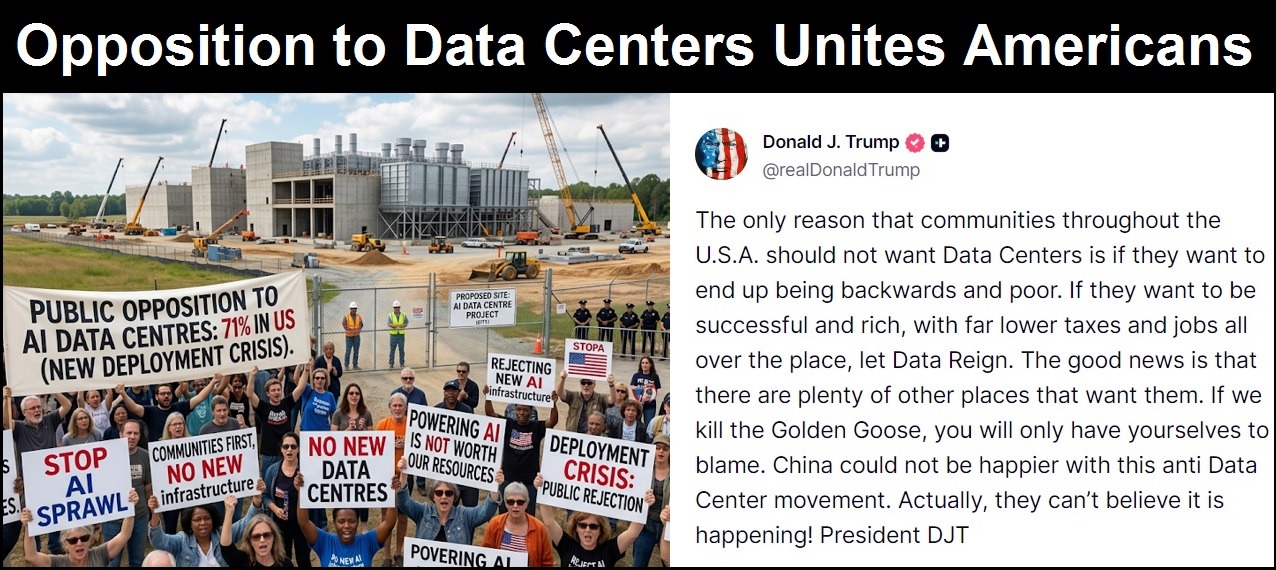
AI Data Center Opposition Unites People Across Political Lines as Trump Attacks Americans Who Oppose Big Tech

by Brian Shilhavy
Health Impact News

Here in 2026 Americans have finally found an issue that unites them as Americans, regardless of political affiliations: opposition to AI data centers being rapidly built in their communities with little to no oversight, as the AI bubble continues to inflate.

According to a recent Gallup poll, 71% of Americans oppose AI data centers near their homes, triggering a wave of legislation that has already stalled $130B in projects.

Americans unite against data centers, with 71% opposing local builds

A Gallup poll conducted in March 2026 found that 71% of American adults oppose building an AI data center near their home, with 48% saying they are strongly opposed.

For historical context, public opposition to nuclear power plants peaked at 63% during the height of anti-nuclear sentiment. Opposition to AI data centers sat somewhere between 42% and 47% in late 2025. By March 2026, Gallup had it at 71%. A separate May 2026 Heatmap Pro poll confirmed the figure, also recording 71% opposition, but with an even sharper edge: 55% of respondents in that survey said they were strongly opposed.

Around half of data center opponents cite electricity and water consumption as their primary grievances. The rest of the opposition cohort points to noise, pollution, and the prospect of higher utility bills.

Gallup found that between 63% and 75% of both Republicans and Democrats oppose local data center construction.

In the first quarter of 2026 alone, community and legislative actions blocked or delayed more than 75 data center initiatives, representing over $130 billion in planned investment.

Roughly 300 state-level bills targeting data center regulation were introduced in the first half of 2026. New York’s governor signed an executive order in July 2026 pausing new hyperscale data center permits for a year. California and other states are advancing their own regulatory frameworks.

Source.

One has to wonder what is up with the other 29% of Americans who are not opposed to these data centers? I would imagine that they are the “faithful MAGA base” who continue to “trust the plan” and cheer the bombing of innocent people, including children, in places like Gaza, Lebanon, and Iran as they continue to worship their Pedophile in Chief, Donald Trump.

Donald Trump has attacked these Americans who make up over 70% of the country, stating that “The only reason that communities throughout the U.S.A. should not want Data Centers is if they want to end up being backwards and poor.”

If you do not live in a community where a new data center is being constructed, and are wondering what all the fuss is about, I have put together a short video that is just over 10 minutes long where you can hear it from the people themselves in these communities that Trump has belittled.

Fox News and some other Right-wing Conservative groups are trying to cast these people who oppose data centers as being part of the “far-left”.

So listen to these people yourself and see if they sound like “far-left” climate control freaks, or if they sound like ordinary, average Americans concerned about their homes, their families, and their future with Big Tech in control. (Video also can be watched here.)

Ohio is one of the largest battlegrounds where this is happening, as both Larry Ellison’s Oracle and Facebook parent company Meta are each building huge data centers in their state.

One of the most outspoken persons in Ohio, who was the last one who spoke in the video above, is Carl Setzer, who accurately stated that there is a huge AI bubble, and that there is no guarantee that any of these companies will even be around in 10 years.

And the current facts backup Setzer’s concerns.

Larry Ellison, the billionaire Zionist friend of Donald Trump and owner of Oracle, has already lost hundreds of billions of dollars with his investing into AI.

One analyst has already stated that the AI bubble is 17 times larger than the dot-com bubble, and four times the size of the 2008 real-estate/subprime bubble.

Oracle’s Massive AI Bet Has Already Cost Larry Ellison $207 Billion. Analyst Warns the AI Bubble Is 17 Times Bigger Than the Dot-Com Bubble.

Larry Ellison’s Oracle gambled its balance sheet on an AI future that analysts are now calling the most dangerous financial bubble in history, and the bill is coming due faster than anyone expected.

by AJ Tiarsmith
24/7 Wall Street

Excerpts:

Larry Ellison has lost $207 billion in less than a year.

Oracle’s market value has fallen by roughly $494 billion since peaking at $877.1 billion in September 2025.

Oracle’s Q4 8-K reported Remaining Performance Obligations of $638 billion, up 363% year-over-year, most locked into long-dated contracts that will not convert to cash for years.

A large chunk ties to OpenAI, whose IPO has slipped to 2027.

S&P Global downgraded Oracle’s credit rating, warning the buildout might pay off long term but could weaken near-term financial position. Melius Research questioned whether Oracle’s spending plans hold if OpenAI or Anthropic scale back demand for compute.

Sitting behind all of it: Project Stargate, a plan to invest up to $500 billion in AI-focused data centers over four years.

The 17x Thesis

In October 2025, Julien Garran, partner at UK firm MacroStrategy Partnership, published a report arguing the AI investment frenzy is a “misallocation of capital” 17 times the size of the dot-com bubble and four times the size of the 2008 real-estate/subprime bubble.

He called it

“the biggest and most dangerous bubble the world has ever seen.”

His “golden rule” case: large language models are statistical word-prediction engines with architectural limits, coding tools reproduce rote patterns, and capability has hit a “scaling wall” since GPT-4 launched in March 2023.

Garran’s answer to “who is actually making money” is blunt: only NVIDIA. Data-center operators, LLM developers, and LLM-based software vendors are, in his framing, “all heavily loss-making” and depend on a “permanent funding tour” of new rounds, with SoftBank and sovereign funds like Saudi Arabia’s serving as backstops.

Full article.

The Great Reset is coming.

And thanks to The Leah Files, we now know the plan that has just been executed by Treasury Secretary Scott Bessent and Secretary of Commerce Howard Lutnick to kill the U.S. dollar and replace it with crypto Stablecoins. See:

Treasury Secretary Scott Bessent Just Restructured The American Financial System to Destroy the U.S. Dollar

This article was written by Human Superior Intelligence (HSI)

See Also:

Understand the Times We are Currently Living Through

Second Edition of eBook Released: The Concept of the American Christian Family is a Myth and is NOT Found Anywhere in the Bible – by Brian Shilhavy

FREE eBook! Restoring the Foundation of New Testament Faith in Jesus Christ – by Brian Shilhavy

The Brotherhood of Satan vs. The Brotherhood of Jesus Christ

KABBALAH: The Anti-Christ Religion of Satan that Controls the World Today

Exposing the Christian Zionism Cult

The Bewitching of America with the Evil Eye and the Mark of the Beast

Jesus Christ’s Opposition to the Jewish State: Lessons for Today

Identifying the Luciferian Globalists Implementing the New World Order – Who are the “Jews”?

The Brain Myth: Your Intellect and Thoughts Originate in Your Heart, Not Your Brain

What is the Condition of Your Heart? The Superiority of the Human Heart over the Human Brain

The Seal and Mark of God is Far More Important than the “Mark of the Beast” – Are You Prepared for What’s Coming?

The Satanic Roots to Modern Medicine – The Image of the Beast?

Medicine: Idolatry in the Twenty First Century – 10-Year-Old Article More Relevant Today than the Day it was Written

Having problems receiving our emails? See:

How to Beat Internet Censorship and Create Your Own Newsfeed

We Are Now on Telegram. Video channels at Bitchute, and Odysee.

If our website is seized and shut down, find us on Telegram, as well as Bitchute and Odysee for further instructions about where to find us.

If you use the TOR Onion browser, here are the links and corresponding URLs to use in the TOR browser to find us on the Dark Web: Health Impact News, Vaccine Impact, Medical Kidnap, Created4Health, CoconutOil.com.

The post AI Data Center Opposition Unites People Across Political Lines as Trump Attacks Americans Who Oppose Big Tech first appeared on Health Impact News.

  •  

What if America Went Completely Dark?

More than a decade ago, a group of snipers shot up an electrical substation in Silicon Valley, striking power transformers and disabling the substation for nearly a month. The shooters were never identified; similar substation shootings, some by neo-Nazis, have taken place since. The longer Christopher Cox studies the American power grid—looking at aging infrastructure and ongoing transformer shortages, specialized manufacturing and rising demand, the massive energy consumption of data centers and whiplash usage of large language models—the more vulnerable it seems. “Somehow, we’ve made the industrial equivalent of a Fabergé egg the linchpin of our civilization,” Cox writes. “What would happen if someone started breaking them?”

The hope of restoring the grid would fade as fossil fuel supplies were exhausted, because so many utilities rely on them to “black-start” their generating units. A 2010 report called “High-Impact, Low-Frequency Event Risk to the North American Bulk Power System,” prepared by the Energy Department and NERC, condensed the entire disaster movie that would follow into a single paragraph: “The supply of food, water and fuel would degrade within days. The facile communication of information to the general population would be greatly complicated by the loss of cellphones, internet access and television. The economy would virtually shut down as electronic transactions could no longer be processed. After several days, widespread social unrest and confusion would ensue.” Thirsty, starved, dirty and surrounded by the useless machines we once depended on, we would be lucky if our misery ended at “confusion.”

  •  
❌