Joel Kaplan, Meta's chief global affairs officer, is leaving, Meta confirmed to Business Insider.
Kaplan, a Republican who once worked for the Bush administration, spent 15 years at Meta.
Kaplan helped bridge ties between Meta CEO Mark Zuckerberg and President Donald Trump.
A longtime political operative at Meta who played a key role in bridging ties between the company and President Donald Trump's administration is leaving.
Joel Kaplan, Meta's chief global affairs officer, will leave after the midterm elections and a transition period, Axios first reported. Meta confirmed the report to Business Insider.
A veteran Marine Corps artillery officer, Kaplan is a Republican who served as an advisor and deputy chief of staff to former president George W. Bush.
Kaplan joined Meta in 2011. At Meta, he oversaw the company's response to policy issues ranging from the Cambridge Analytica scandal to the end of its fact-checking program.
Kaplan helped repair a once-fraught relationship between Meta CEO Mark Zuckerberg and Trump after Meta temporarily suspended Trump's account following the January 6 riot.
Kaplan posted on X on Tuesday that he plans to spend time with his family and figure out what to do next.
Kaplan didn't respond to a request for comment from Business Insider.
Kaplan has served as Meta's chief global affairs officer since 2025, succeeding former UK politician Nick Clegg. Other Meta executives will share his responsibilities, Axios reported.
Have a tip? Contact this reporter securely on Signal at charlesrollet.12 or +1-628-282-2811. Use a personal email address and a non-work device; here's our guide to sharing information securely.
Nvidia CEO Jensen Huang urged Europe to move faster on AI in a conversation with Germany Chancellor Friedrich Merz on Monday.
Nadja Wohlleben/Getty Images
Nvidia CEO Jensen Huang wants Europe to be less cautious in its approach to AI innovation.
Huang told Germany's chancellor that the country and others in Europe are overreliant on regulation.
"I think you overthink things," he told British journalists on a trip to the UK last week.
Cast off the shackles and be bolder, or risk losing the AI race for good.
That's the pointed message Nvidia CEO Jensen Huang has delivered to European leaders during his trip to the continent over the past week.
Over the last seven days, Huang has visited France, Sweden, the UK, and Germany ahead of Nvidia's GTC event in Berlin, which began Tuesday.
During that time, he's been clear that he believes the continent needs to move faster on artificial intelligence and rely less heavily on regulating the sector.
Huang made the case most directly on Monday evening in Berlin, during a public conversation with German Chancellor Friedrich Merz.
Asked how Europe should regulate AI, Huang said safety had to be paramount, but cautioned that policymakers could not regulate their way to technological leadership.
"There's nothing to regulate if the industry doesn't thrive," Huang told Merz, arguing that Germany needed to foster a domestic AI industry while ensuring it developed safely and responsibly.
He said that policymakers should focus on regulating AI applications, similar to the way they regulate products that use the internet, rather than trying to regulate the underlying technology wholesale.
"We should be regulating the applications right away," Huang said.
Merz replied that Europe was still trying to find the balance between innovation and regulation. The German leader said he did not believe "no regulation" was the right answer, but that overly tight rules were not either.
Huang’s response: "Give Germany a chance. Give this industry a chance."
The exchange came as Huang and Merz pitched AI as a potential answer to the economic malaise that led Germany into recessions in 2023 and 2024.
Huang said the country's manufacturing sector, engineering expertise, and industrial know-how are national resources, and that AI could help its companies turn them into an advantage in the next phase of the technology race.
"The next wave of AI is physical," Huang said, referring to robotics, manufacturing, cars, and heavy industry. "Electrons will never replace atoms."
It was the same urgent message Huang had delivered in London days earlier. Speaking to reporters last week, Huang said there was a "strange general behavior" going on in the UK.
He took a swipe at what he described as Britain’s tendency to dwell on failure.
"You have smart people, you have a great culture, you have young people, and the energy is vibrant. But for some reason, if there was a million reasons to win, you find the one reason not to do it."
"I think you overthink things," he added.
The remarks underscore a familiar tension in Europe’s approach to AI. The continent has moved early to establish sweeping rules for the technology, including the EU AI Act, while the US and China have pulled ahead in developing frontier models and the infrastructure needed to train them.
Huang, whose company dominates the market for the advanced chips powering the AI boom, is hardly a neutral observer. Nvidia stands to benefit enormously if governments and companies move faster to build AI infrastructure and deploy its technology.
Regardless of his stake in Europe's AI success, Huang's message was blunt. If the continent spends too long debating how to regulate AI, it may find that the meaningful innovation is done elsewhere.
Prasad Kalyanaraman, vice president of infrastructure services at Amazon Web Services
BASTIEN INZAURRALDE/AFP via Getty Images
Amazon is on an unprecedented spending spree to build more AI data center capacity than anyone else.
The company has extensive experience, yet even it's struggling to bring capacity online fast enough.
Internal documents show Amazon getting bilions of dollars of Nvidia GPUs before they can be deployed.
At an internal staff meeting in September, AWS CFO John Felton had a joke for Prasad Kalyanaraman, the executive overseeing much of Amazon's AI infrastructure expansion.
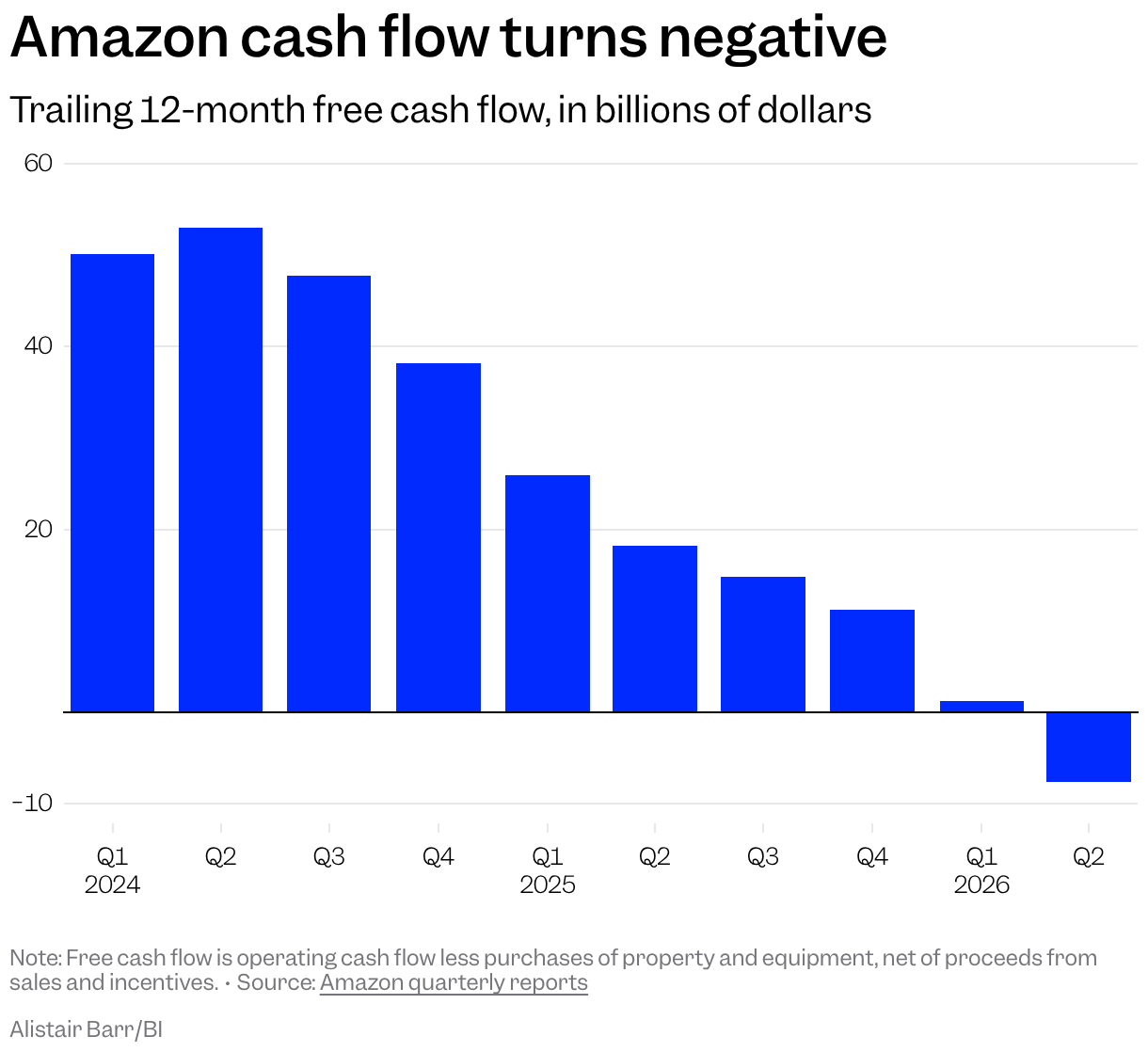
"You've taken us free cash flow negative as a company, so congratulations," Felton said, according to a recording of the meeting obtained by Business Insider.
The remark was lighthearted. But it captured a stunning reversal.
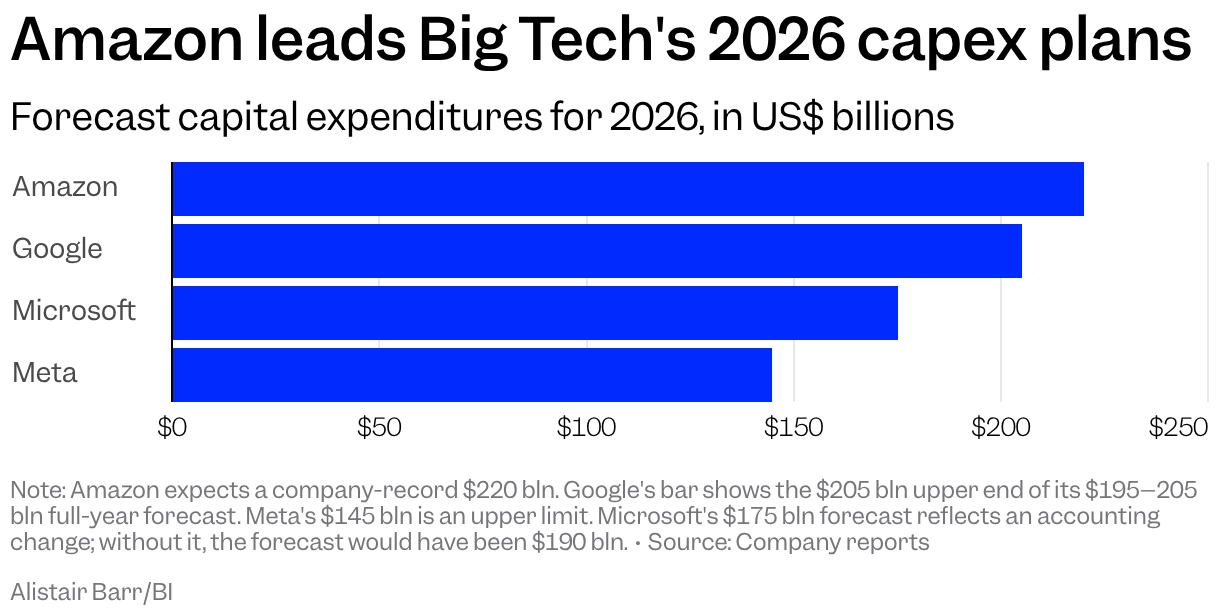
Just two years ago, Wall Street was debating what Amazon would do with its growing cash hoard. Now, cash flow has evaporated as Amazon embarks on its biggest bet ever, spending $220 billion this year alone to build the physical backbone for AI.
At the meeting, Kalyanaraman did not dispute Felton's premise. Amazon's machine-learning and AI business is "hugely free cash flow negative," he said, adding that he expects the company's free cash flow to remain negative for "the next couple of years or so."
Amazon has made big bets before. It spent heavily on cloud computing, fulfillment centers, and its delivery network long before they became some of the company's most valuable assets. Investors questioned those investments at the time, but Amazon ultimately built enormous, profitable businesses from them.
AI is testing this playbook at a far larger scale. Amazon is committing hundreds of billions of dollars to data centers, servers, and power before investors know how quickly those investments will generate revenue.
The company is the best, or among the best, at building data centers, with decades of experience. But the size and complexity of these projects, and the bottlenecks holding progress back, are challenging — even for such a respected cloud pioneer.
Internal documents reviewed by Business Insider and people familiar with the matter show the company trying to coordinate a sprawling industrial system whose parts move on different schedules. A delay in power, equipment, or construction can leave billions of dollars in hardware waiting — and Amazon's cash tied up — while forecasts and costs keep shifting.
Why Amazon thinks it will work
Amazon says it has strong evidence that the capacity will be needed. AWS revenue grew 37% in the second quarter, its fastest pace in 18 quarters, while its backlog reached $496 billion.
CEO Andy Jassy thinks the company has a "clear line of sight" to strong financial returns from this record investment cycle. In his latest annual shareholder letter, he called AI a "once in a lifetime opportunity" and said Amazon would not be conservative in its investments.
"We've been through this cycle with the first big AWS growth wave, and liked the results," Jassy wrote. "We expect to feel similarly about this next wave."
Investors are concerned by the scale of the industry's expansion, especially as AI data centers are costing more to build and taking longer to complete.
The market is "repricing anything that funds multi-year builds against revenue that arrives later," Dan Ives, an analyst at Yorkville Ives, wrote in a recent report. Growing uncertainty around data center permitting and the political fight over electricity prices have given investors another reason to question how quickly these investments will pay off, he added.
Racks, but not enough power
One major industry challenge is securing enough power to run the equipment that goes inside data centers. This includes expensive racks of servers that contain GPUs and other chips that train and run AI models and services such as ChatGPT.
Internal emails from August show Amazon preparing a new "Early Rack Receipt" process for an expected wave of server racks carrying Nvidia's GB300 chips at US facilities before final deployment.
One Amazon email projected the company would take delivery of about $5 billion of Nvidia GB300 racks in August, followed by another roughly $3 billion each month "for the foreseeable future."
Some AWS data center sites had room for more racks but not enough available power to turn them on, people familiar with the effort said, leaving the equipment to be staged at intermediary warehouses until the facilities were ready. These people asked not to be identified discussing sensitive matters.
Timing and coordination
Usually, Amazon doesn't pay for racks until the gear is put into a data center, leaving suppliers to carry the cost of the equipment in transit, according to the internal documents obtained by Business Insider. This helps the company conserve cash.
However, the intensity of the AI data center building boom has made this type of coordination harder. Amazon has to compete more for scarce resources as it jockeys with rivals for access to Nvidia GPUs and other AI components.
Under the new "Early Rack Receipt" process, Amazon now takes ownership of these racks earlier in the supply chain, rather than waiting until the equipment reaches a data center.
The means spending cash sooner. And any delays getting the racks installed and plugged into a reliable power source potentially pushes back the moment when revenue starts flowing from these assets.
At least one AWS supply chain team did not have "a clear forecasted path" for getting racks into data centers, according to one of the emails reviewed by Business Insider.
An Amazon spokesperson said the company routinely stages finished hardware near deployment sites so it can be installed once power capacity is available, calling that approach "best business practice."
The spokesperson added that AWS has "long-established systems" to track infrastructure assets and disputed that the broader company lacks a forecasted path for getting racks into data centers.
This problem is not unique to Amazon.
Bernstein analysts wrote in a recent note that power permits, cooling systems, electrical equipment, construction, and hardware all move on separate schedules.
"Timing is imperfect," the analysts said.
"Inherently uncertain"
John Felton, Chief Financial Officer of Amazon Web Services
Chris Jung/NurPhoto via Getty Images
During the internal staff meeting in September, Felton, the AWS CFO, described the broader problem eloquently: "How do you work in the future when the future is inherently uncertain?"
Kalyanaraman, the AI infrastructure leader, said Amazon's internal outlook for the return on its AI investments had improved. But the assumptions behind those returns keep shifting.
"The forecast is changing on a daily basis," Kalyanaraman said. "The world that we live in is extremely dynamic."
Those shifting assumptions include when data centers will be ready and how much equipment AWS needs to keep on hand, he explained.
An eight-week supply buffer might be routine for a smaller company. But at Amazon's scale, Kalyanaraman said, this could mean holding "billions and billions of dollars" worth of additional equipment inventory — tying up precious cash.
Frugality meets the AI boom
Such tensions are especially striking for Kalyanaraman, a 21-year Amazon veteran who earlier this year was promoted to the elite S-team that reports directly to Jassy.
Amazon's founding story is defined by frugality. It famously used cheap doors as desks when founder Jeff Bezos started in Seattle in the mid-90s.
Kalyanaraman has absorbed this lore into bones. In late 2023, as AWS faced slower growth and layoffs, he urged employees to do more with less. "Frugality breeds innovation," he said back then.
That instinct still shapes his approach. In the September meeting this year, Kalyanaraman told Felton that AWS tries to make major investments at the "last responsible moment," when it has the clearest possible view of demand.
"If we can wait to spend the capital as late as possible, it's better for us," he said.
Amazon CEO Andy Jassy
Bloomberg/Getty Images
But the frenetic pace of the AI boom makes this principle difficult to follow. By the time demand is fully visible, the servers, power, and construction capabilities that AWS needs may no longer be available. That puts pressure on the company to commit more money sooner to secure supply and meet its data center capacity goals.
Kalyanaraman recalled telling Jassy in 2023 that AWS would "surely" be out of its capacity crunch by 2027. Instead, Amazon still expects demand to exceed its available capacity in 2027, the AI infrastructure chief said during the meeting this September.
Secured Power at Risk
Getting enough electricity may be the biggest challenge for an industry leader like Amazon.
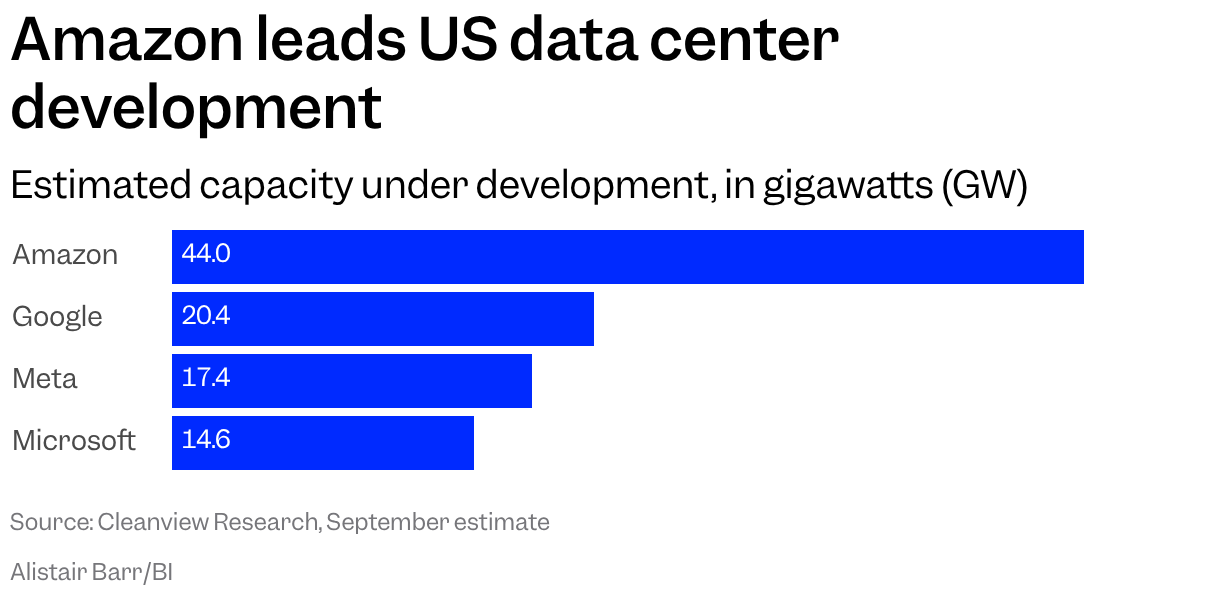
The company has 44 gigawatts of data center capacity under development across 16 states, more than double Google, Meta, and Microsoft, according to Cleanview Research estimates.
An internal AWS dashboard called "Secured Power at Risk" tracks utility and regulatory constraints affecting electricity capacity AWS has lined up for its data centers.
The risks include transmission bottlenecks, requirements to reduce use during grid stress, and "use it or lose it" provisions that can jeopardize capacity if a data center project misses usage or construction milestones.
In other words, AWS is not simply waiting for electricity to arrive. It is managing a portfolio of commitments that can become more costly if a data center project is delayed.
Maryland proposals
A submission to Maryland's utility regulator last year, obtained through a public records request, illustrates the kind of exposure that can accompany massive data center buildouts.
Amazon told the Maryland Public Service Commission that large data center customers could help pay for grid upgrades or bring new power capacity to market without burdening other electricity ratepayers.
The company also proposed setting aside collateral to help utilities get more comfortable with the large investments needed to generate more electricity for data centers. Amazon proposed three years of collateral so that if a large electricity customer abandoned unused capacity, the utility would have time to re-sell the power.
The proposal is not evidence that AWS has made such a payment or posted collateral. It does, however, show that large data centers can face extra financial obligations, beyond their own electricity bills, if projects are delayed or cancelled.
The Amazon spokesperson said such utility rules are not unique to AWS. The company has not disclosed how much cash it has paid upfront to secure power.
New constraints 'keep popping up'
The AI buildout also incurs expenses that are harder to model than a conventional capex plan.
In the September meeting this year, Kalyanaraman said that while reviewing plans for gigawatts of capacity in West Texas, AWS confronted a labor problem: There weren't enough nearby pipefitters, electricians, and other skilled workers to build the facilities.
The company's response, he said, was to pay to construct housing complexes near its data centers so workers could live there for the two or three years needed to complete the projects.
Even the crates used to ship servers have become a planning issue. It may seem absurd to worry about the price of a container when servers cost hundreds of thousands of dollars, Kalyanaraman said. But at AWS's scale, where the company needs so many crates, even trivial items can become a material expense.
"We have new constraints that keep popping up," Kalyanaraman said.
Nvidia's communications operation has been reshaped as the company became the face of the AI boom.
Roughly 15 staffers have left the lean team since 2025 as Nvidia reorganized its communications org.
Former employees described growing workloads as responsibilities expanded.
Nvidia's communications organization has been reshaped as the company became the face of the AI boom, with multiple teams brought under new leadership and a string of departures.
Business Insider identified roughly 15 communications employees who have left Nvidia since 2025, based on LinkedIn profiles and interviews with former employees.
The organization now numbers roughly 70 to 80 people globally, and has more than doubled in size since Mylene Mangalindan joined as vice president of corporate communications in 2023, according to a person close to the company.
The departures have also included newer hires. Anna Soellner, who was recruited to lead corporate communications, left after roughly four months, Business Insider previously reported.
Nvidia is known for high retention. It reported companywide turnover of 3.7% in fiscal 2026, up from 2.5% the prior year, and well below the tech industry average of 21.9% cited in its latest sustainability report.
Mangalindan succeeded longtime communications chief Bob Sherbin, who retired in 2024. She previously worked at the advisory firm Brunswick Group.
She was brought in to "bring fresh blood" and "upgrade the team" to meet Nvidia's growing profile, one former employee said.
At the end of 2024, Nvidia restructured its communications organization. It brought enterprise public relations under Mangalindan's leadership alongside the corporate communications team she already led, according to two former employees.
Corporate communications focuses on Nvidia's reputation and major media outlets, while enterprise handles product and industry messaging,including for its data center business.
One former employee said the consolidation reflected the growing importance of Nvidia's data center business, which sells chips and systems that power AI and had become its biggest revenue driver.
Analyst relations, social media, and influencer marketing also moved under Mangalindan's remit this year, another former employee said.
Three former employees said Nvidia's communications team had long operated with relatively lean staffing, even as workloads grew alongside the company's public profile, leaving staff juggling multiple responsibilities.
These employees said they experienced long hours, difficulty taking time off, and pressure to respond quickly to emails and Slack messages.
A person close to Nvidia said the company's lean staffing allows employees to move quickly and also requires long hours. The person said Mangalindan encourages staff to take vacation, though the team's small size can make scheduling time off difficult, particularly in the summer.
Nvidia is widely known for its demanding work environment. CEO Jensen Huang has emphasized operating at the "speed of light" and is known for fostering a culture of constant accountability.
Have a tip? Contact this reporter via email at gweiss@businessinsider.com or Signal at @geoffweiss.25. Use a personal email address, a nonwork WiFi network, and a nonwork device; here's our guide to sharing information securely.

 Login