AWS expected to get $5 billion of Nvidia GB300 racks, followed by $3 billion more each month.
Some of these GPU systems are being stored elsewhere due to lack of data center power.
Amazon CEO Andy Jassy sees AI as a major opportunity, but getting capacity online is a challenge.
Amazon is racing to secure AI hardware earlier than before, even as data center power shortages leave some GPU systems waiting in warehouses.
Under a new Early Rack Receipt process, AWS expected to receive roughly $5 billion in Nvidia's GB300 server racks at US facilities before final deployment, according to August internal emails reviewed by Business Insider. The company projected roughly $3 billion more in GB300 racks each month "for the foreseeable future," one of the emails said.
Some AWS sites had room for more racks but not enough available power to turn them on, people familiar with the effort said, leaving finished equipment to be staged at intermediary warehouses until the facilities were ready.
At least one AWS team did not have "a clear forecasted path" for getting the incoming racks into data centers at the time, according to one of the emails.
Dark GPUs
A lack of new electricity capacity is one of several bottlenecks slowing the buildout of some AI data centers. This has led to a phenomenon known as dark GPUs, where AI chips and servers are purchased but can sit idle due to power supply issues or other challenges. (Dark GPUs can also refer to system design flaws that mean this gear isn't fully used after being plugged in).
This is partly why financial pressure is mounting on big data center projects. Money must be spent upfront to secure supplies of Nvidia GPUs and other valuable AI components. But if some data centers aren't ready to run, those early investments can tie up huge amounts of cash. Debt financing can fill in the gaps, but the market has become less willing to lend against some of these projects lately.
Trade-off
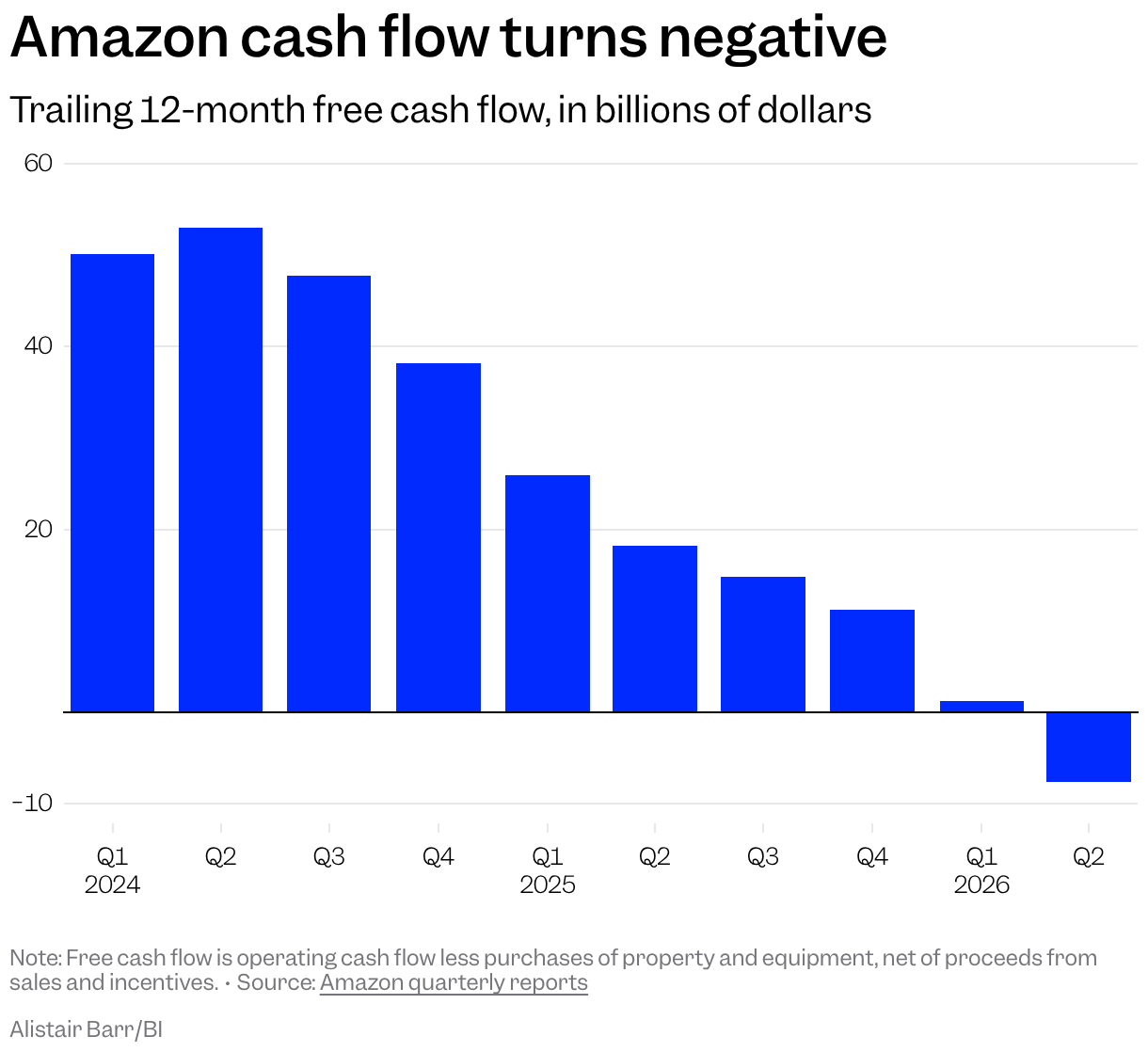
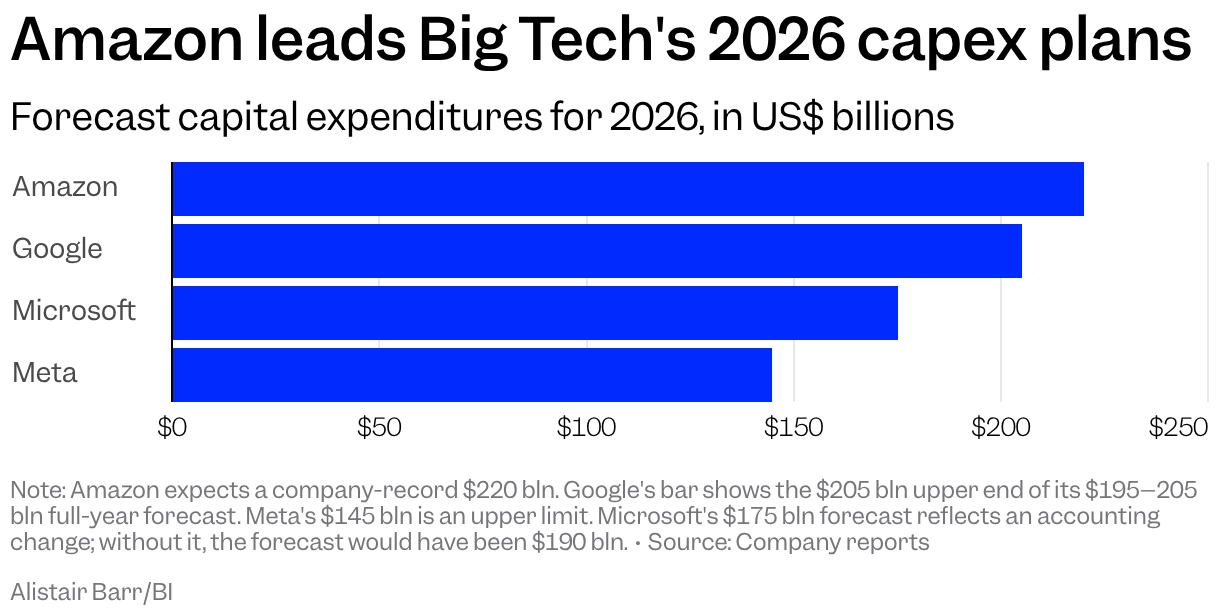
Amazon's early-rack program is one piece of the cloud leader's broader AI buildout, which is putting new pressure on its cash flow, as Business Insider exclusively reported this week. Amazon expects roughly $220 billion in capital expenditures this year — more than any Big Tech peer. Its free-cash-flow turned negative last quarter for the first time since 2023, and could stay negative for a while.
For AWS, the trade-off is securing scarce GPU racks before competitors do, even if some data centers are not yet ready to turn them on. But taking ownership earlier can tie up billions in equipment before it starts generating cloud revenue.
Previously, AWS took ownership of a finished rack only upon delivery to a data center, according to internal documents. Under the new approach, it can pay for and record certain racks earlier in the supply chain.
An Amazon spokesperson said the company routinely stages finished hardware near deployment sites so it can install it once capacity becomes available, calling the practice "best business practice." The spokesperson added that Amazon has long-established systems for tracking infrastructure assets and disputed that the broader company lacked a path for getting racks into data centers.
Amazon CEO Andy Jassy previously said the company has a "clear line of sight" to strong returns from its AI investments, calling the technology a "once in a lifetime opportunity."
"We've been through this cycle with the first big AWS growth wave, and liked the results," Jassy wrote in Amazon's annual shareholder letter. "We expect to feel similarly about this next wave."
Emma Tucker has been involved in a video push at The Wall Street Journal.
John Nacion/Variety via Getty Images
The Wall Street Journal has been planning a big streaming TV push with an ambitious slate of shows.
It's explored shows around editor in chief Emma Tucker and creators like Feed Me's Emily Sundberg.
Sundberg dropped out of talks a few weeks ago, Business Insider has learned.
The Wall Street Journal has been ramping up its push into video and had plans for an ambitious slate of streaming TV shows.
Internal documents viewed by Business Insider described an initial six-series offering that would include a flagship live morning program and an interview show hosted by the Journal's editor in chief, Emma Tucker. The docs are from the summer, and a person familiar with the Journal's strategy said that its plans, including dates and partners, are in flux.
The docs said the Journal had been "in negotiations" with creators such as Feed Me Substacker Emily Sundberg, as well as with the restaurant discovery platform The Infatuation. Sundberg dropped out of the talks a few weeks ago, Business Insider has learned.
The plans called for the shows to launch on the Journal's own channels, YouTube, and social media.
Journal parent company Dow Jones is also hiring a head of programming and content, who would be tasked with building "something ambitious in video." The live job description says the role will pay up to $330,000 in base salary, and involve developing talent that includes employees and external creators, translating the company's journalism into streaming formats, and creating live and on-demand shows.
The Journal and Dow Jones's effort shows how news outlets traditionally known for the written word — including The New York Times — are racing to beef up their video offerings in a media landscape that's seeing both the rise of social video and the decline of cable TV news. It also demonstrates that Tucker is taking a flexible approach to the market by looking to both build shows around in-house talent, including herself, and partner with creators and other media companies.
"Expanding our video presence across Dow Jones and The Wall Street Journal is a major strategic priority, as we have widely communicated," a Dow Jones spokesperson said. "We are actively hiring leadership to shape and execute our go-to-market strategy for video across Dow Jones, and we look forward to sharing our updated plans when ready."
The Journal explored a show with Substacker Emily Sundberg.
Aurore Marechal/Getty Images for The Business of Fashion
The Journal name-checked familiar figures
The internal docs viewed by Business Insider described the live morning show as a 60-minute-long anchor of the initial slate. The docs said the Journal enlisted some familiar names in morning news and videoto help execute the show. They said the Journal has been working with the production company EverWonder, which was cofounded by the former Time Studios executive Ian Orefice with backing from Jeff Zucker's RedBird IMI.
Another show in the proposed slate in the docs was "The Exchange with Emma Tucker," which was billed as a "prestige interview franchise" that would put viewers "in the room with the people running the global economy." The documents name-checked top CEOs, including Microsoft's Satya Nadella, JPMorgan Chase's Jamie Dimon, and BlackRock's Larry Fink, as potential guests.
The person familiar with the Journal's strategy said the documents represented one of a number of different avenues the outlet was exploring and didn't reflect the current status and form of its efforts. The person said the company is in active conversations with a number of external people for potential partnerships.
The documents said the Journal had been "in negotiations" with Sundberg — which have since ended — for a show called "Feed Me, On Camera" that would introduce her "highly engaged, younger creator audience to WSJ while bringing WSJ's scale, authority, and affluent professional audience to her world." The docs envisioned each episode beginning with a "tip, obsession, or question from the Feed Me universe," and following Sundberg to its conclusion while integrating business context and reporting from the Journal.
Other shows the docs said the Journal had explored included one called "Market Price with The Infatuation" that would tackle the "business behind taste, literally." It would combine the cultural authority and young audience of The Infatuation, now owned by JPMorgan Chase, with the Journal's business reporting chops.
Another was "Inside Sports" ("title to change"), a "next generation reboot of 'Real Sports' for the sports-as-an-asset class era," potentially helmed by Emmy-winning TV journalist Armen Keteyian.
The documents said the Journal had been "in negotiations" with The Infatuation and "in discussions" with Keteyian. Business Insider could not confirm the status of those discussions.
The last series listed in the docs was an AI show that aimed to get a big-name host.
The docs said the Journal was in talks with TV journalist Armen Keteyian to helm a sports show.
Patrick McMullan/Patrick McMullan via Getty Images
The Journal compared its plans to 'The Daily'
In the docs, the Journal expressed big ambitions for a live morning news show, and said there had been "nothing new" in the category for a professional audience "in a decade." The last entry on a timeline included in the planning docs was The New York Times' "The Daily" in 2017, which has become a reliable top show on the podcast charts and one of the paper's most successful launches.
"We see an opportunity to reinvent the category," the documents said. The Journal also has its own daily news podcast, called "The Journal."
Like the Times, the Journal is in a rare position in a challenged media environment to make a transformative investment. The Journal, part of Rupert Murdoch's News Corp., is profitable, helped by an early move to paywall its journalism.
The documents said that in its video push, the Journal aimed to produce 20 hours of video a week, expand to a free, ad-supported streaming (FAST) channel, and add subscription options and other formats as demand warranted. Between WSJ TV, existing video shows, licensed shows, and co-productions with creators, the Journal aspired to be an "always-on streaming channel." The person familiar with the Journal's strategy said those goals didn't represent its current plans.
The Journal wanted to make an impact on the level of The New York Times' "The Daily," hosted by Michael Barbaro.
Roy Rochlin/Getty Images for Tribeca Festival
Tucker took the helm at the Journal in 2023, moving from the Murdoch-owned UK Sunday Times with a plan to increase engagement with the Journal's digital products. Digital subscriptions rose 8% to 4.5 million in the three months ended June 30 versus the year-ago period. She has called for more lively writing and enterprise reporting. The Journal had already begun to reorient its video strategy under its former head of video Maral Usefi. Under Usefi, the video team had grown by a third, to 65 people, as of April. She was succeeded by Samantha Henig, who was hired in July to lead a new multimedia team.
The docs said that with the Journal's new effort, it aimed to combine its authority and scale with the personality of creator-led media and modern distribution. In terms of audience, it intended to reach a younger viewership than the traditional business TV audience and more decision-makers than creator-led media.
It projected reaching about 75 million viewers through Dow Jones' social reach, upward of 5.6 million monthly watch hours by its 2028 fiscal year, and ad rates that were three to five times what business content on YouTube commands. The person familiar with the Journal's strategy didn't say if those figures represented its current ambitions.
The Journal made a big push into original video more than a decade ago, including the launch of video app WSJ Live in 2011 and expanding to episodic video doc series. Publishers overall have newly reprioritized video amid the rise of short-form content, YouTube's increasing popularity on TV screens, and the success of new live shows like TBPN.
While embracing creator talent — and getting its own staff involved in video content — could help the Journal reach a younger audience, it comes with risks. Journalists who become on-camera talent can often command higher paydays, or defect to start their own ventures, like The New York Times' "Hard Fork" hosts Kevin Roose and Casey Newton did recently. Creators often have their own audiences, which give them leverage over a news organization that staff reporters might not have.
Flagship video shows are also expensive to produce, which makes high ad rates crucial to the Journal's success with this slate. The internal docs explored pitching a variety of ways for advertisers to get involved, including as launch partners, with category-exclusive partnerships, and as "moment partners" tied to major news events like elections, earnings, and WSJ specials.
Google is injecting more AI into the interview process.
The company has been testing a new format that tests candidates on their AI fluency.
The pilot has recently rolled out more broadly across Google, internal docs show.
AI is changing how Google employees work — and how Google hires them.
The company has been testing several AI-related changes to its hiring process for software engineers, according to documents reviewed by Business Insider. These changes, which Google has been rolling out in phases throughout this year, include allowing the use of AI in coding interviews and permitting interviewers to use Gemini to give candidates feedback.
Many engineers are also now expected to show some degree of AI fluency as a bare minimum, the documents show.
In May, Business Insider reported that Google was piloting ways to integrate AI into the interview process with a small handful of orgs. This included a new "code comprehension" interview in which candidates are assessed on AI fluency and prompt engineering. Candidates can also use Google's Gemini AI as an assistant during the interview.
The new formats have since been rolled out more broadly across the company, according to the internal documents. However, a spokesperson said they were still considered to be in the pilot phase for now.
"We're piloting updates to our interview process for software engineers, including evaluating for AI fluency, to be more reflective of how our teams are operating," Brian Ong, vice president of recruiting at Google, told Business Insider in a statement.
Like other companies, Google is adapting its hiring process to keep pace with the huge transformation AI is having on software engineering. As developers increasingly rely on AI coding assistants, hiring companies want to know how competent they are with these tools.
In April, Google said that three-quarters of new code created at the company is generated by AI and reviewed by humans, a trend that has since continued across the tech industry. Google has said that its employees are increasingly using the company's own Gemini models to both improve other Google products and to build the next generation of Gemini.
The documents say that for some roles, including software engineering, AI fluency and AI product integration are now used as measures of a candidate's abilities. A Google spokesperson said that AI fluency is a requirement for all software engineering jobs, while AI product integration is required for most roles outside entry-level positions.
Google is also piloting the use of Gemini for interview transcription and note-taking in some job interviews conducted via the company's videoconferencing platform, Google Meet, one document shows.
Google wants to speed up the feedback process using AI, too. The same document states that Google is working to enable interviewers to use Gemini to draft role-tailored feedback.
As Google builds out this new interview system, employees were told they may be asked to participate in some of the pilots — but were warned against using AI tools to generate their own interviewing "solutions."
"Do not use GenAI or LLMs to create your own standalone solutions or agents for hiring or interviewing use cases," the document states, referring to large language models.
Housing and Urban Development (HUD) Secretary Scott Turner defended the Trump administration’s efforts to address housing affordability in an exclusive statement to Breitbart News on Monday, as newly released data showed confidence among U.S. homebuilders falling to its lowest level since June 2012 amid rising mortgage rates, construction costs, and weakening buyer demand.
Americans are more likely to get out the vote when the message of the Trump administration is amplified — a mission America First Works (AFW) has been conducting in battleground states, Breitbart News exclusively learned.
On Monday, the Center for American Progress, a left-leaning think tank, released a report showing how President Donald Trump's student-loan repayment overhaul will affect bills and relief for millions of borrowers. The think tank shared the report exclusively with Business Insider.
The student-loan changes, signed into law in Trump's "big beautiful" spending legislation, took effect July 1 and included new income-driven repayment plans and borrowing caps. Borrowers moving from the Biden-era SAVE plan to the new Repayment Assistance Plan, or RAP, could see their student-loan bills increase by $2,163 annually on average, the report said.
For example, the report said a typical borrower with a bachelor's degree with earnings of about $68,615 annually would see their monthly payments increase from $136 to $343. That's a total increase of $2,482 annually, on average.
The findings are based on incomedata from the US Census Bureau's American Community Survey and the Survey of Income and Program Participation, adjusted for inflation using the consumer price index. CAP then estimated how much typical borrowers with different educational circumstances would have to pay under SAVE and RAP based on those plans' rules.
The SAVE plan allowed for lower payments and a shorter timeline to debt relief. The Trump administration eliminated the plan and is requiring borrowers to transition to a new plan, recommending RAP as an option. While the benefits of RAP include waiving unpaid monthly interest, borrowers must make on-time payments — meaning no grace period — to receive them.
Sara Partridge, associate director of higher education at CAP and a coauthor on the report, told Business Insider that while SAVE allowed zero-dollar monthly payments, RAP's minimum payment is $10. "Those $0 payments were a really important protection that many borrowers will struggle without," Partridge said.
For example, per the report, a single borrower without dependents earning $35,000 annually in 2026 would have $0 payments under SAVE. Under RAP, they would owe $88 monthly.
She added that these changes come "at a time when there is high inflation, stagnating wages, and people are generally feeling financially strained," making it more difficult for borrowers to fit a higher monthly bill into their budgets.
Parents and borrowers face increased risk of default
Trump's student-loan repayment overhaul also limits parents' options. Previously, the parent PLUS program allowed parents to borrow up to the full cost of attendance for their kids. Now, parents who took out loans after July 1, 2026, face a lifetime borrowing cap of $65,000. Those new parent borrowers will be limited to the costlier tiered standard repayment plan and will lose access to the income-contingent repayment plan.
Along with higher payments, the repayment overhaul also eliminates all borrowers'ability to defer their loan payments in the event of economic hardship or unemployment, beginning next year.
"This is a tool that borrowers relied on to help them out during times when they were struggling," Partridge said. "And without those options, borrowers may be more likely to become delinquent on their loans or eventually default, which we know can come with some devastating consequences."
Defaulting on federal student loans, which typically occurs after 270 days of nonpayment, can lead to wage garnishment and the seizure of federal benefits, such as Social Security. The most recent data from Federal Student Aid showed that 9.3 million borrowers are in default, with another 1.5 million at risk of defaulting in the next six months.
The Trump administration has said that its changes are intended to simplify a complex repayment system and curb excessive borrowing.
Nicholas Kent, the department's undersecretary, said in a statement that the changes "will ensure students continue to have the access that they need for federal student loans, while helping prevent borrowers from taking on unmanageable debt levels that they may never be able to repay."
Prasad Kalyanaraman, vice president of infrastructure services at Amazon Web Services
BASTIEN INZAURRALDE/AFP via Getty Images
Amazon is on an unprecedented spending spree to build more AI data center capacity than anyone else.
The company has extensive experience, yet even it's struggling to bring capacity online fast enough.
Internal documents show Amazon getting bilions of dollars of Nvidia GPUs before they can be deployed.
At an internal staff meeting in September, AWS CFO John Felton had a joke for Prasad Kalyanaraman, the executive overseeing much of Amazon's AI infrastructure expansion.
"You've taken us free cash flow negative as a company, so congratulations," Felton said, according to a recording of the meeting obtained by Business Insider.
The remark was lighthearted. But it captured a stunning reversal.
Just two years ago, Wall Street was debating what Amazon would do with its growing cash hoard. Now, cash flow has evaporated as Amazon embarks on its biggest bet ever, spending $220 billion this year alone to build the physical backbone for AI.
At the meeting, Kalyanaraman did not dispute Felton's premise. Amazon's machine-learning and AI business is "hugely free cash flow negative," he said, adding that he expects the company's free cash flow to remain negative for "the next couple of years or so."
Amazon has made big bets before. It spent heavily on cloud computing, fulfillment centers, and its delivery network long before they became some of the company's most valuable assets. Investors questioned those investments at the time, but Amazon ultimately built enormous, profitable businesses from them.
AI is testing this playbook at a far larger scale. Amazon is committing hundreds of billions of dollars to data centers, servers, and power before investors know how quickly those investments will generate revenue.
The company is the best, or among the best, at building data centers, with decades of experience. But the size and complexity of these projects, and the bottlenecks holding progress back, are challenging — even for such a respected cloud pioneer.
Internal documents reviewed by Business Insider and people familiar with the matter show the company trying to coordinate a sprawling industrial system whose parts move on different schedules. A delay in power, equipment, or construction can leave billions of dollars in hardware waiting — and Amazon's cash tied up — while forecasts and costs keep shifting.
Why Amazon thinks it will work
Amazon says it has strong evidence that the capacity will be needed. AWS revenue grew 37% in the second quarter, its fastest pace in 18 quarters, while its backlog reached $496 billion.
CEO Andy Jassy thinks the company has a "clear line of sight" to strong financial returns from this record investment cycle. In his latest annual shareholder letter, he called AI a "once in a lifetime opportunity" and said Amazon would not be conservative in its investments.
"We've been through this cycle with the first big AWS growth wave, and liked the results," Jassy wrote. "We expect to feel similarly about this next wave."
Investors are concerned by the scale of the industry's expansion, especially as AI data centers are costing more to build and taking longer to complete.
The market is "repricing anything that funds multi-year builds against revenue that arrives later," Dan Ives, an analyst at Yorkville Ives, wrote in a recent report. Growing uncertainty around data center permitting and the political fight over electricity prices have given investors another reason to question how quickly these investments will pay off, he added.
Racks, but not enough power
One major industry challenge is securing enough power to run the equipment that goes inside data centers. This includes expensive racks of servers that contain GPUs and other chips that train and run AI models and services such as ChatGPT.
Internal emails from August show Amazon preparing a new "Early Rack Receipt" process for an expected wave of server racks carrying Nvidia's GB300 chips at US facilities before final deployment.
One Amazon email projected the company would take delivery of about $5 billion of Nvidia GB300 racks in August, followed by another roughly $3 billion each month "for the foreseeable future."
Some AWS data center sites had room for more racks but not enough available power to turn them on, people familiar with the effort said, leaving the equipment to be staged at intermediary warehouses until the facilities were ready. These people asked not to be identified discussing sensitive matters.
Timing and coordination
Usually, Amazon doesn't pay for racks until the gear is put into a data center, leaving suppliers to carry the cost of the equipment in transit, according to the internal documents obtained by Business Insider. This helps the company conserve cash.
However, the intensity of the AI data center building boom has made this type of coordination harder. Amazon has to compete more for scarce resources as it jockeys with rivals for access to Nvidia GPUs and other AI components.
Under the new "Early Rack Receipt" process, Amazon now takes ownership of these racks earlier in the supply chain, rather than waiting until the equipment reaches a data center.
The means spending cash sooner. And any delays getting the racks installed and plugged into a reliable power source potentially pushes back the moment when revenue starts flowing from these assets.
At least one AWS supply chain team did not have "a clear forecasted path" for getting racks into data centers, according to one of the emails reviewed by Business Insider.
An Amazon spokesperson said the company routinely stages finished hardware near deployment sites so it can be installed once power capacity is available, calling that approach "best business practice."
The spokesperson added that AWS has "long-established systems" to track infrastructure assets and disputed that the broader company lacks a forecasted path for getting racks into data centers.
This problem is not unique to Amazon.
Bernstein analysts wrote in a recent note that power permits, cooling systems, electrical equipment, construction, and hardware all move on separate schedules.
"Timing is imperfect," the analysts said.
"Inherently uncertain"
John Felton, Chief Financial Officer of Amazon Web Services
Chris Jung/NurPhoto via Getty Images
During the internal staff meeting in September, Felton, the AWS CFO, described the broader problem eloquently: "How do you work in the future when the future is inherently uncertain?"
Kalyanaraman, the AI infrastructure leader, said Amazon's internal outlook for the return on its AI investments had improved. But the assumptions behind those returns keep shifting.
"The forecast is changing on a daily basis," Kalyanaraman said. "The world that we live in is extremely dynamic."
Those shifting assumptions include when data centers will be ready and how much equipment AWS needs to keep on hand, he explained.
An eight-week supply buffer might be routine for a smaller company. But at Amazon's scale, Kalyanaraman said, this could mean holding "billions and billions of dollars" worth of additional equipment inventory — tying up precious cash.
Frugality meets the AI boom
Such tensions are especially striking for Kalyanaraman, a 21-year Amazon veteran who earlier this year was promoted to the elite S-team that reports directly to Jassy.
Amazon's founding story is defined by frugality. It famously used cheap doors as desks when founder Jeff Bezos started in Seattle in the mid-90s.
Kalyanaraman has absorbed this lore into bones. In late 2023, as AWS faced slower growth and layoffs, he urged employees to do more with less. "Frugality breeds innovation," he said back then.
That instinct still shapes his approach. In the September meeting this year, Kalyanaraman told Felton that AWS tries to make major investments at the "last responsible moment," when it has the clearest possible view of demand.
"If we can wait to spend the capital as late as possible, it's better for us," he said.
Amazon CEO Andy Jassy
Bloomberg/Getty Images
But the frenetic pace of the AI boom makes this principle difficult to follow. By the time demand is fully visible, the servers, power, and construction capabilities that AWS needs may no longer be available. That puts pressure on the company to commit more money sooner to secure supply and meet its data center capacity goals.
Kalyanaraman recalled telling Jassy in 2023 that AWS would "surely" be out of its capacity crunch by 2027. Instead, Amazon still expects demand to exceed its available capacity in 2027, the AI infrastructure chief said during the meeting this September.
Secured Power at Risk
Getting enough electricity may be the biggest challenge for an industry leader like Amazon.
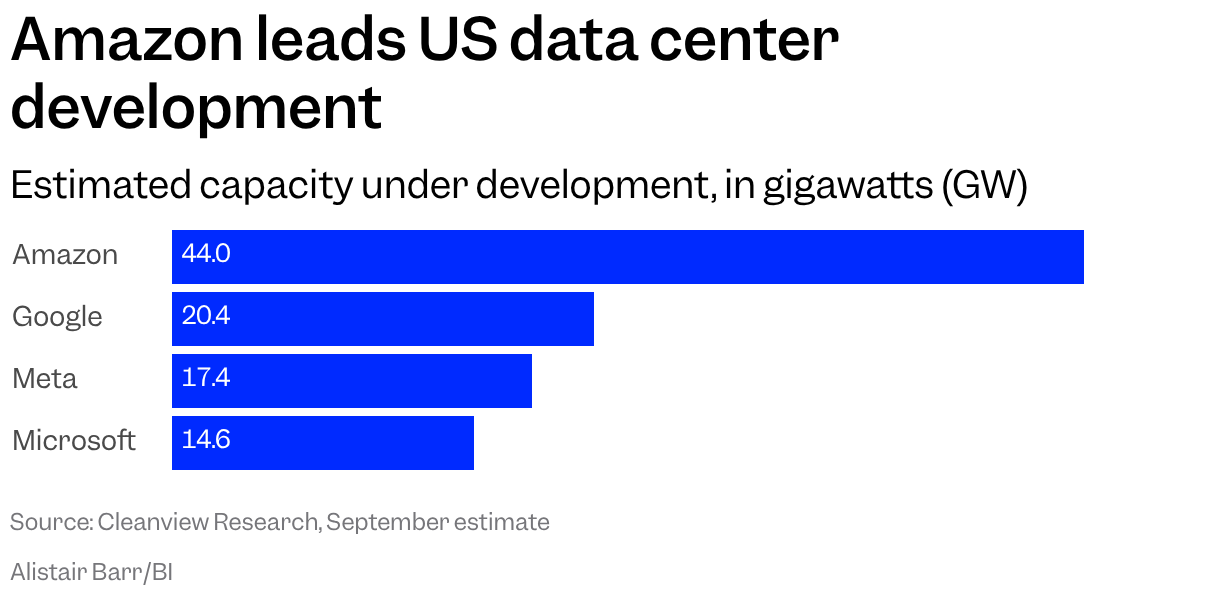
The company has 44 gigawatts of data center capacity under development across 16 states, more than double Google, Meta, and Microsoft, according to Cleanview Research estimates.
An internal AWS dashboard called "Secured Power at Risk" tracks utility and regulatory constraints affecting electricity capacity AWS has lined up for its data centers.
The risks include transmission bottlenecks, requirements to reduce use during grid stress, and "use it or lose it" provisions that can jeopardize capacity if a data center project misses usage or construction milestones.
In other words, AWS is not simply waiting for electricity to arrive. It is managing a portfolio of commitments that can become more costly if a data center project is delayed.
Maryland proposals
A submission to Maryland's utility regulator last year, obtained through a public records request, illustrates the kind of exposure that can accompany massive data center buildouts.
Amazon told the Maryland Public Service Commission that large data center customers could help pay for grid upgrades or bring new power capacity to market without burdening other electricity ratepayers.
The company also proposed setting aside collateral to help utilities get more comfortable with the large investments needed to generate more electricity for data centers. Amazon proposed three years of collateral so that if a large electricity customer abandoned unused capacity, the utility would have time to re-sell the power.
The proposal is not evidence that AWS has made such a payment or posted collateral. It does, however, show that large data centers can face extra financial obligations, beyond their own electricity bills, if projects are delayed or cancelled.
The Amazon spokesperson said such utility rules are not unique to AWS. The company has not disclosed how much cash it has paid upfront to secure power.
New constraints 'keep popping up'
The AI buildout also incurs expenses that are harder to model than a conventional capex plan.
In the September meeting this year, Kalyanaraman said that while reviewing plans for gigawatts of capacity in West Texas, AWS confronted a labor problem: There weren't enough nearby pipefitters, electricians, and other skilled workers to build the facilities.
The company's response, he said, was to pay to construct housing complexes near its data centers so workers could live there for the two or three years needed to complete the projects.
Even the crates used to ship servers have become a planning issue. It may seem absurd to worry about the price of a container when servers cost hundreds of thousands of dollars, Kalyanaraman said. But at AWS's scale, where the company needs so many crates, even trivial items can become a material expense.
"We have new constraints that keep popping up," Kalyanaraman said.
Seventeen's Jeonghan and Joshua are debuting as a duo on October 19 — and hyping up the album with a joint Pinterest diary.
Pinterest
Jeonghan and Joshua from the boy band Seventeen are debuting as a duo.
To promote their much-hyped album, they've launched a visual diary on Pinterest.
The duo told Business Insider about their chemistry, their music — and their joint mood board.
Jeonghan and Joshua from the mega K-pop boy band Seventeen are offering fans a dream to lose themselves in and a mood board for shopping.
The two vocalists are debuting as a much-hyped unit, a spinoff of the 13-member band's activities. As of Monday, they'll be working under the name JxJ — releasing their album, "DREAMSCAPE," and hitting the road together for a concert tour in six Asian cities.
In the meantime, they've been populating not only their Instagrams, but also a sprawling visual diary on their joint Pinterest account.
It's an interesting choice, as far as K-pop goes — usually, teasers are limited to platforms like YouTube or the K-pop-centric social network, Weverse.
In a written interview with Business Insider, the duo described their interest in Pinterest as a means of introducing the "visual world," concept, and vibe of "DREAMSCAPE."
The mood boards and the buffet of photos they've posted for fans to feast on are also a "little gift" to their audience.
"JxJ Diary is a space we created to share the concept and vibe of the album more directly with fans before its release. We spent a lot of time thinking about what kind of content they would enjoy, and decided to launch our first-ever Pinterest channel featuring different sides of ourselves," the duo said.
The singers said they wanted to explore the concept of "dreams" with the posts on their joint account. They've curated a collection of photographs and behind-the-scenes moments, including everything from candid shots to sneak peeks of their album photoshoots.
"We hope fans will take inspiration from the album's imagery and vibe, and express it in their own ways," they added. "It would be really fun to see them create their own version of 'DREAMSCAPE' on Pinterest by collecting photos, experimenting with styling, and curating images that reflect their personal tastes."
The business around the boys
That invitation for fans taps into a K-pop fan economy in which an album is not only heard or watched but also worn, collected, decorated, and remade.
The two Seventeen members belong to a group whose fan base collects their photo cards, travels to their concerts, and goes all in on albums and merchandise. Seventeen's 2023 album, "FML," still holds the record for first-day sales for a K-pop album, with more than 6.4 million copies sold. The band's "NEW" tour from 2025 to 2026 saw them play 31 shows in stadiums across Asia and four US cities, drawing close to a million fans, in person and online.
JxJ now gives Seventeen's fandom something else to get invested in: Jeonghan and Joshua together, and the similarities in theirpersonal style.
Ayumi Nakajima, Pinterest's APAC head of content partnerships, told Business Insider the platform had seen a surge in interest in K-pop, making it prime territory for JxJ to establish a foothold.
Nakajima said that the collaboration with the duo's agency stemmed from the idea that K-pop fans connect with more than just the music. Pinterest gives fans a space to "explore the visual inspiration behind the artist's stories" and "save what resonates with them."
Pinterest has seen a strong surge in interest for all things Korea on the platform. Searches for "K-pop style" rose 19% globally year over year, while "K-beauty" searches rose 114%. In Japan, searches for "K-pop fan art" climbed 368%, while "trading card decoration" rose 77%.
"What visual experiences like the JxJ diary do is bring fans into an artist's creative world earlier, giving them more time to engage with the aesthetics, ideas and storytelling behind a release," Nakajima said.
"That early engagement can really shape fandom-led commerce, because fans aren't just showing up at the point of purchase," Nakajima added. "A look, a mood or a visual reference can spark interest weeks before someone decides what to wear to a concert, what beauty look to try, or what pieces they want to buy."
Chemistry
JxJ's album, "DREAMSCAPE," drops on October 19.
Pinterest
As for the boys behind the Pinterest board, they're prepped to serve up seven tracks spanning genres they're "exploring for the first time" on the new album. The duet songs, from early teasers of the music, involve experiments with house, synthpop, and dance rock. There are also two solo tracks — Joshua's punk rock offering, "Not Personal," and Jeonghan's dreamy bop, "Coloring."
"Seventeen has a certain energy when all 13 members are together, but we think the two of us have a different kind of chemistry when we are together," they told Business Insider. "Rather than trying to showcase something entirely new, we wanted to bring out our natural sides and individual charms as much as possible."
The album is also the product of "a lot of conversations" about the kind of art they each wanted to create.
"By sharing our ideas and the images we each had in mind, we were able to understand each other's tastes on a deeper level," the duo said.
They took a couple of trips together, too, which helped them "get to know each other better and shape a direction that felt uniquely ours."
"We also experimented with our vocals to show a new side of ourselves, so we hope fans will enjoy and support this album," they added.
"DREAMSCAPE" launches on October 19 at 6 p.m. Korea time.
Nvidia's communications operation has been reshaped as the company became the face of the AI boom.
Roughly 15 staffers have left the lean team since 2025 as Nvidia reorganized its communications org.
Former employees described growing workloads as responsibilities expanded.
Nvidia's communications organization has been reshaped as the company became the face of the AI boom, with multiple teams brought under new leadership and a string of departures.
Business Insider identified roughly 15 communications employees who have left Nvidia since 2025, based on LinkedIn profiles and interviews with former employees.
The organization now numbers roughly 70 to 80 people globally, and has more than doubled in size since Mylene Mangalindan joined as vice president of corporate communications in 2023, according to a person close to the company.
The departures have also included newer hires. Anna Soellner, who was recruited to lead corporate communications, left after roughly four months, Business Insider previously reported.
Nvidia is known for high retention. It reported companywide turnover of 3.7% in fiscal 2026, up from 2.5% the prior year, and well below the tech industry average of 21.9% cited in its latest sustainability report.
Mangalindan succeeded longtime communications chief Bob Sherbin, who retired in 2024. She previously worked at the advisory firm Brunswick Group.
She was brought in to "bring fresh blood" and "upgrade the team" to meet Nvidia's growing profile, one former employee said.
At the end of 2024, Nvidia restructured its communications organization. It brought enterprise public relations under Mangalindan's leadership alongside the corporate communications team she already led, according to two former employees.
Corporate communications focuses on Nvidia's reputation and major media outlets, while enterprise handles product and industry messaging,including for its data center business.
One former employee said the consolidation reflected the growing importance of Nvidia's data center business, which sells chips and systems that power AI and had become its biggest revenue driver.
Analyst relations, social media, and influencer marketing also moved under Mangalindan's remit this year, another former employee said.
Three former employees said Nvidia's communications team had long operated with relatively lean staffing, even as workloads grew alongside the company's public profile, leaving staff juggling multiple responsibilities.
These employees said they experienced long hours, difficulty taking time off, and pressure to respond quickly to emails and Slack messages.
A person close to Nvidia said the company's lean staffing allows employees to move quickly and also requires long hours. The person said Mangalindan encourages staff to take vacation, though the team's small size can make scheduling time off difficult, particularly in the summer.
Nvidia is widely known for its demanding work environment. CEO Jensen Huang has emphasized operating at the "speed of light" and is known for fostering a culture of constant accountability.
Have a tip? Contact this reporter via email at gweiss@businessinsider.com or Signal at @geoffweiss.25. Use a personal email address, a nonwork WiFi network, and a nonwork device; here's our guide to sharing information securely.
YouTuber Jake Paul joined President Trump for an Ohio rally ahead of the midterm elections.
Aaron Schwartz/Stringer/Getty; BI
The battle for voters in the 2026 midterm elections is playing out on the TikTok For You Page.
One in four Americans say creator content has influenced who they voted for.
Political candidates are scrambling to connect with more creators in order to reach voters.
Content creators are influencing much more than our coffee orders and skincare routines.
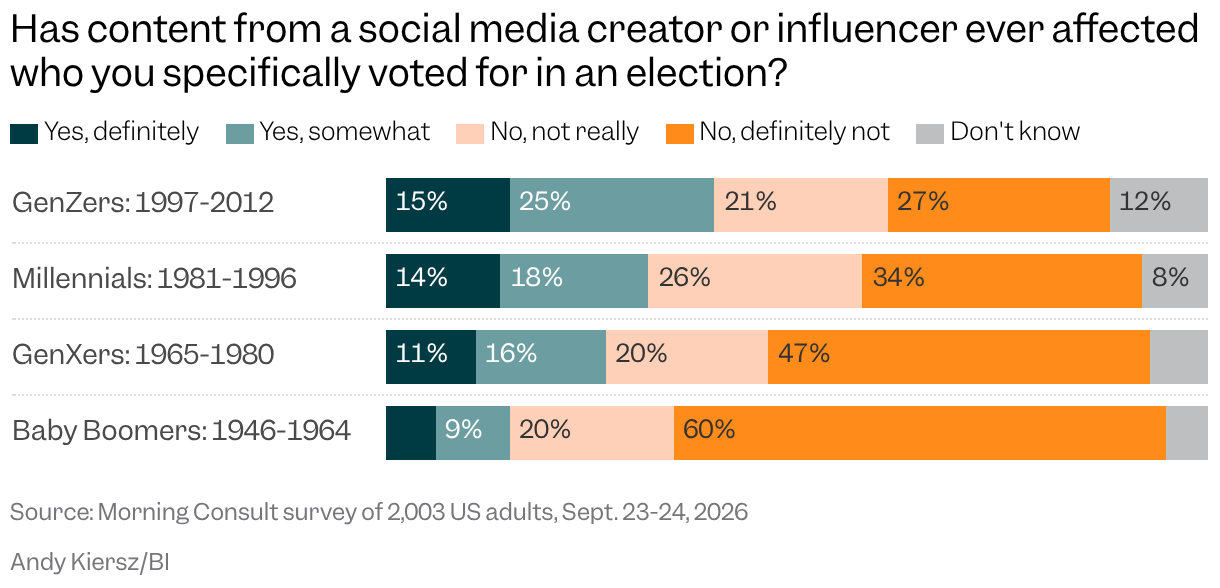
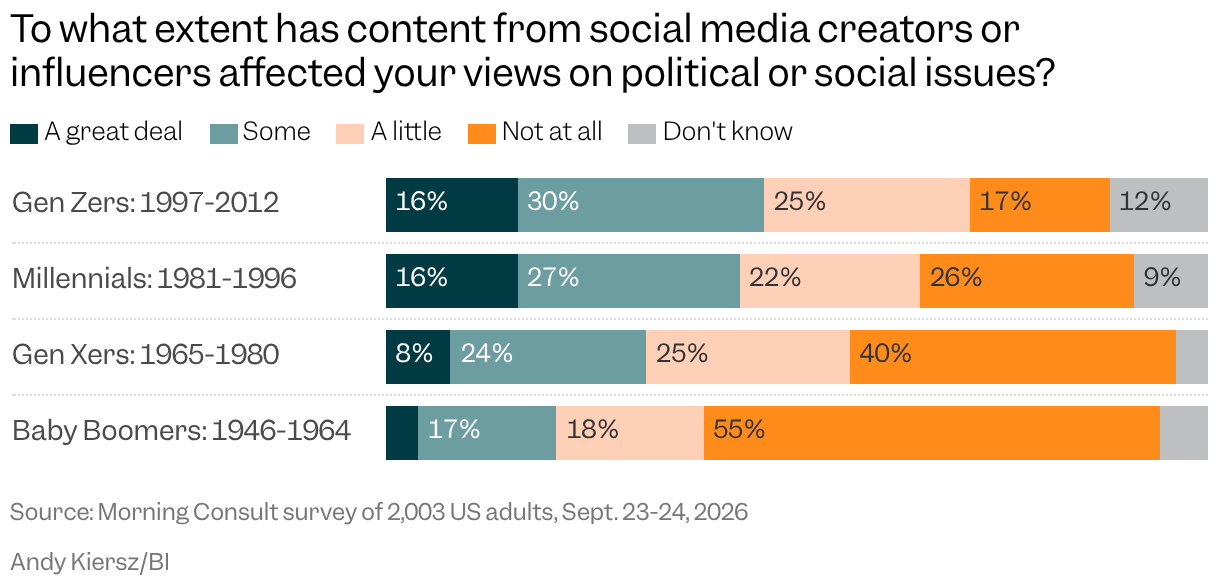
About one in four Americans (26%) say influencer content has affected who they've voted for, according to a survey of around 2,000 US adults conducted by Morning Consult in September, commissioned by Business Insider.
Creator content is an "underestimated avenue" for political campaigns, said Nicole Dunger, a founding partner at the marketing firm People First, which works with candidates and advocacy groups on their creator strategies. "It is a real player and a big player in this space now."
If 2024 was the podcast election, 2026 is shaping up to be the influencer one. Instagram and TikTok creators have joined Fox News hosts and personalities like Joe Rogan as go-to sources of information for voters.
Influencers like Jake Paul and Hasan Piker have emerged as main characters in politics this year.
Paul recently joined President Donald Trump in Ohio for a midterm rally, posting TikTok clips of his Air Force One flight. Piker, meanwhile, has become a campaign ally for progressives like Michigan's Abdul El-Sayed and a negative talking point for Fox News commentators.
As online attention has become a key asset in politics, influencers are helping candidates break through the noise.
A little over half of US adults (56%) told Morning Consult that creator content had affected their views on political or social issues to some degree. That figure jumped among Gen Z respondents, where close to three in four respondents said their views had been swayed by influencer posts.
For campaigns, the challenge is identifying the right creators to work with, particularly when many influencers don't regularly talk about politics.
"You have to have your base of people, your core supporters, and then you have to have a broader cultural space of people who don't always talk about politics," said Parker Butler, a managing partner at the digital strategy firm Luminary Strategies, which works on social strategy with Democratic candidates like James Talarico. "It's worth having different pockets of creators for different purposes."
Reaching creators with smaller followings than Piker (about 3 million Twitch followers), or Paul (around 21 million YouTube subscribers) is a focus in 2026, Butler said.
He said the goal is to shift the creator outreach strategy from "this person has a million followers" to identifying influencers who work in a particular niche a campaign is trying to reach.
Political chatter is moving from TV to YouTube
More and more, political discussions are playing out on digital platforms, whether that's podcasts, YouTube videos, or Twitch streams.
YouTube was the top source for political and election news among US adults in September, narrowly beating out TV, print, and X (formerly Twitter), according to a survey from Syracuse University.
About one in five Democrats and Republicans said podcast appearances could make them "more likely to support a candidate," according to a July through August survey of likely midterm voters from the podcast industry group Sounds Profitable. A smaller share of Independents (11%) said podcasts could make them more likely to back a candidate.
While campaigns see attention moving online, they're still spending the bulk of their ad budgets on TV.
Part of that may be because they're accustomed to buying TV spots. They're also reckoning with the fact that influencer marketing is harder to predict and measure, particularly as social-media feeds become more personalized and algorithmically driven.
"It can be very challenging, but you see the results in the end," Dunger said. "It's the same with door knocking. We know door knocking somehow works and has worked for so long, but it's not like we have those direct measurements."
Microsoft AI recently announced its latest model MAI-Base-2.
AI CEO Mustafa Suleyman compared the model to a similar offering from OpenAI.
Microsoft trained its model more efficiently than OpenAI, he said in an internal meeting.
Microsoft AI CEO Mustafa Suleyman told employees an in-house model was better than a similar offering from OpenAI, one of the software giant's biggest customers and partners.
"We now have a stronger pre-trained base model than the model that currently powers GPT 5.6 Sol," Suleyman said during a town hall meeting with employees on Thursday. "And in fact, we used one-quarter of the compute that OpenAI used to train their model."
Pre-training is the first stage of building an AI model, when it learns patterns from huge amounts of text, images, and other information. This takes massive amounts of expensive computing power, so Microsoft could save money if it's worked out a way to do this more efficiently.
Suleyman said Microsoft privately tested this model against OpenAI models, including one nicknamed "Spud" that powers GPT-5.6. He added that Microsoft's model performed better on tests measuring how well AI can understand and predict patterns in information.
The comparisons are based on technical information Microsoft has about OpenAI's models, Suleyman said.
"Privately and confidentially, we've also compared it to the OpenAI models," Suleyman told employees, while suggesting that Microsoft has special access to information on how OpenAI models perform.
It's notable that Suleyman would choose to highlight limitations of OpenAI models, even in private discussions. Microsoft has invested billions of dollars in OpenAI, and owns a stake in the startup that is likely worth more than $100 billion. Any criticism of OpenAI could potentially dent the value of this huge investment.
The two companies also have a major partnership, with Microsoft offering OpenAI models to its Azure cloud customers. Microsoft has used OpenAI models for its own products such as Copilot, too.
But the relationship between the two companies has frayed in the past year or so. Increasingly, Microsoft has tried to branch out from OpenAI, including by working on its own models.
Suleyman also said Microsoft's new AI model used "12 times less computation than was used for DeepSeek, for example, on compute efficiency."
Suleyman didn't specify which DeepSeek model, but a public blog post described the pre-training of MAI-Base-2 being a lot more efficient than a similar offering from the Chinese lab, called DeepSeek-V4-Pro-Base.
Microsoft in March created a new combined team for its commercial and consumer Copilot products and reassigned Suleyman to focus on building AI models in the company's superintelligence unit.
Microsoft declined to comment and OpenAI did not respond to a request for comment on Thursday.
Apollo is delaying recruiting for its 2028 associate class, Business Insider has learned.
This follows last year's delay, which helped slowed down private equity's chaotic recruiting process.
Apollo said it wants young bankers to have more experience before making their next career move.
Apollo is delaying on-cycle recruiting again this year, after a similar move last year helped push back the recruiting timeline across the private equity industry.
The private equity giant told prospective candidates Thursday afternoon that it will not recruit its 2028 associate class this calendar year, according to an email obtained by Business Insider.
The memo, signed by David Sambur, co-head of Private Equity, and Antoine G. Munfakh, deputy global head of Private Equity, said the firm will wait until candidates who started their investment banking careers over the summer are "closer to completing one full year of professional experience."
The hope, the memo said, is that this will convince others in private equity to delay their process so both candidates and employers can make "better decisions." Last year, after Apollo CEO Marc Rowan said the firm would delay on-cycle recruiting, others, such as General Atlantic also decided to pause.
"We were encouraged that others in the industry took similar steps, and we hope more firms will do the same this year," the memo said.
On-cycle recruiting — the controversial process through which private equity firms hire junior investment bankers for associate roles a year or even two before they would start — had crept earlier and earlier in the years following the pandemic.
Competition among private equity firms to lock up top talent pushed recruiting earlier and made the process notoriously intense. It would kick off with little warning, with junior bankers sometimes calling in sick or interviewing in the middle of the night to avoid jeopardizing their day jobs. JPMorgan's CEO, Jamie Dimon, has been a big critic of the process, calling it "unethical."
In 2025, amid rumblings that on-cycle recruiting could take place before some students even graduated from college, JPMorgan rolled out a policy that incoming analysts could be terminated for accepting future-dated private equity offers.
Questions have swirled if the practice would kick off early again this for the 2028 class, but it appears with this latest move, Apollo is trying to slow down the recruiting timeline across the industry again.
Read the full memo below:
—-
To: Prospective Apollo Associate Candidates, Class of 2028
Subject: Apollo Recruiting, Class of 2028
Congratulations on beginning your career in investment banking. We know how exciting and demanding this period can be, and we hope you are enjoying the experience and learning a great deal.
Last June, we wrote to prospective candidates for our Associate Class of 2027 to explain why Apollo would be delaying its recruiting process. We believed then, as we do now, that young professionals should have the opportunity to develop their skills, gain meaningful experience and better understand their interests before making important decisions about their careers.
We were encouraged that others in the industry took similar steps, and we hope more firms will do the same this year. Young professionals still deserve more time to gather valuable life and work experience before making important career decisions.
We wanted to share with you that for the Associate Class of 2028, we will not participate in on-cycle recruiting this calendar year and intend to wait until candidates are closer to completing one full year of professional experience before engaging in formal recruiting for an Associate position. We believe giving candidates more time and experience before beginning the process leads to better decisions for candidates and employers alike.
In the meantime, we will continue to spend time with many of you, introduce you to our platform and share the diverse array of career opportunities available at Apollo. When our formal recruiting process begins, we intend to approach it thoughtfully and give candidates ample time to prepare, interview and consider their offers.
None of this changes our enthusiasm for meeting and recruiting exceptional young talent. Quite the opposite. Investing in our people has always been central to Apollo's success, and we remain committed to attracting and developing the next generation of investment professionals.
For now, our advice is simple: Focus on the opportunity in front of you. Learn as much as you can. Build relationships, develop your judgment, and take the time to discover what genuinely interests you. There will be plenty of time to make decisions about the next chapter of your career.
We look forward to getting to know you and hope many of you will consider building your careers at Apollo.
Best,
David Sambur
Partner, Co-Head of Private Equity and Head of Equity

 Login