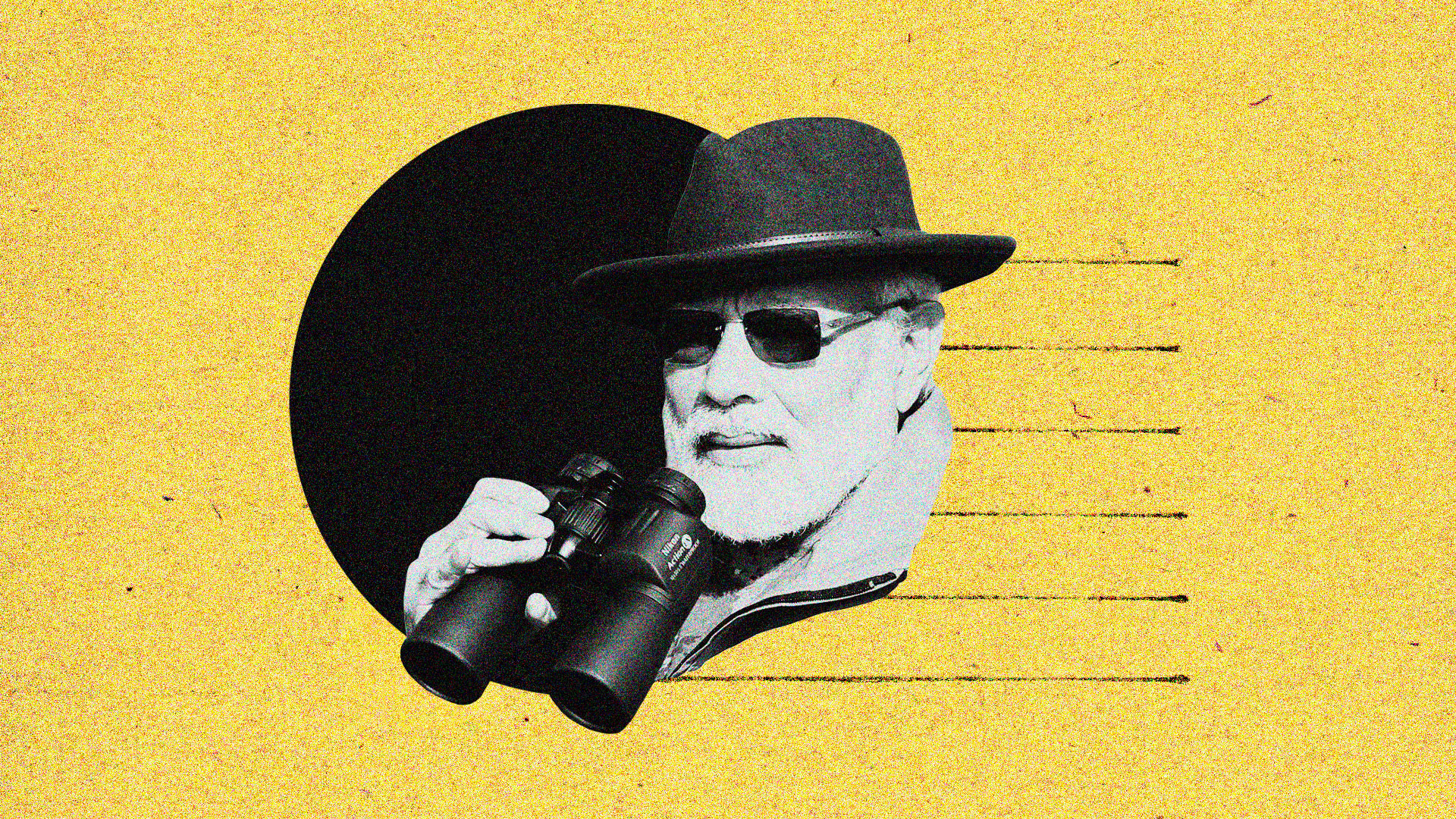
In Perspective, we spoke to the Norwegian explorer Erling Kagge, the first man to reach the North Pole unassisted by animals or vehicles. He is also the first person ever to reach the North and South Poles and the summit of Mount Everest on foot. His book "The North Pole: The History of an Obsession" has just come out in French translation.
On September 30, I walked out of a three-hour medical appointment to dozens of missed calls. They were from colleagues: the entire newsroom of Matsadaash, an independent fact-checking platform, had been arrested. Six journalists, five of them trainees in their early twenties, all picked up in less than 24 hours.
I didn’t know any of them. It didn’t matter. An entire newsroom taken in a day, then disappeared: that was enough. I don’t need to know someone to stand with them. If they are journalists arrested for doing their job, I am with them.
For five days, no one knew where they were. Their families and lawyers filed 18 complaints in that time, according to the Egyptian Initiative for Personal Rights (EIPR), which represents them. The Interior Ministry called Matsadaash an unlicensed, foreign-run page, and linked it to the Muslim Brotherhood, which Egypt designated a terrorist organization in 2013. The Matsadaash founder, Abdelrahman Mansour, denies any affiliation.
When the six journalists were finally produced before state security prosecutors, some, according to their lawyers, said they had been blindfolded, bound, stripped, beaten and given electric shocks. State prosecutors said forensic examinations found no injuries. The journalists were charged with joining and financing a terrorist group, reporting fake news and using social media to spread it. On October 13, their pretrial detention was extended for another 15 days. Their salaries, which EIPR and the Egyptian Journalists Syndicate say were paid under employment contracts filed with Egyptian banks, were described, in the prosecution’s words, as “monthly funding in foreign currencies.”
Over three days, each of the six journalists was interrogated for nearly 30 hours. According to EIPR, not one was confronted with a single report they had written that could be called false. Instead, the prosecution’s own statement accused them of “highlighting shortcomings — and nothing else — in state institutions,” belittling officials and amplifying people’s grievances.
But that is precisely our job. It is what we sign up for as journalists — to ask questions of those in power. On October 4, another colleague was summoned for questioning; thankfully, she was released the same day.
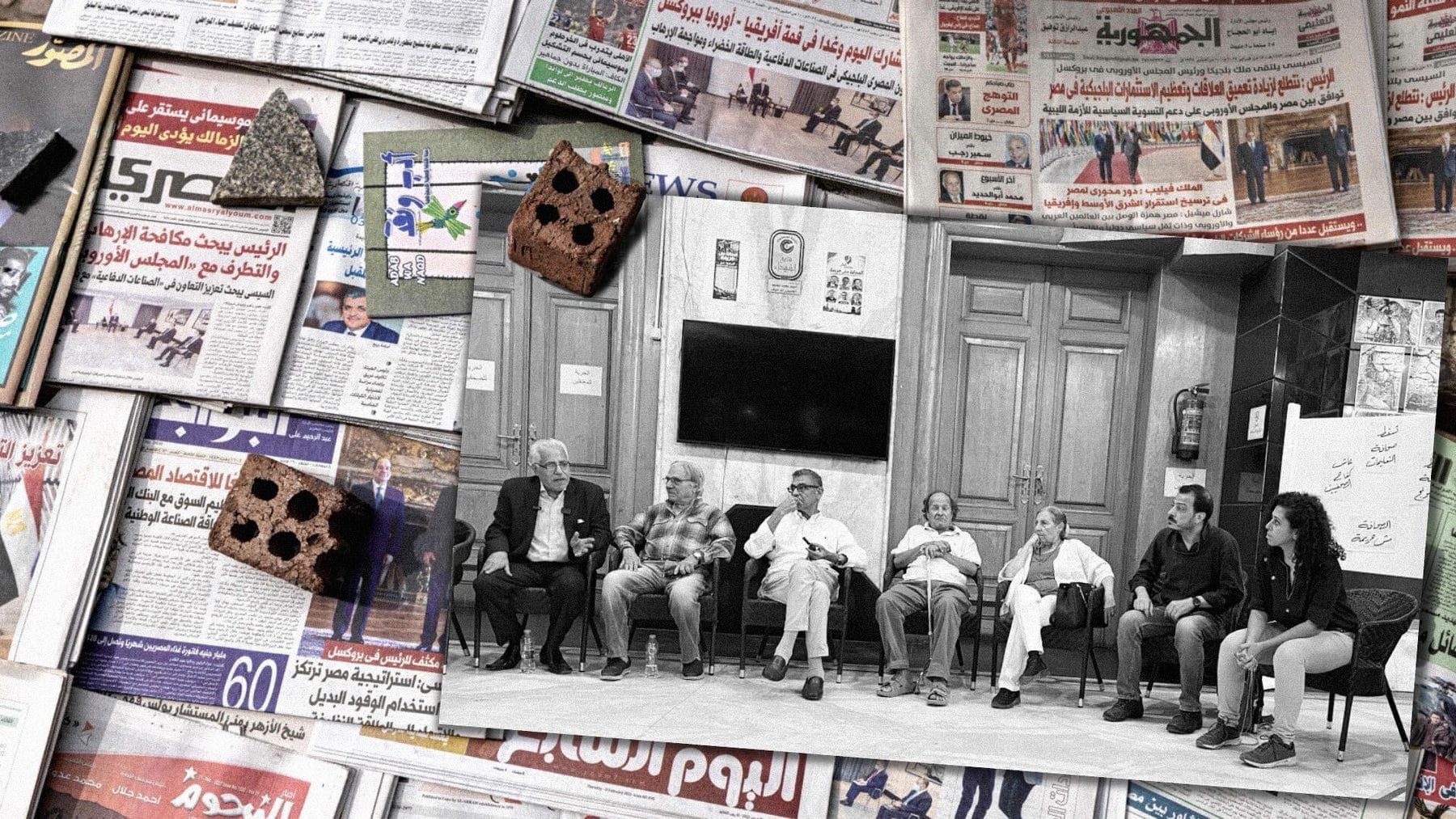
Word spread the way it does now, through social media posts, journalists’ pages and a knot of phone calls I can no longer untangle. Colleagues were gathering at the Journalists Syndicate every day. So I went too. The Syndicate is a union with a long history of standing up for us, and I joined my colleagues there in solidarity with those who had been detained. Not everyone could come every day, but there was always someone — on some days just four, on others more than 20.
Even our older colleagues, in their 60s, 70s and 80s, showed up. Ustaz Mohamed Abdel Kouddous, who once headed the Syndicate’s freedoms committee, is recovering from an accident and could not be there in person, but he was with us through his voice and his written messages. For as long as I can remember, he has been there for every struggle: at Al-Ahram, arguably Egypt’s most prominent daily newspaper; and at the Syndicate, with his megaphone, firing us up. He and I don’t share the same politics, but it has never mattered.
In 2008, on the day of a nationwide strike, plainclothes officers dragged him from his car in broad daylight and held him until nightfall. He asked the Syndicate to demand an investigation, though he expected nothing to come of it. “We do what we need to do,” he said then. It could be the motto of our sit-in today.
Many of us feel embarrassed to eat or to have a cup of tea, not knowing whether our colleagues inside have the same luxury. When I kiss my girls goodnight, I feel ashamed that my colleagues in jail cannot do the same.
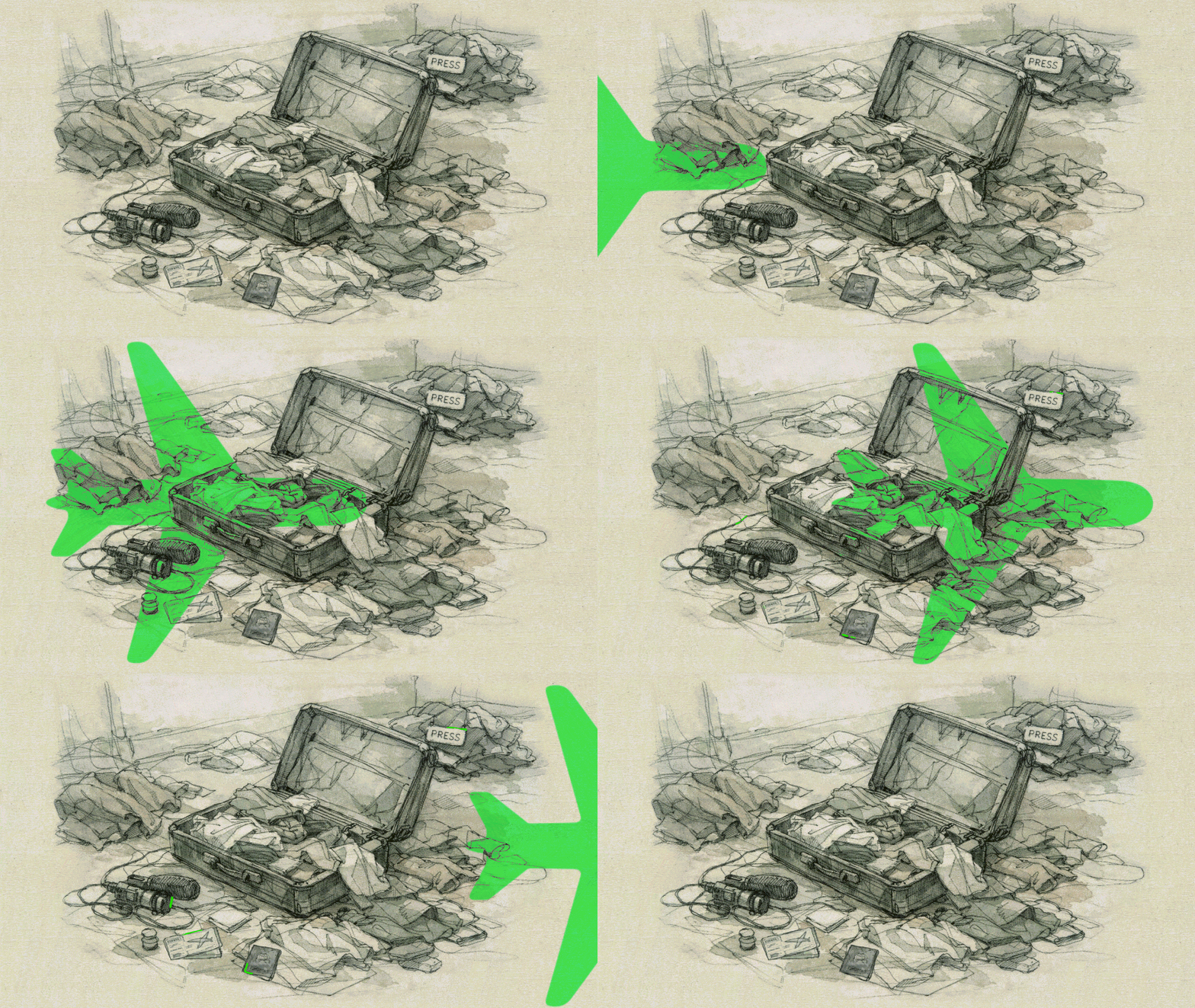
Illustration: Anna Jibladze, using images by Lina El Wardani and Getty Images
I keep thinking about how we got here.
Under Egypt’s former president Hosni Mubarak, the red lines were clear. You did not touch the head of state, his wife and his sons, or a certain institution (the military). But everything else was fair game. We knocked ourselves out writing about poverty and corruption, labor rights and children’s rights, domestic violence, sexual harassment and female genital mutilation.
Then came 2011, and a revolution unlike any other. In Tahrir Square, we rejected violence, and our chant was “selmeya, selmeya” (peaceful, peaceful).
When we brought Mubarak down, he didn’t flee like the Tunisian “strongman” Zine al-Abidine Ben, and we didn’t lynch him like Muammar Gaddafi in Libya. We put Mubarak on trial, in a courtroom. It was dignified. It was the revolution of the dreamers.
In those few years, Egyptian journalists lived with freedoms we had never known. But dreamers are not politicians.
We had lived for decades with no politics: no real political parties, no real elections, no way to learn how power works. So when the door was opened, we didn’t know how to build what we had dreamed of. People kept asking, “What is the alternative?” We had the dream, but not the tools.
What followed our revolution was the opposite of what we fought for: restrictions on a scale we had never seen. The red lines blurred and multiplied, until no one knew where they were anymore. The story of our country, of our revolution and of our journalism is the same story. We are not organized. We are not politicized. But we dare to dream.
Today, at least 25 journalists are behind bars in Egypt, says the Committee to Protect Journalists, almost all of them in pretrial detention. That period is technically limited to two years, but prosecutors file new charges and renew detentions. Some, like the photojournalist Hamdy al-Zaeem, have spent a decade in and out of detention without a single conviction. My colleague Haidar Kandil was taken in June, after documenting arrests of Egypt’s Shia minority.
On the evening of October 14, the lobby of the Syndicate’s headquarters in downtown Cairo was filled with banners and cartoons. Three colleagues and I sat down to write letters to our jailed colleagues: 26 names in total. We fussed over how to organize the letters: how to arrange the names, whether the envelopes should be open or closed, which color went with which name. Colleagues with beautiful handwriting wrote each name in calligraphy. Then we realized we couldn’t spend the whole evening rearranging the deckchairs. At some point, we had to start writing.
But our minds were blank. What could we say? “Why are you inside, and why are we free?” “We feel guilty that we are free and you are paying the price. Maybe we should have paid it instead.”
Of the 26, the only one I have worked with is Haidar. He had a good eye for a story. Like most of the young journalists I work with, he needed guidance, but he was always responsive to edits, to make changes and turn in better copy. We spoke on the phone and exchanged emails and texts, but we had never met. I only know his face from photos online, and here I am pinning his photo on the noticeboard in the syndicate with a #FreeThemAll banner.
In the end, all I wrote was: “I miss you, Haidar. I hope to see you soon. Hang in there. Love, Lina.”
Whenever I feel small, I remind myself that this Syndicate has always fought the good fight. That same evening, the veteran journalist Medhat El-Zahed told us how, during the 1989 Iron and Steel workers’ strike, he and his leftist colleagues were arrested and tortured. The Syndicate’s head at the time, Makram Mohamed Ahmed, was close to the authorities. Still, he protested over the treatment of journalists and visited them in prison.
Today, for the first time, the head of our Syndicate is one of us. Khaled El-Balshy is a dreamer. Eman Ouf, who heads the freedoms committee, is one of us too. The Syndicate has pledged to defend all six Matsadaash journalists. It has asked the Attorney General to investigate the abuse allegations. Its statement chose every word with care, stressing its commitment to the law and to the country’s higher interests, and asked only that our colleagues be released on the Syndicate’s guarantee, or any other, given their young age. It was the most modest of requests. Even that was too much for some.
The tide is so high, and we are so low.
After more than two weeks, we have suspended the sit-in. We are not leaving the Syndicate, and we are not giving up. In our statement, we promised to keep standing with our colleagues through other events, because the battle for press freedom “needs a long breath.”
On October 18, eight independent news outlets from Egypt, Lebanon, Tunisia and Syria, among them Mada Masr and Al-Manassa, announced a joint newsroom to fact-check “Egypt Forum 2026,” the government’s “achievements conference.” The summit runs from October 19 through to October 24 – six days for six journalists. The eight newsrooms have united under the slogan: “Until they return, the fact-checking continues.” The dreamers are learning to organize.
We journalists and dreamers, like those of us who gather in the Syndicate, are stubborn. Many are behind bars of some kind: real ones, imaginary ones, or the bars of a censored internet. But we always walk towards the light. Journalism is how we live and breathe. If we don’t fight for it now, there will be nothing left to fight for tomorrow. No profession, no dignity, and no Syndicate.
This story was published in collaboration withEgab.
French President Emmanuel Macron is making a three-day visit to the Gulf states focused on fuel supplies and strategic ties. The French leader will first visit Kuwait before heading to the United Arab Emirates, Bahrain and Qatar. The Elysée Palace said Macron would seek commitments for additional deliveries of diesel and petrol that could increase supplies available to France.
A new documentary from our sister channel France Télévisions explores US President Donald Trump's relentless crackdown on immigration and the agency carrying it out – United States Immigration and Customs Enforcement, better known as ICE. "ICE : La chasse a l'homme", or "A Manhunt Named ICE" interviews agents and also some of the people who lives have been turned upside down by ICE operations. In Perspective, we spoke to the film's co-writer Marine Pradel.
Huge demonstrations have been held over the last few weeks in Spain over its housing crisis, but the issue is not restricted to Spain. Many other countries also have a huge problem with housing, including Ireland, with experts saying that for every street of 10 houses, the country actually needs 12. Now a new exhibition in Paris at the Irish Cultural Centre is trying to reflect the issue. In Perspective, we spoke to the museum's director and one of the artists taking part.
The author of a new book that tells the story of a White supremacist coup in her hometown of Wilmington, North Carolina has spoken to FRANCE 24 about how those involved and the authorities covered up the event for years. The coup happened back in 1898, but was never mentioned in local schools even when she was a pupil. Lauren Collins is currently living in Paris, where she is a staff journalist for The New Yorker. She spoke to us in Perspective about her book, "They Stole a City".
Far-right candidate Flavio Bolsonaro has pulled off a surprise win in the first round of Brazil’s presidential election. He defied most polls to win with 47 percent, compared to 45 percent for leftist incumbent Luiz Inacio Lula de Silva. We spoke to Thomas Zicman de Barros, a research fellow at CEVIPOF, the political research centre at Sciences Po University, and columnist for our sister radio station RFI. He told us that never before in Brazilian history has a candidate who was behind in the first round then succeeded in the second.
A journalist who has spent more than 20 years investigating Russian leader Vladimir Putin and who is recognised as perhaps Russia's finest investigative journalist has told FRANCE 24 that Putin's aim with the war in Ukraine is simply to prolong his power inside Russia. Roman Badanin has just published a book, "Le Tsar en personne" or "The Tsar in person" which delves into exactly how Putin's mind works. Badanin says Putin acts like a gang member, and his attitude is that "if you beat me, I will beat you even harder". The book is so far out in Russian and French, with an English version to follow. He spoke to us in Perspective.
An acclaimed American author has spoken to FRANCE 24 about his theories on how American society's opinion and ideas of social justice have changed since the presidency of Barack Obama. Thomas Chatterton Williams says the left became disillusioned during Obama's second term, and in later years amid the George Floyd protests and Covid-19 pandemic the discourse shifted – initially for the left, but this also impacted the right. The ripples of those times are still resonating today. His latest book is entitled "Summer of Our Discontent: The Age of Certainty and the Demise of Discourse".
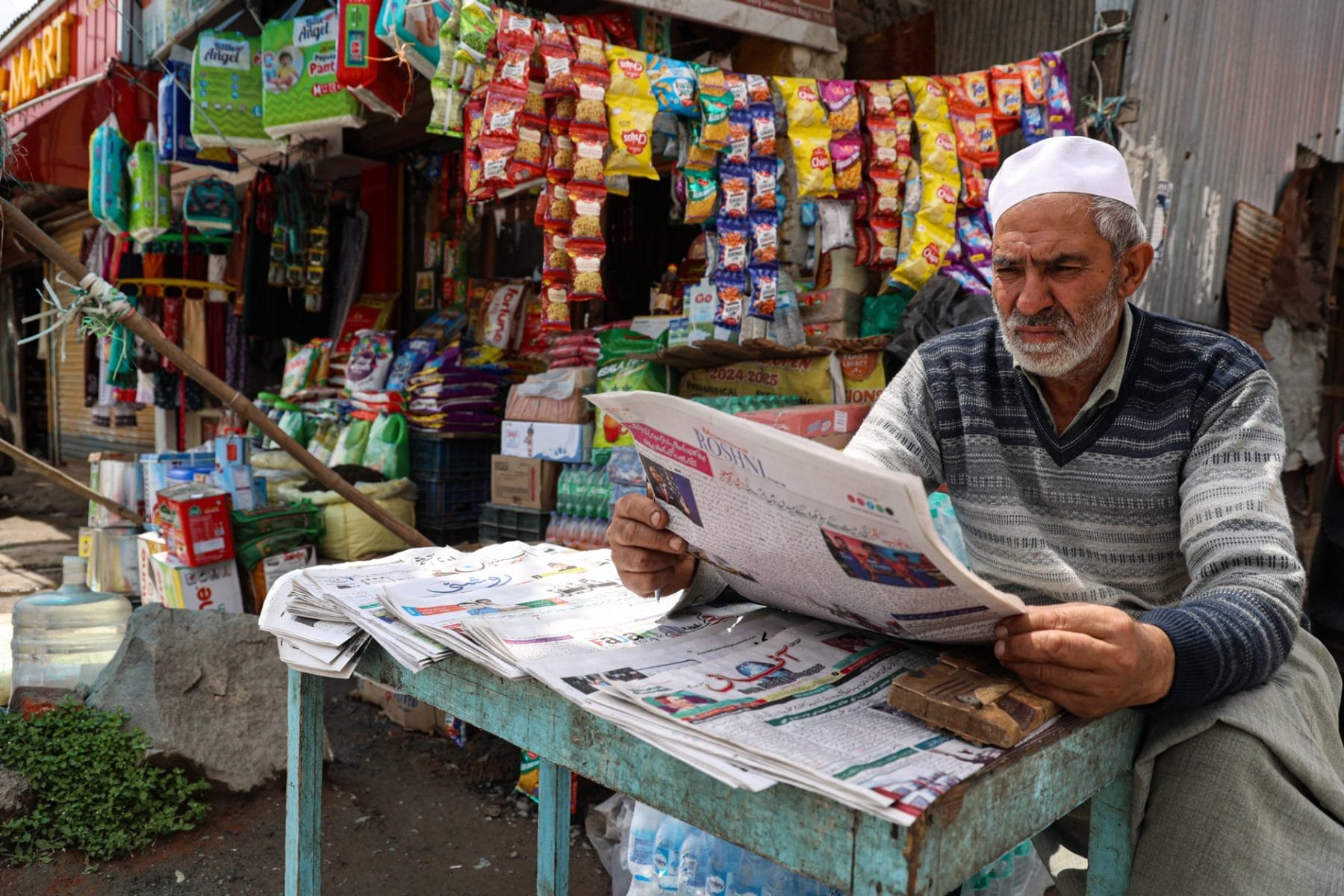
On 19 November 2025, Indian police raided the ‘Kashmir Times’ in Jammu. They said they were on an “anti-terror” operation. The offices had been shut since 2022 and were in dilapidated condition, the equipment largely defunct. Yet, the police claimed to have recovered a “pistol and live AK-47 cartridges.”
Since 2018, only five journalists have faced cases under India’s draconian anti-terror Unlawful Activities (Prevention) Act. Trials rarely start, leaving journalists in a state of perpetual purgatory, even if they are out on bail under onerous conditions.
Before the police came charging into these unused offices last year, the ‘Kashmir Times’, founded by my father in 1954, had long suffered sustained persecution – the seizure of records, of equipment, the harassment of staffers, the use of social media to spread slurs, trumped up charges of tax evasion and the embedding of spies.
The first ever copies of Kashmir Times, initially a weekly, were seized by the government. In 1983, my father survived a murderous assault with serious injuries inflicted by a Hindu nationalist mob. I joined the newspaper in 1989, as the armed militancy, the ‘insurgency’ against the Indian state, became widespread, and experienced firsthand the struggle to report the news accurately and truthfully. The government would frequently withdraw its advertising, which was the main source of funding for most news outlets. We were besieged on several fronts, facing down the state, militants and aggressive Hindu nationalists.
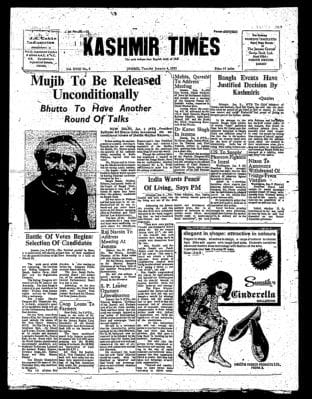
Kashmir Times front page, January 1972. Image courtesy of Kashmir Times / Anuradha Bhasin digitized by Stanford Libraries.
In 2019, as Indian prime minister Narendra Modi began his second term in office, his government removed the special autonomous status granted to Jammu and Kashmir and protections that had existed for nearly 70 years. Once a state, Jammu and Kashmir was split into two federally governed territories. The Indian-administered part of Kashmir – the subject of several military conflicts between India and Pakistan, with both countries claiming the entire disputed territory while controlling a portion of it – had effectively become a police state and control of the media was a critical component of this transformation.
As Executive Editor of the ‘Kashmir Times’, one of the oldest newspapers in the region and the largest, with four editions, I petitioned India’s Supreme Court against the six-month-long internet shutdown that the Modi government imposed in 2019. But by 2020, three editions of the ‘Kashmir Times’ had shut down and the fourth only limped along, a once daily newspaper that was now only occasionally published. By February 2022, even this edition was shut down. I left India with my husband Prabodh Jamwal, the editor of the ‘Kashmir Times’, and revived it as a digital newsroom in exile in the United States in November 2023.
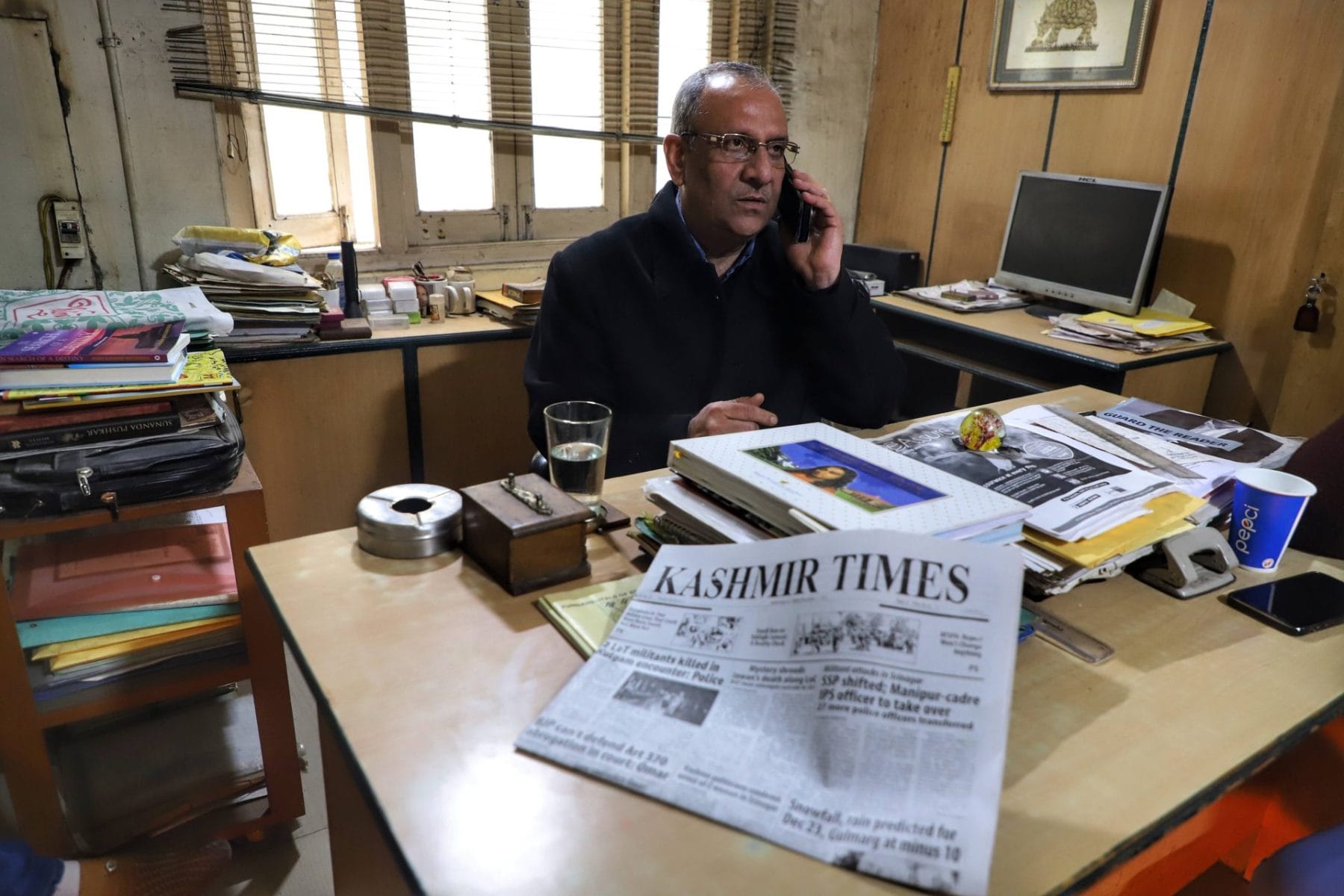
Prabodh Jamwal, Editor of The Kashmir Times, at his office in Srinagar in early 2020. Nasir Kachroo/NurPhoto via Getty Images.
But, as the so-called terror investigation and the mysterious discovery of weapons in our long disused office in 2025 showed, the ‘Kashmir Times’ remained a thorn in the side of the Modi government. The Indian prime minister has frequently presented India on the international stage as the “mother of democracy” and the “Vishwaguru”, a moral exemplar and teacher to the world. Just last week, between September 12 and 13, Delhi hosted Vladimir Putin, Xi Jinping and Iranian president Masoud Pezeshkian as part of the annual BRICS meeting, the global group founded initially by Brazil, Russia, India, China and South Africa (hence the acronym) that is increasingly being presented as an alternative power centre to the American-led Western alliance. For an India seeking to portray itself as not just an emerging superpower but as a democratic force, it is vital that Kashmir remain repressed, hidden away from global scrutiny.
It’s why, even as a newsroom in exile, we continue to be pursued by an Indian government seeking to tarnish our credibility, to deny us the right to report on Kashmir. We are being subject to a vendetta and it represents what has happened to journalism in Kashmir. Journalists have been silenced by the Modi government, Kashmiri voices strangled, and the local media industry deliberately destroyed.
What is happening to journalism in Kashmir is a harbinger of what lies ahead for the rest of India.
A model of suppression
Geeta Seshu of Free Speech Collective, which monitors press freedoms in India, argues that Kashmir is a laboratory where every strategy of media suppression is tested and perfected for use elsewhere. India, which once had a noisy, argumentative press, now ranks at a lowly 157 out of 180 countries in the World Press Freedom Index. Reporters Without Borders, which compiles the ranking, says “press freedom is in crisis” in Modi’s India.
The 2023 Digital Personal Data Protection Act provided a “dangerous framework for expansion of surveillance and censorship” across the country. It empowered the government to demand data from any entity, including journalists, effectively requiring them to reveal their sources. The amendments to the 2020 Information Technology Rules already burden intermediaries with harsh obligations and have been used to arrest journalists, block websites and compel social media platforms to restrict content. Recently, Instagram restricted posts about reports of Kashmiris shot by Indian security forces using pellet guns on unarmed protestors.
Seshu’s fear that what happens in Kashmir will be replicated in the Indian mainland has largely been borne out. For example, in 2023, nearly 50 journalists associated with the portal ‘NewsClick’ – some only vaguely – were subject to arrests and interrogations. Many had their devices seized without due process. Their alleged crimes were essentially guilt by association, charges manufactured not from evidence but from a, frankly, lazy piece of journalism published in the ‘New York Times’ about NewsClick’s funding. The charges were eventually quashed by an Indian court.
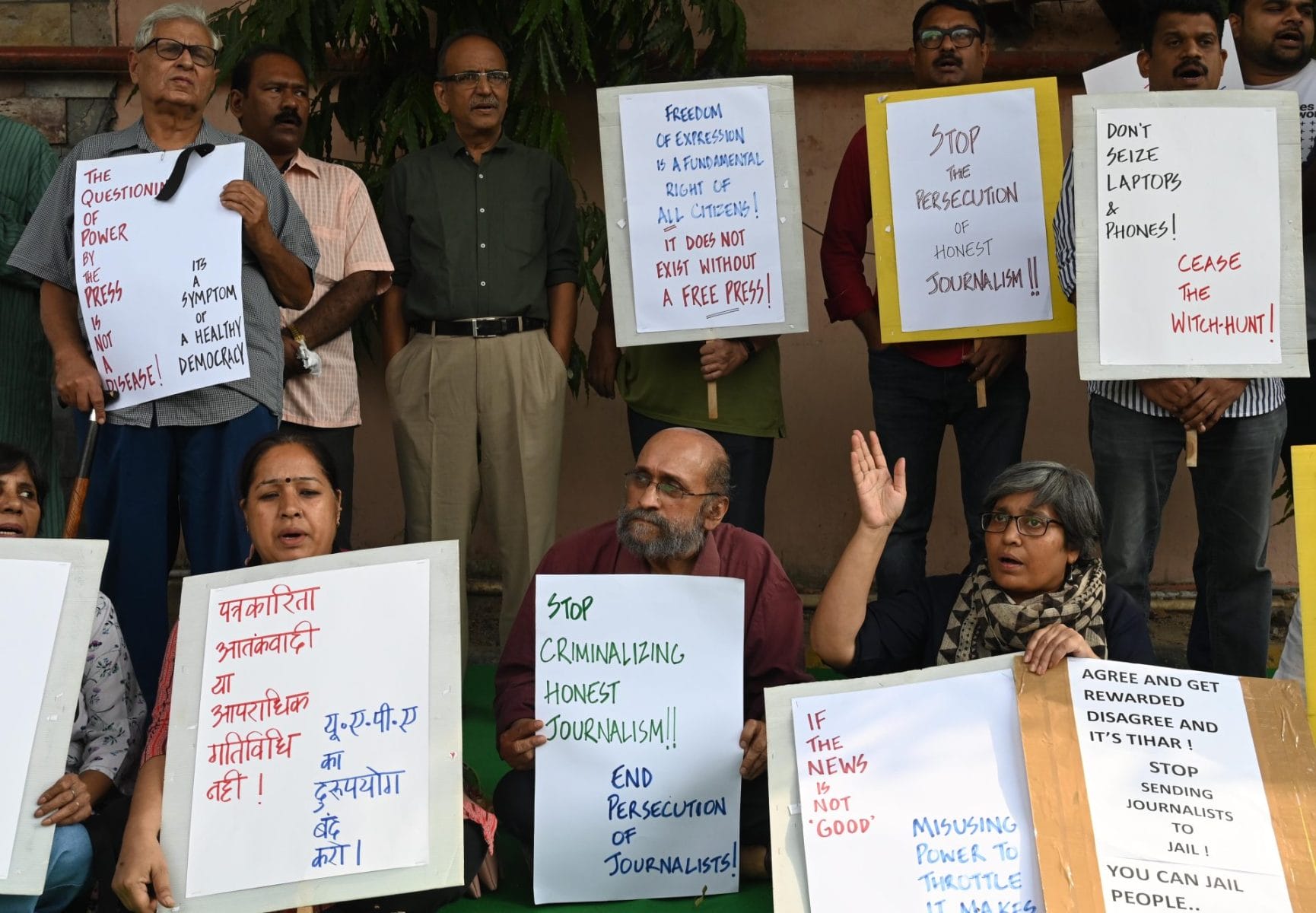
The "To Defend Journalism" protest at New Delhi's Press Club of India, October 2023. Vipin Kumar/Hindustan Times via Getty Images.
Such court rulings are less likely in Kashmir. As a Kashmiri journalist based in Delhi says, “unlike the rest of India, Kashmir is a police state, and state control requires any independent journalism to be shut down.”
In Kashmir, the Indian state has engineered a sophisticated edifice of control through securitization, surveillance and interrogation. It is invisible, intangible, and all-pervasive, a model that extracts quiet surrender and obedience. Unlike the targeted killings of journalists in Gaza, in Kashmir the control of information is seamlessly embedded in everyday life, requiring no enforcement, no traces of brutality. The journalists are essentially cowed into submission.
It began with the world’s longest internet shutdown – a complete lockdown for six months and a partial one for another year. What the shutdown created, despite a court verdict restoring communications, was fear among journalists compelled to work out of a government-surveilled computer facility, and then a perpetuation of that fear through consistent localized and temporary digital shutdowns. So commonplace are these shutdowns that they no longer warrant reporting or commentary.
In June 2020, the Modi government introduced a 53-page document called ‘J&K's Media Policy’ which gave the authorities sweeping powers to monitor, judge, and punish journalists, branding critical reporting as “fake news”, “unethical”, or “anti-national”. The authorities would also routinely remove government advertising from cash-strapped outlets and provide accreditation only to journalists deemed loyal, thus turning bureaucrats into arbiters of what constitutes news and who gets to report it. The effect is chilling.
And then there’s the monitoring of communications.
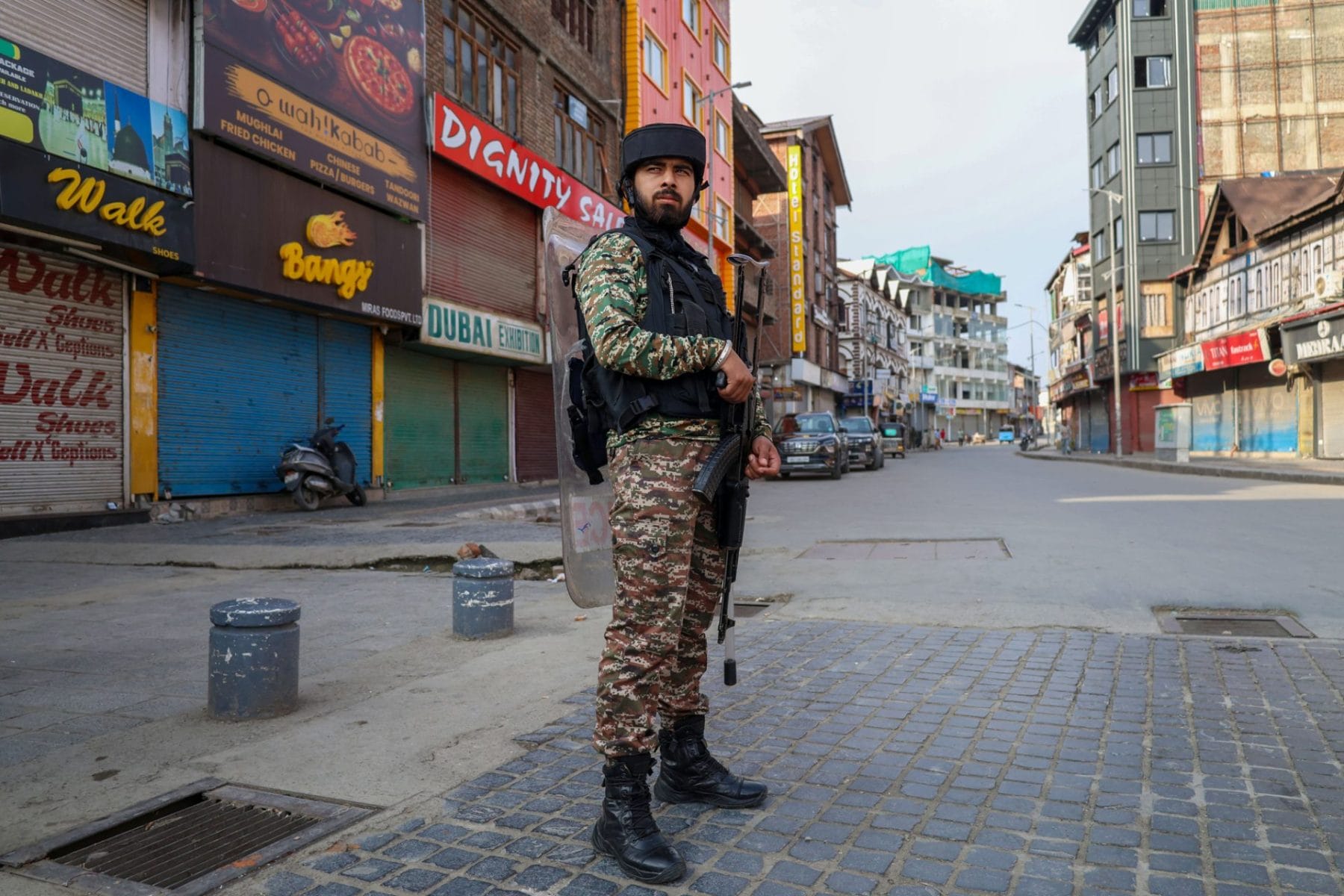
An Indian security personnel in Srinagar, Jammu and Kashmir, August 2026. Firdous Nazir/NurPhoto via Getty Images.
“I can’t say if they’re using Pegasus or some other spyware or technology,” a journalist told me about being interrogated over emails sent to an editor, “but they knew everything about our conversations.” In a 2021 leak, it turned out the Indian government was using Pegasus to spy on at least 40 Indian journalists, only one of who was Kashmiri.
But, a Kashmiri journalist says, “officials have told us ‘nothing in Kashmir is end-to-end encrypted’ and digital activity is clearly being constantly monitored.” No Kashmiri journalist I spoke to for this story, including those who contribute to the ‘Kashmir Times’, have the encrypted messaging Signal app, used worldwide by journalists, on their phones. Devices are routinely checked when journalists are summoned to police stations in Kashmir for questioning. Some said their devices were returned after being tampered with. “You face humiliation and beatings for using Signal and VPNs,” many journalists said. “You can only get away with it if you’re not on their radar,” said one.
In November 2025, the Indian government issued a directive insisting on verifying the “bona fides” of journalists working in Jammu and Kashmir, and the police followed up by requiring journalists to part with personal information including biometrics and bank statements. In January this year, senior journalist Basharat Masood of The Indian Express spent seven hours at a Srinagar police station, then was summoned for three more days and told to sign a bond promising not to “repeat his mistake” – for reporting on the surveillance of mosquea surveillance, even as officials had already admitted to large-scale data collection and verification.
Surveillance normalized
Police also surveil Kashmiris through the use of drone cameras, a network of 1,000 electronic cameras installed at major traffic junctions, and through unrestricted access to people’s social media activity across platforms ostensibly to track anti-India activity. During an illegal “Census 2024” drive, the police collected residents' personal data and GPS-tagged coordinates of homes. And the soon-to-be-rolled-out Jammu and Kashmir-specific digital identity cards that collects the data of entire households, purportedly to ensure the smooth rollout of welfare schemes, has also sparked local anxieties.
Still, as pervasive as the surveillance is, it is journalists that find themselves in the firing line. Any critical word warrants a summons to a police station, interrogation, intimidation and even detention. This happens repeatedly, with journalists never aware of what specific “offence” might trigger a police summons. The reflex, after several such visits to police stations, is self-protection and self-censorship.
A Kashmiri journalist told me that the language the police use to summon journalists for questioning is particularly sinister. It is almost as if the police are enjoying instilling fear. “Aaj dastarkhan par aapki dawat hai”, for instance, is a typical summons. You are invited to a feast, the police say cynically, knowing a journalist is likely to be harshly questioned, even beaten.
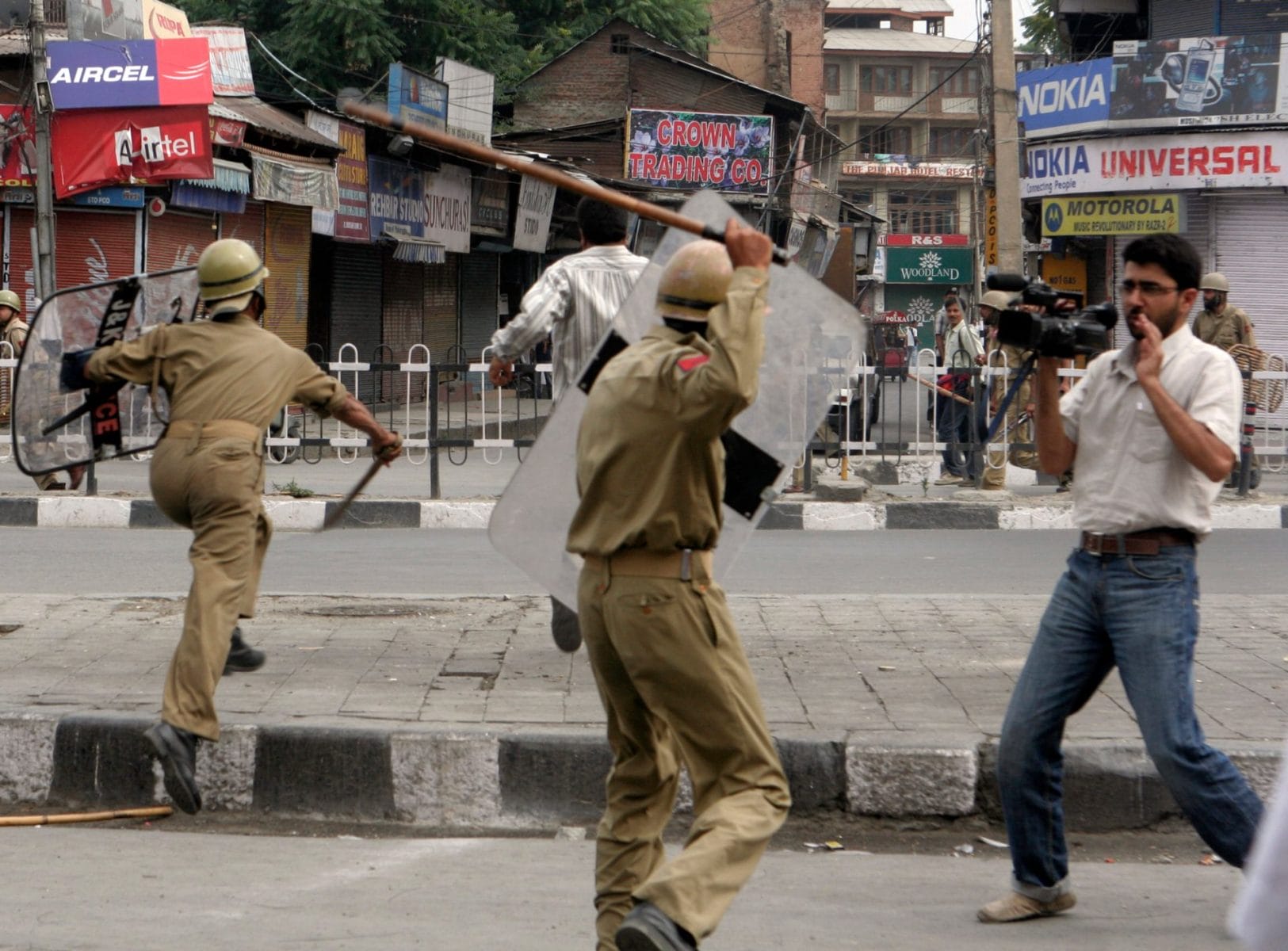
Indian police confront journalists and civilians during a protest on July 10, 2009 in Srinagar in the Indian Administered Kashmir. Yawar Nazir/Getty Images.
Often, Kashmiri journalists, without notice, are placed on no-fly lists. Sanna Irshad Mattoo, a Pulitzer Prize-winning photojournalist, was twice prevented from travelling abroad for exhibitions and award ceremonies, a pointed message that even international recognition offers no protection. At least twelve journalists have had their passports revoked; two of them were already abroad at the time, rendering them stateless.
The Free Speech Collective filed a Right to Information (RTI) query in March 2024 to ascertain exactly how many Kashmiris had had their passports revoked or cancelled. The plea was rejected by the government on grounds of “national security”.
As India continues to press its case as a formidable, if still rising power, citing its 7.8% growth rate over the past quarter, it continues to be defensive and secretive about Kashmir. Foreign journalists are largely barred, or at least heavily restricted, from reporting from both Indian and Pakistani-administered Kashmir. In May, last year, India and Pakistan exchanged air strikes after a terrorist attack in Indian-administered Kashmir and Modi fell out with Donald Trump over the latter’s claim to have stopped both nuclear powers from accelerating towards a disastrous war.
Despite Kashmir being a long-standing issue that merits global attention, reporting from the region has reduced to a trickle.
Mohammad Amin Lara outside his shop in Sopore, Jammu and Kashmir. The shop, once a fully occupied newspaper store, is now a grocery store due to the decline in newspaper sales. Nasir Kachroo/NurPhoto via Getty Images.
A Google search of Kashmir-related news floods your screen with links, but it is bulk without substance. Articles read like a log of official announcements and statements, punctuated by the occasional piece on a shrinking water body, a development project, a political tussle over a non-issue, or unemployment figures. Each report floats like a loose, individual particle suspended in air, packaged and presented as definitive. No investigation into context. No excavation of the past. No interrogation of contributing factors. A story about an alleged terrorist’s hair transplant and cosmetic dentistry, based entirely on police sources, is passed off as an investigation into Kashmiri insurgency. A superficially detailed piece on anti-encroachment drives or home demolitions will carry little beyond the grief of the displaced, or the remarks of a politician whose interest in the community begins and ends with votes. A terrorist’s hair transplant story, based on the police version, passes off as an investigation into Kashmir’s complex insurgency dynamic.
Kashmir fell off the radar a long time ago, says Free Speech Collective’s Geeta Seshu.
Even mundane stories are difficult to report. No one wants to be quoted. A university professor said he could once “talk to journalists and trust they understood the context. Now, a single sentence can be pulled out, circulated on WhatsApp, and suddenly I’m either an anti-national or a government stooge. Both sides will use the same quote to attack you differently. Why would I take that risk?”
Tarushi Aswani, an Indian journalist, told me that “a curtain has been pulled over Kashmir by silencing journalists who ask questions.” Instead, she added, “press release journalism fills the vacuum, erasing the truth about Kashmir, its history, its politics, its development, environment and aspirations.” Kashmir is no longer looking at a mirror. The lack of truthful reporting means nothing is reflected back. Instead, Kashmiris are looking into the lens of a surveillance camera.
*The eight Kashmiri journalists interviewed for this story spoke on condition of anonymity.
Jules Tavernier. — Yosemite - Forest Fire in Moonlit Landscape (Feu de forêt dans un paysage éclairé par la lune), 1881.
Cet été, la « succession des rouleaux caniculaires a ressemblé à une submersion », relève Mohamed Larbi Bouguerra en « Une » de notre édition de septembre. Mégafeux, baisse du niveau des fleuves, impact « dramatique » sur les cultures agricoles… « En matière d'approvisionnement alimentaire mondial, ce tableau vient noircir un horizon déjà assombri par le conflit russo-ukrainien ainsi que par la guerre israélo-américaine contre l'Iran. » Fortement touchés, les pays du Sud attendent encore d'affronter un épisode « redoutablement puissant » d'El Niño, dont l'effet « sur les denrées de base sera d'autant plus fort qu'il se conjuguera à celui des guerres et de la sécheresse ». En Afrique, les politiques publiques misent sur des modèles productivistes, encouragées par les occidentaux et leurs grands groupes industriels, qui échouent et aggravent les problèmes structurels. « La situation ici dépeinte ne résulte d'aucune fatalité. Elle est la conséquence logique, et attendue, d'un modèle d'organisation sociale et de décisions politiques prises en toute connaissance de cause », rappelle Mohamed Larbi Bouguerra.
Aux États-Unis, après avoir définancé des universitésdéjà en péril, sous prétexte de lutte contre l'antisémitisme, dans le cadre d'une « nouvelle ère de répression de la liberté d'expression », le président Donald Trump s'attaque à la gauche et ses nouveaux élus, des « terroristes communistes qui conspirent pour détruire [ce] cher pays », comme le résume Serge Halimi dans nos colonnes. « Ces affabulations, susceptibles de favoriser de nouvelles mesures liberticides ou la contestation des prochains résultats électoraux, ne sont pas réservées à la consommation intérieure » ajoute-t-il : Washington voudrait les exporter avec notamment une conférence sur « le terrorisme politique », évidemment de gauche, tenue le 16 juillet dernier. La France y a participé.
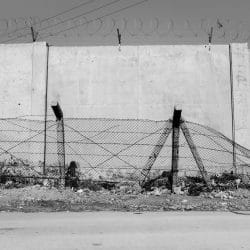
A ride from Tangier, the largest city in northern Morocco to the Spanish enclave of Ceuta takes less than two hours. The border crossing has its own, sleepier rhythm, quite different from the tourist-driven bustle of Tangier. In Ceuta, traders run their errands, Morocco-based expats make visa runs and Spanish people catch ferries to the mainland. On most days, the border crossing seems almost ordinary. The fences, though menacing and topped with razor wire, are less imposing up close and officers make small talk with the expats waiting to get their visas stamped.
Then there are those days when the routine collapses and Ceuta becomes the center of Europe’s migration debate.
The territory is a geographic and political paradox. Despite falling under Spain’s — and the European Union’s — jurisdiction, it sits on the northern edge of Africa, surrounded by Morocco and separated from the Spanish mainland by the Strait of Gibraltar. It is an entry point to Europe, yet not fully part of the Schengen zone, requiring additional immigration checks for travelers crossing to the mainland.
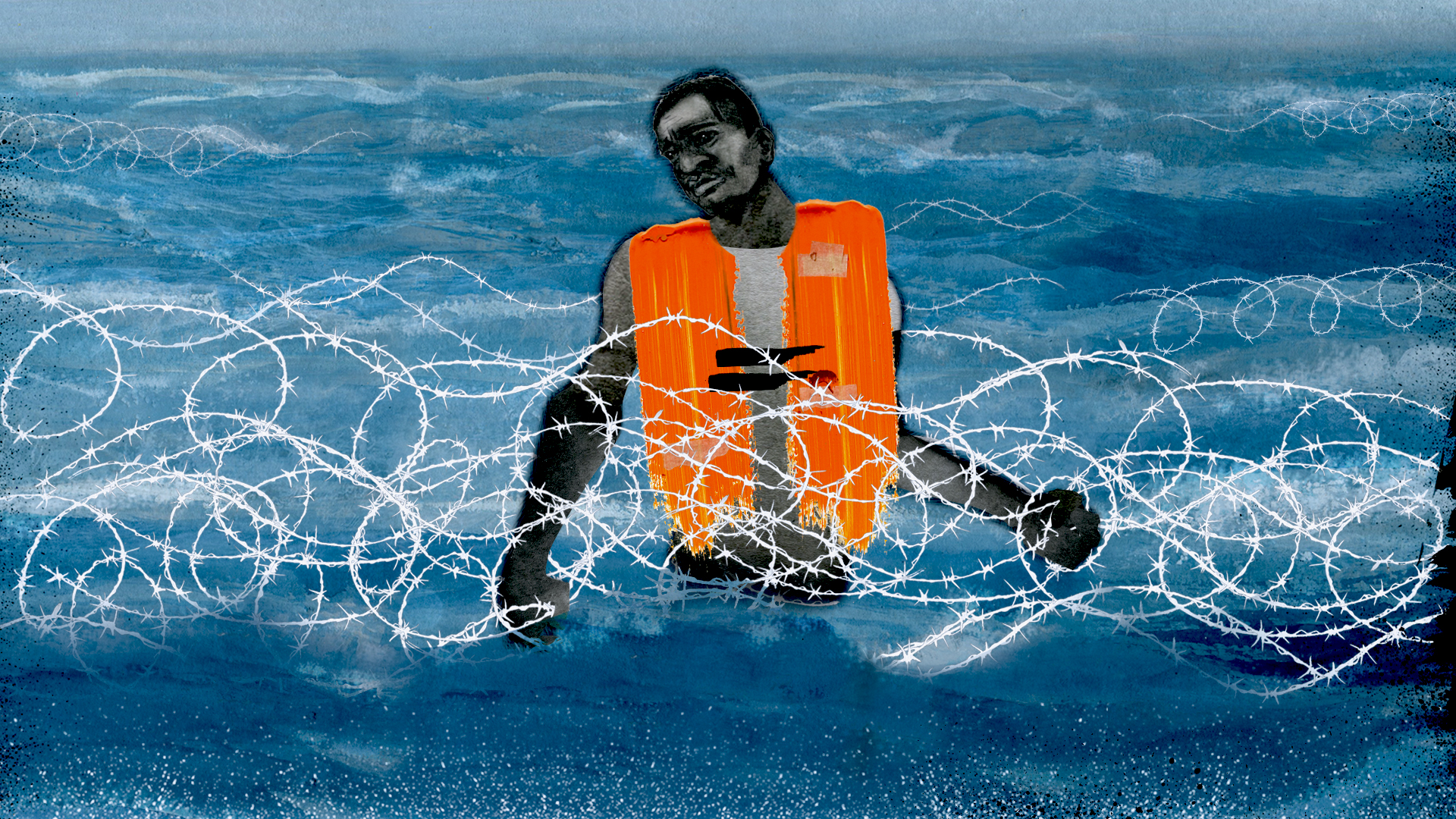
When more than 60,000 people — mostly Moroccan men and teenagers — rushed into Ceuta (almost doubling the coastal city’s population), the images reverberated across Europe. There seemed to be no dramatic buildup to the incident, nor any obvious explanation why thousands of people chose that day to make their way to Spain.
Europe’s far-right politicians seized the narrative, portraying the influx as an imminent invasion, warning that the men were on their way to “Calais” and “Germany.” Italy temporarily suspended the Schengen free movement regime with Spain, meaning travellers arriving by sea and air would now be subject to border checks. Spain threatened to take “proportional measures” in response and did so at midnight on August 8, when it imposed similar checks for visitors from Italy.
The standoff between European governments — led by socialist Pedro Sánchez in Spain and conservative Giorgia Meloni in Italy — is not simply a test for European border security. Instead, what transpired in Ceuta poses bigger questions about the shifting nature of state sovereignty itself: How are we to understand borders, if they’re shaped by forces beyond the state’s reach?
Borders are not just lines separating geographic entities. They are systems built on surveillance, diplomatic bargains and digital networks. Ceuta is the place where all three converge. Its borders, already protected by the sea, have been fortified with steel, outsourced through diplomacy and tested by coordinated rumors.
Steel
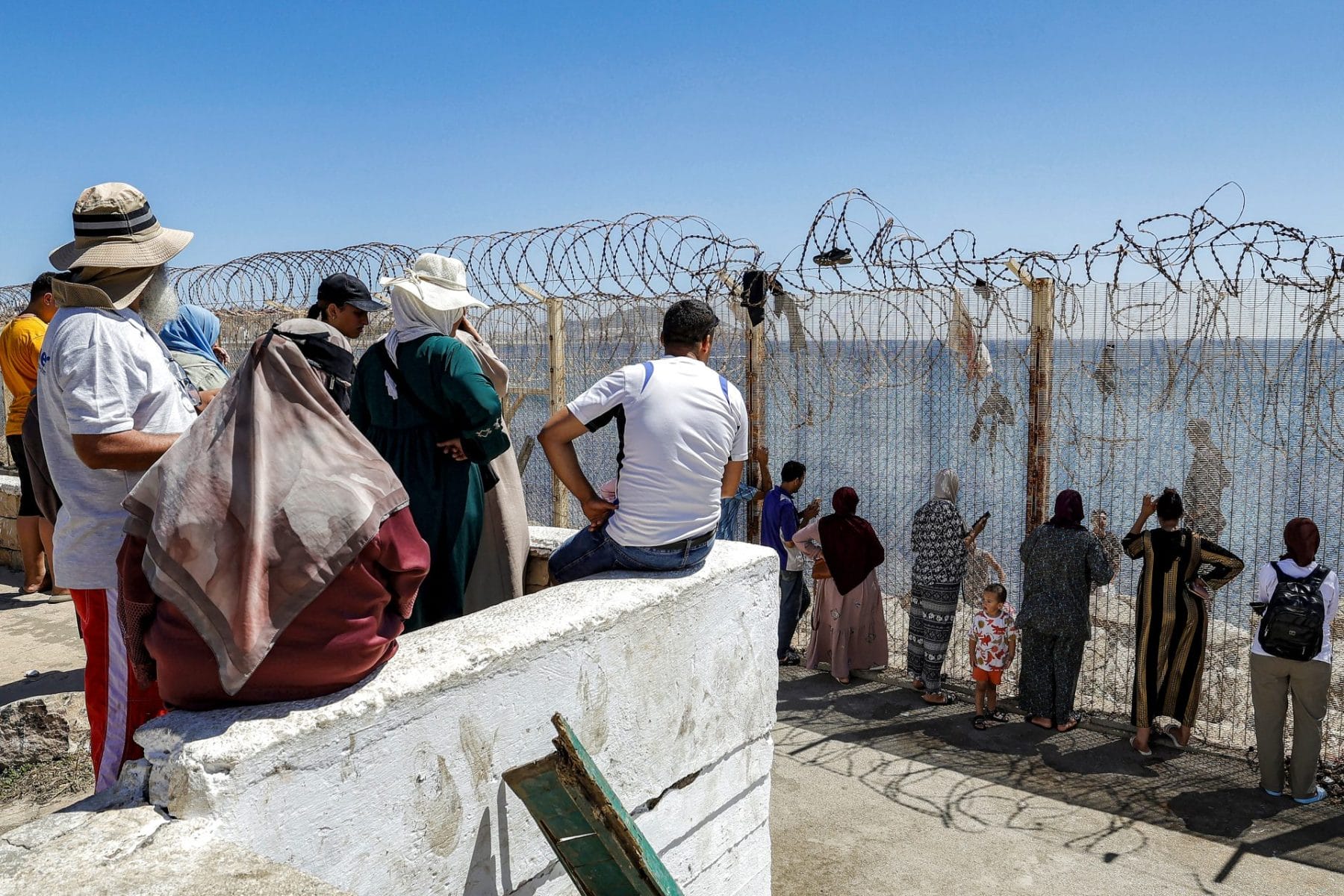
The crossings into the enclave are blocked by a multi-layered barrier of fences and wire. Morocco administers a fence separating it from the neutral area between the two countries. Two fences on the Spanish-controlled territory follow, creating an enclosure monitored by the Spanish Civil Guard. The physical infrastructure is reinforced with motion sensors, thermal and CCTV cameras, maritime communication systems and facial recognition technology.
Even the sea has now been incorporated into the border system. Just three days after the Ceuta border chaos, Spanish authorities installed a 500-metre floating barrier and anchored naval buoys to create another monitored enclosure.
The EU has funded most of the fortifications. The Border Violence Monitoring Network’s report says that since the construction of Ceuta’s border barrier in the 1990s, the EU has spent tens of millions of dollars to make the Spanish-Moroccan frontier more secure, technologically up-to-date and heavily surveilled. With the recent mass crossing, Spain will now receive additional emergency financial aid.
Yet, the architecture of physical surveillance, built and re-built with European money for decades, cannot prevent the human cost of attempting to cross a border. In Ceuta alone, at least 100 people died according to local authorities. “The rationale behind increasing surveillance is that you'll be able to save lives and smash the [people trafficking] gangs, right?” asked Nathan Akehurst, who has written about Ceuta’s border for Jacobin. “Where was that in this case?”
Diplomacy
Akehurst’s question touches upon the human-centered rationale for heavy border surveillance. But there is also a political one. It is not only Spain, as a EU member, that receives funds to manage migration. Morocco has received €427 million since 2015, for migration-related expenses, including technology and training. That’s part of Europe’s wider strategy of border externalization, a practice where Europe moves border control beyond its own territory.
The practice has been around for decades, but went into overdrive after 2015, when approximately 1.3 million people, mostly from Syria, came to the continent seeking asylum. Many of them reached Europe through Turkey, prompting the EU to strike a deal with Ankara: €6 billion in funds, visa liberalization and EU-ascension negotiations in exchange for stricter border controls and curbing irregular arrivals to Greece. The EU also agreed to resettle within Europe one Syrian from Turkey for every Syrian returned to Turkey from Greece. But by 2020, when the EU failed to resettle Syrians, Turkey’s president Recep Tayyip Erdoğan declared he would no longer prevent migrants from crossing Turkey en route to the EU.
“Border externalization is basically paying other countries, but also subjecting them, through a carrot and stick approach, to performing functions that are usually performed by a state itself at their borders,” explained Josephine Solanki from the Transnational Institute, an Amsterdam-based think tank. It leaves space for leaders like Erdoğan, Solanki added, to bargain for influence by turning migrants “into political leverage.”
The cost of outsourcing borders is not just material. It is measured in control that Europe cedes to the foreign governments it relies on for migration policy enforcement.
Relatives and friends waited by a fence topped with barbed-wire for the return of people who had previously crossed into Ceuta. Spanish authorities claim to have sent almost everyone back to Morocco. Abdel Majid BZIOUAT / AFP
In Ceuta, migrants claimed local authorities did not stop them from crossing the border. A young Moroccan man told the New York Times a day after the event: “They opened the border and let everyone go by.”
Border outsourcing agreements were made, among others, with authoritarian regimes in Tunisia, Egypt and Libya, where EU funds were used to detain migrants and quell domestic protests, rights organizations say. Alliances with “deeply unreliable and authoritarian actors” in the name of stability, said Nathan Akehurst, “is short-termist, insane and loses Europe any credibility it has left.” These alliances also allow Europe to “shift the blame to the Moroccans, the Eastern Libyans, the Turkish or whoever decides to take advantage of that moment.”
Rumors
It is yet to be revealed who, if anyone, has taken advantage of the mass crossing into Ceuta. Local and international media have uncovered now-deleted posts that shared tips on routes and equipment for the journey. One of the main networks was called Hrig Sebta network — “Sebta” being the Arabic name of Ceuta and “hrig” being the Maghrebi term for undocumented migrants, literally referencing the burning of identity papers.
In the wake of Ceuta, European ministers pledged to tackle online misinformation to avoid migration crises, but remained cautious when asked about thousands of posts reportedly linked to Russia. Other theories attributed the crossing to Morocco’s tensions with Spain over its closer ties with Algeria, or to Spain’s position on Palestine.
But those rumors, and what appears to be a weeks-long coordinated online campaign behind them, reveal something deeply human that fences can’t deter: movement that is spurred by hopes for a better life.
“[The crossing] would have happened anyway at some point,“ Akehurst argues. “There would have been a crossing because all of the circumstances that generate that are already there before someone with a twitter account throws a match on the fire.”
Yet, let’s pause at the match. It’s not about someone with a social media profile creating chain messages. It is about the ecosystem that can jeopardize borders by creating information flows, turning rumors into perceived opportunities.
Moroccan newspaper TeleQuel already published a report about social media posts amplifying the next hrig — another attempted crossing into Ceuta — on August 15.
When packaged to a hungry audience, rumors carry the currency of truth. They’ve driven migration long before social media was even conceptualized. Now those rumors speed through digital space owned and operated by private companies not prone to accountability and sitting well outside the reach of any single state.
And the EU has understood that for years. “It is necessary to structure the information space, as we have organized in the past the territorial space, the maritime space and the air space,” Thierry Breton, the European Commissioner for Internal Market of the EU said back in 2018. He warned about Big Tech companies treating digital space as a no-man’s-land that they would write rules for.
The no man’s land between Morocco and Spain appears calmer now. But the turmoil of the crossing revealed a new, digital dimension to border governance. Information has always found a way to spread; digital platforms have given it new channels: ones which allow those behind the information to remain faceless, while the information itself passes from screen to screen. It reaches a boiling point, spills over from the digital space and then can be disappeared, even before anyone has had a moment to scroll back.
A lot is written about corruption, but fundamentally it’s about trust and how healthy societies can’t exist without it; and the World Cup has shown what happens when trust breaks down. The decision to allow U.S. striker Folarin Balogun to play in the World Cup match against Belgium was, according to FIFA, made by the relevant disciplinary committee in a routine manner. However, following the similarly generous treatment accorded to Portuguese megastar Cristiano Ronaldo before the tournament began, a lot of people not unreasonably questioned whether the rules were being set aside for commercial reasons.
It’s only football, so does this matter? In some ways, of course not. But I think the episode is instructive of how quickly trust can disappear. No one is under any illusions that FIFA is motivated purely by the desire to spread sweetness and light, thanks to corruption scandals, the grotesque “peace prize,” and all the other nonsense. But previously, what happened on the pitch was assumed to be sacrosanct, which is why these disciplinary decisions mattered more than it at first might appear.
Shortly after the U.S.-Belgium game, Argentina played Egypt, coming back from a two-goal deficit to achieve a remarkable 3-2 victory. I watched the game with my family, and it was notable how — instead of being amazed by Lionel Messi’s wizardry — all of us focussed instead on a refereeing discrepancy that led to a goal for Egypt being ruled out, and a seemingly identical one for Argentina being allowed.
Previously we would have given the referee the benefit of the doubt: even if he’d made a mistake, we’d accept it was an honest one. But now we knew that the tournament had intervened to keep bankable stars playing for longer, in violation of its own precedents and regulations. Any decision that has that effect, as this one did, was immediately suspect.
In the past, particularly when living in Russia, I used to hear a lot of Westerners being quite enthusiastic about corruption: it was nice they’d say, if they’d been stopped speeding, to be able to pay the police officer a bribe on the spot, and skip all the annoying paperwork. But that was a short-sighted way of looking at it: once a police officer, or anyone else in a position of power, gives anyone special treatment, then the trust that keeps all our interactions civilised, starts to break down. The more it is broken down, the harder it is to repair.
I am not particularly interested in football (Welsh rugby, on the other hand), which is a game I find both dull and mercenary. Besides, the Welsh team tends not to be very good. But I am interested in corruption, and I was surprised by how angry the Balogun affair made me. If you love a game, you need to hate its arbiters giving out special treatment, even if you are the beneficiary of it. That is a lesson quite a lot of politicians need to learn, both in the United States and elsewhere.
A report from the Anti-Corruption Data Collective makes particularly grim reading in this light. Lobbying by “high-risk foreign individuals” is higher under Donald Trump than it has previously been; the amounts being spent are often obscure; much of the lobbying is to overturn previous anti-corruption efforts; and, most worryingly, efforts are aimed not just at individual cases, but at the whole principle of fighting corruption.
“If these influence campaigns are successful, this sets a dangerous precedent where the standard for holding corruption accountable shifts according to whoever holds power in Washington. For those seeking to undo consequences of their corrupt acts, each time lobbying works, it confirms that there is a price at which these consequences can be undone,” the report notes. So just like football then.
Cometh the hour, cometh the bin
Sunlight, it is often said, is the best disinfectant. Though I don’t know if that’s literally true when it comes to bacteria, transparency is certainly a useful antidote to the kind of backroom deals that make corruption possible. Generally speaking, politicians honour this idea in principle, if not necessarily in practice, so it’s unusual for British far-right politician Nigel Farage to have launched an election campaign on the single issue that he personally should be allowed to keep his financial affairs secret.
All the other major parties have decided to sit this one out until the official inquiry into Farage’s finances is concluded, at which point there may well be another by-election anyway, leaving serial novelty candidate Count Binface to provide the main opposition. It’s odd to think that someone who obscures his face behind a giant rubbish bin and pretends to be a spacelord from the planet Sigma IX could be the voice of transparency, but it’s 2026, and that appears to be where we are. It would be genuinely hilarious if he won.
Of course, while we’re distracted by the attention-seeking behaviour of tiresome bores like Farage, actually important things are happening elsewhere. It’s definitely worth taking a look at this report into the Iranian drone industry, which illustrates how changes in the world economy have led to a weakening of American influence in particular, and Western influence in general.
This growth of a multi-node decentralised trade system is paralleled by the growth of the large and highly-efficient ‘Chinese Money Laundering Networks,’ which operate with the same scale and speed as any large financial institution, and now dominate illicit crypto activity. This is an interesting paper on how military strategists should think about money laundering, considering its significance in allowing adversaries to buy components for drones, and so on.
We also need to remember, however, that by using money laundering legislation and sanctions profligately, we are lessening their effectiveness by teaching people how to evade them. Like antibiotics, we’ll miss them when they don’t work anymore.
A version of this story was published in this week’s Oligarchy newsletter. Sign up here.
The United Kingdom has taken over the presidency of the Financial Action Task Force, the global standard-setter on tackling money laundering, and seems determined to keep calm and carry on despite the gigantic Donald Trump-sized hole being blasted in everything it’s trying to do.
The new president of the Financial Action Task Force is Giles Thomson, a career civil servant and archetypal safe pair of hands, who’s declared that the organisation’s priority for the next two years is fighting fraud. He estimated the global cost of fraud at $500 billion, which — if compared to the standard estimates of the volume of global money laundering as making up 2 to 5% of everything — means it contributes between a tenth and a quarter of all profits from financial crime.
Fraud is clearly thus a Very Big Deal, and therefore a well-chosen target for Thomson because everyone (including me) agrees that we need to hit it. However, I think I saw a hint of other perhaps more controversial tasks in the rest of his proposed priorities. The suggestion, for example, that the Financial Action Task Force (FATF) will conduct “proportionate assessments of lower capacity countries” looks to me like a recognition that it needs to stop criticising poorer countries that don’t actually launder money just because their legislation isn’t perfect.
This has been a weighty accusation in the past, not least because of the implicit suggestion of racism, made by, among others, regulator Charles Littrell, who summarised the FATF’s great flaw in 2022 thus: “the vast majority of dirty money and assets resides in, passes through, or is facilitated by the world's largest and richest countries. How then do the world's main [anti-money laundering] risk rankings invariably centre blame upon small, relatively poor, and nonwhite jurisdictions?”
This is not an academic question. Being blacklisted by the FATF is serious, and there has been definite unfairness in the past in which countries have ended up being singled out for a punishment beating. Hopefully a recognition of this reality is hidden somewhere inside Thomson’s rather gnomic utterance that “the FATF will support countries and the private sector to focus effort where the threat is greatest.”
Fortunately, the FATF will have an immediate opportunity to demonstrate that it shows neither fear nor favour when it comes to doing the right thing when it publishes the results of the ongoing evaluation of the United States.
The U.S. was last evaluated in 2016, and the FATF made various recommendations, which Washington was supposed to have implemented within three years, and sort of did. With the passage of the Corporate Transparency Act in 2020, some progress was made, but since Donald Trump returned to the White House that has gone into screeching reverse.
Prosecuting foreign corrupt practices is “not a priority, ”transparency around residential ownership has been suspended, the Corporate Transparency Act has been gutted, and crypto is everywhere. Above all, of course, the president himself has been making money at a rate that even Vladimir Putin would have to admire. His headline earnings figure — $2.2 billion in the first year of his second term — is clearly unprecedented, but so are the details.
What for example will future historians make of the fact that the president declared his ownership of the trademark for “THINK BIG AND KICK ASS”? Ha, trick question, there won’t be any historians. They’ll have been replaced by AI.
Tether watch
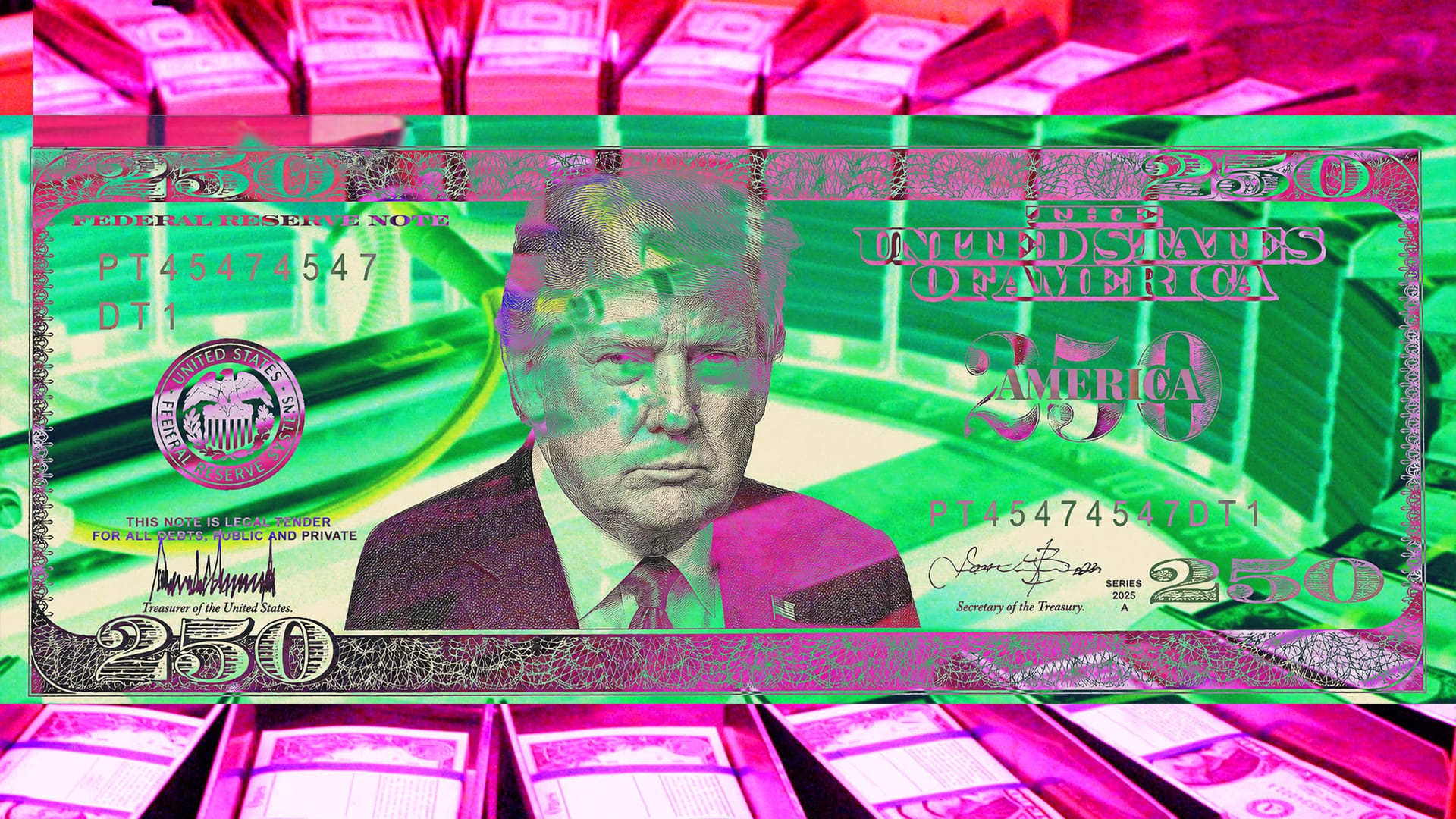
Talking of history, I had slightly been hoping that the U.S. dollars in circulation might hit the appropriately round number of $2.5 trillion to mark the round 250th anniversary of the Declaration of Independence, but it was not to be. If only the Fed had launched the $250 bill in time, perhaps it would have got there, but we’ll just have to wait.
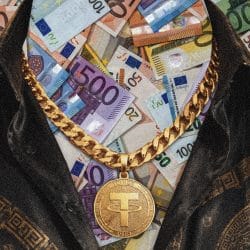
Meanwhile, there’s an interesting time ahead for Tether, this newsletter’s favourite cryptocurrency, which is sailing into choppy waters. It has decided to pull its USDT out of the European Union rather than to comply with the Markets in Crypto Assets regulations on stablecoins, which is a boost for its great rival Circle (USDC), which is very much available in Europe.
The two big stablecoins have markedly different strategies: Tether is dismissive of regulators, while Circle cosies up to them. And now here comes a new rival in Open USD, which is backed by many of the world’s largest banks and tech firms, and which also promises to abide by everyone’s regulations. Is Tether at risk of becoming irrelevant?
Congo’s conflict coltan
Huge credit to the good folks at Global Witness for this report from the Democratic Republic of the Congo, where coltan smuggling is helping to perpetuate the grim conflict in the east of the country. It is the kind of methodical, thorough research that really helps open your eyes to how grim things can be, and how complicit the rest of us are in a global supply chain forged from conflict.
Congolese people hack coltan out of the ground under the eyes of M23 guerrillas, who then smuggle it into Rwanda, where it is repackaged as Rwandan and given certification intended to show it’s not from a war zone. It is then shipped to refiners in China or Kazakhstan to be processed into tantalum, which is in turn sold to leading companies to be incorporated in the phones, tablets, jet engines, and other products that we all rely on for our lovely modern lives.
“Rwandan official figures show that coltan exports have increased more than 2.5 times between 2021 and 2025,” the report notes. “Coltan is an important revenue stream for Rwanda, which levies a 5% tax on exports. Since 2023, it has become the country’s second-largest export earner, after gold.”
And where does the gold come from? Also from the Congo, which is why the U.S. Treasury sanctioned a Rwandan gold refiner last month, following action taken by the European Union against the same company last year, but it has done little to rein in M23.
A version of this story was published in this week’s Oligarchy newsletter. Sign up here.
I was listening to Ezra Klein interviewing a left-wing Democratic Party strategist the other day about what a post-Trump U.S. foreign policy might look like, and it was a pretty striking demonstration of Europe’s irrelevance right now that the only Western European country mentioned in the 90 minutes of the chat was the UK, and that was solely in the context of how it helps kleptocrats.
But aha, a notional Brit might have replied, at least we are about to convict Diezani Alison-Madueke, former head of OPEC, ex-Nigerian oil minister, for her alleged egregious corruption. That notional Brit would be feeling pretty foolish right now though, because this was yet another flop, with her being acquitted on all charges.
Britain has a dire record both when it comes to enabling corruption and when it comes to successfully investigating it, as the failure of yet another high-profile prosecution shows. This latest fiasco should be the impetus the country needs to at last provide the resources and officers that its law enforcement agencies require.
Alison-Madueke saw the hand of divine providence in her acquittal. “It has been a hard journey,” she said, “but I tell you this, God will always do as he will. God will be God and God is not a man that he should lie; when he promises you something, he will see it through” — and who am I to say that she’s wrong? However, there are other potential explanations for what has happened beyond the Almighty manifesting at Southwark Crown Court to give instructions to the jury, including the entrenched incompetence of British police agencies.
It’s hard not to see a parallel with the failed attempt six years ago to investigate Dariga Nazarbayeva, daughter of the former president of Kazakhstan and possessor of a reasonable-to-large London property portfolio, which saw the National Crime Agency (NCA) being comprehensively outwitted by defence lawyers, just as it has been again.
“Today’s verdict is a major blow for the NCA who have come away empty-handed in one of their highest-profile corruption cases, which took over a decade to progress to trial,” said Zainab Saleem, Legal Fellow at Spotlight on Corruption. "It is vital that the UK government properly resources law enforcement agencies tasked with investigating complex bribery and corruption cases and does not take this defeat as grounds for rowing back on anti-corruption enforcement.”
It will be interesting to see what, if anything, results from the suggestions that the new Supreme Leader of Iran has been moving his wealth merrily around with the help of various Western banks, all of it now being investigated by the U.S. Department of Justice. “Funds for the transactions have been routed through financial institutions in the UK, Switzerland, Liechtenstein and the UAE,” reports Bloomberg.
What is the answer? Whatever it is, it will be even more embarrassing for the UK if it doesn’t come up with something plausible by the time it convenes its Illicit Finance Summit in December. (Unless it ends up being rescheduled again, like one of those meetings that no one actually wants to attend but also no one wants to be responsible for cancelling.)
Still, credit where it’s due, at least efforts to improve Companies House — the UK’s formerly-disastrous corporate registry — appear to be finally bearing fruit. It has sent almost a million enforcement letters to people who haven’t verified their identity, which must have been — at the very least — a useful money-spinner for the post office.
The idea of increasing funding to law enforcement agencies is something that Americans would do well to consider too, particularly when it comes to the Internal Revenue Service. “In 2022, under President Joe Biden, Congress approved an $80 billion increase in IRS funding over a decade, with more than half of it slated to restore the agency’s ability to go after the super-rich. This victory was short-lived. By March 2025, Republicans had slashed that $45.6 billion enforcement budget to just under $4 billion — “a 91% decrease,” it notes in this fascinating book excerpt.
I have been interested for a while in the idea of government’s being engaged in “legalisation by under-enforcement,” which is something we see with tax evasion, pollution of waterways, and almost anything else when the rules not being enforced benefit the kind of people who donate money to political parties. But I need a better name for the phenomenon, so please help me out and send one in.
Talking of phenomena that we need a new name for, Elon Musk’s wealth is doing weird things to the Forbes billionaires list. Whoever runs it appears to have decided to only display his net worth to two significant figures. That means that, while we can see an assessment of the wealth of relative paupers like Sergey Brin to the nearest $100 million ($277.6 billion, as I write), we only get a round $1.2 trillion for Musk. Or a round $1. 4 trillion, depending on what day it is, which means his wealth jumps up and down in a minimum increment that, on its own, would be sufficient to make its possessor the richest person in every country in the world except Spain, Canada, Mexico, the United States or France.
And talking of France, the G7 summit in Evian is over. It was of course at a previous French G7 summit when participants created what became the Financial Action Task Force. That was the 1980s and they were concerned about the spread of illegal drugs, the harm they were causing, and the fact that more countries were producing them, and wanted to stop drug dealers being able to keep their profits. Among other things they committed — in the words of the 1989 communiqué — “to prevent the utilization of the banking system and financial institutions,” which is part of the clause that gave birth to the entire global anti-money-laundering system. Well, 37 years have passed, so let’s check in on how that’s going.
This year the G7 communiqué expressed concern about the spread of illegal drugs, about the harm they’re causing, and about the fact that more countries are producing them. “We emphasize the continued need to strengthen the global anti-money laundering architecture to prevent financial crime and improve enforcement and asset recovery outcomes, in line with the Financial Action Task Force standards,” this year’s summit document states.
Plus ça change. Maybe in another 37 years, they’ll look up and wonder whether they should try something else, and indeed whether the FATF standards aren’t ripe for reconsideration.
A version of this story was published in this week’s Oligarchy newsletter. Sign up here.
I’ve been writing this newsletter since 2020, and inmy first edition I marvelled at the concept of the centi-billionaire, and the fact there were at the time three people with 11 zeros in their net worth. What a six years it’s been. When I started writing this week’s edition, Elon Musk was a mere David Sun away from becoming the world’s first trillionaire, and now as I’m finishing it, Musk is worth the scarcely conceivable sum of $1.1 trillion. Nothing like this has ever happened before and there is no sign it is going to stop happening. There is no reason at all to suppose that in another half-decade I won’t be writing about how deci-trillionaires are the new thing.
This increasingly extreme inequality is a challenge for social cohesion, democracy and civilisation that we haven’t seen in modern times, second only to climate change as a threat to our future. Although in some ways, they’re the same challenge, considering the disproportionate share of emissions coming from rich people.
In some ways, if Musk’s wealth seemed to be making him happy it wouldn’t be so bad, but it appears only to make him angrier. I like to think that if I had a trillion dollars, I’d do something more constructive than stir up protests against ethnic minorities.
Reducing inequality is the right thing to do for every reason, not least because it would deprive very rich people of the ability to stoke pogroms anywhere they like. But how to do that? The only thing that has previously reduced inequality to any significant extent has been the 20th century’s series of global conflicts with massive destruction of life and property, and that’s the kind of thing it would be good to avoid.
I think there is a strong argument to be made, however, that the financial trickery abused by the very rich is also bad for national security, and it’s one nicely made here by Matthew McGlynn, who specialises in researching Russia. By degrading the ability of oligarchs to cheat their way to riches, we’d also limit the space of billionaires to dodge taxes and accountability.
It is notable that expert after expert speaking to the House of Representatives Committee on Financial Services about Chinese Money Laundering Networks pleaded for the Corporate Transparency Act to be properly implemented. “When a laundering network operates by scattering its footprint across hundreds of student accounts, dozens of shell companies, and multiple jurisdictions, traditional compliance frameworks may treat flags as isolated, minor incidents. The systemic risk is consistently underestimated, and responses remain heavily reactive,” noted Louis DeTitto.
If first we come for the money launderers, then the billionaires won’t speak out because they’re not money launderers. Also, it would mean we’d do a better job of tackling money laundering, which would be nice.
While on the subject of congressional hearings, there are interesting moves by Senator Richard Blumenthal to probe how Iranian and Russian sanction-dodgers are using cryptocurrencies. In April, he wrote to Binance requesting further information, and now he’s written to Tether asking for information about misuse of its USDT stablecoin.
The details he’s requesting are far-reaching and potentially highly consequential, since they relate to connections with Iran and Russia, including A7, issuer of the leading ruble-denominated cryptocurrency. Perhaps most important, however, is his first question: “What legal jurisdictions does Tether believe it is subject to for USDT, in particular for anti-money laundering rules, reporting obligations, asset seizures, and sanctions compliance? Does Tether believe it is legally required to comply with Department of Treasury sanctions for USDT and issue suspicious activity reports (SARs) to the U.S. government?”
If the U.S. asserts regulatory authority over dollar-denominated cryptocurrencies as it has over all transactions in dollars then that would significantly undermine their attractiveness to illicit actors, and also do a lot to reassure people like me. Tether, meanwhile, has been bigging up its cooperation with law enforcement agencies, and says it’s frozen $450 million globally.
“For the past few years, stablecoins have come to dominate the landscape of illicit transactions, and now account for 84 percent of all illicit transaction volume,” concluded Chainalysis in 2026’s crypto crime report. It estimated total illicit transactions at $154 billion last year, so the stablecoin share of that was almost $130 billion. That is a fraction of the amount of money laundering estimated to move through either the trade system or indeed the formal financial network, but still a lot of money. It’s interesting to see, however, how Chainalysis still holds out hope for well-regulated cryptocurrencies helping to solve problems caused by standard finance.
“Stablecoins and on-chain settlement mechanisms in particular offer low-cost, borderless avenues for remittances, payments, and savings,” Chainalysis said. “If coupled with sound regulation and inclusive policy frameworks, these tools could help governments leverage crypto not just for resilience, but also for broader financial inclusion as part of economic recovery.”
Seeing will be believing.
A version of this story was published in this week’s Oligarchy newsletter. Sign up here.
A top banker has got in trouble by referring to employees whose jobs will be replaced by AI as “lower-value human capital.” But he’s just saying the quiet part out loud: compliance officers have been expected to work like inefficient computers for years already anyway. Standard Chartered CEO Bill Withers used the unfortunate phrase when describing how the bank plans to keep hitting its profitability targets by cutting 15% of back office staff, and has tried to backtrack a little after a predictable storm of criticism, including from the former president of Singapore.
It would be nice to think of bank employees deployed to fight financial crime as super-effective old-school gumshoes, with a bottle of bourbon in the bottom drawer and an inexhaustible stock of one-liners, but in reality their jobs are more like something from ‘The Office’ than ‘The Big Sleep’.
Thousands of people sit in cubicles in Warsaw or Bengaluru, checking through transactions flagged as possibly abnormal by banks’ automated systems, and confirming that 99% of them are, in fact, normal. Anything that might conceivably be abnormal gets sent up the chain, where someone more senior will almost certainly decide it wasn’t.
It is a ruinously expensive process and, as far as we can tell, completely ineffective. The best estimates we have for the size of the criminal economy suggest it has grown, untroubled, along with everything else for decades despite all the laws, fines, and prosecutions that we’ve thrown at the problem.
But banks’ financial crime compliance isn’t about stopping financial crime at all: it’s about stopping banks from being fined, as Standard Chartered has previously been, enormous sums in both the U.S. and the UK. As long as banks can be sure that AI checks boxes in ways that satisfy regulators, then they’ll be happy.
This is a little bit worrying because AI is already getting very good at fraud. I am very alert to attempts to trick me but was sufficiently fooled by an AI email yesterday to forward it on to someone. Fortunately, a very similar one arrived (purportedly from someone else) a few minutes later, alerting me to my mistake. Money laundering is a laborious activity and criminal gangs will be as keen as banks to cut their back office expenditure, and AI could help automate the processing of the many small transactions that add up to a large amount of money. Phishing and smurfing are just a couple of its use cases, however.
“Scammers can leverage AI to scrape data from social media and dating platforms to identify vulnerable targets (e.g. lonely individuals, recent retirees, or people interested in finance) for pig butchering scams,” notes TRM Labs. “Bots can sustain long-term, emotionally persuasive conversations without tiring or making mistakes, making the scam more scalable.”
And that’s before you get onto AI’s ability to exploit cryptocurrencies and smart contracts to really start rampaging through the crypto world. “TRM observed a roughly 500% increase in AI-enabled scam activity over the past year. The convergence of generative AI, programmable financial infrastructure, and global crypto liquidity has altered the economics, velocity, and scalability of fraud,” the blockchain analytics firm said in a follow-up report. This is very bad indeed.
So, although I can see why people are annoyed that Withers referred to his bank’s employees in such a disparaging way, I am more troubled that he’s planning to replace them with AI, rather than to retain them and train them in how to counter it.
It was remarkable, however, to see Warren Davidson, chair of the illicit finance subcommittee at the House of Representatives Financial Services Committee, draw precisely the wrong conclusion from all this. Although he was correct in condemning the defensive nature of compliance, and its focus on generating paperwork over results, he then got lost in praising the White House’s decisions to attack corporate transparency legislation.
"As we focus on risk, we must also ensure that tools like artificial intelligence are fully deployed to counter the AI-enabled crimes of today,” he said, without realising that, without reliable information to train the AI models on, this is as useless an approach as the one he says has failed. If you don’t know who owns what, neither will a computer, no matter how cleverly it can pretend to be human.
I sincerely hope he listened to the testimony of Carole House of the Atlantic Council who forcefully pointed out the harm to national security and to ordinary Americans caused by the United States’ failure to create even an approximation of a decent corporate registry, as well as the historic idiocy of its current crypto policy. “Without a secure identity foundation, AI agents will simply scale up fraud at a speed and volume that human investigators can't possibly track, destroying trust in the whole system,” she said in testimony that I highly recommend you take a look at.
I very much doubt Davidson was listening, however, because that is not the direction the Republican Party is going in right now. I would write more about that, but frankly it’s all too depressing, and I’d rather move on.
So let me point you towards this excellent paper on how online scam marketplaces work, with criminals using the messaging app Telegram and the stablecoin Tether to launder hundreds of billions of dollars. It argues that our current approach of sanctioning exchanges is futile since their owners just shut them down and switch to a new platform that works in the same way but hasn’t yet been sanctioned.
“As long as the underlying digital infrastructure remains permissive, criminal syndicates will simply migrate to new channels. To move from reactive disruption to systemic prevention, the international community must shift its focus toward the structural enablers of these marketplaces,” Elliptic’s Tom Robinson argues. Elliptic is unusual among blockchain analytics companies in being willing to name Tether as a major vector for money launderers. Its rivals tend to just say “stablecoins,” I have no idea why.
Meanwhile, there is something grimly depressing about the fact that — against the backdrop of, well, everything — the UK has postponed June’s illicit finance summit due to “scheduling issues in the international calendar.” Everyone is so busy dealing with the consequences of illicit finance, that no one has time to talk about illicit finance.
A version of this story was published in this week’s Oligarchy newsletter. Sign up here.

 Login