❌

Reading view

Trump's 50% Tariffs on Canadian Goods Illegally Rely on a Superseded Statute, a Lawsuit Argues
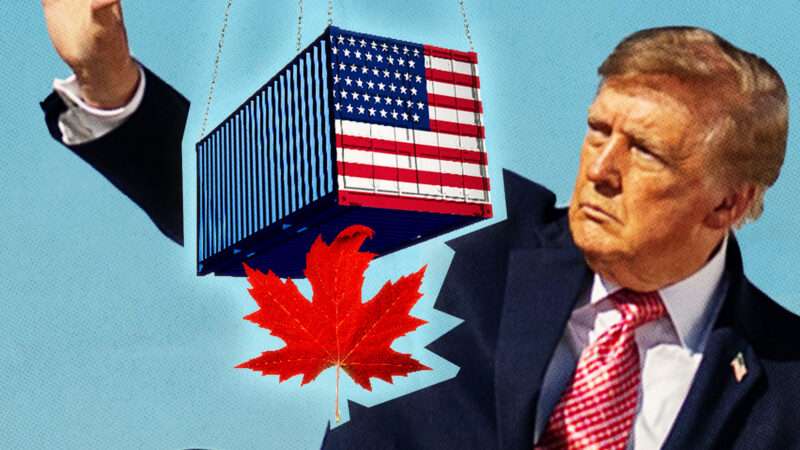
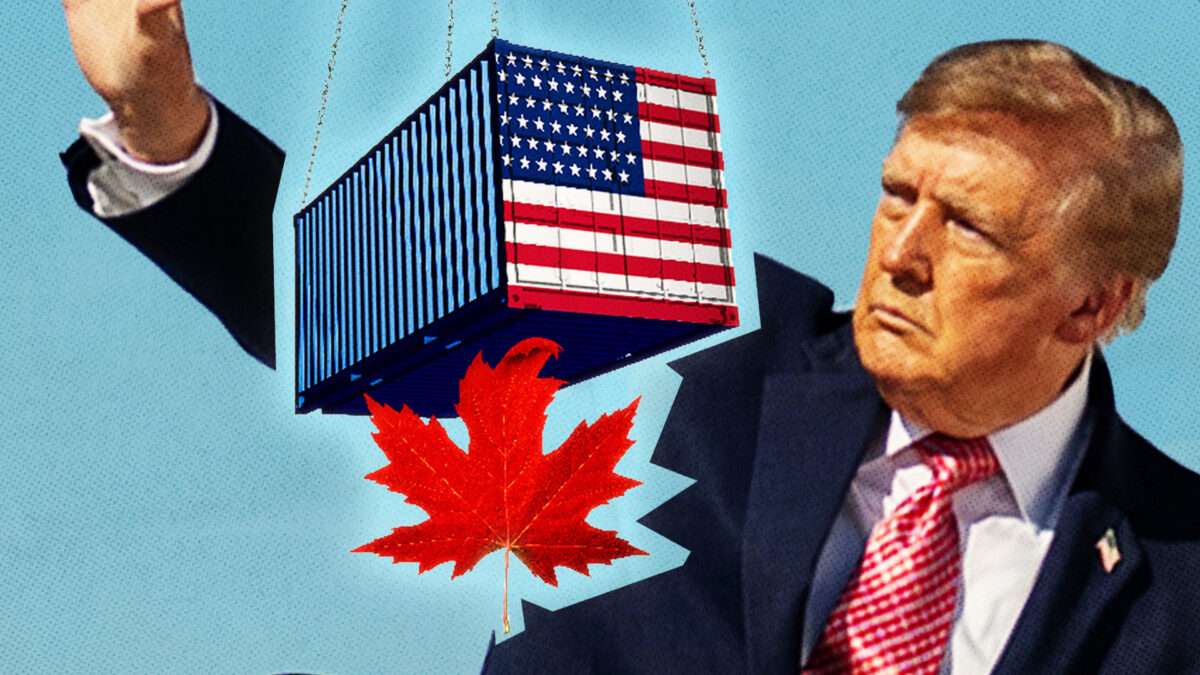
a shipping container and a maple leaf with President Donald Trump in the background | Molly Riley/B66/Avalon/Newscom/Skypixel/Dreamstime

Last July, President Donald Trump imposed 50 percent tariffs on various Canadian goods, a list he subsequently expanded to include additional imports, some of which he banned outright. His legal justification was Section 338 of the Smoot-Hawley Tariff Act, which Congress approved in 1930. Section 338 authorized tariffs in response to discriminatory trade practices. But in the 96 years since it was enacted, no president had ever used it to impose tariffs.

Why is that? According to a lawsuit that the Liberty Justice Center (LJC) filed on Tuesday in the U.S. Court of International Trade (CIT), the answer is clear: Section 338 was superseded by subsequent legislation that likewise targeted discriminatory trade barriers, beginning with the Reciprocal Trade Agreements Act of 1934 and culminating in Section 301 of the Trade Act of 1974. Section 301, the current remedy, includes requirements that Trump apparently sought to dodge by invoking Section 338 instead.

That maneuver is illegal, the LJC argues. "Congress already gave the executive branch a tool for responding to unfair foreign trade practices: Section 301, which requires an investigation, public comment and other safeguards," says Jeffrey M. Schwab, the LJC's director of litigation. "The administration cannot skip those protections by reaching for a 1930 statute that no president had ever used to impose a tariff."

Why not? "Where provisions in two acts are in irreconcilable conflict, the later act, to the extent of the conflict, constitutes an implied repeal of the earlier one," the lawsuit says. "Where a later act covers the whole subject of an earlier one and is clearly intended as a substitute, it operates similarly as a repeal. And a specific policy embodied in a later federal statute controls the construction of an earlier one even absent express amendment."

Even if Section 338 somehow survived congressional approval of contrary laws, the LJC adds, Trump's tariffs exceed the authority it grants. And if Trump's interpretation of Section 338 were correct, the lawsuit says, the provision would violate the nondelegation doctrine, which bars Congress from delegating its tariff power to the president without providing "an intelligible principle" to guide and constrain his exercise of it.

Trump's Section 338 tariffs, in short, are "the Administration's latest attempt to exercise, through a statute never designed for the purpose, the tariff power that the Constitution assigns to Congress." That pattern should be familiar by now.

Shortly after taking office in 2025, Trump claimed to have discovered a previously unnoticed delegation of extensive tariff authority in the International Emergency Economic Powers Act (IEEPA), a 1977 law that does not mention import taxes and had never been used to impose them. That claim was rejected by every court that considered it, and last February the Supreme Court ruled that IEEPA does not authorize tariffs at all.

Trump responded to that decision by immediately announcing similarly broad tariffs under Section 122 of the 1974 Trade Act, which addresses "fundamental international payments problems" caused by "serious United States balance-of-payments deficits." In May, the CIT ruled that the new tariffs were illegal because Trump had failed to "identify balance-of-payments deficits within the meaning of Section 122."

Trump then switched to Plan C, invoking Section 301 of the Trade Act, which authorizes tariffs in response to a foreign "act, policy, or practice" that is "unreasonable or discriminatory" and "burdens or restricts" U.S. commerce. He claimed that provision justified tariffs on 86 trading partners, accounting for nearly all U.S. imports, because they had failed to "impose and effectively enforce a prohibition on the importation of goods produced with forced labor." The CIT is currently weighing challenges to those tariffs, including an LJC lawsuit.

Trump's Section 338 tariffs have now added to the CIT's caseload. The LJC represents Gellert Global Group, an importer that was hit hard by those taxes after Trump added cheese to the list of disfavored Canadian goods. The lawsuit asks the CIT to certify a class of importers, numbering in "the hundreds, if not the thousands," that likewise have been clobbered by Trump's 50 percent tariffs.

Since Trump obviously is aware of Section 301, why did he resort to a never-used, seemingly obsolete provision to justify the tariffs on imports from Canada? As the LJC notes, Section 301 requires an investigation by the Office of the U.S. Trade Representative, "consultation with the foreign country concerned, notice, public comment, a hearing, and determinations within statutory deadlines." It also requires "that action be equivalent in value to the burden imposed, that duties be preferred over other import restrictions, and that actions terminate after four years absent a request for continuation and review."

Can Trump avoid those constraints by invoking Section 338 instead? The LJC thinks not: "Congress did not intend to leave in place a parallel authority that would allow the President to impose the same remedies, for the same conduct, free of every one of those safeguards."

Section 338 has been "impliedly repealed," the LJC argues. "At a minimum, Section 301 controls where, as here, the President seeks to respond to foreign practices within Section 301's scope, and the President may not impose duties in response to such practices while disregarding the procedures and limits Section 301 imposes. Because the President did not proceed under Section 301, the Section 338 Tariffs are unlawful whether or not Section 338 survives."

Even if you ignore subsequent legislation, the LJC argues, the Canadian policies that Trump cited when he announced the tariffs do not qualify as "discrimination" under Section 338. "Canada's motor vehicle surtax and its provinces' alcohol purchasing decisions are responses to tariffs that the United States imposed on Canada, not discrimination by Canada against the United States," it says. Trump also complained that Canada treats European cheese imports more favorably than U.S. cheese imports. But "when Congress enacted Section 338, a preference granted under a reciprocal agreement was not 'discrimination.'"

Section 338 "addresses discrimination: measures that single out United States commerce for worse treatment than the commerce of the world at large," the lawsuit says. "It is not a general authorization to impose tariffs whenever the President disagrees with a trading partner's policies, or whenever a trading partner responds to tariffs the United States has imposed on it."

Trump also was unfazed by Section 338's requirement that the president set duties to "offset" the costs imposed by discriminatory practices, which implies proportionality. Rather than attempt that, the LJC notes, Trump imposed "the statutory maximum rate of 50 percent without tying it to any measured burden."

As interpreted by Trump, the lawsuit warns, Section 338 authorizes the president to "impose tariffs of up to 50 percent on any products of any country that extends better treatment to any other country in any respect—including through any of the hundreds of preferential trade agreements to which the United States is not a party—or that responds to tariffs the United States has imposed on it." Yet Section 338 "contains no clear statement authorizing that power," contrary to the "major questions" doctrine, which applies to assertions of executive authority with "vast economic and political significance."

If Section 338 conferred the sort of unfettered authority that Trump is claiming, the LJC says, it "would supply no intelligible principle constraining the exercise of Congress's power to lay duties." His reading "would convert a narrow, fact-dependent provision into an effectively unrestricted delegation of Congress's tariff power," which would be "an unconstitutional delegation of legislative power."

This case "is not about the president," says LJC CEO Sara Albrecht. "It is about the presidency. No president should have the power to pull a dormant statute off the shelf and use it to impose sweeping tariffs or import bans without the limits Congress required."

The post Trump's 50% Tariffs on Canadian Goods Illegally Rely on a Superseded Statute, a Lawsuit Argues appeared first on Reason Magazine.
  •  

A Texas Lawsuit Dubiously Accuses Students for Life of Violating the State's Abortion Pill Restrictions

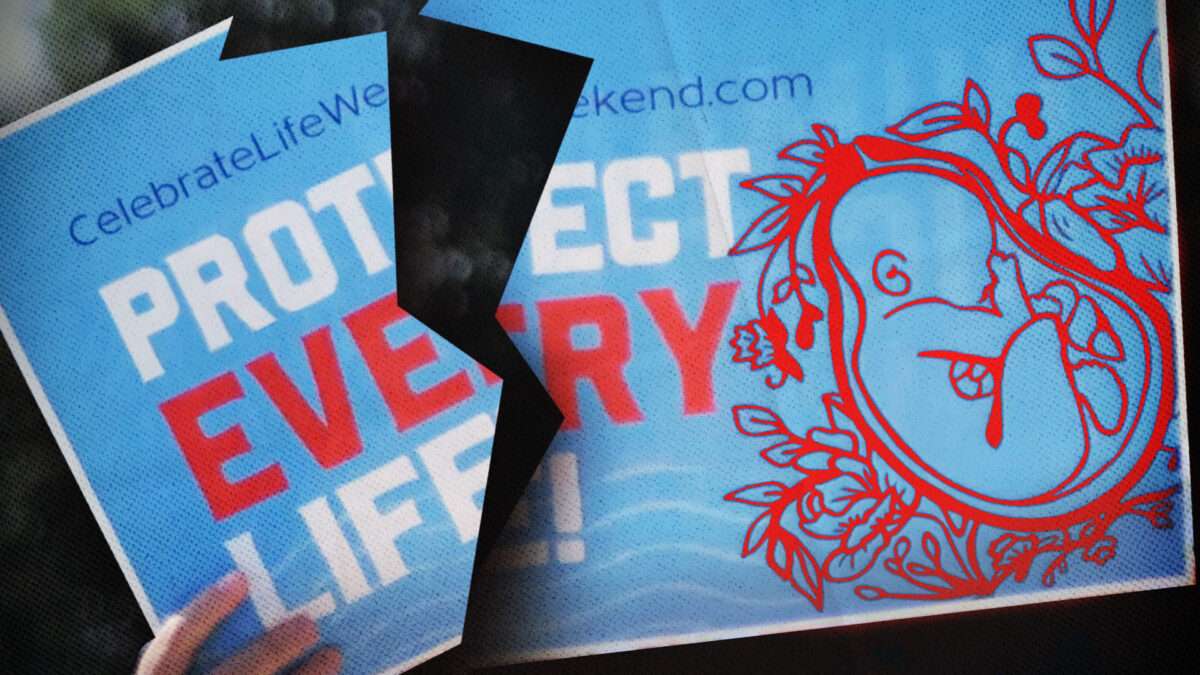
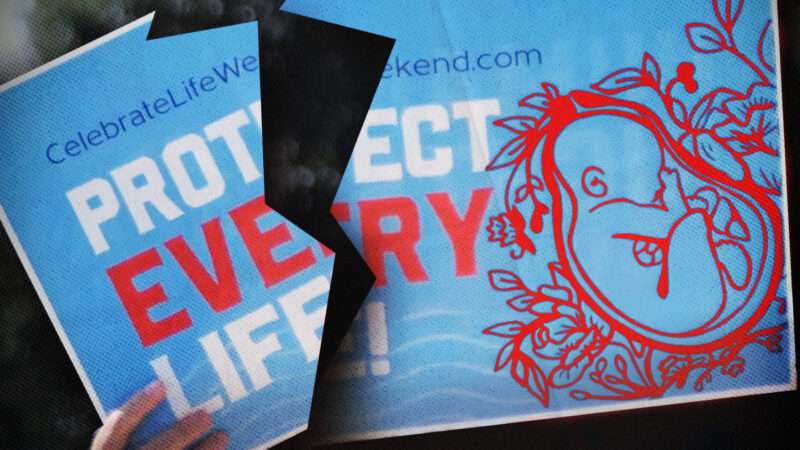
a torn anti-abortion sign | Students for Life/YouTube

Last March on Instagram, Students for Life President Kristan Hawkins posted a photo showing her and two other members of the Virginia-based group standing outside Space Center Houston. According to the captions, Hawkins and her fellow activists, one of whom was holding a mobile phone, were "ordering abortion pills undercover."

A lawsuit filed last week in Harris County, which includes Houston, describes that Instagram post as "nothing more than a publicity stunt." The lawsuit, which aims to deploy a Texas abortion law championed by Students for Life against the organization, is also a publicity stunt. But while it may be effective by that measure, it faces legal challenges that will be hard to overcome.

The lawsuit, which a Texas woman who opposes her state's abortion ban filed under the pseudonym Maria Puerto with help from the reproductive rights group Amplify Legal, is supposed to highlight the vagueness and broad scope of House Bill 7, a 2025 law that authorizes private civil action to enforce state restrictions on "abortion-inducing" drugs. But Puerto's attempted act of legal jiu-jitsu seems too clever by half, relying on a dubious reading of the statute to seek "monetary compensation" it does not authorize and thereby punish anti-abortion activists for constitutionally protected advocacy.

H.B. 7, also known as the Woman and Child Protection Act, says "a person may not manufacture or distribute an abortion-inducing drug in this state" or "mail, transport, deliver, prescribe, or provide an abortion-inducing drug in any manner to or from any person or location in this state." Those prohibitions, it says, "may be enforced only through a qui tam action" against a "person" who "violates" or "intends to violate" them.

Any "person" other than a state or local official can qualify as a "relator" authorized to bring such an action. The relator can seek injunctive relief and "an amount of not less than $100,000 for each violation," plus "costs and reasonable attorney's fees." A successful relator generally receives $10,000 of that "amount," with the rest going to a "charitable organization" of his choice.

As a "person" who is not a government official, Puerto meets H.B. 7's minimal test for standing. And although H.B. 7 precludes lawsuits against pregnant women who obtain "an abortion-inducing drug," Puerto says Hawkins and the other activists "are not pregnant and were not pregnant" at the time of the Instagram post. So far, so good. But although the lawsuit asserts that Hawkins et al. "openly and flagrantly violated" the law's prohibitions, it does not explain how.

A photo accompanying a recent Mother Jones profile of Hawkins shows her and her social media coordinator, Lydia Taylor Davis, outside Space Center Houston during their "abortion-pill 'sting' stunt." Another Mother Jones photo shows Hawkins holding a mobile phone displaying what Puerto's lawsuit describes as "an order confirmation."

Judging from the Mother Jones account, it is not clear whether that description is accurate. "The scheme rapidly went off the rails," Amy Littlefield writes. "The plan was to purchase pills from a couple of services, with Hawkins posing as a male abuser while Davis pretended to be a 16-year-old—all to try to portray mail-order suppliers as reckless and dangerous. For reasons even she couldn't explain, Hawkins chose the fake name 'Wanda' as her male-abuser alter ego. But when Davis input her information, she hit a snag."

Davis was trying to order pills from the Massachusetts Medication Abortion Access Project. But according to Littlefield, that organization "had blocked Davis in its system after Students for Life teased the sting operation on social media." Hawkins "attempted to save the stunt by placing her own order, but 'Wanda' accidentally gave her age as 15," which was below the supplier's minimum age, Littlefield says. "Now a security guard was wandering over to tell them they couldn't film. Having set out to show that telemedicine services don't screen their clients, they inadvertently proved the opposite."

Puerto "will need proof that the Students for Life leaders actually obtained or intended to obtain the pills," abortion law scholar Mary Ziegler notes in Slate. "The activists may argue that the post was not in earnest, and that no one involved ever seriously intended to bring pills into Texas."

Even assuming that Hawkins et al. successfully ordered abortion pills, that conduct by itself does not fit the language of H.B. 7, which applies to people who "distribute" such drugs or who "mail, transport, deliver, prescribe, or provide" them "to or from any person or location in this state." That language encompasses out-of-state suppliers, which raises obvious concerns about extraterritorial application of Texas law. But on its face, the prohibition does not cover someone who simply orders abortion pills.

Puerto's lawyer, Amplify Legal attorney Molly Duane, argues that Hawkins et al. could be covered by the statute's reference to transportation. "What the statute says is that transporting abortion drugs from one location to another within the state is a violation of H.B. 7," Duane told The Texas Tribune. "By the plain language of the statute, this would seem to be a violation. This is the problem with writing such a confusing and vague law."

Under that theory, however, Hawkins, Davis, and the two other activists named in the lawsuit violated H.B. 7 only if they 1) successfully ordered abortion pills, 2) took delivery of them, and 3) subsequently moved them to another location within Texas. The lawsuit alleges only that they "ordered abortion pills, apparently multiple times." According to The Texas Tribune, Duane and Puerto "are hoping that the lawsuit will eventually surface more about what the defendants did with the abortion pills once they ordered them."

The lawsuit faces another obstacle. H.B. 7 does not apply to "speech or conduct protected by the First Amendment." Hawkins et al.'s efforts to show how easily state abortion bans can be circumvented certainly seem to fall into that category. "Students for Life may stress that the case targets their political speech about abortion," which is "protected under the First Amendment," Ziegler notes.

Those are not the only puzzling aspects of the lawsuit. Puerto, a 26-year-old single mother of two young children, emphasizes that she "had no choice but to continue" those pregnancies because she did not "have access to transportation or the economic resources to pay for travel out of state." The lawsuit devotes 11 paragraphs to describing the burdens imposed by her state's denial of "true reproductive rights," which she argues justifies some sort of compensation.

All of this seems legally irrelevant under H.B. 7, which does not require a relator to allege damages of any sort, let alone damages stemming from the abortion ban it aims to reinforce. "With nowhere else to turn for assistance," the lawsuit says, "Ms. Puerto is seeking financial compensation" from Hawkins et al. "in the amount of $459,782—the average cost of raising two children from birth to age 18 in the state of Texas."

Although H.B. 7 sets a minimum award of $100,000, the lawsuit notes, "there is no cap on the monetary compensation owed a relator." But the law does not describe H.B. 7 awards as "monetary compensation" for injuries allegedly suffered by the relator.

The statute's only reference to "compensatory damages" deals with lawsuits filed against H.B. 7 relators under "clawback provisions" of other states that have tried to thwart such litigation. In response to a "clawback" action, the law says, an H.B. 7 relator can seek "compensatory damages, including money damages in an amount equal to the judgment damages and costs, expenses, and reasonable attorney's fees spent in defending the action." By contrast, the bounty for proving a violation of the restrictions on abortion pills is simply "an amount."

The lawsuit itself, emphasizing the lax standards for filing a claim under H.B. 7, notes that Puerto "did not suffer an injury traceable to [the defendants'] ordering of abortion pills that can be remedied by a court." But it suggests that an award to Puerto would be appropriate given the defendants' anti-abortion activism.

The lawsuit notes that Students for Life "proudly advertised" its support for H.B. 7. Puerto complains that Hawkins et al. "ignore the immense harms and multiple deaths already attributed to Texas's cruel abortion bans" and "demean the six million Texans of reproductive age who have had their ability to decide whether and when to begin or expand a family stripped away by these bans." Whatever you make of that charge, the defendants' activism is constitutionally protected and therefore cannot support a cause of action in civil court.

"Texas is a strange place filled with vigilante statutes" that "seek to turn Texans against each other," Duane told The Texas Tribune. "But if anyone should be benefiting from these legal regimes, it's people like our client." While "putting those two things together…might be unusual," she said, "this is the situation that Texas has put its citizens in."

Depending on your perspective, you may or may not sympathize with Duane's reasoning. But it seems unlikely to pass muster as a matter of law.

The post A Texas Lawsuit Dubiously Accuses Students for Life of Violating the State's Abortion Pill Restrictions appeared first on Reason Magazine.
  •  

The 8th Circuit Rejects Qualified Immunity for a Judge Who Jailed 2 Kids for 'Refusing To Follow Directions'

a hand holding a judge's gavel | Atit Phetmuangtong/Dreamstime

A Missouri judge who locked two children in jail cells because he was frustrated by their resistance to a parental custody decision is liable for violating their Fourth Amendment rights, a federal appeals court ruled this week. The U.S. Court of Appeals for the 8th Circuit rejected Taney County Judge Eric Eighmy's claim that he was shielded by qualified immunity, a doctrine that blocks federal civil rights claims unless they allege a violation of "clearly established" law.

"A reasonable judge should have known better," Judge David Stras writes in an opinion joined by the two other members of the 8th Circuit panel. "The law was 'clearly established' enough" to "place the issue 'beyond debate.'"

Institute for Justice attorney Dylan Moore, who wrote an 8th Circuit brief arguing against immunity for Eighmy and participated in oral arguments, welcomed the decision. "Every reasonable person knows that a judge can't throw children in jail for no good reason," he said. "Yet Judge Eighmy claimed qualified immunity shielded him from accountability anyway because no prior case told him that imprisoning innocent kids is unconstitutional. That defense is ridiculous, and we are thrilled that the court saw through it. When government officials commit such obvious constitutional violations, qualified immunity should never enter the picture."

The incident at the center of the case happened after an October 2019 custody hearing involving Kadan Rockett, then 14, and his 12-year-old sister, Brooklyn, who had achieved a modicum of fame as magicians performing on America's Got Talent. Their divorced parents, Bart Rockett and Kami Ballard, agreed that Ballard, who at that point lived in Missouri, would have primary custody of the children, while Rockett, who was living in California, would be "responsible for them at the beginning of each month and 'during TV pilot season.'" But Kadan and Brooklyn did not want to go home with their mother, which led to an argument in the lobby of the courthouse.

Eighmy intervened, telling Kadan and Brooklyn to come with him to a conference room, where he informed them that they had to leave with Ballard. "The children would not budge, even after the judge mentioned that the other option was foster care," Stras notes. "Frustrated, Judge Eighmy had the children follow him again, this time to a waiting area in the courthouse's juvenile division." A few minutes later, Eighmy "led them down a hallway to two holding cells."

Outside the cells, Eighmy again threatened Kadan and Brooklyn with foster care, but they were still unmoved. "Lock them up," the judge told an officer, who "patted them down and ordered them to remove their socks and shoes" before confining them in separate cells.

It is not clear exactly how much time Kadan and Brooklyn spent in the cells. The Institute for Justice says "about an hour," while Stras says "the time spent in the holding-cell area was between twenty and forty minutes." In any case, the children's respect for Eighmy's authority had improved by the time he came back. He "asked them one more time whether they would leave with their mother," Stras writes. "This time, they both nodded yes, so he let them go."

In June 2021, Rockett, the children's father, sued Eighmy on their behalf under 42 USC 1983, which authorizes claims against state or local officials who violate constitutional rights under color of law. In his motion to dismiss the lawsuit, Eighmy argued that he was protected by judicial immunity, which is absolute with respect to a judge's official duties. U.S. District Judge Douglas Harpool disagreed, and the 8th Circuit affirmed that ruling in 2023, noting that Kadan and Brooklyn were beyond Eighmy's contempt power because they were not parties to the custody case and that "judges do not do double duty as jailers."

Eighmy reiterated his judicial immunity claim in a motion for summary judgment, and Harpool rejected it again. After the trial began, Eighmy claimed qualified immunity twice, once after all the evidence had been submitted and again after the jury's verdict in favor of Kadan and Brooklyn. Harpool denied him that defense both times.

The jury ultimately awarded Kadan and Brooklyn $5,000 each in damages, and Harpool added about $327,000 in attorney fees. Eighmy appealed again, reiterating his judicial immunity claim. But the appeals court ruled that he had abandoned that argument by failing to raise it during the trial or after the verdict. So Eighmy was left with qualified immunity, which the appeals court said he did not deserve.

Eighmy clearly violated the Fourth Amendment's prohibition of unreasonable seizures, Stras says, because he "did not have 'probable cause to believe that [the children had] committed' an offense, much less one that justified placing them in a holding cell. Rather, their only misdeed was one every parent knows well: resisting authority. Even in the context of legal-custody proceedings, refusing to leave with a parent is not a jailable offense. Nor were there 'exigent circumstances' arising out of danger to themselves or others."

Did Eighmy's authority as a judge give him extra leeway? Nope. "Criminal contempt was off the table because the children were neither parties to the custody case nor present inside the courtroom," Stras notes. "Nor could the power to punish a party for violating an injunction have provided the justification, given that Judge Eighmy never issued one."

Eighmy's motive for jailing the children does not change that analysis. "We have no doubt that Judge Eighmy believed he was acting in 'good faith,' and possibly even in the children's best interests, by detaining them," Stras writes. "But good faith in the Fourth Amendment context is about reasonable reliance, either on binding appellate precedent or a warrant issued by a 'neutral magistrate.'"

What about Eighmy's argument that he had no way of knowing his actions were unconstitutional? "The law in this area" was "clearly established," Stras says. "'[I]t would have been sufficiently clear [to] every reasonable official,' Judge Eighmy included, that locking up two children for refusing to follow directions violated the Fourth Amendment. As we put it over a decade and a half ago, long before the events in this case, '[i]t is clearly established that a warrantless arrest, unsupported by probable cause, violates the Fourth Amendment."

That principle was so well established, in fact, that Kadan and Brooklyn, neither of whom had attended law school, took it for granted. "I don't know how you have a right to lock us up," Kadan told Eighmy when he threatened to jail them, according to Rockett's amended complaint. "We have done nothing wrong." The complaint says Brooklyn raised the same point. "How can you just lock up kids?" she asked. "This isn't legal. We've done nothing wrong."

Given Eighmy's obvious disregard for Kadan and Brooklyn's Fourth Amendment rights, "we are not concerned about the lack of a prior case" with "fundamentally similar" facts, Stras says. "Indeed, given how clear the law is, it would have been surprising to find one." He quotes an observation that Supreme Court Justice Neil Gorsuch made as a 10th Circuit judge: "Sometimes the most obviously unlawful things happen so rarely that a case on point is itself an unusual thing."

The post The 8th Circuit Rejects Qualified Immunity for a Judge Who Jailed 2 Kids for 'Refusing To Follow Directions' appeared first on Reason Magazine.
  •  

The 3rd Circuit Upholds the Gun Rights of a Man Who Committed a Nonviolent Misdemeanor 2 Decades Ago

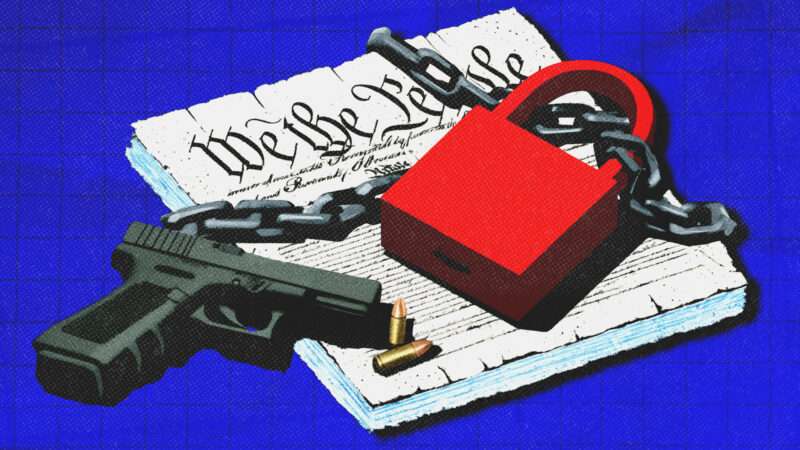
a pistol rests on a padlocked constitution | Luminis/Dreamstime/Midjourney

Thanks to a 2005 DUI conviction in Pennsylvania, Edward Williams permanently lost the constitutional right to keep and bear arms. But he did not realize that until a decade later, and his confusion on that point is understandable.

The federal law that stripped Williams of his Second Amendment rights is commonly described as applying to "felons," and Williams' offense was a misdemeanor. But although his sentence did not include any time behind bars, his crime theoretically could have sent him to prison for up to five years. That was enough to trigger 18 USC 922(g)(1), which covers anyone convicted of "a crime punishable by imprisonment for a term exceeding one year."

When a lawyer alerted Williams to that wrinkle, which made his continued ownership of firearms a federal felony, he got rid of his guns. But he did not think that requirement was fair, reasonable, or constitutional, and this week a federal appeals court agreed. The U.S. Court of Appeals for the 3rd Circuit recognized a historical tradition of disarming "physically dangerous individuals" whose possession of firearms would pose a threat to public safety. But it said Williams plainly does not fit into that category.

"The federal government spent nearly a decade trying to permanently disarm a peaceable man over a nonviolent misdemeanor—and it lost bigly," says Brandon Combs, president of the Firearms Policy Coalition, which supported Williams' lawsuit. "The government does not get to turn a nonviolent conviction into a lifetime ban on exercising a constitutionally protected right."

The 3rd Circuit's en banc decision in Williams v. Attorney General affirms a 2023 ruling by a federal judge who likewise concluded that disarming Williams was unconstitutional. It elaborates on the logic of Range v. Attorney General, a 2023 decision that restored the gun rights of a Pennsylvania man who had been convicted of food stamp fraud. In both cases, the 3rd Circuit held that applying Section 922(g)(1) to the plaintiffs was not "consistent with this Nation's historical tradition of firearm regulation"—the Second Amendment test established by the Supreme Court's 2022 decision in New York State Rifle & Pistol Association v. Bruen.

Writing for the majority in Williams' case, 3rd Circuit Judge Paul Matey acknowledges that the Supreme Court has described "longstanding prohibitions on the possession of firearms by felons" as "presumptively lawful." But "those longstanding customs restricted the violently dangerous (within which some felons would be included), not felons writ large," he says. "Felons were restricted because they posed a physical danger, rather than for their offense of conviction."

Matey argues that "focusing on physical dangerousness corrects the erroneous argument" that "only law-abiding and responsible citizens can exercise the rights protected by the Second Amendment"—a claim that the Supreme Court rejected in the 2024 case United States v. Rahimi. "We find no history that supports disarming irresponsible people, where 'responsible' is defined by the whim of the sovereign or the will of the majority," he says, alluding to the danger of allowing legislators to whittle away at the Second Amendment by criminalizing an ever-widening range of conduct.

Matey emphasizes "the novelty of forever restricting all felons from possessing firearms for lawful purposes." The original restriction, which Congress approved in 1938 as part of the Federal Firearms Act, applied only to violent crimes such as murder, manslaughter, rape, kidnapping, robbery, and assault with a deadly weapon. In 1961, Congress expanded the ban to cover nonviolent crimes punishable by more than a year in prison.

Williams' 2005 DUI conviction qualified for two reasons. He had a prior DUI conviction, stemming from a 2000 arrest in State College. And when he was arrested again in Philadelphia four years later, his blood alcohol concentration was a whopping 0.223 percent. That made his second offense a first-degree misdemeanor, which carries a maximum prison sentence of five years.

Since then, Williams has stayed out of trouble. "He has done nothing violent, let alone dangerous, for over twenty years, and has held steady employment at the same job for over three decades," Matey notes. Williams drinks only occasionally, and a psychological evaluation found he "has a normal personality, without psychopathology and without addiction or violent tendencies."

The Justice Department nevertheless argued that Williams' continuing disarmament is consistent with the Bruen test, which requires historical analogs that are "relevantly similar" in motivation and scope. In making that case, the government relied mainly on early laws aimed at "habitual drunkards"—the same analogy that the Supreme Court unanimously rejected last June in United States v. Hemani, which involved the federal ban on gun possession by "unlawful" drug users.

Although the Justice Department "acknowledges it may proscribe Williams's possession of firearms only if he 'presently poses a physical danger if armed,'" Matey says, it "offers no evidence to establish this as the aim of the habitual drunkard laws." Those laws, the Supreme Court noted in Hemani, "did not seek to protect the public from violence so much as to protect habitual drunkards from themselves and their families from financial devastation."

Nor did the habitual drunkard laws permanently disarm people, as Section 922(g)(1) does. "Most statutes capped the commitment of habitual drunkards to the state inebriate asylum, prison, or hard labor to a few months or years," Matey notes. "Others provided for an indefinite period of incarceration, but had no indication that upon release individuals continued to forfeit their arms. Rather, once someone was 'safe' to 'go at large,' they were restored to the status of a full rights-bearing citizen."

Contrary to the considerations that the Supreme Court deemed relevant in Hemani, Matey says, the Justice Department "fails to show that Williams threatens to 'misuse[] a gun while intoxicated,' or that he 'poses a danger to himself or others as a result' of
alcohol abuse. In fact, much like those nineteenth-century drunkards released from custody and restored their rights, the record shows that Williams poses no present physical danger from the use of a firearm, or anything else."

The 3rd Circuit is one of three federal appeals courts that have allowed people with nonviolent felony records to argue that Section 922(g)(1) is unconstitutional as applied to them. But such challenges have been blocked in six circuits, notwithstanding compelling historical evidence that the law reaches much farther than the Second Amendment allows. So far, the Supreme Court has declined to accept any of the many petitions asking it to resolve that circuit split.

The post The 3rd Circuit Upholds the Gun Rights of a Man Who Committed a Nonviolent Misdemeanor 2 Decades Ago appeared first on Reason Magazine.
  •  

Trump Keeps Coming Up With Legally Dubious Tariff Justifications

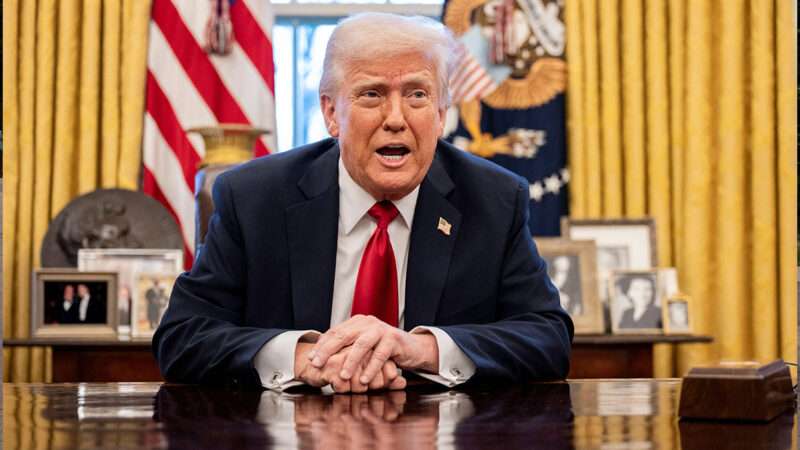
Donald Trump | Photo, middle: Geopix/Alamy

When a president starts with a predetermined policy and then goes looking for a statutory pretext to justify it, he is building on shaky ground. President Donald Trump illustrated that point once again in July, when he announced a third round of broad tariffs after his first two attempts ran into legal trouble.

Shortly after taking office in 2025, Trump claimed to have discovered a previously unnoticed delegation of extensive tariff authority in the International Emergency Economic Powers Act (IEEPA), a 1977 law that does not mention import taxes and had never been used to impose them. That claim was rejected by every court that considered it.

Last February, the Supreme Court ruled that IEEPA does not authorize tariffs at all. But Trump had a backup plan: Hours after that decision, he announced another sweeping set of tariffs, this time relying on Section 122 of the Trade Act of 1974.

That provision allows tariffs in response to "fundamental international payments problems" caused by "serious United States balance-of-payments deficits." In May, the U.S. Court of International Trade (CIT) ruled that the new tariffs were illegal because Trump had failed to "identify balance-of-payments deficits within the meaning of Section 122."

Although that decision was stayed pending appeal, Trump's Section 122 tariffs, which were subject to a 150-day statutory limit, expired on July 24. Trump then switched to Plan C, invoking Section 301 of the Trade Act, which authorizes tariffs in response to a foreign "act, policy, or practice" that is "unreasonable or discriminatory" and "burdens or restricts" U.S. commerce.

Trump's Section 301 tariffs supposedly targeted countries that had failed to "impose and effectively enforce a prohibition on the importation of goods produced with forced labor." The alleged offenders included 86 economies that accounted for nearly all U.S. imports.

In separate complaints, the Liberty Justice Center (LJC) and the law firm Akin Gump, which had played leading roles in challenging Trump's prior tariffs, immediately asked the CIT to block the new import taxes. By and large, they noted, the government had failed to explain how the targeted countries had fallen short, how their alleged failures burdened U.S. commerce, or why the new tariffs could be expected to ameliorate the problem they were supposed to address.

The LJC argued that the forced-labor issue was "simply a pretext" for reinstating Trump's "invalidated global tariff regime." It added that Trump's reading of Section 301, like his interpretation of IEEPA, would violate the "major questions" doctrine, which requires clear congressional authorization for policies of "vast economic and political significance."

This was Trump's "third attempt" to "impose essentially the same set of sweeping global tariffs," Akin Gump's lawyers wrote. "The third time's not the charm."

The post Trump Keeps Coming Up With Legally Dubious Tariff Justifications appeared first on Reason Magazine.
  •  

A Trump Appointee Says the President Likely Violated the First Amendment by Banishing Disfavored Journalists

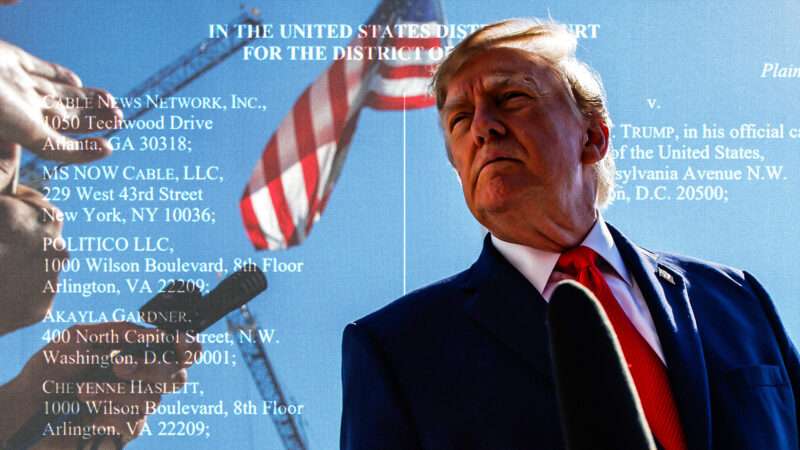
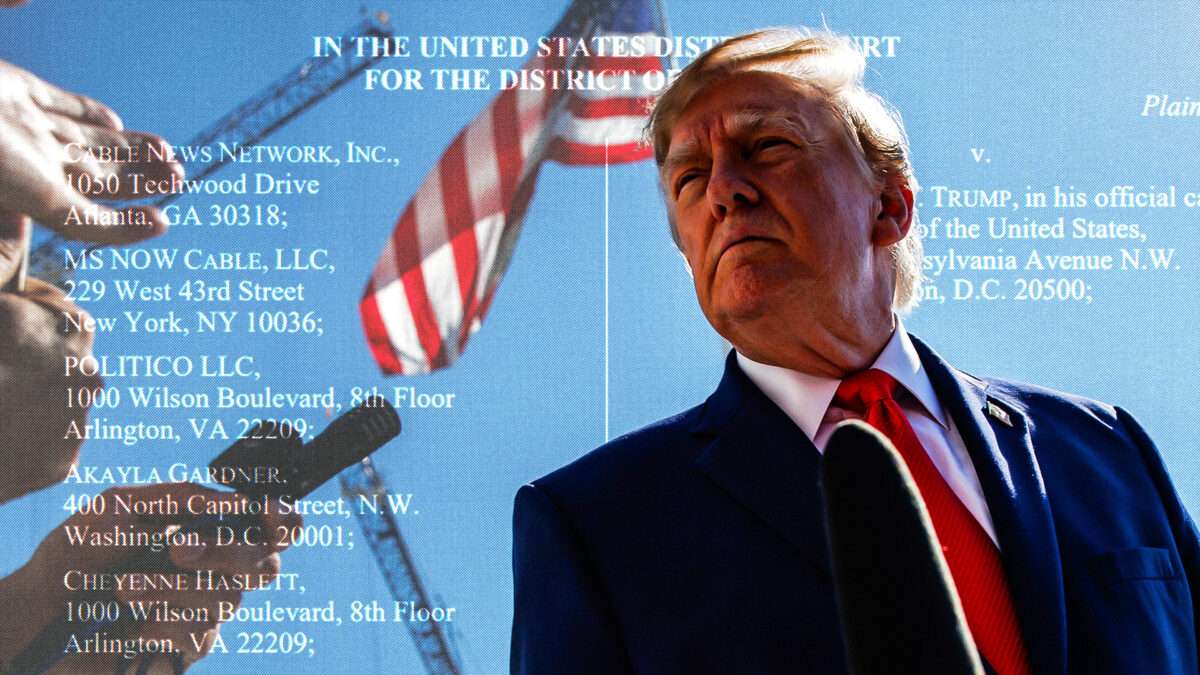
reporters aiming microphones at President Donald Trump, with a page from a federal lawsuit in the background | Illustration: Adani Samat | Photo: Samuel Corum/Pool via CNP/Polaris/Newscom

Last month, a federal judge in Washington, D.C., issued a temporary restraining order (TRO) that required restoration of press passes for 78 journalists employed by three news outlets that President Donald Trump peremptorily banned from the White House on September 18. U.S. District Judge Timothy J. Kelly, a Trump appointee, extended that order on Tuesday, granting a preliminary injunction to CNN, MS NOW, and Politico.

While Kelly's TRO was based on CNN et al.'s claim that their sudden banishment violated the Fifth Amendment's guarantee of due process, his justification for the preliminary injunction also addresses their argument that revocation of their press passes violated the First Amendment by retaliating against them for constitutionally protected speech and discriminating against them based on viewpoint. Kelly concludes that the plaintiffs "are likely to succeed not only on their due process claim, but also on their two First Amendment claims."

A retaliation claim requires showing that the plaintiff engaged in conduct protected by the First Amendment, that the defendant's action was "sufficient to deter a person of ordinary firmness" from "speaking again," and that there was "a causal link between the exercise of a constitutional right and the adverse action." Although the government's lawyers did not dispute that the CNN et al.'s journalism is constitutionally protected, they argued that the plaintiffs had failed to satisfy the two other elements.

Kelly disagrees. The "hard passes" at issue in this case, he notes, give journalists unescorted access to the White House "press area," which includes "the briefing room, the press offices, and certain other locations in and around the White House that are open to correspondents." CNN et al. argued that "a hard pass is an important credential because it 'allows a reporter to react to fast-developing news' and gives them 'swift and easy access to key official sources.'" Since "the revocation of Plaintiffs' hard passes matters a lot as to how, whether, and to what extent they can do their jobs," Kelly says, "it is likely that the open-ended ban here would chill a reporter's work."

Trump's "own comments suggest that he intended the revocation of Plaintiffs'
hard passes to alter their reporting on him, bolstering the case that his action here is sufficient to deter a reporter of ordinary firmness from reporting in the same way she had before," Kelly adds. The day he announced the ban, Trump complained that CNN et al. "purposely write negative news" to "try and diminish the Republicans and a Republican administration." Although "the ban would go as far as you can," he added, "I'd love it" if "they could straighten themselves out."

The plaintiffs also have shown "there is likely a causal link between the exercise of their First Amendment rights and the revocation of their hard passes and exclusion from the White House press area," Kelly writes. "President Trump likely banned Plaintiffs from the White House because he believes that their reporting is generally inaccurate and biased against him."

Again, Trump's public comments amply support that conclusion. He explicitly said he was banning CNN, MS NOW, and Politico "as a result of their constant 'reporting' [of] FAKE NEWS," adding that journalists "shouldn't be able to constantly write or report FICTION and LIES when they're covering the President of the United States, the Trump Administration, or the United States of America." When asked whether his decision was motivated by a "particular reason" or "particular story," Trump replied: "No, no. It's really just cumulative stories over the last two years." The problem, he said, was "purposely negative stories."

In a Truth Social post three days later, Trump likewise condemned "Fake News" that he said was "corrupt, purposeful, pervasive, fully coordinated, and totally out of control." CNN et al.'s reporters are "Third Rate Clowns" who "purposefully distort, twist, and degrade with everything they write or publish," he added that evening. "Virtually every story about me, or anything having to do with me, is negative, wrong and, in many cases, DANGEROUS for our Country! No matter how GREAT my Achievements, they trivialize and demean."

Trump offered a similar defense of the ban in a September 28 interview with Time. "It's just bad story after bad story," and "most of them are fake," he complained. "I don't think anybody should be forced to bear fake news, constantly bad stories, because I've done great things." Although "I can name 100 great things I've done," he added, "I never get good press. I never get fair press."

The government's lawyers maintained that Trump or another official "would have reached the same decision" based on the "alternative ground" that CNN et al. had violated "minimum professional journalistic standards" by "publishing classified and national security information." Kelly was not impressed by that belated rationale, which no one mentioned until after the news outlets gave the government a copy of their lawsuit.

"There is no evidence in the record that President Trump made the decision to revoke
Plaintiffs' hard passes on national security grounds," Kelly writes. "Nor at any time has he directly stated that national security was the reason for his decision. When he announced the ban with his post on September 18, he did not mention national security. When he was asked later that day about the 'particular reason' for his action, he did not mention national security."

Trump did mention "national security" in Truth Social posts he wrote the day that CNN et al. filed their lawsuit. But "that expression appears to have been simply another way for him to describe Plaintiffs' alleged inaccuracies and unfairness in their reporting about topics like his achievements or electoral success," Kelly says. "All this suggests that 'national security' was merely a post-hoc justification for the decision, which greatly undermines" the claim that Trump would have "taken the same action in the absence of Plaintiffs' protected speech."

The government also cited letters to CNN, MS NOW, and Politico from the White House Press Office, which were sent four days after Trump banned them. Those letters averred that the three news outlets had violated "the standards of professionalism and decorum expected of those given access to the White House Complex" by "publishing sensitive or classified information" and "trafficking in verifiable falsehoods about national security and other issues."

The letters "hardly move the needle" on the question of why Trump banned CNN et al. from the White House, Kelly says. They "appear to conflate concerns about otherwise protected speech" with "national security concerns," he notes, and they do not even explicitly say that Trump "made the decision for national security reasons."

Each letter lists specific stories to which the White House objected. But Kelly notes that two reporters "had their hard passes renewed after publishing articles that Defendants cite in their September 22 letters as supporting the potential revocation of their hard passes."

The Trump administration tried to shore up its "national security" justification by submitting a declaration from Pentagon Press Secretary Kingsley Wilson. While Wilson explains "how the publication of classified and sensitive information can undermine national security," Kelly notes, she "says little to nothing about President Trump's decision to revoke Plaintiffs' hard passes" and does not say "anything about White House press practices or operations."

The defendants "have not really tried to support" the claim that CNN et al.'s reporting "damaged national security," Kelly says, noting that news stories based on "sensitive or classified information" are "commonplace, for better or worse." If Trump "would have banned Plaintiffs from the White House even in the absence of their protected speech," he suggests, "Defendants would not have had to scramble to make their case with unsigned letters and a declarant who does not even work there."

The evidence of retaliation also supports the claim that Trump discriminated against CNN et al. based on viewpoint, which is presumptively unconstitutional. The U.S. Court of Appeals for the D.C. Circuit, Kelly notes, has held that "the White House Press Area" qualifies as a "nonpublic forum," meaning journalists cannot be excluded because of the views they have expressed.

"It is likely that Plaintiffs were selected by President Trump for revocation of their access to the White House press area because he believes their coverage of him and his administration is generally inaccurate and biased," Kelly writes. "In other words, it was 'an effort to suppress the speaker's activity due to disagreement with the speaker's view,' rather than to vindicate any other purportedly 'compelling governmental interest,' including maintaining professional standards for journalists or protecting national security. Simply put, that is unlawful viewpoint discrimination."

Kelly's decision "is a stinging defeat for Trump's assault on the free press and a powerful vindication of the First Amendment," Caitlin Vogus, senior adviser for advocacy at the Freedom of the Press Foundation, said in an emailed press release. "As Kelly rightly recognized, presidents don't get to use their power to purge journalists because they don't like what they report."

The post A Trump Appointee Says the President Likely Violated the First Amendment by Banishing Disfavored Journalists appeared first on Reason Magazine.
  •  

Other Courts Should Heed a Federal Judge's Warning About Flock-Enabled Mass Surveillance

robed arms flank ALPR cameras and a judge's gavel | Paul Weaver/Zuma Press/Newscom/Flas100/Oleg Dudko/Doreen Salcher/Dreamstime/Midjourney/Fatima Ruiz

Back in 1983, the Supreme Court declared that "a person traveling in an automobile on public thoroughfares has no reasonable expectation of privacy in his movements from one place to another." That increasingly doubtful proposition underpins a nationwide network of more than 144,000 AI-assisted cameras that track the travels of innocent motorists across the country billions of times each week.

So far, state and federal courts have almost uniformly rejected constitutional challenges to automated license plate readers (ALPRs) installed by companies such as Flock Safety. But in a decision that could signal a shift in the legal treatment of Flock cameras, a federal judge in Oklahoma recently recognized that they enable "a type of indiscriminate mass surveillance."

ALPRs are much more sophisticated than the technology that the Supreme Court considered in 1983, when it approved the warrantless use of a radio transmitter that helped police tail a suspected methamphetamine manufacturer's car. Three decades later, by contrast, the Court said police should have obtained a search warrant before attaching a GPS tracker to another drug suspect's car.

The majority opinion in the latter case emphasized the physical intrusion necessary to install the tracker. But five justices embraced an alternative rationale, saying GPS tracking impinges on reasonable expectations of privacy by revealing potentially sensitive information about the target's historical whereabouts.

That theory came to the fore in a 2018 case involving mobile-phone location data collected by cell sites, which the majority said implicated the Fourth Amendment because "individuals have a reasonable expectation of privacy in the whole of their physical movements." The Supreme Court reiterated that principle this year, extending it to data collected by Google's Location History feature.

"An individual has a reasonable expectation of privacy in records about his cell phone's location," Justice Elena Kagan said in the majority opinion, "and police intrude on that constitutionally protected interest when they demand the information." By similar logic, U.S. District Judge Sara E. Hill concluded this month in the Oklahoma case, people have a reasonable expectation of privacy in ALPR records, and police therefore generally need a warrant to search them.

Those databases include "information about all vehicles that pass by any network-connected camera at all times," which police can peruse "on demand," Hill noted. "Freedom from persistent, dragnet-style surveillance while in public is not a foreign concept in our society, and it is a reasonable expectation that society already accepts," as reflected in the Supreme Court's cellphone decisions.

Like cars, cellphones "move in public places where people can see you in plain view," Hill wrote. "But it becomes constitutionally problematic when law enforcement can indiscriminately and passively catalog your whereabouts over an extended period of time and then use that information for any purpose whenever convenient."

At this point, Hill's decision is an outlier. "It appears that nearly every court examining the issue to date has determined that ALPR technology use is not a search under the Fourth Amendment because people have no reasonable expectation of privacy in their movements on public streets," she noted.

Last month, for instance, a federal judge in California held that ALPR database searches are "clearly distinguishable from and less extensive than the 'near perfect surveillance' achievable" with cell-site or Location History data. And the day after Hill's ruling, a state judge in California rejected a challenge to San Jose's Flock camera network, saying "there is no reasonable expectation of privacy in license plate data collected from cameras directed solely at public streets."

A federal lawsuit involving the same city's ALPR system, which the Institute for Justice filed last April, is still pending. So are challenges to Flock cameras in cities such as Wichita, Kansas, and Norfolk, Virginia.

Even when they reject such lawsuits, courts commonly acknowledge that the legal picture could change as the number and capabilities of ALPRs multiply. If so, it seems likely that Hill will eventually be joined by other judges who recognize the perils of "indiscriminate mass surveillance."

© Copyright 2026 by Creators Syndicate Inc.

The post Other Courts Should Heed a Federal Judge's Warning About Flock-Enabled Mass Surveillance appeared first on Reason Magazine.
  •  

Trump Fired Kimberly Guilfoyle for Influence Peddling That Pales Next to His Presidential Profiteering

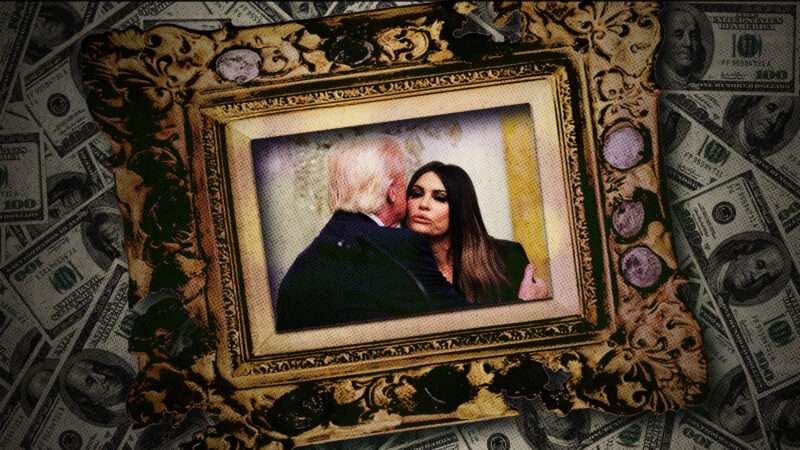
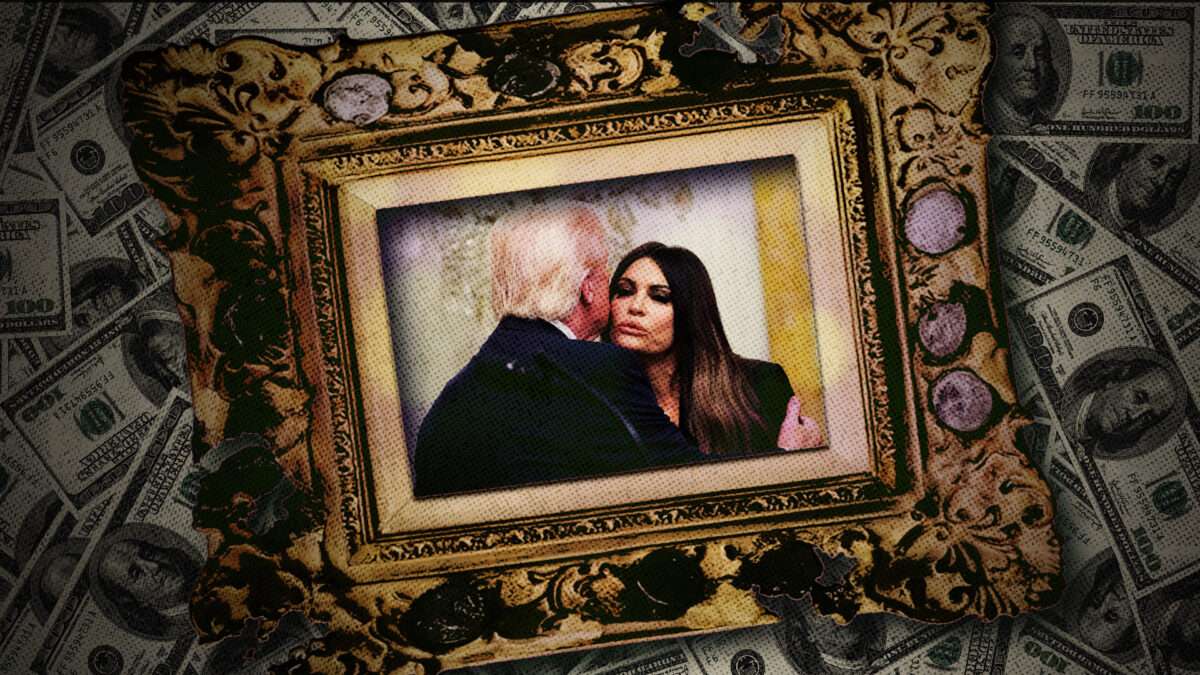
President Donald Trump embraces Kimberly Guilfoyle with a pile of cash under the picture | CNP/AdMedia/Newscom/Altinosmanaj/Gearstd/Dreamstime/Midjourney/Fatima Ruiz

Kimberly Guilfoyle today resigned from her position as the U.S. ambassador to Greece shortly after the White House confirmed that President Donald Trump had asked her to do so. The main provocation seems to have been Guilfoyle's alleged influence peddling, which reportedly featured a request that Republican donor Eric Deters pay off her $100,000 American Express bill, in exchange for which she promised him special access to "Trump world."

The president signaled his displeasure on Monday, saying "we're looking at" axing Guilfoyle, his son's former girlfriend, because "we're not happy." On Tuesday, Trump added that "we didn't like what we were reading." That reaction is not surprising, since Guilfoyle would have been horning in on Trump's territory by trying to sell access and use her office for personal gain. That's his thing.

Consider Trump's attempts to promote the memecoin that he launched three days before beginning his second term. That April, the top 220 $TRUMP holders were invited to "an intimate private dinner" with the president on May 22. The "top 25 coin holders" were promised "an Exclusive Reception before Dinner with YOUR FAVORITE PRESIDENT," plus a "Special VIP Tour" of the White House the next day. The coin's price, which after an initial surge had fallen dramatically since Inauguration Day, rose by more than 50 percent immediately after that announcement.

"Since the announcement, crypto investors around the world have raced to expand their holdings of $TRUMP," The New York Times reported 10 days before the dinner. "Certain buyers, in interviews and statements, have said they bought the coins or entered the dinner contest with the intention of securing an action by Mr. Trump to affect United States policy."

NBC reported that the coin investors who attended the dinner, which was held at the Trump National Golf Club in Sterling, Virginia, had collectively spent $394 million on $TRUMP. On average, that worked out to about $1.8 million a plate.

"This is my president that we're talking about, but I am willing to say that this gives me pause," Sen. Cynthia Lummis (R–Wyo.) said a few weeks before the dinner. "In abstract," Sen. Thom Tillis (R–N.C.) allowed, the event "is hard to understand." Sen. Lisa Murkowski (R–Alaska) drew an analogy: "I don't think it would be appropriate for me to charge people to come into the Capitol and take a tour."

Donald Sherman, executive director of Citizens for Responsibility and Ethics in Washington, was blunter. "This is one of the most blatant and appalling instances of selling access to the presidency I've ever seen," he said.

Compared to that episode, the controversy over the income that Trump's hotel in Washington, D.C., received from influence seekers during his first term might seem tame. But it raised similar ethical questions, albeit in a slightly more subtle way.

The Trump International Hotel's customers included Republican political organizations and a long list of trade groups, such as the National Mining Association, the Independent Petroleum Association of America, the National Confectioners Association, and the Vapor Technology Association, whose interests might be served by currying favor with the president. The hotel also attracted business from the governments of foreign countries, such as Kuwait, Bahrain, Saudi Arabia, Azerbaijan, Malaysia, and Romania, that likewise may have been investing in Trump's good will.

"Believe me, all the delegations will go there," a "Middle Eastern diplomat" told The Washington Post after Trump's election. "Why wouldn't I stay at his hotel blocks from the White House, so I can tell the new president, 'I love your new hotel!'" an "Asian diplomat" said. "Isn't it rude to come to his city and say, 'I am staying at your competitor'?" The Embassy of Kuwait, which had previously held its annual National Day celebration at the Four Seasons, reportedly canceled its reservation there and switched to the president-elect's hotel under pressure from the Trump Organization.

Trump saw no problem with any of this. "The law is totally on my side," he told The New York Times in November 2016. "The president can't have a conflict of interest." He reiterated that take at a press conference nine days before his inauguration. "I have a no-conflict situation because I'm president," he said.

Trump nevertheless said he would donate the profits from money spent by foreign governments at his hotels to the U.S. Treasury. But that solution did not address the money he was taking in from various domestic interest groups or his ability to enrich himself by encouraging Republican organizations or other federal officials to patronize his businesses.

One example of the latter: Vice President Mike Pence and his party stayed at Trump's golf resort in Doonbeg, Ireland, during an official trip in 2019. Although Trump insisted he "had nothing to do" with that decision, critics perceived a violation of the Domestic Emoluments Clause, which says the president may not receive additional compensation from the federal government beyond his official salary.

Trump later said he regretted his attempts to address conflicts of interest during his first term, including his promise that the Trump Organization would avoid new foreign business deals. "I prohibited [my sons] from doing business in my first term, and I got absolutely no credit for it," he told The New York Times 12 days before his second inauguration. "I didn't have to do that, and it's really unfair to them." The lesson he drew was that "nobody cared."

Consistent with that assessment, Trump has thrown all caution to the wind during his second term, capitalizing on his position to rake in millions of dollars by hawking all manner of presidentially branded merchandise, ranging from bibles to cologne; obtain a $400 million "palace in the sky" from the government of Qatar; extort $1 billion in pro bono legal work from disfavored law firms; earn billions from the same cryptocurrency industry he was simultaneously deregulating; and arrange a sweet IRS immunity deal that could save him more than $100 million in back taxes, interest, and penalties. Any worries about unseemly profiteering by Trump's family are long gone, as evidenced by federal contracts with businesses backed by his sons and highly lucrative foreign deals negotiated by his son-in-law.

Compared to all of that, the $100,000 that Guilfoyle allegedly sought in exchange for using her influence with the Trump administration to help Deters looks like pocket change. Her real sin, one suspects, was failing to offer her boss a piece of the action.

The post Trump Fired Kimberly Guilfoyle for Influence Peddling That Pales Next to His Presidential Profiteering appeared first on Reason Magazine.
  •  

TV Networks Protested Press Bans by Declining To Cover Trump. That Might Have Been Illegal, the DOJ Says.

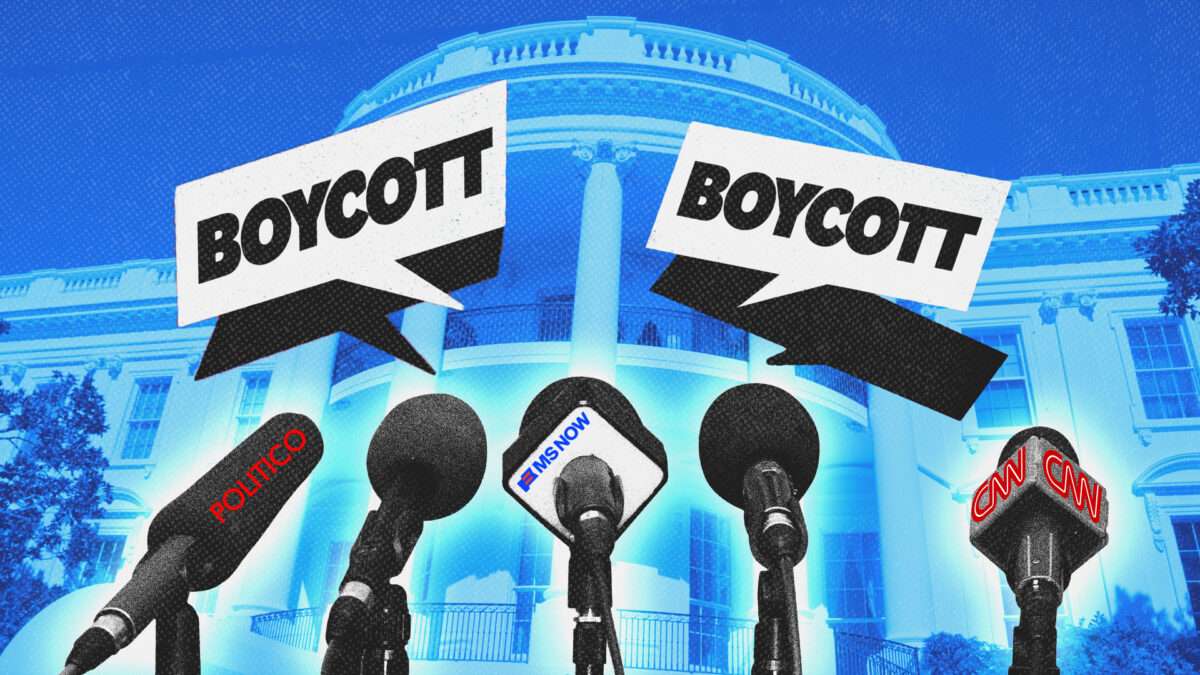
Press microphones in front of the White House | Valentin M Armianu/Picsfive/Dreamstime/CNN/MS NOW/Politico

After President Donald Trump banned CNN, MS NOW, and Politico from the White House last month, ABC, CBS, NBC, and Fox News protested by suspending their participation in the press pool that provides widely used video of presidential events. According to the Department of Justice (DOJ), which last Friday demanded network communications regarding the TV pool, that show of solidarity may have violated the Sherman Antitrust Act.

The antitrust investigation adds another layer of bullying to Trump's vendetta against "Fake News Media Outlets." The president reflexively threatens to yank broadcast licenses in response to news coverage he views as biased against him. He has repeatedly tried to punish disfavored journalists by excluding them from the White House, culminating in last month's sanctions against CNN, MS NOW, and Politico, which irked him by running "purposely negative stories." Now he is deploying the Justice Department against the TV networks that objected to his assault on freedom of the press.

Under a longstanding arrangement, ABC, CBS, NBC, CNN, and Fox News take turns covering the president in venues where press access is limited, sharing the footage with other news outlets. But after Trump excluded CNN from that role, the other networks stopped participating. They resumed their coverage on September 25, the day after a federal judge ordered the White House to restore press passes for employees of CNN, MS NOW, and Politico.

The TV pool suspension was brief, lasting just four days. But it irritated Trump, who on September 24 complained that the networks "refused to cover one of the Biggest and Most Beautiful Events to take place in many years"—i.e., "the arrival at the White House of the Highly Respected President of China, Xi Jinping, and his beautiful wife, Madam Peng." That event was "magnificent" and "made for Television," he said, but the networks "refused to be there" because "they knew how good it would be" and "didn't want credit to be given to 'TRUMP.'"

As the DOJ tells it, the lack of network coverage was not only annoying; it was also potentially illegal. "Members of the television press pool have boycotted covering White House events," Emily Covington, who directs the department's Office of Public Affairs, said on Saturday. "Group boycotts among commercial competitors can violate the Sherman Act," she added, and "the Antitrust Division is simply investigating to determine whether these news organizations have violated the antitrust laws."

Section 1 of the Sherman Act broadly prohibits any "contract," "combination," or "conspiracy" in "restraint of trade." But it applies to group boycotts only insofar as they aim to thwart competing businesses.

William E. Kovacic, who chaired the Federal Trade Commission (FTC) during the George W. Bush administration, is skeptical that the concept applies in this case. "The critical ingredient in successful antitrust cases is to demonstrate that there is unmistakably a commercial motive and that the commercial motive predominates," Kovacic told The New York Times. "And I don't think they would ever be able to do that here."

The Supreme Court's 1990 decision in FTC v. Superior Court Trial Lawyers Association illustrates the importance of a "commercial motive." The case involved attorneys in private practice who were paid to serve as court-appointed counsel for criminal defendants in the District of Columbia. The FTC concluded that they violated the Sherman Act when they agreed to stop accepting cases until their fees were increased.

Since that agreement was aimed at protecting the right to counsel by ensuring adequate funding for court-appointed attorneys, the lawyers association argued, it was protected under NAACP v. Claiborne Hardware, a 1982 decision in which the Supreme Court recognized a First Amendment right to engage in politically motivated consumer boycotts. But the Court saw an important distinction between the two cases.

"Our reasoning in Claiborne Hardware is not applicable to a boycott conducted by business competitors who 'stand to profit financially from a lessening of competition in the boycotted market,'" Justice John Paul Stevens wrote. "No matter how altruistic the motives of respondents may have been, it is undisputed that their immediate objective was to increase the price that they would be paid for their services."

In Claiborne Hardware, by contrast, the boycotters were not trying to reap a financial benefit by reducing competition. Nor were ABC et al. when they "boycotted" the White House TV pool. They were not trying to increase their profits by putting competitors at a disadvantage; they were standing up for freedom of the press.

"The investigation is nonsense," Seth Stern, chief of advocacy at the Freedom of the Press Foundation, says in an emailed press release. "Trump may view the presidency as a business venture, but news outlets' standing up for their constitutional rights has nothing to do with antitrust law….Depriving Trump of the attention he craves is not a competitive harm."

The post TV Networks Protested Press Bans by Declining To Cover Trump. That Might Have Been Illegal, the DOJ Says. appeared first on Reason Magazine.
  •  
❌