❌

Reading view

New in SCOTUSBlog: "The separation and expansion of powers between Congress and the president"

SCOTUSBlog has published the final installment in our series on recent changes in constitutional law. This essay focuses on the separation of powers. It begins:

The late 1990s and early 2000s ushered in the Rehnquist federalism revolution, which appeared to place limits on Congress' powers and expand those of the states. Then came Sept. 11, 2001, and the global war on terror, which seemed poised to expand the president's powers. Yet, by 2008, Congress' powers seemed without meaningful limits and the president's efforts to expand his own powers had failed. And the separation of powers remained, well, separate. Nevertheless, the next two decades would vastly enlarge the president's powers as Congress' authority over the executive branch would be greatly diminished.

Here is a chart that shows the shift in cases:
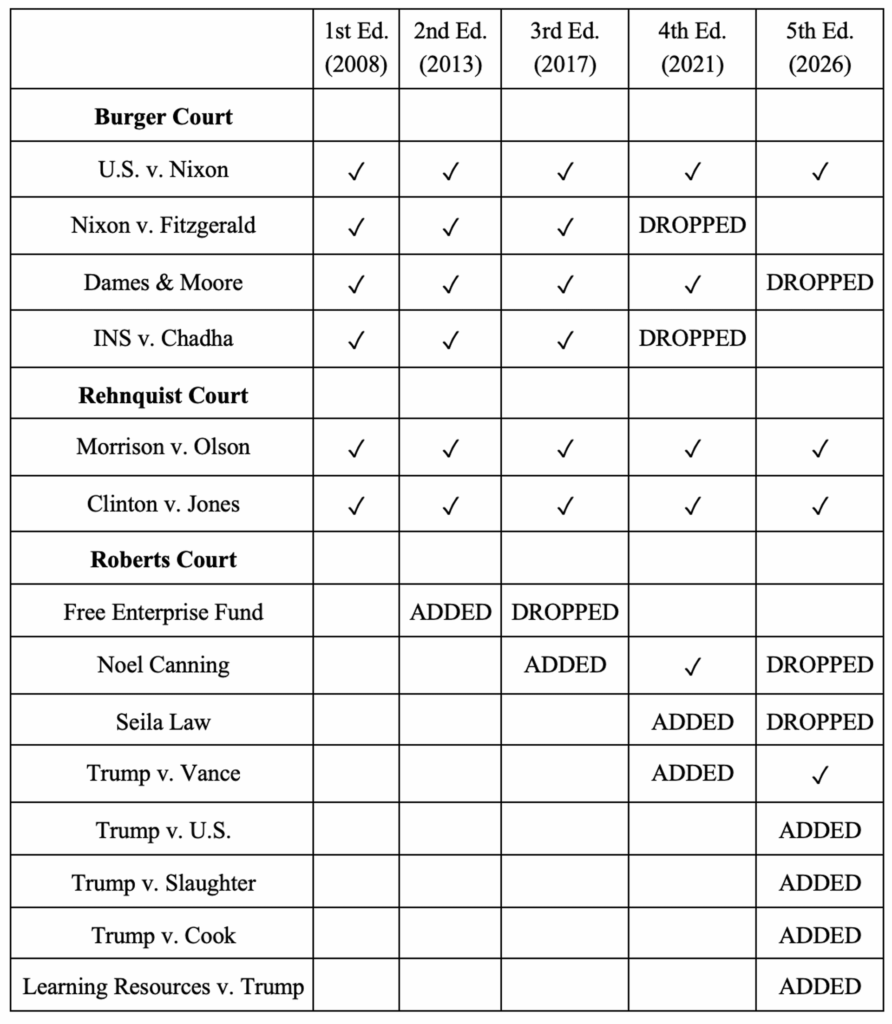
Here is our conclusion:

Up to the fourth edition of our casebook in 2022, constitutional law followed a somewhat predictable arc. To be sure, there were shifts to the left and to the right, but the doctrine could be explained by a coherent narrative: the New Deal settlement on federal power was untouchable; the court would offer only modest protections for federalism; the administrative state was beyond reproach; attempts to single out unpopular groups would be halted; "benign" racial classifications were permitted; and church and state were strictly separated. Now, each aspect of this narrative has been reconceived. The five years since that edition appeared have brought the most changes to constitutional law since the Warren court.

We began this series by observing that lawyers tend to internalize the constitutional law that existed when they attended law school. The same is true of law professors. Virtually all law professors today came of age in a time of stasis. They could safely assume that the trajectory of the Warren court would continue indefinitely. But the jurisprudence of the Burger and Rehnquist courts was primed for a reversal, just as the Warren court reversed so many precedents from before. Ultimately, the Roberts court continues to chip away at precedents from the 1970s and 1980s, even if the precedents from the 1960s and before remain.

Many of these professors have struggled to cope with sudden changes in the doctrine. Some have voiced their despair of teaching constitutional law at all. Unsurprisingly, their students also struggle to cope with these developments. This trend is regrettable. Our role as casebook editors, and constitutional law professors, is to guide students through the entire corpus of constitutional law, from the framing to the present day, without any nostalgia for, or bias against, times gone by.

This is my last planned post with SCOTUSBlog. I'm sure there will be more to come.

The post New in SCOTUSBlog: "The separation and expansion of powers between Congress and the president" appeared first on Reason Magazine.
  •  

Four Justices Recuse From Petition By Publishing Companies And Court Grants New Case on Disparate Impact

Sophisticated clients develop comprehensive strategies to get a cert petition granted. BMG Rights Management (US) LLC v. Cyril E. Vetter was one of those cases. The question presented concerned limitations on the reversion of copyrights. Paul Clement was retained to represent many of the leading media companies. The Parties to the Proceeding were:

Petitioners are BMG Rights Management (US) LLC; Capitol CMG, Inc. (Parent Company Stock Ticker: UMG); Essential Music Publishing LLC (Parent Company Stock Ticker: SONY); and Warner-Tamerlane Publishing Corp (Parent Company NASDAQ Stock Ticker: WMG).

The Plaintiffs secured top-side amicus brief from heavy-hitters including Paramount (represented by Lisa Blatt), the Motion Picture Association of America, the Recording Industry Association of America, and more. Everything was lined up for a cert grant. Alas, there would be no quorum.

Today's order includes this entry:

Because the Court lacks a quorum, 28 U. S. C. §1, and since the qualified Justices are of the opinion that the case cannot be heard and determined at the next Term of the Court, the judgment is affirmed under 28 U. S. C. §2109, which provides that under these circumstances "the court shall enter its order affirming the judgment of the court from which the case was brought for review with the same effect as upon affirmance by an equally divided court." Justice Sotomayor, Justice Gorsuch, Justice Barrett, and Justice Jackson took no part in the consideration or decision of this petition.

The lower court judgment survives, and it is hard to imagine another case with the same parties would trigger a different outcome.

What happened here? I have to imagine that these four Justices, who all have lucrative book deals, recused because of either the parties identified, or the issue presented. Curiously, Justice Alito, who is a new publisher, did not step aside.

Going forward, these and other publishing companies need to be aware that they likely do not have a quorum for a cert grant. However, they stand a good chance of having a favorable lower-court judgment affirmed by a quorum-less court.

I've often wondered whether it makes actual good business sense to give lucrative book deals to the Justices. Do they really ever earn back the advance or is it just an interest-free loan? Well, now that media companies may no longer be able to bring cases to the Supreme Court, that value proposition has become far more difficult.

We've seen how significant Justice Alito's recusal was in Suncor. I think these media recusals may prove even more important to the business community. And while Justice Alito could divest those stocks, authors with book deals cannot cure the conflict.

Also in today's order is a cert grant in the racial preferences case from Montgomery County, Maryland. But the Court re-wrote the QP. Here is the Court's version:

The petition for a writ of certiorari is granted limited to the following question: Whether a plaintiff challenging a facially neutral admissions policy as racially discriminatory must establish that the targeted racial group suffered an aggregate disparate impact relative to its share of the applicant pool.

Here is the question framed in the petition:

Whether a plaintiff alleging that a school district implemented facially-neutral admissions criteria for a racially discriminatory purpose must show that the criteria produced a disparate impact on the targeted racial group before a court may consider evidence of discriminatory intent.

The Court dropped the reference to discriminatory intent and added a focus on "aggregate disparate impact." This case could now reflect an opportunity for the Trump Administration to advance its new policy concerning disparate impact.

The post Four Justices Recuse From Petition By Publishing Companies And Court Grants New Case on Disparate Impact appeared first on Reason Magazine.

  •  

New on SCOTUSBlog: "Witnessing a reorientation of the First and Second Amendments on the Roberts court"

SCOTUSBlog has published the latest essay from me and Randy Barnett on the recent changes in constitutional law. This entry focuses on the Religion Clauses and the Second Amendment. It begins:

Twenty years ago, the Supreme Court strictly enforced the separation of church and state, deferentially reviewed restrictions on free exercise rights, and played no role in enforcing the Second Amendment. This was the state of the law when one of us began law school in the fall of 2006.

What a difference two decades has made for the First and Second Amendments.

The next installment in this series considers the changes to Congress' enumerated powers, the president's executive powers, and the separation of powers between those branches.

The post New on SCOTUSBlog: "Witnessing a reorientation of the First and Second Amendments on the Roberts court" appeared first on Reason Magazine.
  •  
❌