❌

Reading view

The drones flew 1,000 km. St. Petersburg’s oil terminal, fuel depot, and a nearby data center were waiting at the end
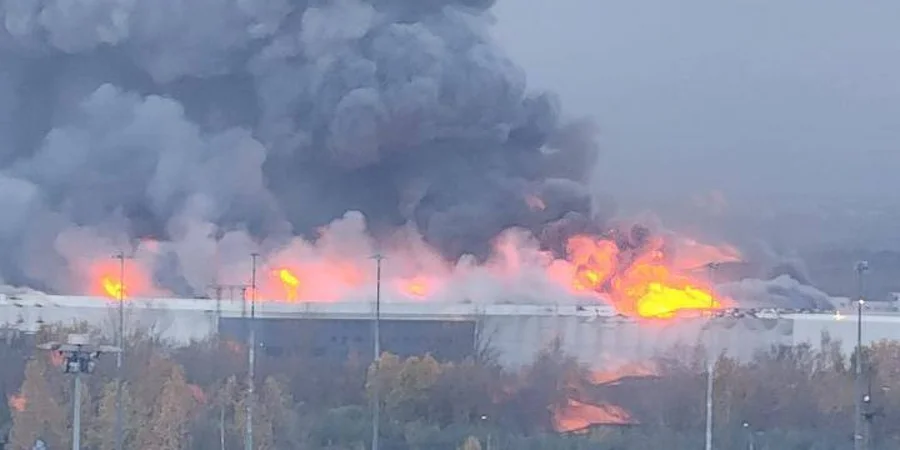
russia’s st petersburg wakes up burning oil sites hit bridge damaged data center after night ukrainian drones · post fire ozon distribution kolpinsky district drone attack 18 2026 astra ukraine

Ukrainian drones struck St. Petersburg’s oil terminal, a fuel depot, an Ozon distribution center, and a VK data center overnight, setting off fires across the city, monitoring channels reported. Russian outlet Meduza called it apparently the largest attack on the city and Leningrad Oblast since the war began. Russian officials acknowledged fires, damaged homes and substations, and power cuts.

Russia keeps fighting along the front while bombarding Ukrainian cities and the grid behind it. Ukraine’s long-range drones, in turn, target the oil exports and logistics that fund and supply that war, and Russia’s Baltic oil ports have been hit repeatedly this year. St. Petersburg is a symbolic place: Russia’s so-called second capital and Putin’s hometown.

Oil terminal and fuel depot on fire

Ukrainian forces struck the Petersburg Oil Terminal with FP-1 drones, starting a fire, Ukrainian drone maker Fire Point said. The company described the terminal as one of the region’s largest, handling 12.5 million tonnes of petroleum products a year, including for export.

Piter port and oil facility in one shot pic.twitter.com/KfptwkhsDS

— Exilenova+ (@Exilenova_plus) October 18, 2026

St. Petersburg Governor Aleksandr Beglov acknowledged fires at the terminal and in four city districts, adding that Pulkovo airport had restricted flights. By morning, firefighters were still battling blazes at the terminal, the Ruchyi oil depot, and industrial warehouses in the Kolpinsky district, he wrote. He claimed one person was killed and five injured. Ukrainian monitoring channel Exilenova+ reported that the Ruchyi depot had been burning since the night.

Ozon hub, VK data center, and a bridge

An Ozon distribution center in Kolpinsky district caught fire after the attack, the company said, Russian independent outlet Astra reported. Astra’s open-source intelligence analyst described it as one of Ozon’s busiest fulfillment centers in northwestern Russia, covering up to 79,000 m².

Ozon in St. Peterburg pic.twitter.com/tA9iwRJf7d

— Exilenova+ (@Exilenova_plus) October 18, 2026

FP-1 drones also hit a VK data center in Novosergiyevka, Leningrad Oblast, causing serious damage, Fire Point said. VK acknowledged a drone attack on the site but claimed its services were working normally. Leningrad Oblast Governor Aleksandr Drozdenko claimed air defenses downed 145 drones over the oblast alone. He acknowledged damage to the data center’s transformer equipment and warehouse complex, and minor damage to the Vostochnaya substation. Two other substations in Yanino went offline, cutting power to about 20,000 people, he said.

Damaged VK data center building in Novosergiyevka, Leningrad Oblast, after a Ukrainian FP-1 drone strike, 18 October 2026
Damaged VK data center building in Novosergiyevka, Leningrad Oblast, after a Ukrainian FP-1 drone strike, 18 October 2026. Photo: Fire Point/X

A drone also hit the cable-stayed bridge over the Korabelny fairway, part of a toll highway linking the city’s north and south, Exilenova+ reported, adding that the extent of the damage was still being clarified. The channel also reported a fire near a Russian Aerospace Forces radar company outside the village of Kaporskoye.

Smoke rising over St. Petersburg after the overnight drone attack, 18 October 2026
Smoke rising over St. Petersburg after the overnight drone attack, 18 October 2026. Photo: Astra

To reach St. Petersburg, Ukrainian drones had to cover 1,000 km across four Russian regions guarded by air defenses and electronic warfare, said Serhii Beskrestnov, adviser to Ukraine’s president on defense technology.

“And these are not cruise missiles with special systems, these are drones that fly at speeds of up to 200 km/h,” he wrote.

Satellite image marking the drone hit on the cable-stayed bridge over the Korabelny fairway in St. Petersburg, 18 October 2026
Satellite image marking the drone hit on the cable-stayed bridge over the Korabelny fairway in St. Petersburg, 18 October 2026. Image: Dnipro Osint via Exilenova+

Strikes resume after a one-sided truce

The same night, Russia hit Ukraine’s grid again, and Ukrainian President Volodymyr Zelenskyy counted 76 Russian strikes on energy since the ceasefire was announced. US President Donald Trump declared the truce on 11 October. Ukraine paused its refinery strikes for three days at Washington’s request, but Russia struck a Kharkiv power plant within hours and kept hitting the grid. Zelenskyy then said Ukraine was resuming strikes on Russian oil and would stop again only in exchange for more US interceptors for its Patriot systems. Trump called the renewed strikes “a disgrace” and said he found Zelenskyy “more difficult to deal with than Putin.”

Ukraine has hit the St. Petersburg area before. In July, drones set fire to Wildberries warehouses near the city. In August, Ukraine began striking Ozon hubs, starting in Samara Oblast. The hubs move dual-use goods such as electronics and drone components.

  •  

Academics Launch Rival Inquiry into Jason Arday’s Appointment

Academics have launched a rival inquiry into the appointment of Jason Arday, accusing the University of Cambridge of watering down its own investigation.

The post Academics Launch Rival Inquiry into Jason Arday’s Appointment appeared first on The Daily Sceptic.

  •  

EU-funded Arctic city co-operation expands with launch of new BRIDGE project

Towns and cities from around the Arctic took part in the launch of an EU-funded Arctic co-operation initiative that will enable more municipal leaders, Indigenous representatives and youth to work together.

The European Union has launched a new initiative gathering 21 towns and cities from across the Arctic to work together on shared priorities. BRIDGE, Building Resilient International Dialogue and Governance for Arctic Engagement, is led by the Arctic Mayors’ Forum (AMF), building on the foundations of the Arctic Regional and Urban Cooperation network (AURC).    

AURC
European Commission

“At a time of ever-increasing environmental and geopolitical change, cooperation among Arctic communities is more important than ever,” said Peter M. Wagner, Head of the European Commission’s Service for Foreign Policy Instruments, speaking at the EU Arctic Forum 2026 in Brussels. “We are proud to launch a new phase of EU support to Arctic cities forging connections across borders, building local capacity, and delivering tangible benefits for their residents.” 

“A safe, resilient and inclusive Arctic isn't a side interest for the EU, it's a shared project,” said Patti Bruns, AMF Secretary General. “I’m excited about our work over the next four years, bringing together communities from Alaska, Canada, Greenland, the Faroe Islands, Iceland, Norway, Sweden and Finland to strengthen cooperation between local governments who face increasing challenges – and opportunities.”

More cities co-operating in a permanent structure

BRIDGE integrates AURC’s approaches and methods into AMF’s permanent structure, extending the cooperation to more Arctic mayors and urban practitioners. 

Despite variations in size and governance structures, Arctic communities share a surprising range of challenges. Building on AURC achievements, these cities are now identifying common themes for the next four years of peer learning, exchanges, study visits, and collaborative problem-solving.

AURC
European Commission

AURC sparked positive changes in Arctic communities 

In 2024, AURC gathered 15 Arctic local authorities from Canada, Finland, Greenland, Iceland, Norway, Sweden and Alaska in the United States for the first time to work together on sustainable development. After two years of structured cooperation with expert support, positive local results were already visible. 

“Whether it was learning from Tromsø’s approach to community hubs or troubleshooting heavy equipment with our Canadian neighbours, AURC provided us with a roadmap for growth,” says Assisaun Toovak, Mayor of Utqiaġvik, the northernmost town in the United States. “We aren’t just a remote town in Alaska: we’re a key player in a global Arctic community.”

From new international welcome houses and services in Rovaniemi (Finland), Gällivare and Luleå (Sweden) and Tromsø (Norway) to plans for a new Youth Commission in Fairbanks North Star Borough (USA) inspired by peers in Sweden, Norway, Iceland and elsewhere, AURC sparked an array of positive local changes across the Arctic. These span citizen engagement and youth participation; attracting and retaining talent; sustainable tourism; culture and inclusive economic development; and resilience and emergency preparedness.

AURC
European Commission

Arctic connections supporting resilience and sustainability

Beyond these tangible changes on the ground, trusted exchanges between mayors and staff of Arctic local authorities are boosting knowledge, capacity to adapt, and new initiatives. So far, these include cross-border cultural exchanges, focused workshops for sustainable Arctic tourism professionals, and best-practice sharing on wildfire preparedness. 

Another major result is a new Interreg Aurora project TALENT NORTH, Attracting and Anchoring Global Talent in the Arctic, developed by the Arctic Six universities alliance and AMF, along with administrations and universities of several Arctic cities.

Erkki Parkkinen, Mayor of Salla, Lapland (Finland), said: “It was the best thing for Salla to join AURC: I can now exchange good practices with friends across the Arctic. It’s very important for our municipalities to stay in touch with each other, for the future of the Arctic, for resilience.”

Read more about positive changes EU-funded cooperation has sparked in Arctic towns and cities. 

BRIDGE is funded by the European Commission’s Service for Foreign Policy Instruments (FPI), working closely with the European External Action Service, the diplomatic wing of the EU, and the Directorate-General for Maritime Affairs and Fisheries (DG MARE).

Arctic Mayors’ Forum is pan-Arctic forum representing the voices of Arctic Peoples through elected leaders at the municipal and community level. They provide an open, collaborative platform for their members, including Indigenous Peoples from around the Arctic.

  •  
❌