Minneapolis Mayor Jacob Frey (D) praised Somali migrants as the "CEOs of the future" and claimed that Somalis were being criticized because people see "the kind of economy and entrepreneurship" they are trying to build.
This video report was collaboratively produced and is being co-published by Workday Magazine and The Real News Network
On the morning of June 16, 2026, 15 people were indicted by the federal government for their involvement in community organizing efforts to oppose Operation Metro Surge in Minnesota this past winter. This group of defendants have become known as the “Minnesota 15,” and over half of them are rank-and-file union members or former union members.
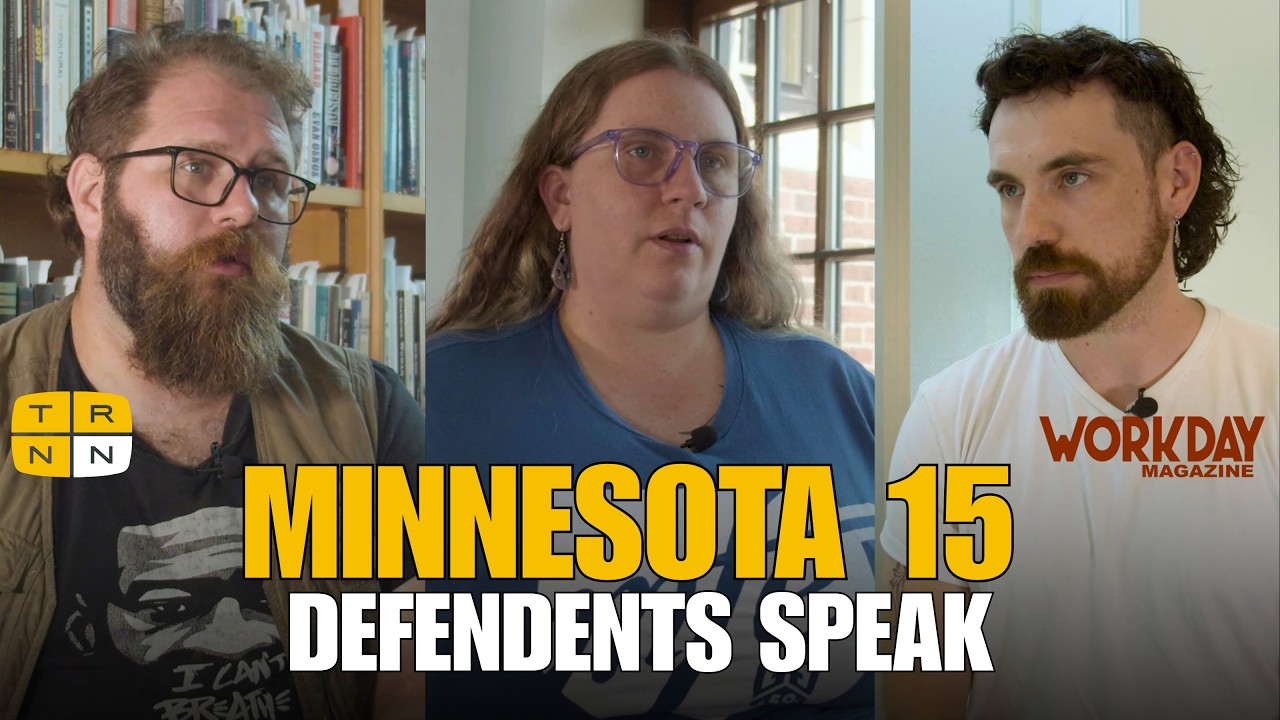
In this special report, collaboratively produced by Workday Magazine and The Real News Network, we speak with three of the “Minnesota 15” defendants about the charges against them and the Trump administration’s attacks on dissent and the labor movement today. Interviewees include: Treasure Thoreson (Minneapolis Federation of Educators, Local 59), Alec Stewart (Minnesota Association of Professional Employees), and Emmett Doyle (Northern Midwest Regional Council of Carpenters).
Credits (Workday Magazine):
Reporting and editorial support: Isabela Escalona, Sarah Lazare, Amy Livingston, and Amie Stager
Videography: Isabela Escalona and Amie Stager
Additional photos and videos: Amie Stager and Riley Bruce
Video editing: Isabela Escalona
Credits (TRNN):
Post-production: Maximillian Alvarez, Jocelyn Dombroski, David Hebden, Kayla Rivara
Special thanks to East Side Freedom Library, Minneapolis Central Library, Hosmer Library, and Minneapolis Federation of Educators.
Transcript
The following is a rushed transcript and may contain errors. It will be updated.
Treasure Thoreson:
Tuesday morning, June 16th, I had just woken up. I was in my pajamas. I hear a knock on the door at seven in the morning, and it’s a woman standing there in business clothes with a tactical vest on top that said Homeland Security.
Alec Stewart:
I was in my car backing out of my garage to go to work, coffee in hand. As soon as I backed out of my parking pad, several squads rolled up. A bunch of agents jumped out of the vehicles. I went to just text my aunt, because I have a dog. I assumed I’d be going to jail or something, and that’s when they smashed my window.
Treasure Thoreson:
I see six more agents standing in front of my house. The woman at the door, she just said, “We’re here with a warrant for your arrest for a conspiracy to harm or impede a federal officer.”.
Alec Stewart:
Exposes that while the government was targeting immigrant communities, tearing families apart, abducting children and murdering spokes in the street.
Emmett Doyle:
I had just typed in on my phone the location of the house that we were working on that day. I was boxed in by a vehicle, and so I rolled my window down to ask the guy like, “Hey, what’s the deal? You’re a pretty bad driver. What’s going on?” And then I looked around and I realized that my car had been surrounded. There was a swarm of armed federal officers with HSI on their uniforms.
Alec Stewart:
I do not think it’s a coincidence that over half of us are rank and file union folk. I think that speaks to, again, the working class nature of both the attack by the federal government and the working class predominant response to that attack.
Treasure Thoreson:
We had at least one person from every single site who was plugged into our committee and was able to get information out to their members and arm their building with the knowledge that they needed to face this kind of violence. And people stepped up in really major ways. Everybody did something, whether it was patrols or walking students to and from school, riding in a cab with a kid to and from school, making sure that their parents had rent money. There were some schools in the district that were delivering hundreds of boxes of food every week.
Emmett Doyle:
The unions that did get involved, I think understand what the labor movement is about in a way that some of our other unions have forgotten. An injury to one is an injury to all isn’t just a moral statement. It’s a hard reality of life. And the unions that stood up during Metro search understood that and demonstrated what solidarity means.
Treasure Thoreson:
We got a lot of great information from the Chicago Teachers Union who had been fighting back ice for months at the point when they came here. But we learned a lot from their struggle and were able to adapt that to fit what we were doing here in Minneapolis.
Alec Stewart:
And that was all without coercion, without money exchanging hands. That was just horizontal organizing. And I think how effective that is, how the power of mutual aid and horizontal organizing is evident because of this indictment. This wouldn’t have happened if what thousands of Minnesotans were doing hadn’t worked. I think the success of the January 23rd general strike speaks to that connection of the labor movement and just seeing the numbers and the outpouring of support for such a strike is historic.
Emmett Doyle:
I think that the general strike that happened in Minneapolis terrified the federal government. There were downtown, just hundreds of thousands of workers in the streets marching. And people have to remember this was severe sub-zero. It was a fantastic feeling of power and of joy and of resistance. And unfortunately, the next day that joy and resistance was answered tragically with the brutality of the beating and murder of Valence Preddy. But I think that the general strike was a major turning point in the regime’s logic of violence that they realized they couldn’t defeat the city.
Background music:
Stores are getting thin. There’s passing down that’s going on. Scabs anymore. We’ll put ourselves in union down this year of 34. Can’t you hear the mark? Either sign or behind. See the times get better when we hold that picket line.
Alec Stewart:
The revelation of Operation Puppet Master exposes that while the government was targeting immigrant communities, tearing families apart, abducting children and murdering our neighbors in the street, they were also attempting to disrupt and dismantle one of the facets of Minnesota that makes us so unique. And that is our strong and unified labor movement.
Isaac Sant:
This is not just an attack on me and my friends and our little group. This is an attack on our entire community. They were spying on us from day one. In fact, five days before Operation Metro Surge was declared on November 28th, they began spying on our organizations. These prosecutions were inevitable. Somebody was going to be on trial in there. If it wasn’t us, it was going to be somebody else. It was going to be one of you. We were being prosecuted for doing something that every single person that everybody and their mom in Twin Cities did to resist their federal occupation.
Emmett Doyle:
This case is meant to intimidate the entire community. It’s meant to tie up the time and efforts of many activists. But beyond that, as a conspiracy case, what they’re trying to do is set up a situation where they can expand and expand and expand the conspiracy. They’re trying to use our own solidarity and close-knit community against us through guilt by association.
Treasure Thoreson:
They want us to be separated. They want to separate out the good protestors from the bad protestor. I don’t want folks to feel afraid to stand up for their neighbor and do the right thing.
Alec Stewart:
It was such an obvious threat on what the Twin Cities is all about, which is community connections and helping each other’s neighbors. And the face of fascism, complacency, I think has no place. I think there was just a very justified feeling of standing up.
Emmett Doyle:
The support and solidarity towards us by our community has been overwhelming in just the most amazing way. I
Treasure Thoreson:
Think that they see our ability to bring people together as threatening. However, going after the 15 of us isn’t going to stop anything in Minneapolis or the Twin Cities because this is a place full of great organizers. We can’t let them bully us out of doing the right thing. We need to stand strong in our values and our morals and know that we are protecting our neighbors and that is the right thing to do. They’re afraid of us and that’s why we’re getting this response.
We speak with three union workers who are among the “Minnesota 15” defendants the Trump administration is targeting for organizing to defend their Minneapolis communities from ICE earlier this year.
This story originally appeared in Workday Magazine on Aug. 21, 2026. It is shared here with permission.
On Tuesday morning, a coalition of leaders and members from labor, community, and faith organizations in Minnesota denounced Operation Puppet Master, an alleged campaign by the Department of Homeland Security (DHS) to spy on Minnesotans during Operation Metro Surge earlier this year. In a press conference held outside of Target’s headquarters in downtown Minneapolis, the coalition urged Minnesotans to continue standing in solidarity with one another, and demanded companies headquartered in the state sign the business for democracy pledge.
The call comes after the New York Times published a report on August 13 about the campaign by DHS. Details were made public in a motion for discovery filed by Kevin Riach, an attorney for healthcare worker Isaac Sant. According to the motion, federal agents “surreptitiously recorded dozens of conversations with ordinary people who were simply exercising their First Amendment right to protest ICE’s lawless rampage in our state. The agents gathered information about Minnesotans from law enforcement databases and internet searches, and created dossiers that are apparently now available agency-wide.”
The documents describe surveillance and infiltration of union and community meetings during and before Operation Metro Surge. Eighteen organizations, including labor unions, were listed in a chart connecting them to Direct Action Minnesota (DAMN), a group of individuals who resisted what coalition members call a “terror campaign” by Immigration and Customs Enforcement (ICE) during Operation Metro Surge. Sant is one of 15 individuals who were indicted and charged by the federal government for conspiracy in what organizers have called an act of political repression and retaliation. More than half of the 15 are rank-and-file union members, and now the federal government is claiming labor organizations to be part of the alleged conspiracy. The motion continues: “With no evidence, the government alleged to the grand jury that this conspiracy in this case extends far beyond the defendants to include the AFL-CIO, the Minneapolis Federation of Educators, the Minnesota Association of Professional Employees, Monarca, Veterans for Peace, and the Grease Pit bicycle repair shop, among others.”
In addition to the AFL-CIO, Minneapolis Federation of Educators (MFE) Local 59, and Minnesota Association of Professional Employees (MAPE), SEIU Local 26 is also named by DHS along with the Workers Solidarity Circle and Black Cat Workers Collective. The motion also states that Homeland Security Investigations subpoenaed financial records for several labor unions, including SEIU locals in Minnesota and the Communication Workers of America (CWA).
Alec Stewart is a MAPE union member and one of the Minnesota 15. “The revelation of Operation Puppet Master exposes that while the government was targeting immigrant communities, tearing families apart, abducting children and murdering folks in the street, they were also attempting to disrupt and dismantle one of the facets of Minnesota that makes us so unique, and that is our strong and unified labor movement,” he said at the press conference.
Treasure Thoreson is a teacher, executive board member at MFE Local 59, and one of the Minnesota 15. Thoreson spoke at the press conference about the food drives, fundraisers, grocery deliveries, and support that educators gave to their community all while continuing to show up to schools to educate students. “The government feels so threatened by our ability to come together and use our protected First Amendment rights, our legal rights as unionists that they feel they must surveil and disrupt. However, that to me is a signal that what we are doing is effective, impactful, and powerful,” she said. According to Thoreson, a GoFundMe that she donated to was flagged by DHS as evidence that she is part of a conspiracy.
Gabriel Van de Water is a community organizer and artist who is one of the Minnesota 15. Van de Water referred to a report by Human Rights Watch detailing the human rights abuses that happened under Operation Metro Surge. “Human Rights Watch referred to the occupation as a manufactured crisis. This administration has chosen to follow up that crisis with a manufactured conspiracy,” said Van de Water. “The Minnesota 15 case and others like it must be understood as an attempt to criminalize dissent, to make an example out of some of us so that all of us hesitate to exercise our rights to protect one another. We will not allow this to happen.”
Kieran Knutson is president of CWA Local 7250, which was also named in the document. “We are more determined than ever to stand up to our repressive government. We are more determined than ever to stand in solidarity with working class people,” he said. “The Minnesota 15 are some of the finest people I know. These are our people, we have their backs. We know that this prosecution against them is a bogus attack on the entire movement.”
Emilia Gonzalez Avalos, the executive director of Unidos MN, a grassroots social justice organization, spoke about the surveillance and infiltration enacted by the federal government on community members and noted the silence of corporations like Target. “They sat in our libraries, in training rooms, and wrote down what we thought about the Constitution. They took down license plates outside a church in Roseville, and built files of the families inside, their addresses, children, and where they work. Federal agents walked into a Target store in Richfield and detained two citizens who were at work,” said Gonzalez Avalos. “To this day, Target has said nothing about it. We came here today because that silence still has answers available.”
Target has been the center of national boycott campaigns for rolling back its diversity, equity, and inclusion commitments, and now this Minnesota coalition is demanding that the corporation meet with coalition members before early voting begins on September 15. Best Buy, 3M, and Cargill were also named by the coalition as corporations that are being urged to sign the pledge.
There is also a labor-endorsed call to boycott Target during the back-to-school season. President of MFE Local 59 Marcia Howard highlighted this call by the American Federation of Teachers that was supported by the national AFL-CIO, which passed a resolution supporting the boycott at its constitutional convention held in Minneapolis in June.
“Educators spend eight billion dollars on back to school supplies,” said Howard. “Between AFT calling for a boycott and AFL-CIO extending that boycott, the only thing that this corporation needs to do is make good. Make good for Alex Pretti, for Renee Good. For all of us who have been in the streets, for our students, for each other.”
Target made $5.1 billion in profits in 2025, and its chair and former CEO Brian Cornell pulled in over $21 million.
Minnesota AFL-CIO president Bernie Burnham speaks in front of Target’s headquarters in downtown Minneapolis. The AFL-CIO was one of the organizations listed by DHS. Photo by Amie Stager.
Bernie Burnham, the president of the Minnesota AFL-CIO, which represents 1000 local unions and hundreds of thousands of workers in the state, said at the press conference that “attacks on labor are not new. Those with power always push back when they face the kind of solidarity we saw in Minnesota last winter.” Burnham continued, “Instead of holding federal agents accountable for shooting and killing Renee Good and our [American Federation of Government Employees] union brother Alex Pretti, or addressing the dangerous and deadly conditions within immigration and detention facilities, the Trump administration continues to weaponize our federal government to intimidate our unions, our communities, and anyone who peacefully opposes their radically authoritarian agenda.”
Coalition members say they remain unintimidated. “Countless Minnesotans rose to the occasion and stood strong in the face of what the Trump administration tried to do to our communities and the whole nation owes those Minnesotans a debt of gratitude,” said Phillip Cryan, the executive vice president of SEIU Healthcare Minnesota & Iowa. “We keep us safe. If they come after any of us, 15 of us, or 1500 of us, the hundreds of thousands of us who did what we needed to do this winter to protect our communities, will be there to support them.”
The U.S. government is attempting to use conspiracy charges to imprison organizers, just as it did in its war against the Black Panther Party, New Left, and other 1960s and ‘70s radicals through its counterintelligence program, COINTELPRO. Through this method, the Trump regime shares the goal of the Nixon administration of disrupting and attempting to destroy domestic opposition to its authoritarian agenda.
Two weeks after the September 2025 murder of right-wing activist Charlie Kirk, Donald Trump issued the National Security Presidential Memorandum 7 (NSPM-7), entitled “Countering Domestic Terrorism and Organized Political Violence.” The memorandum created a category of “domestic terrorist” that, while lacking legal authority, broadly includes anyone who believes in things deemed as constituting “anti-Americanism, anti-capitalism, and anti-Christianity; support for the overthrow of the United States Government; extremism on migration, race, and gender; and hostility towards those who hold traditional American views on family, religion, and morality.” NSPM-7 openly calls for “investigative” tactics designed to “disrupt” and “dismantle” political movements and organizations.
Following the recent use of conspiracy charges to successfully convict people in both the Prairieland case in Texas and the Spokane 3 case in Washington, 15 community members in the Twin Cities were indicted on June 16 for resisting the Trump administration’s December 2025 immigration crackdown dubbed “Operation Metro Surge.” According to the indictment, all defendants are identified as “members and associates of … Direct Action Minnesota (‘DAMN’),” which helped organize Minnesota’s resistance. That organization is now defunct in light of the arrests and revelations about government infiltration.
The primary charge against these 15 community members is that each of them “did knowingly conspire, with other persons known and unknown … to prevent by force, intimidation, and threats officers and employees of the United States Department of Homeland Security from discharging the duties of their officers.” Those accused of “conspiracy” are alleged to have done such routine organizing activities as moderating meetings, engaging in fundraising, posting on social media, and communicating on the secure texting app Signal. Some are also accused of participating in an anarchist speaking tour, called “Breaking the ICE: Lessons from the Resistance in Minnesota,” which followed the collapse of the government’s campaign against the people of Minnesota.
Though the mainstream media headlines touted an “Antifa conspiracy,” anarchists are mentioned more in the 94-page indictment, with references to anarchism on 17 pages. While there are many local anti-fascist groups, and exponentially more people who identify as anti-fascist, the way the government is using “Antifa” to signify a single organization is simply false. People with a wide variety of beliefs and political commitments consider themselves anti-fascist. Anarchists historically have fought fascists as far back as the 1936 Spanish Revolution, prior to World War II, as they believe in the possibility of a cooperative world that is diametrically opposite the one that fascists envision. In painting the defendants as members of antifa and as anarchists, the government is attempting to both scare the public and to marginalize and isolate the accused. The U.S. has a long history of targeting anarchists, going back to repression against immigrant anarchist labor organizers in 1880s Chicago, when four outspoken anarchists were hanged for organizing for the eight-hour workday.
Anarchists traditionally oppose all forms of hierarchy, exploitation, and domination, while both advocating and practicing democratic decision-making. Anarchists pose an intersectionally informed opposition to the contemporary cultural, political, and economic organization of society, while offering an alternative vision of a just, cooperative, and free society.
In the interview that follows, organizer Cameron Kennedy, one of the so-called “Minnesota 15” defendants, discusses his thoughts on anarchism, the role it played in organizing opposition to Operation Metro Surge, and how other communities can organize resistance.
The interview that follows has been lightly edited for clarity.
Paul Messersmith-Glavin:What does anarchism mean to you?
Cameron Kennedy: I think anarchism is deeply misunderstood by most. To me, it’s an egalitarian blueprint for resisting oppression and building a better world that democratizes every aspect of society. That democratizes our communities and workplaces and gives each of us agency and responsibility; where resources are distributed evenly and fairly and not hoarded by the billionaire class.
This wasn’t just a movement without leaders — this was a movement where everyone became a leader.
Maybe more importantly to me personally, it’s a code of conduct that guides my actions and my thinking: to always treat others with respect and grace, to always question and adapt to my surroundings, to educate and work to better myself, to engage with my neighborhood and community, to recognize oppression in all its forms and have the courage to confront it in any capacity I can, as we struggle for a just society.
What aspects of the Twin Cities’ response to Operation Metro Surge, starting late in 2025 until earlier this year, resonate most with anarchist practices and principles?
I think the resistance we saw here in the Twin Cities is deeply and directly influenced by anarchism. There is a strong anarchist and labor history in the Twin Cities that goes back more than 100 years. Anarchists have been deeply involved in movements here, especially since the 2008 Republican National Convention, and in the many uprisings against police brutality, like those around the police murders of Jamar Clark, Philando Castile, George Floyd, and too many others. I think this involvement played a role in introducing the wider population to anarchists’ organizing.
The resistance to Metro Surge was entirely decentralized, meaning there were no leaders and everything was organized on a hyperlocal scale by average working people, connected through apps like Signal and WhatsApp, giving everyone the ability to coordinate in unison at a macro scale. Mutual aid, long associated with anarchism, became a practice that every neighborhood committed to — for instance, to get food and rent money to our immigrant neighbors who were too under threat to leave their houses.
The raids and indictments woke the Twin Cities up again.
The rapid-response loops and Whipple Watch were designed to observe and report all ICE [Immigration and Customs Enforcement] activity through this decentralized network, in which nearly 100,000 people participated at the height. [Whipple Watch is a counter-surveillance project comprised of locals using their constitutional right to observe law enforcement, specifically at the Bishop Henry Whipple Federal Building, where most ICE operations are based.] This gave us the ability to respond to ICE raids in as little as three to five minutes almost anywhere in the Twin Cities. This wasn’t just a movement without leaders — this was a movement where everyone became a leader, and that’s exactly what anarchism is. That self-agency, the air-tight community communication, confrontational nature, and adaptability are why our resistance was so successful against Operation Metro Surge.
How have the indictments of the 15 of you been received by the wider community, namely the 100,000+ people that turned out in subzero temperatures to resist ICE?
My co-defendant Cal said it best: “Homeland Security really kicked the hornets’ nest with this one.” The movement against ICE had burned out post-Metro Surge, after the state of Minnesota moved toward a strategy of local law enforcement cooperating with ICE to arrest immigrants on low-level offenses, turning folks over to ICE at county jails. This allowed ICE to quietly and more effectively carry out its work without the constant flashy confrontations of Metro Surge. The raids and indictments woke the Twin Cities up again. Hundreds have rallied at our court dates and the community is mobilizing for another wave of repression. Bluntly, the raids enraged the Twin Cities back into action.
For myself, I’ve received nothing but support here. My neighbors have offered to help my partner and I any way they can, donating money and food. People recognize me on the street and thank me for the work I’m alleged to have done. It’s very clear that the government’s claim that we are “a danger to our own community” is a load of horseshit and just about anyone in the Twin Cities will tell you as much.
Do you have any advice for how organizers can best use the Signal app for secure communication? What are the best protocols for using that app to organize securely and effectively?
The number one rule is: “Always assume there is a fed in the chat and don’t say anything you don’t want read back to you in court.” I firmly believe mass-oriented organizing is crucial, but in that type of approach, it is impossible to avoid infiltration from the state. I don’t think there is any point in vetting large rapid-response groups, but I don’t think we should then throw the baby out with the bathwater and abandon mass organizing just because of that. Smaller groups doing mutual aid in the Twin Cities, who were being directly targeted by ICE for supporting their neighbors with grocery runs and rent money, restricted their chats to small groups on a need-to-know basis with trusted individuals. There is no bulletproof way to do this work though. Right now, the State Department is using rapid-response chats that nearly 100,000 people were in as evidence of “conspiracy.” Under an authoritarian state, resisting means taking necessary risks to protect our community and even very legal methods will be targeted if they are effective.
Also in rapid-response chats, it’s really important to use the SALUTE method of reporting ICE activity. SALUTE stands for size, activity, location, uniform, time, equipment. So, for example, that might look like utilizing your constitutionally protected right to observe ICE in your neighborhood and reporting to your local rapid-response group something like: “It’s 8:17 am. There are six ICE officers armed with assault rifles, less-lethal weapons, and riot gear. At 38th and Chicago, that are currently detaining one person. No one else on scene.” By giving accurate and precise information, we avoid the rumor mill and unneeded panic that further confuses and spreads fear in the community.
What lessons have you learned from the successful resistance to the ICE surge that you can pass on to other communities that may be targeted in the future?
I think this decentralized hyperlocal organizing is key, as is being confrontational and taking risks (if you can). Protests still serve a purpose, but it’s clear our politicians aren’t listening and they aren’t protecting us; in fact, they are using local police to attack our community and protect ICE despite what they may say in speeches. This is why it’s up to us to take personal responsibility to protect our communities and not show fear when we confront the state that is murdering our neighbors in the streets.
The government’s claim that we are “a danger to our own community” is a load of horseshit and just about anyone in the Twin Cities will tell you as much.
Activating every element of society — from neighborhoods, workplaces, places of worship and even hobby groups — and then combining them in an informal alliance working together to resist ICE is also essential. Combining unions, activist groups, and rapid-response networks is what lead to the first successful general strike in the U.S. in generations. Those connections built a foundation for society to resist effectively together.
Final note: I want people to study what we did in Minneapolis with a critical lens, then apply and adapt it to where you are. The Twin Cites won the battle of Metro Surge while losing more than 1,700 people to deportations and two people to state-sanctioned street executions. The larger war ICE is waging against communities across the country is still raging and intensifying, and in the last few weeks, we have seen record amounts of families being ripped apart.
I firmly believe that solidarity with each other, including groups you might normally never work with, is key: organizing at a micro level with agency, like anarchists, instead of under the control of a large organization, taking orders from leadership like our dysfunctional political system has indoctrinated us to do. And having the courage to confront the brutality of ICE in a way that effectively protects our immigrant neighbors and isn’t merely performative.
Take responsibility, take risks, take care of each other, and never rely on the very state that is ripping our communities apart and murdering our people to solve the problem that both political parties created. Together, we will march arm-in-arm through the ruins that capitalism has brought on itself into a far better world of our own making.

 Login