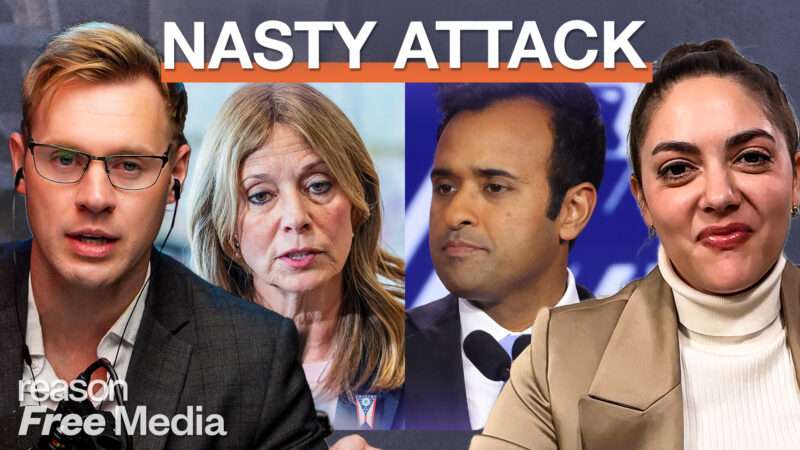
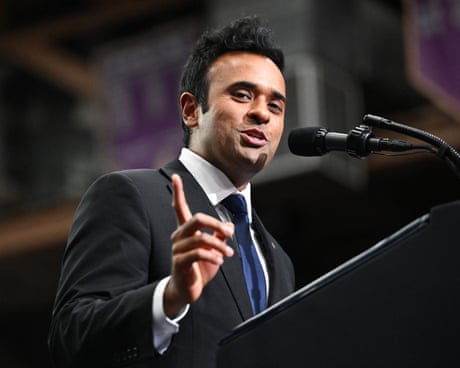
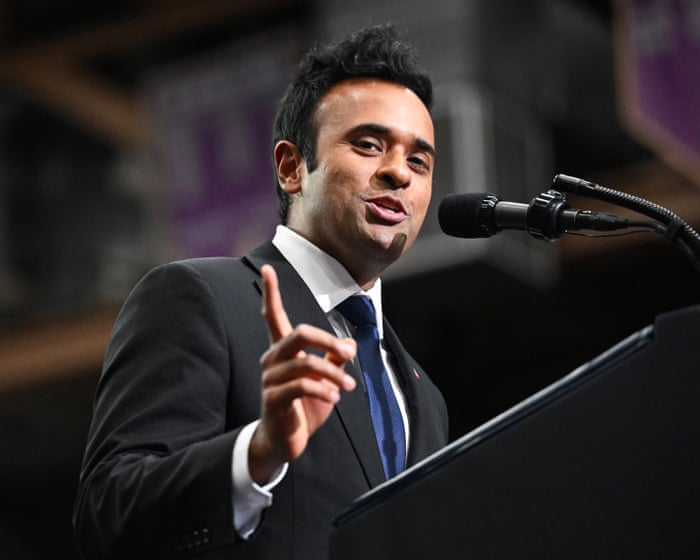
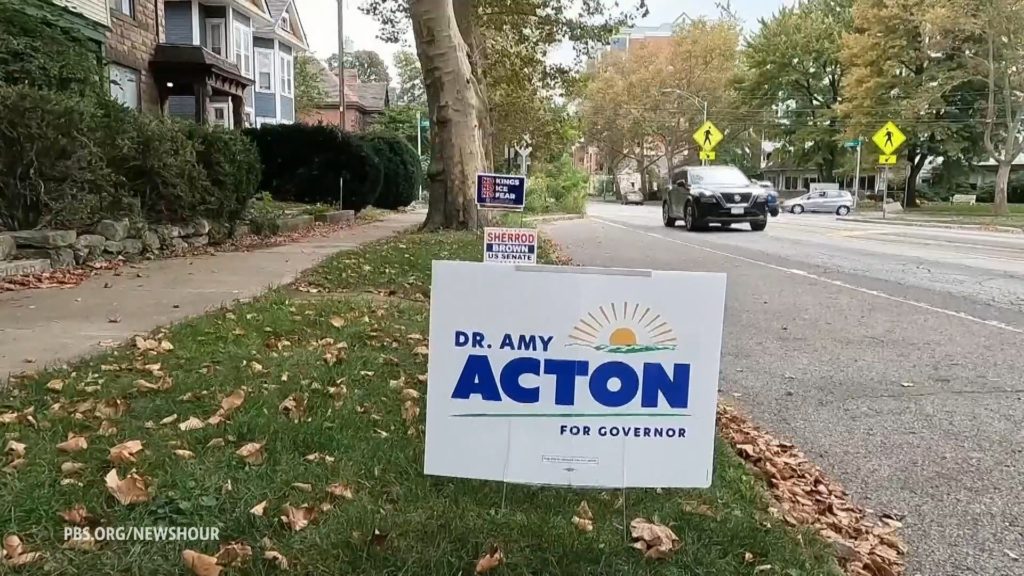
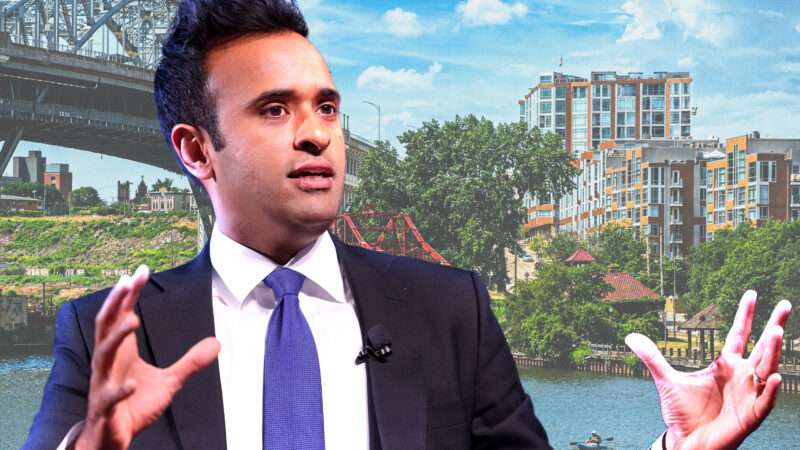
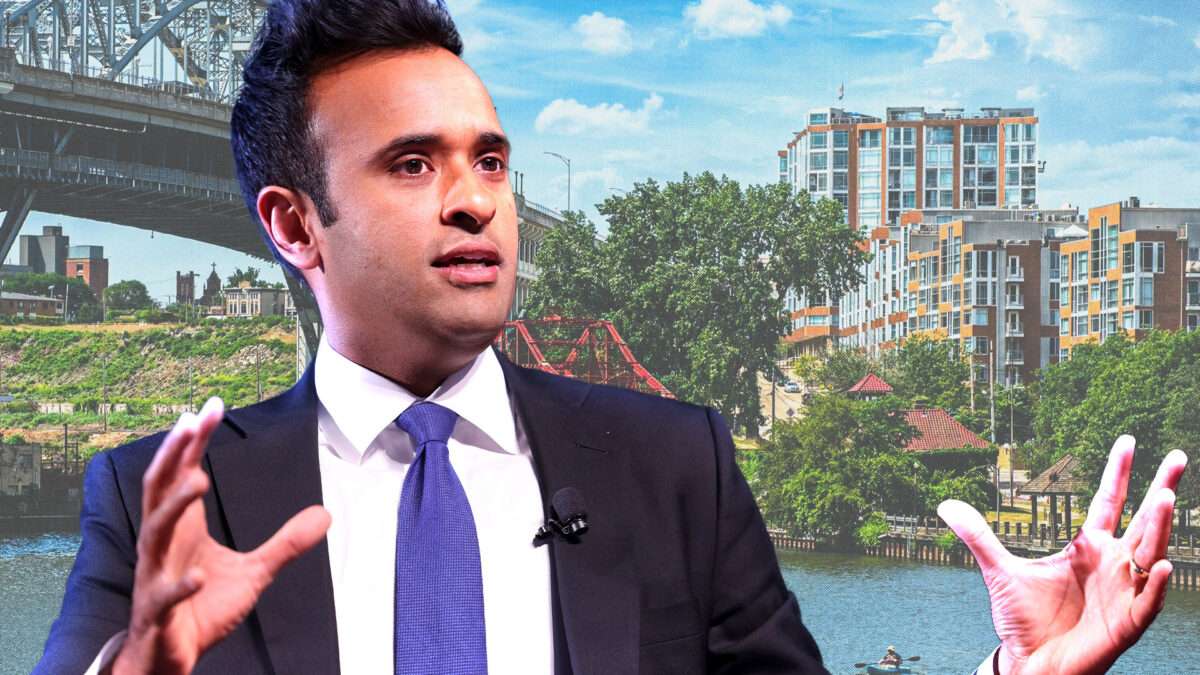
In this segment of Free Media, Reason Senior Editor Robby Soave and Daily Caller Editor in Chief Amber Duke discuss Vivek Ramaswamy's controversial attack ad against his opponent Amy Acton in Ohio's gubernatorial race.
If you enjoy Free Media, come watch Robby debate at our upcoming Reason Versus in Washington, D.C. Tickets are available here.
Ohio Sen. Jon Husted (R) pushed back on a controversial campaign ad run by Ohio gubernatorial nominee Vivek Ramaswamy (R) featuring his opponent’s mother. In a statement to The Associated Press on Wednesday, Husted said he “would not have run” the ad. The video, which initially debuted online, features the mother of Ramaswamy’s opponent, Amy…
Ohio Sen. Jon Husted (R) pushed back on a controversial campaign ad run by Ohio gubernatorial nominee Vivek Ramaswamy (R) featuring his opponent’s mother. In a statement to The Associated Press on Wednesday, Husted said he “would not have run” the ad. The video, which initially debuted online, features the mother of Ramaswamy’s opponent, Amy…
Questions about the video will likely shadow Republican Vivek Ramaswamy, a biotech billionaire who previously ran for president but has never before held public office, in the final two weeks of the contest.
In Cincinnati, the vice president said it was "not really my concern" whether the controversial 60-second spot was appropriate, and said he was focused on supporting Republican candidates in their midterm races.
Ohio gubernatorial candidate Vivek Ramaswamy (R) confirmed to reporters Tuesday evening that his campaign was behind a new attack ad featuring his Democratic opponent Amy Acton’s mother calling her a “liar” and insinuating she suffers from mental health issues. Ramaswamy acknowledged his campaign produced the ad, which began circulating on social media Monday night and…
Ohio gubernatorial candidate Vivek Ramaswamy (R) confirmed to reporters Tuesday evening that his campaign was behind a new attack ad featuring his Democratic opponent Amy Acton’s mother calling her a “liar” and insinuating she suffers from mental health issues. Ramaswamy acknowledged his campaign produced the ad, which began circulating on social media Monday night and…
Ohio Democratic Senate candidate Sherrod Brown pressed his Republican rival, Sen. Jon Husted (Ohio), to condemn a recent advertisement allegedly from Republican gubernatorial candidate Vivek Ramaswamy. “The ad released by Vivek Ramaswamy is disgusting. Everyone, including Jon Husted, should be willing to condemn this ad,” Brown said in a post on the social platform X…
Ohio Democratic Senate candidate Sherrod Brown pressed his Republican rival, Sen. Jon Husted (Ohio), to condemn a recent advertisement allegedly from Republican gubernatorial candidate Vivek Ramaswamy. “The ad released by Vivek Ramaswamy is disgusting. Everyone, including Jon Husted, should be willing to condemn this ad,” Brown said in a post on the social platform X…
Ohio gubernatorial candidate Amy Acton (D) accused Republican rival Vivek Ramaswamy of a “lifelong pattern” of personal attacks after a political ad surfaced online in which her estranged mother called her a “liar.” Acton, who has publicly discussed suffering abuse as a child, suggested Ramaswamy’s campaign was behind the video and criticized him for using…
Democrat Amy Acton ditched a campaign event with left-wing activist Randi Weingarten over the weekend, the event's host claiming Acton couldn’t be there because she “lost her voice."
Amy Acton’s brother calls campaigning on his sister’s sexual abuse from their mother’s husband ‘a despicable low’
The family of Amy Acton, the Democratic candidate for governor of Ohio, is criticizing her Republican opponent Vivek Ramaswamy for using Acton’s estranged mother in a recently released campaign ad.
In the ad, which has circulated among conservatives on social media, her mother, Donna Arthur, said: “She says she grew up living in a tent. None of that is true. She’s lied her entire life.”
Donna Arthur, the mother of Amy Acton, a Democrat running to become Ohio’s next governor, appears in a campaign ad urging voters not to vote for her own daughter.
Ohio gubernatorial candidate Amy Acton’s (D) mother called her a “liar” in a new ad, as her brother labelled the video “a despicable low” on Tuesday ahead of the state’s elections in November. “I love my daughter, but when I saw her lying about her opponent — it is not easy for a mother to…
In recent presidential elections, Ohio has become a reliably Republican state. But in this year's midterms, it's once again a battleground. The races for governor and U.S. Senate are both seen as toss-ups by The Cook Political Report, and there are a handful of competitive House districts. Liz Landers reports on how national issues are affecting Ohio voters as they prepare to head to the polls.
As the Trump administration's short-lived Department of Government Efficiency (DOGE) project implemented its plan to downsize the federal workforce, there was much wailing from the liberal institutions in Washington, D.C.
Federal employee unions filed lawsuits to block the effort. NPR ran profiles of federal workers who, for the first time, faced the prospect of potentially not having absolute job security forever. The Brookings Institution wondered how many jobs the federal government could shed before it crashes.
The answer: plenty. The Trump administration has cut more than 10 percent of the federal workforce, and the government hasn't crashed. Indeed, it hasn't even shrunk—if you're counting by dollars spent instead of people employed.
In a new article for City Journal, Manhattan Institute senior fellow Judge Glock highlights the tremendous gap between the dire predictions about DOGE's cuts and the reality that has emerged, more than a year after DOGE was shut down. Despite having only a modest impact on spending, Glock writes, DOGE "had a massive impact on the federal civil service."
This is true—to a point, more on that in a moment—and notable. Aside from a modest downsizing in the 1990s, the number of people employed by the federal government has been steadily growing for decades. Reversing that trend is one of the few genuinely libertarian accomplishments by the Trump administration.
The cuts to the federal workforce prove that "DOGE worked," argues Glock.
Well, hold on.
Elon Musk and Vivek Ramaswamy (who departed the DOGE project before Trump's inauguration and is now running for governor of Ohio) set some very ambitious goals after being appointed DOGE co-chairs in late 2024. In an op-ed for The Wall Street Journal in November 2024 where they promised "we won't just write reports or cut ribbons. We'll cut costs."
Yes, Musk and Ramaswamy also said they would reduce the federal workforce. But that was presented as a natural consequence of cutting spending, not as the primary goal.
Think about it like this. If I spent months promising my friends and family that I would lose 50 pounds on a new diet, and then didn't lose any weight, would it be fair to say the diet worked?
What if I reduced the number of donuts I eat every day, but still didn't lose any weight? Sure, that might be good for my health in some way—just like reducing unnecessary workers in the federal government is good for America's fiscal health—but it certainly wouldn't mean I had achieved the goal of losing weight.
Finally, even the claim that DOGE cut the federal workforce requires an asterisk. As Glock also notes in his report, the decline in federal workers has been offset by an increase in federal contractors.
It's not a one-for-one trade, of course. The new contractors are overwhelmingly concentrated in places like the Department of Homeland Security and the Pentagon, while the cuts mostly targeted other areas, like the Department of Health and Human Services.
"Most of that increase came from the buildup in homeland-security and defense contracting, including purchases such as surveillance aircraft and tanks, rather than substitutes for government workers," Glock writes. "DOGE achieved real contract savings, but these were more than offset by higher spending elsewhere, reflecting a shift in priorities rather than an overall reduction in contracting."
So, the government is eating fewer donuts but more pizza.
There might be libertarian reasons to prefer contractors over government employees. They are less likely to hold those jobs for life, for one. But there's nothing inherently good about a government policy that cuts jobs in some areas just to create more room in the budget for poorly trained immigration enforcement agents and defense contractors. That may even be a negative outcome for liberty.
In the end, the DOGE project looks less like a meaningful attempt at cutting government spending or employment levels and more like a way to purge parts of the federal workforce likely to get in Trump's way during his second term. "As long as [Trump's] larger commitment is to extending his power rather than rolling back power itself, you shouldn't expect the government to stop growing," as Reason's Jesse Walker wrote last year in comparing DOGE to President Richard Nixon's attempted purge of the civil service.
Did DOGE work? Only if you grade it on a pretty dramatic curve.
Yes, it proved that a president can slash bureaucratic jobs—particularly the bloated managerial and administrative types—without doing much damage to the government's core responsibilities. That's a lesson future administrations should remember.
Maybe, someday, a president will try applying the same logic to government spending too.
When Vivek Ramaswamy ran for president in 2024, he liked to describe himself as a "national libertarian" whose worldview included skepticism of new Middle Eastern wars and support for free trade (provided it wasn't with China).
In a midterm election season in which voters are increasingly angry about higher prices born of protectionist tariffs and high gas prices caused by a new Middle Eastern war, that would seemingly give Ramaswamy, now running for governor of Ohio, a straightforward story to tell about how he'd bring costs down.
Unfortunately for the Republican gubernatorial candidate, the person responsible for the tariffs and the war is President Donald Trump, whose support he's counting on to get him over the finish line in a surprisingly close race against Democrat Amy Acton.
The latest polls show Ramaswamy slightly ahead of Acton, with many voters still undecided.
Other Republican midterm candidates, most prominently Mike Rogers in Michigan, are escaping this bind by criticizing the tariffs and the war without explicitly naming the president who's responsible for both.
Ramaswamy has chosen a different tactic: Shift the conversation to other sources of voters' cost-of-living anxiety that can't be directly laid at Trump's feet.
In the last weeks of this election campaign, Ramaswamy has focused like a laser on two proposals he says will deliver cost relief to Ohio voters. The first is his proposed rollback of homeowners' property taxes. The second is a moratorium on new data center construction.
Like many Midwestern and Western states, Ohioans' property tax bills have shot up in recent years, driven by a pandemic-era spike in home values.
That's in turn sparked a full-blown property tax revolt in the state. The Republican-controlled Legislature passed a raft of property tax relief measures in 2025. Activists are also collecting signatures to place a full abolition of taxes on real property on the statewide ballot next year.
Ramaswamy hasn't endorsed full property tax abolition, but he is promising voters that he will roll back property tax assessments for homeowners to pre-pandemic levels.
On the data centers, he has staked out a very restrictionist position.
Ohio is currently one of the leading states for data center development. Pew Research counts 57 projects currently in the pipeline there, attracted by cheap land and a robust power grid.
The state's data center boom has caused a backlash in rural communities, where voters have objected to data centers' consumption of land and electricity and the special tax incentives some projects have received.
On the ballot in 10 Ohio localities this November are initiatives that would impose additional restrictions on data center development.
Ramaswamy has proposed to go further with a statewide moratoriumthat will remain in effect until the Legislature passes laws that not only require data centers to cover the full costs of the power infrastructure they need, but also provide property tax rebates and free electricity to nearby homeowners.
Local property tax cuts paired with local reductions in spending would, of course, be well in line with a small government worldview.
But the residential property tax rollback Ramaswamy has proposed doesn't directly do that.
Instead, it would reduce property tax revenues and then leave it up to localities to make up for the lost revenue somehow. That could result in spending cuts.
It could also result in localities shifting tax burdens onto commercial properties, raising non-property taxes (like sales taxes), or relying on the state government for more of their revenues.
In the former two scenarios, local tax regimes would become more hostile to growth, given that property taxes are considered one of the most "efficient" taxes. In the latter scenario, the link between people who pay taxes and the people who consume taxpayer-funded local services would become more distant.
Neither is ideal.
While some data centers in Ohio have received tax subsidies, Ramaswamy's proposed solution is to block new data centers until they're legally required to subsidize their neighbors with free electricity and other community benefits.
All of that is to say that it's a shame to see Ramaswamy adopt increasingly non-libertarian positions to avoid making critiques of Trump's cost-increasing tariffs and Iran war that would align with his erstwhile "national libertarian" worldview.
It's ironic, too, that, in trying to avoid making those critiques, Ramaswamy has wound up being more restrictionist on data centers than Trump himself.
In an August Truth Social post, the president famously urged local communities to "let Data Reign" and welcome data center development. Those that did would become "rich and successful," he predicted. Those that didn't would remain "poor and backward."
At a rally in Vandalia, Ohio, over the weekend for Ramaswamy and Republican Senate candidate John Husted, Trump reiterated his support for data centers, saying, "We want them. Look, there's so much money to be made for Ohio. You can't just turn them off. They'll go to China."
Rather than criticize the president's statist interventions, Ramaswamy is talking up his own instead. Ohio will be poorer as a result.

 Login